

Page 1
256-Position, One-Time Programmable,
A
Dual-Channel, I2C Digital Potentiometers
FEATURES
2-channel, 256-position potentiometers
One-time programmable (OTP) set-and-forget resistance
setting provides a low cost alternative to EEMEM
Unlimited adjustments prior to OTP activation
OTP overwrite allows dynamic adjustments with user-
defined preset
End-to-end resistance: 2.5 kΩ, 10 kΩ, 50 kΩ, and 100 kΩ
Compact 10-lead MSOP: 3 mm × 4.9 mm
Fast settling time: t
Full read/write of wiper register
Power-on preset to midscale
Extra package address decode pins: AD0 and AD1 (AD5173)
Single supply: 2.7 V to 5.5 V
Low temperature coefficient: 35 ppm/°C
Low power: I
Wide operating temperature: −40°C to +125°C
APPLICATIONS
Systems calibration
Electronics level setting
Mechanical trimmers replacement in new designs
Permanent factory PCB setting
Transducer adjustment of pressure, temperature, position,
chemical, and optical sensors
RF amplifier biasing
Automotive electronics adjustment
Gain control and offset adjustment
= 5 μs typical on power-up
S
= 6 μA maximum
DD
AD5172/AD5173
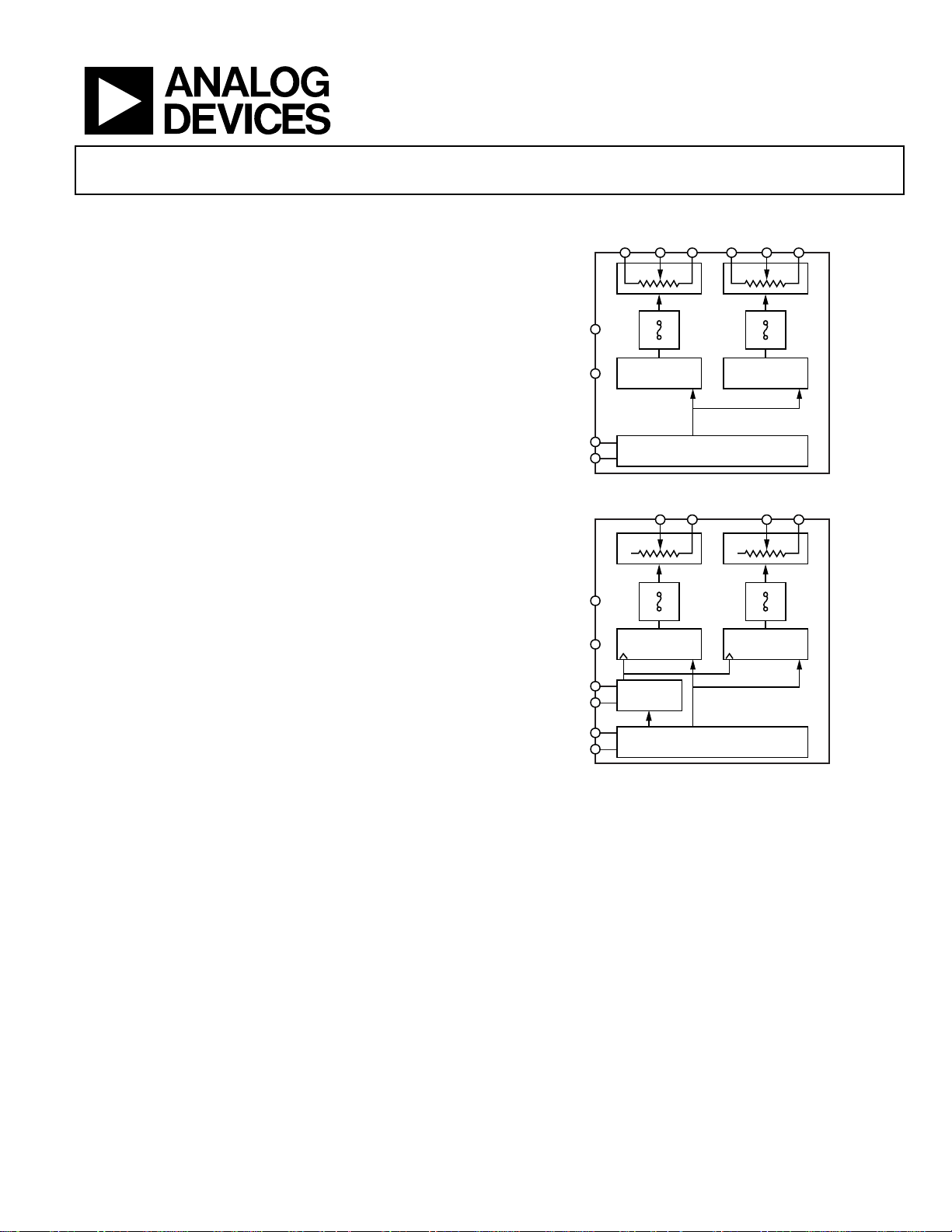
FUNCTIONAL BLOCK DIAGRAMS
W1
RDAC
SERIAL INPUT
W1
RDAC
SERIAL INPUT
B1 A2 W2
FUSE
LINKS
RDAC
REGISTER 2
/
8
REGISTER
B1 W2
FUSE
LINKS
RDAC
REGISTER 2
/
8
REGISTER
1
V
GND
SDA
SCL
V
GND
AD0
AD1
SDA
SCL
DD
DD
12
REGISTER 1
Figure 1. AD5172 Functional Block Diagram
12
REGISTER 1
ADDRESS
DECODE
Figure 2. AD5173 Functional Block Diagram
B2
4103-001
B2
04103-002
GENERAL DESCRIPTION
The AD5172/AD5173 are dual-channel, 256-position, one-time
programmable (OTP) digital potentiometers
1
that employ fuse
link technology to achieve memory retention of resistance
settings. OTP is a cost-effective alternative to EEMEM for users
who do not need to program the digital potentiometer setting
in memory more than once. These devices perform the same
electronic adjustment function as mechanical potentiometers or
variable resistors but with enhanced resolution, solid-state reliability, and superior low temperature coefficient performance.
The AD5172/AD5173 are programmed using a 2-wire, I
2
C®-
compatible digital interface. Unlimited adjustments are allowed
1
The terms digital potentiometer, VR, and RDAC are used interchangeably.
Rev. H
Information furnished by Analog Devices is believed to be accurate and reliable. However, no
responsibility is assumed by Analog Devices for its use, nor for any infringements of patents or other
rights of third parties that may result from its use. Specifications subject to change without notice. No
license is granted by implication or otherwise under any patent or patent rights of Analog Devices.
Trademarks and registered trademarks are the property of their respective owners.
before permanently setting the resistance value. During OTP
activation, a permanent blow fuse command freezes the wiper
position (analogous to placing epoxy on a mechanical trimmer).
Unlike traditional OTP digital potentiometers, the AD5172/
AD5173 have a unique temporary OTP overwrite feature that
allows for new adjustments even after a fuse is blown. However,
the OTP setting is restored during subsequent power-up conditions. This allows users to treat these digital potentiometers as
volatile potentiometers with a programmable preset.
One Technology Way, P.O. Box 9106, Norwood, MA 02062-9106, U.S.A.
Tel: 781.329.4700 www.analog.com
Fax: 781.461.3113 ©2003–2009 Analog Devices, Inc. All rights reserved.
Page 2

AD5172/AD5173
TABLE OF CONTENTS
Features .............................................................................................. 1
Applications ....................................................................................... 1
Functional Block Diagrams ............................................................. 1
General Description ......................................................................... 1
Revision History ............................................................................... 2
Specifications ..................................................................................... 3
Electrical Characteristics: 2.5 kΩ ............................................... 3
Electrical Characteristics: 10 kΩ, 50 kΩ, and 100 kΩ ............. 4
Timing Characteristics ................................................................ 6
Absolute Maximum Ratings ............................................................ 7
ESD Caution .................................................................................. 7
Pin Configurations and Function Descriptions ........................... 8
Typical Performance Characteristics ............................................. 9
Test Circuits ..................................................................................... 14
Theory of Operation ...................................................................... 15
One-Time Programming (OTP) .............................................. 15
REVISION HISTORY
4/09—Rev. G to Rev. H
Changes to DC Characteristics—Rheostat Mode Parameter and
to DC Characteristics—Potentiometer Divider Mode Parameter,
Table 1 ................................................................................................ 3
12/08—Rev. F to Rev. G
Changes to OTP Supply Voltage Parameter, Table 1.................... 3
Changes to OTP Supply Voltage Parameter, Table 2.................... 5
Changes to Table 5 and Table 6 ....................................................... 8
Changes to One-Time Programming (OTP) Section ................ 15
Changes to Power Supply Considerations Section, Figure 46,
and Figure 46 Caption .................................................................... 17
Changes to Ordering Guide .......................................................... 23
7/08—Rev. E to Rev. F
Changes to Power Supplies Parameter in Table 1 and Table 2 ... 3
Updated Fuse Blow Condition to 400 ms Throughout ............... 5
1/08—Rev. D to Rev. E
Changes to Features .......................................................................... 1
Changes to General Description .................................................... 1
Changes to OTP Supply Voltage and OTP Supply Current in
Table 1 ................................................................................................ 3
Changes to OTP Supply Voltage and OTP Supply Current in
Table 2 ................................................................................................ 5
Added OTP Program Time in Table 3 ........................................... 6
Changes to Table 4 ............................................................................ 7
Changes to Table 5 and Table 6 ....................................................... 8
Inserted Figure 30 ........................................................................... 13
Replaced One-Time Programming (OTP) Section ................... 15
Replaced Power Supply Considerations Section ........................ 17
Deleted Device Programming Software Section ........................ 20
Programming the Variable Resistor and Voltage ................... 15
Programming the Potentiometer Divider ............................... 16
ESD Protection ........................................................................... 17
Terminal Voltage Operating Range ......................................... 17
Power-Up Sequence ................................................................... 17
Power Supply Considerations ................................................... 17
Layout Considerations ............................................................... 18
I2C Interface .................................................................................... 19
Write Mode ................................................................................. 19
Read Mode .................................................................................. 19
I2C Controller Programming .................................................... 20
I2C-Compatible, 2-Wire Serial Bus .......................................... 21
Level Shifting for Different Voltage Operation ...................... 22
Outline Dimensions ....................................................................... 23
Ordering Guide .......................................................................... 23
Replaced I
2
C-Compatible, 2-Wire Serial Bus Section ............... 21
Changes to Ordering Guide .......................................................... 23
6/06—Rev. C to Rev. D
Changes to Features .......................................................................... 1
Changes to One-Time Programming (OTP) Section................ 15
Changes to Figure 44 and Figure 45............................................. 17
Changes to Power Supply Considerations Section .................... 18
Changes to Figure 46 and Figure 47............................................. 18
Changes to Device Programming Software Section .................. 19
Updated Outline Dimensions ....................................................... 24
6/05—Rev. B to Rev. C
Added Footnote 8, Footnote 9, and Footnote 10 to Table 1 ........ 3
Added Footnote 8 to Table 2 ............................................................ 5
Changes to Table 5 and Table 6 ....................................................... 9
Changes to Power Supply Considerations Section .................... 17
Changes to I
2
C-Compatible 2-Wire Serial Bus Section ............ 23
Added Level Shifting for Different Voltage Operation Section ...... 24
Updated Outline Dimensions ....................................................... 25
Changes to Ordering Guide .......................................................... 25
10/04—Rev. A to Rev. B
Updated Format ................................................................. Universal
Changes to Specifications ................................................................. 3
Changes to One-Time Programming (OTP) Section................ 13
Changes to Power Supply Considerations Section .................... 15
Changes to Figure 44 and Figure 45............................................. 15
Changes to Figure 46 and Figure 47............................................. 16
11/03—Rev. 0 to Rev. A
Changes to Electrical Characteristics—2.5 kΩ .............................. 3
11/03—Revision 0: Initial Version
Rev. H | Page 2 of 24
Page 3

AD5172/AD5173
SPECIFICATIONS
ELECTRICAL CHARACTERISTICS: 2.5 kΩ
VDD = 5 V ± 10%, or 3 V ± 10%; VA = VDD; VB = 0 V; −40°C < TA < +125°C; unless otherwise noted.
Table 1.
Parameter Symbol Conditions Min Typ1Max Unit
DC CHARACTERISTICS—RHEOSTAT MODE
Resistor Differential Nonlinearity
Resistor Integral Nonlinearity
Nominal Resistor Tolerance
Resistance Temperature Coefficient (∆RAB/RAB)/∆T 35 ppm/°C
Wiper Resistance RWB Code = 0x00, VDD = 5 V 160 200 Ω
DC CHARACTERISTICS—POTENTIOMETER DIVIDER
4
MODE
Differential Nonlinearity
Integral Nonlinearity
5
INL −2 ±0.6 +2 LSB
5
Voltage Divider Temperature Coefficient (ΔVW/VW)/ΔT Code = 0x80 15 ppm/°C
Full-Scale Error V
Zero-Scale Error V
RESISTOR TERMINALS
Voltage Range
Capacitance A, B
Capacitance W
6
7
7
C
Shutdown Supply Current
Common-Mode Leakage ICM V
DIGITAL INPUTS AND OUTPUTS
SDA and SCL
Input Logic High
Input Logic Low
9
9
V
AD0 and AD1
Input Logic High VIH V
Input Logic Low VIL V
Input Current IIL V
Input Capacitance
7
C
POWER SUPPLIES
Power Supply Range V
OTP Supply Voltage
9, 10
V
Supply Current IDD V
OTP Supply Current
Power Dissipation
9, 11 , 12
13
Power Supply Sensitivity PSS
DYNAMIC CHARACTERISTICS
Bandwidth, −3 dB BW Code = 0x80 4.8 MHz
Total Harmonic Distortion THDW
2
2
R-INL R
3
R-DNL RWB, VA = no connect −2 ±0.1 +2 LSB
∆RAB T
DNL −1.5 ±0.1 +1.5 LSB
Code = 0xFF −14 −5.5 0 LSB
WFSE
Code = 0x00 0 4.5 12 LSB
WZSE
VA, VB, VW GND VDD V
CA, CB
W
8
I
V
A_SD
VIH V
V
IL
5 pF
IL
DD_RANGE
T
DD_OTP
I
14
V
DD_OTP
P
V
DISS
, VA = no connect −14 ±2 +14 LSB
WB
= 25°C −20 +55 %
A
f = 1 MHz, measured to
45 pF
GND, code = 0x80
f = 1 MHz, measured to
60 pF
GND, code = 0x80
= 5.5 V 0.01 1 μA
DD
= VB = VDD/2 1 nA
A
= 5 V 0.7 VDD VDD + 0.5 V
DD
= 5 V −0.5 +0.3 VDD V
DD
= 3 V 2.1 V
DD
= 3 V 0.6 V
DD
= 0 V or 5 V ±1 μA
IN
2.7 5.5 V
= 25°C 5.6 5.7 5.8 V
A
= 5 V or VIL = 0 V 3.5 6 μA
IH
= 5.0 V, TA = 25°C 100 mA
DD_OTP
= 5 V or VIL = 0 V, VDD = 5 V 33 μW
IH
= 5 V ± 10%,
V
DD
±0.02 ±0.08 %/%
code = midscale
= 1 V rms, VB = 0 V,
V
A
0.1 %
f = 1 kHz
Rev. H | Page 3 of 24
Page 4

AD5172/AD5173
Parameter Symbol Conditions Min Typ1Max Unit
VW Settling Time tS
= 5 V, VB = 0 V, ±1 LSB
V
A
error band
Resistor Noise Voltage Density e
1
Typical specifications represent average readings at 25°C and VDD = 5 V.
2
Resistor position nonlinearity error, R-INL, is the deviation from an ideal value measured between the maximum resistance and the minimum resistance wiper
positions. R-DNL measures the relative step change from the ideal between successive tap positions. Parts are guaranteed monotonic.
3
VA = VDD, VB = 0 V, wiper (VW) = no connect.
4
Specifications apply to all VRs.
5
INL and DNL are measured at VW with the RDAC configured as a potentiometer divider similar to a voltage output DAC. VA = VDD and VB = 0 V. DNL specification limits
of ±1 LSB maximum are guaranteed monotonic operating conditions.
6
Resistor Terminal A, Resistor Terminal B, and Resistor Terminal W have no limitations on polarity with respect to each other.
7
Guaranteed by design, but not subject to production test.
8
Measured at Terminal A. Terminal A is open circuited in shutdown mode.
9
The minimum voltage requirement on the VIH is 0.7 V × VDD. For example, VIH minimum = 3.5 V when VDD = 5 V. It is typical for the SCL and SDA resistors to be pulled up to VDD.
However, care must be taken to ensure that the minimum VIH is met when the SCL and SDA are driven directly from a low voltage logic controller without pull-up resistors.
10
Different from the operating power supply; the power supply for OTP is used one time only.
11
Different from the operating current; the supply current for OTP lasts approximately 400 ms for one time only.
12
See Figure 30 for an energy plot during an OTP program.
13
P
is calculated from (IDD × VDD). CMOS logic level inputs result in minimum power dissipation.
DISS
14
All dynamic characteristics use VDD = 5 V.
R
N_WB
WB
= 1.25 kΩ, RS = 0 Ω 3.2 nV/√Hz
ELECTRICAL CHARACTERISTICS: 10 kΩ, 50 kΩ, AND 100 kΩ
VDD = 5 V ± 10% or 3 V ± 10%; VA = VDD; VB = 0 V; −40°C < TA < +125°C; unless otherwise noted.
1 μs
Table 2.
Parameter Symbol Conditions Min Typ
1
Max Unit
DC CHARACTERISTICS—RHEOSTAT MODE
Resistor Differential Nonlinearity
Resistor Integral Nonlinearity
Nominal Resistor Tolerance
2
2
R-INL R
3
R-DNL RWB, VA = no connect −1 ±0.1 +1 LSB
ΔRAB T
, VA = no connect −2.5 ±0.25 +2.5 LSB
WB
= 25°C −20 +20 %
A
Resistance Temperature Coefficient (ΔRAB/RAB)/ΔT 35 ppm/°C
Wiper Resistance RWB Code = 0x00, VDD = 5 V 160 200 Ω
DC CHARACTERISTICS—POTENTIOMETER DIVIDER
4
MODE
Differential Nonlinearity
Integral Nonlinearity
5
INL −1 ±0.3 +1 LSB
5
DNL −1 ±0.1 +1 LSB
Voltage Divider Temperature Coefficient (ΔVW/VW)/ΔT Code = 0x80 15 ppm/°C
Full-Scale Error V
Zero-Scale Error V
Code = 0xFF −2.5 −1 0 LSB
WFSE
Code = 0x00 0 1 2.5 LSB
WZSE
RESISTOR TERMINALS
Voltage Range
Capacitance A, B
6
7
VA, VB, VW GND VDD V
CA, CB
f = 1 MHz, measured to
45 pF
GND, code = 0x80
Capacitance W
7
C
W
f = 1 MHz, measured to
60 pF
GND, code = 0x80
Shutdown Supply Current
Common-Mode Leakage ICM V
8
I
V
A_SD
DD
= VB = VDD/2 1 nA
A
= 5.5 V 0.01 1 μA
DIGITAL INPUTS AND OUTPUTS
SDA and SCL
Input Logic High
Input Logic Low
9
9
V
VIH V
V
IL
= 5 V 0.7 VDD VDD + 0.5 V
DD
= 5 V −0.5 +0.3 VDD V
DD
AD0 and AD1
Input Logic High VIH V
Input Logic Low VIL V
Input Current IIL V
Input Capacitance
7
C
5 pF
IL
= 3 V 2.1 V
DD
= 3 V 0.6 V
DD
= 0 V or 5 V ±1 μA
IN
Rev. H | Page 4 of 24
Page 5

AD5172/AD5173
Parameter Symbol Conditions Min Typ
1
Max Unit
POWER SUPPLIES
Power Supply Range V
OTP Supply Voltage
9, 10
V
Supply Current IDD V
OTP Supply Current
Power Dissipation
13
9, 11 , 12
I
P
Power Supply Sensitivity PSS
2.7 5.5 V
DD_RANGE
T
DD_OTP
V
DD_OTP
DISS
= 25°C 5.6 5.7 5.8 V
A
= 5 V or VIL = 0 V 3.5 6 μA
IH
= 5.0 V, TA = 25°C 100 mA
DD_OTP
= 5 V or VIL = 0 V,
V
IH
= 5 V
V
DD
= 5 V ± 10%,
V
DD
33 μW
±0.02 ±0.08 %/%
code = midscale
DYNAMIC CHARACTERISTICS
14
Bandwidth, −3 dB BW RAB = 10 kΩ, code = 0x80 600 kHz
R
R
Total Harmonic Distortion THDW
VW Settling Time tS
= 50 kΩ, code = 0x80 100 kHz
AB
= 100 kΩ, code = 0x80 40 kHz
AB
= 1 V rms, VB = 0 V,
V
A
f = 1 kHz, R
= 5 V, VB = 0 V, ±1 LSB
V
A
= 10 kΩ
AB
0.1 %
2 μs
error band
Resistor Noise Voltage Density e
1
Typical specifications represent average readings at 25°C and VDD = 5 V.
2
Resistor position nonlinearity error, R-INL, is the deviation from an ideal value measured between the maximum resistance and the minimum resistance wiper
positions. R-DNL measures the relative step change from the ideal between successive tap positions. Parts are guaranteed monotonic.
3
VA = VDD, VB = 0 V, wiper (VW) = no connect.
4
Specifications apply to all VRs.
5
INL and DNL are measured at VW with the RDAC configured as a potentiometer divider similar to a voltage output DAC. VA = VDD and VB = 0 V. DNL specification limits
of ±1 LSB maximum are guaranteed monotonic operating conditions.
6
Resistor Terminal A, Resistor Terminal B, and Resistor Terminal W have no limitations on polarity with respect to each other.
7
Guaranteed by design, but not subject to production test.
8
Measured at Terminal A. Terminal A is open circuited in shutdown mode.
9
The minimum voltage requirement on the VIH is 0.7 V × VDD. For example, VIH minimum = 3.5 V when VDD = 5 V. It is typical for the SCL and SDA resistors to be pulled up to VDD.
However, care must be taken to ensure that the minimum VIH is met when the SCL and SDA are driven directly from a low voltage logic controller without pull-up resistors.
10
Different from the operating power supply; the power supply for OTP is used one time only.
11
Different from the operating current; the supply current for OTP lasts approximately 400 ms for one time only.
12
See Figure 30 for an energy plot during an OTP program.
13
P
is calculated from (IDD × VDD). CMOS logic level inputs result in minimum power dissipation.
DISS
14
All dynamic characteristics use VDD = 5 V.
R
N_WB
WB
= 5 kΩ, RS = 0 Ω 9 nV/√Hz
Rev. H | Page 5 of 24
Page 6
AD5172/AD5173
TIMING CHARACTERISTICS
VDD = 5 V ± 10%, or 3 V ± 10%; VA = VDD; VB = 0 V; −40°C < TA < +125°C; unless otherwise noted.
Table 3.
Parameter Symbol Conditions Min Typ Max Unit
I2C INTERFACE TIMING CHARACTERISTICS
SCL Clock Frequency f
Bus-Free Time Between Stop and Start, t
Hold Time (Repeated Start), t
Low Period of SCL Clock, t
High Period of SCL Clock, t
HD;STA
t
LOW
t
HIGH
Setup Time for Repeated Start Condition, t
Data Hold Time, t
Data Setup Time, t
2
HD;DAT
t
SU;DAT
Fall Time of Both SDA and SCL Signals, tF t
Rise Time of Both SDA and SCL Signals, tR t
Setup Time for Stop Condition, t
OTP Program Time t11 400 ms
1
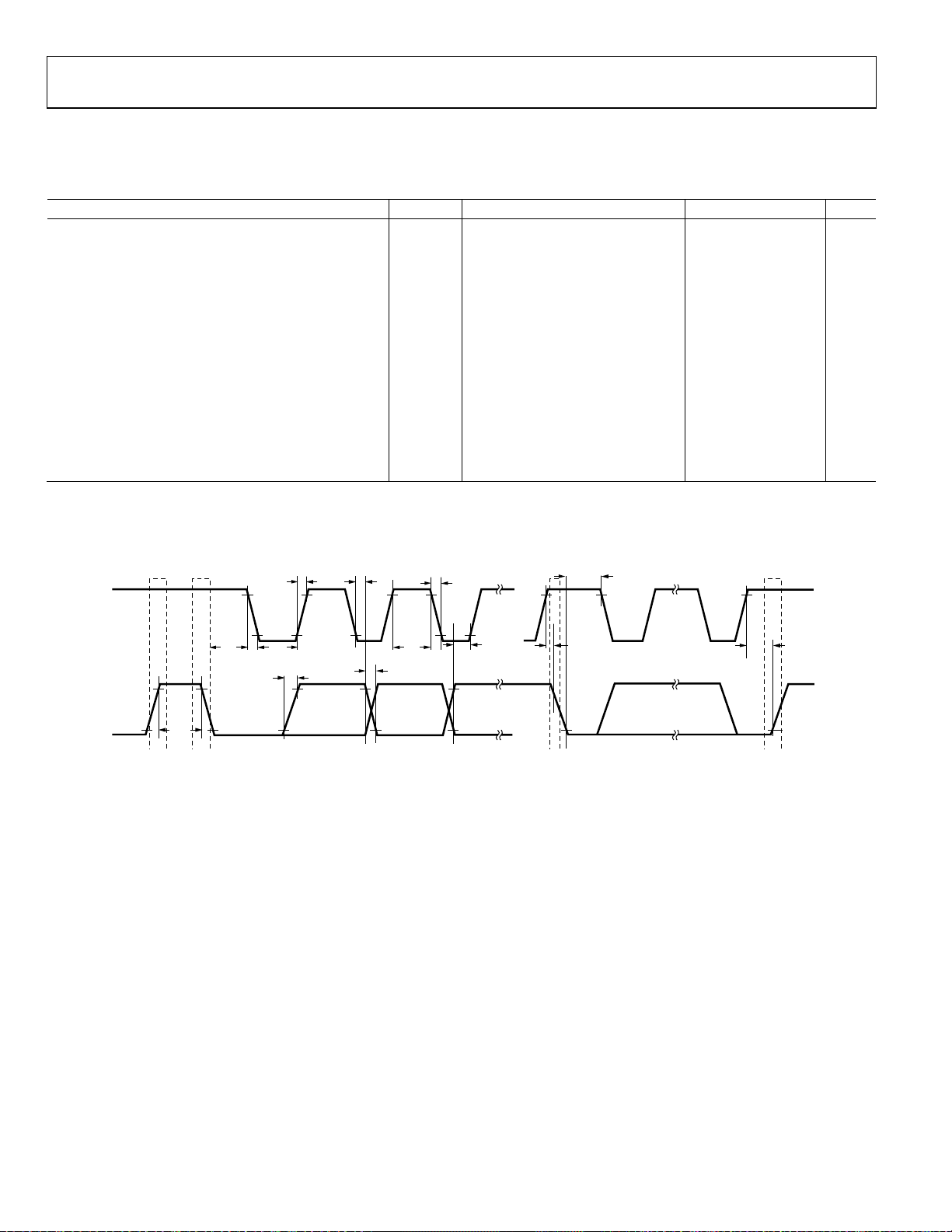
See the timing diagrams for the locations of measured values (that is, see Figure 3 and Figure 48 to Figure 51).
2
The maximum t
has to be met only if the device does not stretch the low period (t
HD;DAT
Timing Diagram
1
t
BUF
t
400 kHz
SCL
1.3 μs
1
2
After this period, the first clock
pulse is generated.
1.3 μs
3
0.6 μs
4
t
SU;STA
0.6 μs
5
t6 0.9 μs
100 ns
7
300 ns
8
300 ns
9
t
SU;STO
t
8
0.6 μs
10
) of the SCL signal.
LOW
t
t
6
9
0.6 μs
t
2
SCL
SDA
t
2
t
1
PS
t
3
t
9
t
8
Figure 3. I
t
4
2
C Interface Detailed Timing Diagram
t
7
t
5
S
t
10
04103-0-039
P
Rev. H | Page 6 of 24
Page 7
AD5172/AD5173
ABSOLUTE MAXIMUM RATINGS
TA = 25°C, unless otherwise noted.
Table 4.
Parameter Rating
VDD to GND −0.3 V to +7 V
VA, VB, VW to GND VDD
Terminal Current, Ax to Bx, Ax to Wx, Bx to Wx1
Pulsed ±20 mA
Continuous ±5 mA
Digital Inputs and Output Voltage to GND 0 V to 7 V
Operating Temperature Range −40°C to +125°C
Maximum Junction Temperature (T
) 150°C
JMAX
Storage Temperature Range −65°C to +150°C
Reflow Soldering
Peak Temperature 260°C
Time at Peak Temperature 20 sec to 40 sec
Thermal Resistance
2
θJA for 10-Lead MSOP 200°C/W
1
The maximum terminal current is bound by the maximum current handling
of the switches, the maximum power dissipation of the package, and the
maximum applied voltage across any two of the A, B, and W terminals at a
given resistance.
2
The package power dissipation is (T
− TA)/θJA.
JMAX
Stresses above those listed under Absolute Maximum Ratings
may cause permanent damage to the device. This is a stress
rating only; functional operation of the device at these or any
other conditions above those indicated in the operational
section of this specification is not implied. Exposure to absolute
maximum rating conditions for extended periods may affect
device reliability.
ESD CAUTION
Rev. H | Page 7 of 24
Page 8
AD5172/AD5173
G
PIN CONFIGURATIONS AND FUNCTION DESCRIPTIONS
1
B1
2
A1
AD5172
3
W2
TOP VIEW
(Not to Scale)
ND
4
V
5
DD
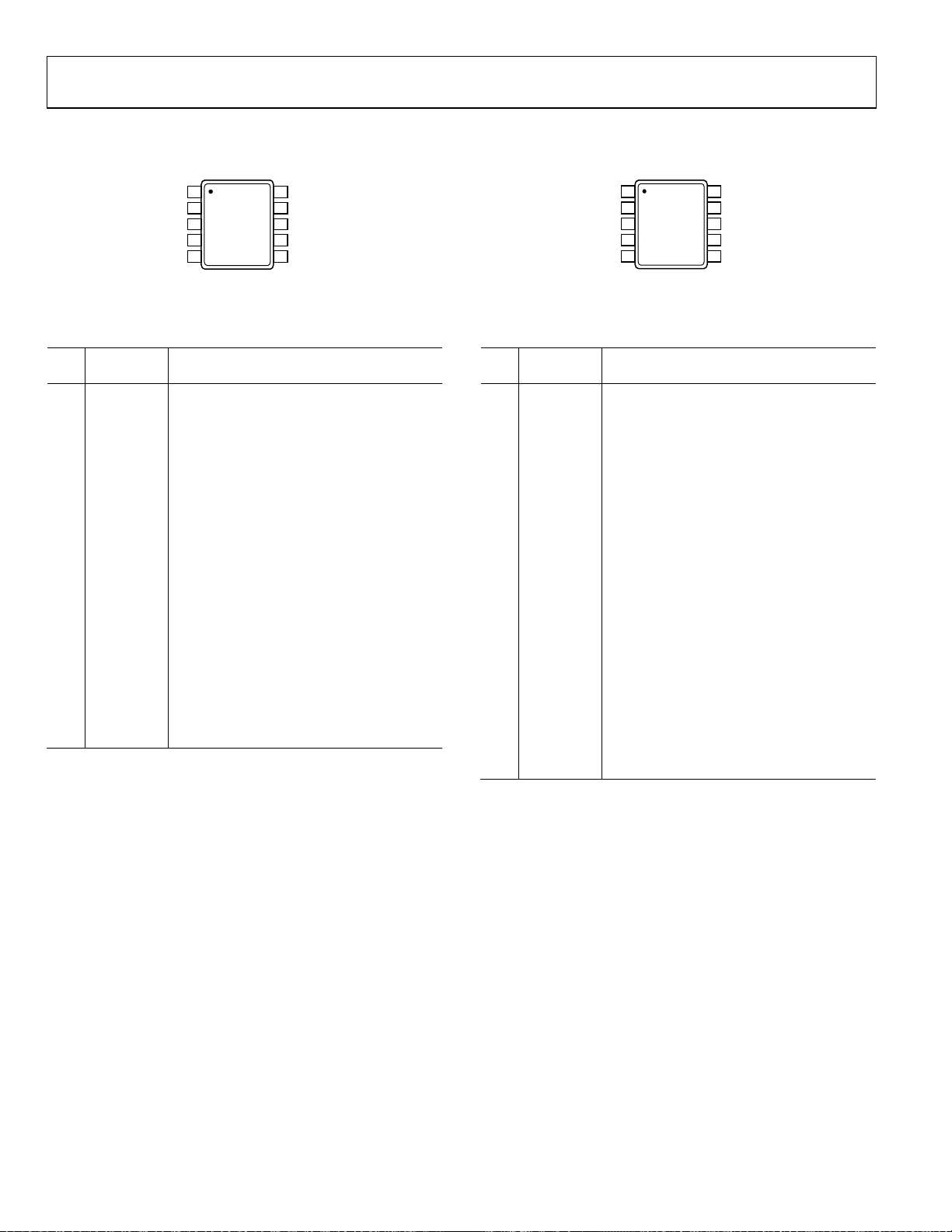
Figure 4. AD5172 Pin Configuration
10
W1
9
B2
8
A2
SDA
7
SCL
6
4103-045
B1
AD0
W2
GND
V
DD
1
2
AD5173
3
TOP VIEW
(Not to Scale)
4
5
W1
10
B2
9
AD1
8
SDA
7
SCL
6
04103-046
Figure 5. AD5173 Pin Configuration
Table 5. AD5172 Pin Function Descriptions
Pin
No. Mnemonic Description
1 B1 B1 Terminal. GND ≤ VB1 ≤ VDD.
2 A1 A1 Terminal. GND ≤ VA1 ≤ VDD.
3 W2 W2 Terminal. GND ≤ VW2 ≤ VDD.
4 GND Digital Ground.
5 VDD
Positive Power Supply. Specified for
operation from 2.7 V to 5.5 V. For OTP
programming, V
needs to be a minimum
DD
of 5.6 V but no more than 5.8 V and to be
capable of driving 100 mA.
6 SCL
Serial Clock Input. Positive-edge triggered.
Requires a pull-up resistor. If this pin is driven
directly from a logic controller without a
pull-up resistor, ensure that the VIH minimum
.
DD
7 SDA
is 0.7 V × V
Serial Data Input/Output. Requires a pull-up
resistor. If this pin is driven directly from a
logic controller without a pull-up resistor,
ensure that the V
minimum is 0.7 V × VDD.
IH
8 A2 A2 Terminal. GND ≤ VA2 ≤ VDD.
9 B2 B2 Terminal. GND ≤ VB2 ≤ VDD.
10 W1 W1 Terminal. GND ≤ VW1 ≤ VDD.
Table 6. AD5173 Pin Function Descriptions
Pin
No. Mnemonic Description
1 B1 B1 Terminal. GND ≤ VB1 ≤ VDD.
2 AD0
Programmable Address Bit 0 for Multiple
Package Decoding.
3 W2 W2 Terminal. GND ≤ VW2 ≤ VDD.
4 GND Digital Ground.
5 VDD
Positive Power Supply. Specified for
operation from 2.7 V to 5.5 V. For OTP
programming, V
needs to be a minimum
DD
of 5.6 V but no more than 5.8 V and to be
capable of driving 100 mA.
6 SCL
Serial Clock Input. Positive-edge triggered.
Requires a pull-up resistor. If this pin is driven
directly from a logic controller without a
pull-up resistor, ensure that the V
7 SDA
is 0.7 V × V
Serial Data Input/Output. Requires a pull-up
.
DD
resistor. If this pin is driven directly from a
logic controller without a pull-up resistor,
ensure that the VIH minimum is 0.7 V × VDD.
8 AD1
Programmable Address Bit 1 for Multiple
Package Decoding.
9 B2 B2 Terminal. GND ≤ VB2 ≤ VDD.
10 W1 W1 Terminal. GND ≤ VW1 ≤ VDD.
minimum
IH
Rev. H | Page 8 of 24
Page 9

AD5172/AD5173
A
TYPICAL PERFORMANCE CHARACTERISTICS
2.0
1.5
1.0
0.5
0
T MODE INL (LSB)
–0.5
–1.0
RHEOST
–1.5
–2.0
VDD = 2.7V
VDD = 5.5V
1289632 640 160 192 224 256
CODE (DECIMAL)
TA = 25°C
R
= 10kΩ
AB
04103-003
Figure 6. R-INL vs. Code vs. Supply Voltages
0.5
0.4
0.3
0.2
0.1
0
–0.1
–0.2
–0.3
POTENTIOMETER MODE DNL (LSB)
–0.4
–0.5
VDD = 2.7V; TA = –40°C, +25° C, +85°C, +125°C
1289632 640 160 192 224 256
CODE (DECIMAL)
RAB = 10kΩ
04103-006
Figure 9. DNL vs. Code vs. Temperature
0.5
0.4
0.3
0.2
0.1
0
–0.1
–0.2
RHEOSTAT MODE DNL (LSB)
–0.3
–0.4
–0.5
VDD = 2.7V
VDD = 5.5V
1289632 640 160 192 224 256
CODE (DECIMAL)
TA = 25°C
R
= 10kΩ
AB
04103-004
Figure 7. R-DNL vs. Code vs. Supply Voltages
0.5
0.4
0.3
0.2
0.1
0
–0.1
–0.2
–0.3
POTENTI OMETER MO DE INL (L SB)
–0.4
–0.5
VDD = 5.5V
T
= –40°C, +25° C, +85°C, +125°C
A
VDD = 2.7V
T
= –40°C, +25° C, +85°C, +125°C
A
1289632 640 160 192 224 256
CODE (DECIMAL)
RAB = 10kΩ
04103-005
Figure 8. INL vs. Code vs. Temperature
1.0
0.8
0.6
0.4
0.2
0
–0.2
–0.4
–0.6
POTENTI OMETER MO DE INL (LSB)
–0.8
–1.0
VDD = 2.7V
1289632 640 160 192 224 256
CODE (DECIMAL)
VDD = 5.5V
TA = 25°C
R
= 10kΩ
AB
04103-007
Figure 10. INL vs. Code vs. Supply Voltages
0.5
0.4
0.3
0.2
0.1
0
–0.1
–0.2
–0.3
POTENTIOMETER MODE DNL (LSB)
–0.4
–0.5
VDD = 2.7V
VDD = 5.5V
1289632 640 160 192 224 256
CODE (DECIMAL)
TA = 25°C
R
= 10kΩ
AB
04103-008
Figure 11. DNL vs. Code vs. Supply Voltages
Rev. H | Page 9 of 24
Page 10

AD5172/AD5173
A
A
T
A
2.0
1.5
1.0
0.5
VDD = 2.7V
T
= –40°C, +25° C, +85°C, +125°C
A
RAB = 10kΩ
4.50
RAB = 10kΩ
3.75
3.00
0
T MODE INL (LSB)
–0.5
–1.0
RHEOST
–1.5
–2.0
VDD = 5.5V
T
= –40°C, +25° C, +85°C, +125°C
A
1289632 640 160 192 224 256
CODE (DECIMAL)
04103-009
Figure 12. R-INL vs. Code vs. Temperature
0.5
0.4
0.3
0.2
0.1
T MODE DNL (LSB)
–0.1
–0.2
RHEOST
–0.3
–0.4
–0.5
VDD = 2.7V, 5.5V; TA = –40°C, +25° C, +85°C, +125°C
0
1289632 640 160 192 224 256
CODE (DECIMAL)
RAB = 10kΩ
04103-010
Figure 13. R-DNL vs. Code vs. Temperature
2.25
1.50
ZSE, ZERO -SCALE ERROR ( LSB)
0.75
VDD = 2.7V, VA = 2.7V
VDD = 5.5V, VA = 5.0V
0
–40 –25 –10 5 20 35 50 65 80 95 110 125
TEMPERATURE (°C)
Figure 15. Zero-Scale Error vs. Temperature
10
)
(µ
1
, SUPPLY CURREN
DD
I
0.1
–40 –7 26 59 92 125
VDD = 5V
VDD = 3V
TEMPERATURE (° C)
Figure 16. Supply Current vs. Temperature
04103-012
04103-013
2.0
1.5
1.0
0.5
0
–0.5
–1.0
FSE, FULL-SCALE ERRO R (LSB)
–1.5
–2.0
–40 –25 –10 5 20 35 50 65 80 95 110 125
VDD = 2.7V, VA = 2.7V
VDD = 5.5V, VA = 5.0V
TEMPERATURE (°C)
RAB = 10kΩ
04103-011
Figure 14. Full-Scale Error vs. Temperature
120
100
80
60
40
20
RHEOSTAT MO DE TEMPCO (ppm/° C)
0
–20
VDD = 2.7V
T
= –40°C TO +85°C, –40°C T O +125°C
A
VDD = 5.5V
T
= –40°C TO + 85°C, –40°C TO +125°C
A
1289632 640 160 192 224 256
CODE (DECIMAL)
Figure 17. Rheostat Mode Tempco ΔRWB/ΔT vs. Code
RAB = 10kΩ
04103-014
Rev. H | Page 10 of 24
Page 11

AD5172/AD5173
50
40
30
VDD = 2.7V
T
20
10
0
–10
–20
POTENTI OMETER MO DE TEMPCO (ppm/° C)
–30
= –40°C TO + 85°C, –40°C TO +125°C
A
VDD = 5.5V
T
= –40°C TO +85°C, –40° C TO +125° C
A
1289632 640 160 192 224 256
CODE (DECIMAL)
RAB = 10kΩ
Figure 18. AD5172 Potentiometer Mode Tempco ΔVWB/ΔT vs. Code
04103-047
0
–6
–12
–18
–24
–30
GAIN (dB)
–36
–42
–48
–54
–60
1k 100k10k 1M
0x80
0x40
0x20
0x10
0x08
0x04
0x02
0x01
FREQUENCY ( Hz)
Figure 21. Gain vs. Frequency vs. Code, RAB = 50 kΩ
04103-050
0
–6
–12
–18
–24
–30
GAIN (dB)
–36
–42
–48
–54
–60
10k 1M100k 10M
0x80
0x40
0x20
0x10
0x08
0x04
0x010x02
FREQUENCY ( Hz)
Figure 19. Gain vs. Frequency vs. Code, RAB = 2.5 kΩ
0
–6
–12
–18
–24
–30
GAIN (dB)
–36
–42
–48
–54
–60
1k 100k10k 1M
0x80
0x40
0x20
0x10
0x08
0x04
0x02
0x01
FREQUENCY ( Hz)
Figure 20. Gain vs. Frequency vs. Code, RAB = 10 kΩ
0
–6
–12
–18
–24
–30
GAIN (dB)
–36
–42
–48
–54
04103-048
–60
1k 100k10k 1M
Figure 22. Gain vs. Frequency vs. Code, R
0
–6
–12
–18
–24
–30
GAIN (dB)
–36
–42
–48
–54
04103-049
–60
0x80
0x40
0x20
0x10
0x08
0x04
0x02
0x01
FREQUENCY ( Hz)
= 100 kΩ
AB
100kΩ
60kHz
50kΩ
120kHz
10kΩ
570kHz
2.5kΩ
2.2MHz
10k1k 100k 1M 10M
FREQUENCY ( Hz)
04103-051
04103-052
Figure 23. −3 dB Bandwidth at Code = 0x80
Rev. H | Page 11 of 24
Page 12

AD5172/AD5173
10
TA = 25°C
1
0.1
, SUPPLY CURRENT (mA)
DD
I
0.01
0 0.5 1.0 1.5 2.0 2.5 3.0 3.5 4.0 4.5 5.0
VDD = 2.7V
DIGITAL INPUT VOLTAGE (V)
VDD = 5.5V
Figure 24. Supply Current vs. Digital Input Voltage
V
W
V
W2
V
W1
04103-057
04103-056
Figure 27. Analog Crosstalk
V
W
SCL
V
V
04103-053
Figure 25. Digital Feedthrough
W2
W1
04103-054
Figure 26. Digital Crosstalk
Figure 28. Midscale Glitch, Code 0x80 to Code 0x7F
V
W
SCL
Figure 29. Large-Signal Settling Time
04103-058
04103-055
Rev. H | Page 12 of 24
Page 13

AD5172/AD5173
T
1
CH1 20.0mA M 200ns A CH1 32.4mA
T 588.000ns
CHANNEL 1
MAXIMUM:
103mA
CHANNEL 1
MINIMUM:
–1.98mA
04103-062
Figure 30. OTP Program Energy for Single Fuse
Rev. H | Page 13 of 24
Page 14

AD5172/AD5173
V
A
V
V
TEST CIRCUITS
Figure 31 to Figure 38 illustrate the test circuits that define the test conditions used in the product specification tables (see Tabl e 1 and Tab l e 2 ).
DUT
A
V+
W
B
V+ = V
DD
1LSB = V+/ 2
V
MS
N
04103-015
Figure 31. Potentiometer Divider Nonlinearity Error (INL, DNL)
NC
DUT
A
W
B
NC = NO CONNECT
I
W
V
MS
4103-016
Figure 32. Resistor Position Nonlinearity Error (Rheostat Operation: R-INL, R-DNL)
DUT
A
V
MS2
W
B
V
W
IW= VDD/R
V
MS1
RW= [V
NOMINAL
– V
MS1
MS2
]/I
W
04103-017
Figure 33. Wiper Resistance
DUT
W
B
OFFSET
GND
V
IN
2.5V
Figure 35. Test Circuit for Gain vs. Frequency
0.1
RSW=
I
DUT
B
W
I
SW
GND TO V
SW
CODE = 0x00
DD
Figure 36. Incremental On Resistance
NC
DUT
V
DD
GND
NC
NC = NO CONNECT
I
A
W
B
V
Figure 37. Common-Mode Leakage Current
+5V
AD8610
–5V
CM
CM
0.1V
V
OUT
04103-019
04103-020
4103-021
A
DUT
V
DD
A
V+
W
B
V+ = VDD± 10%
PSRR (dB) = 20 log
PSS (%/ %) =
V
MS
Figure 34. Power Supply Sensitivity (PSS, PSSR)
ΔV
MS
()
ΔV
VMS%
DD
Δ
ΔVDD%
A1
RDAC1
W1
NC
IN
04103-018
B1
CTA = 20 log [V
NC = NO CONNECT
Figure 38. Analog Crosstalk
V
V
DD
SS
RDAC2
OUT/VIN
W2
A2
V
OUT
B2
]
04103-022
Rev. H | Page 14 of 24
Page 15

AD5172/AD5173
W
THEORY OF OPERATION
SCL
SDA
2
I
C INTERFACE
COMPARATOR
ONE-TIME
PROGRAM/T EST
CONTROL BL OCK
Figure 39. Detailed Functional Block Diagram
The AD5172/AD5173 are 256-position, digitally controlled
variable resistors (VRs) that employ fuse link technology to
achieve memory retention of the resistance setting.
An internal power-on preset places the wiper at midscale
during power-on. If the OTP function is activated, the device
powers up at the user-defined permanent setting.
ONE-TIME PROGRAMMING (OTP)
Prior to OTP activation, the AD5172/AD5173 presets to midscale
during initial power-on. After the wiper is set to the desired
position, the resistance can be permanently set by programming
the T bit high, with the proper coding (see Tab le 8 and Tab le 9 ),
and one-time V
family of digital potentiometers requires V
5.6 V and 5.8 V to blow the fuses to achieve a given nonvolatile
setting. However, during operation, V
result, an external supply is required for one-time programming.
The user is allowed only one attempt to blow the fuses. If the user
fails to blow the fuses during this attempt, the structure of the
fuses can change such that they may never be blown, regardless
of the energy applied during subsequent events. For details, see
the Power Supply Considerations section.
The device control circuit has two validation bits, E1 and E0,
that can be read back to check the programming status (see
Tabl e 7). Users should always read back the validation bits to
ensure that the fuses are properly blown. After the fuses are
blown, all fuse latches are enabled upon subsequent power-on;
therefore, the output corresponds to the stored setting. Figure 39
shows a detailed functional block diagram.
. The fuse link technology of the AD517x
DD_OTP
to be between
DD_OTP
can be 2.7 V to 5.5 V. As a
DD
A
B
04103-026
DAC
REG
FUSES
EN
MUX
FUSE
REG
DECODER
Table 7. Validation Status
E1 E0 Status
0 0 Ready for programming.
1 0
Fatal error. Some fuses are not blown. Do not retry.
Discard this unit.
1 1 Successful. No further programming is possible.
PROGRAMMING THE VARIABLE RESISTOR AND VOLTAGE
Rheostat Operation
The nominal resistance of the RDAC between Terminal A and
Terminal B is available in 2.5 kΩ, 10 kΩ, 50 kΩ, and 100 kΩ.
The nominal resistance (R
accessed by the wiper terminal and the B terminal contact. The
8-bit data in the RDAC latch is decoded to select one of the
256 possible settings.
A
W
B
Figure 40. Rheostat Mode Configuration
Assuming a 10 kΩ part is used, the first connection of the wiper
starts at the B terminal for Data 0x00. Because there is a 50 Ω
wiper contact resistance, such a connection yields a minimum
of 100 Ω (2 × 50 Ω) resistance between Terminal W and Terminal B. The second connection is the first tap point, which
corresponds to 139 Ω (R
50 Ω) for Data 0x01. The third connection is the next tap point,
representing 178 Ω (2 × 39 Ω + 2 × 50 Ω) for Data 0x02, and so
on. Each LSB data value increase moves the wiper up the resistor
ladder until the last tap point is reached at 10,100 Ω (R
) of the VR has 256 contact points
AB
A
W
B
= RAB/256 + 2 × RW = 39 Ω + 2 ×
WB
A
B
W
+ 2 × RW).
AB
04103-027
Rev. H | Page 15 of 24
Page 16

AD5172/AD5173
−
A
R
S
D7
D6
D5
D4
D3
D2
D1
D0
RDAC
LATCH
AND
DECODER
Figure 41. AD5172/AD5173 Equivalent RDAC Circuit
R
S
R
S
W
R
S
B
4103-028
The general equation that determines the digitally programmed
output resistance between W and B is
WB
128
D
DR ×+×= 2
)(
AB
(1)
RR
W
where:
D is the decimal equivalent of the binary code loaded in the
8-bit RDAC register.
R
is the end-to-end resistance.
AB
R
is the wiper resistance contributed by the on resistance of
W
the internal switch.
In summary, if R
the output resistance, R
is 10 kΩ and the A terminal is open circuited,
AB
, is set according to the RDAC latch
WB
codes, as listed in Tab l e 8.
Table 8. Codes and Corresponding RWB Resistance
D (Dec) RWB (Ω) Output State
255 9961 Full scale (RAB – 1 LSB + RW)
128 5060 Midscale
1 139 1 LSB
0 100 Zero scale (wiper contact resistance)
Note that in the zero-scale condition, a finite wiper resistance of
100 Ω is present. Care should be taken to limit the current flow
between W and B in this state to a maximum pulse current of
no more than 20 mA. Otherwise, degradation or possible destruction of the internal switch contact may occur.
Similar to the mechanical potentiometer, the resistance of the
RDAC between Wiper W and Terminal A also produces a digitally controlled complementary resistance, R
. When these
WA
terminals are used, the B terminal can be opened. Setting the
resistance value for R
starts at a maximum value of resistance
WA
and decreases as the data loaded in the latch increases in value.
The general equation for this operation is
–256
128
D
ABWA
DR ×+×= 2
)(
(2)
RR
W
When R
output resistance, R
is 10 kΩ and the B terminal is open circuited, the
AB
, is set according to the RDAC latch
WA
codes, as listed in Tab l e 9.
Table 9. Codes and Corresponding RWA Resistance
D (Dec) RWA (Ω) Output State
255 139 Full scale
128 5060 Midscale
1 9961 1 LSB
0 10,060 Zero scale
Typical device-to-device matching is process-lot dependent
and can vary up to ±30%. Because the resistance element is
processed using thin-film technology, the change in R
AB
with
temperature has a very low temperature coefficient of 35 ppm/°C.
PROGRAMMING THE POTENTIOMETER DIVIDER
Voltage Output Operation
The digital potentiometer easily generates a voltage divider at
wiper to B and at wiper to A, proportional to the input voltage
at A to B. Unlike the polarity of V
positive, voltage across A to B, W to A, and W to B can be at
either polarity.
V
I
Figure 42. Potentiometer Mode Configuration
If ignoring the effect of the wiper resistance for approximation,
connecting the A terminal to 5 V and the B terminal to ground
produces an output voltage at the wiper to B, starting at 0 V up
to 1 LSB less than 5 V. Each LSB of voltage is equal to the voltage applied across Terminal A and Terminal B divided by the
256 positions of the potentiometer divider. The general equation
defining the output voltage at V
valid input voltage applied to Terminal A and Terminal B is
D
)(
DV
W
256
256
V
+=
A
256
A more accurate calculation, which includes the effect of wiper
resistance, V
, is
W
)(
DR
WB
)( += (4)
DV
W
V
A
R
AB
Operation of the digital potentiometer in the divider mode
results in more accurate operation over temperature. Unlike in
the rheostat mode, the output voltage is dependent mainly on
the ratio of the internal resistors, R
values. Therefore, the temperature drift reduces to 15 ppm/°C.
to GND, which must be
DD
A
W
V
O
B
04103-029
with respect to ground for any
W
D
(3)
V
B
)(
DR
WA
V
R
B
AB
and RWB, not on the absolute
WA
Rev. H | Page 16 of 24
Page 17

AD5172/AD5173
V
A
ESD PROTECTION
All digital inputs, SDA, SCL, AD0, and AD1, are protected with
a series input resistor and parallel Zener ESD structures, as
shown in Figure 43 and Figure 44.
340Ω
LOGIC
GND
Figure 43. ESD Protection of Digital Pins
A, B, W
04103-030
rack-mount power supply) must be rated at 5.6 V to 5.8 V and
must be able to provide a 100 mA transient current for 400 ms
for successful one-time programming. When programming
is completed, the V
supply must be removed to allow
DD_OTP
normal operation at 2.7 V to 5.5 V; the device consumes only
microamps of current.
5.7V
R1
10kΩ
2.7V
PPLY FOR OTP ONLY
P1
P2
C1
10µFC20.1µF
V
DD
AD5172/
AD5173
GND
Figure 44. ESD Protection of Resistor Terminals
04103-031
TERMINAL VOLTAGE OPERATING RANGE
The AD5172/AD5173 VDD to GND power supply defines the
boundary conditions for proper 3-terminal digital potentiometer operation. Supply signals present on Terminal A,
Ter min al B , an d Ter mi nal W t h at e xc e ed V
or GND are
DD
clamped by the internal forward-biased diodes (see Figure 45).
DD
A
W
B
GND
04103-032
Figure 45. Maximum Terminal Voltages Set by V
and GND
DD
POWER-UP SEQUENCE
Because the ESD protection diodes limit the voltage compliance
at Te rm i na l A, Te rm ina l B, a nd Te rm ina l W ( se e Figure 45), it
is important to power V
/GND before applying voltage to
DD
Terminal A, Terminal B, and Terminal W. Otherwise, the diode
is forward-biased such that V
is powered unintentionally and
DD
may affect the rest of the user’s circuit. The ideal power-up
sequence is GND, V
relative order of powering V
not important, as long as they are powered after V
, digital inputs, and then VA/VB/VW. The
DD
, VB, VW, and the digital inputs is
A
/GND.
DD
POWER SUPPLY CONSIDERATIONS
To minimize the package pin count, both the one-time programming and normal operating voltage supplies are applied to
the same V
employ fuse link technology that requires 5.6 V to 5.8 V to blow
the internal fuses to achieve a given setting, but normal V
be 2.7 V to 5.5 V. Such dual-voltage requirements need isolation
between the supplies if V
The fuse programming supply (either an on-board regulator or
terminal of the device. The AD5172/AD5173
DD
is lower than the required V
DD
DD
DD_OTP
can
.
P1 = P2 = FDV 302P, NDS0610
4103-035
Figure 46. Isolate 5.7 V OTP Supply from 2.7 V Normal Operating Supply
For example, for those who operate their systems at 2.7 V, use of
the bidirectional, low threshold, P-channel MOSFETs is recommended for the isolation of the supply. As shown in Figure 46,
this assumes that the 2.7 V system voltage is applied first and
that the P1 and P2 gates are pulled to ground, thus turning on
P1 and then P2. As a result, V
of the AD5172/AD5173
DD
approaches 2.7 V. When the AD5172/AD5173 setting is found,
the factory tester applies the V
to both the VDD and the
DD_OTP
MOSFET gates, thus turning P1 and P2 off. To program the
AD5172/AD5173 while the 2.7 V source is protected, execute
the OTP command at this time. When the OTP is completed,
the tester withdraws the V
, and the setting of the AD5172
DD_OTP
or AD5173 is fixed permanently.
The AD5172/AD5173 achieve the OTP function by blowing
internal fuses. Always apply the 5.6 V to 5.8 V one-time program voltage requirement at the first fuse programming attempt.
Failure to comply with this requirement may lead to changing
the fuse structures, rendering programming inoperable.
Care should be taken when SCL and SDA are driven from a low
voltage logic controller. Users must ensure that the logic high
level is between 0.7 V × V
and VDD + 0.5 V.
DD
Poor PCB layout introduces parasitics that can affect fuse
programming. Therefore, it is recommended to add a 1 μF to
10 μF tantalum capacitor in parallel with a 1 nF ceramic capacitor
as close as possible to the VDD pin. The type and value chosen for
both capacitors are important. These capacitors work together to
provide both fast responsiveness and large supply current handling
with minimum supply droop during transients. As a result,
these capacitors increase the OTP programming success by not
inhibiting the proper energy needed to blow the internal fuses.
Additionally, C1 minimizes transient disturbance and low
frequency ripple, whereas C2 reduces high frequency noise
during normal operation.
Rev. H | Page 17 of 24
Page 18

AD5172/AD5173
LAYOUT CONSIDERATIONS
In PCB layout, it is a good practice to employ compact, minimum
lead length design. The leads to the inputs should be as direct as
possible with a minimum conductor length. Ground paths should
have low resistance and low inductance.
Note that the digital ground should also be joined remotely to
the analog ground at one point to minimize the ground bounce.
V
DD
+
C1
10µFC20.1µF
Figure 47. Power Supply Bypassing
V
DD
AD5172
GND
04103-036
Rev. H | Page 18 of 24
Page 19

AD5172/AD5173
I2C INTERFACE
WRITE MODE
Table 10. AD5172 Write Mode
S 0 1 0 1 1 1 1
Slave address byte Instruction byte Data byte
Table 11. AD5173 Write Mode
S 0 1 0 1 1 AD1 AD0
Slave address byte Instruction byte Data byte
READ MODE
Table 12. AD5172 Read Mode
S 0 1 0 1 1 1 1 R A D7 D6 D5 D4 D3 D2 D1 D0 A E1 E0 X X X X X X A P
Slave address byte Instruction byte Data byte
Table 13. AD5173 Read Mode
S 0 1 0 1 1 AD1 AD0 R A D7 D6 D5 D4 D3 D2 D1 D0 A E1 E0 X X X X X X A P
Slave address byte Instruction byte Data byte
W
A A0 SD T 0 OW X X X A D7 D6 D5 D4 D3 D2 D1 D0 A P
W
A A0 SD T 0 OW X X X A D7 D6 D5 D4 D3 D2 D1 D0 A P
Table 14. SDA Bits Descriptions
Bit Description
S Start condition.
P Stop condition.
A Acknowledge.
AD0, AD1 Package pin-programmable address bits.
X Don’t care.
W
Write.
R Read.
A0 RDAC subaddress select bit.
SD
Shutdown connects wiper to B terminal and open circuits the A terminal. It does not change the
contents of the wiper register.
T OTP programming bit. Logic 1 programs the wiper permanently.
OW
Overwrites the fuse setting and programs the digital potentiometer to a different setting. Upon
power-up, the digital potentiometer is preset to either midscale or fuse setting, depending on
whether the fuse link was blown.
D7, D6, D5, D4, D3, D2, D1, D0 Data bits.
E1, E0 OTP validation bits.
00 = ready to program.
10 = fatal error. Some fuses not blown. Do not retry. Discard this unit.
11 = programmed successfully. No further adjustments are possible.
Rev. H | Page 19 of 24
Page 20

AD5172/AD5173
S
S
S
S
I2C CONTROLLER PROGRAMMING
Write Bit Patterns
SCL
SDA
TART BY
MASTER
SCL
SDA
TART BY
MASTER
Read Bit Patterns
SCL
SDA
TART BY
MASTER
SCL
SDA
TART BY
MASTER
1
01
01111
FRAME 1
SLAVE ADDRESS BYTE
1
01
0 1 1 AD1 AD0
FRAME 1
SLAVE ADDRESS BYTE
1
01
01111
FRAME 1
SLAVE ADDRESS BYTE
Figure 50. Reading Data from a Previously Selected RDAC Register in Write Mode—AD5172
1
01
0 1 1 AD1 AD0
FRAME 1
SLAVE ADDRESS BYTE
Figure 51. Reading Data from a Previously Selected RDAC Register in Write Mode—AD5173
19
R/W A0 SD 0 OW X X X
ACK BY
AD5172
T
FRAME 2
INSTRUCTIO N BYTE
19
D7 D6 D5 D4 D3
ACK BY
AD5172
FRAME 3
DATA BYTE
Figure 48. Writing to the RDAC Register—AD5172
19
R/W A0 SD 0 OW X X X
ACK BY
AD5173
T
FRAME 2
INSTRUCTIO N BYTE
19
D7 D6 D5 D4 D3
ACK BY
AD5173
FRAME 3
DATA BYTE
Figure 49. Writing to the RDAC Register—AD5173
19
R/W D7D6 D4D3D2D1D019E1 E0 X X X
ACK BY
AD5172
R/W D7D6 D4D3D2D1D019E1 E0 X X X
ACK BY
AD5173
D5
FRAME 2
INSTRUCTIO N BYTE
D5
FRAME 2
INSTRUCTIO N BYTE
ACK BY
MASTER
ACK BY
MASTER
FRAME 3
DATA BYTE
19
FRAME 3
DATA BYTE
D2 D1 D0
D2 D1 D0
XXX
XXX
9
ACK BY
AD5172
STOP BY
MASTER
9
ACK BY
AD5173
STOP BY
MASTER
9
NO ACK
BY MASTER
STOP BY
MASTER
9
NO ACK
BY MASTER
STOP BY
MASTER
04103-040
04103-041
04103-042
04103-043
Rev. H | Page 20 of 24
Page 21

AD5172/AD5173
I2C-COMPATIBLE, 2-WIRE SERIAL BUS
This section describes how the 2-wire, I2C-compatible serial bus
protocol operates.
The master initiates a data transfer by establishing a start
condition, which is when a high-to-low transition on the SDA
line occurs while SCL is high (see Figure 48 and Figure 49).
The following byte is the slave address byte, which consists of
W
the slave address followed by an R/
whether data is read from or written to the slave device). The
AD5172 has a fixed slave address byte, whereas the AD5173
has two configurable address bits, AD0 and AD1 (see
and ).
Figure 49
The slave whose address corresponds to the transmitted address
responds by pulling the SDA line low during the ninth clock
pulse (this is called the acknowledge bit). At this stage, all other
devices on the bus remain idle while the selected device waits
for data to be written to or read from its serial register. If the
W
bit is high, the master reads from the slave device. If the
R/
W
R/
bit is low, the master writes to the slave device.
In write mode, the second byte is the instruction byte. The first
bit (MSB) of the instruction byte is the RDAC subaddress select
bit. Logic low selects Channel 1; logic high selects Channel 2.
The second MSB, SD, is a shutdown bit. A logic high causes an
open circuit at Terminal A while shorting the wiper to Terminal B.
This operation yields almost 0 Ω in rheostat mode or 0 V in
potentiometer mode. It is important to note that the shutdown
operation does not disturb the contents of the register. When
brought out of shutdown, the previous setting is applied to the
RDAC. In addition, during shutdown, new settings can be
programmed. When the part is returned from shutdown, the
corresponding VR setting is applied to the RDAC.
The third MSB, T, is the OTP programming bit. A logic high
blows the polyfuses and programs the resistor setting permanently.
The OTP program time is 400 ms.
The fourth MSB must always be at Logic 0.
The fifth MSB, OW, is an overwrite bit. When raised to a logic high,
OW allows the RDAC setting to be changed even after the internal
fuses are blown. However, when OW is returned to Logic 0, the
position of the RDAC returns to the setting prior to the overwrite.
Because OW is not static, if the device is powered off and on,
the RDAC presets to midscale or to the setting at which the
fuses were blown, depending on whether the fuses had been
permanently set.
The remainder of the bits in the instruction byte are don’t cares
(see Figure 48 and Figure 49).
bit (this bit determines
Figure 48
After acknowledging the instruction byte, the last byte in write
mode is the data byte. Data is transmitted over the serial bus in
sequences of nine clock pulses (eight data bits followed by an
acknowledge bit). The transitions on the SDA line must occur
during the low period of SCL and remain stable during the high
period of SCL (see Figure 3).
In read mode, the data byte follows immediately after the
acknowledgment of the slave address byte. Data is transmitted
over the serial bus in sequences of nine clock pulses (a slight
difference from the write mode, where there are eight data bits
followed by an acknowledge bit). Similarly, transitions on the
SDA line must occur during the low period of SCL and remain
stable during the high period of SCL (see Figure 50 and Figure 51).
Note that the channel of interest is the one that is previously
selected in write mode. If users need to read the RDAC values
of both channels, they must program the first channel in write
mode and then change to read mode to read the first channel
value. After that, the user must return to write mode with the
second channel selected and read the second channel value in
read mode. It is not necessary for users to issue the Frame 3
data byte in write mode for subsequent readback operations.
Refer to Figure 50 and Figure 51 for the programming format.
Following the data byte, the validation byte contains two validation bits, E0 and E1 (see Tab le 7 ). These bits signify the status of
the one-time programming (see Figure 50 and Figure 51).
After all data bits are read or written, the master establishes a
stop condition. A stop condition is defined as a low-to-high
transition on the SDA line while SCL is high. In write mode,
th
the master pulls the SDA line high during the 10
clock pulse to
establish a stop condition (see Figure 48 and Figure 49). In read
mode, the master issues a no acknowledge for the ninth clock
pulse (that is, the SDA line remains high). The master brings
th
the SDA line low before the 10
clock pulse and then brings the
SDA line high to establish a stop condition (see Figure 50 and
Figure 51).
A repeated write function provides the user with the flexibility
of updating the RDAC output multiple times after addressing
and instructing the part only once. For example, after the RDAC
has acknowledged its slave address and instruction bytes in write
mode, the RDAC output is updated on each successive byte. If
different instructions are needed, however, the write/read mode
must restart with a new slave address, instruction, and data byte.
Similarly, a repeated read function of the RDAC is also allowed.
Rev. H | Page 21 of 24
Page 22

AD5172/AD5173
V
V
Multiple Devices on One Bus (AD5173 Only)
Figure 52 shows four AD5173 devices on the same serial bus.
Each has a different slave address because the states of the AD0
and AD1 pins are different. This allows each device on the bus to
be written to or read from independently. The master device
output bus line drivers are open-drain pull-downs in a fully
2
C-compatible interface.
I
5V
R
PRP
MASTER
5V
SDA
SCL
AD1
AD0
AD5173
SDA
AD1
AD0
AD5173
Figure 52. Multiple AD5173 Devices on One I
SCL
5V
SDA
SCL
AD1
AD0
AD5173
5V
2
C Bus
SDA
SCL
AD1
AD0
AD5173
SDA
SCL
04103-044
LEVEL SHIFTING FOR DIFFERENT VOLTAGE OPERATION
If the SCL and SDA signals come from a low voltage logic
controller and are below the minimum V
level shift the signals for read/write communications between
the AD5172/AD5173 and the controller. Figure 53 shows one
of the implementations. For example, when SDA1 is at 2.5 V,
M1 turns off, and SDA2 becomes 5 V. When SDA1 is at 0 V,
M1 turns on, and SDA2 approaches 0 V. As a result, proper
level shifting is established. It is best practice for M1 and M2
to be low threshold N-channel power MOSFETs, such as the
FDV301N from Fairchild Semiconductor.
= 2.5V
DD1
SDA1
SCL1
CONTROL LER
2.5V
R
R
P
P
G
G
D
S
S
M1
M2
Figure 53. Level Shifting for Different Voltage Operation
level (0.7 V × VDD),
IH
R
P
D
DD2
R
P
2.7V TO 5.5V
AD5172/
AD5173
= 5V
SDA2
SCL2
04103-061
Rev. H | Page 22 of 24
Page 23

AD5172/AD5173
OUTLINE DIMENSIONS
3.10
3.00
2.90
6
10
3.10
3.00
2.90
1
PIN 1
0.50 BSC
0.95
0.85
0.75
0.15
0.05
0.33
0.17
COPLANARITY
0.10
COMPLIANT TO JEDEC STANDARDS MO-187-BA
Figure 54. 10-Lead Mini Small Outline Package [MSOP]
ORDERING GUIDE
1
Model
AD5172BRM2.5 2.5 −40°C to +125°C 10-Lead MSOP RM-10 DCY
AD5172BRM2.5-RL7 2.5 −40°C to +125°C 10-Lead MSOP RM-10 DCY
AD5172BRMZ2.5
2
AD5172BRM10 10 −40°C to +125°C 10-Lead MSOP RM-10 DCZ
AD5172BRM10-RL7 10 −40°C to +125°C 10-Lead MSOP RM-10 DCZ
AD5172BRMZ10
AD5172BRMZ10-RL7
2
10 −40°C to +125°C 10-Lead MSOP RM-10 DCT
2
AD5172BRM50 50 −40°C to +125°C 10-Lead MSOP RM-10 DCX
AD5172BRMZ50
AD5172BRMZ50-RL7
2
50 −40°C to +125°C 10-Lead MSOP RM-10 DCU
2
AD5172BRM100 100 −40°C to +125°C 10-Lead MSOP RM-10 DCW
AD5172BRMZ100
2
100 −40°C to +125°C 10-Lead MSOP RM-10 DCV
AD5172BRMZ100-RL7
AD5173BRM2.5 2.5 −40°C to +125°C 10-Lead MSOP RM-10 DCM
AD5173BRM2.5-RL7 2.5 −40°C to +125°C 10-Lead MSOP RM-10 DCM
AD5173BRMZ2.5
2
2.5 −40°C to +125°C 10-Lead MSOP RM-10 DCH
AD5173BRMZ2.5-RL7
AD5173BRM10 10 −40°C to +125°C 10-Lead MSOP RM-10 DCQ
AD5173BRM10-RL7 10 −40°C to +125°C 10-Lead MSOP RM-10 DCQ
AD5173BRMZ10
AD5173BRMZ10-RL7
2
10 −40°C to +125°C 10-Lead MSOP RM-10 DCL
2
AD5173BRM50 50 −40°C to +125°C 10-Lead MSOP RM-10 DCN
AD5173BRM50-RL7 50 −40°C to +125°C 10-Lead MSOP RM-10 DCN
AD5173BRMZ50
AD5173BRMZ50-RL7
2
50 −40°C to +125°C 10-Lead MSOP RM-10 DCJ
2
AD5173BRM100 100 −40°C to +125°C 10-Lead MSOP RM-10 DCP
AD5173BRM100-RL7 100 −40°C to +125°C 10-Lead MSOP RM-10 DCP
AD5173BRMZ100
1
The part has a YWW or #YWW label and an assembly lot number label on the bottom side of the package. The Y shows the year that the part was made; for example,
Y = 5 means the part was made in 2005. WW shows the work week that the part was made.
2
Z = RoHS Compliant Part.
2
100 −40°C to +125°C 10-Lead MSOP RM-10 DCK
RAB (kΩ) Temperature Range Package Description Package Option Branding
2.5 −40°C to +125°C 10-Lead MSOP RM-10 DCR
10 −40°C to +125°C 10-Lead MSOP RM-10 DCT
50 −40°C to +125°C 10-Lead MSOP RM-10 DCU
2
100 −40°C to +125°C 10-Lead MSOP RM-10 DCV
2
2.5 −40°C to +125°C 10-Lead MSOP RM-10 DCH
10 −40°C to +125°C 10-Lead MSOP RM-10 DCL
50 −40°C to +125°C 10-Lead MSOP RM-10 DCJ
5.15
4.90
4.65
5
1.10 MAX
SEATING
PLANE
0.23
0.08
8°
0°
(RM-10)
Dimensions shown in millimeters
0.80
0.60
0.40
Rev. H | Page 23 of 24
Page 24

AD5172/AD5173
NOTES
Purchase of licensed I2C components of Analog Devices, Inc., or one of its sublicensed Associated Companies conveys a license for the purchaser under the Philips I2C
Patent Rights to use these components in an I
©2003–2009 Analog Devices, Inc. All rights reserved. Trademarks and
registered trademarks are the property of their respective owners.
D04103-0-4/09( H)
2
C system, provided that the system conforms to the I2C Standard Specification as defined by Philips.
Rev. H | Page 24 of 24
 Loading...