

Page 1

Conventional and
Bolt Action
In-Line Rifle
Warranty
Information
This book contains information critical to the safe use and maintenance of Connecticut Valley Arms muzzleloading firearms. YOU MUST READ THIS MATE-
RIAL ENTIRELY AND FULLY UNDERSTAND THIS INFORMATION BEFORE
YOU CAN SAFEL Y USE YOUR MUZZLELOADER. If firearm is loaned or sold by
a dealer or individual this book must accompany the firearm. Replacement books
are available from our factory. Call CVA Customer Service at (770) 449-4687 if
you have any questions.
CVA • SUPERB ACCURACY • LIMITED LIFETIME WARRANTY
Page 2

Conventional & Bolt Action
In-Line Rifles
Model No. ____________ Serial No. ________________
Caliber_______________ Date Purchased ___________
T ype of Gun______________________________________
Warranty
Information
WARNING
IF HANDLED IMPROPERLY FIREARMS ARE
DANGEROUS. READ AND FOLLOW ALL
"CAUTIONS", "CAUTION" AND WARNINGS OF
"DANGER" TO AVOID SERIOUS INJURY AND/
OR DEATH AND/OR PROPERTY DAMAGE.
Call CVA Customer Service at 770-449-4687 if you have any
questions or visit us on the Internet at: www.cva.com or E-mail
us at: info@cva.com
Page 3

TABLE OF CONTENTS PAGE
Section
A Introduction to In-Line Muzzleloaders ....................................................................... 1
B Getting Started .......................................................................................................... 2
C Ten Commandments of Firearm Safety .................................................................... 2
D Safety Considerations Unique to Muzzleloaders ...................................................... 3
E Specific Cautions for Safe Use of CVA In-Line
Muzzleloading Firearms ............................................................................................ 4
F Common Misconceptions Regarding Muzzleloaders ................................................ 6
G Basic Accessories for a Muzzleloader....................................................................... 6
H Blackpowder, Pyrodex and Clean Shot..................................................................... 7
I Projectiles.................................................................................................................. 9
J Recommended Loading Data ................................................................................. 10
K Loading and Shooting CVA In-Line Muzzleloaders ..................................................11
L Ignition System Options ......................................................................................... 14
M Safety Systems ....................................................................................................... 15
N Conventional In-Line Disassembly / Assembly for
Cleaning and Maintenance ..................................................................................... 16
O Bolt Action In-Line Disassembly / Assembly and Cleaning ..................................... 17
P General Cleaning and Maintenance........................................................................ 18
Q Removing a Charge ................................................................................................ 18
R Sight Adjustments ................................................................................................... 19
S Scope Mounting ...................................................................................................... 20
T Sighting in a Scoped Rifle ....................................................................................... 20
U Statement of Liability ............................................................................................... 20
V Voluntary Recall ...................................................................................................... 20
W Service .................................................................................................................... 21
X Ordering Instructions for Replacement Parts .......................................................... 21
Limited Lifetime Warranty........................................................................................ 22
Page 4
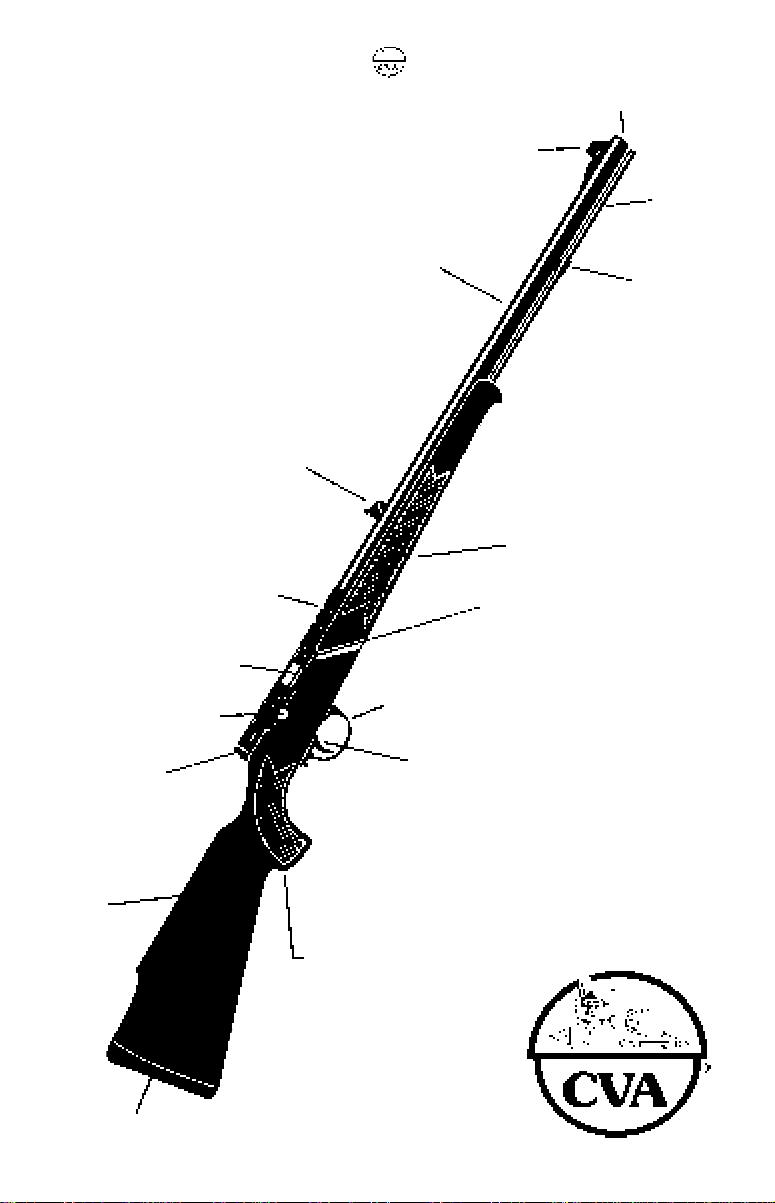
Main Components
Muzzle
of a
Conventional In-Line
Muzzleloading Rifle
Rear Sight
Drilled for
Scope
Bolt
Cocking Handle
Front Sight
Ramrod
Barrel
Thimble
Checkered Grip
Nipple (6x1mm Thread)
Oversized
Trigger Guard
Breech Cap
Stock
Butt Plate/Recoil Pad
Trigger Assembly
Checkered Grip
Page 5
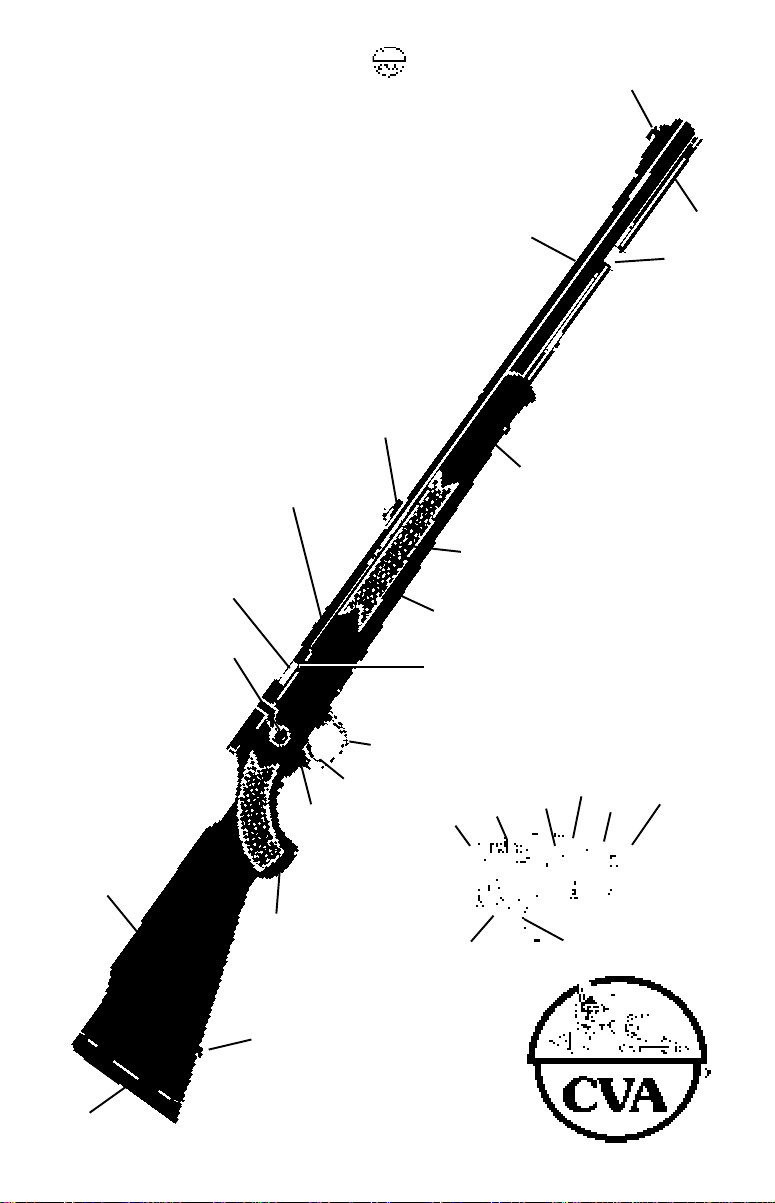
Main Components
of a
Bolt Action In-Line
Front Sight
Muzzleloading Rifle
Rear Sight
Stock
Bolt
Cocking
Handle
Trigger
Safety
Nipple (6x1mm Thread)
Trigger Guard
End
Cap
Checkering
Barrel Fixing
Screw
Bolt
Spring
Barrel
Forend
Striker
Bolt Action
Bolt
Nipple
Ramrod
Barrel
Band
Breech
Plug
Recoil
Pad
Butt
Stock
Pistol
Grip
Sling
Swivel
Stud
Safety
Trigger
Page 6

WARNING: It is important to take the time to read and understand the information found in this book. Familiarize yourself with each part of the firearm and its
proper function. The information contained in the book is critical for the proper
use and care of your firearm. DO NOT ATTEMPT TO LOAD OR FIRE YOUR
MUZZLELOADER UNTIL YOU HA VE READ AND UNDERST AND THE INFORMA TION DESCRIBED IN THIS BOOK.
All muzzleloading firearms, including In-Lines, are faithful to the original
basic designs. For this reason, blackpowder guns cannot be made with many
of the refinements and features that are standard on modem cartridge firearms. Shooters must remember that even now, despite the modern appearance of In-Line design rifles, there is no way to build a muzzleloader that absolves the user from the need to use the special safety precautions and good
judgement unique to all muzzleloading firearms. However, when handled properly, a muzzleloader is a safe and enjoyable firearm for shooting and hunting.
But, if abused, harmful consequences can result. Treat this muzzleloading firearm with the full respect due any firearm.
NOTE: If after reading the instructions, cautions, and dangers contained in this
manual, you are not willing to accept the responsibilities involved in the safe
handling and shooting of a muzzleloader, return the firearm in its entirety to the
place of purchase. If you have any questions about safe use of your CVA firearm, write or call our customer service department at 5988 Peachtree Corners
East, Norcross, Georgia 30071; (770) 449-4687; info@cva.com
If you sell, trade, or give this firearm to any other person - this owner’s
manual must accompany the firearm. Replacement books are available from
CV A.
A. INTRODUCTION TO IN-LINE MUZZLELOADERS
In-Line design muzzleloaders are so described due to the fact that the
ignition source (#11 percussion cap, musket cap or modern primer) is located
directly behind (or, in line with) the propellant charge. By contrast, with Sidelock
design muzzleloaders the ignition source is positioned to the side of the propellant charge.
Among In-Line design muzzleloaders, there are two distinct categories of
rifles which are differentiated by their cocking mechanisms. The first, and earliest design, is called CONVENTIONAL IN-LINE and features a straight-pull
cocking device. The second, and most recent design, is called BOL T ACTION
IN-LINE and utilizes a bolt action style cocking mechanism similar to that of a
modern center-fire rifle.
In the Conventional In-Line category, CVA offers two series of rifles —
Stag Horn and Eclipse. Stag Horn Series rifles are basic in design and incorporate a manual “notch” safety system. Eclipse Series rifles are offered with a
number of feature upgrades and all use an “automatic” safety system.
CVA has two series of Bolt Action In-Lines --- FireBolt™ 209 UltraMag
and HunterBolt™ 209 Magnum. FireBolt™ rifles are CV A’s top of the line Bolt
Action Design In-Lines and feature many upgrades, including Fiber Optic sights,
1
Page 7

bullet guiding muzzle, 26” barrel with fluting, ventilated recoil pad, resin filled
stock, and removable stainless steel bolt assembly. HunterBolt™ rifles are
CV A ’s more basic bolt action featuring Fiber Optic sights, bullet guiding muzzle,
and stainless steel bolt assembly and have fewer features that the FireBolt™.
All CV A bolt action In-Lines and any year 2001+ conventional in-lines (Eclipse
or Stag Horn) are capable of handling the heavier, multiple Pyrodex Pellet “magnum” loads. These “magnum capable” guns can be identified by the one-piece
barrel construction, a serial number ending in 01, 02, 03, and the designation
“magnum” on the barrel. Such “magnum” loads do require the use of a musket
cap or preferably the #209 shotgun primer ignition in order to fully ignite the
charge. The use of PowerBelt™ bullets is also recommended to provide a
perfect gas seal, eliminating gas blowby . Such “magnum” loads should never
be fired in CVA conventional In-Lines that do not feature the one-piece
Monoblock barrel design.
B. GETTING ST ARTED
1. Safety First - Verify gun is unloaded.
2. Assemble gun.
3. Check all functions.
4. Remove nipple (and breech plug if In-Line).
Clean and check opening.
Apply CVA breech plug/nipple grease or anti-seize compound to threads.
5. Clean barrel.
6. Replace and tighten breech plug and nipple until snug.
7. Read and study information booklet.
8. Understand terminology.
9. Get all questions answered
For Safety: CVA encourages that you take a certified hunter’s safety course
before using this muzzleloader or any other firearm. Consult your local Game
& Fish authorities or nearest sporting goods dealer for information on the courses
available.
C. TEN COMMANDMENTS OF FIREARM SAFETY
1. Keep the gun muzzle pointed in a safe direction and never pull it
towards you by the muzzle.
2. Be sure of your target and beyond.
3. Never rely on a gun's "safety".
4. Gun should be unloaded until ready to use.
5. Always wear eye and ear protection.
6. The barrel should be clear of obstruction before shooting.
2
Page 8

7. Handle every gun as if it is loaded.
8. Keep guns and ammo separate and in locked storage.
9. Avoid alcoholic beverages and drugs before and during using a firearm.
10. Do not alter or modify your firearm. Have your firearm checked regularly
by a competent gunsmith. Make sure all parts work properly.
Health Warning: Discharging of firearms in a poorly ventilated area and/or
handling of ammunitions may cause exposure to lead or lead compounds.
According to the state of California, exposure may cause cancer, birth
defects, or other reproductive harm. Make sure that you have proper
ventilation at all times. Be sure to wash hands thoroughly after shooting,
handling ammunition, or cleaning your firearm. Do not eat or smoke during
these activities.
D.
SAFETY CONSIDERA TIONS UNIQUE TO MUZZLELOADERS
1. Never smoke when shooting or handling a muzzleloader or related equipment. Ashes and/or loose sparks may cause powder or caps to ignite,
resulting in personal injury or death.
2. Always wear eye protection. Flying debris from the breech area is always
a possibility with any muzzleloader.
3. Never pour powder into a muzzleloader directly from a flask, horn or any
large volume, enclosed container. Hot embers in the barrel could cause
the container to explode.
4. All powder storage containers and percussion caps should be kept well
away from the area where shooting is to be conducted. Sparks from shooting could cause accidental ignition of these devices. Follow all manufacturers instructions for long term storage of powder and percussion caps.
5. Use only blackpowder, Pyrodex, Pyrodex Pellets (In-Line rifles only), or
other approved blackpowder substitutes in muzzleloading firearms. Never
use modern smokeless powder in a muzzleloader. The use of any
amount of smokeless powder in a muzzleloader will create dangerously high pressures upon ignition and may result in severe injury
or death to the shooter and/or bystanders.
6. Always check to ensure that your muzzleloader is in good working condition before use. Test the bolt and safety mechanisms carefully prior to
loading. Check the barrel for any obstruction as any blockage may cause
the gun to explode.
7. Use only recommended loading data for the particular model of rifle
in use. Different models have different powder charge and projectile
capabilities. Improper loading or overloading of a muzzleloading firearm may result in severe injury or death.
8. Never place a cap on the firearm until you are ready to fire. Cap should
always be removed when walking, climbing trees or fences, transferring
the gun from one person to another, leaving the gun unattended, etc.
9. Never lean or rest a loaded muzzleloader against a tree, wall, vehicle or
3
Page 9

other surface. Any fall of the loaded gun may cause accidental discharge
resulting in severe injury or death to bystanders.
10. Never transport a loaded muzzleloader in any type of vehicle. A muzzleloader is considered loaded until powder, bullet and percussion cap are
removed.
11. Never exchange a loaded muzzleloader with any other person. Only the
party who personally loaded or witnessed the loading of the muzzleloader
should fire it. This practice will help prevent overloading or doubleloading,
which may cause severe injury or death.
12. Never store a loaded muzzleloader. Muzzleloaders should be unloaded
and cleaned (including Bolt Assembly) prior to any storage.
13. Never load a muzzleloader without first making sure that it is unloaded.
14. Exercise extreme caution when hunting from treestands with muzzleloaders. The dropping of a loaded muzzleloader may cause accidental discharge leading to severe injury or death. Be sure the cap is removed
whenever raising or lowering the firearm.
15. Never allow the hammer or bolt of a muzzleloader to rest against the cap.
Any impact to the hammer or bolt could cause accidental discharge.
16. Never rely upon a mechanical safety. Muzzleloaders should always be
handled as if ready to fire, regardless of the safety systems employed.
17. Always use proper cleaning procedures. Firing improperly maintained
muzzleloaders may lead to unsafe pressure conditions, resulting in severe injury or death.
18. Make sure that the projectile is firmly seated against the powder charge.
“Short starting” of the projectile may cause the gun to explode.
19. Always keep the muzzle of the gun pointed in a safe direction while loading. Never lean over the muzzle while loading.
E. SPECIFIC CAUTIONS/RECOMMENDA TIONS FOR THE
USE OF CV A IN-LINE MUZZLELOADING FIREARMS
YOU ARE RESPONSIBLE FOR FIREARM SAFETY! As a gun owner, you
accept a set of demanding responsibilities. How seriously you take these responsibilities can mean the difference between life and death. There is no excuse for
careless or abusive handling of any firearm. At all times handle your muzzleloader
with intense respect for its firepower and potential danger.
Please read and understand all of the cautions, proper handling procedures,
and instructions described in this book before using your new CV A firearm.
Seek professional instruction to become familiar with muzzleloading firearms.
Qualified organizations such as local gun clubs, the National Rifle Association, the
National Muzzleloading Rifle Association, and state hunter education programs
offer approved courses which teach safe handling and hunting procedures. Muzzleloading firearms are different in function and safety features from modern firearms.
Because of these differences, exercise caution and skill in the use of muzzleloading guns. Read and understand the functions and terminology explained in this
4
Page 10

book before attempting to use your CV A muzzleloader .
1. When selecting powder loads be sure to use the correct loading data for
your particular model of CVA In-Line. All CVA Bolt Action In-Lines
(FireBolt™ and HunterBolt™ models) and conventional In-Lines featuring a one-piece MonoBlock barrel design (year 2001 and newer Eclipse
and Stag Horn models) are capable of handling a “magnum” charge of up
to 150 grains of Pyrodex Pellets. Any pre-2001 Eclipse or Stag Horn
models, which have a traditional 2-piece barrel, are rated for a maximum
powder charge of 100 grains. The use of “magnum” pellet loads in any
CV A rifle other than in-line models designated as “magnum” is not recommended.
2. “Magnum” loads for CVA in-lines are safe only when using Pyrodex Pellets. “Magnum” loads of loose blackpowder or Pyrodex are inefficient and
are not recommended. Only FireBolt™, HunterBolt™, and year 2001+
Eclipse and Stag Horn models are approved for Pyrodex Pellet loads in
excess of 100 grains.
3. Always follow recommended loading data when selecting bullet type and
weight. When using saboted bullets and Pyrodex Pellets, maximum bullet
weight should not exceed 300 grains. With loose powder loads, conical
lead bullets should never exceed 400 grains.
4. Always use Musket Caps and the CVA Musket Cap Nipple (AC1425) or
modern #209 Primer Ignition when firing multiple (2 or more) Pyrodex
Pellet loads. The extra fire to the charge ensures efficient burn of the
entire pellet charge.
5. Always use PowerBelt™ Bullets or saboted bullets when using Pyrodex
Pellets. Both provide the tight gas seal necessary for efficient burn of the
entire pellet charge.
6. For maximum accuracy when shooting saboted bullets, the barrel must
be cleaned of powder fouling and plastic residue after each shot.
PowerBelt™ Bullets do not require cleaning after every shot. Y ou can clean
every 4 to 5 shots without compromising accuracy.
7. When using multiple Pyrodex Pellet loads, actual bullet weight should not
exceed 400 grains. Heavier bullets may produce dangerously high pressure levels, possibly resulting in explosion of the gun and severe injury to
the shooter and bystanders.
8. Round ball and patch loads are not recommended for CVA In-Line rifles.
9. Never use modern smokeless powder, or any mix of smokeless powder ,
in muzzleloaders. Such improper loading of the rifle may result in the
explosion the gun, causing severe injury or death to the shooter and bystanders.
10. Never use “Poly Patch” in any CVA rifle.
5
Page 11

F. COMMON MISCONCEPTIONS REGARDING
MUZZLELOADERS
1. MISCONCEPTION:
IS REMOVED.
• As long as the barrel is loaded with powder and projectile the firearm is
loaded and must be treated as a loaded firearm.
2. MISCONCEPTION:
TWO.
• Misfire is the least understood condition and the leading cause of accidents - mainly because the condition is treated casually. When a misfire
occurs keep the muzzle pointed in a safe direction until the load has been
cleared from the barrel. Potentially dangerous misfires occur when the cap
or priming powder ignites, but the main powder charge fails to ignite. Possibilities are (1) a blocked or clogged vent (flash channel or touchhole), (2)
a contaminated (wet or oily) main powder charge or (3) no main powder
charge. Wait a few minutes, then recap or reprime and try again to shoot
out the load. When several attempts fail, remove the projectile by using an
approved method described in number 3.
3. MISCONCEPTION:
• Pulling a projectile is dangerous when there is a powder charge behind
the projectile. Four approved methods to remove a projectile from the barrel are to: (1) Use a CO2 discharger to blow the projectile from the barrel;
(2) Remove the percussion nipple from the breech plug and work powder
into the flash channel. Replace the nipple, recap and discharge; or (3)
Remove the nipple and place the barrel's breech in eight inches of water to
soak (deactivate) the main powder charge (for about an hour) before pulling the projectile; (4) With the muzzle in a safe direction, remove the barreled action making sure that the percussion cap (and any excess fulminate) is removed from the nipple. Remove the bolt, nipple and breech plug
(see page 13 & 14). Empty the powder into a safe container. Using the
ramrod and cleaning jag with a solvent soaked cleaning patch, push the
bullet from the breech forward and out the muzzle of the barrel.
A MUZZLELOADER IS UNLOADED AFTER THE CAP
A MISFIRE WILL NOT FIRE AFTER A MINUTE OR
PULLING A PROJECTILE IS A SAFE PRACTICE.
4. MISCONCEPTION:
BLOW DOWN THE BARREL TO CLEAN OR CLEAR THE
VENT AND EXTINGUISH HOT SP ARKS OR EMBERS.
• Blowing down the barrel is hazardous. Keep all parts of the body away from
the muzzle at all times. Point the muzzle only at the intended target.
G. BASIC ACCESSORIES FOR A MUZZLELOADER
1. LOADING ACCESSORIES
Propellant - Blackpowder or acceptable substitute such as Pyrodex or Pyrodex
Pellets. NEVER USE SMOKELESS POWDER.
Projectile - Balls, bullets, sabots
Ignition Source - Percussion Cap, Musket Cap, or Modern 209 Primer.
6
Page 12

Flask - To transport and dispense powder
Powder Measure - To measure correct powder charge
Bullet Starter - To "start" bullet down the barrel
Capper - To carry and dispense percussion caps
2. CLEANING ACCESSORIES
Solvent - Cleaning solution
Patches - For cleaning inside of barrel
Nipple Wrench - For installing and removing nipple
Jag - Retains cleaning patch on end of ramrod
3. OTHER NEEDED ACCESSORIES
Bullet Puller - For removing lodged bullet.
Patch Puller - For removing lodged patches.
Preloaders - To hold premeasured powder charge and bullet for quick
reloading.
H. BLACKPOWDER, PYRODEX AND CLEAN SHOT
WARNING: Many manufacturers, including CVA, are now promoting guns which are
designed to shoot heavier than standard powder charges. Some shooters have become
confused by advertising for these rifles and attempt to use heavier charges and/or projectiles in guns which were not designed to handle the resulting high pressures. Even
some experienced shooters have made this mistake. Some have even used what is
known as a "duplex load," which is a mixture of blackpowder and smokeless powder.
Any percentage of smokeless powder in a duplex load may create pressures equal to a
pure smokeless charge and could cause a blackpowder gun to explode. THESE LOAD-
ING PRACTICES ARE EXTREMELY DANGEROUS! All shooters need to be completely clear as to the recommended loads of each blackpowder gun that they own.
Only four types of propellant are acceptable for use in CVA muzzleloading firearms.
The first type is BLACKPOWDER. (IMPORTANT: The term "blackpowder" refers to
the formulation of the propellant, not the color. Many of the smokeless propellants manufactured for modern cartridges or shotgun shells are also black in color,
but will create extremely dangerous pressures in the muzzleloading barrels.)
When purchasing blackpowder be certain that it is in the original manufacturer’s
container and that the granulation or type is clearly marked on the label.
Blackpowder is manufactured in four specific types or granulations. The accompa-
nying chart will help identify the types and common usage.
BLACKPOWDER CHART SHOWING APPROXIMA TE USE OF THE V ARIOUS
GRANULA TIONS…
FG (Commonly called Single “F”) The muzzleloading enthusiast finds
little use for this very coarse blackpowder. Its use is pretty much
restricted to the large bore (10, 8, 4 gauge) shotguns of yesterday .
FFG (Commonly called Double “F”) This is a very popular powder for
the larger (.45 to .58 caliber rifles). It is also used for 12, 16 and 20
gauge muzzleloading shotguns. While it is not considered a pistol
7
Page 13

powder, it is sometimes used in very large caliber single shot pistols.
FFFG (Commonly called Triple “F”) It is used in all percussion revolvers,
most single shot pistols, and most of the smaller (under .45 caliber) rifles.
FFFFG (Commonly called Four “F”) The finest of all currently available
blackpowders, Four “F” is best for priming flintlocks. Due to its limited use, it is sometimes difficult to obtain.
The second type of propellant acceptable for use in CVA muzzleloading
firearms is PYRODEX. Pyrodex is a propellant designed for use in percussion
rifles, pistols and shotguns found to be in good shooting condition by a competent gunsmith. Pyrodex relates closely to blackpowder on a volume to volume
basis, not the weight of the charge. In other words, a scoop type measure set to
dispense 100 grains of blackpowder will dispense roughly 72 grains of Pyrodex
(Pyrodex is bulkier). This lighter charge weight of Pyrodex will fill the measure
and provide a charge which is ballistically similar to 100 grains of blackpowder
of the appropriate granulation. Used in this manner, Pyrodex will yield approximately the same velocities and pressures as blackpowder. Pyrodex is currently
available in three granulations. These types and their uses are listed below:
PYRODEX RS (rifle & shotgun) Designed for use in all calibers of
percussion muzzleloading rifles and
shotguns. Pyrodex Select has similar loading characteristics to RS.
PYRODEX P (pistol powder) Designed for use in percussion
muzzleloading pistols and cap &
ball revolvers. Also used in small
caliber rifles.
PYRODEX CTG (cartridge powder) Designed for use in blackpowder
cartridges. This powder is not suited
for use in muzzleloading firearms.
The third type of propellant acceptable for CV A In-Line rifles is PYRODEX
PELLETS.
Pyrodex Pellets for .50 caliber come in two grain equivalents (as of this
printing 1/01) – 50 grains and 30 grains. Pellets may be combined into multiple
pellet loads to create several different grain equivalent loads. Pyrodex pellets
are available in 60 grain equivalents for .54 caliber in-line rifles. For .45 caliber
CVA In-Line rifles, .44 caliber Pyrodex Pellets are recommended. These are
available in 30 grain increments only .
Pyrodex Pellets contain a black ignitor on one end. For best ignition, this
ignitor end of the pellet should be placed into the barrel first.
When using Pyrodex Pellets in CVA In-Line rifles the Musket Cap or 209
primer ignition system is recommended. This system provides the hotter flash
necessary to ensure efficient ignition of the entire pellet charge.
Pyrodex Pellets are the only propellant which can be used to create
“magnum” loads for CV A “magnum” capable in-line rifles. CV A “magnum”
capable rifles include all bolt action in-lines and any year 2001+ Eclipse
8
Page 14

and Stag Horn models. These “magnum” capable” guns can be easily
identified by the one-piece barrel construction, a serial number ending in
01, 02, 03, and the designation “magnum” on the barrel. Such “magnum”
loads do require the use of a musket cap or preferably the #209 shotgun
primer ignition in order to fully ignite the charge. Such “magnum” loads
should never be fired in a CVA conventional In-Lines that do not feature
the one-piece Monoblock barrel design.
The fourth type of propellant acceptable for CV A rifles is Clean Shot. Clean
Shot is a propellant designed for use in percussion rifles, pistols, and shotguns
found to be in good shooting condition by a competent gunsmith. Clean Shot
relates closely to blackpowder on a volume-to-volume basis, not the weight of
the charge.
Clean Shot FFG Black Powder Replacement Designed for use in all cali-
bers of percussion muzzleloading rifles and shotguns.
Clean Shot FFFG Black Powder Replacement Designed to be used in
percussion muzzleloading
pistols and cap & ball revolvers.
Clean Shot Pelletized Powder Designed for use in .50
caliber and larger in-line
rifles with musket cap or
#209 ignition. Available in
both 30 grain and 50 grain
equivalents.
I. PROJECTILES
The CVA catalog and warranty book list a variety of conical bullets, including
PowerBelt™ Bullets, as well as saboted bullets that are proper for use in our
firearms. CV A ’s PowerBelt™ Bullets are the recommended projectile for use in all
CV A rifles featuring a 1:48 twist or faster including all CV A in-line rifles. CVA bore
diameters and bullet diameters have been carefully designed to provide a safe
optimum result when used with our recommended powder charges and projectiles
in the appropriate caliber.
DO NOT USE OVERSIZED CONICAL BULLETS IN YOUR CVA GUN. CVA
rifles are designed for use with bullets or sabots (not to be confused with PolyPatch) and most conical bullets. Some extremely large conical bullets cause
very high pressures due to poor fit to bore diameter, improper gas seal and
excessive mass. The use of any conical bullet over 400 grains or saboted bullet
over 300 grains in a .50 caliber rifle could cause barrel damage resulting in a
non-warranty repair situation.
NOTE: MUZZLELOADING PROJECTILES MUST BE MADE FROM PURE LEAD. LINOTYPE OR WHEEL
WEIGHT LEADS CONT AIN ANTIMONY WHICH CREATES AN EXTREMEL Y HARD, OVERSIZED PROJECTILE AND IS VERY DIFFICULT TO LOAD.
9
Page 15

CVA does not recommend the use of non-CVA projectiles for CVA rifles.
This is due to the fact that CVA has no control over projectile bullet molds or
saboted bullets sold and marketed by other manufacturers. Some projectiles
produced by other manufacturers, especially saboted bullets, can produce high
barrel pressures creating unsafe conditions. If you have questions concerning
the correctness of a component contact the CVA customer service department
at 5988 Peachtree Corners East, Norcross, Georgia 30071; 770-449-4687 or
fax 770-242-8546, or visit us on the web at CVA.com or E-mail us at
info@CV A.com.
1. CVA POWERBELT™ BULLETS - CVA
PowerBelt™ Bullets are conical projectiles with
a plastic base. The base or “belt” provides a
perfect gas seal, eliminating accuracy robbing
A
B
C
blow-by . Like sabots, the PowerBelt™ Bullet’s
patented snap-on base creates a perfect gas
seal, providing consistent pressures and unsurpassed accuracy. But unlike sabots,
PowerBelt™ Bullets are easy to load and do
Figure 1
not require cleaning after every shot. And they are full caliber sized, so
you get the most knock down power possible out of a muzzleloader.
PowerBelt™ Bullets are available in .45, .50, and .54 calibers, copper
coated or pure lead, with hollow points or AeroTips, and in a variety of
grain weights. They are the #1 selling muzzleloading bullet on the market
and the only bullet recommend for CVA in-line rifles. ( Figure 1-A)
2. CONICAL BULLETS—such as the CVA Buckslayer™ Bullet, Buffalo Bullet,
Maxi-Ball and others of this type provide superior accuracy in all CVA firearms as well as increased knock down power desired by hunters. These
projectiles are best suited for use in fast twist rifling barrels which stabilize
the bullet more rapidly. They will also yield excellent accuracy in the slower
twist models. (Figure 1-B)
3. SABOTED BULLETS—Modern sabots from various manufacturers have
been tested and provide acceptable accuracy in CV A firearms when complying with the sabot manufacturer’s recommendations for usage. Because other
manufacturers tolerances vary beyond the control of CV A, different brands
of sabots may have varying diameters. Therefore, when using sabots other
than CVA, the shooter must determine that the sabot in use is not of too
large a diameter for the CV A barrel. Saboted bullets of 300 grains weight
or less are required when using Pyrodex Pellets as a propellent. When
shooting sabots, cleaning between shots is recommended if maximum accuracy is to be maintained. (Figure 1-C)
Loads for conical bullets and sabots should not exceed the maximum load
recommended in T able 1.
J. RECOMMENDED LOADING DAT A
The proper charge for any muzzleloading firearm is an efficient load which
provides consistent ignition and velocity while keeping breech pressures below
the maximum safe levels.
10
Page 16

The shooter should load using the minimum and maximum charge limitations shown in the table below. It is recommended to begin shooting using a
charge in the middle of the recommended range, gradually increasing or decreasing the load to obtain the desired results. Tests have shown that heavier
loads increase breech pressures while providing only a minor increase in velocity . These tests also indicate that heavier loads may be less accurate.
T ABLE 1
CALIBER PROJECTILE CHARGE CHARGES IN GRAINS
FIREARM TYPE TYPE MINIMUM MAXIMUM
.50 .50 Conical Powder FFG 50 100
.54 .54 Conical Powder FFG 60 120
.50
.54
.50
.54
.50
.50 PowerBelt™/Sabot
.54 PowerBelt™/Sabot
.50 PowerBelt™/Sabot
.54 PowerBelt™/Sabot
.50 PowerBelt™ / Sabot
Powder FFG 50 100
Powder FFG 60 120
Pellet 50 100
Pellet 60 120
"Magnum Pellet" 100 150*
*WARNING: This is a “Magnum” charge and can only be safely loaded in magnum capable rifles. Magnum capable rifles include all CVA Bolt Action in-lines
(FireBolt™, MagBolt™, and HunterBolt™) and any year 2001+ Eclipse and
Stag Horn rifles. These “magnum capable” guns can be identified by the onepiece barrel construction, a serial number ending in 01, 02, 03, and the designation “magnum” on the barrel. Such “magnum” loads do require the use of a
musket cap or preferably the #209 shotgun primer ignition in order to fully ignite
the charge. Such “magnum” loads should never be fired in CVA conventional
In-Lines that do not feature the one-piece Monoblock barrel design.
K. LOADING AND SHOOTING CVA IN-LINE
MUZZLELOADERS
ATTENTION: Many manufacturers, including CVA, are now promoting guns
which are designed to shoot heavier than standard powder charges. Shooters
may become confused by advertising for these rifles and attempt to use heavier
charges and or projectiles in guns which were not designed to handle the resulting high pressures. Even some experienced shooters have made this mistake! Some have even used what is known as a "duplex load," which is a mixture of blackpowder and smokeless powder. Any percentage of smokeless powder in a duplex load may create pressures equal to a pure smokeless charge
and could cause a blackpowder gun to explode. THESE LOADING PRAC-
TICES ARE EXTREMELY DANGEROUS! All shooters need to be completely
clear as to the recommended loads of each blackpowder gun that they own.
1. Wear shatterproof shooting glasses and ear plugs or muffs to protect your-
self from sparks, bits of fragmented caps, and hearing loss.
11
Page 17

2. Verify the rifle is not loaded.
a. Place ramrod down the barrel to breech plug and mark ramrod a t the
muzzle.
b. Remove ramrod and lay along outside of barrel, lining up mark at muzzle.
c. The end should be at the base of the breech plug. If rod does not line up,
assume the rifle is loaded and that it should be disarmed before proceed-
ing.
3. Check to make sure that breech plug and nipple are snugly screwed into
place. Do not overtighten.
4. Pulling the bolt to the rear with Eclipse Rifles will engage the trigger safety
(all other CV A models require the manual setting of the safety mechanism
to the "safe" position). Insure the trigger does not release the bolt.
5. Clean all oil and grease from barrel interior.
6. With the rifle pointed in a safe direction, place a percussion cap on the nipple or
a 209 primer into the breech plug (if rifle has been adapted for 209 usage).
CAUTION: Use a capper to place cap on the nipple as percussion caps are sensitive to pressure and
can explode under extreme finger pressure.
7. Release the safeties and fire cap or Modern 209 Primer to insure bore and
nipple are dry of solvent or moisture. Repeat minimum of three (3) times if
using caps. NEVER DRY FIRE ANY CVA RIFLE. DOING SO WILL DAM-
AGE BOL T ASSEMBL Y AND/OR NIPPLE AND WILL NOT BE COVERED
UNDER WARRANTY.
Figure 2
Figure 3
8. Pour powder from flask into a powder measure that is set for correct powder charge (See Figure 2).
9. With the muzzle pointed “up” and no part of your body extended over the gun,
pour a measured charge or drop the correct number of Pyrodex Pellets
down the barrel. (See suitable charges–Table 1, Page 9)(See Figures 2 and
3).
12
Page 18

CAUTION: Do not pour a charge directly from horn or flask. If a smoldering ember is present, it could
ignite the powder in the container, as well as the powder charge, as it is poured into the barrel. This
excessive amount of powder could cause a dangerous explosion. Therefore, be safety minded; use a
powder measure.
10. If using loose powder, slap side of barrel in front of receiver. This will help
insure that powder will fully enter the breech and nipple area.
11. For Lubricated Bullets, PowerBelt™ Bullet or Saboted Bullet:
a. Make sure bullet is lubricated. PowerBelt™ Bullets and Saboted Bul-
lets should require no additional lubrication.
b. Start the projectile into the bore with your fingers, making sure it is
centered.
c. Use short end of bullet starter to press bullet just into muzzle. (See
Figure 5).
12. Use longer end of ball starter to move projectile about six inches down the
bore. (See Figure 6).
13. With ramrod, push projectile down on top of powder , firmly , but without crushing the powder or Pyrodex Pellets. (See Figure 7).
Figure 5
Figure 6
Figure 7
CAUTION: When using the ramrod, never grab it more than 8 inches above the muzzle. To do so could
cause a side stress; break the ramrod; and possibly puncture your hand.
13
Page 19

IMPORT ANT: Be sure projectile is seated firmly against powder. No air space
should exist between projectile and powder .
14. WITH GUN POINTED IN SAFE DIREC-
TION and bolt locked to the rear, place a
percussion cap on nipple or 209 primer into
the breech plug (if rifle has been adapted
for 209 usage). THE GUN IS NOW
LOADED.(See Figure 8).
15. Release the safety and YOU ARE READY
TO FIRE.
Figure 8
16. Aim at target. Squeezing trigger will cause
the bolt to fall on cap and the gun will fire.
17. After firing, wait one minute to reload. This allows all remaining sparks in barrel
to burn out prior to reloading.
18. If a misfire or failure to fire occurs, wait at least one minute with the gun pointed
at the target.
a. Install a new percussion cap on the nipple. Be certain of the target and
fire.
CAUTION: Wait at least one minute with gun pointed at target if misfire or failure to
fire occurs.
b. Never attempt to shoot out a projectile which is not firmly seated against
powder charge. The ball and powder charge should be removed using a
ball puller. See Section P, Removing A Charge.
c. Go back to Step 1 and repeat, being sure bore and nipple are clean and
free of obstructions and moisture.
L. IGNITION SYSTEM OPTIONS
1. STANDARD #1 1 IGNITION SYSTEM – This is the original ignition source
for all CVA In-Line rifles. It is suitable with the use of blackpowder or
Pyrodex powder only .
2. MUSKET CAP IGNITION SYSTEM – The CVA musket cap nipple en-
ables the shooter to use Musket Caps in their In-Line guns. Musket Caps
deliver approximately 3 times the flash to the charge than standard #1 1
percussion caps. Musket caps are suitable with use of loose powder and
are recommended when using Pyrodex Pellets.
3. #209 SHOTGUN PRIMER IGNITION SYSTEM – Accepts modern #209
shotgun primers. This ignition source can be used in CVA Bolt action
rifles and in all year 2000 and beyond In-Line rifles. The shotgun primer
14
Page 20

is the most reliable in foul weather and is suitable for use with loose
powder or Pyrodex Pellets.
NOTE: All FireBolt™, HunterBolt™, MagBolt™, and Eclipse rifles manufactured after January 1, 2000 are equipped with a 3-Way ignition system, allowing the use of any of the three ignition options. All 2001 model
Stag Horn rifles are equipped with the #209 ignition as the primary and
only ignition system
M. SAFETY SYSTEMS
WARNING: Never rely on any mechanical safety.
1. All Eclipse Series rifles are equipped
with an Auto Safety . The automatic trigger safety is located at the rear of the
trigger guard. This safety is designed to
automatically engage each time the bolt
falls forward. To disengage the safety,
press the safety button to the rear. Green
indicates safety-on, red is safety-off (Figure 9).
2. All Staghorn Series rifles are equipped
with a manual safety . The manual safety
is engaged by pulling the bolt to the
rear until it locks in position; then simply flip the cocking bolt upward until it
engages the breech notch. The gun will
then be on "safe". To disengage the
safety, flip the locking bolt down into
the cocked or "fire" position (Fig. 10).
3. All Firebolt™, MagBolt™ and
HunterBolt™ Series bolt action rifles
are equipped with a trigger blocking
safety , which is located behind the trigger guard. This safety should not be
confused with the automatic safety
found on Eclipse series rifles. The
safety should manually be engaged to
the forward (green) position for safe
setting (Fig. 11).
➔
Automatic Safety Figure 9
➔
Manual Notch Safety Figure 10
➔
Trigger Blocking Safety Figure 11
15
Page 21

N. CONVENTIONAL IN-LINE DISASSEMBL Y/ASSEMBL Y FOR
CLEANING AND MAINTENANCE. (FIGURE 12)
NOTE: Before beginning this procedure make
sure gun is unloaded. (See Step 2 of Section
K).
1. Remove ramrod from gun.
2. Loosen and remove the hex screw from
the underside of the stock.
3. Remove the barrel/receiver assembly
from the stock.
4. Unscrew and remove the cap at the rear of the receiver. Percussion bolt
should be in the uncocked position prior to unscrewing cap.
5. Remove the bolt spring(s).
6. Unscrew the handle from the percussion bolt by twisting counter clockwise. NOTE: Some models have a handle that is retained by a spring
and does not require unscrewing before removal.
7. While depressing the trigger, remove the bolt by sliding out through the
rear of the receiver.
8. Remove the nipple and breech plug for cleaning by engaging the nipple
with the specially supplied nipple wrench and turning in a counter-clockwise motion.
9. The breech plug is removed with the tool supplied. The slotted end
removes the nipple. The screw driver end removes the breech plug.
The steel rod slides through the tool acting as a handle. IMPORTANT-
LUBRICATE BREECH PLUG AND NIPPLE THREADS WITH CVA
BREECH PLUG/NIPPLE GREASE (OR AN ANTI-SEIZE COMPOUND)
BEFORE REINST ALLING.
10. Clean barrel according to instructions found in General Cl eaning and Maintenance Section (Section P). After each session it is critical to take apart
trigger and bolt assembly and clean thououghly , especially when using
moder 209 primers.
11. Do not attempt to disassemble the trigger assembly . Clean as a one-piece
unit.
12. Avoid prolonged exposure to water or solvents when cleaning wood stock
guns. Damage to the finish could result. Treat with good quality stock wax
or polish to preserve finish and protect from weather damage.
13. Reassemble the rifle by reversing the order of disassembly. NOTE: On
Stag Horn Series/Manual Safety Models make sure that spring tip is
inserted into small hole in back of bolt.
Figure 12
16
Page 22

14. Preparation Before Loading
a. Insure no obstructions are present in the barrel.
b . Insure barrel is clean and dry before loading. Fire several caps through
the rifle before loading powder to eliminate any moisture or solvent remaining in the barrel.
c. Insure bolt locks in place to the rear and be certain safety is engaged.
Insure the trigger does not activate the bolt before placing a percussion cap on the nipple.
DO NOT ATTEMPT TO USE THIS RIFLE IF ANY OF THE SAFETY MECHANISMS DO NOT OPERATE PROPERLY. CHECK WITH A COMPETENT GUNSMITH TO CORRECT THE PROBLEM, AS ACCIDENT AL FIRING MA Y RESUL T .
NOTE: CHECK BREECH PLUG FOR SNUG FIT WITH THE BREECH
WRENCH. ATTACH THE WRENCH FROM THE REAR OF THE RECEIVER.
TURN CLOCKWISE.
O.
BOLT ACTION DISASSEMBLY/ASSEMBLY AND CLEANING
1. Check to ensure gun is unloaded.
2. Open bolt handle up and slide toward the rear
of the barrel. Once the bolt is open and in
the rear position, place slight downward pressure on the bolt handle and continue sliding
out of the receiver. The entire bolt assembly
should now be separated from the receiver.
3. Using the allen wrench supplied with the gun,
remove the bolt cap. The spring, striker, bolt
Figure 13
handle, and bolt body will now come apart. (Fig. 13)
4. Clean all parts with toothbrush and solvent. It is critical to take apart
the bolt assembly and clean thoroughly, especially when using
modern #209 primers.
5. Dry all parts thoroughly and lubricate with gun oil.
6. Reassemble bolt body , bolt handle, striker, and spring. (Fig. 14)
7. Move bolt handle to uncocked position. (Fig. 15)
8. Place the bolt cap back over the spring.
While pressing the spring downward,
screw the bolt cap on to the bolt body.
9. Holding the bolt cap securely with the
allen wrench, twist the bolt handle
counter clockwise to the cocked position.
10. Follow steps 1-3 of section N to remove
barrel from stock.
17
Figure 14
Page 23

11. Follow steps 9-14 in section N.
12. Return bolt to receiver.
P. GENERAL CLEANING AND MAIN-
TENANCE
Blackpowder and Pyrodex are very corrosive. Therefore, careful cleaning of your muzzleloading firearm is extremely important. If left
uncleaned for any length of time the fouling will
cause rust, pits, and degradation of the metal particularly around threaded areas.
The barrel attaching system on most CVA firearms allows for the barrel to be
removed for easier cleaning without disassembly. The recommended cleaning
procedure for In-Line CV A rifles follows.
NOTE: Before beginning this procedure make sure gun is unloaded. (See Section
K, Step 2).
1. Remove the barrel from the stock.
2. For thorough cleaning, disassemble gun as instructed in section N or O,
carefully cleaning all bolt assembly components. For quick cleaning leave
Breech Plug and bolt assembly in and clean the barrel while still assembled.
3. Attach a cleaning jag to the ramrod.
4. Push a solvent saturated patch down the muzzle with the ramrod.
5. Pump the rod and patch up and down in the barrel. HELPFUL HINT: The
nipple should always be removed for cleaning.
6. Replace cleaning patches as often as needed until barrel is clean of all signs
of fouling.
7. When completed, wipe off all excess solvent and dry barrel thoroughly.
8. Clean fouling on the stock and exterior parts by wiping with an oily cloth.
9. Oil the barrel inside and out well and reassemble the firearm.
*All oils should be natural; NO PETROLEUM PRODUCTS.
Figure 15
Q. REMOVING A CHARGE
Under normal conditions a muzzleloading firearm is unloaded simply by firing it
into a suitable and safe backstop. There are, however , some conditions under which
the firearm cannot be fired and the charge must be removed.
18
Page 24

THE TWO MOST COMMON CONDITIONS ARE AS FOLLOWS:
1. If the projectile is not seated firmly against the powder charge, stop immedi-
ately! Do not attempt to fire the rifle. You must remove the charge and clean
the barrel.
2. If the rifle is loaded in a proper manner yet fails to fire after repeated
attempts (as explained in the “Loading and Shooting” Section).
NEVER A TTEMPT TO PULL A CHARGE UNTIL THE POWDER HAS BEEN RENDERED INERT (DEACTIV A TED) BY THOROUGHL Y SOAKING IN WATER.
Removing a projectile is dangerous when there is a powder charge behind the projectile. Four approved methods to remove a projectile from the
barrel are to: (1) Use a CO2 discharger to blow the projectile from the barrel; (2)
Remove the nipple from the breech plug and work powder into the flash channel. Replace the nipple, recap or reprime to discharge; or (3) With the muzzle in
a safe direction, and the percussion cap (and any excess fulminate) removed
from the nipple, remove the bolt, nipple and breech plug (see section M, N).
Empty the powder into a safe container. Using the ramrod and cleaning jag
with a solvent soaked cleaning patch, push the projectile from the breech forward and out the muzzle of the barrel.
After the projectile has been removed from the bore, clean the bore, barrel
and parts as explained in the “Cleaning” section and reassemble the firearm.
If for any reason you are unable to remove the charge in the manner recommended, soak the barrel in very hot water for one-half hour. Once the powder has
been rendered inert, take the barrel to a qualified gunsmith.
R. SIGHT ADJUSTMENTS
Most CVA rifles are equipped with adjustable style rifle sights for windage and
elevation.
1. Adjust the rear sight for elevation by loosening the retaining screw and slid-
ing the sight up the ramp to raise the point of impact or down the ramp to
lower the point of impact.
2. Adjust the rear sight for windage by loosening the retaining screw so that
sight will slide to the left or right. To move the point of impact to the right,
move rear sight to the right. To move the point of impact to the left, move
rear sight to the left.
19
Page 25

S. SCOPE MOUNTING
CV A In-Line rifles are drilled and tapped for easy scope installation. Do not drill
additional holes in the barrel as this could weaken its structure and contribute to
a rupture, causing injury and/or death to yourself and others. Scopes should be
mounted according to manufacturer’s instructions. CVA ’s Rapid Remount Scope
Mount System™ (AC1655) allows the shooter the option of a quick detachable
scope mounting system, that returns to the zero point when reinstalled.
T. SIGHTING IN A SCOPED RIFLE
1. Safety first - Gun unloaded.
2. Scope mounted and bore sighted.
3. Load gun.
4. Start at 25 yards. Shoot three shot group.
5. Adjust scope to center of group. Should be 1" high at 25 yards to be zero at
100 yards.
6. Clean gun.
7. Repeat process of 3 shot group until sighted-in. Check at 50 and 100 yards.
U. STATEMENT OF LIABILITY
This gun is classified as a firearm or dangerous weapon and is sold by us with
the express understanding that we assume no liability for its resale and unsafe
handling under local laws and regulations. Connecticut Valley Arms assumes no
responsibility for physical injury or property damage resulting from intentional or
accidental discharge, or the function of any gun subject to influences beyond our
control. We will honor no claim which was the result of careless or improper handling, unauthorized adjustment, improper loading, use of improper powder or components, corrosion or neglect.
For your protection, examine this firearm carefully at the time of purchase. If
any unsafe condition exists contact your dealer or CV A immediately .
Connecticut Valley Arms does not recommend or approve of any custom alteration or conversion. Firearms subjected to alteration are not covered by factory
warranty. Responsibility for these alterations rests totally with the individual performing such work. Any such work done improperly or without proper judgement
may cause malfunction or damage resulting in injury or death to the shooter and/or
bystanders.
V. VOLUNT ARY RECALL
In August 1997, CVA implemented a V oluntary Recall of all In-Line rifle
models with serial numbers ending in 95 or 96. If you have a CVA In-Line
20
Page 26

model with such a serial number do not use or allow anyone else to use the
gun. If you have one of these rifles, call CVA immediately at 770-449-4687
for complete details and a replacement barrel.
In May 1999, Blackpowder Products, Inc. purchased the assets of Connecticut V alley Arms, Inc. and now operates under the trade name of Connecticut V alley Arms and/or CV A. Any claims relating to the above described
Voluntary Recall should be addressed to Connecticut V alley Arms, Inc., not
Blackpowder Products, Inc. Blackpowder Products, Inc. assumes no liability for any products manufactured or sold prior to January 1, 1998.
W . SERVICE – (770) 449-4687 MON-FRI 8:30 - 4:00 PM EST
Should your CV A firearm require repair , we recommend that it be returned to
our factory. This will insure all work is performed by a competent staff of trained
technicians.
Any firearm returned to the factory should be marked to the attention of Repair Department. A letter of instructions should be enclosed to facilitate handling.
Please be sure to include name, address and phone number. All firearms must
be un loaded and shipped via United Parcel Service (UPS).
Our Service Department will inspect and evaluate the problem. Should any
work required not be covered by warranty , you will be advised of the cost. No work
will be done without your approval.
X. ORDERING INSTRUCTIONS FOR REPLACEMENT PARTS
1. All correspondence and orders must be addressed to:
CV A
5988 Peachtree Corners East
Norcross, GA 30071
Attention: Customer Service
2. Include in the order:
Model of Gun
Part Number
Part Description
Caliber and T ype (Percussion, Flintlock)
3. If the proper part identification is not possible from the parts list, send the
specific part in question to aid identification.
4. Discontinued items are subject to availability. CVA will reserve the right to
make compatible substitutions when necessary .
5. Enclose the total retail price of the item plus postage and handling. Refer to
the chart to determine this.
6. Please allow four to six weeks from receipt of order for delivery .
21
Page 27

POST AGE & HANDLING CHART
Orders T otaling: Add
UP TO $20.00.......................................................................................... $3.50
$20.01 - $30.00........................................................................................ $5.00
$30.01 - $50.00........................................................................................ $7.00
$50.01 - $80.00...................................................................................... $10.00
$80.01 - $110.00.................................................................................... $15.00
$110.01 - $200.00.................................................................................. $20.00
$200.01 - $500.00 .................................................................................$25.00
OVER $500.00 ....................................................................................... $30.00
Georgia residents must add 6% sales tax.
LIMITED LIFETIME W ARRANTY
Connecticut Valley Arms (CVA), warrants all factory finished firearms to be
free of defects in material or workmanship, for the lifetime of the firearm, to the
original consumer owner. This warranty is established by return of the authorized
warranty card within fifteen (15) days of purchase, and is not transferable.
Any CVA firearm or part thereof returned postage paid to the address below
will be repaired or replaced to our commercial standard, free of charge, and returned to the purchaser postage prepaid.
This warranty does not cover any damage resulting from careless handling,
improper loading, corrosion, neglect, or customer alteration. Nor does it cover normal wear of any part, metal or wood finish, cost of inconvenience due to product
failure, or transportation damage.
Connecticut V alley Arms reserves the right to refuse to repair or replace firearms or parts thereof damaged by the above. This warranty does not apply to “kit”
models. While CVA does guarantee quality and workmanship of the parts contained in each kit, we have no control over final finishing and assembly of these
products. Therefore, no responsibility for construction or use of kit models is implied or assumed. Any part determined, by our inspection, to be faulty will be replaced free of charge.
This warranty gives you specific legal rights. You may also have other rights
which vary from state to state.
This warranty is void if:
• Any propellant other than the correct type blackpowder or Pyrodex has
been used.
• CVA recommended powder charge has been exceeded.
• Any form of plastic patch has been used. (modern day sabots not included)
• Any attempt has been made to remove barrel from receiver.
Address all inquiries and correspondence to:
Connecticut V alley Arms
5988 Peachtree Corners East
Norcross, GA 30071
22
Page 28

NOTES
23
Page 29

NOTES
24
Page 30

Connecticut Valley Arms
5988 Peachtree Corners East
Norcross, Georgia 30071
FORM 103
REV . 01/01
 Loading...