

Page 1

Tiziano
OVEN
Use and maintenance manual
TZ 230
TZ 420
TZ 425
TZ 430
TZ 435
Page 2

2
Page 3

Introduction
Contents
We congratulate you for choosing a product designed and
manufactured with cutting-edge technology.
The oven is checked and tested in the Manufacturer’s plant
before being delivered to the customer.
The “production process check sheet” enclosed with it
guarantees that each step in the production process, from
assembly to packaging, was carefully checked from both the
operating and safety standpoints.
Before the installation, read the content of this manual
carefully: it contains important information regarding product
assembly and safety regulations.
The foundation
Our company was founded in 1963 by the Lorenzo, Luigi and
Paolo Cuppone brothers. It immediately specialized in the
production of ovens and equipment to prepare and cook pizza.
The constant research and experimentation of new equipment
that are even now the strength of our company, have led us
to design and patent the machinery and ovens that have
revolutionized the way pizza is made.
Technical service
Your Dealer can solve any technical problem regarding use and
maintenance.
Do not hesitate to contact him in case of doubt.
CUPPONE 1963
Cuppone F.lli S.r.l.
Via Sile, 36
31057 Silea (TV) - ITALY
T +39 0422 361143
F +39 0422 360993
[email protected] - www.cuppone.com
Introduction ................................................................. 3
Technical service.........................................................................................3
Safety instructions ...................................................... 4
Basic notions ................................................................ 6
Knowing your oven ..................................................................................6
Preparing to use the oven ....................................................................6
Some piece of advice... ...........................................................................7
Use ................................................................................ 9
Knowing the control panel ..................................................................9
Use guided procedure ............................................................................10
Maintenance and cleaning ......................................... 12
Warnings ..........................................................................................................12
Oven cleaning ..............................................................................................12
Replacing components ..........................................................................14
Oven downtime for prolonged periods ......................................16
Disposal at end of life ..............................................................................16
Disposing of ashes and food residues ..........................................16
Warranty ....................................................................... 17
Ed. 0121 - 70702502 REV02 Tiziano Use and maintenance CP
Something is not working... ........................................ 18
What to do in case of any malfunction ........................................18
3
Page 4

Safety instructions
• Read this guide carefully before
using and maintaining the
appliance, and keep it with care in
an accessible place for any future
consultation by the various operators.
• Moreover, the manual must always accompany
the product through its life, even in case of
transfer.
• Before performing any maintenance, disconnect
the electricity supply.
• Unauthorised actions, tampering or
modifications that do not follow the information
provided in this manual can cause damages,
injuries or fatal accidents and null and void the
warranty.
• Use or maintenance that fail to comply with the
instructions in this manual may cause damage,
injury or fatal accidents.
• The serial plate provides important technical
information. This is vital in case of a request for
maintenance or repair of the equipment: please
do not remove, damage or modify it.
• Some parts of the equipment can reach high
temperatures. We recommend you avoid
pressing surfaces and do not get materials
either flammable or sensitive to heat near the
appliance.
• Do not rest objects on the oven, above all if built
in material sensitive to heat.
• These appliances are intended to be used
for commercial applications, for example in
restaurant kitchens, canteens, hospitals and
commercial companies such as bakeries,
butcher shops, etc., but not for the continuous
and mass production of food. A use other
than the stated one is considered improper,
potentially dangerous for people and animals
• This appliance can be used by children aged
• To clean the appliance, any of its components or
• The staff using the appliance must be
• Children must be supervised to make sure they
• Always use tools resistant to heat (e.g. In steel).
• Check regularly that fumes can be discharged
• FIRE RISK: leave the area around the appliance
and might permanently damage the appliance.
The improper use of the equipment shall void
the warranty.
from 8 years and above and persons with reduced physical, sensory or mental capabilities or
lack of experience and knowledge if they have
been given supervision and instruction concerning use of the appliance in a safe way and understand the hazard involved. Children must not
play with the appliance. Cleaning and user maintenance shall not be made by children without
supervision.
accessories and the sub-structure DO NOT use:
- aggressive, abrasive, powder or corrosive
detergents (e.g. hydrochloric or sulphuric acid,
caustic soda, etc.).
- abrasive or sharp tools (e.g. abrasive sponges,
scrapers, steel brushes, etc.);
- steamed or pressurised water jets.
professionally prepared and periodically trained
on its use, as well as the safety and accident
prevention regulations.
do not play with the appliance or parts of it.
Cooking utensils in plastic or similar material
might not withstand the oven high temperatures.
safely. Do not obstruct the duct for any reason.
free and clean from fuels. Do not store flammable
materials near this appliance.
• WARNING: RISK OF EXPLOSION! It is forbidden to
use the oven in environments at risk of explosion.
• WARNING: always switch off the main switch
when you finish using the appliance, above
all during cleaning or in cases of prolonged
downtime.
• If you notice any anomaly (e.g. damaged power
cable, etc.), malfunction or fault, do not use
the appliance and contact a Service Centre
authorized by the Manufacturer. Demand
original spare parts, or the Warranty will be null
and void.
• Place the emergency phone numbers in a visible
location.
• WARNING: it is forbidden to place flammable
solids or liquids (spirits for instance) in the
cooking chamber during the operation.
• Monitor the appliance during its entire operation,
do not leave dishes in the oven unattended!
• Failure to follow these regulations may cause
damage or even fatal injury, subsequently
invalidating the guarantee and relieving the
Manufacturer of all liability.
• We recommend you have the appliance checked
by an Authorized Service Centre at least once a
year.
4
Page 5
Symbols used in the manual and on
the labels applied to the machine
Indicates that caution is required when performing
an operation described in a paragraph that bears this
symbol. The symbol also indicates that maximum
operator awareness is required in order to avoid
unwanted or dangerous consequences
Reference to another chapter where the subject is
dealt with in more detail.
Manufacturer’s tip
Indicates that the surfaces marked with this symbol
may be hot and must therefore be touched carefully
Dangerous voltage
The symbol identifies the terminals which, connected to each other, carry the various parts of a device
or system to the same potential (not necessarily the
earth potential)
The company cannot be held liable for any print or transcription
errors, reserving the right to make changes where deemed
suitable without prior notice.
Partial reproduction without the Manufacturer's consent
is prohibited. Measurements are purely indicative and not
binding.
The original language used to prepare this manual is English:
the Manufacturer is not responsible for any translation/
interpretation or print errors.
Indicates that it is necessary to read carefully the
paragraph marked with this symbol before installing,
using and maintaining the equipment
Ed. 0121 - 70702502 REV02 Tiziano Use and maintenance CP
5
Page 6
0
200
100
300
°C
400
600
500
0
200
100
300
°C
400
600
500
Basic notions
Knowing your oven
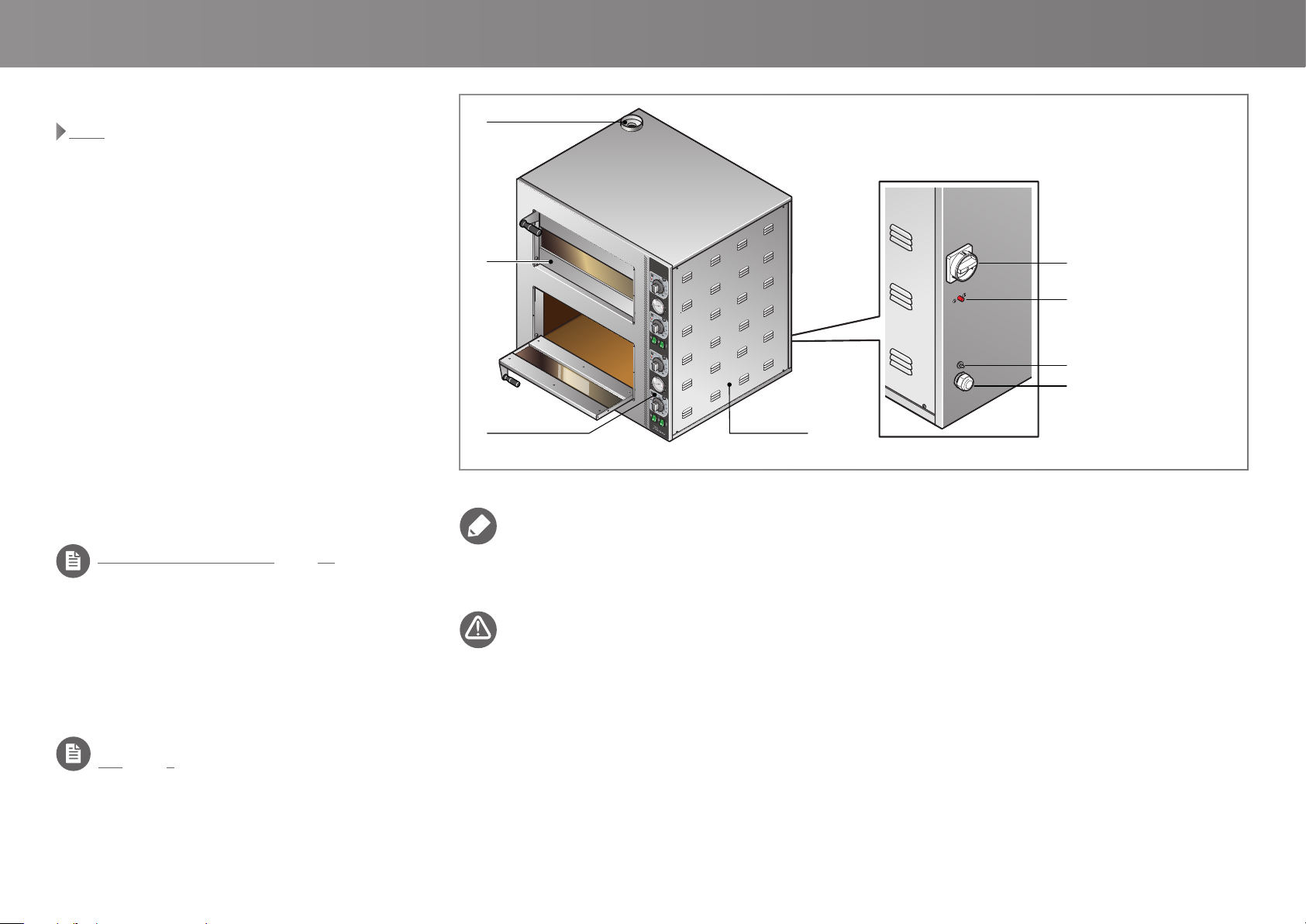
Fig. 1
Your oven can be used only to bake pizzas or similar dishes,
such as bread or focaccia and to grill vegetables.
Its main parts are:
A Oven smoke exhaust
B Oven door
C Control panel
D Panel to access electrical components
E Oven supply input
F Equipotential
G Safety thermostat reset (USA models only)
H Circuit breaker (only USA models)
A
B
(only USA models)
H
(only USA models)
G
The oven can manage separately the temperature:
• of the cooking chamber;
• of the bottom.
Preparing to use the oven
Clean the oven and any accessories accurately, both externally
and internally, following the instructions in the dedicated
chapter rigorously.
Maintenance and cleaning - page 12.
The rst time you use the oven, we recommend you set
the “chamber” and “bottom” temperatures at 150°C / 302 °F,
for at least 8 hours, without placing any food inside. In
this first phase, because of the humidity evaporating from the
insulating materials, the oven will give out unpleasant smells
and fumes that will gradually disappear during the following
operating cycles.
To switch the oven on and set its parameters, refer to:
Use - page 9
F
E
C
Fig. 1
The first day of use is considered as a running-in period: during this time the refractory bricks and insulating material keep releasing
humidity until they dry out completely.
Some parts of the equipment can reach high temperatures. We advise you to avoid touching surfaces and not to get
materials either flammable or sensitive to heat near the appliance.
Do not rest objects on the oven, above all if built in material sensitive to heat.
Take care and use personal protection equipment (i.e. gloves) when putting food into the cooking chamber or getting it
out.
D
6
Page 7
Some piece of advice...
• Before starting cooking, always preheat the oven: this is vital
to get good food. Pre-heating the oven must last at least
an hour.
• During work, keep the refractory surfaces clean using a stiff
bristle brush.
• Passing from a type of pizza to another, wait for the oven to
stabilize.
• An excess of flour in the cooking chamber can create smoke,
smell and give the pizza an unpleasant taste.
• Clean the oven at the end of service.
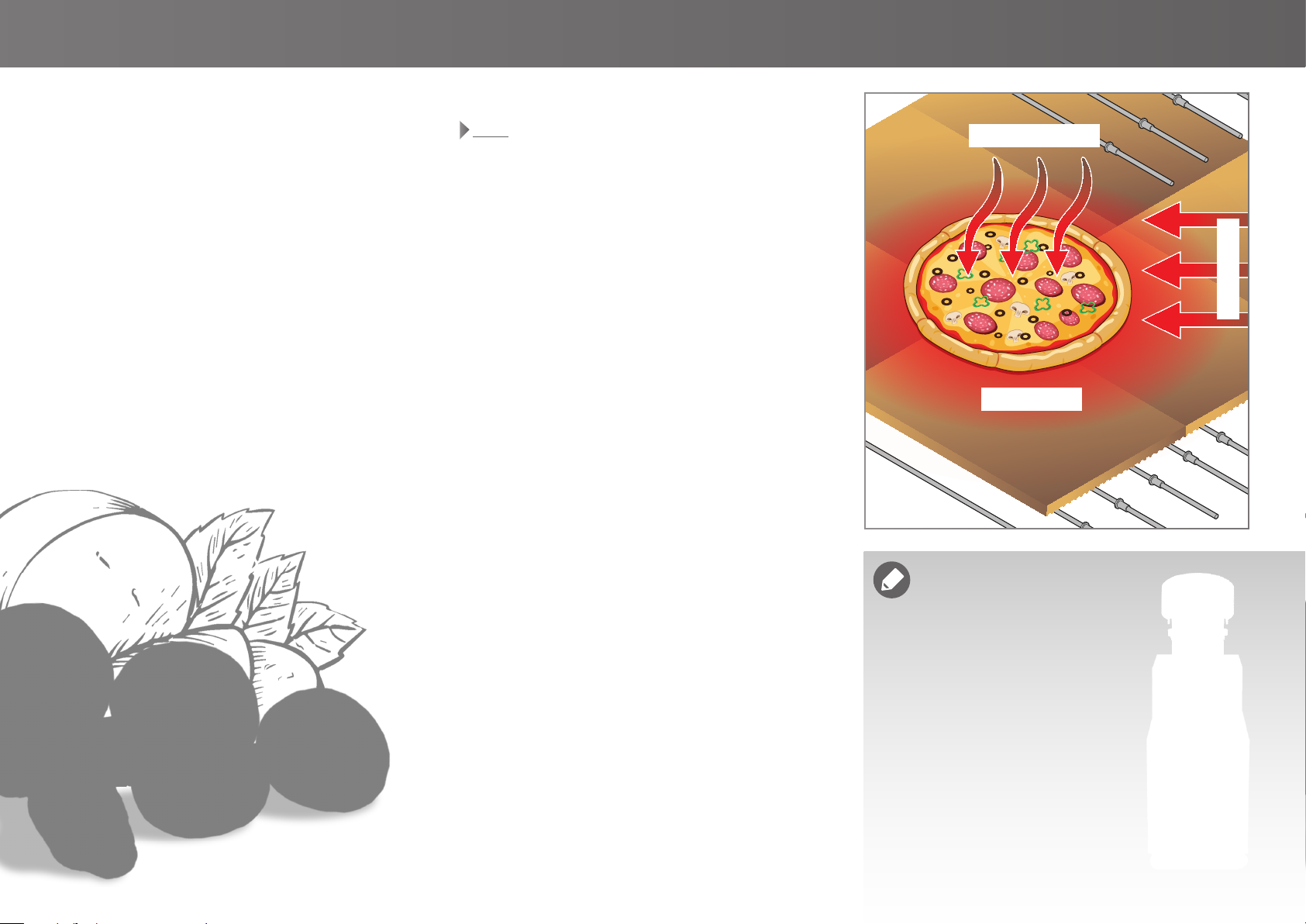
Fig. 2
In ovens, products cook thanks to the combined action of:
• radiation: the heat and infrared rays produced by the top
elements make products crunchy and golden
• convection: the hot air that circulates in the chamber cooks
the product evenly
• conduction: the bottom elements heat the refractory
surfaces on which the products rest.
Unsatisfactory cooking results
If the cooking results are not as expected, try and check the
following:
• incorrect oven parameters:
• temperature in the chamber either too high or too low
• incorrect preheating:
• preheating is vital to get superb results right from the first
pizza
• during preheating, the BOTTOM temperature has been
set too high: the refractory surfaces (without pizzas) have
become too hot and burnt the first pizzas.
RADIATION
CONVECTION
CONDUCTION
Fig. 2
Ed. 0121 - 70702502 REV02 Tiziano Use and maintenance CP
What is Pizzaform?
Pizzaform is a manufacturer’s patent.
It is a special press, produced in five models,
to make pizza dough discs up to Ø52cm
[Ø20.47 in.].
Its main features are:
- high hourly output, up to 400 pizzas an
hour, without using specialized labour;
-
consistent shape and thickness of the disc
of dough, without giving up the traditional
edge, obtained thanks to the special shape
of the chrome plates;
- possibility of changing the thickness of the
dough discs easily.
7
Page 8
Basic notions
COOKING TABLES
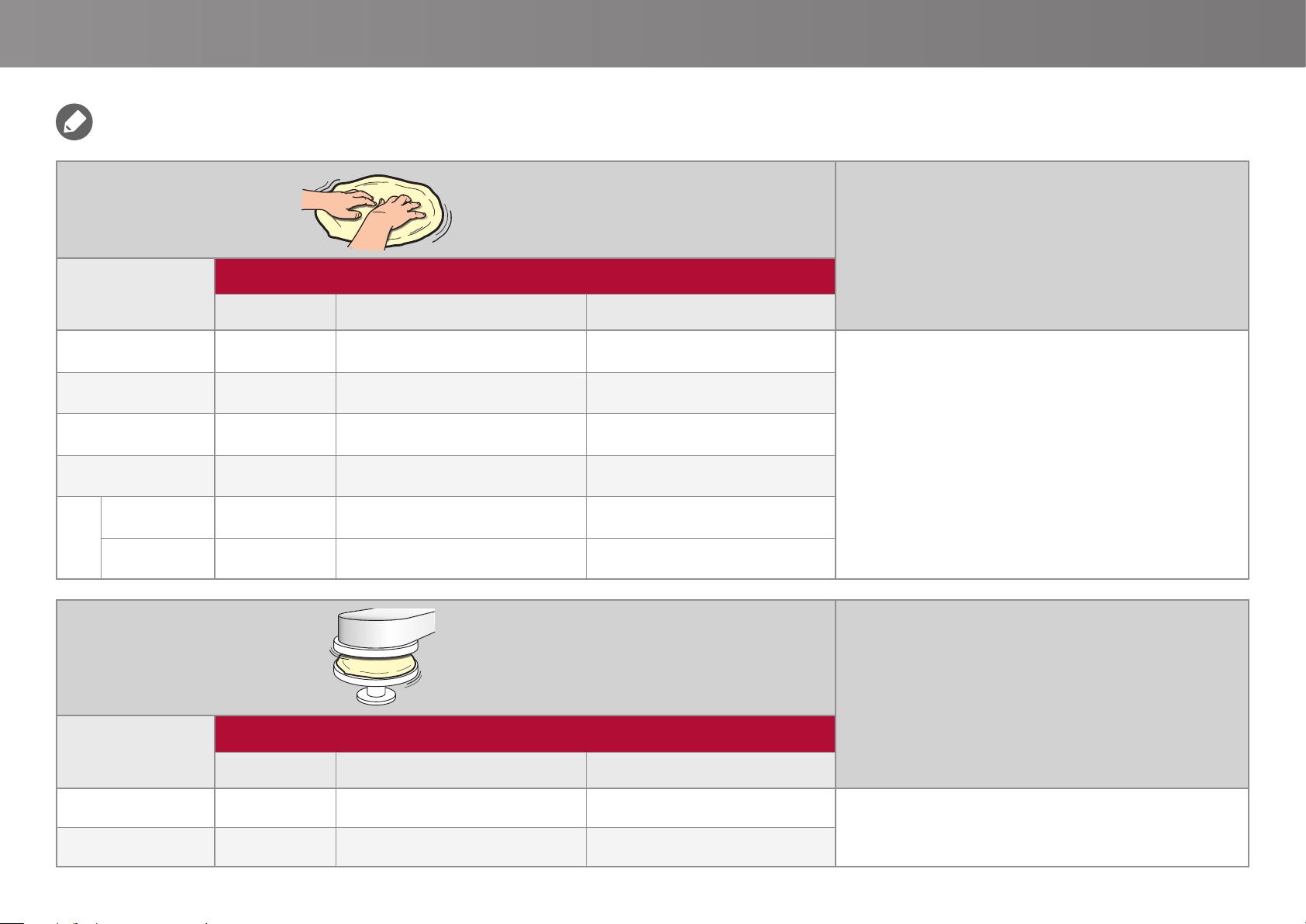
The parameters in the tables are just indicative, since they can vary according to the temperature of the room where the oven is installed and the type of dough to bake (e.g. type of flour, hydration, etc.).
Manual stretching
COOKING
TYPE
TIME CHAMBER TEMPERATURE BOTTOM TEMPERATURE
CLASSIC 3 min 310°C - 330°C / 590°F - 626°F 150°C - 320°C / 302°F - 608°F
CLASSICA MAXI 4 min 310°C - 330°C / 590°F - 626°F 150°C - 320°C / 302°F - 608°F
PAN 4 min 330°C / 626°F 400°C / 752°F
BAKING-TIN 5 - 7 min 330°C / 626°F 380°C/ 716°F
PRECOOKING 5 min 270°C / 518°F 260°C / 500°F
PADDLE
FINISHING 3 min 290°C / 554°F 270°C / 518°F
Stretching with Pizzaform
Pre-eating (manual stretching)
time: 1 hour
(can vary according to the set temperatures)
temperature: the same as the type of pizza to be cooked
COOKING
TYPE
TIME CHAMBER TEMPERATURE BOTTOM TEMPERATURE
CLASSIC 3 min 310°C / 590°F 150°C - 300°C / 302°F - 572°F
CLASSICA MAXI 4 min 310°C / 590°F 150°C - 300°C / 302°F - 572°F
8
Pre-heating (with Pizzaform)
time: 1 hour
(can vary according to the set temperatures)
temperature: the same as the type of pizza to be cooked
Page 9
Use
Table of contents
Knowing the control panel ............................................................9
Use guided procedure ......................................................................10
A - Turning the oven on ...................................................................10
B - Setting the preheating ..............................................................10
C - Starting cooking ............................................................................11
D - Switching the light on (optional) .......................................11
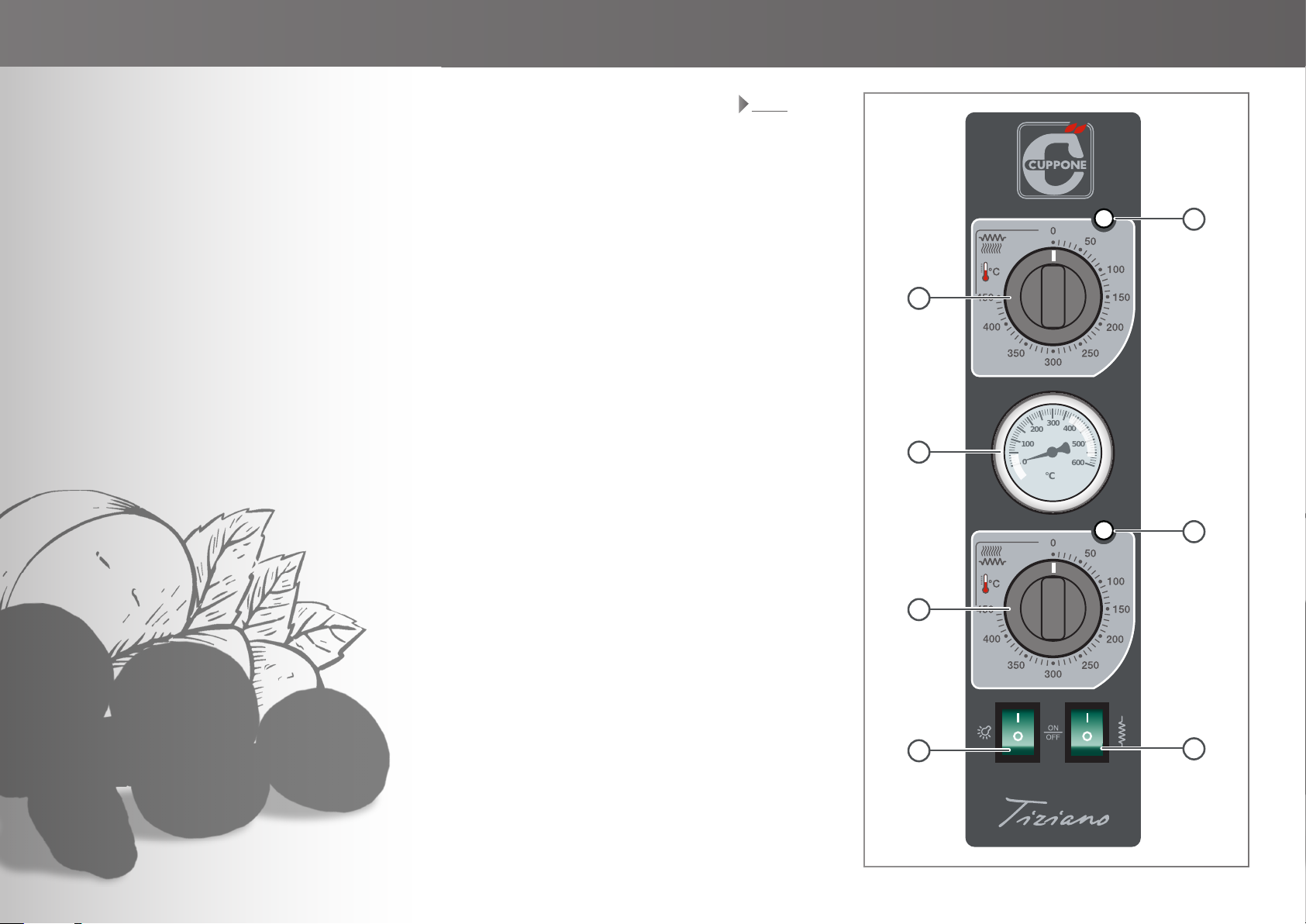
E - Switching the oven off ..............................................................11
Knowing the control panel Fig. 3
1 White warning light
If ON, it shows the top elements are heating
2 Thermostat
Powers the top elements and controls the temperature of
the cooking chamber.
3
White warning light
If ON, it shows
4 Thermostat
Powers of the bottom elements and controls the
temperature of the bottom.
5 Pyrometer
Displays the temperature in the cooking chamber.
6 Light switch
Switches the light in the cooking chamber on and off.
7 ON/OFF switch
Switches the oven on and off.
the bottom elements are heating.
1
2
300
400
200
5
100
0
500
600
°C
3
Ed. 0121 - 70702502 REV02 Tiziano Use and maintenance CP
4
6
Fig. 3
9
7
Page 10
Use
Use guided procedure
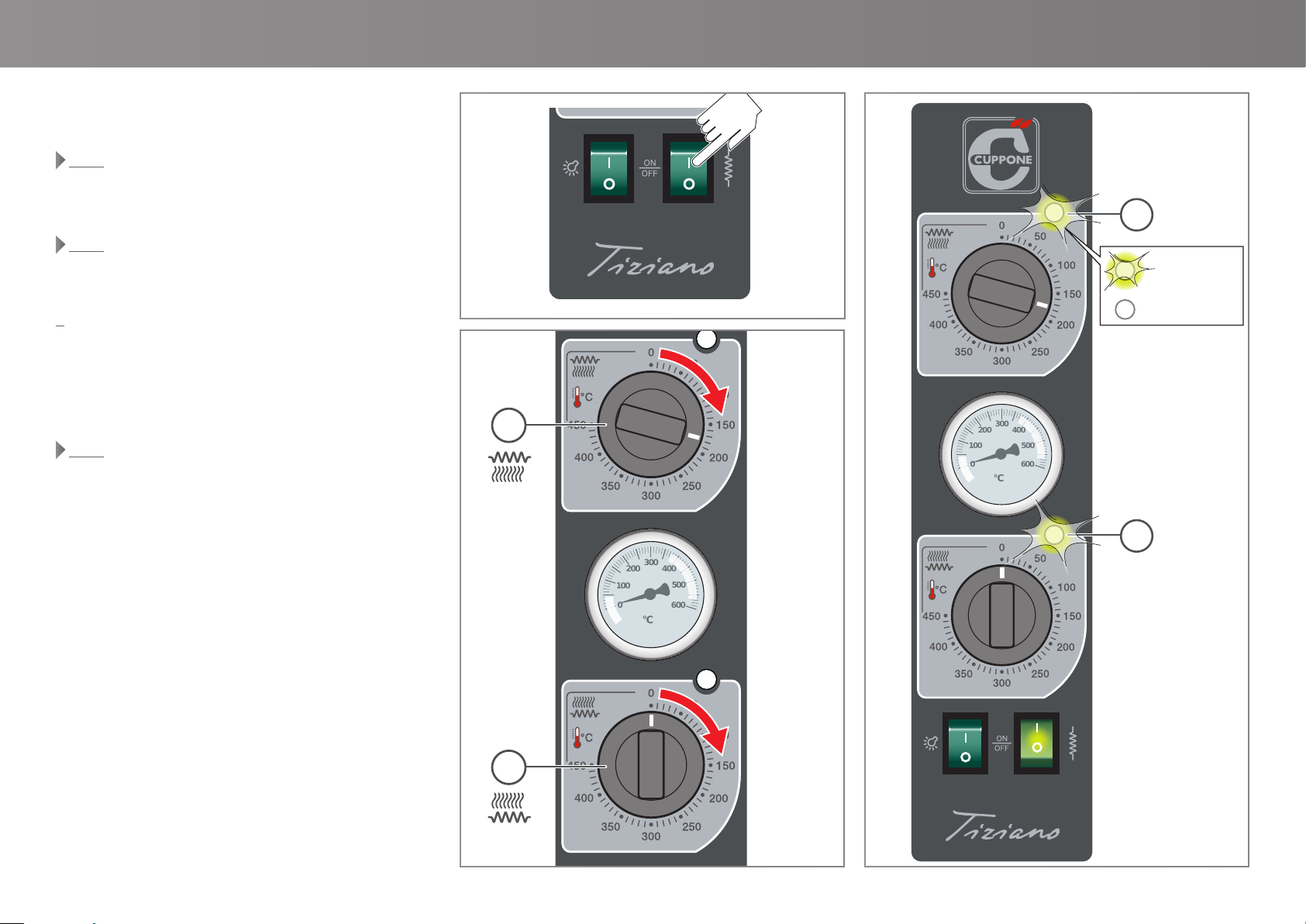
A - Turning the oven on
Fig. 4
Pressing the ON/OFF key supplies the oven.
B - Setting the preheating
Fig. 5
Rotate the (A) “chamber” temperature and (B) “bottom”
temperature knobs clockwise to set the same cooking
temperatures as the recipe you wish to use (
8)
.
After setting the temperature, the oven immediately begins
to heat, however, it is necessary to wait about an hour before
putting the products in the oven, so that the oven reaches an
optimal temperature and is ready for cooking.
Fig. 6
The white warning lights (C) and (D) will remain on until the
set temperatures are reached; their going off means that preheating is complete and the oven is ready for cooking.
The thermostats controlling the elements will keep the set
temperatures constant, switching the elements on and off as
required.
see table on page
Fig. 4
chamber
A
100
C
elements
on
elements
off
300
400
200
100
0
500
600
°C
D
300
400
200
500
0
600
°C
bottom
Fig. 5
B
Fig. 6
10
Page 11
0
200
100
300
°C
400
600
500
0
200
100
300
°C
400
600
500
Use
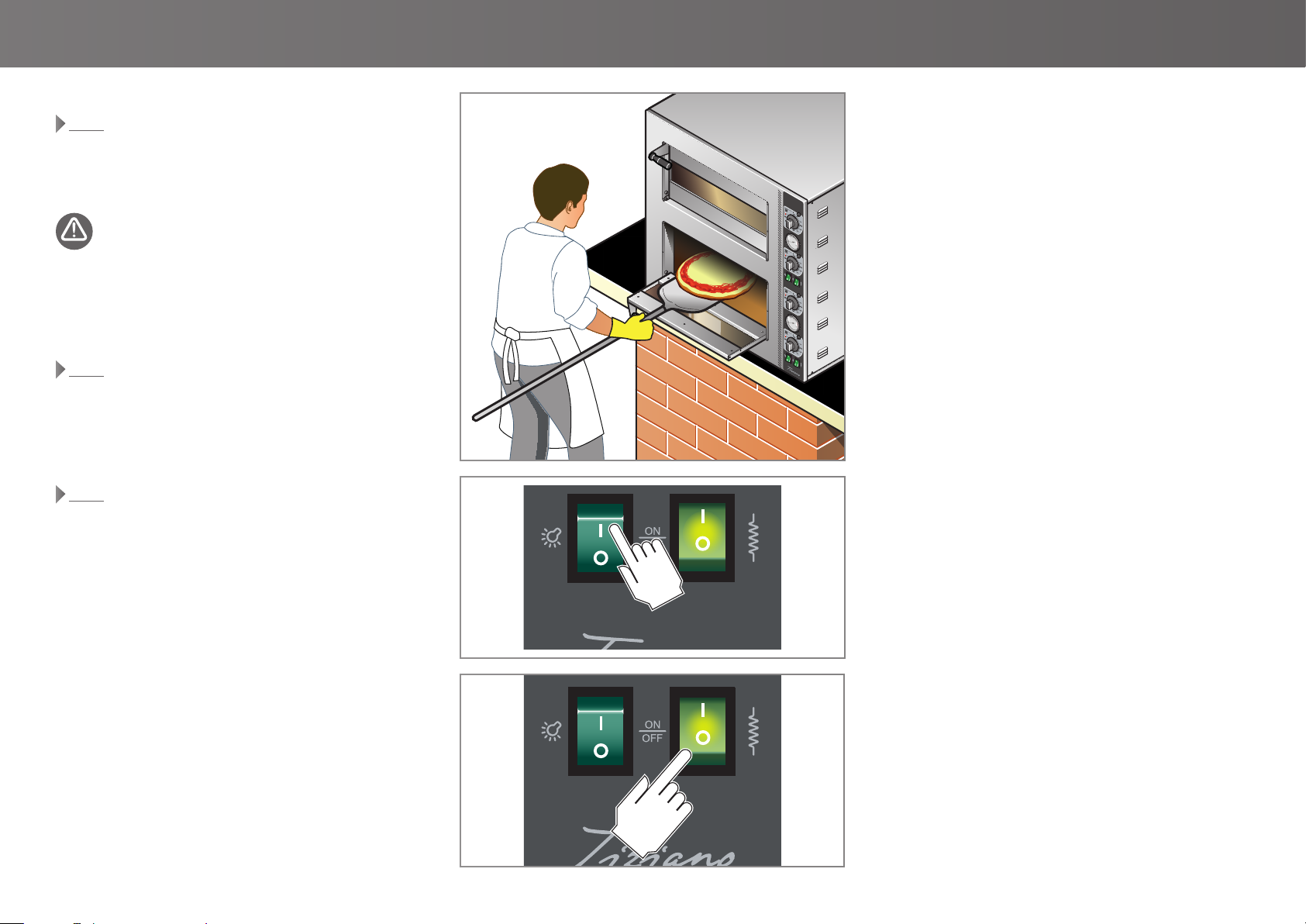
C - Starting cooking
Fig. 7
Once preheating is complete, you can start cooking and bake
the products using personal protection equipment (e.g. gloves)
and tools suitable for contact with food and made of material
resistant to high temperatures (e.g. steel).
For optimal results, always adhere to the oven capacity
declared by the Manufacturer and position the products
to be cooked evenly in the cooking chamber.
During cooking, it is always possible to change the temperatures acting as usual.
D - Switching the light on (optional)
Fig. 8
With the oven both off and on, the light can be switched on
pressing the light key, as required. Press the same key to switch
it off.
E - Switching the oven o
Fig. 9
To switch the oven off with the ON/OFF key.
Fig. 7
Fig. 8
Fig. 9
Ed. 0121 - 70702502 REV02 Tiziano Use and maintenance CP
11
Page 12
0
200
100
300
°C
400
600
500
0
200
100
300
°C
400
600
500
0
200
100
300
°C
400
600
500
0
200
100
300
°C
400
600
500
0
200
300
°C
400
600
500
0
200
100
300
°C
400
600
500
0
200
100
300
°C
400
600
500
0
200
100
300
°C
400
600
500
Maintenance and cleaning
Warnings
Before any cleaning, it is necessary to switch o the
power to the appliance (acting on the system switch)
and wear suitable personal protection equipment (e.g.
gloves, etc.). The user must carry out only routine maintenance,
for extraordinary maintenance, contact a Service Centre
requesting service from an authorised technician. The
Manufacturer warranty does not cover damages due to
negligent or incorrect maintenance or cleaning (e.g. use of
unsuitable detergents).
Any cleaning must be carried out with the oven
completely cold and wearing adequate personal
protection devices (e.g. gloves, etc.).
When cleaning any part or accessory do NOT use:
• abrasive or powder detergents;
• aggressive or corrosive detergents (e.g. hydrochloric
or sulphuric acid, caustic soda, etc,). Caution! Never use these
substances also when cleaning the substructure/floor under the
appliance or its base;
• abrasive or sharp tools (e.g. abrasive sponges, scrapers, steel
brushes, etc.);
• steamed or pressurised water jets.
It is best to have a Service Centre perform maintenance
and inspection on the appliance at least once a year to
ensure top working and safety conditions.
Oven cleaning
Cleaning the external steel parts
Use a cloth dampened with hot soapy water and end with
rinsing and drying.
Cleaning the glass
Clean any glass with a soft cloth and special glass detergent.
Cleaning the control panel
Clean the control panel with a soft cloth and a little detergent
for delicate surfaces.
Avoid also using very aggressive detergents that may damage
the construction material (polycarbonate).
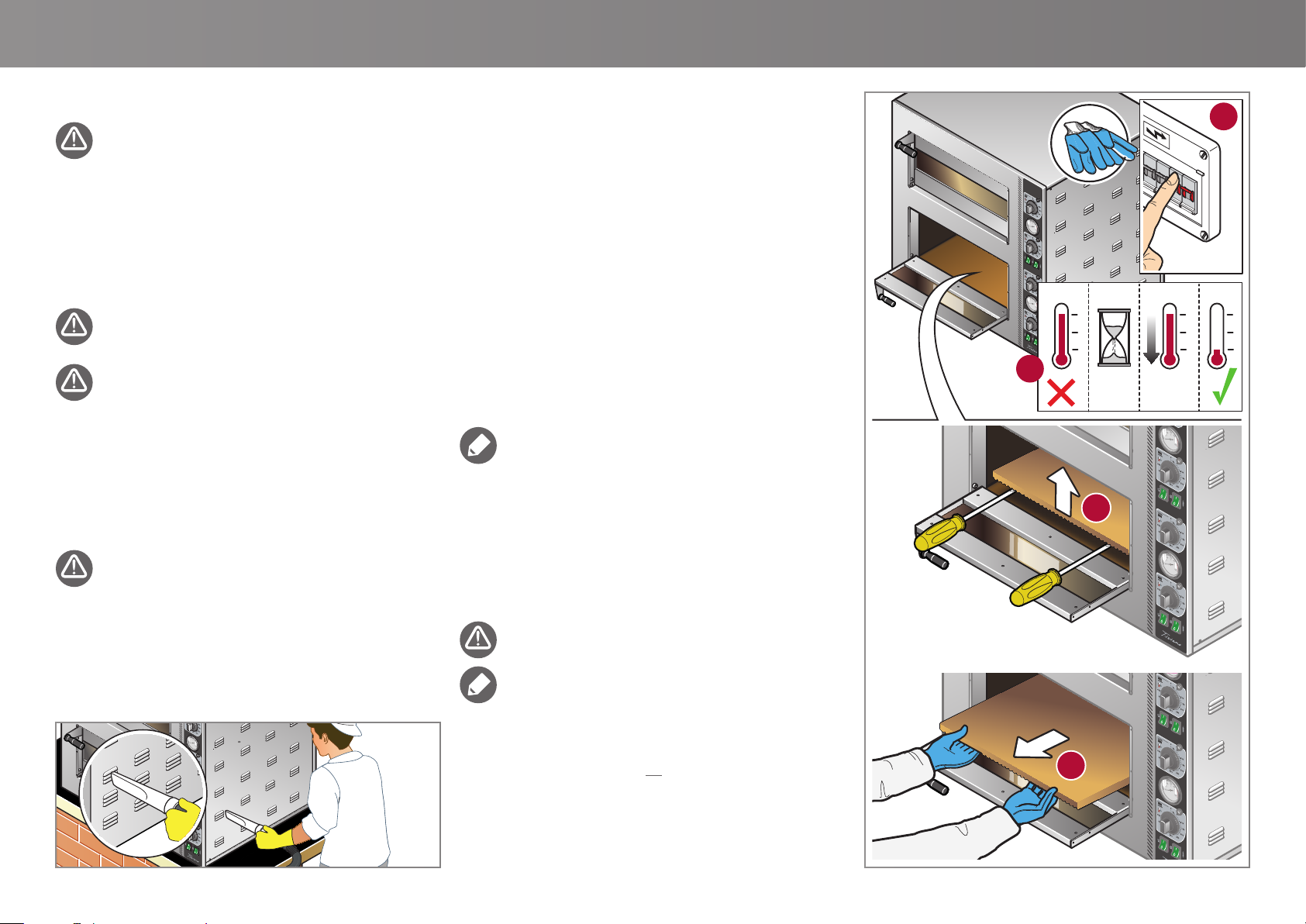
Cleaning the refractory surface
On the refractory surface, there are normally some food
residues (e.g. fat, food residues, etc.) that must be removed
frequently for health and safety reasons.
Remove the coarser food residues with a natural fibre brush;
then, if necessary, remove the refractory bricks of the cooking
surface as shown in the figure and suck the carbonized residues
accumulated under them on the bottom of the oven with an
ash extraction bin.
Never use liquids to clean the refractory surface.
A
OFF
B
C
Keep the vents of the electrical compartment clean and clear.
While reinserting the bricks, be careful not to pinch your
fingers.
Replacement refractory bricks can be obtained from the
Manufacturer on request.
If the use of a natural fibre brush to eliminate food residues from
the refractory surface is not sufficient, see chapter “Setting the
pyrolysis parameters” on page. 13
Fig. 10
12
Fig. 11
D
Page 13
0
200
100
300
°C
400
600
500
0
200
100
300
°C
400
600
500
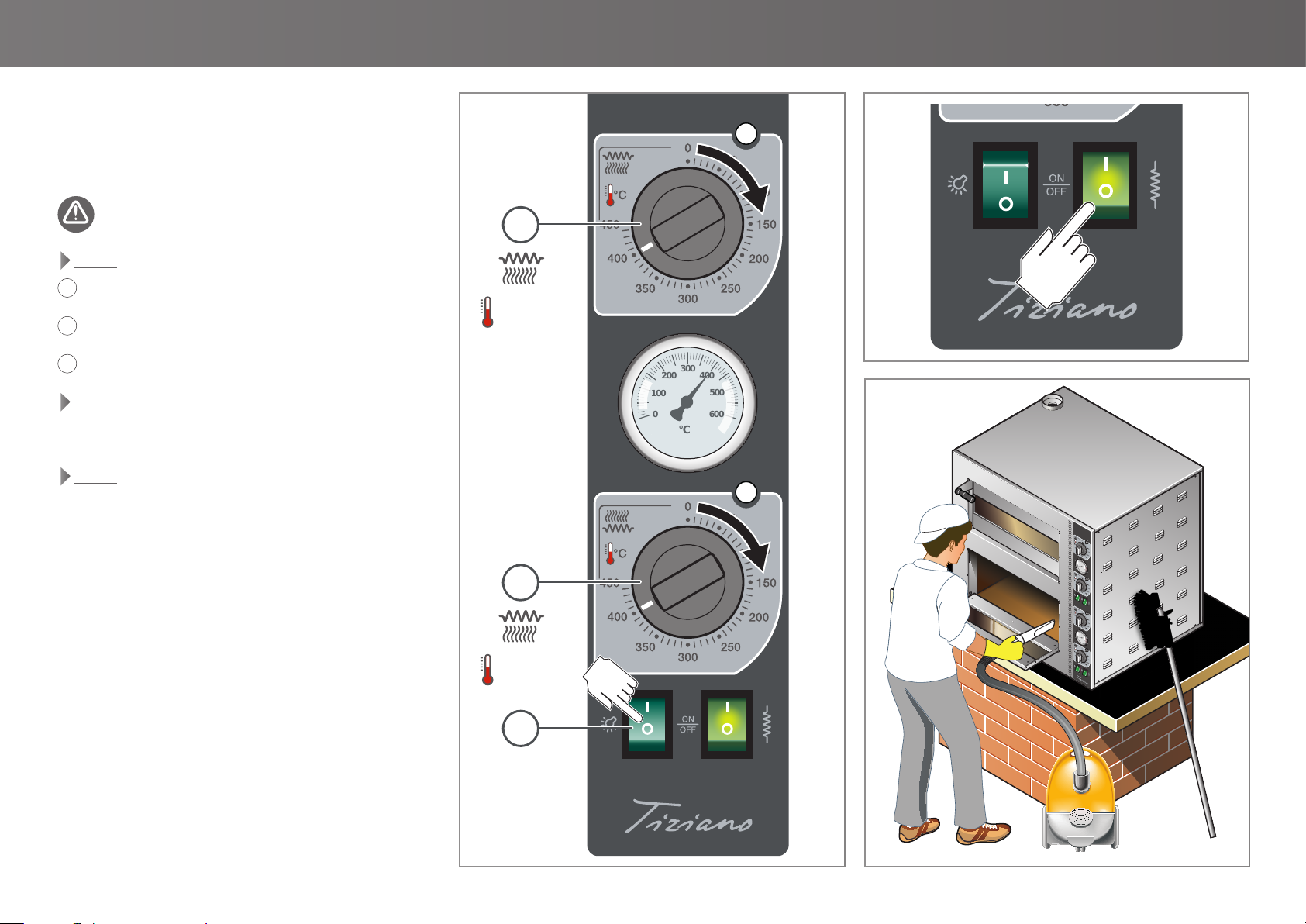
Setting the pyrolysis parameters
Pyrolysis is a thermochemical crystallization process of food
residues that have deposited in the cooking chamber, which takes
place by bringing the oven up to 400°.
Before starting the pyrolysis, remove the coarser food
residues with a natural fibre brush.
Fig. 12
A
Rotate knob (A) “chamber” temperature clockwise to set a
temperature of 400°C /752°F;
B
Rotate knob (B) “bottom” temperature clockwise to set a
temperature of 400°C /752°F;
C
switch lights (C) of the cooking chamber off.
Fig. 13
When the set temperature is reached, switch the oven off
using the ON/OFF key and let it cool with the door closed.
Fig. 14
With a cold oven, clean the chamber from the crystallized
food residues using a natural fibre brush and then vacuum
with an ash extraction bin.
A
400°C
752°F
100
0
200
Fig. 13
300
400
500
600
°C
B
400°C
752°F
C
Fig. 12
Ed. 0121 - 70702502 REV02 Tiziano Use and maintenance CP
13
Fig. 14
Page 14
0
200
100
300
°C
400
600
500
0
200
100
300
°C
400
600
500
0
200
100
0
200
100
0
200
100
300
°C
400
600
500
0
200
100
300
°C
400
600
500
Maintenance and cleaning
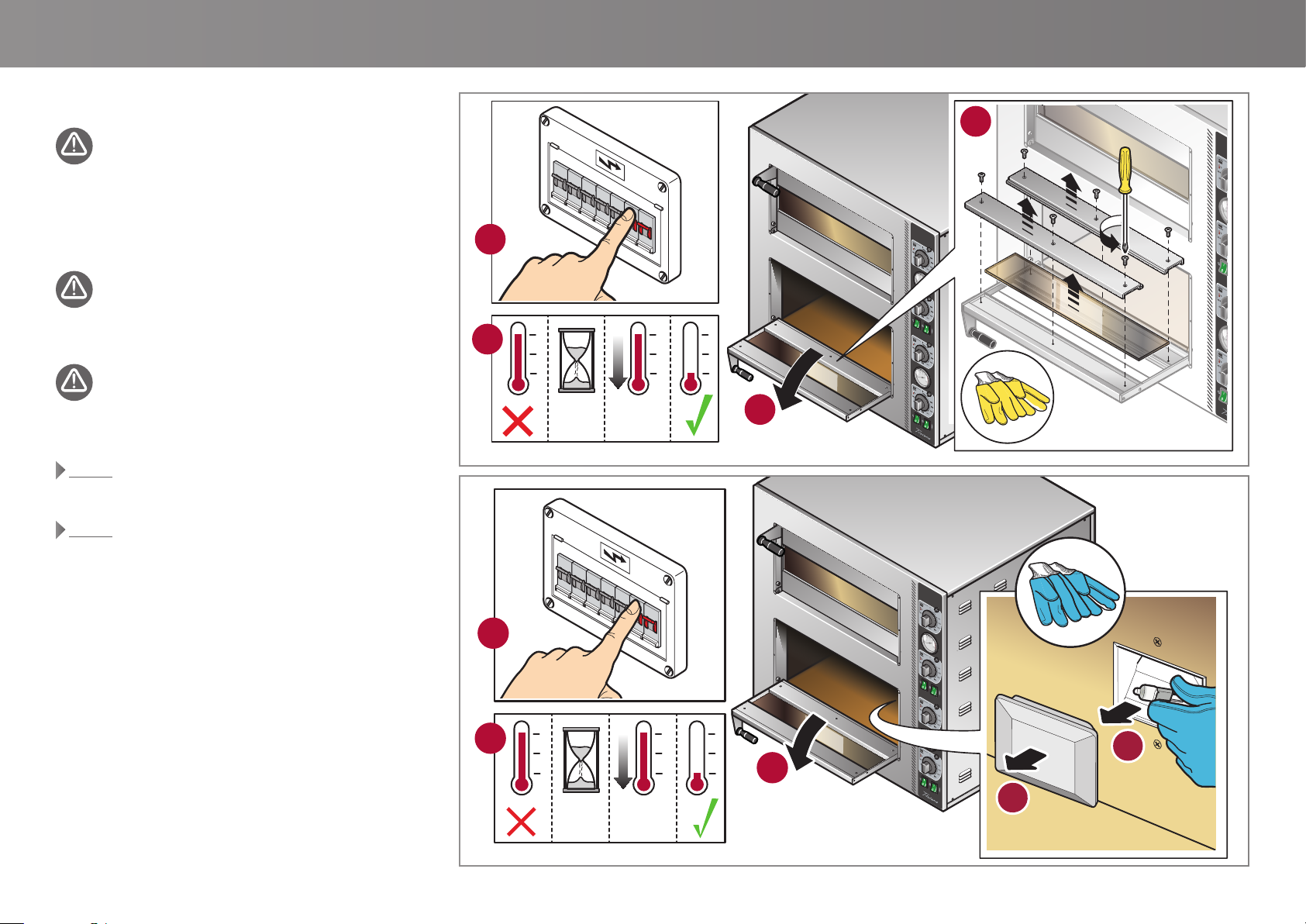
Replacing components
The user must replace only the stated components: in
case of a fault or for extraordinary maintenance, contact
the Retailer requesting service from an authorised
technician. As replacements, always use original spare parts to
be requested from the Retailer: using non original parts might
cause injuries to people, non optimal performance and even
serious damage of the appliance itself.
Before any replacement, it is necessary to switch o
the power to the appliance (acting on the system
switch) and wear suitable personal protection
equipment (e.g. gloves, etc.).
Any replacement must be carried out with the oven
completely cold and wearing adequate personal
protection devices (e.g. gloves, etc.).
A
B
D
OFF
C
Replacing the door glass
Fig. 15
Fig. 15
Replacing the internal bulb and glass
Fig. 16
Before replacing the bulb, switch o the power to the
appliance (acting on the system switch); it is not enough to use
the ON/OFF key, because bulbs can still be live.
Never press the bulb glass with your bare hands; always
wear gloves.
Never switch the oven on without having refitted the bulb
A
OFF
protective glass; replace it straight away if it breaks.
B
E
C
D
Fig. 16
14
Page 15
0
200
100
300
°C
400
600
500
0
200
100
300
°C
400
600
500
0
200
100
300
°C
400
600
500
0
200
100
300
°C
400
600
500
200
300
°C
400
600
500
0
200
100
300
°C
400
600
500
0
200
100
300
°C
400
600
500
0
200
100
300
°C
400
600
500
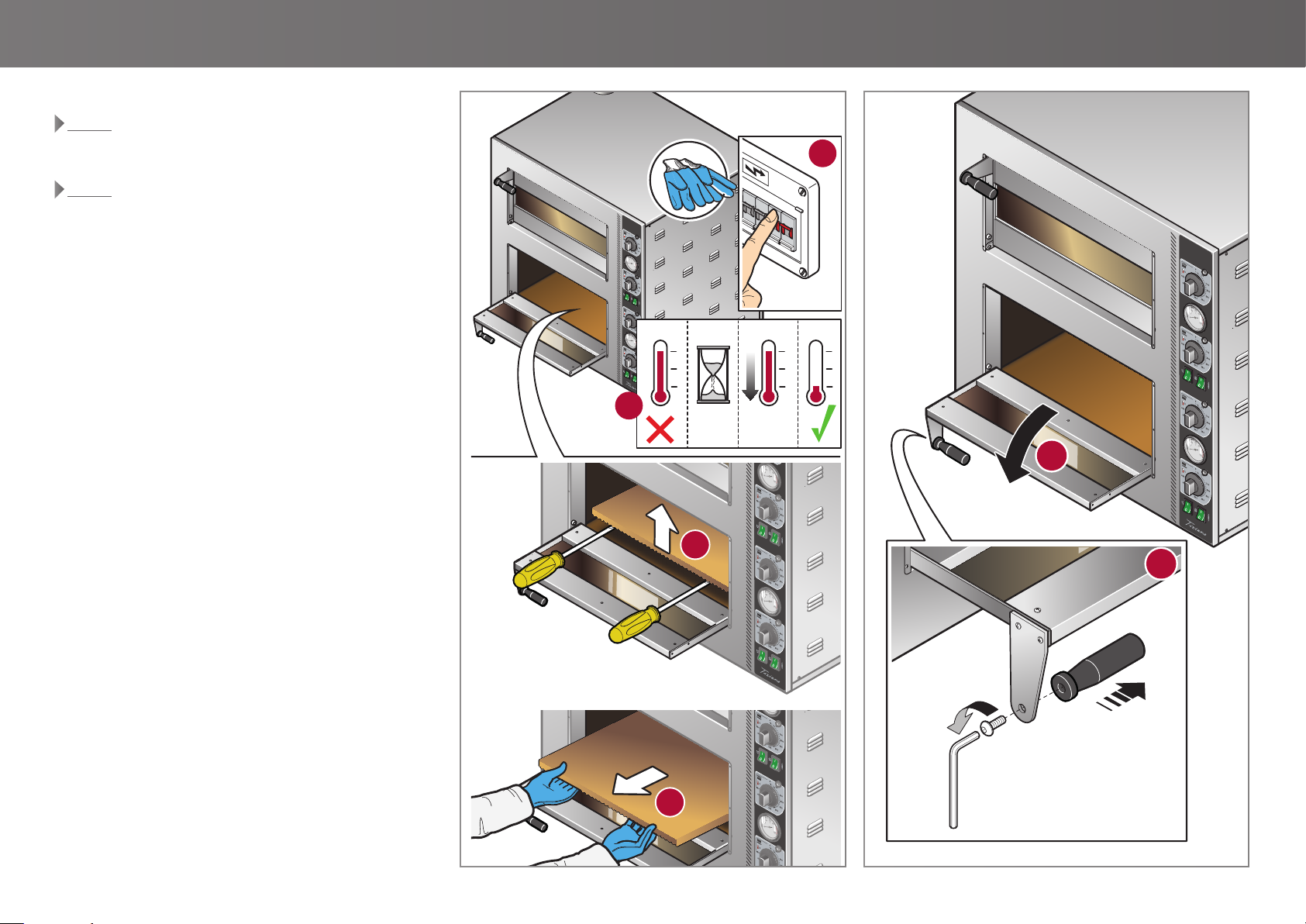
Replacing the refractory bricks
Fig. 17
Replacing the door handle
Fig. 18
A
OFF
B
A
C
B
D
Fig. 17
Ed. 0121 - 70702502 REV02 Tiziano Use and maintenance CP
15
Fig. 18
Page 16
0
200
100
300
°C
400
600
500
0
200
100
300
°C
400
600
500
Maintenance and cleaning
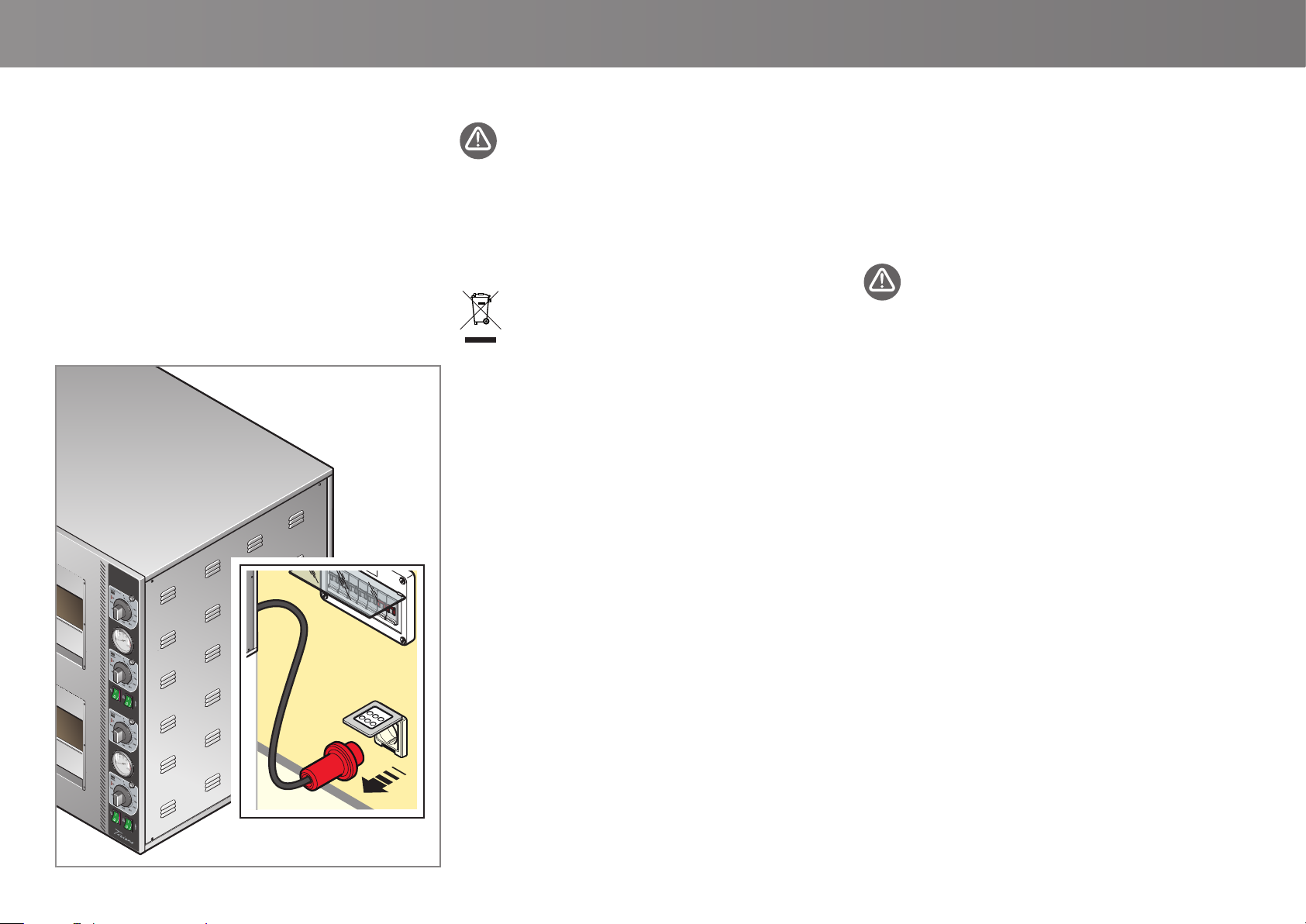
Oven downtime for prolonged
periods
During any downtime, switch the power off. Protect the steel
outside surfaces passing over them with a soft cloth slightly
damp with Vaseline oil.
Leave the door ajar to guarantee correct ventilation.
Before resuming operations:
• accurately clean the equipment and accessories;
• reconnect the equipment to the power;
• inspect the equipment before using it.
Disposal at end of life
To avoid any unauthorised use and associated risks,
before discarding the machine make sure it cannot be
used; for this purpose, cut and remove the power cord
(once the equipment is unplugged).
Make sure no child can accidentally remain trapped inside the
cooking chamber, locking the door (for example, with adhesive
tape or locks).
Equipment disposal
Pursuant to art. 13 of Legislative Decree no. 49 of 2014
“Implementation of WEEE directive 2012/19/EU on
electric and electronic waste”, the barred bin symbol
specifies that the product was introduced on the
market after August 13, 2005 and that it must not be discarded
with other waste at the end of its working life but disposed of
separately. All the equipment has been made with recyclable
metal materials (stainless steel, iron, aluminium, zinc plate,
copper, etc.) that as a percentage make up more than 90% of
the weight. Attention must be paid to the management of this
product at the end of its life, reducing any negative impact on
the environment and improving the efficiency of resources,
applying the principles of “who pollutes pays”, prevention,
preparation for re-use, recycling and recovery. Please remember
that illicit or incorrect product disposal is punishable by law.
Information on disposal in European Union countries
The EU Directives on WEEE equipment has been adopted
in different ways by different countries, therefore in order to
dispose of this equipment correctly we suggest that you
contact your local authority or your dealer in order to ask the
correct method of disposal.
Disposing of ashes and food residues
The ash and food residues removed with cleaning must
be disposed of according to the regulations in force in
the country where the oven is used.
If in doubt, we suggest contacting the local authorities to ask
for the correct method of disposal.
While waiting for disposal, the ash and food residues must be
stored in fireproof metal cans, resistant to high temperatures
and provided with a lid that must always remain closed.
Keep the latter away from the elements and in a place
inaccessible to children and animals.
Do not approach materials that can be flammable, explosive or
heat-sensitive.
Information on disposal in Italy
WEEE equipment in Italy must be delivered to:
• to Collection Centres (also named eco-islands or ecoplatforms)
• the dealer where new equipment is purchased who must
withdraw it free of charge (“one to one” withdrawal).
Fig. 19
16
Page 17

Warranty
• 8.1 Each Product sold is to be considered compliant when
delivered in the quantity, quality and type indicated in the
written Confirmation. Please refer to the provisions of art. 1.1.
• 8.2 The Seller warranties:
• (a) that the Products are free from defects in material and
workmanship, and
• (b) that (except in the case of defects known or to be
known by the Buyer) the Products are of merchantable
quality.
• 8.3 Any hidden defects of the Products must be reported in
writing by the Buyer within 8 days of discovery, under penalty of forfeiture. Packaging defects are excluded - even if they
have caused defects or damage to the internal Products; in
fact, packaging defects have to be reported at the time of
delivery, pursuant to art. 5.8 of the present General Conditions of Sale.
• Written notices by the Buyer for the Products defective shall
contain a full description of the defects and faults as well as
the mention of the delivery date and that of defect discovery
of the Products.
• Warranty is excluded if the defect derives from the Buyer’s actions, such as (and not limited to) incorrect installation of the
Product, use of the Product in a manner that does not comply
with the normal method of use, failure to comply with the
instructions contained in the “user and installation manual”,
tampering with the Product. Warranty does not cover normal
wear and tear of the Product due to use.
• The seller is responsible for defects that occur within one year
from the activation of the warranty as provided for in art. 8.12
of the present General Conditions of Sale.
• 8.4 The Seller shall have the right to examine, or have a representative examine, the defective Product and, should the
existence of the defect be ascertained, the Buyer shall be entitled to repair or replacement, at the sole final decision of
the Seller.
• Once the defect is reported, the Buyer must not use the Product until it is examined by the Seller or by their deputy. In case
the Seller realises that the Product was used after the notification of the complaint, the Buyer loses the right to obtain
replacement or repair.
• 8.5 Replacement or repair will take place under the following
terms:
• a) The Seller may repair the defective Products by going - or
sending a deputy - to the place where such Products are
located;
• b) Alternatively, the Seller may repair the defective Product
at its own factory, or other place chosen by the Seller;
• c) Or alternatively, the Seller may opt for the replacement of
the defective Products.
• In case the repair / replacement of the Products is not possible, the Seller will pay the Buyer a refund. Such refund shall
be subjected to quantification, yet must not exceed the price
paid for the Products. Any compenation for damage is excluded.
• 8.6 In case of repair of the Products at a place chosen by the
Seller or in case of replacement of the defective Products, the
shipment of the Product will be charged to the Buyer who
must send them, at his own expense and risk, to the place
indicated by the Seller.
• 8.7 In no case shall the Seller be held liable for any indirect
or consequential damages and/or loss of profit that the Buyer may suffer arising out of or caused by defective or faulty
Products such as (but not limited to) cancellation of orders by
customers, penalties for late deliveries, forfeitures or indemnifications of whatsoever nature.
• 8.8 The Seller shall indemnify and hold the Buyer harmless
from any liability or prejudices arising out of defective or
faulty Products, unless the alleged liability arises from any
negligent act or’ omission by the Buyer or any failure by the
Buyer to perform its obligations.
• 8.9 The Seller shall not be liable for damage to persons and /
or property that may derive from improper use of the Products and / or from any use, processing or transformation of
the Products that do not comply with their intended use and
/ or with the instructions provided by the Seller, except the
case of gross negligence or wilful misconduct by the Seller.
• The Seller will also not be liable in the event of damage to
persons or property or in the case of malfunction or damage
or deterioration of the Product deriving from the fact that the
Product has been connected to a non-compliant electrical
system.
• 8.10 The Buyer shall not be able to raise any claim for personal
injury or damage to property other than those which are the
subject of the contract, or for loss of profit, unless it is clear
from the circumstances of the case that the Seller committed
“gross negligence” .
• 8.11 “Gross negligence” shall not include any and all lack of
adequate care and expertise, but it is to be intended as an
act or omission by the Seller which implies either a failure to
consider any serious risk that a conscientious supplier would
normally have foreseen as likely to occur, or a deliberate neglect of any risk deriving from such act or omission.
• 8.12 The validity of the Warranty hereto referred is subject
to activation on the website www.cuppone.com within 48
hours after the time the Product is installed.
Spare parts
• 9.1 Until and within 10 years as of the delivery of the Product, the Seller undertakes to assist the Buyer in identifying
the spare parts for the maintenance of the Product (if it is so
requested by the Buyer). In any case, the Seller is in no way
responsible for the failure to identify such sources.
Applicable law and multi-step clause
• 11.1 The Italian law, as the law of the Seller, shall govern the
sale under the present Terms and Conditions of sale.
• 11.2 Both the Seller and the Buyer exclude the application of
the Vienna Convention.
• 11.3 The parties shall defer the disputes arising out of the
present contract to a mediation attempt managed by the
Service of Mediation of the Chamber of Arbitration of Milan.
• If the mediation attempt fails, all disputes - included those of
not contractual nature - arising out of, related or connected
to the present General Conditions of Sale shall be settled by
arbitration under the Rules of the Chamber of Arbitration of
Milan (the Rules), by a sole arbitrator / three arbitrators, appointed in accordance with the Rules, which are deemed to
be incorporated by reference into this clause. The Arbitral Tribunal will judge according to the Italian law. The seat of the
arbitration will be in Milan (Italy). The language of the arbitration will be Italian.
Ed. 0121 - 70702502 REV02 Tiziano Use and maintenance CP
17
Page 18
0
200
100
300
°C
400
600
500
0
200
100
300
°C
400
600
500
Something is not working...
What to do in case of any malfunction
• Try and check the table on this page. If none of the proposed
solutions solves the problem, continue reading the following
procedure.
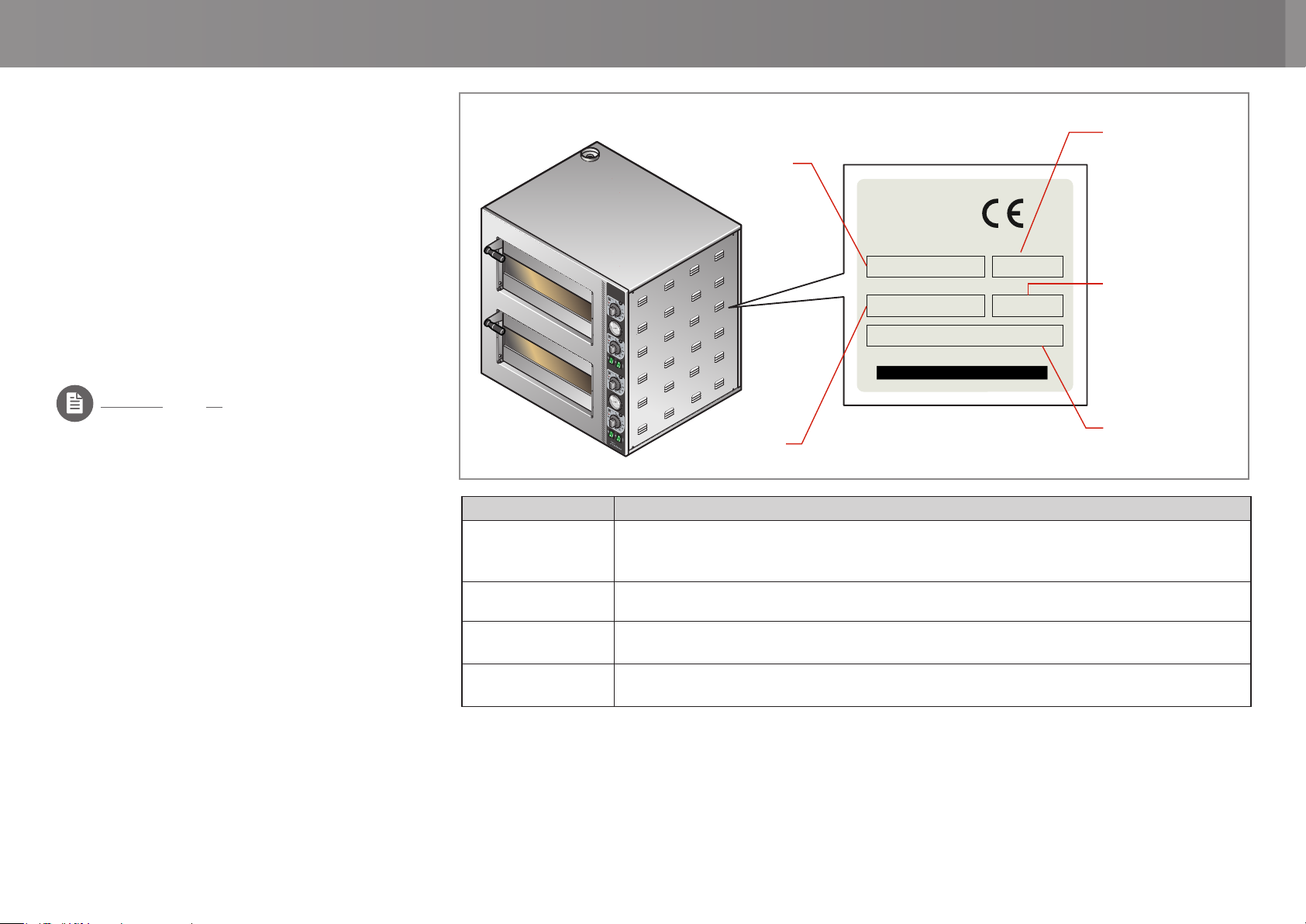
• Note the oven data (rating plate) and the date and number of
the appliance purchase invoice.
Serial number.....................................................................................................
Model ......................................................................................................................
Invoice date.........................................................................................................
Invoice number ................................................................................................
• Read the chapter on warranty carefully.
Warranty - page 17.
• Contact the Dealer with the details of the oven. While waiting
for Technical service, disconnect the appliance from the
mains.
CUPPONE 1963
Cuppone F.lli S.r.l.
Via Sile, 36
31057 Silea (TV) - ITALY
T +39 0422 361143
F +39 0422 360993
[email protected] - www.cuppone.com
Model
Voltage
Fig. 20
Problem Solution
The oven does not
turn on
The oven turns on but
cooking does not start
The oven does not
cook evenly
The first pizzas are
burnt
• Make sure the oven is correctly connected to the mains (plug correctly inserted into the socket)
and that the mains are working.
• Make sure the main switch is ON.
• Make sure you set the cooking parameters correctly.
• Make sure you set the cooking parameters correctly.
• In case of incomplete baking cycles, change the positions of the pizzas.
• During preheating, the BOTTOM temperature has been set too high: the refractory surfaces
(without pizzas) have become too hot and burnt the first pizzas.
MADE IN ITALY
Mod. TZ435/2M−C5−CP
VO LTAC 3 400−50Hz
VO LT
AC
S/N TZ4352MC5CP 20041451
KW
KW
Year of production
2020
Absorption
10,4
Serial number
18
Page 19

Page 20

CUPPONE 1963
Cuppone F.lli S.r.l.
Via Sile, 36
31057 Silea (TV) - ITALY
T +39 0422 361143
F +39 0422 360993
[email protected] - www.cuppone.com
 Loading...