

Page 1
USER MANUAL
MINI
Behind-the-ear
CV-MINI, CA-MINI,
CM-MINI
Page 2

2
YOUR HEARING AID
(To be filled out by the hearing care professional)
CV
CA
CM
Date: ______________________________________
Battery size: 10
Page 3

3
CONTENTS
SYMBOLS................................. 4
DESCRIPTION OF THE HEARING AID ............ 5
The battery ...............................8
Inserting the battery ....................... 8
Removing the battery ..................... 10
Low battery indication..................... 11
Turning the hearing aid on and off ............. 12
Function signals...........................12
Right/left identification ......................13
Positioning the hearing aid................... 14
Removing the hearing aid ...................15
Volume adjustment ........................16
Listening programs ........................ 17
Switching between the listening programs ...... 18
Using a telephone ......................... 19
CLEANING............................... 20
The hearing aid...........................21
The microphone openings..................21
IN CASE OF MALFUNCTION ................. 22
CARING FOR YOUR HEARING AID ............. 23
WARNINGS .............................. 24
REGULATORY INFORMATION ................. 27
PROGRAM FORMS ......................... 30
Page 4
4
SYMBOLS
The following symbols will be used throughout the
manual:
WARNING
Messages with this heading indicate serious adverse reactions,
potential safety hazards and inadequate performance of device.
CAUTION
Messages with this heading indicate/include information regarding any special care to be exercised.
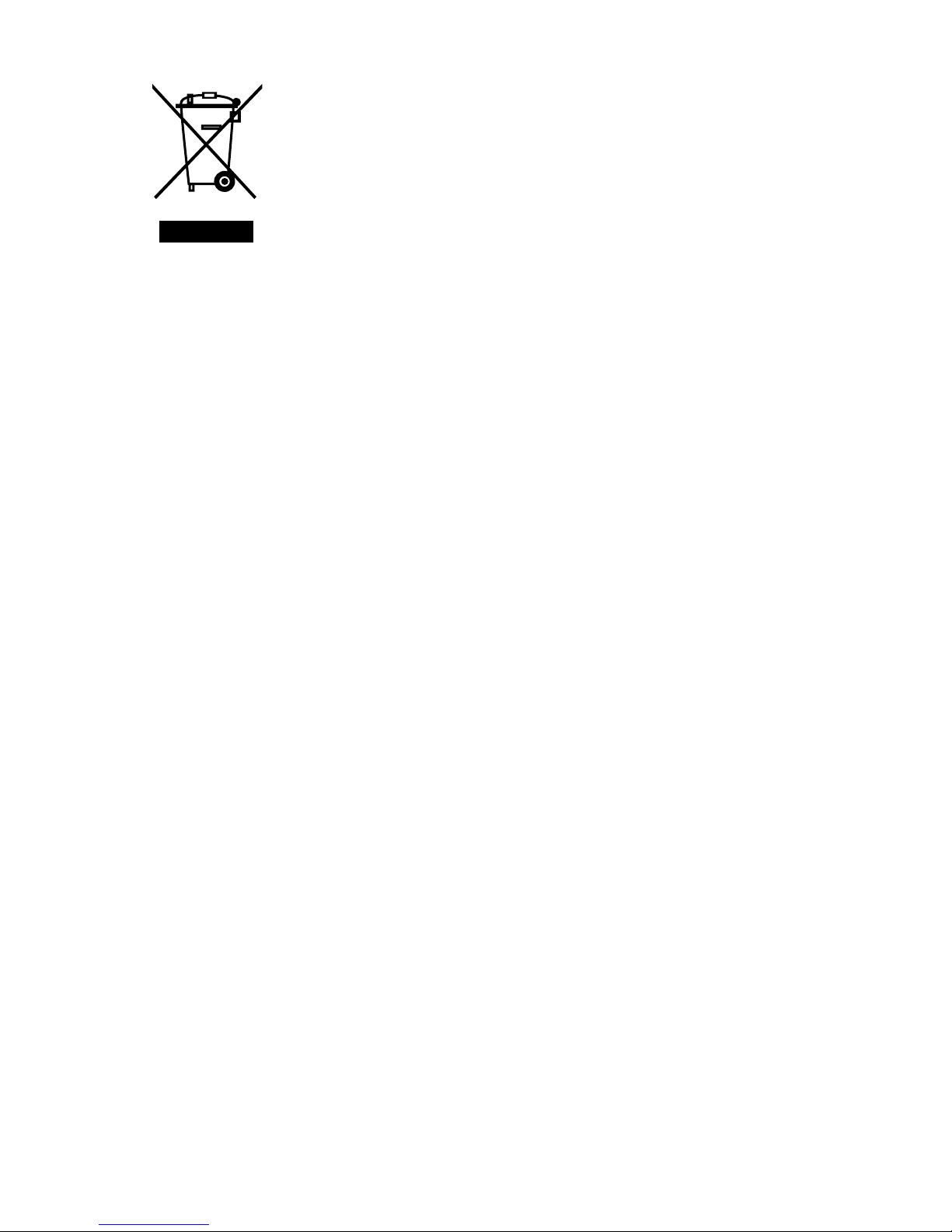
Not for general waste.
Page 5

5
DESCRIPTION OF THE HEARING AID
1. Microphone openings
2. Program button
3. On/off function
4. Nail grip
Your hearing aid is used with an ear-set which consists
of a tube and an open dome, ear-tip or earmold.
The illustration above shows the hearing aid without
an ear-set. The choice of ear-set solution depends on
your specific needs. Please refer to the separate earset user manual.
1.
3.
4.
Page 6
6
NOTE
In addition to these user instructions, a separate user manual
is provided describing the various ear-set solutions available
for your hearing aid: “Ear-sets for Coselgi BTE hearing aids”.
WARNING
This booklet and the manual “Ear-sets for Coselgi BTE hearing
aids” contain important information and instructions. Read
these booklets carefully before you start using the hearing aid.
NOTE
Your hearing aid, ear-set and accessories may not look exactly as illustrated in this booklet. We also reserve the right to
make any changes considered necessary.
Page 7

7
Intended use
The hearing aids are intended as air conduction amplification devices to be used in everyday listening environments.
Indications for use
The devices are indicated for individuals with a range
of hearing loss severity from minimal (10 dB HL) to
moderately severe (80 dB HL) and all hearing loss configurations.
They are to be programmed by licensed hearing care
professionals (audiologists, hearing aid specialists,
otolaryngologists) who are trained in hearing (re) habilitation.
Page 8
8
The battery
We recommend zinc-air batteries. Use a size 10 bat-
tery for the hearing aid.
To obtain replacement batteries, please consult your
hearing care professional. It is important to take note
of the expiration date and the recommendations on
the battery pack regarding disposal of used batteries.
Otherwise there is a risk that the battery life may be
reduced.
Inserting the battery
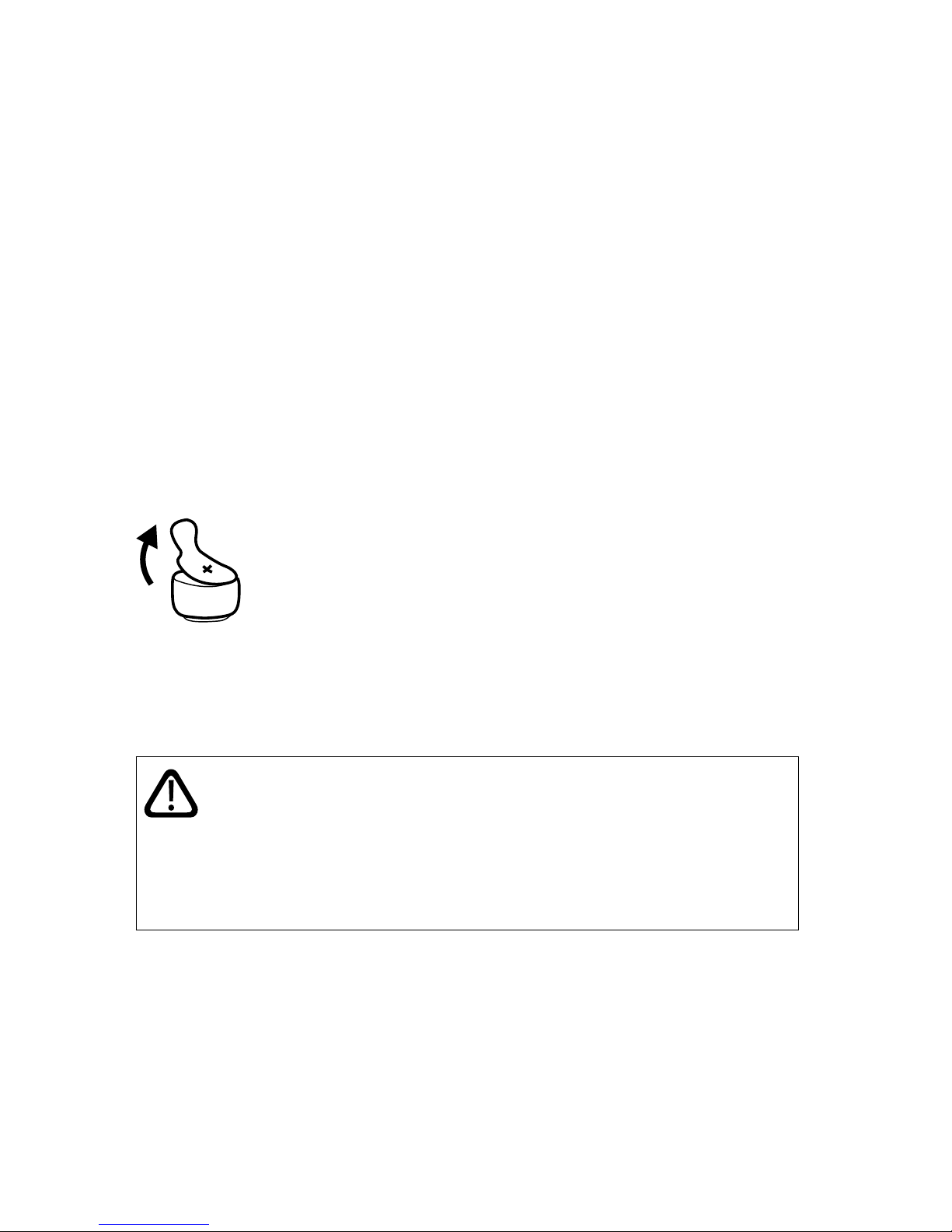
Before inserting a new battery into the
hearing aid, remember to remove the adhesive tab. Once the tab has been removed, wait 60 seconds before placing the
battery into the hearing aid.
CAUTION
Do not use batteries if there is a sticky residue from the tab or
other unwanted substance, as this can cause the hearing aid to
malfunction.
Page 9
9
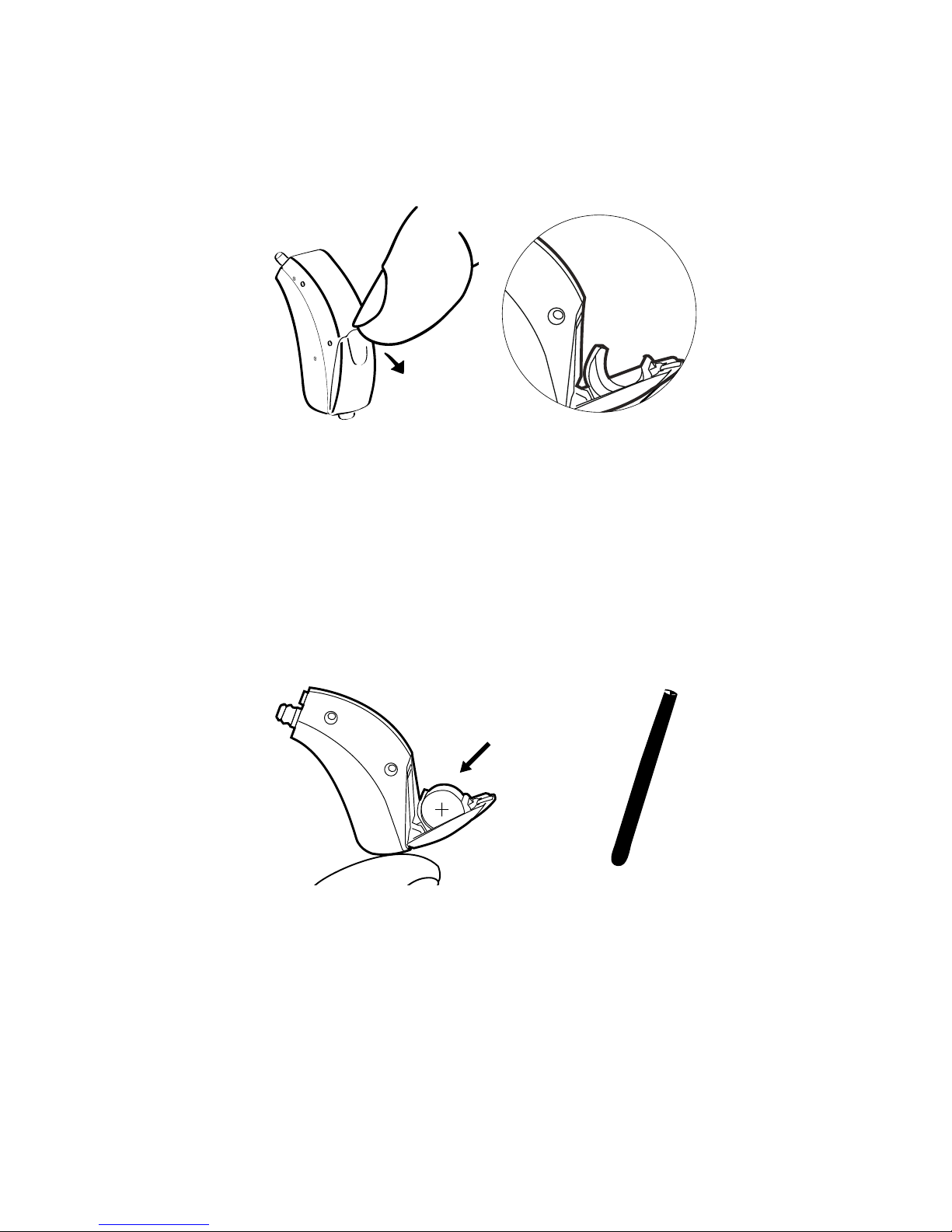
Use the nail grip to gently swing the battery drawer
open. Do not press the drawer beyond the open position.
Place the battery in the drawer as illustrated, so that
the plus (+) sign on the battery is facing towards you
when you hold the hearing aid as shown. You can use
the battery magnet provided to steer the battery into
place.
If the battery drawer does not close easily, the battery
is incorrectly inserted.
When changing battery, it is a good idea to hold the
hearing aid over a table.
Page 10
10
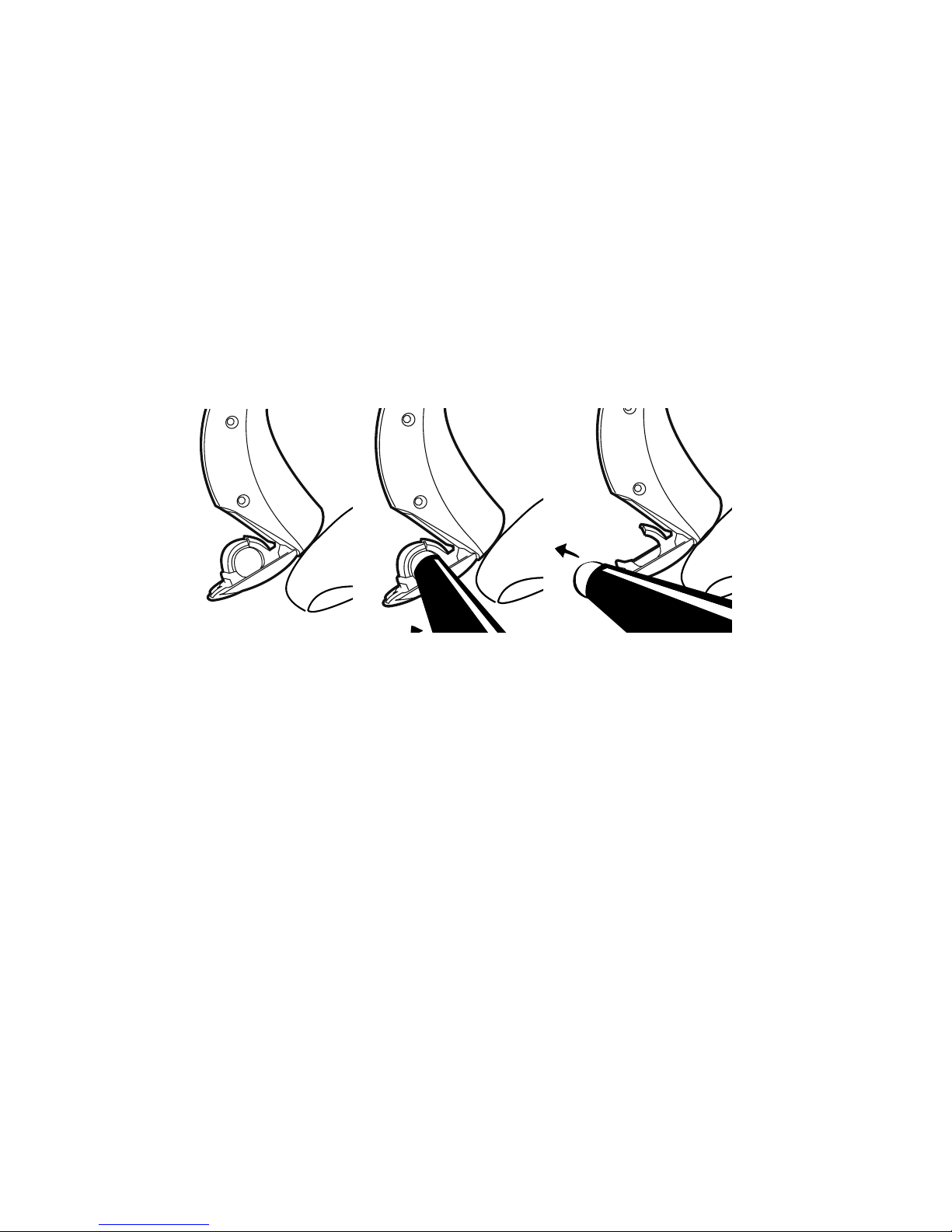
Removing the battery
1. Open the battery drawer as previously described.
Place the hearing aid on the provided cloth on a
clean, plane surface and turn it as illustrated.
2. Supporting the drawer with your finger, use the
battery magnet provided to push the battery out of
the battery drawer from the minus side.
1 2
Page 11
11
Low battery indication
Four rapid beep-tones will sound when the battery is
nearly exhausted, unless this function has been disabled. We recommend that you always have a spare
battery with you.
For adjustment of the beep-tone level or disabling of
the function, please consult your hearing care professional.
WARNING
Never leave an exhausted battery in the hearing aid. Exhaust-
ed batteries may leak, damaging the hearing aid.
WARNING
Your hearing aid may stop functioning, for instance if the
battery is exhausted. You should be aware of this possibility, in
particular when you are in traffic or are otherwise dependent
on warning signals.
Page 12
12
Turning the hearing aid on and off
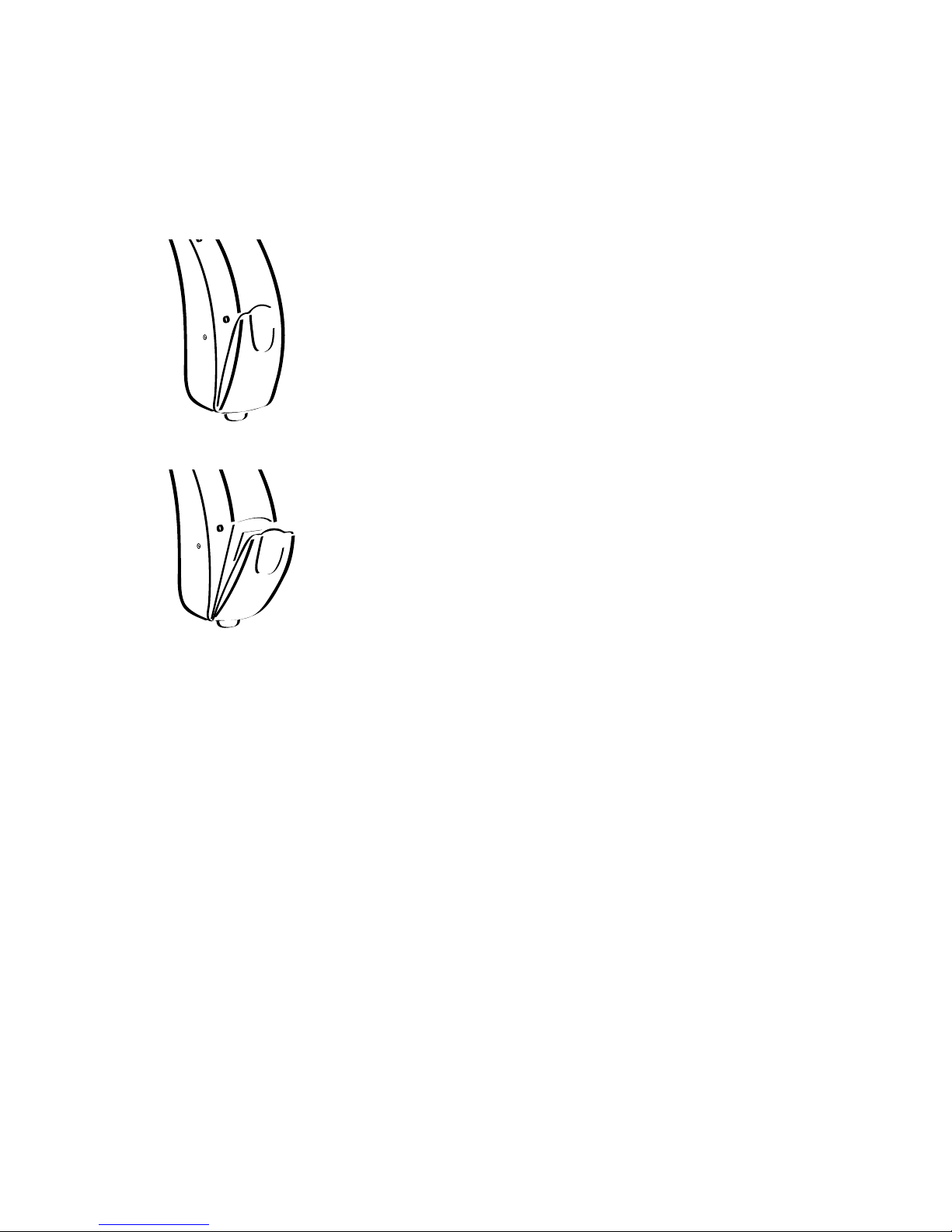
The battery drawer of the hearing aid also functions as
the on/off switch.
Close the battery drawer to turn on the
hearing aid.
Open the battery drawer to turn off
the hearing aid.
Please remember to turn off the hearing aid when it is not in use. Remove
the battery if the hearing aid will not
be used for several days.
Function signals
Your hearing aid may be set to produce a signal to indicate the use of certain functions. The signal is tones
adjusted by the hearing care professional in consultation with you. The signal can also be deactivated.
Page 13
13
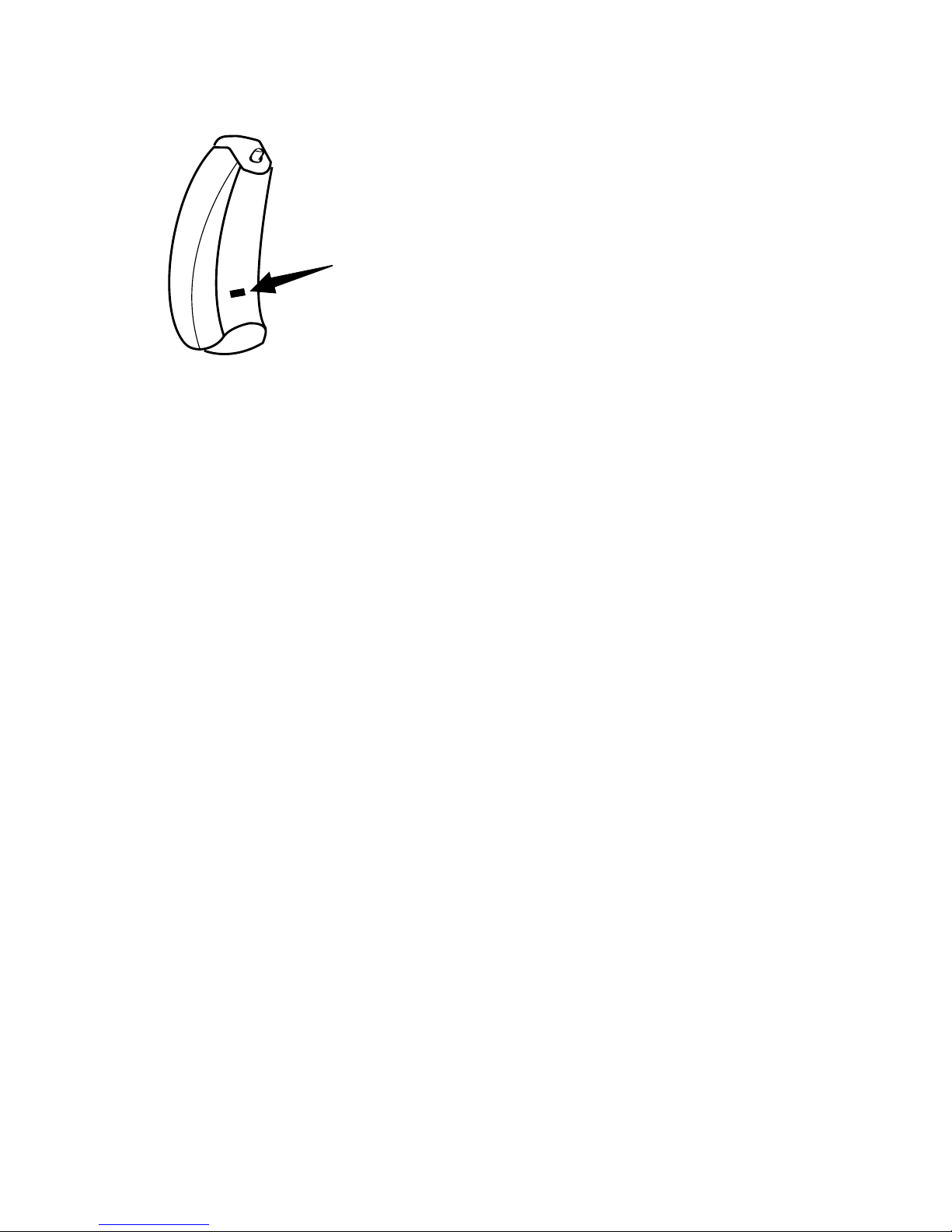
Right/left identification
If you wear hearing aids on both ears,
the hearing aids can be provided with
colored marks (red mark = right and
blue mark = left).
The arrow shows the position of the
identification mark.
Page 14
14
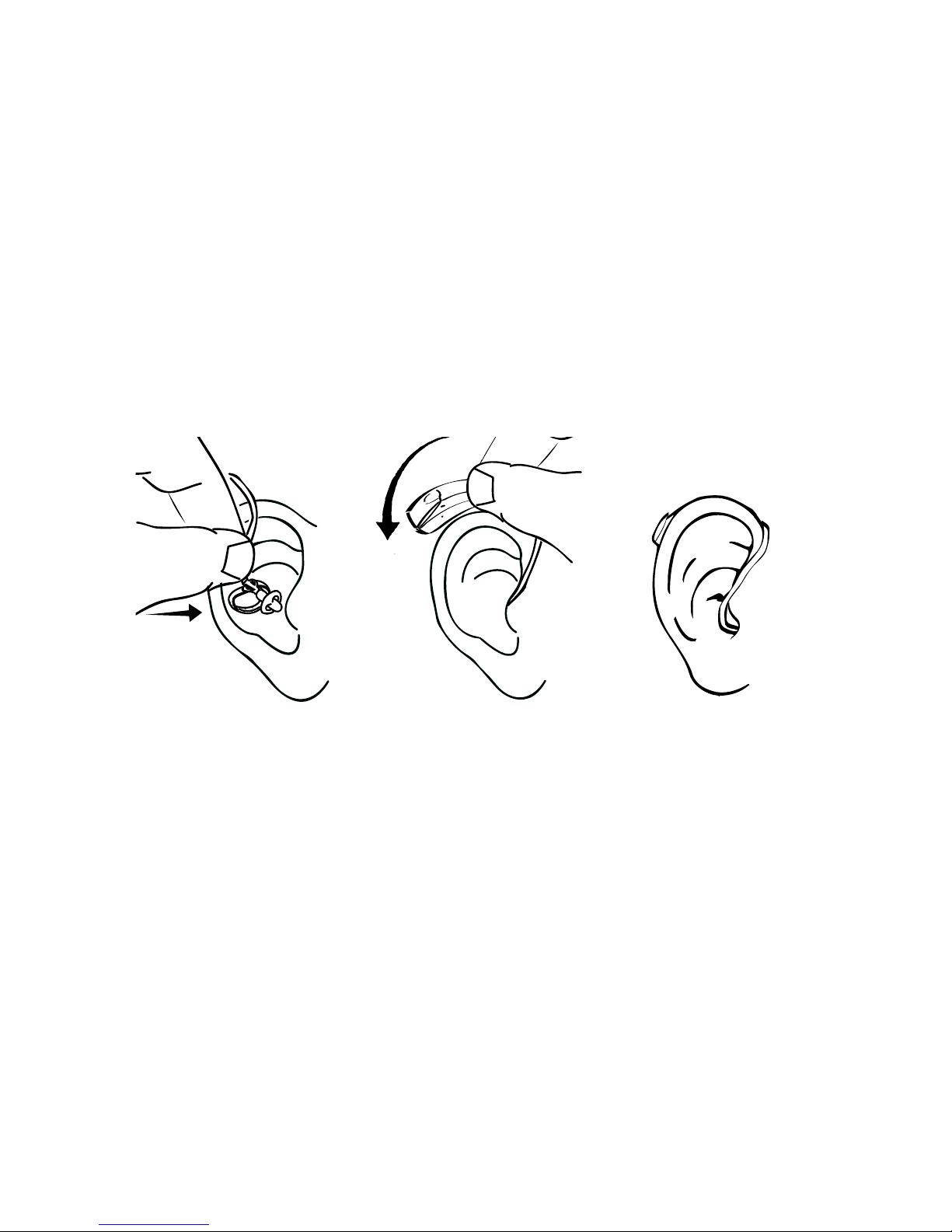
Positioning the hearing aid
Insert the earpiece in the ear canal while holding the
lower part of the tube. It may help to pull the outer ear
backwards and upwards with the opposite hand.
Place the hearing aid behind the ear, so that the hearing aid and tube rest comfortably on the ear, close to
your head.
The illustrations show an open dome. For further information on dome/ear-tip/earmold types, anchors and
procedures, see the separate ear-set user manual provided.
Page 15
15
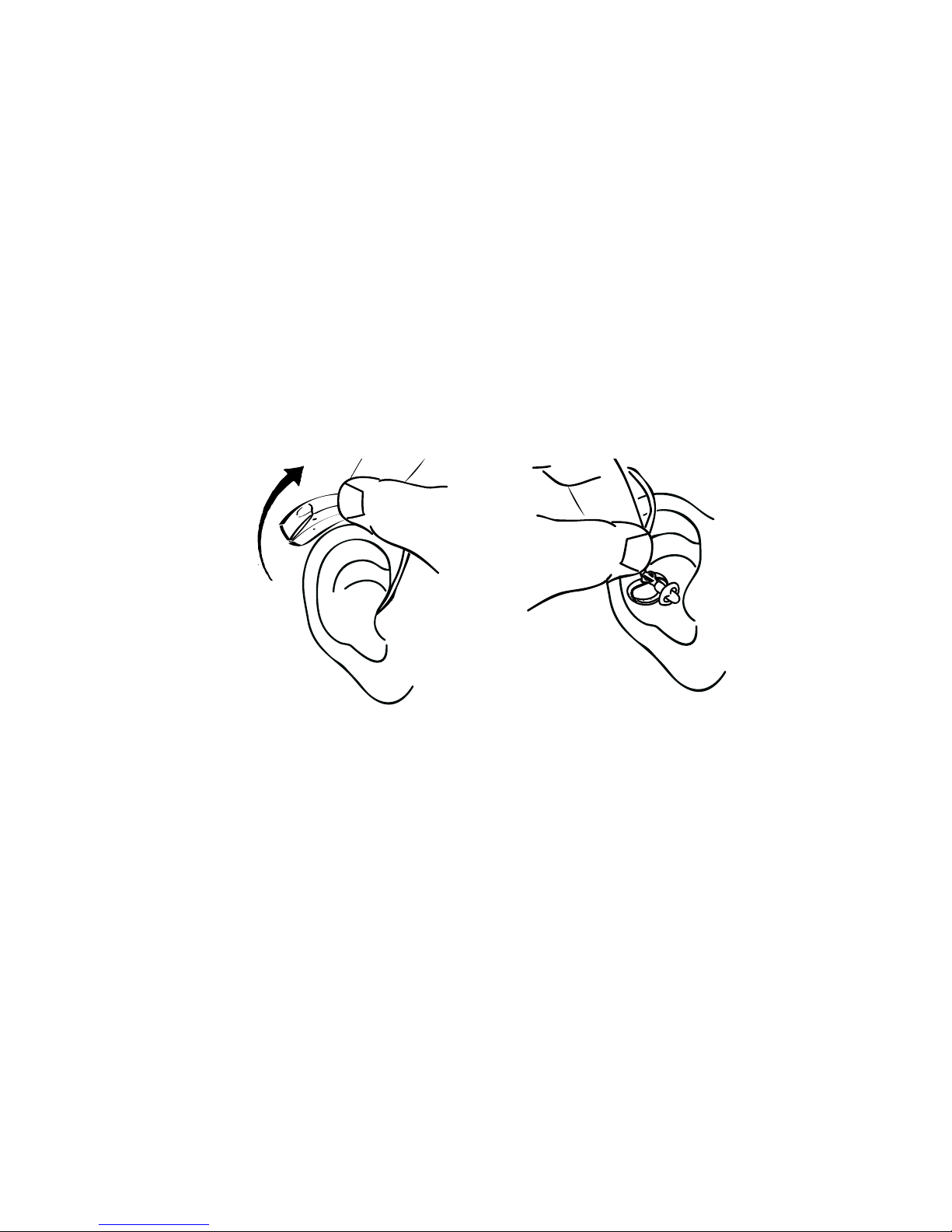
Removing the hearing aid
Remove the hearing aid from its position behind the
ear.
Carefully pull the earpiece out of the ear canal, while
holding the lower part of the tube. If the earpiece is
provided with an extraction cord, take hold of this and
carefully pull the earpiece out of the ear canal.
Page 16
16
Volume adjustment
The hearing aid volume is adjusted automatically in
accordance with your sound environment.
CAUTION
If the volume in the hearing aid is generally too loud or too
weak, or the reproduced sounds are distorted, or if you would
like any further information, consult your hearing care professional.
Page 17
17
Listening programs
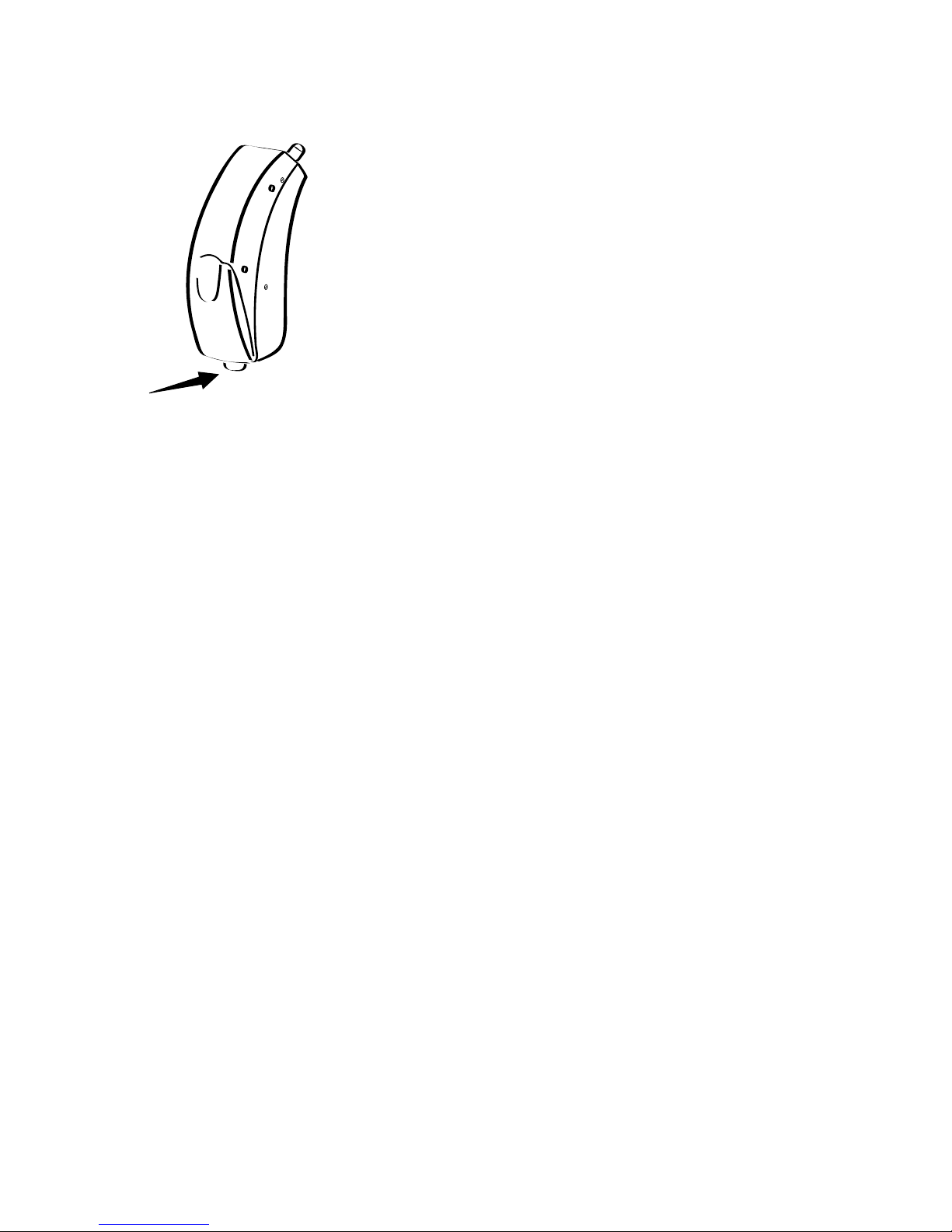
Depending on model and how your
hearing care professional has programmed your hearing aid, you can
have several listening programs intended for specific listening situations.
At the back of this booklet your hearing care professional can list the listening programs that are available
in your hearing aid.
If your needs change over time, the combination of listening programs can be changed.
Main program: Standard program.
New user program: Has the same features as the
Main program, but provides slightly less amplification.
Phone: For talking on the phone.
TV: For listening to the TV.
Page 18
18
Switching between the listening
programs
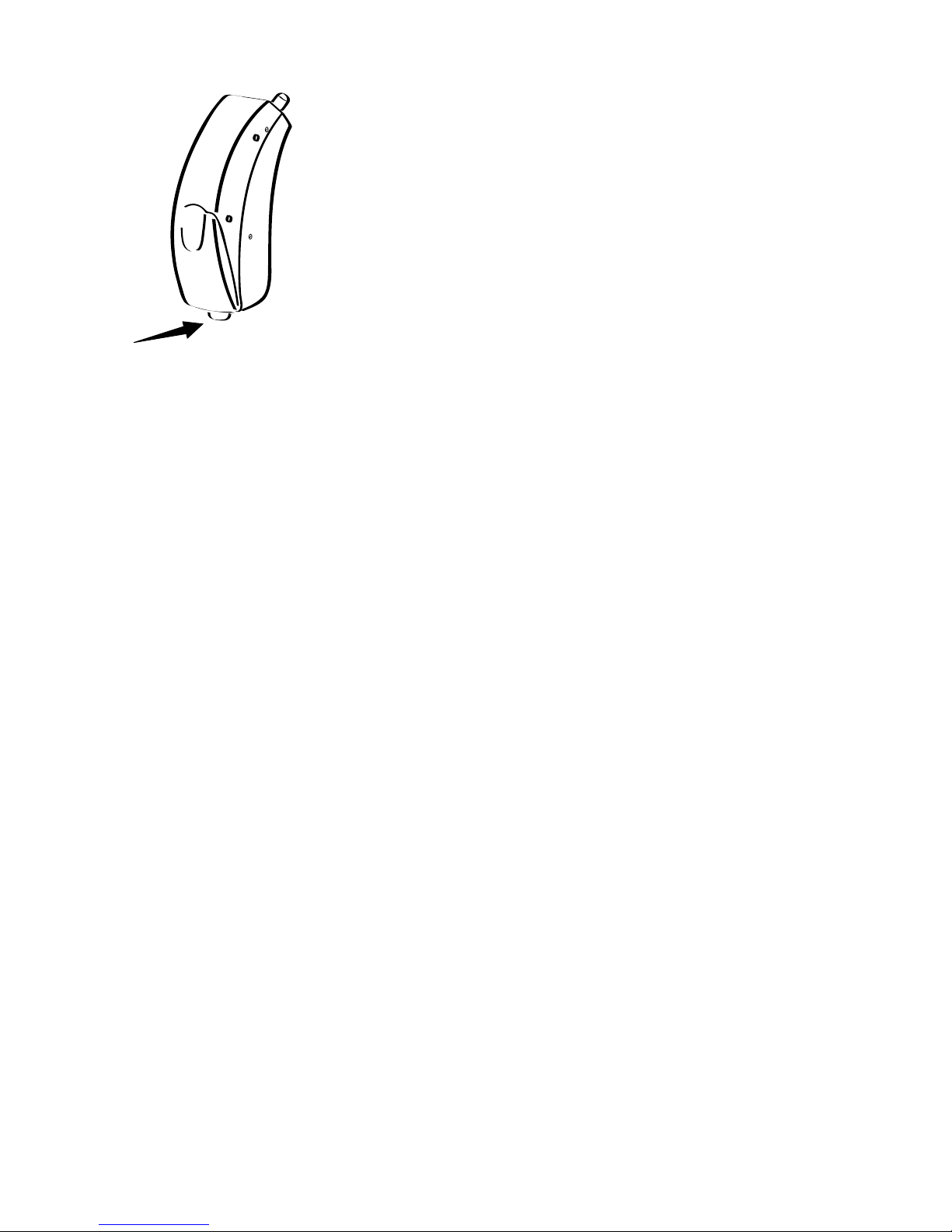
To change programs, press the program button briefly. Each time you
switch to another program, an acoustic indicator will sound unless this
function has been disabled.
Program 1: One short beep
Program 2: Two short beeps
Page 19
19
Using a telephone
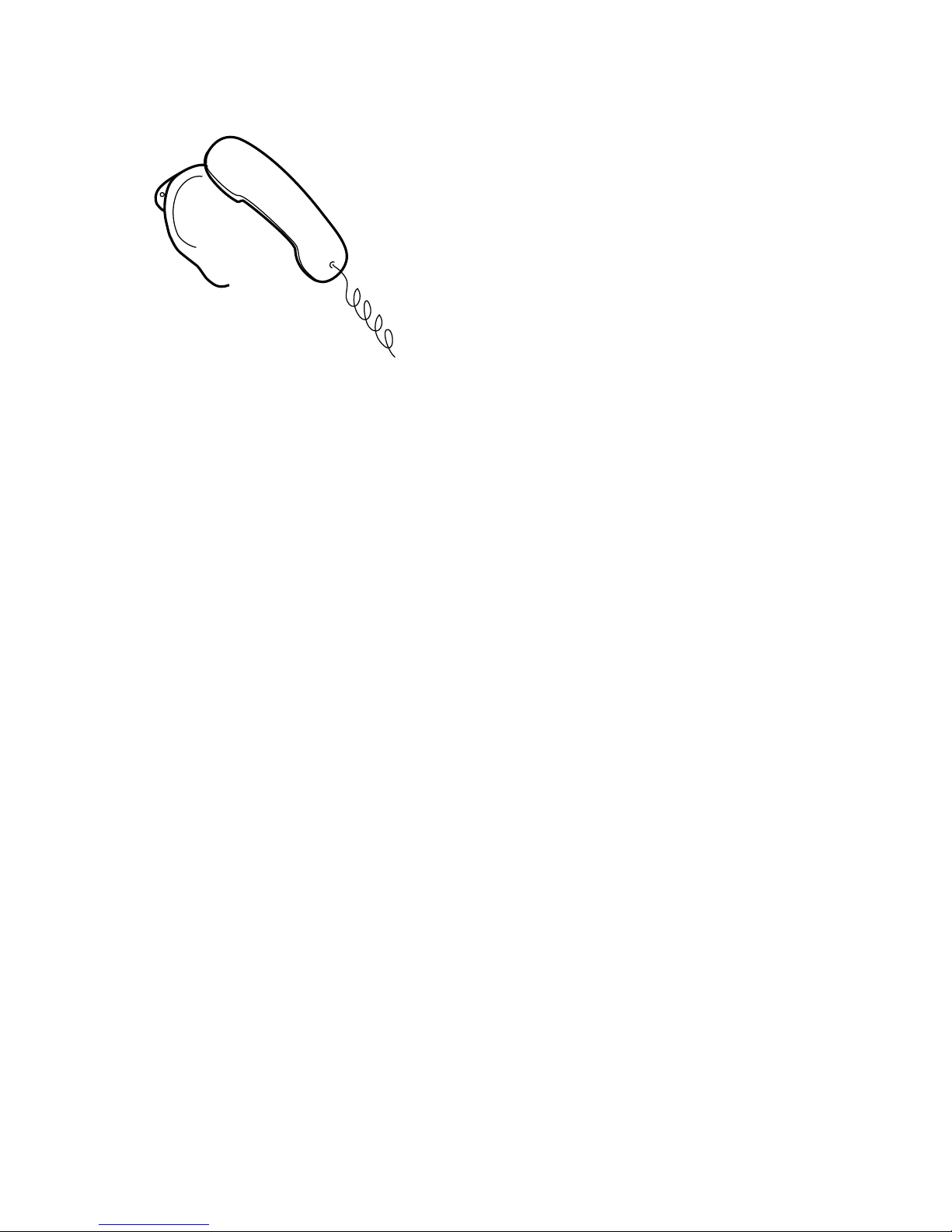
When using a telephone, we
recommend that you hold the
telephone against your head at
an angle above your ear, rather than directly against the ear.
If the sound is not optimal, try
moving the telephone earpiece
to a slightly different position.
Page 20
20
CLEANING
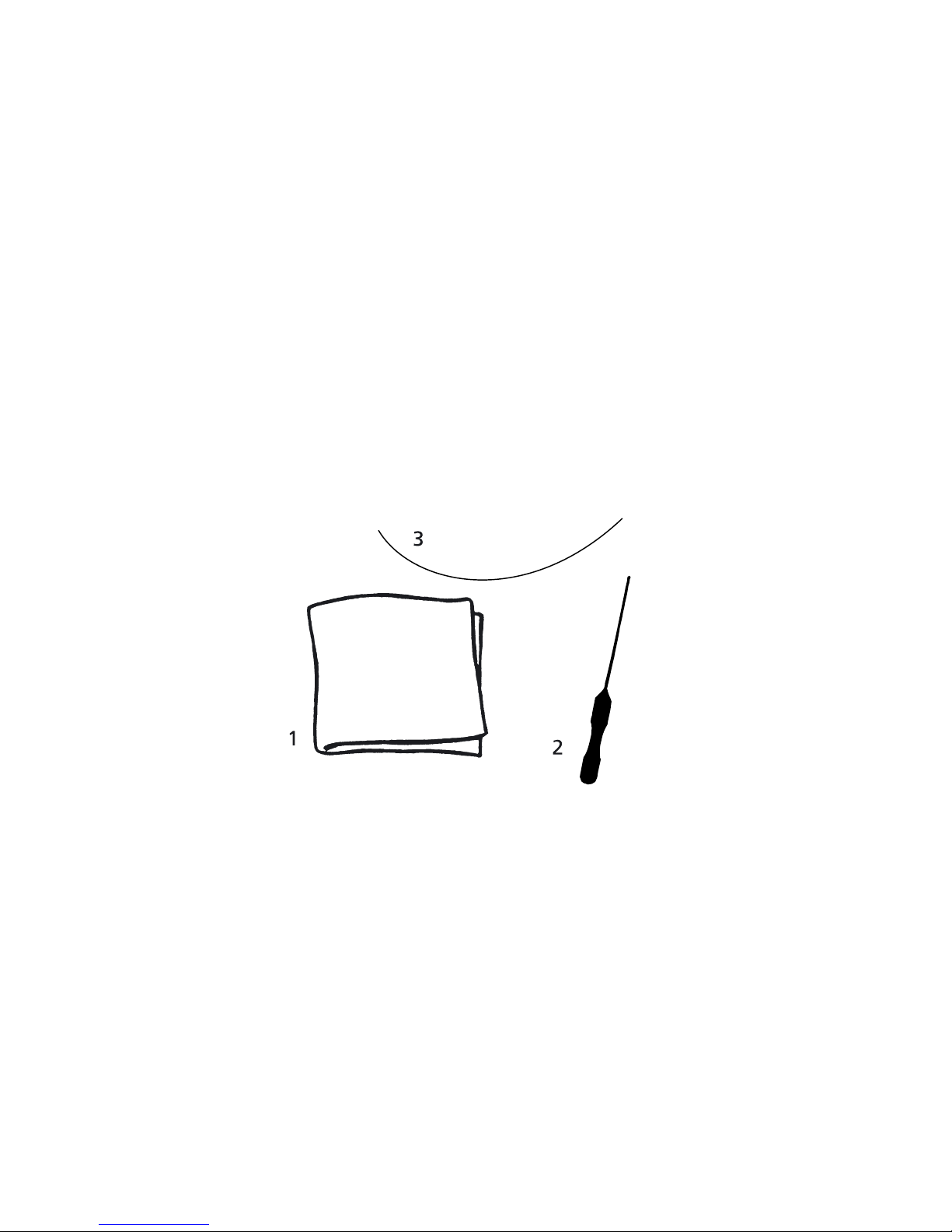
The following cleaning accessories are available for
the hearing aid and ear-set*. For cleaning the ear-set,
see the user manual “Ear-sets for Coselgi BTE hearing aids”.
1. Cloth
2. Wax removing tool
3. Cleaning thread
Contact your hearing care professional if you need additional supplies of cleaning accessories.
* Selection depends on ear-set type
Page 21
21
The hearing aid
Clean the hearing aid with the
soft cloth after use.
WARNING
Never use water or cleaning solutions to clean the hearing aid,
as this may cause it to malfunction.
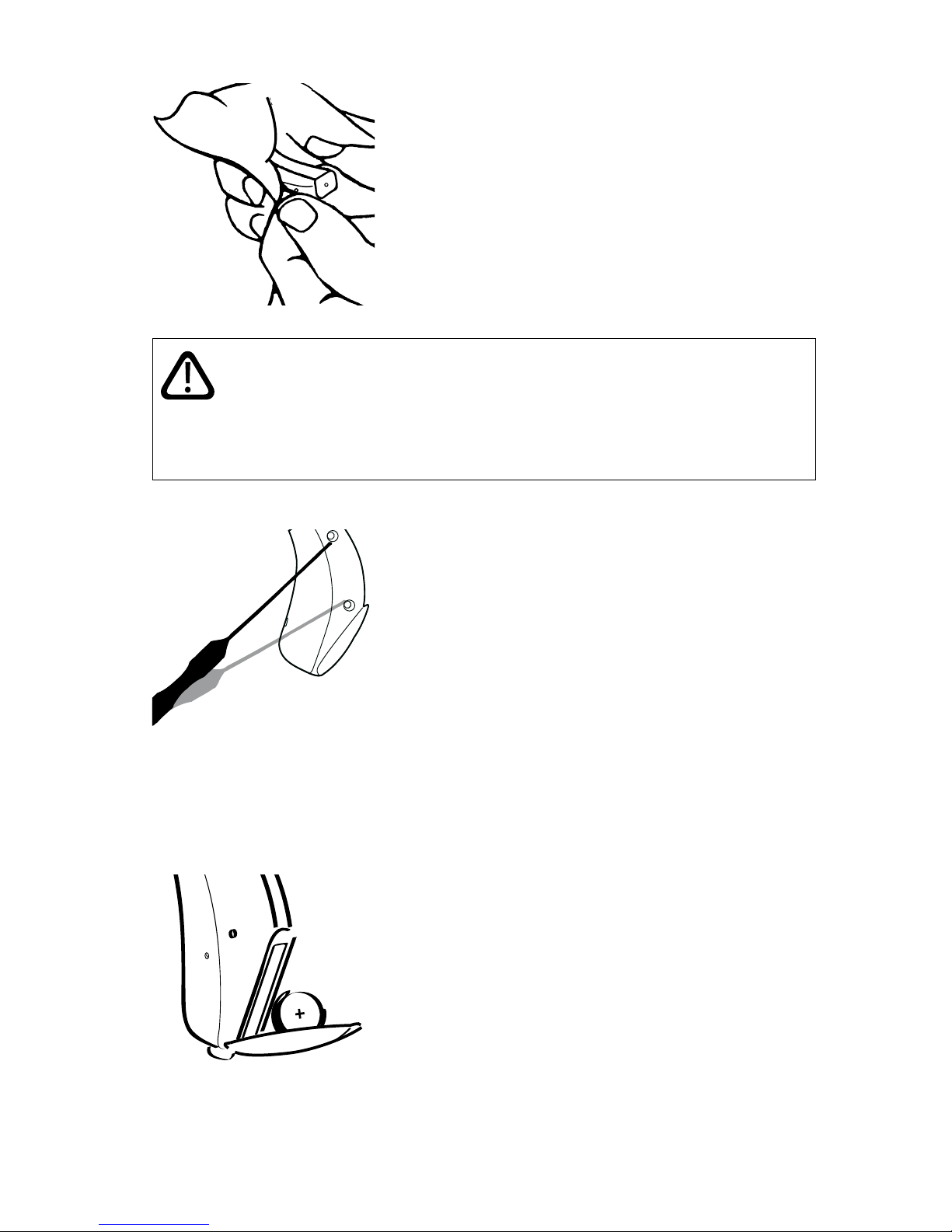
The microphone openings
Clean the microphone openings
by passing the wax removing tool
straight through the openings.
If you feel resistance, withdraw
the tool and try again. Use only
the wax removing tool provided.
When the hearing aid is not in
use, the battery drawer should be
left open, to ventilate the hearing
aid and allow it to dry.
Page 22
22
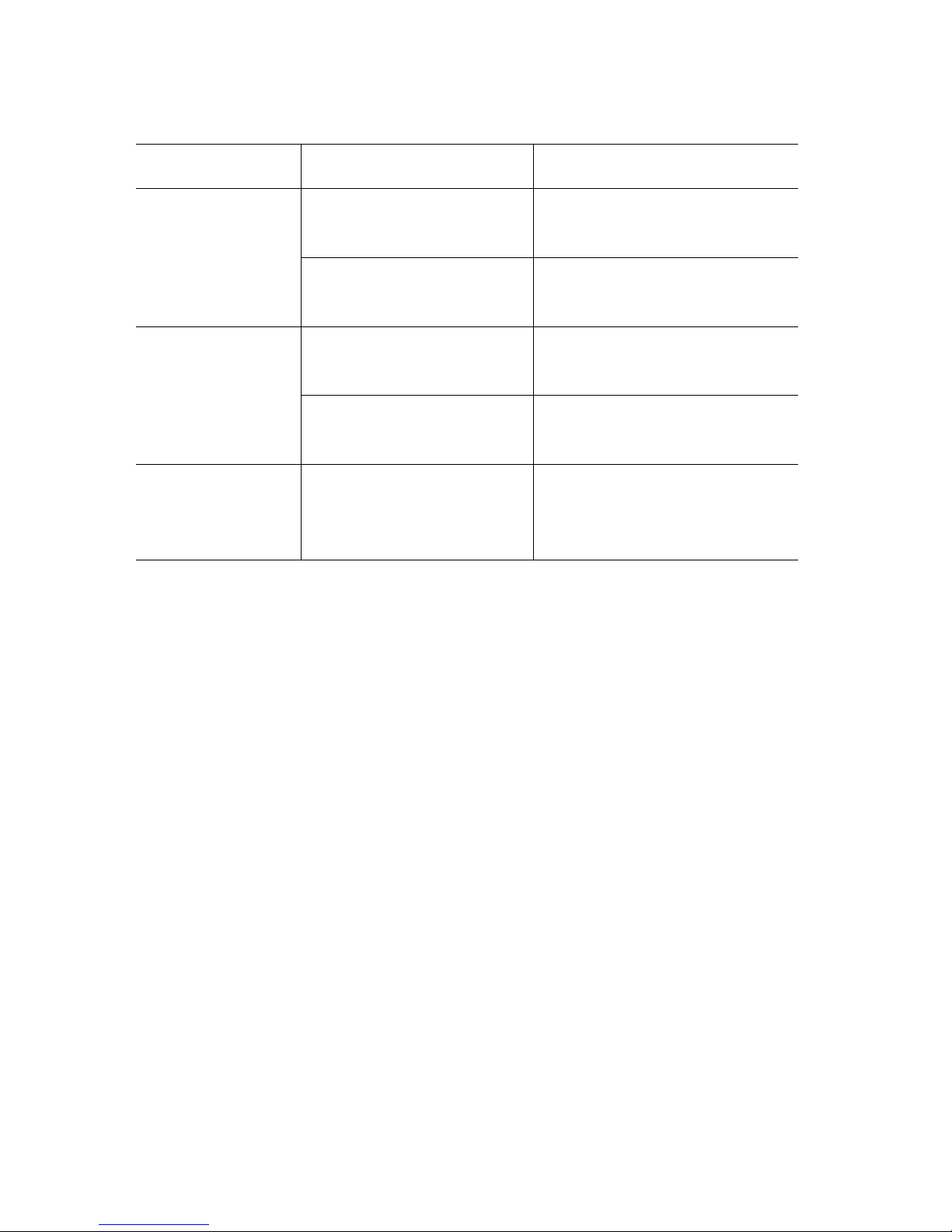
IN CASE OF MALFUNCTION
Problem Possible cause Solution
The hearing
aid is completely silent
The hearing aid is
not turned on
Make sure the battery
drawer is closed
The battery does not
work
Insert a new battery in
the battery drawer
The hearing
aid volume is
not powerful
enough
Your ear is blocked
by earwax
Contact your ENT
doctor/physician
Your hearing may
have changed
Contact your hearing
care professional
The hearing
aid whistles
continuously
Your ear is blocked
by earwax
Contact your ENT
doctor/physician
Note: This information covers only the hearing aid.
See the “Ear-sets for Coselgi BTE hearing aids” user
manual for information specific to your ear-set.
If the problems persist, contact your hearing care professional for assistance.
Page 23
23
CARING FOR YOUR HEARING AID
The hearing aid is a valuable object and should be
treated with care. Here are some things you can do to
prolong the life of your hearing aid:
CAUTION
• Turn off your hearing aid when it is not in use. Remove the
battery if the hearing aid will not be used for several days.
• When the hearing aid is not in use, keep it in its case in a cool,
dry location out of reach of children and pets.
• Do not expose the hearing aid to extreme temperatures or
high humidity. Make sure to dry the hearing aid thoroughly
after heavy perspiration such as that which may occur during
intense physical activity, e.g. playing sports.
• Avoid dropping your hearing aid – perform cleaning and
battery changes while holding the hearing aid above a soft
surface.
• Do not wear your hearing aid while in the shower or swimming, or when using a hair dryer, perfume, hair and body
sprays or gels such as suntanning lotions or creams.
• In environments with high humidity, a drying kit may be used
daily to reduce the amount of moisture inside the hearing aid.
See the instructions enclosed with the drying kit.
Page 24
24
WARNINGS
WARNING
Hearing aids and batteries can be dangerous if swal lowed
or used improperly. Swallowing or improper use can result
in severe injury or even fatalities. In case of ingestion, contact a physician immediately and the 24 Hour National Button Battery Ingestion Hotline at (202) 625-3333.
• Keep hearing aids and their parts, accessories and batteries out of reach of children and anyone else who might swallow such items or otherwise cause injury to themselves. Do
not change batteries in front of them and do not let them
see where you keep your battery supply. Discard used batteries carefully.
• Batteries are very small and can easily be mistaken for pills
or the like. Never put a battery or hearing aid in your mouth
for any reason as you may risk swallowing it.
• Risk of explosion if battery is replaced by an incorrect type
or recharged. Dispose of used batteries according to the instructions.
• Never allow others to wear your hearing aid, as this could
cause permanent damage to their hear ing.
• When selecting a listening program, please remember that
there are situations in which it is particularly important to be
able to hear the surrounding sounds (e.g. traffic, warning signals).
• The hearing aid is made of modern non-allergenic materials.
Nonetheless, in rare cases skin irritation may occur. If you notice skin irritation in or around your ear or ear canal, contact
your hearing care professional.
Page 25
25
WARNING
• Be aware that the use of any type of hearing aid may involve a
slightly increased risk of infection in the ear canal. An infection
can arise as a result of inadequate ventilation of the ear. We
therefore recommend that you remove the hearing aid and earset from your ear at night to allow the ear canal to be ventilated.
Make sure that you clean and inspect your hearing aid and earset as required. If an infection occurs, you should seek medical
attention and contact your hearing care professional for advice
on how to disinfect the various hearing aid parts. Do not under
any circumstances use alcohol, chlorine or similar substances.
• Do not use Coselgi hearing aids in mines or other areas with
explosive gases.
• Do not wear your hearing aid during radiation, X-rays,
MRIs, CT or other medical treatments and scans. The emissions from these procedures as well as from other types of radiation, such as that in a microwave oven, can damage your
hearing aid. Radiation from, for example, room surveillance
equipment, burglar alarms and cell phones is weaker and will
not damage the hearing aid, but may create audible interference.
CAUTION
• Although your hearing aid has been designed to comply with
the most stringent international electromagnetic compatibility
standards, the possibility cannot be excluded that it may cause
interference with other equipment, such as medical devices.
• Never try to open or repair the hearing aid yourself.
Page 26

26
ADVICE
NOTE
• The hearing aid will not restore normal hearing and will not
prevent or improve a hearing loss resulting from organic
conditions. However, the hearing aid can help you to make
the best possible use of your remaining hearing ability. You
should also bear in mind that it can take time to get used to a
new hearing aid and new sounds.
• In most cases, using the hearing aid infrequently will not permit you to gain full benefit from it.
• The use of a hearing aid is only part of hearing habilitation
and may need to be supplemented by auditory training and
instruction in lipreading.
• The use of hearing aids increases the risk of accumulation
of earwax. Contact your physician/ENT doctor if you suspect
that a plug of earwax has accumulated in your ear. Earwax
may not only reduce your own hearing but also the effect of
the hearing aid considerably. It is a good idea to ask your
physician to clean your ears a couple of times a year.
Page 27

27
REGULATORY INFORMATION
Contraindications:
• Congenital or traumatic deformity of the ear
• Active drainage from the ear within 90 days
• History of rapid progressive hearing loss within previous 90
days
• Acute or chronic dizziness
• Sudden unilateral hearing loss in previous 90 days
Important notice for prospective hearing aid users
Good health practice requires that a person with a hearing loss
have a medical evaluation by a licensed physician (preferably a
physician who specializes in diseases of the ear) before purchasing a hearing aid. Licensed physicians who specialize in diseases
of the ear are often referred to as otolaryngologists, otologists, or
otorhinolaryngologists. The purpose of medical evaluation is to
assure that all medically treatable conditions that may affect hearing are identified and treated before the hearing aid is purchased.
Following the medical evaluation, the physician will give you a
written statement that states that your hearing loss has been medically evaluated and that you may be considered a candidate for
a hearing aid. The physician will refer you to an audiologist or a
hearing aid dispenser, as appropriate, for a hearing aid evaluation.
The audiologist or hearing aid dispenser will conduct a hearing
aid evaluation to assess your ability to hear with and without a
hearing aid. The hearing aid evaluation will enable the audiologist or dispenser to select and fit a hearing aid to your individual
needs.
If you have reservations about your ability to adapt to amplification, you should inquire about the availability of a trial-rental or
purchase-option program. Many hearing aid dispensers now offer programs that permit you to wear a hearing aid for a period of
time for a nominal fee after which you may decide if you want to
purchase the hearing aid.
Page 28

28
Federal law restricts the sale of hearing aids to those individuals
who have obtained a medical evaluation from a licensed physician. Federal law permits a fully informed adult to sign a waiver
statement declining the medical evaluation for religious or personal beliefs that preclude consultation with a physician. The exercise of such a waiver is not in your best health interest and its use
is strongly discouraged.
Children with hearing loss
In addition to seeing a physician for a medical evaluation, a child
with a hearing loss should be directed to an audiologist for evaluation and rehabilitation since hearing loss may cause problems in
language development and the educational and social growth of
a child. An audiologist is qualified by training and experience to
assist in the evaluation and rehabilitation of a child with a hearing loss.
Page 29
29
Hearing aids, accessories and batteries
should not be disposed of with normal household waste. Please consult your national
Coselgi distributor for advice on how to
dispose of these items.
Page 30
30
PROGRAM FORMS
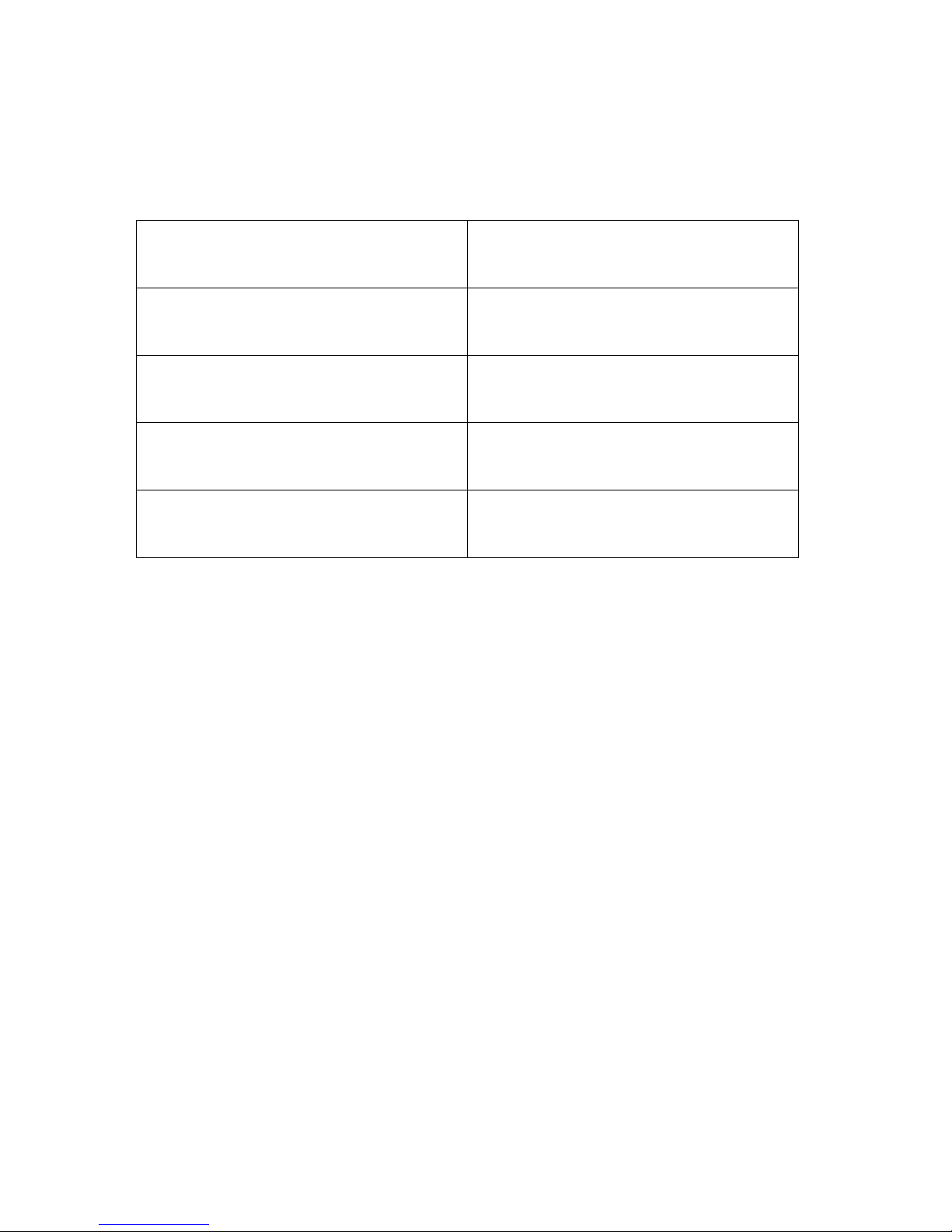
Programs available in your hearing aid:
Program Chosen position
Main program
New user program
Phone
TV
Page 31
31
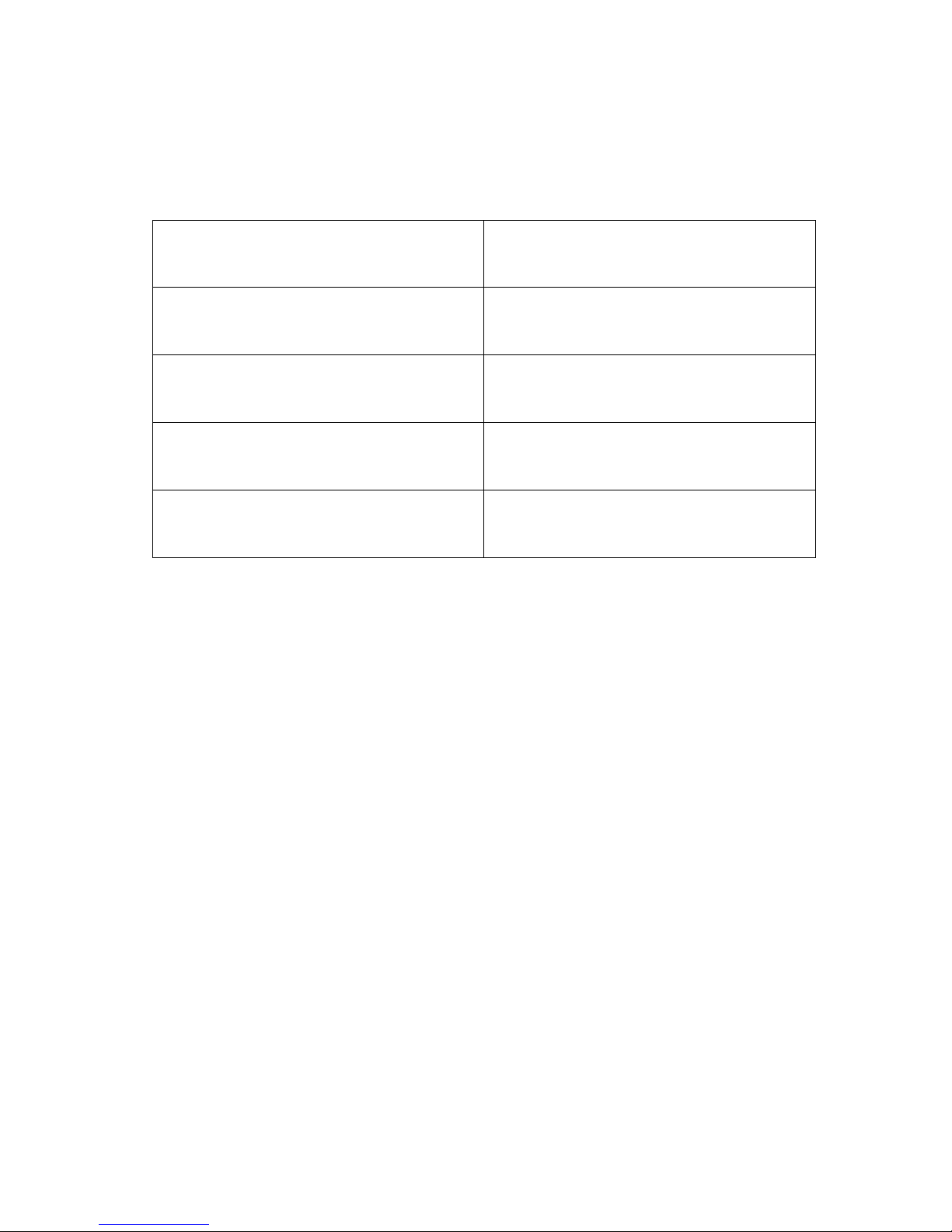
Programs available in your hearing aid:
Program Chosen position
Main program
New user program
Phone
TV
Page 32
Manufacturer
¡9 514 0133 041*¤
Printed by HTO / 2013-09
9 514 0140 041 #02
¡#01v¤
 Loading...