

Page 1
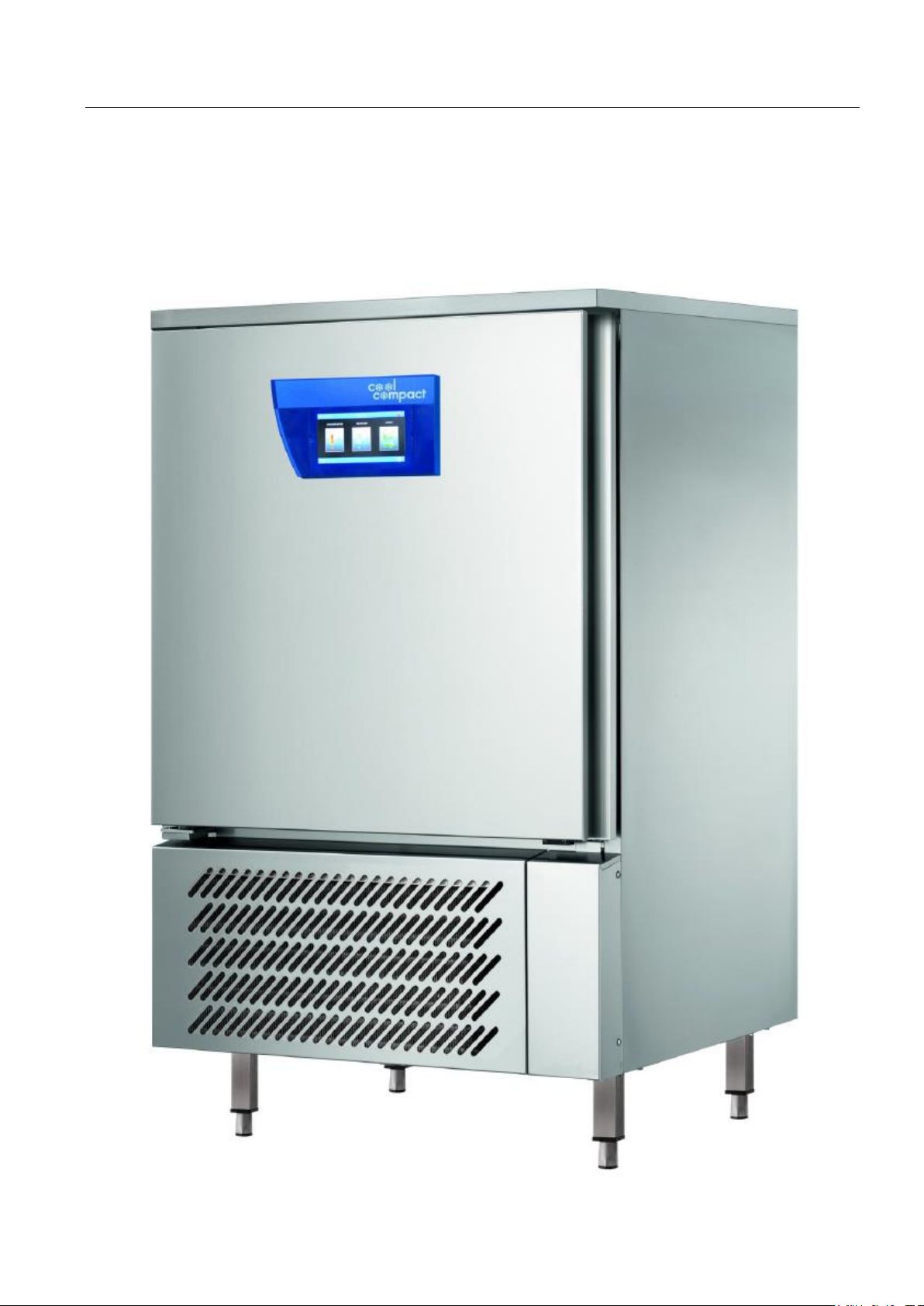
OPERATING MANUAL
Blast chiller - freezer
5 X GN 1/1 – 15 X GN 1/1
Series: SKFME / SKFZK
Page 2

2
CONTENTS
Page
1.
PRELIMINARY REMARKS
3
2
PURPOSE OF USE
3
3.
GENERAL TIPS
3
4.
SAFETY REGULATIONS
4
5.
TECHNICAL DATA
4
6.
INSTALLATION
5
6.1
Transport and handling of the equipment
5
6.2
Unpacking and setting
5
6.3
Electrical connection
7
6.4
Connection of an external unit
8
6.4.1
Setting
8
6.4.2
Electrical connection
8
6.4.3
Connection of coolant hoses
8
6.5
Tips concerning installation
8
7.
USE
9
7.1
Equipment in the standby mode
9
7.2
Equipment in the cooling mode
9
7.3
Categories of food products
9
7.4
Automatic and individually set programs
9
7.5
Cycle in progress
10
7.6
Other functions
10
7.7
Machine in the heating mode
11
7.8
Combined mode (option)
11
7.9
Options
11
7.10
Alarms
12
7.11
Manual mode and Multilevel mode
12
7.12
USB
13
7.13
HACCP report
14
7.14
Help (option)
14
7.15
Modem (option)
14
8.
MAINTENANCE
16
8.1
Safety
16
8.2
Cleaning
16
8.3
Care
16
8.4
Non-standard maintenance work
17
9.
WARRANTY AND SERVICE
17
10.
SCRAPPING AND RECYCLING
17
11.
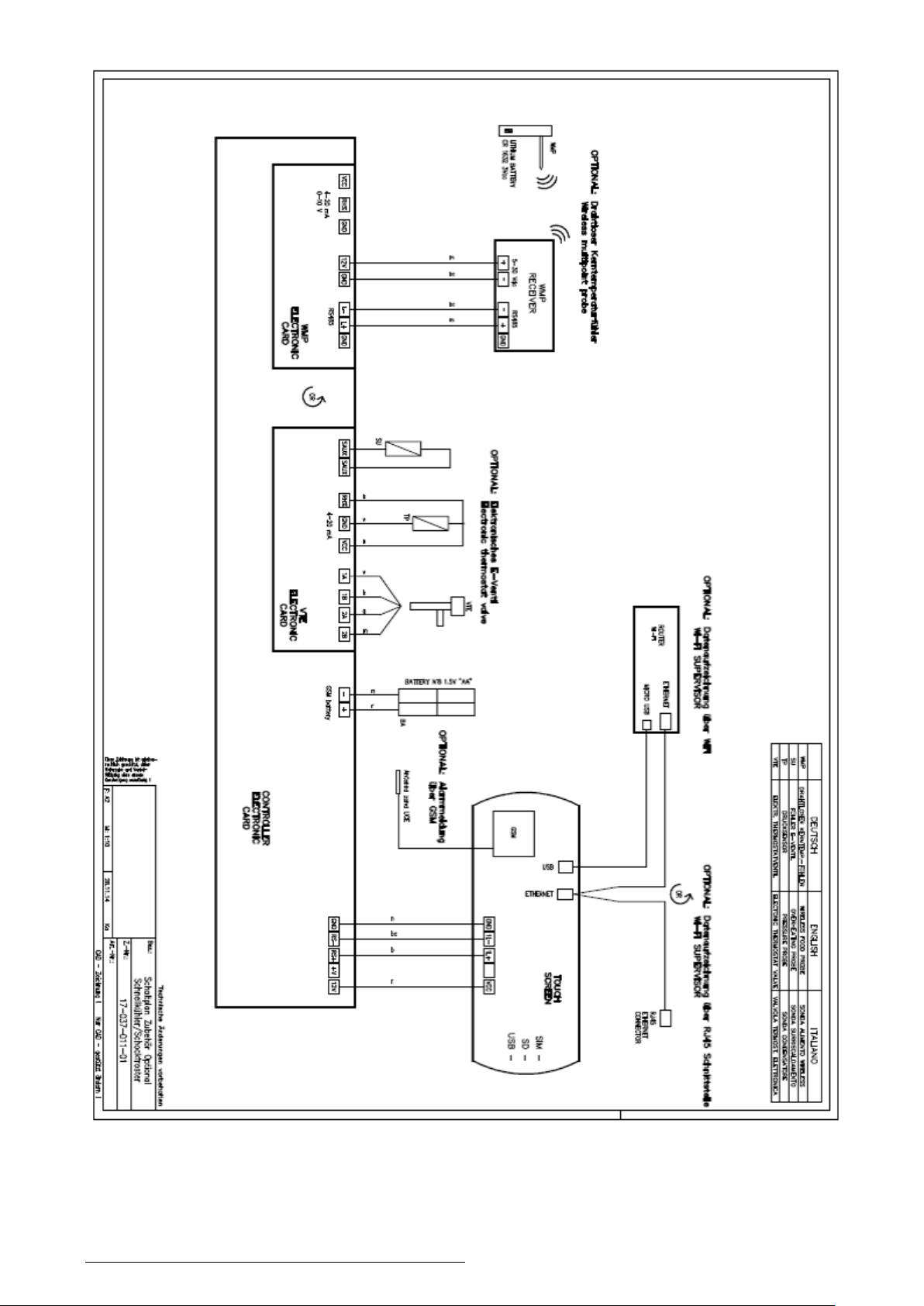
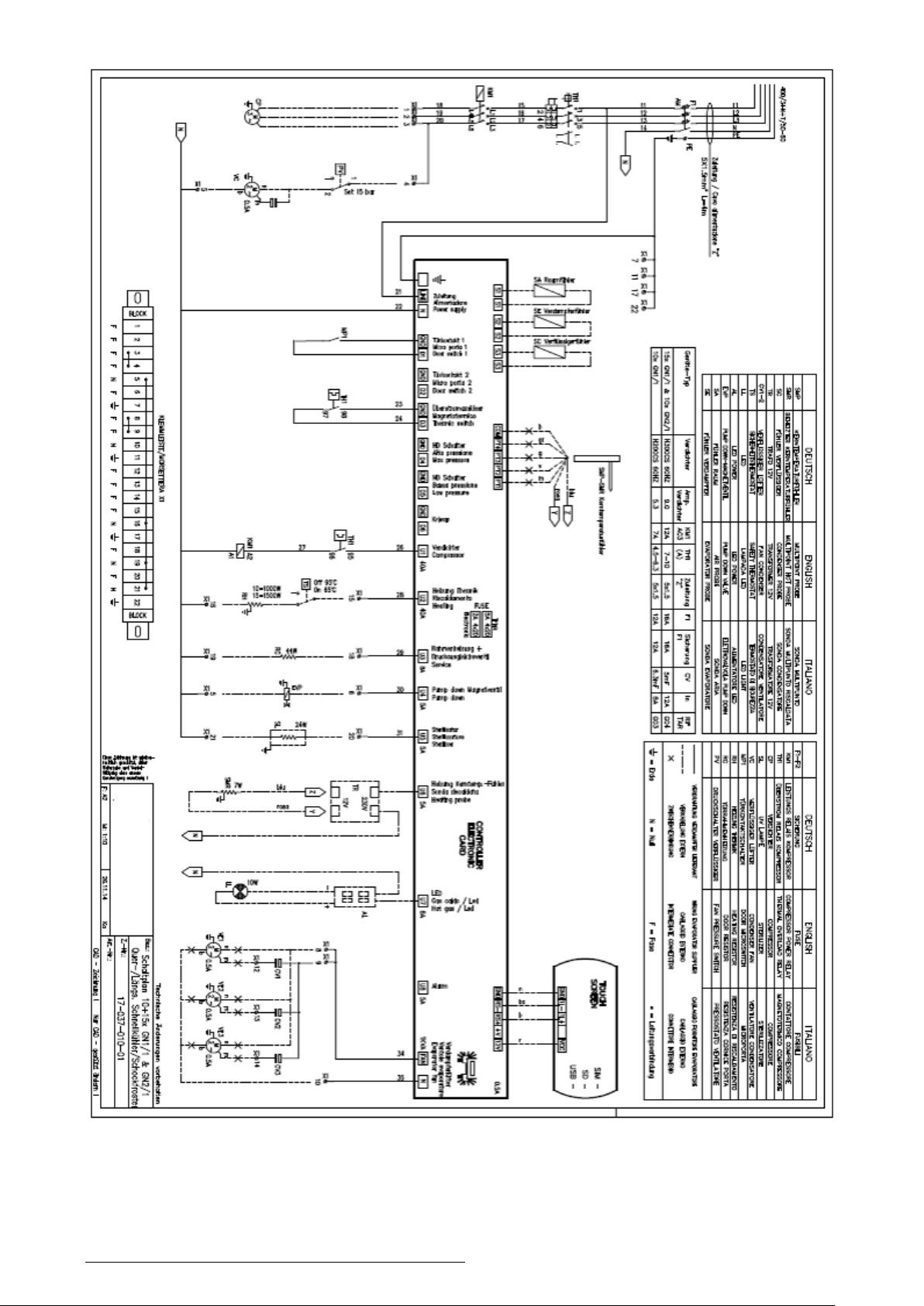
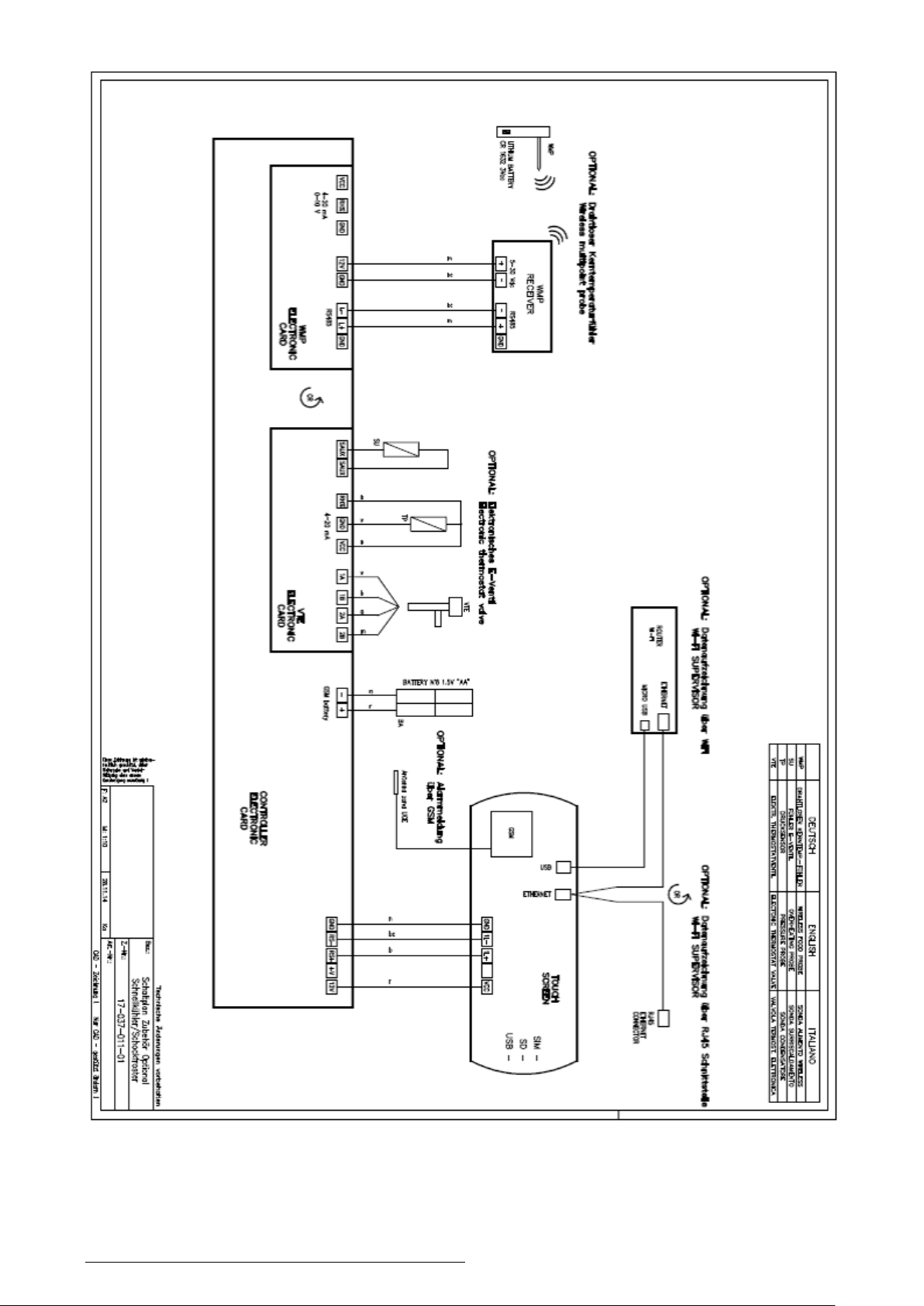
WIRING DIAGRAM
18-21
12.
DECLARATION OF CONFORMITY
22
Page 3

3
1. PRELIMINARY REMARKS
Thank you for buying our blast chiller-freezer. All our products are subject to constant quality control.
Please read the manual carefully so as to be able to enable long and problem-free use of our products.
The operating manual is intended to provide the following information:
• general tips;
• safety regulations;
• technical data;
• installation;
• use;
• maintenance;
• guarantee and service;
• scrapping and recycling; and
• declaration of conformity.
2. PURPOSE OF USE
Blast chillers-freezers are used to quickly cool down certain food products so as to avoid growth of
bacteria in food and to maintain high quality of food.
Such equipment is used in two ways:
• Quick cooling in order to reduce the temperature from +90 °C to +3 °C in 90 minutes.
• Freezing in order to reduce the temperature from +90 °C to -18 °C in 240 minutes.
During the quick cooling, one can set the most appropriate cooling cycles for the specific food products
being cooled.
After the cycle is completed, the equipment switches to the storage mode. One must keep in mind that
the blast chiller-freezer is intended for storage of products for up to 2 days.
3. GENERAL TIPS
• The equipment is suitable only for quick cooling/blast freezing of food products.
• After the equipment is unpacked and the protections are removed, please check if the
equipment is not damaged. If any damage is found, please inform the supplier or installer
immediately.
• Before works related to setting and installation are started, please check if the data pertaining
to the power and voltage of the electrical system given in the data plate correspond to the actual
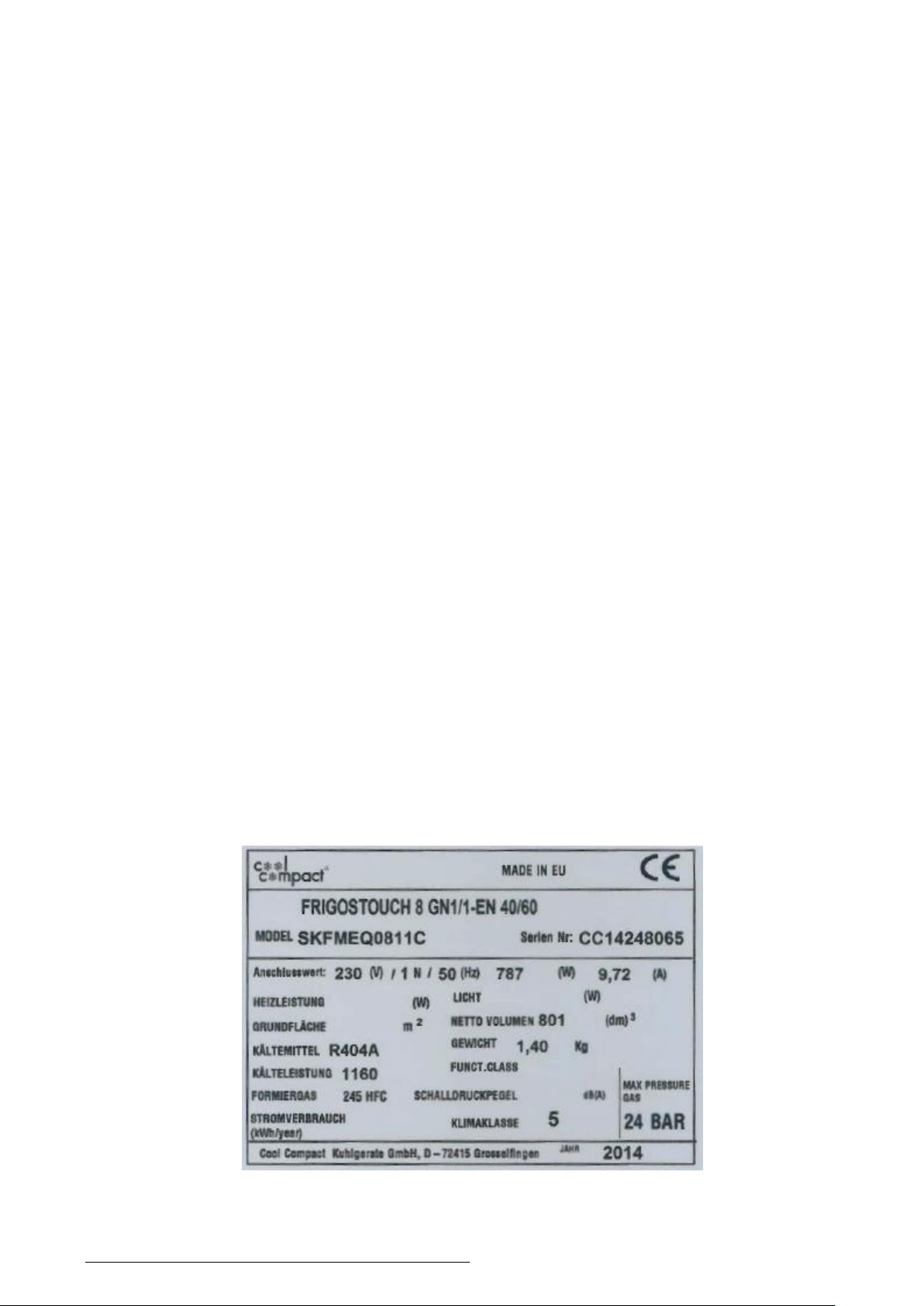
local values. The data plate is located in the back of the equipment and on the back page of the
operating manual.
• In the event of a breakdown, the equipment must be switched off immediately.
Installation, startup, and maintenance of the blast chiller-freezer must be performed by qualified
companies that provide cooling services or by persons authorized by the manufacturer. In order to
ensure safe installation, use, and maintenance of the blast chiller, one must carefully read the
instructions contained in this manual and keep this manual in a place where it will be easily accessible
for the user.
4. SAFETY REGULATIONS
Page 4
4
In the course of the design and the production of the blast chillers-freezers, particular attention was
paid to observance of the safety rules, which enable the user to use the equipment safely.
• In order to avoid accidental touching of live cables, the equipment is fitted with metal guards.
Such protections may be removed only by qualified personnel.
• In order to avoid accidental contact with moving parts, the blades of the fan on the condenser
and in the enclosure of the evaporator are covered with a protective grille.
• The electrical system complies with the CEI EN 60335-1:2002 standard.
As is the case with any electrical equipment, in order to avoid dangerous situations during installation
and during use, one must act in compliance with the applicable regulations.
• Before performing any maintenance, disconnect the equipment from the power supply network.
• Do not work with the equipment with wet hands or feet.
• Do not remove and do not tamper with protective devices while performing regular maintenance
work.
• Do not put any devices or kitchen tools into the cover of electrical and mechanical parts.
• Use appropriate and compatible equipment for maintenance.
• When not in use, the equipment should be switched off and the plug should be taken out of the
power socket.
Failure to observe the above rules may affect the safety of the equipment and of the user. The
manufacturer is not responsible for any changes to the original method of functioning of the equipment,
failure to observe the operating instructions, or changes to or installation of additional devices.
5. TECHNICAL DATA
In order to determine the technical characteristics of the blast chillers-freezers, it is recommended to
pay attention to the information contained in the data plate located on the back cover of the operating
manual.
A data plate is also provided in the back of the blast chiller and is intended for:
• identification of the product during the service based on its model, product number, and serial
number;
• providing information about the required electric power and supply voltage of the equipment;
• providing information about the type and quantity of the coolant.
•
Page 5

5
The manufacturer is not responsible for improper use of the product.
The manufacturer also reserves the right to make the necessary and useful changes in its products that
the manufacturer finds necessary, without changing its basic functions.
6. INSTALLATION
Setting, installation, connection, and maintenance work on the blast chiller-freezers may be performed
only by a person who builds cooling equipment and/or a technically qualified and authorized
manufacturing company.
6.1. TRANSPORT AND HANDLING OF THE EQUIPMENT
In order to properly transport and then handle the blast chiller-freezer, one must comply with the
following instructions:
• In order to avoid damage to objects or injury of persons during transport of the equipment, one
must use appropriate means of transport and equipment.
• Check if the selected means of transport is appropriate for the weight of the blast chiller-freezer.
• Note: During transport of the equipment, it may not be turned upside down or laid on the side.
Such a position may cause damage to the equipment and hinder the cooling cycle.
6.2. UNPACKING AND SETTING
Before the equipment is installed, it must be unpacked carefully.
• Set a blast chiller-freezer that still has not been unpacked using an appropriate forklift in the
vicinity of the eventual place of installation.
• Cut the tape and pull the cardboard packaging upward. In order to avoid damage to the
equipment, do not use knives or other similar tools.
• Take out the wooden base and set the chiller in the final position.
• Take off the PVC protective film from all sides.
• Remove the plastic protection from the probe for measuring the temperature inside the product.
• Place the equipment in a level position in a well ventilated room.
• Avoid putting the equipment close to a direct source of heat or in an area directly exposed to
sunlight.
• The place where the equipment is to be set must be well ventilated and free from dust.
• The air humidity should be equal to a maximum of 70%.
• All uneven spots on the floor must be eliminated before the installation.
• Leave free space in the area where air is sucked into and exhausted out of the unit (around the
ventilation openings) in order to ensure proper ventilation.
• The ambient temperature should be in the range of +16 °C to +32 °C.
• The floor of the equipment must be sealed to prevent penetration of water from the outside! (It
must be sealed or covered with silicone.)
• Keep a distance of at least 50 cm on all sides in order to ensure proper circulation of air.
• All elements of the packaging of the equipment should be disposed of in compliance with
applicable regulations. In no case may they constitute a burden to the environment.
Page 6
6
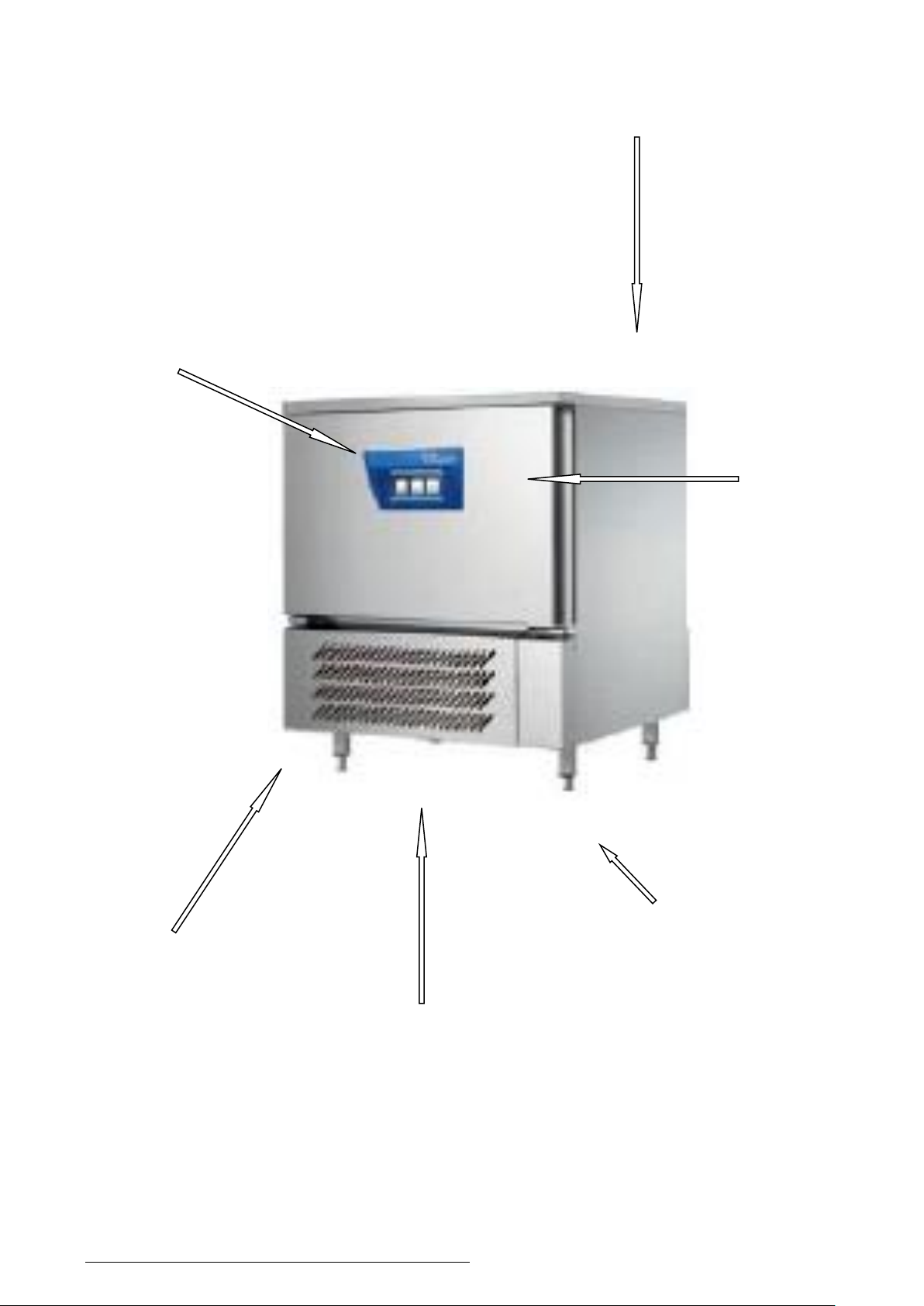
Data plate (on the back)
Control panel
Door
Legs with height adjustment
Unit chamber with a grate
air inlet cover
Removable condensate container
Door
Page 7
7
6.3. ELECTRICAL CONNECTION
The equipment is delivered without the plug for connecting to the power supply line. This connection
must be made by qualified workers.
If the connection is made by the user or by unqualified workers, the manufacturer will be exempted from
any and all responsibility.
• Check the integrity of the power supply lines. In the event of damage, have a qualified specialist
perform the repair.
• The supply voltage must correspond to the values specified in the data place of the equipment.
• The electrical cable must have an integrated multi-pole main switch which opens all contacts,
including those in the zero conductor. The minimum distance between open contacts must be
equal to 3 mm and the cable must be connected to an appropriate overcurrent switch or fuse.
The selected parameters and settings must correspond to those shown on the data plate.
• The main switch must be located close to the equipment, easily acceptable, and enable its use
each time for the equipment.
• The ground cable made by the investor must be connected to the appropriate grounding
terminals (clamps) of the equipment.
• It is prohibited to use connections, multiple plug sockets, extension cables, and cables with not
permitted cross-section.
• Local standards must be complied with.
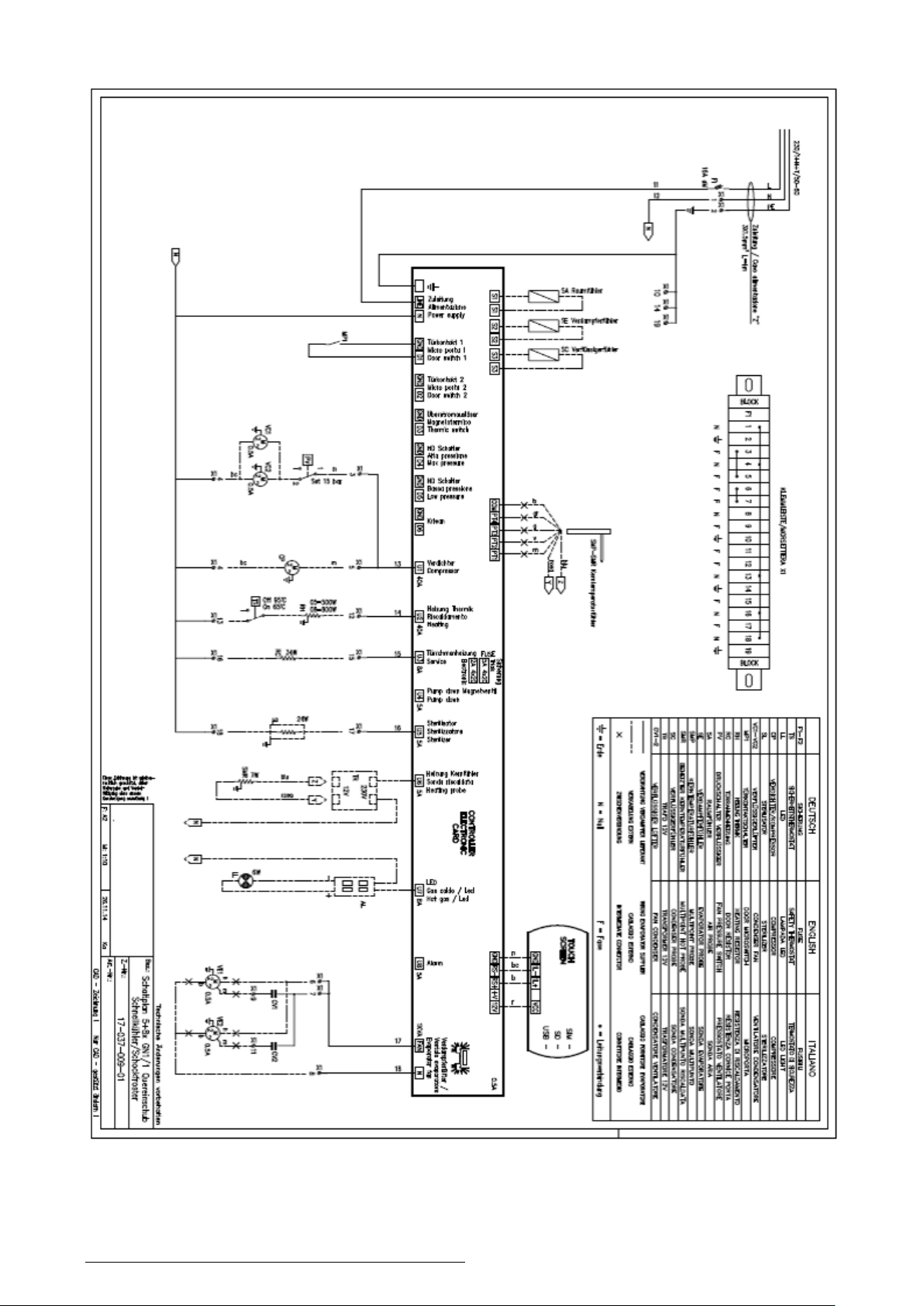
• The detailed information concerning the electrical connection can be found in the wiring diagram
in the operating instruction or on the back wall of the equipment.
• During normal operation of the equipment and during its maintenance, the installation cable
must not be stretched or crushed.
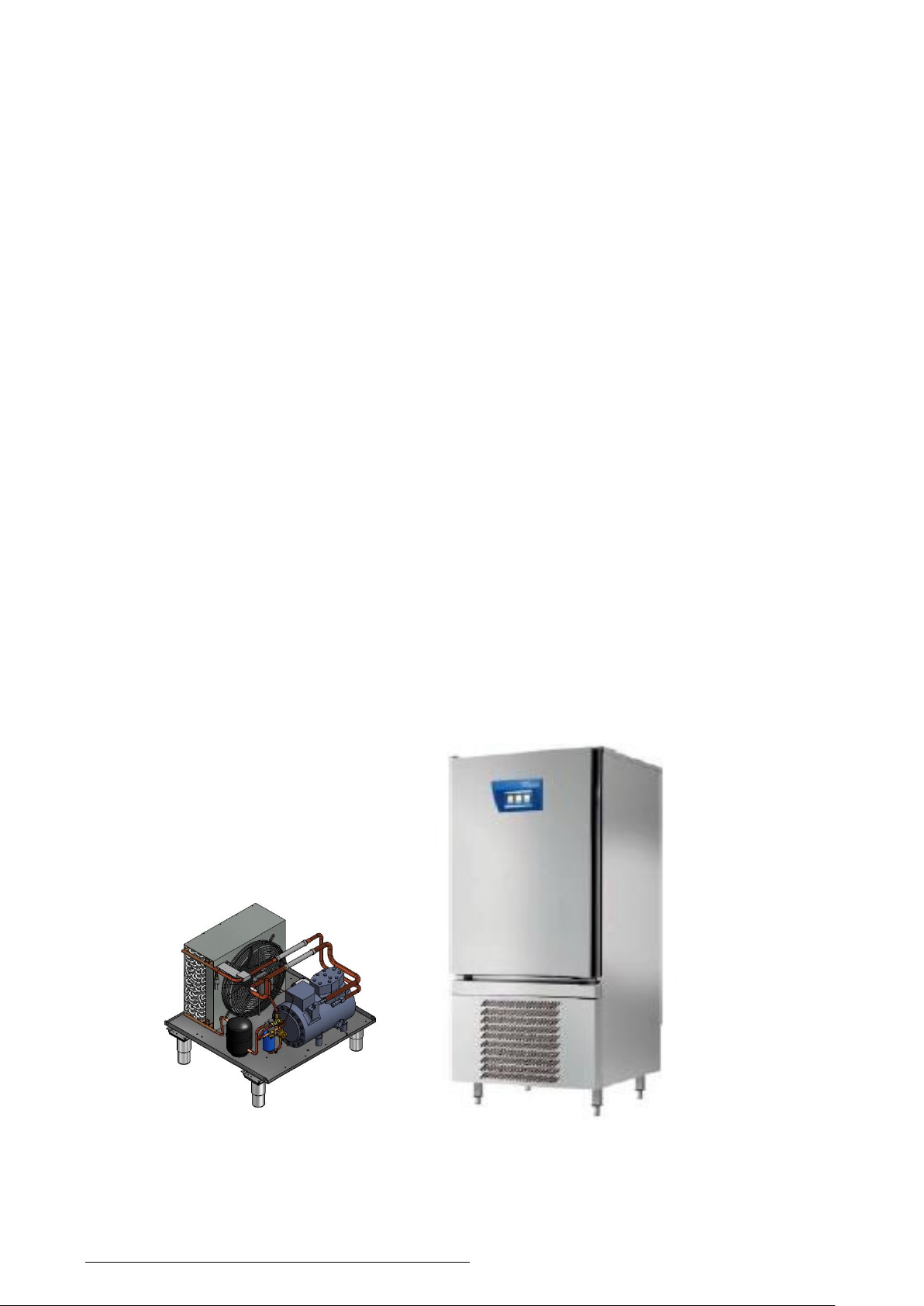
6.4. CONNECTION OF AN EXTERNAL UNIT
Two units should be connected in accordance with the following instruction.
Cooling unit Blast chiller-freezer
6.4.1. SETTING
Page 8

8
After the unit has been unpacked, perform the following procedure:
• Set the equipment on a stable ground.
• Set the unit under an appropriate cover that will protect it against the weather and at the distance
of 10 m from the blast chiller-freezer.
• Avoid putting the equipment close to a direct source of heat or in an area directly exposed to
sunlight.
• Maintain a distance of 500 mm from the air inlet and 1,500 mm from the air outlet.
• Connect the coolant hoses to the equipment.
• Ensure an appropriate circulation of oil in the vertical ducts.
• The equipment is delivered without the coolant.
6.4.2. ELECTRICAL CONNECTION
• The blast chiller-freezer must be connected with 2 electrical cables (the cross-section is stated
in the technical data) in accordance with the data specified in the wiring diagram on the
connections board in the condenser module. When connecting the condenser to the
connections board, observe the line number and the terminal number.
6.4.3. CONNECTION OF COOLANT HOSES
• Connect the liquid hose of the condenser to the liquid hose of the blast chiller-freezer.
• Connect the hot gas duct of the condenser to the hot gas duct of the blast chiller-freezer.
• Connect the suction duct of the condenser to the suction duct of the blast chiller-freezer.
• Open all closing valves in the system, leave the common cooling cycle, and check the tightness.
Fill the cooling equipment with the R404a/R507 coolant.
• If the condenser is set higher than the blast chiller-freezer, equip the system with appropriate
air traps.
When connecting both units:
• avoid reducing pieces;
• reduce all bends to a minimum;
• protect the pipes as appropriate, and
• provide the suction duct with appropriate insulation.
6.5. TIPS CONCERNING INSTALLATION
After the blast chiller-freezer has been set and connected, the technical staff should check if the
installation has been performed properly.
• Check proper operation of electrical connections.
• Make sure that the input power complies with the applicable standard.
• Make sure that the gas pressure in the cooling system is correct.
• Conduct at least one full cooling cycle in order to make sure that all parts of the equipment are
working properly.
• Before the startup, the equipment should be cleaned (see item 8.2).
• Such accessories as guides, frames, etc. should be installed as required at an appropriate
height.
7. USE
7.1. Equipment in the standby mode
9
Page 9
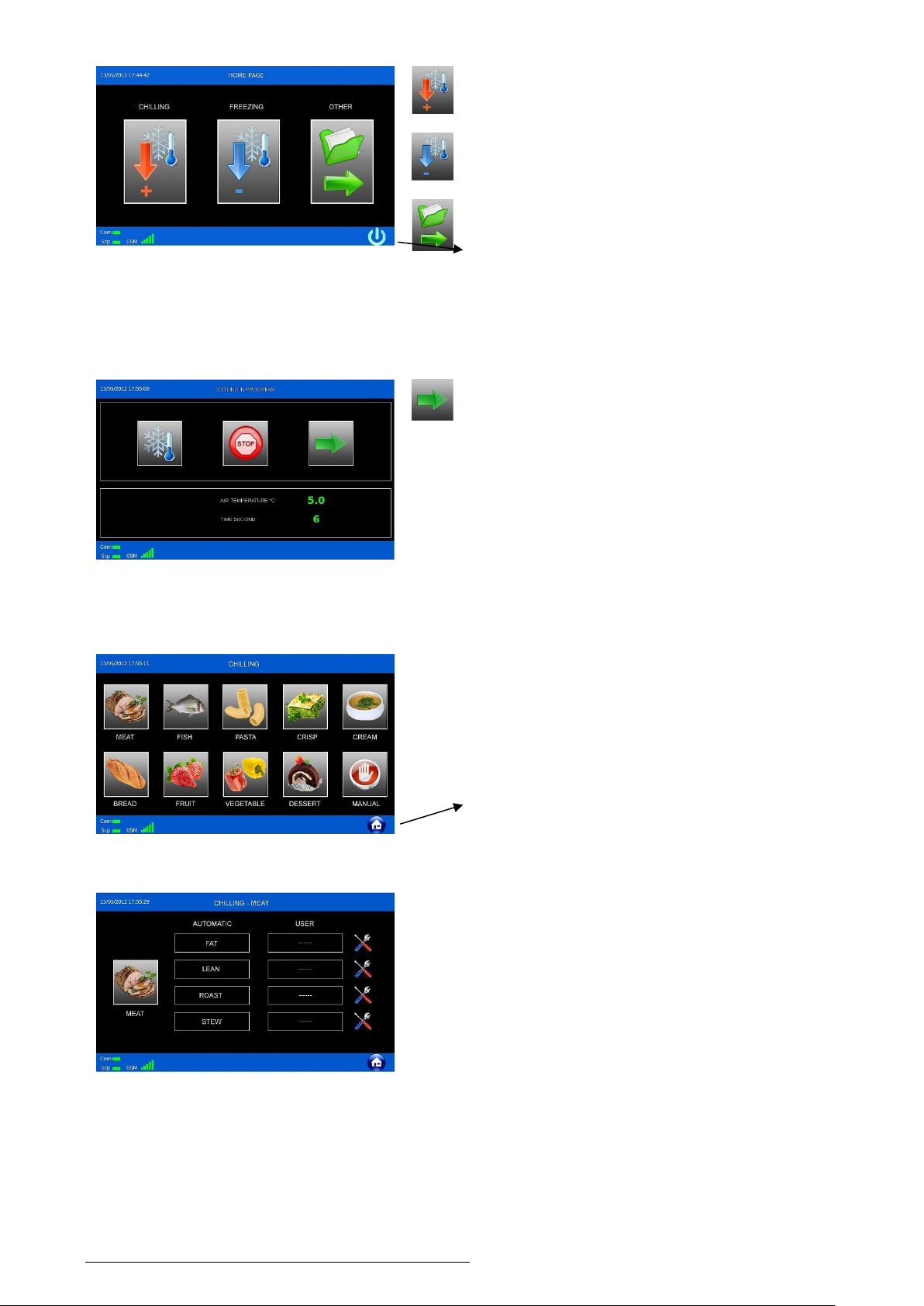
Quick cooling:
enables starting the quick cooling cycle.
Freezing:
enables starting the freezing cycle.
Other:
enables access to other functions.
Standby: enables access to the standby mode (the
machine is switched off). In order to leave the
standby mode, move the red squares from the left
side to the right side. Before the power supply of the
machine is cut off, switch it to the standby mode.
7.2. Equipment in the cooling mode
Green arrow:
enables going to the next page.
NOTE:
Cooling is switched on automatically before the
quick cooling and freezing mode; this is beneficial
because it makes it possible to reduce the
temperature inside the machine (empty) so as to
reduce the time of the next cycle.
The cooling time is not limited; it can be stopped by
pressing the STOP button. The recommended
minimum duration of the cooling is 15 minutes.
7.3. Categories of food products
Depending on the food product that is used at a
given time, the appropriate category of the product
must be selected or the general manual mode must
be performed.
Home: Return to the main page and put the machine
in the standby mode.
7.4. Automatic and individually set programs
In the left column there are 4 automatic programs to
be selected depending on the properties of the food
product. When those programs are selected, no
other parameters must be entered. Only the food
probe must be inserted.
In the right column there are 4 individual programs
that can be set by the user.
In such a case, the user is fully responsible for the
result obtained for a given food product. In the case
of individual programs, one can enter a name (e.g.
POULTRY) and a description (e.g. Monday morning,
40 kg). In order to enter such text, enter the NAME
or DESCRIPTION button and then the specific
range.
Page 10
10
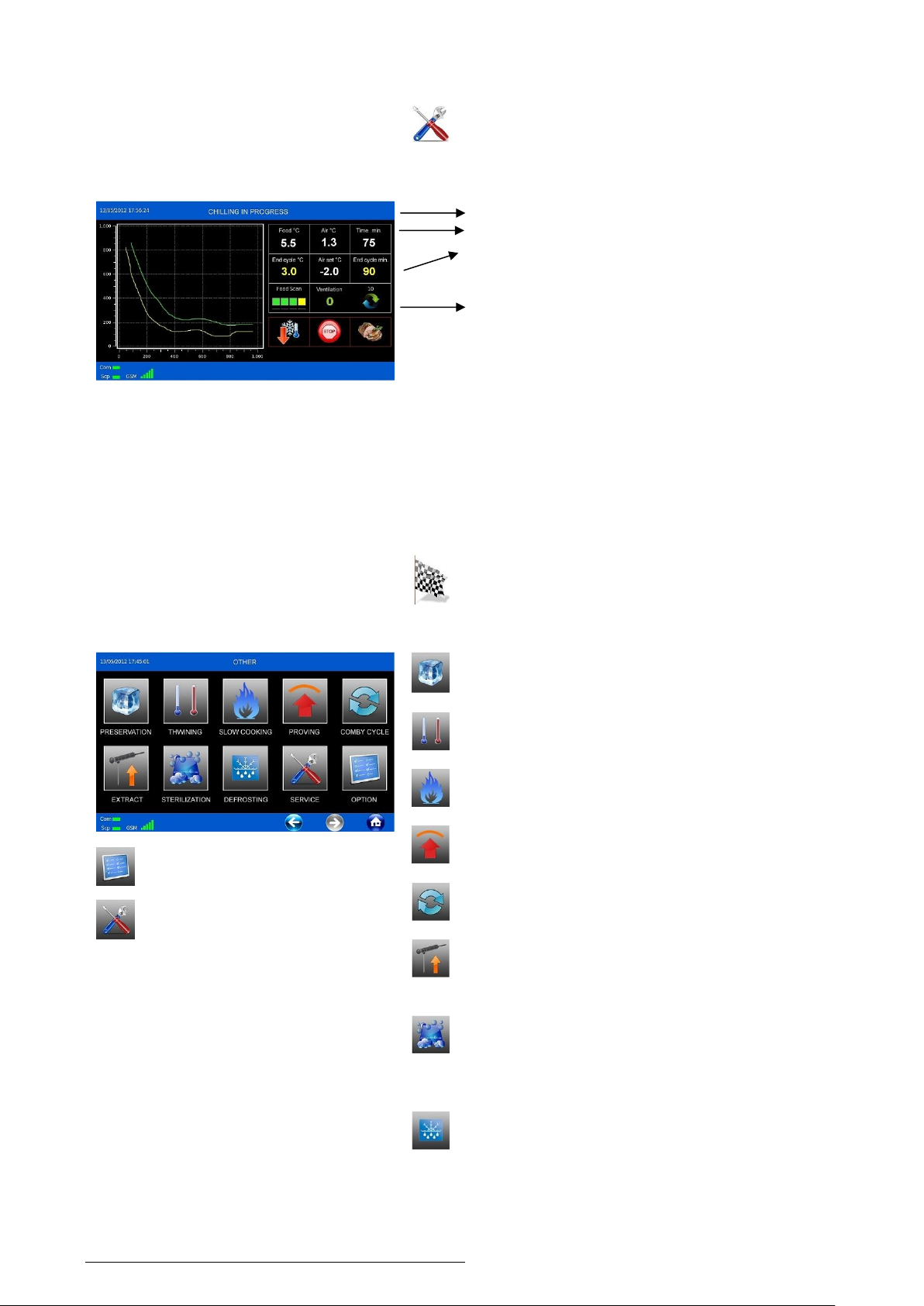
Edition:
enables entering or changing the program.
7.5. Cycle in progress
The date, time, and current function.
Readout of the current time and temperature.
Values set by the user: The yellow values are the
reference values to be achieved.
Fan controller:
If the color of the symbol is grey, the speed of the
internal fans cannot be changed.
The graphic element on the right side shows the
distribution of temperature.
After the graphic element is pressed, one can go to
another range where it is possible to select the
probes to be displayed in the graphic element, show
the parameters of the machines, the alarms, the
energy consumption, and the ON/OFF status of the
machine.
Flag: indicates the end of the process. At the end of
the process, the machine emits an intermittent
acoustic signal, which can be switched off by clicking
the flag symbol.
7.6. Other functions
Options: go to the “Options”
range.
Service: go to the “Service”
range.
Maintenance: enables starting the maintenance
cycle.
Thawing: enables starting the thawing cycle.
Slow Cooking: enables starting the cooking cycle in
a low temperature (option).
Proofing:
enables starting the proofing cycle (option).
Combined cycle: enables starting the combined
cycle (option).
Removal: enables starting the heating of the probe
in order to facilitate removal of the probe from a
frozen food product (option).
Sterilization: enables starting the sterilization cycle
(option). Before this cycle starts, connect the
sterilizer to a power socket inside the machine.
Manual thawing: enables starting the evaporator
thawing cycle. This process is justified when a
cooling or thawing cycle has been completed.
7.7. Machine in the heating mode
Page 11
11
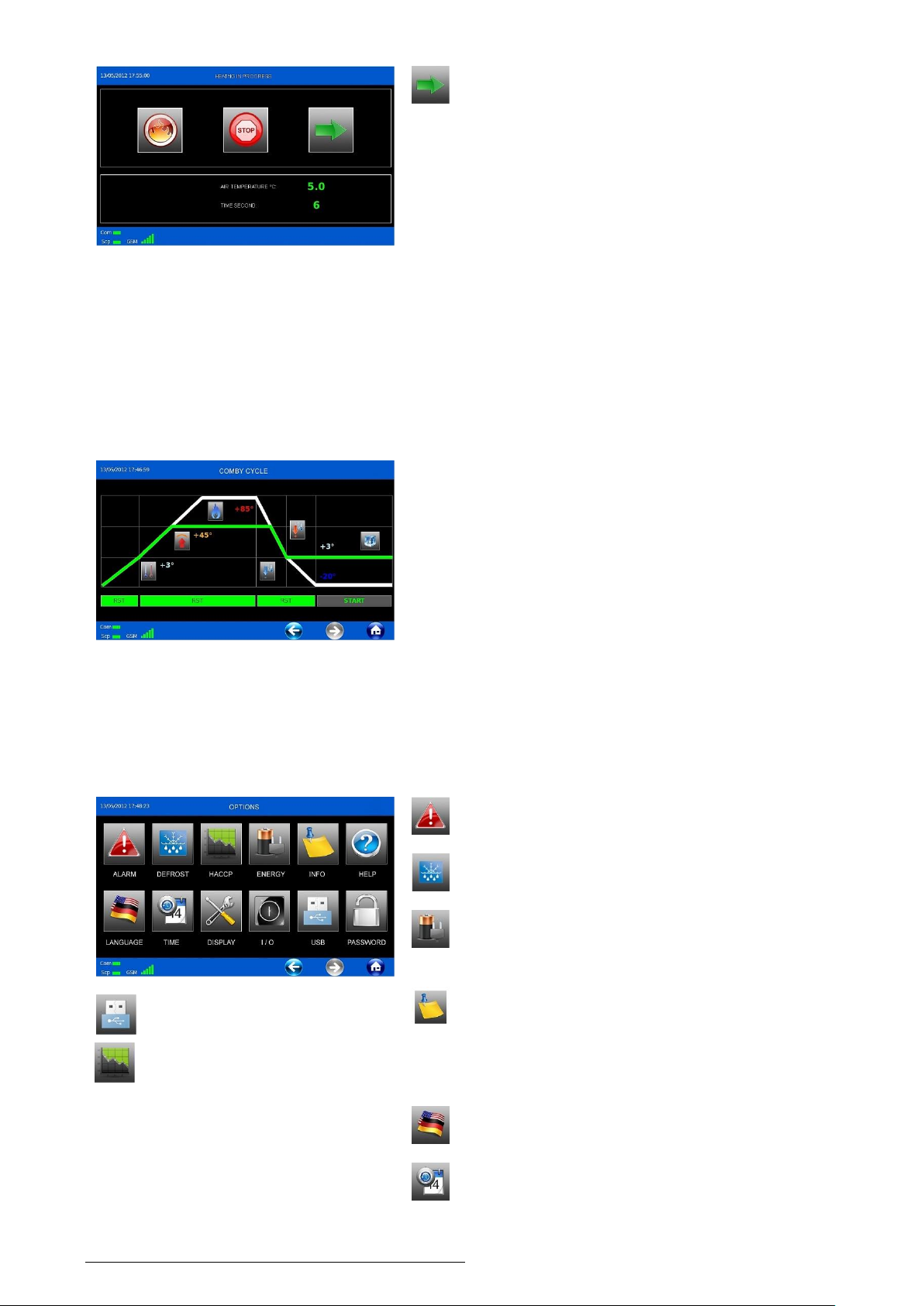
NOTE:
When the quick cooling or thawing
process is completed, the machine
goes into the maintenance phase.
Otherwise, the machine stops
operation when the Slow Cooking and
proofing process is completed.
Green arrow:
enables going to the next page.
NOTE:
Heating is switched on automatically before the
thawing process, the Slow Cooking process, and the
proofing process; this is beneficial because it makes
it possible to increase the temperature inside the
machine (empty) in order to reduce the time of the
next cycle.
The heating time is not limited; it can be stopped by
pressing the STOP button. The recommended
minimum duration of the heating is 15 minutes.
7.8. Combined mode (option)
NOTE: In the Slow Cooking and
proofing modes, it is recommended to
enter: ventilation = 1; in the thawing
process, it is recommended to enter:
ventilation = 10.
The combined mode makes it possible to
automatically and sequentially start the thawing,
proofing, and slow cooking cycles as well as the
quick cooling and freezing cycles. In order to set a
cycle, click the relevant symbol and enter the
appropriate values.
NOTE: In the modes in which the food probe is
used, it is beneficial to maintain a temperature
difference between air and the food product on the
level of at least 10 C.
7.9. Options
USB: going into the “USB”
mode.
HACCP: displays the graphic
element and the HACCP values
for each cycle and day.
Alarms: A list of identified alarms is displayed.
Thawing: displays a list of completed thawing
processes.
Energy: shows the consumption of the machine, the
network voltage, and the status of the batteries if the
equipment has a GSM module (option).
Info: displays the serial number of the machine and
of the software. Also, it is possible to enter the
telephone number to which SMS alarms are to be
sent if the equipment has a GSM module (option).
Language: enables choosing the language of the
screen.
Time: enables entering the date and the time. Press
the clock to confirm.
Page 12
12
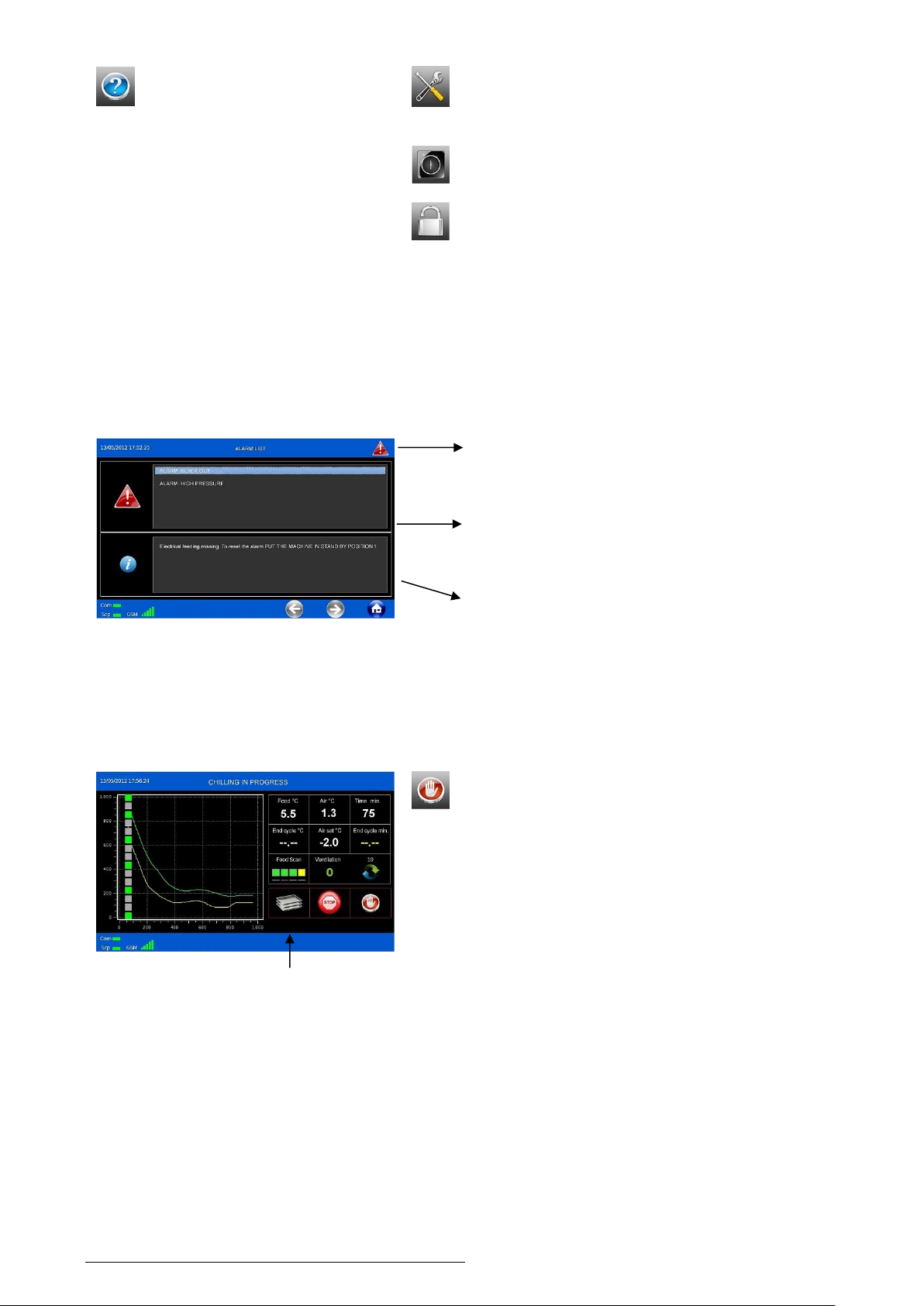
Help: going to the new range,
which contains several useful
instructions for the service
technician and for the user. In this
range, demonstration films are
presented (option).
Screen: enables setting the brightness of the
screen, the time when the screen saver is switched
on, and the configuration of the screen saver.
ON/OFF: enables observation of the status of the
machine in real time; probes, alarms, relays, etc.
Password: enables importing two password levels
named “Entry” and “Chef.” The “Entry” code protects
the main page and is required when the equipment
is switched on, at the time of new access to the
equipment after the standby mode after a screen
saver was used. The “Chef” code protects the
settings of individual programs, the surroundings of
the USB for import/export of data and entering of
passwords.
7.10. Alarms
Indications of alarms: This symbol is displayed if
the machine goes into the alarm mode. In order to
silence the alarm, press this symbol.
Visualization of current alarms.
In order to obtain information, press the alarm line.
Visualization of useful information about deleting of
an alarm.
NOTE:
Current alarms are deleted only when correct
operation of the machine is restored.
7.11. Manual mode and Multilevel
mode
Multilevel function
NOTE:
The quick cooling, manual freezing,
fermentation, and maintenance mode
do not involve use of a food probe.
Manual mode: A simplified quick cooling of freezing
mode.
During the manual mode, the multilevel function can
be activated.
The multilevel function makes it possible to specify
the time of the cycle in order to cool down the sheet
metal entered into the machine.
On the left side of the graphic element, a column is
displayed with squares that symbolize the levels of
the machine. The squares are depicted using a color
code:
Grey - the level is not in use;
Green - the level is in the cooling process;
Red - the level has completed a cooling process.
If the cooling time expires on a given level, the
machine emits an intermittent acoustic signal. The
customer may open the door and take out the cooled
sheet metal; as a result, the signal is stopped
automatically.
The color of the square changes from red to green.
If the multilevel function is not activated, the time is
equal to the time of the general cycle.
Page 13
13
On the other hand, if the multilevel function is
activated, the quick cooling and freezing time is
equal to the time set for the last sheet metal.
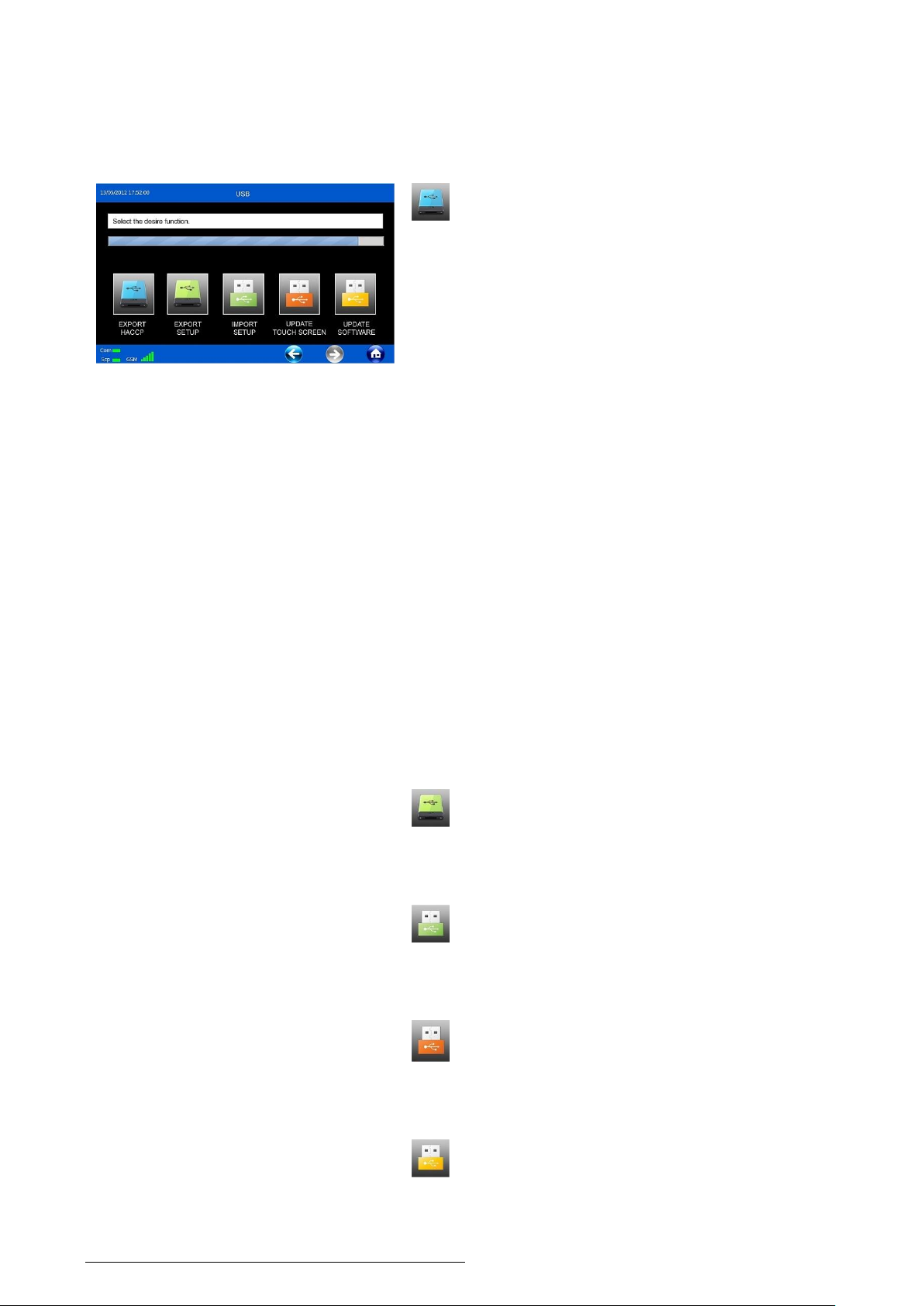
7.12. USB
The USB port is located on the right
side of the screen and is protected with
a protective guard that can be opened
from the left side to the right side.
Export HACCP: makes it possible to save copies of
all HACCP data to a USB memory.
The quantity of the data saved in the memory of the
machine depends on the length of the period of its
use. If the machine is used for about 6 hours a day,
the memory is used up after about one year;
afterwards, new data is written over older data.
A .ZIP file is copied to the USB memory; the file
contains .CSV files identified with a data (year,
month, day), time (hour and minute) and cycle type,
e.g. 120601 1530 ABB. CSV.
Each CSV file constitutes a single cycle started on a
given day and at the specified time. The CSV file,
which can be read using the MSExcel software,
contains the following parameters: date (day, month,
year), e.g. 010612, time (hour, minute, second), e.g.
153000, temperature of the food probe (°C), e.g. 3 5
7 9, air temperature (°C), e.g. -5, alarms that
occurred, e.g. 0, power consumption (W), e.g. 1290,
identification of the tip of the food probe with
calculation, e.g. 3.
All the parameters are grouped and form a record. A
CSV file contains a list of records that are saved
every 10 seconds in the format shown in the
example below:
010612 153000 |3|5|7|9|-5|0| 1290 | 3
010612 153010 |2|4|6|8|-6|0| 1295 | 3
010612 153020 | 1 | 3 | 5 | 7 | -7 | 0 | 1307 | 3
Settings export: makes it possible to save in USB
memory a copy of the settings of individual cycles,
passwords, the telephone number to which the alarm
is sent as a text message, if a GSM module is
present (option), the settings of the screen saver,
and the settings of the screen brightness.
Settings import: makes it possible to download the
data recorded by the “Settings export” function from
the USB memory.
As a result, it is possible to create an exact copy of
the machine.
Software update: using the USB memory, it is
possible to upload an update of the software for the
general mode to the memory of the machine.
Software update: using the USB memory, it is
possible to upload an update of the software for the
general mode to the memory of the machine.
Page 14
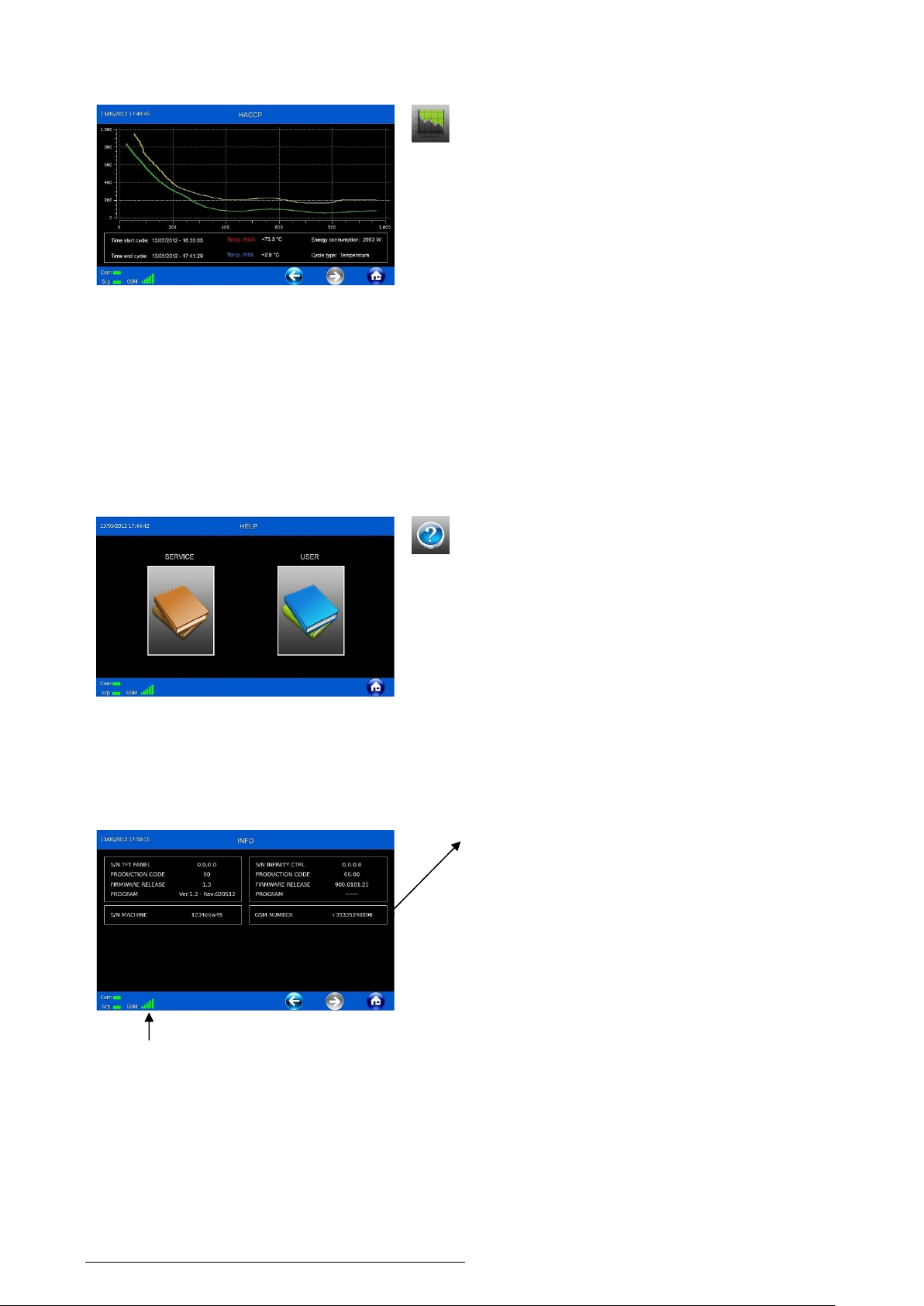
14 7.13. HACCP report
In order to access the HACCP report, press the
HACCP symbol; then select the appropriate day to
verify the HACCP data and confirm by pressing the
search button.
A table is displayed where all cycles conducted in a
given day can be seen. After a cycle has been
selected, an HACCP report is displayed after several
seconds.
The graphic element can show different temperature
values depending on the type of cycle performed:
Time cycle; only the air temperature is displayed.
A cycle with a food probe; the air temperature and
the food product center are displayed.
Then the minimum temperatures and the maximum
temperatures measured during the cycle are shown.
Time cycle; the air probe temperatures are
displayed.
A cycle with a food probe; the temperatures inside
the food product are shown.
7.14. Help (option)
The scope of help is divided into two segments: one
which is password protected and is intended for the
service technician and one which is intended for the
user and is not password protected.
In the segment intended for the service technician
there are video files that show ways to repair the
machine,
e.g. ways to replace the fan or to access the
electrical parts.
The segment intended for the user contains video
files showing ways to use the machine,
e.g. how to switch on a cycle, set a program, or
display an HACCP report.
7.15. Modem (option)
LED GSM
The work mode of the modem is
related to the available SIM card. The
customer has to buy a SIM card. The
SIM card must be charged up so as to
enable sending text messages.
GSM number: enables entering the telephone
number to which the machine sends text messages
with alarms.
Press the button and enter the telephone number,
starting with the country prefix, e.g. +390000000000.
The modem has the following functions:
1) In the event of an alarm, the modem sends a text
message to the GSM number with identification of
the type of the alarm, e.g. alarm, air probe.
2) If the power supply is cut of, the modem
immediately sends a warning text message to the
GSM number,
e.g. alarm, blackout.
3) The machine can verify the status of each GSM
number in real time. In order to obtain such
information, an inquiry must be sent to the number of
a SIM card bought and installed by the user.
Page 15

15
The SIM card slot is located on the
right side of the screen and is protected
with a protective guard that can be
opened from the left side to the right
side. In order to take out the SIM card
from the slot, press the small yellow
button.
When the machine detects the SIM
card, the LEG GSM diodes are
activated and show the quality of the
received signal.
The modem is connected to a group of
batteries that must be replaced every
two years. The group consists of 8
NiMH 1.2 V AA rechargeable batteries.
The machine responds to such an inquiry by sending
the following information:
S/N - serial number of the machine
51 - temperature probe, air
52 - temperature probe, evaporator
53 - temperature probe, condenser
54 - temperature probe, overheating
55 - suction pressure
56 - temperature probe, power supply 4
57 - temperature probe, power supply 3
58 - temperature probe, power supply 2
59 - temperature probe, power supply 1
Working mode = Function:
Quick cooling (chilling), freezing, storage, thawing,
cooking, proving, waiting.
Example:
S/N:30136842024
51 = -10
52 = -25
53 = 50
54 = 0
55 = 0
56 = 9
57 = 8
58 = 7
59 = 6
Function = Chilling
4) Each GSM number can send text messages to
the machine.
Such messages are displayed on the touch screen
but only on the main page. If a title page is not
displayed on the screen, the text message is saved
and displayed as soon as the main page is opened.
A message must be preceded by the Msg
abbreviation, for example Msg Good job!
In order to cancel the message view on the display,
press any place on the touch screen.
Page 16

16
8. MAINTENANCE
Read the instructions contained in this chapter carefully. They contain the basic principles of
maintenance of the blast chiller-freezer.
8.1. SAFETY
When performing works related to cleaning, keep in mind the following safety rules (see also item 3):
• Do not remove and do not tamper with protective devices while performing regular maintenance
work.
• Do not work with the equipment with wet hands or feet.
• Do not put any devices or kitchen tools into the cover of electrical and mechanical parts.
• Use appropriate and compatible equipment for maintenance.
• When not in use, the equipment should be switched off and the plug should be taken out of the
power socket.
• Do not pull the cable of the probe measuring the temperature of the product so as not to remove
it from the product.
• Do not warm the probe measuring the temperature inside the product with flames.
The products are made with utmost care so as to guarantee the highest safety standards to the
customers.
8.2. CLEANING
Before cleaning starts, disconnect the equipment from the power supply mains:
• Clean steel surface on the inside and on the outside of the equipment with a damp cloth and a
neutral, non-abrasive cleaning agent. Wipe the surfaces thoroughly with a piece of cloth (do not
rinse them with water) and dry them thoroughly.
• Do not scrub the surfaces with sharp objects.
• Do not use any aggressive substances or solvents because their residues may damage the
machine and interfere with its operation.
• Perform cleaning (of the condenser) with compressed air or a brush with long bristle.
• Do not use metal, sharpened, or other objects that may cause damage.
8.3. CARE
In order to ensure high quality of the equipment for a long time, implement the following precautions:
• Handle the probe measuring the temperature inside the product with care because the sensor
is very sensitive.
• When the equipment is not used for a long time, apply a protective film of Vaseline oil with a
piece of cloth.
• During down periods, clean and dry the interior. Leave the door slightly open to improve the
circulation of air.
When the equipment is not in use for a long time, disconnect it from the power supply.
Page 17
17
8.4. NON-STANDARD MAINTENANCE WORK
Any non-standard maintenance work must be performed only by qualified workers, a technician, or an
installer.
The manufacturer does not accept responsibility for work on the equipment that has been neglected
but is listed in this manual.
9. WARRANTY AND SERVICE
We guarantee that the blast chiller-freezer is manufactured from the best materials in state-of-the-art
manufacturing processes. At the end of the production cycle, all equipment undergoes strict checks by
qualified personnel.
All materials used in the structure of the equipment are suitable for food contact.
The coolant used in the cooling system meets the conditions set forth in the relevant regulations.
If you require service, please contact the vendor from whom you purchased the equipment. Please
describe in detail the reason for the request and provide the data stated on the data plate on the back
of the equipment. (See item 4: Technical data.)
10. SCRAPPING AND RECYCLING
The structure of the blast chiller-freezer comprises the following materials:
Stainless steel Inox 18/10 (structure)
Copper (cooling system)
Coolant (R 404A) (cooling system)
Compressor oil (cooling system)
PVC for food (plastic elements)
Polyurethanes (insulation)
Scrapping and disposal of the equipment is performed in compliance with the applicable regulations. In
order to recycle some materials, such as the coolant, the insulation materials, and the compressor
lubrication oil you should hire a specialized company.
We reserve the right to make technical changes.
Page 18
18
11. CONNECTIONS LAYOUT
Page 19
19 20 21
Page 20
Page 21
Page 22

22
12. DECLARATION OF CONFORMITY
We hereby declare that the equipment described below meets the principal safety and health
requirements set forth in the Machinery Directive 2006/42/EC, the EMC Directive, and the Low-Voltage
Directive.
Designation/data
The product described above complies with the following documents:
EN 55014-1:2012-05
Electromagnetic compatibility. Requirements for household
appliances, electric tools and similar apparatus. Emission
EN 55014-2:2009-06
Electromagnetic compatibility. Requirements for household
appliances, electric tools and similar apparatus. Immunity. Product
family standard
EN 61000-3-2:2011-06
Electromagnetic compatibility (EMC). Limits. Limits for harmonic
current emissions (equipment input current ≤ 16 A per phase)
EN 61000-3-3:2012-07
Electromagnetic compatibility (EMC). Limits. Limitation of voltage
changes, voltage fluctuations and flicker in public low-voltage supply
systems, for equipment with rated current ≤ 16 A per phase and not
subject to conditional connection
EN 60335-1:2012-03
Household and similar electrical appliances. Safety. General
requirements
EN 60335-2-34:2011-08
Household and similar electrical appliances. Safety. Particular
requirements for motor-compressors
EN 378-1:2012-08
Refrigerating systems and heat pumps. Safety and environmental
requirements. Basic requirements, definitions, classification and
selection criteria
EN 62233:2009-04
Measurement methods for electromagnetic fields of household
appliances and similar apparatus with regard to human exposure
EN 50581:2012 (RoHS)
Technical documentation for the assessment of electrical and
electronic products with respect to the restriction of hazardous
substances
DIN 18872-5-2013
Equipment for commercial kitchens - refrigeration technology
equipment - Part 5: Blast chiller and blast freezer; Requirements and
testing
This declaration loses its validity in the event of any changes to the equipment that have not been
approved by us.
Valid as of: June 2014
Cool Compact Kühlgeräte GmbH
220220.200/135.03.2015
 Loading...