

Page 1

INSTRUCTION MANUAL
CONTRX FORKLIFT JIBS
JLT, PBJLT, CHJLT
INSTALLATION
CONTRX Fork Lift Truck Attachments shall be assembled and installed in accordance with the
manufacturer's instructions, unless other specific arrangements have been approved in writing by
manufacturer.
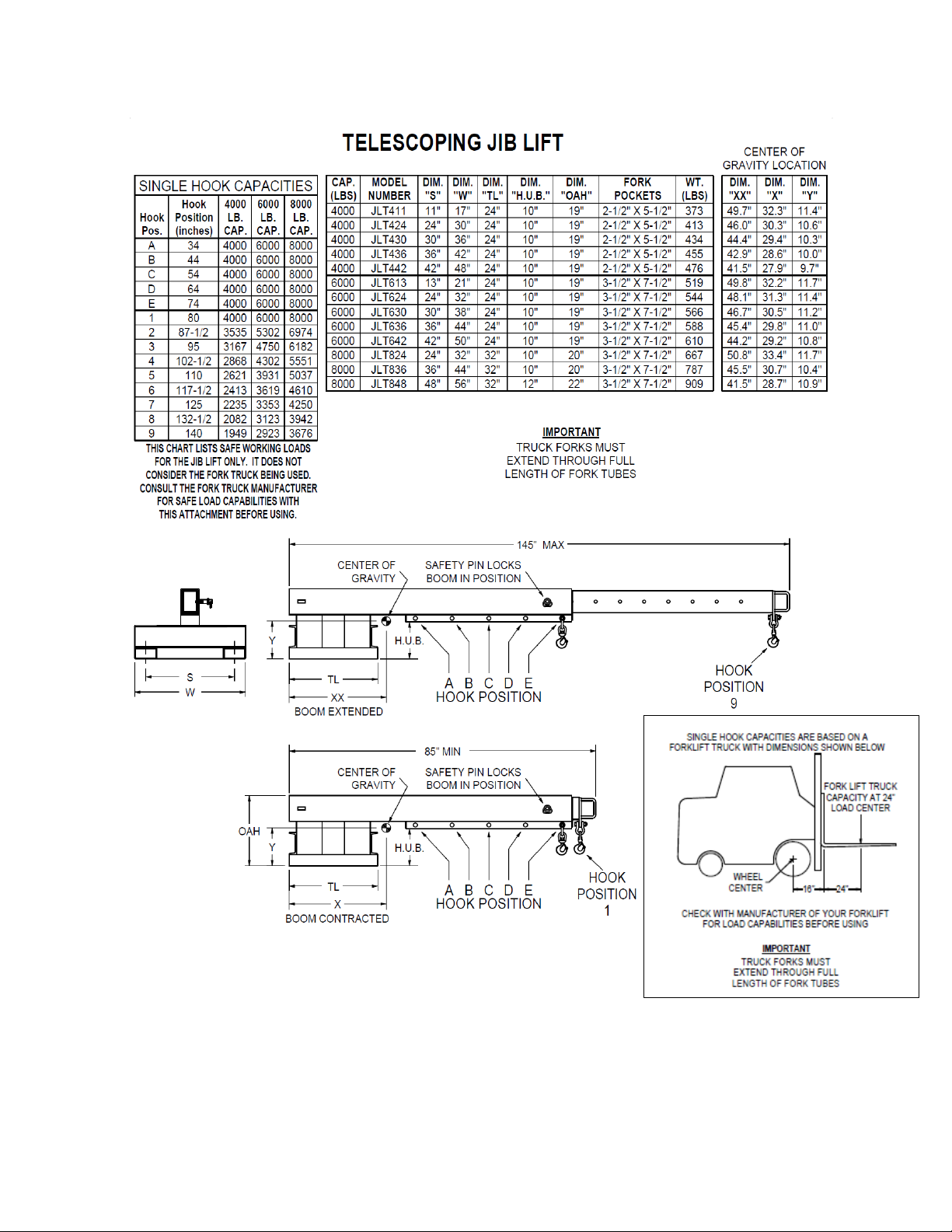
Adjust width of forks to match fork pockets of forklift jib attachment. Be sure truck forks extend
through full length of fork tubes/pockets. Anchor forklift attachment by securing safety chain to the
truck’s frame.
OSHA 1910.178(a)(5) indicates “If the truck is equipped with front-end attachments other than factory
installed attachments, the user shall request that the truck be marked to identify the attachments and
show the approximate weight of the truck and attachment combination at a maximum elevation with
load laterally centered.” CONTRX provides the information required to enable the user to contact the lift
truck manufacturer directly to meet this OSHA requirement. This information can be found on the
CONTRX Technical Data tag affixed to the attachment.
OPERATOR TRAINING
Fork lift attachments shall be operated in accordance with manufacturer's operating instructions, and by
personnel who have received instructions described in the "Operating Practices" section of these
guidelines.
Training shall also include instruction regarding:
1. Details of the operating cycle.
2. Application of the attachment to the load including (according to the manufacturer's instructions)
adjustments to the attachment, if any, to adapt it to various sizes and kinds of loads.
3. Instruction in any special operations or precautions that may be required.
4. Recognition of proper load configuration. For example, preferred operation requires an orderly
pattern of stacking.
5. Before assuming responsibility for using the attachment, an operator shall demonstrate his
understanding of the lifting procedure to the instructor.
The instructor should record, for your personnel evaluation, notes of operator's demonstrated ability.
Page 2

INSPECTION
The attachment should be visually inspected by or under the direction of an appointed person on a daily
or weekly schedule depending on the nature of the attachment and the severity of the service.
Details to look for include but are not limited to:
1. Structural deformation.
2. Cracks in the structural frame, welds, attachment points, mechanically operating parts, any attached
slings, clevises and hooks.
3. Malfunctions during operation of a mechanically operating attachment.
4. Loose covers, fasteners and stops.
5. Faulty operation of automatic hold and release mechanisms.
6. Wear of lifting or attachment points, load supporting clevises, pins, slings, linkages and mechanical
parts.
7. Missing nameplates and markings. Contact CONTRX for replacements.
MAINTENANCE AND REPAIRS
1. A preventive maintenance program should be established for each attachment by a qualified person
based on recommendations made by its manufacturer.
2. Any repairs shall be done by the manufacturer or with instructions and guidance from the
manufacturer. If repairs are performed by someone other than the manufacturer a qualified person
should have responsibility for repairs. Dated records and details of repairs and parts replacement should
be carefully maintained by a qualified person, and copies kept in your possession.
3. Replacement parts shall be at least equivalent to the original manufacturer's specifications
OPERATING PRACTICES DO’S
1. The operator shall have received, read and understood the manufacturer's operating instructions.
2. The operator shall watch carefully that the attachment is performing properly during the lifting
procedure.
3. The operator shall be familiar with the standard directing hand signals and forklift operation.
4. The operator shall respond to signals from an appointed person only. However, stop signals from
anyone shall be obeyed.
5. The operator shall notify a designated person when he considers a load to be unsafe.
6. The operator shall observe the attachments before using. Any defect found shall be examined by a
qualified person to determine if it is a hazard.
DON’TS
1. The operator shall not operate a malfunctioning attachment or one with an "out of service" tag
attached.
2. The operator shall not use the attachments for any purpose(s) other than those designated by the
manufacturer's operating instructions.
3. The operator shall not use an attachment when the capacity, weight or safety markings are missing or
are not legible.
4. No one shall make alterations or modifications to attachments without consulting the manufacturer.
5. No one shall obscure or paint over the manufacturer's capacity, weight, or safety markings.
6. Loads shall not be lifted higher than necessary or be left suspended unattended.
7. The attachment shall not lift a load that is not properly balanced for safe lifting.
Page 3
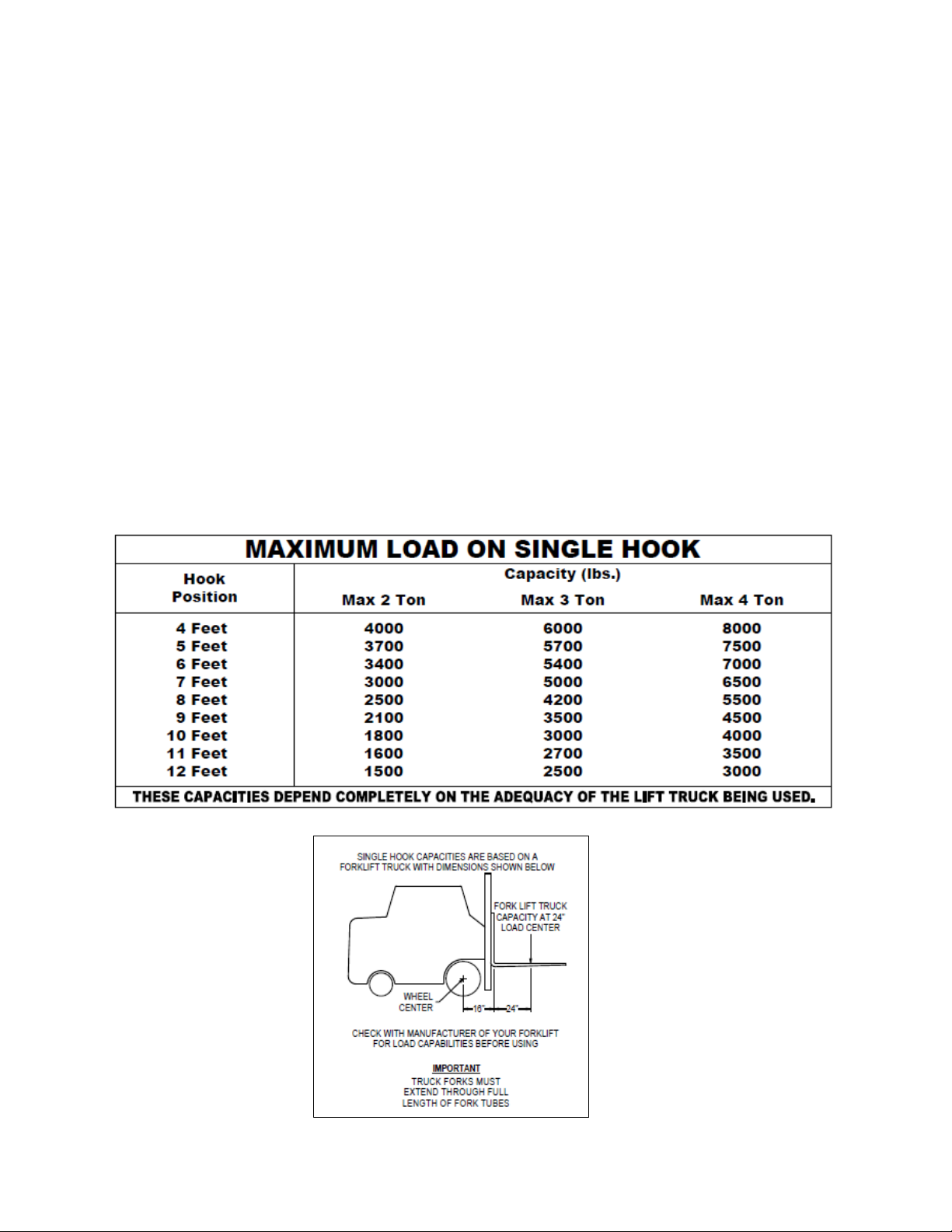
HANDLING THE LOAD
1. The attachment shall not be loaded in excess of its rated capacity.
2. The combined weight of the attachment and load shall not exceed the rated load of the fork lift when
load center and lost load is considered. (See fork lift manufacturer’s information).
3. The attachment shall be applied to the load in accordance with the manufacturer's recommended
operating procedure.
4. Attachment chains shall not be kinked, and multiple part lines shall not be twisted about each other.
5. The attachment shall not touch obstructions during load movement.
6. The attachment shall not be loaded with loose material that might fall during movement.
7. The operator or other personnel shall not place themselves or any part of their bodies beneath
suspended loads.
8. The load or attachment shall not be slid on the floor or other surface.
9. The attachment shall not be used for loads for which it is not designed.
10. Do not attempt to reposition load when raised.
11. A preliminary lift of a few inches shall be made to establish that the load is stable.
12. All loads shall be accelerated and decelerated smoothly. This applies to both mast movement and
fork lift movement.
Page 4
Page 5
 Loading...