

Page 1

CONKER NS6
Quick Start Guide
&
Safety Information Sheet
Page 2
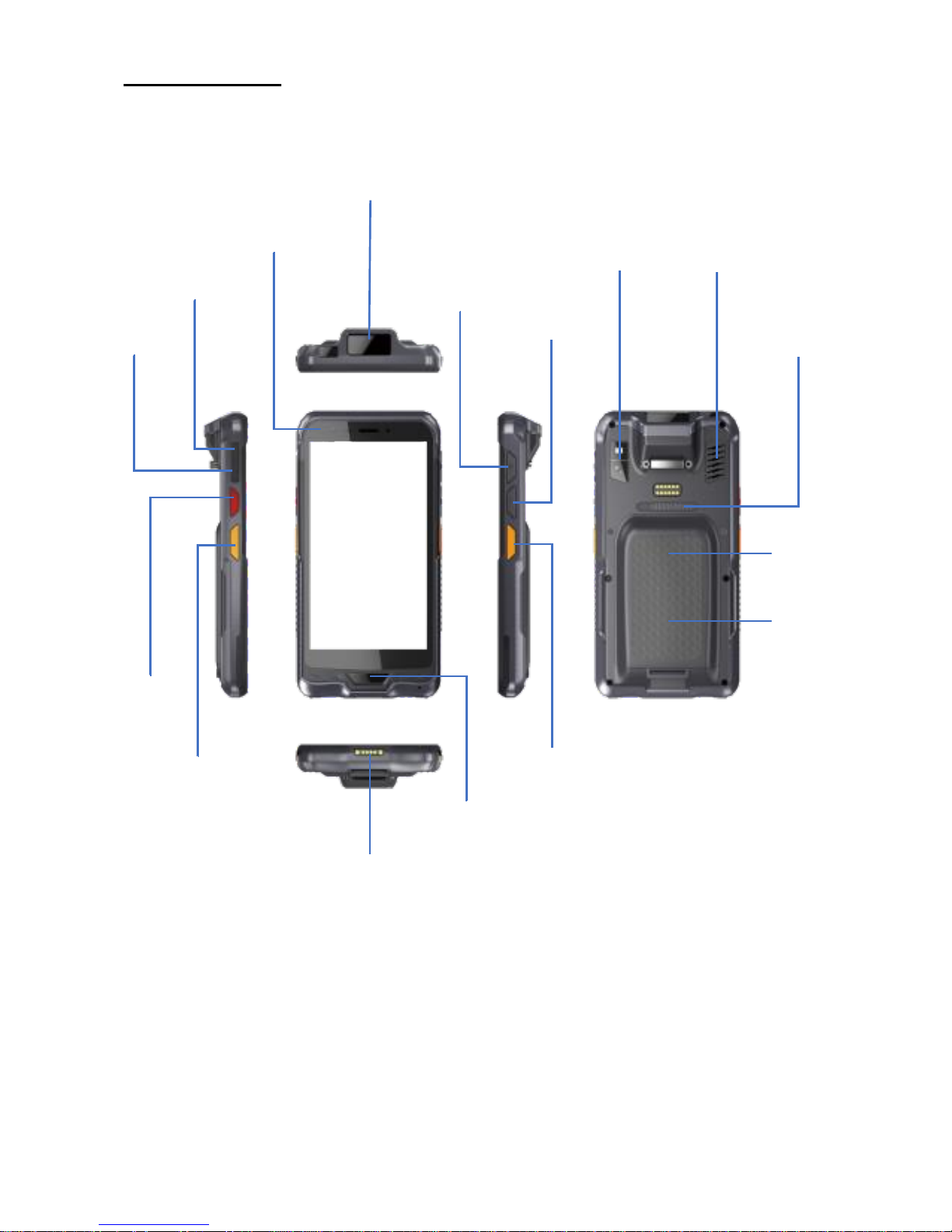
Device Layout
Volume -
Volume +
Micro USB
Audio Jack
Front camera
Barcode scan window
Rear
Camera
Speaker
Battery
Release
NFC
Antenna
Barcode Trigger
Windows Key
Docking Connector
Barcode Trigger
Power
Button
Battery
Page 3
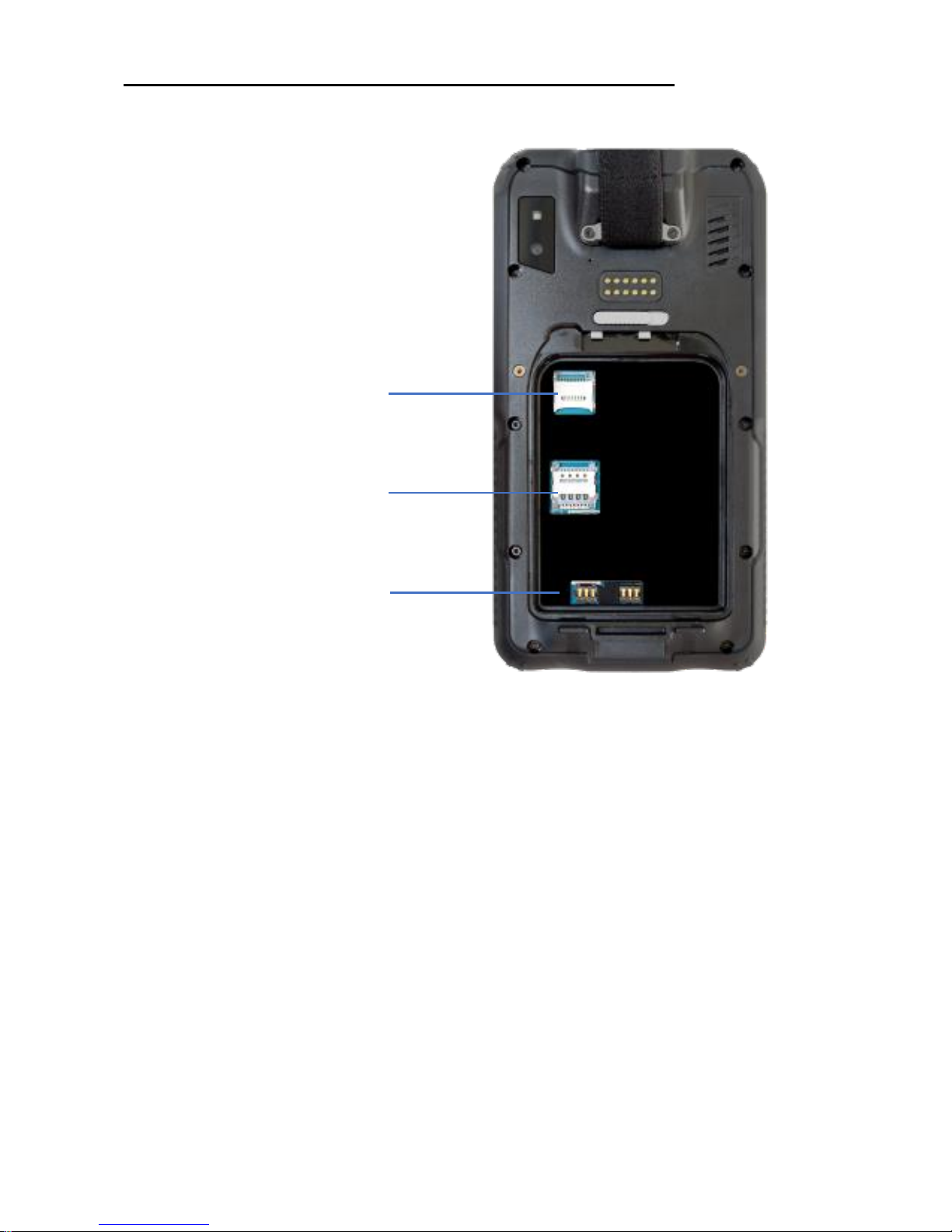
Installing the Battery, SIM card and Micro SD card
N.B. Ensure the device is powered off before removing the
battery.
The battery is removed by sliding the battery release catch to
the left and prying the battery from the top left corner recess.
This reveals the Micro SD (memory card) slot and SIM card
slot.
N.B. This device only accepts a micro-size SIM card
(12x15mm).
To replace the battery, insert at the bottom end first. Press
firmly at the top end before sliding the battery release to the
right in order to lock the battery in place.
Micro SD slot
SIM card slot
Battery connection
Page 4

Barcode Scanning
If a barcode scanner is installed you can activate the barcode
scanner using either the left or right barcode trigger buttons.
The barcode function is configured as a keyboard wedge so the
acquired barcode will be automatically pasted to the active
cursor if present.
Page 5

Page 6

CE Marking and European Economic Area
Tablet Technologies hereby declares that this
equipment is in compliance with Directive
2011/65/EU and 1999/5/EC or 2014/53/EU. The
following standards have been applied and tested. Conformity
is limited to the essential requirements of the R&TTE.
IT Equipment :
EN 60950-1:2006/A11:2009/A1:2010/A12:2011/A2:2013
EMF Exposure and SAR EN 50360:2001/A1:2012, EN 622091:2006, EN 62209-2:2010, EN 50566:2013, EN 62311:2008,
EN 62479:2010
ElectroMagnetic Compatibility:
EN 301 489-1 V1.9.2, EN 301 489-17 V2.2.1, EN 301 489-3
V1.6.1, EN 301 489-7 V1.3.1, EN 301 489-24 V1.5.1
Radio Spectrum:
EN 300 328 V1.8.1, EN 301 511 V9.0.2, EN 301 908-1 V6.2.1,
EN 301 908-2 V5.4.1, EN 300 440-1 V1.6.1, EN 300 330-1
V1.7.1, EN 300 330-2 V1.5.1
The device has the following transmitted power characteristics:
Bluetooth 3.80 dBm EIRP
WiFi 16.16 dBm EIRP
UTRA FDD 24 dBm
The device operates in the following radio frequency ranges:
GSM 850/900/1800/1900
GPS 1575.42 MHz (Rx)
Bluetooth 2402 - 2480 MHz
WiFi (20 MHz) 2412 - 2472 MHz
WiFi (40 MHz) 2422 - 2462 MHz
UTRA FDD Bands 1/3/7/8/20
NFC 13.56 MHz
Page 7

LED Product – Honeywell N3680 2D Barcode Scanner
Contains LEDs for Illumination and aiming
LED Safety Statement
LEDs have been tested and classified as “EXEMPT RISK
GROUP” to the standard IEC 62471:2006.
Page 8

Battery Information
CAUTION. Use only approved batteries. Risk of
explosion if battery is charged with an
incompatible charger, exposed to heat >60C or
replaced by an incorrect type.
European Battery Directive 2006/66/EC
Dispose of batteries separately and responsibly. All waste
batteries are classified as hazardous waste and should be
disposed of at a battery recycling centre.
Our rechargeable battery packs are designed and constructed
to the highest standards within the industry. However, there are
limitations to how long a battery can operate or be stored before
needing replacement. Many factors affect the actual life cycle of
a battery pack, such as heat, cold, harsh environmental
conditions and severe drops. Batteries are considered chemical
products. As such, battery performance will deteriorate over
time if stored for a long period of time without being used. When
batteries are stored over six (6) months, some irreversible
deterioration in overall battery quality may occur. Store batteries
at half of full charge in a dry, cool place, removed from the
equipment to prevent loss of capacity, rusting of metallic parts
and electrolyte leakage. When storing batteries for one year or
longer, the charge level should be verified at least once a year
and charged to half of full charge.
Replace the battery when a significant loss of run time is
detected. Standard warranty period for all batteries is one year
from order fulfilment, regardless if included as part of a mobile
computer with a longer warranty duration or ongoing
maintenance contract. The cycle life of batteries will vary
according to the charge and discharge conditions, the
temperature and other usage conditions. When used in
accordance with the IEC charge and discharge specifications
the typical cycle life of a battery is between 300 and 400 cycles
at room temperature. Individual results may vary.
Page 9

Lithium batteries do not suffer from “battery memory” therefore
you do not need to fully charge to 100% or fully discharge to
0%. Complete discharge of batteries should always be avoided.
Shallow discharge is preferable, i.e. recharge at 20% if
possible.
Battery Safety Guidelines
• The area in which the units are charged should be clear of
debris and combustible materials or chemicals.
• Improper battery use may result in a fire, explosion, or other
hazard.
• To charge the mobile device battery, the battery and charger
temperatures must be between 0°C and +40°C (+32°F to
+104°F).
• Do not use incompatible batteries and chargers. Use of an
incompatible battery or charger may present a risk of fire,
explosion, leakage, or other hazard. If you have any
questions about the compatibility of a battery or a charger,
contact Tablet Technologies support.
• For devices that utilize a USB port as a charging source, the
device shall only be connected to products that bear the
USB-IF logo or have completed the USB-IF compliance
programme.
• Do not disassemble or open, crush, bend or deform,
puncture, or shred.
• Severe impact from dropping any battery-operated device on
a hard surface could cause the battery to overheat.
• Do not short circuit a battery or allow metallic or conductive
objects to contact the battery terminals.
• Do not modify or remanufacture, attempt to insert foreign
objects into the battery, immerse or expose to water or other
liquids, or expose to fire, explosion, or other hazard.
• Do not leave or store the equipment in or near areas that
might get very hot, such as in a parked vehicle or near a
radiator or other heat source.
• Do not place battery into a microwave oven or dryer.
Page 10

• Battery usage by children should be supervised.
• Please follow local regulations to promptly dispose of used
re-chargeable batteries.
• Do not dispose of batteries in fire.
• Seek medical advice immediately if a battery has been
swallowed.
• In the event of a battery leak, do not allow the liquid to come
in contact with the skin or eyes. If contact has been made,
wash the affected area with large amounts of water and seek
medical advice immediately.
• If you suspect damage to your equipment or battery, contact
Tablet Technologies support to arrange for inspection.
Ingress Protection
This device has an IP Rating of IP67 as defined in international
standard IEC 60529 as follows.
IP6x:
Ingress of dust is not entirely prevented, but it must not enter in
sufficient quantity to interfere with the satisfactory operation of
the equipment; complete protection against contact.
IPx7:
Protected against the effect of immersion between 15cm and
1m for 30 minutes.
Please note that this product is not considered “waterproof” and
proper maintenance and care should always be undertaken. If
the product comes into contact with water, time should be taken
to dry the product to avoid water ingress over time. Any
damage to the product, e.g. from drops, may affect the product
seals and thus affect the IP rating. As this device has a user
removable battery, care must always be taken to correctly reassemble the battery compartment ensuring that all sides are
clear of debris and correctly sealed before resuming operating.
 Loading...