

Page 1
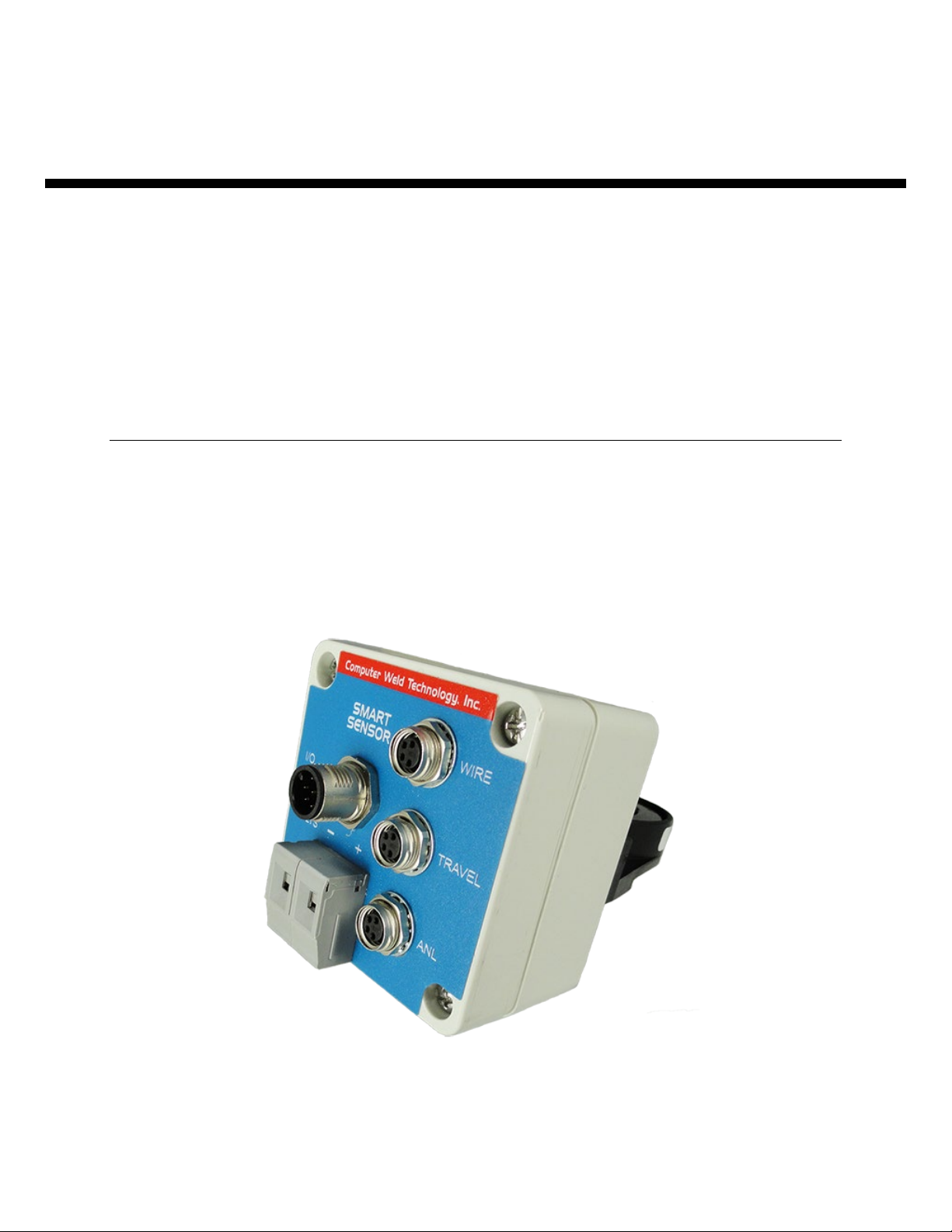
SmartSensor
Computer Weld Technology
A Lincoln Electric Brand
10702 Old Bammel N Houston Rd.
Houston, TX 77086
Phone: (713) 462
Fax: (713) 462
Email: [email protected]
Operation / Installation Manual
-2118
-2503
Manual Part Number: A8M5027
Revised: 7/23/2020
Page 2

Page 3

SAFETY PRECAUTIONS – READ BEFORE USING
Welding is not particularly hazardous when certain safety practices are followed. Everyone using this
equipment should be thoroughly trained in safe welding practices. Failure to observe safe practices may cause
serious injury.
Handling welding torches presents no danger if the appropriate safety regulations are strictly adhered to. For
example:
• Starting procedures must be reserved for those fully conversant with processes relating to arc
welding equipment.
• Arc welding can prove damaging to eyes, skin, and hearing! It is therefore imperative that both
management and operators understand and follow the ANSI Standard Z49.1, SAFETY IN
WELDING ANDCUTTING. All Personal Protective Equipment (PPE) shall be in place in
accordance with this referenced specification and all other applicable and governing regulations.
• The operating data provided in the Specifications are maximum values. Overloading the welding
torch will inevitably damage the product and void any and all warranties.
• Before changing any parts on the torch or control box, disconnect the torch from the welding
power source and disconnect the control box input power source. Unplug the control box from the
electrical outlet.
• The operating instructions for all other welding components - e.g. power source, wire feed and
cooling unit must be followed per the manufacturer’s recommendations.
• Never pull the cable assembly across sharp edges or set down on a hot surface.
• Never move the torch by pulling or dragging by the welding torch or cable.
• Curtains or partitions shall be installed to protect other workers or observers from arc radiation.
• When handling gas cylinders, consult the instructions issued by the manufacturers and the
suppliers of the pressurized gas.
• Work pieces that have been degreased using chlorinated solvents must be sprayed down with
clean water before welding starts to avoid the risk of phosgene forming. For the same reason, no
degreasing baths containing chlorine must be placed close to the welding point.
• All vapors given off by metals can cause harm and a special warning is attached to lead,
cadmium, copper, zinc, and beryllium. Take appropriate precautions to ensure that the legal
maximum levels of toxic concentrations are not exceeded.
• Do not touch the welding torch with bare skin until it has had adequate time to cool down.
• Wait to adjust the rotation diameter until the torch has cooled to room temperature.
Fume and Gases
FUMES AND GASES can be hazardous. Welding and cutting
produces fumes and gases. Breathing these fumes and gases
can be hazardous to your health.
• Keep your head out of the fumes. Do not breathe the fumes.
• If inside, ventilate the area and/or use local forced ventilation at the arc to remove welding and
cutting fumes and gases. The recommended way to determine adequate ventilation is to sample
for the composition and quantity of fumes and gases to which personnel are exposed.
• If ventilation is poor, wear an approved air-supplied respirator.
• Read and understand the Safety Data Sheets (SDSs) and the manufacturer’s instructions for
adhesives, coatings, cleaners, consumables, coolants, degreasers, fluxes and metals.
• Work in a confined space only if it is well ventilated, or while wearing an air-supplied respirator.
Always have a trained watch-person nearby. Welding fumes and gases can displace air and
lower the oxygen level causing injury or death. Be sure the breathing air is safe.
Page 4
• Do not weld or cut in locations near degreasing, cleaning, or spraying operations. The heat and
rays of the arc can react with vapors to form highly toxic and irritating gases.
• Do not weld or cut on coated metals, such as galvanized, lead, or cadmium plated steel, unless
the coating is removed from the weld area, the area is well ventilated, and while wearing an air
supplied respirator. The coatings and any metals containing these elements can give off toxic
fumes if welded.
Arc Rays
ARC RAYS can burn eyes and skin. Arc rays from welding and cutting processes
produce intense visible and invisible (ultraviolet and infrared) rays that can burn eyes
and skin. Sparks fly off from the weld.
• Wear an approved welding helmet fitted with a proper shade of filter lenses to protect your face
and eyes from arc rays and sparks when welding, cutting, or watching (see ANSIZ49.1 and Z87.1
listed in Safety Standards).
• Wear approved safety glasses with side shields under your helmet.
• Use protective screens or barriers to protect others from flash, glare and sparks; warn others not
to watch the arc.
• Wear body protection made from durable, flame resistant material (leather, heavy cotton, wool).
• Body protection includes oil-free clothing such as leather gloves, heavy shirt, cuff less trousers,
high shoes and a cap.
Welding and Cutting
Welding or cutting on closed containers such as tanks, drums or pipes, can cause
them to blow up. Sparks can fly off from the welding or cutting arc. The flying sparks,
hot work piece and hot equipment can cause fires and burns. Accidental contact of
electrode to metal objects can cause sparks, explosion, overheating or fire. Check
and be sure the area is safe before doing any welding or cutting.
• Remove all flammables within 35 ft. (10.7 m) of the welding or cutting arc. If this is not possible,
tightly cover them with approved covers.
• Do not weld or cut where flying sparks can strike flammable material.
• Protect yourself and others from flying sparks and hot metal.
• Be aware that welding sparks and hot materials from welding and cutting can easily go through
small cracks and openings to adjacent areas.
• Watch for fire, and keep a fire extinguisher nearby.
• Be aware that welding or cutting on a ceiling, floor, bulkhead or partition can cause fire on the
hidden side.
• Do not weld or cut on containers that have held combustibles, or on closed containers such as
tanks, drums, or pipes unless they are properly prepared according to AWS F4.1 and AWS A6.0
(see Safety Standards).
• Do not weld or cut where the atmosphere may contain flammable dust, gas, or liquid vapors
(such as gasoline).
• Connect work cable to the work as close to the welding or cutting area as practical to prevent
welding or cutting current from traveling long, possibly unknown paths and causing electric shock,
sparks and fire hazards.
• Do not use welder to thaw frozen pipes.
• Remove stick electrode from holder or cut off welding wire at contact tip when not in use.
Page 5

• Remove any combustibles, such as a butane lighter or match, from your person before doing any
welding or cutting.
• After completion of work, inspect area to ensure it is free of sparks, glowing embers, and flames.
• Use only correct fuses or circuit breakers. Do not oversize or by-pass them.
• Follow requirements in OSHA 1910.252 (a) (2) (iv) and NFPA 51B for hot work and have a fire
watcher and extinguisher nearby.
• Read and understand the Safety Data Sheets (SDSs) and the manufacturer’s instructions for
adhesives, coatings, cleaners, consumables, coolants, degreasers, fluxes and metals.
Electric Shock
Touching live electrical parts can cause fatal shocks or severe burns. The electrode
and work circuit is electrically live whenever the output is on. The input power circuit
and machine internal circuits are also live when power is on. In gas metal arc welding
(GMAW), the wire, wire reel, drive roll housing and all metal parts touching the
welding wire are electrically live. Incorrectly installed or improperly grounded
equipment is a hazard.
• Do not use AC output in damp areas, if movement is confined, or if there is danger of falling.
• Use AC output ONLY if required for the welding or cutting process.
• If AC output is required; use remote output control if present on unit. Additional safety
precautions are required when any of the following electrically hazardous conditions are present:
in damp locations or while wearing wet clothing; on metal structures such as floors, gratings or
scaffolds; when in cramped positions such as sitting, kneeling or lying; or when there is a high
risk of unavoidable or accidental contact with the workpiece or ground. For these conditions, use
the following equipment in order presented: 1) a GMAW DC constant voltage (wire) welder, 2) a
DC manual (stick) welder or 3) an AC welder with reduced open circuit voltage. In most
situations, use of a DC, constant voltage wire welder is recommended. And, do not work alone!
• Disconnect input power or stop engine before installing or servicing equipment. Lockout/tagout
input power according to OSHA 29 CFR 1910.147 (see Safety Standards).
• Properly install, ground, and operate this equipment according to its Owner’s Manual and
national, state/provincial and local codes.
• Always verify the supply ground – check and be sure that input power cord ground wire is
properly connected to ground terminal in disconnect box or that cord plug is connected to a
properly grounded receptacle outlet.
• When making input connections attach proper grounding conductor first and double-check
connections.
• Keep cords dry, free of oil and greases and protected from hot metal and sparks.
• Frequently inspect power cord for damage or bare wiring. Replace cord immediately if damaged.
Bare wiring can kill.
• Turn off all equipment when not in use.
• Do not use worn, damaged, undersized or poorly spliced cables.
• Do not drape cables over your body.
• If earth grounding of the workpiece is required; ground it directly with a separate cable.
• Do not touch electrode if you are in contact with the work, ground or another electrode from a
different machine.
• Do not touch electrode holders connected to two welding machines at the same time since
double open circuit voltage will be present.
• Use only well-maintained equipment. Repair or replace damaged parts at once. Maintain unit
according to manual.
• Wear a safety harness if working above floor level.
• Keep all panels and covers securely in place.
Page 6
• Clamp work cable with good metal-to-metal contact to workpiece or worktable as near the weld
as practical.
• Insulate work clamp when not connected to workpiece to prevent contact with any metal object.
• Do not connect more than one electrode or work cable to any single weld output terminal.
Disconnect cable for process when not in use.
Cylinders
Compressed gas cylinders contain gas under high pressure. If damaged, a cylinder
can explode. Since gas cylinders are normally part of the welding process, be sure to
treat them carefully.
• Protect compressed gas cylinders from excessive heat, mechanical shocks, physical damage,
slag, open flames, sparks and arcs.
• Install cylinders in an upright position by securing to a stationary support or cylinder rack to
prevent falling or tipping.
• Keep cylinders away from any welding, cutting or other electrical circuits.
• Never drape a welding electrode or cutting torch over a gas cylinder.
• Never allow a welding electrode or cutting torch to touch any cylinder.
• Never weld on a pressurized cylinder – explosion will result.
• Use only the correct compressed gas cylinders, regulators, hoses and fittings designed for the
specific application; maintain them and associated parts in good condition.
• Turn face away from valve outlet when opening cylinder valve. Do not stand in front of or behind
the regulator when opening the valve.
• Keep protective cap in place over valve except when cylinder is in use or connected for use.
• Use the right equipment, correct procedures and sufficient number of persons to lift and move
cylinders.
• Read and follow instructions on compressed gas cylinders, associated equipment, and
Compressed Gas Association (CGA) publication P-1 listed in Safety Standards.
 Loading...