

Page 1
Global LCD Panel Exchange Center
ಖᙕ
ՠ܂
ᐉு
ߡۥ
ދป
Issued Date: Apr. 02, 2008
www.panelook.com
Doc No.:
Model No.: M156B1-L02
Te n t a t iv e
TFT LCD Tentative Specification
MODEL NO.: M156B1-L02
Customer:
Approved by:
Note:
For Reference Only
2008-04-21
PMMD
cs_lee(ޕݳᆣ
Director Accept
15:18:28 CST
One step solution for LCD / PDP / OLED panel application: Datasheet, inventory and accessory!
Director
/56510/44926)
1 / 26
Version 0.0
www.panelook.com
Page 2
Global LCD Panel Exchange Center
Issued Date: Apr. 02, 2008
www.panelook.com
Doc No.:
Model No.: M156B1-L02
Te n t a t iv e
- CONTENTS -
REVISION HISTORY ............................................................................................................................... 3
1. GENERAL DESCRIPTION .................................................................................................................. 4
1.1 OVERVIEW
1.2 FEATURES
1.3 APPLICATION
1.4 GENERAL SPECIFICATIONS
1.5 MECHANICAL SPECIFICATIONS
2. ABSOLUTE MAXIMUM RATINGS....................................................................................................... 5
2.1 ABSOLUTE RATINGS OF ENVIRONMENT
2.2 ELECTRICAL ABSOLUTE RATINGS
2.2.1 TFT LCD MODULE
2.2.2 BACKLIGHT UNIT
3. ELECTRICAL CHARACTERISTICS .................................................................................................... 7
3. 1.1 TFT LCD MODULE
3.1.2 Vcc Power Dip Condition:
3.2 BACKLIGHT UNIT
4. BLOCK DIAGRAM ............................................................................................................................... 11
4.1 TFT LCD MODULE
4.2 BACKLIGHT UNIT
5. INPUT TERMINAL PIN ASSIGNMENT................................................................................................ 12
5.1 TFT LCD MODULE
5.2 LVDS DATA MAPPING TABLE
5.3 BACKLIGHT UNIT
5.4 COLOR DATA INPUT ASSIGNMENT
6. INTERFACE TIMING ........................................................................................................................... 15
6.1 INPUT SIGNAL TIMING SPECIFICATIONS
6.2 POWER ON/OFF SEQUENCE
7. OPTICAL CHARACTERISTICS........................................................................................................... 17
7.1 TEST CONDITIONS
7.2 OPTICAL SPECIFICATIONS
8. PACKAGING ........................................................................................................................................ 21
8.1 PACKING SPECIFICATIONS
8.2 PACKING METHOD
9. DEFINITION OF LABELS .................................................................................................................... 23
10. PRECAUTIONS ................................................................................................................................. 24
10.1 ASSEMBLY AND HANDLING PRECAUTIONS
10.2 SAFETY PRECAUTIONS
11. MECHANICAL CHARACTERISTICS................................................................................................. 25
2 / 26
One step solution for LCD / PDP / OLED panel application: Datasheet, inventory and accessory!
Version 0.0
www.panelook.com
Page 3
Global LCD Panel Exchange Center
Issued Date: Apr. 02, 2008
www.panelook.com
Doc No.:
Model No.: M156B1-L02
Te n t a t iv e
REVISION HISTORY
Version Date Section Description
Ver 0.0 Apr. 02, 08’ - M156B1-L02 Tentative specification was first issued.
3 / 26
One step solution for LCD / PDP / OLED panel application: Datasheet, inventory and accessory!
Version 0.0
www.panelook.com
Page 4

Global LCD Panel Exchange Center
Issued Date: Apr. 02, 2008
www.panelook.com
Doc No.:
Model No.: M156B1-L02
Te n t a t iv e
1. GENERAL DESCRIPTION
1.1 OVERVIEW
M156B1-L02 is a 15.6” TFT Liquid Crystal Display module with 2 CCFL Backlight unit and 30pin
1ch-LVDS interface. This module supports 1366 x 768 WXGA mode and can display up to 16.7M colors.
The inverter module for Backlight is not built in.
1.2 FEATURES
- Contrast ratio 500:1
- Response time 8ms.
- Brightness 250nits
- Color saturation NTSC 65%.
- WXGA (1366 x 768 pixels) resolution.
- DE (Data Enable) only mode.
- LVDS (Low Voltage Differential Signaling) interface.
- RoHS compliance.
1.3 APPLICATION
- TFT LCD Monitor
1.4 GENERAL SPECIFICATI0NS
Item Specification Unit Note
Active Area 344.232(H) × 193.536(V) (15.6” diagonal) mm
Bezel Opening Area 347.5(H)x196.8(V) mm
Driver Element a-Si TFT active matrix - -
Pixel Number 1366 x R.G.B. x 768 pixel -
Pixel Pitch 0.252 (H) x 0.252 (V) mm -
Pixel Arrangement RGB vertical stripe - -
Display Colors 16.7M color -
Transmissive Mode Normally White - -
Surface Treatment AG type, 3H hard coating, Haze 25 - -
(1)
1.5 MECHANICAL SPECIFICATIONS
Item Min. Typ. Max. Unit Note
Horizontal(H) 363.3 363.8 364.3 mm
Module Size
Note (1) Please refer to the attached drawings for more information of front and back outline dimensions.
Vertical(V) 215.4 215.9 216.4 mm
Depth(D) 13.8 14.3 14.8 mm
Weight - 1300 g -
4 / 26
One step solution for LCD / PDP / OLED panel application: Datasheet, inventory and accessory!
(1)
Version 0.0
www.panelook.com
Page 5

Global LCD Panel Exchange Center
A
Issued Date: Apr. 02, 2008
www.panelook.com
Doc No.:
Model No.: M156B1-L02
Te n t a t iv e
2. ABSOLUTE MAXIMUM RATINGS
2.1 ABSOLUTE RATINGS OF ENVIRONMENT
Item Symbol
Storage Temperature TST -20 60 ºC (1)
Operating Ambient Temperature TOP 0 50 ºC (1), (2)
Shock (Non-Operating) S
Vibration (Non-Operating) V
Note (1) Temperature and relative humidity range is shown in the figure below.
(a) 90 %RH Max. (Ta Љ 40 ºC).
(b) Wet-bulb temperature should be 39 ºC Max. (Ta > 40 ºC).
(c) No condensation.
Note (2) The temperature of panel display surface area should be 0 ºC Min. and 60 ºC Max.
- 50 G (3), (5)
NOP
- 1.5 G (4), (5)
NOP
Min. Max.
Value
Unit Note
Relative Humidity (%RH)
100
90
80
60
Operating Range
40
20
10
Storage Range
Temperature (ºC)
Note (3) 11ms, half sine wave, 1 time for ± X, ± Y, ± Z.
8060-20 400 20-40
Note (4) 10 ~ 300 Hz, 10min/cycle, 3 cycles each X, Y, Z.
Note (5) At testing Vibration and Shock, the fixture in holding the module has to be hard and rigid enough
so that the module would not be twisted or bent by the fixture.
The fixing condition is shown as below:
t Room Temperature
Side Mount Fixing Screw
Gap=2mm
Bracket
LCD Module
Side Mount Fixing Screw
Stage
5 / 26
One step solution for LCD / PDP / OLED panel application: Datasheet, inventory and accessory!
Version 0.0
www.panelook.com
Page 6

Global LCD Panel Exchange Center
Issued Date: Apr. 02, 2008
www.panelook.com
Doc No.:
Model No.: M156B1-L02
Te n t a t iv e
2.2 ELECTRICAL ABSOLUTE RATINGS
2.2.1 TFT LCD MODULE
Item Symbol
Power Supply Voltage Vcc -0.3 +6.0 V
Logic Input Voltage VIN -0.3 4.3 V
Min. Max.
2.2.2 BACKLIGHT UNIT
Item Symbol
Lamp Voltage VL 2.5K V
Lamp Current IL 3 8 mA
Lamp Frequency F
Note (1) Permanent damage might occur if the module is operated at conditions exceeding the maximum
L
Min. Max.
50 60 KHz (1), (2), (3)
40 80 KHz (1), (2), (4)
Value
Value
Unit Note
(1)
Unit Note
(1), (2)
RMS
RMS
(1), (2)
values.
Note (2) Specified values are for lamp (Refer to 3.2 for further information).
Note (3) The frequency range can guarantee the optical and electrical characteristics.
Note (4) The frequency range will not effect the Lifetime and reliability characteristics.
6 / 26
One step solution for LCD / PDP / OLED panel application: Datasheet, inventory and accessory!
Version 0.0
www.panelook.com
Page 7
Global LCD Panel Exchange Center
www.panelook.com
Doc No.:
Issued Date: Apr. 02, 2008
Model No.: M156B1-L02
Te n t a t iv e
3. ELECTRICAL CHARACTERISTICS
3.1.1 TFT LCD MODULE Ta = 25 ± 2 ºC
Parameter Symbol
Min. Typ. Max.
Power Supply Voltage Vcc 4.5 5.0 5.5 V -
Ripple Voltage VRP - - 100 mV -
Rush Current I
Power Supply Current
RUSH
White (0.3) A (3)a
Black (0.35) A (3)b
Vertical Stripe
-
-
-
2 A (2)
(0.4) A (3)c
LVDS differential input voltage Vid 100 - 600 mV
LVDS common input voltage Vic - 1.2 - V
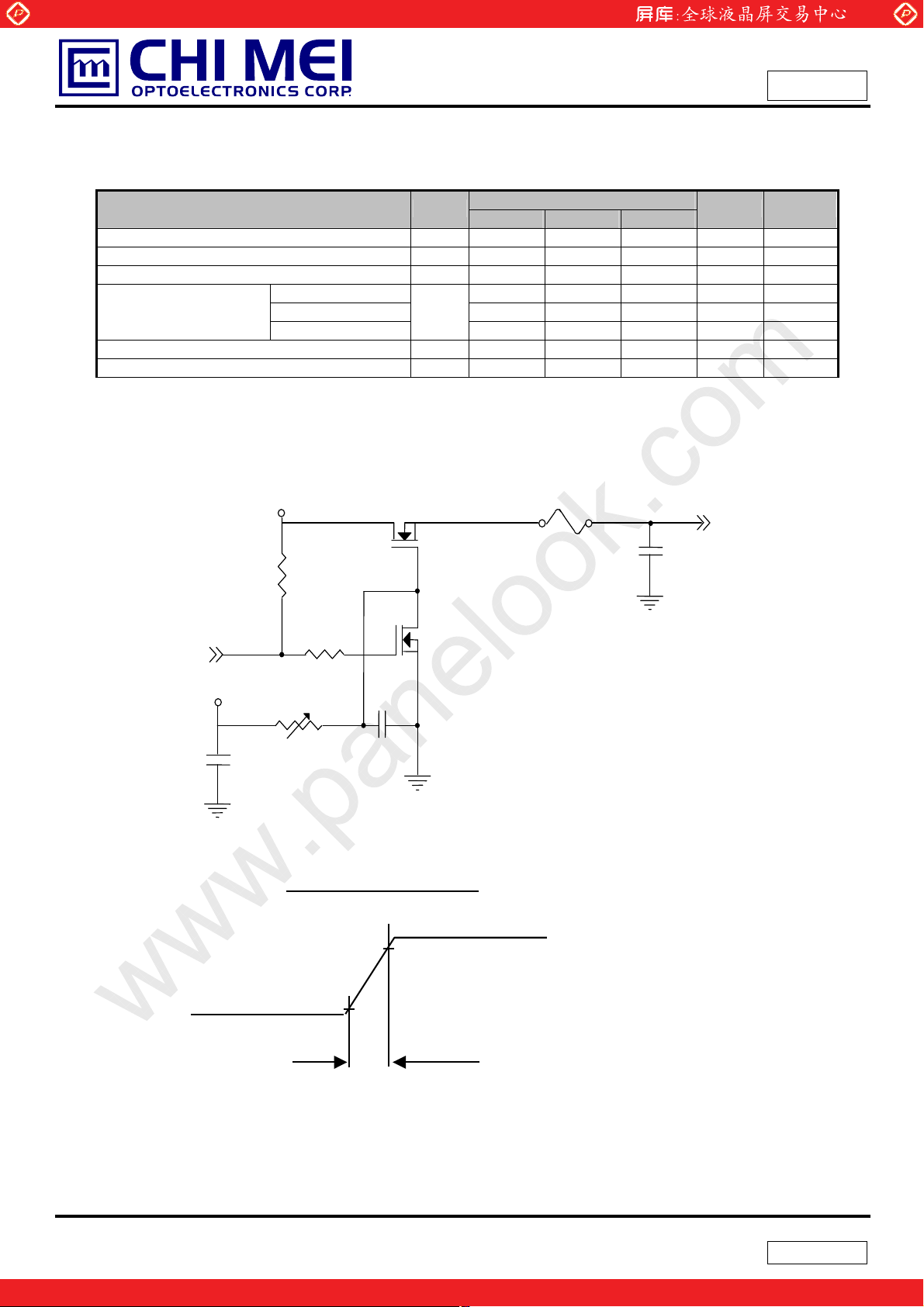
Note (1) The module should be always operated within above ranges.
Note (2) Measurement Conditions:
Value
Unit Note
(High to Low)
(Control Signal)
SW
+12V
+5.0V
R1
47K
R2
1K
47K
VR1
C1
1uF
Q1 2SK1475
C2
0.01uF
Q2
2SK1470
FUSE
C3
1uF
Vcc
(LCD Module Input)
Vcc rising time is 470Ps
Vcc
0.9Vcc
0.1Vcc
GND
470Ps
7 / 26
One step solution for LCD / PDP / OLED panel application: Datasheet, inventory and accessory!
Version 0.0
www.panelook.com
Page 8
Global LCD Panel Exchange Center
Issued Date: Apr. 02, 2008
www.panelook.com
Doc No.:
Model No.: M156B1-L02
Te n t a t iv e
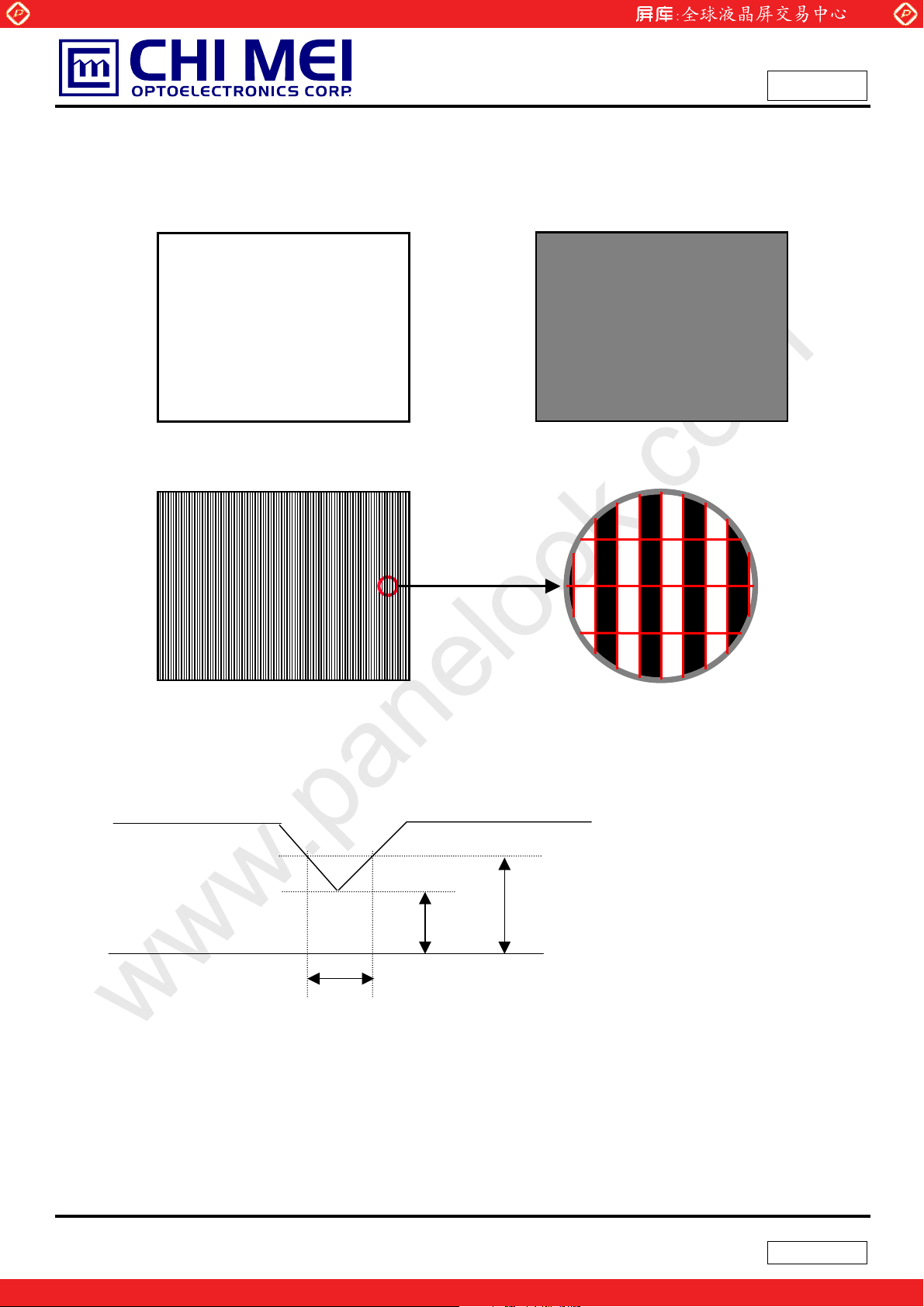
Note (3) The specified power supply current is under the conditions at Vcc = 5.0 V, Ta = 25 ± 2 ºC, fv = 60
Hz, whereas a power dissipation check pattern below is displayed.
a. White Pattern
Active Area
c. Vertical Stripe Pattern
b. Black Pattern
Active Area
R
G
R
B
G
R
B
G
R R
G
B
B
B
B
R
R
R
G
G
G
G
B
B
B
B
R
R
Active Area
3.1.2 Vcc Power Dip Condition:
Dip condition:
Vcc
4.5V
4.0V
Td
msTdVVccV 20,5.40.4 ddd
8 / 26
One step solution for LCD / PDP / OLED panel application: Datasheet, inventory and accessory!
Version 0.0
www.panelook.com
Page 9

Global LCD Panel Exchange Center
www.panelook.com
Doc No.:
Issued Date: Apr. 02, 2008
Model No.: M156B1-L02
Te n t a t iv e
3.2 BACKLIGHT UNIT Ta = 25 ± 2 ºC
Parameter Symbol
Min. Typ. Max.
Lamp Input Voltage VL 585 650 715 V
Lamp Current IL 3.0 7.0 8.0 mA
Lamp Turn On Voltage V
Operating Frequency F
S
L
1200 (0 )к V
11 0 0 ( 2 5 )к V
50 55 60 KHz (3)(7)
40 55 80
Lamp Life Time LBL 40,000 50,000 Hrs (5), IL= 7.0mA
Power Consumption PL 9.24 W (4), IL = 7.0 mA
Note (1) Lamp current is measured by current amplify & oscilloscope as shown below:
+
ΗΗΗΗ
-
Value
Unit Note
I
RMS
RMS
(2)
RMS
(2)
RMS
= 7.0 mA
L
(1)
KHz (3)(8)
ΗΗΗΗ
LCD
Module
Inverter
Current
Amplify
Oscilloscope
+
Current
Probe
Measure equipment:
Current Amplify: Tektronix TCPA300
Current probe: Tektronix TCP312
Oscilloscope: TDS3054B
Note (2) The voltage that must be larger than Vs should be applied to the lamp for more than 1 second
after startup. Otherwise, the lamp may not be turned on normally.
Note (3) The lamp frequency may produce interference with horizontal synchronization frequency from the
display, which might cause line flow on the display. In order to avoid interference, the lamp
frequency should be detached from the horizontal synchronization frequency and its harmonics as
far as possible.
Note (4) P
VL 2 (for 2 lamps)
= I
L
L
Note (5) The lifetime of lamp can be defined as the time in which it continues to operate under the condition
Ta = 25 2
o
C and IL = 7.0 mArms until one of the following events occurs:
(a) When the brightness becomes Љ 50% of its original value.
(b) Effective lighting length decreases 80% under for initial. (Effective lighting length is a scope of
luminance 80% over for average luminance at several point in lamp center.)
Note (6) The waveform of the voltage output of inverter must be area-symmetric and the design of the
inverter must have specifications for the modularized lamp. The performance of the Backlight,
such as lifetime or brightness, is greatly influenced by the characteristics of the DC-AC inverter for
the lamp. All the parameters of an inverter should be carefully designed to avoid producing too
9 / 26
One step solution for LCD / PDP / OLED panel application: Datasheet, inventory and accessory!
Version 0.0
www.panelook.com
Page 10

Global LCD Panel Exchange Center
Issued Date: Apr. 02, 2008
www.panelook.com
Doc No.:
Model No.: M156B1-L02
Te n t a t iv e
much current leakage from high voltage output of the inverter. When designing or ordering the
inverter please make sure that a poor lighting caused by the mismatch of the Backlight and the
inverter (miss-lighting, flicker, etc.) never occurs. If the above situation is confirmed, the module
should be operated in the same manners when it is installed in your instrument.
The output of the inverter must have symmetrical (negative and positive) voltage waveform and
symmetrical current waveform.(Unsymmetrical ratio is less than 10%) Please do not use the inverter
which has unsymmetrical voltage and unsymmetrical current and spike wave. Lamp frequency may
produce interface with horizontal synchronous frequency and as a result this may cause beat on the
display. Therefore lamp frequency shall be as away possible from the horizontal synchronous
frequency and from its harmonics in order to prevent interference.
Requirements for a system inverter design, which is intended to have a better display performance, a
better power efficiency and a more reliable lamp. It shall help increase the lamp lifetime and reduce its
leakage current.
a. The asymmetry rate of the inverter waveform should be 10% below;
b. The distortion rate of the waveform should be within Ѕ2 ± 10%;
c. The ideal sine wave form shall be symmetric in positive and negative polarities
* Asymmetry rate:
I p
I -p
Note (7) 50~60KHz, the frequency range can guarantee the optical and electrical characteristics.
Note (8) 40~80KHz, the frequency range will not effect the Lifetime and reliability characteristics.
| I
* Distortion rate
I
– I –p | / I
p
(or I –p) / I
p
rms
rms
* 100%
10 / 26
One step solution for LCD / PDP / OLED panel application: Datasheet, inventory and accessory!
Version 0.0
www.panelook.com
Page 11

Global LCD Panel Exchange Center
www.panelook.com
Doc No.:
Issued Date: Apr. 02, 2008
Model No.: M156B1-L02
Te n t a t iv e
4. BLOCK DIAGRAM
4.1 TFT LCD MODULE
SCAN DRIVER IC
LVDS INPUT /
TIMING CONTROLLER
DC/DC CONVERTER &
REFERENCE VOLTAGE
TFT LCD PANEL
(1366x3x768)
DATA DRIVER IC
RX0(+/-)
RX1(+/-)
RX2(+/-)
RX3(+/-)
RXC(+/-)
NC
Vcc
(STM MSAKT2407P30A
INPUT CONNECTOR
or EQUIVALENT)
VL
LAMP CONNECTOR
(YEONHO 35001HS-02L)
4.2 BACKLIGHT UNIT
BACKLIGHT UNIT
1 HV(Pink)
2 LV(White)
1 HV(Pink)
11 / 26
One step solution for LCD / PDP / OLED panel application: Datasheet, inventory and accessory!
2 LV(White)
Version 0.0
www.panelook.com
Page 12

Global LCD Panel Exchange Center
Issued Date: Apr. 02, 2008
www.panelook.com
Doc No.:
Model No.: M156B1-L02
Te n t a t iv e
5. INPUT TERMINAL PIN ASSIGNMENT
5.1 TFT LCD MODULE
Pin Name Description
1 NC No connection.
2 NC No connection.
3 NC No connection.
4 GND Ground
5 RX0- Negative LVDS differential data input. Channel 0
6 RX0+ Positive LVDS differential data input. Channel 0
7 GND Ground
8 RX1- Negative LVDS differential data input. Channel 1
9 RX1+ Positive LVDS differential data input. Channel 1
10 GND Ground
11 RX2- Negative LVDS differential data input. Channel 2
12 RX2+ Positive LVDS differential data input. Channel 2
13 GND Ground
14 RXCLK- Negative LVDS differential clock input.
15 RXCLK+ Positive LVDS differential clock input.
16 GND Ground
17 RX3- Negative LVDS differential data input. Channel 3
18 RX3+ Positive LVDS differential data input. Channel 3
19 GND Ground
20 NC Not connection, this pin should be open.
21 NC
22 NC
23 GND Ground
24 GND Ground
25 GND Ground
26 VCC +5.0V power supply
27 VCC +5.0V power supply
28 VCC +5.0V power supply
29 VCC +5.0V power supply
30 VCC +5.0V power supply
Note (1) Connector Part No.: STM MSAKT2407P30A or STARCONN 093G30-B0001A
Not connection, this pin should be open.
Reserved. (For internal test used)
12 / 26
One step solution for LCD / PDP / OLED panel application: Datasheet, inventory and accessory!
Version 0.0
www.panelook.com
Page 13

Global LCD Panel Exchange Center
Issued Date: Apr. 02, 2008
www.panelook.com
Doc No.:
Model No.: M156B1-L02
Te n t a t iv e
5.2 LVDS mapping table
LVDS Channel 0
LVDS Channel 1
LVDS Channel 2
LVDS Channel 3
LVDS output D7 D6 D4 D3 D2 D1 D0
Data order G0 R5 R4 R3 R2 R1 R0
LVDS output D18 D15 D14 D13 D12 D9 D8
Data order B1 B0 G5 G4 G3 G2 G1
LVDS output D26 D25 D24 D22 D21 D20 D19
Data order DE NA NA B5 B4 B3 B2
LVDS output D23 D17 D16 D11 D10 D5 D27
Data order NA B7 B6 G7 G6 R7 R6
5.3 BACKLIGHT UNIT:
Pin Symbol Description Remark
1 HV High Voltage Pink
2 LV Low Voltage White
Note (1): Connector Part No.: YEONHO 35001HS-02L or equivalent
13 / 26
One step solution for LCD / PDP / OLED panel application: Datasheet, inventory and accessory!
Version 0.0
www.panelook.com
Page 14

Global LCD Panel Exchange Center
Issued Date: Apr. 02, 2008
www.panelook.com
Doc No.:
Model No.: M156B1-L02
Te n t a t iv e
5.4 COLOR DATA INPUT ASSIGNMENT
The brightness of each primary color (red, green and blue) is based on the 8-bit gray scale data input for
the color. The higher the binary input, the brighter the color. The table below provides the assignment of
color versus data input.
Data Signal
Basic
Colors
Gray
Scale
Of
Red
Color
Black
Red
Green
Blue
Cyan
Magenta
Yellow
White
Red(0) / Dark
Red(1)
Red(2)
Red(253)
Red(254)
Red(255)
R7 R6 R5 R4 R3 R2 R1 R0 R7 R6 G5 G4 G3 G2 G1 G0 R7 R6 B5 B4 B3 B2 B1 B0
0
0
1
1
0
0
0
0
0
0
1
1
1
1
1
1
0
0
0
0
0
0
:
:
:
:
:
:
1
1
1
1
1
1
Red Green Blue
0
0
0
0
0
0
0
0
0
0
0
0
0
0
0
0
1
1
1
1
1
1
0
0
0
0
0
0
0
0
0
0
0
0
0
0
0
0
1
1
1
1
1
1
1
1
0
0
0
0
0
0
0
0
0
0
0
0
0
0
0
0
1
1
0
0
0
0
0
0
1
1
1
1
1
1
1
1
1
1
1
1
1
1
1
1
0
0
0
0
0
0
0
0
1
1
1
1
1
1
1
1
1
1
1
1
1
1
1
1
0
0
1
1
1
1
1
1
1
1
1
1
1
1
1
1
1
1
0
0
0
0
0
0
0
0
0
0
0
0
0
0
0
0
0
0
0
0
0
1
0
0
0
0
0
0
0
0
0
0
0
0
0
0
1
0
0
0
0
0
0
0
0
0
0
0
:
:
:
:
:
:
:
:
:
:
:
:
:
:
:
:
:
:
:
:
:
:
:
:
:
:
:
:
:
:
:
:
1
1
1
1
0
1
0
0
0
0
0
0
0
0
0
0
1
1
1
1
1
0
0
0
0
0
0
0
0
0
0
0
1
1
1
1
1
1
0
0
0
0
0
0
0
0
0
0
0
0
0
0
0
0
0
0
0
0
0
0
1
1
1
1
1
1
1
1
1
1
1
1
0
0
0
0
1
1
1
1
0
0
0
0
0
0
0
0
0
0
0
0
:
:
:
:
:
:
:
:
0
0
0
0
0
0
0
0
0
0
0
0
0
0
0
0
0
0
1
1
1
1
1
1
0
0
1
1
0
0
0
0
0
0
:
:
:
:
0
0
0
0
0
0
Green(0) / Dark
Green(1)
Gray
Scale
Of
Green
Gray
Scale
Of
Blue
Note (1) 0: Low Level Voltage, 1: High Level Voltage
Green(2)
Green(253)
Green(254)
Green(255)
Blue(0) / Dark
Blue(1)
Blue(2)
Blue(253)
Blue(254)
Blue(255)
0
0
0
0
0
0
0
0
0
0
0
0
0
0
0
0
0
0
0
0
0
:
:
:
:
:
:
:
:
:
:
:
:
:
:
:
:
0
0
0
0
0
0
0
0
0
0
0
0
0
0
0
0
0
0
0
0
0
0
0
0
0
0
0
0
0
0
0
0
0
0
0
0
0
0
0
0
0
0
:
:
:
:
:
:
:
:
:
:
:
:
:
:
:
:
0
0
0
0
0
0
0
0
0
0
0
0
0
0
0
0
0
0
0
0
0
0
0
0
0
0
0
0
0
0
0
0
0
0
0
0
0
0
0
0
0
0
0
0
0
0
1
0
0
0
0
0
0
0
0
0
0
0
0
0
0
0
1
0
0
0
0
0
0
0
0
0
:
:
:
:
:
:
:
:
:
:
:
:
:
:
:
:
:
:
:
:
:
:
:
:
:
:
:
:
:
:
:
:
:
:
0
1
1
1
1
1
1
0
1
0
0
0
0
0
0
0
0
0
1
1
1
1
1
1
1
0
0
0
0
0
0
0
0
0
0
1
1
1
1
1
1
1
1
0
0
0
0
0
0
0
0
0
0
0
0
0
0
0
0
0
0
0
0
0
0
0
0
0
0
0
0
0
0
0
0
0
0
0
0
0
0
0
0
0
1
0
0
0
0
0
0
0
0
0
0
0
0
0
0
0
1
0
:
:
:
:
:
:
:
:
:
:
:
:
:
:
:
:
:
:
:
:
:
:
:
:
:
:
:
:
:
:
:
:
:
:
0
0
0
0
0
0
0
0
0
1
1
1
1
1
1
0
1
0
0
0
0
0
0
0
0
0
1
1
1
1
1
1
1
0
0
0
0
0
0
0
0
0
0
1
1
1
1
1
1
1
1
14 / 26
One step solution for LCD / PDP / OLED panel application: Datasheet, inventory and accessory!
Version 0.0
www.panelook.com
Page 15

Global LCD Panel Exchange Center
Issued Date: Apr. 02, 2008
www.panelook.com
Doc No.:
Model No.: M156B1-L02
Te n t a t iv e
6. INTERFACE TIMING
6.1 INPUT SIGNAL TIMING SPECIFICATIONS
The input signal timing specifications are shown as the following table and timing diagram.
Signal Item Symbol Min. Typ. Max. Unit Note
Frequency Fc 50.0 85 TBD MHz -
LVDS Clock
LVDS Da t a
Vertical Active Display Term
Horizontal Active Display Term
Note: Because this module is operated by DE only mode, Hsync and Vsync input signals should be set
Period Tc - 13.0 - ns
High Time Tch - 4/7 - Tc Low Time Tcl - 3/7 - Tc Setup Time Tlvs 600 - - ps Hold Time Tlvh 600 - - ps Frame Rate Fr 40 60 TBD Hz Tv=Tvd+Tvb
Total Tv TBD 795 TBD Th Display Tvd TBD 768 TBD Th Blank Tvb TBD 27 Tv-Tvd Th Total Th TBD 1798 TBD Tc Th=Thd+Thb
Display Thd TBD 1366 TBD Tc Blank Thb TBD 432 Th-Thd Tc -
to low logic level or ground. Otherwise, this module would operate abnormally.
INPUT SIGNAL TIMING DIAGRAM
DE
Th
DCLK
T
DE
DATA
C
Thb
hd
T
15 / 26
One step solution for LCD / PDP / OLED panel application: Datasheet, inventory and accessory!
Version 0.0
www.panelook.com
Page 16

Global LCD Panel Exchange Center
www.panelook.com
Doc No.:
Issued Date: Apr. 02, 2008
Model No.: M156B1-L02
Te n t a t iv e
6.2 POWER ON/OFF SEQUENCE
To prevent a latch-up or DC operation of LCD module, the power on/off sequence should be as the
diagram below.
Power Supply
for LCD, Vcc
0V
- Interface Signal
(LVDS Signal of
Transmitter), V
0V
I
- Power for Lamp
Timing Specifications:
0.5< t1 Љ 10 msec
0 < t2 Љ 50 msec
0 < t3 Љ 50 msec
t4 Њ 500 msec
Power On
90%
10%
Power Off
90%
t1
t3t2
Valid Data
t6t5
50%50%
ONOFF OFF
Restart
10%
t4
t5 Њ 450 msec
t6 Њ 90 msec
16 / 26
One step solution for LCD / PDP / OLED panel application: Datasheet, inventory and accessory!
Version 0.0
www.panelook.com
Page 17

Global LCD Panel Exchange Center
www.panelook.com
Doc No.:
Issued Date: Apr. 02, 2008
Model No.: M156B1-L02
Te n t a t iv e
7. OPTICAL CHARACTERISTICS
7.1 TEST CONDITIONS
Item Symbol Value Unit
Ambient Temperature Ta 25±2
Ambient Humidity Ha 50±10 %RH
Supply Voltage VCC 5V V
Input Signal According to typical value in "3. ELECTRICAL CHARACTERISTICS"
Lamp Current IL 7.0 mA
Inverter Operating Frequency FL 55±5 KHz
Inverter Darfon VK12164.101
7.2 OPTICAL SPECIFICATIONS
The relative measurement methods of optical characteristics are shown in 7.2. The following items should
o
C
be measured under the test conditions described in 7.1 and stable environment shown in Note (5).
Item Symbol Condition Min. Typ. Max. Unit Note
Red
Color
Green
Chromaticity
(CIE 1931)
Blue
White
Center Luminance of White
(Center of Screen)
Contrast Ratio CR
Rx
Ry
Gx
Gy
Bx
By
Wx
Wy
L
C
=0q, TY =0q
T
x
CS-1000T
Typ -
0.03
0.283 0.313
0.299 0.329
(210) 250 - cd/m2(4), (5)
(350) (500) - - (2), (5)
(0.638)
(0.333)
(0.290)
(0.591)
(0.153)
(0.082)
Typ +
0.03
- (1), (5)
0.343
0.359
TR - (2) (4)
Response Time
White Variation
Viewing Angle
Horizontal
Vertica l
TF - (6) (12)
T
GtG_AVE_
GW
Tx+
T
-
x
TY+
T
-
Y
=0q, TY =0q
T
x
T
=0q, TY =0q
x
USB2000
CR Њ 10
USB2000
- -
- (1.4) (1.5) - (5), (6)
(75) (85) (75) (85) (70) (80) (70) (80) -
ms (3), (7)
Deg. (1), (5)
17 / 26
One step solution for LCD / PDP / OLED panel application: Datasheet, inventory and accessory!
Version 0.0
www.panelook.com
Page 18

Global LCD Panel Exchange Center
y
y
y
www.panelook.com
Doc No.:
Issued Date: Apr. 02, 2008
Model No.: M156B1-L02
Te n t a t iv e
Note (1) Definition of Viewing Angle (Tx, Ty):
Normal
TX- = 90º
6 o’clock
T
- = 90º
x-
y-
Note (2) Definition of Contrast Ratio (CR):
The contrast ratio can be calculated by the following expression.
Contrast Ratio (CR) = L255 / L0
L255: Luminance of gray level 255
L 0: Luminance of gray level 0
Tx = T
= 0º
Ty- Ty
Tx
Tx
12 o’clock direction
y+
T
+ = 90º
x+
TX+ = 90º
CR = CR (1)
CR (X) is corresponding to the Contrast Ratio of the point X at Figure in Note (6).
Note (3) Definition of Response Time (T
Gray Level 255
100%
90%
Optical
Response
10%
0%
66.67ms 66.67ms
T
, TF):
R
F
Gray Level 0
Gray Level 255
T
R
18 / 26
One step solution for LCD / PDP / OLED panel application: Datasheet, inventory and accessory!
Version 0.0
www.panelook.com
Page 19

Global LCD Panel Exchange Center
500
Issued Date: Apr. 02, 2008
www.panelook.com
Doc No.:
Model No.: M156B1-L02
Te n t a t iv e
Note (4) Definition of Luminance of White (L
Measure the luminance of gray level 255 at center point
= L (1)
L
C
L (x) is corresponding to the luminance of the point X at Figure in Note (6).
Note (5) Measurement Setup:
The LCD module should be stabilized at given temperature for 20 minutes to avoid abrupt
temperature change during measuring. In order to stabilize the luminance, the measurement
should be executed after lighting Backlight for 20 minutes in a windless room.
LCD Module
LCD Panel
USB2000
):
C
CS-1000T
Center of the Screen
mm
Light Shield Room
(Ambient Luminance < 2 lux)
19 / 26
One step solution for LCD / PDP / OLED panel application: Datasheet, inventory and accessory!
Version 0.0
www.panelook.com
Page 20

Global LCD Panel Exchange Center
X
A
www.panelook.com
Doc No.:
Issued Date: Apr. 02, 2008
Model No.: M156B1-L02
Te n t a t iv e
Note (6) Definition of White Variation (GW):
Measure the luminance of gray level 255 at 13 points
GW =
Maximum [L(1), L(2), L(3), L(4), L(5), L(6), L(7), L(8), L(9), L(10), L(11), L(12), L(13)]
Minimum [L(1), L(2), L(3), L(4), L(5), L(6), L(7), L(8), L(9), L(10), L(11), L(12), L(13)]
Horizontal Line Number
˄˃
ˉ
˛˂ˇ
˛˂ˇ˛˂ˇ
˛
Vertical Line Number
˛˂ˇ
ˌ
˄˄
˄˃
˄˃
˅
ˇ
˪˂ˇ ˪˂ˇ
ˊ
ˆ
˄
ˈ
˄˅
˪˂ˇ
˪
ˋ
˄˃
˄ˆ
˄˃
˪˂ˇ
ΚTest Point
XЈ1 to 13
Note (7) Definition of Response Time (T
T
GTG_AVE
is defined as the total average response time for “Gray To Gray “.
The Gray to Gray response time is defined as the following chart.
Gray to Gray
G0
G32
G64
G96
Initial Gray
G128
G160
G192
G224
G255
ctive Area
GTG_AVE
G0 G32 G64 G96 G128 G160 G192 G224 G255
):
Target Gray
20 / 26
One step solution for LCD / PDP / OLED panel application: Datasheet, inventory and accessory!
Version 0.0
www.panelook.com
Page 21

Global LCD Panel Exchange Center
Κ
Issued Date: Apr. 02, 2008
www.panelook.com
Doc No.:
Model No.: M156B1-L02
Te n t a t iv e
8. PACKAGING
8.1 PACKING SPECIFICATIONS
(1) 10 LCD modules / 1 Box
(2) Box dimensions: 489(L) X 382(W) X 330(H) mm
(3) Weight: approximately 15.7Kg (10 modules per box)
8.2 PACKING METHOD
(1) Carton Packing should have no failure in the following reliability test items.
Test Item Test Conditions Note
ISTA STANDARD
Random, Frequency Range: 1 – 200 Hz
Vibration
Dropping Test 1 Angle, 3 Edge, 6 Face, 60cm Non Operation
Top & Bottom: 30 minutes (+Z), 10 min (-Z),
Right & Left: 10 minutes (X)
Back & Forth 10 minutes (Y)
Non Operation
Figure. 8-1 Packing method
21 / 26
One step solution for LCD / PDP / OLED panel application: Datasheet, inventory and accessory!
Version 0.0
www.panelook.com
Page 22

Global LCD Panel Exchange Center
Issued Date: Apr. 02, 2008
www.panelook.com
Doc No.:
Model No.: M156B1-L02
Te n t a t iv e
Sea and land transportation
Air transportation
Figure. 8-2 Packing method
Figure. 8-3 Packing method
22 / 26
One step solution for LCD / PDP / OLED panel application: Datasheet, inventory and accessory!
Version 0.0
www.panelook.com
Page 23

Global LCD Panel Exchange Center
www.panelook.com
Doc No.:
Issued Date: Apr. 02, 2008
Model No.: M156B1-L02
Te n t a t iv e
9. DEFINITION OF LABELS
9.1 CMO MODULE LABEL
The barcode nameplate is pasted on each module as illustration, and its definitions are as following explanation.
(a) Model Name: M156B1-L02
(b) Revision: Rev. XX, for example: A0, A1… B1, B2… or C1, C2…etc.
(c) CMO barcode definition:
Serial ID: XX
-XX-X-XX-YMD-L-NNNN
Code Meaning Description
XX CMO internal use -
XX Revision Cover all the change
X CMO internal use -
XX CMO internal use -
Year: 2001=1, 2002=2, 2003=3, 2004=4…
YMD Year, month, day
Month: 1~12=1, 2, 3, ~, 9, A, B, C
Day: 1~31=1, 2, 3, ~, 9, A, B, C, ~, W, X, Y, exclude I, O, and U.
L Product line # Line 1=1, Line 2=2, Line 3=3, …
NNNN Serial number Manufacturing sequence of product
(d) Customer’s barcode definition:
Serial ID: CM
-15B12-X-X-X-XX-L-XX-L-YMD-NNNN
Code Meaning Description
CM Supplier code CMO=CM
15B11 Model number M156B1-L02 = 15B12
X Revision code Non ZBD: 1,~,9,0 / ZBD: A~Z
X Source driver IC code
X Gate driver IC code
Century=1, CLL=2, Demos=3, Epson=4, Fujitsu=5, Himax=6, Hitachi=7, Hynix=8,
LDI=9, Matsushita=A, NEC=B, Novatec=C, OKI=D, Philips=E, Renasas=F,
Samsung=G, Sanyo=H, Sharp=I, TI=J, Topro=K, Toshiba=L, Windbond=M
XX Cell location Tainan Taiwan=TN, Ningbo China=NB
L Cell line # 1~12=1~C
XX Module location Tainan Taiwan=TN, Ningbo China=NB
L Module line # 1~12=1~C
Year: 2001=1, 2002=2, 2003=3, 2004=4…
YMD Year, month, day
Month: 1~12=1, 2, 3, ~, 9, A, B, C
Day: 1~31=1, 2, 3, ~, 9, A, B, C, ~, T, U, V
NNNN Serial number By LCD supplier
23 / 26
One step solution for LCD / PDP / OLED panel application: Datasheet, inventory and accessory!
Version 0.0
www.panelook.com
Page 24

Global LCD Panel Exchange Center
Issued Date: Apr. 02, 2008
www.panelook.com
Doc No.:
Model No.: M156B1-L02
Te n t a t iv e
10. PRECAUTIONS
10.1 ASSEMBLY AND HANDLING PRECAUTIONS
(1) Do not apply rough force such as bending or twisting to the module during assembly.
(2) To assemble or install module into user’s system can be only in clean working areas. The dust and oil
may cause electrical short or worsen the polarizer.
(3) It’s not permitted to have pressure or impulse on the module because the LCD panel and Backlight will
be damaged.
(4) Always follow the correct power sequence when LCD module is connecting and operating. This can
prevent damage to the CMOS LSI chips during latch-up.
(5) Do not pull the I/F connector in or out while the module is operating.
(6) Do not disassemble the module.
(7) Use a soft dry cloth without chemicals for cleaning, because the surface of polarizer is very soft and
easily scratched.
(8) It is dangerous that moisture come into or contacted the LCD module, because moisture may damage
LCD module when it is operating.
(9) High temperature or humidity may reduce the performance of module. Please store LCD module within
the specified storage conditions.
(10) When ambient temperature is lower than 10ºC may reduce the display quality. For example, the
response time will become slowly, and the starting voltage of CCFL will be higher than room
temperature.
10.2 SAFETY PRECAUTIONS
(1) The startup voltage of Backlight is approximately 1000 Volts. It may cause electrical shock while
assembling with inverter. Do not disassemble the module or insert anything into the Backlight unit.
(2) If the liquid crystal material leaks from the panel, it should be kept away from the eyes or mouth. In
case of contact with hands, skin or clothes, it has to be washed away thoroughly with soap.
(3) After the module’s end of life, it is not harmful in case of normal operation and storage.
24 / 26
One step solution for LCD / PDP / OLED panel application: Datasheet, inventory and accessory!
Version 0.0
www.panelook.com
Page 25

Page 26

 Loading...