

Page 1
Operating, Maintenance
& Parts Manual
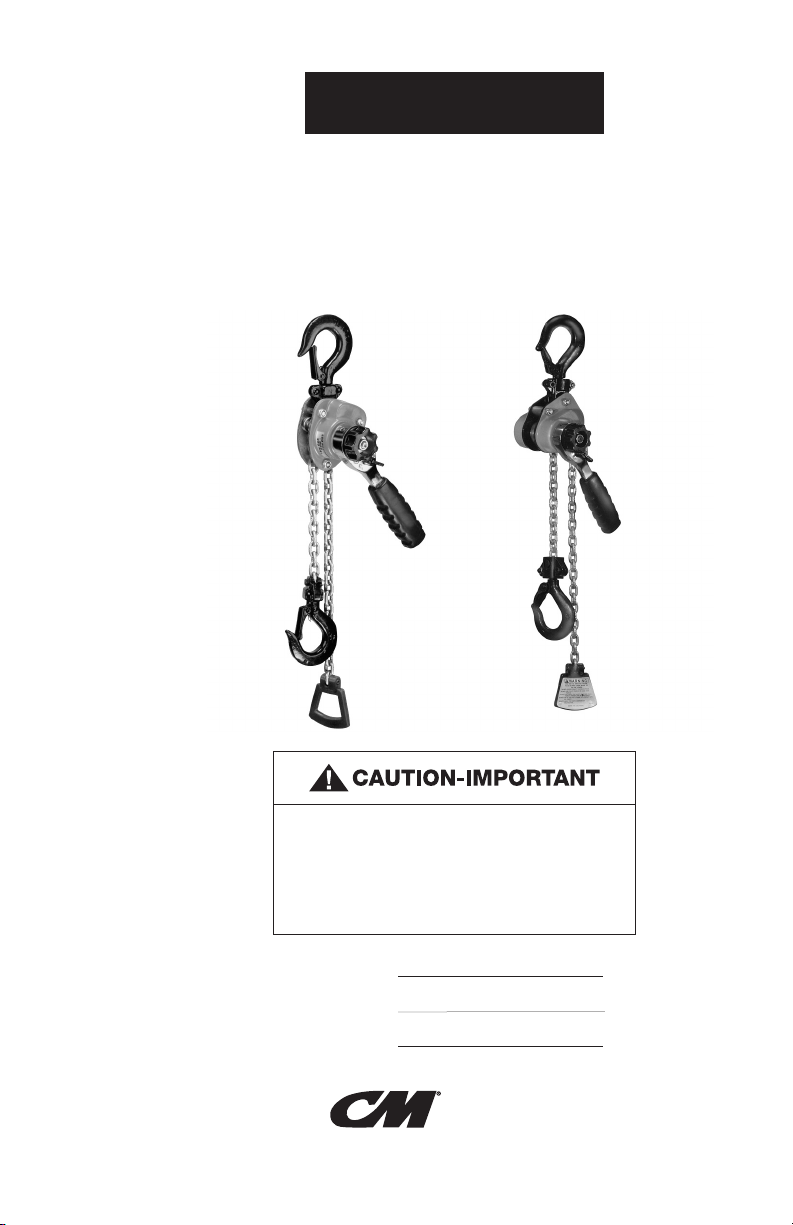
SERIES 602/603
Manually Lever Operated Chain Hoist
Maximum Capacity:
Series 602: 550 Pounds (250 Kg.)
Series 603: 1100 Pounds (500 Kg.)
Series 602 Series 603
FORWARD THIS MANUAL TO OPERATOR:
If not properly installed, operated and maintained, the use
of al l mec hanical equipment presents t he po ssibility of
personal injury or property damage. Before hoist use, all
persons should read this manual thoroughly. For safe, dependable and economical performance, follow all instructions and recommendations contained herein. It is also
important to retain this manual for current and future use.
Model Number
Serial Number
Purchase Date
COLUMBUS McKINNON CORPORATION
140 JOHN JAMES AUDUBON PARKWAY
LEVER OPERATED CHAIN HOISTS
02805 MANUAL NO. 602/603-A
Printed in China
AMHERST, NEW YORK 14228-1197
Page 2
INSTALLATION
. Read and understand the safety precautions on page 7 of this manual.
1
2. Estimate the load that is to be lifted or moved and make sure it does not exceed the hoist’s rated
capacity (550 lbs. / 250 Kg. for the Series 602 and 1100 lbs. / 500 Kg. for the Series 603).
3. Make sure that the support to which the upper hook is attached is strong enough to hold several
times the weight of the load. Be sure the hoist is solidly held in in the uppermost part
f the upper hook, the latch is closed and the latch does not contact the support.
o
4. Make sure that the hoist is rigged so that the upper and lower hooks will form a straight line when
the hoist is operated and the frame is free to swivel and will not come in contact with any object.
5. Spanish and French Warning labels for the loose end ring are packed separately.
f needed, attach these to the loose end ring at installation.
I
ailure to use as directed herein may cause injury to you or others and could result
F
in property damage.
• DO NOT exceed the 550 lbs. (250 Kg.) capacity of the hoist or 58 lbs. (26 Kg.) handle pull
on the Series 602, or 1100 lbs. (500 Kg.) capacity of the hoist or 56 lbs. (25 Kg.) handle pull
on the Series 603 when lifting or pulling.
• DO NOT use the hoist to lift people or loads over people.
• DO NOT use a damaged or malfunctioning hoist.
• DO NOT use if the load chain is twisted, kinked, worn, stretched or damaged.
• DO NOT use unless the hoist’s frame and chain form a straight line between hooks.
• DO NOT use if the hoist’s frame is in contact with any object.
• DO NOT leave a suspended load or hoist under tension unattended.
• DO NOT use an extension on the handle. Operate using hand power only.
• DO NOT apply loads to the tip of the hooks or to the hook latches.
• DO NOT remove warning labels and tags from the hoist.
OPERATION
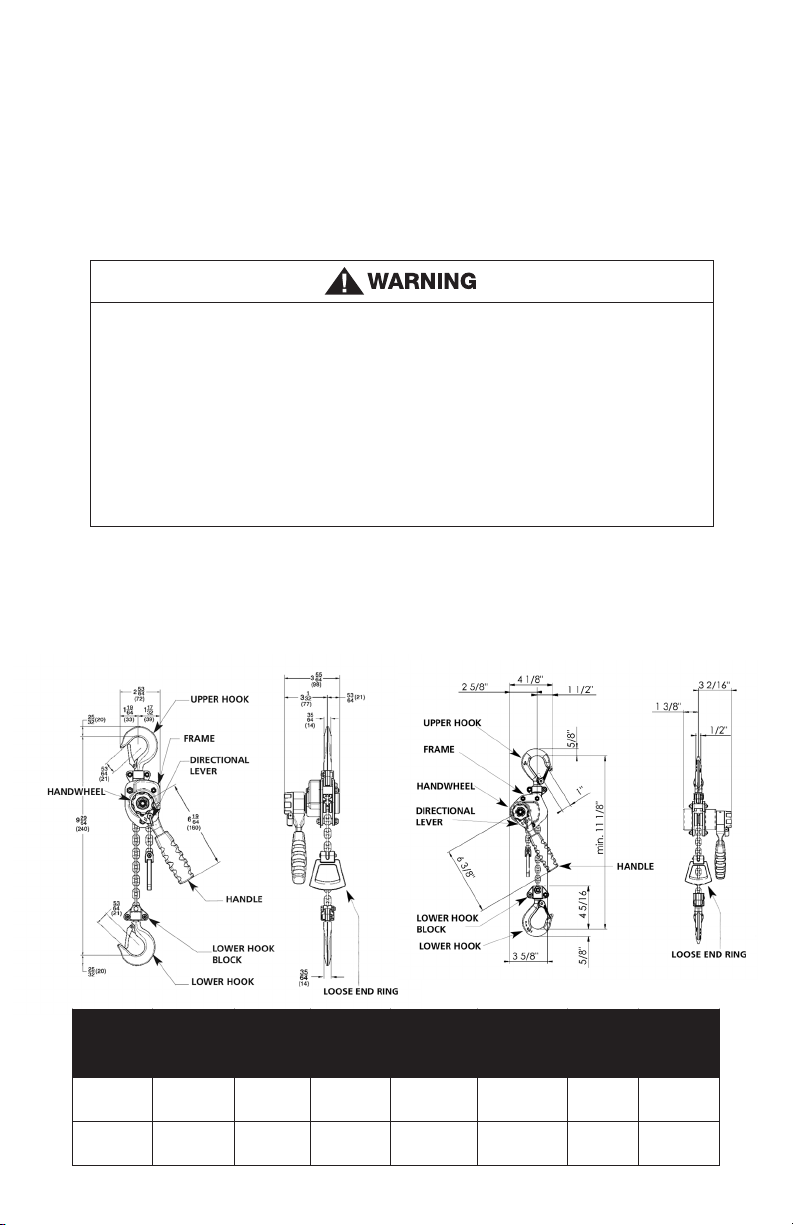
Before using the Series 602/603 Lever Hoist, familiarize yourself with main parts (See Fig. 1). Always
check the hoist for proper operation before use and under no circumstance should you attempt to use
a malfunctioning hoist. To reduce the risk of injury, the user must read and understand this manual.
FIGURE 1
SERIES 602 LEVER HOIST SERIES 603 LEVER HOIST
ALL DIMENSIONS ARE INCHES
Model
Number
TB602
TB603
Maximum
Capacity
550 lbs.
(250 kg.)
1100 lbs.
(500 kg.)
Standard
Lift
5 ft.
(1.5 m)
5 ft.
(1.5 m)
Chain
Size
4 x 12 mm
4 x 12 mm
Minimum
Distance
Between
Hooks
9-7/16"
(240 mm)
11-1/8"
(282 mm)
Pull on
Handle to
Lift Max.
Capacity
58 lbs.
(26 kg.)
56 lbs.
(25 kg.)
Net
Weight
5 lbs.
(2.3 kg.)
6 lbs.
(2.7 kg.)
Shipping
Weight
6 lbs.
(2.7 kg.)
7 lbs.
(3.2 kg.)
2 Series 602/603 Operating, Maintenance & Parts Manual
Page 3
FREE CHAINING
n this mode, the load can be pulled through the hoist in either direction by hand for quick attachment
I
o the load. To set the hoist to free chaining mode:
t
1. With no load on the hoist, move the directional lever to the center (neutral) position.
2. *Pull the load chain, in either direction, to its desired length so that the lower hook can
be attached to the load. Note that the chain must feed into the hoist freely. If it does not,
check for twisted chain. A twisted chain may become damaged by the chain guide rollers
or liftwheel and result in chain damage.
*Pull the chain slowly and be careful: HANDLE MAY SPIN.
OPERATING THE LEVER HOIST
he Series 602/603 Lever Hoist can be used in any position as long as it is rigged to pull in a straight
T
line from hook to hook and the frame is free to swivel on the upper hook.
If the hoist is not rigged in a straight line hook to hook manner or if the
frame is not free to swivel on the upper hook, handle pull may break the
frame, bend upper hook and/or break the chain and cause physical injury
or loss of load.
Always rig the hoist in a straight line hook to hook manner and do not
allow the frame to touch the load or any object when in use.
When operating in limited spaces, use attachments or slings to make sure the frame is free to swivel
on the upper hook and that there are no obstructions that would prevent you from operating the hoist.
1. Suspend or attach the hoist from an adequate support (see INSTALLATION).
2. Following the instruction for FREE CHAINING, take up the slack chain and attach the lower
hook to load to be lifted or moved. Make sure that the load will be applied to the bowl of the
lower hook and that it will not be applied to the latch or tip of the hook.
3. To lift or pull load, set the directional lever to () LOAD position and slowly pull chain in either
direction by hand to ensure the hoist is out of the free chaining mode. Be careful: HANDLE
MAY SPIN. Then operate the handle up and down to tension the load only enough to check
that the brake is engaged and that the attachments to hooks and load are firmly seated.
Then repeatedly operate the handle up and down to lift or pull the load. DO NOT OVERLOAD!
A handle pull of 58 pounds (26 Kg.) results in applying the maximum capacity of 550 pounds
(250 Kg.) to the Series 602 hoist, and a handle pull of 56 lbs. (25 Kg.) results in applying the
maximum capacity of 1100 lbs. (500 Kg.) to a Series 603 hoist.
4. To lower or loosen the load, move the directional lever to the () UNLOAD position and operate
the handle up and down repeatedly.
With no load on the hoist and when the directional lever is in the () LOAD
or () UNLOAD position, pulling sharply on either end of the chain will
cause the handle to spin rapidly.
TO AVOID INJURY:
Never pull sharply on either end of the chain when the directional lever is in
the () LOAD or () UNLOAD position.
Series 602/603 Operating, Maintenance & Parts Manual 3
TO AVOID INJURY:
Page 4
f directional lever is forced out of engagement with a load applied, load will be released.
I
O AVOID INJURY:
ith a load applied to the hoist, do not force the directional lever into the center (neutral) position.
W
LOCKED BRAKE
f a hoist under load is suddenly relieved of the load by removing the load from the hoist by some other
I
means, the brake will remain locked. The brake could also lock if the lower hook block is run tightly
against the frame. To unlock the brake, move the directional lever to the () UNLOAD position and pull
harply on the handle, or reapply the load and operate the hoist in the normal manner.
s
MAINTENANCE/INSPECTION
The Series 602/603 Lever Hoist normally requires very little maintenance, other than the frequent and
periodic inspection listed in the chart on page 5. However, if the hoist is disassembled for inspection,
the following should be observed when reassembling.
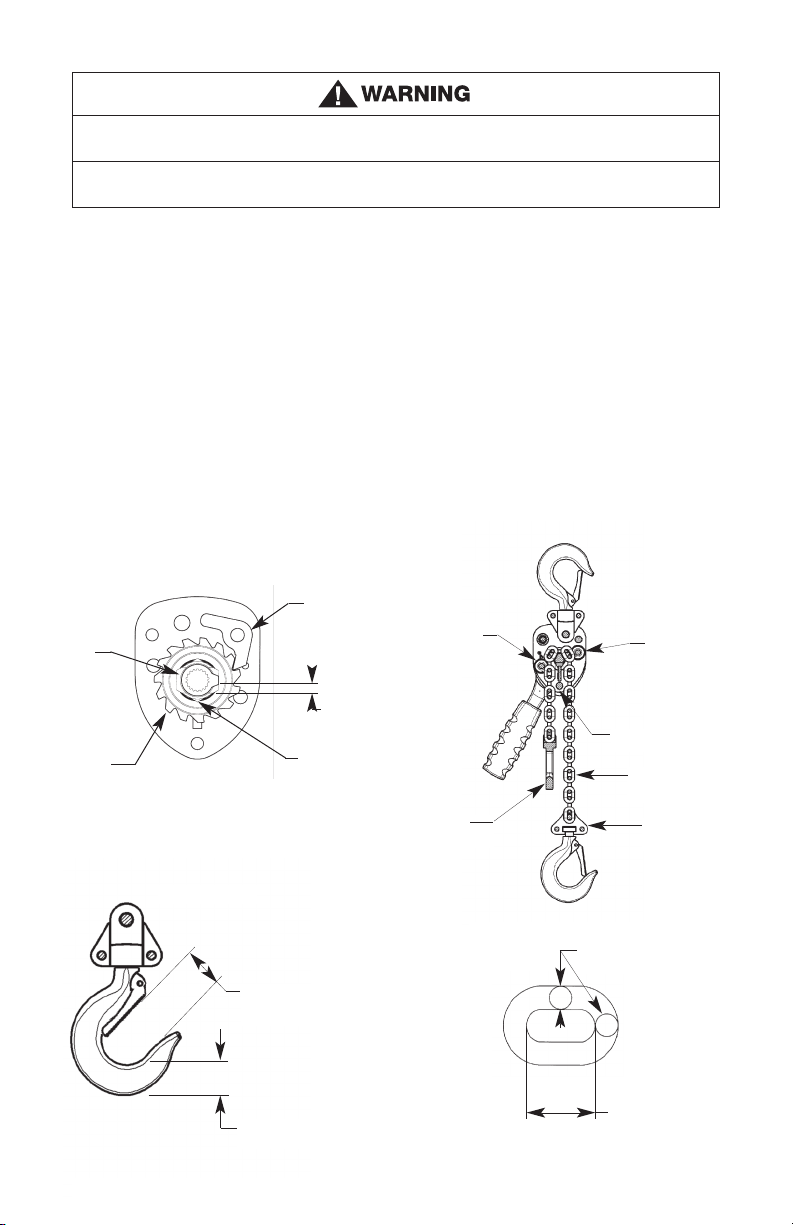
1. The pawl must engage the teeth of the ratchet as shown in Figure 2.
2. The check washer must be positioned on the ratchet hub as shown in Figure 2.
3. When installing the chain, it must be fed through the chain guide rollers with the welds away
from the liftwheel, the lower hook must be directly below the upper hook and the loose end ring
must be positioned and oriented at the end of the chain as shown in Figure 3
4. A rivet is used to attach the latch to the hook. To remove the latch grind off the head of the rivet.
When installing the latch, only peen over the end of the rivet enough to secure it.
T
CHECK
WASHER
RATCHET
FIGURE 2
FIGURE 4
PAWL
RATCHET
PAWL
0.91" (23.1 mm)
MAXIMUM
THROAT OPENING
.71" (18mm)
MINIMUM SEAT
1
/8"
FIGURE 3
CHAIN GUIDE
ROLLER
LOOSE END RINGPOSITION AS SHOWN
FIGURE 5
CHAIN GUIDE
ROLLER
STRIPPER
LOAD CHAIN
WELDS AWAY
FROM LIFTWHEEL
LOWER HOOK
BLOCK
.149" (3.8mm)
STOCK DIAMETER
.496" (12.6mm)
MAXIMUM PITCH
4 Series 602/603 Operating, Maintenance & Parts Manual
Page 5

FREQUENT & PERIODIC INSPECTION CHART
TEM
I
LABELING
&TAGS
OPERATION
FREQUENCY
DAILY
FREQUENT)*
(
X X
X X
––– X
X X
X X
VERY6
E
MONTHS
(PERIODIC)
HATTOCHECK
W
Nameplate,
capacity label
arning labels &
w
free chaining tag
General
peration
O
Overload test
Directional Lever
ree Chaining
F
INSPECTION
METHOD
Visually
Lift & lower
light load
a
Lift & lower
a 688 lb.
(312 Kg.) load
or the 602
f
or a 1378 lb.
(625 Kg.) for
the 603 one
foot (300 mm)
Movement Lever must move smoothly.
Movement
These items must be legible and securely
astened to the hoist. Replace if necessary.
f
1. Chain must feed into and out
of the hoist freely.
. Brake must hold the load when handle
2
is released.
1. Pull on handle should be about 73# (33Kg.)
2. Brake should operate smoothly
while lowering.
In free chaining mode, chain should feed into
and out of the hoist freely when pulled by hand.
CCEPTANCELEVEL
A
X X
X X
HOOK
ASSEMBLIES
CHAIN
BRAKE
DISC
HOIST
HEAD
*Daily or before each use.
X X
X X
X X
X X Lubrication Visually
X X
X X
X X
––– X
––– X
X X Handle Visually
––– X Stripper Visually Stripper must not be bent, corroded or worn.
X X Hardware Visually
––– X Pawl & Ratchet Visually
Hook opening
& bowl wear
Hook latch
Hook
deformation
Hook chain screw,
upper hook pin,
hook collars and
hook collars
hardware
Hooks, chemical
damage, cracks,
gouges
Corrosion, Pitting,
Gouges
Wear &
Contamination
Deformation
& Twists
Wear &
Contamination
Side plate
& Covers
Measure
opening and
bowl wear
Operation,
engagement
& damage
Visually
Visually
Visually
Visually
Measure
chain for wear
& stretch
Visually
Measure
thickness
& visually
Visually
See Figure 4.
1. Latch must not be damaged.
2. Latch must operate smoothly with sufficient
pressure to engage the tip of the hook tightly.
Hook must not be bent more than
10 degrees from the plane of the unbent hook.
There must be no damage,
corrosion, excessive wear or looseness.
There must be no excessive cracks,
corrosion, visible cracks or gouges.
Chain should be frequently
lubricated using Frisk Bros.
Lubriplate 10-R, or equal.
There must be no excessive corrosion,
pitting or gouges on the chain.
See figure 5.
Chain must be free of twists.
Take the hoist out of service if the thickness
is less than 0.094” (2.4 mm) or if the friction
surfaces are glazed, oily or contaminated.
Frame and covers should not be damaged
or corroded.
Handle must not be bent or corroded.
Grip should not be damaged.
All nuts must not be corroded
and must be securely tightened.
There should be no excessive wear of the
ratchet teeth and the tip of the pawl. The pawl
spring should not be corroded or stretched.
Series 602/603 Operating, Maintenance & Parts Manual 5
Page 6

SERIES 602/603 LEVER HOIST PARTS LIST
ARTNUMBER
DESCRIPTION
HAINSTOPASSEMBLY
C
LOADCHAIN(PERFOOTCODE)
HOOKLATCHKITS(2INCLUDED)
M HOISTS PARTS AND SERVICES ARE AVAILABLE
C
IN THE UNITED STATES AND IN CANADA
As a CM hoist user you are assured of reliable repair and parts services through a network of Master
Parts Depots and Service Centers that are strategically located in the United States and Canada. These
facilities have been selected on the basis of their demonstrated ability to handle all parts and repair requirements promptly and efficiently. To quickly obtain the name of the Master Parts Depot or Service
Center located nearest you call (800) 888-0985. Fax: (716) 689-5644.
CM reserves the right to change materials or design if, in its opinion such changes will improve its product.
Abuse, repair by an unauthorized person, or use of non-CM replacement parts voids the guarantee and
could lead to dangerous operation. For full “Terms of Sale”, see Sales Order Acknowledgement.
02100004 02100009
00230168 00400449
P
602 603
0230260
0
6 Series 602/603 Operating, Maintenance & Parts Manual
Page 7
SAFETY PRECAUTIONS
Each Series 602/603 Manually Operated Lever Hoist is built in accordance with the specifications contained
herein and at the time of manufacture complies with our interpretation of applicable sections of *ASME B30.21,
*ANSI/ASME HST-3M and the Occupational Safety and Health Act-1970.
The safety laws for elevators and for dumbwaiters specify construction details that are not incorporated in CM industrial
hoists. We recommend the use of equipment that meets state and national safety codes for such use. Columbus McKinnon
Corporation cannot be responsible for applications other than those for which CM equipment is recommended.
HIS SYMBOL POINTS OUT IMPORTANT SAFETY INSTRUCTIONS WHICH IF NOT FOLLOWED
T
COULD ENDANGER THE PERSONAL SAFETY AND/OR PROPERTY OF YOURSELF AND
OTHERS. READ AND FOLLOW ALL INSTRUCTIONS IN THIS MANUAL AND ANY PROVIDED WITH
HE EQUIPMENT BEFORE ATTEMPTING TO OPERATE YOUR SERIES 602/603 LEVER HOIST.
T
*Copies of the standards may be obtained from ASME Order Department, 22 Law Drive, Box 2300, Fairfield, NJ 07007-2300.
mproper operation of a hoist can create a potentially
I
hazardous situation which, if not avoided, could result
or serious injury. To avoid such a potentially
in death
hazardous situation, the operator shall:
1. NOToperate a malfunctioning or unusually performing hoist.
. NOToperate the hoist until you have thoroughly read and
2
understood this Operating, Maintenance and Parts Manual.
operate a hoist which has been modified without the
3. NOT
manufacturer’s approval or certification to be in conformity
with applicable OSHA regulations.
lift or pull more than rated load for the hoist.
4. NOT
5. NOTuse damaged hoist or hoist that is not working properly.
6. NOTuse hoist with twisted, kinked, damaged,
or worn load chain.
operate with any lever extension (cheater bar).
7. NOT
8. NOTattempt to “free-chain” the hoist while load is applied.
9. NOTuse the hoist to lift, support, or transport people.
10. NOT lift loads over people and make sure all personnel
remain clear of supported load.
attempt to lengthen the load chain or repair damaged
11. NOT
load chain.
12. Protect the hoist’s load chain from weld splatter or other
damaging contaminants.
13. NOT operate hoist when it is restricted from forming a
straight line from hook to hook in the direction of loading.
14. NOT
use load chain as a sling or wrap load chain around load.
15. NOT apply the load to the tip of the hook or to the hook latch.
16. NOT apply load unless load chain is properly seated in the
chain wheel(s) or sprocket(s).
17. NOT apply load if bearing prevents equal loading on all load
supporting chains.
operate beyond the limits of the load chain travel.
18. NOT
19. NOT leave load supported by the hoist unattended unless
specific precautions have been taken.
20. NOT allow the chain or hook to be used as an electrical
or welding ground.
allow the chain or hook to be touched by a live welding
21. NOT
electrode.
22. NOT remove or obscure the warnings on the hoist.
23. NOT operate a hoist which has notbeen securely attached
to a suitable support.
operate a hoist unless load slings or other
24. NOT
approved single attachments are properly sized
and seated in the hook saddle.
25. NOT lift loads that are notbalanced and that the holding
action is not secure, taking up slack carefully.
operate a hoist unless all persons are and remain clear
26. NOT
of the supported load.
27. Report malfunctions or unusual performances of a hoist,
after it has been shut down until repaired.
operate a hoist on which the safety placards or decals
28. NOT
are missing or illegible.
29. Be familiar with operating controls, procedures and
warnings.
mproper operation of a hoist can create a potentially
I
hazardous situation which, if not avoided, could result
or moderate injury. To avoid such a potentially
in minor
hazardous situation, the operator shall:
1. Maintain a firm footing or be otherwise secured when
operating the hoist.
2. Check brake function by tensioning the hoist prior to each lift
or pulling function.
3. Use hook latches. Latches are to retain slings, chains, etc.
under slack conditions only.
4. Make sure the hook latches are closed and not supporting
any parts of the load.
5. Make sure the load is free to move
and will clear all obstructions.
6. Avoid swinging the load or hook.
7. Avoid lever “fly-back” by keeping a firm grip on the lever
until operating stroke is completed and the lever is at rest.
8. Inspect the hoist regularly, replace damaged or worn parts,
and keep appropriate records of maintenance.
9. Use the hoist manufacturer’s recommended parts when
repairing the unit.
10. Lubricate load chain per hoist manufacturer’s
recommendations.
use the hoist load limiting or warning device
11. NOT
to measure load (If so equipped).
12. NOT
operate except with manual power.
13. NOT permit more than one operator to pull on lever
at the same time. More than one operator is likely
to cause hoist overload.
14. NOT allow your attention to be diverted
from operating the hoist.
allow the hoist to be subjected to sharp contact with
15. NOT
other hoists, structures, or objects through misuse.
16. NOT adjust or repair the hoist unless qualified to perform
such adjustments or repairs.
Series 602/603 Operating, Maintenance & Parts Manual 7
Page 8
WARRANTY
Every hoist is thoroughly inspected and performance tested prior to
shipment from the factory. If any properly installed, maintained and
operated hoist as outlined in the applicable accompanying CM manual
develops a performance problem due to defective materials or
workmanship as verified by CM, repair or replacement of the hoist will
be made to the original purchaser without charge and the hoist will be
returned, transportation prepaid. This warranty does not apply where
deterioration is caused by normal wear, abuse, improper or inadequate
maintenance, eccentric or side loading, overloading, chemical or
abrasive actions, excessive heat, improper installation, unauthorized
modifications or repairs, or use of non-CM repair parts.
EXCEPT AS STATED HEREIN, COLUMBUS MCKINNON
MAKES NO OTHER WARRANTIES, EXPRESSED OR IMPLIED,
INCLUDING WARRANTIES OF MERCHANTABILITY AND FITNESS
FOR A PARTICULAR PURPOSE.
Alterations or modifications of equipment and use of nonfactory repair parts can lead to dangerous operation and injury.
• Do not alter or modify equipment
• Do not use equipment to lift, support or
otherwise transport people
• Do not suspend unattended loads over people
TO AVOID INJURY:
© 2011 Columbus McKinnon Corporation
 Loading...