

Page 1
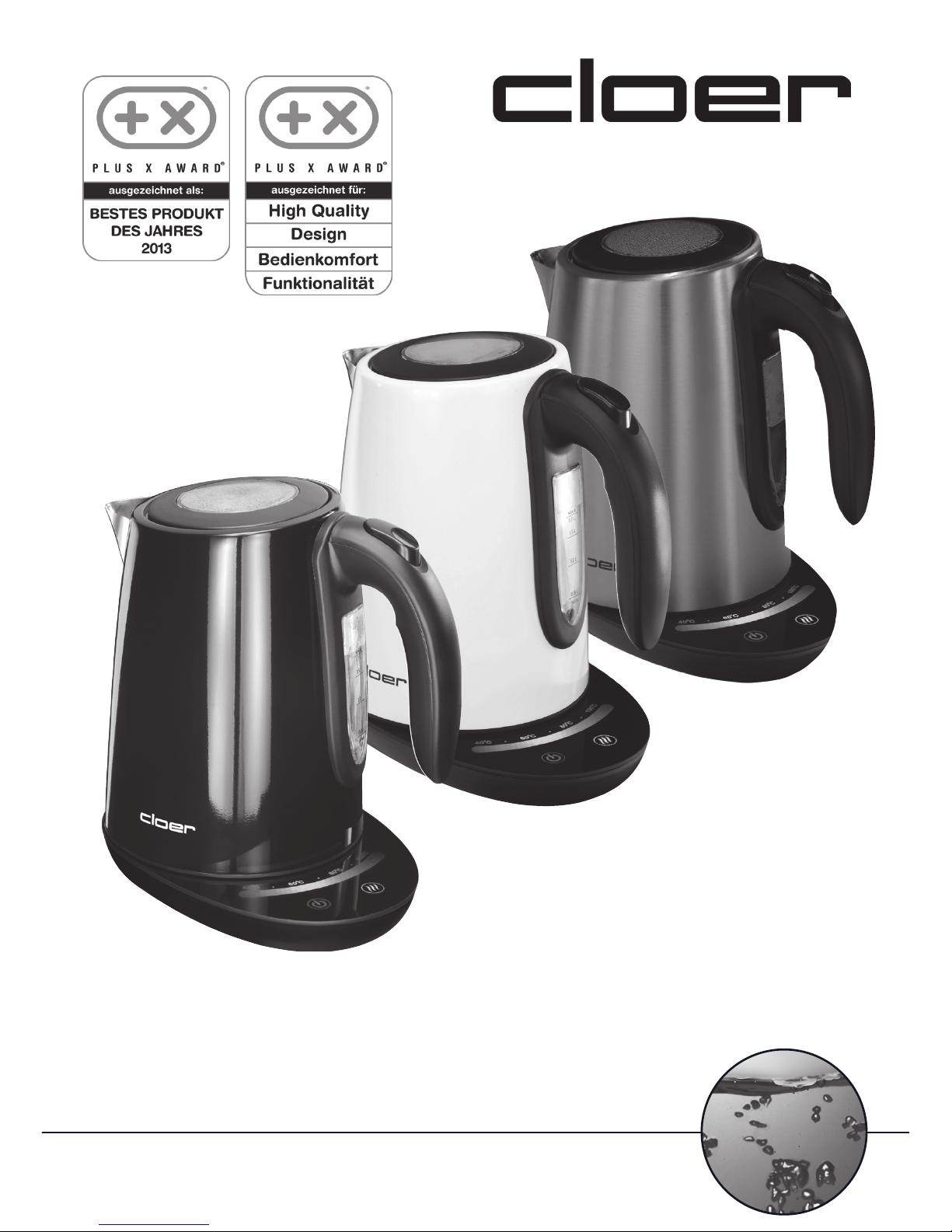
Gebrauchsanweisung
Operating Instructions
4950
Wasserkocher mit Temperaturregler 4950 / 4951 / 4959
Electric Kettle with Temperature Controller 4950 / 4951 / 4959
4959
4951
Page 2
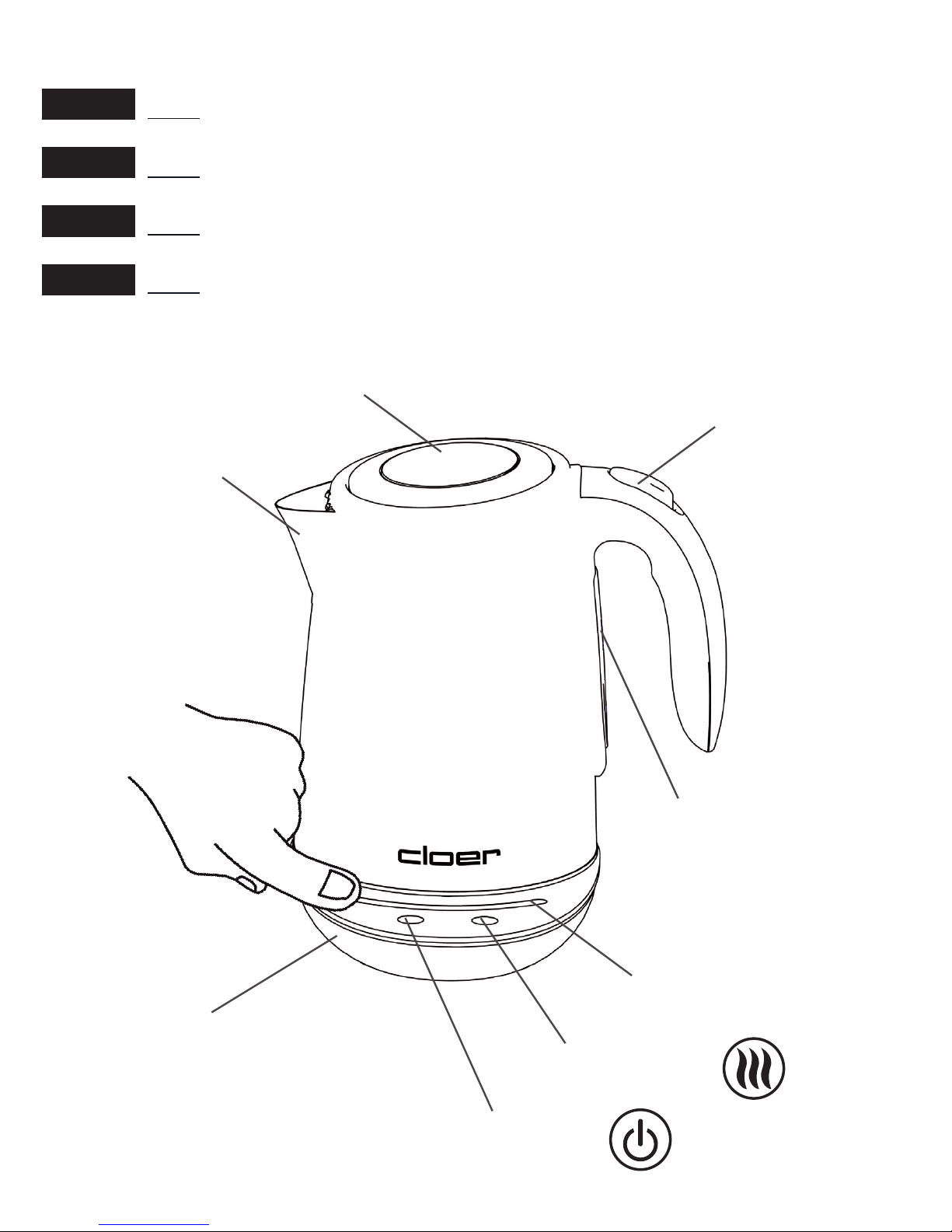
DE Basisstation mit Touch-
Bedienfeld, 360° Zentral kontakt und Kabelaufwicklung
EN Base station with touch panel,
360° central contact and
cable rewind
DE Wasserstandsanzeige
EN Water level display
DE Deckel-Entriegelungsknopf
EN Cover release knob
DE Deckel
EN Lid
DE Ausguss
EN Spout
DE An-/Ausschalter
EN ON/OFF switch
DE Temperaturregler
EN Temperature control
DE Warmhalte-Taste
EN Keeping warm button
Gebrauchsanweisung
Operating Instructions
Notice d´utilisation
Gebruiksaanwijzing
DE
EN
F
NL
........................................... 3
......................................... 7
.............................................. 11
............................................ 15
2
Page 3

DE
Grundlegende Sicherheitshinweise
Dieses Gerät ist dazu bestimmt, im Haushalt und ähnlichen Anwendungen verwendet zu werden, wie beispielsweise
- in Küchen für Mitarbeiter in Läden und Büros
- in landwirtschaftlichen Anwesen;
- von Kunden in Hotels, Motels und anderen Wohneinrichtungen
- in Frühstückspensionen.
Lassen Sie Reparaturen an Cloer Elektrogeräten nur von autorisierten
Cloer Fachhändlern oder vom Cloer Werkskundendienst durchführen.
Durch unsachgemäße Reparaturen können erhebliche Gefahren für
den Benutzer entstehen. Zudem erlischt dadurch Ihr Garantieanspruch.
Betreiben Sie das Gerät nur an haushaltsüblichen Steckdosen. Prüfen
Sie, ob die auf dem Typenschild angegebene Netzspannung mit der
Ihres Stromnetzes übereinstimmt.
Ist die Anschlussleitung beschädigt, muss sie durch einen autorisierten Cloer Fachhändler oder den Cloer Werkskundendienst ersetzt werden, um Gefährdungen zu vermeiden.
Ziehen Sie den Netzstecker aus der Steckdose,
- wenn eine Störung auftritt.
- wenn das Gerät längere Zeit nicht benutzt wird.
- vor jeder Reinigung.
Ziehen Sie bitte nur am Stecker, niemals an der Zuleitung.
Die Zuleitung nicht zu stramm spannen, da ansonsten die Gefahr besteht, dass das Gerät umkippt.
Die Z uleitung nicht über scharfe Kanten ziehen, nicht zum Tragen benutzen und vor Hitze schützen (Herdplatte / offene Flamme)
Dieses Gerät kann von Kindern ab 8 Jahren und darüber benutzt
werden, wenn sie beaufsichtigt werden oder bezüglich des sicheren
Gebrauchs des Gerätes unterwiesen wurden und die daraus resultierenden Gefahren verstanden haben.
Reinigung und die Wartung durch den Benutzer dürfen nicht durch
Kinder durchgeführt werden, es sei denn, sie sind 8 Jahre oder älter
und werden beaufsichtigt. Das Gerät und seine Anschlussleitung sind
von Kindern unter 8 Jahren fernzuhalten.
Kinder dürfen nicht mit dem Gerät spielen.
Geräte können von Personen mit reduzierten physischen, sensorischen oder mentalen Fähigkeiten oder Mangel an Erfahrung und/
oder Wissen benutzt werden, wenn sie beaufsichtigt oder bezüglich
des sicheren Gebrauchs des Gerätes unterwiesen wurden und die daraus resultierenden Gefahren verstanden haben.
Schützen Sie Ihr Gerät vor Feuchtigkeit (Spritzwasser / Regen).
Lassen Sie das Gerät vollständig abkühlen, bevor Sie es reinigen oder
verstauen.
Dieses Gerät ist nicht dafür bestimmt durch eine Zeitschaltuhr oder
einen externen Timer bedient zu werden.
Verwenden Sie den Wasserkocher nur mit dem mitgelieferten Kontaktsockel.
Das Gerät und die Basisstation niemals unter fließendem Wasser reinigen oder darin eintauchen.
·
·
·
·
·
·
·
·
·
·
·
·
·
·
·
·
3
Page 4
Sehr geehrte Kundin, sehr geehrter Kunde,
wir wünschen Ihnen viel Freude mit Ihrem neuen Wasserkocher mit Touch-Bedienfeld.
Ihre Firma Cloer
Aufstellen
Entfernen Sie alle Verpackungsteile und evtl.
Aufkleber, nicht das Typenschild.
Stellen Sie den Wasserkocher auf eine trockene,
rutschfeste und ebene Unterlage.
Vor dem Erstgebrauch
Bitte lesen Sie vor dem Erstgebrauch diese Anleitung aufmerksam durch und bewahren Sie
diese auf, falls Sie nochmal etwas nachlesen
möchten.
Kochen Sie mind. ein mal 1,7 l Wasser auf 100°C
auf und schütten Sie dieses anschließend weg.
Sicherheitshinweise zum
Kontaktsockel und Wasserkocher
Unterschreiten Sie nicht die MIN-Markierung (=
0,8 l) auf der Wasserstandsanzeige, da das Gerät
sonst nicht ordnungsgemäß abschalten kann.
Füllen Sie den Wasserkocher nicht über die
MAX-Markierung (= 1,7 l) auf der Wasserstandsanzeige hinaus mit Wasser. Durch ein mögliches
Übersprudeln besteht Verbrühungsgefahr!
Nehmen Sie den Wasserkocher vor dem Einfüllen mit Wasser bitte immer vom Kontaktsockel
ab.
Der Wasserkocher ist nur zum Erhitzen von
Wasser geeignet.
Stellen Sie dieses Gerät niemals auf oder in die
Nähe von heißen Gas- oder Elektroplatten.
Der Kontaktsockel darf nur in trockenem Zustand in Betrieb genommen werden.
Bitte vermeiden Sie unbedingt, dass Wasser
über den Kontaktsockel geschüttet wird.
Ist versehentlich Wasser auf den Kontaktsockel
gelangt, verfahren Sie wie folgt:
- Ziehen Sie den Netzstecker aus der Steckdose.
- Trocknen Sie den Kontaktsockel mit einem
saugfähigen, trockenen Küchentuch ab.
- Trocknen Sie die Aufstellfläche des Kontakt sockels ab.
- Stecken Sie den Netzstecker wieder ein.
Lassen Sie das Gerät während des Betriebs niemals unbeaufsichtigt.
ACHTUNG:
Der Wasserkocher wird im
Betrieb heiß. Bitte fassen Sie
das Gerät nur am Haltegriff an.
Touch-Bedienfeld
Ihr Wasserkocher ist mit einer Temperaturregelung und einer Warmhaltefunktion ausgestattet,
die über ein modernes Touch-Bedienfeld durch
Berührung gesteuert werden. Für beides lässt
sich eine Temperatur im Bereich von 40°-100°C
wählen. Durch die geschlossene Oberfläche
kann kein Schmutz, Staub oder Wasser in das
Basis-Innere gelangen.
Inbetriebnahme
Stecken Sie den Stecker in die Steckdose.
Nehmen Sie den Wasserkocher vom Kontaktsockel ab.
Öffnen Sie den Deckel mit der Taste am Griff.
Füllen Sie die gewünschte Menge kaltes Wasser
in den Wasserkocher. Dazu können Sie die Wasserstandsanzeige hinter dem Griff nutzen.
HINWEIS: Achten Sie darauf, dass Sie die MINMarkierung (= 0,8 l) nicht unterschreiten, damit
der Temperatursensor mit Wasser bedeckt ist.
Andernfalls kann das Gerät nicht ordnungsgemäß abschalten.
HINWEIS: Achten Sie darauf, dass Sie die MAXMarkierung (= 1,7 l) nicht überschreiten, da der
Wasserkocher ansonsten überkochen kann.
Verbrühungsgefahr!
Schließen Sie den Deckel per Hand und stellen
Sie das Gerät in beliebiger Position zurück auf
den 360°-Kontaktsockel.
Ihr Wasserkocher ist mit einer Temperaturreglung ausgestattet und funktioniert durch Berührung (siehe auch unter „Touch-Bedienfeld“).
Wählen Sie die gewünschte Temperatur (zwischen 40° und 100°C), indem Sie auf der „TouchTemperatur-Leiste“ die gewünschte Temperatur
berühren. Die LED-Anzeige leuchtet anschließend bis zu dieser Stelle blau auf.
INFO: Kochendes Wasser erhalten Sie bei einer
Temperatur von 100°C.
Bitte beachten Sie, dass die Wassertemperatur
nach dem Kochvorgang wenige Grad Celsius von
der gewählten Temperatur abweichen kann.
Drücken Sie nun den Ein-/Ausschalter auf dem
Touch-Bedienfeld.
Wenn das Wasser die gewünschte Temperatur
erreicht hat, piept der Wasserkocher dreimal
und schaltet anschließend selbstständig ab.
Die LEDs der Temperaturleiste leuchten noch
einige Zeit nach.
Sie können den laufenden Kochvorgang auch
jederzeit durch erneutes Betätigen des Ein-/
Ausschalters abbrechen.
Bitte warten Sie einen Moment bis das Wasser
nicht mehr sprudelt.
Zum Ausgießen des Wassers heben Sie den
Wasserkocher vom Kontaktsockel ab.
Warten Sie einige Minuten bis Sie das Gerät erneut mit Wasser befüllen und benutzen, um es
abkühlen zu lassen. Achten Sie dabei darauf,
dass Sie beim Bedienen nicht an das heiße Gehäuse kommen. Verbrennungsgefahr!
Warmhaltefunktion
Sie haben die Möglichkeit das Wasser nach dem
Kochvorgang warmzuhalten.
Gehen Sie vor wie unter „Inbetriebnahme“ beschrieben, drücken Sie jedoch anstelle des Ein-/
Ausschalters die Warmhalte-Taste.
Dadurch betätigt sich auch automatisch der
Ein-/Ausschalter und das Gerät beginnt zu kochen.
Anschließend wird das Wasser auf der gewählten Temperatur warmgehalten.
Sie können während der Warmhaltezeit den
Wasserkocher jederzeit vom Kontaktsockel abnehmen, sich Wasser eingießen und wieder zurückstellen, woraufhin die Warmhaltefunktion
fortgesetzt wird.
Die Warmhaltefunktion können Sie jederzeit
stoppen, indem Sie erneut die Warmhalte-Taste
DE
·
·
·
·
·
·
·
·
·
·
·
·
·
·
·
·
·
·
·
·
·
·
·
·
·
·
·
·
·
·
·
·
·
·
·
·
·
4
Page 5
DE
betätigen. Andersfalls schaltet das Gerät automatisch nach ca. 2 Stunden ab.
Sie können die Warmhaltetaste auch während
eines normalen Kochvorgangs noch nachträglich einschalten.
Kochen Sie dazu wie gewohnt Wasser und wählen Sie nach Betätigen des Ein-/Ausschalters die
Warmhalte-Taste.
Überhitzungsschutz
Der Wasserkocher besitzt einen Überhitzungsschutz. Sollten Sie den Wasserkocher versehentlich ohne Wasser betreiben, schaltet der
Überhitzungsschutz das Gerät sicher ab und
hat ggf. kurzfristig keine Funktion. Lassen Sie
das Gerät in diesem Fall ca. 1 Stunde abkühlen.
Anschließend kaltes Wasser einfüllen und das
Gerät ist wieder betriebsbereit.
Reinigung
ACHTUNG: Das Gerät und die Basisstation nie-
mals unter fließendem Wasser reinigen oder
darin eintauchen!
Reinigen Sie den Wasserkocher nicht mit stark
scheuernden Mitteln. Diese könnten das Gerät
zerkratzen.
Starke Verschmutzungen mit einem Tuch und
lauwarmen Wasser entfernen.
Herausnehmen / Reinigen des
Kalkfilters
Der Kalkfilter befindet sich unterhalb des Ausgusses im Inneren des Wasserkochers.
Zum Entnehmen drücken Sie die obere flache
Kante mit beiden Daumen nach unten, um die
beiden Halterungen zu lösen. Nehmen Sie den
Filter anschließend nach oben hin heraus.
Reinigen Sie den Kalkfilter mit etwas Spülwasser
und setzen Sie diesen mit dem unteren Stift zuerst in das unterste Loch der Kalkfilter-Halterung
des Wasserkochers ein. Anschließend drücken
Sie die oberen beiden Filter-Haken zurück in die
eckigen Löcher der Halterung im Wasserkocher
bis der Kalkfilter einrastet.
Entkalken
Bei kalkhaltigem Wasser sollte der Wasserkocher in regelmäßigen Zeitabständen entkalkt
werden (je nach Härtegrad des Wasser, ca. alle
2-3 Wochen).
Verwenden Sie zum Entkalken ein handelsübliches, flüssiges Entkalkungsmittel (keine chemischen Entkalker) und beachten Sie dabei
dessen Gebrauchsanweisung.
TIPP: Bei leichter Verkalkung können Sie den
Wasserkocher, anstatt Entkalkungsmittel zu
verwenden, auch mit einer Mischung von 5-6
Esslöffel Essig auf 0,5 l Wasser entkalken.
Bitte beachten Sie beim Entkalken:
Füllen Sie zunächst kaltes Wasser in den Wasserkocher.
Kochen Sie dieses kurz auf.
Geben Sie nun das Entkalkungsmittel hinzu und
lassen Sie das Gerät eine Zeitlang stehen.
ACHTUNG: Kochen Sie diese Mischung nicht auf.
Spülen Sie den Topf nach dem Entkalken zwei
mal mit klarem Wasser aus.
Reinigen Sie den Wasserkocher nicht mit stark
scheuernden Mitteln. Diese könnten das Gerät
zerkratzen.
HINWEIS: Durch regelmäßiges Entkalken wird
der Stromverbrauch niedrig gehalten und die
Lebensdauer Ihres Wasserkochers verlängert.
Der Kalkgehalt ist von Region zu Region unterschiedlich. Bitte erfragen Sie bei Ihrem örtlichen
Wasserwerk oder Stadtwerk den Härtegrad
Ihres Wassers nach.
Bei fehlerhafter Funktionsweise aufgrund
von Verkalkung besteht kein Garantieanspruch!
Problem / Ursache / Abhilfe
Problem Eventuelle
Ursache
Abhilfe
Wasserkocher hat
keine Funktion
Gerät nicht
angeschlossen
Stecken Sie
den Stecker
in die Steckdose
Wasserkocher hat
keine Funktion
Überhitzungsschutz
hat sich eingeschaltet
s. Seite 5
unter „Überhitzungsschutz“
Wasser
sprudelt im
Wasserkocher über
Zu viel
Wasser
eingefüllt
Weniger Wasser einfüllen,
MAX-Markierung (= 1,7 l)
darf nicht
überschritten
werden
Wasserkocher
schaltet nicht
ab
Zu wenig
Wasser
eingefüllt
Mehr Wasser
einfüllen /
MIN-Markierung (= 0,8 l)
nicht unterschreiten
Am Boden
des Wasserkochers bilden
sich weiße
Flecken
Wasserkocher verkalkt
Wasserkocher
entkalken
Wasserkocher wird
im Betrieb
sehr laut
Wasserkocher verkalkt
Wasserkocher
entkalken
Umweltfreundliche Entsorgung
Unsere Geräte haben für den Transport ausschließlich umweltfreundliche Verpackungen.
Geben Sie Kartonagen und Papier in die Altpapiersammlung, Kunststoffverpackungen in den
Wertstoffmüll.
ACHTUNG!
Elektrogeräte gehören
nicht in den Hausmüll.
Elektrogeräte enthalten wertvolle Rohstoffe.
Führen Sie auch das ausgediente Gerät bitte
dem anerkannten Recyclingkreislauf zu. Über
Entsorgungsmöglichkeiten informiert Sie Ihre
Gemeinde- oder Stadtverwaltung.
Kunden-Service
Sollte es einmal vorkommen, dass Ihr Cloer-
·
·
·
·
·
·
·
·
·
·
·
·
·
·
·
·
·
·
5
Page 6

Ausgenommen von der Garantie sind Schäden,
die auf
unsachgemäße Nutzung,
natürliche Abnutzung bzw. Verschleiß,
äußere Einwirkungen (z.B. Transportschäden,
Stöße, Schläge, Hitzeeinwirkung, Säuren o.ä.),
mangelnde Entkalkung*
oder auf ungeeignetes Zubehör zurückzuführen sind.
Die Garantie erlischt, wenn das Gerät
gewerblich genutzt,
unautorisiert geöffnet, abgeändert
oder ein unautorisierter Reparaturversuch vorgenommen wurde.
Für Verbrauchsmaterial wird ebenfalls keine
Garantie übernommen.
* Wasserkocher / Kaffeeautomat / Teeautomat
Gerät einen Schaden hat, wenden Sie sich bitte
an Ihren Fachhändler oder an den Cloer-Werkskundendienst. Cloer Elektrogeräte entsprechen
den aktuellen EG-Richtlinien und Sicherheitsvorschriften.
Garantiebedingungen für
Deutschland
Cloer gewährt Ihnen, dem privaten Endverbraucher, eine limitierte Herstellergarantie.
Bei sorgfältiger Behandlung und Beachtung der
Bedienungsanleitung sowie der Sicherheitshinweise verpflichten wir uns, das Gerät kostenlos
instandzusetzen, soweit es sich um Materialoder Herstellungsfehler handelt. Die Instandsetzung erfolgt durch Reparatur bzw. Ersatz der
schadhaften Komponenten. Ausgewechselte
Teile werden Eigentum der Firma Cloer. Weitere
Ansprüche, gleich welcher Art, insbesondere
Schadenersatzansprüche, sind ausgeschlossen.
Diese Garantie beeinträchtigt keine Rechte, die
Verbraucher gemäß den jeweils geltenden nationalen Gesetzen bezüglich des Verkaufs von
Waren haben.
Die Garantiefrist beträgt 2 Jahre und beginnt
mit dem Datum, an dem das Produkt erstmals
von einem Endverbraucher erworben wurde.
Die Garantiefrist wird durch spätere Weiterveräußerung, durch Reparaturmaßnahmen
oder durch Austausch des Produktes weder verlängert, noch beginnt sie von neuem oder wird
anderweitig beeinflusst.
Diese Garantie wird von Ihrem Händler an
Sie weitergegeben. Um Garantieleistungen in
Anspruch zu nehmen, wenden Sie sich direkt
an Ihren Händler.
In Deutschland bietet Cloer registrierten Verbrauchern die Möglichkeit, erweiterte Garan-
tieleistungen direkt mit dem Werkskundendienst abzuwickeln. Voraussetzung hierfür ist,
dass das Produkt bei einem autorisierten Händler
gekauft und per Postkarte oder über Internet
unter http://www.cloer.de/service registriert
wurde. Für die Inanspruchnahme von Garantieleistungen wenden sich registrierte Verbraucher in jedem Fall zunächst telefonisch, per
Fax oder Mail an den Werkskundendienst.
Bitte schicken Sie keine Geräte unaufgefordert.
Insbesondere dürfen Pakete niemals unfrei
eingesendet werden. Diese werden von den
Paketdiensten nicht zugestellt, sondern für Sie
kostenpflichtig retourniert. Sprechen Sie daher
zuerst mit uns.
Wir sagen Ihnen, wie Sie Ihr Gerät an uns einsenden sollen.
Wenden Sie sich an den:
Cloer Werkskundendienst
Tel.: 02932.6297-660
Fax: 02932.6297-860
Mail: [email protected]
Zum Nachweis des Garantieanspruchs ist
unbedingt ein Kaufbeleg mit Kaufdatum
und Händleranschrift im Original vorzulegen.
Ohne diesen Kaufbeleg erfolgt die Reparatur
ohne Rückfrage kostenpflichtig.
·
·
·
·
·
·
·
·
6
DE
Page 7

EN
Basic safety instructions
This electrical appliance is exclusively determined for private use and
using in:
– staff kitchen areas in shops, offices and other working environments
– in farm houses
– by clients in hotels , motels and other residential type environments
– on bed and breakfast type environments.
Have repairs of Cloer electronic appliances carried out only by
authorized Cloer specialist dealers or by the Cloer customer service.
Improper repairs can involve substantial dangers for the user. Furthermore, this will void your warranty claims.
Only operate the appliance at household-usual power sockets. Check
if the mains voltage stated on the type plate is up to that of your
power supply network.
If the supply cord is damaged, it must be replaced by an authorized Cloer
specialist dealer or the Cloer customer service to avoid endangering.
Pull power plug of the power socket
– in case of a defect.
– if the appliance is not used for a longer time.
– before any cleaning.
Only pull at the plug, never at the feed cable.
Do not tighten the feed cable too tight as otherwise the appliance is
likely to tip over.
Do not stretch the feed cable over sharp edges.
Do not use the feed cable for carrying and protect it from heat (hotplate/ open flame).
This appliance can be used by children aged from 8 years and above if
they have been given supervision or instruction concerning use of the
appliance in a safe way and understand the hazards involved.
Cleaning and user maintenance shall not be made by children unless
they are older than 8 and supervised. Keep the appliance and its cord
out of reach of children less than 8 years.
Children shall not play with the appliance.
This appliance is not intended for use by persons with reduced
physical, sensory or mental capabilities, or lack of experience and
knowledge, unless they have been given supervision or instruction
concerning use of the appliance by a person responsible of their safety.
Protect your appliance from humidity (splash water / rain).
Let the appliance cool off before cleaning or stowing away.
The appliance is not intended to be operated by means of an external
timer or seperate remote-control system.
Use the electric kettle only with the provided contact base.
Do not immerse appliance or base in water and do not clean under
running water!
·
·
·
·
·
·
·
·
·
·
·
·
·
·
·
·
·
·
7
Page 8
vered with water, otherwise the appliance can
not switch o properly.
ATTENTION: Make sure not to ll water past the
MAX marking (= 1,7 l) on the water level display.
Scalding may result from water boiling over.
Close the lid manually and place the electric
kettle anywhere on the 360° contact base.
Your water boiler is equipped with a temperature control and works by touch (please see also
“Touch control panel“).
Select the desired temperature (between 40°
and 100°C) by touching it on the “Touch-Temperature Strip“. The LED display then lights up blue
to this point.
INFO: Water will boil at a temperature of 100°C.
Please observe that the water temperature after
boiling may deviate from the selected temperature by a few degrees Celsius.
To switch it on, press the ON/OFF switch on the
touch panel.
When the water reaches the desired temperature, the electric kettle will beep three times and
then switches o automatically.
The LEDs of the temperature control will light
up afterwards.
You can interrupt the boiling process at any time
by pushing up the ON/OFF switch again.
Please wait a moment until the water stops
bubbling.
To pour the water, lift the electric kettle from the
contact base.
IMPORTANT: Always make sure that the device
is switched o before removing the electric
kettle from the contact base.
Wait a few minutes to let the device cool off before filling it with water again and using it. Do
not touch the hot housing during operation.
Danger of burning!
Keeping warm function
You can keep the water hot after boiling.
Proceed as described in „Operation“, but push
the button for keeping warm instead of the ON/
OFF switch.
This automatically operates the ON/OFF switch
and the device starts to boil.
Then the water is kept warm on the selected
temperature.
You can remove the water boiler from the
contact socket at any time during the keeping
warm time, pour water and return it, which will
continue the keeping warm function.
You can stop the keeping warm function at
any time by pushing the keeping warm button
again.
Otherwise, the device will automatically switch
off after approx. 2 hours.
You may also switch on the keeping warm
button subsequently during a regular boiling
process.
For this, boil water as usual and select the
keeping warm button after pushing the ON/OFF
switch.
8
·
·
·
·
·
·
·
·
·
·
·
·
·
·
·
·
·
·
·
·
·
·
·
Dear Customer
We wish you much pleasure with your new
electric kettle with touch panel.
Your Cloer Company
Preparation for use
Remove all packaging elements and labels, but
not the rating plate.
Place the electric kettle on a dry, even, non-slip
surface.
Before initial use
Please read these operating instructions carefully before using the device for the rst time
and save these instructions in case you want to
read it again.
Boil at least once 1.7 l water at 100°C, and then
pour this away.
Safety notices for use of the
contact base / electric kettle
Do not come below the MIN marking (= 0.8 l) on
the water level display, otherwise the appliance
can not switch o properly.
Do not ll the electric kettle with water past the
MAX marking (= 1,7 l) on the water level display.
Scalding may result from water boiling over.
Always remove the electric kettle from the
contact base before lling with water.
This electric kettle may only be used for heating
water.
Do not place this appliance on or near a hot gas
or electric burner.
Before operating the machine, make sure that
the contact base is dry.
Please make sure that water is never spilled on
the contact base.
If water is accidentally spilled onto the contact
base, proceed as follows:
– Unplug the unit from the wall socket.
– Dry the contact base with an absorbent
dry kitchen towel.
– Dry the surface beneath the contact base.
– Plug the unit into the wall socket again.
Never leave the appliance unattended when in
use.
CAUTION!
The surface is hot during
operation. Only touch the
device at its handle.
Touch control panel
Your electric kettle is equipped with a temperature control and a “keep-warm“ function,
controlled by a modern touch control panel. For
both a temperature in the range of 40° -100°C
can be selected. The closed surface prevents
dirt, dust or water to get into the base interior.
Operation
Plug the power plug into the wall socket.
Remove the electric kettle from the contact
base.
Open the lid by pressing the cover release knob
at the handle.
Fill the electric kettle with desired amount of
cold tap water using the water markings on the
water level display behind the handle.
ATTENTION: Make sure not to ll below the MIN
marking (= 0.8 l) so that the heat detector is co-
·
·
·
·
·
·
·
·
·
·
·
·
·
·
·
·
·
·
EN
Page 9
Overheating protection device
The electric kettle is equipped with a overheating protection. In the event that you accidentally operate the electric kettle without
water, the device will automatically switch
o for your safety and can have no function for
a short time. Let the appliance allow to cool for
ca. 1 hour. Afterwards ll in cold water and the
device will be ready to operate again.
Cleaning
CAUTION: Do not immerse appliance or base in
water and do not clean under running water!
Do not clean the electric kettle with heavily
abrasive cleaners. They could scratch the appliance.
Clean very dirty appliances with a damp cloth
and lukewarm water.
Removing / cleaning the lime
filter
The lime filter is located below the pouring
spout inside of the kettle.
To remove, press the upper flat edge with
your thumbs to release the two brackets. Then
remove the filter towards the top.
Clean the lime filter with a little bit of soapy water and place it into the bottom hole of the scale
filter holder of the water boiler with the bottom
pin first. Then push the two upper filter hooks
back into the square holes of the holder in the
water boiler until the scale filter latches.
Decalcifying
If you have hard water, the electric kettle should
be decalcied regularly (depending on the
hardness of the water, about every 2 - 3 weeks).
Use a commercially available liquid decalcifying
product (do not use chemical decalciers) and
follow the manufacturer’s instructions.
TIP: Mild calcium deposits can also be removed
with a mixture of 5 to 6 tablespoons of vinegar
in 0.5 l of water.
Please observe the following when decalcifying the machine:
First, pour cold water into the electric kettle.
Briey bring it to a boil.
Now, add the decalcier and let the device
stand for a while.
CAUTION: Do not bring this mixture to a boil.
After decalcifying, rinse the pot twice with clear
water.
Do not clean the electric kettle with heavily
abrasive cleaners. They could scratch the appliance.
NOTE: Regularly decalcifying your electric kettle
will reduce the electricity used and prolong the
life of the appliance. The calcium content of
water varies from region to region. Please consult your local water works or utility works for
information on water hardness.
In the event of malfunctions due to calcium
deposits, the guarantee will be voided!
Problem / Cause / Solution
Problem Possible
cause
Solution
Electric kettle
does not
function
Appliance
is not
plugged in
Plug the
power plug
into the
wall socket
Electric kettle
does not
function
Overheating
protection
switches o
appliance
Please see
page 9 under
“Overheating
protection
device“
Water bubbles over in
the electric
kettle
Too much
water has
been added
Add less
water, do not
exceed the
MAX marking
Electric kettle
does not
switch o
Added to
little watter
Add more
water / do
not come
below the
MIN marking
(= 0.8 l)
Electric kettle
makes loud
noises during
operation or
Too much
calcication
inside the
electric kettle
Decalcify
the electric
kettle
White spots
form at the
bottom of
the electric
kettle
Too much
calcication
inside the
electric kettle
Decalcify
the electric
kettle
Environmentally friendly disposal
We use only environmentally friendly packaging
for the transport of our appliances. Please recycle cardboard/paper and plastic packaging appropriately.
CAUTION!
Electrical appliances should
not be disposed of with
the household trash.
Electrical appliances contain valuable raw materials. When an appliance is worn-out, please
take it to a recognised recycling facility. Please
consult the local authorities for information on
recycling appliances.
Customer service
In the event that your Cloer appliance becomes
defective, please contact your Cloer dealer or
Cloer customer service department. Cloer electrical appliances comply with current EC guidelines and safety regulations.
Conditions of warranty
Cloer grants you, the private end user, a
limited manufacturer’s warranty. Assuming
careful handling and compliance with the operating instructions and safety notices, we will
be obligated to replace the appliance at no
cost, insofar as there are defects in material or
workmanship. The repair will be eected by
repairing or replacing defective components.
·
·
·
·
·
·
·
·
·
·
·
·
·
·
·
·
9
EN
Page 10

Any parts replaced will become the property of
Cloer. All further claims of any type, especially
claims for indemnication, are not valid. This
warranty does not aect any rights of the customer with respect to the sale of goods in accordance with the applicable national laws.
The warranty period is 2 years starting from the
date on which the product was rst urchased
by an end consumer. The warranty period will
not be extended or begin anew or in any other
way be aected by the subsequent sale, repair
or replacement of the product. This warranty is
passed on to you by your retail dealer. In order
to assert a warranty claim, please contact your
dealer directly.
If you have questions about your product,
please contact the Cloer importer in your country. The address and telephone number can be
found on our website at http://www.cloer.de
or you can send an e-mail to
As proof of warranty entitlement you must submit the original sales receipt with the date of
sale and the dealer’s address. Without the sales
receipt, the repair will be carried out at your expense without asking.
The warranty does not cover damages resulting
from
improper use,
natural wear and tear,
external inuences (e.g. damage from transport,
shocks, jolts, heat, acids, etc.),
insucient decalcifying *
or unsuitable accessories.
The warranty will be void if the appliance
is used commercially,
is opened or modied without authorisation
or if unauthorised repairs are attempted.
Also, the warranty does not apply to consumable materials.
* electric kettle / coeemaker / teamaker
·
·
·
·
·
·
·
·
10
EN
Page 11
11
Consignes de sécurité fondamentales
Cet appareil est destiné à l’usage au foyer ou dans des applications similaires
dont par exemple :
– dans les coins cuisines des collaborateurs dans les magasins, dans les bureaux et d‘autres domaines des entreprises;
– dans les propriétés agricoles;
– par les clients d’hôtels, motels et d’autres locaux d’habitation;
– dans les pensions offrant le petit-déjeuner.
Ne conez les réparations des appareils électriques Cloer qu’à des revendeurs
Cloer agréés ou au service après-vente usine de la maison Cloer. Des réparations inexpertes peuvent engendrer des risques considérables pour l’utilisateur.
Elles entraînent en outre la perte de vos droits à garantie.
Ne raccordez l’appareil qu’aux prises femelles habituellement présentes dans un
foyer. Vériez que la tension indiquée sur la plaque signalétique concorde bien
avec celle débitée par votre secteur.
Si le cordon est abîmé et pour éviter des risques inutiles, il faudra le faire remplacer
par un revendeur Cloer agréé ou par le service après-vente usine Cloer.
Débranchez la che mâle de la prise de courant
– lorsqu’un dérangement survient.
– si l’appareil doit rester assez longtemps sans servir.
– avant chaque nettoyage.
Pour débrancher la che mâle, saisissez toujours cette dernière, jamais le cordon.
Ne tendez pas le cordon d‘alimentation car il y a sinon risque que l’appareil se
renverse.
Veillez à ce que le cordon d‘alimentation ne frotte pas contre des arêtes vives.
N‘utilisez jamais le cordon d‘alimentation pour porter l’appareil et protégez aussi
le cordon contre la chaleur (foyer de cuisinière / ammes nues).
Cet appareil peut être utilisé par les enfants âgés de 8 ans ou plus à condition que
ceux-ci soient surveillés ou qu’ils aient été instruits à propos de l’utilisation en toute
sécurité de l’appareil et qu’ils aient compris les dangers auxquels ils s’exposent.
Le nettoyage et l’entretien à la charge de l’utilisateur ne doivent pas être conés
à des enfants à moins que ces derniers ne soient âgés de 8 ans ou plus et qu’ils
soient surveillés.
L’appareil et son câble de raccordement doivent être conservés hors de la portée des enfants de moins de 8 ans.
Surveillez les enfants pour être sûr(e) qu’ils ne jouent pas avec l’appareil.
Cet appareil peut être utilisé par les personnes dont les capacités physiques,
sensorielles ou mentales sont réduites ou ne disposant d’aucune expérience et
/ ou connaissances à condition que ces personnes soient surveillées ou qu’elles
aient été instruites à propos de l’utilisation en toute sécurité de l’appareil et
qu’elles aient compris les dangers auxquels elles s’exposent.
Protégez votre appareil contre l’humidité (projections d’eau / pluie).
Laissez l’appareil intégralement refroidir avant de le nettoyer ou de le ranger.
Cet appareil n’est pas destiné à être utilisé par le biais d’une minuterie ou d’un
autre chronomètre externe.
Ne pas immerger dans l´eau.
·
·
·
·
·
·
·
·
·
·
·
·
·
·
·
·
·
·
F
Page 12
secteur sur une prise de courant murale.
Retirez la bouilloire de son socle.
Ouvrez le couvercle de la bouilloire amovible
en appuyant sur le bouton d‘ouverture du
couvercle.
Remplissez la bouilloire de la quantité d‘eau
froide souhaitée. Pour vous aider, utilisez
l‘indicateur de niveau d‘eau sous la poignée.
REMARQUE : veillez à toujours atteindre au
moins le repère MIN (= 0,8 1) pour couvrir ainsi
la sonde thermique d‘eau. Sinon, l‘appareil ne
pourra pas s‘éteindre correctement.
REMARQUE : veillez à ne pas dépasser
le repère MAX (= 1,7 l) sinon la bouilloire
risque de déborder quand elle bout. Risque
d‘ébouillantement !
Fermez le couvercle à la main et replacez
l‘appareil sur le socle d‘alimentation à contact
sur 360°, dans n‘importe quelle direction.
Votre bouilloire est équipée d‘une régulation de
la température et fonctionne par effleurement
(voir également sous « Zone de commande
tactile »). Sélectionnez la température
souhaitée (entre 40 °C et 100 °C) en effleurant
la température voulue sur la barrette de
température tactile. L‘affichage à LED s‘allume
en bleu jusqu‘à l‘emplacement correspondant.
INFO : pour obtenir de l‘eau bouillante,
choisissez une température de 100 °C.
À noter qu‘après avoir chauffé, la température
de l‘eau peut varier de quelques degrés Celsius
en moins que la température sélectionnée.
Appuyez à présent sur l‘interrupteur Marche/
Arrêt sur la zone de commande tactile.
Lorsque l‘eau a atteint la température souhaitée,
la bouilloire émet trois bips successifs puis
s‘éteint automatiquement.
Les LED de la barrette de température tactile
restent allumées un court instant.
Mais vous pouvez également arrêter la bouilloire
à tout moment pendant le cycle de chauffe en
poussant le bouton de MARCHE-ARRET.
Patientez un peu jusqu‘à ce que l‘eau ne
bouillonne plus.
Pour verser l‘eau, soulevez la bouilloire de son
socle d‘alimentation.
Avant de remplir à nouveau la bouilloire d‘eau
et de l‘utiliser, patientez quelques minutes
pour qu‘elle se refroidisse. Quand vous utilisez
la bouilloire, veillez à ne pas toucher sa surface
chaude. Risque de brûlure !
Fonction « Maintien au chaud »
Une fois que l‘eau a bouilli, vous avez la
possibilité de la maintenir au chaud.
Procédez comme décrit sous « Mise en service »,
mais au lieu d‘appuyer sur l‘interrupteur Marche/
Arrêt, appuyez sur la touche Maintien au chaud.
L‘interrupteur Marche / Arrêt est alors
automatiquement actionné, et l‘appareil
chauffe l‘eau.
Ensuite, l‘eau est maintenue à la température
souhaitée.
Pendant la durée de maintien au chaud,
vous pouvez retirer la bouilloire de son socle
d‘alimentation à tout moment, verser de l‘eau
12
·
·
·
·
·
·
·
·
·
·
·
·
·
·
·
·
·
·
·
·
·
·
Chère cliente, cher client,
Nous vous souhaitons beaucoup de plaisir à
l’utilisation de votre nouvelle bouilloire.
La société Cloer
Mise en place
Enlevez toutes les parties d‘emballage et
les éventuelles étiquettes, sauf la plaque
signalétique.
Posez la bouilloire sur une surface plane, sèche
et non glissante.
Avant la première utilisation
Lisez attentivement ce mode d’emploi avant
d’utiliser votre bouilloire pour la première fois.
Faites bouillir au moins une fois 1,7 litre d‘eau
jusqu‘à 100 °C puis jetez cette eau.
Conseils de sécurité pour
l‘utilisation du socle / de la
bouilloire
Remplissez toujours au moins jusqu‘au repère
MIN (= 0,8 l) de l‘indicateur de niveau d‘eau,
sinon l‘appareil ne pourra pas s‘éteindre
correctement.
Quand vous remplissez la bouilloire, veillez à
ce que le niveau d‘eau ne dépasse pas le repère
MAX (= 1,7 l). Vous risqueriez de vous brûler du
fait du débordement de l’eau en ébullition.
Retirez toujours la bouilloire de son socle pour
la remplir.
La bouilloire est exclusivement destinée à faire
chauer de l’eau.
Ne placez jamais cet appareil sur ou à proximité
de plaques électriques ou d‘une gazinière
chaudes.
Le socle doit impérativement être sec pour être
mis en service.
Evitez impérativement de verser de l‘eau sur le
socle de contact.
Si vous avez malencontreusement versé de l’eau
sur le socle, procédez de la manière suivante:
– Débranchez la prise mâle de la prise de courant
murale.
– Essuyez le socle avec un essuie-tout sec et absor bant.
– Essuyez la surface sur laquelle est posée le socle.
– Rebranchez la prise mâle de secteur.
Surveillez impérativement l‘appareil quand il
fonctionne.
ATTENTION:
Lorsque la bouilloire est en
cours de fonctionnement, elle
devient très chaude. Veillez à ne
la prendre que par la poignée.
Zone de commande tactile
Votre bouilloire est équipée d‘une régulation de
la température et d‘une fonction de maintien
au chaud qui se commandent par effleurement
au moyen d‘une zone de commande tactile
moderne. Pour ces deux fonctions, il est
possible de sélectionner une température de
40 °C à 100 °C. La surface hermétique empêche
la pénétration des saletés, de la poussière et de
l‘eau à l‘intérieur de la base.
Mise en service et consignes
d’utilisation
Commencez par brancher la prise mâle
·
·
·
·
·
·
·
·
·
·
·
·
·
·
F
Page 13
et la remettre sur son socle : la fonction de
Maintien au chaud reprend.
Pour arrêter à tout moment la fonction de
maintien au chaud, appuyez une nouvelle
fois sur la touche Maintien au chaud. Sinon,
l‘appareil s‘éteint automatiquement au bout de
2 heures environ.
Vous pouvez également activer la touche
Maintien au chaud à tout moment pendant
que la montée en température normale de la
bouilloire.
Pour ce faire, faites chauffer l‘eau comme
d‘habitude puis sélectionnez la touche Maintien
au chaud après avoir appuyé sur l‘interrupteur
Marche/Arrêt.
Protection contre la surchauffe
La bouilloire est équipée d‘une protection
contre la surchaue. Si vous utilisez la bouilloire
sans eau par mégarde, la protection contre la
surchauffe éteint l‘appareil en toute sécurité et
ce dernier peut ne pas fonctionner pendant
quelque temps. Dans ce cas, laissez l‘appareil
refroidir pendant env. 1 heure. Ensuite,
remplissez-le d‘eau froide : l‘appareil est à
nouveau opérationnel.
Nettoyage
REMARQUE: Ne jamais plonger l’appareil et la
base dans l’eau ou tout autre liquide.
Ne nettoyez pas la bouilloire avec des produits
trop agressifs. Ils risqueraient de rayer la
bouilloire.
Au besoin, essuyer l’extérieur de l’appareil avec
un linge doux, humide.
Retrait/nettoyage du filtre
anticalcaire
Le filtre anticalcaire se trouve sous le bec verseur,
à l‘intérieur de la bouilloire.
Pour le retirer, appuyez sur le bord supérieur plat
à l‘aide de vos deux pouces pour désolidariser
les deux fixations. Ensuite, retirez le filtre par le
haut.
Nettoyez le filtre anticalcaire en le rinçant à l‘eau
puis replacez-le dans la bouilloire en insérant
d‘abord la broche inférieure dans le trou le plus
bas de la fixation du filtre anticalcaire. Ensuite,
appuyez sur les deux crochets supérieurs du filtre
pour les insérer dans les trous rectangulaires de
la fixation dans la bouilloire jusqu‘à ce que le
filtre anticalcaire s‘encrante.
Détartrage
Si votre eau est calcaire, vous devrez détartrer
régulièrement votre bouilloire (environ toutes
les 2 à 3 semaines selonla dureté de l’eau).
Pour détartrer votre bouilloire, utilisez les
produits liquides de détartrage vendus
couramment dans le commerce (n‘utilisez pas
de détartrant chimique) et procédez toujours
conformément au mode d‘emploi fourni.
ASTUCE: Si votre bouilloire n’est que légèrement
entartrée, vous pouvez, à la place d’un produit
détartrant, également la détartrer avec 5 à 6
cuillères à soupe de vinaigre dans 0,5 litre d‘eau.
Pour détartrer, procédez de la manière
suivante:
Commencez par remplir la bouilloire avec de
l‘eau froide.
Faites bouillir brièvement.
Ajoutez le détartrant et laissez la bouilloire
ainsi pendant quelques instants.
ATTENTION: Il ne faut pas faire bouillir ce
mélange.
Après le détartrage, rincez le contenant de la
bouilloire deux fois avec de l‘eau claire.
Ne nettoyez pas la bouilloire avec des produits
trop agressifs. Ils risqueraient de rayer la
bouilloire.
Remarque: Si vous détartrez régulièrement
votre bouilloire, la consommation d‘électricité
reste faible et votre bouilloire durera plus
longtemps. La dureté de l’eau varie d’une
région à l’autre. Vous pouvez vous renseigner
auprès de votre mairie ou du service
des eaux de votre commune pour connaître
le degré de dureté de l’eau de votre habitation.
En cas de dysfonctionnement pour cause
d‘entartrage, la garantie s‘annule!
Problème / Cause / Solution
Probléme Cause
possible
Solution
La bouilloire
ne fonctionne
pas
L’appareil
n’est pas
branché
Branchez la
prise mâle
sur une prise
de courant
murale
La bouilloire
ne fonctionne
pas
La protection
contre la
surchauffe
s‘est
déclenchée.
voir page
13 sous
« Protection
contre la
surchauffe »
L’eau
bouillante
déborde de la
bouilloire
Vous avez
versé trop
d’eau
Verser moins
d’eau, il ne
faut pas
dépasser
le repère
Maximum (=
1,7 l)
La bouilloire
ne s‘éteint
pas
Pas assez
d‘eau
Rajouter
de l‘eau
au moins
jusqu‘au
repère MIN (=
0,8 l)
Des tâches
blanches se
forment sur
le fond de la
bouilloire
La bouilloire
est entartrée
Détartrer
la bouilloire
La bouilloire
est très
bruyante
lorsqu’elle
fonctionnement
La bouilloire
est entartrée
Détartrer
la bouilloire
Comment jeter le wok lorsqu’il
est usagé en respectant
l’environnement
Nos appareils sont toujours emballés pour le
transport dans des emballages respectueux de
l’environnement. Déposez les cartons, le papier
et les emballages en plastique dans les points
·
·
·
·
·
·
·
·
·
·
·
·
·
·
·
·
·
·
·
13
F
Page 14

présentation de ce ticket de caisse, la réparation
est obligatoirement eectuée à titre onéreux.
La garantie ne s’exerce pas si le dommage
résulte:
d’une utilisation non conforme,
de l’usure naturelle,
d’eets extérieurs (par ex. dégâts de transport,
chocs, coups, chaleur, acides, etc.),
de l’absence de détartrage *
ou de l’utilisation d’accessoires inappropriés.
La garantie s’annule si l’appareil
est utilisé à titre professionnel,
est ouvert ou modié arbitrairement
ou si une tentative de réparation a été opérée
arbitrairement.
Aucune garantie ne s’exerce sur les
consommables.
* Bouilloire / Cafetière / Théière
14
·
·
·
·
·
·
·
·
de collecte prévus à cet effet pour le recyclage.
ATTENTION!
Les appareils électriques ne
doivent pas être jetés dans les
ordures ménagères.
Les appareils électriques comportent des
matériaux recyclables. C‘est pourquoi vous
devez déposer l’appareil usagé dans un point de
collecte public destiné au recyclage. Renseignezvous auprès de votre mairie pour connaître les
points de collecte et les déchetteries.
Service après-vente
Si, malgré tous nos soins, votre appareil Cloer
présente un défaut, veuillez vous adresser à
votre revendeur Cloer ou au service après-vente
Cloer.
Les appareils électriques Cloer sont conformes
aux prescriptions de sécurité et aux directives
européennes en vigueur.
Conditions de garantie
Cloer vous accorde, en qualité de consommateur
nal privé, une garantie constructeur limitée.
A condition d’une utilisation soigneuse
de l’appareil et du respect des indications
gurant dans le mode d’emploi ainsi que
des consignes de sécurité, nous nous
engageons à apporter gratuitement réparation
à l’appareil dans la mesure où il s’agit d‘un
vice de matériau ou de fabrication. La
réparation apportée à l’appareil consiste en
une réparation eective de l’appareil ou en un
remplacement des composants défectueux.
Les pièces remplacées sont la propriété de
la société Cloer. Toutes les autres demandes,
de quelque sorte que ce soit, notamment
les demandes de réparation de dommage,
sont exclues.
Cette garantie n’altère nullement les droits
des consommateurs conformément aux lois
nationales respectivement en vigueur relatives
à la vente de marchandises.
La période de garantie est de 2 ans. Elle
commence à courir à la date où le produit
a été acheté pour la première fois par le
consommateur nal. La période de garantie n’est
nullement prolongée, ni renouvelée, ni modiée
par la revente ultérieure du produit, par des
mesures de réparation ou par l’échange du
produit.Cette garantie vous est cédée par votre
revendeur. Pour faire valoir des prestations de
garantie, veuillez vous adresser directement
à votre revendeur.
Pour toute question sur votre produit,
veuillez vous adresser à l’importateur Cloer
national de votre pays. Vous trouverez sur
notre site Internet http://www.cloer.de son
adresse et son numéro de téléphone. Vous
pouvez également envoyer un email à l’adresse
qui vous correspond:
Pour faire valoir une demande de garantie, il
est impérativement nécessaire de présenter
le ticket de caisse original indiquant la date
d‘achat et l‘adresse du revendeur. A défaut de
F
Page 15

15
NL
Essentiële veiligheidsaanwijzingen
Dit toestel is geschikt om in het huishouden en in gelijkaardige omstandigheden
te worden gebruikt, bijvoorbeeld:
– in de keuken voor medewerkers in winkels, kantoren en andere branches;
– op landbouwdomeinen;
– door klanten in hotels, motels en andere woongelegenheden;
– in bed-and-breakfasts.
Laat reparaties aan elektrische apparatuur van Cloer uitsluitend uitvoeren door
geautoriseerde Cloer-leveranciers of door de klantendienst van Cloer in Nederlande: Appliance- Huishoud BV te Zoetermeer tel. 079-3634242 Ondeskundige
reparaties kunnen aanzienlijk gevaar opleveren voor de gebruiker. Zij leiden tot
het vervallen van garantie-aanspraken.
Gebruik het apparaat uitsluitend door aansluiting op voor huishoudingen gebruikelijke contactdozen. Controleer of de spanning van het stroomnet overeenstemt
met de op het typeplaatje van het apparaat aangegeven netspanning.
Het apparaat beschikt over een type stroomkabel dat indien het is beschadigd,
om gevaren te vermijden, door een geautoriseerde Cloer-leverancier of door de
klantendienst van Cloer dient te worden vervangen.
Verwijder de netstekker uit de contactdoos
– wanneer een storing optreedt.
– wanneer het apparaat lange tijd niet wordt gebruikt.
– voor iedere reiniging.
Trek uitsluitend aan de stekker, nooit aan de kabel.
Span de stroomkabel niet te strak. Bij strak spannen bestaat het gevaar van
omvallen van het apparaat.
Trek de stroomkabel niet over scherpe randen.
Gebruik de kabel niet om het apparaat te dragen en bescherm de kabel tegen
hitte (fornuis / vuur).
Dit apparaat kan door kinderen vanaf 8 jaar en ouder worden gebruikt wanneer
ze onder toezicht staan of instructies kregen met betrekking tot het veilig gebruik
van het apparaat en de daaruit voortvloeiende gevaren hebben begrepen.
De reiniging en het onderhoud door de gebruiker mag niet door kinderen worden
uitgevoerd, tenzij ze 8 jaar of ouder zijn en onder toezicht staan.
Het apparaat en de aansluitleiding moeten buiten het bereik van kinderen onder
de 8 jaar worden gehouden.
Kinderen dienen onder toezicht te blijven om er zeker van te kunnen zijn dat zij
niet spelen met het apparaat.
Apparaten kunnen door personen met verminderde lichamelijke, zintuigelijke of
mentale vermogens of gebrek aan ervaring en/of kennis worden gebruikt indien
ze onder toezicht staan of instructies kregen met betrekking tot het veilig gebruik
van het apparaat en de daaruit voortvloeiende gevaren hebben begrepen.
Bescherm het apparaat tegen vocht (spattend water / regen).
Laat het apparaat volledig afkoelen voordat u het reinigt of opbergt.
Dit apparaat is niet geschikt om door een (externe) timer te worden bediend.
Het apparaat nooit onder stromend water reinigen of onderdompelen.
·
·
·
·
·
·
·
·
·
·
·
·
·
·
·
·
·
·
Page 16
hoeveelheid koud water. Gebruik daarvoor de
waterpeilmarkering achter de greep.
AANWIJZING: Let erop, dat het waterpeil
minstens tot het MIN-merkteken (=0,8 l) op de
schaal wordt gevuld, zodat de temperatuursensor
in water is ondergedompeld. Zo niet kan het
apparaat zich niet correct uitschakelen.
AANWIJZING: Let erop, dat het waterpeil niet
tot boven het MAX-merkteken (=1,7 l) wordt
gevuld, omdat de waterkoker anders kan
overkoken. Verbrandingsgevaar!
Sluit het deksel met de hand en plaats het
apparaat dan in een willekeurige positie op de
360° contactsokkel terug.
Uw waterkoker is met een temperatuurregeling
uitgerust en kan door aanraking worden
bediend (zie ook onder „Touch-bedieningsveld“).
Stel de gewenste temperatuur (tussen 40°C en
100°C) in door op het veld „Touch-temperatuur“
te drukken. De LED-weergave licht vervolgens
tot deze locatie blauw op.
INFO: Kokend water krijgt u bij een temperatuur
van 100°C.
Let erop, dat de watertemperatuur na het
koken enkele graden Celsius van de ingestelde
temperatuur kan afwijken.
Druk nu op de aan/uitschakelaar op het Touchbedieningsveld.
Wanneer het water de gewenste temperatuur
bereikt heeft, piept de waterkoker drie keer en
schakelt hij zichzelf dan uit.
De Leds van het temperatuurveld blijven nog
een tijdje oplichten.
U kunt het kookproces ook altijd afbreken door
opnieuw op de aan/uitschakelaar te drukken.
Wacht dan een moment tot het water niet meer
borrelt.
Voor het uitgieten van het water neemt u de
waterkoker van de contactsokkel.
Wacht enkele minuten alvorens het apparaat
opnieuw met water te vullen en te gebruiken,
zodat het kan afkoelen. Let er daarbij op, dat
u bij het bedienen de hete behuizing niet
aanraakt. Verbrandingsgevaar!
Warmhoudfunctie
U hebt de mogelijkheid om het water na het
koken warm te houden.
Volg de instructies zoals ze onder
„Inbedrijfstelling“ beschreven staan, maar
druk op de Warmhoud-toets i.p.v. op de Aan/
uitschakelaar.
Zo wordt de Aan/uitschakelaar ook automatisch
geactiveerd en begint het apparaat te koken.
Vervolgens wordt het water op de ingestelde
temperatuur warm gehouden.
Tijdens de warmhoudtijd kunt u de waterkoker
van de contactsokkel nemen, water inschenken
en terugplaatsen, waarna de warmhoudfunctie
wordt voortgezet.
De warmhoudfunctie kunt u op elk moment
stoppen door opnieuw op de Warmhoudtoets
te drukken. Zo niet schakelt het apparaat
zichzelf automatisch na ca. 2 uur uit.
U kunt de Warmhoudtoets ook tijdens het
16
·
·
·
·
·
·
·
·
·
·
·
·
·
·
·
·
·
·
·
·
·
Zeer geachte klant,
Wij wensen U veel plezier met uw nieuwe
waterkoker.
Opstellen
Verwijder alle verpakkingsdelen en evt.
plakplaten niet het typeplaatje verwijderen.
Plaats de waterkoker op een droge, stroeve en
vlakke ondergrond.
Bij het eerste gebruik
Lees voor het eerste gebruik de gebruiksaanwijzing aandachtig door.
Kook minstens één keer 1,7 l water aan 100°C en
giet het daarna weg.
Veiligheid tijden het gebruik van
de kontaktvoet / waterkoker
Vul het waterpeil minstens tot het MINmerkteken (=0,8 l) op de schaal, omdat
het apparaat zich anders niet correct kan
uitschakelen.
Vul de waterkoker niet boven de Max.
merkstreep (= 1,7 l). Door de koker te vullen met
te veel water heeft U kans dat het water gaat
spetteren.
Voor het vullen neemt U de koker altijd af van
de kontaktvoet.
De waterkoker is alleen geschikt voor het koken
van water.
Plaats het apparaat nooit op of in de buurt van
hete gas- of elektrische kookplaten.
De kontaktvoet alleen gebruiken in droge
toestand.
Voorkom absoluut dat er water over de
contactstekker wordt gemorst.
Is er ondanks alles toch water op de kontaktvoet
terecht gekomen ga dan als volgt te werk:
– Verwijder de kontaktstop uit de wandkon taktdoos.
– Droog de kontaktvoet af met een wateropne mende doek.
– Droog het opstelvlak ook af met een droge
doek.
– Plaats de kontactstop weer in de wandkon taktdoos.
Laat het apparaat nooit onbewaakt
functioneren.
OPGEPAST!
De waterkoker wordt tijdens
het gebruik heet, altijd de
koker vastpakken aan de
handgreep.
Touch-bedieningsveld
Uw waterkoker is met een temperatuurregeling
en een warmhoudfunctie uitgerust, die door
middel van een modern touch-bedieningsveld
door aanraking worden bediend Voor beide
kan een temperatuur tussen 40°C en 100°C
worden ingesteld. Door het gesloten oppervlak
kan geen vuil, stof of water in de kern van het
apparaat doordringen.
In gebruik / bedienen
Plaats eerst de kontaktstop in de
wandkontaktdoos.
Neem de waterkoker van de kontaktvoet.
Open het deksel van de waterkoker door de
dekselvergrendelingsknop in te drukken.
Vul de waterkoker met de gewenste
·
·
·
·
·
·
·
·
·
·
·
·
·
·
·
·
·
NL
Page 17
normale kookproces bijkomend indrukken.
Kook water zoals u dat normaal zou doen en
druk na het indrukken van de Aan/uitschakelaar
ook op de Warmhoudtoets.
Oververhittingsbeveiliging
De waterkoker bevat een
oververhittingsbeveiliging. Mocht u vergeten
hebben het apparaat met water te vullen,
schakelt de beveiliging tegen oververhitting
het apparaat veilig uit en kunt u het pas na
een tijdje opnieuw inschakelen. Laat het
apparaat in dit geval ca. 1 uur afkoelen. Daarna
koud water bijvullen en het apparaat is weer
gebruiksklaar.
Reinigen
OPGELET: Het apparaat en het kontaktvoet
nooit onder stromend water reinigen of
onderdompelen!
Reinig de waterkoker niet met sterk schurende
middelen. Deze kunnen krassen geven op en in
het apparaat.
Sterke vervuiling met lauw water verwijderen.
Uitnemen/reinigen van kalkfilter
Het kalkfilter bevindt zich onder de tuit binnenin
de waterkoker.
Om het kalkfilter uit te nemen drukt u op de
bovenste vlakke zijde met beide duimen naar
omlaag om de beide klemmen los te maken.
Neem het filter vervolgens er via de bovenzijde
uit.
Reinig het kalkfilter met wat spoelwater en
plaats deze met de onderste pin eerst in het
onderste gat van de kalkfilter-uitsparing in
de waterkoker terug. Daarna drukt u de beide
bovenste filterhaken terug in de hoekige
openingen van de filterhouder in de waterkoker
tot het kalkfilter vastklikt.
Ontkalken
Bij kalkhoudend water adviseren wij uw
waterkoker regelmatig te ontkalken afhankelijk
van de hardheid van het water iedere 2 - 3
weken.
Gebruik voor het ontkalken een in de handel
verkrijgbaar, vloeibaar ontkalkingsmiddel
(geen chemische ontkalker) en volg daarbij de
instructies van de gebruiksaanwijzing.
TIP: Bij een lichte verkalking kunt u de waterkoker,
in plaats van met een ontkalkingsmiddel, ook
met een mengeling van 5-6 eetlepels azijn in
0,5 liter water ontkalken.
Bij het ontkalken:
Vul de waterkoker met water b.v. met 0.5 liter
water.
Laat dit water even koken.
Voeg een ontkalkingsmiddel toe en laat het
apparaat een tijd lang staan.
OPGELET: Deze combinatie van water en
ontkalkingsmiddel niet laten koken.
Spoel de waterkoker na het ontkalken tweemaal
goed uit met schoon water.
Maak de waterkoker niet schoon met sterk
schurende middelen.
OPGELET: Door het apparaat regelmatig te
ontkalken wordt het stroomverbruik laag
gehouden en de levensduur van koker verlengd.
De kalkaanslag verschilt van plaats tot plaats.
Vraag bij uw waterleidingsbedrijf de juiste
hardheidgraad op.
Bij defekten welke veroorzaakt worden door
verkalking daarvoor vervalt U aanspraak op
garantie.
Problemen / Oorzaak / Oplossing
Probleem Evt.
Oorzaak
Oplossing
Apparaat
werkt niet
Apparaat is
niet aangesloten
Plaats de
kontaktstop
in de wandkontaktdoos
Waterkoker
functioneert
niet
Beveiliging
tegen oververhitting is
geactiveerd
zie p. 17
onder „Beveiliging tegen
oververhitting“
Water
spettert er
overheen
Met teveel
water gevuld
Met minder
water vullen
niet boven de
max. markering (=1,7 l)
Waterkoker
schakelt niet
uit
Te weinig
water gevuld
Meer water
bijvullen /
niet onder
MIN-merkteken (=0,8
liter) gaan
Op de bodem
van de waterkoker vormen
zich witte
vlekken
Apparaat is
verkalkt
Apparaat
ontkalken
Apparaat
maakt meer
lawaai
Apparaat is
verkalkt
Apparaat
ontkalken
Milieuvriendelijke afhandeling
Onze apparaten hebben voor het transport
uitsluitend milieuvriendelijke verpakkingen.
De verpakking kan ingeleverd worden bij
het oud papier, informeer bij uw plaatselijke
Gemeentereiniging.
OPGELET!
Elektrische apparaten behoren
niet bij het huisvuil.
Elektrische apparaten bevatten waardevolle
grondstoffen. Lever het apparaat in bij uw
plaatselijke gemeentereiniging
Servicedienst
Indien het voorkomt dat uw Cloer apparaat een
defect heeft, wendt U zich dan tot Uw handelaar
of tot de Cloer servicedienst. Telefoon. 079-
3634242.
Cloer elektrische apparaten beschikken
over de actuele EG Richtlijnen en
veiligheidsvoorschriften.
·
·
·
·
·
·
·
·
·
·
·
·
·
·
·
·
·
·
·
17
NL
Page 18

18
Garantiebepalingen
Cloer verleent U, als huishoudelijk gebruiker
een gelimiteerde garantie. Bij zorgvul-
dig gebruik en met in achtneming van de
gebruiksaanwijzing alsmede de
veiligheidsvoorschriften verpichten
wij het apparaat zonder kosten
te repareren indien het euvel
terug te voeren is op materiaal – of fabricage
fouten. De defecte componenten worden
hersteld c.q. vervangen. De vervangen
onderdelen blijven eigendom van Cloer. Verdere
claims van welke aard of wijze ook, in het
bijzonder aanspraken op schadeuitkeringen,
zijn uitgesloten.
Deze garantie geeft geen rechten, de verbruiker,
overeenkomstig de geldende nationale wetten,
welke betrekking hebben op de verkoop van
waren.
De garantietijd bedraagt 2 jaar en begint met
de datum waarop de gebruiker het apparaat
heeft aangeschaft. De garantietijd wordt
door latere verkoop, door reparaties of door
vervanging van het produkt nog verlengd nog
begint opnieuw of wordt op een andere wijze
beinvloed.
Deze garantie wordt voor door uw vakhandelaar
aan U doorgegeven. Om aanspraak
te maken op garantie, wendt U zich dan tot
uw vakhandelaar.
Bij vragen over een Cloer product wendt U zich
tot de Cloer importeur in uw land. Op onze
internet site http://www.cloer.de vindt U de
adressen en telefoonummers of zendt een
E-Mail aan:
Om aanspraak te maken op garantie dient U een
koopbon te overleggen met ingevulde datum
en stempel vande vakhandelaar warbij U het
apparaat heeft gekocht. Zonder overleg van
deze koopbon wordt de reparatie berekend.
Uitgesloten van garantie en schade zijn:
ondeskundig gebruik
natuurlijke slijtage
invloeden van buiten (b.v. transportschade,
stoten, zuren, vallen enz…)
verkalking*
of op niet bijbehoerende onderdelen, welke gebruikt zijn, zijn terug te voeren.
De garantie vervalt, wanneer het apparaat
professioneel gebruikt wordt,
geopend wird, veranderd wird of hersteld wird,
niet door een erkende vakman.
Vor gebruikte materialen wordt eveneens geen
garantie verleend.
* Waterkoker / Ko automaat / Thee automaat
·
·
·
·
·
·
·
·
NL
Page 19

19
Page 20
© 2013 by Cloer Elektrogeräte GmbH
Technische Änderungen, Irrtümer bzw. Druckfehler vorbehalten.
We reserve the right to make technical changes, we are not liable for any errors or printing errors.
Datum / Date
1495.04
Stempel und Unterschrift des Händlers
Stamp and signature of dealer
 Loading...