

Climma CWS BASIC 121, CWS BASIC 201, CWS BASIC 161, CWS BASIC 251, CWS 121RC Installation, Operation And Maintenance Manual
...Page 1
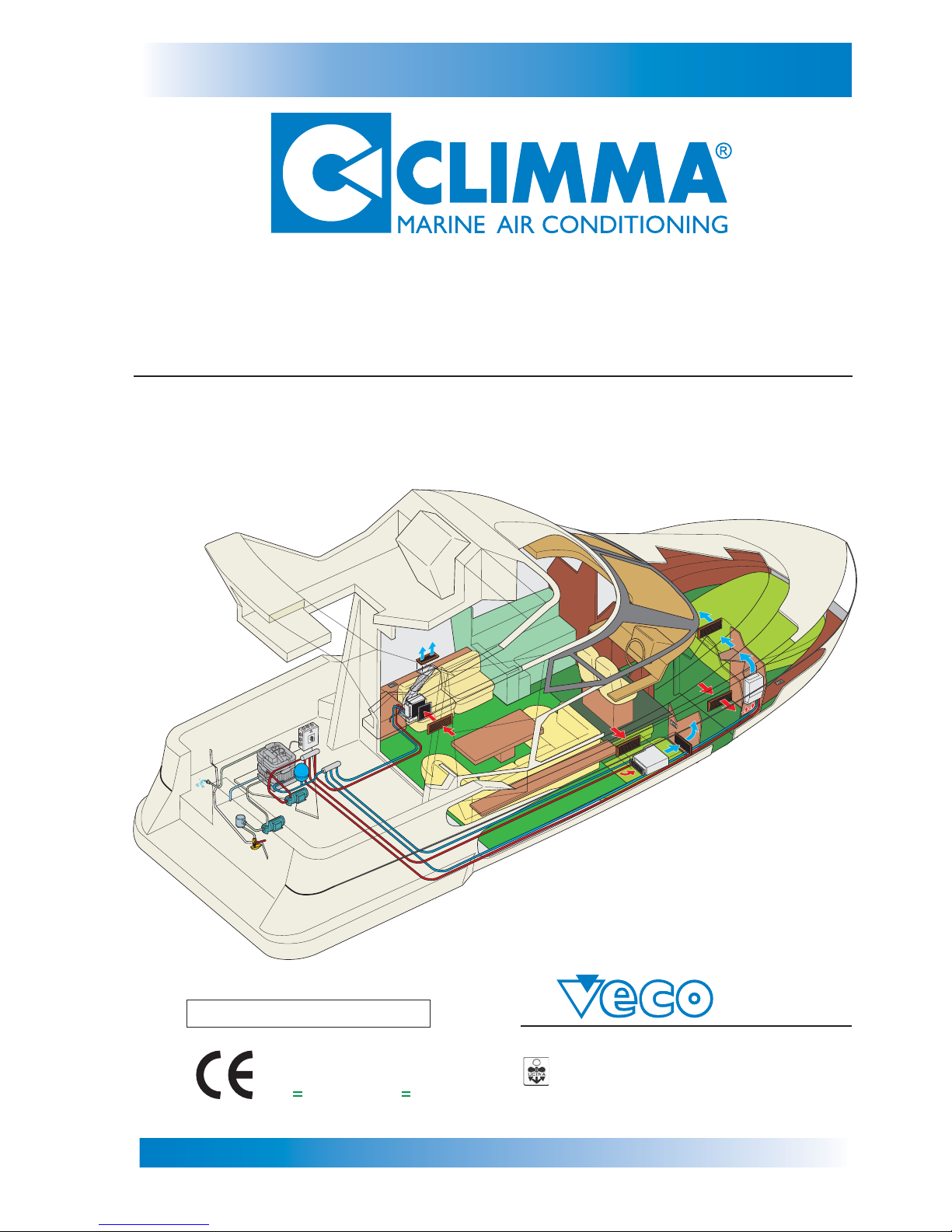
CWS Basic 121-161-201-251
www.climma.it
CHILLER SYSTEM
MODELS CWS BASIC
121-161-201-251
INSTALLATION, OPERATION AND
MAINTENANCE MANUAL
S.p.A.
COMPANY
WITH QUALITY SYSTEM
CERTIFIED BY DNV
ISO 9001/2000
Via Cantore, 6/8 - 20034 Giussano (MI) ITALY
Tel. +39 0362.35321 - fax +39 0362.852995
info@veco.netE-mail:
Cod. A041250 01/09/06
Page 2

Page 1
1- ELECTRICAL CONNECTIONS
CWS Basic 121-161-201-251
All the connections must be made by skilled technical engineers
and must comply with the safety rules of the country where the unit
is installed.
The unit must be connected to a good ground connection, using a
cable of correct size.
Supply must be made using a cable adequate to the maximum
operating load. Also the sea-water pump line should be done with a
cable adequate to the power.
Supply must be connected from a suitable circuit breaker. Any
maintenance or inspection to the system must be performed disconnecting first the mains supply.
1.1- Mains supply
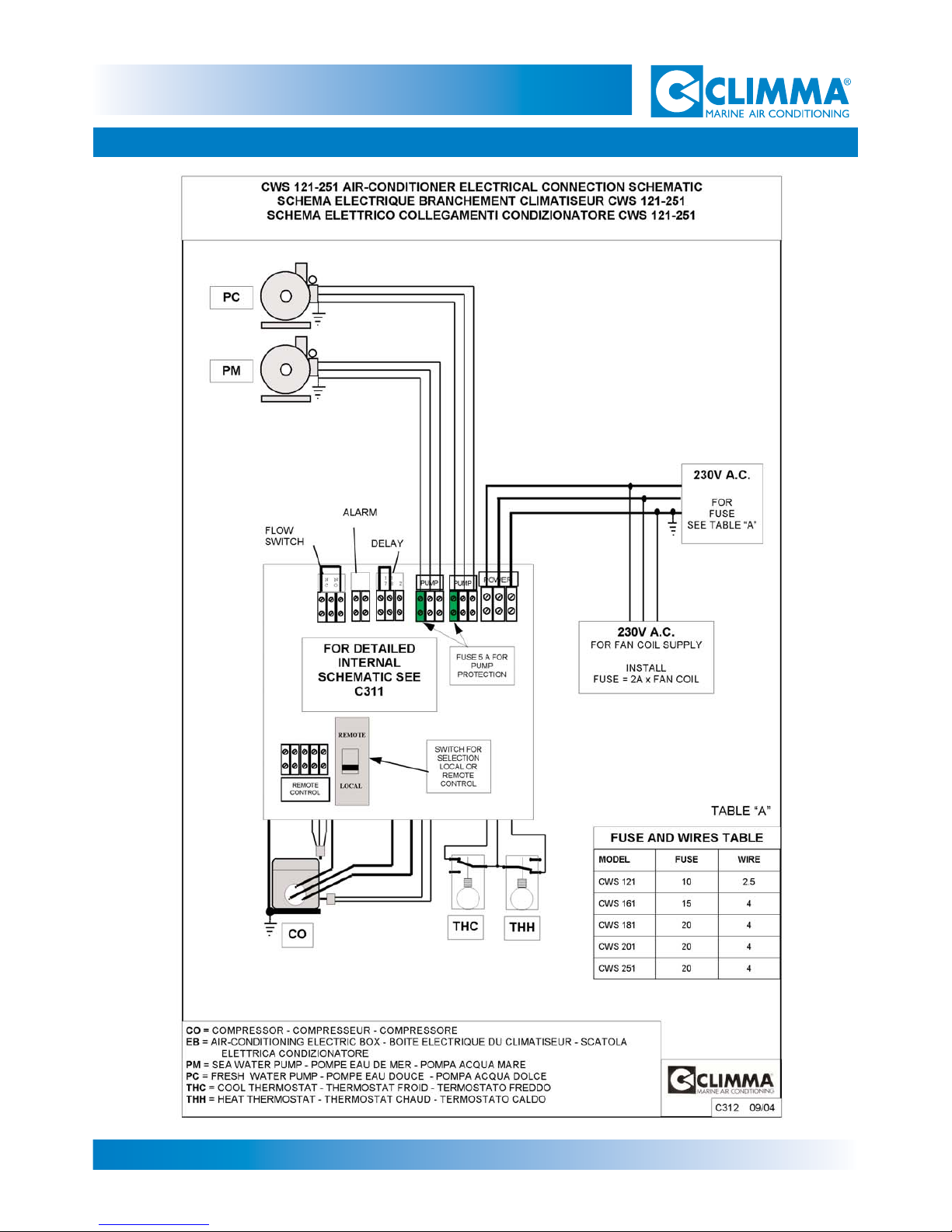
The connections of the other system components must be made following our
schematics C312 (p.2) and C650 for the triphase version (p.3).
Both pumps connections are equipped with internal fuse (5A).
1.2- Connection of the system components
Page 3
Page 2
1- ELECTRICAL CONNECTIONS
CWS Basic 121-161-201-251
Page 4

Page 3
1- ELECTRICAL CONNECTIONS
CWS Basic 121-161-201-251
C650 02/02
CWS 251 RY AIR-CONDITIONER ELECTRICAL CONNECTION SCHEMATIC
SCHEMA ELECTRIQUE BRANCHEMENT CLIMATISEUR CWS 121 - 251 RY
SCHEMA ELETTRICO COLLEGAMENTI CONDIZIONATORE CWS 121 - 251 RY
PM
CO = COMPRESSOR - COMPRESSEUR - COMPRESSORE
EB = AIR-CONDITIO NING ELECTRIC BOX - BOITE ELECTRIQUE DU CLIMATISE UR - SCATOLA
EL ET TRICA COND I ZI ONATORE
PM = SEA WATER PUMP - POMPE EAU DE MER - POMPA ACQUA MARE
PC = FRESH WATER PUMP - POMPE EAU DOUCE - POMPA ACQUA DOLCE
THC = COOL THERMOSTAT - THERMOSTAT FROID - TERMOSTATO FREDDO
THH = HEAT THERMOSTAT - THERMOSTAT CHAUD - TERMOSTATO CALDO
230V A.C.
FOR FAN COIL SUPPLY
INSTALL
FUSE = 2A x FAN COIL
PC
CO
THC
THH
EB
FLOW
SWITCH
EXTERNAL
CONTROL
ALARM
DELAY
PUMP
PUMP
FUSE 5 A FOR
PUMP
PROTECTION
Supply
400V
A.C.
S
POWER
1 1 A
7 8 2
N N C
C O
T R N
GND S R N GND
T
POWER
La scatola elettrica contiene un dispositivo di
sicurezza per impedire al compressore di
girare nella direzione sbagliata. Quindi, dopo
av er colleg ato l’a l i mentazione, se il
compressore non dovesse avviarsi invertire
sui morsetti la fase S con la T come mostrat o
sopra.
The electric box has a motor protector inside
to avoid compressor spinning in the wrong
way. If, after supply connection, the
compressor doesn’t work, invert phase S with
ph ase T on t erminal b ase (as shown in the
scheme above
ATTENZIONE-ATTENTION
Electric Box
Cod. M66765R Y
Page 5
Page 4
2- SEA WATER CIRCUIT
CWS Basic 121-161-201-251
2.1 - Sea-water pump
The sea-water pump is needed to circulate the given water quantity through
the refrigerant sea-water exchanger. The sea-water pump should also be
quiet, continous duty rated, of marine grade construction material.
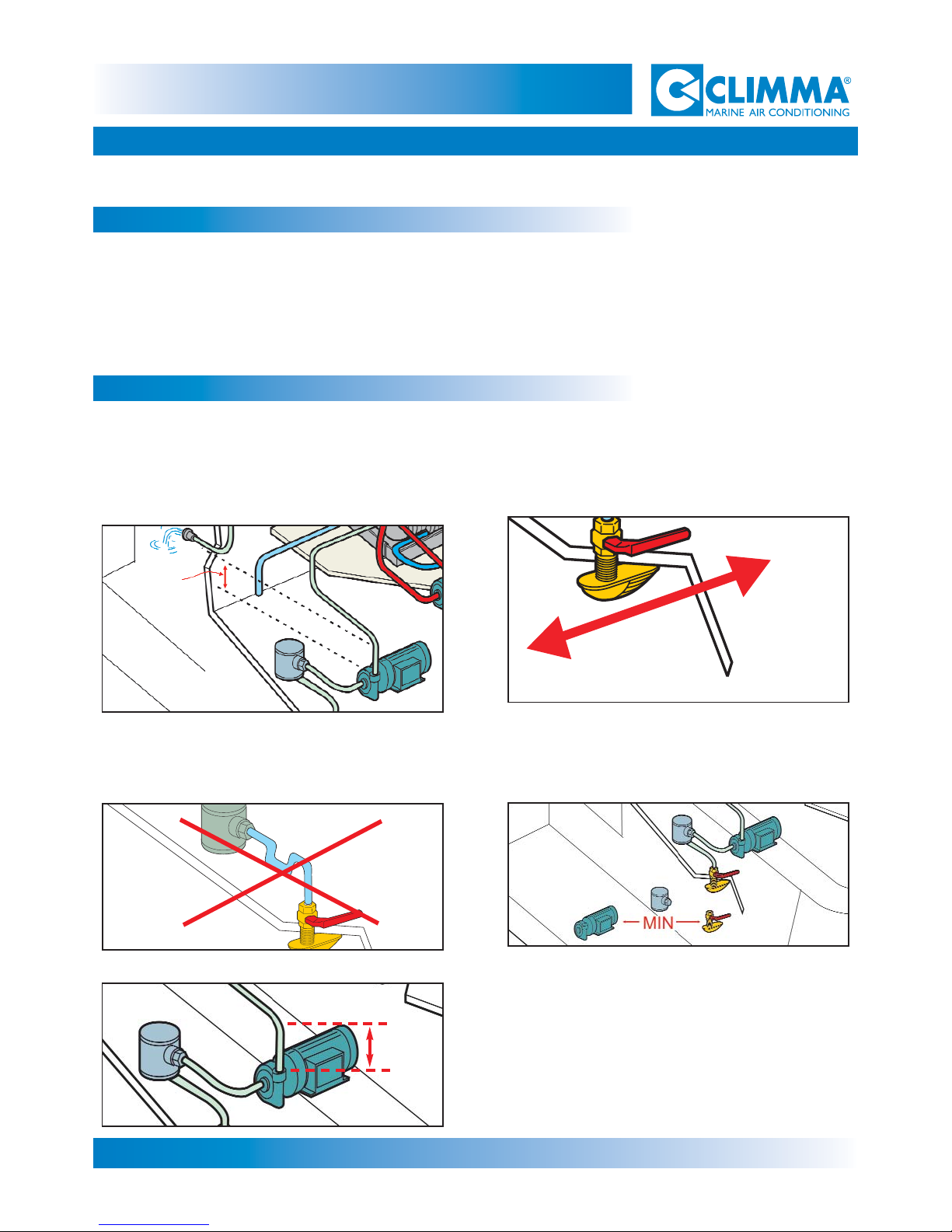
2.2 - Location
BOW
STERN
25 cm
A - The pump should be installed with the shaft in
horizontal position and the water outlet at top. The
centrifugal pump must be installed at least 0,50 m
below the water line.
B - The water intake must be "scoop" type, oriented
forward.
C - Seacock, strainer and pump intake should be
connected without siphoning; the piping should
always rise from seacock to the pump.
D - The intake line should be as short as possible (it
is very difficult to run a good circuit with an intake
piping longer than 1 m).
E - The outlet line of the pump should rise at least
for 25 cm (10 in.) just after the pump outlet in order
to keep the pump primed at all times.
0,5 m
Page 6
Page 5
2- SEA WATER CIRCUIT
CWS Basic 121-161-201-251
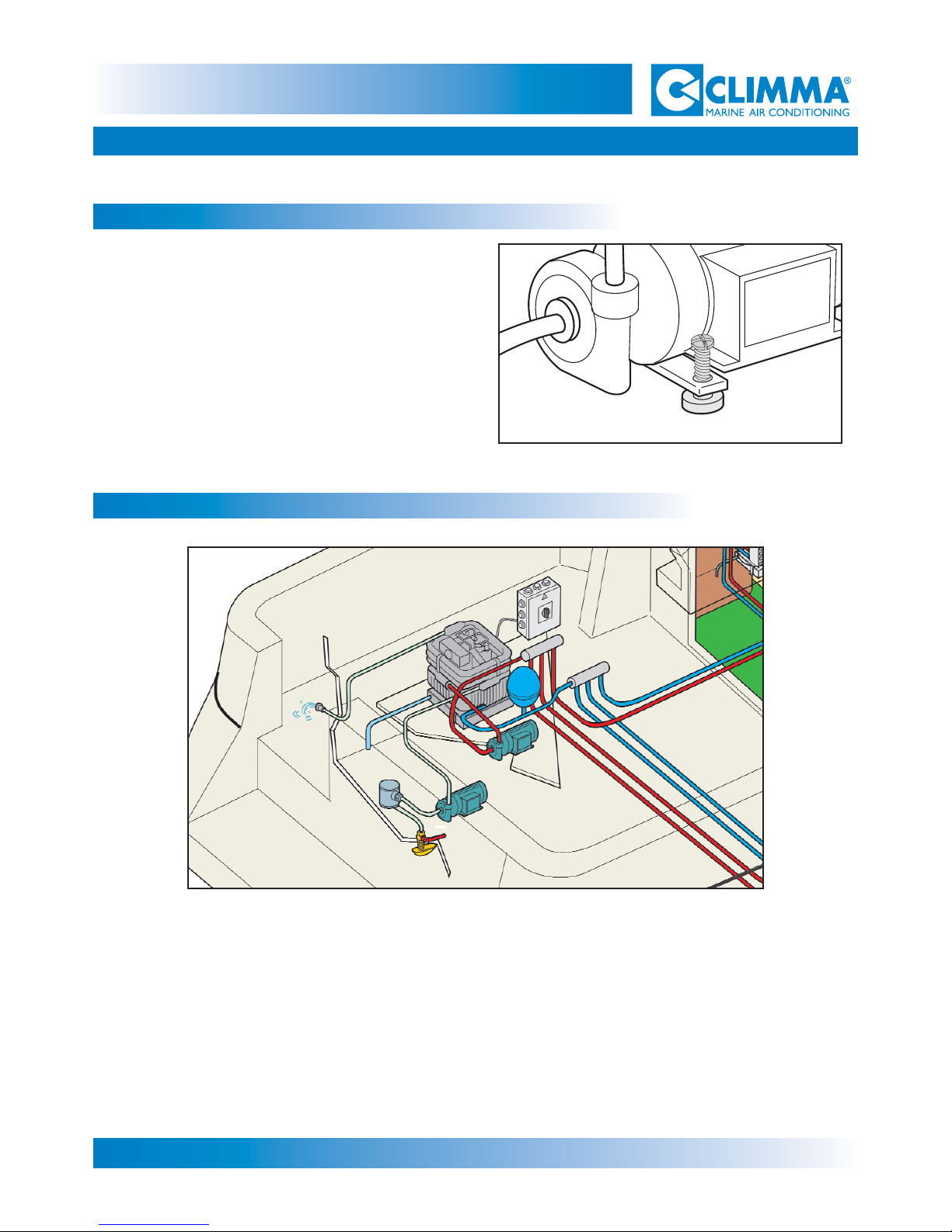
The pump should be fastened with adequate
screws using the holes in its base or the special
fixing base (available for small models). For larger pumps, the original quiet and smooth running can be improved by using a silent block
mounting.
2.3 - Installation
2.4- Sea-water circuit
Some rules are given at chapter 2.2.
We can resume the following: the circuit should always rise from water intake to the unit
manifold. After that the circuit can rise again or drop to the discharge port. It is absolutely
important to prevent that the circuit rises and drops making siphons, which will prevent air
to be drained, causing an airlock during the navigation. The discharge side of the circuit
should be made so that the water discharge won't cause excessive noise both for this yacht
and its neighbours.
Page 7
Page 6
3- FRESH WATER CIRCUIT
CWS Basic 121-161-201-251
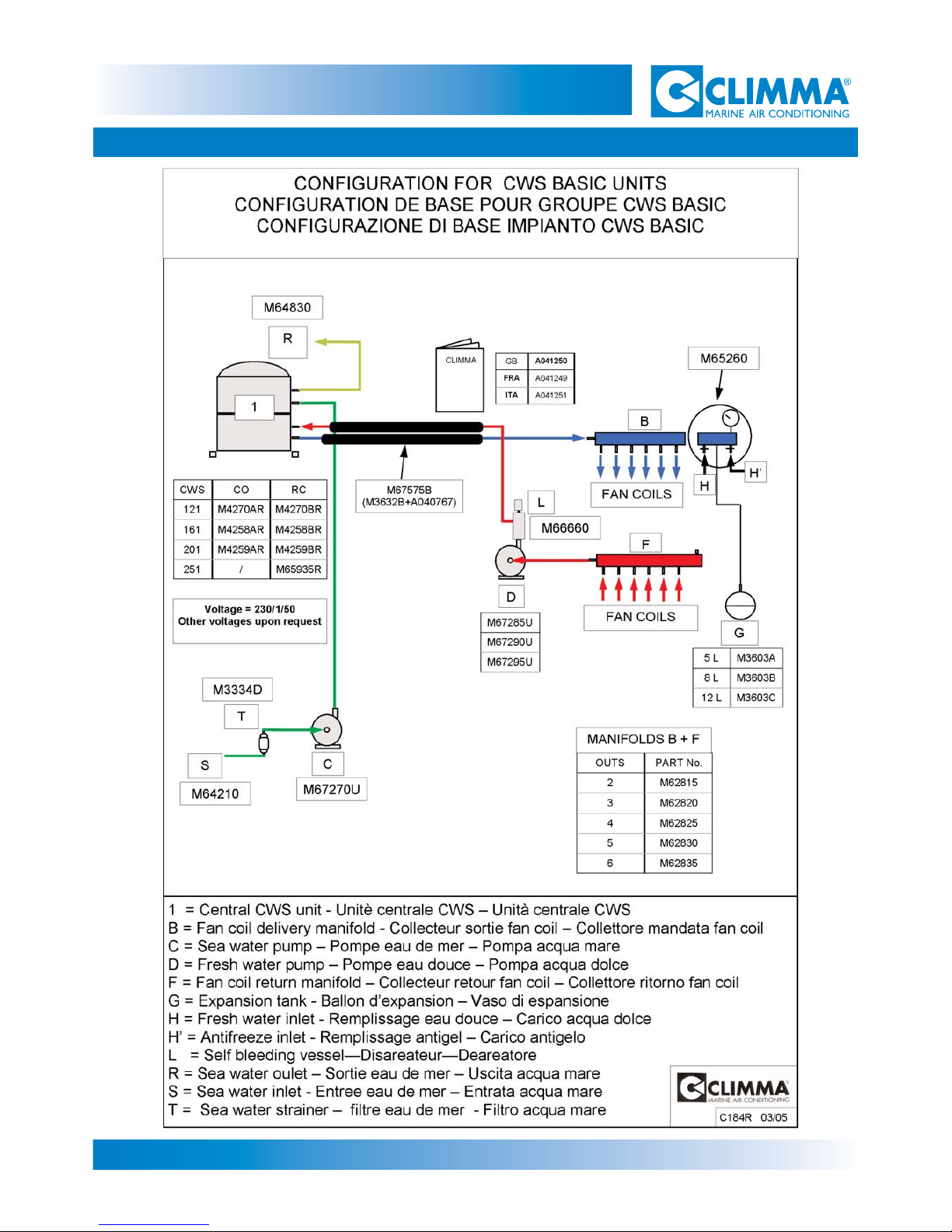
Follow the installation schematic, with particular regard to the sense and position of components.
Keep in mind the accessibility of components for the following steps of installation and also for
maintenance. Respect the flow sense marked on the unit.
Keep accessible the purging valve installed on the fresh water return. Respect the nominal diame-
ters of the manifold.
Manifold: install it in an accessible position, if possible with a certain heel (purging valve higher).
Check that each calibrating valve (if installed) of the manifold is fully open.
Expansion tank: respect the schematic. Connecting port must be upwards to drain out of it.
Fresh water pump: respect the layout schematic.
Fresh water circuit: keep in mind that the easiest and shortest is the best.
Theorethically any "high" point in the circuit must have a purging valve. Siphoning and "up-anddown" must be avoided as anyway they make the air purging difficult and trap air.
Fan coil: respect the flow sense. Each fan coil is equipped with a purging valve that must be accessible both at installation and also for maintenance.
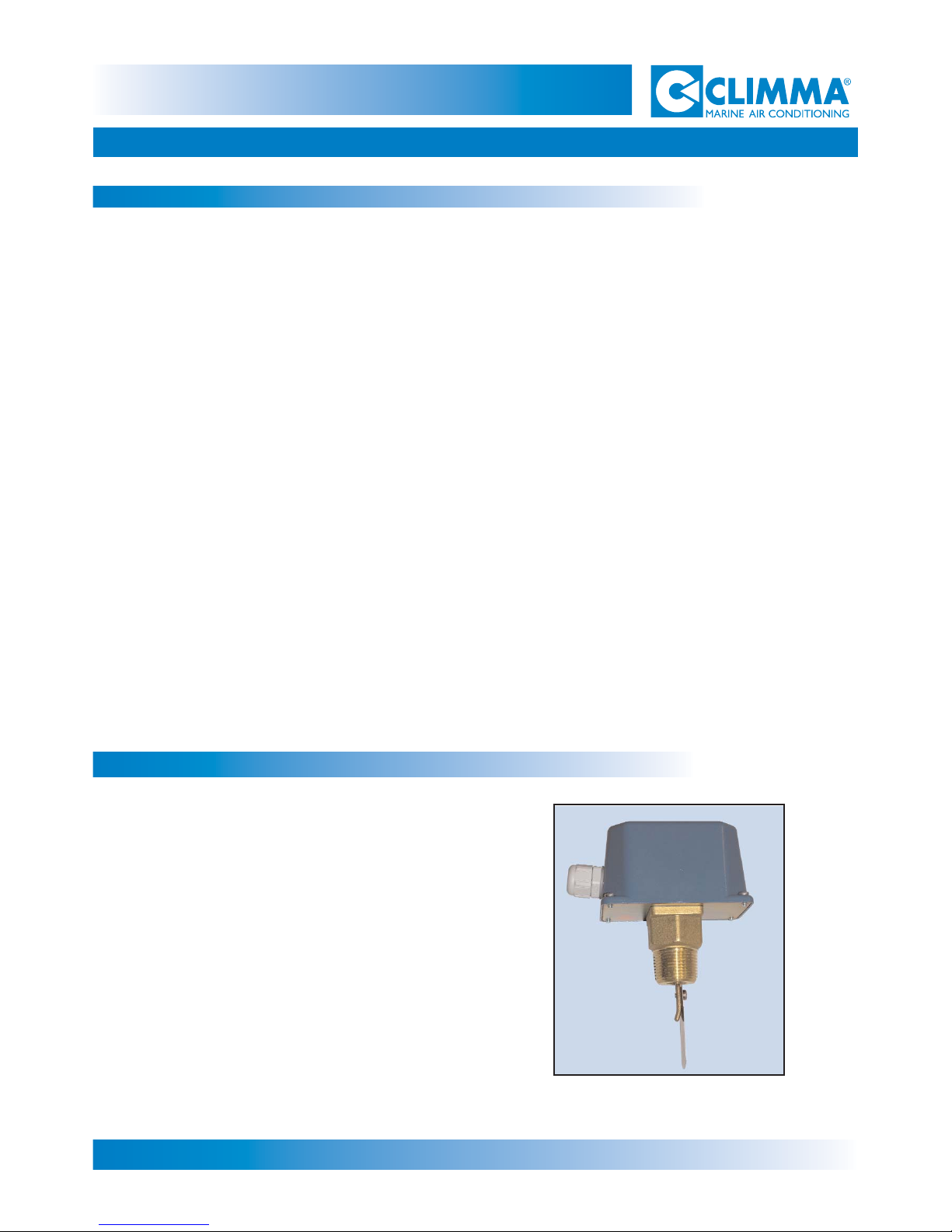
This item must be installed on the fresh water
manifold. It must be accessible for maintenance and calibration.
The flow switch is needed as a safety device
which cuts out the compressor if the fresh
water circulation stops or is not enough.
The flow must be electrically connected to the
electrical box (two wires cables and ground
connection), as specified in the electrical
schematic.
3.1- 1Fresh water circuit connections
3.2- Flow switch (option)
Page 8

Page 7
3- FRESH WATER CIRCUIT
CWS Basic 121-161-201-251
When the circuit is under pressure with the antifreeze solution, purge the air as follows:
Bleed the entire circuit (manifold, fan coils and all the other purging points) starting from the lowest level
and keeping the circuit pressure at 1,5 Bars.
This purging must be done without running the pump.
Repeat all points, until no more air comes out from the bleeding valves, still keeping the pressure at 1,5
Bars.
Set to "Off" position each compressor switch.
Then check the sea-water intake is open and start the unit in "Cool" mode; both pumps will run.
Let the fresh water pump run for 30 seconds, then stops the system and bleed again all points, keeping
the pressure at 1,5 Bars.
Bleeding can be considered over when no more air is coming off the purging points and the fresh water
circulation pump runs even and quiet.
We strongly recommend that a special "air bleeding vessel" be installed in the fresh water circuit, just after
the pump outlet. This device will dramatically reduce the bleeding procedure and will also keep the system
free of air during its life. The "air bleeding vessel" is available in several sizes.
3.3- Pressurizing the fresh
The gauge set installed in the fresh water circuit is equipped with two charging ports, each (H-H1)
with a manual valve and an automatic check valve, which prevents the internal charge to come back
to the pressurized sanitary circuit in case of mistake. Use one of the two valves to charge and pressurize the circuit with fresh water up to 1,5 Bars, checking it with the pressure gauge. This port must
be permanently connected to the yacht sanitary water system.
Check that the circuit keeps the pressure over a certain period of time indicating that it is leak proof.
As you are sure that the circuit is leak proof, reduce the pressure to make room and add antifreeze
to the circuit.
3.4- Antifreeze solution
We suggest two methods for filling the fresh water circuit with antifreeze:
a) Calculate approximately the circuit capacity, fill it with water and add to it 20% of antifreeze, using
the second charging valve by gravity or using a pressure pump. Then connect the circuit to the sanitary water circuit of the vessel, pressurize up to 1,5 Bars and start purging the air. It is obvious that
if purging will be difficult, the percentage of antifreeze will decrease, as more water will be needed to
fill the circuit, therefore more antifreeze must be added to the circuit.
b) Empty the circuit from the water used for the leak test. Prepare the antifreeze solution in the quantity needed to fill the circuit, made with 20% of antifreeze liquid; fill the circuit, using a pressure pump.
Then proceed with purging air and topping up the pressure using the solution.
water circuit
3.5- Air bleeding
Page 9
Page 8
3- FRESH WATER CIRCUIT
CWS Basic 121-161-201-251
Page 10

Page 9
3- FRESH WATER CIRCUIT
CWS Basic 121-161-201-251
Page 11

Page 10
4- COMMISSIONING
4.1- Fresh water circuit
Important notice: The fresh water circulation must be adequate to the fan coil capacity.
Check that this capacity is > or = as to the value specified on the central unit.
The compressor cannot run without fresh water circulation. Reduced or no water circulation will cause freezing situation and might damage the evaporator coil because of ice.
The following safeties prevent the unit to be damaged by the lack of fresh water circulation.
The fresh water circuit must be filled with water and antifreeze solution
(20%). The addition of antifreeze lowers the freezing point of the water and
adds an additional safety to the circuit. Check that the fresh water circuit
pressure gauge shows 1,5 bars.
This device stops the unit if the water flow stops below the preset minimum.
As explained at chapter 3.2, a safety flow switch is installed in the fresh
water circuit outlet manifold. It is very important to make sure that this
safety device is properly wired to the control box: To do this, it is possible
to simulate a lack of fresh water flow just pushing the lever inside the switch
protecting cup. Warning: The flow switch is connected to the main electrical box and this check must be done by expert engineers only, keeping in
mind all the safety precautions.
a) Antifreeze solution:
b) Safety flow switch (option):
Page 12

Page 11
4- COMMISSIONING
CWS Basic 121-161-201-251
Give supply to the main control box.
Turn the "Mode" switch to the "Cool" or "Heat" position.
Check that both pumps have an even flow.
As the compressor runs, the fresh water temperature will begin to
cool down (if the unit is in "Cool" mode) or to heat up (if the unit is in
"Heat" mode). As the fresh water temperature is approaching the set
point ("Cool" mode = +12° C, "Heat" mode = +40° C) the thermostat
will stop the compressor.
The speed at which the water cools down depends from several factors, as the number and capacity of fan coil connected, the fan coil
speed, the room temperature, etc….; therefore this value is not a
valuable parameter.
4.2 Start up
4.3- Sea water circuit
Check that the sea-water intake is fully open
and that the flow is even.
Page 13

Page 12
4- COMMISSIONING
CWS Basic 121-161-201-251
4.4 Fan coil
Check that each fan coil is correctly fed with chilled water, measuring the inlet and outlet temperatures. The difference between the two temperatures should be between 5°
C and 10° C. If the differential is higher, it normally means that there is still air in the
circuit and the circulation in that fan coil is poor.
In case of particularly long circuit, it might be necessary to adjust the fan coil flow closing the calibrating valves of the fan coils nearer to the manifold in order to let more
water to reach the ones, which are more distant.
Check that the thermostat sensor is correctly positioned in the air intake of each fan
coil. If the temperature control is "Fan only", the thermostat stops the fan when the
ambient temperature reaches the set point.
IMPORTANT: With the "Fan only" control, the thermostat sensor must be installed on
the air intake but not on the fan coil.
If the fan coil control is "Water valve" then the thermostat closes the special water
valve connected to the fan coil while the fan keeps running. In this case the thermostat sensor must be installed on the fan coil fastened to the special thermostat bulb
holder.
Page 14

Page 13
5- OPERATION
CWS Basic 121-161-201-251
5.1 Start from the main control box
Turn the "Mode" switch installed on the main control box of the
system CWS Basic on the "Heat" or "Cool".
The system will begin to run and also the compressor.
5.3 Pumps
Pumps start when the main "Mode" switch is turned to the
"Cool" or "Heat" position.
IMPORTANT: Both pumps keep running even when the compressor is
stopped by the thermostat.
5.3 Stop from the main electrical box
Turn the "Mode" switch to the "Off" position.
Page 15

Page 14
5- OPERATION
CWS Basic 121-161-201-251
5.4 Fan coil in summer operation
(standard fan coil control panel)
The temperature in each cabin is controlled by a room thermostat, which controls
the fan motor. The panel (fan coil) "Mode" switch (see fig.1) must be set in "blue
ice star" position. Set the thermostat according to the desired temperature. From
the control panel, it is also possible to check the fan coil speed through the "speed
control" switch, as shown in fig.1.
The fan speed control can run the fan on three different speeds. The minimum
speed is in the centre of the fan control switch.
5.5 Fan coil in winter operation
(standard fan coil control panel)
The temperature in each cabin is controlled by a room thermostat, which controls
the fan motor. The panel (fan coil) "Mode" switch (see fig.1) must be set in "red sun"
position. Set the thermostat according to the desired temperature. From the control
panel, it is also possible to check the fan coil speed through the "speed control"
switch, as shown in fig.1.
The fan speed control can run the fan on three different speeds. The minimum
speed is in the centre of the fan control switch.
fig.1
Page 16

Page 15
6- MAINTENANCE
CWS Basic 121-161-201-251
Every time the unit is operated, check that:
Before turning the unit on, check that the fresh water pressure in the circuit is between 1,5 and 2 Bars (21-28 PSI) as indicated by the gauge on the unit. If the
pressure drops frequently, the circuit must be repaired and the leak(s) fixed as
continous topping up the pressure will dilute the antifreeze reducing the unit safety.
The antifreeze solution of the fan coil circuit must be checked at least every two
years or before if the circuit had leaks that caused a complete refilling. The solution to refill the circuit must be composed by 80% water and 20%. glycol.
Check frequently the efficiency of the sea-water circuit, inspecting the sea-water
strainer and evaluating or even measuring the sea-water flow from the outlet. We
suggest keeping available a spare seal for the sea-water pump and also one for
the fresh water pump.
Clean or even replace the air filters on each fan coil. Adirty air filter is dramatically
reducing the fan coil efficiency as it reduces the air flow.
At the beginning of the summer season, check that the condensate drain from
each fan coil is clean and discharges freely. Consider that in humid and hot days
the condensate can reach a flow of 1 litre per hour of each fan coil.
If the system is not operated for a while, we suggest to remove the back end of
each pump and turn (two or three turns are sufficient) the cooling forced-fit to the
driving shaft of the pumps.
IMPORTANT: Reassemble and fix adequately the protective back end
after the operation.
6.1-
Page 17

Page 16
7- TROUBLESHOOTING
CWS Basic 121-161-201-251
7-1 Central unit
Problems to the CWS central unit may be caused by:
Lack of cooling water circulation (sea water circuit). Check the sea
water circuit outlet. Long running without cooling water may damage
the system.
It's better to check also the sea water circuit without starting up the conditioning system.
Problems of main supply (low voltage). Apermanent low voltage supply
may damage the electrical components of the unit and even the compressor motor. Do not insist to run the system in low volt age conditions.
The fan coil doesn't run: make sure first that the control panel is properly set to yhe desired "Mode" function ("Cool" in summer and "Heat" in winter) and that the thermostat is turned completely to "18" for summer operations and to "24" for winter operations. Then
check the connecting plugs. If the plugs are ok, then test the voltage at the plug terminals
once the "Max" speed is selected. The voltage between the black and the blue wires must
be 230V. If the voltage is correct, then the fan motor is defective and must be replaced.
Give to the service every detail about the fan coil and, if possible, about the motor in order
to get the correct spare. Be aware that the fan coil motor must run with its specified run
capacitor, which is installed in the control box. If there is no voltage, then check the change over switch and the thermostat on the control panel.
7.2 - Fan Coil
Page 18

Page 17
7- TROUBLESHOOTING
CWS Basic 121-161-201-251
7.3 Cool mode : the fresh water
circuit doesn't cool.
Page 19

Page 18
7- TROUBLESHOOTING
CWS Basic 121-161-201-251
7.4 Heat mode : the fresh water
circuit doesn't heat up.
Page 20

Page 19
8- TECHNICAL DATAS
CWS Basic 121-161-201-251
8-1 Fan coil capacitor table
Fan coil capacitor speed table for fan coil units
capacitors codes
Fan coil code
Electrical box for
models
Capacitor
Code
Page 21

Page 22

Page 23

Page 24

Page 24
9- ELECTRICAL SCHEMATICS
CWS Basic 121-161-201-251
Page 25

Page 25
9- ELECTRICAL SCHEMATICS
CWS Basic 121-161-201-251
Page 26

Page 26
9.1- Codes of spare parts
CWS Basic 121-161-201-251
16
CWS 121-161-201-251
Page 27

Page 27
9.1- Codes of spare parts
CWS Basic 121-161-201-251
Description
Capacitor
Evaporator
Thermostat support box
"Hot cycle" thermostat
"Chilly cycle" thermostat
Thermometer
Compressor
Compressor klixon
Stopper ¼ sae
Needle valve Schrader
High pressure switch
Reversal cycle valve
Valve coil
Electrical box
Inox steel tank
Outlet rubber holder
Outlet rubber holder screw
Base fastener clamp (4 parts)
 Loading...