

Page 1
MANUFACTURER CERTIFICATE
MODEL: SL3K3M, 3M 3000KG Flat Woven Webbing Sling
PART NO: 7630488
1. Manufacturer: Clarke International, Hemnall Street, Epping, Essex, CM16 4LG.
2. Product: Single Leg, PES Reinforced Flat Eye, Length: 3 Metre, Width: 90mm.
3. Material: High Tenacity Multi-filament Polyester (PES)
4. Standard: BS EN 1492-1:2000+A1:2008, Test Reference: Sections A.3 and A.4
5. Grade of Fitting: Without Fitting
6. Traceability Code: See Attached Label
7. Static Test Coefficients: 211.5kN
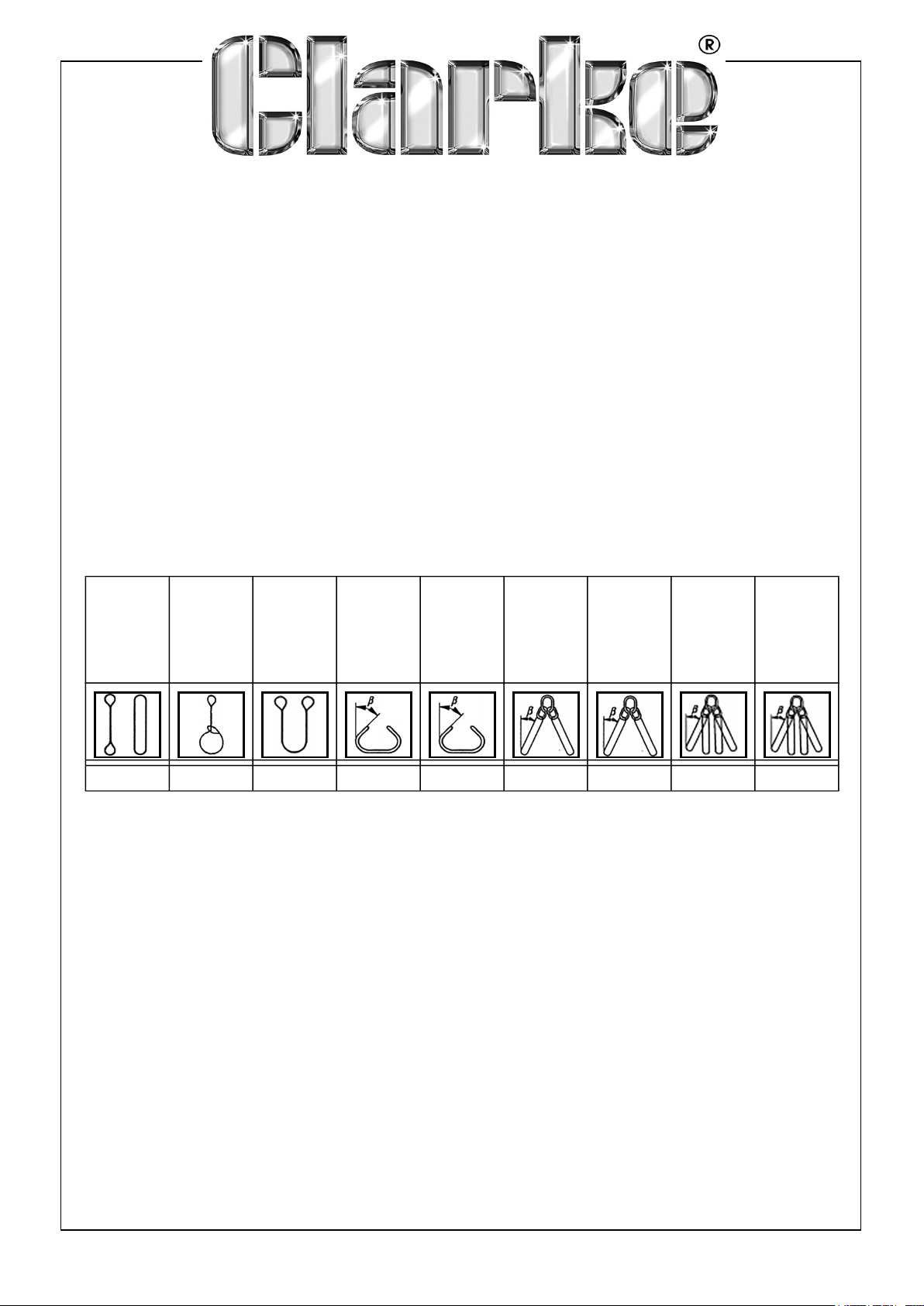
MAXIMUM WORKING LOAD LIMIT
BASKET
STRAIGHT
LIFT
(M=1)
3 Tonne 2.4 Tonne 6 Tonne 4.2 Tonne 3 Tonne 4.2 Tonne 3 Tonne 6.3 Tonne 4.5 Tonne
CHOKED
LIFT
(M=0.8)
PARALLEL
(M=2)
HITCH
ß = 0° to
45°
(M=1.4)
BASKET
HITCH
ß = 45° to
60°
(M=1)
2 LEG
SLING
ß = 0° to
45°
(M=1.4)
2 LEG
SLING
ß = 45° to
60°
(M=1)
3 & 4 LEG
SLING
ß = 0° to
45°
(M=2.1)
3 & 4 LEG
SLING
ß = 45° to
60°
(M=1.5)
SAFETY
1. Determine the weight of the load. The weight of the load should be within the rated capacity
of the web sling.
2. Select a web sling that has suitable characteristics for the type of load, hitch and
environment.
3. Web slings SHOULD NOT be loaded in excess of the rated capacity. Consideration should
be given to the sling to load angle which effects the rated capacity.
4. Web slings with fittings which are used in a choker hitch should be of sufficient length to
assure that the choking action is on the webbing and NEVER on the fitting.
5. Web slings used in a basket hitch should have the load balanced to prevent slippage.
6. The opening in the fittings should be the proper shape and size to ensure that the fitting will
seat properly in the hook or other attachments.
7. Web slings SHOULD ALWAYS be protected from being cut by sharp corners, sharp edges,
protrusions or abrasive surfaces.
Parts & Service: 020 8988 7400 / E-mail: [email protected] or [email protected]
Page 2

8. Web slings SHOULD NOT be dragged on the floor or over abrasive surfaces.
9. Web slings SHOULD NOT be twisted, shortened, lengthened, tied into knots or joined by
knotting together.
10. Web slings SHOULD NOT be pulled from under loads when the load is resting on the web
sling.
11. DO NOT drop web slings equipped with metal fittings.
12. Web slings that appear to be damaged SHOULD NOT be used unless inspected by a
competent person and accepted as usable.
13. The web sling should be hitched in a manner providing control of the load.
14. Personnel should stand clear between the sling and the load and from between the sling and
the crane/hoist hook.
15. Personnel should stand clear of suspended loads.
16. Personnel SHOULD NOT ride on the web sling or on the load being lifted.
17. AVOID shock loading.
18. AVOID twisting and kinking the legs (branches).
19. Any load applied to the hook should be centred in the base (bowl) of the hook to prevent
point loading on the hook.
20. During lifting, with or without the load, personnel should be alert for possible snagging.
21. The web slings legs (branches) should contain or support the load from the side above the
centre of gravity when using a basket hitch.
22. Web slings should be long enough so that the rated load and capacity is adequate when the
sling to load angle is taken into consideration.
23. Only web slings with legible identification tags should be used.
24. Tags and labels should be kept away from the load, hook and any point of choke.
25. Web slings SHOULD NOT be constricted or bunched between the ears of a clevis, shackle
or in a hook.
26. Place blocks under the load prior to setting down the load to allow removal of the webs
slings, if applicable.
27. Web slings should be stored in a cool, dry and dark place to prevent loss of strength when
not in use through exposure to ultra violet light. Web slings should not be stored in
chemically active areas.
28. Chemically active environments can affect the strength of the webs sling to varying degrees
ranging from little to total degradation. The web sling manufacturer or qualified person
should be consulted before slings are used in a chemically active environment.
29. Polyester slings SHOULD NOT be used in temperatures in excess of 90°C (194°F) however,
they may be used in temperatures as low as -40°C (-40°F).
30. Slings incorporating aluminum fittings SHOULD NOT be used where fumes, vapours,
sprays, mists of alkaline and/or acids are present.
31. Environments in which synthetic web slings are continuously exposed to ultra violet light can
affect the strength of synthetic webbing in varying degrees, ranging from slight to total
degradation. The degradation is also cumulative.
Parts & Service: 020 8988 7400 / E-mail: [email protected] or [email protected]
Page 3
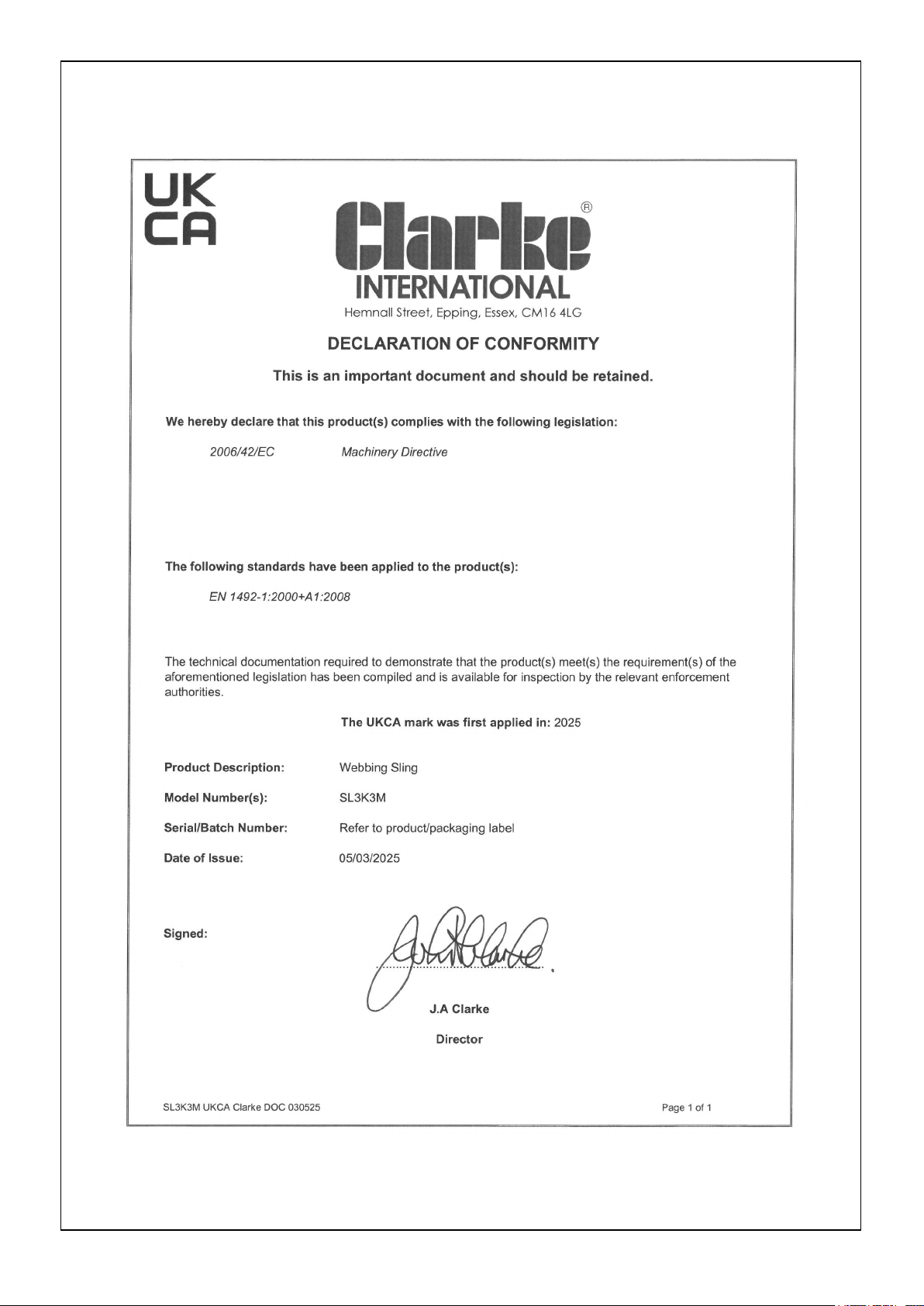
DECLARATION OF CONFORMITY - UKCA
Parts & Service: 020 8988 7400 / E-mail: [email protected] or [email protected]
Page 4
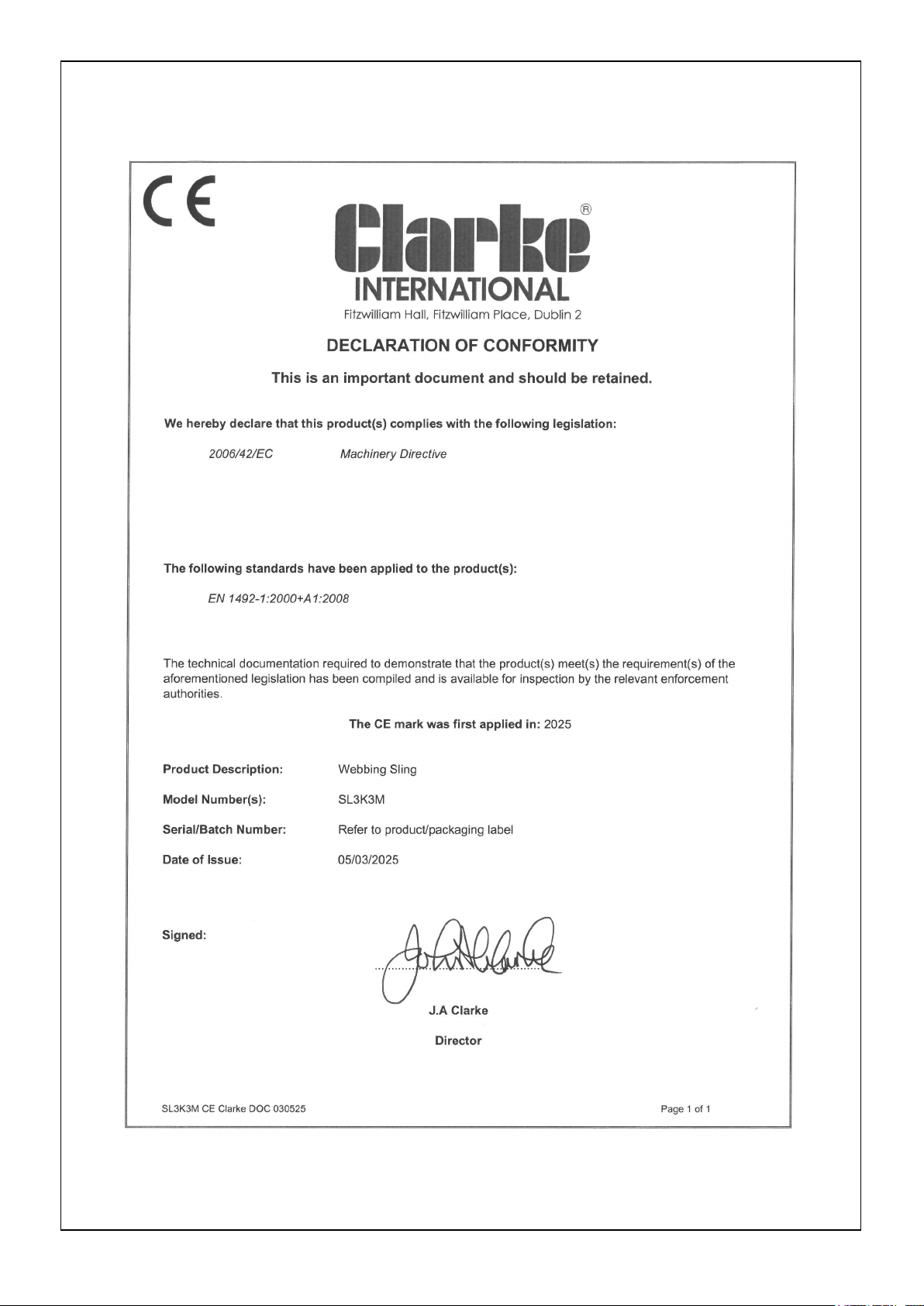
DECLARATION OF CONFORMITY - CE
Parts & Service: 020 8988 7400 / E-mail: [email protected] or [email protected]
 Loading...