

Page 1
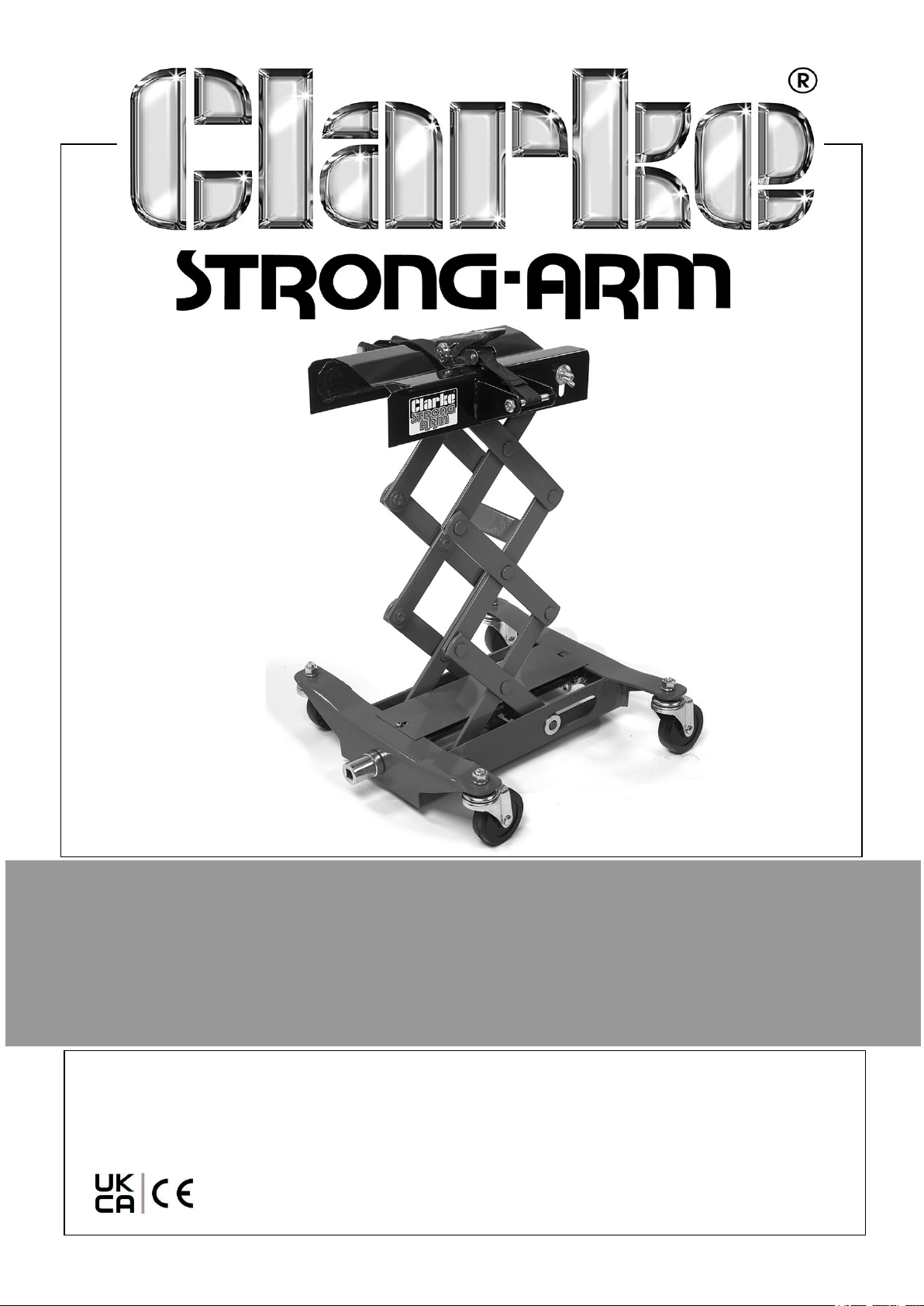
200KG TRANSMISSION JACK
MODEL NO: CTJ200
PART NO: 7612607
OPERATION AND MAINTENANCE
INSTRUCTIONS
ORIGINAL INSTRUCTIONS GC0925
Page 2
INTRODUCTION
Thank you for purchasing this CLARKE Transmission Jack, designed for use in the
removal and installation of transmissions and differentials.
Before attempting to use this product, please read this manual thoroughly and follow
the instructions carefully. In doing so you will ensure the safety of yourself and that of
others around you, and you can look forward to your purchase giving you long and
satisfactory service.
GUARANTEE
This product is guaranteed against faulty manufacture for a period of 12 months from
the date of purchase. Please keep your receipt which will be required as proof of
purchase.
This guarantee is invalid if the product is found to have been abused or tampered
with in any way, or not used for the purpose for which it was intended.
Faulty goods should be returned to their place of purchase, no product can be
returned to us without prior permission.
This guarantee does not effect your statutory rights.
SPECIFICATION
Rated Load 200 kg
Min Height 185 mm
Max Height with head 600 mm
Base size 280 x 170 mm
Dimensions (L x W ) 450 x 420 mm
Weight 18.5 kg
2
Parts & Service: 020 8988 7400 / E-mail: [email protected] or [email protected]
Page 3

SAFETY PRECAUTIONS
1. DO NOT exceed the rated capacity of the jack.
2. DO NOT allow personnel to operate the jack unless they have read these safety
precautions.
3. Ensure that the jack is in good working order. Have any damaged parts repaired or
replaced immediately. Use genuine Clarke parts only. The use of unauthorised
parts may be dangerous and will invalidate the guarantee.
4. DO NOT operate the jack if damaged.
5. Use the jack in a suitable, well lit work area.
6. Keep the work area clean and tidy and free from unrelated items.
7. Use the jack on level and solid ground, preferably concrete. Avoid soft/unmade
ground as the jack may sink in.
8. Ensure the vehicle is securely and rigidly supported.
9. Check the transmission is centred on the jack saddle.
10. Ensure all non-essential persons keep a safe distance whilst the jack is in use.
11. Ensure there are no personnel or obstructions under the vehicle transmission
before lowering.
12. DO NOT stand or work under the load until it secured by suitable means.
13. Ensure when lifting, that the jack and all parts of the load can be clearly seen.
14. NEVER climb on, or attempt to ride on the jack.
15. Use the jack for lifting transmissions only, NOT for supporting the weight of the
vehicle.
16. Take care not to trap fingers in the moving parts of the jack.
17. Lower the load as much as possible before moving the jack. DO NOT transport
loads in an elevated position.
18. Ensure that you can see the saddle and jacking point throughout the jacking
operation in case there is any relative movement.
19. NEVER tamper with the product or modify it in any way, as this could prove to be
dangerous and will invalidate the guarantee. Only use the product for the purpose
for which it is intended.
20. Use appropriate safety equipment such as protective footwear when using this
jack.
21. When replacing parts, use only those supplied by Clarke International. Refer to
the parts list on page 9.
3
Parts & Service: 020 8988 7400 / E-mail: [email protected] or [email protected]
Page 4

22. Ensure that the jack is properly maintained and that no corrosion is allowed to
weaken any part of it.
23. If the jack has been subjected to an abnormal load it should be removed from
service immediately and fully inspected by qualified personnel and passed as
serviceable before being used again.
24. When not in use, store the jack, fully lowered, in a safe, dry, childproof area.
IMPORTANT: ALWAYS ensure that the centre of gravity of the load, is
centred about the head section, before taking the full weight.
LIFTING OPERATIONS AND LIFTING EQUIPMENT
Regulations 1998
This jack, depending on use, may fall within the scope of LOLER. It is the owner’s
responsibility to determine whether or not it does and, if so, to comply with any
applicable requirements in LOLER, for having the jack thoroughly examined.
4
Parts & Service: 020 8988 7400 / E-mail: [email protected] or [email protected]
Page 5
CONTENTS
Unpack the components on a clean flat area of hard standing and ensure that all parts
are present as follows:
• Transmission jack
• Castors with brakes (4)
• Fixings pack (washers & nuts)
• Retaining ratchet strap
Visually inspect all components to ensure that no damage was suffered in transit. Any
damage should be reported to your CLARKE dealer immediately.
ASSEMBLY
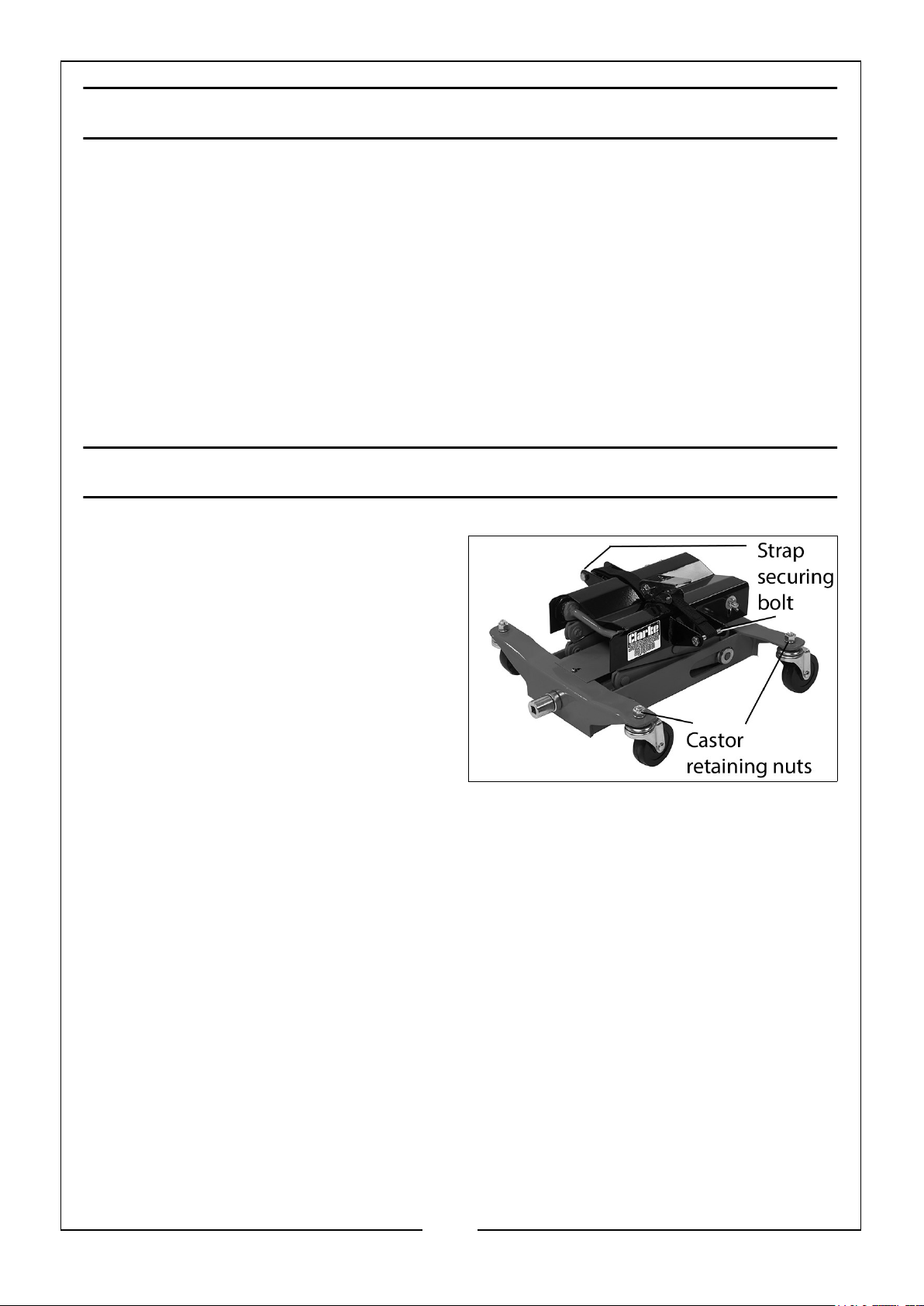
1. Using a 19mm wrench, fit the castors
to the base of the jack using the nuts
and washers supplied.
2. Connect the ratchet strap to the jack,
passing the securing bolts through the
brackets at either side.
3. The webbing strap will need to be
passed through the ratchet spool
according to the size of the gearbox
being handled.
4. Position the jack on its castors and ensure it is on firm level ground before use.
5
Parts & Service: 020 8988 7400 / E-mail: [email protected] or [email protected]
Page 6
OPERATING INSTRUCTIONS
WARNING: BEFORE LIFTING, ENSURE THE SAFETY PRECAUTIONS
ARE STRICTLY FOLLOWED. NO RESPONSIBILITY CAN BE ACCEPTED
FOR INCORRECT USE OF THE JACK
1. Ensure the vehicle is in a safe state as mentioned in the safety precautions,
ensuring the ground on which the jack is to operate is level and solid.
2. Raise the vehicle to an appropriate height and secure it on suitable supports (not
supplied).
3. Position the jack saddle under the vehicle transmission.
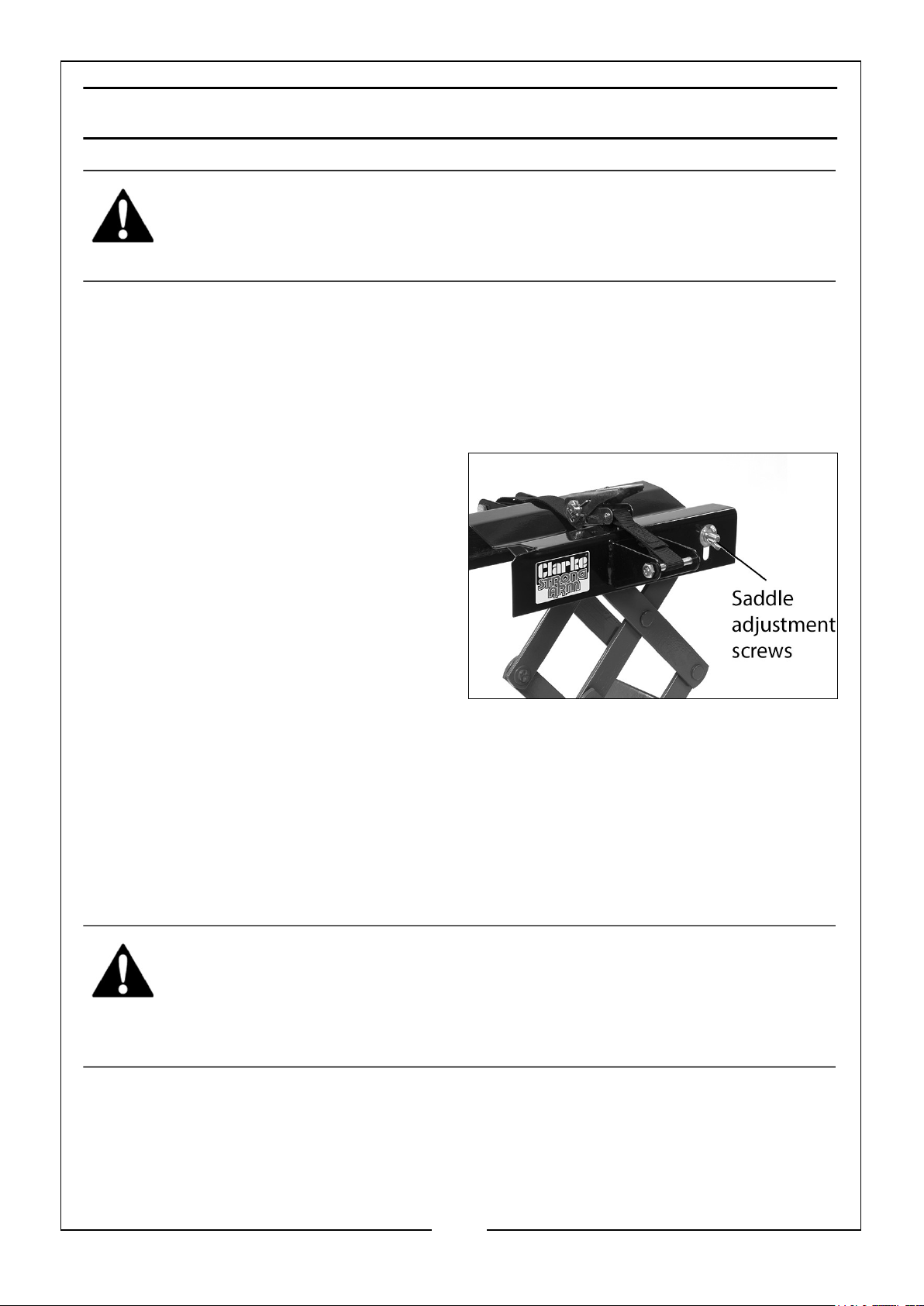
4. Loosen the saddle tilt adjustment
screws and open the strap using the
ratchet .
5. Use a 1/2” square drive (ideally with a
ratchet) to rotate the drive socket
clockwise to extend the lifting
components until the saddle contacts
the transmission casing.
• Allow the saddle to tilt as
appropriate to seat itself firmly
beneath the load.
6. Firmly tighten the saddle tilt adjustment screws to secure the saddle at the
optimum angle.
Ensure the centre of gravity of the load is completely centred about the saddle before
the full load is taken and secure the load with the ratchet strap if necessary.
With the load fully secured, turn the drive socket SLOWLY anticlockwise to lower the
jack and load.
WARNING: ALWAYS LOWER IN A SLOW AND CONTROLLED MANNER
AND THAT THERE ARE NO OBSTRUCTIONS IN THE PATH OF THE
DESCENDING LOAD.
WARNING: TAKE CARE NOT TO TRAP FINGERS IN THE MOVING
PARTS OF THE JACK.
6
Parts & Service: 020 8988 7400 / E-mail: [email protected] or [email protected]
Page 7

CARE & MAINTENANCE
IMPORTANT: Only fully qualified personnel should attempt any repairs.
1. ALWAYS visually inspect the jack before use, to ensure that all parts are correctly
locate and secure. Check for damage or worn parts and check the castors for
damage. DO NOT use the jack unless it is perfectly serviceable.
2. The jack should be fully inspected periodically as follows:
• Check for cracks and deformation of components.
• Check castors to ensure they move freely without undue wear to their
bores and that the wheels are not cracked or damaged.
• Remove any rust and repaint to prevent further corrosion.
• Ensure that all decals and warning notices are in place and legible.
3. DO NOT leave the jack in the open, exposed to the elements. Keep under cover
when not in use.
7
Parts & Service: 020 8988 7400 / E-mail: [email protected] or [email protected]
Page 8
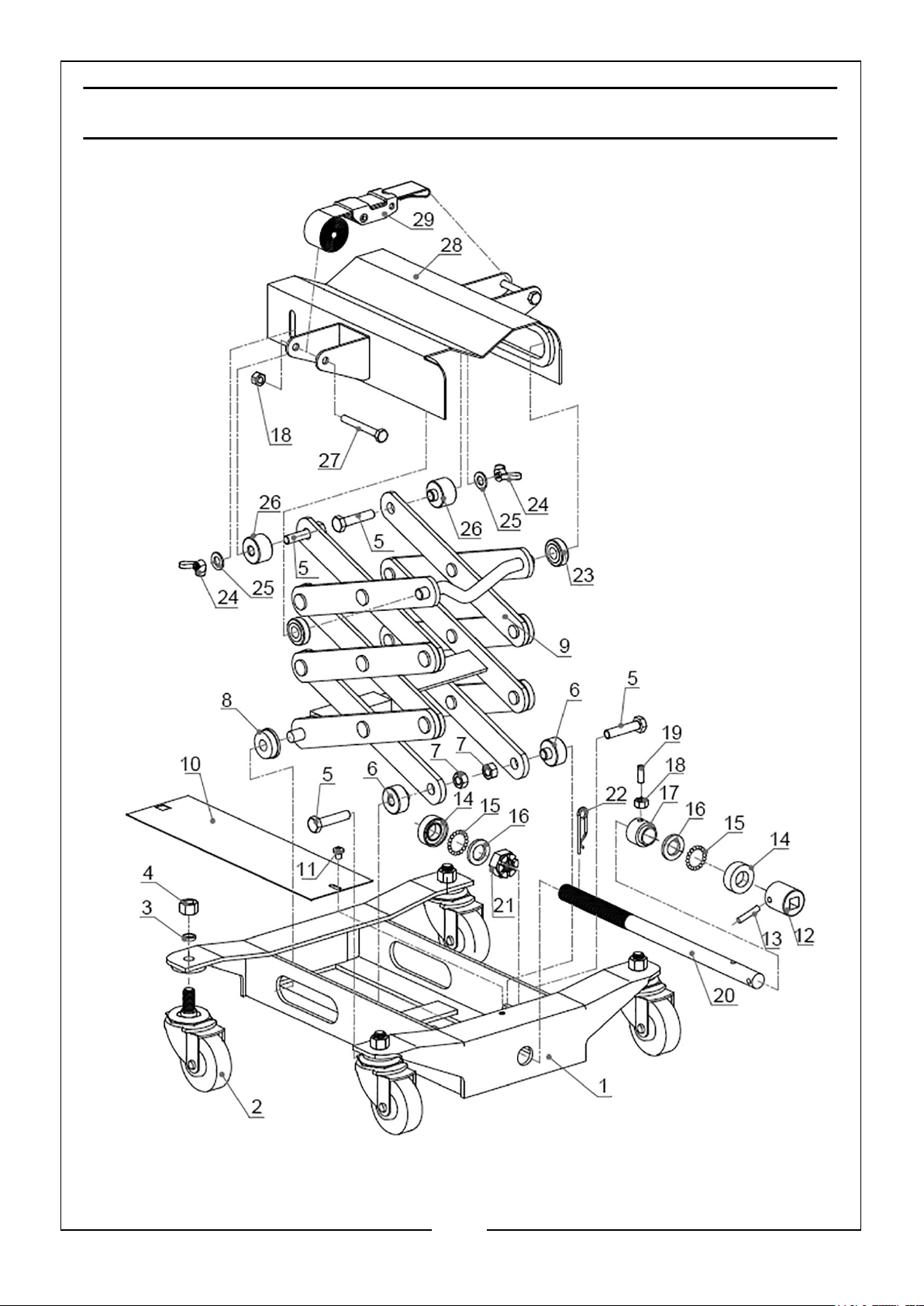
Page 9
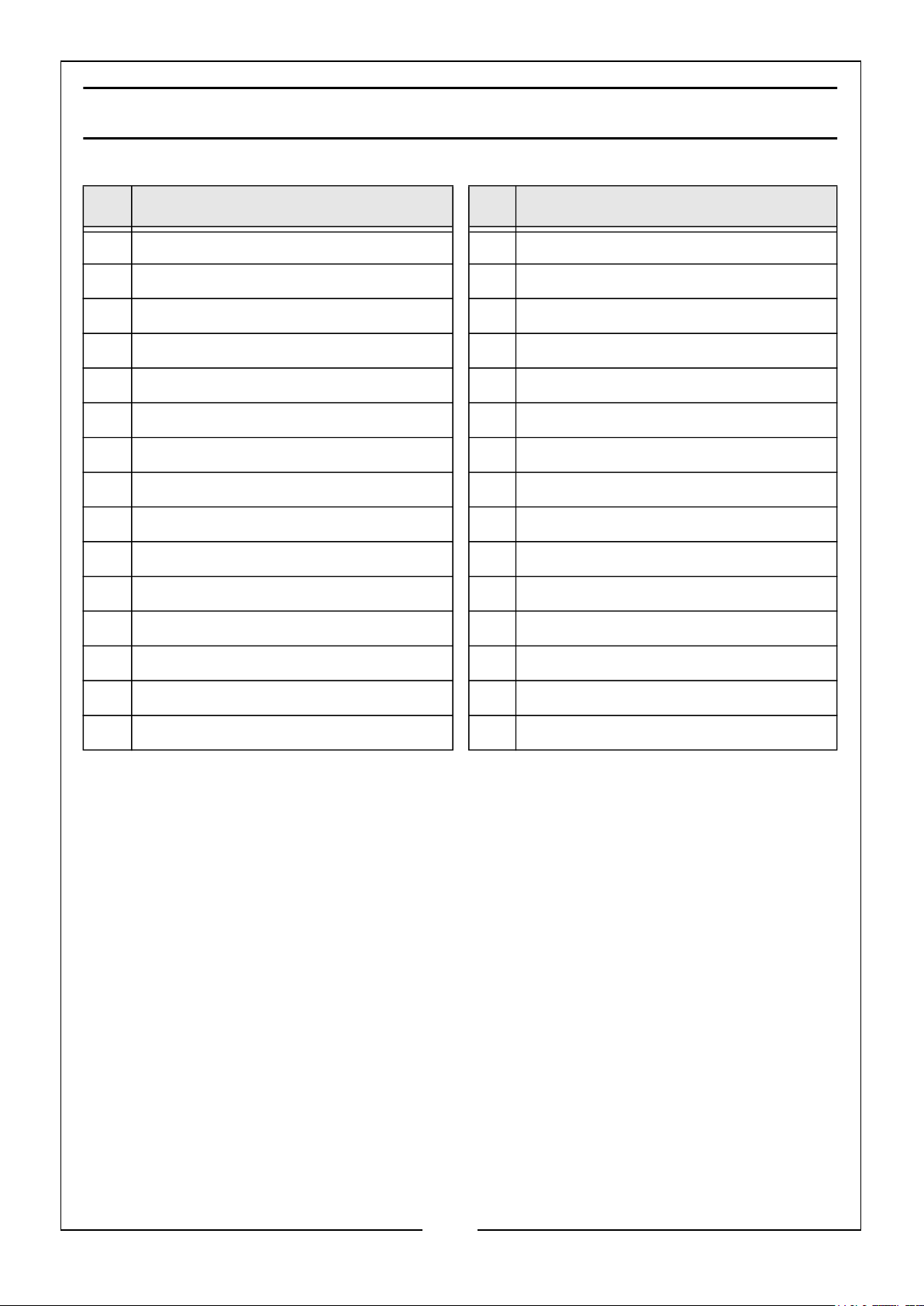
COMPONENT PARTS
No Description No Description
1 Base 16 Bearing washer
2 Castor 17 Bush
3 Lock washer 12 dia 18 Nut M8
4 Nut M12 19 Screw M8 x 18
5 Bolt M10 x 45 20 Screwed rod
6 Bush 21 Adjusting nut
7 Nut M10 22 R-pin
8 Wheel 23 Wheel
9 Frame 24 Wingnut M10
10 Cover plate 25 Washer 10 dia
11 Bolt M6 x 12 26 Bush
12 Socket 27 Bolt M8 x 65
13 Pin 28 Saddle
14 Bearing 29 Ratchet tie-down
15 Steel ball 4 dia
9
Parts & Service: 020 8988 7400 / E-mail: [email protected] or [email protected]
Page 10
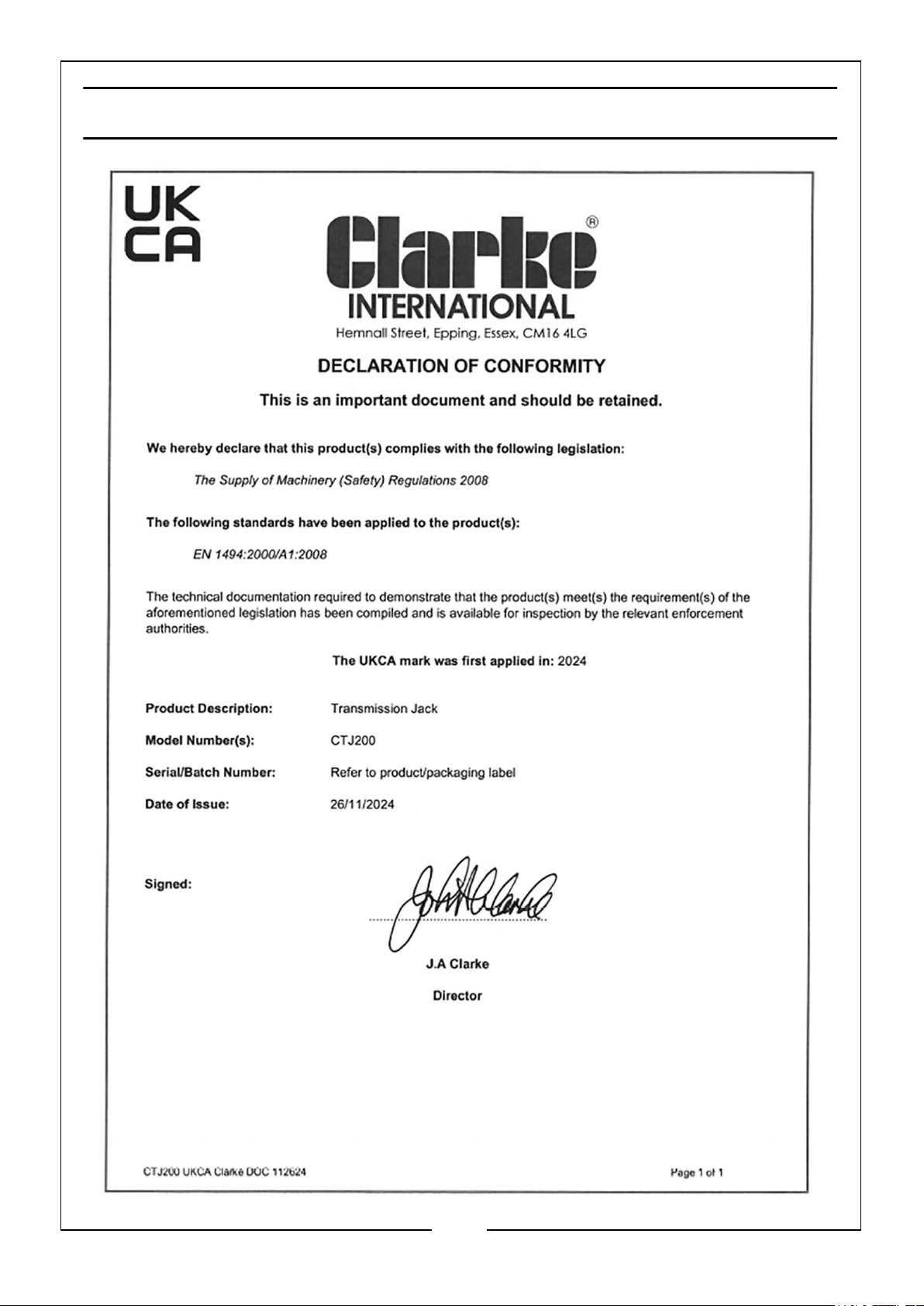
DECLARATIONS OF CONFORMITY - UK
10
Parts & Service: 020 8988 7400 / E-mail: [email protected] or [email protected]
Page 11
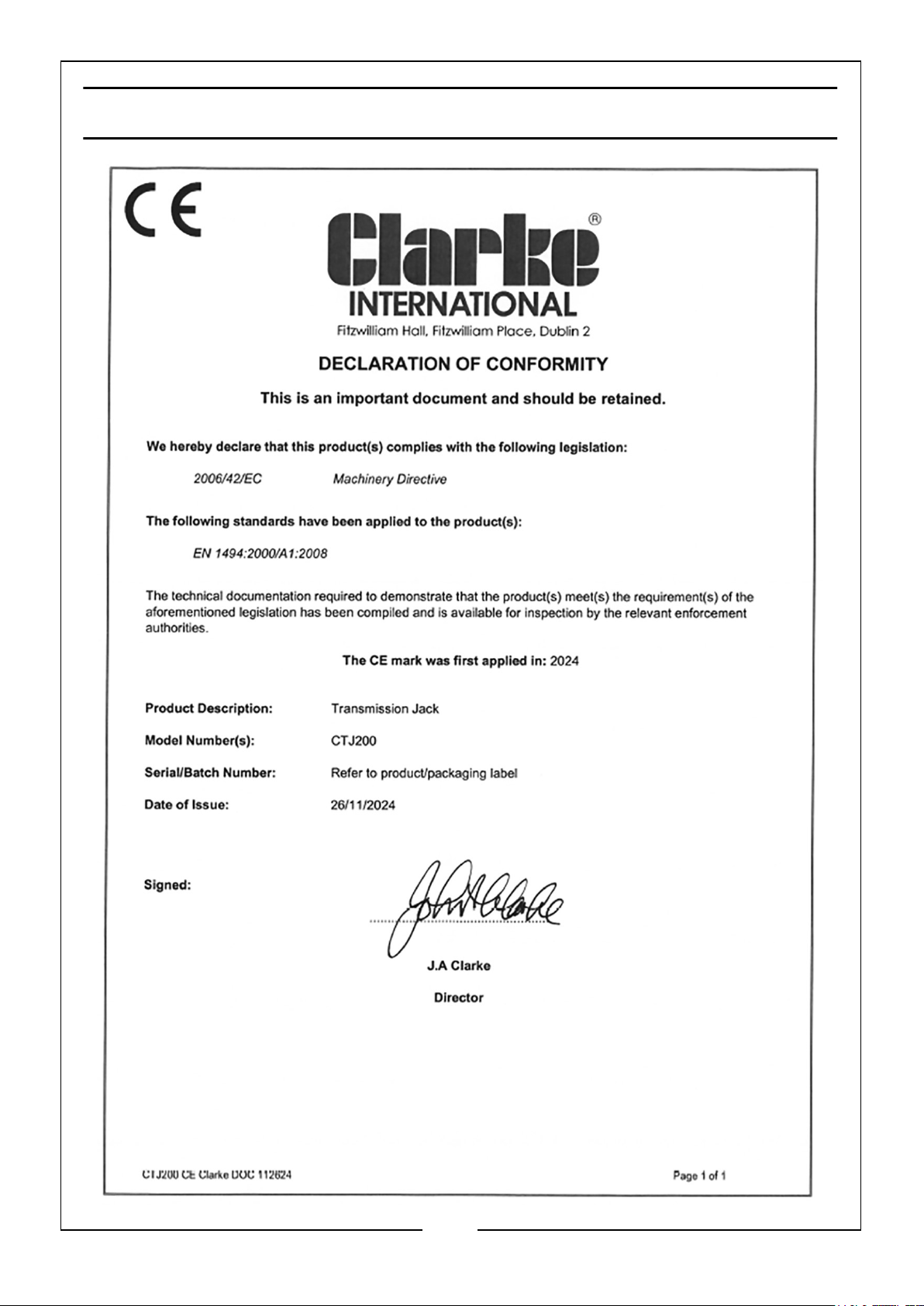
DECLARATION OF CONFORMITY - CE
11
Parts & Service: 020 8988 7400 / E-mail: [email protected] or [email protected]
Page 12

 Loading...