

Page 1
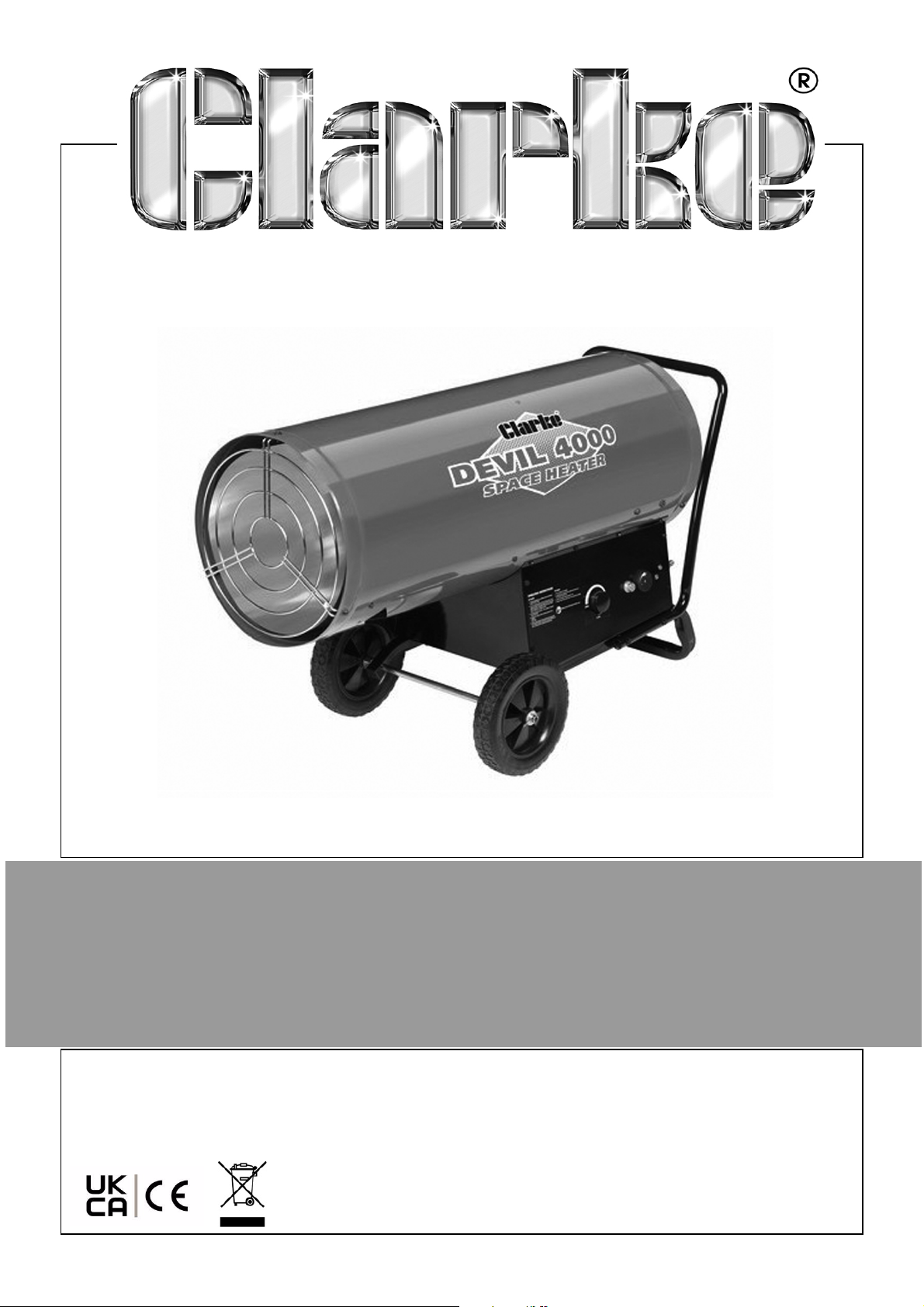
PROPANE GAS HEATER
MODEL NO: DEVIL 4000
PART NO: 6926150
OPERATION & MAINTENANCE
INSTRUCTIONS
ORIGINAL INSTRUCTIONS DL0722 - Rev 6
Page 2
INTRODUCTION
Thank you for purchasing this CLARKE product.
Before attempting to use this product, please read this manual thoroughly and
follow the instructions carefully.
This is a forced air heater meaning that a blower or fan pushes the air through
the heater.
Proper combustion depends upon the air flow; therefore, the heater must not
be modified or operated with parts removed or missing. Likewise, safety
systems must not be circumvented or modified in order to operate the heater.
FUNCTION AND OPERATING PARAMETERS
This is gas powered heater. It’s intended use is for drying and the warming of
commercial/industrial buildings where adequate ventilation is provided.
• It must be operated as prescribed in the operating manual.
• Is not intended to be used for domestic use or for the heating of
habitable areas.
• Is not intended to be used to reach and maintain a certain level of
human thermal comfort within an enclosed space in which the heater is
situated.
• Is not intended to be used in enclosed areas with restricted ventilation.
• Is not for use in areas with high levels of fluctuating drafts.
• Is not intended for warming animals or live stock.
GUARANTEE
This product is guaranteed against faulty manufacture for a period of 12
months from the date of purchase. Please keep your receipt which will be
required as proof of purchase.
This guarantee is invalid if the product is found to have been abused or
tampered with in any way, or not used for the purpose for which it was
intended.
Faulty goods should be returned to their place of purchase, no product can
be returned to us without prior permission.
This guarantee does not effect your statutory rights.
2
Parts & Service: 020 8988 7400 / E-mail: [email protected] or [email protected]
Page 3

GENERAL SAFETY PRECAUTIONS
Read, and make sure you fully
understand the following precautions
and the hazards associated with this
type of equipment.
1. Check the heater thoroughly for
damage. DO NOT operate a
damaged heater.
2. DO NOT modify the heater or
operate a heater which has been
modified from its original
condition.
3. Use only propane gas.
4. Use only VAPOUR WITHDRAWAL
propane supply. If there is any
question about vapour
withdrawal, ask your propane
dealer.
9. For indoor use only in well
ventilated areas.
10. If at any time gas odour is
detected, IMMEDIATELY STOP
operation until the source of gas
has been located and corrected.
11. Install the heater such that it is not
directly exposed to water spray,
rain and/or dripping water.
12. Maintain minimum clearance
from normal combustible material
(e.g. like paper).
13. Due to the high surface and
exhaust temperatures, adults and
children must observe sufficient
clearances to avoid burns or
clothing ignition.
5. Mount the propane cylinders
vertically (shut-off valve up).
Secure them from falling or being
knocked over and protect them
from damage.
6. Locate propane containers at
least 7ft. (2.13m), from the heater
and do not direct the exhaust
toward containers.
7. IMPORTANT: Use only the hose
and regulator assembly provided
with the heater. Inspect the hose
assembly before each use of the
heater. If there is excessive
abrasion or wear, or hose is cut,
replace with the hose assembly
listed on the parts list before using
the heater.
14. Operate only on a stable, level
surface.
15. Do not use with duct work. Do not
restrict air inlet or exit.
16. Use only the electrical voltage
specified.
17. Do not move, handle or service
while hot or burning.
18. Use only in accordance with local
codes of practice.
19. Do not place torsional stress on
any hoses.
8. Not to be used for the heating of
habitable areas of domestic
premises.
3
Parts & Service: 020 8988 7400 / E-mail: [email protected] or [email protected]
Page 4
MINIMUM FRESH AIR OPENING REQUIREMENTS
• Minimum ventilation: 3.5 ft
• Do not use in un-ventilated areas.
• The flow of combustion and ventilation air must not be obstructed.
2
MINIMUM CLEARANCES FROM COMBUSTIBLES
Outlet 8 Ft Top 3 Ft
Sides 2 Ft Rear 2 Ft
RISKS OF CARBON MONOXIDE POISONING
Even though this heater operates very close to 100 percent combustion
efficiency, it still produces small amounts of carbon monoxide.
• Carbon Monoxide (CO) is toxic.
• Pregnant women, persons with a heart or lung condition, anaemia
or under the influence of alcohol, or those at high altitude, are more
likely to be effected by Carbon Monoxide.
• CO can build up in a confined space and failure to provide
adequate ventilation can be fatal.
The early symptoms of asphyxiation caused by inadequate ventilation are:
•headache
• dizziness
•nausea
• dry mouth or sore throat
Should anyone show these symptoms, they must GET FRESH AIR IMMEDIATELY.
Turn off the heater and have it serviced before using again.
Be sure to follow all the warnings in this manual.
WE RECOMMEND THE USE OF A CARBON MONOXIDE
DETECTOR
4
Parts & Service: 020 8988 7400 / E-mail: [email protected] or [email protected]
Page 5
ELECTRICAL CONNECTIONS
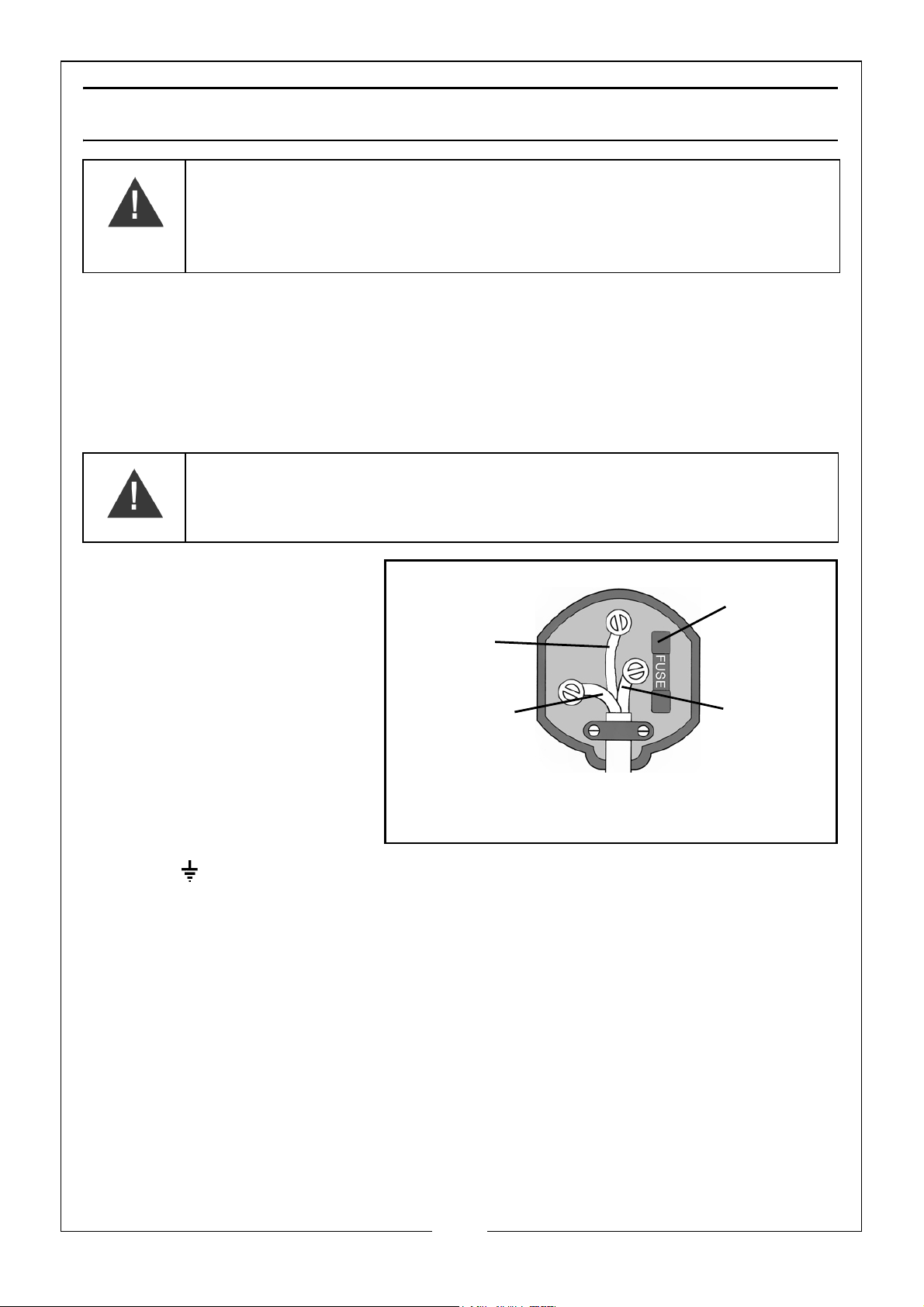
Plug must be BS1363/A approved.
Always fit
Ensure that the outer sheath of
Neutral
(Blue)
Live
(Brown)
Earth
(Green and
a 13 Amp
the cable is firmly held by the clamp
fuse.
Yellow)
WARNING: READ THESE ELECTRICAL SAFETY INSTRUCTIONS
THOROUGHLY BEFORE CONNECTING THE PRODUCT TO THE MAINS
SUPPLY.
Connect the mains lead to a standard, 230 Volt (50Hz) electrical supply
through an approved BS1363 plug fitted with a BS1362 13 amp fuse.
If the plug has to be changed because of damage, it must be removed and a
replacement fitted, following the wiring instructions shown below. The old plug
must be discarded safely, as insertion into a power socket could cause an
electrical hazard.
WARNING: WIRES IN THE MAINS LEAD ARE COLOURED IN
ACCORDANCE WITH THE FOLLOWING CODE:
GREEN/YELLOW = EARTH, BLUE = NEUTRAL, BROWN = LIVE.
• The BLUE wire must be
connected to the
terminal marked N or
coloured black.
We strongly recommend that this machine is connected to the mains supply
through a Residual Current Device (RCD)
If you are not sure, consult a qualified electrician. DO NOT try to do any
repairs.
•The BROWN wire must
be connected to the
terminal marked L or
coloured red.
• The YELLOW AND
GREEN wire must be
connected to the
terminal marked E
or or coloured green.
5
Parts & Service: 020 8988 7400 / E-mail: [email protected] or [email protected]
Page 6
PROPANE GAS SUPPLY
WARNING: THE FITTING AND CHANGING OF THE GAS CYLINDERS MUST BE
CARRIED OUT IN A FLAME FREE ATMOSPHERE.
WARNING: YOU SHOULD ONLY USE PROPANE GAS CYLINDERS AVAILABLE
FROM BUILDERS MERCHANTS OR GAS SUPPLIERS.
This portable, direct-fired gas heater is designed to give safe, efficient and
reliable operation, and is for use with propane gas only.
As with all mechanical equipment, optimum performance will only be
achieved if the correct operation and servicing procedures are followed.
WARNING: PROPANE GAS CYLINDERS MUST BE USED AND STORED IN
ACCORDANCE WITH THE ‘HIGHLY FLAMMABLE LIQUIDS AND LIQUEFIED
PETROLEUM GASES REGULATIONS 1972’
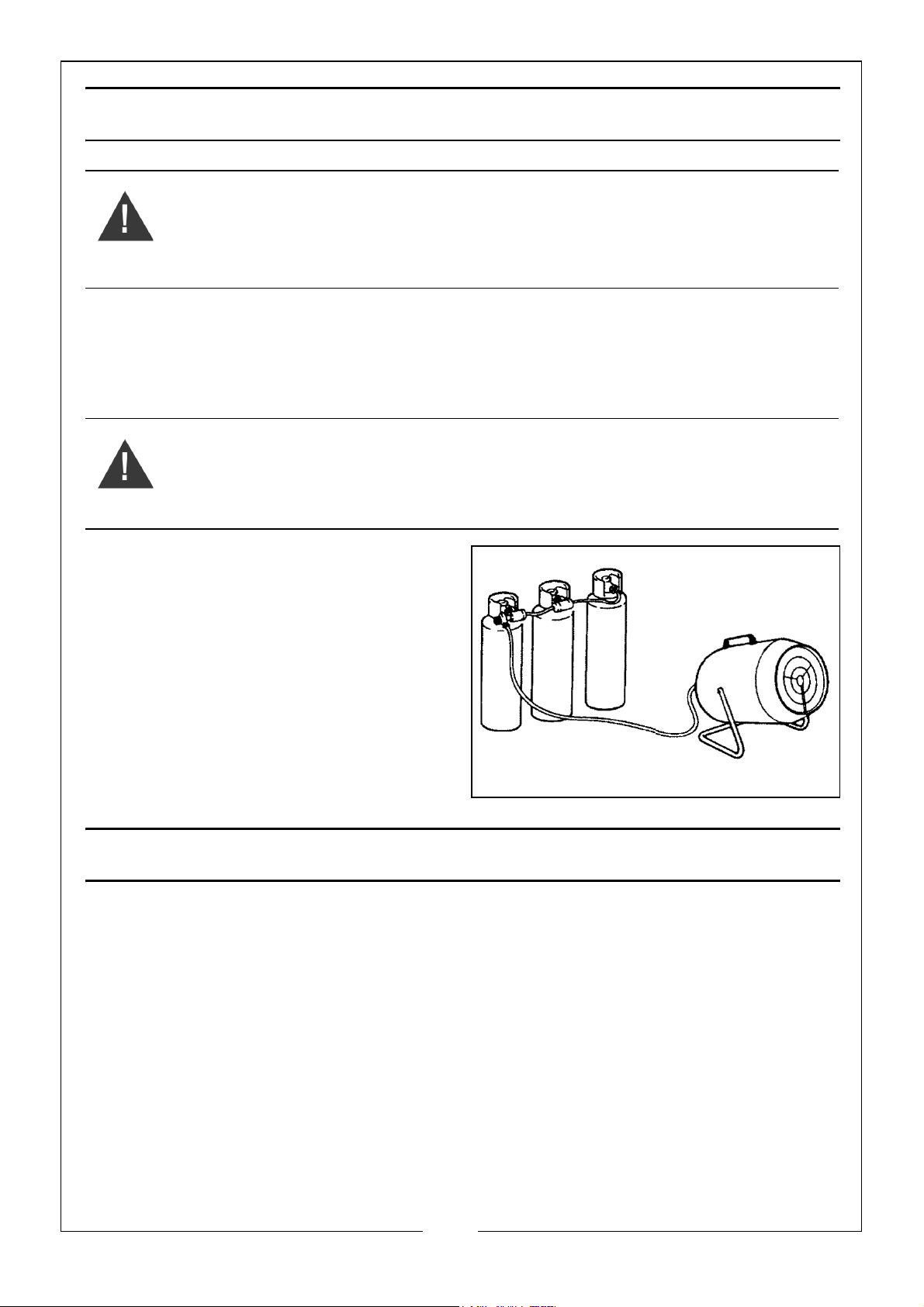
In order to reduce the risk of icing up
when operating at long periods at
maximum capacity, you should use a
larger capacity gas bottle, or two/
three bottles in parallel as shown in the
diagram.
Ensure the Propane gas bottle, gas
hose and electric cable, are
positioned behind the unit, away from
the heat.
IN THE EVENT OF A GAS LEAK
1. Extinguish all smoking materials and other open flames.
2. Do NOT operate electric switches or light matches.
3. Close all supply valves on gas tank or cylinder.
4. Do NOT use your phone. USE a neighbour's phone or your mobile phone
from outside the building or wherever you detected the gas leak to call the
fire service.
5. Immediately get everyone out of the building or area.
Do NOT re-enter the building, or area until a trained service person or the fire
service advises it is safe to return.
6
Parts & Service: 020 8988 7400 / E-mail: [email protected] or [email protected]
Page 7
ASSEMBLY
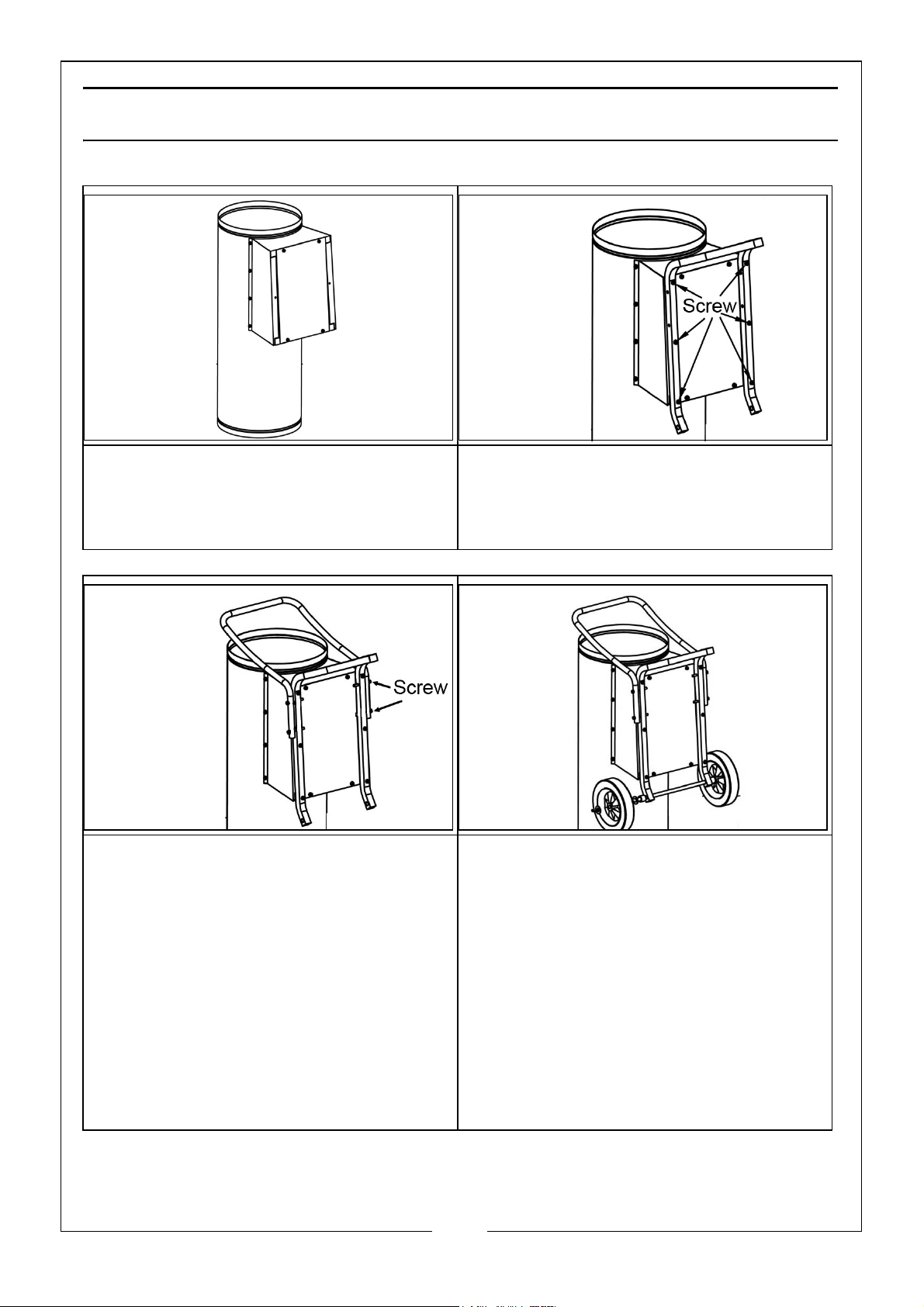
1. Stand the heater on end as
shown. We recommend the help
of an assistant to lift and steady
the heater during assembly.
3. Attach the handle to the lower
frame and secure using four
machine screws.
2. Attach the lower frame and
secure using six of the machine
screws provided.
4. Slide the axle into position.
5. Place the axle sleeve onto each
end.
6. Place the wheels onto each
end.
7. Place the spacer onto each
end.
8. Secure everything in place with
a cotter pin on each end of the
axle.
7
Parts & Service: 020 8988 7400 / E-mail: [email protected] or [email protected]
Page 8
PREPARATION
LOCATION
• Position the heater at a safe distance from combustible materials.
• This heater must not be placed on wooden floors or other
combustible materials.
• When used, the heater should rest on suitable insulating material at
least 1 inch thick and extending 3 ft or more beyond the heater in all
directions.
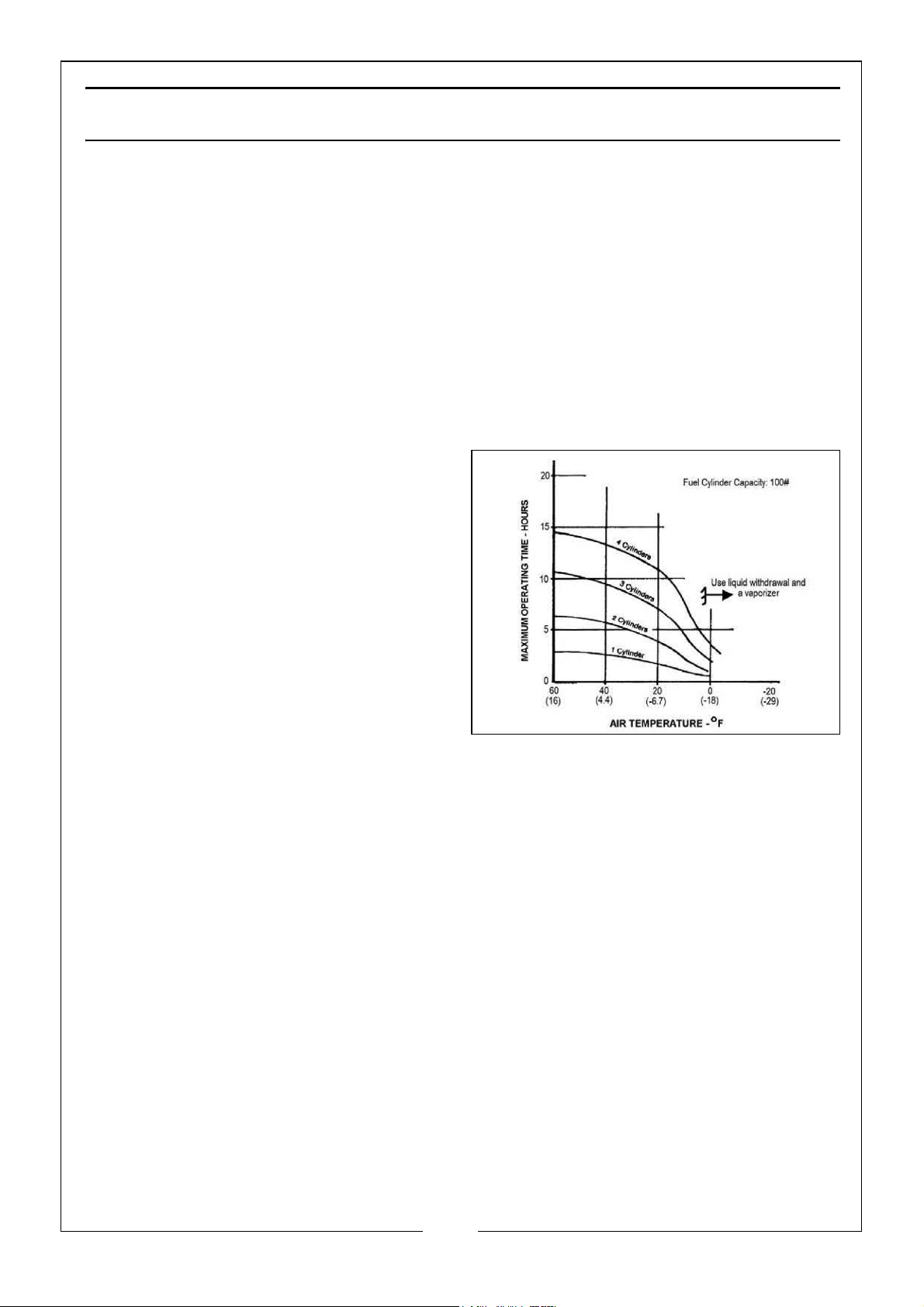
SIZE AND CAPACITY OF PROPANE CYLINDERS
The chart shows the approximate size
of the cylinder required for these
heaters. To use the chart:
1. Select the lowest air temperature
expected (at the bottom of the
chart).
2. Move straight up to time of
operation desired (left side).
3. Read the cylinder size required
Always use full cylinders with good air
circulation and no frost on the cylinders.
CONNECTING THE GAS BOTTLE
1. Check the heater for possible shipping damage. If any is found do not use
the heater.
2. Follow all of the “General Safety” precautions on page 3.
3. Connect a POL (Prest-o-Lite) fitting on hose/regulator assembly to the
propane tank(s).
• Turn the POL fitting anti-clockwise into the threads on the tank.
Tighten firmly using a wrench.
4. Connect the hose to the heater by rotating the hose fitting clockwise.
• Make sure that all gas connections are secure.
5. Open the cylinder's gas valve and check all gas connections with a soap
and water solution. DO NOT USE A FLAME.
6. Connect the power cable to a 230V, 50Hz, mains socket.
8
Parts & Service: 020 8988 7400 / E-mail: [email protected] or [email protected]
Page 9
OPERATING INSTRUCTIONS
WARNING: BEFORE STARTING THE HEATER, YOU MUST ENSURE THAT THE
MINIMUM VENTILATION REQUIREMENTS ARE OBSERVED TO AVOID THE
RISK OF CARBON MONOXIDE POISONING.
HEATER START UP
1. Open the propane supply valve on the propane tank(s) slowly.
• If not opened slowly, the excess-flow check valve on the propane
tank will stop the gas flow. If this happens, close the propane supply
valve and open again slowly.
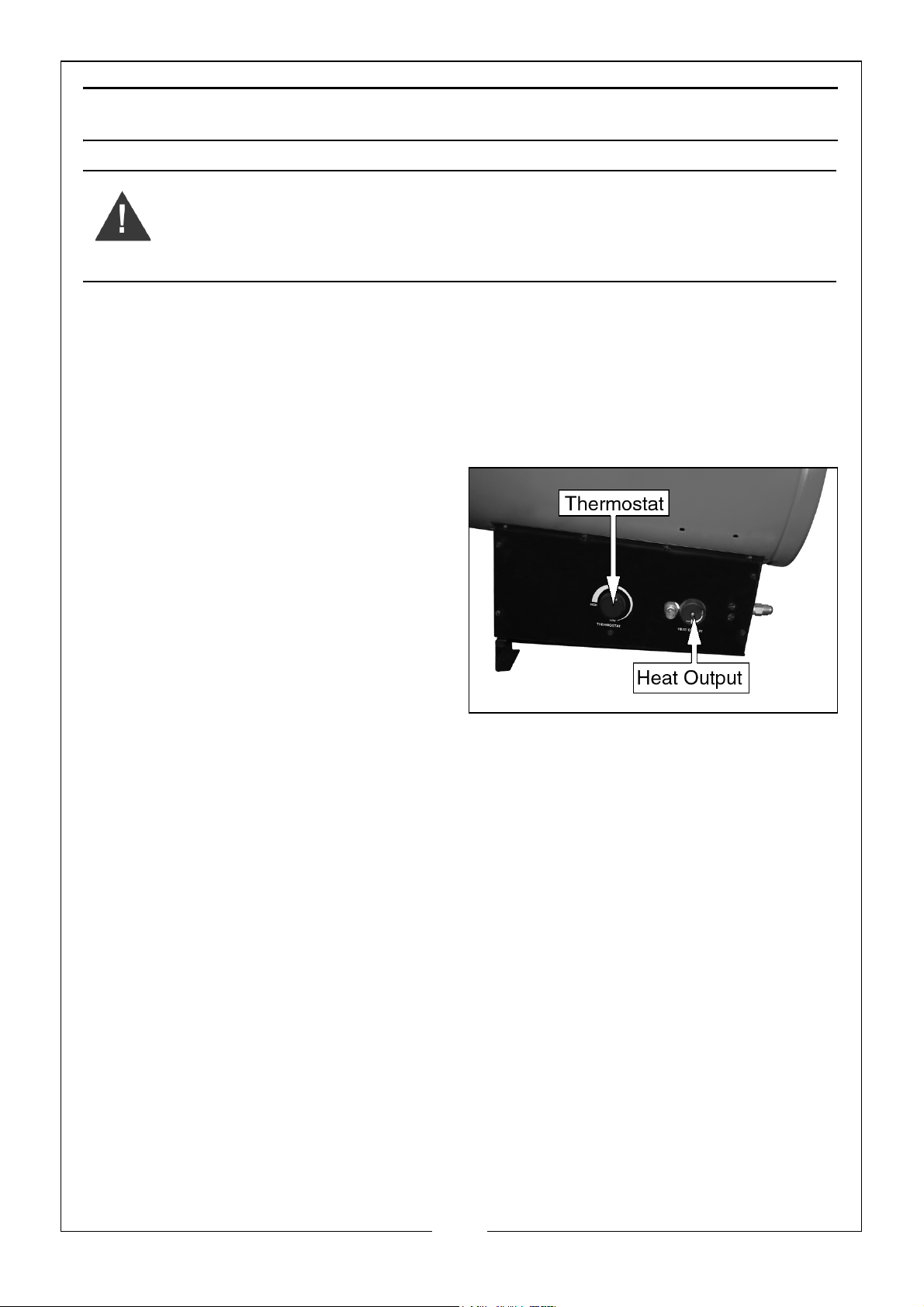
2. Set thermostat to ‘high’.
• The heater will ignite
automatically.
3. Adjust the heat output to the
desired setting.
4. Set the thermostat to the required
setting.
• The heater will turn off and on
automatically as the air
temperature varies in the heater area.
HEATER SHUT DOWN
1. Securely close the valve on the propane cylinder.
2. Continue to operate the heater until all fuel in the hose has burned.
3. Set the power switch to the OFF (O) position.
4. Turn the heater thermostat to “off”.
5. Unplug the heater.
RESTART AFTER SAFETY SHUTDOWN
1. Securely close the valve on the propane cylinder.
2. Unplug heater.
3. Wait 5 minutes.
4. Restart, following the Heater Start Up procedure above.
9
Parts & Service: 020 8988 7400 / E-mail: [email protected] or [email protected]
Page 10
MAINTENANCE, STORAGE AND SERVICING
WARNING: TO PREVENT PERSONAL INJURY, UNPLUG THE HEATER FROM
THE MAINS SUPPLY BEFORE SERVICING.
MAINTENANCE AND STORAGE
1. The heater should be inspected at least annually by a qualified person.
2. Before each use, check the soft “0” ring seat at the bullnose of the POL
fitting. If the "0" ring is cut, scuffed, or otherwise damaged, replace it.
3. Turn off the gas at the LP-gas supply cylinder(s) when the heater is not in
use.
4. When the heater is to be stored indoors, the connection between the LPgas supply cylinder(s) and the heater must be disconnected and the
cylinder(s) removed from the heater and stored out of doors in
accordance with local regulations.
SERVICING
A hazardous condition may result if a heater is used that has been modified or
is not functioning properly. When the heater is working properly:
• The flame is contained within the heater.
• The flame is essentially blue with perhaps some yellow tipping.
• There is no strong disagreeable odour, eye burning or other physical
discomfort.
• There is no smoke or soot internal or external to the heater.
• There are no unplanned or unexplained shut downs of the heater.
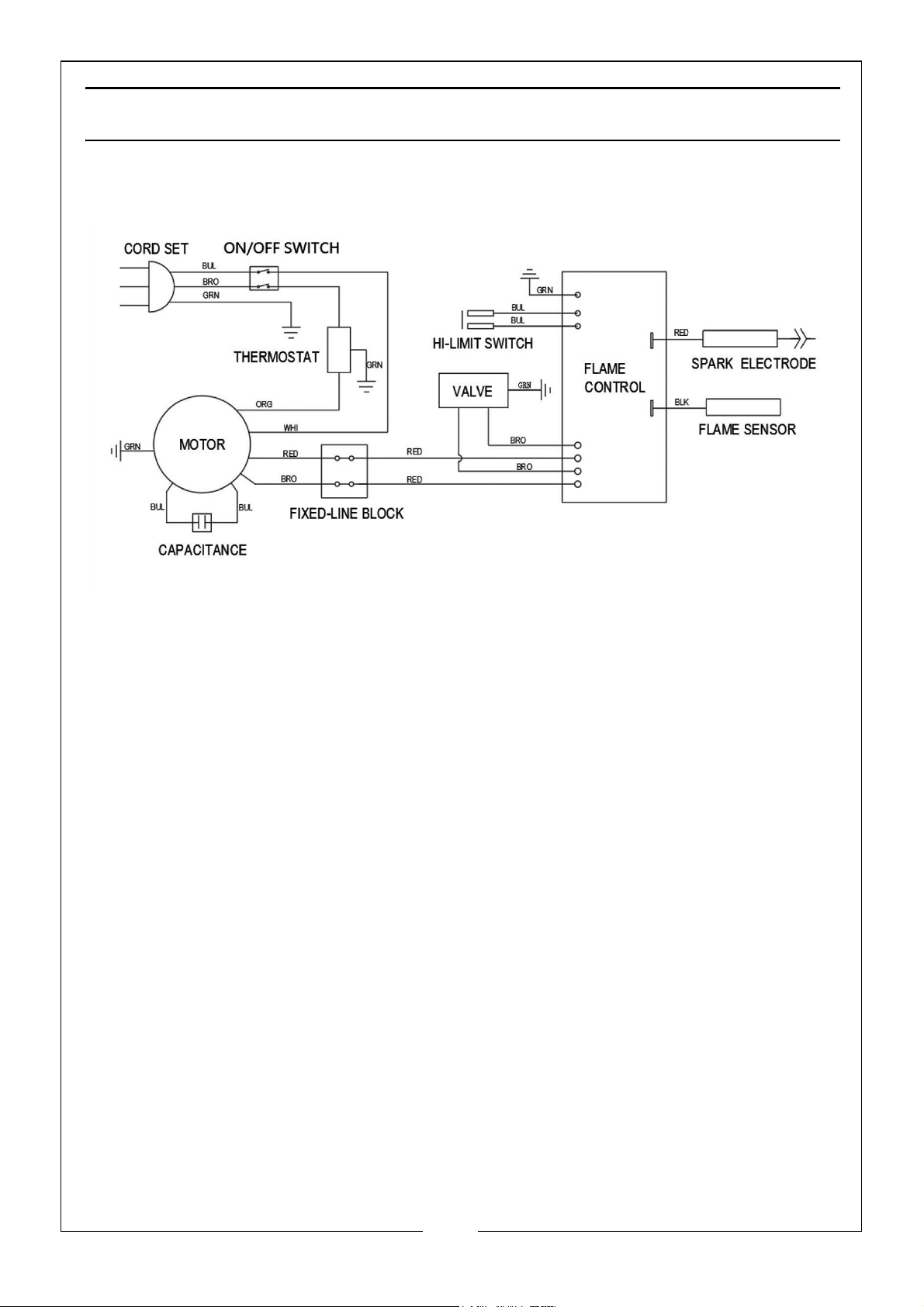
The parts lists and wiring diagram show the heater as it was constructed. Do
not use a heater which is different from that shown. In this regard, use only the
hose, regulator and cylinder connection fitting (POL fitting) supplied with the
heater.
A heater which is not working correctly must be repaired, but only by a
trained, experienced service person.
10
Parts & Service: 020 8988 7400 / E-mail: [email protected] or [email protected]
Page 11
SPECIFICATIONS
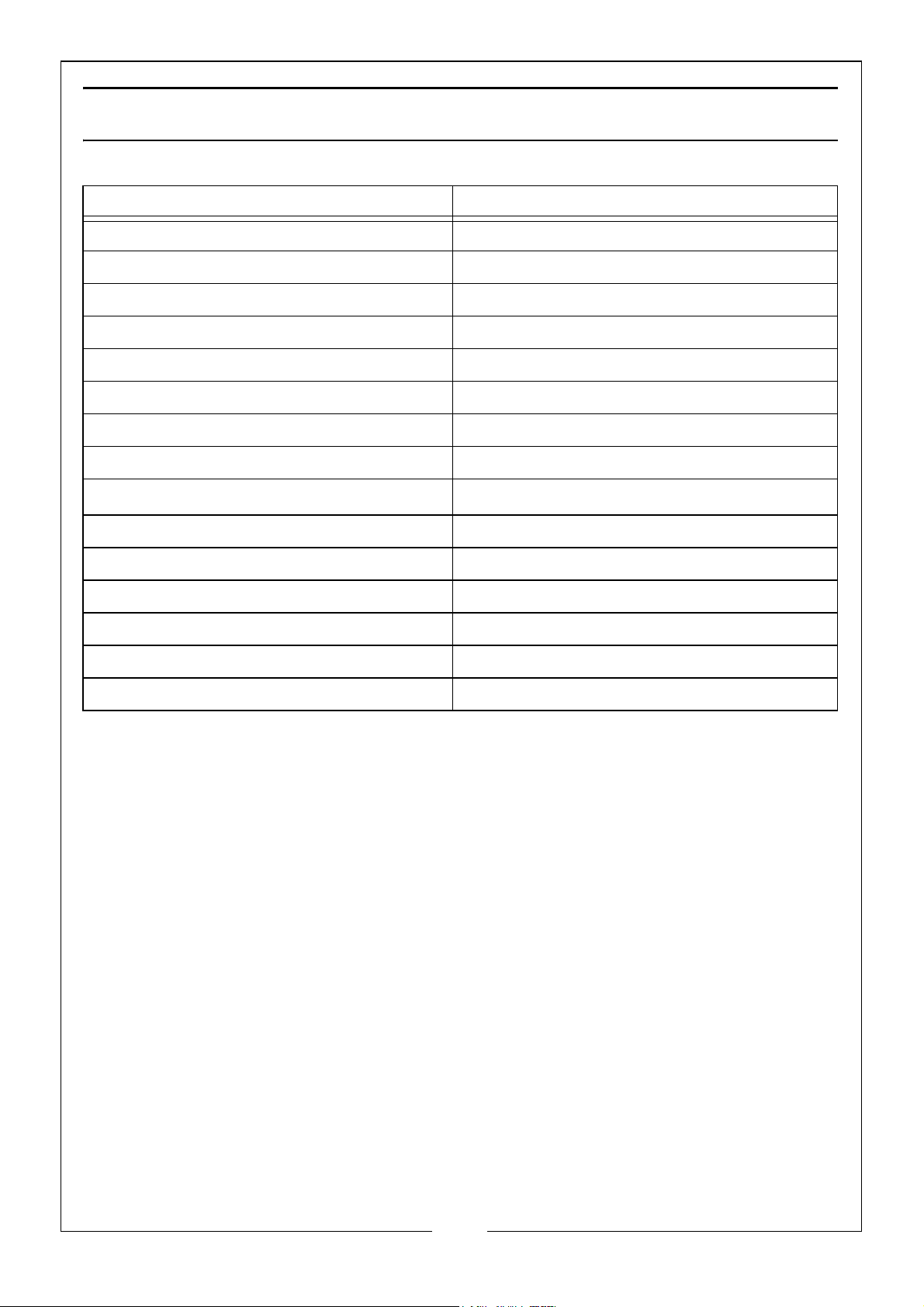
Model DEVIL 4000
Gas Type Propane
BTU Rating 400,000
Maximum Pressure Bottle Pressure
Minimum Pressure 1.4 Bar
Regulator Output 20 PSIG (0.14MPa)
Electrical Input 220-240V, 50Hz
Ignition Direct Spark
Primary Flame Control Solid State 10-15 Sec timing
Operating Temperature Range
Fuel Consumption 5.2-8.4 kg/hr
Fuel Orifice Port No 1
Fuel Orifice Port Size 2.35 mm
Heated Air Output 1400 CFM
Weight 24.6 kg
Dimensions (L x W x H) 994 x 404 x 621 mm
o
C - 35 oC
15
11
Parts & Service: 020 8988 7400 / E-mail: [email protected] or [email protected]
Page 12
Page 13
PARTS LIST
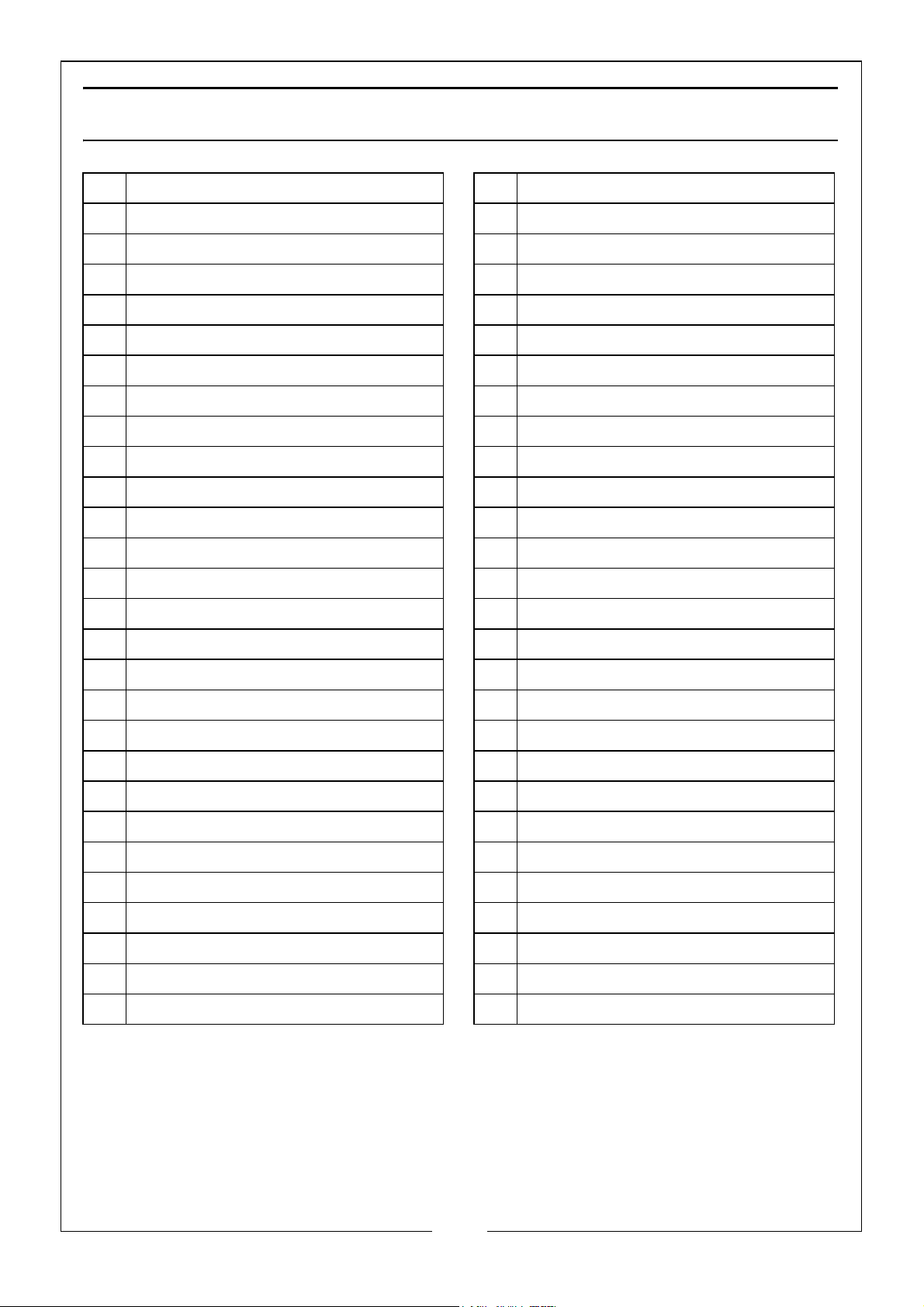
1 Front Guard 29 Control Box End Panel
2 Locknut 30 Thermostat Mounting Bracket
3 Machine Screw 31 Thermostat Assembly
4 Middle Cylinder 32 Orifice (2.35 mm port)
5 Outer Shell 33 Fuel Tube Assembly
6 Grille Inlet 34 Male Fitting, Conn. 1/4 MPT x 1/2
7 Machine Screw 35 TEE 1/4 N PT, Female Fitting
8 Machine Screw 36 Fitting, Plug 1/4 MPT
9 Burner Outer Plate 37 Burn Rate Adjustment Valve
10 Burner Grids 38 Male Fitting Conn 1/4 NPI x G1/4
11 Burner Inner Plate 39 Solenoid Valve
12 Burner-Fibre Frax Gasket 40 Inlet Connector
13 Electrode-Flame Sensor 41 Control Box CRTL Panel
14 Flame Holder Assemby 42 Burn Rate Adjustment Knob
15 High Limit Switch 43 Power Switch
16 Set Screw 44 Thermostat Knob
17 Burner - SS Spacer 45 Strain Relief Bush
18 Burner-Mixing Tube 46 Power Cable Assembly
19 Fan 47 Hose/Regulator Assembly
20 Fan Spacer-Nylon 48 Handle
21 Motor Mounting 49 Lower Frame
22 Motor Assembly 50 Machine Screw
23 Control Mounting Bracket 51 Machine Screw
24 Flame Control 52 Spacer
25 Terminal Board 53 Cotter Pin
26 Control Box End Panel 54 Wheel
27 Control Box Bottom Panel 55 Axle
28 Capacitor
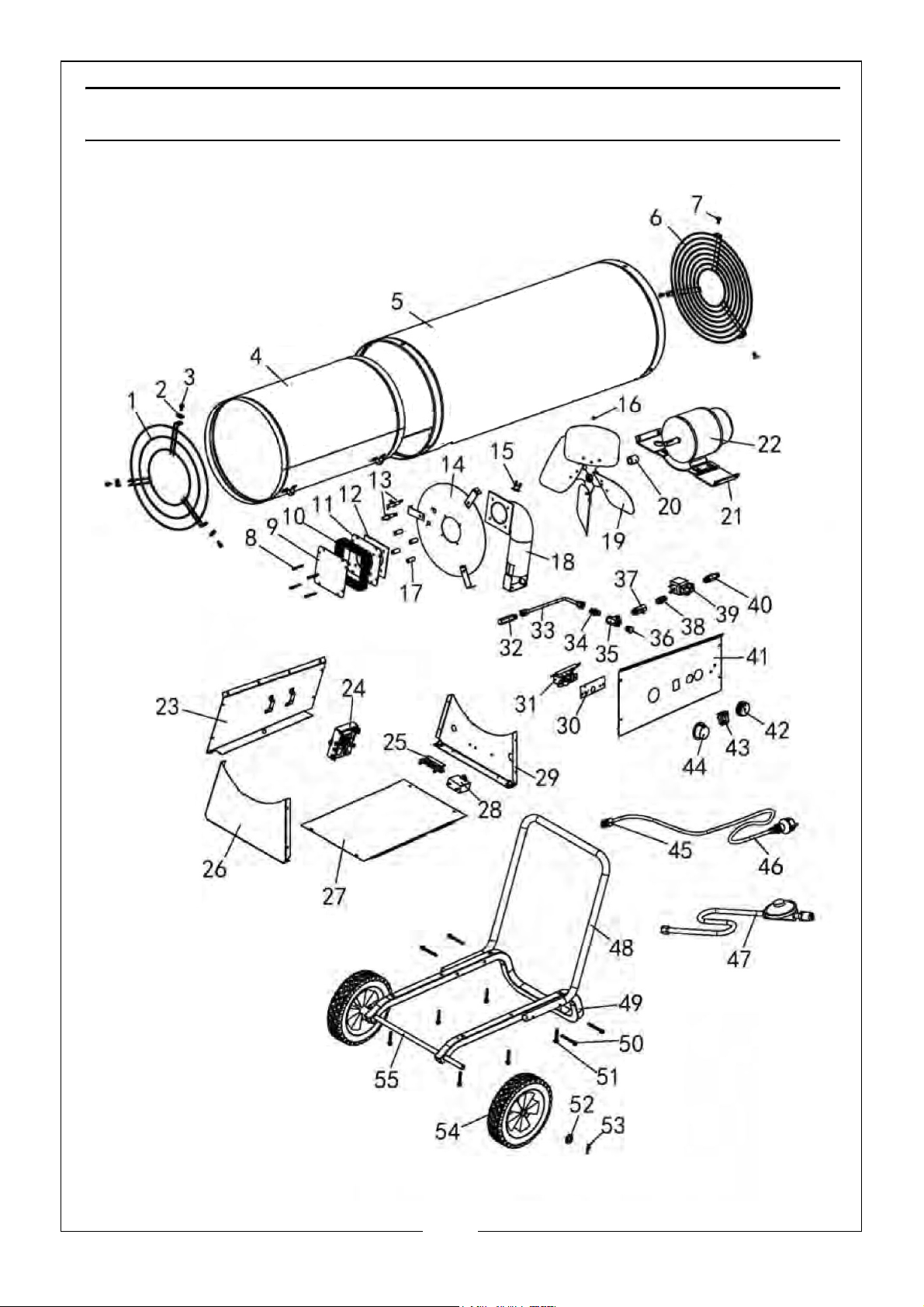
When requesting spare parts, please quote the reference GFDEV4000/01-55.
13
Parts & Service: 020 8988 7400 / E-mail: [email protected] or [email protected]
Page 14
Page 15
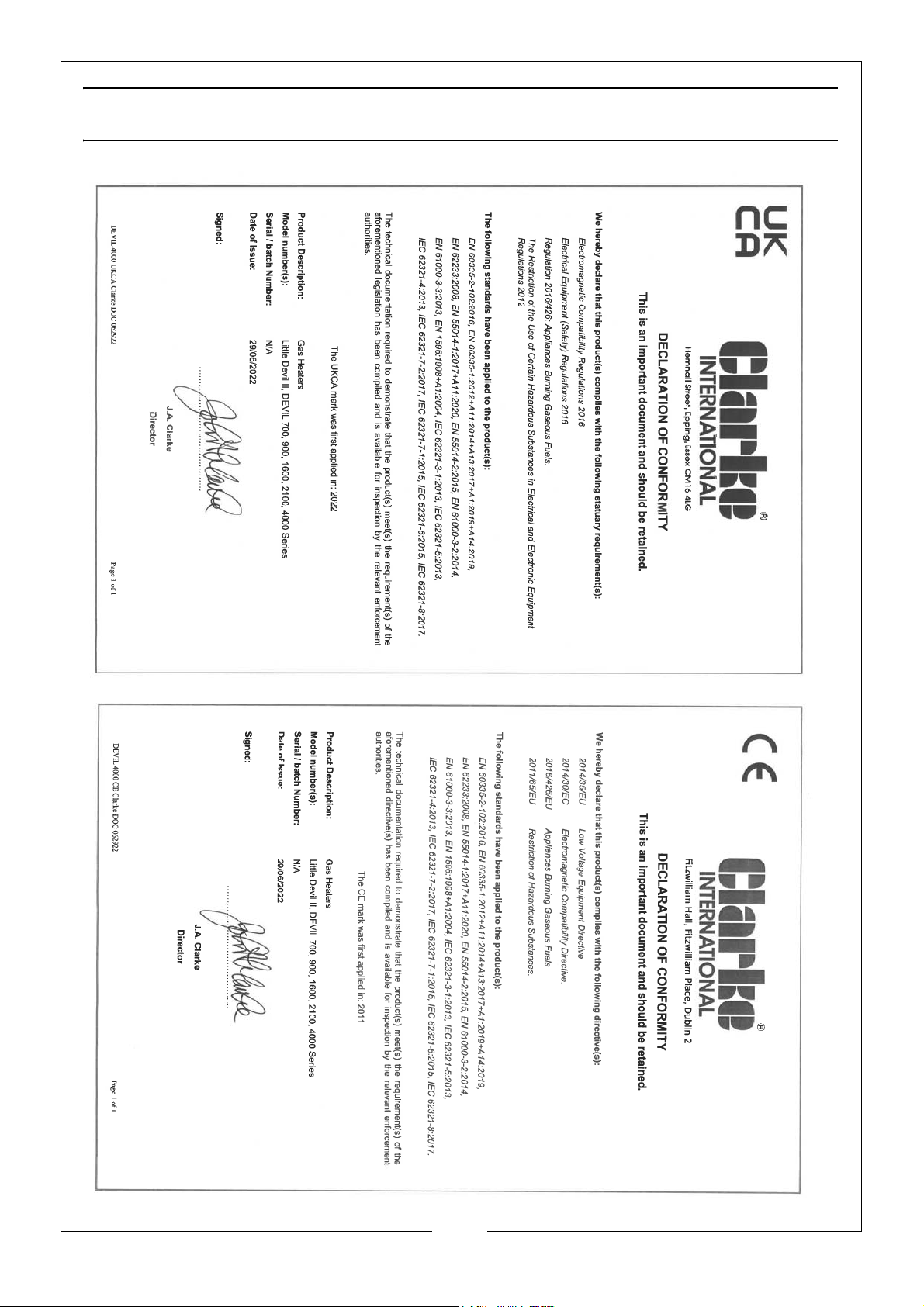
DECLARATION OF CONFORMITY
15
Parts & Service: 020 8988 7400 / E-mail: [email protected] or [email protected]
Page 16

 Loading...