

Page 1
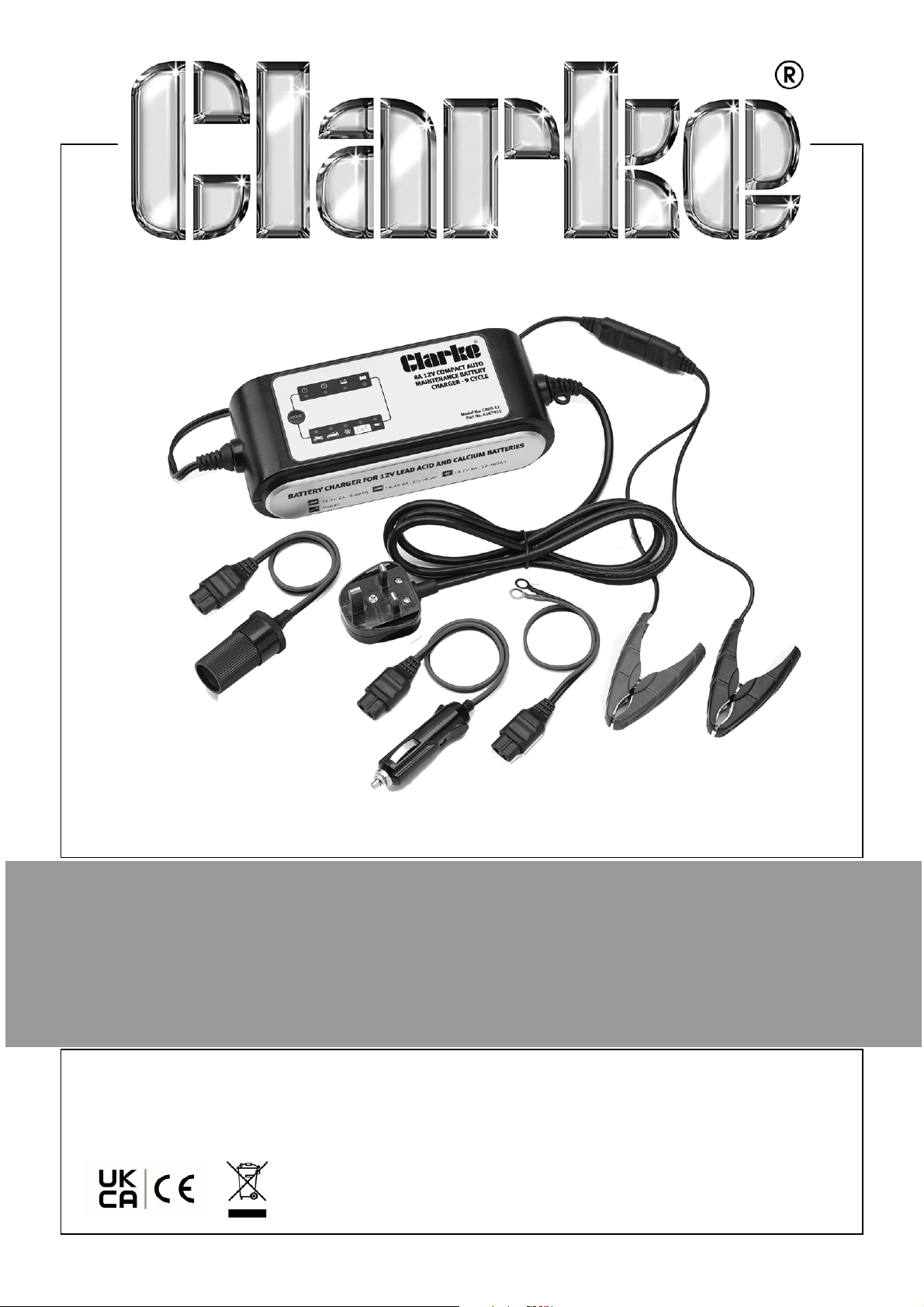
AUTOMATIC BATTERY CHARGER /
MAINTAINER
MODEL NO: CBO9-12
PART NO: 6267025
OPERATION & MAINTENANCE
INSTRUCTIONS
ORIGINAL INSTRUCTIONS
LS0321 - ISS 5
Page 2
INTRODUCTION
Thank you for purchasing this CLARKE product.
Before attempting to use this product, please read this manual thoroughly and
follow the instructions carefully. In doing so you will ensure the safety of yourself
and that of others around you, and you can look forward to your purchase
giving you long and satisfactory service.
GUARANTEE
This product is guaranteed against faulty manufacture for a period of 12
months from the date of purchase. Please keep your receipt which will be
required as proof of purchase.
This guarantee is invalid if the product is found to have been abused or
tampered with in any way, or not used for the purpose for which it was
intended.
Faulty goods should be returned to their place of purchase, no product can
be returned to us without prior permission.
This guarantee does not effect your statutory rights.
ENVIRONMENTAL RECYCLING POLICY
Through purchase of this product, the customer is taking on the
obligation to deal with the WEEE in accordance with the WEEE
regulations in relation to the treatment, recycling & recovery and
environmentally sound disposal of the WEEE.
In effect, this means that this product must not be disposed of with general
household waste. It must be disposed of according to the laws governing
Waste Electrical and Electronic Equipment (WEEE) at a recognised disposal
facility.
2
Parts & Service: 020 8988 7400 / E-mail: [email protected] or [email protected]
Page 3
SAFETY INSTRUCTIONS
WARNING: DO NOT USE ON ANY OTHER BATTERIES APART FROM THOSE
MENTIONED IN THE SPECIFICATION TABLE ON PAGE 12 .
WARNING: DISCONNECT THE CHARGER FROM THE MAINS POWER BEFORE
MAKING OR BREAKING DC CONNECTION, SERVICING OR PERFORMING
ANY MAINTENANCE.
WARNING: ENSURE THERE ARE NO SOURCES OF IGNITION NEAR THE
WORK AREA I.E. NAKED FLAMES, SPARKS, CIGARETTES, FLAME HEATERS
ETC AS THE CHARGING PROCESS PRODUCES EXPLOSIVE GASES.
• Always keep the charger in good condition.
• Keep the charger clean.
• Always keep the work area clean and tidy and make sure that there is
sufficient lighting.
• Use eye protection (standard spectacles are not adequate) and
protective clothing. Do not touch your eyes while working with
batteries.
• Remove loose clothing, watches, and any jewellery, and contain long
hair. A lead acid battery can cause a short-circuit current sufficient to
weld metal to metal, which will cause dangerous burns.
• Read the vehicle manufacturers instruction manual for specified
battery charging instructions.
• Disconnect the battery and move it to a safe, dry level area for
charging. If the battery cannot be removed, refer to manufacturers
handbook.
• Clean the clamps and battery terminals to remove oxidation.
• When you connect the clamps to the battery, make sure that you
follow the correct polarity. Red is Positive (+) and Black is Negative (-).
• DO NOT pull or lift the charger by its cables.
• DO NOT pull plugs from the sockets by the power cable.
• DO NOT try to charge a non-rechargeable battery.
• DO NOT use the charger for something other than that for which it is
designed.
• DO NOT let the clamps touch each other when the power is on.
• DO NOT get the charger wet or use it in damp or wet locations or areas
where there is condensation.
3
Parts & Service: 020 8988 7400 / E-mail: [email protected] or [email protected]
Page 4
• DO NOT operate the charger if there is any visible damage.
• DO NOT try to modify or open the charger.
• DO NOT charge the battery with the engine running.
• DO NOT charge a frozen battery.
• When not in use disconnect the charger from the power supply and
keep in a safe, dry area.
• DO NOT let untrained persons operate the charger. It is not intended for
use by persons with reduced physical, sensory or mental capabilities, or
lack of experience and knowledge, unless they have been given
instruction concerning the use of the charger and are supervised by a
person responsible for their safety.
• Keep children and unauthorised persons away from the working area.
• Follow these instructions and those of the battery and vehicle
manufacturers.
PERSONAL PRECAUTIONS
• Ensure there is another person within hearing range of your voice, or
close enough to come to your aid, should a problem arise.
• Have fresh water and soap nearby in case battery acid contacts skin,
clothing or eyes.
• Wash immediately with soap and water if battery acid contacts skin or
clothing. If acid enters the eye, flush the eye immediately with cool,
clean running water for at least 15 minutes and seek immediate
medical attention.
• DO NOT smoke or allow a flame in the vicinity of battery or engine.
SAFETY SYMBOLS
Read all
instructions before
use
For indoor use only.
4
Parts & Service: 020 8988 7400 / E-mail: [email protected] or [email protected]
Page 5
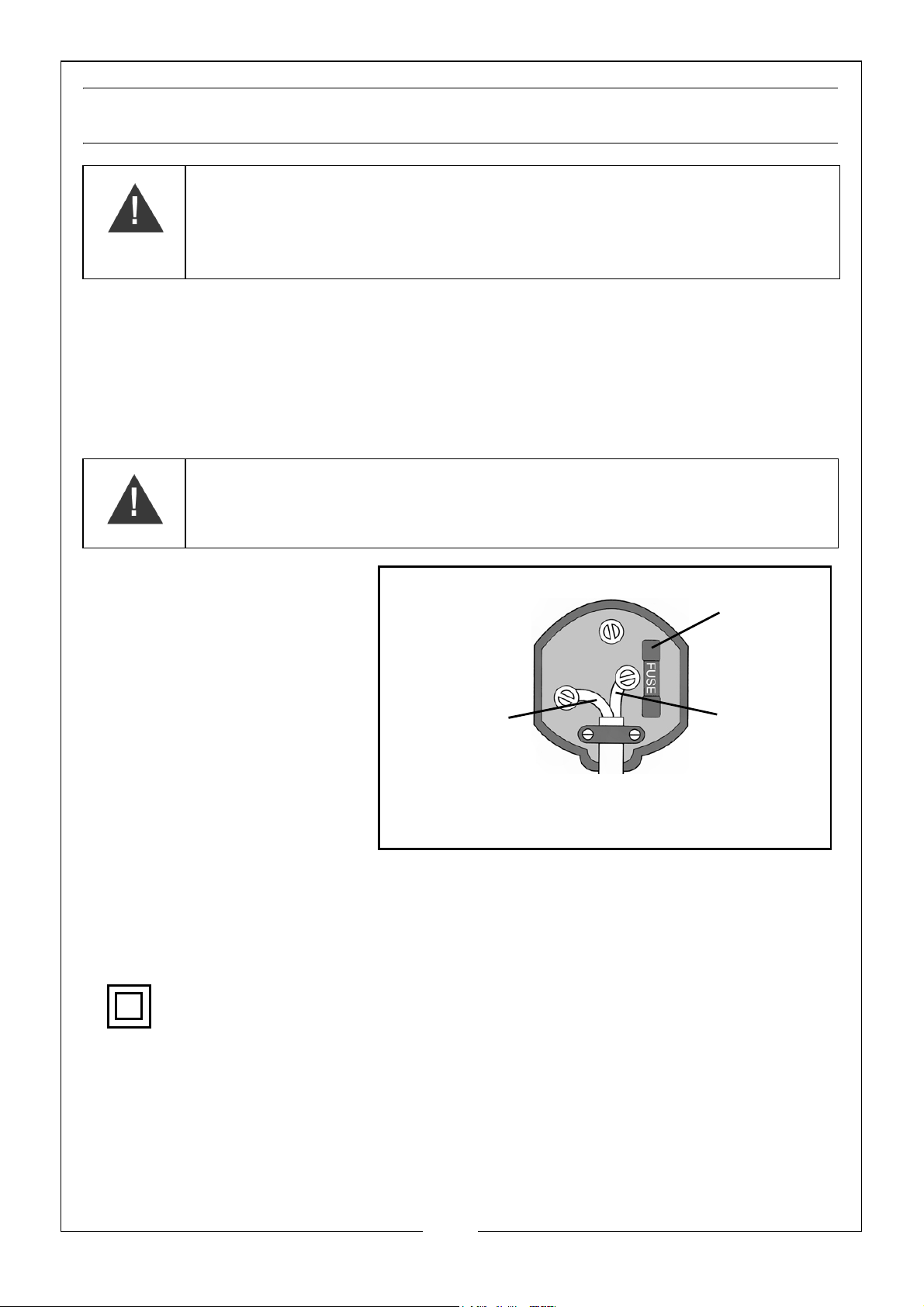
ELECTRICAL CONNECTIONS
Plug must be BS1363/A approved.
Always fit
Ensure that the outer sheath of
Neutral
(Blue)
Live
(Brown)
a 5 Amp
the cable is firmly held by the clamp
fuse.
WARNING: READ THESE ELECTRICAL SAFETY INSTRUCTIONS
THOROUGHLY BEFORE CONNECTING THE PRODUCT TO THE MAINS
SUPPLY.
Connect the mains lead to a standard, 230 Volt (50Hz) electrical supply
through an approved BS1363/A plug fitted with a BS1362 fuse.
If the plug has to be changed because of damage, it must be removed and a
replacement fitted, following the wiring instructions shown below. The old plug
must be discarded safely, as insertion into a power socket could cause an
electrical hazard.
WARNING: WIRES IN THE MAINS LEAD ARE COLOURED IN
ACCORDANCE WITH THE FOLLOWING CODE: BLUE = NEUTRAL,
BROWN = LIVE.
•The BLUE wire must be
connected to the
terminal which is
marked N or coloured
black.
•The BROWN wire must
be connected to the
terminal which is
marked L or coloured
red.
We strongly recommend that this machine is connected to the mains supply
via a Residual Current Device (RCD)
If in any doubt, consult a qualified electrician. DO NOT attempt any repairs
yourself.
This symbol indicates that this is a Class II product, and does not require
an earth connection.
Parts & Service: 020 8988 7400 / E-mail: [email protected] or [email protected]
5
Page 6
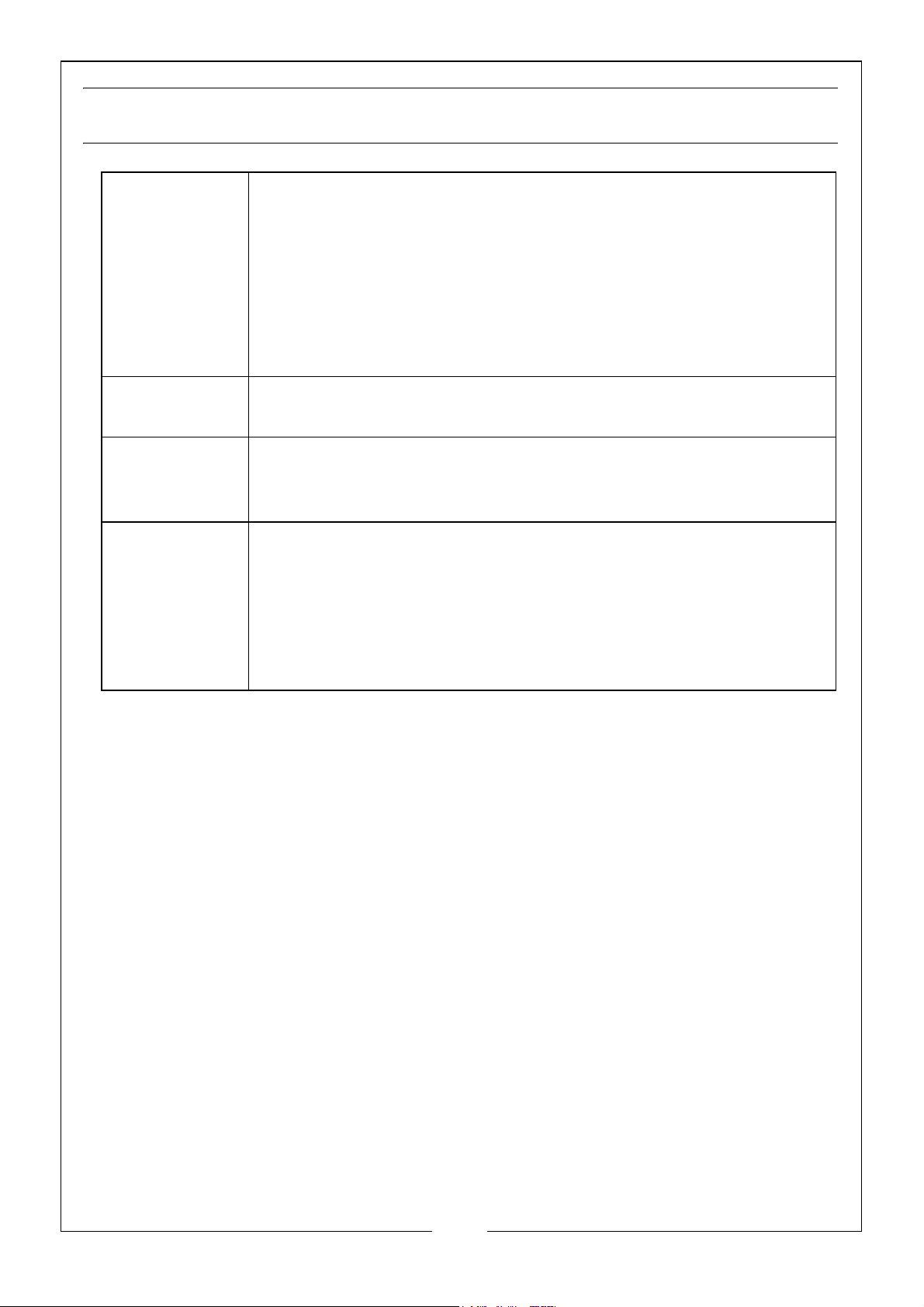
THE 9-STAGE CHARGING PROCESS
1-5
Diagnosis
&
Recovery
6
Bulk
7
Absorption
8-9
Maintenance
Charge
The diagnostic function detects the condition of the battery.
If the voltage is over 7.5V ± 0.5V the charger begins to pulse
charge with a small current until the voltage reaches 10.5V ±
0.5V.
If the voltage detected is over 10.5V ± 0.5V the charger skips
pulse charging and switches to the preselected charging
mode.
Up to 80% of the charge is delivered in this phase.
A constant low charging current increases the voltage
slowly from 14.1V to 14.4V. In this phase the battery almost
gets to 100% capacity and then moves to phase 8 and 9.
If the voltage across the battery terminals drops below
12.8V, the charger starts a maintenance charge at a
constant 0.8A until the voltage reaches 14.4V at which point
the maintenance charge is turned off.
The charger can be left connected to the battery to
perform this maintenance function indefinitely.
6
Parts & Service: 020 8988 7400 / E-mail: [email protected] or [email protected]
Page 7
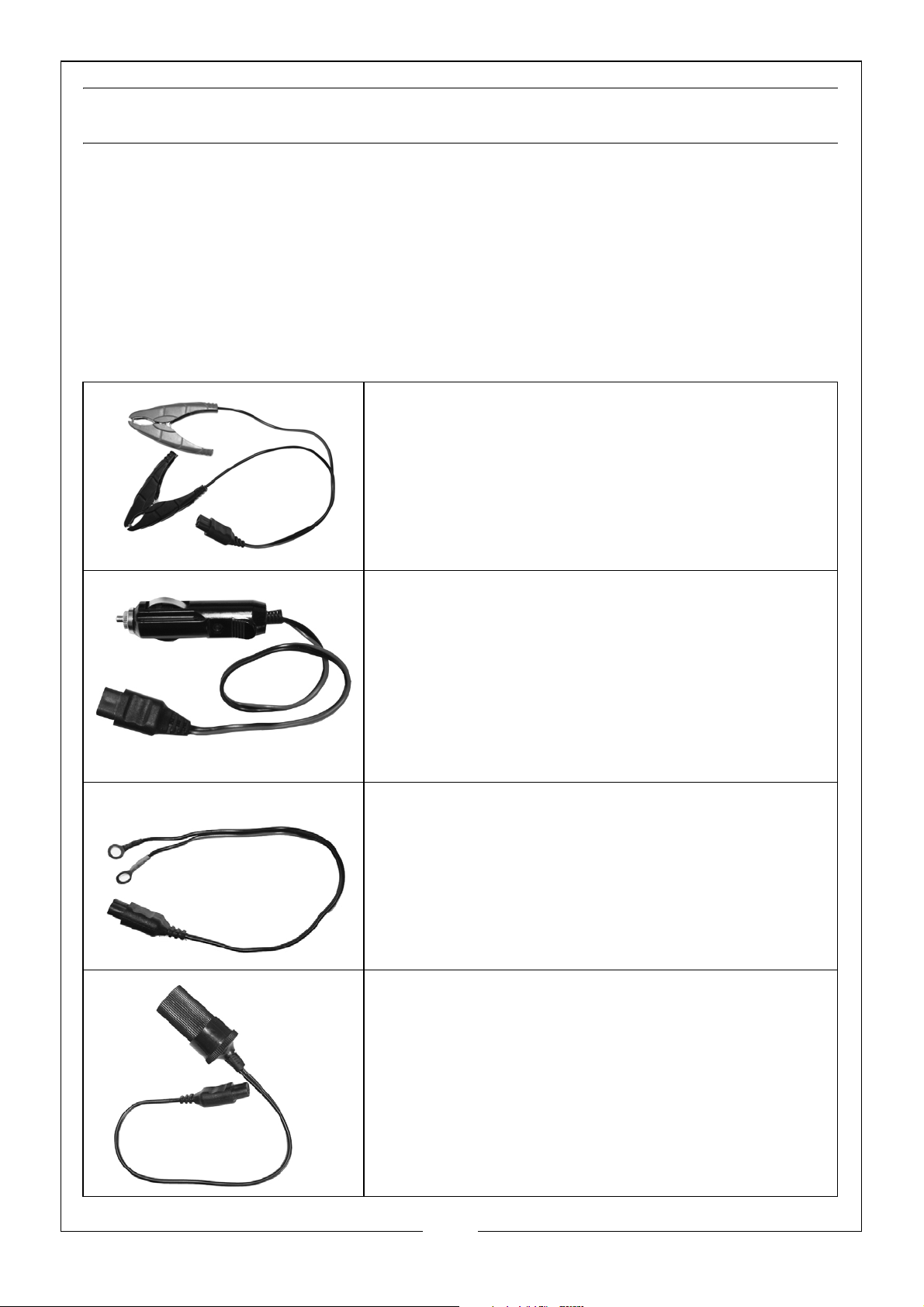
ATTACHMENTS
1. The charger should be connected to the battery or the vehicle accessory
(cigar lighter) socket, before connecting it to the mains supply.
IMPORTANT: Check the vehicle handbook and note whether the vehicle
has a positive earth or negative earth.
2. The output cable from the charger terminates in a socket. Connect one of
the following leads into this socket.
Crocodile clips - for connecting direct to the
battery terminals, positive (Red) and negative
(Black).
Cigar lighter lead - when you want to charge
the battery though the vehicle accessory
(cigar lighter) socket.
NOTE: Not all vehicles allow charging this way,
and doing so can damage the vehicles
electronic systems, see the vehicle
handbook for details on recommended
methods of charging the battery.
Lead (C) is for semi permanent connection to
the battery via eyelets.
Lead (D) offers an opportunity of a power
supply for 12 volt appliances (<5 Amp / 80W
Max) fitted with a vehicle accessory plug.
The other end of the cable terminates with a
plug for connection to the charger lead
socket.
7
Parts & Service: 020 8988 7400 / E-mail: [email protected] or [email protected]
Page 8
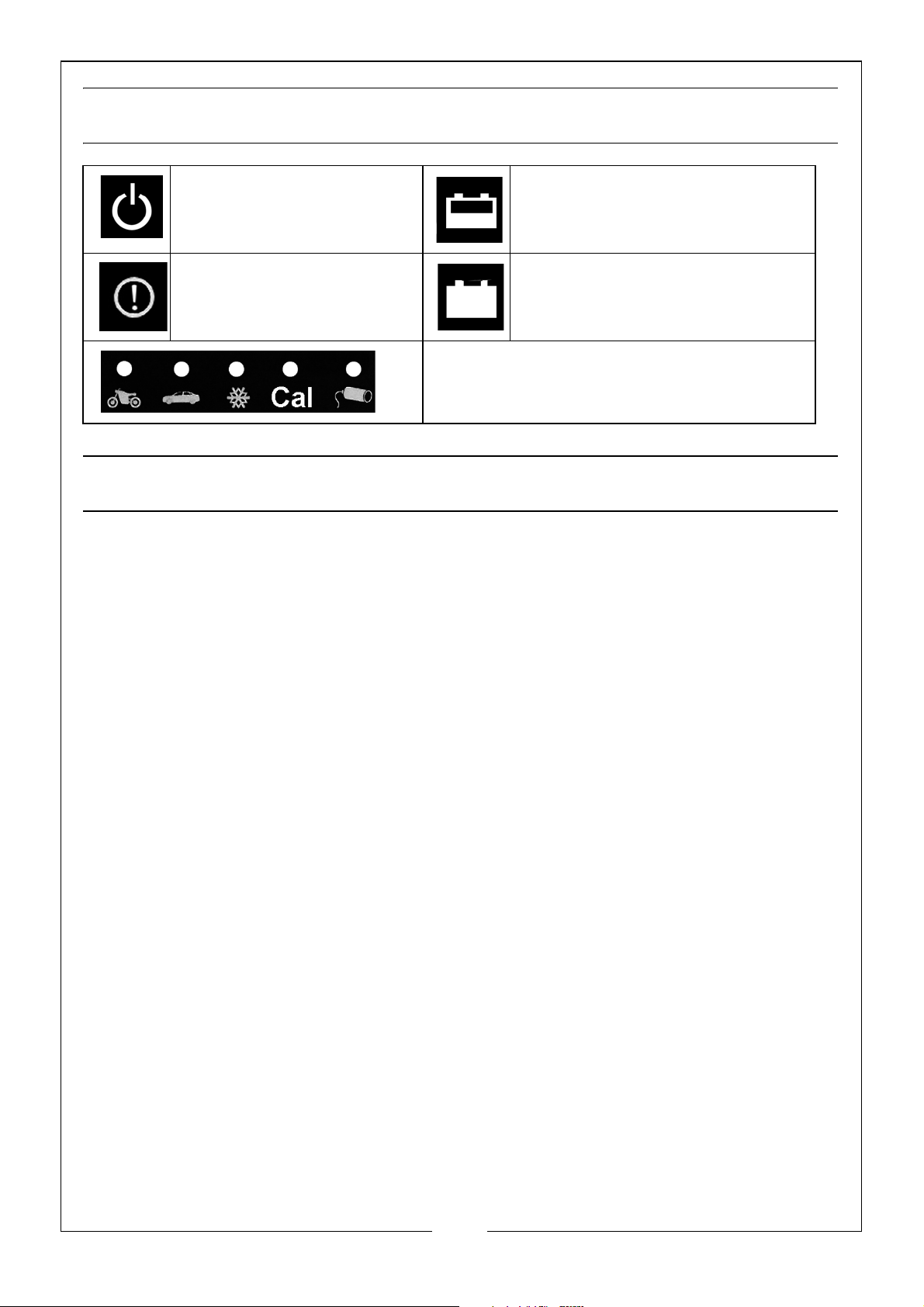
INDICATORS
Power ON Gereen LED Chaging Red LED
Fault Condition Red LED Fully Charged Green LED
Modes (see page 10)
OPERATION
CONNECT THE CHARGER TO THE BATTERY
CONNECTING A NEGATIVE EARTHED BATTERY
1. Make sure that the black clamp is not touching the battery or the fuel line.
2. Connect the positive (+) red clamp to the positive (+) battery post then
connect the negative (-) black clamp to the negative (-) battery post or
vehicle chassis.
CONNECTING A POSITIVE EARTHED BATTERY
1. Make sure that the red clamp on the clamp lead is not touching the
battery or the fuel line.
2. Connect the negative (-) black clamp to the negative (-) battery post then
connect the positive (+) red clamp to the positive (+) battery post or
vehicle chassis.
BATTERY NOT IN A VEHICLE
1. Connect the (+) red clamp to the positive (+) battery post then connect
the (-) black clamp to the negative (-) battery post.
PERMANENT CONNECTION TO VEHICLE USING EYELET LEAD
1. Connect the eyelet on the red (+) wire to the positive (+) battery terminal,
then connect the eyelet on the black (-) wire to the negative (-) battery
terminal.
• Make sure that the cable does not get tangled in any moving parts.
8
Parts & Service: 020 8988 7400 / E-mail: [email protected] or [email protected]
Page 9

CONNECT CHARGER TO MAINS POWER SUPPLY
1. Insert the plug into the mains power supply.
2. Switch on the power supply.
• The “POWER” LED will illuminate.
CHARGER SETUP
1. Press the MODE button repeatedly to select the mode you want to use
(See “Charging Modes” on page 10.) for a full description.
• The LED adjacent to the selected made will be illuminated.
• If the Mode button is pressed again during charging, the charger will
switch to the next charging mode and will function in that mode.
• Once the battery is fully charged and if the charger remains
connected, the charger will switch to trickle charge / maintenance
mode and will remain in this mode even if the user selects another
mode. This protects the battery from being damaged
2. When the “FULL” LED is lit and maintenance mode is not required,
disconnect the charger from the power supply, remove the clamps from
the battery in the reverse order they were fitted.
FAULT PROTECTION
In the case of a short circuit, open circuit, or reversed polarity, the “Fault” (!)
LED will light up and the charger will turn off and revert to standby mode.
The fault must be identified and resolved before any of the charging modes
are initiated.
9
Parts & Service: 020 8988 7400 / E-mail: [email protected] or [email protected]
Page 10
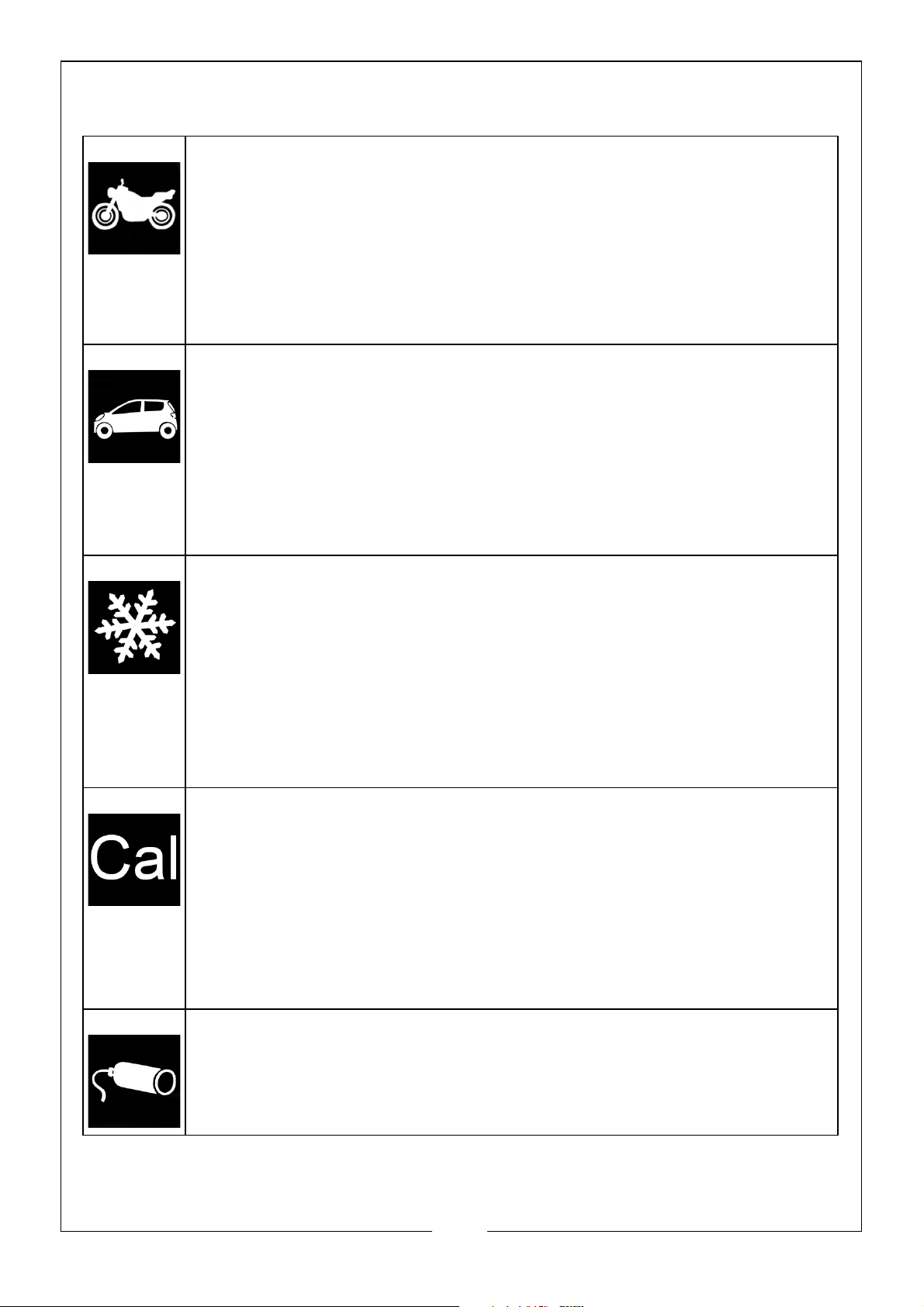
CHARGING MODES
1 This mode is suitable for charging small batteries with a capacity of
6-40Ah.
1. Press the MODE button until the LED adjacent to the
motorcycle symbol is illuminated.
• Charging will start and the 'charging' LED will illuminate.
• When the battery is fully charged the 'charging' LED will
extinguish and the 'fully charged' LED will illuminate.
2 This mode is mainly for charging large batteries with a capacity or
24-160Ah.
1. Press the MODE button until the LED adjacent to the car
symbol is illuminated.
• Charging will start and the 'charging' LED will illuminate.
• When the battery is fully charged the 'charging' LED will
extinguish and the 'fully charged' LED will illuminate.
3 This mode is mainly for charging large batteries with a capacity of
20-160Ah in cold conditions or for charging several AGM batteries
with a capacity over 20Ah.
1. Press the MODE button until the LED adjacent to the ice crystal
symbol is illuminated.
• Charging will start and the 'charging' LED will illuminate.
• When the battery is fully charged the 'charging' LED will
extinguish and the 'fully charged' LED will illuminate.
4 This mode is for lead calcium batteries or a battery below 10.5V with
no capacity to absorb charging current.
• The charger will raise the output voltage up to 17 volts. The
Mode 4 LED will illuminate and flash, the charging LED will
illuminate.
• If the battery cannot be recovered within 2 hours the
“Fault” (!) LED will illuminate. The battery may require
replacing.
5 A DC power supply for use with 12 volt appliances fitted with a
vehicle accessory plug.
• Voltage / Current (12V/5.0A)
• Maximum output power is 80 watts.
10
Parts & Service: 020 8988 7400 / E-mail: [email protected] or [email protected]
Page 11
MAINTENANCE
WARNING: DISCONNECT THE CHARGER FROM THE MAINS POWER BEFORE
SERVICING OR PERFORMING ANY MAINTENANCE.
Other than cleaning, this charger does not require any specific maintenance.
CLEANING
Only use a dry cloth to clean the charger. DO NOT use solvents or cleaning
agents on the casing.
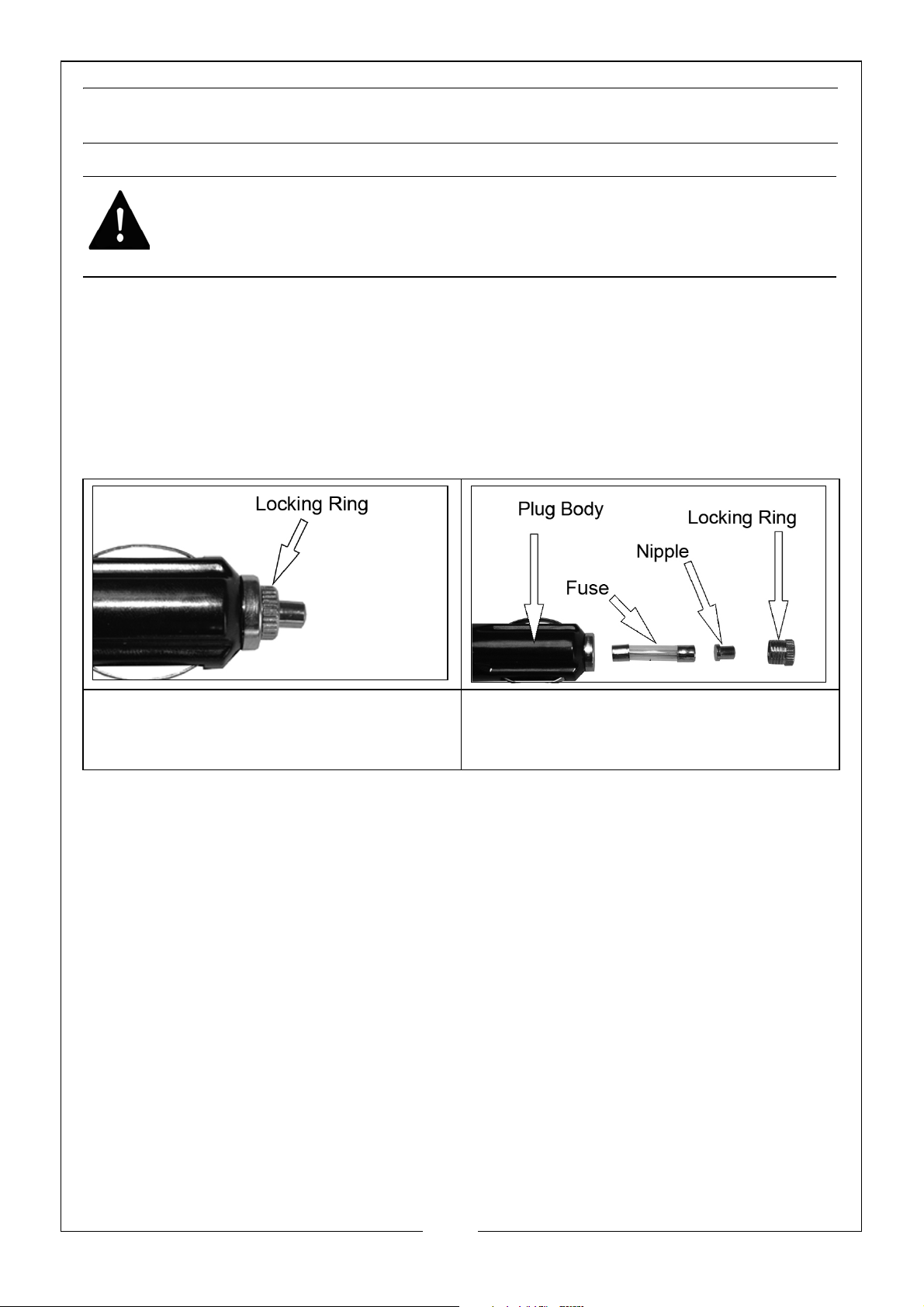
CHANGING THE FUSE IN THE CIGAR LIGHTER CONNECTION
1. Unscrew the locking ring,
making sure that you do not
lose the nipple
2. Replace the 15A glass fuse and
reassemble the plug.
11
Parts & Service: 020 8988 7400 / E-mail: [email protected] or [email protected]
Page 12
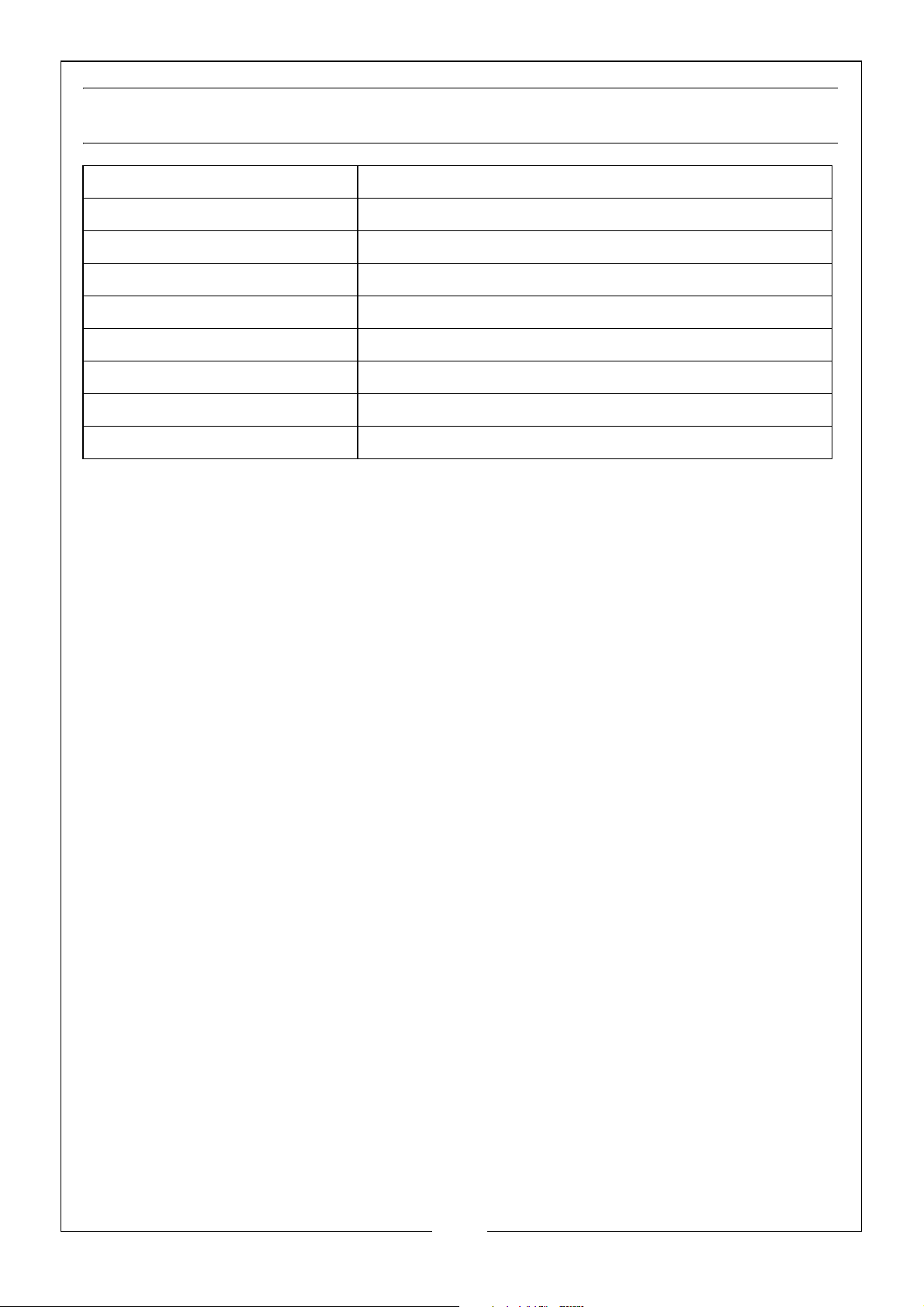
SPECIFICATION
Input Voltage 230V
Battery Voltage 12V
Compatible Battery Types Calcium, Lead acid: SLA, WET, AGM, VRLA
Charging Current 8A
Input Power / Current 130W / 0.57 Amp
Charge Type 9-Cycle
Ambient Temperature -20°C to +50°C
Dimensions (L X W X H) 215 x 95 x 60 mm
Weight 1.2 kg
12
Parts & Service: 020 8988 7400 / E-mail: [email protected] or [email protected]
Page 13
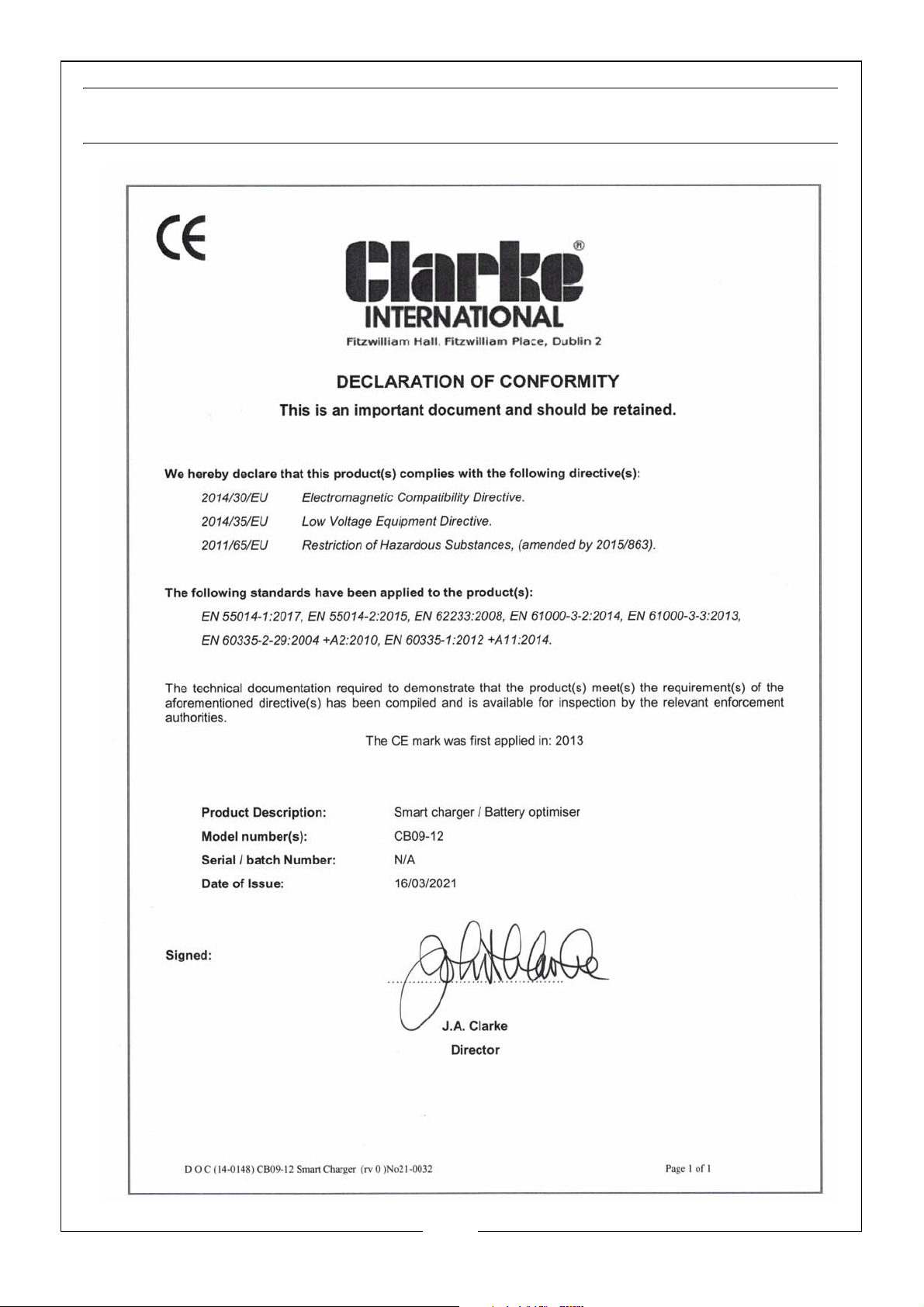
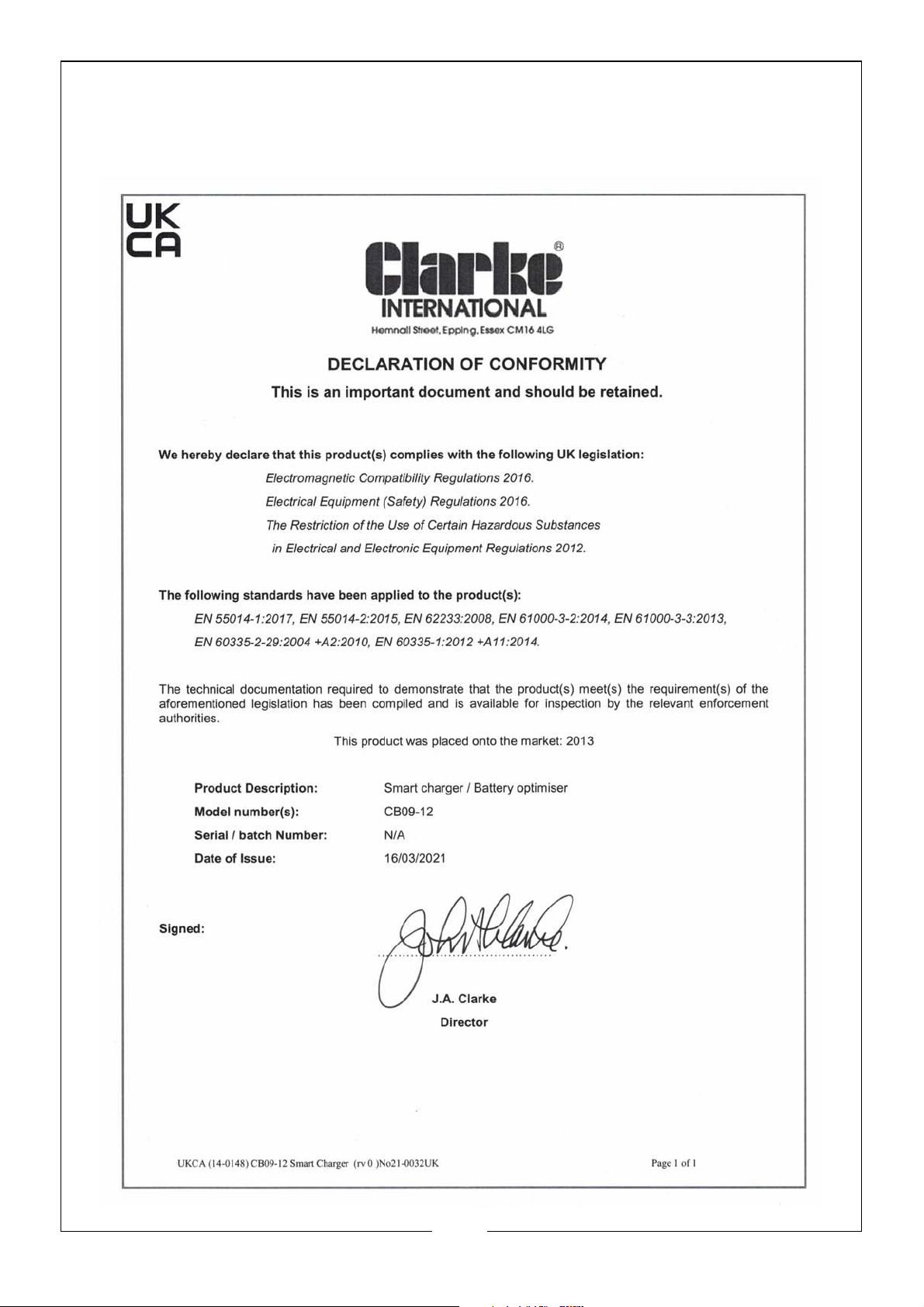
DECLARATION OF CONFORMITY
13
Parts & Service: 020 8988 7400 / E-mail: [email protected] or [email protected]
Page 14
Page 15

Page 16

 Loading...