

Page 1

Issue 44 The VMARS Newsletter
The Clansman UK/PRC-351 and its Variants – Part 2
Murray McCabe
In part 2 of his article, Murray McCabe looks at variants, such as the PRC-352 and BCC-61, together with various
vehicle and transportable installations. He concludes by identifying a number of specific safety risks to avoid when
working on this equipment.
PRC-352
The mechanically band switched 20 watt RF power
amplifier AM-352 can be used with the PRC-351 in two
ways:
a) Attached between the set and the battery and powered
from the set battery. This gives a portage load of 10kg
and a battery life of 6 hours.
b) With its own battery (i.e. two identical batteries are
carried, one for the set and one for the RF amplifier).
This gives a portage load of 12.5kg and returns the
battery life to 12 hours.
The PRC-352 cannot be operated while it is being man
portaged. The AM-352 has only a 50 Ohm BNC output
socket and requires a device like the TUAAM to match to a
whip antenna or a special static ground antenna, suitable for
a 50 ohm feed.
radio sets in close proximity, for example on the same vehicle.
The maximum RF power on tune should not exceed 20
watts, but once tuned the TUAAM can handle 50 watts. Rough
efficiency checks indicate that 20 to 25% of the transmitter
output power is lost in the TUAAM.
There are no manual controls on the TUAAM, just RF
input and output BNC sockets and a 7 pin supply and control
connector. In the unit are more than 50 transistors controlling 3
servo motor driven variable capacitors. The configuration is two
inductively coupled tuned circuits with the antenna fed via a
variable capacitor from the second LC circuit. The first stage of
operation tunes the two LC circuits in sequence against a
dummy load resistor in the unit. It is primarily this resistor rating
that limits permissible tuning power to 20 watts RF. The tuning
of the first 2 tuned circuits is ‘silent’. No power is radiated to
betray the the radio’s position. However, the third stage, the
final matching to the vehicle antenna is incomplete.
Fig.11 TUAAM
Fig.10 AM-352 RF Amplifier
The PRC-352 was originally intended for operation with
a lightweight ground mounted monopole, omni-directional
antenna, shaped like an inverted skeleton pyramid. It had an
overall height of 1m and was of especially light construction
for man portage. Two PRC-352s working with this antenna
had a set-to-set range of about 16 km. The same antenna
could be used with the PRC-351 to provide ranges of about
11 km.
There is little evidence of this antenna in service. It
appears to have been replaced with a ground spike antenna
with an optional elevated kit.
BCC 543 TUAAM (UK M.O.D. No.TN402)
The TUAAM is primarily intended for vehicle use. It
automatically tunes and matches a 2m end fed whip
antenna to a 50 output VHF transmitter at any frequency
in the range 30 to 76 MHz. Matched VSWR at the
transmitter is normally better than 1.2:1 and tuning time less
than 5 seconds. Its operational supply voltage is 32 to 22
volts DC and it weighs 3.5 kg.
The TUAAM has more tuned circuits than necessary as
a matcher. It provides additional RF selectivity that reduces
spurii in transmission and reception. This aids operation of
January 2006 12
RT-351
SKT2
Battery
DCCU
Initiate
Box
Handset or headset
RF Antenna
Fig.12 Simplified ‘Clip-in’ block diagram
In clip-in operation the TUAAM is powered via the Initiate
Box from the RT-351 battery, which in turn, is being charged
from the DCCU. The normal initiate box was BCC 425. It has a
selector switch for ‘N’ normal or ‘S’ silent tuning plus a TUNE
Page 2

The VMARS Newsletter Issue 44
button. In ‘N’ operation pressing and releasing the TUNE
button takes the unit through all 3 stages of matching. If ‘S’
is initially selected only the first 2 stages are completed. The
amber pilot light on the initiate box glows for about 3
seconds during the tuning sequence. If the bulb lights for
about 10 seconds there is an equipment or connection fault.
If a ‘S’ matching operation is performed, the antenna
will be connected before final impedance matching but
reception will still be possible. When radio silence can be
broken switch to ‘N’ and press the TUNE button. The stage
3 final matching will occur in about 1 second.
Transmitter Receiver, BCC 61 (5821-99-630-6155)
The BCC 61 together with pilot’s control box D692/1,
Interface Unit BCC 556, Power Supply BCC 534, TUAAM
BCC 543 and a 1.7m aircraft whip aerial with an integral
impedance matching transformer combine to make
Helicopter radio BCC 306. The BCC 306 had the RAF
designation ARI-23258/1. It is an RT-351 transceiver with
the switches to set the frequency, whip antenna base and
battery toggle clamps removed. A 19-way connector is
mounted in their place to allow the set controls to be cabled
to, and electrically operated from, the remote pilot’s control
box.
The design philosophy adopted was to use a standard
PRC-351 and to bolt external hardware to it. A front panel
assembly was bolted to the PRC-351 with extended knobs that
engaged with the tops of the existing digital frequency setting
switches and the FUNCTION switch. The front panel assembly
also contained a knob for the rear mounted REMOTE switch
plus an extended mechanical drive to the rear of the set. This
bolted on top of the REMOTE switch knob and allowed it to be
controlled from the front of the set. A robust perforated plate
was fitted to the set `top', i.e. over the ON/OFF and REMOTE
switch labels. This provides mechanical protection, especially
for the REMOTE switch drive, and ensures cooling in AFV
applications where the set top can be used as a shelf or a step
for combat boots. These `bolt-ons' account for most of the
tapped holes on the outer surfaces of the set casing.
The VRQ-301 system hardware is similar to that of the
BCC 306 helicopter set, i.e. the PRC-351 with `bolt-ons', as
above, the 20 watt AM-352 RF amplifier as an option, the BCC
543 TUAAM, the BCC 534 Power Supply Unit which is
electrically similar to the BCC 306 PSU but operates over a
wider supply range of 20 to 33Volts DC. Finally there is the
BCC 550 vehicle interface box.
Fig.14 VRQ 301 HP
Without the AM-352 the set is called the VRQ-301 LP
with the AM-352 it is designated VRQ-301 HP.
Fig.13 BCC 61
The BCC 306 was originally intended for Wessex
helicopters with 24V supplies but could be made available
for other voltages. It provided air liaison with ground units at
distances of 30+ km from aircraft flying at 100m over open
country. The US AN/ARC-44 valve set had previously
provided this capability. This set had 100 kHz channel
spacing and covered from 24 to 52 MHz. The ARC-44
worked with the PRC-10 series and similar NATO sets
including VHF/FM Larkspur equipments but it was not
compatible with Clansman VHF/FM radios. It had
inadequate frequency coverage and its transmitter frequency
stability relied, in part, on a free running LC oscillator.
VRQ-301D
VRQ-301
Introduced in 1976, the VRQ-301 is a vehicle version of
the RT-351, intended for use in AFVs, soft-skinned vehicles
or helicopters in which duties it can provide radio
communications plus intercom facilities. The main difference
between it and the BCC 306 is that the controls remain on
the set where they are locally, mechanically adjusted. The
set cannot be tuned remotely.
13 January 2006
The VRQ-301D is a transportable set intended for
operation in hard to reach sites. The set is sometimes remotely
Fig.15. VRQ-301D
Page 3
Issue 44 The VMARS Newsletter
controlled, generally in an air defence role. It is built into a
tubular metal space frame and includes the RT unit with boltons as used on the VRQ-301, the 20 watt AM-352 RF
amplifier, the BCC 543 TUAAM, vehicle type whip base, two
batteries, charger unit (number unknown) and the BCC 553
interface unit.
BCC 307 Clip-in and Portage
Racal originally produced the BCC 307 clip-in
arrangement based on use of the light weight Clansman (or
Para.) pack frame, plus the TUAAM, the TUAAM initiate box
and the BCC 528 battery charger. The radio and the pack
frame plus its portage webbing, all clipped into the vehicle
mounting. The pack frame with webbing weighed 1.4 kg.
The pack frame itself had limited robustness for field service
and was easily bent. Conversely, the French TR-PP 13 and
others had demonstrated that a pack-frame was not
necessary for a man-pack.
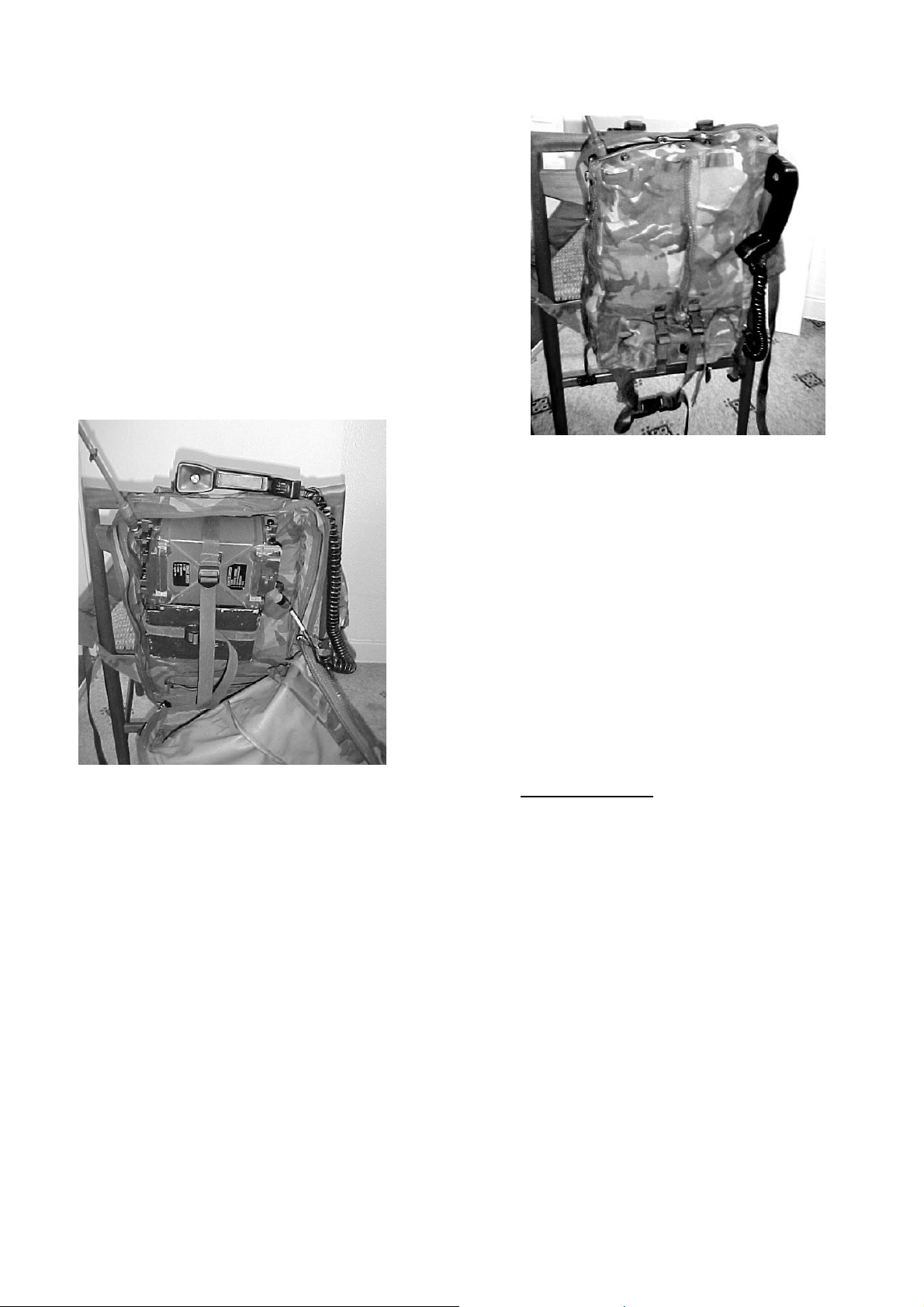
Fig.17. Closed Rucksack
rucksacks such as Rucksack Radio Carrier DPM 5820-99-869-
2113. This rucksack is suitable for use with Radios PRC-320,
350, 351, 352 and Cougar. It has a substantial back pad,
internal straps for all these radio types, an internal pocket for a
spare antenna, space for additional gear and an external pocket
for a spare battery. It also has robust external zips to allow
large, optional side pockets to be attached. It is ‘man-pack only’
and weighs little more than 0.5 kg.
Fig.16. Open Rucksack showing set straps
As a solution the military adopted the stronger, heavier,
GS Mk.2 pack frame and an adaptor plate assembly that
was held to the GS pack frame with ‘tap head’ type butterfly
nuts. The radio was bolted to the adaptor plate. For clip-in
operation the adaptor plate with radio was removed from the
pack frame. Its butterfly nuts were then used to clamp the
radio and adapter to a Dexion mounting in the vehicle.
The weight of GS pack frame, adaptor and webbing
was 3.1 kg. A prime requirement of a man-pack radio is that
its load on the soldier should be minimised. Racal had
gone to significant trouble to hold the weight of the basic
radio plus its battery down to 6.24 kg. It seems illogical to
add 3.1 kg of the GS pack-frame so increasing the soldier’s
load by 50%. This was especially so when the GS packframe was only necessary to cater for the rare event that the
radio might be required for clip-in duty.
Recent newsreels seem to show good sense ultimately
prevailed. PRC-351s are seen carried in
unframed
HEALTH WARNINGS
The insulated washer of the RF power transistors in the
RT-351 and AM-352 are made from beryllium oxide. This
material is highly toxic and must be handled with extreme care
to avoid breakage and/or ingesting or breathing in particles of
the substance.
The meter of the SURF 4W is illuminated by a radioactive
source. There is reputed risk from contamination if the
‘radioactive bulb’ ruptures in a workshop or similar confined
space. Caution is counselled
In his article on battery refurbishment Colin Guy warns
that leakage from defective cells can contain Potassium
Hydroxide, which is poisonous.
It is inadvisable to stand close to the antenna of a PRC352 for more than several minutes when it is transmitting.
.
Acknowledgements
My thanks to John Teague for the photograph of the
VRQ-301D space frame and to all VMARS members and
friends who helped me learn about the RT-351.
~ ~ ~
January 2006 14
 Loading...