

Page 1
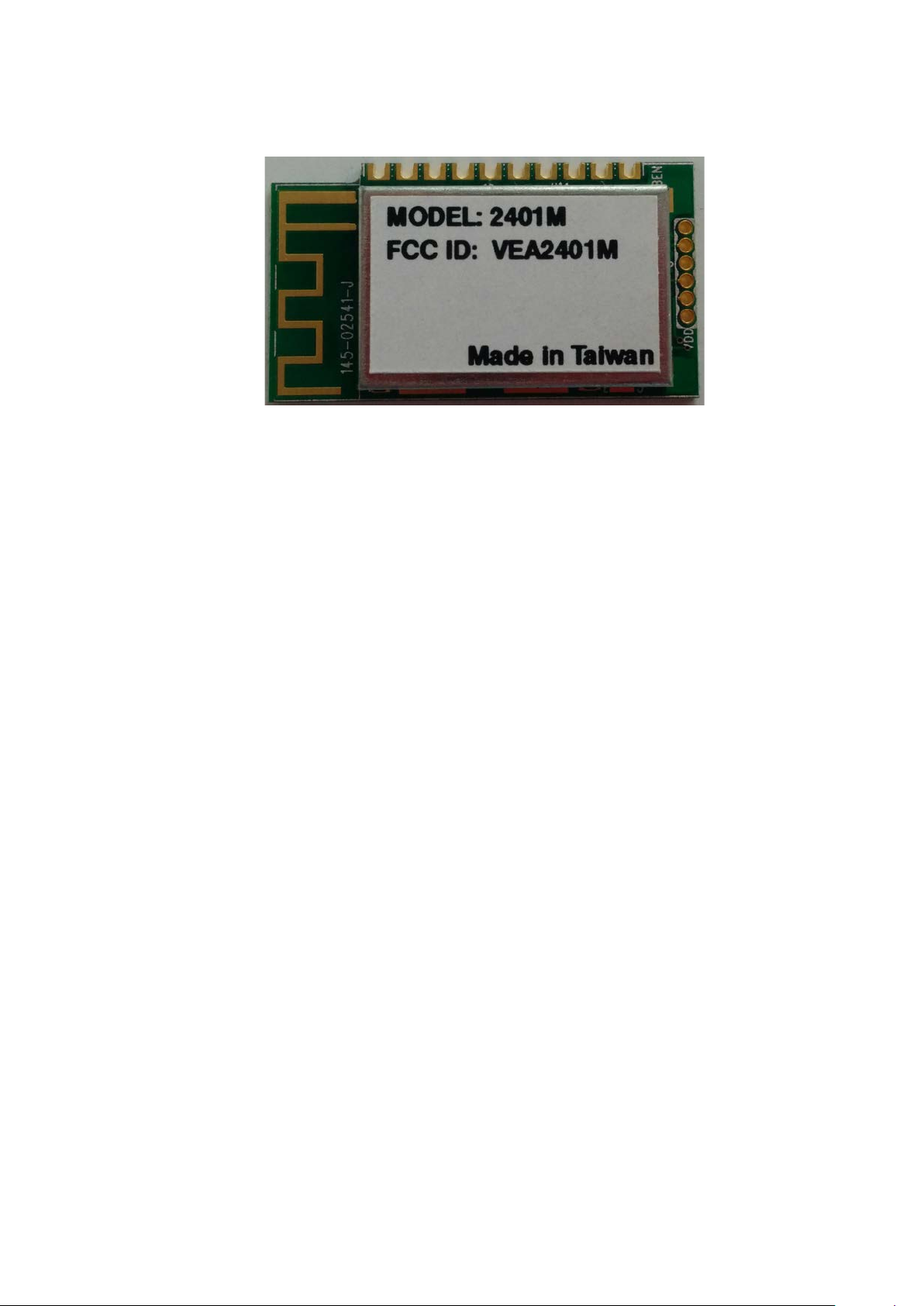
2401M OPERATOR'S MANUAL
1. Features
On-chip low power microcontroller
In system programmable, 256KB
8 KB SRAM
On board crystal and PCB Antenna.
2. Application
Mobile device accessories (Android/iOS)
Wireless data communication
Remote sensors
Page 2
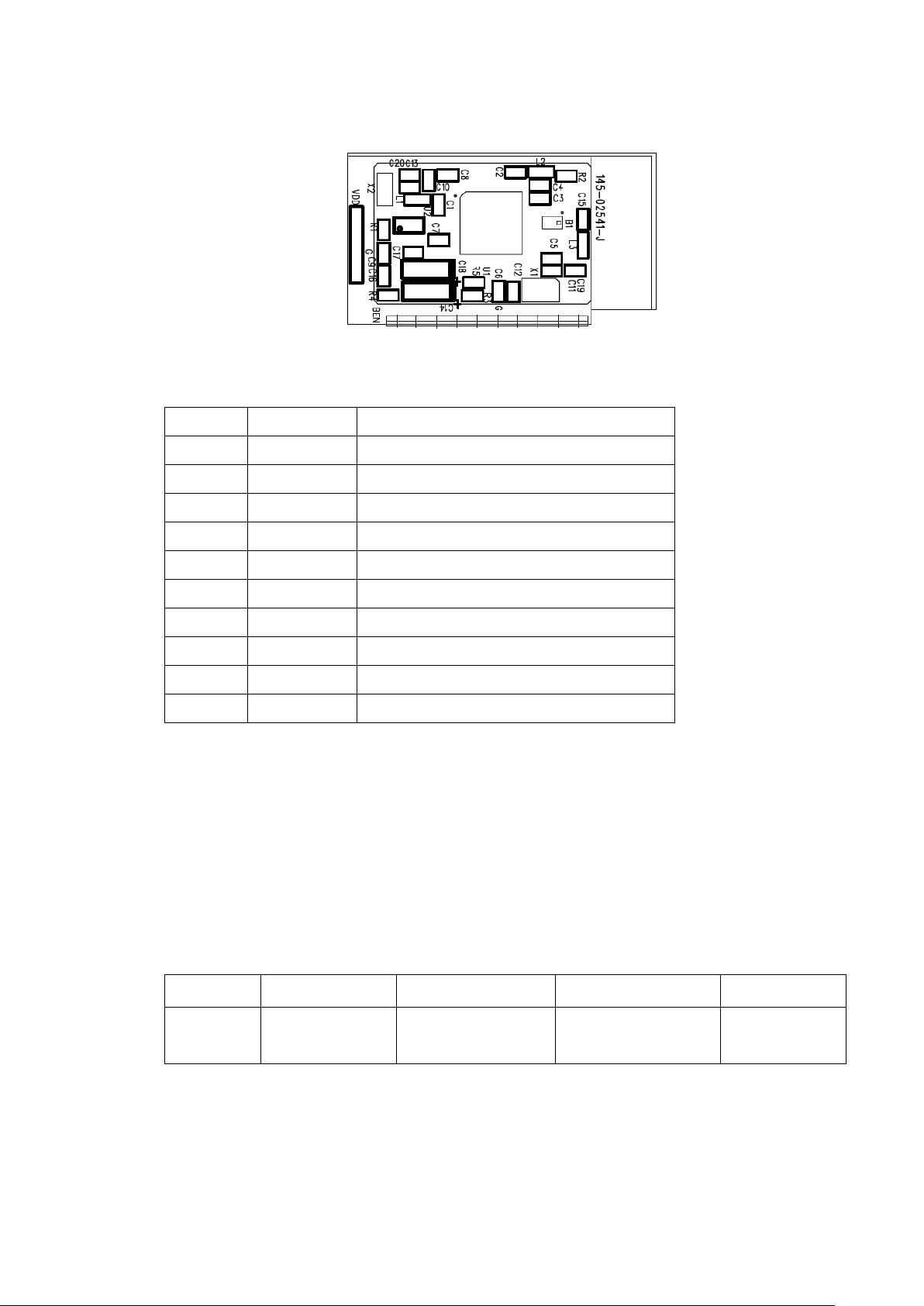
3. Pin Definition
Pin No. Pin Type Function Description
1 Digital I/O GPIO/ UART_RX
2 Digital I/O GPIO/ UART_TX
1 2 3 4 5 6 7 8 9 10
3 Digital I/O GPIO / Digital IO
4 Digital I/O GPIO / Digital IO
5 Digital I/O GND
6 Digital I/O Vcc
7 Digital I/O Vcc Enable
8 Digital I/O GPIO / CTS
9 Digital I/O GPIO / RTS
10 Digital I/O GPIO / Digital IO
4. Protocol :
Communication parameters: 115200 , 8 , n , 1
The maximum of every packet in the two-way communication is 20 Bytes
Every communication will be transferred by the packet, it's an one-inquiry-one-answer
approach.
When a host sends an inquiry packet, clients will answer with a received packet.
Host RXD Time Out:0.5 sec.
Format of command and answer packet:
(1Byte) (1Byte) (1Byte) (1Byte) (nByte)
Start code Length of
packet
Start code of the host, fixed with ‘$’(24H)
Start code of the answer of client , fixed with ‘%’(25H)
Command type and code are defined by HEX Code
Command parameter is based on the conditions of the command, there are HEX Code ,
or ASCII Code.
When a host sends a wrong structure or command of a packet, clients won't answer any
Command Type Command Code Command
Parameter
Page 3

packet.
There are three kinds of command types :
I. General setting , like System reset , battery voltage status and system version.
II. Wireless products communication setting
III. Boot code update-Dongle
Page 4

Federal Communication Commission Interference Statement
This equipment has been tested and found to comply with the limits for a Class
B digital device, pursuant to Part 15 of the FCC Rules. These limits are
designed to provide reasonable protection against harmful interference in a
residential installation.
This equipment generates, uses and can radiate radio frequency energy and, if
not installed and used in accordance with the instructions, may cause harmful
interference to radio communications. However, there is no guarantee that
interference will not occur in a particular installation. If this equipment does
cause harmful interference to radio or television reception, which can be
determined by turning the equipment off and on, the user is encouraged to try
to correct the interference by one of the following measures:
. Reorient or relocate the receiving antenna.
. Increase the separation between the equipment and receiver.
. Connect the equipment into an outlet on a circuit different from that to which
the receiver is connected.
. Consult the dealer or an experienced radio/TV technician for help.
FCC Caution: To assure continued compliance, any changes or modifications
not expressly approved by the party responsible for compliance could void the
user's authority to operate this equipment. (Example - use only shielded
interface cables when connecting to computer or peripheral devices).
End Product Labeling
This transmitter module is authorized only for use in devices where the
antenna may be installed such that 5 mm may be maintained between the
antenna and users. The final end product must be labeled in visible area with
the following: “Contains FCC ID: VEA2401M”
”
End Product Manual Information
The user manual for end users must include the following information in a
prominent location. “IMPORTANT NOTE: To comply with FCC RF exposure
compliance requirements, the antenna used for this transmitter must be
installed to provide a separation distance of at least 5 mm from all persons
and must not be colocated or operating in conjunction with any other antenna
or transmitter.” This device complies with part 15 of the FCC rules.
Operation is subject to the following two conditions (1) This device may
not cause harmful interference and (2) This device must accept any
interference received, including interference that may cause undesired
operation.
Page 5

IMPORTANT NOTE: In the event that these conditions can not be met (for
example certain laptop configurations or c
then the FCC authorization is no longer considered valid and the FCC ID can
not be used on the final product. In these circumstances, the OEM
integrator will be responsible for reevaluating the end product (including the
transmitter) and obtaining a separate FCC authorization. As long as a
condition above is met, further transmitter test will not be required. However,
the OEM integrator is still responsible for testing their end product for any
additional compliance requirements required with this module installed (for
example, digital device emissions, PC peripheral requirements, etc.).
olocation with another transmitter),
 Loading...