

Page 1
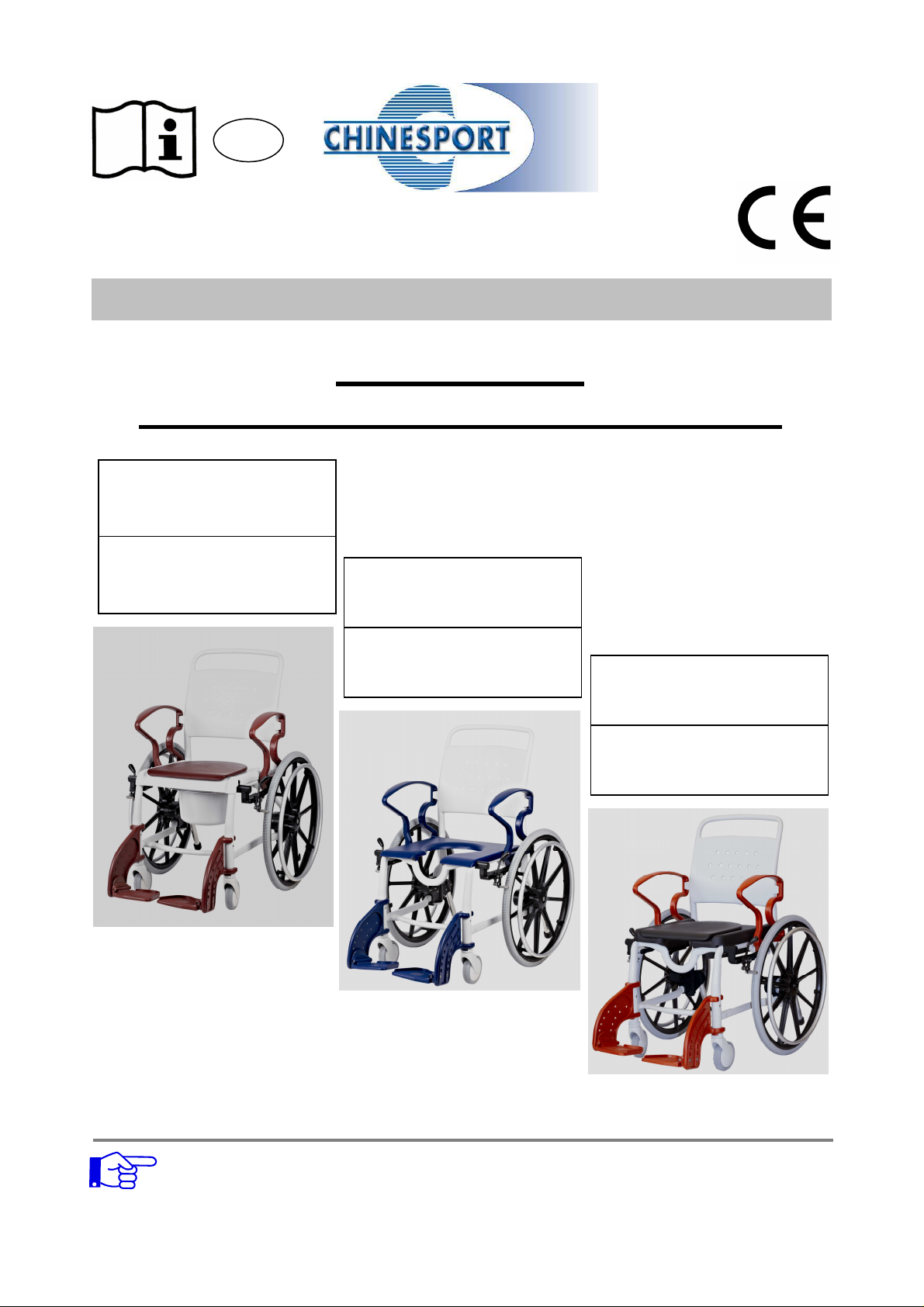
Commode
Wheel
Chair
Serial Number
Shower
Wheel
Chair
Art. No
.:
01818
-
335/
10
0 kg
Serial Number
Shower/Com
mode
Art. No
.:
01822
-
346/
100 kg
Serial Number
Important advisories
!
CHINESPORT SPA
GB
BA No.: 02.07.084/02-12
Shower and Commode Wheel chairs
Art. No.: 01814-345/100 kg
“München“
• Read this User Instructions before first time use of the chair and keep it at hand for the user.
• Adhere to all advisories, especially the safety advisories.
• Keep this User Instructions booklet at hand for future use and subsequent sales.
User Instructions
Selfpropelling
”Lübeck“
Via Croazia 2 – 33100 UDINE
(Italy)
Tel. +39 0432 621621
Fax +39 0432 621620
www.chinesport.com
Wheel Chair “Genf“
Page 2
F
G
Z
A
B
C
E
D
P
K
O
CHINESPORT / BA No.: 02.07.084/02-12 GB
Product description
München Lübeck
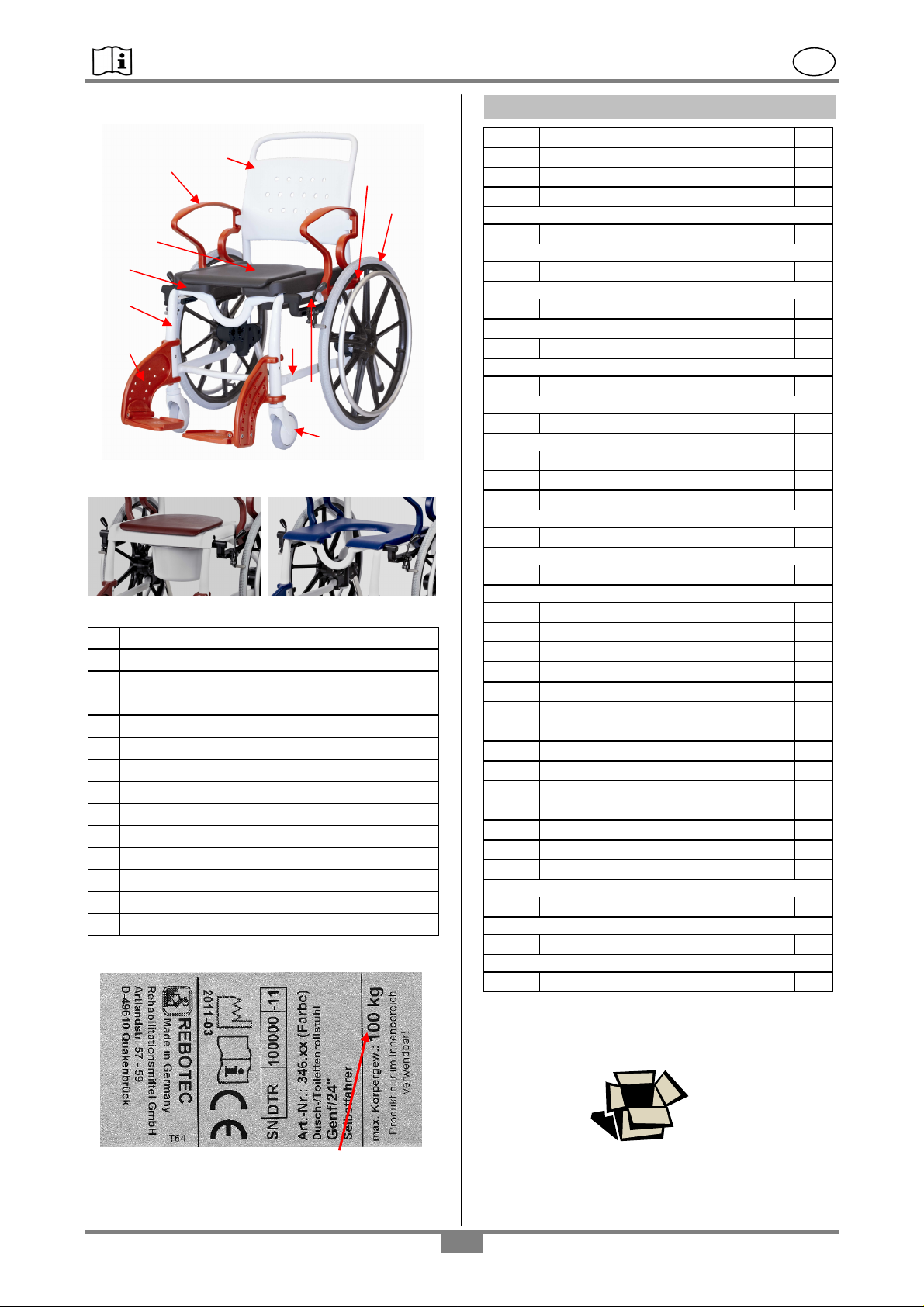
Chair illustration shows:
A
B
C
D
E
F
G
K
L
M
O
P
V
Z
Nameplate (Z) éxample: Genf
V
Backrest
Armrests swingable
Locking pins
Chair frame
PUR seat with or without hygine opening
Shower seat
Toilet seat
PUR seat cushion (removable)
Grip wheels for selfpropelling
Locking brakes for grip wheels
Wheel castor complete without brake
Footrests with foot plates (adjustable)
Commode pan with lid
Nameplate for product
M
The name-plate is very important for product
identification, and thus must not be removed.
Always observe allowable
maximum patient body weight
Table of contents
1.
1.1 Introduction 4
1.2 Intended proper use 4
L
!
1.3 Equipment 4
2.
3.
4.
5.
6.
7.
8.
8.1 Scope of delivery 5
8.2 Technical specifications 5
9.
10.
11.
11.1 Sitting down
11.2 Getting up
11.3 Swivelling the armrests outwards
11.4 Adjusting the footrest height
11.5 Folding away footrests 8
11.6 Removing the footrests
11.7 Removing the seat
11.8 Handling the commode pan
11.9 Using the grip wheel brakes
11.10 Adjusting the grip wheel brakes
11.11 Adjusting seat height setting 9
11.12 Tip-over prevention 9
11.13 Driving over a toilet 9
12.
13.
14.
We recomend, if possible, keeping the packaging
for later transport. This will allow secure packaging
in the event of a return transport.
General advisories 4
Warranty 4
Spare parts orders, complaints 4
Re-use, lifetime 4
Disposal 4
Symbol advisories 4
Safety advisories, use 5
Product specifications 5
Spare parts 6
Setting up the chair for use 6
Using the chair 7
Troubleshooting 10
Care 10
Maintenance 10
7
7
8
8
8
8
8
8
8
- 2 -
Page 3
SN
CHINESPORT / BA No.: 02.07.084/02-12 GB
1. General advisories
1.1 Introduction
In these User Instructions you will find information
and advisories for start-up, use, operation,
maintenance and care of the shower and
commode wheel chair / selfpropelling
1.2 Intended proper use
The shower/commode wheel chair is for homecare
and out-patient purposes. The chair is to be used
exclusively for assistance during showering or
bathing, using a toilet, or for transfer of persons
inside buildings.
The shower must be designed so that the wheel
chair can be rolled into it unhindered. The chair is
not designed for long periods of sitting.
Persons with limited perception, damage to joints
in both arms as well as inability to sit must not use
the patient-propelled chair.
The chair is not suitable for use in wet areas
(e.g. for saunas, areas with swimming poollike conditions, as surface discolouration and
adverse effects on the mechanical strength
can result.
Store the chair only in a dry condition!
Pay attention to the ambient conditions when using
the chair. The chair may be used only for very
short times in conditions that are outside the limits.
Ambient temperature: 0 to 40°C (104oF)
Relative humidity: 30% to 70%.
1.3 Equipment
The chairs are made of a plastic frame with tubes.
The selfpropelling wheel chair has two swivel
castors up front and two grip wheels in the rear
with locking brakes. Both front wheels are height
adjustable.
The armrests can be partially swivelled back. The
footrests are height-adjustable and can be
removed or folded away.
The seat area contains a toilet like opening under
which a commode pan with lid can be pushed in.
The chairs can be rolled over a conventional
bathroom toilet.
(Drive-over height H/B see: 8.2, distance G).
2. Warranty
There is a 2-year warranty on our shower and
commode chairs. A prerequisite for the warranty is
use in accordance to the requirements outlined
herein, as well as conducting regular maintenance.
Excluded are all wear parts.
Not observing the User Instructions, improper
maintenance, unauthorised modifications done to
the product without the manufacturer’s permission
automatically lead to the immediate nullification of
warranty and product liability (see Maintenance).
The delivery date written on the delivery note
applies as the valid start date of the warranty
period.
3. Spare parts orders, complaints
To exclude incorrect spare parts deliveries and to
ensure rapid processing of complaints, always
provide the product name, serial number (SN) and
the product’s year of manufacture. You can find
this information on the chair’s nameplate.
4.
Re-use, lifetime
The product is designed for re-use. The re-use
(lifetime) depends on the product’s condition.
Before re-use, maintenance of the chair must be
conducted and the applicable instructions
concerning safety care and maintenance must be
fully adhered to.
The expected lifetime of the chair can be up to 5
years when used properly and the safety
instructions, maintenance intervals and care
instructions are followed.
Beyond this time period, the chair can be used
further if it is still in a safe condition (after a
complete inspection.
5. Disposal
Products that can no longer be used are to be
disposed of separately from regular household
rubbish. This must be done according to the local
and national regulations for environmental
protection and raw material recycling. Please
contact your local disposal company or officials for
further information.
6. Symbol advisory
Symbol - nameplate:
Read the User Instructions booklet!
Product conforms to the Medical
Products Directive 93/42/EEC.
Year of Manuf. Serial No
Product Product
Symbols in the User Instructions:
Important advisory Language
GB
or information!
Caution – Follow safety advisories!
Care Maintenance
- 3 -
Page 4
Dimensions
CHINESPORT / BA No.: 02.07.084/02-12 GB
7. Safety advisories for use
When using the chair, the following safety
advisories must be observed:
Danger of slipping!
• Before using, check to be sure the seat is
securely pressed into the seat frame.
• Before using the chair always arrest the castor
brakes of the rear wheels (except when moving),
or the locking brakes of the grip wheels in order
to prevent a roll-away of the chair.
• When sitting down into the chair, the user must
not sit on the front edge of the seat or seat
cushion. Be sure the user sits all the way back
on the seat.
Danger of tipping over!
• The chair may be used when sitting and when
rolling only when the armrests are locked into
position.
• The chair may be pushed only using the push
bow (backrest).
• The footrests must be swivelled away or folded
up whenever the patient sits down or gets up.
The patient must never attempt to stand on the
footrests.
• The chair must not bump into door sills, jambs or
on uneven surface.
• Use the chair only indoors and on solid, even,
non-slippery surfaces.
• The chair may be pushed only at a walking
speed or less (with or without the patient).
• Do not lean out of the chair (when the chair is
still or in motion). If the swivel castors are
swivelled inwards, then the stability of the chair
is decreased.
• When adjusting the height of the chair, always
observe the applicable instructions.
Danger of breakage!
• Never attempt to carry or lift the chair while a
patient is sitting on it.
• The chair is suitable only for transporting
persons. Be sure to observe the maximum
allowable patient body weight (specified on
the nameplate)!
• Never expose the chair to wide temperature
variations. Observe the instructions concerning
the temperature range of use (see: 1.2).
• Do not grab hold of or pull on attached objects,
such as armrest cushions.
Danger of pinching!
• To prevent body parts or objects from getting
pinched, never reach into the hinge area when
folding the armrests up or down. Be sure to
check that the hinge areas are unobstructed
before moving the armrests!
• To prevent body parts from getting pinched, do
not reach between the seat and the frame when
pressing the seat into the seat frame.
• Be sure other parts do not get jammed when
folding and unfolding the footrests.
Danger of falling!
• Sitting down, standing up and moving the patient
should be supervised by a qualified care-worker,
as to the health condition of the patient.
• Use of the chair by patients who do not have
complete physical control and normal movement
must not be done unsupervised.
• Rolling the chair on any sloped surface may be
done only with the assistance of a care worker.
Warning! Danger of injury!
• At surface temperatures over 40°C (104°F),
there’s a risk of injury. Therefore do not expose
the chair to any source of heat (exposure to the
sun, storing near a heater, cleaning with hot
water) just before the chair is used. Before using
the chair, allow it to cool down.
8. Product specifications
8.1 Scope of delivery
The product has been carefully inspected in the
factory for freedom of defects and for
completeness. After having received it, carefully
check over the product for possible transport
damages and for completeness
• 1 shower / commode chair (base model)
• 1 backrest
• 1 seat, optional with cover
• 1 commode pan with lid (optional)
• 1 accessory box
• 1 User Instructions
8.2. Technical specifications
We reserve the right to make technical developments
and improvements with respect to the design shown
in the User Instructions booklet.
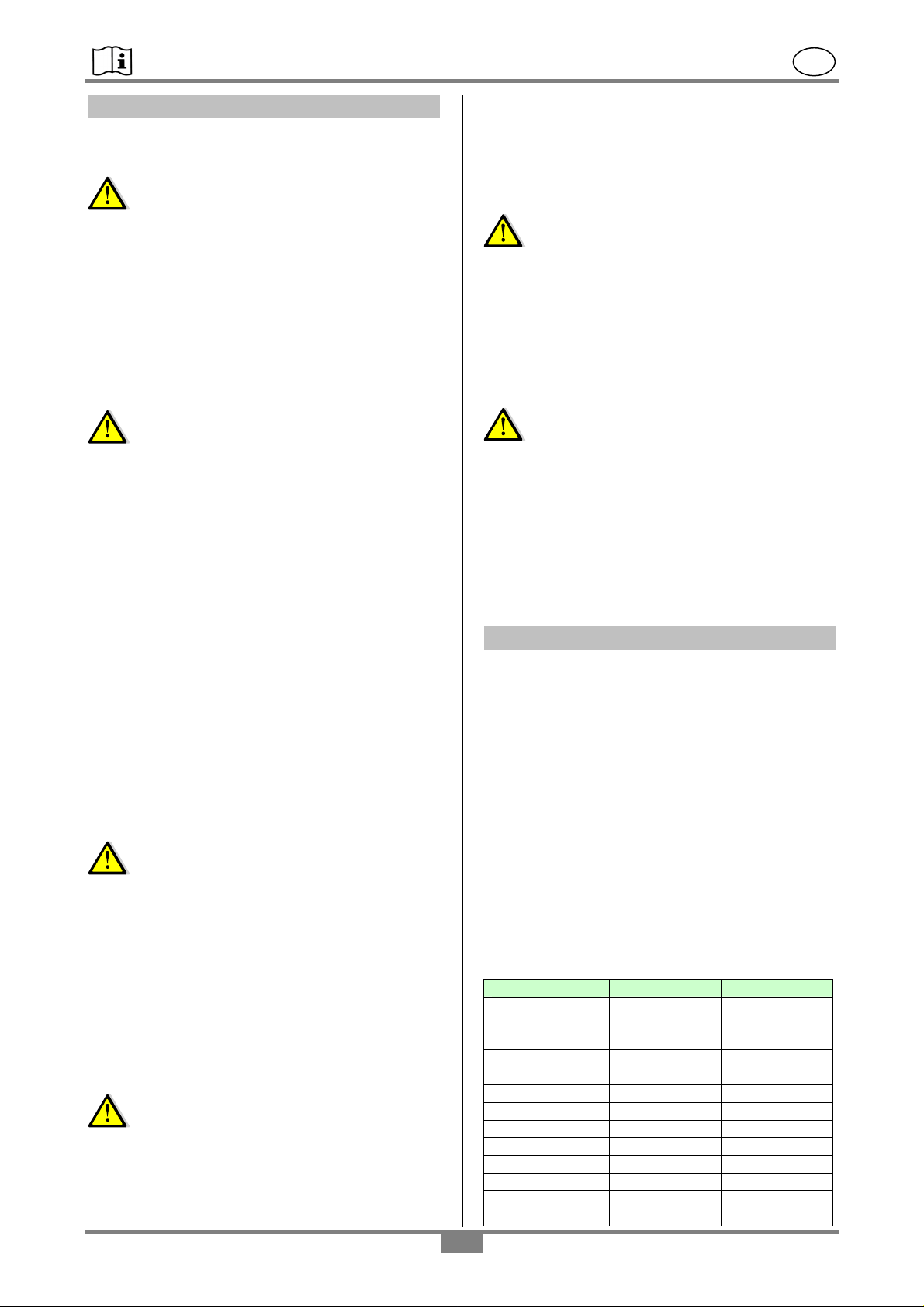
München Lübeck
A. height 102 cm 102 cm
B. width 73 cm 73 cm
C. depth 100 cm 100 cm
D. seat height adj. 53-58 cm adj. 53-58 cm
E. seat width
F. seat depth
G. clearance* H=43/B=36 cm H=43/B=36 cm
H. foot height ca. 32-46 cm 32-46 cm
I1. wheels Ø 5“ / 12.5 cm 5“ / 12.5 cm
I2. grip rim Ø 24“ / 60 cm 24“ / 60 cm
Turning radius 110 cm 110 cm
Body weight max. 100 kg max. 100 kg
Product weight** 24.8 kg 22.8 kg
.
46 cm 46 cm
45 cm 45 cm
- 4 -
Page 5
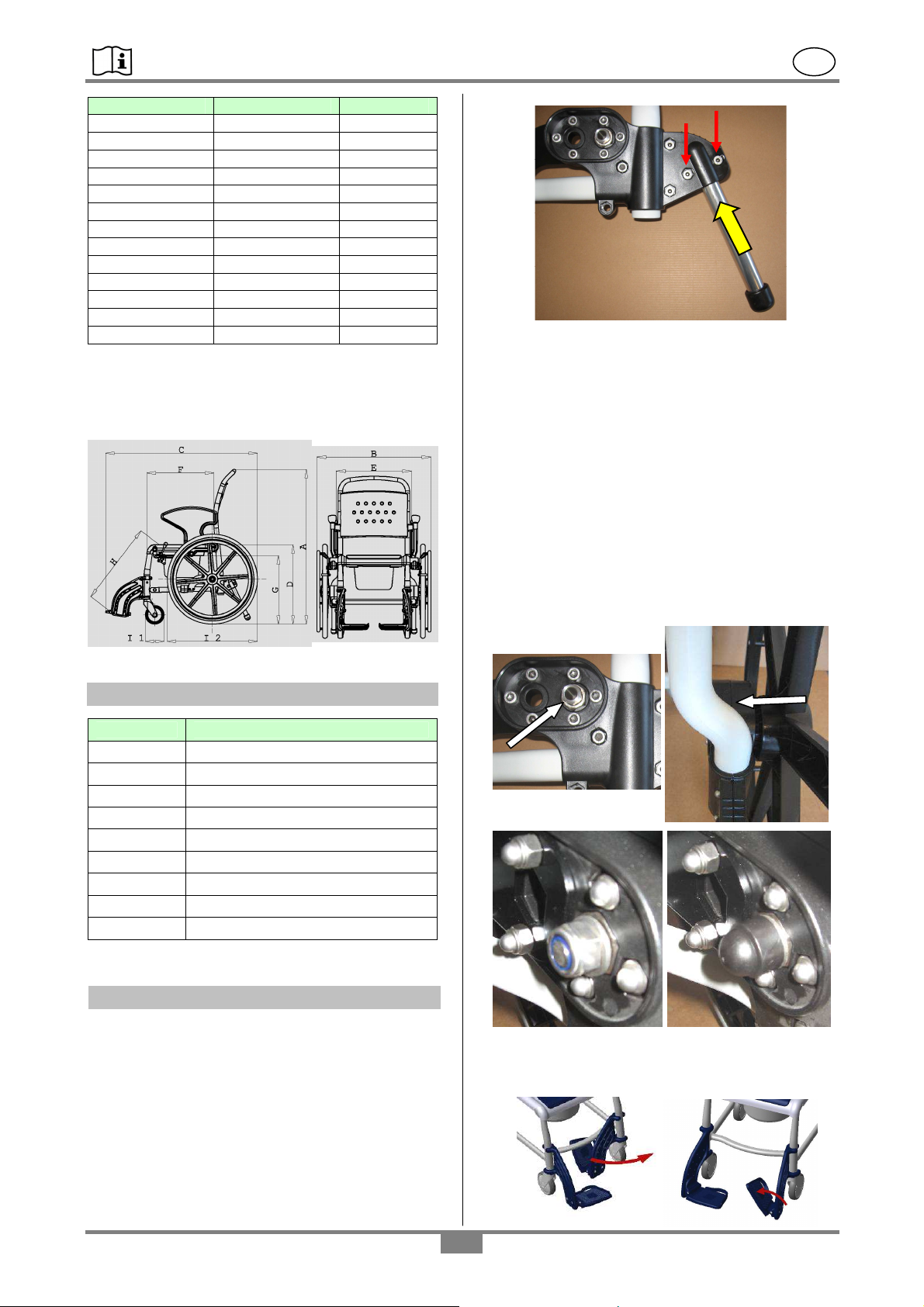
Dimensions
CHINESPORT / BA No.: 02.07.084/02-12 GB
Genf
A. height 102 cm
B. width 73 cm
C. depth 100 cm
D. seat height ca. adj. 57-62 cm
E. seat width 46 cm
F. seat depth 45 cm
G. clearance * H=43/B=36 cm
H. foot height ca. 32-46 cm
I1. wheel Ø 5“ / 12.5 cm
I2. grip rim Ø 24“ / 60 cm
Turning radius 110 cm
Body weight max. 100 kg
Product weight** 25.4 kg
* H = clearance, B = clearance width for toilet
Hv = height adjustable (only the front wheels)
** Product weight without accessories
Diagram:
9. Spare parts
Article No. Name
301.* Commode pan with lid
307.* Commode seat, 2-part
308.54 Shower seat, blue
309.* Pan receptacle
440.10.62 PUR seat cushion
440.10.04 PUR seat with care opening
440. * .60 PUR back cushion
02.07.084 User Instructions - patient-propelled
02.10.071 Maintenance Instructions - chairs
*
provide colour
10. Setting up the chair for use
The product is delivered partially pre-assembled.
The following assembly instructions must be
carried out before first-time use:
1. Install the tip-prevention tube
Lay the chair on its side and insert the head
protection tube (1) (accessory) into the back
open ends of the adapter journal (2). Push into
the tube until it hits the striker and screw it
tight. For both screws, use the Allen key.
Assemble the other side in the same way.
2
2. Install the grip wheels
Put the chair on an even surface for
assembling.
Remove the pre-installed nut from the screw
and pull off the flat washer.
Hold the grip wheel in front of the adapter
journal (1)
Insert the screw through adapter journal (2).
Insert the washer (3).
Screw on the retaining nut (3)
Tighten the nut (with 2 closed ring wrenches
19 mm).
Tighten the grip wheels only so tight that they
are still able to turn.
Finally, press on the black cap (4)
1
3
3. Turn the footrests forwards until they click into
position.
- 5 -
1
2
4
Page 6
1
2
3
3
CHINESPORT / BA No.: 02.07.084/02-12 GB
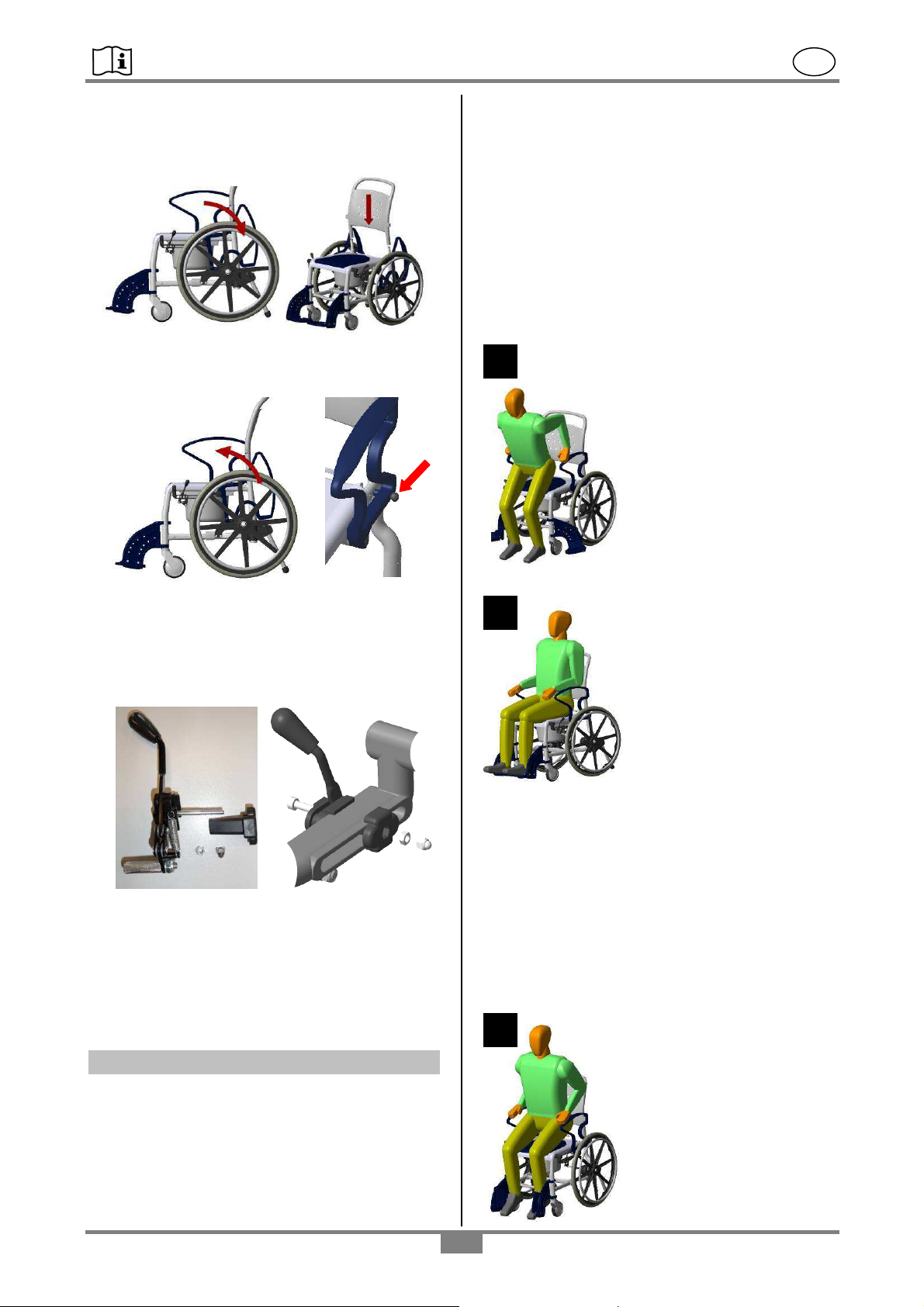
4. Swivel the armrests to the back, insert the
backrest into the steel tubes of the chair frame
and push it down until it hits the striker of the
lower frame.
5. Then swivel the armrests forwards until they
reach the slot of the backrest and click into the
locking pins of the lower frame.
6. Mounting of parking brake
Loosen the nuts (2) and take of the plastic part
(3). Set the parking brake with screw (1)
through the brake holder (4). Srew up the
parking brake with the brake bracket.
Respect left /right!
7. Adjusting the parking brake (see: 11.10).
8. Adjust the foot support height (see: 11.4).
9. Lay the seat cushion on the frame, press it
down until it clamps into place. Then put the
seat cover on. Finally, push in the commode
pan under the seat (see: 11.8 and 11.9).
1
4
2
11. Using the chair
When using the chair, the following points
must be adhered to:
Before use, it must be assured that the chair is in a
proper condition for safe use.
If necessary, depending on the physical and
strength limitations of the user (patient’s ability to
move and muscle strength), sitting down and
getting up should not be done without
assistance from a care worker. The chair may
not be used for long patient transport times.
11.1 Sitting down
Before sitting down in the chair, be sure it is
secured against slipping away (see: 11.9) and
tipping over, that the armrests are locked into
position, that the shower/commode seat is properly
mounted, and that the footrests are folded away to
the side or folded up.
The patient should stand as
closely as possible near the
chair. He should then sit down
slowly on the seat while
supporting himself on both
armrests.
If this is not possible due to his
physical limitations, then a
care-worker must assist him. If
necessary a patient lifter may
have to be used.
Caution – danger of falling!
To prevent the patient from
falling out of the chair, be sure
the patient is seated
completely on the chair, and
not just on the edge.
For transporting the patient, be
sure he is leaned back against
the seat back and be sure he
uses the footrests.
11.2 Getting up
Before getting up, be sure the chair is stable and
secured against slipping away (see: 11.9) and
tipping over, that the armrests are locked in
position, and the footrests are folded away to the
side or folded up.
The patient should then move his body forward
until his feet are flat on the floor.
The patient must then place
both hands on the armrests
and slowly lift himself up.
The patient must not lean too
far forwards, in order to avoid
falling.
The patient should have the
care worker assist him when
getting up.
- 6 -
Page 7
Max
4
CHINESPORT / BA No.: 02.07.084/02-12 GB
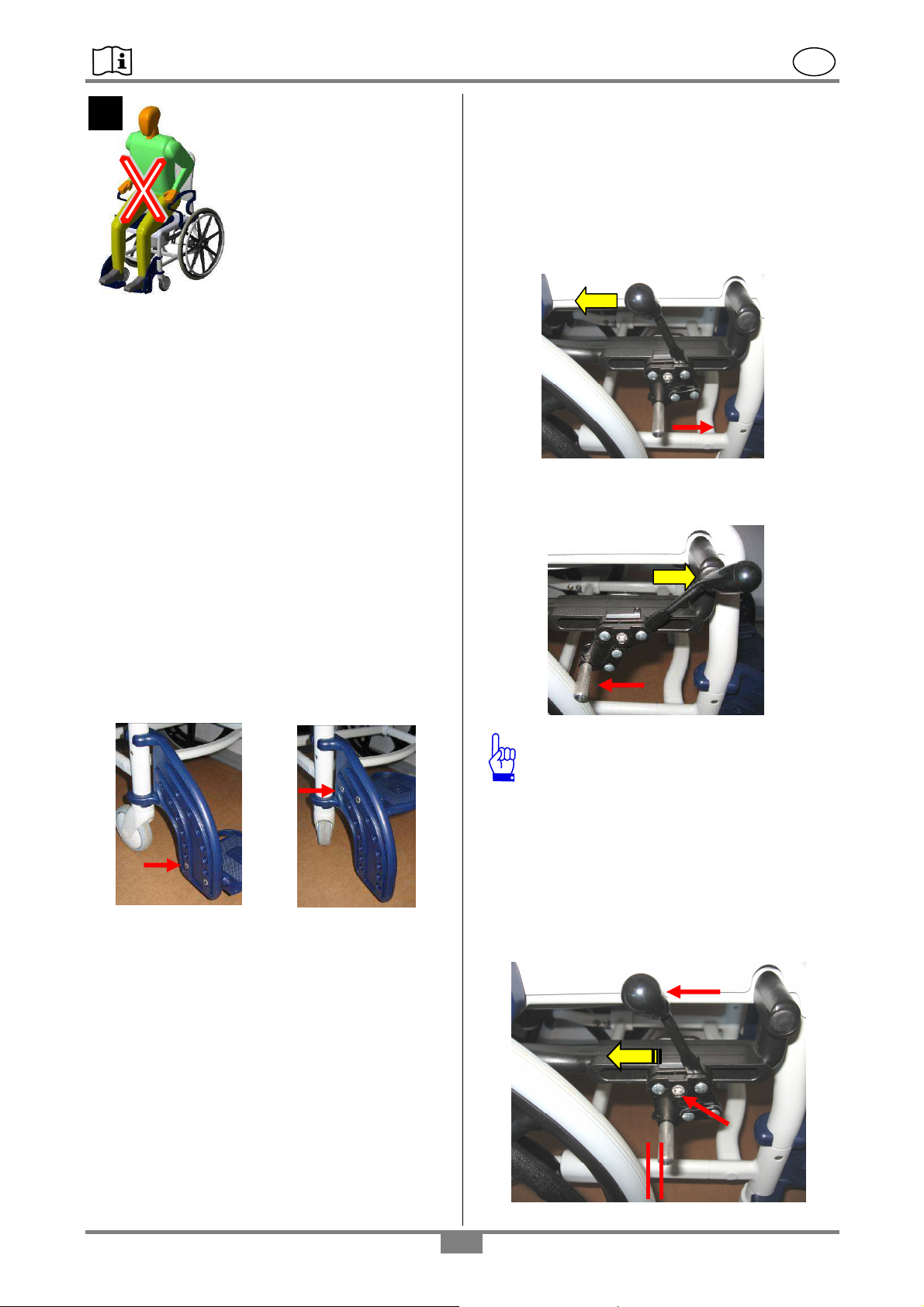
Caution – danger of falling!
The patient must not stand on
the footrests when sitting
down, getting up, or leaving
the chair.
11.3 Swivelling the armrests outwards
By pulling out the locking pin, the locking
mechanism is disengaged and the armrests may
be swivelled back. When swivelling the armrests
up, check to be sure that the armrests are properly
seated in the locking position of the backrest and
locked by the locking pin.
Check the locking mechanism on a regular basis
for impaired function that may arise from calcium
deposits.
11.4 Adjusting the footrest height
The footrests are height-adjustable at 7 stages,
each 25 mm. To do this, unscrew the screws of the
footrests on the side using an SW6 Allen key.
Select the appropriate height and tighten the
screws of the footrest. Be sure the screw is
securely seated.
11.5 Folding away the footrests
Next swivel the footplates upwards and lift the
footrests. The footrests can now be swivelled back
to the side.
11.6 Removing the footrests
Lift up the footrests approx. 10 cm and turn them
outwards 90°. Now you can lift the footrests up and
remove them.
11.7 Removing the shower / commode seat
The seat can be removed from its receptacles for
the purpose of cleaning or exchanging simply by
pulling it up.
Min.
11.8 Handling the commode pan
Push the commode pan under the seat from
behind the chair. To remove the pan, lift it up
slightly and pull it out.
11.9 Using the wheel locks – grip wheel
By pulling (1) back the lever of the wheel brake,
the brake of the grip wheel is released.
By pressing (2) the lever to the front, the grip
wheels are locked. Push the lever all the way
11.10 Adjusting the parking brake
Push the lever (1) all the way back. Slightly loose
the cap nut (2) of the parking brake and screw the
Allen key.
Slide the parking brake about 2cm in front of the
wheel and re-tighten the Allen screw.
Then retighten the nut.
1
2
If the braking effect is not sufficient, or it
diiminishes over time due to wear, then it is
necessary to adjust the brakes (see: 11.10).
2cm
1
2
- 7 -
Page 8
CHINESPORT / BA No.: 02.07.084/02-12 GB
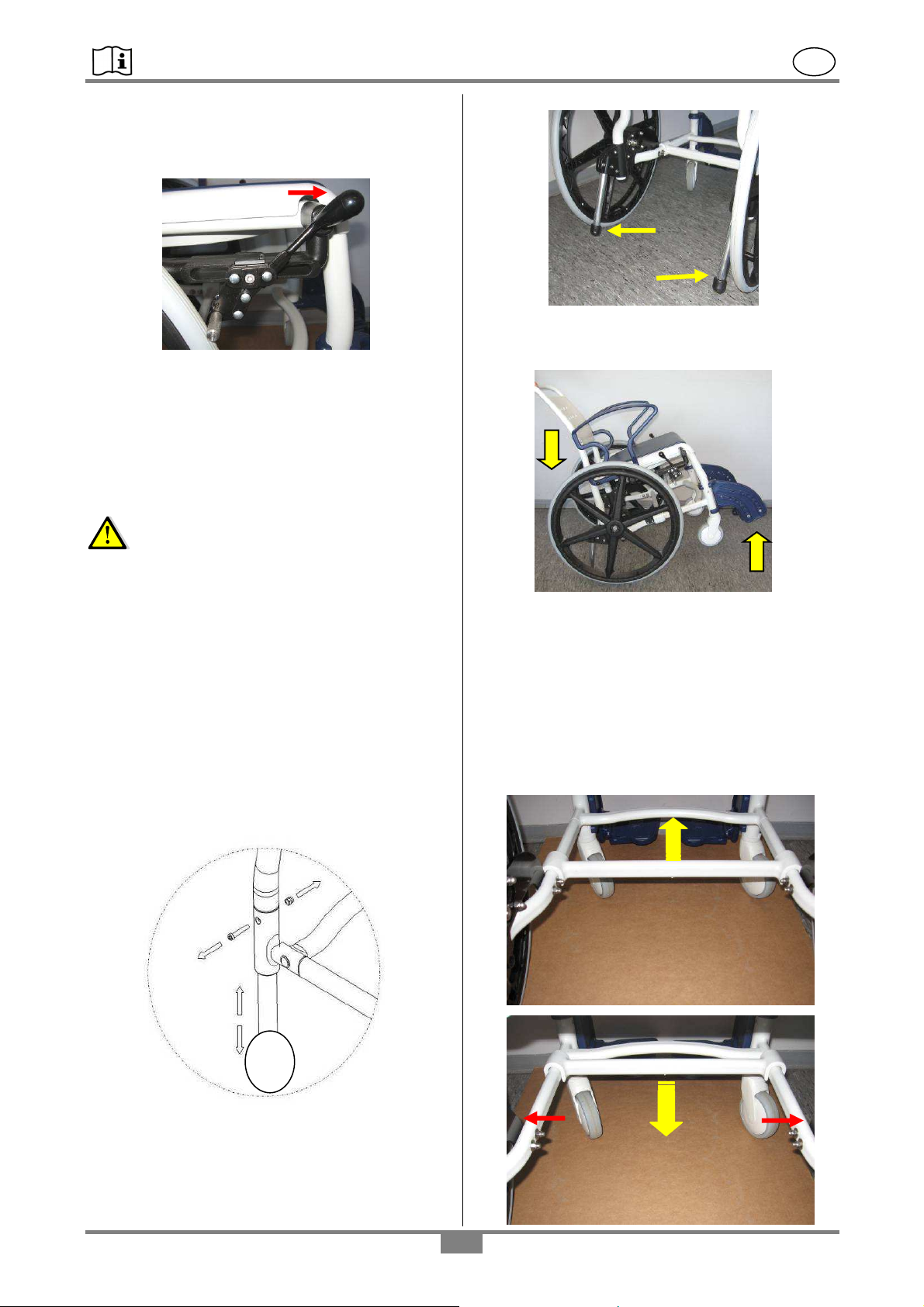
Check the function of the wheel brake by pressing
the lever forwards. If the brake effect is still not
sufficient, then carry out the adjustment steps
again (reduce or increase the distance to the
wheel).
11.11 Adjusting the seat height
Both front wheels in the chair frame of the patientpropelled chair are height-adjustable (2 stages,
each 25 mm). By adjusting the front wheels, the
sitting position of the patient is changed so that the
patient is leaning back against the backrest.
Because of this increased inclination, the
commode pan can slip out.
Danger of tipping over!
Be sure that both wheels are set at the same
height and that the screws are
adequately tightened.
Remove all loose objects (such as toilet pan,
covers) and lay the chair on its side.
Push the footrests all the way up.
Using the Allen key (accessory) completely
unscrew the screws (left rotation) in the wheel
unit. When loosening the screw, press against
the retaining nut.
Pull out the wheel unit until the next holes line
up.
Screw the wheel unit back on firmly (right
rotation) and push the footrests back down.
Clean the chair before using it again!
11.12 Tip-over protection
In order to overcome objects, the patient-propelled
chair can be tipped back. In doing so, the front
wheels are lifted up from the ground, thus allowing
an obstacle to be overcome.
Firmly place both hands on the backrest and tip
the chair back until the fixed legs almost reach the
floor.
11.13 Driving over a toilet
When driving over a commode, attention must be
paid to the clearance (see: 8.2 dimension G).
To assure that the chair can be rolled with enough
clearance over the toilet, push the cross-brace with
you hand until it hits the striker at the front brace
(A). After the commode is finished being used, the
cross-brace (B) must be pushed back to the striker
at holder (C) in order to assure the chair’s stability.
A
B
B
C
- 8 -
Page 9
CHINESPORT / BA No.: 02.07.084/02-12 GB
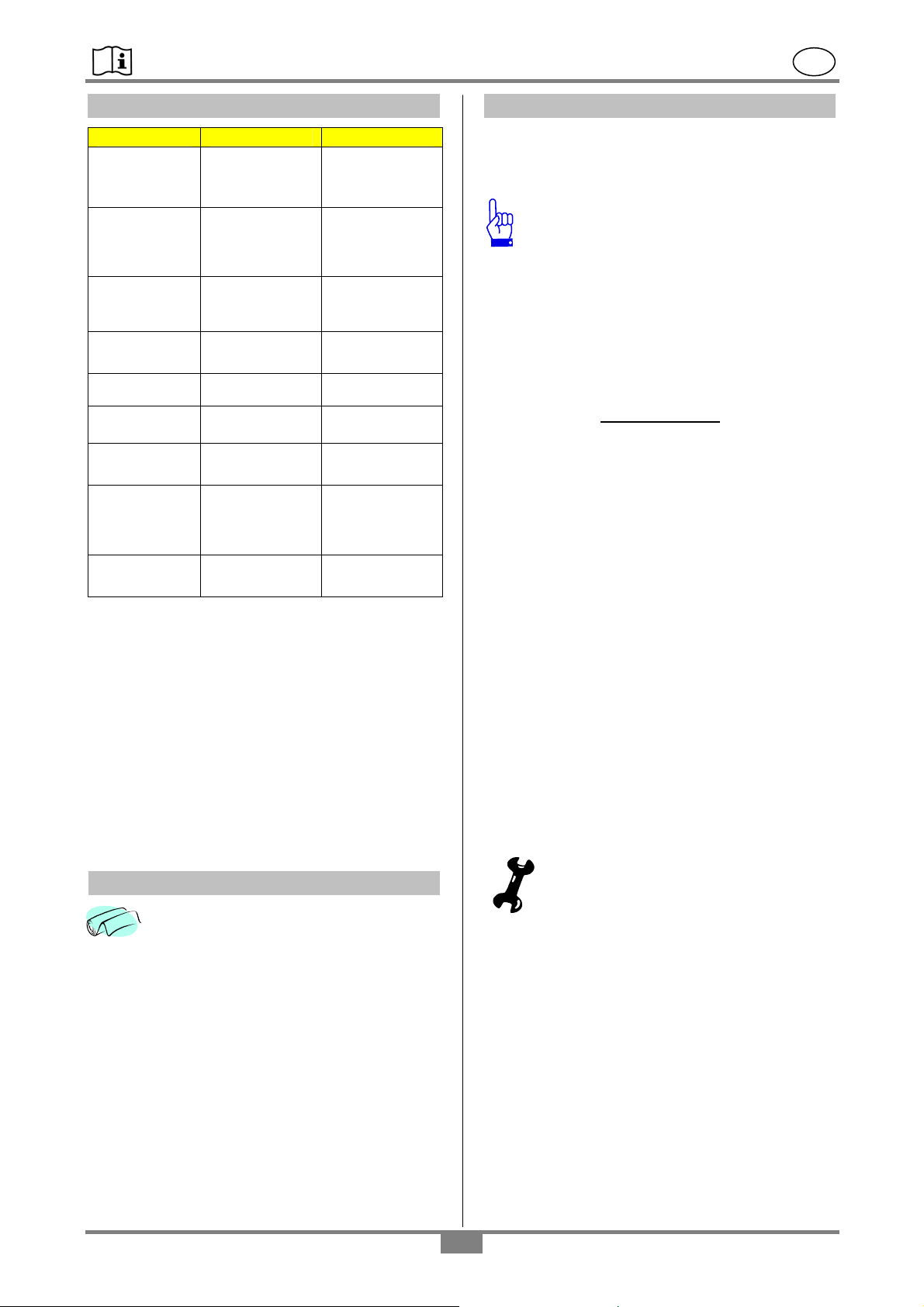
12. Troubleshooting
Fault Poss. cause Correction
Armrests do
not swivel
properly
Locking pins
cannot be
pulled out
Footplate
cannot be
flipped
Brake lock
does not brake
Wheel turns
with difficulty
Wheel does
not turn
Wheel is no
longer round
Chair frame
too unstable
Castor wheels
are bent
Locking pins are
caked up with
deposits
Caked up,
tension spring is
jammed or
defective
Deposit build-up
in the hinge,
jamming
Generally
defective
Deposits, bulidup
Generally
defective
Wheel is
unevenly worn
Screws are
loose
Crashed into
obstacles
Clean, check
periodically
Clean,
replace locking
pin
Clean,
check screw
connection
See Section
Maintenance!
Clean
See Section
Maintenance!
See Section
Maintenance!
Tighten the
frame screws
and the wheel
units
See Section
maintenance!
13. Care
In general the chair can be cleaned using
a mild conventional cleaning and
disinfecting agent. Simply wipe the chair
with clean water and cloth, and then wipe
Do not use an abrasive scouring agent or cleaner
(read the product instructions!) that contain
aggressive solvents (acids, thinners). Do not use
stiff cleaning brushes, as these will damage the
plastic surfaces or cause deposits to build up on
the plastic parts and other materials.
When using the product in a clinical area, the
shower/commode chair must be cleaned on a
regular basis at 85°C for 3 minutes in a cleaning
machine, in addition to general cleaning. First
remove any loose accessories.
dry with a clean cloth.
14. Maintenance
The cause of accidents or damage may be due to
the late detection of wear and/or improper use, as
well as irregular or no maintenance.
For safety reasons and for preventing
accidents, the chair must undergo a
complete maintenance at least once a
year. (Refer to the Medical Products Act and
the local regulations-MPBetreibV).
For documenting maintenance REBOTEC offers a
maintenance manual (see: Section 9.).
Here you will find all information concerning the
scope of maintenance and forms for
documentation.
You can order this instruction manual or download
it at our website: www.rebotec.de.
Maintenance extent
Check at regular time intervals:
The intervals depend on the frequency the product
is used and on the condition of the product.
• Check for apparent damage:
(cracks, fractures, loose parts)
• All screwed connections for tightness
(especially the castor wheels and the frame).
• Function of the armrests and locking pins.
• Function of the footrests
(replace defective footrests).
• Rolling ability, check function of the wheels
(replace defective wheels).
• Check accessories for defects
If you have questions concerning
maintenance and repairs to the chair, then
contact an authorised dealer or medical
equipment supply outlet.
When making repairs, use only original spare parts
from REBOTEC. Observe all advisories concerning
guarantee and warranty.
Never make any unauthorised modifications or
conversions to the chair. These will only adversely
affect the safety and function of the chair.
In such cases the manufacturer overtakes no
liability!
Follow all the instructions when ordering spare
parts, re-use and product lifetime of the chair.
After a complete maintenance or repair of the chair
is done, we recommend a complete cleaning for
assuring hygiene. Follow the cleaning instructions.
- 9 -
Page 10
CHINESPORT / BA No.: 02.07.084/02-12 GB
Notes:
Manufacturer:
REBOTEC® Rehabilitationsmittel GmbH
DE-49610 Quakenbrück, Artlandstr. 57-59
Telephone: (+49) 5431/9416-0
Telefax: (+49) 5431/9416-66
http://www.rebotec.de
E-mail: [email protected]
- 10 -
 Loading...