

Page 1
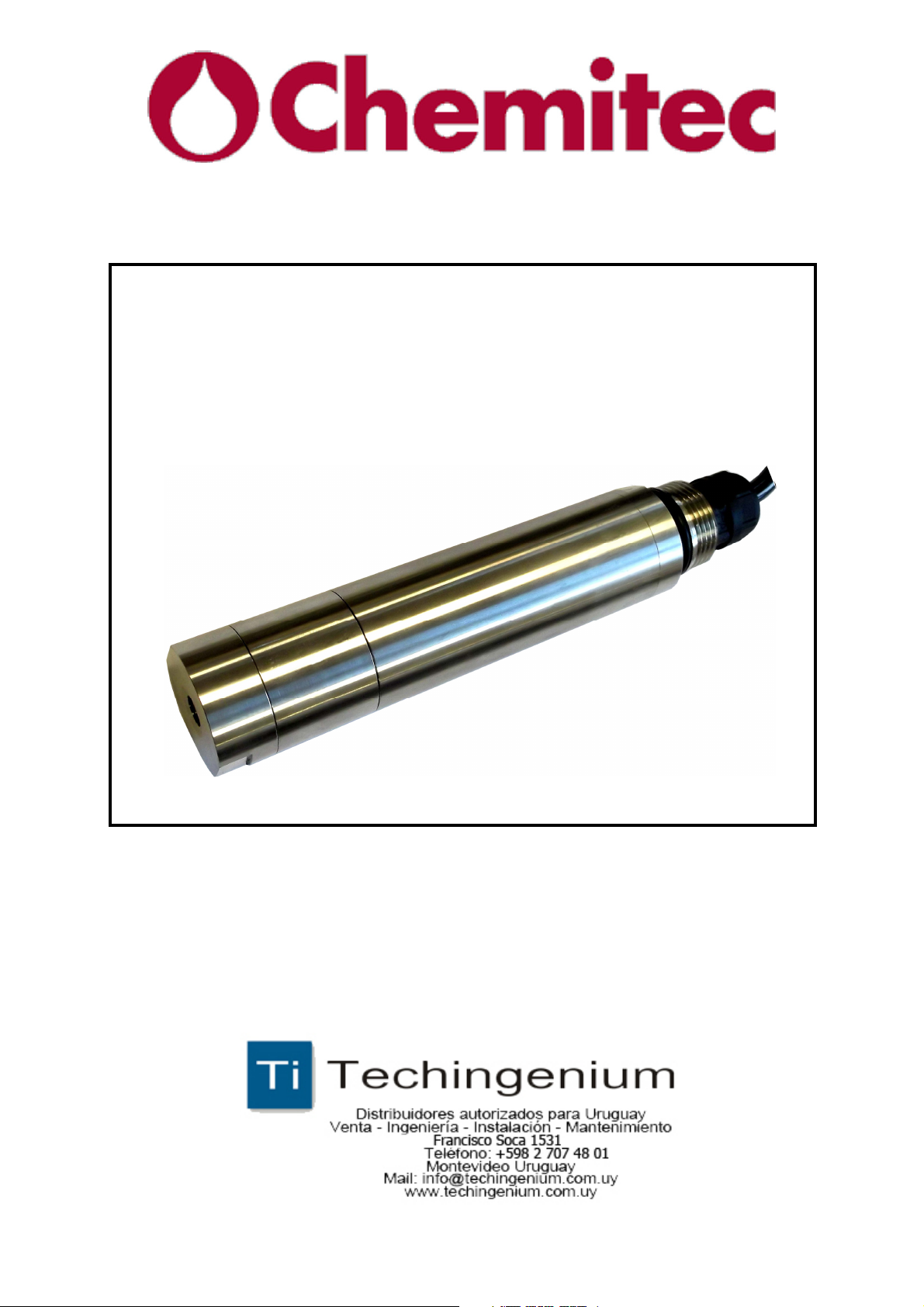
S423/C/OPT
SONDA OSSIGENO OTTICA
OPTICAL OXYGEN PROBE
MANUALE TECNICO / TECHNICAL MANUAL
P/N: ………………….
Rev. 0 Ver. 1.0
EDIZIONE Febbraio 2014 / EDITION February 2014
Page 2

SS442233//CC//OOPPTT OOppttiiccaall
OOxxyyggeenn PPrroobbee
DDaattaa SShheeeet
t
The S423/C/OPT probe is used for the optical measure of oxygen in pure
and process waters. The principle of measurement is based on the effect of
dynamic luminescence quenching by molecular oxygen.
Applications
• Measure of oxygen in wastewater
• Measure of oxygen in primary, industrial, recirculating water
Features and benefits
• Reliable concentration measurement
using optical measuring process
• Dynamic luminescence measuring method
• AISI 316 or Black rigid PVC sensor body
• Interchangeable cap for luminophore’s replacement
• No mechanically moving parts
• Immediate installation and easy manteinance
• Ability to set salinity and barometric pressure for the compensation of the
oxygen value
Operating principle
The collision between the luminophore in its excited state and the quencher
(oxygen) results in radiationless deactivation and is called collisional or
dynamic quenching. After collision, energy transfer takes place from the
excited indicator molecule to oxygen which consequently is transferred from
its ground state (triplet state) to its excited singlet state. As a result, the
indicator molecule does not emit luminescence and the measurable
luminescence signal decreases.
A relation exists between the oxygen concentration in the sample and the
luminescence intensity as well as the luminescence lifetime which is
described in the Stern-Volmer-equation (1). Here, τ0 and τ are the
luminescence decay times in absence and presence of oxygen (I0 and I are
the respective luminescence intensities), [O2] the oxygen concentration and
KSV the overall quenching constant.
S423/C/OPT Optical oxygen probe – Data Sheet 9
Page 3

SS442233//CC//OOPPTT OOppttiiccaall
OOxxyyggeenn PPrroobbee
Principle of dynamic luminescence method:
DDaattaa SShheeeet
I0/I = T0/T= 1+Ksv*O2
I=f(O2) T=f(O2)
Where:
I: Luminescence intensity in presence of oxygen
I0: Luminescence intensity in absence of oxygen
τ: Luminescence decay time in presence of oxygen
τ0: Luminescence decay time in absence of oxygen
KSV: Stern-Volmer constant (quantifies the quenching efficiency and
therefore the sensitivity of the sensor)
[O2]: Oxygen content
t
Principle of dynamic quenching of luminescence by molecular oxygen
(1) Luminescence process in absence of oxygen
(2) Deactivation of the luminescent indicator molecule by molecular oxygen
S423/C/OPT Optical oxygen probe – Data Sheet 10
Page 4
SS442233//CC//OOPPTT OOppttiiccaall
Composition of the supply
OOxxyyggeenn PPrroobbee
DDaattaa SShheeeet
t
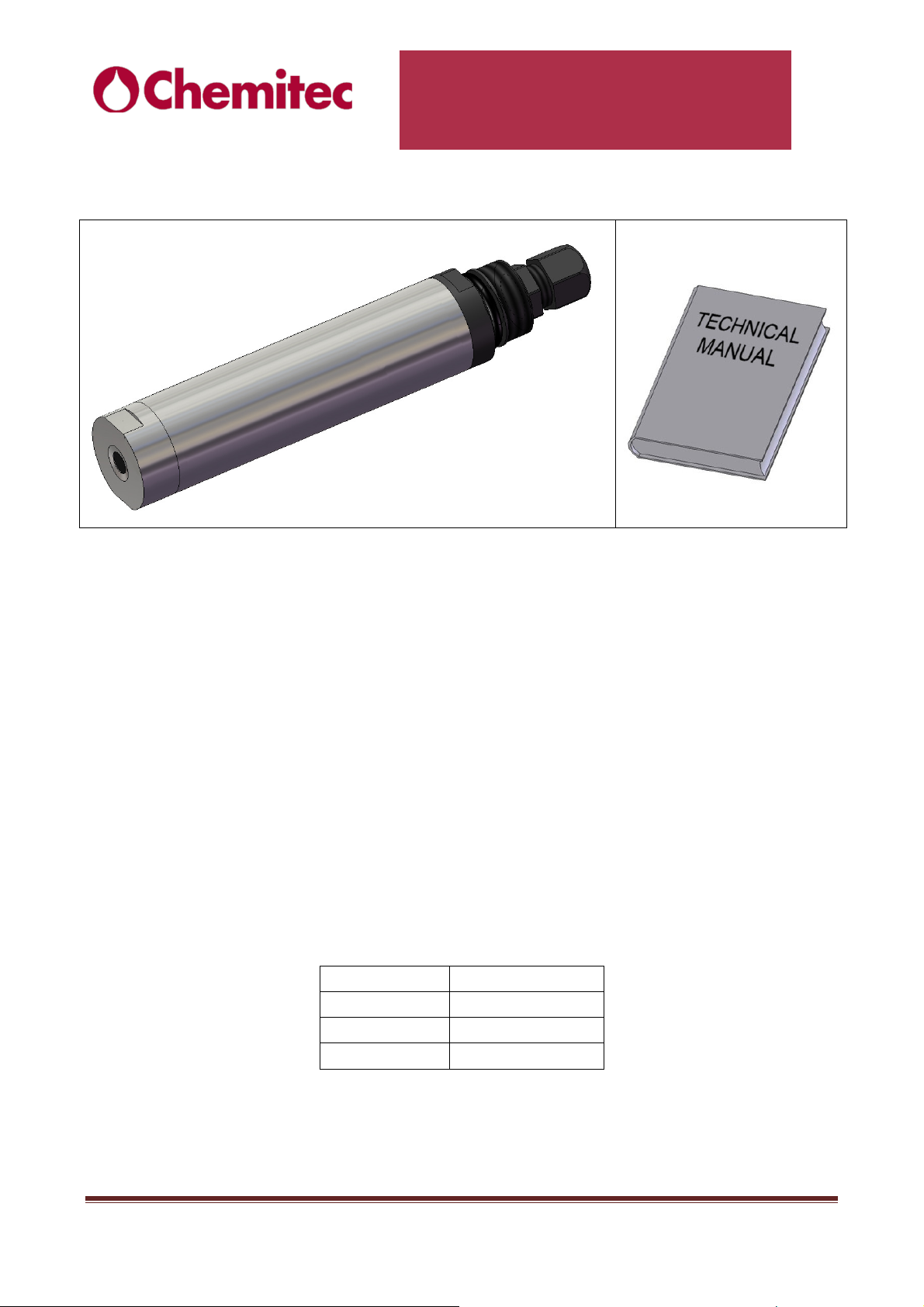
2 1
The supply consists of a single package containing the following parts:
1. 1 S423/C/OPT Optical Oxygen Probe with a 10 m cable
2. 1 Technical Manual for instructions
Electric installation
Turn off the instrument, connect the cables of the probe to the terminal block
of the meter. Please observe the colors shown on the sticker located under
the electronic cover of the instrument or refer to the chart below.
The measuring sensor is supplied with 10m cable kit, for connections at
greater distances do not exceed 1000m cable. Do not run the cable near high
power cables or inverter in order to avoid problems of noise on the
measurement.
RED +12V …24V
BLACK GROUND
YELLOW A+ RS485
GREEN B- RS485
S423/C/OPT Optical oxygen probe – Data Sheet 11
Page 5
SS442233//CC//OOPPTT OOppttiiccaall
OOxxyyggeenn PPrroobbee
DDaattaa SShheeeet
Hydraulic installation
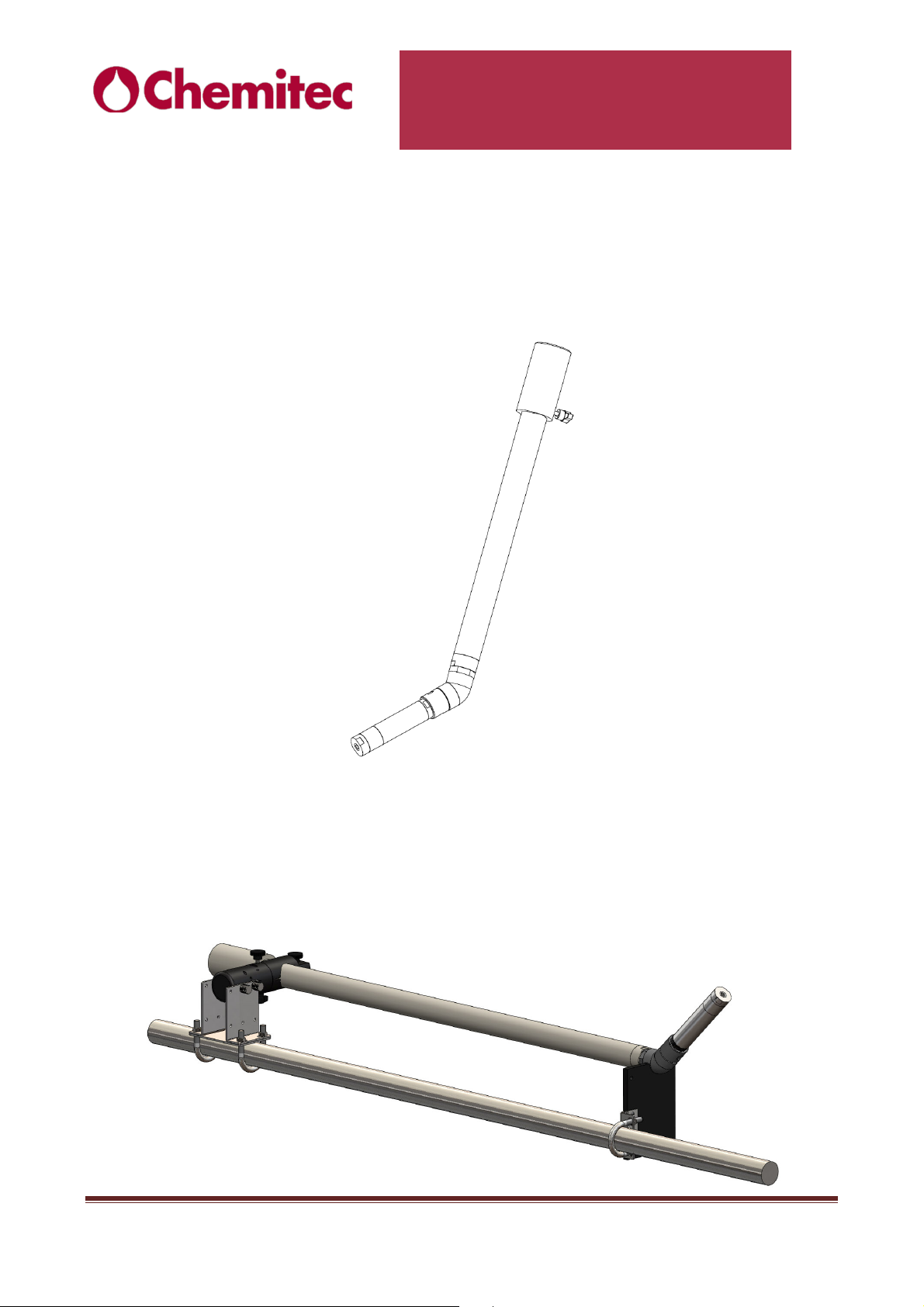
The S423/C/OPT probe is supplied with a circular ip67connector for the
connection to the 42 and 50 series units, and can be provided with the
appropriate probe holder S315 / O, available in various tube lengths.
t
Together with the probe holder is provided a device for positioning the probe
at 45°.
It is also possible to equip the assembly with a swivel system that provides
the ability to get almost any configuration, as well as easier cleaning and
maintenance of the system (see figure below).
S423/C/OPT Optical oxygen probe – Data Sheet 12
Page 6
SS442233//CC//OOPPTT OOppttiiccaall
OOxxyyggeenn PPrroobbee
DDaattaa SShheeeet
t
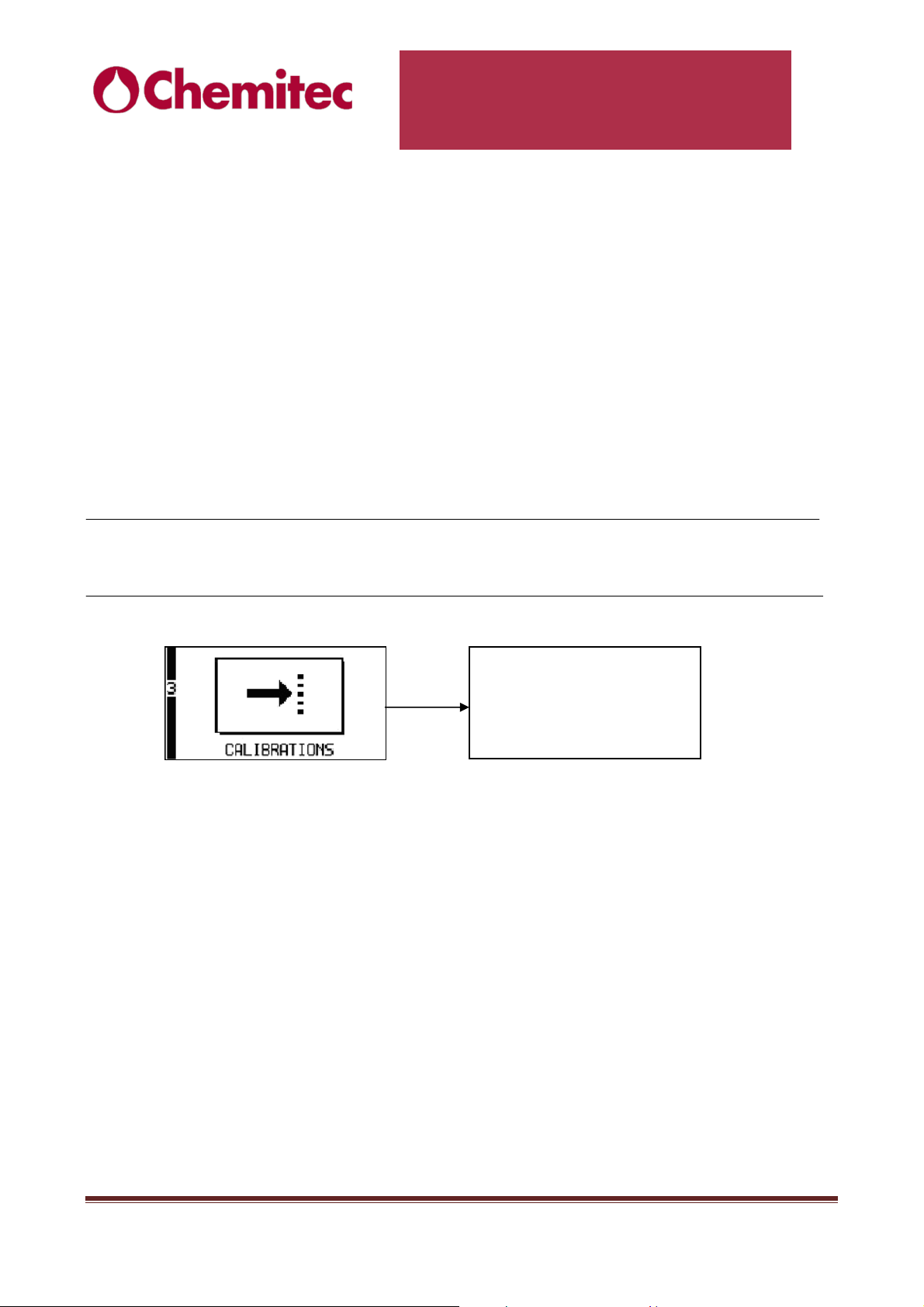
Calibration of the sensor
This program step allows the calibration of the oxygen sensor.
The calibration must necessarily be carried out:
− Every time the sensor cap 9400410134 or 9400410135 is replaced
− When starting after a long period of non-use
− Whenever discrepancies occur, according to a known value
For proper operation it is necessary, in addition to the cases mentioned
above, to verify calibration or recalibrate the probe periodically.
The frequency of this operation will be determined by the user, taking into
account the type of application and the type of electrode used.
NOTE
To perform a calibration in oxygen saturated solution immerse the
probe in a container of clean water and wait 10 minutes for stabilization.
Then continue with the Auto Calibration of the sensor
ENTER
Automatic Calibration
Press ENTER
pO2 : 21.96%
Temp: 29.3°C
Wait for the values (O2 and °C) to stabilize, then press ENTER; if the
procedure is successful the display will show "Calibration OK”
If ”Faulty Probe” is displayed, we recommend:
− To check the removable protection cap
− To assure the integrity of the membrane placed on the top of the
probe
− To check the cable integrity, the correct connection to the instrument
and on the probe.
S423/C/OPT Optical oxygen probe – Data Sheet 13
Page 7
SS442233//CC//OOPPTT OOppttiiccaall
OOxxyyggeenn PPrroobbee
DDaattaa SShheeeet
t
Precautions and warnings
Remove the black rubber protection cap from the probe before installing.
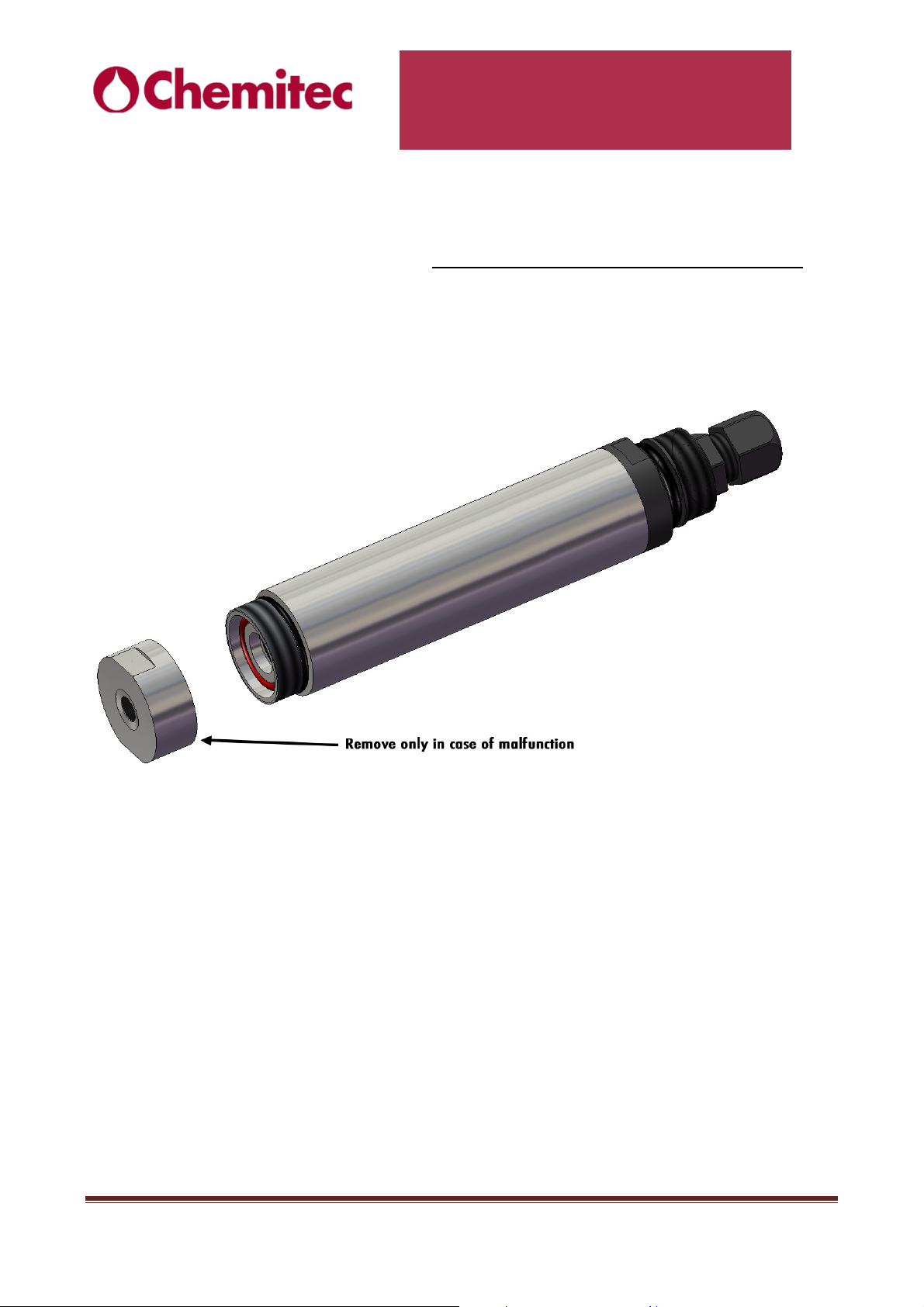
Warning: it is strictly recommended not to remove the interchangeable cap
from the probe unless there is a malfunction of the probe itself due to
the luminophore and is absolutely necessary to replace the glass containing
the polymer (see figure below):
Furthermore, it is necessary to pay particular attention to the substances
with which the part of the probe deputed to measurement can come into
contact: for example, organic acids such as acetic acid does not affect the
sensor. However, avoid the exposure of the luminophore in organic
solvents such as acetone, chloroform, benzene and
toluene.Chlorine gas can even destroy the sensor or otherwise affect the
measurements.
Pay special attention to the formation of air bubbles: these may
interfere with the oxygen measure. To overcome this problem, use the
kit of inclination to 45° of the probe, so that the bubbles can slip
upward.
S423/C/OPT Optical oxygen probe – Data Sheet 14
Page 8
TECHNICAL DATA
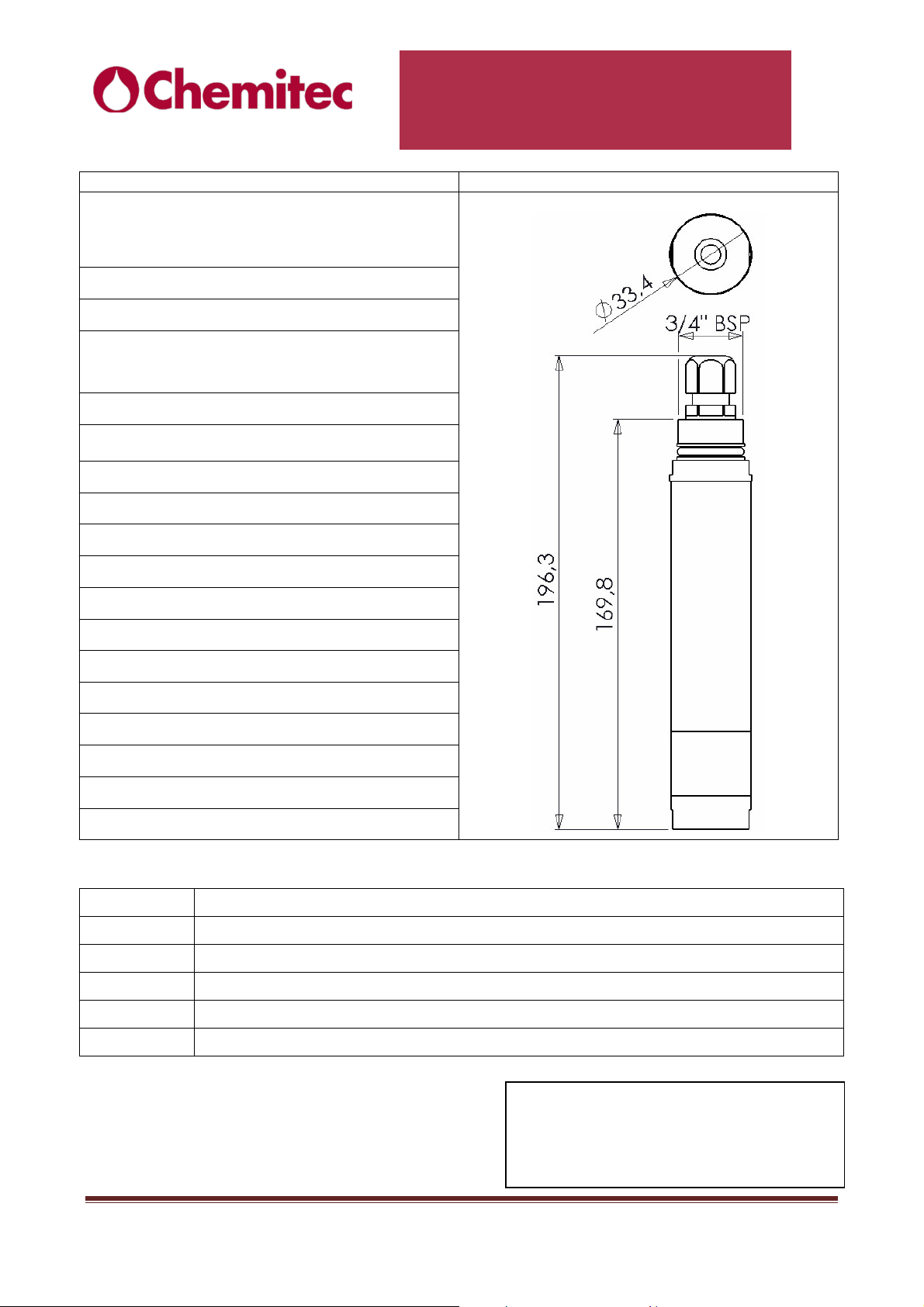
DIMENSIONS
Materials
Response:
CHEMITEC s.r.l.
SS442233//CC//OOPPTT OOppttiiccaall
:
AISI 316 Body (PVC Body optional)
Special Glass Optics
NBR and Sylicon O-Rings
Thread: 3/4” BSP
Measuring ranges: 0,00 to 20,00 mg/L 0-200%
Measuring method: Optical measure by
luminescence
Accuracy: +/-0,1mg/L or +/-1 %
90% of the value in less than 60
seconds
Maximum refreshing time: < 1 second
WorkingTemperature: -10÷ 60 °C
Max Working Pressure: 5 bar
OOxxyyggeenn PPrroobbee
DDaattaa SShheeeet
t
Maximum absorption: 2W
Mechanical Protection: IP68 Sensor+cable
Cable: 10m integral
Power Supply: 12…24Vdc
Signal interface: RS-485 Modbus RTU Protocol
Water move: No necessary move
Compensation of temperature: Via internal NTC
Luminophore diameter: 10mm
Connector IP67: yes
Order codes
9700830067
9700831067
9700832067
9700833067
9400410134
S423/C/OPT Optical Oxygen and Temperature Probe
S423/C/OPT PVC Optical Oxygen and Temperature Probe
S423/C/OPT 4-20mA Optical Oxygen and Temperature Probe
S423/C/OPT 4-20mA PVC Optical Oxygen and Temperature Probe
Luminescent membrane with AISI316 support for S423/C/OPT
9400410135
S423/C/OPT Optical oxygen probe – Data Sheet 15
Luminescent membrane with PVC support for S423/C/OPT
Via Isaac Newton 28 - 50018 Scandicci (FI)
Tel. +39 055 7576801 fax +39 055 756697
Web site: www.chemitec.it
E-mail: [email protected]
 Loading...