

Page 1
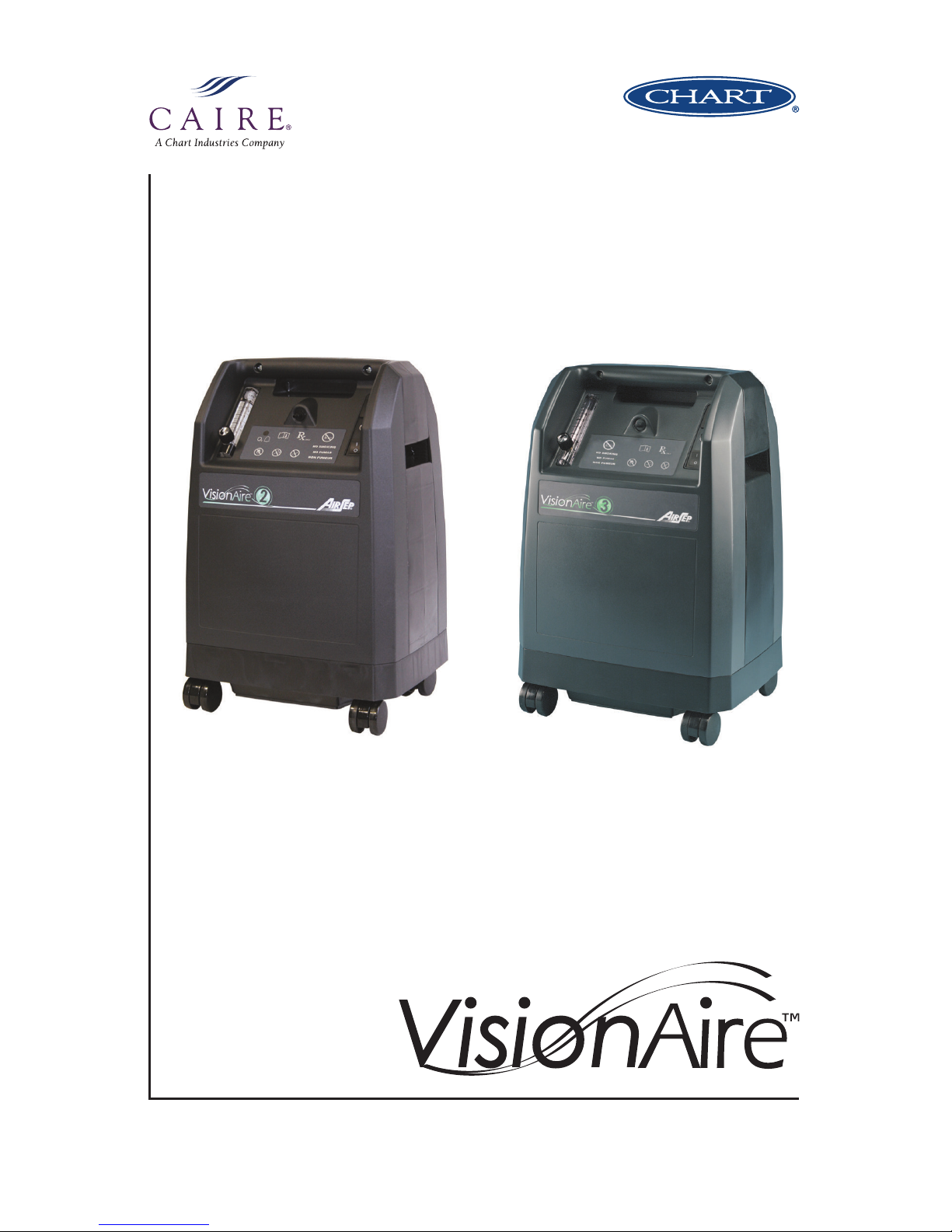
VisionAire 2 & 3
User Manual
Page 2
2 — MN165-1 M
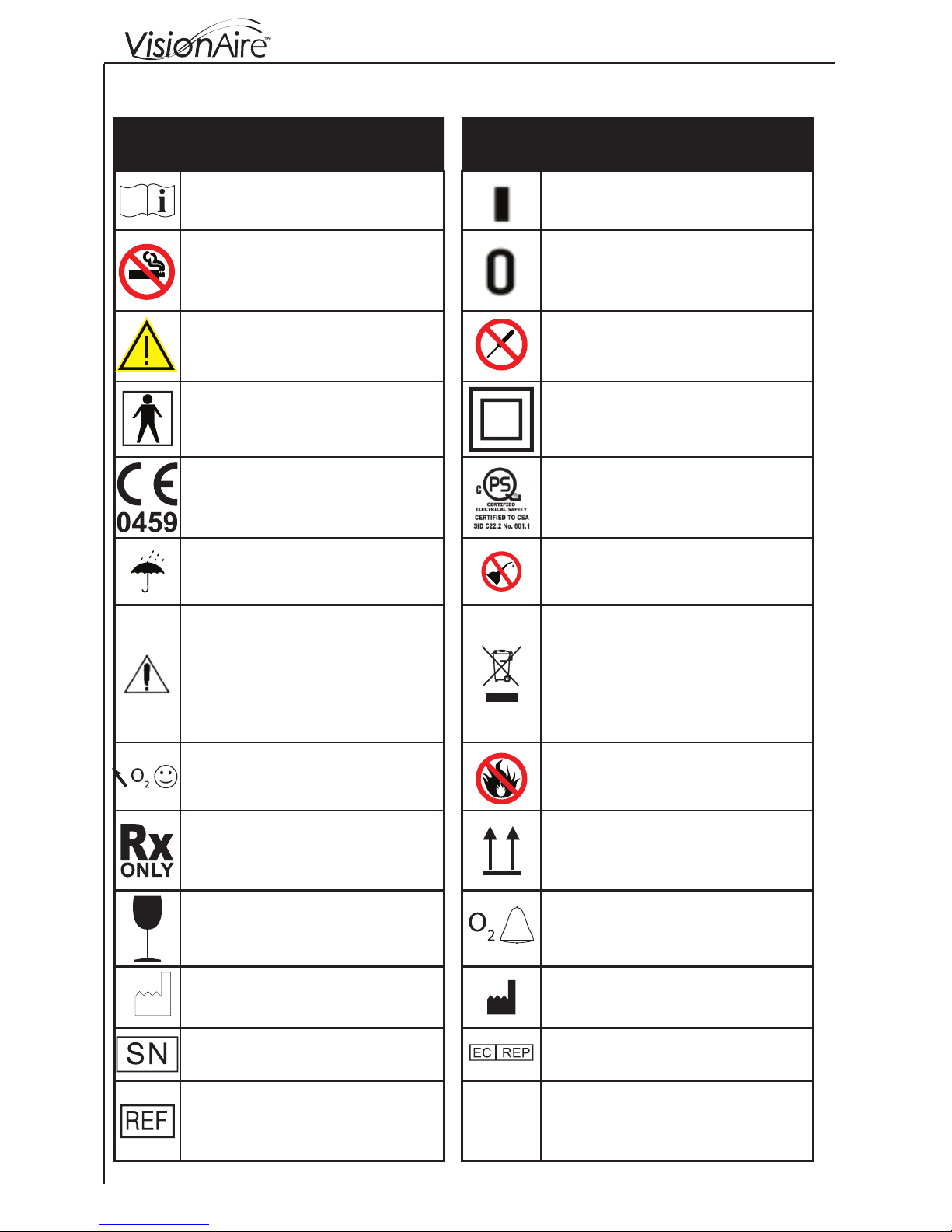
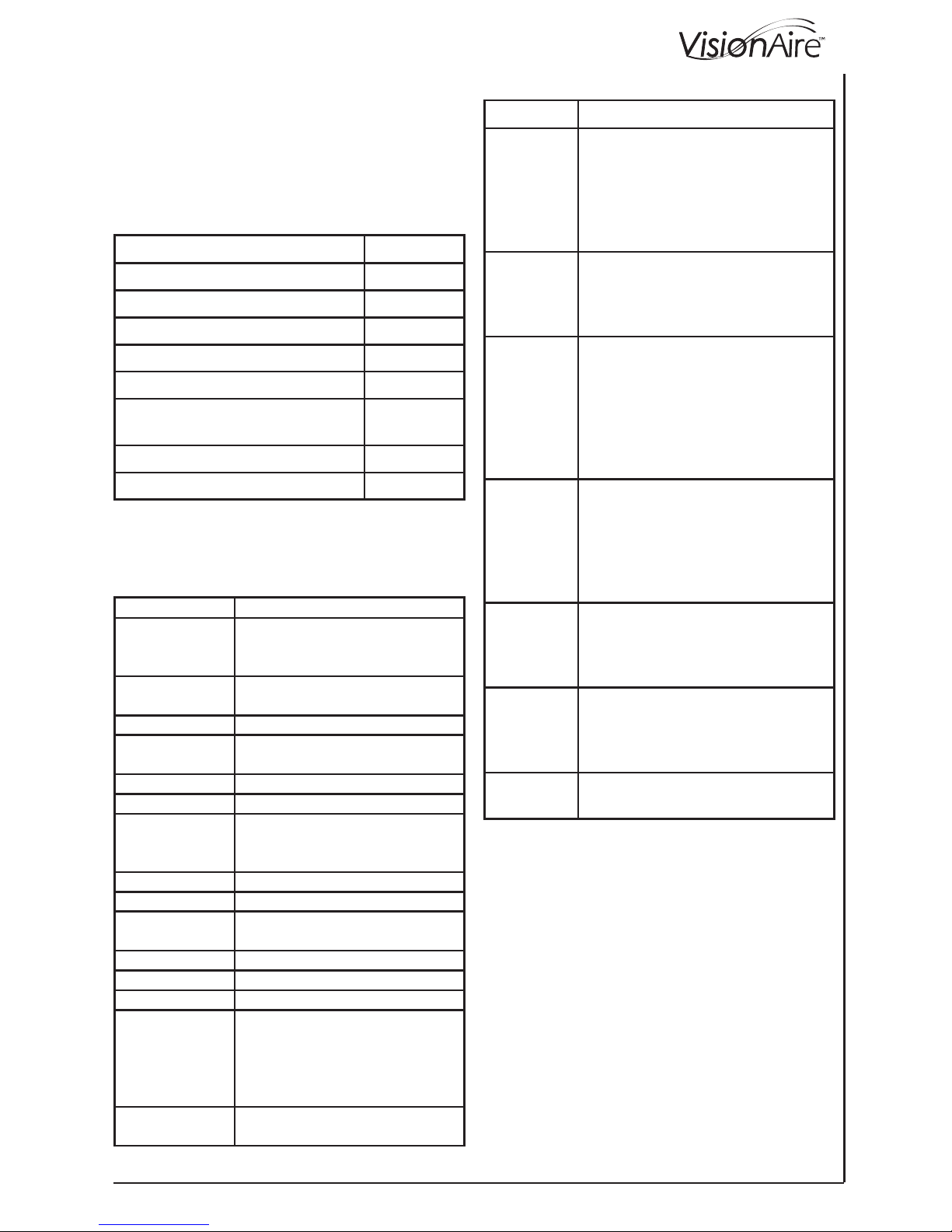
Sym-
bol
Denition Symbol Denition
Read user manual before operation.
See user manual for instructions.
ON (power switch on)
No Smoking Icon: Do not smoke near
unit.
OFF (power switch off)
Warnings and Cautions
No serviceable parts inside. Do not open
cover.
Type BF equipment (degree of
protection against electric shock)
Class II equipment
Complies with the 93/42/EEC directive
drawn up by the approved organization
No. 0459
Safety agency for CAN/CSA C22.2
No. 601.1 M90 for medical electrical
equipment
Keep unit and accessories dry Use no oil or grease.
Consult the accompanying documents
This symbol is to remind the equipment
owners to return it to a recycling facility
at the end of its life, per Waste Electrical
and Electronic Equipment (WEEE)
Directive. Proper disposal of waste
of electrical and electronic equipment
required.
Oxygen outlet connection to the
cannula
Do not expose to open ames
Caution: Federal law (USA) restricts
this for sale or rental by or on the order
of a physician or licensed health care
provider.
Keep in the vertical position
Fragile – handle with care Oxygen concentration warning LED
Date of Manufacture Name and address of manufacturer
Serial number
Authorized representative in the
European Community
Catalog number
User Controls & System Status Indicators
Page 3

VisionAire 2 & 3 User Manual — 3
Contents
User Controls & System Status Indicators ................................................................................. 2
Indications for Use ............................................................................................................................ 4
Contraindications for Use ...............................................................................................................4
Safety Guidelines ............................................................................................................................... 4
Introduction ........................................................................................................................................ 8
Concentrator Components ............................................................................................................ 9
Operating Instructions ..................................................................................................................12
Care and Cleaning ...........................................................................................................................13
Troubleshooting ..............................................................................................................................14
Product Specications ...................................................................................................................15
Disposal...............................................................................................................................................19
English: A multilingual version of the manual is available through your equipment provider.
Español: Una versión multilingüe del manual está disponible a través de su proveedor de equipo.
Français: Une version multilingue du manuel est disponible par l’intermédiaire de votre fournisseur de
matériel.
Deutsche: Eine mehrsprachige Version des Handbuchs ist in Ihrer Geräte-Anbieter
Page 4
4 — MN165-1 M
Important!
Safety Instructions are dened as follows:
Indications for Use
Contraindications for Use
Safety Guidelines
WARNING: IMPORTANT SAFETY INFORMATION
FOR HAZARDS THAT MIGHT CAUSE SERIOUS
INJURY.
CAUTION: Important information for preventing
damage to the VisionAire.
Note: Information needing special attention.
WARNING: IT IS VERY IMPORTANT TO SELECT
ONLY THE PRESCRIBED LEVEL OF OXYGEN. DO
NOT CHANGE THE FLOW SELECTION UNLESS
YOU HAVE BEEN DIRECTED TO DO SO BY A
LICENSED CLINICIAN. THE PORTABLE OXYGEN CONCENTRA
TOR MAY BE USED DURING SLEEP UNDER THE RECOMMEN
DATION OF A QUALIFIED CLINICIAN.
WARNING: FEDERAL USA LAW RESTRICTS THIS DEVICE
TO SALE OR RENTAL BY ORDER OF A PHYSICIAN OR OTHER
LICENSED HEALTH CARE PROVIDER.
WARNING: THIS UNIT IS NOT TO BE USED FOR LIFE
SUPPORT. GERIATRIC, PEDIATRIC, OR ANY OTHER PATIENT
UNABLE TO COMMUNICATE DISCOMFORT WHILE USING
THIS DEVICE MAY REQUIRE ADDITIONAL MONITORING.
PATIENTS WITH HEARING AND/OR SIGHT IMPAIRMENTS
MAY NEED ASSISTANCE WITH MONITORING ALARMS.
WARNING: NO MODIFICATION OF THIS EQUIP
MENT IS PERMITTED
WARNING: IN CERTAIN CIRCUMSTANCES, THE
USE OF NONPRESCRIBED OXYGEN CAN BE
HAZARDOUS. THIS DEVICE SHOULD ONLY BE
USED WHEN PRESCRIBED BY A PHYSICIAN.
WARNING: NOT FOR USE IN THE PRESENCE OF FLAMMABLE
ANESTHETICS.
WARNING: AS WITH ANY ELECTRICALLY POWERED DEVICE,
THE USER MAY EXPERIENCE PERIODS OF NONOPERATION
AS A RESULT OF ELECTRICAL POWER INTERRUPTION, OR
THE NEED TO HAVE THE VISIONAIRE SERVICED BY A QUAL
IFIED TECHNICIAN. THE VISIONAIRE IS NOT APPROPRIATE
FOR ANY PATIENT WHO WOULD EXPERIENCE ADVERSE
HEALTH CONSEQUENCES AS THE RESULT OF SUCH TEMPO
RARY INTERRUPTION.
WARNING: SMOKING WHILE USING OXYGEN IS
THE NUMBER ONE CAUSE OF FIRE, INJURY, AND
DEATH. YOU MUST FOLLOW THESE SAFETY
WARNINGS:
WARNING: DO NOT ALLOW SMOKING, CANDLES, OR OPEN
FLAMES WITHIN THE SAME ROOM OF THE DEVICE OR THE
OXYGENCARRYING ACCESSORIES.
WARNING: SMOKING WHILE WEARING AN OXYGEN CAN
NULA CAN CAUSE FACIAL BURNS AND POSSIBLY RESULT
IN DEATH.
WARNING: REMOVING THE CANNULA AND PLACING IT
ON CLOTHING, BEDDING, SOFAS, OR OTHER CUSHION
MATERIAL WILL CAUSE A FLASH FIRE WHEN EXPOSED TO A
CIGARETTE, HEAT SOURCE, SPARK OR OPEN FLAME.
WARNING: IF YOU SMOKE, YOU MUST ALWAYS FOLLOW
THESE 3 IMPORTANT STEPS FIRST: TURN OFF THE OXYGEN
CONCENTRATOR, TAKE OFF THE CANNULA, AND LEAVE THE
ROOM WHERE THIS DEVICE IS LOCATED.
Note: Portable and mobile RF communications equipment can
eect medical electrical equipment.
CAUTION: Federal (USA) law restricts this device to sale or rental by order of a physician
or other licensed health care provider.
WARNING: THIS DEVICE SUPPLIES HIGHCON
CENTRATION OXYGEN THAT PROMOTES RAPID
BURNING. DO NOT ALLOW SMOKING OR OPEN
FLAMES WITHIN THE SAME ROOM OF 1 THIS
DEVICE, OR 2 ANY OXYGENCARRYING AC
CESSORY. FAILURE TO OBSERVE THIS WARNING CAN RESULT
IN SEVERE FIRE, PROPERTY DAMAGE AND / OR CAUSE
PHYSICAL INJURY OR DEATH.
WARNING: DO NOT USE YOUR OXYGEN CONCENTRATOR IN
THE PRESENCE OF FLAMMABLE GASES. THIS CAN RESULT
IN RAPID BURNING CAUSING PROPERTY DAMAGE, BODILY
INJURIES OR DEATH.
WARNING: DO NOT LEAVE A NASAL CANNULA ON CLOTH
ING, BED COVERINGS OR CHAIR CUSHIONS. IF THE UNIT IS
TURNED ON BUT NOT IN USE, THE OXYGEN WILL MAKE THE
MATERIAL FLAMMABLE. SET THE I/0 POWER SWITCH TO
THE 0 OFF POSITION WHEN THE OXYGEN CONCENTRATOR
IS NOT IN USE.
WARNING: USE NO OIL, GREASE, OR PETROLEUMBASED
OR OTHER FLAMMABLE PRODUCTS WITH THE OXY
GENCARRYING ACCESSORIES OR THE OXYGEN CON
CENTRATOR. ONLY WATER BASED, OXYGEN COMPATIBLE
LOTIONS OR SALVES SHOULD BE USED. OXYGEN ACCELER
ATES THE COMBUSTION OF FLAMMABLE SUBSTANCES.
WARNING: CLEAN THE CABINET, CONTROL PANEL, AND
POWER CORD ONLY WITH A MILD HOUSEHOLD CLEANER
APPLIED WITH A DAMP CLOTH NOT WET OR SPONGE, AND
THEN WIPE ALL SURFACES DRY. DO NOT ALLOW ANY LIQUID
TO GET INSIDE THE DEVICE.
Page 5
VisionAire 2 & 3 User Manual — 5
CAUTION: In the event of an alarm or you
observe the Oxygen Concentrator is not
working properly; consult the Troubleshooting section in this manual. If you cannot
resolve the problem, consult your Equipment Provider.
CAUTION: To prevent a void warranty, follow all manufac-
turers’ instructions.
WARNING: SMOKING WHILE USING OXYGEN
IS THE NUMBER ONE CAUSE OF FIRE INJURIES
AND RELATED DEATHS. YOU MUST FOLLOW
THESE SAFETY WARNINGS:
WARNING: DO NOT ALLOW SMOKING, CANDLES, OR OPEN
FLAMES IN THE SAME ROOM WITH THE DEVICE OR THE
OXYGENCARRYING ACCESSORIES.
WARNING: SMOKING WHILE WEARING AN OXYGEN CAN
NULA MAY CAUSE FACIAL BURNS AND POSSIBLY DEATH.
WARNING: IF YOU SMOKE, THESE 3 STEPS MAY SAVE YOUR
LIFE: TURN OFF THE OXYGEN CONCENTRATOR, TAKE OFF
THE CANNULA, AND LEAVE THE ROOM WHERE THIS DEVICE
IS LOCATED.
WARNING: “NO SMOKING OXYGEN IN USE” SIGNS MUST
BE PROMINENTLY DISPLAYED IN THE HOME, OR WHERE OX
YGEN IS IN USE. PATIENTS AND THEIR CAREGIVERS MUST
BE INFORMED ABOUT THE DANGERS OF SMOKING IN THE
PRESENCE OF, OR WHILE USING, MEDICAL OXYGEN.
WARNING: DO NOT USE YOUR OXYGEN CONCENTRATOR IN
THE PRESENCE OF FLAMMABLE GASES. THIS CAN RESULT
IN RAPID BURNING CAUSING PROPERTY DAMAGE, BODILY
INJURIES OR DEATH.
WARNING: REMOVING THE CANNULA AND PUTTING IT
ON CLOTHING, BEDDING, SOFAS, OR OTHER CUSHION
MATERIAL WILL CAUSE A FLASH FIRE WHEN EXPOSED TO A
CIGARETTE, HEAT SOURCE, OR FLAME.
WARNING: DO NOT LEAVE A NASAL CANNULA ON OR
UNDER CLOTHING, BED COVERINGS OR CHAIR CUSHIONS.
IF THE UNIT IS TURNED ON BUT NOT IN USE, THE OXYGEN
WILL MAKE THE MATERIAL FLAMMABLE. SET THE OXYGEN
CONCENTRATOR TO THE 0 OFF POSITION WHEN THE
OXYGEN CONCENTRATOR IS NOT IN USE.
WARNING: DO NOT ATTEMPT ANY MAINTE
NANCE OTHER THAN THE POSSIBLE SOLU
TIONS LISTED WITHIN THIS MANUAL. DO NOT
REMOVE COVERS, ONLY YOUR EQUIPMENT
PROVIDER OR A QUALIFIED SERVICE TECHNICIAN SHOULD
REMOVE THE COVERS OR SERVICE THIS DEVICE.
WARNING: ONLY ACCESSORIES RECOMMENDED BY
THE MANUFACTURER. USE OF ANY OTHER MAY BE
HAZARDOUS, CAUSE SERIOUS DAMAGE TO YOUR OXYGEN
CONCENTRATOR AND WILL VOID THE WARRANTY .
CAUTION: Always place oxygen supply tubing
and power cords in a manner that prevents a
trip hazard.
WARNING: THE MANUFACTURER RECOM
MENDS AN ALTERNATE SOURCE OF SUPPLE
MENTAL OXYGEN IN THE EVENT OF A POWER
OUTAGE, ALARM CONDITION, OR MECHANI
CAL FAILURE. CONSULT YOUR PHYSICIAN OR EQUIPMENT
PROVIDER FOR THE TYPE OF RESERVE SYSTEM REQUIRED.
WARNING: DO NOT ALLOW EITHER THE AIR INTAKE OR
THE AIR OUTLET VENTS TO BECOME BLOCKED. DO NOT
DROP OR INSERT ANY OBJECTS INTO ANY OPENINGS ON
THE DEVICE. THIS CAN CAUSE THE OXYGEN CONCENTRA
TOR TO OVERHEAT AND IMPAIR PERFORMANCE.
WARNING: ELECTRICAL SHOCK HAZARD.
TURN OFF THE UNIT AND DISCONNECT THE
POWER CORD FROM THE ELECTRIC OUTLET
BEFORE YOU CLEAN THE UNIT TO PREVENT
ACCIDENTAL ELECTRICAL SHOCK AND BURN HAZARD.
ONLY YOUR EQUIPMENT PROVIDER OR A QUALIFIED
SERVICE TECHNICIAN SHOULD REMOVE THE COVERS OR
SERVICE THE UNIT.
WARNING: CARE SHOULD BE TAKEN TO PREVENT THE
OXYGEN CONCENTRATOR FROM GETTING WET OR
ALLOWING FLUIDS TO ENTER THE UNIT. THIS CAN CAUSE
THE UNIT TO MALFUNCTION OR SHUT DOWN, AND CAUSE
AN INCREASED RISK FOR ELECTRICAL SHOCK OR BURNS.
WARNING: DO NOT USE LIQUID DIRECTLY ON THE UNIT.
A LIST OF UNDESIRABLE CHEMICAL AGENTS INCLUDES
BUT IS NOT LIMITED TO THE FOLLOWING: ALCOHOL
AND ALCOHOLBASED PRODUCTS, CONCENTRATED
CHLORINEBASED PRODUCTS ETHYLENE CHLORIDE, AND
OILBASED PRODUCTS PINESOL®, LESTOIL®. THESE
ARE NOT TO BE USED TO CLEAN THE PLASTIC HOUSING
ON THE OXYGEN CONCENTRATOR, AS THEY CAN DAMAGE
THE UNIT’S PLASTIC.
WARNING: THE OXYGEN CONCENTRATOR
SHOULD NOT BE USED ADJACENT TO OR
STACKED WITH OTHER EQUIPMENT. IF AD
JACENT OR STACKED USE IS UNAVOIDABLE,
THE DEVICE SHOULD BE OBSERVED TO VERIFY NORMAL
OPERATION.
WARNING: NO MODIFICATION OF THIS EQUIPMENT IS
PERMITTED.
WARNING: USE OF CABLES AND ADAPTERS OTHER THAN
THOSE SPECIFIED, WITH THE EXCEPTION OF CABLES AND
ADAPTERS SOLD BY THE MANUFACTURER OF THE MEDICAL
ELECTRICAL EQUIPMENT AS REPLACEMENT PARTS FOR
INTERNAL COMPONENTS, MAY RESULT IN INCREASED
EMISSIONS OF DECREASED IMMUNITY OF THE OXYGEN
CONCENTRATOR.
WARNING: USE ONLY ELECTRICAL VOLTAGE AS SPECIFIED
ON THE SPECIFICATION LABEL AFFIXED TO THE DEVICE.
WARNING: DO NOT USE EXTENSION CORDS WITH THIS
UNIT OR CONNECT TOO MANY PLUGS INTO THE SAME
ELECTRICAL OUTLET. THE USE OF EXTENSION CORDS
COULD ADVERSELY AFFECT THE PERFORMANCE OF THE
DEVICE. TOO MANY PLUGS INTO ONE OUTLET CAN RESULT
IN AN OVERLOAD TO THE ELECTRICAL PANEL CAUSING THE
BREAKER/FUSE TO ACTIVATE OR FIRE IF THE BREAKER OR
FUSE FAILS TO OPERATE.
Page 6
6 — MN165-1 M
CAUTION: Do not position the unit so that it
is dicult to access the power cord.
CAUTION: The concentrator should be located
as to avoid smoke, pollutants or fumes.
CAUTION: Ensure concentrator is operated in an upright
position.
CAUTION: Always place oxygen supply tubing and power
cords in a manner that prevents a trip hazard.
CAUTION: Position the unit away from curtains or drapes,
hot air registers or heaters. Be certain to place the unit
on a at surface and make sure all sides are at least 1
foot (30 cm) away from a wall or other obstruction. Do
not place the unit in a conned area. Choose a dust and
smoke free-location away from direct sunlight. Do not
operate the unit outdoors unless the unit is plugged
into a Ground Fault Circuit Interrupter (GFCI) protected
outlet.
CAUTION: Do not operate this unit in a restricted or
conned space where ventilation can be limited. This can
cause the device to overheat and aect performance.
CAUTION: Do not allow either the air intake or the
air outlet vents to be blocked. DO NOT drop or insert
any object into any openings on the device. This can
cause the Oxygen Concentrator to overheat and impair
performance.
CAUTION: The Manufacturer recommends an alternate
source of supplemental oxygen in the event of a power
outage, alarm condition, or mechanical failure. Consult
your physician or Equipment Provider for the type of
reserve system required.
CAUTION: It is very important to select only the prescribed level of oxygen. Do not change the ow selection
unless you have been directed to do so by a licensed
clinician.
CAUTION: The Oxygen Concentrator may be used during
sleep under the recommendation of a licensed clinician.
CAUTION: Operating or storing the Oxygen Concentrator
outside of its normal operating temperature range can
impair the performance of the unit. Refer to the specication section of this manual for storage and operating
temperature limits.
CAUTION: In the event of an alarm or you observe the
Oxygen Concentrator is not working properly; consult
the troubleshooting section of this manual. If you cannot
resolve the problem, consult your Equipment Provider.
CAUTION: If the audio alarm is weak or does not sound
at all, consult your Equipment Provider immediately.
CAUTION: For units equipped with the oxygen monitor
option - Contact your Equipment Provider immediately if
the amber OXYGEN MONITOR light remains on for more
than 15 minutes and/or the audio alarm activates.
CAUTION: If the humidier bottle tubing is not properly
connected to the humidier bottle tting or to the
oxygen outlet, an oxygen leak can occur.
AVERTISSEMENT: CET APPAREIL PRODUIT
DE L’OXYGÈNE À CONCENTRATION ÉLEVÉE,
FAVORISANT UNE COMBUSTION RAPIDE. NE
PAS PERMET TRE DE FUMER OU DES FLAMMES
NUES DANS LA MÊME CHAMBRE: 1 CET APPAREIL OU
2 TOUT ACCESSOIRE CONTENANT DE L’OXYGÈNE. NE
PAS UTILISER DE PRODUITS À BASE D’HUILE, DE GRAISSE
OU DE PÉTROLE SUR OU À PROXIMITÉ DE L’UNITÉ.
DÉCONNECTER LE CORDON D’ALIMENTATION DE LA
PRISE ÉLECTRIQUE AVANT DE NETTOYER OU DE FAIRE
L’ENTRETIEN DE L’UNITÉ.
AVERTISSEMENT: RISQUE DE CHOC ÉLECTRIQUE. NE
PAS ENLEVER LES COUVERCLES LORSQUE L’UNITÉ EST
BRANCHÉE. SEULS VOTRE FOURNISSEUR D’ÉQUIPEMENT
OU UN TECHNICIEN DE SERVICE QUALIFIÉ DEVRAIT
ENLEVER LES COUVERCLES OU FAIRE L’ENTRETIEN DE
L’UNITÉ.
WARNING: THE OXYGEN CONCENTRATOR
SHOULD NOT BE USED ADJACENT TO OR
STACKED WITH OTHER EQUIPMENT. IF AD
JACENT OR STACKED USE IS UNAVOIDABLE,
THE DEVICE SHOULD BE OBSERVED TO VERIFY NORMAL
OPERATION.
WARNING: NO MODIFICATION OF THIS EQUIPMENT IS
PERMITTED.
WARNING: USE OF CABLES AND ADAPTERS OTHER THAN
THOSE SPECIFIED, WITH THE EXCEPTION OF CABLES
AND ADAPTERS SOLD BY THE MANUFACTURER OF THE
MEDICAL ELECTRICAL EQUIPMENT AS REPLACEMENT
PARTS FOR INTERNAL COMPONENTS, MAY RESULT IN
INCREASED EMISSIONS OF DECREASED IMMUNITY OF
THE OXYGEN CONCENTRATOR.
WARNING: USE ONLY ELECTRICAL VOLTAGE AS SPECIFIED
ON THE SPECIFICATION LABEL AFFIXED TO THE DEVICE.
WARNING: DO NOT USE EXTENSION CORDS WITH THIS
UNIT OR CONNECT TOO MANY PLUGS INTO THE SAME
ELECTRICAL OUTLET. THE USE OF EXTENSION CORDS
COULD ADVERSELY AFFECT THE PERFORMANCE OF
THE DEVICE. TOO MANY PLUGS INTO ONE OUTLET CAN
RESULT IN AN OVERLOAD TO THE ELECTRICAL PANEL
CAUSING THE BREAKER/FUSE TO ACTIVATE OR FIRE IF THE
BREAKER OR FUSE FAILS TO OPERATE.
Page 7
VisionAire 2 & 3 User Manual — 7
Note: Cannula must be non-kinking, which can be used for a
total length of 25 ft. (7.6 m) max.
Note: Ensure the cannula is fully inserted and secure. You
should hear or feel oxygen ow to the prongs of the nasal
cannula. If oxygen does not seem to ow, rst verify that
the owmeter ball is registering a ow. Then, place the tip of
the cannula into a glass of water; if bubbles come out of the
cannula, oxygen is owing. If bubbles do not appear, refer to
the troubleshooting section of this manual.
Note: Always follow the cannula manufacturer’s instructions
for proper use. Replace the disposable cannula as recommended by the cannula manufacturer or your Equipment
Provider. Additional supplies are available from your
Equipment Provider.
Note: The use of some oxygen administration accessories not
specied for use with this oxygen concentrator may impair
its performance. Recommended accessories are referenced
within this manual.
Note: To Equipment Provider: The following ox ygen administration accessories are recommended for use with the Oxygen
Concentrator
• Humidier Bottle: Part No. HU003-1
• Nasal Cannula with 7 feet (2.1 m) of tubing: Part No.
CU002-1
• OxySafe Kit: Part No. 20629671
Note: The Manufacturer does not recommend the sterilization
of this equipment.
Note: If the unit has not been used for an extended time
period, it needs to operate for a minimum of several minutes
before power failure alarm can become activated.
Note: For units equipped with the oxygen monitor option When you turn the unit on, it’s normal for the amber OXYGEN
MONITOR light to turn on and remain on for up to ve
minutes.
Note: The concentrator releases warm air out the bottom
of the unit which can permanently discolor temperature sensitive ooring surfaces such as vinyl. The concentrator should
not be used over ooring that is sensitive to heat staining.
The Manufacturer is not responsible for ooring that becomes
discolored.
Note: To prevent a void warranty, follow all manufacturers’
instructions.
Note: Do not attempt any maintenance other than the possible solutions listed within the manual.
Note: Portable and mobile RF communications equipment can
eect medical electrical equipment.
Note: There is never a danger of depleting the oxygen in a
room when you use your Oxygen Concentrator unit.
Note: AirSep oers the OxySafe as an optional accessory. This
is intended to be used in conjunction with the Visionaire 2/3
concentrator. For customers in regions requiring compliance
to EN ISO 8359:1996-Ammendment1:2012, this accessory
will meet this need.
The OxySafe is a thermal fuse to stop the ow of gas in the
event that the downstream cannula or oxygen tubing is
ignited and burns to the OxySafe. It is placed in-line with the
nasal cannula or oxygen tubing between the patient and the
oxygen outlet of the Visionaire 2/3.
For proper use of the OxySafe, always refer to the manufacturer’s instructions (included with each OxySafe kit).
AirSep oers an OxySafe kit that includes OxySafe with 2” of
tubing to connect to the oxygen outlet; PN 20629671
Page 8

8 — MN165-1 M
Introduction
Operator Prole:
AirSep’s Stationary Concentrators are intended
to supply supplemental Oxygen to users suffering
from discomfort due to ailments which affect the
efciency of ones lungs to transfer the oxygen in
air to their bloodstream. Users can benet from
supplemental oxygen therapy for respiratory care at
home, in the hospital, or at a medical facility. Oxygen
Concentrator use requires a physician’s prescription,
and are not intended for life support use.
Although Oxygen therapy can be prescribed for
patients of all ages the typical oxygen therapy patient
is older than 65 years of age and suffers from chronic
obstructive pulmonary disease (COPD). Patients
typically have good cognitive abilities and must be
able to communicate discomfort. If the user is unable
to communicate discomfort, or unable to read and
understand the concentrator labeling and instructions
for use, then use is recommended only under the
supervision of one who can. If any discomfort is felt
while using the concentrator, patients are advised
to contact their healthcare provider. Patients are
also advised to have back-up oxygen available (i.e.
cylinder oxygen) in the event of a power outage or
concentrator failure. There are no other unique skills
or user abilities required for concentrator use.
This Patient Manual will acquaint you with AirSep’s
VisionAire 2 and VisionAire 3 Oxygen Concentrators.
Make sure you read and understand all of the
information contained in this guide before operating
your concentrator. Should you have any questions,
your Equipment Provider will be happy to answer
them for you.
Why Your Physician Prescribed Oxygen
Many people today suffer from a variety of heart,
lung, and other respiratory diseases. A signicant
number of these patients can benet from
supplemental oxygen therapy for respiratory care at
home, in the hospital, or at a medical facility.
Oxygen is a gas that makes up 21% of the room air
we breathe. Our bodies depend on a steady supply
to function properly. Your physician has prescribed
supplemental oxygen therapy because your body is
not able to get enough oxygen from room air. Oxygen
is a non-addictive drug, and your physician prescribed
a ow sufcient to improve your condition.
Please keep in mind that unauthorized oxygen therapy
can be dangerous. You must seek medical advice
before you use this unit. The Equipment Provider who
supplies your oxygen equipment will demonstrate how
to set the prescribed ow rate.
What is an Oxygen Concentrator?
Oxygen concentrators were introduced in the mid1970s and have become the most convenient, reliable
source of supplemental oxygen available today.
Without an oxygen concentrator, the average patient
would require a delivery of 12 bottles/cylinders
of oxygen each month. Your oxygen concentrator
produces all the oxygen you need, with no deliveries
required.
The air we breathe contains approximately 21%
oxygen, 78% nitrogen, and 1% other gases. In the
VisionAire 2 or VisionAire 3 unit, room air passes
through a regenerative adsorbent material called
molecular sieve. This material separates the oxygen
from the nitrogen and other gases. The result is a
constant supply of high concentration supplemental
oxygen that is delivered to the patient.
Note: There is never a danger of depleting the
oxygen in a room when you use your VisionAire 2 or
VisionAire 3 unit.
Page 9
VisionAire 2 & 3 User Manual — 9
Concentrator Components
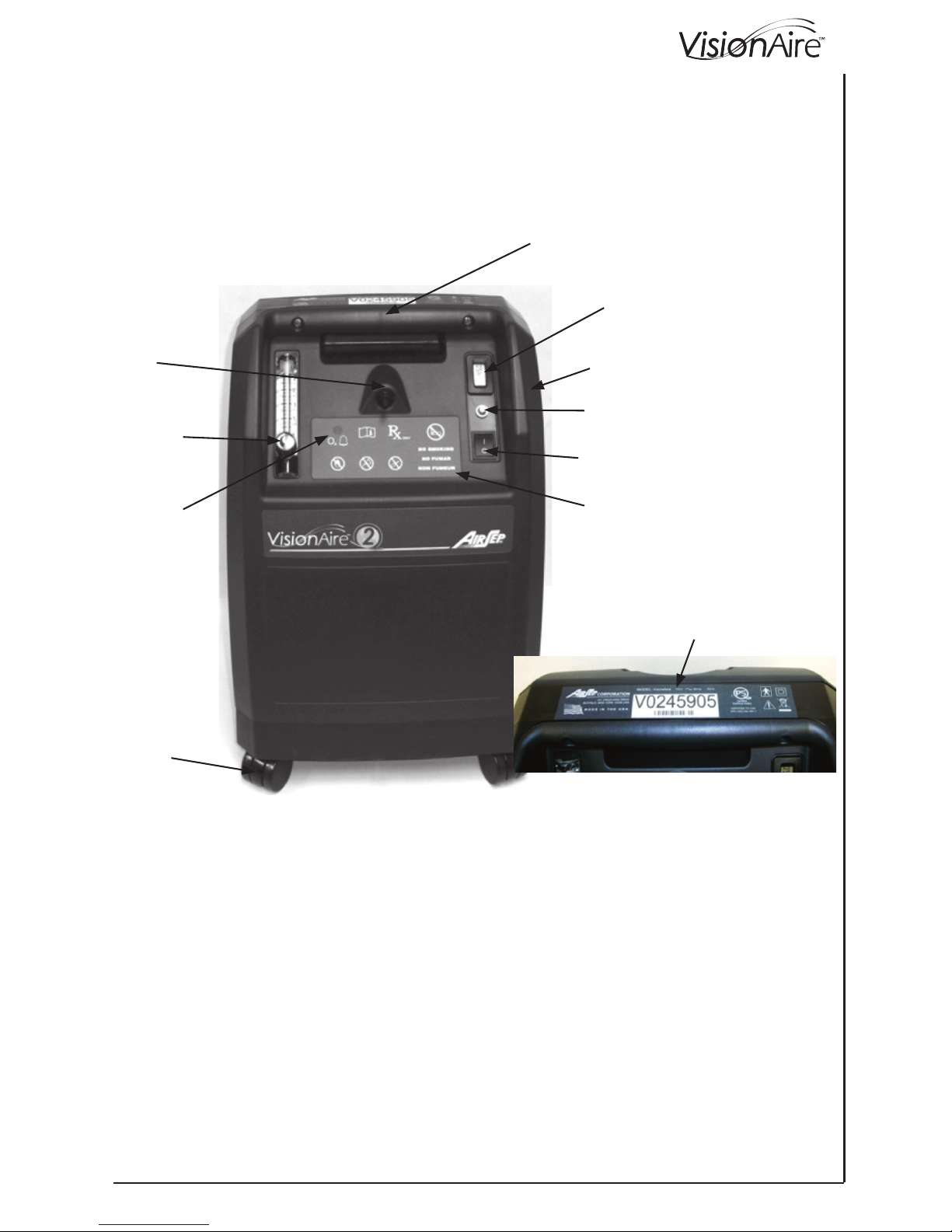
Review the gures below and become familiar with
the important parts of your VisionAire 2 or VisionAire
3 Oxygen Concentrator.
Front of Concentrator
Specication Label
Caster(s)
Circuit Breaker Reset Button
Side Handle(s)
Hour Meter
Top Handle
Low Oxygen
Concentration
Indicator
(optional – mandated
for EU and specic
countries)
Flowmeter
Adjustment
Knob
Oxygen Outlet
ON/OFF (I/0) Power Switch
Operating Instructions Label
Top and Side Handles: Enables convenience in
carrying the unit.
On/Off (I/0) Power Switch: Starts and stops the
operation of the unit.
Oxygen Outlet: Provides connection for a humidier
(if required) or cannula.
Circuit Breaker Reset Button: Resets the unit after
electrical overload shutdown.
Flowmeter Adjustment Knob: Controls the oxygen
ow rate in liters per minute (LPM).
Low Oxygen Concentration Indicator (optional –
mandated for EU and specic countries): When
equipped with an Oxygen Monitor – a warning LED
(amber) is activated on the front panel (see ‘Safety
Features’ for details).
Hour Meter: Records the concentrator’s cumulative
hours of operation.
Operating Instructions Label: Directs usage of the
unit.
Casters: Four casters enable unit to be easily moved,
as needed.
Specication Label: Displays electrical specications
and serial number.
Page 10
10 — MN165-1 M
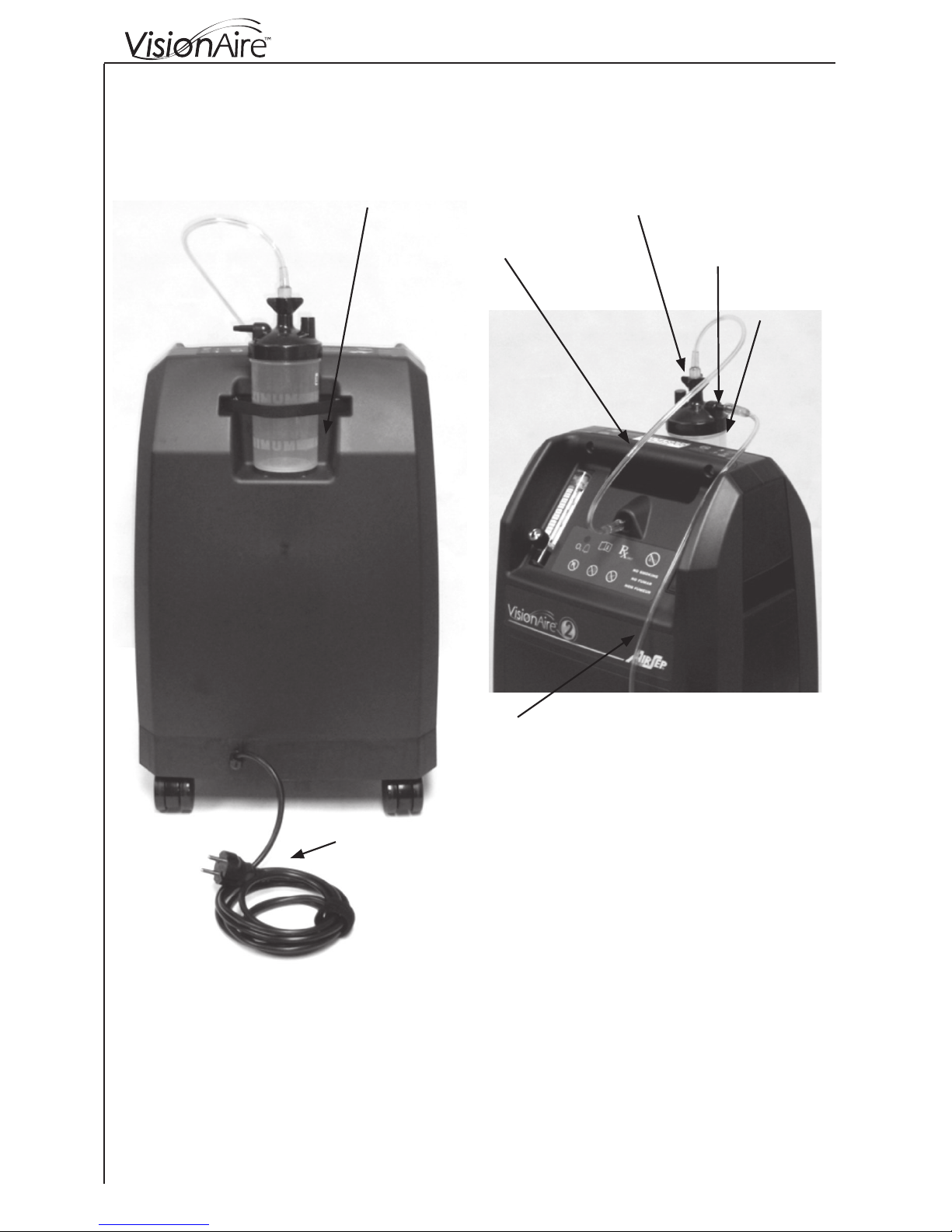
Back of Concentrator
Humidier Bottle
Recess
Power Cord
Power Cord: Allows connection of the unit to an
electrical outlet.
Humidier Bottle Recess: Area to place the optional
humidier bottle.
Humidier Bottle (optional)
Humidier Bottle Fitting
Humidier Bottle
Humidier Bottle (optional): Humidies the oxygen
before it reaches the patient.
Humidier Bottle Oxygen Outlet: Connection for
oxygen tubing/cannula.
Humidier Bottle
Oxygen Outlet
Humidier Bottle Tubing
Oxygen Tubing/Cannula
Page 11
VisionAire 2 & 3 User Manual — 11
Accessories
Recommended for use with VisionAire 2 and
VisionAire 3.
The use of certain administration accessories which
are not specied for use with this concentrator may
reduce performance and void the manufacturer’s
warranty.
Item PN
Humidier Bottle HU003-1
Cannula, 25 feet (7.6 m) CU002-4
Cannula, 7 feet (2.1 m) CU002-1
Humidier Bottle Tubing TU176-160
Humidier Bottle Fitting F0655-1
Oxygen Tubing,
25 feet (7.6 m)
CU004-3
Tubing/Cannula Connector CU009-1
OxySafe Kit 20629671
Materials in direct or indirect contact
with patient
Item Material
Concentrator
Cabinet (all
parts)
NOVA PS6201 Super High
Impact Polystyrene
Gas Outlet,
Nozzle
Aluminum, Black Anodized
On / Off Switch DuPont FR50
Hour Meter Acrylonitrile Butadiene Styrene
(ABS) Plastic & Acrylic
Flowmeter ABS (STAT-TECH AS1000)
Gas Outlet Brass
Circuit Breaker Button - Melamine or Urea
Formaldehyde, Mounting Bushing
– Polyamide 66 (Nylon)
Unit Labels Lexan
Power Cord Polyvinyl Chloride (PVC), Metal
Cord Strain
Relief
Nylon
Cord Wrap Velcro
Dust Filter Polyester
Humidier Strap Yarn, Rubber
Humidier
Bottle
Top – Acrylonitrile Butadiene
Styrene (ABS)
Bottle – Polypropylene (PP)
Diffuser -Polyvinyl Chloride
(PVC)
Cannula
(Tubing)
Polyvinyl Chloride (PVC)
Safety Features
Part Safety Feature
Compressor
Motor
Thermal safety is ensured by a
thermostat situated in the stator
winding (135°C/ 275 °F). A
safety relief valve is tted to the
compressor outlet and is calibrated
to 280 kPa (40 psig).
Power
Failure
In the event the unit is operating and
a loss of power occurs, an audible
single - pulse intermittent alarm will
activate.
Oxygen
Monitor
The oxygen monitor detects any drop
in concentration below 82% (±3%)
and activates a visual alarm (amber
LED indicator on front panel). If the
concentration continues to operate
below 82%, an audible 2-pulse
intermittent alarm will also activate.
Hi Pressure An over-pressure safety feature
prevents potential damage to device
components at a pressure of 207
kPa (30 psig (± 2 psig). An audible
4-pulse intermittent alarm will
activate.
Low
Pressure
An audible 3-pulse intermittent
alarm will activate if the device
pressure reduces to ≤ 35 kPa (5 psig
(± 1 psig).
No Flow
Warning
An obstruction to the ow of
oxygen, such as a pinch or kink in
the delivery cannula, will activate an
audible 6- pulse intermittent alarm.
Product
Filter
≥ 10 micron
Page 12
12 — MN165-1 M
Operating Instructions
Review the following information before you operate
your oxygen concentrator.
Note: The concentrator releases warm air out the bottom
of the unit which can permanently discolor temperature sensitive ooring surfaces such as vinyl. The concentrator should
not be used over ooring that is sensitive to heat staining.
The manufacturer is not responsible for ooring that becomes
discolored.
Humidier Bottle Connection (Optional)
If additional humidication is required with your
oxygen therapy, perform the following steps each time
you ll or clean the humidier, which may have been
initially set up for your use.
1. Remove the humidifier bottle from the humidifier
bottle recess.
2. Open the humidifier bottle. If you have a pre-filled
bottle, do not perform this step. Proceed to step 5.
3. Fill the humidifier bottle with cool or cold water
(distilled water is preferred) to the fill line indicated
on the bottle. DO NOT OVERFILL.
4. Re-connect the top cover to the humidifier bottle.
5. Place the humidifier bottle in the humidifier bottle
recess on the back of the concentrator and connect
the humidifier bottle tubing to the oxygen outlet
and the humidifier bottle fitting.
CAUTION: If the humidier bottle tubing is
not properly connected to the humidier
bottle tting or to the oxygen outlet, an
oxygen leak can occur.
Cannula Connection
Connect the tubing and cannula to the unit’s oxygen
outlet, or to the optional humidier’s oxygen outlet.
Starting the Concentrator
WARNING: “NO SMOKING OXYGEN IN USE”
SIGNS MUST BE PROMINENTLY DISPLAYED
IN THE HOME, OR WHERE OXYGEN IS IN USE.
PATIENTS AND THEIR CAREGIVERS MUST BE
INFORMED ABOUT THE DANGERS OF SMOKING IN THE
PRESENCE OF, OR WHILE USING, MEDICAL OXYGEN.
WARNING: DO NOT USE EXTENSION CORDS WITH THIS
UNIT OR CONNECT TOO MANY PLUGS INTO THE SAME
ELECTRICAL OUTLET. THE USE OF EXTENSION CORDS
COULD ADVERSELY AFFECT THE PERFORMANCE OF
THE DEVICE. TOO MANY PLUGS INTO ONE OUTLET CAN
RESULT IN AN OVERLOAD TO THE ELECTRICAL PANEL
CAUSING THE BREAKER/FUSE TO ACTIVATE OR FIRE IF THE
BREAKER OR FUSE FAILS TO OPERATE.
CAUTION: Position the unit away from curtains
or drapes, hot air registers or heaters. Be certain
to place the unit on a at surface and make sure
all sides are at least 1 foot (30 cm) away from a wall or
other obstruction. Do not place the unit in a conned
area. Choose a dust and smoke free-location away from
direct sunlight. Do not operate the unit outdoors unless
the unit is plugged into a Ground Fault Interrupter (GFI)
protected outlet.
1. Locate the unit near the electrical outlet in the
room where you spend most of your time.
2. Insert the power cord plug into the electrical outlet.
3. Set the I/0 power switch to the “I” position to turn
the unit on. An audible alarm will loudly sound for
approximately 5 seconds.
4. The low oxygen concentration indicator remains
on for a few minutes and until the oxygen
concentration reaches minimum concentration
requirements, (only pertains to unit equipped with
an Oxygen Monitor)
5. To set the flow of supplemental oxygen, turn the
flowmeter adjustment knob left or right until the
ball inside the flowmeter centers on the flow line
number prescribed by your physician. To view
the flowmeter at the proper angle, note that the
back line and the front number line must give
appearance of one line.
6. The concentrator is now ready for use.
Note: Optimal oxygen concentration is obtained within 10
minutes after the device is switched on (90% of the concentration is obtained after approximately 5 minutes).
Page 13
VisionAire 2 & 3 User Manual — 13
CAUTION: It is very important to select only the
prescribed level of oxygen. Do not change the
ow selection unless you have been directed to
do so by a licensed clinician.
Normally, you should not need to adjust the owmeter
on your unit. If you turn the owmeter adjustment
knob clockwise, you will decrease and can shut off the
ow of oxygen from your unit.
Note: Ensure the cannula is fully inserted and secure. You
should hear or feel oxygen ow to the prongs of the nasal
cannula. If oxygen does not seem to ow, rst verify that
the owmeter ball is registering a ow. Then, place the tip of
the cannula into a glass of water; if bubbles come out of the
cannula, oxygen is owing. If bubbles do not appear, refer to
the troubleshooting section of this manual.
CAUTION: Ensure concentrator is operated in
an upright position.
Turning the Concentrator O
Set the I/0 power switch to the “0” position to turn off
the unit.
WARNING: ELECTRICAL SHOCK HAZARD.
TURN OFF THE UNIT AND DISCONNECT THE
POWER CORD FROM THE ELECTRIC OUTLET
BEFORE YOU CLEAN THE UNIT TO PREVENT
ACCIDENTAL ELECTRICAL SHOCK AND BURN HAZARD.
ONLY YOUR EQUIPMENT PROVIDER OR A QUALIFIED
SERVICE TECHNICIAN SHOULD REMOVE THE COVERS OR
SERVICE THE UNIT.
WARNING: CARE SHOULD BE TAKEN TO PREVENT THE
OXYGEN CONCENTRATOR FROM GETTING WET OR
ALLOWING FLUIDS TO ENTER THE UNIT. THIS CAN CAUSE
THE UNIT TO MALFUNCTION OR SHUT DOWN, AND CAUSE
AN INCREASED RISK FOR ELECTRICAL SHOCK OR BURNS.
WARNING: DO NOT USE LIQUID DIRECTLY ON THE UNIT.
A LIST OF UNDESIRABLE CHEMICAL AGENTS INCLUDES
BUT IS NOT LIMITED TO THE FOLLOWING: ALCOHOL
AND ALCOHOLBASED PRODUCTS, CONCENTRATED
CHLORINEBASED PRODUCTS ETHYLENE CHLORIDE, AND
OILBASED PRODUCTS PINESOL®, LESTOIL®. THESE
ARE NOT TO BE USED TO CLEAN THE PLASTIC HOUSING
ON THE UNIT, AS THEY CAN DAMAGE THE UNIT’S PLASTIC.
WARNING: CLEAN THE CABINET, CONTROL PANEL, AND
POWER CORD ONLY WITH A MILD HOUSEHOLD CLEANER
APPLIED WITH A DAMP CLOTH OR SPONGE, AND THEN
WIPE ALL SURFACES DRY. DO NOT ALLOW ANY LIQUID TO
GET INSIDE THE DEVICE.
Note: Always follow the cannula manufacturer’s instructions
for proper use. Replace the disposable cannula as recommended by the cannula manufacturer or your Equipment
Provider. Additional supplies are available from your
Equipment Provider.
Note: To prevent a voided AirSep warranty, follow all manufacturers’ instructions.
Note: AirSep does not recommend the sterilization of this
equipment.
Humidier Bottle (optional)
Check water level daily and add water as needed
To clean and disinfect the humidier, follow your
Equipment Provider’s instructions, or the instructions
included with the humidier bottle.
Outside Cabinet
Use a mild household cleaner applied with a
damp cloth or sponge to clean the exterior of the
concentrator, and then wipe all surfaces dry. Do not
allow any liquids to enter the concentrator.
Care and Cleaning
Page 14
14 — MN165-1 M
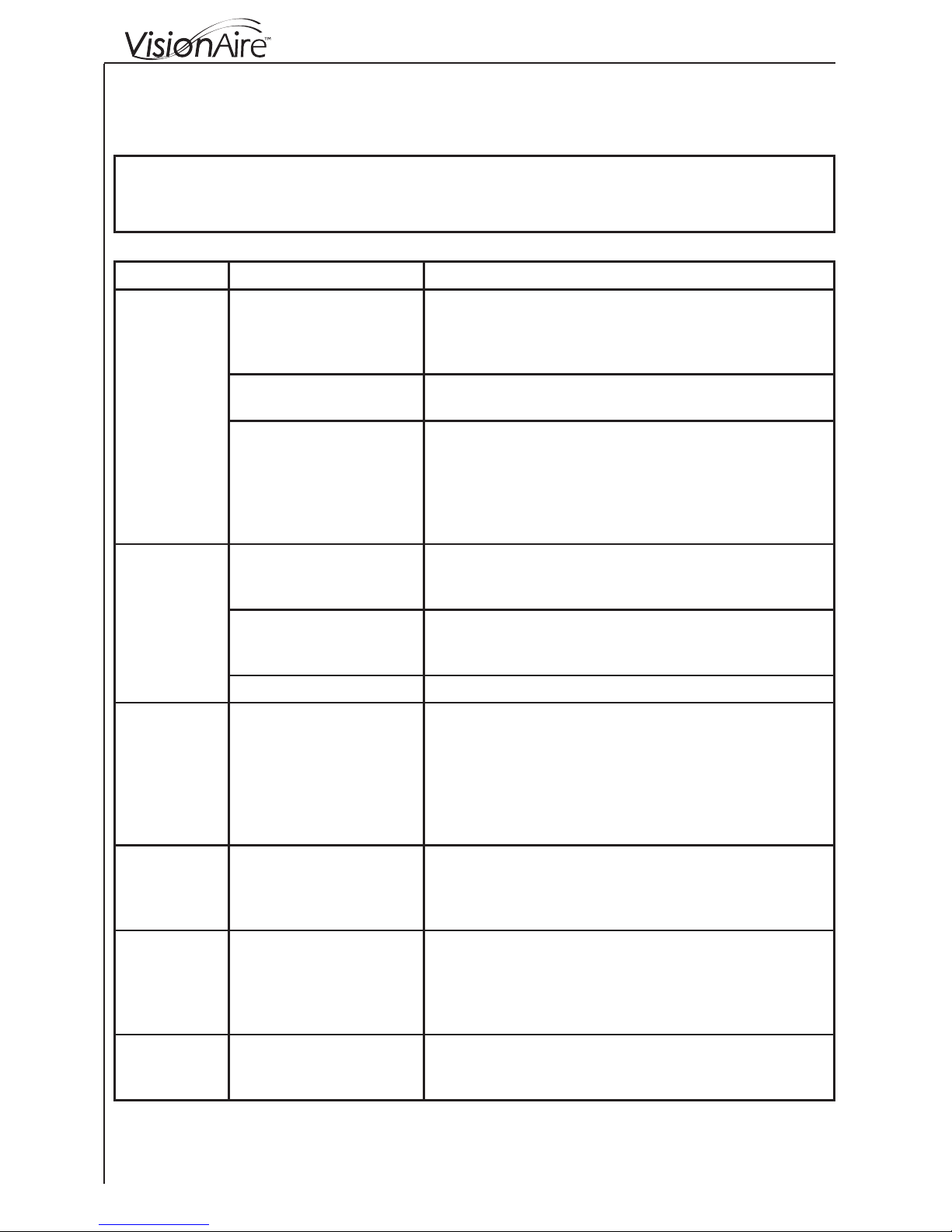
If your concentrator fails to operate properly, consult your Equipment Provider, and refer to the troubleshooting
chart on the following pages for probable causes and solutions.
Note: Do not attempt any maintenance other than the possible solutions listed within the manual
Note: If the unit has not been used for an extended time period, it needs to operate for several minutes before power failure alarm
can become activated.
Problem Probable Cause Solution
Unit does
not operate.
Power failure
condition
causes an
alarm to
sound.
The power cord is not
connected to the electrical
outlet.
Check power cord at the electrical outlet for a proper
connection.
No power at the electrical
outlet.
Check power source, wall switch, in-house fuse or circuit
breaker.
Circuit breaker on
concentrator unit is
activated.
Press (do not hold in) the circuit breaker reset button in the
front of the unit.
If the circuit breaker trips again or the alarm continues to
sound after the unit is turned on, contact your Equipment
Provider.
Limited or no
oxygen ow.
Dirty or obstructed
humidier bottle, or leak
present.
Remove the humidier bottle, and if ow is restored, clean
or replace the humidier bottle.
Defective nasal cannula, or
other oxygen accessories,
i.e. oxygen tubing.
Remove and check accessories for kinks or obstructions.
Replace if needed.
Cannula tubing loose. Check cannula tubing connection at control panel.
Condensation
collects in the
oxygen tubing
when you use
a humidier
bottle
Unit not properly
ventilated.
Elevated operating
temperatures.
Make sure unit is positioned away from curtains or drapes,
hot air registers or heaters. Be certain to place the unit so all
sides are at least 1 foot (30 cm) away from a wall or other
obstruction. Do not place the unit in a conned area.
Rell humidier bottle with COLD water.
DO NOT OVERFILL. Allow oxygen tubing to dry out, or
replace with new tubing.
Intermittent
alarm sounds
at one second
intervals.
See “Safety Features” for
a description of auditory
indicators.
Set I/0 power switch to 0 position, use your reserve oxygen
supply (if provided), and consult your Equipment Provider
immediately.
Oxygen
Concentration
Indicator
remains lit
(amber)
Oxygen concentration is ≤
82% (±3%).
Set I/0 power switch to the 0 position, use your reserve
oxygen supply (if provided), and consult your Equipment
Provider immediately.
All other
problems.
Set I/0 power switch to the 0 position, use your reserve
oxygen supply (if provided), and consult your Equipment
Provider immediately.
Troubleshooting
Page 15

VisionAire 2 & 3 User Manual — 15
For correct use of the device refer to the following
chart. The chart provides important information
about the recommended operating environments, or
operating conditions.
Specications
Flow
Specications
(1)
1/2 lpm – 3 lpm
1/8 lpm – 2 lpm
Oxygen
Concentration
(2)
90% (+ 5.5% / - 3%)
Electrical
Requirements
115 VAC / 60 Hz, 3.0 A
230 VAC / 50 Hz, 1.5 A
230 VAC/ 60 Hz, 1.0 A
Power
Consumption
VisionAire 2 = 200 Watts (+/- 10%)
VisionAire 3 = 200 Watts (+/- 10%)
Sound 45 dba anechoic
Dimensions 14.1 in. W x 11.5 in. D x 20.8 in. H
(35.8 cm W x 29.2 cm D x 52.8 cm H)
Weight 30 lbs (13.6 kg)
Electrical Shock
Protection
Class II, Type BF
Environmental
Limit
Conditions
(3)
Operating conditions: 5°C to 40°C (41°F
to 104°F) at altitudes up to 10,000 ft.
(523 mmHg) above sea level.
Storage: -20°C to 60°C (-4°F to 140°F)
Relative Humidity: up to 95% RH
non-condensing
(1) ±10% of indicated setting, or 200 mL, whichever is greater
(2) Performance based at 21°C (70°F) at nominal operating
pressure range: 0-7 kPa (0-1 psig back pressure). Maximum
outlet pressure : 55 kPa. ( 7.98 psig)
(3) Operating outside of these operational specications can
limit the concentrators ability to meet Oxygen Concentration
specication at higher liter ow rates.
Product Specifications
Page 16
16 — MN165-1 M
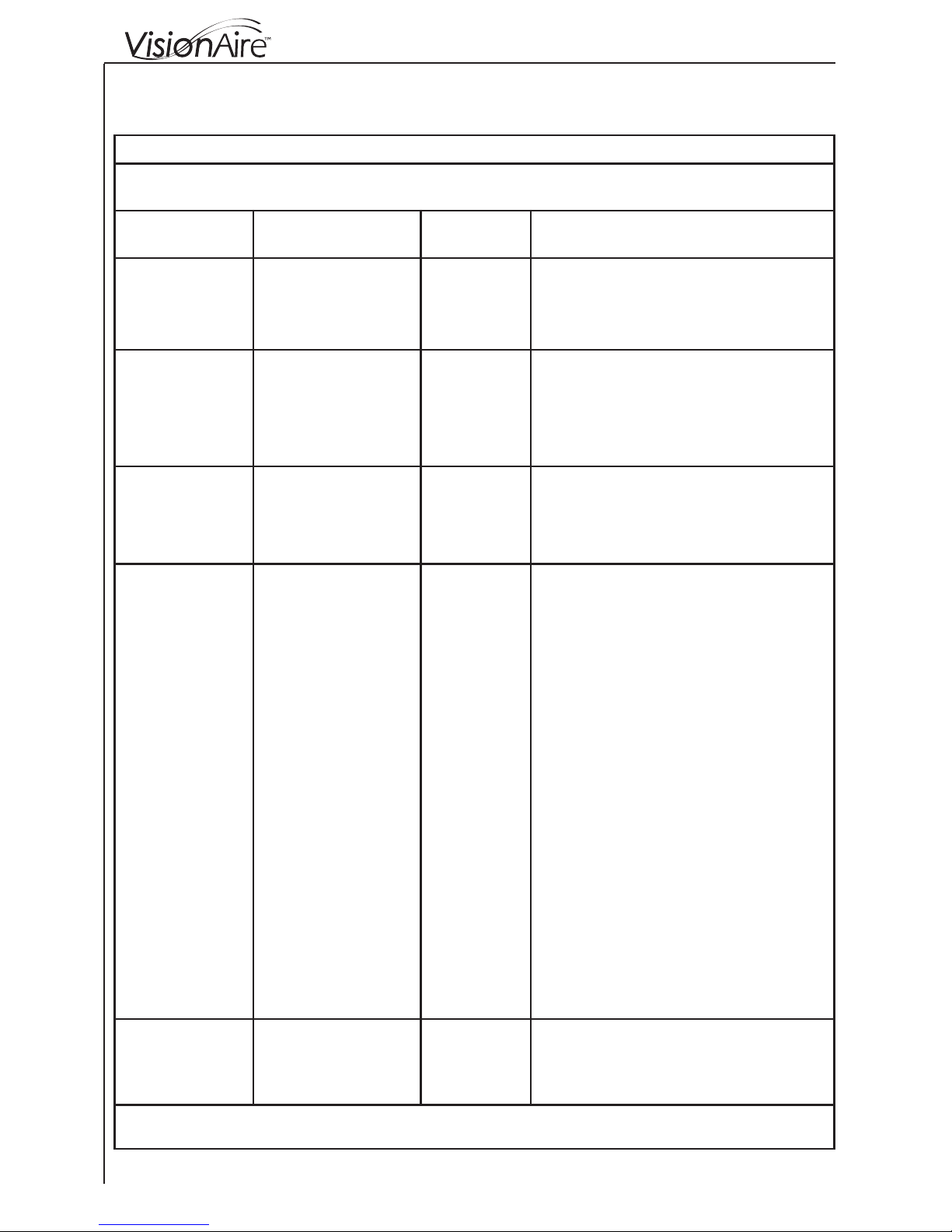
Medical equipment needs special precautions regarding EMC and need to be installed and put into service
according to the EMC information provided in this section.
Guidance and Manufacturer’s Declaration—Electromagnetic Immunity
The unit is intended for use in the electromagnetic environment specied below. The customer or the user of the
unit should assure that it is used in such an environment.
Immunity test IEC 60601 test level Compliance
level
Electromagnetic environment – guidance
Electromagnetic
environment –
guidance
IEC 61000-4-2
±6 kV contact
±8 kV air
±6 kV contact
±8 kV air
Floors should be wood, concrete or ceramic tile. If oors are covered with synthetic
material, the relative humidity should be at
least 30 %.
Electrical fast
transient/burst
IEC 61000-4-4
±2 kV for power supply
lines
±1 kV for input/output
lines
±2 kV for
power supply
lines
N/A
Mains power quality should be that of a typical
commercial or hospital environment.
Surge
IEC 61000-4-5
±1 kV line(s) to line(s)
±2 kV line(s) to earth
±1 kV line(s)
to line(s)
Mains power quality should be that of a typical
commercial or hospital environment.
Voltage dips, short
interruptions and
voltage variations
on power supply
input lines IEC
61000-4-11
<5 % UT
(>95 % dip in UT )
for 0,5 cycle
40 % UT
(60 % dip in UT )
for 5 cycles
70 % UT
(30 % dip in UT )
for 25 cycles
<5 % UT
(>95 % dip in UT )
for 5 sec
<5 % UT
(>95 % dip
in UT )
for 0,5 cycle
40 % UT
(60 % dip in
UT )
for 5 cycles
70 % UT
(30 % dip in
UT )
for 25 cycles
<5 % UT
(>95 % dip
in UT )
for 5 sec
Mains power quality should be that of a typical
commercial or hospital environment. If the user
of the unit requires continued operation during
power mains interruptions, it is recommended
that the unit be powered from an uninterruptible power supply or a battery.
Power frequency (50/60 Hz)
magnetic eld IEC
61000-4-8
3 A / m 3 A / m
Power frequency magnetic elds should be at
levels characteristic of a typical location in a
typical commercial or hospital environment.
NOTE U
T
is the A.C. mains voltage prior to application of the test level.
Page 17
VisionAire 2 & 3 User Manual — 17
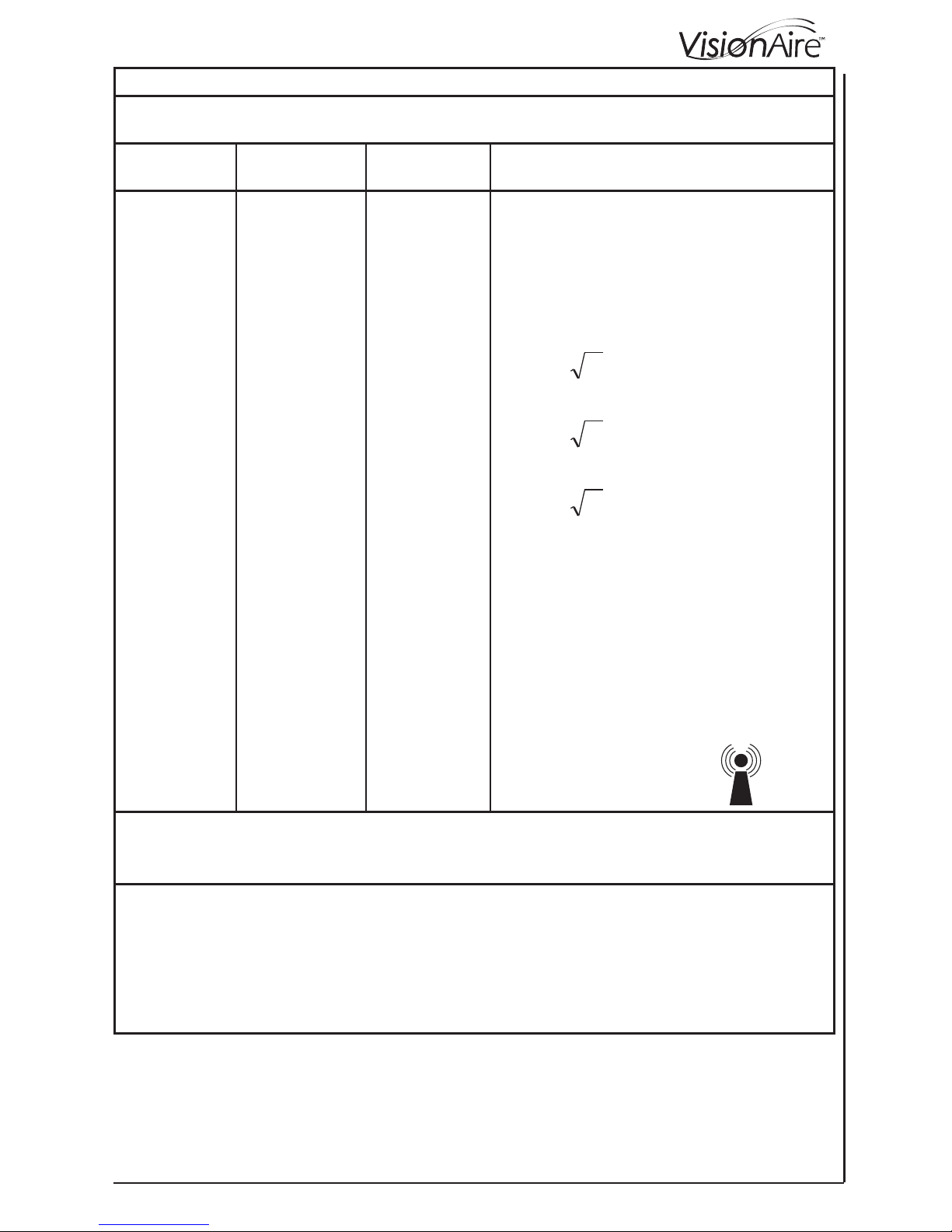
Guidance and Manufacturer’s Declaration–Electromagnetic Immunity
The unit is intended for use in the electromagnetic environment specied below. The customer or the user of the
unit should assure that it is used in such an environment.
Immunity test IEC 60601 test
level
Compliance
level
Electromagnetic environment – guidance
Conducted RF
IEC 61000-4-6
Radiated RF
IEC 61000-4-3
3 Vrms
150 kHz to 80
MHz
3 V/m
80 MHz to 2,5
GHz
3 Vrms
3 V/m
Portable and mobile RF communications equipment
should be used no closer to any part of the VisionAire,
including cables, than the recommended separation
distance calculated from the equation applicable to
the frequency of the transmitter.
Recommended separation distance
Pd 2.1
Pd 2.1
= 80 MHz to 800 MHz
Pd 2.1
= 800 MHz to 2,5 GHz
Where P is the maximum output power rating of the
transmitter in watts (W ) according to the transmitter
manufacturer and d is the recommended separation
distance in metres (m).
Field strengths from xed RF transmitters, as determined by an electromagnetic site survey,a should
be less than the compliance level in each frequency
range. b
Interference may occur in the vicinity of equipment
marked with the following symbol:
NOTE 1 At 80 MHz and 800 MHz, the higher frequency range applies.
NOTE 2 These guidelines may not apply in all situations. Electromagnetic propagation is aected by absorption and
reection from structures, objects and people.
a
Field strengths from xed transmitters, such as base stations for radio (cellular/cordless) telephones and land
mobile radios, amateur radio, AM and FM radio broadcast and TV broadcast cannot be predicted theoretically with
accuracy. To assess the electromagnetic environment due to xed RF transmitters, an electromagnetic site survey
should be considered. If the measured eld strength in the location in which the VisionAire is used exceeds the
applicable RF compliance level above, the VisionAire should be observed to verify normal operation. If abnormal
performance is observed, additional measures may be necessary, such as re-orienting or relocating the VisionAire.
b
Over the frequency range 150 kHz to 80 MHz, eld strengths should be less than 3 V/m.
Page 18
18 — MN165-1 M
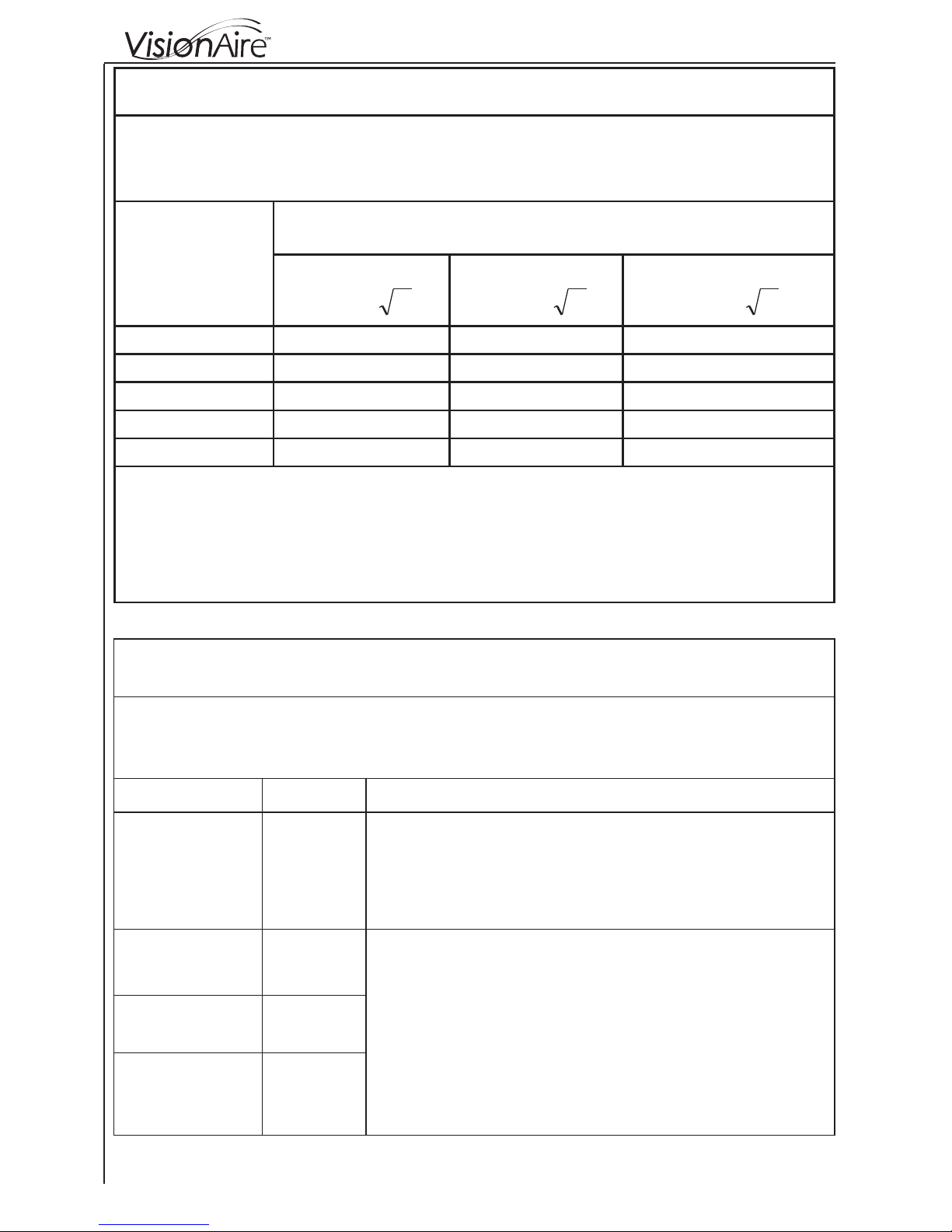
Recommended separation distances
between portable and mobile RF communications equipment and the unit
The unit is intended for use in an electromagnetic environment in which radiated RF disturbances are controlled.
The customer or the user of the unit can help prevent electromagnetic interference by maintaining a minimum
distance between portable and mobile RF communications equipment (transmitters) and the unit as recommended
below, according to the maximum output power of the communications equipment.
Rated maximum
output power of
transmitter
W
Separation distance according to frequency of transmitter
m
150 kHz to 80 MHz
Pd 2.1
80 MHz to 800 MHz
Pd 2.1
800 MHz to 2,5 GHz
Pd 2.1
0,01 0.12 0.12 0.23
0,1 0.38 0.38 0.73
1 1.2 1.2 2.3
10 3.8 3.8 7.3
100 12 12 23
For transmitters rated at a maximum output power not listed above, the recommended separation distance d in
metres (m) can be estimated using the equation applicable to the frequency of the transmitter, where P is the maximum output power rating of the transmitter in watts (W) according to the transmitter manufacturer.
NOTE 1 At 80 MHz and 800 MHz, the separation distance for the higher frequency range applies.
NOTE 2 These guidelines may not apply in all situations. Electromagnetic propagation is aected by absorption and
reection from structures, objects and people.
Guidance and Manufacturer’s Declaration —Electromagnetic Emissions
The unit is intended for use in the electromagnetic environment specied below. The customer or the user of the
unit should assure that it is used in such an environment.
Emissions Test Compliance Electromagnetic Environment - Guidance
RF emissions
CISPR 11
Group 1
The unit uses RF energy only for its internal function. Therefore, its RF
emissions are very low and are not likely to cause any interference in
nearby electronic equipment.
RF emissions
CISPR 11
Class B
The unit is suitable for use in all establishments, including domestic establishments and those directly connected to the public low-voltage power supply network that supplies buildings used for domestic purposes.
Harmonic emissions
IEC 61000-3-2
Class A
Voltage uctuations/
icker emissions
IEC 61000-3-3
Complies
Page 19
VisionAire 2 & 3 User Manual — 19
Method of disposing of waste: All waste from
AirSep’s VisionAire 2 and VisionAire 3 Oxygen
Concentrator must be disposed of using the
appropriate methods specied by local authorities.
Method for disposing of the device: In order to
preserve the environment, the concentrator must be
disposed of using the appropriate methods specied
by local authorities.
AVERTISSEMENT: CET APPAREIL PRODUIT
DE L’OXYGÈNE À CONCENTRATION ÉLEVÉE,
FAVORISANT UNE COMBUSTION RAPIDE.
NE PAS PERMETTRE DE FUMER OU DES
FLAMMES NUES DANS LA MÊME CHAMBRE: 1 CET
APPAREIL OU 2 TOUT ACCESSOIRE CONTENANT DE L’OX
YGÈNE. NE PAS UTILISER DE PRODUITS À BASE D’HUILE,
DE GRAISSE OU DE PÉTROLE SUR OU À PROXIMITÉ DE
L’UNITÉ. DÉCONNECTER LE CORDON D’ALIMENTATION DE
LA PRISE ÉLECTRIQUE AVANT DE NETTOYER OU DE FAIRE
L’ENTRETIEN DE L’UNITÉ.
AVERTISSEMENT: RISQUE DE CHOC ÉLECTRIQUE. NE
PAS ENLEVER LES COUVERCLES LORSQUE L’UNITÉ EST
BRANCHÉE. SEULS VOTRE FOURNISSEUR D’ÉQUIPEMENT
OU UN TECHNICIEN DE SERVICE QUALIFIÉ DEVRAIT
ENLEVER LES COUVERCLES OU FAIRE L’ENTRETIEN DE
L’UNITÉ.
Disposal
Conformity with EN 60-601 (§ 6.8.2 b) /
Classication:
“The manufacturer, assembler, installer or importer
are not considered to be responsible themselves
for the consequences on the safety, reliability and
characteristics of a device unless:
- The assembly, tting, extensions, adjustments,
modications or repairs have been performed by
persons authorized by the party in question,
- The electrical installation of the corresponding
premises complies with IEC regulations.
- The device is used in accordance with the
instructions for use. “If the replacement parts used
for the periodic servicing by an approved technician
do not comply with the manufacturer’s specications,
the latter is absolved from all responsibility in the
event of an accident. Do not open the device while
in operation: risk of electrical shock. This device
complies with the requirements of the MDD (93/42/
EEC:2007/47/EC) Annex I European directive but
its operation may be affected by other devices being
used close by, such as diathermy and high frequency
electro-surgical equipment, debrillators, short wave
therapy equipment, mobile telephones, CB and other
portable devices, microwave ovens, induction plates
or even remote control toys and more generally
electromagnetic interferences which exceed the levels
specied by the EN 60601-1-2 standard.
Classication
Type of protection against electric shock:
Class II Protection from electric shock is achieved by
DOUBLE INSULATION.
Protective earthing or reliance upon installation
conditions are not required.
Degree of protection against electric shock:
Type BF Equipment providing a particular degree of
protection against electric shock, particularly
regarding:
1) Allowable leakage current;
2) Reliability of protective earth connection
(if present).
Not intended for direct cardiac application.
Method of cleaning and infection control allowed:
Please refer to your Equipment Provider and the
VisionAire Service Manual.
Degree of safety of application in the presence of
ammable gases:
Equipment not suitable for such application.
Mode of operation:
Continuous duty.
Page 20
As of the date of this publication, VisionAire, AirSep and their related logos
(as applicable) are trademarks registered by CAIRE Inc.
Lysol
®
is a registered trademark of Reckitt Benckiser, UK.
OxySafe
®
is a registered trademark of Applied Home Healthcare Equipment.
Pine-Sol
®
and Lestoil® are registered trademarks of The Clorox Company.
CAIRE Inc.
2200 Airport Industrial Dr., Ste. 500
Ball Ground, GA 30107
1-800-482-2473
Worldwide: www.chartindustries.com/Respiratory-Healthcare
Medical Product Services GmbH
Borngasse 20
35619 Braunfels, Germany
Worldwide: www.chartindustries.com/Respiratory-Healthcare
|MN165-1_MN~
MN165-1_M
Copyright © 2016 Chart Industries. CAIRE Inc. reserves
the right to discontinue its products, or change the prices,
materials, equipment, quality, descriptions, specications
and/or processes to its products at any time without prior
notice and with no further obligation or consequence.
All rights not expressly stated herein are reserved by us,
as applicable.
 Loading...