

Page 1
C
erious
echnologies
T
C
erious Ceramic Reference
The Perfect Blend of Science and Magic
Page 2
Introduction
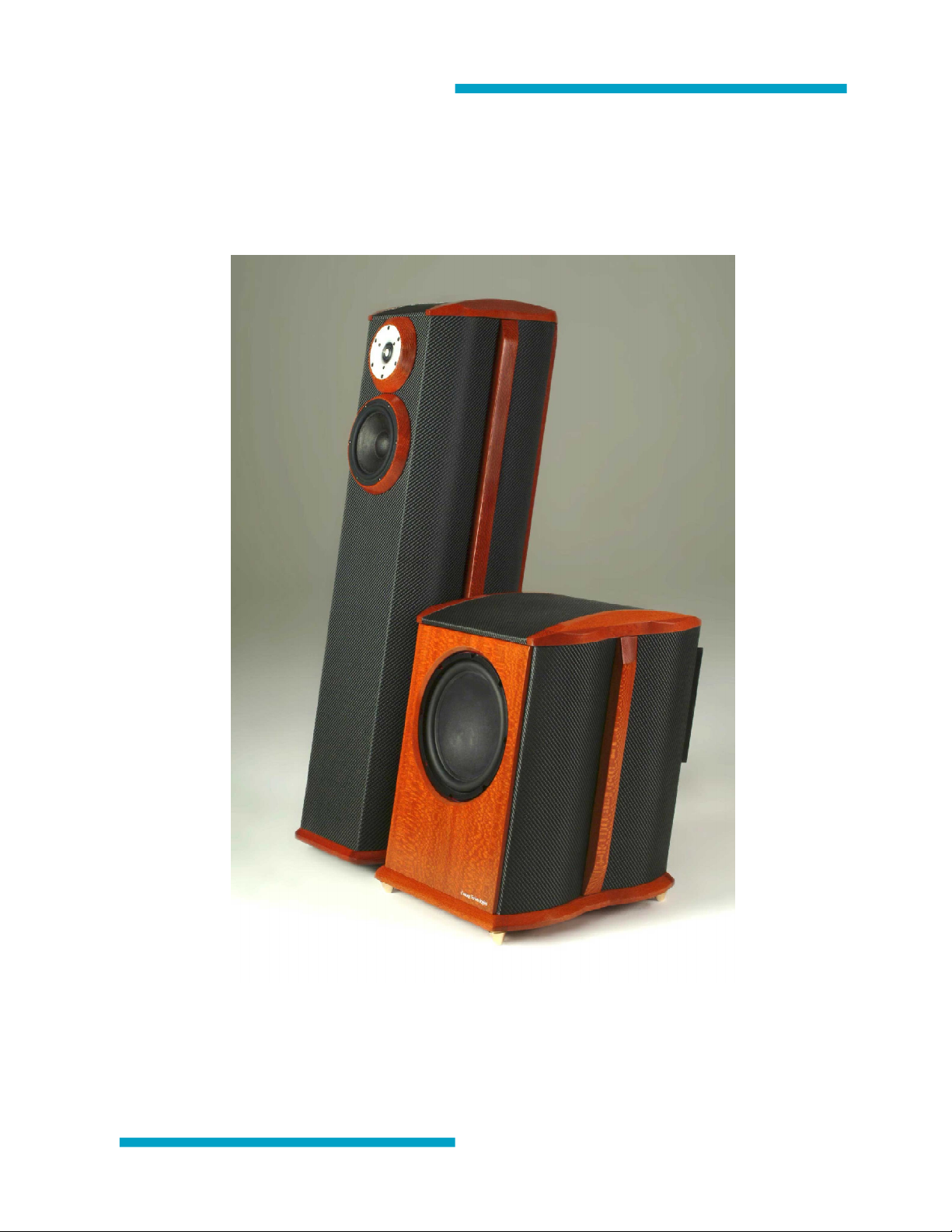
The Cerious Technologies Ceramic Reference
system is a tour de force of new technologies. Constructed of the
most advanced composites on Earth, each cabinet is such an
efficient energy sink that no sound absorption materials are needed
to dissipate internal waves. Traditional wire has been replaced
with composite conductors damped by reactive liquid ceramic.
Even the resistors are special composites developed for this
project. Complex engineering with one goal -
Loudspeaker design is a delicate job of managing the limits of the
real world. The more simple the design is in its final execution, the
fewer elements will be present to be balanced into harmony. The
only catch is that simplicity may be the most complex engineering concept of all. We at Cerious Technologies
in the achievement that is the
ment system for
Technology serving Music
Ceramic Reference
loudspeaker
simplicity
take great pride
. It is our state-
.
.
System Overview
The
Ceramic Reference
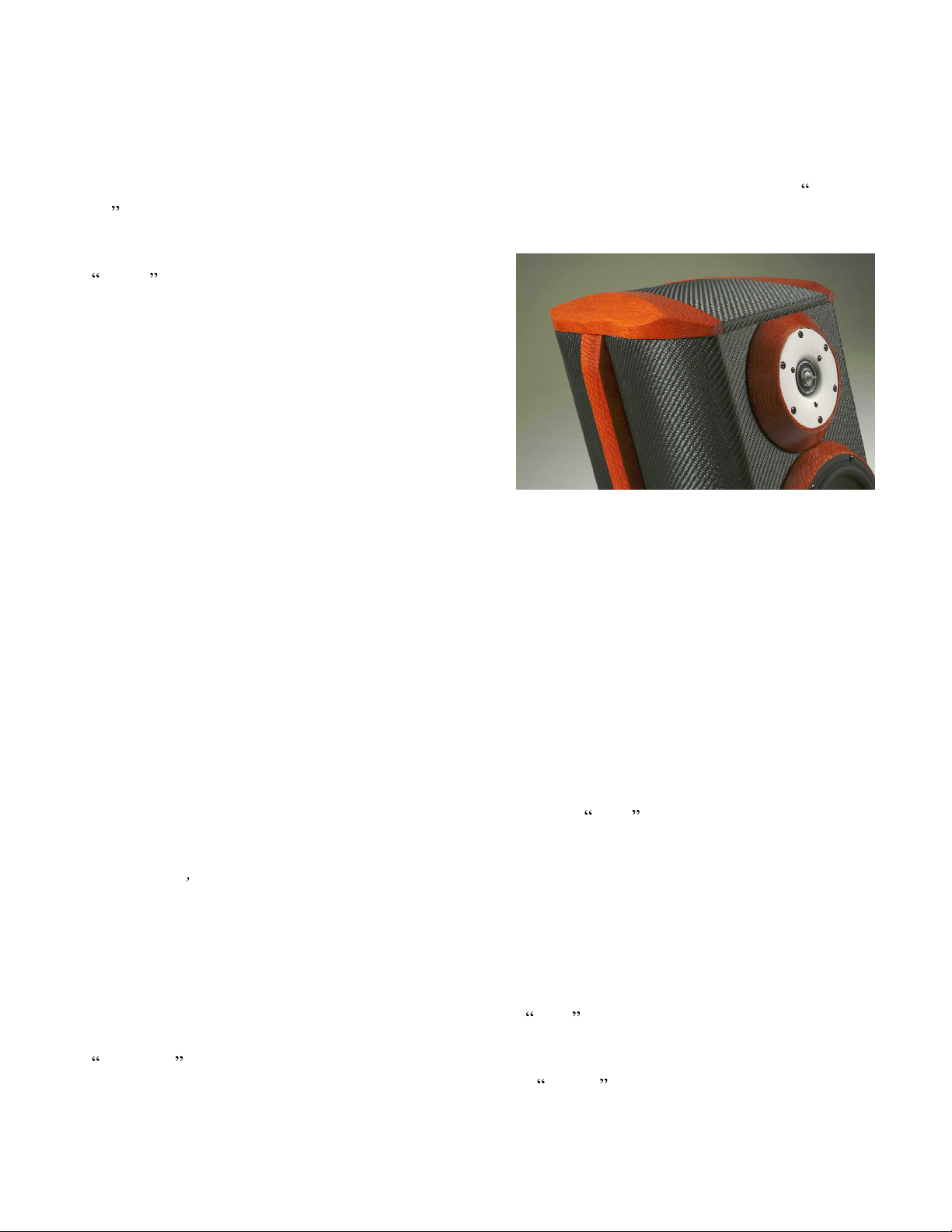
self-powered subwoofers. The satellites employ a custom Scan Speak ring tweeter and an 18 cm custom
midrange with a proprietary ceramic composite cone. The composite cone yields stiffness close to solid
ceramic cones, but has the internal damping characteristics found in traditional paper cones. This results
in the detail and extension of exotic ceramic cone drivers, yet do not require complex filtering that must
address their inherent ringing and resonance instability. These drivers are
and musical allowing for crossover designs that work with the strengths of the drivers, not forced to deal
with the dark side of driver control.
is a four piece dynamic driver system consisting of a two way satellite and two
inherently
detailed, refined,
Each subwoofer utilizes two 25 cm, cast basket woofers with composite Aluminum/Ceramic cones. No
woofer cones are stiffer or as well damped. This reveals itself not in the bass region, but in the
midrange, where utter tonality is displayed. Integral 300 watt amplification with variable crossover
allows flexibility of room integration. The subwoofer/crossover/amplification interface is designed from
the ground up as a system, eliminating potential problems and component mismatches. Let there be no
mistake, however, that these subwoofers are polite do not get in the way bass generators. They are
capable of rocking your world both sonically
and physically
.
Yes, This is Rocket Science...
The cabinets of the
significant is the
is acknowledged that the job of an enclosure is to absorb the rear wave of the
driver, current enclosure design philosophy does not address this purpose directly.
The design philosophy of constructing a rigid acoustically dead enclosure,
which will therefore be unable to absorb anything
material is the little white lie of loudspeaker design. Sound absorption materials
simply cannot accomplish this task alone.
Ceramic Reference
purpose
for which they were designed and constructed. While it
are unique for many reasons, but the most
, and fill it with sound absorbing
Page 3
Anechoic chambers are facilities designed to absorb sound. The best chamber in the world is the size of
a gymnasium with 12 foot long wedges of sound absorbing material and yet it is only capable of neutralizing signals down to 60 Hz. It is folly to believe that some foam stuffed into a shoebox sized enclosure
will do what our anechoic chamber cannot. Clearly, if we are to be successful, we must face the real
world function of an enclosure. Our cabinet must not be dead , it must instead be an energy sink
drawing sound away from the drivers and dissipating it as a heat sink does drawing heat away from
transistors and dissipating it in an amplifier. We would never design a heat sink out of a thermally inert
material and then figure we can get it to function be painting the outside with aluminum!
Enter the world of composites. A composite is a combination of materials combined to create a unique
material that has characteristics unlike any single (homogenous) material that exists as a single entity.
So...what? Single materials possess common traits such as the stiffer they are the more they ring and
will be
sophisticated Band-Aids. We at Cerious Technologies
not design a material that is rigid and inherently stable with regard to energy?
Other loudspeaker companies attempt to deal with this by choosing the least offensive material, such
as phenolics and other exotics . They all, however, are fatally flawed. They all behave as a single
material does. You must choose: Do you want rigidity or a stable energy platform? You cannot have
both. Even traditional composites such as Carbon Fiber behave closely to homogenous materials. It
quickly became obvious that a new design direction must be undertaken.
inherently
unstable with regard to energy storage. Dealing with this in the past meant highly
just happen to find this to be an oxymoron. Why
C
erious Technologies
one that was extremely rigid, yet was designed to absorb the tremendous
impact of objects designed for destruction. This extremely high loss material
is a proprietary synthetic ceramic, a material that can be engineered to have
differing and specific properties to match applications. The particle density,
energy storage and resonance properties can be controlled to fine tune
panels constructed of this material allowing complete control of the behavior of each panel.
The synthetic ceramic used, once set, does not take well to machining. For
this reason the cabinets of the
molding process is used, so that a high loss inner portion is surrounded by a
more rigid structural ceramic. In addition, fluid filled tubes line the inside of the enclosures vibrating
to actively dissipate internal acoustic waves. The enclosure system is so efficient at dissipating internal acoustic energy that
no internal sound absorption material is needed
research into ballistic armor offered a new material,
Ceramic Reference
are cast in molds. A co-
.
The Satellites
The satellites are designed to handle frequencies from 80 Hz to 25 KHz. Each enclosure is cast of
synthetic ceramic. Each section is designed to dissipate specific acoustic inputs resulting in an acoustic
Black Hole behind the midrange driver. Three 7 cm aerospace grade aluminum/Kevlar composite
tubes run vertically through the center of the enclosure breaking up any standing waves by creating
uneven surfaces throughout the enclosure. Each tube is filled with different materials to have unique
resonance characteristics further broadening the spectrum of energy dissipation.
Page 4
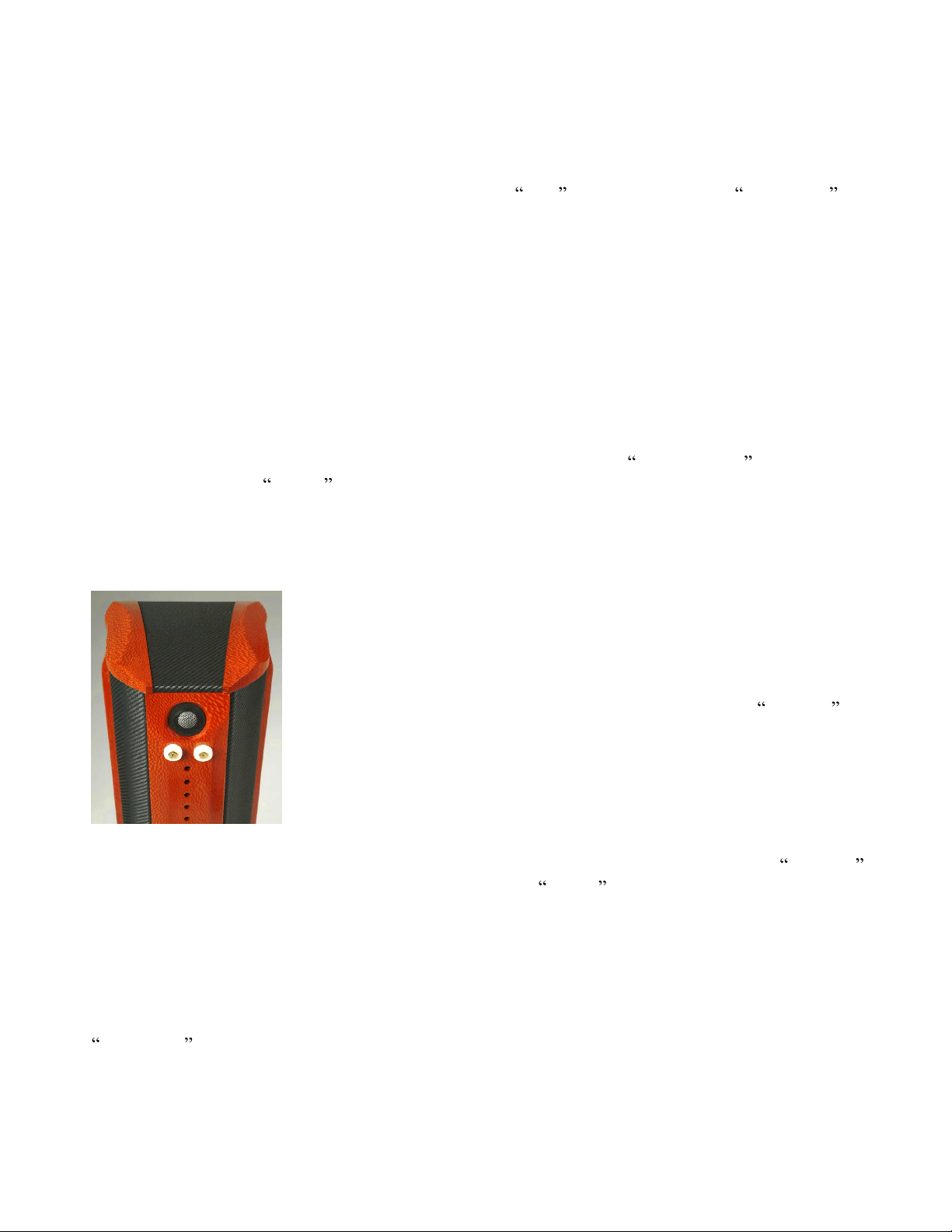
The rear of the enclosure is the final piece of the midrange loading. While acoustic output is dealt with
through vibration cancellation, the air pressure within the enclosure must be extremely low allowing the
midrange free range of movement. A series of vent holes run down the back panel, each getting progressively larger in diameter as they move away from the midrange. The use of flow analysis resulted in an
even and equal pressure release over a wide area broadband in nature. In this way the speed of open
air designs can be realized without their negative room loading properties.
Why do the cabinets need to be this massive for just a
simple two way design? In a way loudspeakers can
be viewed as the mirror image of the turntable. Each
involves the transition between mechanical and
electrical energy. The big breakthrough in turntables
came with the realization of the importance of directcoupling and the preservation of energy throughout
the entire process. Analog addicts can attest to the
benefit of mass
possess more weight and size to their presentations.
Mass adds stability to the conversion process.
. Larger high mass designs simply
The drivers, crossovers, and the way they interface are further areas of research unique to the
Reference
electronics - traditional wire and the way you terminate it, namely the solder joint. Each signal path in
the
Ceramic Reference
Many other designs show with pride their huge pc boards filled with components that correct for every
problem their drivers and enclosures possess. We designed drivers and enclosures that need no such
correction. Our crossovers act as -
Matching driver sensitivities, however, requires the use of resistors. Traditional resistors use fine gauge
high resistance wire that no audiophile would ever accept for use in their system. Resistors, like solder
joints, just plain sound bad. So how do you match levels in drivers, limit solder joints and limit the
number of components the signal must go through? The answer is the
cables developed by Cerious Technologies
driver, when the resistance can be designed into the cables? Each cable used in the
Reference
specifically for that purpose. The tweeter needs exactly 4.4 Ohms of series resistance to match the
midrange.
ite Liquid Ceramic
will current limit or fail!
The other inherent aspect of matching dynamic drivers is in the arena of time domain. The acoustic
centers must be matched on the same plane if the loudspeaker is to be time coherent. For this reason the
cabinet slopes back 10 degrees to get the acoustic centers close . The unusual hand turned mounting
rings serve two functions. The first is to get the drivers out away from the baffle to aid in the goal of
free space mounting. This will aid in imaging. The second function is the fine tuning of the time
domain with the thickness of the rings getting the interface spot on . Each
individually pulse tested to verify its integrity in the time domain. This enables the system to image like
a mini-monitor with the impact and image size of larger systems.
project. Research focused on eliminating one of the most sonically harmful elements of
has no more than two solder joints giving new meaning to getting the lead out.
crossovers
is a custom designed composite specific to the task of transmitting the exact signal needed
It s in the cable
cables will glow red and melt their pure Teflon jackets at 2000 degrees before they
. Unlike traditional resistors that have power limits and can fail, the
! Period. Each signal path employs but a single element.
Composite Liquid Ceramic
. Why solder a resistor in line to the wire that goes to each
Ceramic
Ceramic Reference
Ceramic
Compos-
is
Page 5
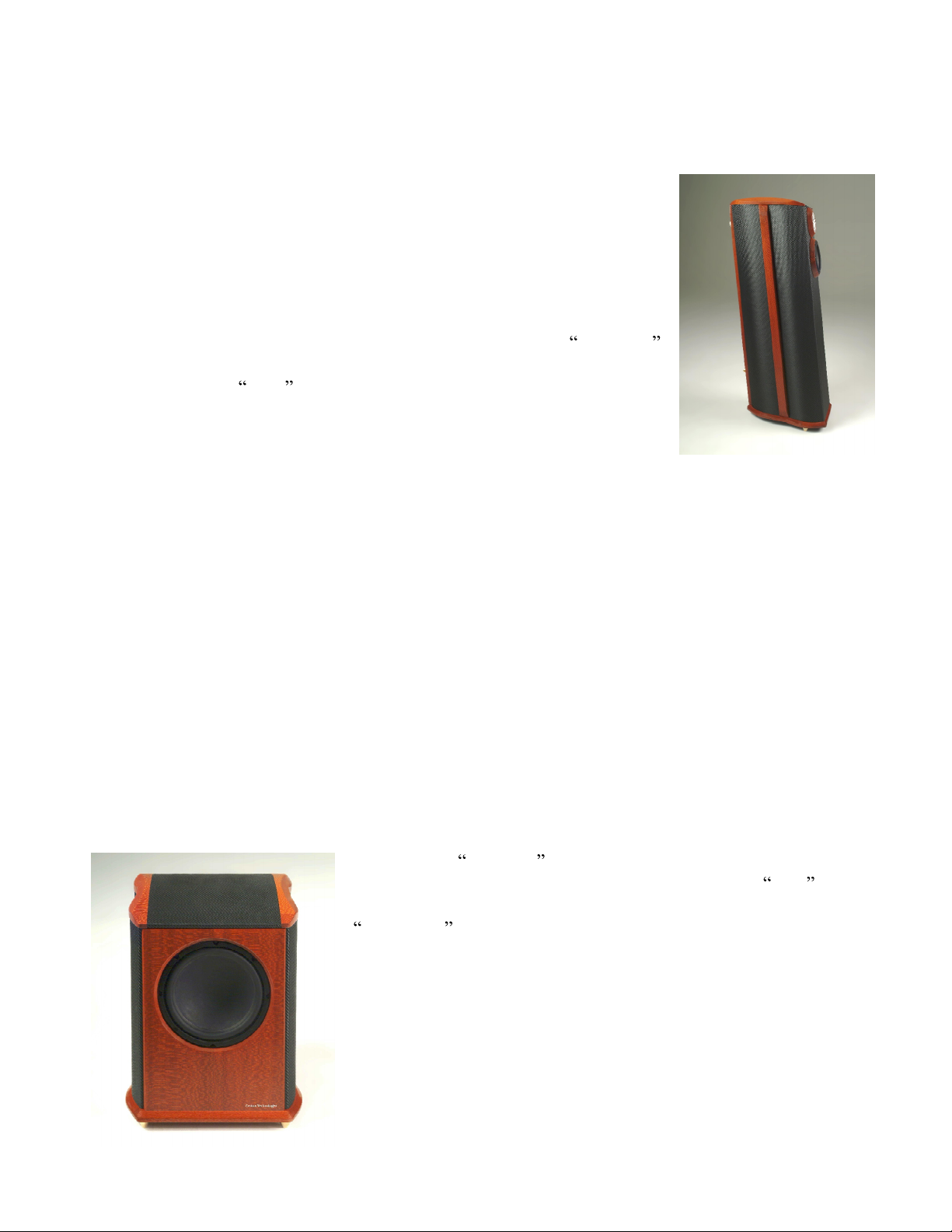
The individual drivers were chosen for their musicality and inherent linearity. Any non-linearity is
addressed in the formulation of the composite ceramic cones. This is done at the mechanical level to
eliminate the need for correction of any kind electrically or acoustically. The result is a sonically pure
reproduction unhindered by normal acoustic pressures present in other
cabinets and parts contamination of traditional components. The design of
the midrange specifically addresses acoustic compression allowing it to
maximize the gains of its loading resulting it large scale dynamic contrasts.
The custom Scan Speak tweeter matches the midrange in its ability to
delineate detail and dynamics. The final product is ultimate
The cabinet finish is equally unique. Kevlar is impregnated with a proprietary sealer. The Kevlar is then applied under pressure, literally squeezing
the cabinet in a vise of Kevlar fibers. Under this application Kevlar is
stronger than steel, tying the whole cabinet into one functional element.
The Kevlar finish, however, does more. The special finish does not make
the fabric hard, like carbon fiber. It remains soft and pliable, so it acts as an
acoustic deadener, like felt. Felt that is stronger than steel. The aesthetics of
the finished cabinets must be seen
finish technology was the result of over three years of research developing new and radical finishes for
the furniture industry.
and felt
, to be truly appreciated. This
transparency
.
The Subwoofers
Cast synthetic ceramic enclosures. Integral 300 watt amplifier/crossover. Dual 25 cm cast basket aluminum/ceramic composite cone woofers.
Only 15 liters of internal volume - less than many mini-monitors. No internal sound absorption material.
Fluid filled side-pod damping. This is just the beginning to the radical design of the
subwoofers
The enclosures for the
than for the satellites. Structural rigidity is of an even greater priority when dealing with the tremendous
stresses involved with bass reproduction. Each subwoofer enclosure is constructed as a monoque structure, like a Formula 1 car. The skeleton is formed of a composite of Kevlar and Corian. A mold is
.
Ceramic Reference
Composite Liquid Ceramic
subwoofers are constructed in a slightly different manner
constructed around this skeleton and the synthetic ceramic is cast
into the mold capturing the skeleton forming one single piece that
has no seams. The sides are flared to allow fluid filled pods that
react to dissipate vibration. The result is a cabinet that is truly
bulletproof and dead quiet.
The other key to structural resonance control would reside in the
ability to eliminate the large air masses that occupy standard
subwoofer systems. In acoustic structures resonances occur through
two forms of excitation - vibration and transmission. Vibrations
transmitted directly from the driver to the cabinet can be controlled
by cabinet rigidity and mass, but, energy carried by the air mass that
occupies the cabinet is extremely random and hard to control. If we
are to control energy transmission, we must eliminate the air mass.
cables with pure silver wire grounds.
Ceramic Reference
Page 6
Focusing on this problem and treating this air mass as an
medium it proved a monumental task to dissipate this energy in any practical
fashion. Through extensive computer modeling and mathematical analysis, a
cabinet design was formulated that
Therefore, the medium by which resonance is carried throughout the cabinet
could be effectively eliminated. With no air mass inside to carry the sound
around no resonances could be transmitted from one area of the cabinet to
another. This creates an enclosure of such low noise that no sound absorption
material is needed inside the subwoofer.
The two woofers operate in parallel connected via a transmission line with
each woofer functioning as the other woofer s enclosure . Unlike other
designs that sacrifice the output of one woofer for another, you get full
acoustic output from both woofers. Each subwoofer is 92 db 1 watt/1 meter efficient with no need for
equalization. Combined with the integral 300 watt amplifier bass is fast, articulate, and capable of
moving large amounts of air.
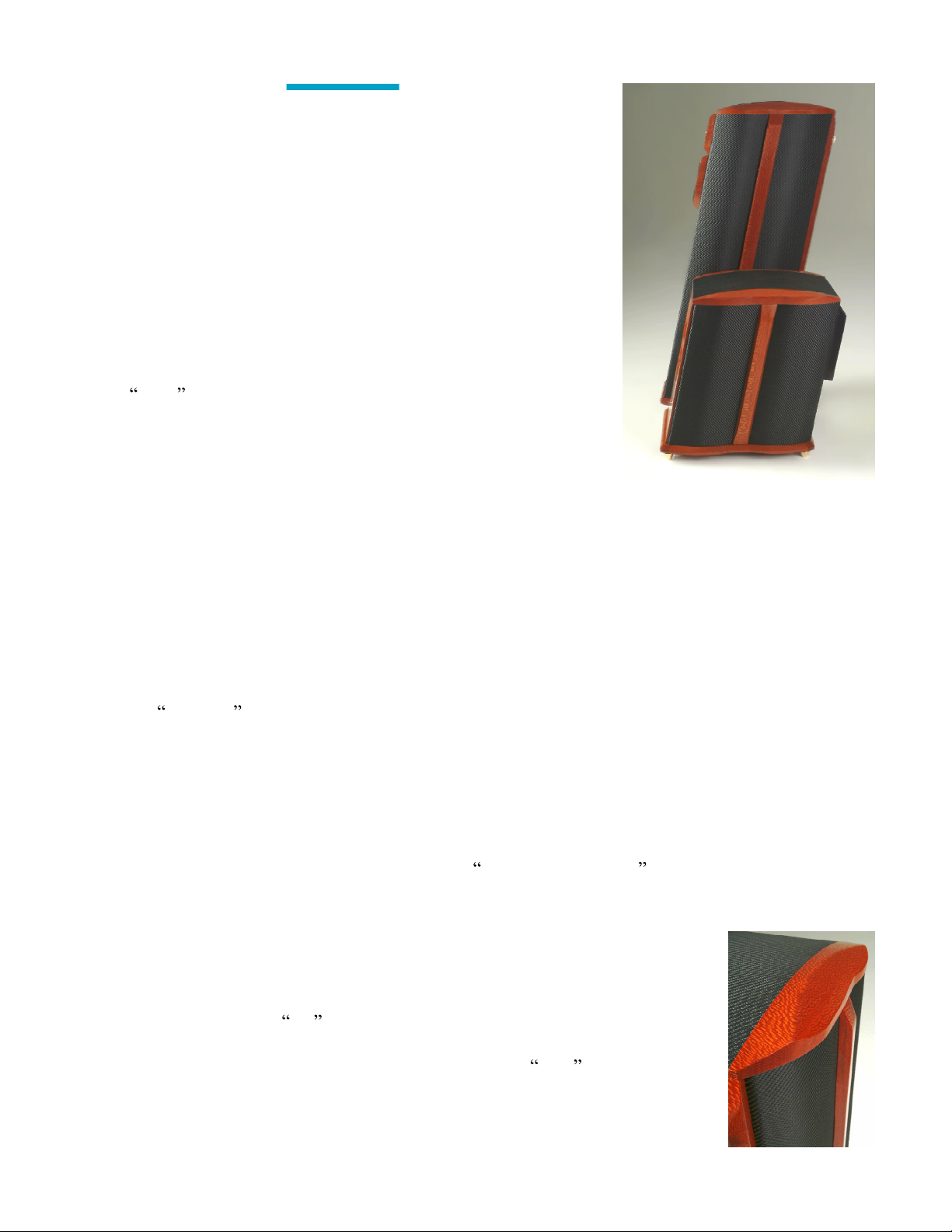
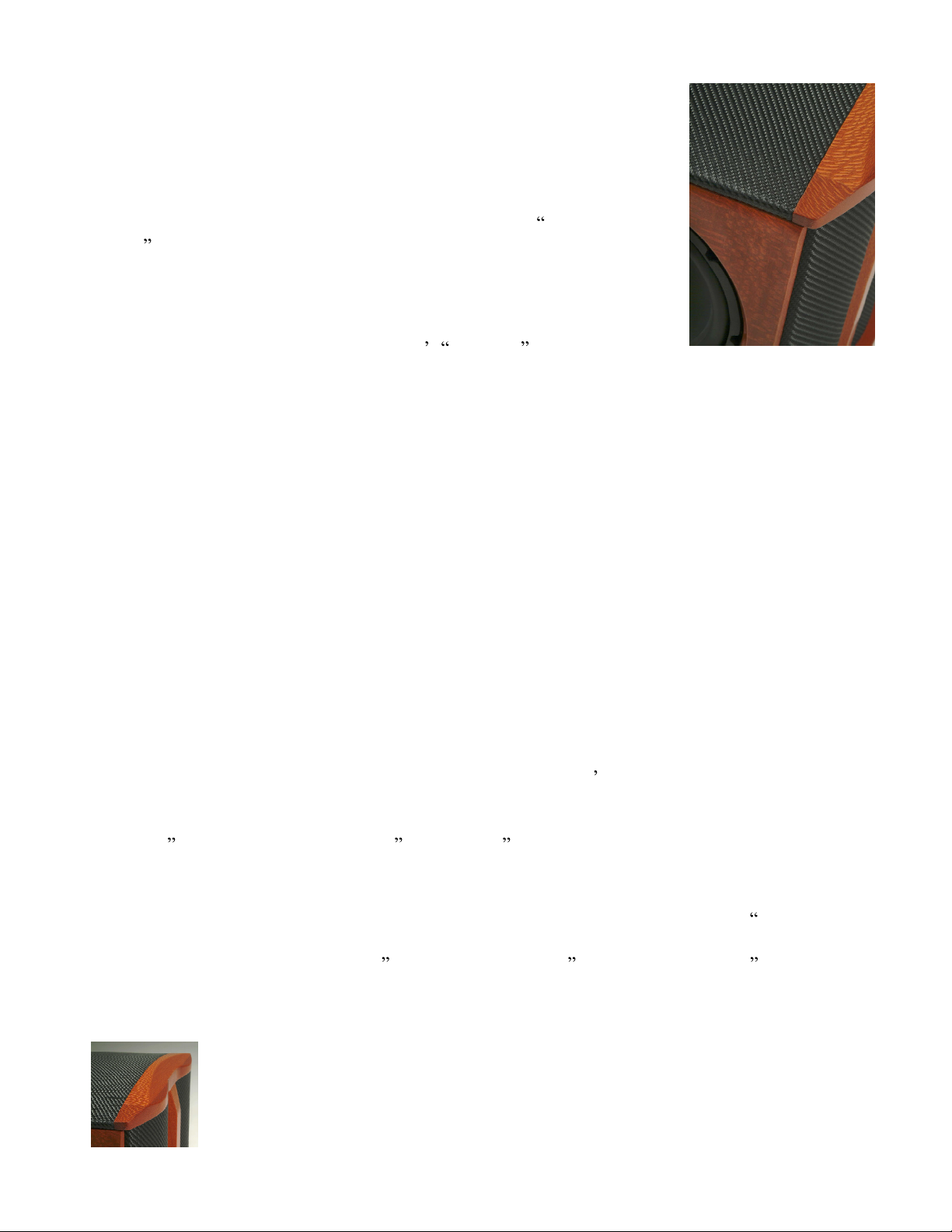
Matching the satellites each subwoofer is slanted rearward at 10 degrees and compress wrapped in
Kevlar. The Kevlar comes in any color as long as it is black. Fine exotic wood accents are available in
many varieties. The wood featured in the spectacular photos is Lacewood. The choice of wood has no
impact on the sonics, as it serves exclusively as an accent trim. The combination of the satellites and
subwoofers forms a seamless system that is as beautiful visually as it is sonically designed for many
years of trouble free enjoyment. From all of us at Cerious Technologies
our achievement the Ceramic Reference.
did not vary with internal volume.
energy
transmission
we take great pride in sharing
The Almighty Specifications
Satellites
crossing over at 3,800 Hz (single order slopes) to a 29 mm ring radiator tweeter. The tweeter is 3.6
Ohms impedance throughout most of its range. Combined with integral 4.4 Ohm resistance in the cable
feed to the tweeter, the tweeter just happens to match the midrange s smooth 8 Ohm impedance, resulting in a smooth impedance curve of 8 Ohms. The satellites are 90 db 1 watt/1 meter. While easy to
drive, they will provide an open window to what feeds them. Transparency rules! Each satellite measures 10.5 wide (at its widest point), 15 deep, and 43 tall (at its highest point) with an angle of 10
degrees. Each satellite weighs 115 pounds.
Subwoofers
300 watt amplifier/crossover with variable frequency, volume, and selectable phase. Auto sense turn on
circuitry. Each subwoofer measures 18 (at its widest point), 22 (at its tallest point), 20 deep and
weigh 150 pounds each. Realistic in room response down to a rock solid 25 Hz. They will go down to 5
Hz in a closet at 1/4 watt. Please choose which specification that makes you happiest!
: Two way dynamic driver system employing an 18 cm composite ceramic cone midrange
: Dual 25 cm cast basket aluminum/ceramic cone woofers each capable of 2 travel. Integral
C
erious Technologies
6526 Conestoga Drive
Lansing, Mi 48917
Specifications subject to change without notice. Rights reserved Cerious Technologies Group.
 Loading...