

Page 1

!
Page 2

!
The Catalinbread Talisman was designed to emulate the legendary (and gigantic!) EMT
140 plate reverb unit introduced in the late 1950’s. In use for decades now in studios
around the world, it has become an industry standard and has been used on some of the
most iconic recordings ever made.
"
For those not familiar, a plate reverb is essentially a very large sheet metal panel (roughly
7’ x 5’) suspended within a metal frame by heavy duty springs and encased within a large
wooden box. The incoming signal hits the metal plate via a driver amplifier and transducer
causing it to vibrate much like the cone of a speaker does. Pickups placed around the
plate sense the vibration and the signal is then sent to an output amplifier to boost the
signal. Sliding damper pads inside the box are adjusted to determine the length of decay.
It’s a brilliantly simple design. The result is an incredibly lush and natural sounding reverb
that never seems to get in the way of the source signal - it just embellishes it and creates
the illusion of space. "
"
The Talisman provides the same lush dimension to your sound - subtly creating space
around your playing at minimum settings to seemingly endless waves of ambient
shimmering reflections at the extremes. Drawing sonic inspiration from classic albums of
the 70's such as Pink Floyd's Dark Side Of The Moon to those incendiary first Van Halen
records and literally thousands of others, the Talisman excels at replicating those
quintessential plate reverb sounds. Featuring controls used in the studio models like high
pass filtering and pre-delay, we’ve made it easy for guitarists to dial in that same
compelling sound when using it with an amplifier.
"
Hello and welcome to your new
Talisman!
Page 3
!
Let’s begin by plugging the Talisman into your amp’s input without any other pedals in
the chain. We will address integrating it into your effects chain later on. Set your amp
to a clean setting, this way you can hear the most accurate representation of how the
reverb sounds and responds to your playing.
"
A quick word about effects loops - many
players prefer to use reverb effects in the
effects loops of their amplifiers. The
Talisman can be used in the effects loops
of many amps provided they are
instrument level or adjustable line level
loops. Loops that are non-adjustable line
level with a hot output may cause the
Talisman’s preamp to clip. If that is the
case, simply run the Talisman as the last
pedal in your chain of effects prior to the
amp’s input.
"
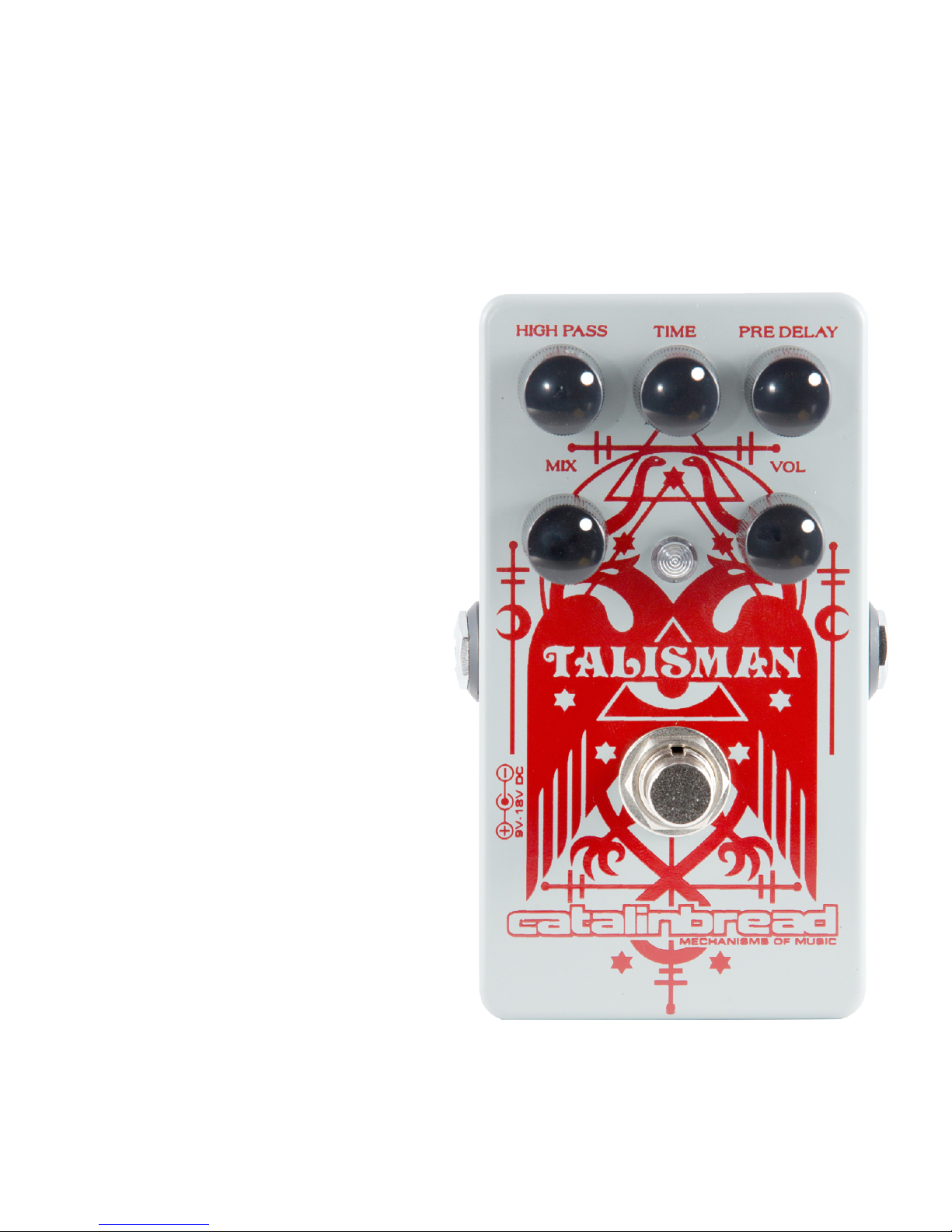
Let’s start with a medium decay, fullbodied EQ sound. Set the controls
thusly:
QUICK START
HIGH PASS - 7:00
TIME - 11:00
PRE DELAY - 7:00
MIX - 12:00
VOL - to your desired output level
Notice the clear reflected sound - very
natural and room-like. Big sounding,
but unobtrusive.
!
Now let’s explore the effect of the PRE
DELAY and HIGH PASS controls on
this setting. These controls allow you to
fine tune the attack characteristic and
EQ of the reverb in relation to the dry
signal.
Page 4

The PRE DELAY adjusts the time lag between your initial dry signal attack and the
onset of the reverbed signal. For lush, ethereal sounds you’ll want to set this fairly low
so that the reverb immediately envelops the signal. Turning it up allows room for fast
picked or staccato notes to remain clear and articulate before the reverb fills in with an
unobtrusive underlying pad. At maximum settings, the onset is delayed so much that
you can dial in an almost ‘slapback’ echo type effect if you wish. ""
The HIGH PASS is a filter control that gradually removes lower frequencies from the
reverbed signal to keep things from getting muddy within the context of a mix or
when hit with a signal with a wide EQ spread. This can be especially useful when
chording or when using a lot of distortion. Pay attention to its relationship to the
TIME, control - you may find even when playing clean that at longer delay times that
removing some low end via this knob helps to keep things light and airy.
The remaining controls are fairly self-explanatory and are detailed below.
The MIX control allows you to dial in the amount of effected signal from completely dry
to 100% wet.
!
The HIGH PASS control gradually filters out lower frequencies as it is increased. If you
find the signal to be muddy, you can turn up the HIGH PASS control for increased
clarity and a more detailed reverb sound.
!
The TIME control adjusts the length of the reverb tail from a short ‘small room’ type
decay to an almost infinite pad of soupy fog. It’s possible when the pedal’s internal
slider switch is set to BUFF to then bypass the pedal and play over that ‘infinite pad’
with an unaffected signal.
!
The PRE DELAY control adjusts the time between your dry signal and the onset of
reverb reflection. AS you turn the PRE DELAY knob up, you can hear the reverb
detach from the dry guitar signal up to about 100mS. If you want your guitar signal to
cut through the mix more and be less obscured by the reverb tail, this is where the PRE
DELAY control comes into play.
!
The VOL knob controls the overall output volume. When the pedal’s internal slider
switch is set to BUFF mode (the Talisman ships from us in this mode - see the
INTERNAL CONTROLS section below for more info), the VOL control is still active in
bypass. This allows you the ability to use the Talisman as a global master volume for
your entire pedalboard if you wish. The discrete preamp is also capable of a healthy
amount of boost! Unity volume versus your bypassed signal (when the internal slider is
set to TB mode) will occur at different settings based on whether you are powering it at
9vDC or 18vDC - 18vDC will provide the greatest amount of boost.
CONTROLS IN DETAIL
Page 5

INTERNAL CONTROLS
BUFF/TB SWITCH. Located in the lower left corner of the circuit board is the slider
switch that allows you to run the pedal in two different states of bypass. In BUFF
mode, the reverb reflections will trail off naturally when bypassing the pedal. In this
mode, the VOL control remains active in bypass allowing you to use it as a ‘master
volume’ for your entire pedalboard. In TB mode, the pedal is completely bypassed
including the VOL control. "
WHERE TO PLACE YOUR TALISMAN
IN YOUR EFFECT CHAIN
Time based effects typically live at the end of effect chains. Running dirt pedals
and delays for example into the Talisman will allow them to remain clear and
detailed. If you run reverb before dirt pedals, the result can a bit more
compressed and less detailed than if you had set it up the other way around and
obviously distorted as well. This can be a very cool thing! It’s fun to experiment
with effects positioning and discover the relationships between them to tailor the
sounds that you are searching for!
POWER SUPPLY
The Talisman can be powered by any good quality filtered and regulated 9 to
18vDC power supply with a center-negative tip plug designed for use with effect
pedals. At 18vDC you will notice more output from the VOL control, and the
reflected sounds to be bigger and clearer. "
SPECIFICATIONS
Buffered or True Bypass switching (slider switch located inside)
4.375” (11.11 cm) x 2.375” (6 cm) x 1.875” (4.76 cm)
62mA current draw
9-18vDC power supply operation
 Loading...