

Page 1

SECTION 1. IDENTIFICATION
SAFETY DATA SHEET
Product name
Manufacturer or supplier's details
Company name HY-GN
Address 930 TAHOE BLVD, STE. 802
Telephone
Emergency telephone
number
Recommended use of the chemical and restrictions on use
Recommended use Hand Sanitizer
Restrictions on use
Hand Sanitizer Gel, 80% SD Ethanol
PMB 700, INCLINE VILLAGE NV 89451
CHEMTREC 1-800-424-9300
CHEMTREC +1-703-527-3887: Outside USA & CANADA
This is a personal care or cosmetic product that is safe for
consumers and other users under normal and reasonably
foreseeable use. Cosmetics and consumer products,
specifically defined by regulations around the world, are
exempt from the requirement of an SOS for the consumer.
While this material is not considered hazardous, this SOS
contains valuable information critical to the safe handling and
proper use of the product for industrial workplace conditions
as well as unusual and unintended exposures such as large
spills. This SOS should be retained and available for
employees and other users of this product. For specific
intended-use guidance, please refer to the information
provided on the package or instruction sheet.
SECTION 2. HAZARDS IDENTIFICATION
GHS Classification
Flammable liquids
Eye irritation
GHS label elements
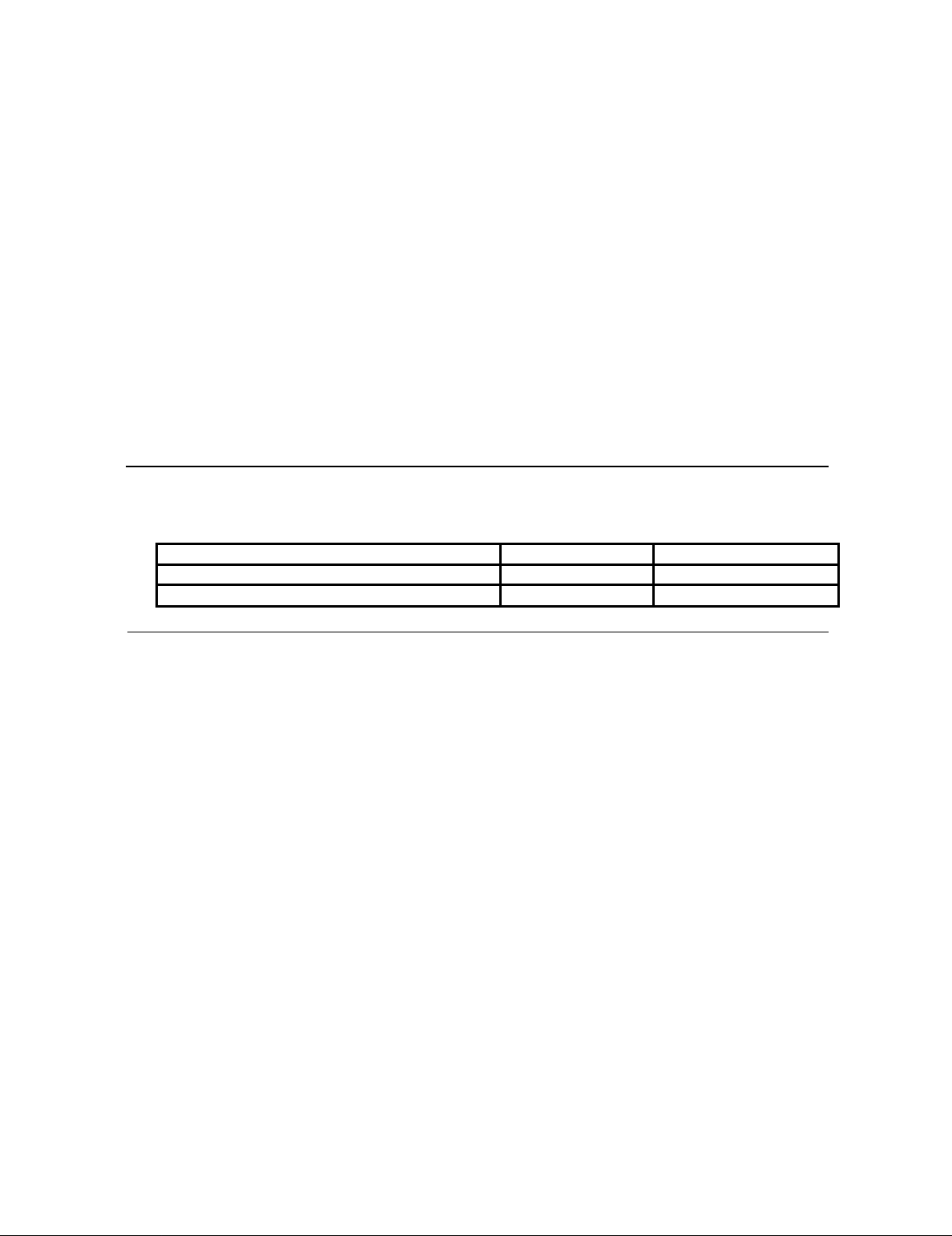
Hazard pictograms
Signal word
Hazard statements
H226 Flammable liquid and vapors.
H319 Causes serious eye irritation.
Category 3
Category 2A
Warning
Page 2
Precautionary statements
Prevention:
Response:
Storage:
Disposal:
P210 Keep away from heat/ sparks/ open flames/ hot surfaces. - No smoking.
P233 Keep container tightly closed.
P240 Ground/bond container and receiving equipment.
P241 Use explosion-proof electrical/ ventilating/ lighting/ equipment.
P242 Use only non-sparking tools.
P243 Take precautionary measures against static discharge. P280 Wear eye
protection/ face protection.
P305 + P351 + P338 IF IN EYES: Rinse cautiously with water for several
minutes. Remove contact lenses, if present and easy to do. Continue rinsing.
P337 + P313 If eye irritation persists: Get medical advice/ attention.
P370 + P378 In case of fire: Use dry sand, dry chemical or alcohol-resistant
foam to extinguish.
P403 + P235 Store in a well-ventilated place. Keep cool.
P501 Dispose of contents/ container to an approved waste disposal plant.
Other Hazards: None known
SECTION 3. COMPOSITION/ INFORMATION ON INGREDIENTS
Hazardous components
Chemical name
CAS-No.
Concentration (%)
Ethyl Alcohol
64-17-5
>=77% to <80%
lsopropyl Alcohol
67-63-0
>=4% to<6%
SECTION 4. FIRST AID MEASURES
General advice
If inhaled
In case of skin contact
In case of eye contact
If swallowed
Most important symptoms
and effects, both acute and
delayed
Protection of first aiders
In the case of accident or if you feel unwell, seek medical
advice immediately.
When symptoms persist or in all cases of doubt seek medical
advice.
If inhaled, remove to fresh air.
If symptoms persist, call a physician.
Wash with water and soap as a precaution.
Get medical attention if irritation develops and persists.
In case of contact, immediately flush eyes with plenty of water
for at least 15 minutes.
If easy to do, remove contact lens, if worn.
Seek medical advice.
If swallowed, DO NOT induce vomiting.
Rinse mouth with water.
Obtain medical attention.
Causes serious eye irritation.
First Aid responders should pay attention to self-protection
and use the recommended protective clothing
Page 3

SECTION 5. FIREFIGHTING MEASURES
Suitable extinguishing media
Unsuitable extinguishing
media
Specific hazards during
firefighting
Hazardous combustion
products
Specific extinguishing
methods
Further information
Special protective equipment
for firefighters
Use water spray, alcohol-resistant foam, dry chemical or
carbon dioxide.
High volume water jet
Do not use a solid water stream as it may scatter and spread
fire.
Cool closed containers exposed to fire with water spray.
Flash back possible over considerable distance.
May form explosive mixtures in air.
Exposure to decomposition products may be a hazard to
health.
Carbon oxides
Carbon oxides
Use extinguishing measures that are appropriate to local
circumstances and the surrounding environment.
Use water spray to cool unopened containers.
Collect contaminated fire extinguishing water separately. This
must not be discharged into drains.
Fire residues and contaminated fire extinguishing water must
be disposed of in accordance with local regulations.
In the event of fire, wear self-contained breathing apparatus.
Use personal protective equipment.
SECTION 6. ACCIDENT AL RELEASE MEASURES
Personal precautions,
protective equipment and
emergency procedures
Environmental precautions
Methods and materials for
containment and cleaning up
Use personal protective equipment.
Ensure adequate ventilation.
Remove all sources of ignition.
Evacuate personnel to safe areas.
Keep people away from and upwind of spill/leak.
Material can create slippery conditions.
Discharge into the environment must be avoided.
Prevent further leakage or spillage if safe to do so.
Retain and dispose of contaminated wash water.
Local authorities should be advised if significant spillages
cannot be contained.
Non-sparking tools should be used.
Soak up with inert absorbent material.
Suppress (knock down) gases/ vapours/ mists with a
water spray jet.
Keep in suitable, closed containers for disposal.
Clean contaminated floors and objects thoroughly while
observing environmental regulations.
SECTION 7. HANDLING AND STORAGE
Advice on safe handling
For personal protection see section 8.
Keep away from heat and flame.
Use with local exhaust ventilation.
Avoid contact with eyes.
Page 4
Conditions for safe storage
Take measures to prevent the buildup of electrostatic charge.
Keep in properly labelled containers.
Keep containers tightly closed in a dry, cool and wellventilated place.
Store in accordance with the particular national regulations.
SECTION 8. EXPOSURE CONTROLS/PERSONAL PROTECTION
Components with workplace control parameters
Components
CAS-No.
Value type
(Form of
exposure)
Control
parameters /
Permissible
concentration
Basis
Ethyl Alcohol
64-17-5
TWA
1,000 ppm
1,900 mg/m3
NIOSH REL
TWA
1,000 ppm
1,900 mg/m3
OSHA Z-1
STEL
1,000 ppm
ACGIH
lsopropyl Alcohol
67-63-0
TWA
200 ppm
ACGIH
STEL
400 ppm
ACGIH
TWA
400 ppm
980 mg/m3
NIOSH REL
ST
500 ppm
1,225 mg/m3
NIOSH REL
TWA
400 ppm
980 mg/m3
OSHA Z-1
Biological occupational exposure limits
Components
CAS-No.
Control
parameters
Biological
specimen
Sampling
time
Permissible
concentration
Basis
lsopropyl Alcohol
67-63-0
Acetone
Urine
End of
shift at
end of
work week
40 mg/I
ACGIH
BEi
Personal protective equipment
Respiratory protection
Hand protection
Remarks
Eye protection
Skin and body protection
Protective measures
Hygiene measures
No personal respiratory protective equipment normally
required.
No special protective equipment required.
Wear face-shield and protective suit for abnormal processing
problems.
No special measures necessary provided product is used
correctly.
Choose body protection in relation to its type, to the
concentration and amount of dangerous substances, and to
the specific workplace.
Ensure that eye flushing systems and safety showers are
located close to the working place.
Handle in accordance with good industrial hygiene and safety
practice.
Avoid contact with eyes.
Page 5

SECTION 9. PHYSICAL AND CHEMICAL PROPERTIES
Appearance
Color
Odour
Odour Threshold
pH
Melting point/freezing point
Initial boiling point and boiling
range
Flash point
Evaporation rate
Flammability (solid, gas)
Flammability (liquids)
Upper explosion limit
Lower explosion limit
Vapour pressure
Relative vapour density
Density
Solubility(ies)
Water solubility
Partition coefficient: n-
octanol/water
Auto-ignition temperature
Thermal decomposition
Viscosity
Viscosity, kinematic
Explosive properties
Oxidizing properties
liquid
clear, greenish-blue
alcohol-like
No data available
3.8 - 5.2, (20 °c)
No data available
75.00 ·c
26.50 ·c
No data available
Not app licable
No data available
No data available
No data available
No data available
0.8742 g/cm3
soluble
Not applicable
No data available
The substance or mixture is not classified self-reactive.
80 - 600 mm2/s (20 °C)
Not explosive
The substance or mixture is not classified as oxidizing.
SECTION 10. STABILITY AND REACTIVITY
Reactivity
Chemical stability
Possibility of hazardous
reactions
Conditions to avoid
Not classified as a reactivity hazard.
Stable under normal conditions.
Vapours may form explosive mixture with air.
Heat, flames and sparks.
Page 6

Incompatible materials
Hazardous decomposition
products
Strong oxidizing agents
No hazardous decomposition products are known.
SECTION 11. TOXICOLOGICAL INFORMATION
Information on likely routes of exposure
Inhalation
Eye contact
Skin contact
Acute toxicity
Not classified based on available information.
Components:
Ethyl Alcohol:
Acute oral toxicity
Acute inhalation toxicity
lsopropyl Alcohol:
Acute oral toxicity
Acute inhalation toxicity
Acute dermal toxicity
LD50 (Rat): > 5,000 mg/kg
LC50 (Rat): 124.7 mg/I
Exposure time: 4 h
Test atmosphere: vapour
LD50 (Rat): > 5,000 mg/kg
LC50 (Rat): 72.6 mg/I
Exposure time: 4 h
Test atmosphere: vapour
LD50 (Rat): > 5,000 mg/kg
Skin corrosion/ irritation
Not classified based on available information.
Components:
Ethyl Alcohol:
Species: Rabbit
Method: OECD Test Guideline 404
Result: No skin irritation
lsopropyl Alcohol:
Species: Rabbit
Result: No skin irritation
Serious eye damage/ eye irritation
Causes serious eye irritation.
Components:
Ethyl Alcohol:
Species: Rabbit
Result: Irritation to eyes, reversing within 21 days
Method: OECD Test Guideline 405
lsopropyl Alcohol:
Species: Rabbit
Result: Irritation to eyes, reversing within 21 days
Respiratory or skin sensitization
Skin sensitization: Not classified based on available information.
Respiratory sensitization: Not classified based on available information.
Page 7

Components:
Ethyl Alcohol:
Test Type: Local lymph node assay (LLNA)
Exposure routes: Skin contact
Species: Mouse
Result: negative
lsopropyl Alcohol:
Test Type: Buehler Test
Exposure routes: Skin contact
Species: Guinea pig
Method: OECD Test Guideline 406
Result: negative
Germ cell mutagenicity
Not classified based on available information.
Components:
Ethyl Alcohol:
Genotoxicity in vitro
Genotoxicity in vivo
lsopropyl Alcohol:
Genotoxicity in vitro
Genotoxicity in vivo
Carcinogenicity
Test Type: In vitro mammalian cell gene mutation test
Result: negative
Test Type: Rodent dominant lethal test (germ cell) (in vivo)
Test species: Mouse
Application Route: Ingestion
Result: negative
Test Type: Bacterial reverse mutation assay (AMES)
Result: negative
Test Type: Mammalian erythrocyte micronucleus test (in vivo
cytogenetic assay)
Test species: Mouse
Application Route: lntraperitoneal injection
Result: negative
Not classified based on available information.
Components:
lsopropyl Alcohol:
Species: Rat
Application Route: inhalation (vapour)
Exposure time: 104 weeks
Method: OECD Test Guideline 451
Result: negative
IARC
OSHA
NTP
No component of this product present at levels greater than or
equal to 0.1% is identified as probable, possible or confirmed
human carcinogen by IARC.
No component of this product present at levels greater than or
equal to 0.1% is identified as a carcinogen or potential
carcinogen by OSHA.
No component of this product present at levels greater than or
equal to 0.1% is identified as a known or anticipated carcinogen
by NTP.
Page 8

Reproductive toxicity
Not classified based on available information.
Components:
Ethyl Alcohol:
Effects on fertility
lsopropyl Alcohol:
Effects on fertility
Effects on fetal
development
Test Type: Two-generation reproduction toxicity study
Species: Mouse
Application Route: Ingestion
Method: OECD Test Guideline 416
Result: negative
Test Type: Two-generation reproduction toxicity study
Species: Rat
Application Route: Ingestion
Result: negative
Test Type: Embryo-fetal development
Species: Rat
Application Route: Ingestion
Result: negative
STOT • single exposure
Not classified based on available information.
Components:
lsopropyl Alcohol:
Assessment: May cause drowsiness or dizziness.
STOT - repeated exposure
Not classified based on available information.
Repeated dose toxicity
Components:
Ethyl Alcohol:
Species: Rat
NOAEL: 2,400 mg/kg
Application Route: Ingestion
Exposure time: 2 y
lsopropyl Alcohol:
Species: Rat
NOAEL: 5000 ppm
Application Route: inhalation (vapour)
Exposure time: 104 w
Method: OECD Test Guideline 413
Aspiration toxicity
Not classified based on available information.
SECTION 12. ECOLOGICAL INFORMATION
Ecotoxicity
Components:
Ethyl Alcohol:
Toxicity to fish LC50 (Pimephales promelas (fathead minnow)): > 1,000 mg/I
Exposure time: 96 h
Page 9

Toxicity to daphnia and other
aquatic invertebrates
Toxicity to algae
Toxicity to daphnia and other
aquatic invertebrates
(Chronic toxicity)
Toxicity to bacteria
lsopropyl Alcohol:
Toxicity to fish
Toxicity to daphnia and other
aquatic invertebrates
Toxicity to bacteria
EC50 (Daphnia magna (Water flea)): > 1,000 mg/I
Exposure time: 48 h
EC50 (Chlorella vulgaris (Fresh water algae)): 275 mg/I
Exposure time: 72 h
Method: OECD Test Guideline 201
NOEC (Daphnia magna (Water flea)): 9.6 mg/I
Exposure time: 9 d
EC50 (Photobacterium phosphoreum ): 32.1 mg/I
Exposure time: 0.25 h
LC50 (Pimephales promelas (fathead minnow)): 10,000 mg/I
Exposure time: 96 h
EC50 (Daphnia magna (Water flea)): > 10,000 mg/I
Exposure time: 24 h
EC50 (Pseudomonas putida): > 1,050 mg/I
Exposure time: 16 h
Persistence and degradability
Components:
Ethyl Alcohol:
Biodegradability Result: Readily biodegradable.
Biodegradation: 84 %
Exposure time: 20 d
lsopropyl Alcohol:
Biodegradability
Bio accumulative potential
Components:
Ethyl Alcohol:
Partition coefficient: n-
octanol/water
lsopropyl Alcohol:
Partition coefficient: n-
octanol/water
Mobility in soil
No data available
Other adverse effects
No data available
Product:
Regulation
Remarks
Result: rapidly degradable
log Pow: -0.35
log Pow: 0.05
40 CFR Protection of Environment; Part 82 Protection of
Stratospheric Ozone - CAA Section 602 Class I Substances
This product neither contains, nor was manufactured with a
Class I or Class II ODS as defined by the U.S. Clean Air Act
Section 602 (40 CFR 82, Subpt. A, App.A + 8).
Page 10

SECTION 13. DISPOSAL CONSIDERATIONS
Disposal methods
Waste from residues
Contaminated packaging
Dispose of in accordance with local regulations.
Dispose of as unused product.
Empty containers should be taken to an approved waste
handling site for recycling or disposal.
SECTION 14. TRANSPORT INFORMATION
International Regulation
IATA-DGR
UN/ID No.
Proper shipping name
Class
Packing group
Packing instruction
(cargo aircraft)
Packing instruction
(passenger aircraft)
IMDG-Code
UN number
Proper shipping name
Class
Packing group
Labels
EmS Code
Marine pollutant
National Regulations
49 CFR
UN/ID/NA number
Proper shipping name
Class
Packing group
ERG Code
Marine pollutant
UN 1987
Alcohols, n.o.s.
(Ethanol, Propan-2-ol)
3
Ill
366
355
UN 1987
ALCOHOLS, N.O.S.
(Ethanol, Propan-2-ol)
3
Ill
3
F-E, S-D
no
UN 1987
Alcohols, n.o.s.
3
Ill
127
no
SECTION 15. REGULATORY INFORMATION
EPCRA • Emergency Planning and Community Right-to-Know Act
CERCLA Reportable Quantity
This material does not contain any components with a CERCLA RQ.
SARA 304 Extremely Hazardous Substances Reportable Quantity
This material does not contain any components with a section 304 EHS RQ.
SARA 311/ 312 Hazards
SARA302
SARA 313
Fire Hazard Acute Health Hazard
No chemicals in this material are subject to the reporting
requirements of SARA Title Ill, Section 302.
The following components are subject to reporting levels established by
SARA Title Ill, Section 313:
Page 11

lsopropyl Alcohol
67-63-0 4-6%
Clean Air Act
This product does not contain any hazardous air pollutants (HAP), as defined by the U.S. Clean Air
Act Section 12 (40 CFR 61).
This product does not contain any chemicalslisted under the U.S. Clean Air Act Section 112(r) for
Accidental Release Prevention (40 CFR 68.130, Subpart F).
The following chemical(s} are listed under the U.S. Clean Air Act Section 111 SOCMI Intermediate or
Final VOC's (40 CFR 60.489):
Ethyl Alcohol 64-17-5
lsopropyl Alcohol 67-63-0
This product does not contain any voe exemptions listed under the U.S. Clean Air Act Section
Vers
1.1 Revision Date: 03/20/2020
Clean Water Act
This product does not contain any toxic pollutants listed under the U.S. Clean Water Act Section
307
US State Regulations
Massachusetts Right To Know
Ethyl Alcohol
lsopropyl Alcohol
Pennsylvania Right To Know
Ethyl Alcohol
Water (Aqua)
lsopropyl Alcohol
New Jersey Right To Know
Ethyl Alcohol
Water (Aqua)
lsopropyl Alcohol
California Prop 65
64-17-5
67-63-0
64-17-5
7732-18-5
67-63-0
64-17-5
7732-18-5
67-63-0
This product does not contain any chemicals known to State
of California to cause cancer, birth defects, or any other
reproductive harm.
The components of this product are reported in the following inventories:
TSCA On TSCA Inventory
AICS
DSL
ENCS
ISHL
KECI
PICCS
IECSC
NZloC
On the inventory, or in compliance with the inventory
On the inventory, or in compliance with the inventory
On the inventory, or in compliance with the inventory
On the inventory, or in compliance with the inventory
On the inventory, or in compliance with the inventory
On the inventory, or in compliance with the inventory
On the inventory, or in compliance with the inventory
On the inventory, or in compliance with the inventory
Inventories
AICS (Australia), DSL (Canada), IECSC (China), REACH (European Union), ENCS (Japan), ISHL (Japan),
KECI (Korea), NZloC (New Zealand}, PICCS (Philippines), TCSI (Taiwan), TSCA (USA)
Page 12
SECTION 16. OTHER INFORMATION
Further information
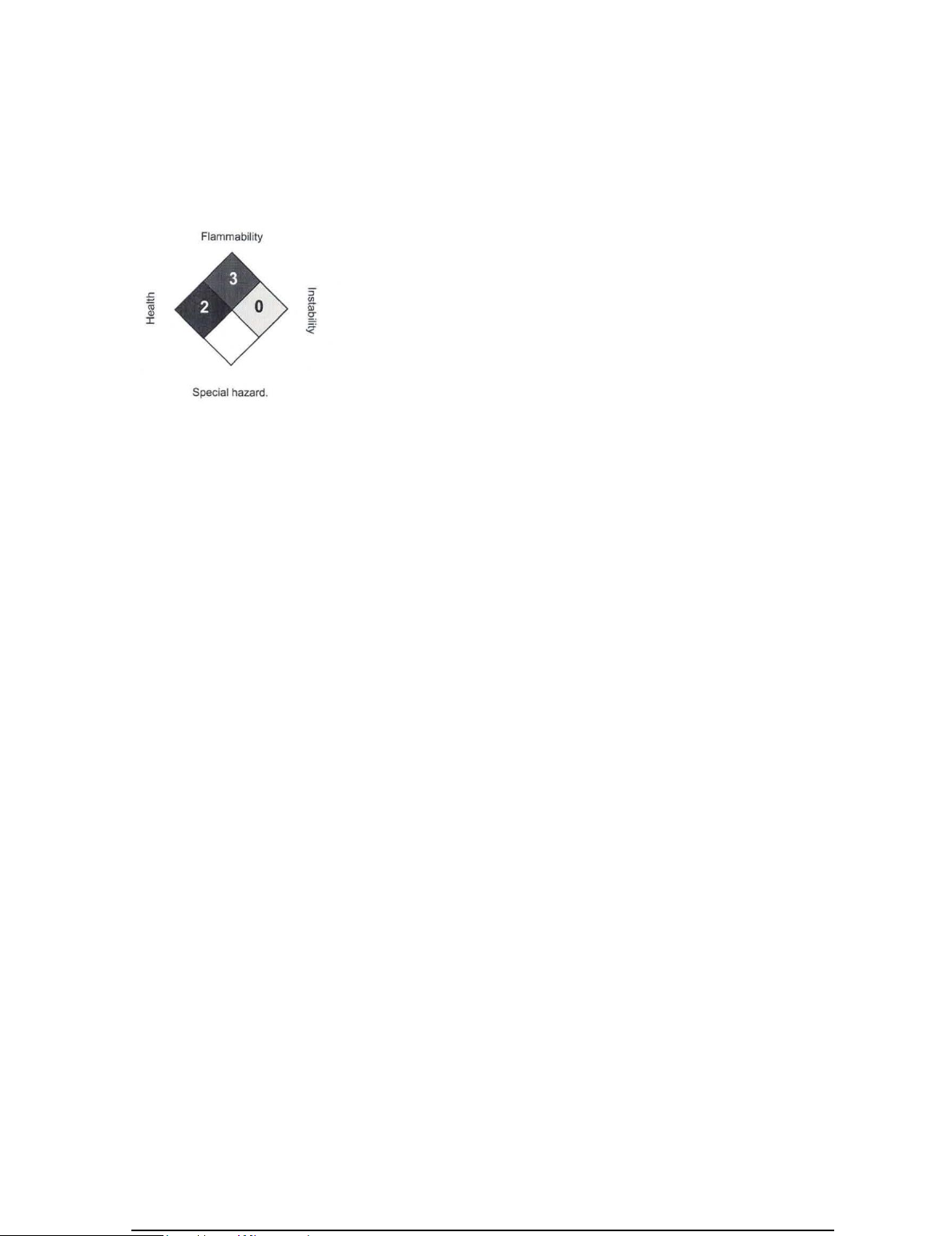
NFPA:
HMIS Ill:
0 = not significant, 1 =Slight,
2 = Moderate, 3 = High
4 = Extreme, • = Chron ic
The information presented above is believed to be accurate and represents the best information
currently available to HY-GN.
HY-GN makes no warranty, express or implied, with respect to such information, and assumes no
liability resulting from its use. The user is responsible for the proper and safe use, handling,
storage and disposal of the product. and assumes liability for any loss, injury, damage or
expense arising from any failure to do so. The data in this sheet is based on information and
experience available at the time of writing.
HEALTH
2
FLAMMABILITY
3
PHYZICAL.HAZARD
0
 Loading...