

Page 1

Operating instruction Baseline 2000 CP
Cleaning with the Baseline 2000 CP
To remove the oxide layer of welded stainless steel components, use a strip of the supplied cleaning
pad. Attach the strips with the O - ring on the hand stamp.
Caution: To prevent short circuit s must be replaced in time by prolonged use of the cleaning
or polishing felt.
The stamp is connected using the enclosed black cable to the black connector on the Baseline 2000 CP.
The red wire must be connected to the workpiece. Complete of the appropriate electrolyte (electrolyte
A for light oxide layers) something in the supplied wide-mouth container and immerse the st amp. Brushing
until you have removed with the stamp of the oxide layer to remove this. The selector switch must be
set to stage 1 and light up the red light.
Caution: When working with chemicals, always wear an acid apron, goggles and gloves.
With long-term work of the stamp could be too warm. Cooling it in water, or attach a second stamp. In
case of overheating the device, the thermal protection against overheating the unit switches off.
Polishing with the Baseline 2000 CP
For polishing stainless steel, use a strip of the included polishing felt. Attach the strips with the O - ring
on the intended hand stamp.
Caution: To avoid short-circuiting the polishing felt to be changed in time when in use.
The stamp is connected using the enclosed black cable to the black connector on the Baseline 2000 CP.
The red wire must be connected to the workpiece. Fill from the accompanying electrolyte C something
in the supplied wide-mouth container and dip the stamp. Slide your punch a few times over the area to
be cleaned. The selector switch
must be set to 2 (polishing).
Caution: When working with chemicals, always wear the supplied acid resistant apron,
goggles and gloves.
With long-term work of the stamp could be too warm. Cooling it in water, or attach a second stamp. Is
overheating, the overheating protection device, the device switches off. Wait a few seconds and then
press the thermal fuse on the front again.
Caution: Low-alloy steel, residual cooling liquid, drilling oil and similar substances can
results in chemical reactions.
Caution: Do not use the device in wet rooms; protect it against moisture and splash water.
Bymat GmbH · Neusser Str. 106 · D - 41363 Jüchen · Tel. + 49 (0) 21 65 - 87 28 0 · Fax: + 49 (0) 21 65 - 87 28 28
Page 2
Page 3
Page 4
Page 5
Page 6
By skin contact:
This product does not contain substances classified as dangerous for inhalation, however, in case of symptoms of intoxication
remove the person affected from the exposure area and provide with fresh air. Seek medical attention if the symptoms get worse or
persist.
By inhalation:
The symptoms resulting from intoxication can appear after exposure, therefore, in case of doubt, seek medical attention for direct
exposure to the chemical product or persistent discomfort, showing the MSDS of this product.
Description of first aid measures:4.1
Safety data sheet
Elektrolyt A
Material no.: 2030 DH / 2035 DH
According to 1907/2006/EC (REACH), 453/2010/EC
SECTION 1: IDENTIFICATION OF THE SUBSTANCE/MIXTURE AND OF THE COMPANY/UNDERTAKING
+49 21 65 / 87 28 0
1.4 Emergency telephone number:
Bymat GmbH
Neusser Strasse 106
D – 41363 Jüchen / Germany
Tel.: +49 21 65 / 87 28 -0
Email: [email protected]
1.3 Details of the supplier of the safety data sheet:
Uses advised against: All uses not specified in this section or in section 7.3
Relevant uses: Cleaner. For professional use only.
1.2 Relevant identified uses of the substance or mixture and uses advised against:
Elektrolyt A
1.1 Product identifier:
SECTION 2: HAZARDS IDENTIFICATION
2.2 Label elements:
The product is not classified as dangerous according to CLP Regulation (EC) nº 1272/2008.
CLP Regulation (EC) nº 1272/2008:
In accordance with Directive 67/548/EC and Directive 1999/45/EC, the product is not classified as dangerous.
Directive 67/548/EC and Directive 1999/45/EC:
2.1 Classification of the substance or mixture:
Non-applicable
2.3 Other hazards:
EUH210: Safety data sheet available on request
Supplementary information:
Non-applicable
Precautionary statements:
Non-applicable
Hazard statements:
CLP Regulation (EC) nº 1272/2008:
SECTION 3: COMPOSITION/INFORMATION ON INGREDIENTS
In accordance with Annex II of Regulation (EC) nº1907/2006 (point 3), the product contains:
Components:
Chemical description:
Mixture composed of chemical products
ConcentrationChemical name/ClassificationIdentification
01-2119485924-24-XXXX
7664-38-2
231-633-2
015-011-00-6
CAS:
EC:
Index:
REAC
H:
Skin Corr. 1B: H314 - DangerRegulation 1272/2008
2,5 - <10 %
C: R34Directive 67/548/EC
Phosphoric Acid
ATP CLP00
To obtain more information on the risk of the substances consult sections 8, 11, 12 and 16.
SECTION 4: FIRST AID MEASURES
Date of compilation: 2014-09-07 Version: 1
Page 1/8
- CONTINUED ON NEXT PAGE -
Page 7

A.- Precautions for safe manipulation
7.1 Precautions for safe handling:
Safety data sheet
Elektrolyt A
Material no.: 2030 DH / 2035 DH
According to 1907/2006/EC (REACH), 453/2010/EC
SECTION 4: FIRST AID MEASURES (continue)
Non-applicable
Indication of any immediate medical attention and special trea tment needed:4.3
Acute and delayed effects are indicated in sections 2 and 11.
Most important symptoms and effects, both acute and delayed:4.2
Do not induce vomiting, but if it does happen keep the head up to avoid inhalation. Keep the person affected at rest. Rinse out the
mouth and throat, as they may have been affected during ingestion.
By consumption:
Rinse eyes thoroughly with water for at least 15 minutes. If the injured person uses contact lenses, these should be removed unless
they are stuck to the eyes, as this could cause further damage. In all cases, after cleaning, a doctor should be consulted as quickly as
possible with the MSDS of the product.
By eye contact:
This product is not classified as dangerous when in contact with the skin. However, in case of skin contact it is recommended to
remove contaminated clothes and shoes, rinse the skin or shower the person affected if necessary thoroughly with cold water and
neutral soap. In case of serious reaction consult a doctor.
SECTION 5: FIREFIGHTING MEASURES
Act in accordance with the Internal Emergency Plan and the Information Sheets on actions to take after an accident or other
emergencies. Destroy any source of ignition. In case of fire, refrigerate the storage contain ers and tanks for products susceptible to
inflamation, explosion or BLEVE as a result of high temperatures. Avoid spillage of the products used to extinguish the fire into an
aqueous medium.
Additional provisions:
Depending on the magnitude of the fire it may be necessary to use full protective clothing and individual respiratory equipment.
Minimum emergency facilities and equipment should be available (fire blankets, portable first aid kit,...) in accordance with Directive
89/654/EC.
Advice for firefighters:5.3
As a result of combustion or thermal decomposition reactive subproducts are created that can become highly toxic and, consequently,
can present a serious health risk.
Special hazards arising from the substance or mixture:5.2
Product is non-flammable under normal conditions of storage, manipulation and use. In the case of inflammation as a result of
improper manipulation, storage or use preferably use polyvalent powder extinguishers (ABC powder), in accordance with the
Regulation on fire protection systems. IT IS NOT RECOMMENDED to use tap water as an extinguishing agent.
Extinguishing media:5.1
SECTION 6: ACCIDENTAL RELEASE MEASURES
See sections 8 and 13.
Reference to other sections:6.4
Absorb the spillage using sand or inert absorbent and move it to a safe place. Do not absorb in sawdust or other combustible
absorbents. For any concern related to disposal consult section 13.
It is recommended:
Methods and material for containment and cleaning up:6.3
This product is not classified as dangerous to the environment. Keep product away from drains, surface and underground water.
Environmental precautions:6.2
Isolate leaks provided that there is no additional risk for the people performing this task. Personal protection equipment must be used
against potential contact with the spilt product (See section 8). Evacuate the area and keep out those who do not have protection.
Personal precautions, protective equipment and emergency procedures:6.1
SECTION 7: HANDLING AND STORAGE
Date of compilation: 2014-09-07 Version: 1
Page 2/8
- CONTINUED ON NEXT PAGE -
Page 8
As a preventative measure it is recommended to use basic Personal Protection Equipment, with the corresponding ""CE marking""
in accordance with Directive 89/686/EC. For more information on Personal Protection Equipment (storage, use, cleaning,
maintenance, class of protection,…) consult the information leaflet provided by the manufacturer. For more i nfomation see
subsection 7.1.
All information contained herein is a recommendation which needs some specification from the labour risk prevention services as
it is not known whether the company has additional measures at its disposal.
General security and hygiene measures in the work placeA.-
8.2 Exposure controls:
Safety data sheet
Elektrolyt A
Material no.: 2030 DH / 2035 DH
According to 1907/2006/EC (REACH), 453/2010/EC
SECTION 7: HANDLING AND STORAGE (continue)
Maximum time: 12 Months
Maxim um Temp.: 25 ºC
Minimum Temp.: 5 ºC
Technical measures for storageA.-
7.2 Conditions for safe storage, including any incompatibilities:
It is recommended to have absorbent material available at close proximity to the product (See subsection 6.3)
Technical recommendations to prevent environmental risksD.-
Do not eat or drink during the process, washing hands afterwards with suitable cleaning products.
Technical recommendations to prevent ergonomic and toxicological risksC.-
Product is non-flammable under normal conditions of storage, manipulation and use. It is recommended to transfer at slow speeds
to avoid the generation of electrostatic charges that can affect flammable products. Consult section 10 for information on
conditions and materials that should be avoided.
Technical recommendations for the prevention of fires and explosionsB.-
Comply with the current legislation concerning the prevention of industrial risks. Keep containers hermetically sealed. Control spills
and residues, destroying them with safe methods (section 6). Avoid leakages from the container. Maintain order and cleanlines s
where dangerous products are used.
Except for the instructions already specified it is not necessary to provide any special recommendation regarding the uses of this
product.
7.3 Specific end use(s):
Avoid sources of heat, radiation, static electricity and contact with food. For additional information see subsection 10.5
General conditions for storageB.-
SECTION 8: EXPOSURE CONTROLS/PERSONAL PROTECTION
Substances whose occupational exposure limits have to be monitored in the work environment
8.1 Control parameters:
Environmental limitsIdentification
2014YearEC: 231-633-2
2 mg/m³IOELV (STEL)CAS: 7664-38-2
1 mg/m³IOELV (8h)Phosphoric Acid
DNEL (Workers):
LocalSystemicLocalSystemicIdentification
Long exposureShort exposure
1 mg/m³Non-applicable2 mg/m³Non-applicableInhalationEC: 231-633-2
Non-applicableNon-applicableNon-applicableNon-applicableDermalCAS: 7664-38-2
Non-applicableNon-applicableNon-applicableNon-applicableOralPhosphoric Acid
DNEL (Population):
LocalSystemicLocalSystemicIdentification
Long exposureShort exposure
0,73 mg/m³Non-applicableNon-applicableNon-applicableInhalationEC: 231-633-2
Non-applicableNon-applicableNon-applicableNon-applicableDermalCAS: 7664-38-2
Non-applicableNon-applicableNon-applicableNon-applicableOralPhosphoric Acid
Non-applicable
PNEC:
Date of compilation: 2014-09-07 Version: 1
Page 3/8
- CONTINUED ON NEXT PAGE -
Page 9

Lower flammabil ity l i mi t: Non-applicable *
Autoignition temperature: Non-applicable *
Flash Point: Non Flammable (>60 ºC)
Flammability:
Melting point/freezing point: Non-applicable *
Decomposition temperature: Non-applicable *
Solubility property: Non-applicable *
Solubility in water at 20 ºC: Non-applicable *
Partition coefficient n-octanol/water 20 ºC: Non-applicable *
Vapour density at 20 ºC: Non-applicable *
pH: Non-applicable *
Concentration: Non-applicable *
Kinematic viscosity at 40 ºC: Non-applicable *
Kinematic viscosity at 20 ºC: Non-applicable *
Dynamic viscosity at 20 ºC: Non-applicable *
Relative density at 20 ºC: 1,042-1,047
Density at 20 ºC: Non-applicable *
Product description:
Evaporation rate at 20 ºC: Non-applicable *
Vapour pressure at 50 ºC: Non-applicable *
Vapour pressure at 20 ºC: Non-applicable *
Boiling point at atmospheric pressure: Non-applicable *
Volatility:
Odor: Characteristic
Color: Colourless
Appearance: Characteristic
Physical state at 20 ºC: Liquid
Appearance:
9.1 Information on basic physical and chemical properties:
Safety data sheet
Elektrolyt A
Material no.: 2030 DH / 2035 DH
According to 1907/2006/EC (REACH), 453/2010/EC
SECTION 8: EXPOSURE CONTROLS/PERSONAL PROTECTION (continue)
B.- Respiratory protection
The use of protection equipment will be necessary if a mist forms or if the professional exposure limits are exceeded.
C.- Specific protection for the hands
Non-applicable
D.- Ocular and facial protection
Non-applicable
E.- Bodily protection
Non-applicable
It is not necessary to take additional emergency measures.
F.- Additional emergency measures
In accordance with the community legislation for the protection of the environment it is recommended to avoid environmental spillage
of both the product and its container. For additional information see subsection 7.1.D
Environmental exposure controls:
SECTION 9: PHYSICAL AND CHEMICAL PROPERTIES
*Not relevant due to the nature of the product, not providing information property of its hazards.
Date of compilation: 2014-09-07 Version: 1
Page 4/8
- CONTINUED ON NEXT PAGE -
Page 10
Specific target organ toxicity (STOT)-repeated exposure:G-
Based on available data, the classification criteria are not met, as it does not contain substances classified as dangerous for this
effect. For more information see section 3.
Specific target organ toxicity (STOT)-time exposure:F-
Based on available data, the classification criteria are not met, as it does not contain substances classified as dangerous with
sensibilizing effects. For more information see section 3.
Sensitizing effects:E-
Based on available data, the classification criteria are not met, as it does not contain substances classified as dangerous for the
effects mentioned. For more information see section 3.
CMR effects (carcinogenicity, mutagenicity and toxicity to reproduction):D-
Based on available data, the classification criteria are not met, however, it contains substances classified as dangerous for skin
contact. For more information see section 3.
Contact with the skin and the eyes:C-
Based on available data, the classification criteria are not met
Inhalation:B-
Based on available data, the classification criteria are not met, however, it contains substances classified as dangerous for
consumption. For more information see section 3.
Ingestion:A.-
In case of exposure that is repetitive, prolonged or at concentrations higher than recommended by the occupational exposure limits, it
may result in adverse effects on health depending on the means of exposure:
Dangerous health implications:
The experimental information related to the toxicological properties of the product itself is not available
Information on toxicological effects:11.1
Safety data sheet
Elektrolyt A
Material no.: 2030 DH / 2035 DH
According to 1907/2006/EC (REACH), 453/2010/EC
SECTION 9: PHYSICAL AND CHEMICAL PROPERTIES (continue)
Refraction index: Non-applicable *
Surface tension at 20 ºC: Non-applicable *
9.2 Other information:
Upper flammability limit: Non-applicable *
*Not relevant due to the nature of the product, not providing information property of its hazards.
SECTION 10: STABILITY AND REACTIVITY
See subsection 10.3, 10.4 and 10.5 to find out the specific decomposition products. Depending on the decomposition conditions,
complex mixtures of chemical substances can be released: carbon dioxide (CO2), carbon monoxide and other organic compounds.
Hazardous decomposition products:10.6
Not applicableNot applicablePrecautionNot applicableNot applicable
OthersCombustible materialsCombustive materialsWaterAcids
Incompatible materials:10.5
Not applicableNot applicableNot applicableNot applicableNot applicable
HumiditySunlightIncrease in temperatureContact with airShock and friction
Applicable for handling and storage at room temperature:
Conditions to avoid:10.4
Under the specified conditions, hazardous reactions that lead to excessive temperatures or pressure are not expected.
Possibility of hazardous reactions:10.3
Chemically stable under the conditions of storage, handling and use.
Chemical stability:10.2
No hazardous reactions are expected if the following technical instructions storage of chemicals. See section 7.
Reactivity:10.1
SECTION 11: TOXICOLOGICAL INFORMATION
Date of compilation: 2014-09-07 Version: 1
Page 5/8
- CONTINUED ON NEXT PAGE -
Page 11
Safety data sheet
Elektrolyt A
Material no.: 2030 DH / 2035 DH
According to 1907/2006/EC (REACH), 453/2010/EC
SECTION 11: TOXICOLOGICAL INFORMATION (continue)
Specific toxicology information on the substances:
Non-applicable
Other information:
Based on available data, the classification criteria are not met, as it does not contain substances classified as dangerous for this
effect. For more information see section 3.
Aspiration hazard:H-
Based on available data, the classification criteria are not met, as it does not contain substances classified as dangerous for this
effect. For more information see section 3.
GenusAcute toxicityIdentification
Non-applicableLC50 inhalationEC: 231-633-2
Rabbit2470 mg/kgLD50 dermalCAS: 7664-38-2
Rat3500 mg/kgLD50 oralPhosphoric Acid
SECTION 12: ECOLOGICAL INFORMATION
12.1 Toxicity:
The experimental information related to the ecotoxicological properties of the product itself is not available
GenusSpecieAcute toxicityIdentification
Non-applicableEC50EC: 231-633-2
CrustaceanDaphnia magna4,6 mg/L (12 h)EC50CAS: 7664-38-2
Non-applicableLC50Phosphoric Acid
Not available
12.2 Persistence and degradability:
Not available
12.3 Bioaccumulative potential:
Not available
12.4 Mobility in soil:
Not described
12.6 Other adverse effects:
Non-applicable
12.5 Results of PBT and vPvB assessment:
SECTION 13: DISPOSAL CONSIDERATIONS
Community legislation: Directive 2008/98/EC, 2000/532/EC: Commission Decision of 3 May 2000
In accordance with Annex II of Regulation (EC) nº1907/2006 (REACH) the community or state provisions related to waste
management are stated
Regulations related to waste management:
Consult the authorized waste service manager on the assessment and disposal operations in accordance with Annex 1 and Annex 2
(Directive 2008/98/EC). As under 15 01 (2000/532/EC) of the code and in case the container has been in direct contact with the
product, it will be processed the same way as the actual product. Otherwise, it will be processed as non-dangerous residue. We do
not recommended disposal down the drain. See paragraph 6.2.
Waste management (disposal and evaluation):
It is not possible to assign a specific code, as it depends on the intended use by the user.
Waste class (Directive 2008/98/EC)DescriptionCode
Waste treatment methods:13.1
SECTION 14: TRANSPORT INFORMATION
This product is not regulated for transport (ADR/RID,IMDG,IATA)
Date of compilation: 2014-09-07 Version: 1
Page 6/8
- CONTINUED ON NEXT PAGE -
Page 12

Abbreviations and acronyms:
http://esis.jrc.ec.europa.eu
http://echa.europa.eu
http://eur-lex.europa.eu
Principal bibliographical sources:
Minimal training is recommended to prevent industrial risks for staff using this product, in order to facilitate their comprehension and
interpretation of this safety data sheet, as well as the label on the product.
Advice related to training:
Skin Corr. 1B: H314 - Causes severe skin burns and eye damage
CLP Regulation (EC) nº 1272/2008:
R34: Causes burns
Directive 67/548/EC and Directive 1999/45/EC:
The phrases indicated do not refer to the product itself; they are present merely for informative purposes and refer to the indivi dual
components which appear in section 3
Text of R-phrases considered in section 3:
Non-applicable
Modifications related to the previous security card which concerns the way s of managing risks . :
This safety data sheet has been designed in accordance with ANNEX II-Guide to the compilation of safety data sheets of Regulation
(EC) Nº 1907/2006 (Regulation (EC) Nº 453/2010)
Legislation related to safety data sheets:
Safety data sheet
Elektrolyt A
Material no.: 2030 DH / 2035 DH
According to 1907/2006/EC (REACH), 453/2010/EC
SECTION 15: REGULATORY INFORMATION
Safety, health and environmental regulations/le gis lat ion spec if ic for the substance or mixture:15.1
Regulation (EC) 649/2012, in relation to the import and export of hazardous chemical products: Non-applicable
Active substances for which a decision of non-inclusion onto Annex I (Regulation (EU) No 528/2012): Non-applicable
Regulation (EC) 1005/2009, about substances that deplete the ozone layer: Non-applicable
Candidate substances for authorisation under the Regulation (EC) 1907/2006 (REACH): Non-appli cable
The supplier has not carried out evaluation of chemical safety.
Chemical safety assessment:15.2
- Regulation (EC) No 1223/2009 of the European Parliament and of the Council of 30 November 2009 on cosmetic products
- Regulation (EC) No 648/2004 of the European Parliament and of the Council of 31 March 2004 on detergents
- Commission Regulation (EC) No 907/2006 of 20 June 2006 amending Regulation (EC) No 648/2004 of the European Parliament
and of the Council on detergents, in order to adapt Annexes III and VII
- Commission Regulation (EC) No 551/2009 of 25 June 2009 amending Regulation (EC) No 648/2004 of the European Parliament
and of the Council on detergents, in order to adapt Annexes V and VI thereto (surfactant derogation)
The Chemicals (Hazard Information and Packaging for Supply) Regulations 2009, 2009 No. 716
The Carriage of Dangerous Goods and Use of Transportable Pressure Equipment Regulations 2009 (CDG 2009), SI 2009 No 1348
The Carriage of Dangerous Goods and Use of Transportable Pressure Equipment (Amendment) Regulations 2011, 2011 No. 1885
Control of Substances Hazardous to Health Regulations 2002 (as amended)
EH40/2005 Workplace exposure limits
The Waste Regulations 2011, 2011 No. 988
Other legislation:
It is recommended to use the information included in this safety data sheet as data used in a risk evaluation of the local circumstances
in order to establish the necessary risk prevention measures for the manipulation, use, storage and disposal of t his product.
Specific provisions in terms of protecting people or the environment:
Non-applicable
Limitations to commercialisation and the use of certain dangerous substances and mixtures (Annex XVII, REACH):
SECTION 16: OTHER INFORMATION
Date of compilation: 2014-09-07 Version: 1
Page 7/8
- CONTINUED ON NEXT PAGE -
Page 13

Safety data sheet
Elektrolyt A
Material no.: 2030 DH / 2035 DH
According to 1907/2006/EC (REACH), 453/2010/EC
SECTION 16: OTHER INFORMATION (continue)
- ADR: European agreement concerning the international carriage of dangerous goods by road
-IMDG: International maritime dangerous goods code
-IATA: International Air Transport Association
-ICAO: International Civil Aviation Organisation
-COD: Chemical Oxygen Demand
-BOD5: 5-day biochemical oxygen demand
-BCF: Bioconcentration factor
-LD50: Lethal Dose 50
-CL50: Lethal Concentration 50
-EC50: Effective concentration 50
-Log-POW: Octanol–water partition coefficient
-Koc: Partition coefficient of organic carbon
The information contained in this security data sheet is based on sources, technical knowledge and current legislation at European and state level, without being able to guarantee its accuracy.
This information cannot be considered a guarantee of the properties of the product, it is simply a description of the security requirements. The occupational methodology and conditions for users of
this product are not within our awareness or control, and it is ultimately the responsibility of the user to take the necessary measures to obtain the legal requirements concerning the manipulation,
storage, use and disposal of chemical products. The information on this security data sheet only refers to this product, which should not be used for needs other than those specified.
Date of compilation: 2014-09-07 Version: 1
Page 8/8
- END OF SAFETY DATA SHEET -
Page 14

Safety data sheet
Elektrolyt C
Material no.: 2020 DC / 2021 DC / 2025 DC
According to 1907/2006/EC (REACH), 453/2010/EC
SECTION 1: IDENTIFICATION OF THE SUBSTANCE/MIXTURE AND OF THE COMPANY/UNDERTAKING
+49 (0) 21 65 / 87 28 0
1.4 Emergency telephone number:
Bymat GmbH
Neusser Strasse 106
D -41363 Jüchen Germany
Tel.: +49 (0) 21 65 / 87 28 0
Email: [email protected]
1.3 Details of the supplier of the safety data sheet:
Uses advised against: All uses not specified in this section or in section 7.3
Relevant uses: Cleaner. For professional use only.
1.2 Relevant identified uses of the substance or mixture and uses advised against:
Elektrolyt C
1.1 Product identifier:
SECTION 2: HAZARDS IDENTIFICATION
2.2 Label elements:
Eye Dam. 1: Serious eye damage, Category 1
Skin Corr. 1B: Skin corrosion, Category 1B
Classification of this product has been carried out in accordance with CLP Regulation (EC) nº 1272/2008.
CLP Regulation (EC) nº 1272/2008:
C: R34 - Causes burns
This product was classified in accordance with Directive 67/548/EC and Directive 1999/45/EC, adapting the requirements to
Regulation (EC) nº1907/2006 (REACH regulation).
Directive 67/548/EC and Directive 1999/45/EC:
2.1 Classification of the substance or mixture:
Non-applicable
Other hazards:2.3
Phosphoric Acid
Substances that contribute to the classifica tion
Non-applicable
Supplementary information:
P280: Wear protective gloves/protective clothing/eye protection/face protection
P301+P330+P331: IF SWALLOWED: rinse mouth. Do NOT induce vomiting
P303+P361+P353: IF ON SKIN (or hair): Remove/Take off immediately all contaminated clothing. Rinse skin with water/shower
P305+P351+P338: IF IN EYES: Rinse cautiously with water for several minutes. Remove contact lenses, if present and easy to do.
Continue rinsing
P310: Immediately call a POISON CENTER or doctor/physi cian
Precautionary statements:
Skin Corr. 1B: H314 - Causes severe skin burns and eye damage
Hazard statements:
Danger
CLP Regulation (EC) nº 1272/2008:
SECTION 3: COMPOSITION/INFORMATION ON INGREDIENTS
In accordance with Annex II of Regulation (EC) nº1907/2006 (point 3), the product contains:
Components:
Chemical description:
Mixture composed of chemical products
Date of compilation: 2014-11-19 Version: 1
Page 1/9
- CONTINUED ON NEXT PAGE -
Page 15

6.1 Personal precautions, protective equipment and emergency procedures:
Safety data sheet
Elektrolyt C
Material no.: 2020 DC / 2021 DC / 2025 DC
According to 1907/2006/EC (REACH), 453/2010/EC
SECTION 3: COMPOSITION/INFORMATION ON INGREDIENTS (continue)
ConcentrationChemical name/ClassificationIdentification
01-2119485924-24-XXXX
7664-38-2
231-633-2
015-011-00-6
CAS:
EC:
Index:
REAC
H:
Skin Corr. 1B: H314 - DangerRegulation 1272/2008
25 - <50 %
C: R34Directive 67/548/EC
Phosphoric Acid
ATP CLP00
To obtain more information on the risk of the substances consult sections 8, 11, 12 and 16.
SECTION 4: FIRST AID MEASURES
Non-applicable
Indication of any immediate medical attention and special trea tment needed:4.3
Acute and delayed effects are indicated in sections 2 and 11.
Most important symptoms and effects, both acute and delayed:4.2
Request immediate medical assistance, showing the MSDS of this product. Do not induce vomiting, because its expulsion from the
stomach can be hazardous to the mucus of the main digestive tract, and its inhalation, to the respiratory system. Rinse out the mouth
and throat, as they may have been affected during ingestion. In the case of loss of consciousness do not administrate anything orally
unless supervised by a doctor. Keep the person affected at rest.
By consumption:
Rinse eyes thoroughly with luke warm water for at least 15 minutes. Do not allow the person affected to rub or close their eyes. If the
injured person uses contact lenses, these should be removed unless they are stuck to the eyes, as this could cause further damage.
In all cases, after cleaning, a doctor should be consulted as quickly as possible with the MSDS of the product.
By eye contact:
Remove contaminated clothing and footwear, rinse skin or shower the person affected if appropriate with plenty of cold water and
neutral soap. In serious cases see a doctor. If the product causes burns or freezing, clothing should not be removed as this could
worsen the injury caused if it is stuck to the skin. If blisters form on the skin, these should never be burst as this will increase the risk
of infection.
By skin contact:
This product does not contain substances classified as dangerous for inhalation, however, in case of symptoms of intoxication
remove the person affected from the exposure area and provide with fresh air. Seek medical attention if the symptoms get worse or
persist.
By inhalation:
Request medical assistance immediately, showing the MSDS of this product.
Description of first aid measures:4.1
SECTION 5: FIREFIGHTING MEASURES
Act in accordance with the Internal Emergency Plan and the Information Sheets on actions to take after an accident or other
emergencies. Destroy any source of ignition. In case of fire, refrigerate the storage containers and tanks for products susceptible to
inflamation, explosion or BLEVE as a result of high temperatures. Avoid spillage of the products used to extinguish the fire into an
aqueous medium.
Additional provisions:
Depending on the magnitude of the fire it may be necessary to use full protective clothing and individual respiratory equipment.
Minimum emergency facilities and equipment should be available (fire blankets, portable first aid kit,...) in accordance with Directive
89/654/EC.
Advice for firefighters:5.3
As a result of combustion or thermal decomposition reactive subproducts are created that can become highly toxic and, consequently,
can present a serious health risk.
Special hazards arising from the substance or mixture:5.2
Product is non-flammable under normal conditions of storage, manipulation and use. In the case of inflammation as a result of
improper manipulation, storage or use preferably use polyvalent powder extinguishers (ABC powder), in accordance with the
Regulation on fire protection systems. IT IS NOT RECOMMENDED to use tap water as an extinguishing agent.
Extinguishing media:5.1
SECTION 6: ACCIDENTAL RELEASE MEASURES
Date of compilation: 2014-11-19 Version: 1
Page 2/9
- CONTINUED ON NEXT PAGE -
Page 16
Safety data sheet
Elektrolyt C
Material no.: 2020 DC / 2021 DC / 2025 DC
According to 1907/2006/EC (REACH), 453/2010/EC
SECTION 6: ACCIDENTAL RELEASE MEASURES (continue)
See sections 8 and 13.
Reference to other sections:6.4
Absorb the spillage using sand or inert absorbent and move it to a safe place. Do not absorb in sawdust or other combustible
absorbents. For any concern related to disposal consult section 13.
It is recommended:
Methods and material for containment and cleaning up:6.3
This product is not classified as dangerous to the environment. Keep product away from drains, surface and underground water.
Environmental precautions:6.2
Isolate leaks provided that there is no additional risk for the people performing this task. Personal protecti o n equipment must be used
against potential contact with the spilt product (See section 8). Evacuate the area and keep out those who do not have protection.
SECTION 7: HANDLING AND STORAGE
Maximum time: 12 Months
Maximun Temp.: 25 ºC
Minimum Temp.: 5 ºC
Technical measures for storageA.-
7.2 Conditions for safe storage, including any incompatibilities:
It is recommended to have absorbent material available at close proximity to the product (See subsection 6.3)
Technical recommendations to prevent environmental risksD.-
Do not eat or drink during the process, washing hands afterwards with suitable cleaning products.
Technical recommendations to prevent ergonomic and toxicological risksC.-
Product is non-flammable under normal conditions of storage, manipulation and use. It is recommended to transfer at slow speeds
to avoid the generation of electrostatic charges that can affect flammable products. Consult section 10 for information on
conditions and materials that should be avoided.
Technical recommendations for the prevention of fires and explosionsB.-
Comply with the current legislation concerning the prevention of industrial risks. Keep containers hermetically sealed. Control spills
and residues, destroying them with safe methods (section 6). Avoid leakages from the container. Maintain order and cleanlines s
where dangerous products are used.
Precautions for safe manipulationA.-
7.1 Precautions for safe handling:
Except for the instructions already specified it is not necessary to provide any special recommendation regarding the uses of thi s
product.
7.3 Specific end use(s):
Avoid sources of heat, radiation, static electricity and contact with food. For additional information see subsection 10.5
General conditions for storageB.-
SECTION 8: EXPOSURE CONTROLS/PERSONAL PROTECTION
Substances whose occupational exposure limits have to be monitored in the work environment
8.1 Control parameters:
Environmental limitsIdentification
2014YearEC: 231-633-2
2 mg/m³IOELV (STEL)CAS: 7664-38-2
1 mg/m³IOELV (8h)Phosphoric Acid
DNEL (Workers):
LocalSystemicLocalSystemicIdentification
Long exposureShort exposure
1 mg/m³Non-applicable2 mg/m³Non-applicableInhalationEC: 231-633-2
Non-applicableNon-applicableNon-applicableNon-applicableDermalCAS: 7664-38-2
Non-applicableNon-applicableNon-applicableNon-applicableOralPhosphoric Acid
Date of compilation: 2014-11-19 Version: 1
Page 3/9
- CONTINUED ON NEXT PAGE -
Page 17
Safety data sheet
Elektrolyt C
Material no.: 2020 DC / 2021 DC / 2025 DC
According to 1907/2006/EC (REACH), 453/2010/EC
SECTION 8: EXPOSURE CONTROLS/PERSONAL PROTECTION (continue)
DNEL (Population):
LocalSystemicLocalSystemicIdentification
Long exposureShort exposure
0,73 mg/m³Non-applicableNon-applicableNon-applicableInhalationEC: 231-633-2
Non-applicableNon-applicableNon-applicableNon-applicableDermalCAS: 7664-38-2
Non-applicableNon-applicableNon-applicableNon-applicableOralPhosphoric Acid
Non-applicable
PNEC:
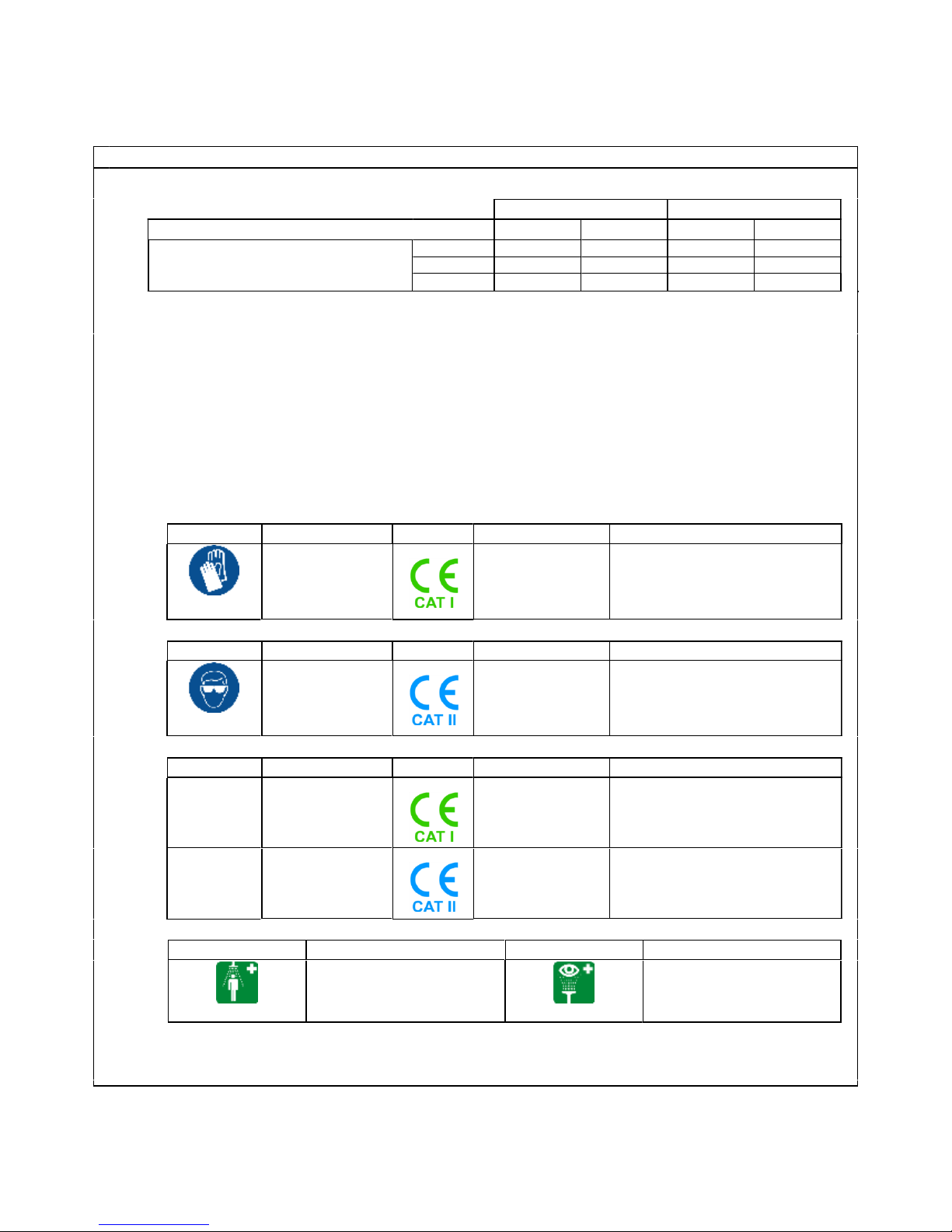
Respiratory protectionB.-
As a preventative measure it is recommended to use basic Personal Protection Equipment, with the corresponding ""CE marking""
in accordance with Directive 89/686/EC. For more information on Personal Protection Equipment (storage, use, cleaning,
maintenance, class of protection,…) consult the information leaflet provided by the manufacturer. For mo re infomation see
subsection 7.1.
All information contained herein is a recommendation which needs some specification from the labour risk prevention services as
it is not known whether the company has additional measures at its disposal.
General security and hygiene measures in the work placeA.-
8.2 Exposure controls:
The use of protection equipment will be necessary if a mist forms or if the professional exposure limits are exceeded.
Specific protection for the handsC.-
RemarksCEN StandardLabellingPPEPictogram
Replace the gloves at any sign of deterioration.
EN 374-1:2003
EN 374-3:2003/AC:2006
EN 420:2003+A1:2009
Chemical protective gloves
Mandatory hand
protection
Ocular and facial protectionD.-
RemarksCEN StandardLabellingPPEPictogram
Clean daily and disinfect periodically according to the
manufacturer´s instructions. Use if there is a risk of
splashing.
EN 166:2001
EN 172:1994/A1:2000
EN 172:1994/A2:2001
EN ISO 4007:2012
Panoramic glasses against
liquid splash
Mandatory face
protection
Bodily protectionE.-
RemarksCEN StandardLabellingPPEPictogram
For professional use only.EN ISO 13688:2013Work clothing
NoneEN ISO 20347:2012
EN ISO 20344:2011
Anti-slip work shoes
F.- Additional emergency measures
StandardsEmergency measureStandardsEmergency measure
DIN 12 899
ISO 3864-1:2002
ANSI Z358-1
Eyewash stations
ISO 3864-1:2002
Emergency shower
In accordance with the community legislation for the protection of the environment it is recommended to avoid environmental spillage
of both the product and its container. For additional information see subsection 7.1.D
Environmental exposure controls:
Date of compilation: 2014-11-19 Version: 1
Page 4/9
- CONTINUED ON NEXT PAGE -
Page 18

Not applicableNot applicableNot applicableNot applicableNot applicable
HumiditySunlightIncrease in temperatureContact with airShock and friction
Applicable for handling and storage at room temperature:
10.4 Conditions to avoid:
Under the specified conditions, hazardous reactions that lead to excessive temperatures or pressure are not expected.
10.3 Possibility of hazardous reactions:
Chemically stable under the conditions of storage, handling and use.
10.2 Chemical stability:
No hazardous reactions are expected if the following technical instructions storage of chemicals. See section 7.
10.1 Reactivity:
Safety data sheet
Elektrolyt C
Material no.: 2020 DC / 2021 DC / 2025 DC
According to 1907/2006/EC (REACH), 453/2010/EC
SECTION 9: PHYSICAL AND CHEMICAL PROPERTIES
Refraction index: Non-applicable *
Surface tension at 20 ºC: Non-applicable *
9.2 Other information:
Upper flammability limit: Non-applicable *
Lower flammabil ity l i mi t: Non-applicable *
Autoignition temperature: Non-applicable *
Flash Point: Non Flammable (>60 ºC)
Flammability:
Melting point/freezing point: Non-applicable *
Decomposition temperature: Non-applicable *
Solubility property: Non-applicable *
Solubility in water at 20 ºC: Non-applicable *
Partition coefficient n-octanol/water 20 ºC: Non-applicable *
Vapour density at 20 ºC: Non-applicable *
pH: Non-applicable *
Concentration: Non-applicable *
Kinematic viscosity at 40 ºC: Non-applicable *
Kinematic viscosity at 20 ºC: Non-applicable *
Dynamic viscosity at 20 ºC: Non-applicable *
Relative density at 20 ºC: 1,290 - 1,295
Density at 20 ºC: Non-applicable *
Product description:
Evaporation rate at 20 ºC: Non-applicable *
Vapour pressure at 50 ºC: Non-applicable *
Vapour pressure at 20 ºC: Non-applicable *
Boiling point at atmospheric pressure: 100 ºC
Volatility:
Odor: Characteristic
Color: Colourless
Appearance: Characteristic
Physical state at 20 ºC: Liquid
Appearance:
9.1 Information on basic physical and chemical properties:
*Not relevant due to the nature of the product, not providing information property of its hazards.
SECTION 10: STABILITY AND REACTIVITY
Date of compilation: 2014-11-19 Version: 1
Page 5/9
- CONTINUED ON NEXT PAGE -
Page 19
Safety data sheet
Elektrolyt C
Material no.: 2020 DC / 2021 DC / 2025 DC
According to 1907/2006/EC (REACH), 453/2010/EC
SECTION 10: STABILITY AND REACTIVITY (continue)
See subsection 10.3, 10.4 and 10.5 to find out the specific decomposition products. Depending on the decomposition conditions,
complex mixtures of chemical substances can be released: carbon dioxide (CO2), carbon monoxide and other organic compounds.
Hazardous decomposition products:10.6
Not applicableNot applicablePrecautionNot applicableNot applicable
OthersCombustible materialsCombustive materialsWaterAcids
Incompatible materials:10.5
SECTION 11: TOXICOLOGICAL INFORMATION
Specific toxicology information on the substances:
Non-applicable
Other information:
Based on available data, the classification criteria are not met, as it does not contain substances classified as dangerous for this
effect. For more information see section 3.
Aspiration hazard:H-
Based on available data, the classification criteria are not met, as it does not contain substances classified as dangerous for this
effect. For more information see section 3.
Specific target organ toxicity (STOT)-repeated exposure:G-
Based on available data, the classification criteria are not met, as it does not contain substances classified as dangerous for this
effect. For more information see section 3.
Specific target organ toxicity (STOT)-time exposure:F-
Based on available data, the classification criteria are not met, as it does not contain substances classified as dangerous with
sensibilizing effects. For more information see section 3.
Sensitizing effects:E-
Based on available data, the classification criteria are not met, as it does not contain substances classified as dangerous for the
effects mentioned. For more information see section 3.
CMR effects (carcinogenicity, mutagenicity and toxicity to reproduction):D-
Above all, skin contact may occur as fabrics of all thicknesses can be destroyed, resulting in burns. For more information on the
secondary effects see section 2.
Contact with the skin and the eyes:C-
Prolonged inhalation of the product is corrosive to mucous membranes and the upper respiratory tract
Inhalation:B-
Corrosive product, its consumption causes burns destroying the full thickness of fabrics. For more information on the secondary
effects of contact with the skin see section 2.
Ingestion:A.-
In case of exposure that is repetitive, prolonged or at concentrations higher than recommended by the occupational exposure limits, it
may result in adverse effects on health depending on the means of exposure:
Dangerous health implications:
No experimental information is available on the product itself in relation to the toxicological properties. When performing the danger
classification on corrosive or irritant effects the recommendations included in section 3.2.5 of Annex VI of Directive 67/548/EC, in
paragraphs b) and c) of section 3 of article 6 of Directive 1999/45/EC and in section 3.2.3.3.5. of Annex I of CLP Regulation were
taken into account.
Information on toxicological effects:11.1
GenusAcute toxicityIdentification
Non-applicableLC50 inhalationEC: 231-633-2
Rabbit2470 mg/kgLD50 dermalCAS: 7664-38-2
Rat3500 mg/kgLD50 oralPhosphoric Acid
SECTION 12: ECOLOGICAL INFORMATION
12.1 Toxicity:
The experimental information related to the ecotoxicological properties of the product itself is not available
Date of compilation: 2014-11-19 Version: 1
Page 6/9
- CONTINUED ON NEXT PAGE -
Page 20
Safety data sheet
Elektrolyt C
Material no.: 2020 DC / 2021 DC / 2025 DC
According to 1907/2006/EC (REACH), 453/2010/EC
SECTION 12: ECOLOGICAL INFORMATION (continue)
GenusSpecieAcute toxicityIdentification
Non-applicableEC50EC: 231-633-2
CrustaceanDaphnia magna4,6 mg/L (12 h)EC50CAS: 7664-38-2
Non-applicableLC50Phosphoric Acid
Not available
12.2 Persistence and degradability:
Not available
12.3 Bioaccumulative potential:
Not available
12.4 Mobility in soil:
Not described
12.6 Other adverse effects:
Non-applicable
12.5 Results of PBT and vPvB assessment:
SECTION 13: DISPOSAL CONSIDERATIONS
Community legislation: Directive 2008/98/EC, 2000/532/EC: Commission Decision of 3 May 2000
In accordance with Annex II of Regulation (EC) nº1907/2006 (REACH) the community or state provisions related to waste
management are stated
Regulations related to waste management:
Consult the authorized waste service manager on the assessment and disposal operations in accordance with Annex 1 and Annex 2
(Directive 2008/98/EC). As under 15 01 (2000/532/EC) of the code and in case the container has been in direct contact with the
product, it will be processed the same way as the actual product. Otherwise, it will be processed as non-dangerous residue. We do
not recommended disposal down the drain. See paragraph 6.2.
Waste management (disposal and evaluation):
It is not possible to assign a specific code, as it depends on the intended use by the user.
Waste class (Directive 2008/98/EC)DescriptionCode
Waste treatment methods:13.1
SECTION 14: TRANSPORT INFORMATION
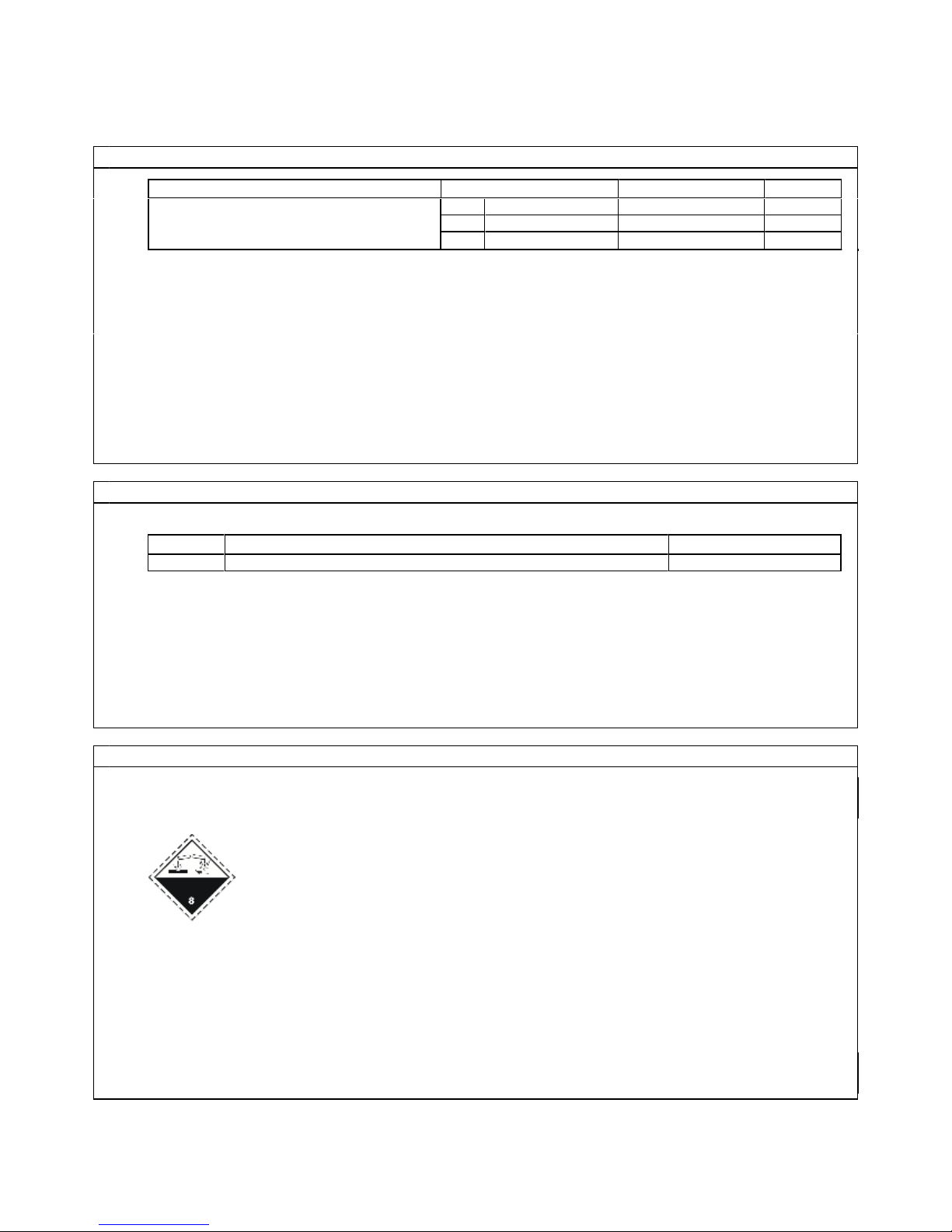
With regard to ADR 2013 and RID 2013:
Transport of dangerous goods by land:
Transport in bulk according to
Annex II of MARPOL 73/78 and
the IBC Code:
Non-applicable
14.7
Dangerous for the environment:
Special precautions for user
No
14.5
ETunnel rest riction code:
14.1
14.2
14.3
14.4
14.6
UN proper shipping name:
Labels:
Packing group:
UN number:
Transport hazard class(es):
Special regulations:
Physico-Chemical properties:
UN1805
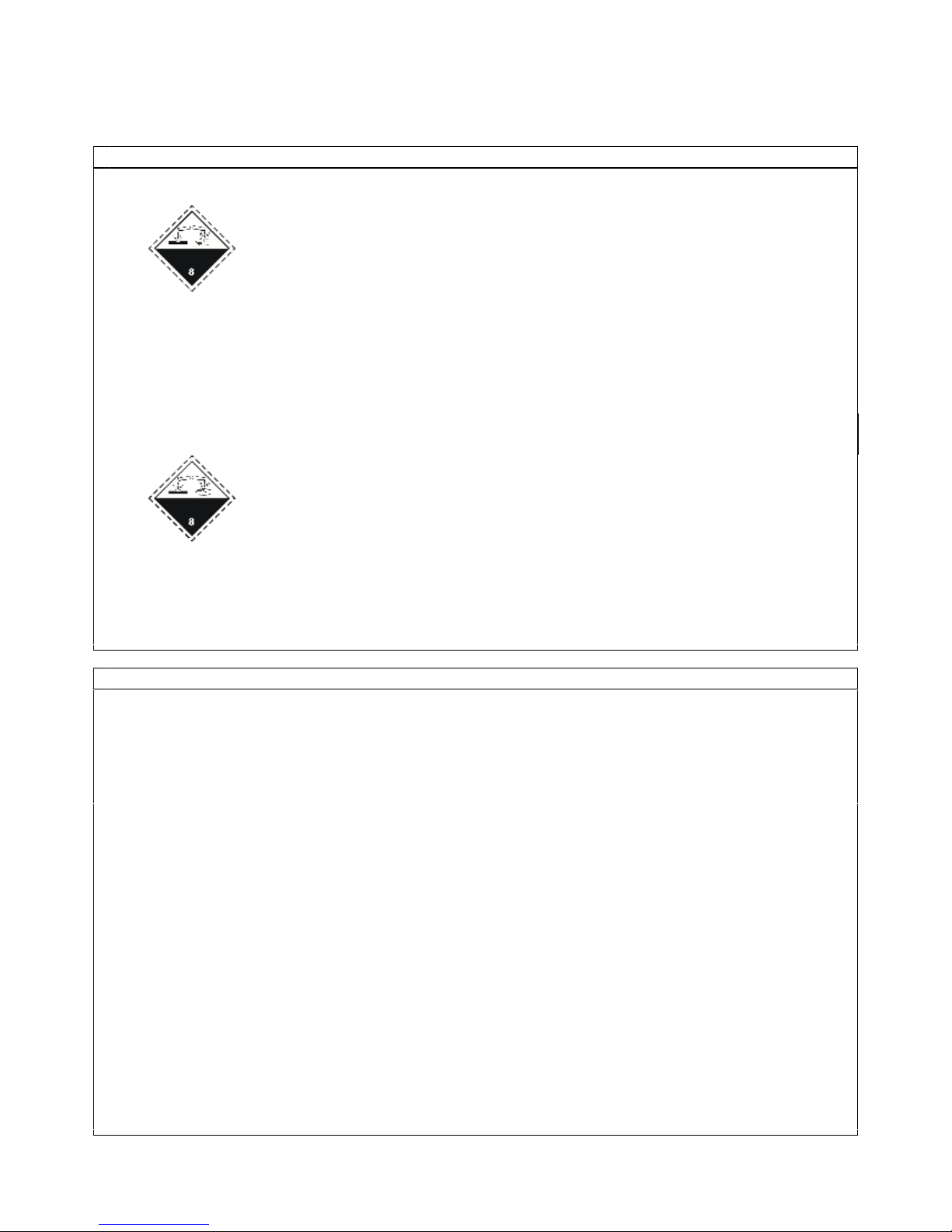
8
III
PHOSPHORIC ACID, SOLUTION
8
Non-applicable
see section 9
Limited quantities: 5 L
With regard to IMDG 36-12:
Transport of dangerous goods by sea:
Date of compilation: 2014-11-19 Version: 1
Page 7/9
- CONTINUED ON NEXT PAGE -
Page 21
- Regulation (EC) No 1223/2009 of the European Parliament and of the Council of 30 November 2009 on cosmetic products
- Regulation (EC) No 648/2004 of the European Parliament and of the Council of 31 March 2004 on detergents
- Commission Regulation (EC) No 907/2006 of 20 June 2006 amending Regulation (EC) No 648/2004 of the European Parliament
and of the Council on detergents, in order to adapt Annexes III and VII
- Commission Regulation (EC) No 551/2009 of 25 June 2009 amending Regulation (EC) No 648/2004 of the European Parliament
and of the Council on detergents, in order to adapt Annexes V and VI thereto (surfactant derogation)
The Chemicals (Hazard Information and Packaging for Supply) Regulations 2009, 2009 No. 716
The Carriage of Dangerous Goods and Use of Transportable Pressure Equipment Regulations 2009 (CDG 2009), SI 2009 No 1348
The Carriage of Dangerous Goods and Use of Transportable Pressure Equipment (Amendment) Regulations 2011, 2011 No. 1885
Control of Substances Hazardous to Health Regulations 2002 (as amended)
EH40/2005 Workplace exposure limits
The Waste Regulations 2011, 2011 No. 988
Other legislation:
It is recommended to use the information included in this safety data sheet as data used in a risk evaluation of the local circumstances
in order to establish the necessary risk prevention measures for the manipulation, use, storage and disposal of this product.
Specific provisions in terms of protecting people or the environment:
Non-applicable
Limitations to commercialisation and the use of certain dangerous substances and mixtures (Annex XVII, REACH):
Safety data sheet
Elektrolyt C
Material no.: 2020 DC / 2021 DC / 2025 DC
According to 1907/2006/EC (REACH), 453/2010/EC
SECTION 14: TRANSPORT INFORMATION (continue)
Transport in bulk according to
Annex II of MARPOL 73/78 and
the IBC Code:
Non-applicable
14.7
Dangerous for the environment:
Special precautions for user
No
14.5
F-A, S-B
EmS Codes:
14.1
14.2
14.3
14.4
14.6
UN proper shipping name:
Labels:
Packing group:
UN number:
Transport hazard class(es):
Special regulations:
Physico-Chemical properties:
UN1805
8
III
PHOSPHORIC ACID, SOLUTION
8
223
see section 9
Limited quantities: 5 L
With regard to IATA/ICAO 2014:
Transport of dangerous goods by air:
14.1
14.2
14.3
14.4
14.6
see section 9Physico-Chemical properties:
III
Packing group:
8Labels:
8
Transport hazard class(es):
PHOSPHORIC ACID, SOLUTION
UN number:
UN proper shipping name:
UN1805
Dangerous for the environment:
No
14.5
Transport in bulk according to
Annex II of MARPOL 73/78 and
the IBC Code:
Non-applicable
14.7
Special precautions for user
SECTION 15: REGULATORY INFORMATION
Safety, health and environmental regulations/le gis lat ion spec if ic for the substance or mixture:15.1
Regulation (EC) 649/2012, in relation to the import and export of hazardous chemical products: Non-applicable
Active substances for which a decision of non-inclusion onto Annex I (Regulation (EU) No 528/2012): Non-applicable
Regulation (EC) 1005/2009, about substances that deplete the ozone layer: Non-applicable
Candidate substances for authorisation under the Regulation (EC) 1907/2006 (REACH): Non-appli cable
Date of compilation: 2014-11-19 Version: 1
Page 8/9
- CONTINUED ON NEXT PAGE -
Page 22

Safety data sheet
Elektrolyt C
Material no.: 2020 DC / 2021 DC / 2025 DC
According to 1907/2006/EC (REACH), 453/2010/EC
SECTION 15: REGULATORY INFORMATION (continue)
The supplier has not carried out evaluation of chemical safety.
15.2 Chemical safety assessment:
SECTION 16: OTHER INFORMATION
- ADR: European agreement concerning the international carriage of dangerous goods by road
-IMDG: International maritime dangerous goods code
-IATA: International Air Transport Association
-ICAO: International Civil Aviation Organisation
-COD: Chemical Oxygen Demand
-BOD5: 5-day biochemical oxygen demand
-BCF: Bioconcentration factor
-LD50: Lethal Dose 50
-CL50: Lethal Concentration 50
-EC50: Effective concentration 50
-Log-POW: Octanol–water partition coefficient
-Koc: Partition coefficient of organic carbon
Abbreviations and acronyms:
http://esis.jrc.ec.europa.eu
http://echa.europa.eu
http://eur-lex.europa.eu
Principal bibliographical sources:
Minimal training is recommended to prevent industrial risks for staff using this product, in order to facilitate their comprehension and
interpretation of this safety data sheet, as well as the label on the product.
Advice related to training:
Skin Corr. 1B: H314 - Causes severe skin burns and eye damage
CLP Regulation (EC) nº 1272/2008:
R34: Causes burns
Directive 67/548/EC and Directive 1999/45/EC:
The phrases indicated do not refer to the product itself; they are present merely for informative purposes and refer to the individual
components which appear in section 3
Text of R-phrases considered in section 3:
Non-applicable
Modifications related to the previous security card which concerns the way s of managing risks . :
This safety data sheet has been designed in accordance with ANNEX II-Guide to the compilation of safety data sheets of Regulation
(EC) Nº 1907/2006 (Regulation (EC) Nº 453/2010)
Legislation related to safety data sheets:
The information contained in this security data sheet is based on sources, technical knowledge and current legislation at European and state level, without being able to guarantee its accuracy.
This information cannot be considered a guarantee of the properties of the product, it is simply a description of the security requirements. The occupational methodology and conditions for users of
this product are not within our awareness or control, and it is ultimately the responsibility of the user to take the necessary measures to obtain the legal requirements concerning the manipulation,
storage, use and disposal of chemical products. The information on this security data sheet only refers to this product, which should not be used for needs other than those specified.
Date of compilation: 2014-11-19 Version: 1
Page 9/9
- END OF SAFETY DATA SHEET -
 Loading...