

Page 1
RT Series Respirator Hood
User Manual
Bullard RT Series Respiratory Systems provide a continuous flow of air from
a remote air source via airline. The flow of air is delivered to the respirator
wearer through a patented air delivery system. RT Series respirators
offer protection from airborne contaminants that are not immediately
dangerous to life or health (IDLH), or that do not exceed concentrations
allowed by applicable OSHA, MSHA, EPA, NIOSH or ACGIH regulations and
recommendations, or any other applicable regulations for continuous flow
airline or powered air-purifying respirators.
RT Series airline respirators are approved by NIOSH (TC-19C-412
Type C). Bullard has determined that these respirators may be used to
provide respiratory protection in general purpose applications, including
pharmaceutical manufacturing, chemical and pesticide handling, tank
cleaning, spray painting and other industrial or agricultural applications in
which hazardous compounds are present.
Bullard RT hoods are available in two different Tychem® materials. Bullard
hoods will accommodate limited facial hair without compromising the level of
protection. The hood is held in place by the inflatable neck cuff (RT1 and RT2)
or a sport material neck cuff (RT3 and RT4), which fits under the wearer’s
chin and provides a positive seal. This keeps the hood in position on the
head and prevents it from rising upwards when supplied with breathing air.
Breathing air is supplied from a breathing tube connected to the back of the
hood, and the air is routed through overhead channels that deliver the air
down across the lens of the hood.
RT Series respirators are compatible with breathing air sources such as
breathing air compressors. Bullard offers the appropriate approved breathing
tube, flow control device and air supply hose to connect the RT Series
respirator to these breathing air sources.
respirators. All Bullard parts must be present and properly assembled to
constitute a NIOSH approved respirator. For technical assistance, contact
Bullard Cutomer Service at 877-BULLARD (285-5273) or 859-234-6616.
NOTE
Bullard RT Series hoods are also NIOSH approved for certain PAPR
configurations. Please refer to your Bullard PAPR manual or call
Customer Service at 877-BULLARD (285-5273).
RT Series respirators are approved by NIOSH for use with optional Bullard
climate control devices. Contact Bullard or our local authorized distributor
for more information about these and other accessories for RT Series
WARNING
Read all instructions and warnings before using these respirators. Save this manual for future reference.
The RT Series respirator’s air source must supply clean, breathable air, Grade D or better, at all times. The RT respirator does not purify air or filter out
contaminants. Connecting the RT respirator to a line supplying nitrogen or other harmful gases could cause death or serious injury. Failure to follow these
instructions could result in death or serious injury.
Table of Contents
Approval Label.................................................2
Component Concept - RT Series Hood.........................3
Warnings and Limitations.................................... 3
Operations
Protection .......................................................4
Breathing Air Requirements .........................................4
Breathing Air Pressure ............................................4
Breathing Air Supply Hoses and Hose Fittings . . . . . . . . . . . . . . . . . . . . . . . . . . 4
Breathing Air Pressure Table ........................................ 5
Respirator Assembly
Installing Breathing Tube Assembly in Respirator Hood . . . . . . . . . . . . . . . . . . 6
Using Climate Control Devices....................................... 6
Respirator Use
Donning.......................................................7
Removing.......................................................7
Inspection, Cleaning and Storage
Hood...........................................................8
Breathing Tube ...................................................9
Flow Control Valve/Climate Control Device. . . . . . . . . . . . . . . . . . . . . . . . . . . 9
Air Supply Hoses ...................................................9
Storage .........................................................9
Parts and Accessories......................................10-12
Return Authorizations. ...................................... 12
www.bullard.com
Page 2
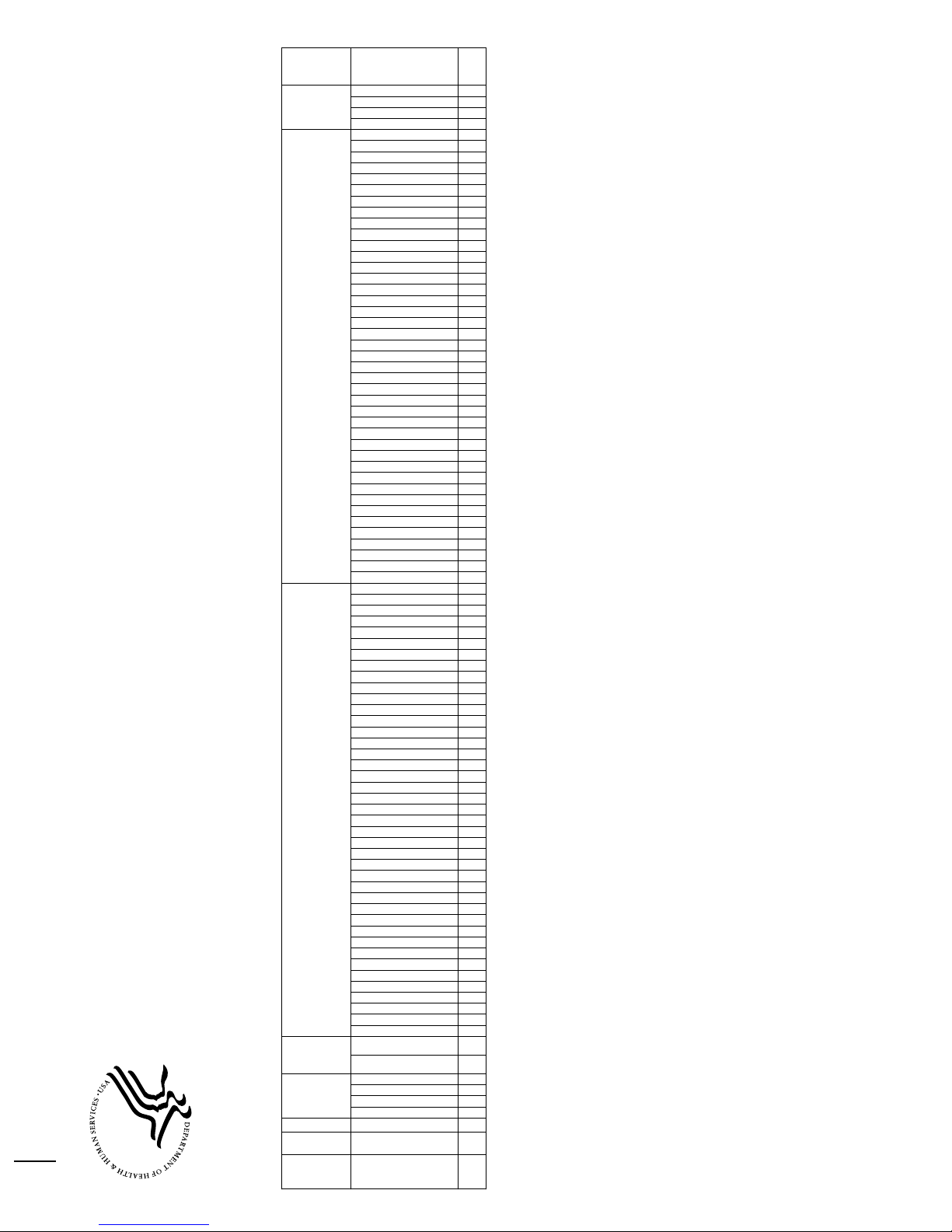
RT Series Respirator Approval Label
2
Bullard
Cynthiana, KY 41031 USA
1-800-827-0423
RT Series Respirator
This respirator is approved only in the following configurations:
CAUTIONS/
ALTERNATE FLOW CONTROL DEVICES ALTERNATE AIR SUPPLY HOSES
TUBES
BREATHING
ALTERNATE
SSEMBLIES
HOOD A
ALTERNATE
MODEL
TC -
LIMITATIONS2
ACCESSORIES
PROTECTION1
HS
F44
F43
F42
F41
F40
F30
F31
F32
F33
F34
F35
RT4
RT3
RT2
RT1
5454
5457
4696
F40S
F40B
F30B
F30S
F35B
F35S
RTBT
20BT
36501
54511
54510
46917
46915
46913
DC70ML
V52533
V55031
V55030
V55032
V52531
V52530
V52532
DC5040
DC5041
DC5042
DC5043
DC5044
V2050ST
46917FM
46917FF
46916FF
46916FS
DC5040B
DC5040S
V20100ST
V55033FS
V52533FF
V52533FS
AC100034
AC100033
AC100030
AC100032
AC100031
HC240034
HC240033
HC240030
HC240032
HC240031
DC70XLXXL
V55033GRN
V55030GRN
AC100030S
AC100030B
HC240030S
HC240030B
V5KF2530XXX
V5KF2531XXX
V5KF2532XXX
V5KF2533XXX
V5KF2535XXX
V5KF5030XXX
V5KF5031XXX
V5KF5032XXX
V5KF5033XXX
V5KF5035XXX
V52530GREEN
V5KF2533XXXFF
V5KF2533XXXFS
V5KF5033XXXFF
V5KF5033XXXFS
FRIGITRON2000
JMNOS
ABCDE-
FRIGITRON2000B
FRIGITRON2000S
RT SERIES HOODS
RT X X X X X X X X X X X X X X X X X X X X X X X X X X X X X X X X X X X X X X X X X X X X X X X X X X X X X X X X X X X X X X X X X X X X X X X X X X X X X X X X X X X X X X X X X X X X
CF
SA/
19C-412
PROTECTION
1
CF=CONTINUOUS FLOW
SA=SUPPLIED-AIR
configuration specified by the manufacturer.
maintenance of these respirators.
Instructions before donning.
S. Special or critical User’s Instructions and/or specific use limitations apply. Refer to User’s
MSHA, OSHA and other applicable regulations.
J. Failure to properly use and maintain this product could result in injury or death.
M. All approved respirators shall be selected, fitted, used and maintained in accordance with
CAUTIONS AND LIMITATIONS
2
A. Not for use in atmosphere containing less than 19.5 percent oxygen.
B. Not for use in atmospheres immediately dangerous to life or health.
N. Never substitute, modify, add or omit parts. Use only exact replacement parts in the
O. Refer to User’s Instructions, and/or maintenance manuals for information on use and
meeting the requirements of CGA G-7.1 Grade D or higher quality.
C. Do not exceed maximum use concentrations established by regulatory standards.
D. Air-line respirators can be used only when the respirators are supplied with respirable air
E. Use only the pressure ranges and hose lengths specified in the User’s Instructions.
Page 3
RT Series Respirator Hood
User Manual for use with supplied air respirators
Component Concept
RT Series
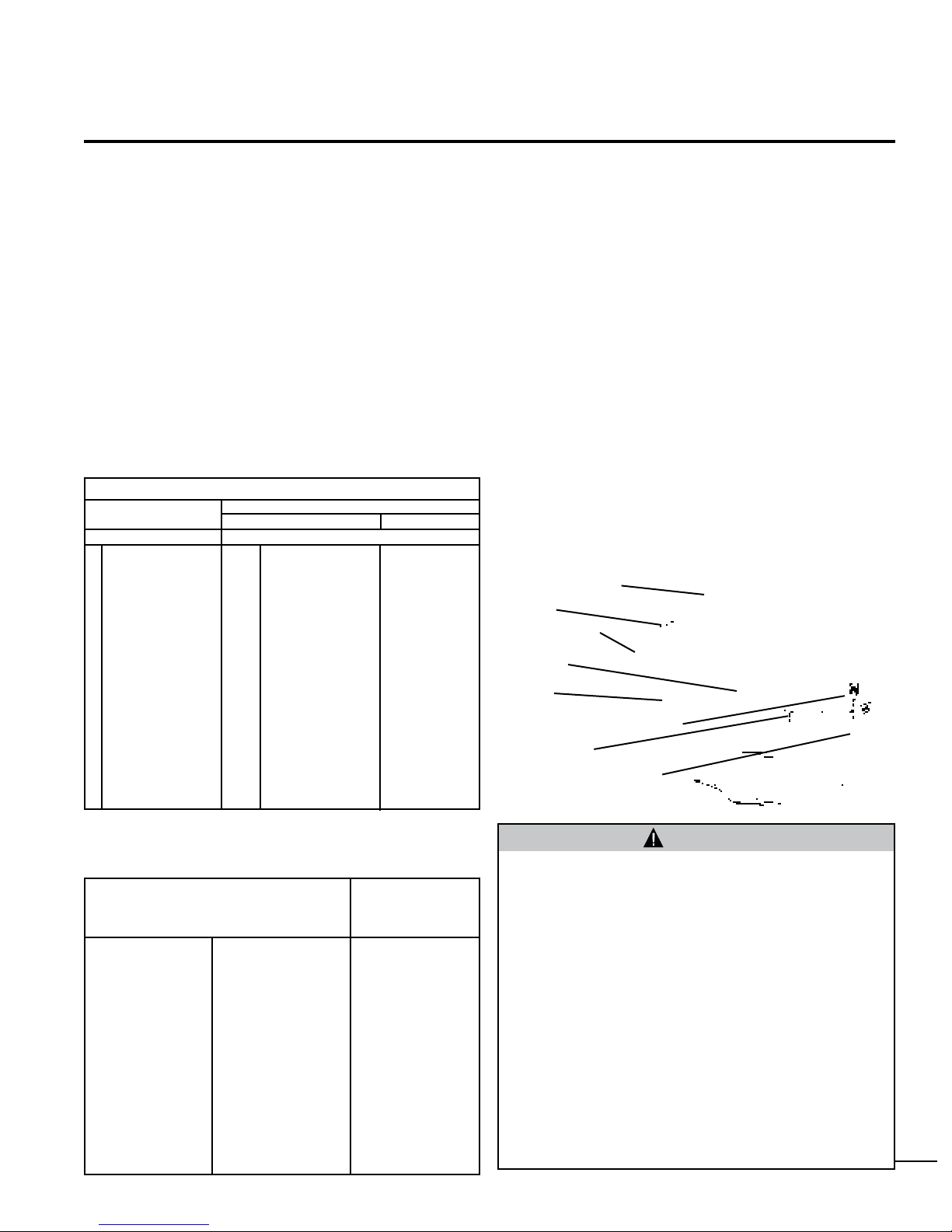
Bullard RT Series airline respirators consist of four components (Figure 1);
all must be present and properly assembled to constitute a complete NIOSH
approved respirator.
➀ Respirator Hood: Available in two Tychem®-based materials.
RT1 Tychem QC hood, inner bibs, inflatable neck cuff
RT2 Tychem SL hood, inner bibs, inflatable neck cuff
RT3 Tychem QC hood, inner bib, sport neck cuff
RT4 Tychem SL hood, inner bib, sport neck cuff
➁ Breathing Tube for RT Series Respirators:
20BT Wire-reinforced heavy-duty breathing tube
RTBT Lightweight disposable breathing tube
➂ Flow Control Device: Connects respirator hood to air supply hose.
Available with a choice of quick-disconnect fittings, constant or adjustable
airflow control and optional climate control devices.
Flow Control Device*
Without Climate
Control Devices
F30
P
A
R
T
N
o.
* All flow control devices require the 20BT or RTBT breathing tube to constitute complete breathing
tube assemblies. Breathing tube must be purchased separately.
➃ Air Supply Hose: Connects breathing tube to air source supplying clean
breathable air.
3/8" Coiled I.D. Hose
V5 Starter/Extension
Available in 25 and
50 foot lengths with
a variety of 1/4" and
1/2" quick-disconnect
materials. See parts
F30B
F30S
F31
F32
F33
F34
F35
F35B
F35S
Hose for High Pressure
Compressed Air Source
V5
Hose
fitting styles and
list (page 11) for
details.
With Climate Control Devices
Cold Only
AdjustableConstant
F40 AC100030 HC240030
F40B AC10030B HC240030B
F40S AC10030S HC240030S
F41 AC10031 HC240031
F42 AC10032 HC240032
F43 AC100033 HC240033
F44 AC100034 HC240034
FRIGITRON 2000
FRIGITRON 2000B
FRIGITRON 2000S
DC5040
DC5040B
DC5040S
DC5041
DC5042
DC5043
DC5044
V10
3/8" Coiled I.D. Hose
469 Starter Hose
545 Extension Hose
Available in 25, 50,
and 100 foot lengths
with a variety of 1/4"
quick-disconnect fitting
styles and materials.
See parts list (page 11)
for details.
Cautions and Limitations
For RT Series Airline Respirators
A. Not for use in atmospheres containing less than 19.5% oxygen.
B. Not for use in atmospheres immediately dangerous to life or health (IDLH). IDLH
is defined in 29 CFR 1910.134(b).
C. Do not exceed maximum use concentrations established by regulatory
standards.
D. Airline respirators can be used only when respirators are supplied with
respirable air meeting the requirements of CGA G-7.1 Grade D or higher quality.
E. Use only the pressure ranges and hose lengths specified in the instruction
manual.
I. Contains electrical parts that may cause an ignition in flammable or explosive
atmospheres.
J. Failure to properly use and maintain this product could result in injury or death.
M. All approved respirators shall be selected, fitted, used, and maintained in
accordance with MSHA, OSHA, and other applicable regulations.
N. Never substitute, modify, add, or omit parts. Use only exact replacement parts in
the configuration as specified by the manufacturer.
Hot/Cold
Hose for Low
Pressure Ambient
Air Pump
V20
1/2" Coiled I.D. Hose
V5 Starter/Extension
Hose
Available in 50 and
100 foot lengths with
1/2" quick-disconnect
Industrial Interchange
fittings. See parts list
(page 11) for details.
O. Refer to users instructions, and/or maintenance manuals for information on use
and maintenance of these respirators.
S. Special or critical User’s Instructions and/or specific use limitations apply. Refer
to User’s Instructions before donning.
➀ Respirator Hood
Clamp
➁ Breathing Tube
Inner bib
Clamp
Failure to heed these warnings could result in death or serious injury.
Use strictly in accordance with instructions, labels and limitations pertaining to the RT
Series respirator.
1. The RT Series respirator does not supply oxygen.
2. Use only in adequately ventilated areas containing at least 19.5% oxygen.
3. Do not use when concentrations of contaminants are immediately dangerous to life or
health (IDLH). IDLH is defined in 29 CFR 1910.134(b).
4. Do not use these respirators for respiratory protection against abrasive blasting using
silica sand as the abrasive.
5. Do not use in circumstances where the airborne concentration level of contaminant
exceeds maximum use concentration for this type of respirator as established by
regulatory standards.
6. Leave area immediately if:
a. Breathing becomes difficult.
b. Dizziness or other distress occurs.
c. You taste or smell the contaminant.
d. Unit becomes damaged.
7. Use strictly in accordance with instructions, labels and limitations pertaining to the RT
Series respirator in use.
8. Never alter or modify this respirator. Use only NIOSH approved Bullard RT Series
components and replacement parts for this respirator.
www.bullard.com
➂ Flow Control Device
Belt
➃ Air Supply Hose
WARNING
Fig. 1
Clean Breathable Air
Source Supplying
Grade “D” or Higher
Air Quality (See Breathing Air Requirements
on page 4.)
Component Concept/ Cautions and Limitations
3
Page 4
Operations
Protection
Respiratory
The RT Series respirator is NIOSH approved (TC-19C-412) as a Type C
continuous-flow supplied air respirator. It can be worn for general purpose
applications, including pharmaceutical manufacturing, chemical and pesticide
handling, tank cleaning, spray painting, and other industrial or agricultural
applications in which hazardous compounds are present.
The RT Series respirator is not approved for use in any atmosphere
immediately dangerous to life or health (IDLH), or from which the wearer
cannot escape without the aid of the respirator. IDLH is defined in 29 CFR
1910.134(b)
Head
RT Series respirator hoods DO NOT provide head protection.
Face
RT Series respirator hoods DO NOT provide face protection. If face protection
is required, use the Bullard 20TICH or 20SICH model.
Eyes
RT Series respirator hoods DO NOT provide eye protection. Wear approved
safety glasses or goggles at all times.
Ears
RT Series respirator hoods DO NOT provide hearing protection. Use properly
fitted earmuffs, earplugs or other protection when exposed to high noise
levels.
RT Series Respirator Breathing Air Requirements
Air Quality
WARNING
The RT Series respirator must be supplied with clean, breathable air,
Grade D or better, at all times. This respirator does NOT purify or filter
out contaminants. Failure to heed these warnings could result in death
or serious injury.
Respirable, breathable air must be supplied to the point-of-attachment of
the approved Bullard air supply hose. The point-of-attachment is the point
at which the air supply hose connects to the air source. A pressure gauge
attached to the air source is used to monitor the pressure of air provided to
the respirator wearer (see Figure 2).
Supplied breathing air must AT MINIMUM meet the requirements for Type 1
gaseous air described in the ANSI/Compressed Gas Association Commodity
Specification G-7.1 for Grade D or higher quality as specified by Federal
regulations 42 CFR, Part 84.141(b) and 29CFR1910.134(i).
The requirements for Grade D breathable air include:
Oxygen.................................................19.5-23.5%
Hydrocarbons (condensed) in mg/m3 of gas . . . . . . . . . . . . . . . 5 mg/m3 max.
Carbon monoxide.........................................10 ppm max.
Carbon dioxide........................................1,000 ppm max.
Odor............................................................*
No toxic contaminants at levels that make air unsafe to breathe.
*Specific measurement of odor in gaseous air is impractical. Air may normally
have a slight odor. The presence of a pronounced odor should render the air
unsatisfactory.
Contact the Compressed Gas Association (1725 Jefferson Davis Highway,
Arlington, VA 22202) or www.cganet.com for complete details on Commodity
Specification G-7.1.
Operations / Breathinig Air Requirements
Air Source
Locate the source of supplied air, whether it is a breathing air compressor
or an ambient air pump, such as a Bullard Free-Air® pump, in a clean air
environment. Locate the air source far enough from your work site to ensure
the air remains contaminant-free. Always use an inlet filter on your air
source.
Use suitable after-cooler/dryers with filters, and carbon monoxide monitors
and alarms, as necessary to assure clean, breathable air at all times.
Compressed air should be regularly sampled to be sure that it meets Grade D
requirements.
RT Series Respirator Breathing Air Pressure
Air pressure should be monitored at the point-of-attachment while operating
this respirator. A reliable air pressure gauge must be present to permit you to
monitor pressure during actual respirator operation.
WARNING
Failure to supply the minimum required pressure at the point-of-attachment for your hose length and RT respirator type will reduce airflow and
could result in death or serious injury.
Special or Critical User’s Instructions
The Breathing Air Pressure Table (see page 5) defines the air pressure ranges
necessary to provide RT Series respirators with a volume of air that falls
within the required range of 6-15 cfm or 170-425 lpm (Ref. 42 CFR, Part 84,
Subpart J, 84.150).
Make sure you understand the information in the Breathing Air Pressure Table
before using this respirator.
1. Determine the type of air source you are using (Column 1), then find your
flow control valve/climate control device (Column 2).
2. Be sure your Bullard air supply hose (Column 3) is approved for use with
your flow control valve/climate control device.
3. Determine that your Bullard air supply hose is within the approved length
(Column 4).
4. Make sure you have not exceeded the maximum number of hose sections
(Column 5).
5. Set the air pressure at the point-of-attachment within the required
pressure range (Column 6) for your flow control valve/climate control device,
and air supply hose type and length.
RT Series Respirator Breathing Air Supply Hoses
and Hose Fittings
NIOSH approved Bullard air supply hose(s) MUST be used between the
breathing tube connection fitting on the wearer’s belt and the point-ofattachment to the air supply.
NIOSH approved Bullard quick-disconnect fittings MUST be used to connect
V5 or V20 hose lengths together. When connecting lengths of V10 hose, only
use Bullard V11 hose-to-hose adapters. Secure connection(s) until wrenchtight and leak-free. Total connected hose length and number of hoses MUST
be within the ranges specified on the Breathing Air Pressure Table (see page
5).
The breathing tube connection fitting MUST be secured to the belt that is
supplied with this respirator. Securing the breathing tube connection helps
prevent the air supply hose from snagging, disconnecting or pulling the
respirator hood off your head.
4
www.bullard.com
Page 5

RT Series Respirator Hood
User Manual for use with supplied air respirators
Special or Critical User’s Instructions
RT Breathing Air Pressure Table
This table defines the air pressure ranges necessary to provide CC20 Series respirators with a volume of air that falls within the required range of 6-15 cfm or 170-425 lpm according to U.S. Government
regulations (42 CFR, Part 84, Subpart J, 84.150, Table 8).
1 2 3 4 5 6
Air Source
Stationary or Portable Air
Compressor
®
Bullard Free-Air
Pumps F35, F35b, F35s V20 50
Flow Control Valve/
Climate Control Device
F30, F30B, F30S, F31, F32,
F33, F34
F40, F40B, F40S, F41, F42,
F43, F44
AC100030, AC100030B,
AC100030S, AC100031,
AC100032, AC100033,
AC100034
DC5040, DC5040B, DC5040S,
DC5041, DC5042, DC5043,
DC5044
HC2400030, HC2400030B,
HC2400030S, HC2400031,
HC2400032, HC2400033,
HC2400034
Frigitron 2000
Frigitron 200B
Frigitron 2000S
Air Supply Hose
V10 25
V10 25
V5 25
V10 25-50
V5 25
V10 50
V5 25
V10 25
V5 25
V20 50
Air Supply Hose
Length (feet)
50
75-150
200
250-300
50
75-150
200
250-300
50
75-150
175-300
50
75-150
200
250
300
50
50
75-150
200
250
300
50
100
200
300
100
200
300
Maximum Number of
Hose Sections
1
2
3
5
5
1
2
3
5
5
1
2
2
3
5
1
1
2
3
3
3
5
1
2
1
2
3
4
5
5
1
1
1
2
2
3
1
2
2
3
Required Pressure
Range (psig air)
14-15
15-18
19-29
25-34
31-39
22-25
24-27
27-37
33-40
38-45
22-26
25-30
55-65
60-70
65-75
55-65
56-69
52-54
59-72
80-84
85-92
90-98
53-57
67-71
59-61
63-65
68-75
77-79
80-82
84-86
65-66
68-69
4-6
6-8
10-15
13-18
16-22
18-25
22-30
25-34
Breathing Air Pressure Table
www.bullard.com
5
Page 6
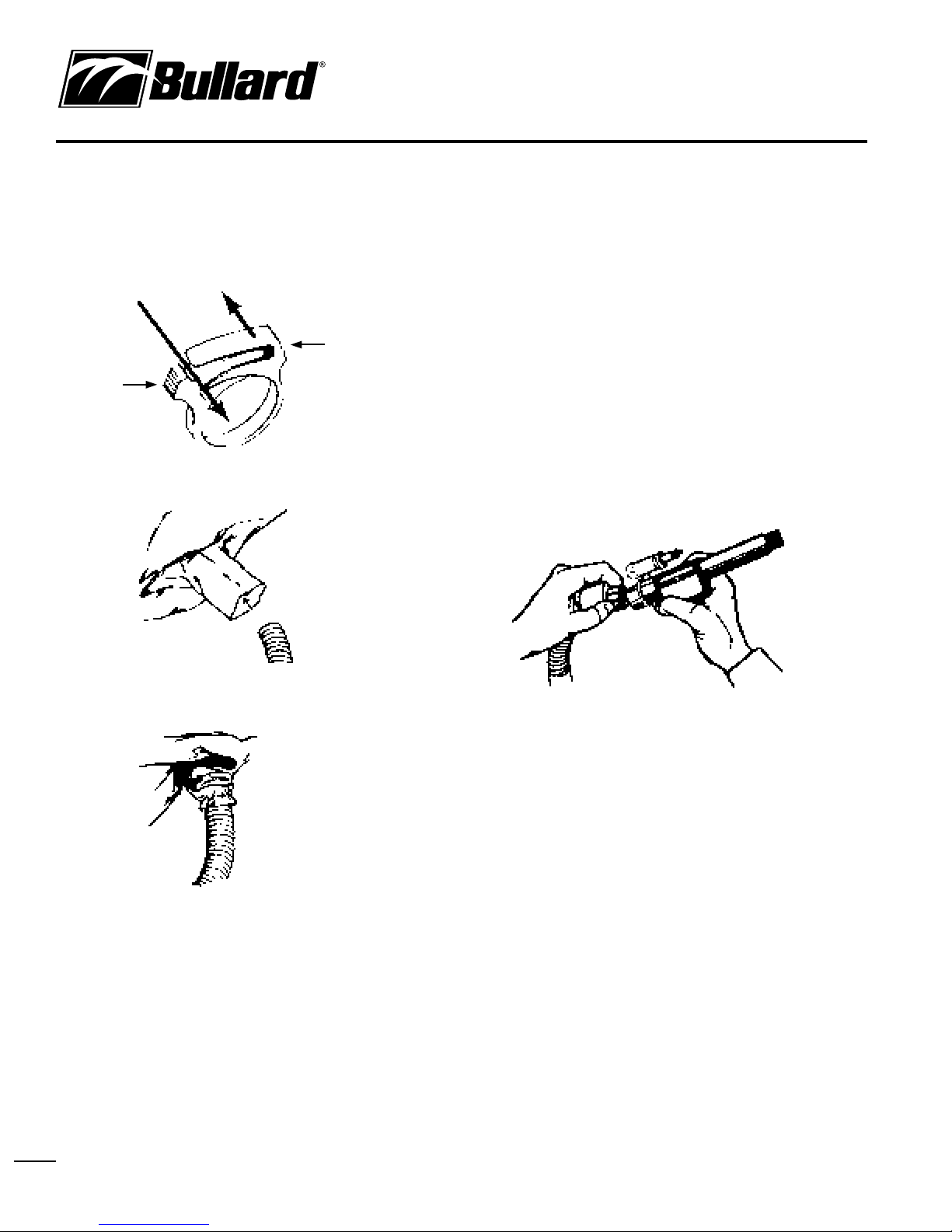
Installing Breathing Tube Assembly
in RT Series Respirator Hoods
1. Remove nylon clamp from the breathing tube (see Figure 3). Do not remove
foam from inside the breathing tube, used with RT Series Airline Respirators.
The foam helps reduce the noise level of incoming air.
to remove
to tighten
to tighten
Shortening RTBT Breathing Tube Length
If you find that the RTBT disposable breathing tube is too long, it can be cut
down to a shorter length. This cannot be done for the 20BT breathing tube.
To do this, first determine how much shorter you need to make the tube. The
tube cannot be shortened more than 6 inches. Mark a line with a marker pen
where you want to make the cut. Take a sharp cutting instrument and cut
through the breathing tube and foam inside. Be careful not to damage the
remaining tube or foam. If this does occur, replacement will be necessary.
Using Climate Control Devices for RT Series
Airline Respirators
RT Series Airline Respirators are approved by NIOSH for use with three
optional Bullard climate control devices: AC1000 Series, HC2400 Series, and
Frigitron 2000 Series.
Figure 3
2. Insert the open end of the breathing tube approximately five inches into
hood’s air entry sleeve (see Figure 4).
Figure 4
3. Install nylon clamp over air entry sleeve and breathing tube. If desired, 2 or
more clamps may be used(see Figure 5).
Figure 5
1. Follow the instructions supplied with your climate control device.
2. Be sure to use only the 20BT or RTBT with your climate control device.
3. Screw nylon hose connector on end of breathing tube to hose thread on
climate control device.
4. Firmly tighten hose connector by hand (see Figure 6).
Figure 6
5. Lace belt supplied with respirator through belt loop bracket on climate
control device.
4. Engage clamp locks and squeeze together until tight.
5. Attach other end of 20BT or RTBT breathing tube to flow control device on
belt by screwing nylon hose connector on flow control device.
Breathing Tube Assembly / Climate Control Devices
6
www.bullard.com
Page 7
RT Series Respirator Use
WARNING
Do not put on or remove these respirators in a hazardous atmosphere
except for emergency escape purposes. Failure to heed these warnings
could result in death or serious injury.
Donning the RT Respirator
Before using your RT Series respirator, assemble the respirator using the
instructions given on page 6.
1. Connect NIOSH approved Bullard air supply hose to an air source supplying
Grade D breathable air as defined on page 4. Turn on breathing air source.
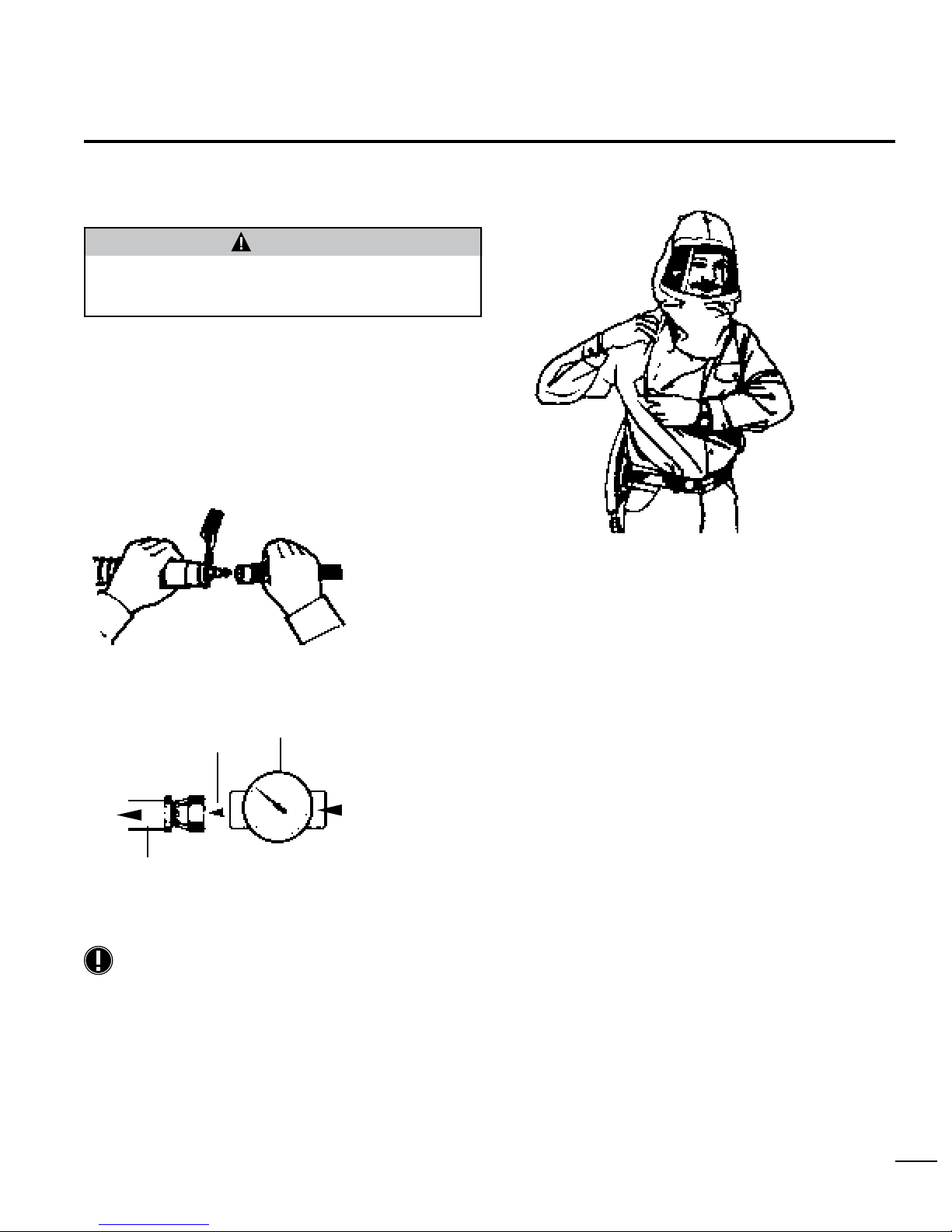
2. With air flowing, connect breathing tube assembly to air supply hose (see
Figure 7). Connect quick-disconnect fitting on breathing tube assembly to
quick-disconnect coupler on air supply hose. Once fitting is secured, release
coupling sleeve to lock fittings together. Pull on both hoses to make sure they
are attached securely.
RT Series Respirator Hood
User Manual for use with supplied air respirators
Figure 9
Figure 7
3. Adjust air pressure at point-of-attachment to within the approved pressure
range (see Figure 8). See the Breathing Air Pressure Table (page 5) for approved pressure ranges.
Pressure Gauge
Point-of-Attachment
Respirator
Air Supply Hose
4. With air still flowing, put on RT Series respirator hood. Pull the hood over
your head until the neck cuff is securely around your neck.
Figure 8
Grade “D”
Breathable
Air Source
NOTE
The RT3 and RT4 hoods have an adjustable velcro strap near the top of
the lens that allows the user to customize the curvature of the lens to
his/her personal preference. This strap may be removed if desired.
7. Pull respirator outer bib over collar of shirt or protective clothing. Pull
the long outer bib down on the outside of clothing and secure with tie down
straps or tape (if employer operating procedures will allow.)
10. With breathing tube assembly attached to the hood, fasten belt at waist or
hip level and adjust for comfort.
11. Recheck air pressure and adjust if necessary.
12. With air flowing into your respirator, you are now ready to enter work
area.
Removing the RT Series Respirator
When finished working, leave work area wearing respirator and with air still
flowing. Once outside contaminated area, remove respirator and then disconnect the air supply hose using the quick-disconnect fittings.
RT Series Respirator Use/Donning/Doffing
5. Make sure that the breathing tube is not twisted after donning.
6. Tuck inner bib of hood into shirt or protective clothing for additional splash
and overspray protection (see Figure 9).
www.bullard.com
7
Page 8

Inspection, Cleaning and Storage
WARNING
Failure to heed these instructions could result in death or serious injury.
LEAVE WORK AREA IMMEDIATELY IF:
- Any respirator component becomes damaged
- Airflow into respirator hood stops or slows down
- Air pressure gauge drops below the minimum specified in the
Breathing Air Pressure Table
- Pressure is felt in the ears
- Breathing becomes difficult
- You become dizzy, nauseous, too hot, too cold, or ill
- You taste, smell, or see contaminants inside
respirator hood
- Your vision becomes impaired
WARNING
Do not store respirator in your work area or leave it unattended in
a contaminated environment. Respirable contaminants can remain
suspended in the air for several hours after work activity ceases,
even though you may not see them. Proper work practice requires you
to wear the respirator until you are outside the contaminated area.
If you place or store the respirator in a contaminated environment,
contaminants, dirt, and dust could get into the respirator. When you put
the respirator back on, you could breathe in contaminants upon reuse.
Failure to heed these instructions could result in death or serious injury.
Bullard RT Series respirators have a limited service life. Therefore, a regular
inspection and replacement program must be conducted.
Bullard RT Series respirators and all component parts and assemblies should
be inspected for damage or excessive wear before and after each use to
ensure proper functioning. Immediately remove the respirator from service
and replace parts or assemblies that show any sign of failure or excessive
wear that might reduce the degree of protection originally provided.
Use only Bullard RT Series respirator components and replacement parts
manufactured by Bullard and approved by NIOSH for use with these
respirators.
Since respirator use and the quality of maintenance performed vary with
each job site, it is impossible to provide a specific time frame for respirator
replacement.
Inspect all components of this respirator system during cleaning and before
and after each use for signs of wear, tear or damage that might reduce the
degree of protection originally provided. Respirators used by more than
one person must be cleaned, inspected and sanitized after each use. If not
cleaned, contamination may cause illness or disease.
WARNING
The air you breathe will not be clean unless the respirator you wear
is clean. Failure to heed this warning could result in death or serious
injury.
Hood
Inspection
Inspect the hood material for rips, tears, or damage from excessive wear that
might reduce the degree of protection originally provided. Inspect the inner
neck cuff for elasticity. The respirator’s plastic lens should be inspected for
cracks, scratches or any other signs of damage.
Disassemble the breathing tube from the hood by removing the nylon hose
clamp. To remove the hose clamp, slide the locks sideways in opposite
directions.
If damage is detected, replace immediately with Bullard replacement part(s)
or remove the respirator from service.
Cleaning
Bullard does not recommend laundering the hood. When the hood becomes
dirty, it should be discarded and replaced. The respirator’s plastic lens should
be hand-sponged with warm water and mild detergent, rinsed, and air-dried.
After cleaning and before reassembling, once again carefully inspect parts for
signs of damage.
WARNING
Do not use volatile solvents for cleaning this respirator or any parts and
assemblies. Strong cleaning and disinfecting agents, and many solvents,
can damage the plastic parts and reduce the protective properties of
the respirator. Failure to heed these instructions may result in minor or
moderate injury and/or equipment damage.
Inspection, Cleaning and Storage
8
www.bullard.com
Page 9
RT Series Respirator Hood
User Manual for use with supplied air respirators
Breathing Tube
Inspection
Inspect the breathing tube for tears, cracks, holes, or excessive wear that
might reduce the degree of protection originally provided. If any signs of excessive wear are present, replace the breathing tube immediately or remove
the respirator from service.
Cleaning
To clean the breathing tube, hand-sponge with warm water and mild detergent, being careful not to get water inside. Rinse and air-dry. After cleaning,
once again carefully inspect breathing tube for signs of damage.
Flow Control Valve/
Climate Control Device
Inspection
Be sure the hose thread is screwed tightly into the breathing tube so no air
can escape during use. Check the adjustment knob on the flow control device
for cracks and other damage.
Cleaning
To clean, hand-sponge with warm water and mild detergent, being careful
not to get water inside. After cleaning, once again carefully inspect breathing
tube for signs of damage. If any signs of excessive wear are present, replace
the flow control valve/climate control device or remove the respirator from
service.
WARNING
Do not cut or remove the foam that is inside the RT Series Airline
Respirator breathing tube. The foam helps reduce the noise level of
the incoming air supply. It does not filter or purify your breathing air.
NIOSH has approved this respirator with the foam in place. Failure to
follow these instructions may result in minor or moderate injury and/or
equipment damage.
Air Supply Hoses
Inspection
Air supply hose(s) should be inspected closely for abrasions, corrosion, cuts,
cracks and blistering. Be sure the hose fittings are crimped tightly to the hose
so that no air can escape. Make sure the hose has not been kinked or crushed
by any equipment that may have rolled over it.
If any of the above signs are present or any other signs of excessive wear
are detected, replace the hose(s) immediately or remove the respirator from
service.
Cleaning
The air supply hose(s) should be hand-sponged with warm water and mild
detergent, rinsed and air dried. Do not get water inside the air supply hose.
After cleaning, once again carefully inspect air supply hose(s) for signs of
damage.
WARNING
Only use air supply hoses that are NIOSH approved for use with the RT
Series respirator. Other hoses could reduce airflow and protection, and
expose the wearer to life-threatening conditions. Failure to follow these
instructions could result in death or serious injury.
Storage
After reusable respirator components have been cleaned and inspected, place
them in a plastic bag or an airtight container.
Store the respirator and parts where they will be protected from contamination, distortion and damage from elements such as dust, direct sunlight, heat,
extreme cold, excessive moisture and harmful chemicals. Five-year maximum
shelf life.
www.bullard.com
Inspection Cleaning and Storage
9
Page 10
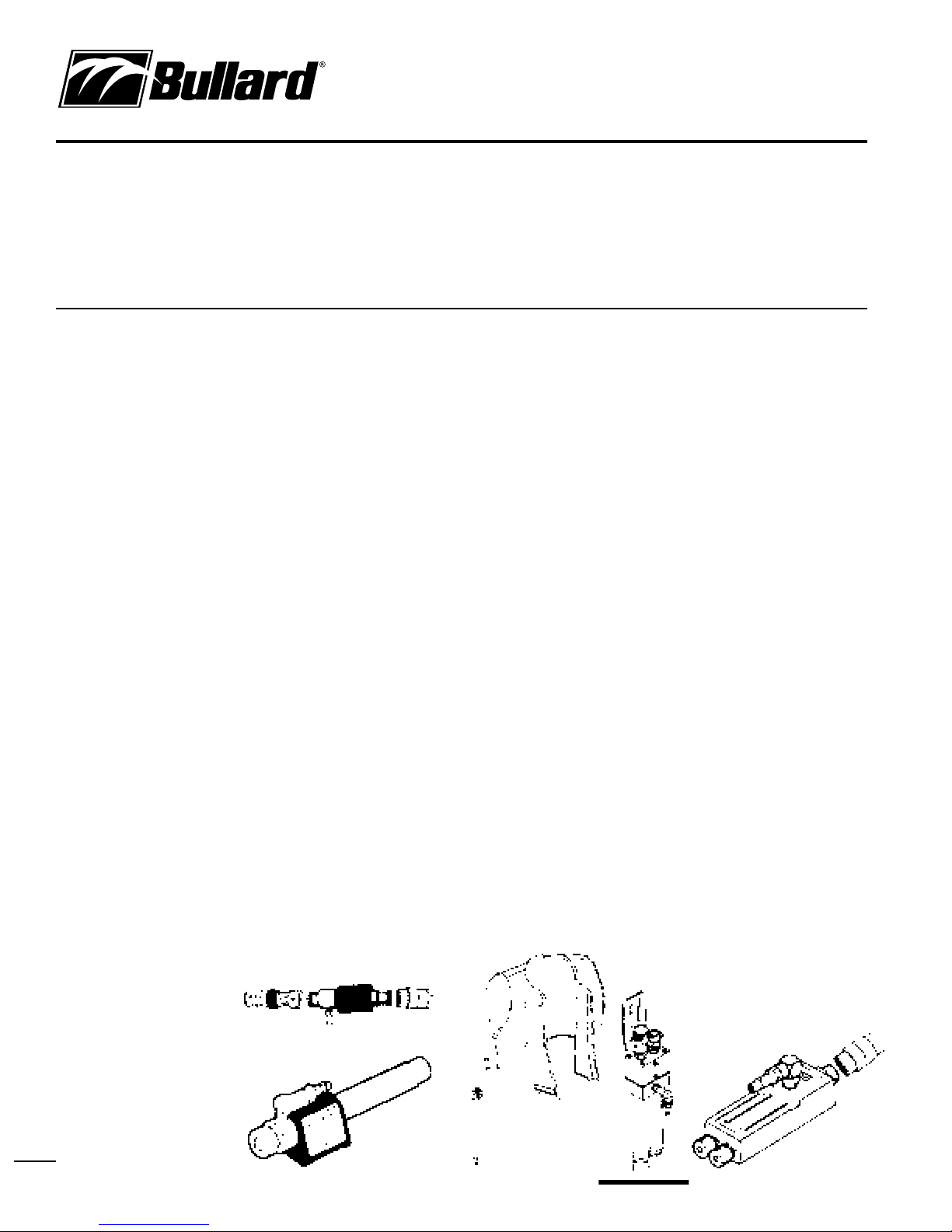
Parts and Accessories
RT Series airline respirators consist of four components – respirator hood, breathing tube, flow control device, and air supply hose. All components must be
present and properly assembled to constitute a complete NIOSH approved respirator.
CATALOG
NUMBER DESCRIPTION
Fully Disposable Respirator Assemblies
RT1DA Includes RT1 hood with RTBT breathing tube installed
and ready for use
RT2DA Includes RT2 hood with RTBT breathing tube installed
and ready for use
RT3DA Includes RT3 hood with RTBT breathing tube installed
and ready for use
RT4DA Includes RT4 hood with RTBT breathing tube installed
and ready for use
Respirator Assemblies
For use with compressed air
RT130 Includes RT1 hood, and V30 breathing tube
assembly
RT230 Includes RT2 hood, and V30 breathing tube
assembly
RT330 Includes RT3 hood and V30 breathing tube assembly
RT430 Includes RT4 hood and V30 breathing assembly
Respirator Hoods
RT1 Tychem QC hood, inner bibs, inflatable neck cuff
RT2 Tychem SL hood, inner bibs, inflatable neck cuff
RT3 Tychem QC hood, inner bib, sport neck cuff
RT4 Tychem SL hood, inner bib, sport neck cuff
Accessories
36501 Belt, decontaminable
HS Heat Shield
Flow Control Devices for RT Series Airline
Respirators
Flow Control Valves
F30 Constant flow control valve with 1/4” Industrial
Interchange (Hansen compatible) quick-disconnect
nipple (other industrial fittings available)
F40 Adjustable flow control valve with 1/4” Industrial
Interchange (Hansen compatible) quick-disconnect
nipple (other industrial fittings available)
F35 Constant flow control valve with 1/2” Industrial
Interchange (Hansen compatible) quick-disconnect
nipple
CATALOG
NUMBER DESCRIPTION
Climate Control Assemblies for
RT Series Airline Respirators
For use with Breathing Air Compressors
Cold Tubes – Adjustable Flow
AC100030 With 1/4” Industrial Interchange steel (Hansen
compatible) quick-disconnect nipple
AC100031 With 1/4” Schrader steel quick-disconnect nipple
AC100032 With 1/4” Snap-Tite steel quick-disconnect nipple
AC100033 With 1/4” Snap-Tite brass quick-disconnect nipple
AC100034 With 1/4” Snap-Tite stainless quick-disconnect nipple
Hot/Cold Tubes - Adjustable Flow
HC2400 With 1/4” Industrial Interchange steel (Hansen
compatible) quick-disconnect nipple
HC240031 With 1/4” Schrader steel quick-disconnect nipple
HC240032 With 1/4” Snap-Tite steel quick-disconnect nipple
HC240033 With 1/4” Snap-Tite brass quick-disconnect nipple
HC240034 With 1/4” Snap-Tite stainless quick-disconnect nipple
Replacement Parts for Climate Control Assemblies
MV2400 Muffler/valve assembly for HC2400
Dual-CooL™ - Climate Control Device
DC5040 With 1/4” Industrial Interchange steel (Hansen
compatible) quick-disconnect nipple. Includes CH60
connector hose and nylon belt (Order vest
separately)
DC5041 Same as above with 1/4" Schrader steel nipple
DC5042 Same as above with 1/4" Snap-Tite steel nipple
DC5043 Same as above with 1/4" Snap-Tite brass nipple
DC5044 Same as above with 1/4" Snap-Tite stainless nipple
DC70M/L Medium/Large cooling vest
DC70XL/XXL Extra Large/XX-Large cooling vest
Climate Control Assembly
For use with Bullard EDP30
or ADP20 Free-Air Pump
Cool Tube - Adjustable Flow
Frigitron® 2000 With 1/2” Industrial Interchange steel (Hansen
compatible) quick-disconnect nipple.
RT Series
Hood
Ordering Information
10
HC2400 Series
AC1000 Series
DC70M/L
DC70XL/XXL
www.bullard.com
DC5040
Dual-Cool
Frigitron 2000
Page 11

Parts and Accessories
CATALOG
NUMBER DESCRIPTION
Air Supply Hoses and Fittings for CC20 Series
Airline Respirators
V10 Series Starter Hose Kits
For use with Breathing Air Compressors
Include 25’ (7.6m), 3/8” I.D. rubber hose with 1/4” female quick-disconnect coupler
and V13 adapter fitting (3/8” hose-to-3/8” pipe)
4696 With 1/4” Industrial Interchange steel (Hansen
compatible) quick-disconnect coupler
46913 With 1/4” Schrader steel quick-disconnect coupler
46915 With 1/4” Snap-Tite steel quick-disconnect coupler
V10 Series Extension Hose Kits
For use with Breathing Air Compressors
Include 3/8” I.D. rubber hose, V11 hose-to-hose adapter fitting and V13 hose-to-pipe
fitting (3/8” hose-to-3/8” pipe)
5454 25’ (7.6 m) Extension hose kit
5457 50’ (15.2 m) Extension hose kit
5458 100’ (30.5 m) Extension hose kit
V5 Series Coiled Hoses
For use with Breathing Air Compressors
Include 3/8” I.D. Nylon coiled hose with 1/4” female quick-disconnect coupler and
1/4” male quick-disconnect nipple.
V52530 25’ (7.6 m) with 1/4” Industrial Interchange steel (Hansen
compatible) fittings
V55030 50’ (15.2 m) with 1/4” Industrial Interchange steel (Hansen
compatible) fittings
V52531 25’ (7.6 m) with 1/4” Schrader steel quick-disconnect fittings
V55031 50’ (15.2 m) with 1/4” Schrader steel quick-disconnect fittings
V52532 25’ (7.6m) with 1/4” Snap-Tite steel fittings
V5 Series Kink-Free Hoses *
XXX is designation RED, GRN, BLK, YLW, BLU
For use with Breathing Air Compressors
Include 3/8” I.D. Nylon coiled hose with 1/4” female quick-disconnect coupler and
1/4” male quick-disconnect nipple.
V5KF2530XXX 25’ (7.6 m) with 1/4” Industrial Interchange
steel (Hansen compatible) fittings
V5KF5030XXX 50’ (15.2 m) with 1/4” Industrial Interchange steel
(Hansen compatible) fittings
V5KF2531XXX 25’ (7.6 m) with 1/4” Schrader steel quick-
disconnect fittings
V5KF5031XXX 50’ (15.2 m) with 1/4” Schrader steel quick-
disconnect fittings
V5KF2532XXX 25’ (7.6m) with 1/4” Snap-Tite steel fittings
V5KF5032XXX 50’ (15.2 m) with 1/4” Snap-Tite steel fittings
V5KF2533XXX 25’ (7.6m) with 1/4” Snap-Tite brass fittings
V5KF5033XXX 50’ (15.2 m) with 1/4” Snap-Tite brass fittings
V5KF2533XXXFF 25’ (7.6m) with 1/4” Snap-Tite brass fittings
V5KF5033XXXFF 50’ (15.2 m) with 1/4” Snap-Tite brass fittings
V5KF2533XXXFS 25’ (7.6m) with 1/4” Snap-Tite brass fittings
V5KF5033XXXFS 50’ (15.2 m) with 1/4” Snap-Tite brass fittings
V5KF2535XXX 25’ (7.6 m) with 1/2” Industrial Interchange
steel (Hansen compatible) fittings
V5KF5035XXX 50’ (15.2 m) with 1/2” Industrial Interchange
steel (Hansen compatible) fittings
RT Series Respirator Hood
User Manual for use with supplied air respirators
CATALOG
NUMBER DESCRIPTION
V20 Series Hoses
For use with Bullard Free-Air Pumps
Include 1/2” I.D. rubber hose with 1/2” Industrial Interchange (Hansen compatible)
female quick-disconnect coupler and
1/2” male quick-disconnect nipple
V2050ST 50’ (15.2 m)
V20100ST 100’ (30.5 m)
Quick-Disconnect Nipples, Couplers and Adapters
For use with V10 hoses only
Nipples
1/4” Industrial Interchange (Hansen compatible)
S9841 With 1/4” Female NPT
V17 With 3/8” Female NPT
1/4” Schrader
S19432 With 1/4” Female NPT
S19433 With 3/8” Female NPT
1/4” Snap-Tite
S19442 With 1/4” Female NPT
S17651 With 3/8” Female NPT
Couplers (Shut-Off Type)
1/4” Industrial Interchange (Hansen compatible)
V14 With 1/4” Female NPT
V15 With 3/8” Male NPT
1/4” Schrader
V18 With 1/4” Female NPT
S17603 With 1/4” Male NPT
S17601 With 3/8” Male NPT
1/4” Snap-Tite
V19 With 1/4” Female NPT
S17615 With 3/8” Female NPT
S17611 With 1/4” Male NPT
S17614 With 3/8” Male NPT
Hose Adapters
V11 Hose-to-hose, 3/8” hose to 3/8” hose
V12 Hose-to-pipe, 3/8” hose to 1/4” pipe
V13 Hose-to-pipe, 3/8” hose to 3/8” pipe
Other Available Flow Control Assemblies (without breathing
tube) for RT Series Airline Respirators
Adjustable Flow
F40 1/4” Industrial Interchange
F40B 1/4” Industrial Interchange (Brass)
F40S 1/4” Industrial Interchange (Stainless Steel)
F41 1/4” Schrader
F42 1/4” Snap-Tite, steel
F43 1/4” Snap-Tite, brass
F44 1/4” Snap-Tite, stainless steel
Constant Flow
F30 1/4” Industrial Interchange
F30B 1/4” Industrial Interchange (Brass)
F30S 1/4” Industrial Interchange (Stainless Steel)
F31 1/4” Schrader
F32 1/4” Snap-Tite, steel
F33 1/4” Snap-Tite, brass
F34 1/4” Snap-Tite, stainless steel
F35 1/2” Industrial Interchange
F35B 1/2” Industrial Interchange (Brass)
F35S 1/2” Industrial Interchange (Stainless Steel)
Ordering Information
www.bullard.com
11
Page 12
Parts and Accessories
Adjustable Cool Tubes
Cold Only Hot/Cold Dual-Cool Coupling Type
AC100030 HC240030 DC5040 1/4” Industrial Interchange 1/4” Snap-Tite, steel
AC100030B HC240030B DC5040B 1/4” Industrial Interchange (Brass) 1/4” Snap-Tite, brass
AC100030S HC240030S DC5040S 1/4” Industrial Interchange (Stainless Steel) 1/4” Snap-Tite, stainless steel
AC100031 HC240031 DC5041 1/4” Schrader
AC100032 HC240032 DC5042
AC100033 HC240033 DC5043
AC100034 HC240034 DC5044
FRIGITRON2000
FRIGITRON2000B
Air Supply Hose
4696,46913, 46915,
5454, 5457, 5458
V5 Coiled Hose
V52530, V55030,
V52531, V55031,
V52532, V55032
Return Authorization
The following steps must be completed before Bullard will accept any returned goods. Please read carefully.
Follow the steps outlined below to return goods to Bullard for repair or replacement under warranty or for paid repairs:
1. Contact Bullard Customer Service by telephone or in writing at:
Bullard
1898 Safety Way
Cynthiana, KY 41031-9303
Toll-free: 877-BULLARD (285-5273)
Phone: 859-234-6616
In your correspondence or conversation with Customer Service, describe the problem as completely as possible. For your convenience, your Customer Service
specialist will try to help you correct the problem over the phone.
2. Verify with your Customer Service specialist that the product should be returned to Bullard. Customer Service will provide you with written permission and a
return authorization number as well as the labels you will need to return the product.
3. Before returning the product, decontaminate and clean it to remove any hazardous materials which may have settled on the product during use. Laws and/or
regulations prohibit the shipment of hazardous or contaminated materials. Products suspected to be contaminated will be professionally discarded at the
customer’s expense.
4. Ship returned products, including those under warranty, with all transportation charges pre-paid. Bullard cannot accept returned goods on a freight collect
basis.
5. Returned products will be inspected upon return to the Bullard facility. Bullard Customer Service will telephone you with a quote for required repair work
which is not covered by warranty. If the cost of repairs exceeds stated quote by more than 20%, your Customer Service specialist will call you for authorization
to complete repairs. After repairs are completed and the goods have been returned to you, Bullard will invoice you for actual work performed.
Americas:
E.D. Bullard Company
1898 Safety Way
Cynthiana, KY 41031-9303
Toll free: 877-BULLARD (285-5273)
Tel: 859-234-6616
Fax: 859-234-8987
www.bullard.com
Europe:
Bullard GmbH
Lilienthalstrasse 12
53424 Remagen • Germany
Tel: +49-2642 999980
Fax : +49-2642 9999829
www.bullardextrem.com
Asia-Pacific:
Bullard Asia Pacific Pte. Ltd.
LHK Building
701, Sims Drive, #04-03
Singapore 387383
Tel: +65-6745-0556
Fax: +65-6745-5
www.bullard.com
©2011 Bullard. All rights reserved.
ISO 9001
certified
6081256210D (1011)
 Loading...