

Page 1

MUSIC WITH EMOTION
BRYSTON
LOUDSPEAKER OWNERS MANUAL
Page 2

GENERAL SPECIFICATIONS
RULE NUMBER ONE
Unless you live in an open field the way your speaker will
perform is a function of the ROOM/SPEAKER interface.
The standing waves, the nearby surface reflections, the
tonal balance and the soundstage are all greatly affected
by placement of the speaker within the confines of the listening room.
Bryston speakers are designed to consider that all speakers are listened to in real rooms and the interaction of the
room with the speaker with specific designs can be made
to enhance the listening experience. This is accomplished
by designing speakers which have the widest ‘smooth and
even’ on and off axis frequency response over the widest
angle possible both vertically and horizontally as much as
current technology will permit.
RULE NUMBER TWO
It’s very important to choose the correct size speaker for
your listening room. A small speaker in a large room will
not pressurize the room properly and a large speaker in a
small room will typically over drive your room. There is
some flexibility with this rule when you take into account
the polar response of a given speaker – Point Source vs
Vertical Array, vs Planar etc.
PLACEMENT
The location of your new speakers will significantly affect
the sound quality you experience in your particular room
so take care to position them correctly. Avoid trying to
“hide” them inside an entertainment center or other en-
closed cabinets or behind furniture.
Bryston speakers sound their best in free space, unencumbered by surrounding cabinetry, with a clear line towards your seating area. Large upholstered chairs blocking the tweeters may result in reduced treble detail and
MUSIC WITH EMOTION
Features:
All speakers available in
Active or Passive versions.
Custom colors available.
Three (3) sets of five-way binding posts allow for Bi-Amping
or Tri-Amping or Active.
ALL BRYSTON SPEAKERS
COME WITH FOUR EASILY
CHANGEABLE MODULES TO
SWITCH BETWEEN :
SINGLE-AMP
BI-AMP
TRI-AMP
ACTIVE
PAGE 2
Page 3
MUSIC WITH EMOTION
CONNECTING YOUR BUSINESS TO THE TECHNOLOGY RESOURCES
YOU NEED
clarity. For a wide and spacious stereo or home theater
soundstage, separate the front left and right speakers by 6
feet or more, up to 12 feet apart, or by at least half the distance you sit from the speakers, (e.g. if you sit 15 feet away
from the speakers, separate them by at least 8 feet).
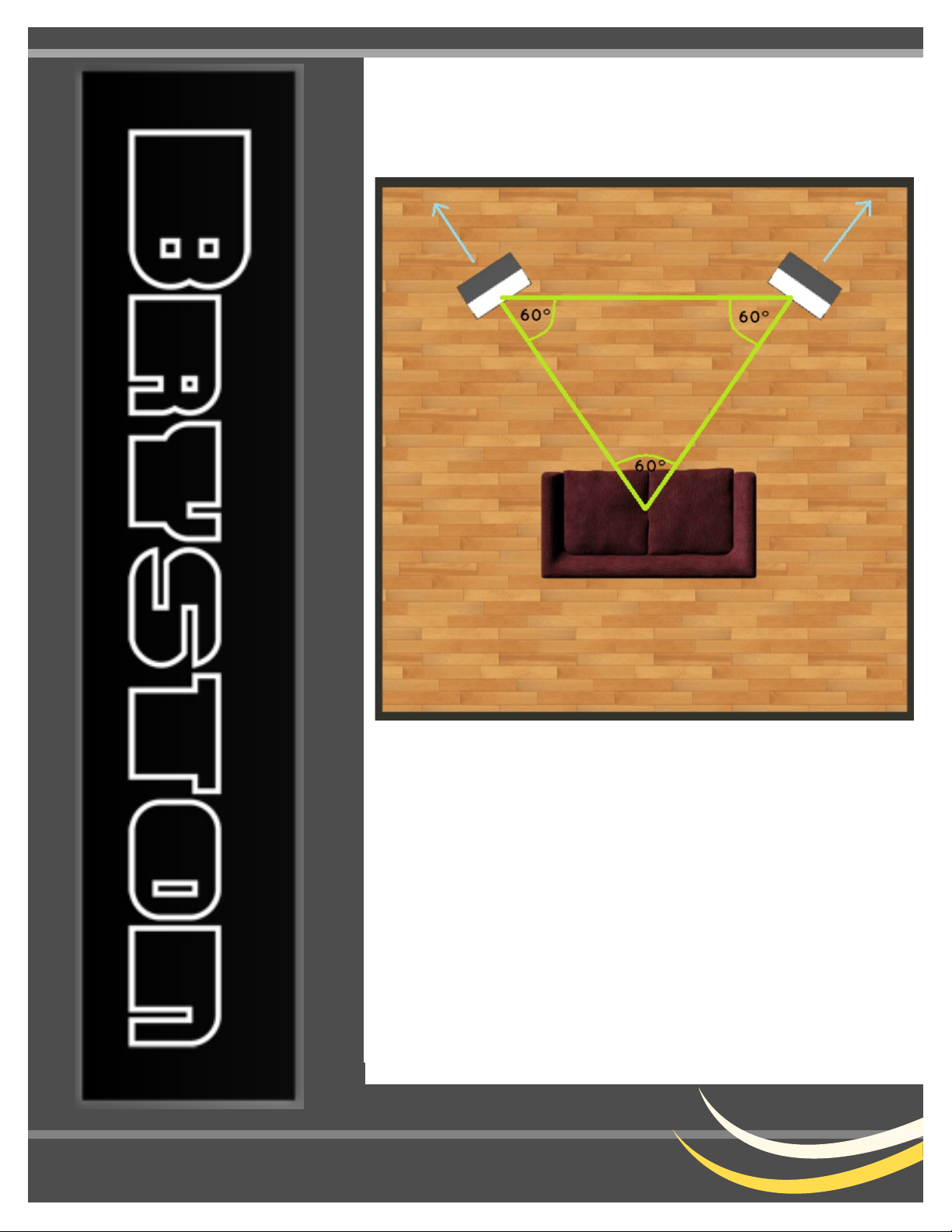
Ideally you should try and set up your system in a triangle—so
you are sitting the same distance from the speakers that they
are apart.
You can experiment with slightly angling the speakers in toward the listening area or having them face straight out into
the room. Each room is different, and toeing in the speakers
toward your seating may improve the stereo soundstage.
If you are using our speakers as your main speakers in a
home theater, place them to each side of the video display or
screen equidistant from the screen so the stereo sound will
be integrated with the TV image. Keep your speakers out of
corner locations by 1 foot or more, as corners may result in
exaggerated “boomy” bass and colored sound. Leave at least
2 or 3 inches between the rear of the speakers and the wall
behind for “breathing” room for the bass ports.
PAGE 3
Page 4
MUSIC WITH EMOTION
CONNECTING YOUR BUSINESS TO THE TECHNOLOGY RESOURCES
YOU NEED
Note, too, that the closer you place tower speakers to any ad-
jacent walls, including the wall behind the speakers, the
greater the deep bass output will be. The farther out you move
them from nearby wall surfaces, the less bass you’ll hear. Ex-
periment with the placement so bass is smooth and deep, free
from “boomy” bass effects.
QUICK-START SPEAKER SETUP
Bryston speakers arrive pre-assembled with large nonmarring adjustable feet. Optionally you may install the included spike feet by removing the large feet using the provided
Allen wrench. Install the spike feet and tighten securely in the
inserts provided at the bottom of the speaker. Speaker leveling, the height of both types of feet can be adjusted by turning
the foot up or down on the thread.
The Bryston tower speakers come with ‘OUTRIGGERS’ which
can replace the feet if desired. We recommend the outriggers
for greater structural rigidly and decoupling.
Turn the speakers around and look at the back panel. You’ll
see 3 sets of (LINKED) gold-plated 5-way binding posts, to
which you are going to connect the speaker cables from your
receiver or amplifier. Each gold binding post has a colored
ring around it -- BLACK is NEGATIVE. Most receiver and amplifier manufacturers use this color code and you should use
it as well - it makes things a lot easier to hook up your speaker
cables. You will also see a positive (+) sign engraved in the
plastic beneath one of the other coloured binding post, and a
negative (-) sign beneath the BLACK post. Your amplifier may
or may not have these positive and negative symbols. If you
wish, you can use these symbols along with the color coding
to guide you.
PAGE 4
Page 5

MUSIC WITH EMOTION
CONNECTING YOUR BUSINESS TO THE TECHNOLOGY RESOURCES
The Cables
Examine your speaker cables. On the ends, there may be
spade lugs or banana plugs, each one color-coded red or
black like your speaker binding posts to help you identify the
red and black (positive and negative) wires on each end of the
cable. If the cable ends are bare wires and lack color coding,
check the wires: one may be copper-colored, the other silver.
Some generic cables may simply have a colored thread or a
ribbed pattern on the plastic insulation to indicate the positive
wire. Alternatively, some speaker cables may have writing on
one side or the other (perhaps the brand name, for example)
or even a positive sign or negative sign on each of the conductors. Whichever you have, just follow the Red-To-Red,
Black-to-Black connection rule or use the + to + or - to - con-
nection scheme for each cable pair.
THE RECIEVER OR AMPLIFIER
Look at the speaker connectors on the rear panel of your receiver or amplifier. These will usually be red and black binding posts, like those on your speakers, or red and black
spring-loaded push connectors. The Red (+) terminal on your
receiver’s Right speaker output connects to the Red (+) bind-
ing post of the Right speaker. The Black (-) terminal on your
receiver output connects to the Black (-) binding post on the
Right speaker. Follow the same pattern to connect the receiv-
er’s Left speaker outputs to the Left speaker’s binding posts,
then the left surround (the speaker to your left from your listening seat), and right surround speakers, the center-channel
speaker, and additional rear speakers required by 7.1channel systems. If your A/V receiver or amplifier has the new
Consumer Electronics Association color coding for each
speaker channel, the negative terminal (-) will always be
black, however, the positive terminal (+) will have a different
color corresponding to each channel of the surround system.
If you find this color coding confusing, note the positive (+)
and negative (-) polarity for each speaker and the speaker cable.
BIWIRING OR TRIWIRING - PASSIVE VERSIONS
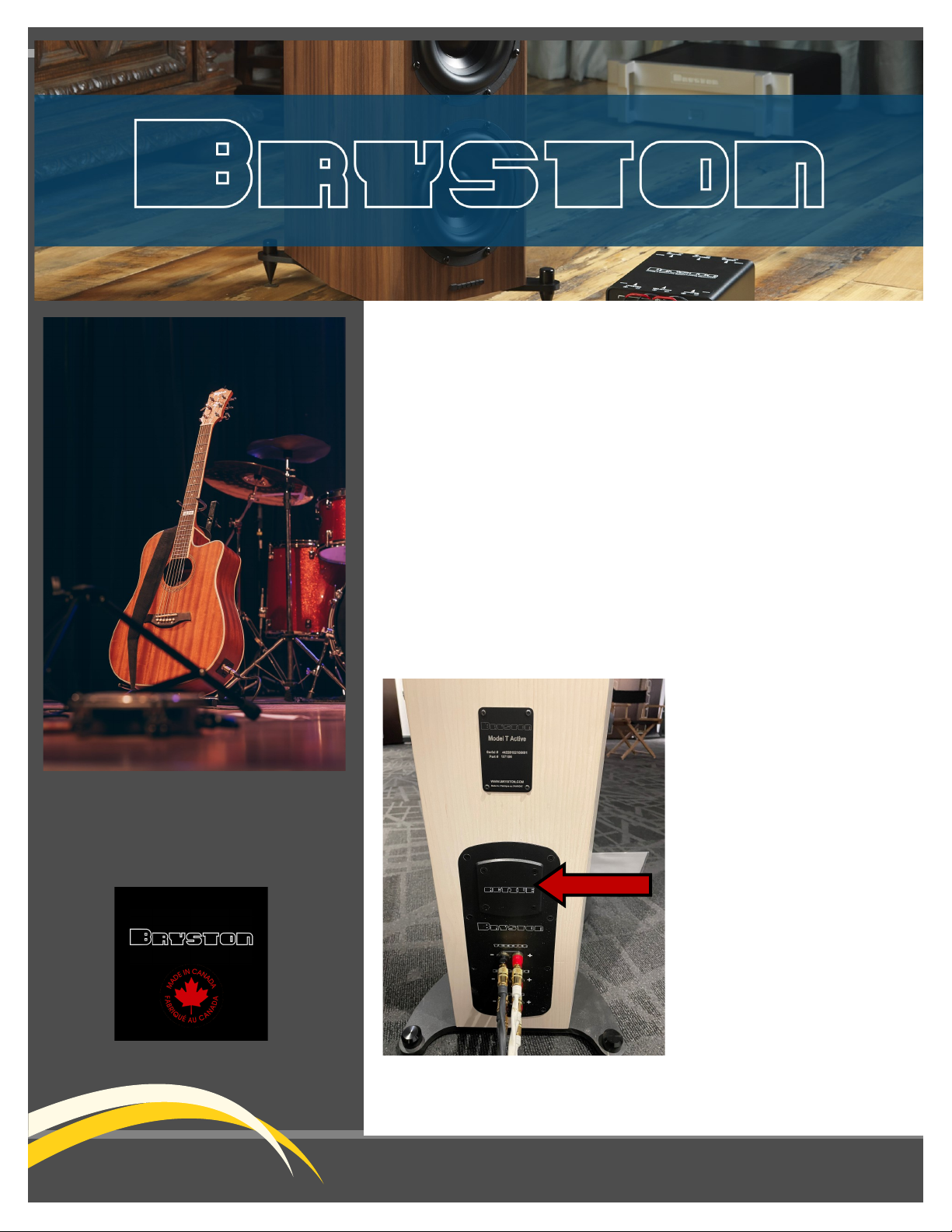
Remove the rear panel module linking the Two or Three pairs
of binding posts for the separate woofer and midrange and
tweeter sections of the crossover for each speaker. Connect
Two or Three speaker cables (depending on the module chosen) one cable to the tweeter pair of binding posts and one
cable to the midrange pair and one pair to the woofer - for
each speaker (two twin cables for bi-wiring and 3 twin cables
for tri-wiring per speaker).
PAGE 5
Page 6
GENERAL SPECIFICATIONS
At your receiver or amplifier, connect the two cables to one
pair of red and black output terminals for the left channel, and
two or three speaker cables to the other pair(s) of output ter-
minals for the right channel. Always maintain the (+ to +) and
black-to black (- to -) connection scheme for each channel’s
speaker connections.
BI-AMPING: To power your speaker with two amplifiers, remove and replace the rear panel module linking the two pairs
of binding posts for the separate woofer and midrange/
tweeter sections of the crossover for each speaker. Connect
one stereo amp to the lower set of binding posts on each
speaker (the woofers), and the second stereo amp to the upper pair of binding posts (the mid range/tweeters) on each.
Adjust the level (gain) of each amp for equal output,
TRI-AMPING: To power your speaker with three amplifiers,
remove and replace the rear panel module linking the pairs of
binding posts for the separate woofer and midrange and tweeter sections of the crossover for
each speaker. Connect
one stereo amp to the
lower set of binding posts
on each speaker (the
woofers), and the second
stereo amp to the midrange pair of binding
posts and one set to the
tweeter pair on each.
MUSIC WITH EMOTION
PAGE 6
This removable module
comes in 4 versions:
1. Single amplifier
2. Bi-wire version
3. Tri-wire version
4. Active (Pg. 9)
Page 7
MUSIC WITH EMOTION
CONNECTING YOUR BUSINESS TO THE TECHNOLOGY RESOURCES
YOU NEED
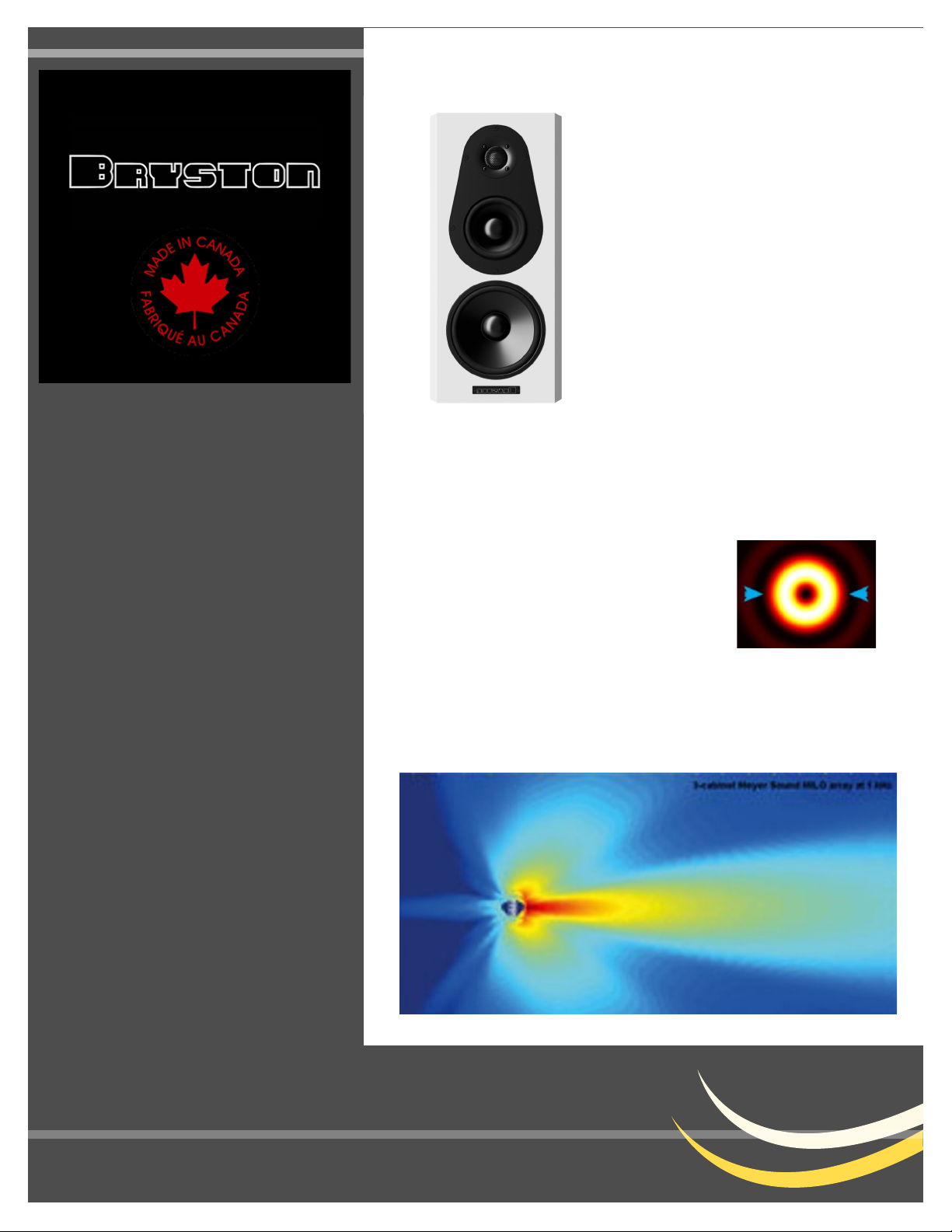
In physics, a point source
is an energy source with
negligible dimensions – a
tiny, singular point in
space where the energy
emanates.
In physics terms, a true
point source speaker
would be impossible as it
would be infinitely small
with the ability to produce
frequencies from 20Hz to
20kHz equally in all directions.
Most speakers approximate this performance by using single drivers or coax drivers or in most cases 2
or 3-way drivers clustered together as close as
physically possible.
A true point source speakers,
sound expands away from the
speaker as an ever-enlarging
sphere.
Unlike the line array system or a line source or a dipole or bi-pole, a point source speaker radiates
sound in a spherical pattern.
BRYSTON MODEL T
10
POINT SOURCE SPEAKER
PAGE 7
Bryston T10 Point Source Speakers
• The Point Source T-10 speakers
consist of the Tiny T10, The Compact T10 and the Mini T10
• All crossovers utilize high power
air core inductors everywhere.
• Manufactured and finished as 3
separate cabinets.
• All models easily changeable by
the user to Passive or Active.
• Tri-Wire or Bi-Wire available on
all models.
• Aluminum front baffle diffraction
plates.
• More substantial Outriggers now
included in price with Towers.
• Shipping including and towers
must ship on skid.
• Specialized packing due to
height (towers).
Page 8
MUSIC WITH EMOTION
CONNECTING YOUR BUSINESS TO THE TECHNOLOGY RESOURCES
YOU NEED
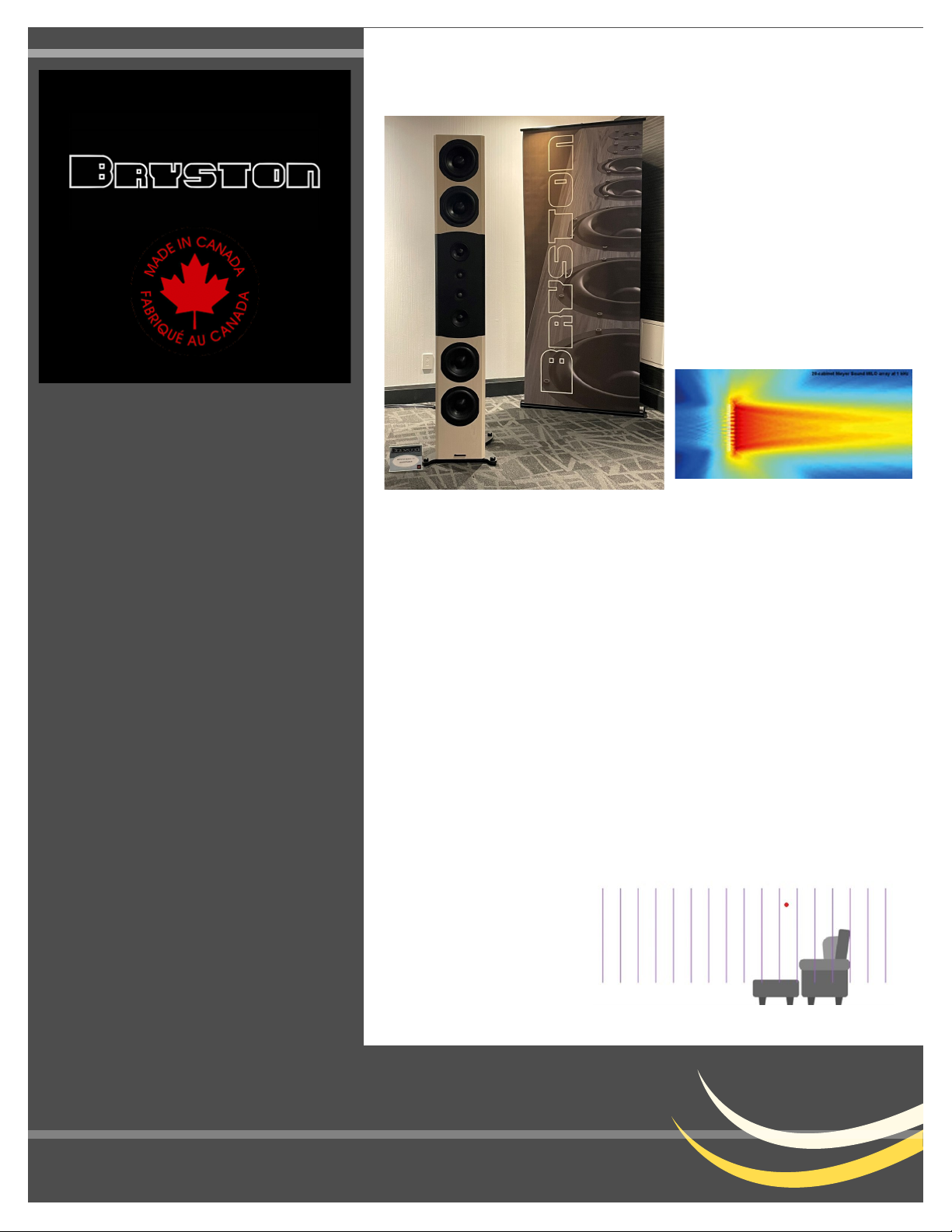
Bryston tower speakers are partial Line Arrays and different
from point source
speakers in the way
they radiate energy
into the room.
The sound radiates
outward in an expanding cylinder, as though
BRYSTON MODEL T
10
LINE ARRAY SPEAKER
PAGE 8
Bryston T10 Line Array Speakers
• T
10
Series consist ot the Model
T10, The Middle T10 and the Slim
T10
• All crossovers utilize high power
air core inductors everywhere.
• Manufactured and finished as 3
separate cabinets.
• All models easily changeable by
the user to Passive or Active.
• Tri-Wire or Bi-Wire available on
all models.
• Aluminum front baffle diffraction
plates.
• More substantial Outriggers now
included in price with Towers.
• Shipping included and Towers
must ship on skid.
• Specialized packing due to
height of the Towers.
There are some significate advantages to this type of sound
propagation:
• More uniform SPL throughout the listening space
• Arrays effectively reduce floor and ceiling reflections
• The perceived volume is quite uniform throughout the
listening area.
• Having the woofers pressurizing the room a four different
locations also assist in reducing the huge dips and peeks in
the frequency response all to common in most listening
rooms.
• Allows you to hear more of the speaker in your room
• Superior Intelligibility
• A better Sense of
Realism
Page 9
MUSIC WITH EMOTION
The Bryston BAX-1 Digital Electronic Crossover is really a very specialized and unique crossover. Unless designed as a dedicated
crossover all active crossovers I am aware of just provide the customer with a 'generic' approach to adjustments. By that I mean you
can choose the slope and the crossover point and sometimes the Q
but they do not take into account the SOUND POWER or total radiated energy of the speaker (which is what you hear in a room)
The Bryston BAX-1 on the other hand is designed with a specific
Bryston speaker in mind. The Active Model T has different software
then the Middle T and the Mini T has different software again.
The reason for that is we put each version of the Model T's in our
factory anechoic camber and we make over 300 measurements but
vertically and horizontally around the speaker and adjust the soft-
ware to provide as accurate as possible the best SOUND POWER
for the specific Model T speaker.
Additionally, Most fully active systems restrict your choice of preamplifier and amplifiers by building in internal chip type amplifiers and
preamplifiers which save space but can limit performance.
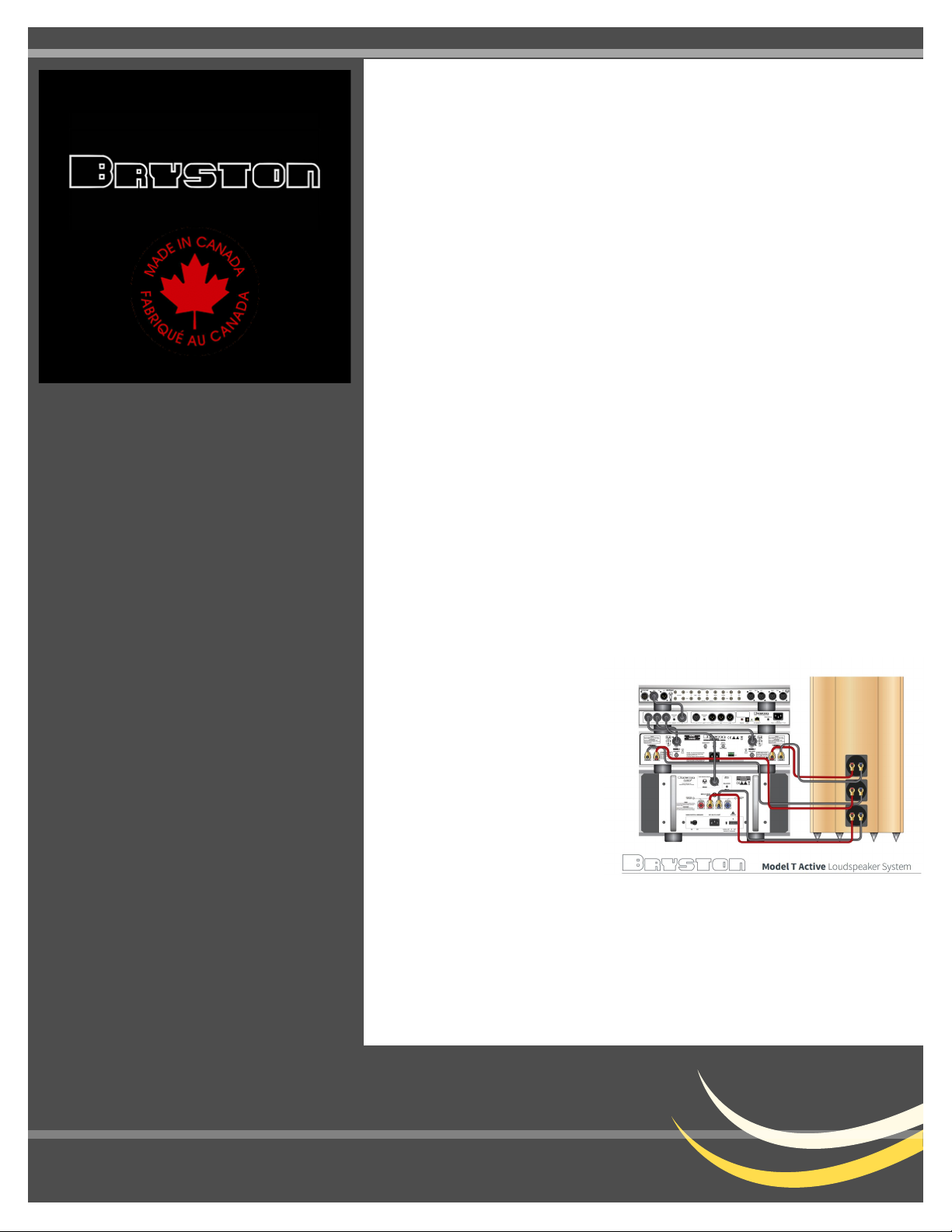
Bryston’s system includes a high resolution external digital crosso-
ver model BAX-1 that accepts input from your favorite stereo analog
preamplifier and outputs analog signal to your choice of amplifiers.
The BAX-1 makes it easy to choose the amplifiers that work best for
your listening preferences. Each loudspeaker needs 3 (preferably
Bryston) amplifier channels with equal gain.
Most listeners will choose
a high powered mono
amp for the bass section
and a medium powered
two channel amp for the
midrange and tweeter
sections. The BAX-1 high
quality DSP crossover
improves performance by
directly powering drivers
without intermediate passive components in the crossover. Also, much finer adjustments can
be made to compensate for response non-linearities. Because we
are no longer confined to traditional crossover geometry, we can
tailor the on and off axis response independently for incredibly natural tone and spatial resolution.
TYPICAL BRYSTON ACTIVE SYSTEM SETUP
PAGE 9
ACTIVE FEATURES INCLUDE:
• XLR analog input from your line-
level preamp.
• 3 pairs (low, mid, high) of XLR
analog out to feed your choice of
amplifier complement
• 96/24 analog to digital to analog
conversion
• Factory programmed crossover
settings
• Controllable via web-based user
interface
• 6 channels of amplification re-
quired (3 channels per loudspeaker)
• Firmware upgradeable
• Bass EQ
Page 10
MUSIC WITH EMOTION
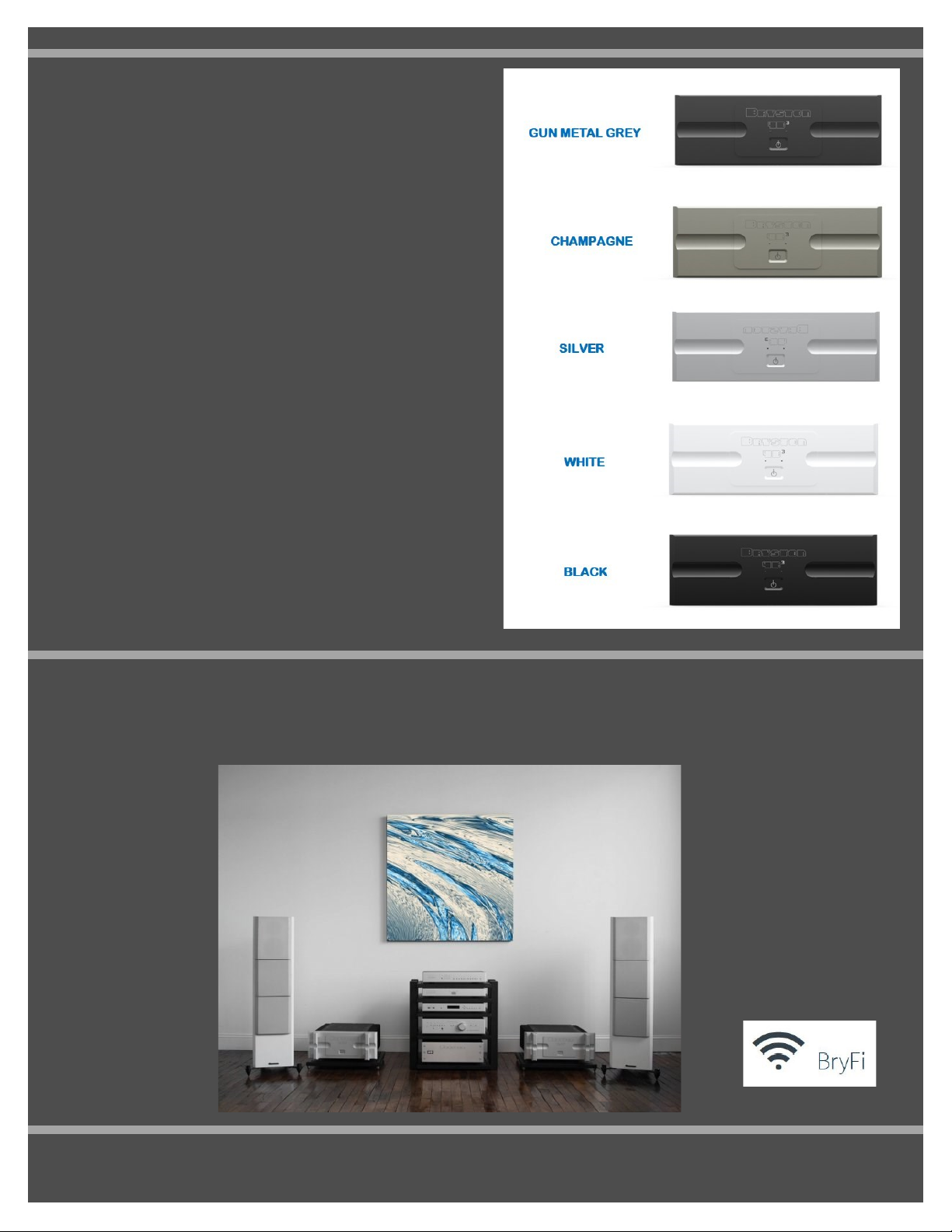
Personalized Faceplates
Bryston is pleased to introduce the availability of personalized faceplate colors, available
now for Bryston amplifiers, preamplifiers, CD
players, digital players, phono stages and
DAC’s.
Our new color choices, plus the option to
create custom colors, enable Bryston electronics to blend seamlessly or contrast ele-
gantly within any décor or equipment rack.
Enjoy bespoke color choices as an added
touch to any entertainment space.
ADDITIONAL CUSTOM COLOURS
AVAILABLE UPON REQUEST
Source buttons only available in Black or Silver
You can even order your Bryston speakers in a matching color to your
electronics if desired.
PAGE 10
Page 11
MUSIC WITH EMOTION
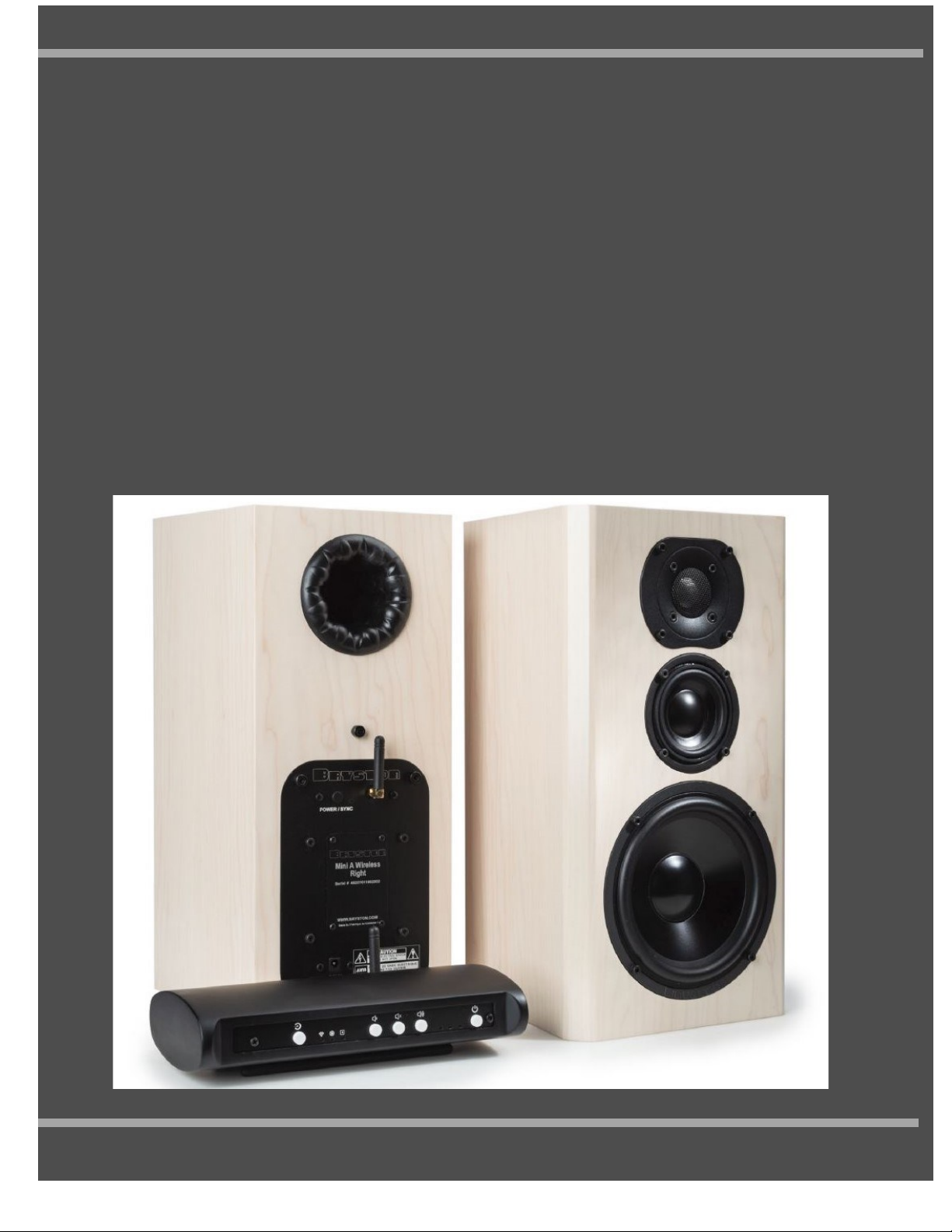
Our Bryston Wireless loudspeakers are based on Bryston’s passive speakers using the high quality
internal passive crossovers and drivers but the Wireless speaker series models incorporate an internal state of the art amplifier in each speaker.
All Wireless models ship with a Wireless ‘four-in-one transmitter’ that permits streaming over Wi-Fi
via Apple AirPlay or UPnP.
On the rear of the transmitter are a line-level analog input, digital optical in, four USB ports for connecting external storage devices, and an Ethernet port.
It also incorporates a Pi Linux-based computer, which makes possible network playback from NAS
drives and supported streaming services, under control of a Web-based interface that can run on
iOS and Android devices.
BRYSTON WIRELESS LOUDSPEAKERS
PAGE 11
Page 12

Bryston Ltd
677 Neal Dr
Peterborough On
Canada
www.bryston.com
MUSIC WITH EMOTION
 Loading...