

Bradford White D-80T-180-3N, D-100S-250-3NA, D-100T-250-3NA, D-38T-155-3N+, D-100S-199-3N Installation Manual
...Page 1
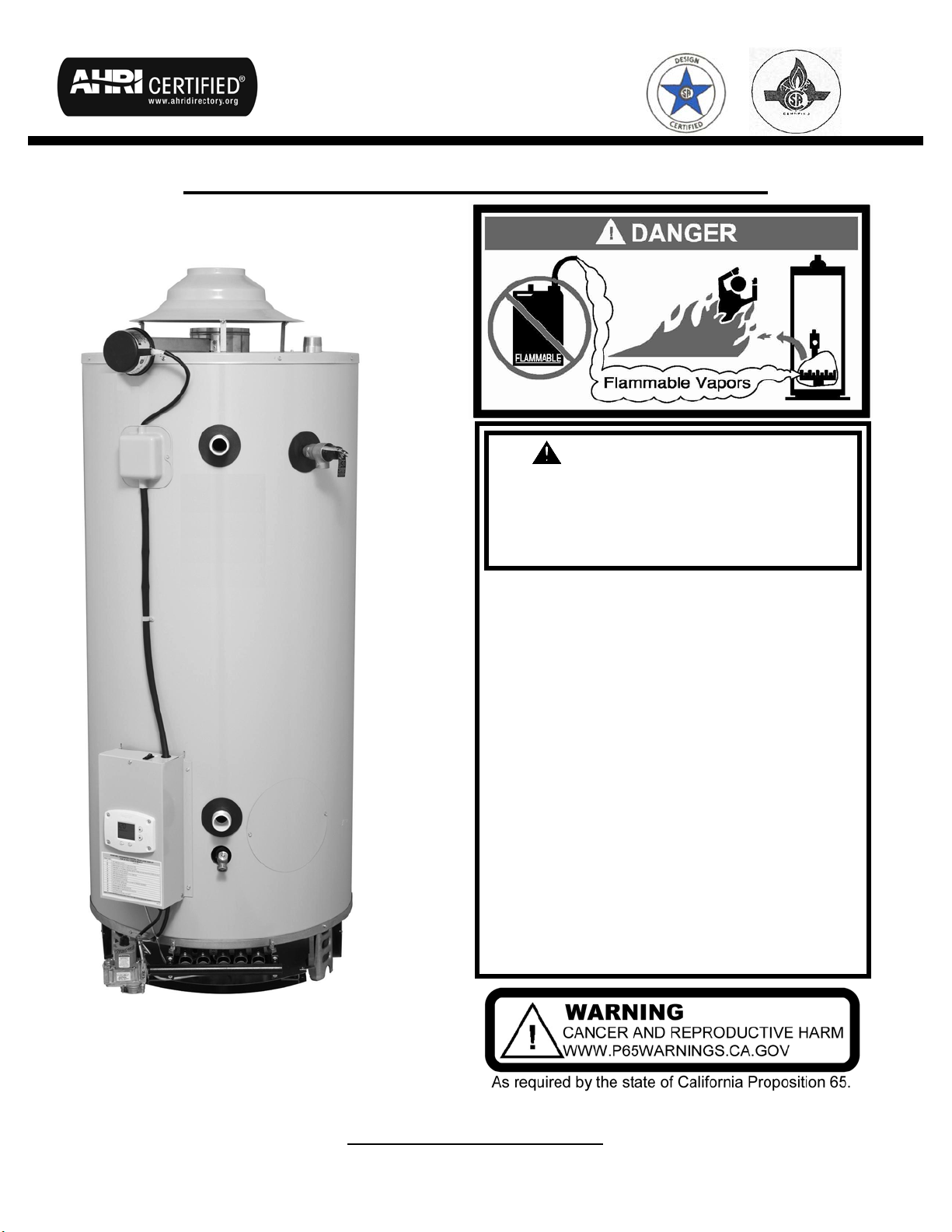
a plumbing prof essional.
personal injury or death.
GAS-FIRED COMMERCIAL WATER HEATER
- Do not st ore or use gasoline or ot her
- WHA T T O DO IF Y OU SMELL GAS
- For your family ’s com f ort, saf et y and
W A RNI N G: I f the informa t ion in
t hese inst r uct ions is not followed
exact ly, a f ire or explosion may
result ca using propert y dam age,
f lammable vapors and liquids in t he
vic inity of t his or any ot her appliance.
• Do not t r y to light any appliance.
• Do not t ouc h any elect ric al switch; do
not use any phone in your building.
• Immediately call y our gas supplier
f rom a neighbor’ s phone. Follow the
gas supplier’ s instructions.
• If y ou cannot reach your gas supplier,
cal l th e fi r e d epar tmen t.
conv enience, it is recomm ended this
water h eater b e i ns tal l ed and ser vi c ed b y
INSTALLATION/OPERATION MANUAL
PLACE THESE INSTRUCTIONS ADJACENT TO WATER HEATER AND NOTIFY OWNER TO KEEP FOR FUTURE REFERENCE
WITH TROUBLESHOOTING GUIDE
238-47675-00F 8/18
Page 2
SECTION I: IM P O RTANT INFORMATION
Thi s water h eater h as a l im i t ed warr anty. The warr an t y for thi s water h eater i s v al id o nl y if th e water h eater
any damage, injury, or loss of lif e resulting f rom alteration and/or f ailure to com ply wit h these instruct ions.
IMPORTANT-Before proceeding, please inspect the water heater and components for possible damage. DO NOT
purchased or the manufacturer listed on the rating plate for replacement parts.
NOTICE
I
IMPORTANT INFORMATION..........................2
VIII
ELECTRICAL CONNECTIONS.....................21
II
SPECIFICATIONS............................................5
IX
OPERATING INSTRUCTIONS......................23
III
GENERAL INFORMATION..............................8
X
MAINTENANCE.............................................32
DIAGNOSTIC AND TROUBLESHOOTING
GUIDE............................................................34
V
VENTING........................................................15
XII
PARTS LIST...................................................54
INSTALLATION FOR POTABLE
WATER AND SPACE HEATING...................55
VII
GAS CONNECTIONS....................................19
XIV
NOTES………………………………………….56
TA BLE OF CONTENTS
This gas-fired water heater is design certified by CSA International under the American National Standard,
READ CAREF ULLY
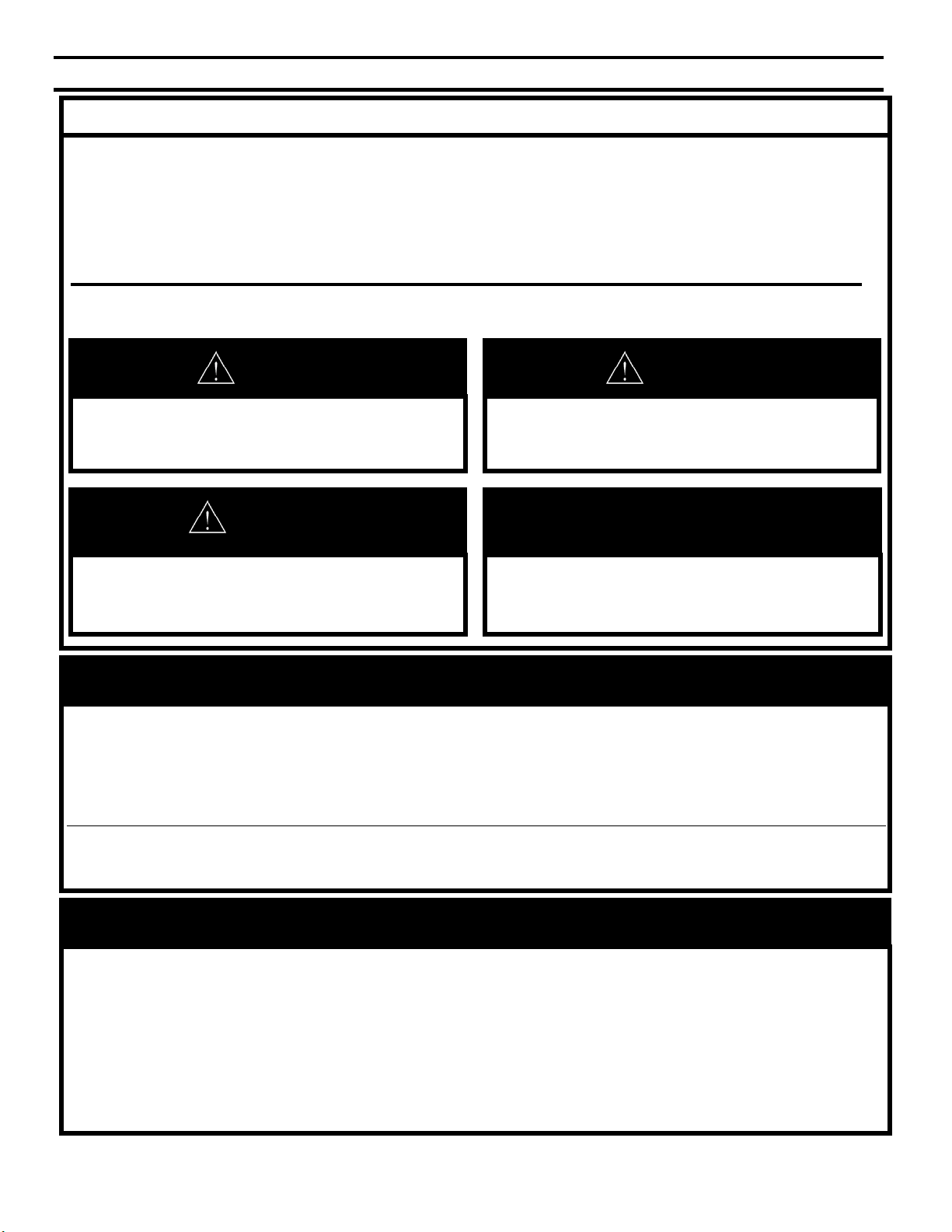
Indicates special instruc t ions on installation,
Indicates a pot entially hazardous sit uation, which,
WARNING
Indicates potent ially hazardous situat ion, which, if
injury or property damage.
CAUTION
Indicat es an imminent ly hazardous sit uation,
injury or substant ial property damage.
DANGER
Z21.10.3 and CAN/CGA 4.3-M (as indicated on the rating plate). These st andards are available from CSA
Standards Association, 5060 Spectrum Way Mississauga, Ontario L4W 5N6 CANADA.
This w ater heater must be installed in accordance w ith loc al codes. In the absence of local codes, it must be
installed in compliance w it h t he National Fuel Gas Code (ANSI Z223 . 1-Latest Edition), or in Canada CAN/CGA
B149.1 Natural Gas Installation Code (Latest Edition) or CAN/CGA B14 9.2 Propane Instal lat ion Co de (Lat est
Edition).
The follow ing terms are used throughout t his manual to bring at t ention t o the presence of hazards at various
risk levels, or t o import ant inf ormat ion concerning product lif e.
w hic h, if not avoided, will result in death, serious
not avoided, may result in moderate or minor
NOTICE
if not avoided, could result in death, serious injury
or substantial property damage.
has been installed, maintained and operated in accordance w it h these instructions. The warranty does not
cover damage or injury caused by t he use of any energy-saving devices (other than t hose aut horized by t he
manufact urer) in conjunct ion wit h t his wat er heater. The use of unaut horized energy-sav i ng d ev ic es m ay
dec reas e t h e l ife o f t he water heater and endanger life and/or property. The manufact urer will not be liable for
install damaged components. If damage is evident, please contact the supplier where the water heater was
operation or m aintenance, w hic h are import ant
but not related to personal injury hazards.
IV INSTALLATION INSTRUCTIONS..................10 XI
VI WATER CONNECTIONS……………………..17 XIII
2
Page 3
DANGER
DO NOT store or use gas oline or other f lammable, combustible, or corrosive vapors and/or liquids in the vicinity of this
or any other appliance.
This water heater is equipped with an adjustable thermostat to control water temperature. Hot water temperatures
The slower
or to draw their own bath water. NEVER leave a child or disabled person unattended in a bathtub or shower.
Toxic chemic al, such as those used for boiler treatment, must not be introduced into potable water used for spac e
heating.
This water heater must not be connected to an existing heating system or c omponent(s) pr eviously used with a nonpotable water heating appliance.
All piping components connected to this water heater for space heating applications must be suitable for use with
WARNING
Improper installation, adjustments, alteration, service or maintenance can cause property damage, personal injury or
reference by owner and service technician.
This water heater requires regular maintenance and service to operate safely. Follow the instructions contained in this
manual.
Installation, maintenance, and service must be performed only by a qualified, skilled and knowledgeable installer or
service provider.
Installation is not complete unless a temperature and pressure relief valve is installed into the proper location at the
top of this water heater.
It is the responsibility of the installing contractor to see that all controls are correctly installed and are properly
operating when the installation is complete.
DO NOT operate this water heater without first being certain it is filled with water.
DO NOT tamper with or alter the water heater and/or controls.
DO NOT operate water heater with jumpered or absent controls or safety devices.
DO NOT operate water heater if any external part has been under water. Immediately call a qualified service
been under water.
DO NOT attempt to use this water heater with any gas other than the type listed on the rating plate. Do not attempt to
gas company if there are any questions.
For installations in high altitude regions, this water heater must be ordered from the supplier to the manufacturer’s
constructed water heaters.
Incorrect operation of this appliance may create a hazard to life and property and will nullify the warranty.
DO NOT operate this water heater if the input rate exceeds the rate shown on the water heater rating plate.
This water heater contains very hot water under high pressure. Do not unscrew any pi pe fittings nor attempt to
unless they are cool.
This water heater must be properly vented and connected to an approved vent system in good condition. DO NOT
required for automatic dishwasher and laundry use can cause scald burns resulting in serious personal injury and/or
death. The temperature at which injury occurs varies with the person’s age and the time of exposure.
response time of disabled pers ons incr eases the hazards to them . NEVER allow small children to use a hot water tap,
potable water.
loss of life. Failure to follow all instructions in the proper order can cause personal injury or death. Read and
understand all instructions, including all those provided with the appliance before installing, starting-up, operating,
maintaining or servicing this appliance. Keep this manual and literature in legible condition with this water heater for
technician to inspect the appliance and to replace any part of the control system including gas controls, which has
convert this water heater for use with a gas other than the type for which it is equipped. Failure to use the proper gas
can create an unsafe condition resulting in property damage, bodily injury, or death. Consult your local gas supplier or
specifications for that particular altitude. Contact the company listed on the rating plate when ordering high altitude
disconnect any components of this water heater without positively assuring the water is cool and is not under pressure.
Always wear protective clothing and equipment when installing, starting up or servicing this water heater to prevent
scald injuries. Do not rely on the temperature gauges to determine the temperature. Do not touch any components
operate water heater with the absence of an approved vent system. A clean and unobstructed vent system is
necessary to allow noxious fumes that could cause injury or loss of life to vent safely and will contribute toward
maintaining the water heater’s efficiency.
3
Page 4
WARNING
This water heater needs fresh air for safe operation and must be installed so there are provisions for adequate
burners, and flue tubes and creates a risk of asphyxiation.
Water heater materials of construction, products of combustion and the fuel contain carbon monoxide, nitrogen oxides,
respirators and equipment when servicing or working nearby this water heater.
Flammable items, pressurized containers or any other potential fire hazardous articles must never be placed on or
with this water heater.
Insulation blankets are not required for this water heater. This water heater meet s or exceeds the ASHRAE/IES 90.1b
(latest edition) standards with respect to insulation and standby loss requirements.
Set t ing t he w at er t emperature t o t he maximum set point c an result in scalding hot water deliv er ed to th e
r a long
faucet at the time it is open.
Liquefied petroleum gases/propane gas is heavier than air and will remain at floor level if there is a leak.
D O NO T O PERATE THE APPL I AN CE U NTI L T HE LEAK A G E IS C O R REC TED !
WARNING
Prior to connecting the gas supply line to a gas fired water heater, ensure that the gas supply line does not have
WARNING
combustion and ventilation air. Insufficient air supply will cause a recirculation of combustion products resulting in
contamination that may be hazardous to life. This will result in carboning or sooting of the combustion chamber,
aldehydes and/or other toxic or harmful substanc es which can cause death or serious injur y and which are known to
the state of California to cause canc er, birth defects and other reproductive harm . Always use proper safety clothing,
adjacent to the water heater. Open containers of flamm able material should not be stored or us ed in the same room
faucets. It is highly recommended that t he maximum setpoint be adjusted t o t he lowest t emperature possible
f or t he needs of t he installation. See f ollowing section in t his Inst allat ion/Operat ion Manual t o c hange the
maximum set point limit (max setpoint ). M ak e su re th e wat er heater c on tro l di sp lay i s no t i n a p ub l ic ar ea t h at
can result in t he t emperature sett ings being improperly adjusted.
Hydrogen gas can be produced in an operating water heater that has not had water drawn from the tank fo
period of time (generally two weeks or more) . Hydrogen gas is extremely flammable. To prevent the possibility of injury
under these conditions, we recomm end the hot water faucet to be open for several minutes at the kitchen sink before
you use any electrical appliance, which is connect to the hot water system. If hydrogen is present, there will be unusual
sounds such as air escaping through the pipes as hot water begins to f low. Do not smoke or have open flame near the
moisture/water or dirt/scale inside the gas line. Commonly this check is done at the lowest point in the gas
distribution system prior to gas burning appliances.
Do not use this appliance if any external part to the tank has been submerged in water. You should contact a qualified
service technician to inspect the appliance and to replace any part of the control system including the combination gas
control which has been submerged in water. See the Gas Connections section of this manual before servicing or replacing
a water heater that has had any external part to the tank submerged in water.
Basement s, craw l spaces, closets and areas below ground level w ill serve as pockets for accumulat ion of
leak in g gas. Before lighting, smell all around the appliance area for gas. Be sure to smell next to t he f loor.
I F Y O U S MELL GA S :
• DO NOT try to light any appliance.
• DO NOT touch any elect ric sw itch; do not use any t elephone in your building.
• Immediately call your gas supplier from a telephone in another building. Follow the gas supplier’s
instructions.
• If y ou cannot reach your gas supplier, call t he fire department.
To comply with NSF requirements this water heater is to be:
a) Sealed to the floor with sealant, in a smooth and easily cleanable way, or
b) Installed with an optional leg kit that includes legs and/or extensions that provide a minimum clearance of 6”
beneath the water heater.
4
Page 5
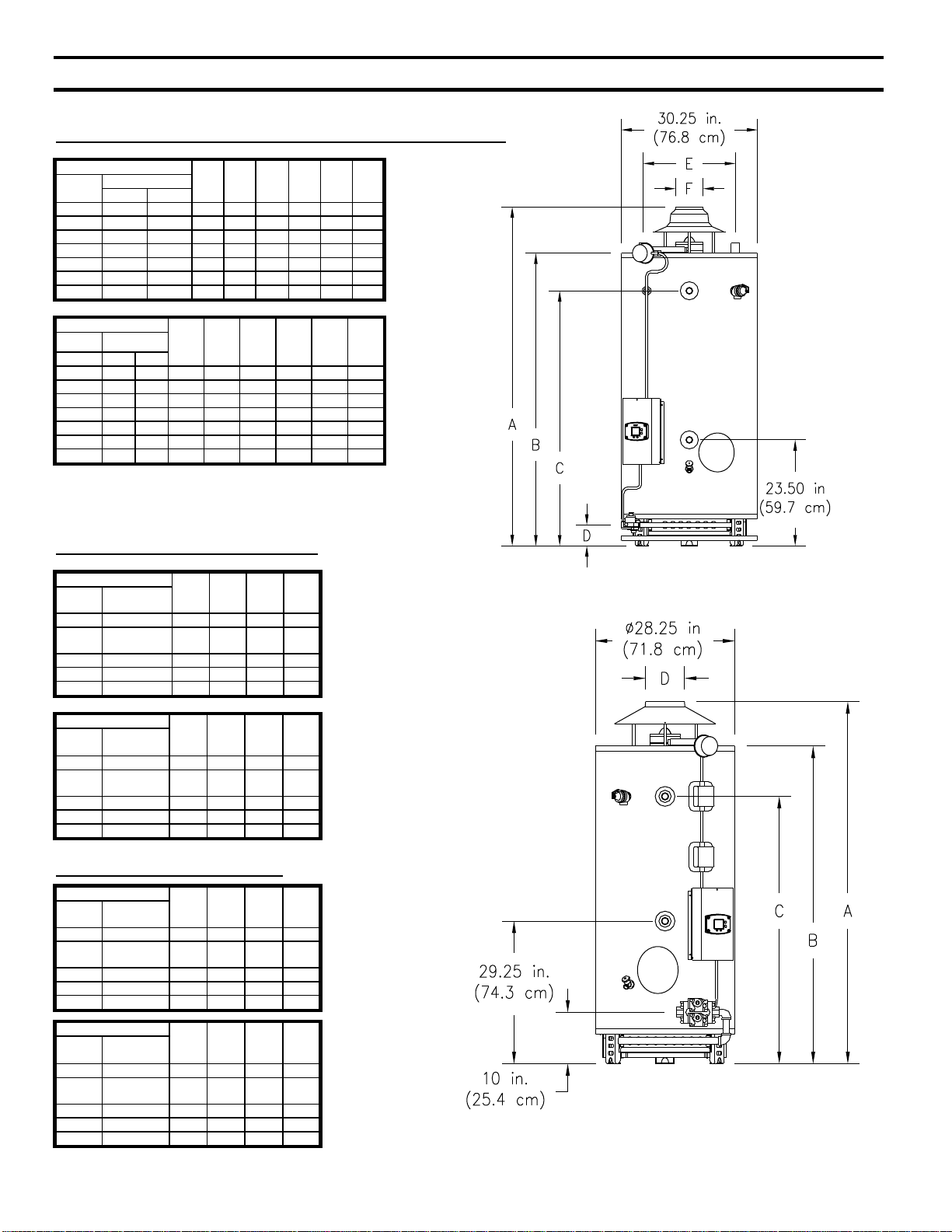
Model Description
Capacity
(GAL)
Input (BTU/hr)
Nat.
LP
100
199,999
199,999
75.00
64.75
56.50
4.63
23 6 100
250,000
250,000
75.00
64.75
56.50
4.63
23 6 100
270,000
N/A
75.00
64.75
56.50
4.63
23 6 100
300,000
300,000
75.44
64.75
56.50
4.63
23 7 80
399,999
375,000
71.50
60.25
51.50
10.25
N/A 8 80
450,000
425,000
69.00
60.25
51.50
10.25
N/A
10
80
505,000
475,000
69.00
60.25
51.50
10.25
N/A
10 Model Description
Input (kW/hr)
(Litres)
Nat.
LP
378.5
58.6
58.6
191
164
144
11.8
58.4
15.2
378.5
73.2
73.2
191
164
144
11.8
58.4
15.2
378.5
79.1
N/A
191
164
144
11.8
58.4
15.2
378.5
87.9
87.9
192
166
144
11.8
58.4
17.8
302.8
117.2
109.9
181
153
131
26.0
N/A
20.3
302.8
131.8
124.5
175
153
131
26.0
N/A
25.4
302.8
148.0
139.2
175
153
131
26.0
N/A
25.4
Model Description
Capacity
(GAL)
Input
(BTU/hr)
65
370,000
71.38
64.75
54.13
8
399,999
(NAT ONLY)
75
300,000
72.00
65.75
54.13
7
80
425,000
81.00
75.50
64.50
10
80
505,000
81.00
75.50
64.50
10 Model Description
Capacity
(Litres)
Input
(kW/hr)
246.1
108.4
181
164
137
20.3
117.2
(NAT ONLY)
283.9
87.9
183
167
137
17.8
302.8
124.5
206
192
164
25.4
302.8
148.0
206
192
164
25.4
Model Description
Capacity
(GAL)
Input
(BTU/hr)
65
370,000
73.25
64.75
54.50
8
399,999
(NAT ONLY)
75
300,000
75.88
65.75
54.13 7 80
425,000
82.75
75.50
64.50
10
80
505,000
82.75
75.50
64.50
10 Model Description
Capacity
(Litres)
Input
(kW/hr)
246.1
108.4
186
165
138
20.3
117.2
(NAT ONLY)
283.9
87.9
193
167
138
17.8
302.8
124.5
210
192
164
25.4
302.8
148.0
210
192
164
25.4
Figure 1
Figure 2
SECTION II: SPECIFICATIONS
Non-Flue Damper Models and Flue Damper Models (Figure 1)
A
(in) B (in) C (in) D (in) E (in) F (in)
F
E
D
C
B
Capacity
A
(cm)
(cm)
(cm)
(cm)
(cm)
(cm)
1. N/A - Denotes not available.
Non-Flue Damper Models (Figure 2)
A
(in.) B (in.) C (in.) D (in.)
65
246.1
71.38 64.75 54.13 8
A
(cm) B (cm) C (cm) D (cm)
181 164 137 20.3
Flue Damper Models (Figure 2)
A
(in.) B (in.) C (in.) D (in.)
65
246.1
73.25 64.75 54.50 8
A
(cm) B (cm) C (cm) D (cm)
186 165 138 20.3
5
Page 6
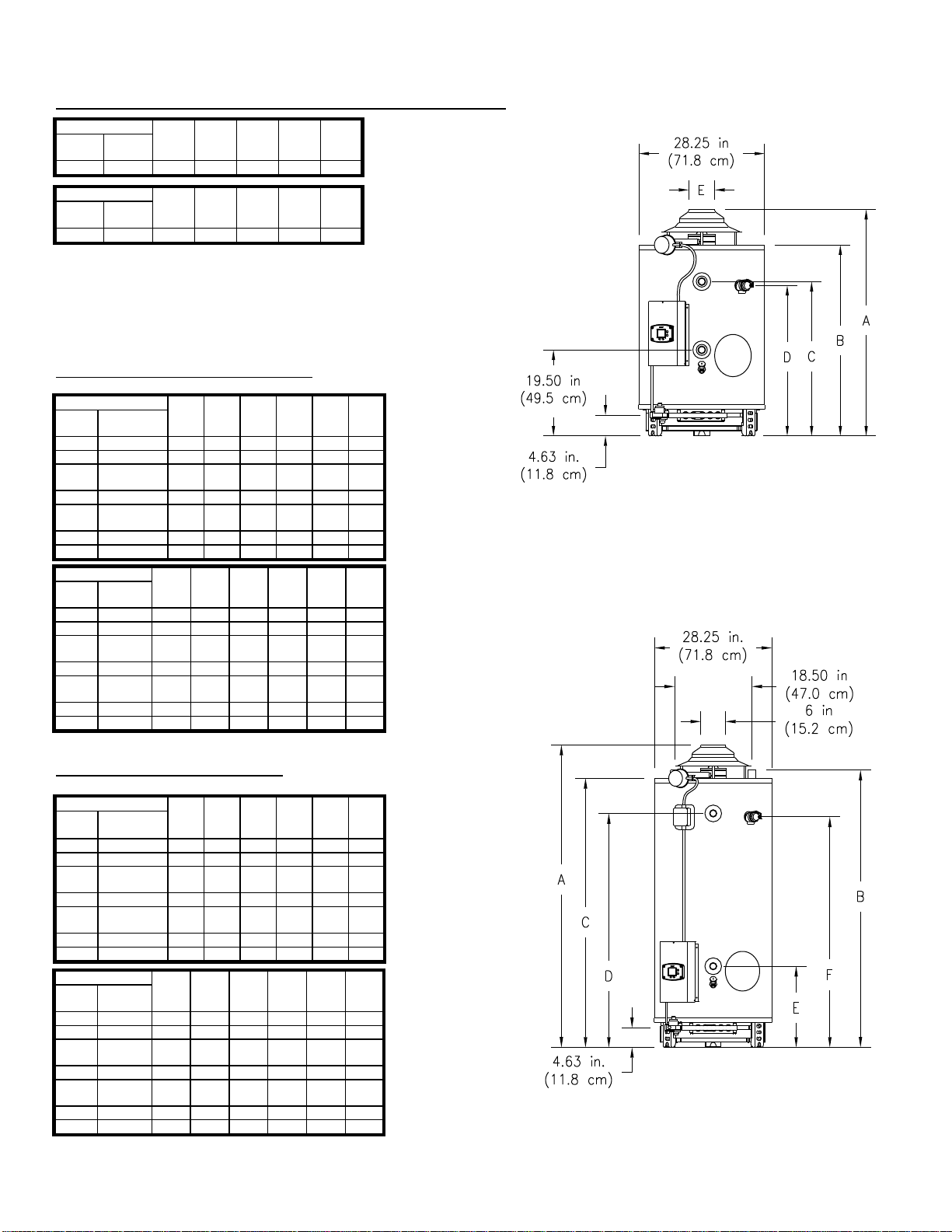
Model Description
E
Capacity
(GAL)
Input
(BTU/hr)
38
155,000
51.00
43.50
35.00
33.75
6 Model Description
Capacity
(Litres)
Input
(kW/hr)
143.9
45.4
130
110
89
86
15.2
Model Description
Cap.
(GAL)
Input
(BTU/hr)
80
180,000
70.13
66.25
64.50
56.00
19.50
55.13
80
199,999
70.13
66.25
64.50
56.00
19.50
55.13
250,000
(235,000 LP)
98
199,999
81.13
77.25
75.50
67.00
19.50
66.13
250,000
(235,000 LP)
100
199,999
75.50
69.88
61.88
60.38
20.75
56.88
100
250,000
75.50
69.88
61.88
60.38
20.75
56.88
Model Description
Cap.
(GAL)
Input
(BTU/HR)
80
180,000
71.88
66.25
64.50
56.00
19.50
55.13
80
199,999
71.88
66.25
64.50
56.00
19.50
55.13
250,000
(235,000 LP)
98
199,999
83.38
77.25
75.50
67.00
19.50
66.13
250,000
(235,000 LP)
100
199,999
76.75
70.00
67.88
60.38
20.75
56.88
100
250,000
76.75
70.00
67.88
60.38
20.75
56.88
Model Description
Cap.
(Liters)
Input
(kW/hr)
302.8
52.8
178
169
164
142
49.5
140
302.8
58.7
178
169
164
142
49.5
140
73.3
(68.9 LP)
371.0
58.7
206
196
192
170
49.5
168
73.3
(68.9 LP)
378.5
58.7
192
177
157
153
52.7
144
378.5
73.3
192
177
157
153
52.7
144
Model Description
Cap.
(Liters)
Input
(kW/hr)
302.8
52.8
183
169
164
142
49.5
1.40
302.8
58.7
183
169
164
142
49.5
1.40
73.3
(68.9 LP)
371.0
58.7
224
196
192
170
49.5
1.68
73.3
(68.9 LP)
378.5
58.7
192
177
157
153
52.7
1.44
378.5
73.3
192
177
157
153
52.7
1.44
Figure 3
Figure 4
Flue Damper Models and Non-Flue Damper Models (Figure 3)
A
(in.) B (in.) C (in.) D (in.)
A
(cm) B (cm) C (cm) D (cm) E (cm)
Non-Flue Da mper Models (Figure 4 )
A
(in.) B (in.) C (in.) D (in.) E (in.) F (in.)
(in.)
80
98
302.8
371.0
70.13 66.25 64.50 56.00 19.50 55.13
82.88 77.25 75.50 67.00 19.50 66.13
A
(cm) B (cm) C (cm) D (cm) E (cm) F (cm)
178 169 164 142 49.5 140
211 196 192 170 49.5 168
Flue Damper Models (Figure 4)
A
(in.) B (in.) C (in.) D (in.) E (in.) F (in.)
80
98
71.88 66.25 64.50 56.00 19.50 55.13
88.38 77.25 75.50 67.00 19.50 66.13
302.8
371.0
A
(cm) B (cm) C (cm) D (cm) E (cm) F (cm)
183 169 164 142 49.5 1.40
224 196 192 170 49.5 1.68
6
Page 7
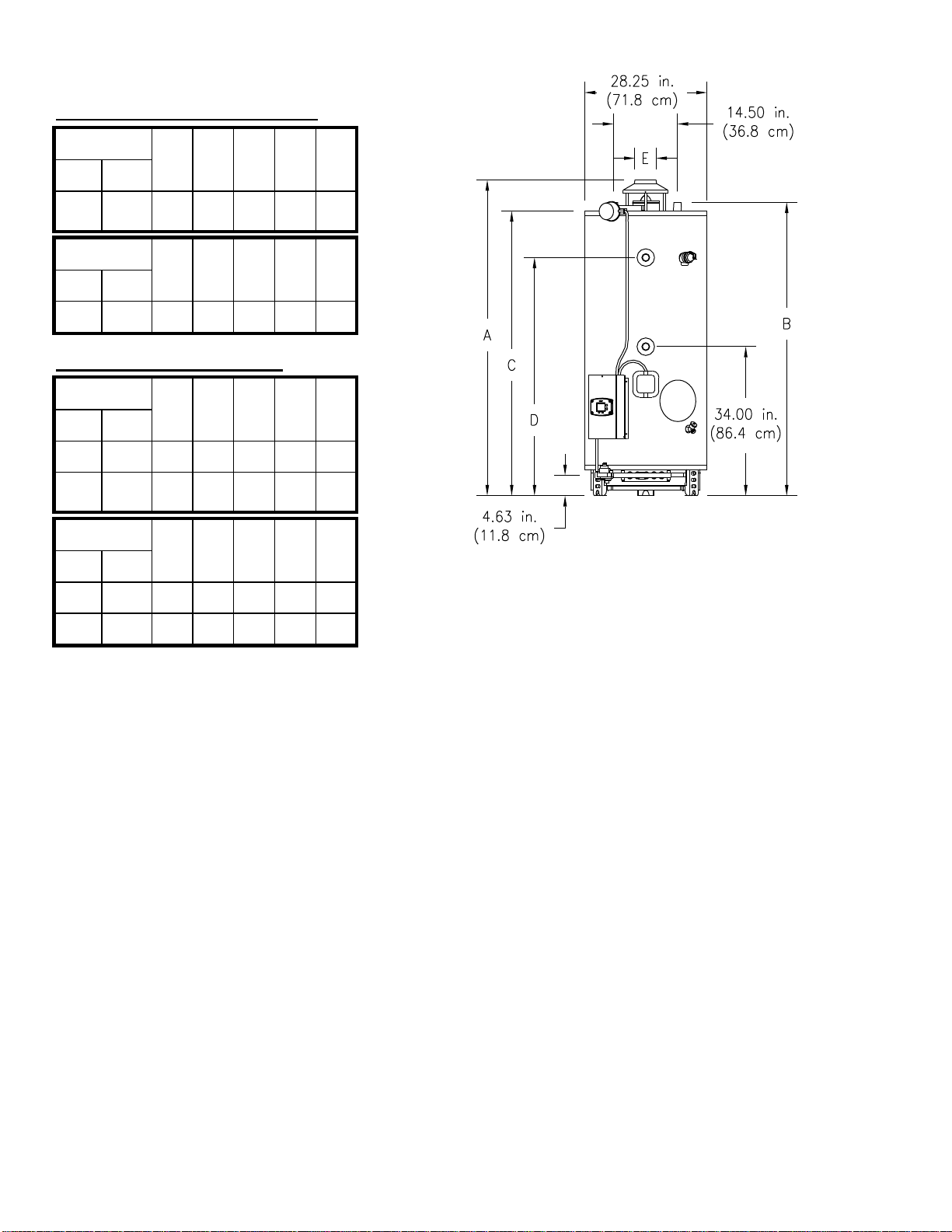
160,000
(155,000
LP)
46.9
160,000
(155,000
LP)
(Liters)
(kW/hr)
Figure 5
Non-Flue Damper Models (Figure 5)
Model Description
Capacity
(GAL)
Model Description
Capacity
(Liters)
283.9
Input
(BTU/hr)
75
Input
(kW/hr)
(45.4 LP)
A
(in.) B (in.) C (in.) D (in.) E (in.)
70.13 67.13 65.00 54.50 6
A
(cm) B (cm) C (cm) D (cm) E (cm)
178 171 165 138 15.2
Flue Damper Models (Figure 5)
Model Description
Capacity
(GAL)
Model Description
Capacity
283.9 36.6 183 171 165 138 12.7
283.9
Input
(BTU/hr)
75 125,000 72.25 67.13 65.00 54.50 5
75
Input
46.9
(45.4 LP)
A
(in.) B (in.) C (in.) D (in.) E (in.)
72.25 67.13 65.00 54.50 6
A
(cm) B (cm) C (cm) D (cm) E (cm)
184 171 165 138 15.2
The following notes apply to the tables accompanying Figures 1 - 5.
1. All models with flue dampers and/or above 400,000 BTU per hour input employ a “spark to pilot” (IID) ignition system
and requires 120 volt AC electric supply.
2. Model number may have a suffix “N” for natural gas or “X” for liquefied petroleum (LP) gases. Some models may have
“A” as a suffix for ASME. Check the rating plate on front of the water heater for model number verification.
7
Page 8

Keep clear of combination temperature and pressure relief valve discharge line outlet. The discharge may be
WARNING
SECTION III: GENERAL INFORMATION
FEATURES
1. Porcelain enamel lined tank provides corrosion protection with a tough glass lining on the interior of the tank.
2. Magnesium anodes provide an extra measure of protection and extends tank life.
3. Flue Damper on 24 volt ignition models reduces standby losses on the burner off cycle saving fuel.
4. Hand Hole Cleanout allows inspection of tank interior and allows the removal of lime and sediment deposits.
5. Honeywell Integrated Water Heater Control on 24 volt models having the following features:
• Attractive digital water heater display on control panel for precisely setting and displaying the temperature setpoint.
Pressing temperature up and down buttons changes the temperature setpoint. Temperature format may be
displayed in degrees F or degrees C.
• Single control board with plug in wiring controls temperature, ignition, and flue damper operation.
• Reduced number of parts for servicing and wiring.
• Plug in wiring reduces chance of miswiring.
• Water heater display will show diagnostic codes in the event the water heater needs servicing. Aids in diagnosing
and servicing the water heater. Temperature of the tank sensors can be monitored in the Service Mode.
• Water heater display can show up to 10 previous error codes to further aid in servicing the water heater.
hot enough to cause scald injury. The water is under pressure and may splash.
For protection against excessive temperatures and pressure, install temperature and pressure protective equipment
required by local codes, but not less than a combination temperature and pressure relief valve certified by a
nationally recognized testing laboratory that maintains periodic inspection of production of listed equipment or
materials as meeting the requirements of the Standard for Relief Valves and Automatic Gas Shutoff Devices for Hot
Water Supply Systems, ANS Z21.22 and the Standard CAN1-4.4 Temperature, Pressure, Temperature and
Pressure Relief Valves and Vacuum Relief Valves. The combination temperature and pressure relief valve must be
marked with a maximum set pressure not to exceed the maximum working pressure of the water heater. The
combination temperature and pressure relief valve must also have an hourly rated temperature steam BTU
discharge capacity not less than the hourly rating of the water heater.
Install the combination temperature and pressure relief valve into the opening provided and marked for this purpose
on the water heater.
Note: Some models may already be equipped or supplied with a combination temperature and pressure relief valve.
Verify that the combination temperature and pressure relief valve complies with local codes. If the combination
temperature and pressure relief valve does not comply with local codes, replace it with one that does. Follow the
installation instructions above on this page.
Install a discharge line so that water discharged from the combination temperature and pressure relief valve will exit
within six (6) inches (15.2 cm) above, or any distance below the structural floor and cannot contact any live electrical
part. The discharge line is to be installed to allow for complete drainage of both the combination temperature and
pressure relief valve and the discharge line. The discharge opening must not be subjected to blockage or freezing.
DO NOT thread, plug or cap the discharge line. It is recommended that a minimum clearance of four (4) inches (10.2
cm) be provided on the side of the water heater for servicing and maintenance of the combination temperature and
pressure relief valve.
Do not place a valve between the combination temperature and pressure relief valve and the tank.
8
Page 9

WARNING
This product contains one or more chemicals known to the State of
California to cause c ancer, birth defects, or reproductive harm.
DISHWASHING MACHINE RE QUIREMENTS
All dishwashing machines meeting the National Sanitation Foundation requirem ents are designed to operate with water
flow pressures between 15 and 25 pounds per square inch. Flow pressures above 25 pounds per square inch, or below 15
pounds per square inch, will result in improperly sanitized dishes.
The National Sanitation Foundation also recommends circulation of 180°F water. Where this is done, the circulation should
be very gentle so that it does not cause any unnecessary turbulence inside the water heater. The circulation should be just
enough to provide 180°F water at the point of take-off to the dishwashing machine. Adj ust flow by means of the valve in
the circulation line.
A sacrificial anode is used to ex tend tank life. The removal of this anode, ex cept for inspection and/or replacement, will
nullify the warranty. In areas where water is unusually active, an odor may occur at the hot water faucet due to a reaction
between the sacrificial anode and the impurities in the water. If this should happen, an alternative anode may be
purchased from the supplier that installed this water heater. This will minimize the odor while protecting the tank.
Additionally, the water heater should be flushed with appropriate dissolvers to eliminate any bacteria.
9
Page 10
INSTALLATION OF THIS WATER HEATER REQUIRES ABILITY EQUIVALENT TO THAT OF A LICENSED
he gas supplier
UNDER NO CIRCUMSTANCES SHALL FLAM MABLE MATERIALS, SUCH
NE OR PAINT THINNER BE USED OR STORED IN T HE VICINITY OF THIS WATER HEATER, V ENT
AIR INTAKE SYSTEM OR IN ANY LOCATION FROM W HICH FUMES COULD REACH THE W ATER HEAT ER OR
VENT-A IR IN TAK E S YS TEM .
SECTION IV: INSTALLATION INSTRUCTIONS
WARNING
TRADESM AN IN THE FIELD INVOLVED. PLU M BI N G, A I R S U PPLY , V ENTING, GAS SUPPLY A N D ELEC T R I CAL
WO RK A RE REQ U I RED .
DO NOT ATTEMPT TO LIGHT ANY GAS APPLIANCE IF YOU ARE NOT CERTAIN OF THE FOLLOWING:
• Liquefied petroleum gases/propane gas and natural gas have an odorant added by t
t hat aids in detect ion of t he gas.
• Most people recognize this odor as a ‘‘sulfur’’ or ‘‘rot t en egg’’ smell.
• Other conditions, such as ‘‘odorant fade’’ can cause the odorant t o diminish in intensity, or ‘‘fade’’,
and no t be as read il y detec tab l e.
• If you have a diminished sense of smell, or are in any way unsure of t he presence of gas, immediately
cont act your gas supplier from a t elephone in another building.
• Gas detec tor s ar e av ail abl e. Contact your gas supplier or plumbing professional for more inf ormation.
Liquefied petroleum gases/propane gas is heavier than air and w ill remain at floor level if there is a leak.
Basement s, craw l spaces, closets and areas below ground level w ill serve as pockets for accumulat ion of
leak in g gas. Before lighting, smell all ar ou nd th e app li anc e ar ea fo r g as. Be sure to smell next t o the floor.
I F Y O U S MELL GA S :
• Do not try t o light any appliance.
• Do not touch any electric sw it c h; do not use any t elephone in your building.
• Immediately call your gas supplier from a telephone in another building. Follow the gas supplier’s
instructions.
• If y ou cannot reach your gas supplier, call t he fire department.
D O NO T O PERATE THE APPL I AN CE U NTI L T HE LEAK A G E IS C O R REC TED !
This water heater must be located in an area w here leakage of the tank, water line connections, or the
co mb inati on t emp erat ur e and pres sure r elief val ve wil l n ot resu lt i n dam age t o t he ar ea adjac ent to t he w at er
heat er or to low er f loors of the struct ure. When such locations cannot be avoided, a suitable drain pan must
be inst alled under t he w at er heat er. The drain pan depth must be suitable for draining and collecting w ater,
and have a minimum length and w idth of at least f our (4) inches (10 .0 c m) measured from t he jacket of the
w ater heater. The drain pan, as described above, can be purchased from your plumbing professional. The
drain pan must be piped to an adequate drain. The piping must be at least ¾ inch (2 .0 cm) in diameter and
pit ched f or proper drainage.
Water heaters are heat producing appliances. To avoid damage or injury there must be no materials stored
agai nst t h e w at er heat er and p rop er c are must be t aken to avoid unnecessary cont act (especially by children)
w ith the water heater components.
AS GASOLI
-
10
Page 11
DAMAGE TO THE WATER HEATER CAUSED BY EXPOSURE TO CORROSIVE VAPORS IS NOT COVERED BY
STORE ANY POTENTIALLY CORROSIVE COMPOUNDS IN THE VICINITY OF THE WATER HEATER.
NOTICE
The N ational Fuel Gas Code (A N SI Z 23 3.1- lat est e dit ion) or in Canada The Natural Gas or Propane
If t he buildings cold w at er supply has a back-flo w pr ev en t er , c h ec k v alv e o r w ater m et er with c hec k v al v e,
CAUTION
IF COMBUSTIBLE FLOORING IS USED, A THERMAL BREAK LEG KIT MUST BE INSTALLED BEFORE SETTING
WARNING
Minimum Clearances
Inst allat ion Code CAN/CGA (B149.1, B149.2- la t e st e dit ion) , e xpressly prohibit s the f ollowing:
a. Inst allation of a w at er heater in a bathroom, bedroom, or any occupied room normally kept c losed.
b. Installation of a w at er heat er in a garage, unless the unit is installed so that t he burner and ignit ion
dev i c es are at least ei gh teen (1 8) i nc h es (45.8 cm) above floor level and protect ed t o avoid damage by
a moving vehicle.
The location of this water heater is of the utmost importance. Before installing this water heater, you should read the
Installation section of these instructions. After reading these Installation and Operating Instructions, select a location for
the water heater where the floor is level and is easily accessible to water lines, gas supply (type identified on the rating
plate), an adequate open drain, and a chimney or exhaust gas vent. DO NOT locate the water heater where water lines
could be subjected to free zing temperatures. Make sure the cold water pipes are not located directly above the
gas control box or any other electrical control so that condensate dur ing humid weather does not drip on the
controls.
WATER HEATER IN PLACE. THE APPROPRIATE LEG KIT HAS BEEN INCLUDED WITH THIS WATER HEATER.
This installation must allow access to the front of the water heater and adequate clearanc e must be provided for servicing
and operating this water heater. The water heater m ay be installed on either a combus tible or non-c om bustible f loor. If the
water heater is to be installed directly on carpeting, it must be installed on top of a m etal or wood panel (or equivalent)
extending beyond the full width and depth of the appliance by at least three (3) inches (7.6 cm) in any direction or, if the
appliance is to be installed in an alcove or closet, the entire f loor must be covered by the panel. The minimum clearances
to combustibles for this water heater are given on the following pages. A minim um of 24 inches front clearance must be
provided for inspection and servicing. Adequate clearances must be provided for easy access to controls by service
personnel to enable proper cleaning, servicing, and operation of the water heater. Under no circumstances is the f ront of
the water heater to be placed in a position where the burner tray assembly cannot slide out for removal when servicing.
This water heater MUST be installed indoors out of the wind and weather.
Note: For California ins tallation this water heater mu st be braced, anchored, or strapped to avoid falling or
moving during an earthquake. See instructions for correct installation procedures. Instructions may be obtained
from DSA Headquarters Office, 1102 Q Street, Suite 5100, Sacramento, California 95811.
Water heater corrosion and component failure can be caused by the heating and breakdown of airborne chemical vapors.
Examples of some typical compounds that are potentially corrosive are: spray can propellants, cleaning solvents,
refrigerator and air conditioning refrigerants, swimming pool chemicals, calcium and sodium chloride, waxes and process
chemicals. These materials are corrosive at very low concentration levels with little or no odor to reveal their presence.
THE WARRANTY. DO NOT OPERATE THE WATER HEATER IF EXPOSURE HAS OR WILL OCCUR. DO NOT
11
Page 12
UNPACKING
INSPECT SHIPMENT carefully for any signs of damage.
1. All equipment is carefully manufactured, inspected and packed.
2. Any claims for damage or shortage in shipment must be filed imm ediately with the manufacturer noted on the
rating plate label.
LOCATE WATER HEATER in front of final position before removing crate.
1. LOCATE so that venting connections will be short and direct.
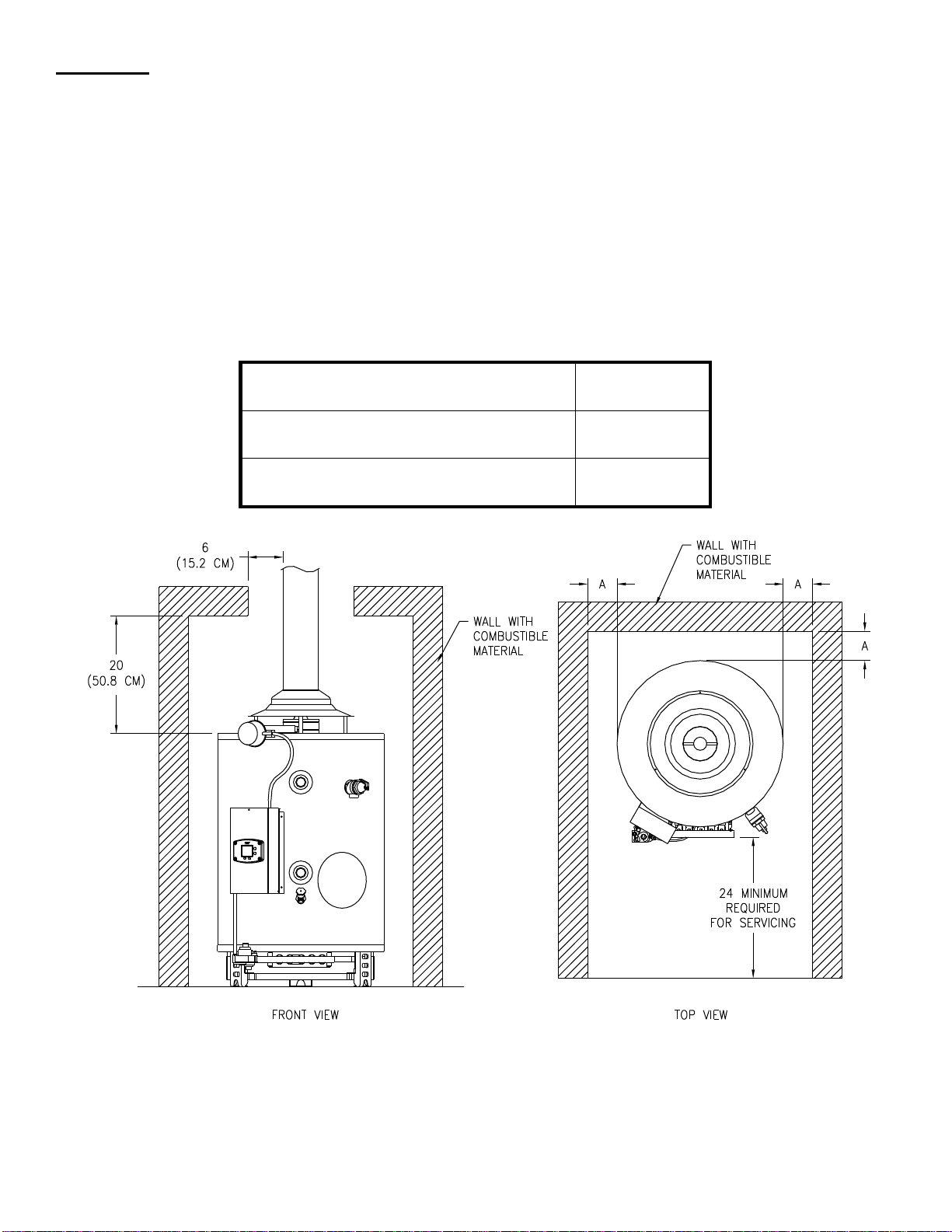
2. THIS WATER HEATER IS SUITABLE FOR INSTALLATION ON CO MBUSTIBLE FLOOR . The thermal break leg
kit supplied with the water heater must be used.
3. Proper venting practices must be considered when selecting a location for this water heater. For exact venting
specifications, please consult the Venting section of these Installation and Operating Instructions.
4. It is recommended that a minimum clearance of four (4) inches (10.2 cm) be provided on the side of the water
heater for servicing and maintenance of the combination temperature and pressure relief valve.
5. Increase distances to provide clearance for servicing.
Input
Less than or equal to 300,000 BTUH 2 in. (5.1 CM)
Greater than 300,000 BTUH 6 in (15.2 CM)
Front, sides
and Rear “A”
12
Page 13
IMPORTANT-The flow of combustion and ventilating air must not be obstructed.
WARNING
The draft diverter relief opening of the water heater and combustion air inlet must be in the same atmospheric
CAUTION
REMOVE CRATE
1. Remove all banding and pry off crate sides carefully so as not to damage the water heater.
2. Carefully roll/lift the water heater from the crate base.
MOVE WATER HEATER TO PERMANENT POSITION by sliding or walking. Place drain pan underneath water heater
INSTALL TEMPERATURE AND PRESSURE RELIEF VALVE (if not already installed).
This water heater must be located in an area where the general public does not have access to set temperatures.
AIR REQUIREMENTS
1. Do not obstruct the flow of ventilating air.
2. For s afe operation, adequate air is needed for com bustion and ventilation. Sooting may result in serious damage
to the water heater and risk of fir e or ex plosion. It can also create a risk of asphyxiation. Such a condition often will
result in a yellow, luminous burner flame, causing carboning or sooting of the combustion chamber, burner and
flue tubes.
MECHANICAL EXHAUSTING OF ROOM AIR - Where an exhaust fan is installed in the same room with this
water heater and combustion air is drawn from inside the room, sufficient openings for air must be provided in the
walls. UNDERSIZED OPENINGS WILL CAUSE AIR TO BE DRAWN INTO THE ROOM THROUGH THE WATER
HEATER’S VENTING SYSTEM, CAUSING POOR COMBUSTION THAT MAY BE HAZARDOUS TO LIFE.
SOOTING MAY RESULT IN SERIOUS DAMAGE TO THE WATER HEATER AND RISK OF FIRE OR EXPLOSION,
WHICH CAN ALSO CREATE A RISK OF ASPHYXIATION. Refer to local codes and /or National Fuel Gas Code
(ANSI Z223.1-Latest Edit ion), or in Canada CAN/CGA B149 . 1 Natural Gas Installation Code (Latest Edition) or
CAN/CGA B149 . 2 Propane Inst allat ion Code (Latest Edition) for proper air opening sizing.
CONFINED SPACES
3
If the water heater is installed in a confined space (volume is less than 50 ft.
/1000 BTU (15 m3/0.29 kW) per hour of the
total input rating of all gas appliances in that space), air must be supplied through two permanent openings. One opening
must be within 12 inches (30.5 cm) from the top of the enclosure and one within 12 inches (30.5 cm) of the bottom. The
openings must be protected by metal louvers or 1/4” (6.4 mm) min. mesh metal screen. The size of the openings are as
follows:
pressure zone. Large exhaust fans in kitchens and other locations can lower the air pressure inside an enclosure and
interfere with the proper operation and venting of the water heater. In these cases, the water heater should be
installed in a separate room with the combustion and ventilation air supplied directly from outdoors as previously
described.
1. If the openings communicate directly with an additional room(s) of sufficient volume, each opening must have a
2
minimum free area opening of 1 in.
appliances in the confined space, but not less than 100 in.
/1000 BTU (2.54cm2/0.29kW) per hour of the total input rating of all gas
2
(254 cm2).
2. If the openings communicate with the outdoors through horizontal ducts, each opening must have a minimum free
2
area of 1 in.
3. If the openings communicate directly with the outdoors or through vertical ducts with the outdoors, each opening must
have a minimum free area of 1 in.
/2000 BTU (2.54cm2/0.59kW) per hour of the total rating of all gas appliances in the enclosure.
2
/4000 BTU (2.54cm2/1.18kW) per hour of the total rating of all gas appliances in
the enclosure.
13
Page 14

ALL A IR FROM INSIDE THE BUILDING: The confined space must be provided with two permanent openings
communicating directly with an additional room(s) of sufficient volume so that the combined volume of all spaces meets
the criteria for an unconfined space. The total input of all gas utilization equipment installed in the combined space must be
considered in making this determination. Each opening must have a minimum free area of 1 in.
2
(2.54cm
100 square inches (254cm
/0.29kW) per hour of the total input rating of all gas utilization equipment in the confined space, but not less than
2
). One opening must be within 12 inches (30.5 cm) of the top and one within 12 inches (30.5
cm) of the bottom of the enclosure.
UNCONFINED SPACES
In unconfined spaces in buildings, infiltration may be adequate to provide air for combustion, ventilation and dilution of flue
gases. However, in buildings of tight construction (for example, weather stripping, heavily insulated, caulked, vapor barrier,
etc.), additional air may need to be provided using the methods described above under CONFINED SPACES: All Air From
Outdoors or SPECIALLY ENGINEERED INSTALLATIONS.
SPECIALLY ENGINEERED INSTALLATIONS
The requirements noted under CONFINED SPACES above must not necessarily govern when special engineering,
approved by the authority having jurisdiction, provides an adequate supply of air for combustion, ventilation, and dilution of
flue gases.
2
/1000 BTU
14
Page 15
Do not t urn on elect rical pow er t o wat er heater unt il f lue damper is inst alled and w at er heater is filled w it h
CAUTION
The venting syst em must be installed properly f ollowing all local codes or in t he absence of local codes, the
in Operation’’.
SECTION V: VENTING
latest ed iti on o f th e Nati on al Fuel Gas Code (ANSI Z223.1- l atest edi ti on ), o r i n Canad a, Th e Natu ral Gas and
Propane Installation Code (B149 . 1 -0 0 l atest ed iti on ). Failure to properly install t he venting syst em could result
in property damage, personal injury, or death.
Careful ly in sp ec t th e v ent ing syst em of a replacement wat er heater installation bef ore connecting t o the
vent ing system. All joint s in the vent connect or must be securely f astened w it h screw s and fit tight ly
together. Inspect the venting syst em f or signs of det eriorat ion (rust and perforation) and replace any sect ions
t hat are not in good condition.
The chimney must be lined and in good condit ion. Check t o make sure the venting syst em is properly sized
f o r th e wat er h eat er . If t he vent ing syst em w as previously sized for another gas appl ian c e th at h as b een
removed, t he venting syst em may now be t oo large. Refer t o th e latest ed i t i o n o f the N at i o nal Fuel Gas Cod e
(ANSI Z223.1-latest edition), or in Canada, t he Nat ural Gas and Propane Installation Code (B1 4 9 . 1-00 l atest
edition) f or t he correct sizing of v ent ing systems and common vent ing wit h anot her gas appliance. Do not
vent t his w at er heater int o t he vent ing system of anot her gas appliance designed to vent under positive
pressure.
The w ater heater sh ou ld be i n stall ed as c lo se as p ract ical t o t he vent ing system t o minim ize t he vent
connect or length required. Refer to local codes for t he distance limit ations on vent connect or lengt hs. A t t he
complet ion of t he w at er heater installation, t he burner and vent ing system must be checked for proper
operation wit h all other commonly vent ed appliances in operat ion. Check f or spillage of f lue product s around
t he outside relief opening of t he draft hood af t er several minutes of operation. The flame f rom a match should
be draw n int o the draft hood. Do not use the w at er heater or connect ed equipment if spillage is detect ed unt il
t he problem is corrected. Refer to th e l at es t ed i t i on o f the N at i o nal Fuel Gas Cod e, o r i n Can ada, the N at u r al
Gas and Propane Installat ion Code f or complet e details on the ‘‘Procedure to Be Followed t o Place Equipment
This water heater has been shipped with a draft diverter for which it was designed with reference to the horizontal and
vertical planes, its certified category I, per latest ANSI Z 21.10.3-2015.CSA 4.3-2015 revision. Refer to the latest edition of
the National Fuel Gas Code (ANSI Z223.1-latest edition), or in Canada, the Natural Gas and Propane installation Code
(B149.1-00 latest edition). If removed, the draft diverter must be replaced in the same position and secured to the jacket
top by the screws with which it was installed.
This water heater must be connected to a lined masonry chimney or venting system approved by local codes or
ordinances. The vent connector used to attach the draft diverter outlet to the chimney or approved vent must be of the
same diameter as the draft diverter outlet or larger. For proper venting in certain installations, a larger vent connector may
be needed. Consult venting tables in ANSI standard (Z223.1- latest edition), National Fuel Gas Code and CAN/CGA
(B149.1 or B149.2-latest editions) Natural Gas and Propane Installation Code, or local code officials for proper application
for your area.
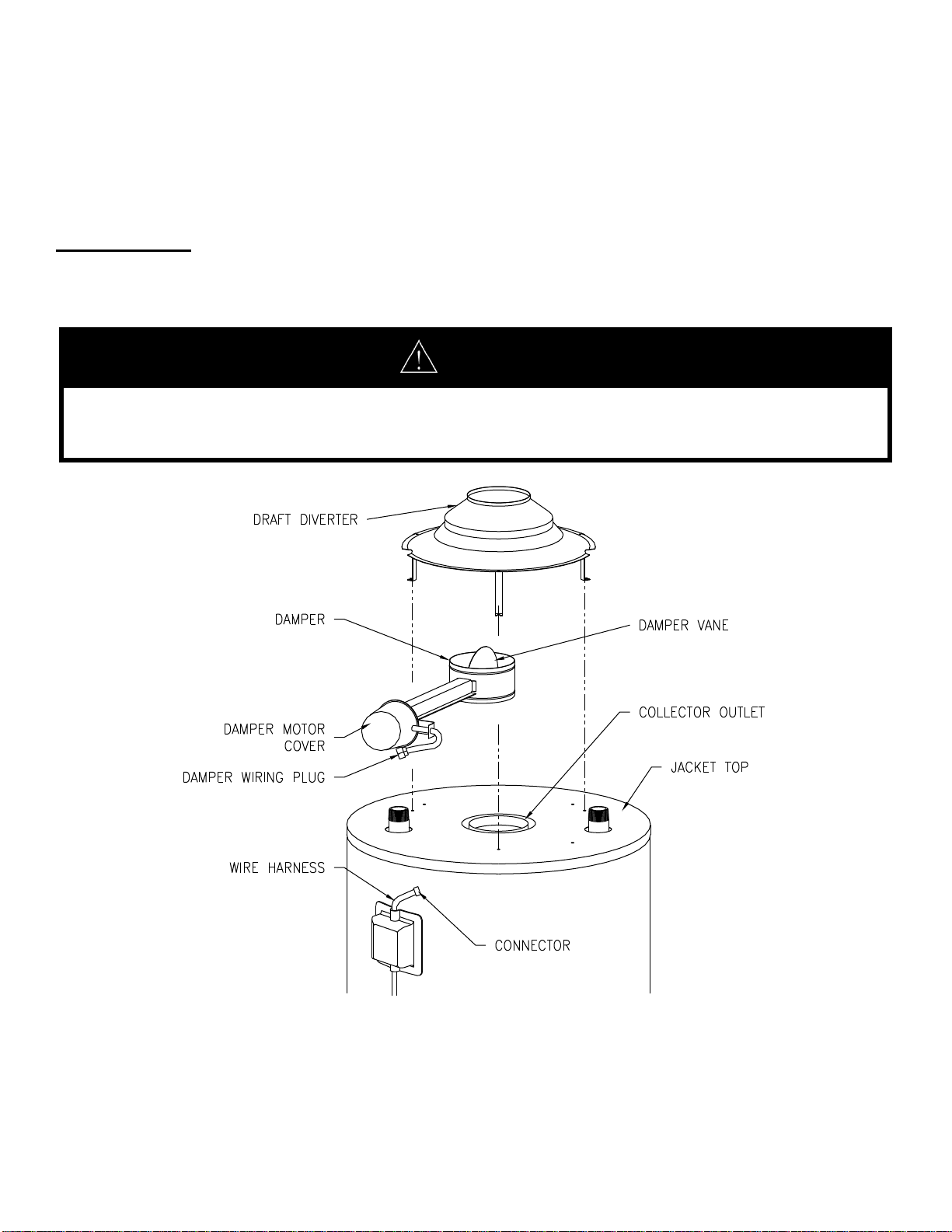
FLUE DAMPER
Refer to Figure 6 and follow these instructions:
WARNING
water.
1. Remove the damper from the accompanying box shipped within the crate.
2. Locate the collector outlet on top of the water heater. Place the damper over the collector outlet and rotate as
necessary to a position in which the damper wiring plug can be fully engaged with the connector on the side of the
water heater.
15
Page 16
Modif ic ation t o the f lue damper or the draft div erter may result in personal injury, property damage or deat h.
instructions w it hout modif ic ation.
CAUTION
3. Secure the flue damper to the jacket top with sheet metal screws.
4. Connect the damper wiring plug to the damper wire harness connector on the side of the water heater. Note: The plug
and connector can only be engaged one way (polarized).
5. The Lighting and Operating instructions are outlined in this manual. The damper must be in the open position when
the water heater main burner is operating (the arrow on the damper plate is in the “up” position when open. Be certain
the arrow is in a visible position when installed).
DRAFT DIVERTER
This water heater has been shipped with a draft diverter for which it was designed. Remove the bag containing the legs
and instructions from the draft diverter. Attach the legs to the draft diverter and attach the draft diverter to the water heater
per the instructions in the bag.
The fl u e dam p er an d d raft d i v erter are to b e pl ac ed i n p o siti on an d o per ate ex ac tl y as stated in these
Figure 6
16
Page 17
A PPR O XI MA TE TIME/TEM PERATURE REL A TIO NS HI PS I N S C AL D S
120°F (49°C)
More t han 5 minut es
125°F (52°C)
1½ t o 2 minut es
130°F (54°C)
About 3 0 seconds
135°F (57°C)
About 1 0 seconds
140°F (60°C)
Less than 5 seconds
145°F (63°C)
Less than 3 seconds
150°F (66°C)
About 1 ½ seconds
155°F (68°C)
About 1 second
If sweat fittings are to be used, DO NOT apply heat to the nipples on top or side of the water heater. Sweat the tubing
nipples containing a plastic liner.
CAUTION
FAILURE TO INSTALL AND MAINTAIN A NEW, LISTED TEMPERATURE AND PRESSURE RELIEF VALVE
TEMPERATURE AND PRESSURES.
WARNING
If this water heater is installed in a closed water supply system, such as the one having a back-flow preventer in the
contacted on how to control this situation.
NOTICE
SECTION VI: WATER CONNECTIONS
NOTE: BEFORE PROCEEDING WITH THE INSTALLATION, CLOSE THE MAIN WATER SUPPLY VALVE.
After shutting off the main water supply, open a faucet to relieve the water line pressure to prevent any water from leaking
out of the pipes while making the water connections to the water heater. After the pressure has been relieved, close the
faucet. The COLD water inlet and HOT water outlet are identified on the top and front of the water heater. Make sure the
diptube is in place before making the cold water connection. Make the proper plumbing connections between the water
heater and the plumbing system to the house. Install a shut-off valve in the cold water supply line.
to the adapter before fitting the adapter to the water heater connections. It is imperative that heat is not applied to the
WILL RELEASE THE MANUFACTURER FROM ANY CLAIM WHICH MIGHT RESULT FROM EXCESSIVE
cold water supply, provisions must be made to control thermal expansion. DO NOT operate this water heater in a
closed system without provisions for controlling thermal expansion. Warranties do not cover damages from thermal
expansions such as pressure bulges and/or deformities. Your water supplier or local plumbing inspector should be
After installation of the water lines, open the main water supply valve and fill the water heater. While the water heater is
filling, open several hot water faucets to allow air to escape from the water system. When a steady stream of water flows
through the faucets, close them and check all water connections for possible leaks. NEVER OPERATE THE WATER
HEATER WITHOUT FIRST BEING CERTAIN IT IS FILLED WITH WATER.
17
Page 18

Keep clear of combination temperature and pressure relief valve discharge line outlet. The discharge may be
WARNING
hot enough to cause scald injury. The water is under pressure and may splash.
For protection against excessive temperatures and pressure, install temperature and pressure protective equipment
required by local codes, but not less than a combination temperature and pressure relief valve certified by a
nationally recognized testing laboratory that maintains periodic inspection of production of listed equipment or
materials as meeting the requirements of the Standard for Relief Valves and Automatic Gas Shutoff Devices for Hot
Water Supply Systems, ANS Z21.22 and the Standard CAN1-4.4 Temperature, Pressure, Temperature and
Pressure Relief Valves and Vacuum Relief Valves. The combination temperature and pressure relief valve must be
marked with a maximum set pressure not to exceed the maximum working pressure of the water heater. The
combination temperature and pressure relief valve must also have an hourly rated temperature steam BTU
discharge capacity not less than the hourly rating of the water heater.
Install the combination temperature and pressure relief valve into the opening provided and marked for this purpose
on the water heater.
Note: Some models may already be equipped or supplied with a combination temperature and pressure relief valve.
Verify that the combination temperature and pressure relief valve complies with local codes. If the combination
temperature and pressure relief valve does not comply with local codes, replace it with one that does. Follow the
installation instructions above on this page.
Install a discharge line so that water discharged from the combination temperature and pressure relief valve will exit
within six (6) inches (15.2 cm) above, or any distance below the structural floor and cannot contact any live electrical
part. The discharge line is to be installed to allow for complete drainage of both the combination temperature and
pressure relief valve and the discharge line. The discharge opening must not be subjected to blockage or freezing.
DO NOT thread, plug or cap the discharge line. It is recommended that a minimum clearance of four (4) inches (10.2
cm) be provided on the side of the water heater for servicing and maintenance of the combination temperature and
pressure relief valve.
Do not place a valve between the combination temperature and pressure relief valve and the tank.
Hydrogen gas can be p roduced in an operating water heater that has not had water drawn from the tank for
a long period of time (generally two weeks or more). Hydrogen gas is extremely flammable. To prevent the
possibility of injury under these conditio ns, we recommend the hot water faucet to be o p en for several
minutes at the kitchen sink before you use any electrical appliance which is connected to the hot water
system. If hydrogen is present, there will be an unusual s o un d such as air escapi ng through the pipes as hot
water begins to flow. Do not smoke or have open flame near the faucet at the time it is open.
This water heater can deliver scalding temperature
water at any faucet in the system. Be careful
whenever using hot water to avoid scalding injury.
Certain appliances such as dishwashers and
automatic clothes washers may require increased
temperature water. By setting the thermostat on this
water heater to obtain the increased temperature
water required by these appliances, you may create
the potential for scald injury. To protect against injury ,
you should install an ASSE approved mixing valve in
the water system. This valve will reduce point of
discharge temperature by mixing cold and hot water in
branch supply lines. Such valves are available from
the manufacturer of this water heater or a local
plumbing supplier. Please consult with a plumbing professional. For information regarding space heating water
connections and plumbing arrangements, refer to the section at the end of this manual.
18
Page 19

The manufacturer of this water heater will not be liable for any damage or injury caused as a result of a cracked gas
WARNING
The water heater and individual shutoff valve must be disconnected from the gas supply piping system during any
CAUTION
SECTION VII: GAS CONNECTIONS
The gas supply lines must meet all requirements of the National Fuel Gas Code (ANSI Z223.1-Latest Edition), or in
Canada CAN/CGA B149.1 Natural Gas Installation Code (Latest Edition) or CAN/CGA B149.2 Propane Installation Code
(Latest Edition).
The minimum permissible gas supply pressure for the purpose of input adjustment is one (1.0) inch (0.25 kPa) water
column above the operating manifold pressure. See the rating plate and gas valve for the manifold pressure and gas type.
The maximum permissible gas supply pressure is fourteen (14.0) inches (3.5 kPa) water column for natural gas and
liquefied petroleum gases/propane gas.
1. Connect this water heater only to the type of gas (Natural or Propane gas) as shown on the rating plate. Use clean
black iron pipe or equivalent material approved by local codes and ordinances. (Dirt and scale from the pipe can enter
the gas valve and cause it to malfunction). The inlet gas line must have a minimum length of three (3) inches (7.6 cm)
drip leg (sediment trap) installed as close to the water heater’s gas valve as possible. A ground joint union must be
installed as close to the water heater as possible in the gas supply line feeding the water heater to permit servicing of
the water heater. Compounds used on the threaded joints of the gas piping must be resistant to the action of liquefied
petroleum gases/propane gas. DO NOT apply pipe dope to the gas valve inlet and make certain that no pipe dope has
become lodged in the inlet screen of the gas valve. Extreme care must be taken to ensure no pipe dope enters the
gas valve. Avoid excessive torque when tightening the gas supply line to the gas valve. Excessive torque may result in
cracking of the gas valve housing and could create a gas leak. The suggested maximum torque is 31.5 ft. lbs. (4.4 kg-
m).
inlet as a result of excessive torque.
2. This water heater and its gas connection must be leak tested before placing the water heater in operation. Check for
gas leaks with a soap and water solution and a brush or a commercial leak detector fluid. NEVER USE A MATCH OR
OPEN FLAME FOR TESTING!
pressure testing of the system at test pressures in excess of 1/2 psi (3.5 kPa). The water heater must be isolated
from the gas supply piping system by closing its manual shutoff valve during any pressure testing of the gas supply
system at test pressures equal to or less than 1/2 psi (3.5 kPa). The supply line must be capped when not connected
to the water heater.
3. While checking for leaks care must be taken to prevent solution from contacting the electrical connections at the
control. If electrical connections at the control become wet, they must be thoroughly dried before attempting to operate
the water heater.
19
Page 20

WARNING
Water heater s are heat-producing appliances. To avoid damage or injury there must be no m aterials stored against
CIRCUMSTANCES SHOULD FLAMMABLE
MATERIALS, SUCH AS GASOLINE OR PAINT THINNER BE USED OR STORED IN THE VICINITY OF THIS
WATER HEATER OR IN ANY LOCATION FROM WHICH FUMES COULD REACH THE WATER HEATER.
Installation or service of this water heater requires ability equivalent to that of a licensed tradesman in the field
involved. Plumbing, air supply, venting, gas supply and electrical work are required.
Light the unit in accordance with the operating instructions label attached to the water heater.
Under no circumstanc es should the input r ate ex ceed the input r ate s hown on the water heater r ating plate. O ver f iring
could result in damage or sooting of the water heater.
If the unit is exposed to the following, do not operate water heater until all corrective steps have been made by a
5. Sooting
NEVER OPERATE THE WATER HEATER WIT HOUT FIRST BEING CERTAIN IT IS FIL LED WITH W ATER AND A
F THE
WATER HEATER.
the water heater or direc t vent system, and proper care m ust be taken to avoid unnecessary contact (especially by
children) with the water heater and direct vent system. UNDER NO
factory authorized independent service contractor or qualified service professional.
1. Flooding to or above the level of the burner or controls
2. External firing
3. Damage
4. Firing without water
TEMPERATURE AND PRESSURE RELIEF VALVE IS INSTALLED IN THE RELIEF VALVE OPENING O
TO FILL THE WATER HEATER
1. Close the water heater drain valve by turning the knob clockwise. If alternative water connections are provided but not
used, make certain they are plugged (i.e. rear connections).
2. Open the cold water supply shut-off valve.
3. Open several hot water faucets to allow air to escape from the system.
4. When a steady stream of water flows from the faucets, the water heater is filled. Close the faucets and check for water
leaks at the water heater drain valve, combination temperature and pressure relief valve and the hot and cold water
connections.
5. To restore operation of water heater refer to operating instruction label on the water heater.
TO DRAIN THE WATER HEATER
Should it become necessary to completely drain the water heater, make sure you follow the steps below:
1. Reduce the thermostat setpoint to the lowest setting. On water heater models having 24 volt controls, depress the
control panel rocker switch on the top of the control box to the “OFF” position and disconnect the power to the water
heater.
2. Rotate and partially depress gas control knob clockwise to the “OFF” position.
3. Shut off the gas supply to the water heater.
4. Close the cold water supply shut-off valve.
5. Open the drain valve on the water heater by turning the knob counter-clockwise. The drain valve has threads on the
end that will allow the connection of a standard hose coupling.
6. Open a hot water faucet to allow air to enter the system.
To refill the water heater, refer to “To Fill the Water Heater.”
20
Page 21

WARNING
Turn off or disconnect the electrical power supply to the water heater before servicing. Label all wires prior to
Verify proper
This water heater must be wired on a separate circuit. Failure to wire on a separate circuit may cause improper
water heater.
Do not energize the electric circuit before the water heater tank is filled with water.
Standing pilot
SECTION VIII: ELECTRICAL CONNECTIONS
Standing Pilot Wiring Diagram
Robertshaw Gas Valve Honeyw el l Gas Valve
Spark to Pilot (IID) igni t i on system.
disconnection when servicing controls. Wiring errors can cause improper and dangerous operation.
operation after servicing.
All electrical wiring must be installed and grounded in accordance with local codes, or in the absence of local codes,
the National Electrical Code, ANSI/NFPA 70 and/or CSA C22.2 Electrical Code. In Canada, follow t he latest edition
of th e Canad ian Electr ic al Cod e (Part 1, CSA -C22 . 1 ) and all applicable local codes.
The water heater must be wired to a 115 volt, 60 Hz, AC power supply. The water heater must be wired on a separate
circuit and breaker. If a flexible line cord and plug is permitted by local code, then provide a three wire grounding type
receptacle within reach of the line cord provided on the control box. Do not plug the line cord into a receptacle that can
have the power supply interrupted by a switch that is used to control lights or another appliance.
If wiring in conduit is required, cut the line cord close to the control board and make the appropriate wiring connections.
CAUTION
operation or failure of the electrical components of the water heater. Refer to the “Electrical Connections” section of the
Installation and Operating Instructions Manual for complete instructions on electrical wiring and connections to the
21
Page 22

Spark to Pilot Ignition (IID) Wiring Diagram
22
Page 23

SECTION IX: OPERATING INSTRUCTIONS
Lighting And Shutdown Instructions
Standing Pilot Models
23
Page 24

Lighting and Shutdown Instructions
Spark to Pilot Ignition (IID) Models
24
Page 25

A PPR O XI MA TE TIME/TEM PERATURE RELATIONSHIPS IN SCALDS
120°F (49°C)
More t han 5 minut es
125°F (52°C)
1½ t o 2 minut es
130°F (54°C)
About 3 0 seconds
135°F (57°C)
About 1 0 seconds
140°F (60°C)
Less than 5 seconds
145°F (63°C)
Less than 3 seconds
150°F (66°C)
About 1 ½ seconds
155°F (68° C)
About 1 second
Thi s water heater, when set at a low er t emperature sett ing, is not c apable of producing hot wat er of
CAUTION
Whenever the water heater is filled with cold water, condensate will form on the cool tank surface and drops of water
NOTICE
Hotter water increases the risk of scald injury. Scalding may occur within five (5) seconds at a temperature setting of
DANGER
TEMPERATURE ADJUSTMENT
140°F (60°C). To protect against hot water injury, install an ASSE approved mixing valve in the water system. This
valve will reduce point of discharge temperature by mixing cold and hot water in branch water lines. A licensed
plumbing professional or local plumbing authority should be consulted.
This water heater is equipped with an energy cut out device to prevent overheating. Should overheating occur or the
gas supply fail to shut off, turn off the manual gas control valve to the appliance and call a qualified service
technician.
suff ic ient t emperature f or sanitizing purposes.
will fall on the hot burner and combustion chamber surfaces producing a “sizzling” noise. Condensation is normal
and does not indicate a leak. It will disappear when the tank becomes heated.
The l o wer th e t em p eratu re s et ti ng, t he greater t he energy efficiency, bot h t o heat t he wat er and to maintain
t h e sto rag e t em p eratu r e du ri ng stan db y p eri od s. Lo wer water tem p eratu res also ex ten d tan k li fe. Remem ber ,
no water h eat i n g sy s t em wil l pr ov i de exac t tem per atur es at al l ti mes . A l low a f ew days of operation at t his
sett ing t o det ermine the correct t emperature set t ing consistent wit h the requirements for the installation.
Condensation does not mean your tank is leaking. Over 40% of reported tank leaks on installation are proven to be
condensation. To avoid unnecessary expense and inconvenience, make sure the tank is leaking before calling a
service person.
The temperature selector knob of the thermostat has been adjusted to its lowest setting when shipped from the factory.
The marking on the thermostat temperature scale (shown at left) is the preferred starting point
for setting the temperature control. For energy-efficient operation of your water heater, the
suggested initial temperature setting is approximately 120°F (49°C). Households with small
children or invalids may require a 120°F (49°C) or lower temperature setting to reduce the risk
of scald injury. Some states require a lower temperature setting. Full counterclockwise
rotation of the temperature selector dial is the minimum temperature setting. Full clockwise
rotation of the temperature selector dial is the maximum temperature setting. NOTE: The
lower the temperature setting, the greater the energy efficiency, both to heat the w ater and to
maintain its temperature during standby periods. Lower water temperatures also extend tank
life. Remember, no water heating system will provide exact temperatures at all times. Allow a
few days of operation at this setting to determine the correct temperature setting consistent with
25
Page 26

SELECT
SET
Status
Set button
Select button
Temperature
Down Button
Temperature
Up Button
°F
idle
setpoint
Operational
Sequence of
operation Indicator
Reads "Idle” or “Heating"
Status Indicator
Read
"Operational"
or "Service Needed"
Shown flashing
in display only when
temp is adjusted
Temperature Setpoint
in Degrees F or Degrees C
Range 70 - Max °F
Range 21 - Max ° C
Water Heater Display and Control Buttons
If t he wat er heater display does not show ‘‘Operational’’ in the ‘‘Status’’ indicat or, there may be an operating
WARNING
When the maximum setpoint is reached, the display will show ‘‘Max Setpoint ’’ w ithout the setpoint value.
The default t emperature setpoint f rom t he f act ory i s 7 0 ˚F (21˚C).
NOTICE
your needs. NOTE: This water heater, when set at a lower temperature setting, is not capable of producing hot water of
sufficient temperature for sanitizing purposes.
During the winter season or any cold period, you may desire a higher temperature setting to adjust for the colder incoming
water. This adjustment, however, may cause additional condensation to form on the cooler tank surface. This does not
mean the tank is leaking. During summer months, the warmer incoming water temperatures will benefit the performance of
your water heater and reduce the amount of condensation developed.
TEMPERATURE ADJUSTMENT (24V CONTROL SYSTEM)
The water heater temperature setting is adjusted by using the control display mounted to the front of the control panel of
the water heater. The water heater thermostat is set at the lowest setpoint of 70°F when shipped from the factory. The
control display shows the temperature setpoint in degrees Fahrenheit (°F) or degrees Celsius (°C), and the status of the
water heater (“Idle” or “Heating”). If the water heater is functioning normally, the display will also show “Operational”.
For energy efficient operation of your water heater, the suggested initial temperature setting is 120°F (49°C). During the
winter season, or any cold period, you may desire a higher temperature setting to adjust for the colder incoming water.
This adjustment, however, may cause additional condensation to form on the cooler tank surface. This does not mean the
tank is leaking. During summer months, the warmer incoming water temperatures will benefit the performance of your
water heater and reduce the amount of condensation developed.
Condensation does not mean your tank is leaking. Over 40% of reported tank leaks on installation are proven to be
condensation. To avoid unnecessary expense and inconvenience, make sure the tank is leaking before calling a service
person.
malfunc t ion wit h t he wat er heater. If t his is the case, a numeric code w ill be displayed. Ref er to th e lab el n ex t
t o t he display f or t he definit ion of the error code and call your plumbing prof essional or service agent to
serv i c e t h e water h eater. Do no t try to r eset th e water h eat er with ou t h av in g a q u ali fied ser v ic e p erso n t o
diagnose and correct t he problem. If t he display is blank or does not show an error code, make sure there is
po wer to t h e wat er h eat er .
Set t ing t he w at er t emperature t o t he maximum set point c an result in scalding hot water delivered to the
f aucets. It is highly recommended that t he maximum setpoint be adjust ed to t he lowest t emperature possible
f or t he needs of t he installation. See following sect ion t o change the maximum setpoint limit (max setpoint ).
The maximum set t ing is equal to approximat ely 1 80 ˚F (82˚C).
26
Page 27

Step 1: Depress and hold “Temperature Up” button until desired setpoint temperature appears in the display.
Step 2: “Setpoint” indicator begins flashing in the display after pressing “Temperature Up” button.
Step 3: Press “SET” button for new setting to take effect immediately. “Setpoint” will stop flashing. If the “SET” button is not
SELECT
SET
Status
°F
idle
Operational
Step 1
SELECT
SET
Status
°F
idle
setpoint
Operational
Step 2
"Setpoint"
flashes
SELECT
SET
Status
°F
idle
setpoint
Operational
Press SET Button for sett ing to
to take eff ect im m ediat ely
Step 3
"Setpoint" flashes
for 10 seconds
To I ncrease Setpoint T emperat ure
pressed, the new temperature setting will take effect in approximately 10 seconds.
27
Page 28

Step 1: Depress and hold “Temperature Down” button until desired setpoint temperature appears in the display.
Step 2: “Setpoint” indicator begins flashing in the display after pressing “Temperature Down” button.
Step 3: Press “SET” button for new setting to take effect immediately. The setpoint will stop flashing. If the “SET” button is
SELECT
SET
Status
°F
idle
Operational
Step 1
SELECT
SET
Status
°F
idle
setpoint
Operational
"Setpoint"
flashes
Step 2
SELECT
SET
Status
°F
idl
e
setpoint
Operational
"Setpoint" flashes
for 10 seconds
Press SET for se tting to
take effect im m ediat ely
Step 3
To Decrease Setpoint Temperature
not pressed, the new temperature setting will take effect in approximately 10 seconds.
28
Page 29

Step 1: Press “SELECT” button until °F/°C is displayed.
Step 2: Press “SET” button to change temperature format. Symbol °F/°C will flash.
Step 3a: Press “Temperature Up” button to change temperature format to °C.
SELECT
SET
Status
°C
idle
Operational
Step 3a
°F/°C
°F/°C Flashes
Changes to "°C"
SELECT
SET
Status
idle
Operational
Press
select
Step 1
°F
°F/°C
SELECT
SET
Status
idle
Operational
Step 2
°F/°C Flashes
°F
°F/°C
To Change Temperature Format in Display from °F to °C or ˚C to ˚F:
29
Page 30

Step 3b: Press “Temperature Down” button to change temperature format to °F.
Step 4: Press “SET” button to confirm ˚F or ˚C format. °F/°C will stop flashing. Setpoint display will appear in the format
Step 5: Pressing “SELECT” button will return display to setpoint in format selected (˚F or ˚C) immediately.
SELECT
SET
Status
°F
idle
Operational
Step 4
Press Set
°F/°C
Symbol "°F/°C" Stops Flashing
SELECT
SET
Status
°F
idle
Operational
Step 3b
°F/°C
°F/°C Flashes
Changes to "°F"
SELECT
SET
Status
°F
idle
Operational
Press select
Step 5
Setpoint shown in °F
selected (˚F or ˚C) in 10 seconds.
30
Page 31

WARNING
WATER HEATER OR VENT SYSTEM.
Hydrogen gas can be produced in an operating water heater that has not had water drawn from the tank for a long
WARNING
IMPORTANT- In the event of an emergency, turn off the gas and electric (if applicable) to the appliance.
damaged or if any joi n t is found not sealed
NOTICE
An automatic gas shut-off device (ECO) is incorporated in the sensor and control board which will shut off all gas supply to the burner
and pilot if the water heater temperature exceeds 200°F (93°C). Should the ECO function (open), the water temperature should be
reduced to approximately 120°F (49°C) and follow applicable Lighting Instructions to place the water heater in operation. The water
heater must have the problem corrected by a qualified service person before putting the water heater back in operation. It is
recommended that all service work be performed by a qualified service agency.
If the water heater is to remain idle for 30 days or more or is subjected to freezing temperatures while shut off, the water heater and
piping should be fully drained (See “To Drain the Water Heater”) and the drain valve should be left fully open.
period of time (generally two weeks or more). Hydrogen gas is extremely flammable. To prevent the possibility of injury
under these conditions, we recommend the hot water faucet to be open for several minutes at the kitchen sink before
you use any electrical appliance which is connected to the hot water system. If hydrogen is present, there will be an
unusual sound such as air escaping through the pipes as hot water begins to flow. Do not smoke or have open flame
near the faucet at the time it is open.
Burner Flame Check
At the time of installation and at periodic intervals (about every 3 months), a visual check of the pilot and burner flames should be
made to determine if they are burning properly. No adjustment to the air shutter should be required for this heater. The burner flames
should be blue with yellow tips. A blue-orange flame is characteristic of operation on liquefied petroleum (LP) gas. If the burner flame
does not appear as described, an air shutter adjustment may be required. The burner tube flames should light smoothly from the pilot.
IMPORTANT- The water heater should be inspected at a minimum annually by a qualified service technician
for damaged components and/or joints not sealed. DO NOT operate th is water heater if any p art is found
Figure 8
WARNING
Do not run out of propane gas. Damage to the water heater may occur.
Water heaters are heat producing appliances. To avoid damage or injury there must be no materials stored against
the water heater or vent system, and proper care must be taken to avoid unnecessary contact (especially by
children) with the water heater and vent system. UNDER NO CIRCUMSTANCES SHALL FLAMMABLE
MATERIALS, SUCH AS GASOLINE OR PAINT THINNER BE USED OR STORED IN THE VICINITY OF THIS
WATER HEATER, VENT SYSTEM OR IN ANY LOCATION FROM WHICH FUMES COULD REACH THE
31
Page 32

IMPORTANT- If the combination temperature and pressure relief valve on the appliance discharges periodically, this
inspector on how to correct this situation. Do not plug the combination temperature and pressure relief valve outlet.
NOTICE
FOR YOUR SAFETY, DO NOT ATTEMPT REPAIR OF COMBINATION GAS CONTROL, BURNERS OR GAS
CAUTION
When lifting lever of the combinati o n temperature and pressure relief valve, hot water will be released under
WARNING
SECTION X: MAINTENANCE
The following maintenance should be performed by a qualified service technician at the minimum periodic intervals suggested below.
In some installations, the maintenance interval may be more frequent depending on the amount of use and the operating conditions of
the water heater. Regular inspection and maintenance of the water heater will help to insure safe and reliable operation.
1. Annual checks of the ignition systems (millivolt and electronic), temperature controls and any other water heater controls are
necessary to ensure proper operation. Also, all safety shut-off valves must be checked to verify proper operation and tightness.
2. The flow of combustion and ventilation air MUST NOT be restricted. Clear the combustion air openings of any dirt, dust, or other
restrictions. WARNING! The combustion ventilation system may be HOT.
3. At all times keep the water heater area clear and free from combustible materials, gasoline and other flammable vapors and
liquids.
4. Bi-annually conduct a visual check of the pilot and burner flames to determine that they are burning properly. See “Burner Flame
Check” section for example of proper burner flame pattern.
5. Annually remove the main burner rack assembly to clean orifices and related parts of any dirt or other foreign material. Inspect
the burner ports for obstructions or debris and clean with a wire brush, vacuum, or use a mild detergent solution to clean as
needed. NOTE: It is imperative for proper operation of the water heater that the main burner rack be replaced in the original
location
.
pressure. Be careful that any released water does not result in bodily injury or property damage.
Keep clear of the combination temperature and pressure relief valve discharge line outlet. The d i sc har ge m ay
be hot enough t o cause scald injury. The wat er i s un der p ressu re an d may spl ash .
WARNING
Do not run out of propane gas. Damage to the water heater may occur.
6. At least once a year, check the combination temperature and pressure relief valve to insure that the valve has not become
encrusted with lime. Lift the lever at the top of the valve several times until the valve seats properly without leaking and operates
freely.
may be due to thermal expansion in a closed water supply system. Contact the water supplier or local plumbing
7. Monthly drain off a gallon of water to remove silt and sediment. WARNING! This water may be HOT.
8. All models are equipped with a cleanout opening to aid in removal of hard water deposits from the tank bottom. If this water
heater operates under hard water conditions, the following should be performed at least every 3 months: Drain the water heater.
Remove the cleanout jacket cover and tank cover. When cleaning the tank, care must be taken to avoid trying to break deposits
loose as this could damage the glass lining and shorten the life of the water heater. After cleaning, replace the cleanout tank
cover and jacket cover, and refill with water.
9. A sacrificial anode rod has been installed to extend tank life. The anode rod should be inspected annually (every year) and
replaced when necessary to prolong tank life. Water conditions in your area will influence the time interval for inspection and
replacement of the anode rod. Contact the plumbing professional who installed the water heater or the manufacturer listed on
the rating plate for anode replacement information. The use of a water softener may increase the speed of anode consumption.
More frequent inspection of the anode is needed when using softened (or phosphate treated) water.
10. The venting system must be inspected at least once a year to ensure against leakage of exhaust products.
PIPING. REFER REPAIRS TO A QUALIFIED SERVICE TECHNICIAN.
32
Page 33

Manufactured under one or more of the following U.S. Patents: 5,277,171; 5,341,770; 5,372,185; 5,485,879;
2,476,685; 2,504,824; 2,548,958
Contact your supplier, plumbing professional or contact the company at the address given on the rating plate of the water
heater for replacement parts.
Provide the part name as well as the model and serial number(s) of the water heater(s) when ordering parts.
READ THE WARRANTY FOR A FULL EXPLANATION OF THE LENGTH OF TIME THAT PARTS AND THE WATER
HEATER ARE WARRANTED.
5,574,822; 5,596,952; 5,660,165; 5,682,666; 5,761,379; 5,943,984; 5,954,492; 5,988,117; 6,056,542; 6,142,216;
6,442,178; 6,684,821; 6,935,280; 7,063,132; 7,063,133; 7,007,748; 7,270,087; 7,334,419; 7,337,517; 7,409,925;
7,458,341; 7,559,293; 7,621,238; 7,634,976; 7,650,859; 7,665,210; 7,665,211; 7,699,026; 7,866,168; 7,900,589;
7,971,560; 7,992,526 8,082,888; 8,146,772; Other U.S. and Foreign patent applications pending. Current Canadian
Patents: 2,092,105; 2,107,012; 2,108,186; 2,112,515; 2,143,031; 2,239,007; 2,262,174; 2,314,845; 2,409,271;
Complete the following information and retain for future reference:
Model No:
Serial No:
Service Phone
Days: Nights:
Address:
Supplier:
Supplier Phone No:
TYPICAL INSTALLATION
33
Page 34

SECTION XI: DIAGNOSTIC AND TROUBLESHOOTING GUIDE
OPERATING AND TROUBLESHOOTING GUIDE-SEQUENCE OF OPERATION (STANDING PILOT WITH
MILLI-VOLT CONTROL)
1. With the pilot lit, the pilot burner assembly power pile generates milli-voltage to energize the magnet coil in the gas
valve permitting gas flow through pilot and to the main gas ports of the valve. Simultaneously, milli-voltage is also
directed to the ECO (energy cut off) switches located in the thermostat.
2. Set the control knob on the gas valve to “ON” position.
3. Set the adjustable thermostat to desired water temperature.
4. As the water temperature decreases below the thermostat setting in the tank, the contacts in the thermostat will
close, thereby energizing the circuit to the main valve permitting the flow of gas to the main burner.
5. A slow opening feature of the gas valve will cause the burners to light slowly at a reduced manifold pressure. After a
few seconds (allowing the combustion system to stabilize), the manifold pressure will increase to the maximum
setting of the gas valve.
6. The burners will continue to fire until the thermostat becomes satisfied, where upon the contacts will open, deenergize the main valve circuit, and the burners will extinguish.
7. If the temperature rises above fixed ECO (energy cut off) setting, the ECO contacts will open simultaneously deenergizing pilot and main valve circuits, and the burners will be extinguished.
DIAGNOSTIC GUIDE FOR HONEYWELL INTEGRATED CONTROL SYSTEM FOR FLUE DAMPER
MODELS-SEQUENCE OF OPERATION
1. W hen the tank temperature drops below the tem perature setpoint on the display, the control opens the flue dam per
to start the ignition sequence.
2. W hen the flue damper reac hes the full open position, the end switch in the damper closes, com pleting the 24 volt
circuit to the control.
3. After the end switch closes, the control sends 24 volt power to the pilot valve “PV” terminals on the gas valve
allowing pilot gas to flow to the pilot. T he control also s ends high voltage through the pilot electrode to spark to the
pilot hood and ignite the pilot gas. If the pilot does not ignite within 90 seconds, the pilot valve is denergized and the
sparking stops for 65 seconds, and will attempt to ignite the pilot two more times. If the pilot does not light on the 3
attempt, the control will go into “soft lockout” for 1 hour and then will repeat the 3 ignition attempts.
4. W hen the pilot is lit, the flame is sensed by the flame s ense rod. The flame sense signal received by the control
board causes the sparking to s top and the main gas valve to open. The m ain burner s ignite fr om the pilot flame. The
pilot is continually monitored by the flame sensing circuit. If for any reason, the pilot flam e is not sens ed by the flam e
sensing circuit, the gas valves close. After a 65 second delay, the pilot valve opens and the pilot electrode sparks to
relight the pilot. The same sequence will occur in the event of a power supply or gas supply interruption.
5. T he main burners continue to operate until the water temperature in the tank increas es past the control setpoint,
which will cause the gas valve to close. T he flue damper c loses shortly after the gas valve closes . The water heater
remains in the standby mode until the temperature drops below the setpoint and initiates another heating cycle.
6. If for some reason, the tank temperature should reach or exceed 200˚F, then the control closes the gas valve and
goes into a “hard loc kout” state and will not operate until reset by a qualified service person. The display will read
“error code 65”, which indicates the tank high lim it temperature has been ex ceeded. No attempt should be made to
reset the control until a service person has cor rected the cause of the high limit condition. Refer to the diagnostic
service section at the end of this Installation and Operating Instructions Manual.
rd
34
Page 35

Step 1: Press “Select” and “Temperature Up” buttons together and hold for 3 seconds until “Max Setpoint” is shown in the
Step 2: Pressing “Select” button will change display to next mode
SELECT
SET
Status
°F
idle
Operational
Water
Temp
SELECT
SET
Status
idle
Operational
"Max Setpoint"
next to Temperature
Setpoint value
Max
Setpoint
The following procedure is for service and installation personnel only. Resetting lockout conditions without
correcting the malfunction can result in a hazardous condition.
WARNING
30 Seconds after the last button press, the display will automatically return to the “User Mode”. Simultaneously
NOTICE
ACCESSING SERVICE MODE ON THE WATER HEATER DISPLAY (FOR SERVICE PERSONNEL ONLY)
The display has a “service mode” for changing the maximum setpoint and accessing information in aiding servicing of the
water heater. This procedure is for service and installation personnel only. To enter the Service Mode, follow the steps
illustrated below:
display.
pressing the “Select” and “Temperature Up” buttons will switch the display immediately to the “User Mode”.
35
Page 36

Error Code Number (Display/Reset). This is only shown if there is an operating error in the “User Mode”.
1. Max Setpoint (Display/Change)
2a. Water Temperature Average (Displays average if there are two sensors – sensor temperature displayed if single
SELECT
SET
Status
°F
idle
Water Tem p
Operational
SELECT
Lockout RESET
Status
Service Needed
Error Code Shown
in Water Heat er Display
SELECT
SET
Status
°F
idle
Operational
Max Setpoint value in
Water Heat er Display
Max
Setpoint
The following is the sequence of modes available in “Service Mode” by pressing the “Select” button:
sensor is used).
36
Page 37

2b. Water Temperature - Upper Sensor (Displays if there is an upper sensor – some models)
2c. Water Temperature - Lower Sensor (Displays if there are two sensors)
3. Flame Current of Pilot Flame Sensor (Displays only in the Heating Cycle)
SELECT
SET
Status
Heating
Operational
Flame Current
µA
SELECT
SET
Status
°F
idle
Operational
Upper
Sensor
SELECT
SET
Status
°F
idle
Operational
Lower Sensor
37
Page 38

4. Setpoint (Display/Change)
5. ˚F/˚C (Display/Change)
6. Differential (Display only – shows the differential of the thermostat)
SELECT
SET
Status
°F
idle
Differential
Operational
SELECT
SET
Status
°F/C°
idle
Operational
°F
SELECT
SET
Status
°F
idle
setpoin
t
Operational
38
Page 39

7. Software Version (Display only)
8. Error Code History (Displays if there are present error codes or up to 10 previous error codes). Water Heater Display
Step 1: In service mode press the “Select” button until “Max Setpoint” is displayed.
SELECT
SET
Status
idle
Operational
Soft
SELECT
SET
Status
°F
idle
Max
Operational
Setpoint
SELECT
SET
Status
idle
Operational
No current error codes
Set t ing t he w at er t emperature t o t he maximum set point c an result in scalding hot water delivered to the
being improperly adjusted. See previous w arning on scalds and an ASSE approved mixing valve.
WARNING
will show -- if there are no error codes.
To change the Maximum Setpoint Limit (Max Setpoint) for the temperature setpoint:
f aucets. It is highly recommended that t he maximum setpoint be adjust ed to t he lowest tem p eratu r e po ssi bl e
f or t he needs of t he installation. See following sect ion t o change the maximum setpoint limit (max setpoint ).
M ak e sur e th e water h eat er c on tr ol di sp lay i s n ot i n a p ub l ic ar ea t h at c an resu lt i n t h e tem per atur e setti ng s
39
Page 40

Step 2: Press “Set” button to enter setting mode. “Max Setpoint” will flash to indicate setting mode.
Step 3: Press the “UP” or “DOWN” buttons to change the maximum setpoint value. This will limit the maximum setpoint the
Step 4: Press “Set” button to confirm new “Max Setpoint” value and stop setting mode.
SELECT
SET
Status
°F
idle
Operational
Max
Setpoint
"Max Setpoint" Flashes
SELECT
SET
Status
°F
idle
Operational
Max
Setpoint
"Max Setpoint" continues to flash
while making adjustments
SELECT
SET
Status
°F
idle
Operational
Max
Setpoint
"Max Setpoint" stops flashing
user can select. Note: The maximum setpoint is approximately 180˚F.
40
Page 41

Step 5: 30 Seconds after the last button press, the Water Heater Display will go back to “User Mode”. It will read “Max
Step 1: In Service Mode, Press the “Select” button until “Water Temp” is displayed in the upper right section of the water
SELECT
SET
Status
idle
Operational
Max
Setpoint
Exiting Service Mode
SELECT
SET
Status
°F
idle
Operational
Water
Temp
Setpoint” without showing a temperature value if the temperature setpoint is at the maximum setting. The Water Heater
Display can be set back to the “User Mode” immediately by pressing both the “Temperature Up” and “Select” buttons
together for 3 seconds.
Display of Water Temperature:
heater display. For water heaters using two temperature sensors in the tank, this will be the average reading between the
two sensors. For water heaters using a single sensor, this is the reading for the sensor.
41
Page 42

Step 2: For water heaters using two temperature sensors, pressing the “Select” button again displays the Upper Sensor
Step 3: For water heaters using two temperature sensors, pressing the “Select” button again displays the Lower Sensor
The pilot flame sense current is available only when the burners are in operation. Step 1: Make sure the status displays
SELECT
SET
Status
°F
idle
Operational
Lower Sensor
SELECT
SET
Status
Operational
Flame
Current
Heating
µA
SELECT
SET
Status
°F
idle
Operational
Upper Sensor
temperature reading. “Upper Sensor” will be displayed in the lower right side of the status window of the water heater
display.
temperature reading. “Lower Sensor” will be displayed in the lower left side of the status window of the water heater
display.
To Display Flame Sense Current of the Pilot Fla m e Sensor:
“Heating” or draw enough hot water to start the burners. Step 2: Enter the “Service Mode” described previously. Step 3:
Press the “Select” button until a number value is displayed with “Flame Current” to the right of the number. The value
displayed is in microamps (µA).
42
Page 43

Step 1: In “Service Mode” press the “Select” button until “Setpoint” is shown in the water heater display.
Step 2: Press the “Set” button to enter the setting mode. “Setpoint” will flash in the water heater display.
Step 3: To raise the temperature setpoint, press the “Temperature Up” button until the desired temperature is shown on the
SELECT
SET
Status
°F
idle
setpoint
Operational
SELECT
SET
Status
°F
idle
setpoint
Operational
"Setpoint" Flashes
SELECT
SET
Status
°F
idle
setpoint
Operational
"Setpoint" Flashes
Note: The maximum temperature that can be set in the Water Heater Display is limited to the “Max Setpoint”
NOTICE
To Display and Change Temperature Setpoint:
water heater display.
described previously. To change the “Max Setpoint”, refer to the procedure “To Change the Maximum Setpoint
Limit…” described previously under “Accessing the Service Mode on the Water Heater Display”.
43
Page 44

Step 4: To lower the temperature setpoint, press the “Temperature Down” button until the desired temperature is shown on
Step 5: When the desired setpoint is reached on the water heater display, press the “Set” button to confirm the new
To Display and Change Temperature Format (˚F/˚C):
SELECT
SET
Status
°F
idle
setpoint
Operational
"Setpoint" Flashes
SELECT
SET
Status
°F
idle
setpoint
Operational
"Setpoint" Stops Flashing
SELECT
SET
Status
idle
Operational
°F
°F/C°
the water heater display.
setpoint. “Setpoint” stops flashing in the water heater display.
To Change Temperature Format in Display from ˚F to ˚C or ˚C to ˚F:
Step 1: While in “Service Mode”, press “Select” button until “˚F/˚C” is shown in the upper right portion of the water heater
display.
44
Page 45

Step 2: Press “Set” button to change temperature format. “˚F/˚C” symbol will flash in the water heater display.
Step 3a: Press “Temperature Up” button to change temperature format to ˚C.
Step 3b: Press “Temperature Down” button to change temperature format to ˚F.
SELECT
SET
Status
idle
Operational
°F
°F/C°
"°F/°C" Flashes
SELECT
SET
Status
idle
Operational
°C
Changes to "°C"
°F/C°
"°F/°C" Flashes
SELECT
SET
Status
idle
Operational
°F
Changes to "°F"
°F/C°
"°F/°C" Flashes
45
Page 46

Step 4: Press “Set” button to confirm ˚F or ˚C format. ˚F/˚C will stop flashing.
Step 5: Pressing “Select” button will return display to setpoint in format selected (˚F or ˚C) immediately.
SELECT
SET
Status
°F
idle
Operational
Lower Sensor
Setpoint shown in °F
SELECT
SET
Status
°F
idle
Operational
°F
°F/C°
"°F/°C" Symbol Stops Flashing
46
Page 47

Lockout RESET
SELECT
Status
Service needed
Error Code Shown in
Water Heat er Display
Press for 2 seconds
SELECT
SET
Status
Service Needed
SELECT
Lockout RESET
Status
Service Needed
Error Code Shown in
Water Heater Display
Step 1: Press for 3 seconds
to enter service mode.
Step 2: Press for 3 seconds to
reset control in service mode.
Resetting Error Codes in Hard Lockout Condition
The following procedure is for service and installation personnel only. Resetting lockout conditions without correcting
.
WARNING
How to reset the control from Lockout Conditions:
the malfunction can result in a hazardous condition
If an error code is displayed (except for #4, low flame sense current), the water heater will be in a “lockout condition” with
the water heater display showing the error code number and “Service Needed” in the status section of the display window.
Error codes 62 (maximum number of retries detected) and 63 (maximum number if ignition recycles detected) are “Soft
Lockouts” in which the control can be reset in the “User Mode” by pressing the lower right button under “Lockout Reset”
shown in the lower right portion of the display. The control will also go through 3 attempts to relight the burners every hour
in the soft lockout condition.
Resetting Error Codes in Soft Lockout Condition
All other error codes will put the water heater into a “Hard Lockout” condition, in which the water heater will not operate and
cannot be reset in the “User Mode”. To reset a hard lockout, first enter the “Service Mode” described earlier by pressing
both the “Temperature Up” and “Select Buttons” at the same time for 3 seconds. Then press the lower right button under
“Lockout Reset” in the water heater display and hold for 3 seconds.
47
Page 48

Error Codes and Error History Display:
Step 1:
SELECT
SET
idle
Service Needed
SELECT
SET
Status
°F
idle
Operational
No Current Error Code
If there is an operating problem with the water heater, an error code number will appear on the water heater display with
“Service Needed” to the right of the “Status” indicator. The error code label is located below the water heater display and
the following section in this Installation and Operating Instruction Manual explains the error codes with corrective actions to
repair the water heater.
Example of Error Code in the Display:
Error Code History:
In “Service Mode” pressing the “Select” button after the “Software Version” (item 8 in the previously described sequence of
service modes) will show an error code history, if there have been any previous operating problems with the water heater.
If the display shows --, there is not a current error code.
The Water Heater Display will provide up to 10 previous error codes. The oldest error code will be stored in code index #1
and the most recent in code index #10 (if there are 10 error codes).
To view previous error codes:
In “Service Mode” press the “Select” button until the next display after the “Software Version”. If there are no current error
codes, the display will show -- .
48
Page 49

Step 2:
Step 3:
SELECT
SET
Status
idle
Operational
Error Code Index
SELECT
SET
Status
idle
Operational
No Error Code Shown
for Code Index 10
Press the “Temperature Down” button to select the error code index, starting with the most recent error code “10”.
Press the “Select” button to view the error code for “code 10”. If there is a number displayed, note what the number is. The
label next to the water heater display will identify the code number. If no number is displayed with only a “--“ in the water
heater display, then there has not been an error code for error code index 10.
49
Page 50

Step 4:
Step 5:
SELECT
SET
Status
idle
Operational
Error Code Index
SELECT
SET
Status
idle
Operational
Stored Error Code
For Code Index #9
Press the “Temperature Down” button to change to the previous code index, code #9.
Press the “Select” button for code index #9 to view if there are any code numbers.
50
Page 51

Step 6:
Step 7: 10 seconds after the last button press, the Water Heater Display will revert back to the current error code display.
Error
Code
Determine flame sense current in the Service Mode with the water heater
pilot.
Check to see if flue damper has fully opened. If not, disconnect damper
replace flue damper.
Check to see if flue damper has fully closed. If not, disconnect damper
is continuity, the end switch is stuck closed. Replace flue damper.
SELECT
SET
Status
°F
idle
setpoint
Operational
Exiting Service Mode
Continue pressing the “Temperature Down” button to change to the next error code index and press “Select” to view the
error code number, if any , for that index number. Continue on to index #1, the oldest error code index. The water heater
display will store up to 10 error codes with the oldest code starting in code index #1 with the most recent code in code
index #10.
To exit Service Mode, either wait 30 seconds or press Temperature Up button and Select Button for 3 seconds.
DIAGNOSTIC ERROR CODES AND TROUBLESHOOTING PROCEDURES FOR HONEYWELL INTEGRATED
CONTROLS (24 VOLT FLUE DAMPER MODEL SERIES)
Definition of Code Cause of Problem and Actions Taken to Correct
4
55
56
Low Flame Sense
Current
Damper End Switch
Failed to Close
(Stuck Open)
Damper End Switch
Failed to Open (Stuck
Closed)
operating. If less than 1.0 microamps, check pilot flame sense rod and wire.
Clean flame sense rod with emery cloth. If problem is not solved, replace
harness at damper plug connection and check for 24 volts between pins on
red and white wires. If no voltage, check wire harness or measure output on
control board (pins 1&4). If there is no voltage at the control board, replace
control. Replace wire harness if voltage does not pass to the pin terminals
from the control. If there is 24 volts at flue damper connection, replace flue
damper. If damper is open, disconnect harness and check continuity
between pins from black and yellow wires on flue damper. If no continuity,
harness at damper plug connection and check for 24 volts between pins on
red and white wires. If no voltage, check wire harness or measure voltage
output on control board (pins 1&4). If there is no voltage at the control board,
replace control. Replace wire harness if voltage does not pass to the pin
terminals from the control. If there is 24 volts at flue damper connection,
replace flue damper. If damper is closed, disconnect harness and check
continuity between pins from black and yellow wires on flue damper. If there
51
Page 52

Error
Code
Flame Sensed Out of
Gas Valve)
Check to make sure gas valve has closed. No voltage should be present at
harness are correct. If gas valve is stuck open, replace.
Flame Detected After
Completes
Check to make sure gas valve has closed. No voltage should be present at
harness are correct. If gas valve is stuck open, replace.
Upper Sensor
Readings Faulty
Resistance of upper sensor out of operating range. Check continuity of wire
harness to upper sensor, and if O.K., replace upper sensor.
Lower Sensor
Readings Faulty
Resistance of lower sensor out of operating range. Check continuity of wire
harness to lower sensor, and if O.K., replace lower sensor.
Pilot flame sensor rod is shorted to ground. Check to see if flame sensor wire
or flame rod is bent.
AC Line Frequency
Incorrect
Check line voltage to the water heater. Determine cause of low or high
separate line.
Check line voltage to the water heater for erratic readings. Also check wiring
control board.
Pilot is either not lighting or not staying lit during the ignition cycle. Check
damaged or electrode is damaged.
Pilot flame is lost during run cycle, then reestablished on ignition cycle.
flame sensor, or electrode is damaged.
64
Electronics Failure
Replace control board.
Water temperature in tank has exceeded 200˚F. Check lower sensor. Make
replace control board.
Definition of Code Cause of Problem and Actions Taken to Correct
6
23
24
31
32
57
58
59
Normal Sequence
(Before Opening Gas
Valve or After Closing
Flame Detected
Before Ignition
Heating Cycle
Flame Rod Shorted
to Ground
Error – Signal Too
Noisy or Frequency
Line Voltage Too Low
or High
Check to make sure gas valve has closed. No voltage should be present at
the gas valve before or after ignition cycle. Make sure wire positions on the
wire harness are correct. If gas valve is stuck open, replace.
the gas valve before the ignition cycle. Make sure wire positions on the wire
the gas valve before the ignition cycle. Make sure wire positions on the wire
has bare spots touching metal parts of if flame sensor rod is touching the
pilot shield or other metal parts. Replace pilot if flame sense wire is damaged
Check line voltage frequency to the water heater. Determine if there are wide
fluctuations. Call an electrician if the problem persists. The water heater
should be on a separate line.
voltage. Call an electrician or your utility. The water heater should be on a
61
62
63
65
DC Output Voltage
Unstable
Maximum Number of
Retries Detected
Maximum Number of
Ignition Recycles
Detected
High Water
Temperature (Over
200˚F)
to make sure there are no shorts. If power supply and wiring is O.K., replace
inlet gas pressure for minimum pressure on rating label. Is pilot electrode
sparking? Check gas valve wire harness for broken wires or shorts. If 24
volts is present between PV and PV/MV terminals at the gas valve, replace
gas valve. Check for voltage output to the yellow and red gas valve wires on
the control board pins. If during the ignition trial period, there is no voltage
present at the control board pin terminal for the red and yellow wires leading
to the gas valve, then replace the control board. Replace pilot if wires are
Check inlet gas pressure. Is gas pressure dropping below the minimum
operating pressure on the rating label after the main gas valve opens? Is the
gas pipe size to the water heater adequate? Check the pilot shield position
and condition of the burners. Clean or replace as needed. Check the pilot
flame and observe the microamp output on the run cycle. Check the pilot
tubing to the pilot and replace if crimped or damaged. Replace pilot if wires,
sure sensor is fully inserted into the well (clip on sensor wire secures sensor
in place). Check lower and upper (where used) sensor readings. If not within
specifications, replace sensor. If sensor and wire harnesses check O.K.,
52
Page 53

In Degrees F
°F 0 1 2 3 4 5 6 7 8 9
40
26109
25400
24712
24045
23399
22771
22163
21573
21000
20445
50
19906
19383
18876
18383
17905
17440
16990
16553
16128
15715
60
15314
14925
14548
14180
13823
13477
13140
12812
12494
12185
70
11884
11592
11308
11032
10763
10502
10248
10000
9760
9526
80
9299
9078
8862
8653
8449
8250
8057
7869
7685
7507
90
7333
7165
7000
6839
6683
6531
6383
6238
6098
5961
100
5827
5697
5570
5446
5326
5208
5094
4982
4873
4767
110
4663
4562
4464
4368
4274
4183
4094
4006
3922
3839
120
3758
3679
3602
3527
3453
3382
3312
3244
3177
3112
130
3048
2986
2925
2866
2808
2752
3697
3643
2590
2538
140
2488
2439
2391
2344
2298
2253
2209
2166
2124
2083
150
2043
2004
1966
1928
1891
1856
1820
1786
1753
1720
160
1688
1656
1625
1595
1566
1567
1509
1481
1454
1427
170
1402
1376
1351
1327
1303
1280
1257
1235
1213
1191
180
1170
1150
1129
1110
1090
1071
1053
1035
1017
999
190
982
965
949
933
917
901
886
871
857
842
200
828
814
801
788
775
762
749
737
725
713
In Degrees C
°C 0 1 2 3 4 5 6 7 8 9 0 32648
31026
29495
28049
26682
25389
24166
23010
21915
20879
10
19898
18968
18088
17253
16461
15710
14998
14322
13680
13071
20
12492
11942
11419
10922
10450
10000
9572
9165
8778
8409
30
8057
7722
7403
7099
6808
8532
6268
6016
5775
5546
40
5327
5117
4917
4726
4543
4368
4201
4042
3889
3742
50
3602
3468
3340
3217
3099
2986
2878
2774
2675
2579
60
2488
2400
2316
2235
2157
2083
2011
1942
1876
1813
70
1752
1693
1637
1582
1530
1480
1432
1385
1340
1297
80
1256
1216
1177
1140
1105
1070
1037
1005
974
944
90
916
888
861
835
810
786
763
741
719
698
Procedure for Checking Thermostat Sensors
Set the thermostat above water temperature (See temperature adjustment section) and observe system through one (1)
complete cycle. Make sure system operates as desired.
To check the upper sensor or lower sensor assembly, compare the resistance of the sensor terminals (blue leads for
upper sensor, yellow and black lead for lower sensor) as measured by an ohmmeter to the water temperature as
measured by an accurate thermometer. Thermistor resistance increases as the temperature decreases. The tables below
show the correct sensor resistance at various temperatures. Replace the sensor if the ohm reading in the chart does not
approximate the reading from the sensor at the temperature measured in the tank.
53
Page 54

Spark To Pilot Ignition Parts List.
* Denotes emergency shut-off devices.
PART NAME AND DESCRIPTION
1. Drafthood
17. Integrated Control Board
2. Diptube
18. Pilot Shield
3. Flue Baffle
19. Control Box
4. Cleanout Access
(Jacket) Cover
5. Drain Valve
21. Utility Cover
22. Wire Harness-Damper/
Upper Sensor
6a. Cleanout Cover O-Ring
(Not Pictured)
6b. Cleanout Cover Gasket
A.S.M.E. (Not Pic)
7. Heat Shield
25. Tank Leg Thermal Break
8. Main Burner Tube(s)
26. Lower Temp Sensor
27. Wire Harness-Lower
Sensor
10. Pilot Burner Assembly
28. T&P Valve
11. Pilot Supply Tube
29. Nylon Cable Clamp
12. Main Burner Manifold
30. Self Tapping Screw
13. Gas Valve *
31. Control display *
14. Main Burner Orifice
32. Upper Temp Sensor
15. Control Box Cover
33. Outlet Nipple
16. Transformer
34. Collector Head
Standing Pilot Parts List
* Denotes emergency shut-off devices.
PART NAME AND DESCRIPTION
1. Drafthood
2. Diptube
3. Flue Baffle
4. Cleanout Access (J acket) Cover
5. Drain Valve
6. Cleanout Cover
6a. Cleanout Cover O-Ring (Not Pictured)
6b. Cleanout Cover Gasket A.S. M. E . (Not Pic)
7. Heat Shield
8. Main Burner Tube(s)
9. Burner Tray
10. Pilot Burner Assembly
11. Pilot Supply Tube
12. Main Burner Manifold
13. Gas Valve *
14. Main Burner Orifice
15. Pilot Shield
16. Utility Cover
17. Anode Rod
18. Tank Leg Thermal Break
19. Wire Harness
20. T&P Valve
21. Outlet Nipple
22. Collector Head
23. Thermostat *
SECTION XII: PARTS LIST
REPLACEMENT PARTS LISTS
Contact your supplier, plumbing professional or the company listed on the rating plate of the water heater for replacement parts.
Provide the part name as well as the model and serial number(s) of the water heater(s) when ordering parts. When applicable, the
following information must be provided: type of gas, voltage and amperage, item number (from the following list) and description (from
the following list).
20. Power Switch
6. Cleanout Cover
23. Flue Damper
24. Anode Rod
9. Burner Tray
54
Page 55

SECTION XIII: INSTALLATION FOR POTABLE WATER AND SPACE HEATING
THE FOLLOWING INSTRUCTIONS ARE FOR INSTALLATION OF:
GAS WATER HEATERS SUITABLE FOR WATER (POTABLE) HEATING AND SPACE HEATING
1. All piping components connected to this water heater for space heating applications must be suitable for use with
potable water. In Massachusetts, space heating piping length must not exceed 50 feet.
2. Toxic chemicals, such as those used for boiler treatment, must not be introduced into potable water used for
space heating.
3. This water heater must not be connected to an existing heating system or component(s) previously used with a
non-potable water heating appliance.
4. When the system requires water for space heating at temperatures higher than required for other uses, a means
such as an ASSE approved mixing valve shall be installed to temper the water for those uses in order to reduce
scald hazard potential.
Please refer to the illustrations below and on the following pages for suggested piping arrangements.
55
Page 56

SECTION XIV: NOTES
56
 Loading...