

Page 1
JP02-R01-120_201610
Assembly, Installation, Care,
Maintenance and Use Instructions
USER’S MANUAL
10FT X 7.5FT RECTANGULAR INGROUND TRAMPOLINE
AND “STEEL FLEX” METAL RING ENCLOSURE COMBO
WARNING
YOU MUST THOROUGHLY READ AND UNDERSTAND THE INSTRUCTIONS IN THIS
MANUAL, BEFORE ASSEMBLING AND USING THIS TRAMPOLINE.
SAVE THIS MANUAL FOR FUTURE REFERENCE.
MAXIMUM WEIGHT OF THE USER SHALL NOT EXCEED 220LBS (100KG).
DO NOT ALLOW MORE THAN ONE PERSON ON THE TRAMPOLINE AT A TIME.
DO NOT ALLOW YOUNG CHILDREN TO USE UNLESS SUPERVISED BY AN ADULT.
Customer Service Number: (1) 877-512-9188
Please contact us, before Returning the item to the store, where purchased.
Page 2
Thank you for purchasing this product. We hope that you will enjoy it. It will take a little time to
assemble it. Please take it as an exercise in assembling this product. It is not unusual for you to take
more than an hour to assemble this product; so please be patient and enjoy this process with a friend.
WARNING
MAXIMUM WEIGHT OF THE USER SHALL NOT EXCEED 220LBS (100KG)
TRAMPOLINE ASSEMBL Y AND MOVING
Select a location where you want the trampoline permanently prior to assembly.
MOVING THE TRAMPOLINE
If you need to move the trampoline, two or three people are required. When moving, lift the
trampoline slightly off the ground and keep it horizontal to the ground. For any type of other
movement, you should disassemble the trampoline.
We strongly recommend that you do not use the trampoline without an enclosure. If you find
the trampoline is being used without an enclosure, stop the user and immediately purchase
and install the enclosure. Lateral clearance is essential. Place the trampoline away from walls,
structures, fences and other play areas. Maintain a clear space on all sides of the trampoline.
Do not allow children to play or jump on the trampoline when it’s windy or during tornado
season. Wind can lift up this trampoline and cause serious injury or death.
INTRODUCTION
Before you begin using this trampoline, be sure to carefully read all the information provided
to you in this manual. Just like any other type of physical recreational activity, participants can be
injured. To reduce the risk of injury, be sure to follow appropriate safety rules and tips.
Misuse and abuse of this trampoline is dangerous and can cause serious injury!
Trampolines, being rebounding devices, propel the performer to unaccustomed heights and into a
variety of body movements.
Always inspect the trampoline before each use for worn mats, loose or missing parts.
Proper assembly, care and maintenance of product , safety tips, warnings, and proper techniques
in jumping and bouncing are all included in this manual. All users and supervisors must read and
familiarize themselves with these instructions. Anybody who chooses to use this trampoline must
be aware of their own limitations in regards to performing various jumps and bounces with this
trampoline.
1
Page 3
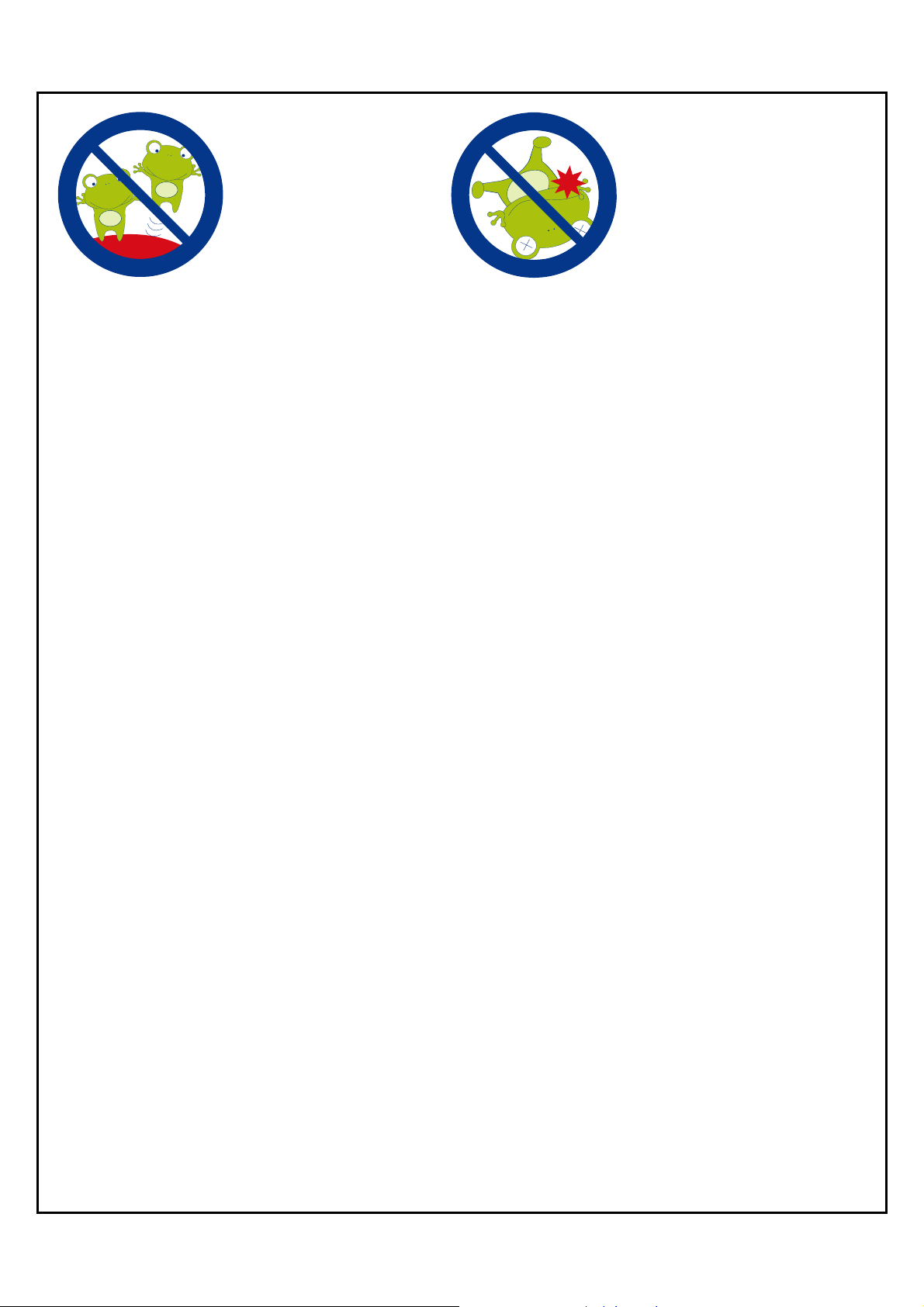
NO MORE THAN ONE
PERSON AT A TIME ON THE
TRAMPOLINE!
MULTIPLE JUMPERS
INCREASE THE RISK OF
INJURY SUCH AS BROKEN
HEAD, NECK, LEG OR BACK.
PARALYSIS OR DEATH CAN
RESULT IF YOU LAND ON
YOUR HEAD OR NECK!
DO NOT PERFORM
SOMERSAULTS (FLIPS) AS
THIS WILL INCREASE YOUR
CHANCES OF LANDING ON
YOUR HEAD OR NECK!
ALWAYS CONSULT A PHYSICIAN BEFORE PERFORMING ANY KIND OF PHYSICAL ACTIVITY
Adequate overhead clearance is essential. A minimum of 24ft from ground level is recommended. Provide
clearance for wires, tree limbs, and other possible hazards.
Lateral clearance is essential. Place the trampoline away from walls, structures, fences, and other play
areas.
Maintain a clear space of 2.5 meters on all sides of the trampoline. For safe use of the trampoline, please
be aware of the following when selecting a place for your trampoline:
Place the trampoline on a level surface before use; illumination may be required for shady areas and
indoor areas.
Secure the trampoline against unauthorized and unsupervised use.
Remove any obstructions from beneath the trampoline.
The owner and supervisors of the trampoline are responsible to make all users aware of practices
specified in the use instructions.
Do not attempt or allow somersaults. Landing on the head or neck can cause serious injury, paralysis or
death, even when landing in the middle of the bed.
Do not allow more than one person on the trampoline. Use by more than one person at the same time can
result in serious injury.
Use trampoline only with mature, knowledgeable adult supervision.
For additional information concerning the trampoline equipment, contact the manufacturer.
Only for domestic use and outdoor use.
Not suitable for children under 3 years. Small parts. Choking hazard. Long cord. Strangulation hazard.
Maximum weight of the user shall not exceed 220lbs (100kg).
Only one user. Collision hazard.
Adult supervision required.
No somersaults.
Always jump in the middle of the mat.
All nuts and bolts must be checked for tightness and if necessary must be retightened.
All spring-loaded (pit pin) joints must be checked to see that they are still intact and cannot become
dislodged during play.
Check all coverings for bolts and sharp edges and replace them if necessary.
If self-locking nuts are used, it should be noted that these are only suitable for one assembly and must
therefore be replaced.
Information regarding the expiry of the enclosure.
Trampolines over 20in. (51 cm) tall are not recommended for use by children under 6 years of age.
Inspect the trampoline before each use. Make sure the frame padding is correctly and securely positioned.
Replace any worn, defective, or missing parts.
Climb on and off the trampoline. It is a dangerous practice to jump from the trampoline to the floor or
ground when dismounting, or to jump onto the trampoline when mounting. Do not use the trampoline as a
springboard onto other objects.
Stop bounce by flexing knees as feet come in contact with the trampoline bed. Learn this skill before
attempting others.
Learn fundamental bounces and body positions thoroughly before trying more advanced skills. A variety of
trampoline activities can be carried out by performing the basic fundamentals in various series and
combinations, performing one fundamental after another, with or without feet bounces between them.
Avoid bouncing too high. Stay low until bounce control and repeated landing in the center of the trampoline
can be accomplished. Control is more important than height.
Focus eyes on the trampoline. This will help control bounce.
Avoid bouncing when tired. Keep turns short.
Properly secure the trampoline when not in use. Protect it against u nauthoriz ed use. If a tra mpoline ladd er
is used, the supervisor should remove it from the trampoline when leaving the area to prevent
unsupervised access by children under 6 years of age.
2
Page 4

Ladder lets young children climb onto trampoline.
Keep objects away which could interfere with the performer. Maintain a clear area around the trampoline.
Do not use the trampoline while under the influence of alcohol or drugs.
For information concerning skill training, contact a certified trampoline instructor.
Bounce only when the surface of the bed is dry. Wind or air movement should be calm to gentle. The
trampoline must not be used in gusty or severe winds.
Always start your jump at the center of the trampolin e mat. When you land more than 1ft away from the
center of the trampoline mat, stop your jump immediately!! Restart your jump at the center of the
trampoline mat.
Read all instructions before using the trampoline, warnings and instructions for the care, maintena nce, and
use of this trampoline are included to promote safe, enjoyable use of this equipment.
Do not eat while jumping
Instructions that the trampoline is not intended to be buried into the ground.
TRAMPOLINE PLACEMENT
The minimum overhead clearance required is 24 feet (7.3 meters). In terms of horizontal clearance,
please ensure that no hazardous objects are near the trampoline such as tree limbs, other
recreational objects (i.e. swing sets, swimming pools), electrical power wiring, walls, fences, etc. For
safe use of the trampoline, please be aware of the following when selecting a place for your
trampoline:
Make sure it is placed on a flat and level surface.
The area is well-lit.
There are no obstructions beneath the trampoline.
When not in use, the trampoline shall be secured against unauthorized use.
The surface of the jump bed shall be dry. Do not jump on wet bed.
Wind or air movement shall be calm and gentle. Do not use trampoline in gusty or severe wind.
Person in charge and responsible for use of the trampoline shall mak e users aware of practice specified
on this manual. Person in charge shall be a qu alified adult. This person shall always be present, when
trampoline is in use.
Do not place trampoline on concrete floor, hard ground su rface (i.e. rock) or slippery surface. Do not use
indoors.
WARNING
If you do not follow these guidelines, you increase the risk of someone getting injured.
This trampoline was designed and manufactured with quality materials and craftsmanship. If proper
care and maintenance are provided, it will provide all jumpers with years of exercise, fun, and
enjoyment as well as reduce the risk of injury. Please follow the guidelines listed below:
This trampoline is designed to withhold a certain amount of weight and use. Please make sure that
only one person is using the trampoline at any one time. Also, the person should weigh less than 220
pounds; jumpers should either wear socks, gymnastics shoes, or be barefoot when using the
trampoline.
Please be aware that street shoes or tennis shoes should NOT be worn while using the trampoline. In
order to prevent the trampoline mat from getting cut or damaged please do not allow any pets onto
the mat. Also, jumpers should remove all sharp objects from their pockets prior to using the
trampoline.
All objects should be kept off the trampoline mat at all times.
Always inspect the trampoline before each use for worn, abused or missing parts. A number of
conditions could arise that may increase your chances of getting injured. Please be aware of:
Punctures, frays, tears or holes worn in the bed or frame padding
Missing, improperly positioned or insecurely attached frame padding
Sagging trampoline mat
Loose stitching or any kind of deterioration of the mat
Bent or broken frame parts (legs and/or rails)
Broken, missing or damaged springs
3
Page 5

Damaged, missing or insecurely attached frame pad
Protrusions of any types (especially sharp typed) on the frame, springs or mat or suspension
Always close the net opening before practice
Empty pockets and hands before practice
Do not exit the mat by a jump
Limit the time of continuous usage (make regular stops)
IF YOU FIND ANY OF THE PREVIOUS CONDITIONS OR ANYTHING ELSE THAT YOU FEEL
COULD CAUSE HARM TO ANY USER, THE TRAMPOLINE SHOULD BE DISASSEMBLED OR
SECURED FROM USE UNTIL THE CONDITION(S) HAS BEEN RESOLVED.
WINDY CONDITIONS
In severe wind situations, the trampoline can be blown about. If you expect windy weather conditions,
the trampoline should be moved to a sheltered area or be disassembled. Another option is to tie the
round, outside portion (top frame) of the trampoline to the ground using ropes and stakes. To ensure
security, at least four (4) tie downs should be used. Do not just secure the legs of the trampoline to
the ground because they can be pulled out of the frame sockets.
TRAMPOLINES OVER 20 IN. (51CM) TALL ARE NOT RECOMMENDED FOR USE BY CHILDREN
UNDER 6 YEARS OF AGE.
DO NOT USE INDOORS.
IMPORTANT !
READ IT! Failure to follow these instructions to ensure proper operational condition of your
trampoline may lead to serious injury or death. Do not allow more than one person on the
trampoline at a time.
1. Maintenance of T r am poline Enclosure Net and Pad
Enclosure net and pad are prone to wear and tear like tires on a car. Gradual deterioration of the material will
occur, the speed of which will depend on the level of exposure to UV rays, airborne pollution, and outdoor
weather conditions such as rain and wind.
The net and pad need to be properly maintain ed and checked by following the Maintenance Schedule set out in
these instructions. When the material shows any signs of weakness, you must stop using the trampoline
immediately, properly store the trampoline and restrict access by users until a new replacement net or pad is
properly installed.
2. Maintenance Requirement for Enclosure Net
Your trampoline enclosure netting is manufactured with UV resistant material. Despite this the netting is
exposed to the outdoor elements including sunlight, wind, rain and wildlife.
The net surrounding the trampoline must be checked prior to each use. This includes, but is not limited to
inspecting the net for cracks, excess wear, brittleness, stretching, all connections and for overall integrity. The
net must be immediately replaced if it shows any signs of wear, damage, being stretched, cracked, loose, brittle
or otherwise loses any integrity. The following Maintenance Schedule must be followed:
1 to 3 Months 3 to 6 Months 6 to 12 Months
Thorough inspection for UV
damage and prior to every
use for net.
Thorough inspection for UV
damage and prior to every
use for net, net hanger and
straps.
Thorough inspection before
every use on net, net
hanger, straps, zippers, ties
and strings. Replace after
12 months or earlier
4
Page 6

IT IS RECOMMENDED THAT THE NET BE REPLACED ON A YEARLY BASIS OR
EARLIER UNDER NORMAL USE, EVEN IF IT DOES NOT SHOW ANY VISIBLE
SIGNS OF DAMAGE.
INFORMATION ON USE OF THE TRAMPOLINE
Initially, you should get accustomed to the feel and bounce of the trampoline. The focus must be
on the fundamentals of your body position and you should practice each bounce (the basic
bounces) until you can do each skill with ease and control.
To break a bounce, all you need to do is flex your knees sharply before they come in
contact with the mat of the trampoline. This technique should be practiced while you are
learning each of the basic bounces. The skill of braking should be used whenever you lose
balance or control of your jump.
Always learn the simplest bounce first and be consistent with the control of your bounce before
moving on to more difficult and advanced bounces. A controlled bounce is one when your
take off point and landing point is the same spot on the mat. If you move up to the next
bounce without first mastering the previous, you increase your chances of getting injured.
Do not bounce on the trampoline for extended periods of time because fatigue can increase your
chances of becoming injured. Bounce for a brief period of time and then allow others to join in on
the fun! Never have more than one person bouncing on the trampoline.
Jumpers should wear clothing free of drawstrings, hooks, loops or anything that could get caught
while using the trampoline/enclosure and result in entanglement or strangulation, or both.
If you are just beginning, you may want to wear long sleeve shirts and pants to protect against
scrapes and abrasions until you master correct landing positions and form.
Do not wear hard sole shoes, such as tennis shoes on the trampoline, as this will cause
excessive wear on the mat material.
You should always mount and dismount properly in order to avoid injury. To mount properly, you
should PLACE your hand on the frame and either step or roll up onto the frame, over the springs,
and onto the trampoline mat. You should always remember to place your hands onto the frame
while mounting or dismounting. Do not step directly onto the frame pad or grasp the frame pad.
To dismount properly, move over to the side of the trampoline and place your hand onto the
frame as a support and step from the mat to the ground. Smaller children should be assisted
when mounting and dismounting the trampoline.
Do not bounce recklessly on the trampoline since this will increase your chances of getting
injured. The key to safety and having fun on the trampoline is control and mastering the various
bounces. Never try to out-bounce another bouncer in terms of height! Never use the trampoline
alone without supervision.
ACCIDENT CLASSIFICATION
Mounting and dismounting: Be very careful when getting on and off the trampoline. DO NOT mount
the trampoline by grabbing the frame pad, stepping onto the springs, or by jumping onto the mat of
the trampoline from any object (i.e. a deck, roof, or ladder). This will increase your chances of getting
injured! DO NOT dismount by jumping off the trampoline and landing on the ground, regardless of the
makeup of the ground. If small children are playing on the trampoline, they may need help in
mounting and dismounting.
5
Page 7
.
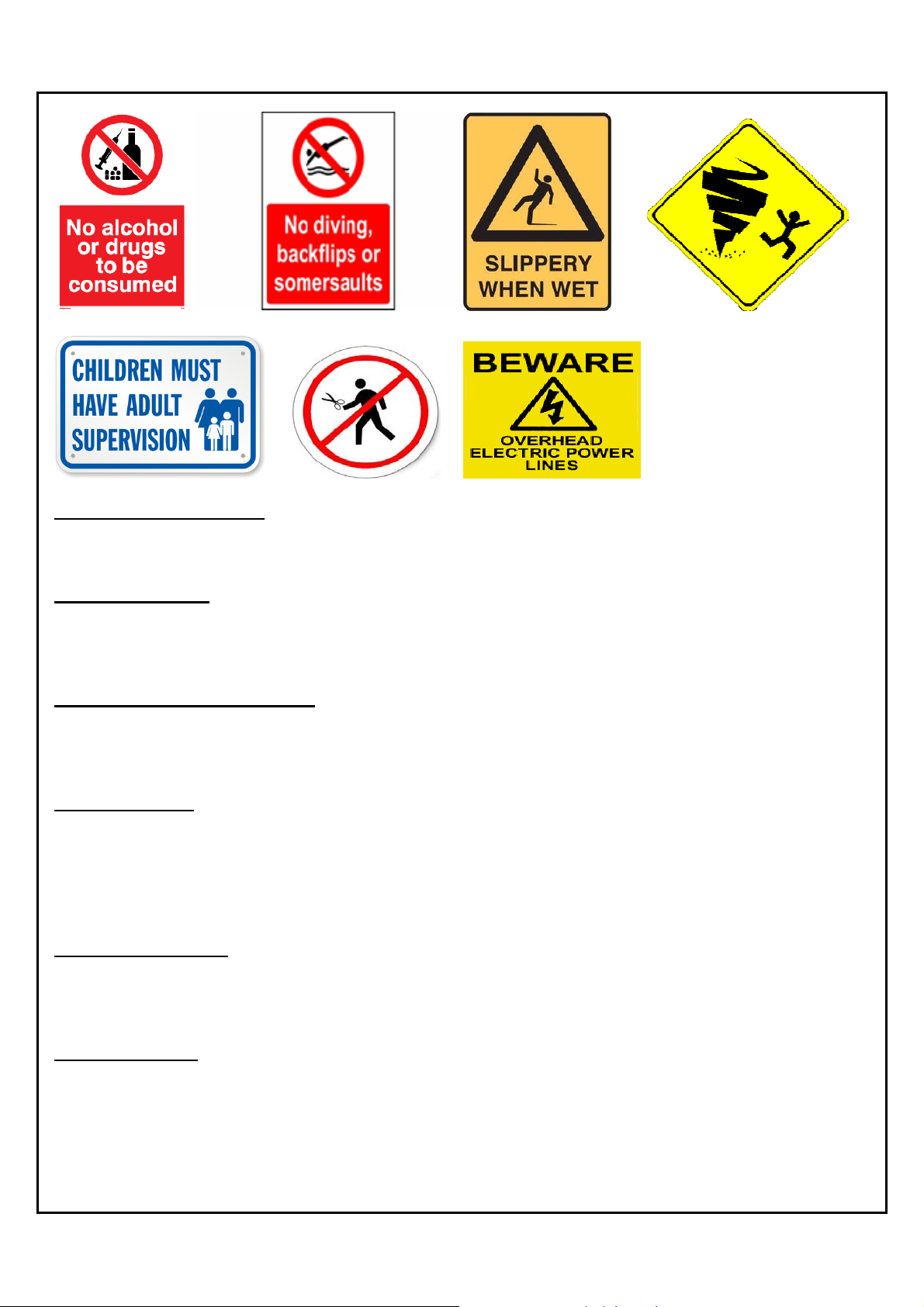
Use of alcohol or Drugs: DO NOT consume any alcohol or drugs when using this trampoline! This
will increase your chances of getting injured since these foreign substances might impair your
judgments, reaction time, and overall physical coordination.
Multiple Jumpers: If you have multiple jumpers (more than one person on the trampoline at any one
time), you increase the chances of getting injured. Injuries could occur when you fly off the trampoline,
lose control, collide with the other jumper(s) or land on the springs. Generally, the lightest person on
the trampoline will get injured.
Striking the Frame or Springs: When playing on the trampoline, STAY in the center of the mat. This
will reduce the risk of getting injured by landing on the frame or springs. Always ensure that the frame
pad covers the frame of the trampoline. DO NOT jump or step onto the frame pad directly since it was
not intended to support the weight of a person.
Loss of Control: DO NOT try difficult manoeuvres, or any manoeuvre until you have mastered the
previous maneuverer, or if you are just learning how to jump on a trampoline. If you do, you will
increase the risk of getting injured by landing on the frame, springs or off the trampoline completely
because you might lose control of your jump. A controlled jump is considered landing on the same
spot that you took off from. If you do lose control when you are jumping on the trampoline, bend your
knees sharply when you land and this will allow you to regain control and stop your jump.
Somersaults (Flips): DO NOT PERFORM somersaults of any type (backwards or forwards) on this
trampoline, if you make a mistake when trying to perform a somersault, you could land on your head
or neck. This will increase your chances of getting your neck or back broken, which will result in death
or paralysis, even when landing in the middle of the trampoline mat.
Foreign Objects: DO NOT use the trampoline if there are pets, other people, or any objects
underneath the trampoline. This will increase the chances of an injury occurring. DO NOT hold any
foreign objects in your hand and DO NOT place any objects on the trampoline while anyone is playing
on it. Please be aware of what is overhead when you are playing on the trampoline. Tree limbs, wires,
of other objects located over the trampoline will increase your chances of getting injured.
6
Page 8
Poor Maintenance of Trampoline: A trampoline in poor condition will increase your risk of getting
injured. Please inspect the trampoline before each use for bent steel tubes, torn mat, loose or broken
springs, and overall stability of the trampoline.
Weather Conditions: Please be aware of the weather conditions when using the trampoline. If the
mat of the trampoline is wet, the jumper could slip and injure him or herself. If it is too windy, jumpers
could lose control.
Limiting Access: When the trampoline is not in use, always store the access ladder in a secure
place so that children cannot play on the trampoline unsupervised.
TIPS TO REDUCE THE RISK ACCIDENTS
Jumper’s role in accident prevention
The key here is to stay in control of your jumps. DO NOT move onto more complicated, more difficult
manoeuvres until you have mastered the basic, fundamental bounce.
Education is also key to safety and very important. Read, understand, and practice all safety
precautions and warnings prior to using the trampoline. A controlled jump is when you land and take
off from the same location. For additional safety tips and instructions, contact a certified trampoline
instructor.
Supervisor’s Role in Accident Prevention
Supervisors need to understand and enforce all safety rules and guidelines. It is the responsibility of
the supervisor to provide knowledgeable advice and guidance to all jumpers of the trampoline. If
supervision is unavailable or inadequate, the trampoline could be stored in a secure place,
disassembled to prevent unauthorized use, or covered with a heavy tarp that can be locked or
secured with lock or chains. The supervisor is also responsible to ensure that the safety placard is
placed on the trampoline and that jumpers are informed of these warnings and instructions.
TRAMPOLINE SAFETY INSTRUCTIONS
JUMPERS
Do not use trampoline if you have consumed alcohol or drugs
Remove all hard and sharp objects from person before using trampoline
You should climb on and off in a controlled and careful manner. Never jump on or off the
trampoline and never use the trampoline as a device to bounce onto or into another object.
Always learn the basic bounce and master each type of bounce before trying more difficult types
of bounces. Review the Basic Skills Section to learn how to do the basics
To stop your bounce, flex your knees when you land on the mat with your feet
Always be in control when you are bouncing on the trampoline. A controlled jump is when you
land at the same spot that you took off from. If at any time you feel out of control, try to stop your
bouncing
Do not jump or bounce for prolonged periods of time or too high for a number of jumps
Keep your eyes in the mat to maintain control. If you do not, you could lose balance or control
Never have more than 1 person on the trampoline at any one time
Always have a supervisor watching you when you are on the trampoline
SUPERVISORS
Educate yourself with the basic jumps and safety rules. To prevent and reduce the risk of injuries,
enforce all safety rules and ensure that new jumpers learn the basic bounces before trying more
difficult and advanced jumps.
All jumpers need to be supervised, regardless of skill level or age.
7
Page 9
Never use the trampoline when it is wet, damaged, dirty, or worn out. The trampoline should be
inspected before any jumpers start bouncing on it.
Keep all objects that could interfere with the jumper away from the trampoline. Be aware of what
is overhead, underneath, and around the trampoline.
To prevent unsupervised and unauthorized use, the trampoline should be secured when not in
use.
LESSON PLAN
The following lessons are suggested in order to learn basic steps and bounces before moving onto
more difficult, complicated bounces. Before actually getting on and using the trampoline, you should
read and understand all safety instructions. A complete discussion and demonstration of body
mechanics and trampoline guidelines should occur between the supervisor and student as well.
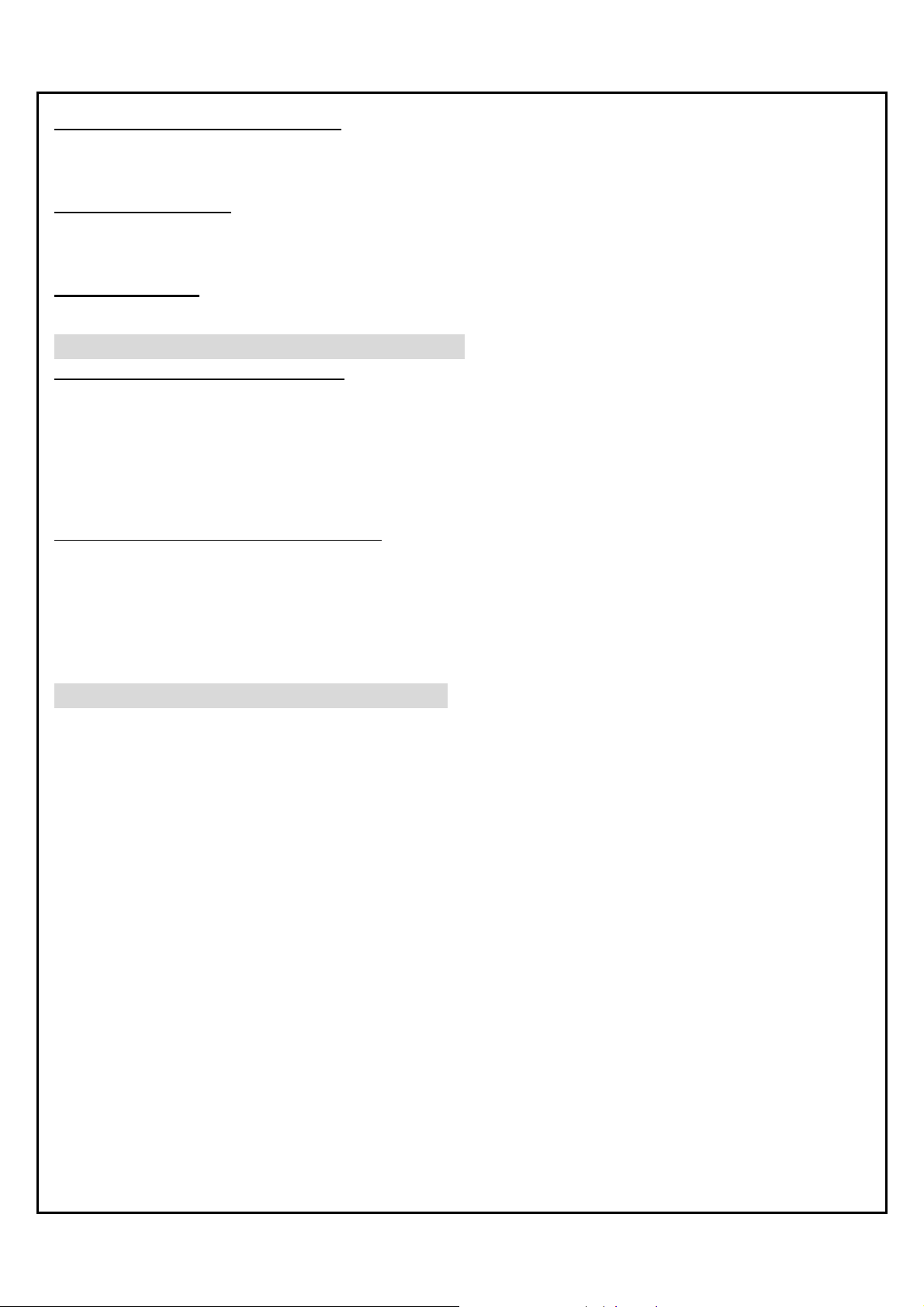
THE BASIC BOUNCE
1. Start from the standing position, with your feet
having shoulder width apart and with head up
and eyes on mat.
2. Swing arms forward and up in a circular motion.
3. Bring feet together while in mid-air and point
toes downwards.
4. Keep the feet shoulder width apart when landing
on mat.
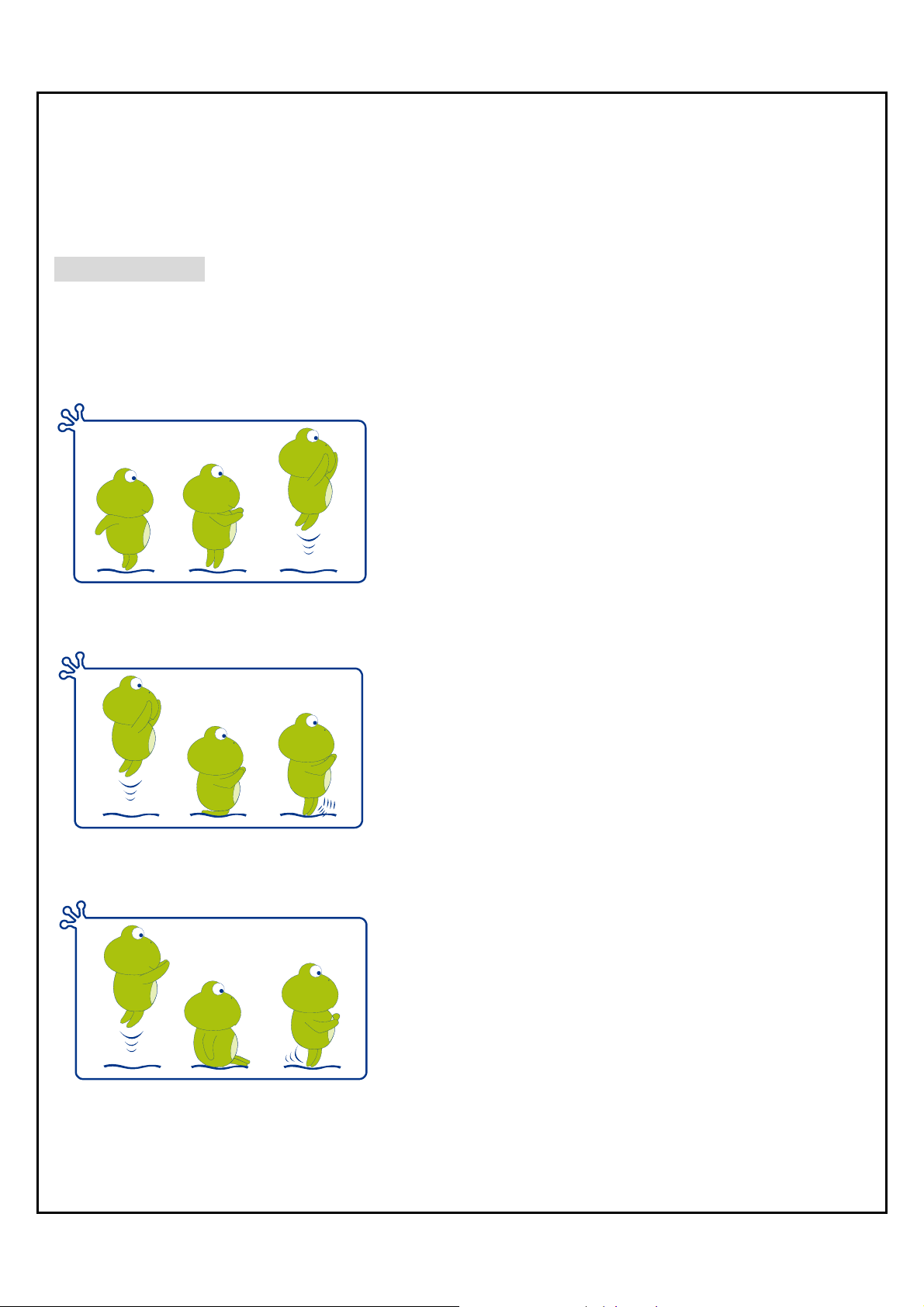
KNEE BOUNCE
SEAT BOUNCE
1. Start with the basic bounce and keep it low.
2. Land on knees while keeping your back
straight and body erect while using your arms
to maintain balance.
3. Bounce back to basic bounce position by
swinging arms up.
1. Land in a flat sitting position.
2. Place hands on mat besides hips, but do not
lock your elbow.
3. Return to erect position by pushing with
hands.
8
Page 10
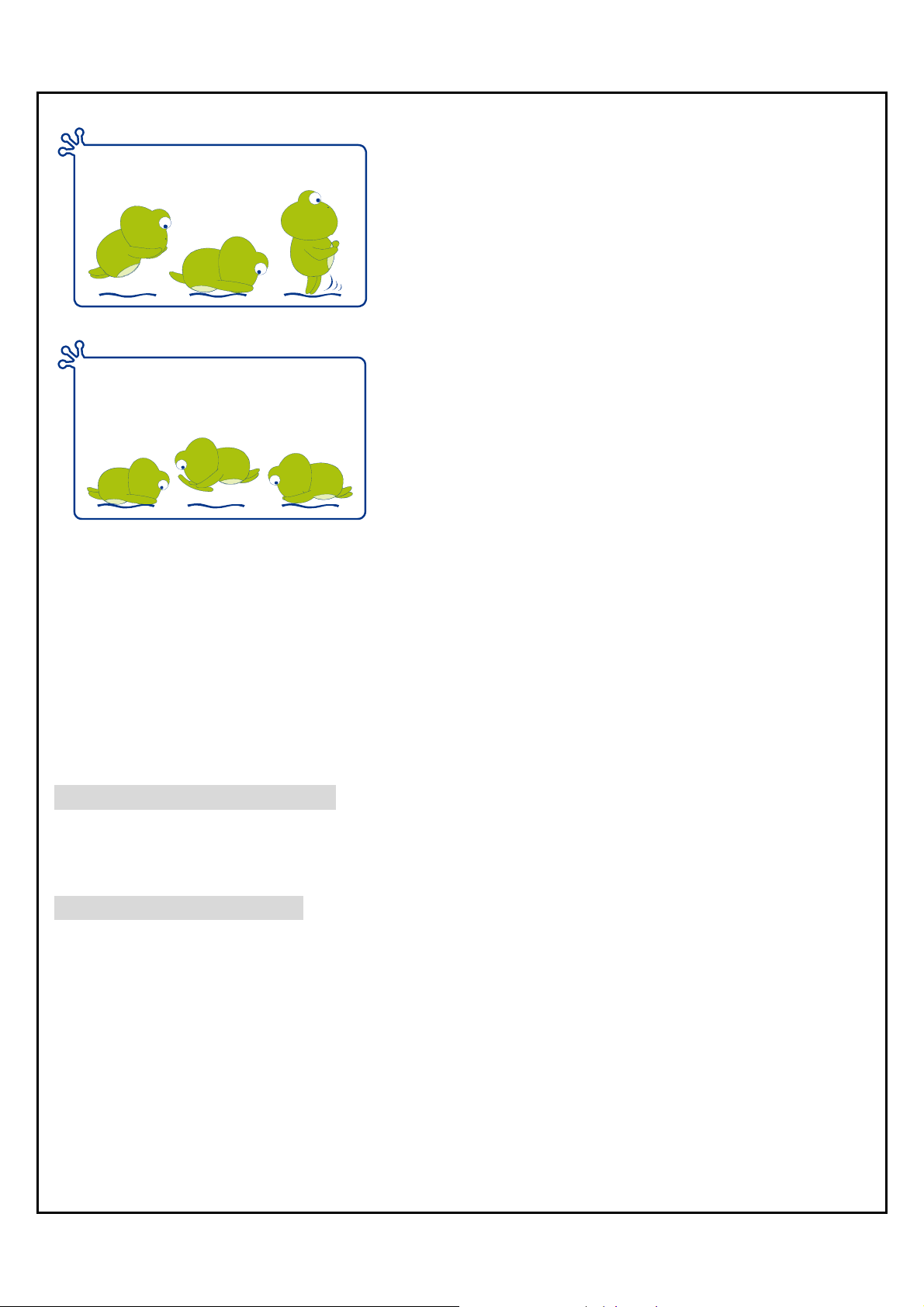
FRONT BOUNCE
180 DEGREE BOUNCE
1. Start with a low bounce.
2. Land in prone (face down) position and keep
hand and arms extended forward on mat.
3. Push off the mat with arms to return to
standing position.
1. Start with the Front Bounce position.
2. Push off with left or right hands and arms
(depending on which way you wish to turn).
3. Maintain head and shoulders in the same
direction while keeping your back parallel to
the mat and your head up.
4. Land in the Prone position and return to
standing position.
ALWAYS START YOUR JUMP AT THE BROKEN CIRCLE. WHEN YOU LAND
MORE THAN 1FT OR 30.5CM AWAY FROM THE EDGE OF THE BROKEN CIRCLE,
STOP YOUR JUMP IMMEDIATELY!!
RESTART YOUR JUMP AT THE OF BROKEN CIRCLE.
ALWAYS START YOUR JUMP AT THE CENTER OF THE TRAMPOLINE MAT.
WHEN YOU LAND MORE THAN 1FT OR 30.5CM AWAY FROM THE CENTER OF
THE TRAMPOLINE MAT, STOP YOUR JUMP IMMEDIATELY!!
RESTART YOUR JUMP AT THE CENTER OF THE TRAMPOLINE MAT.
ASSEMBLY INSTRUCTIONS
To assemble this trampoline all you need is our special spring loading tool provided with this
product. During periods of non-use, this trampoline can be easily disassembled and stored. Please
read the assembly instructions before beginning to assemble the product.
PRIOR TO ASSEMBLING
Please refer to next page for parts descriptions and numbers. The assembly steps use these
descriptions and numbers as reference for your convenience.
Make sure that you have all parts listed. If you are missing any parts, please refer to this page for
instructions on how to attain any parts.
To prevent any injuries to your hands from pinch points during assembly, please use protective
gloves to protect your hands.
9
Page 11
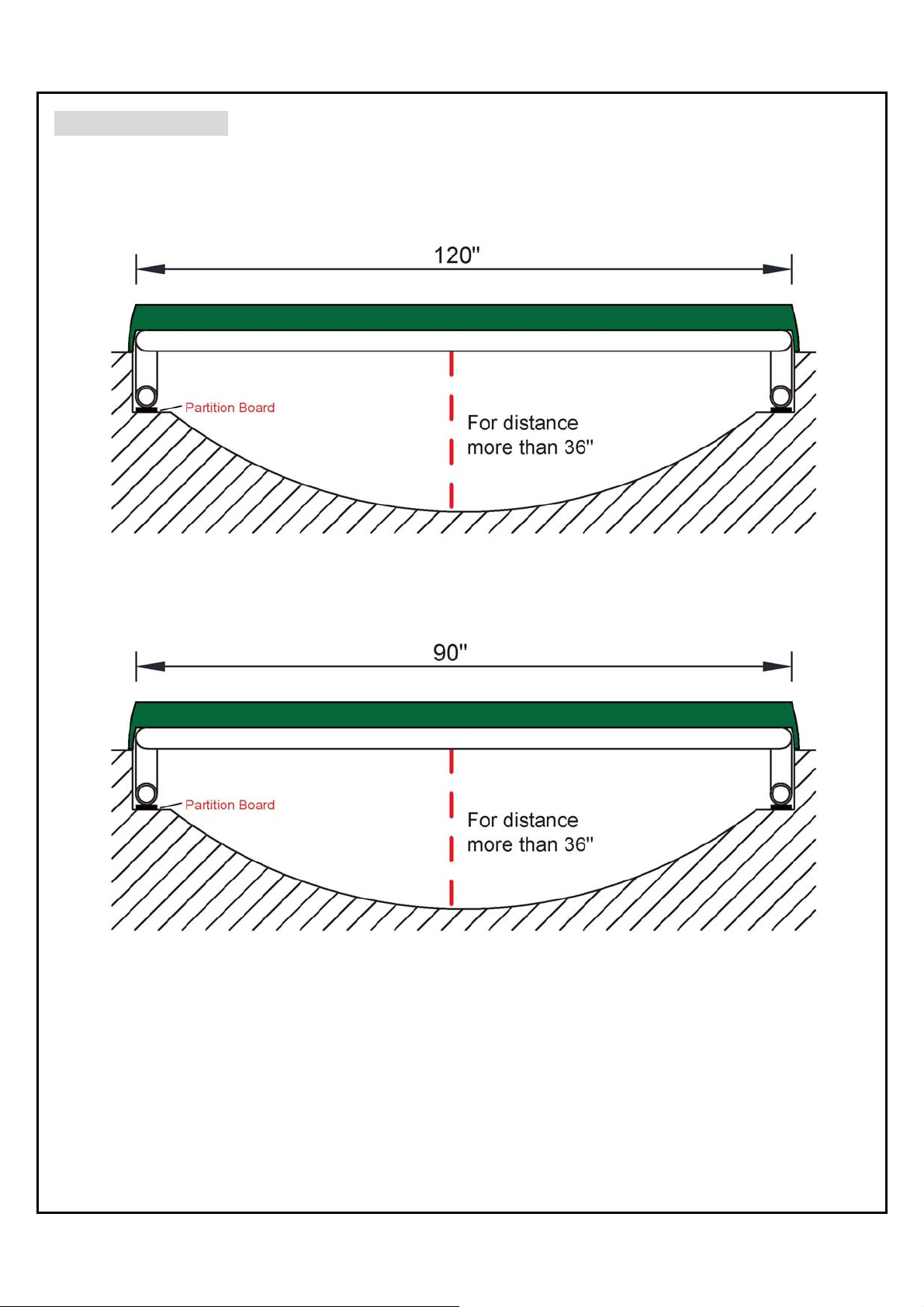
Working Drawing
Please refer to the following figure to dig a pit.
Long Side View :
Short Side View :
10
Page 12
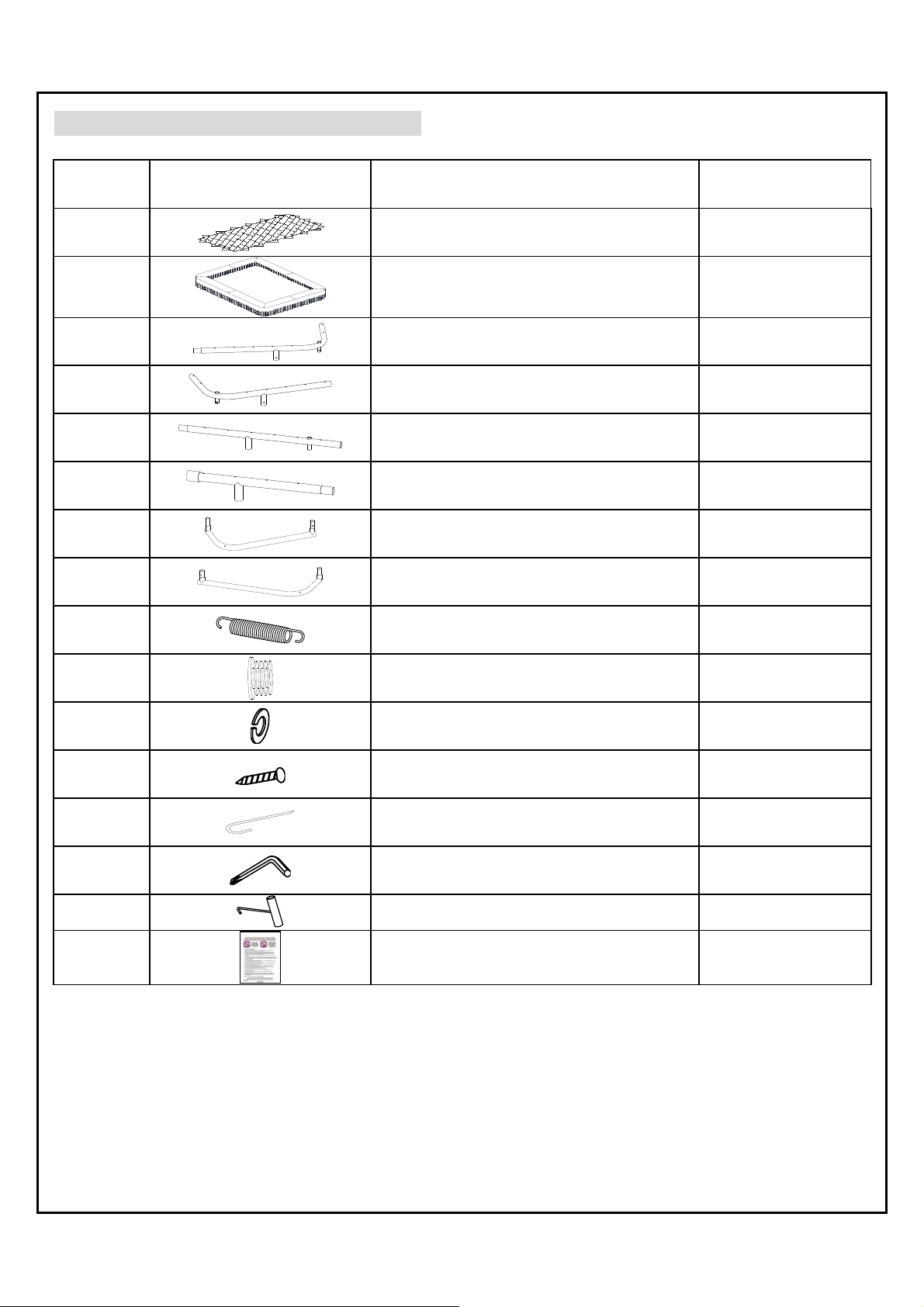
Trampoline and Enclosure Parts List
Trampoline
Part
Number
1
2
3
4
5
6
7
8
Diagram Description Quantity
Trampoline Mat, stitched with Triangle-
Rings
1
Frame Pad 1
Top Rail with Leg Sockets A 2
Top Rail with Leg Sockets B 2
Top Rail with Leg Sockets C 2
Top Rail with Leg Sockets D 2
Leg Base A 2
Leg Base B 2
9
Galvanized Springs 58
10 Large Cap(used on Leg Base) 8
11
12
13
14
Small Spring Lock Washer 8
Self-Locking Screw 8
Anchor Set 6
Allen Wrench 1
15 Spring Loading Tool 1
16 Trampoline Safety Instruction Placard 1
11
Page 13
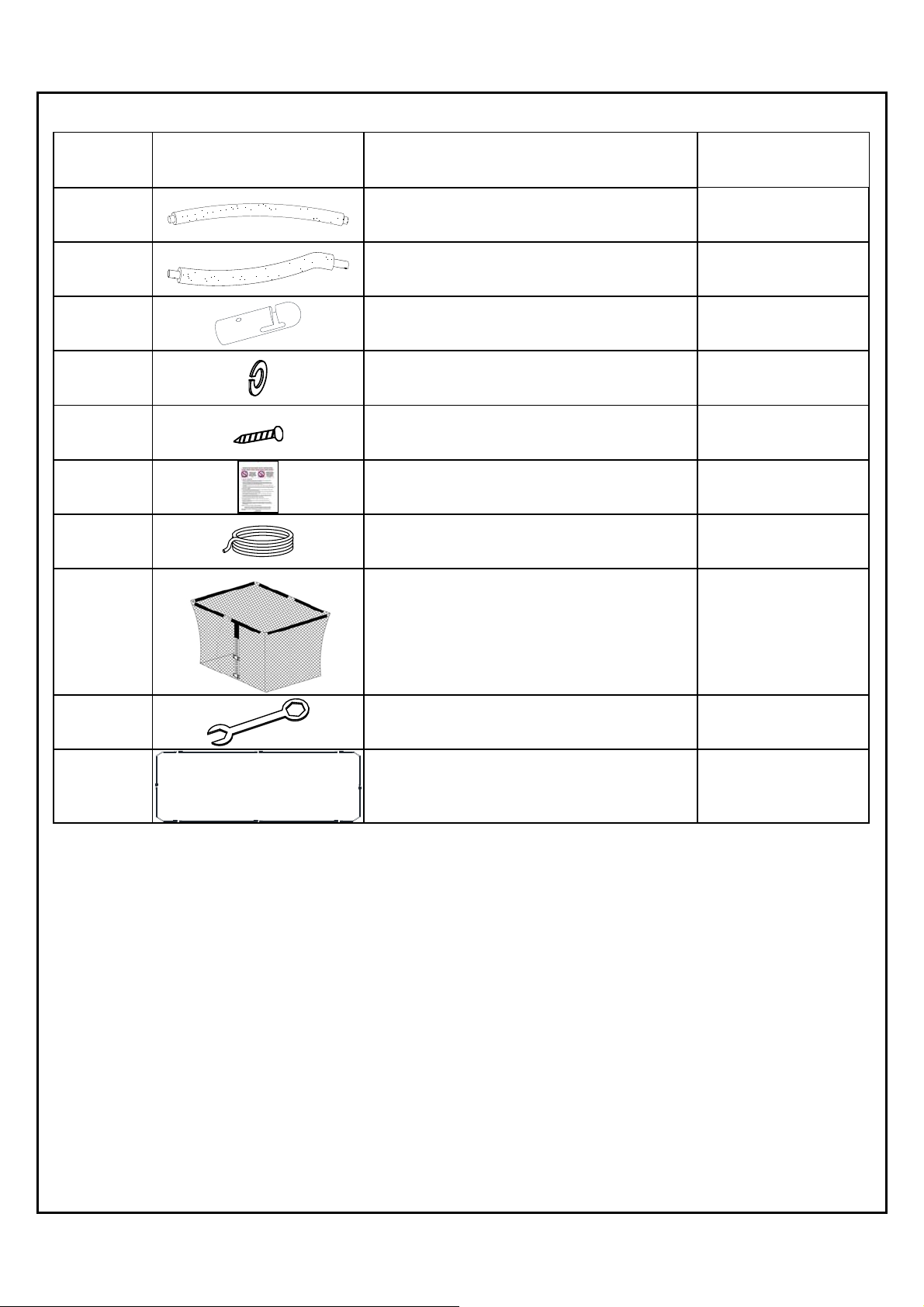
Enclosure
Part
Number
A
B
C
Diagram Description Quantity
Upper Frame Tube with Foam 6
Lower Frame Tube with Foam 6
Plastic Cap
D
E
Small Spring Lock Washer
Self-Locking Screw
F Enclosure Safety Instruction Placard 1
G
Cord
6
6
18
6
H
Enclosure Netting
1
I
Wrench
1
J
Cable Wire Sets
1
TOOLS REQUIRED FOR ASSEMBLY ARE LISTED ABOVE. PHILLIPS SCREW DRIVER,
WHICH IS NOT INCLUDED, COULD BE USED FOR EASIER ASSEMBLY.
12
Page 14
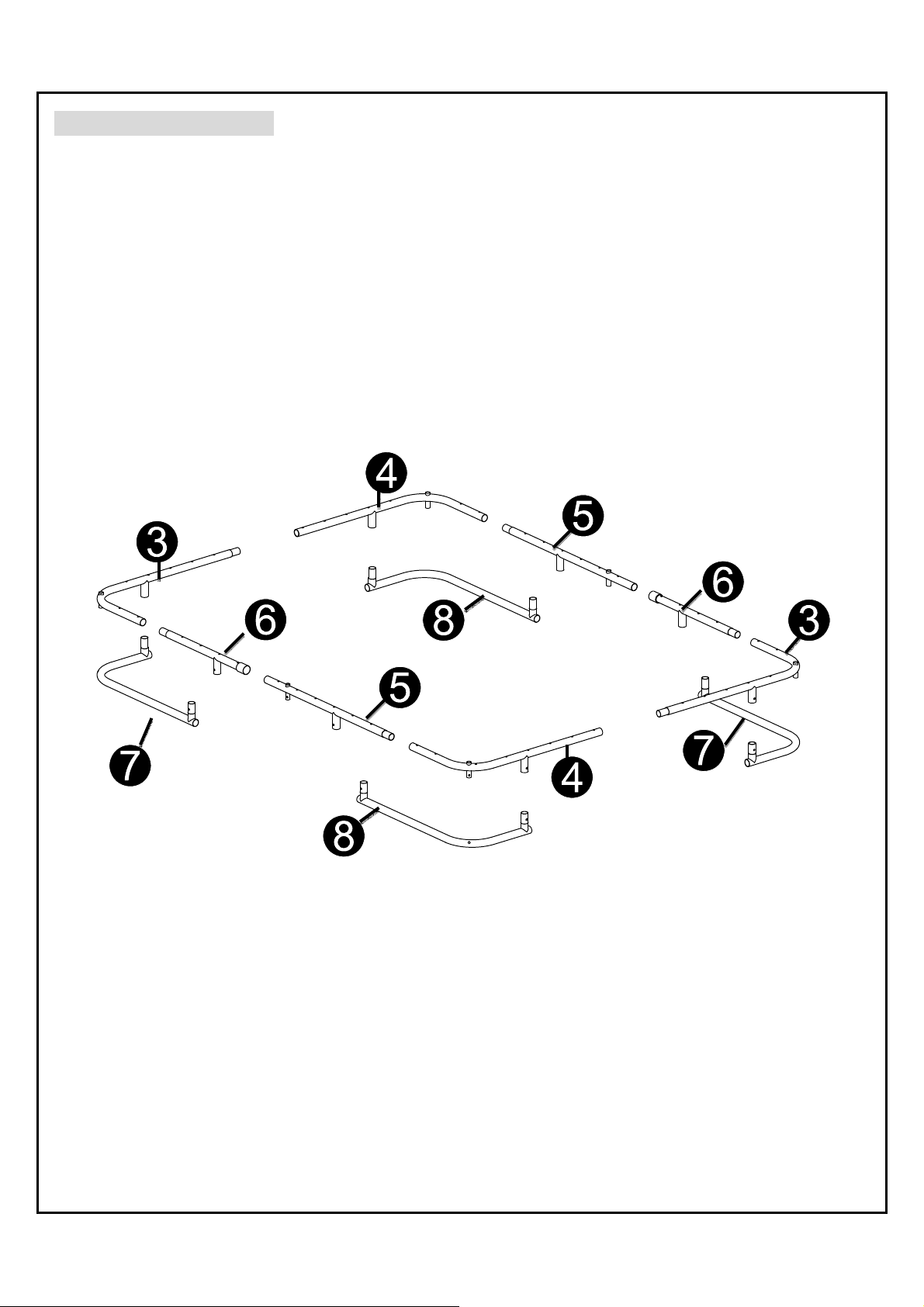
Trampoline Assembly
STEP 1
Locate the following 12 pieces of steel tubing parts that are needed to assemble the trampoline frame:
Top Rail with Leg Sockets A (# 3)
2 -
Top Rail with Leg Sockets B (# 4)
2 -
Top Rail with Leg Sockets C (# 5)
2 -
Top Rail with Leg Sockets D (# 6)
2 -
Leg Base A (# 7)
2 -
Leg Base B (# 8)
2 -
Lay out all the parts on dry flat surface as shown in STEP 1.
All parts with the same number are interchangeable and have no “right” or “left” orientation.
Note:
13
Page 15
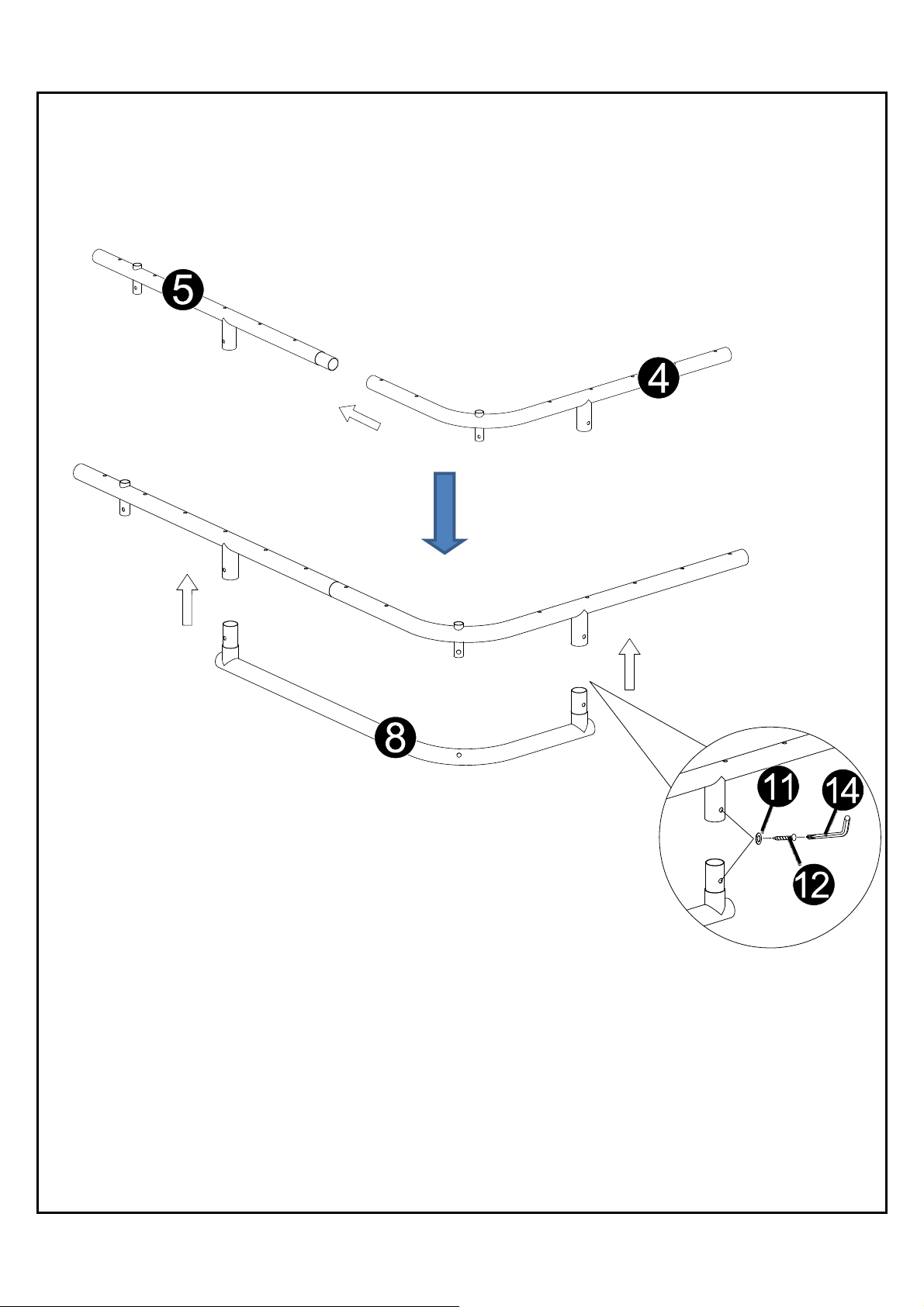
STEP 2
Connect Top Rail with Leg Sockets B (# 4) and Top Rail with Leg Sockets C (# 5) as shown.
Secure the Leg Base B(# 8)to the ASSEMBLED Top Rails with Leg Sockets by using Self-Locking Screw (#
12) , Small Spring Lock washer (# 11) as shown in STEP 2.
14
Page 16
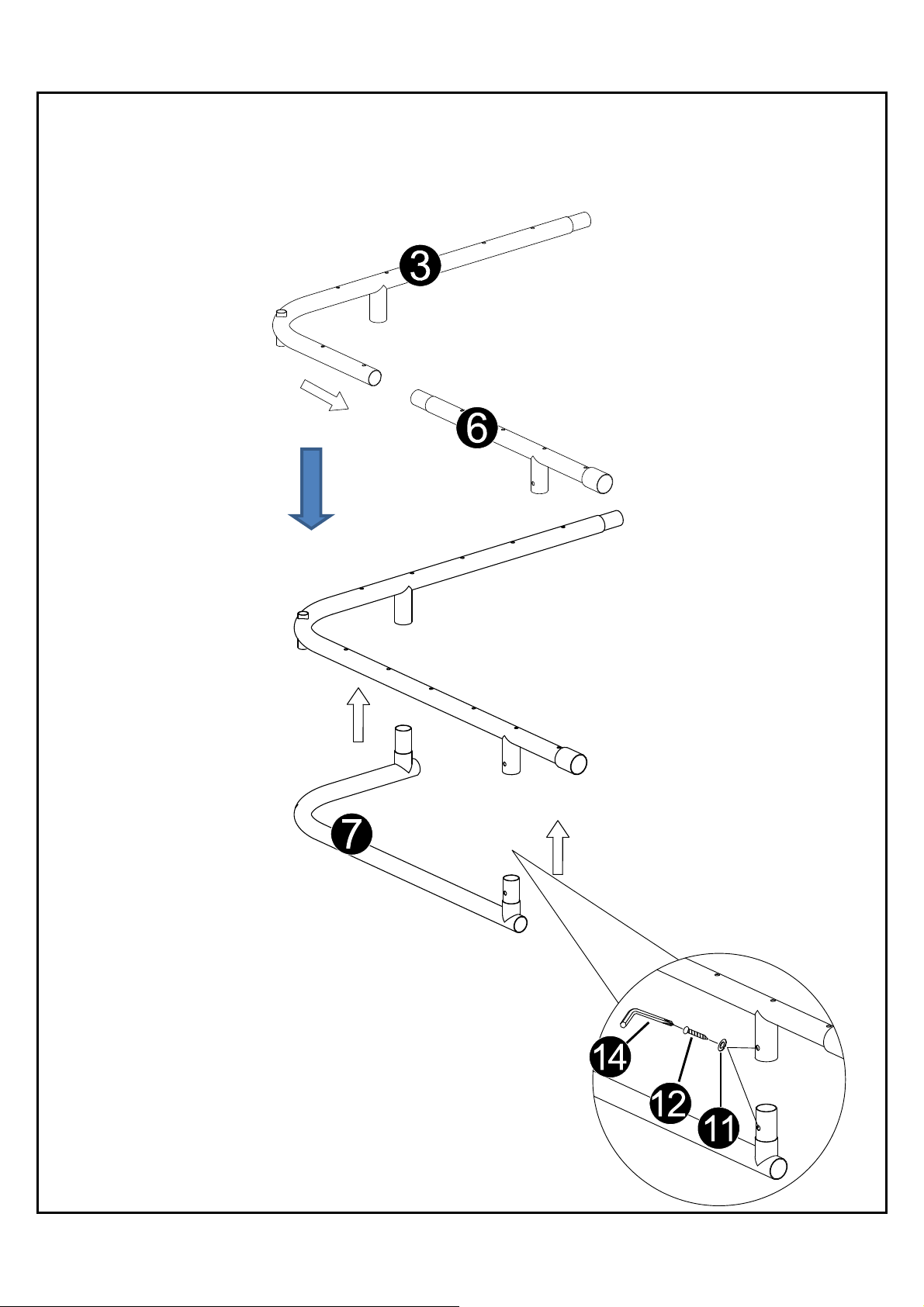
STEP 3
Connect Top Rail with Leg Sockets A (# 3) and Top Rail with Leg Sockets D (# 6) as shown.
Secure the Leg Base A(# 7)to the ASSEMBLED Top Rails with Leg Sockets by using Self-Locking Screw (#
12) , Small Spring Lock washer (# 11) as shown in STEP 3.
15
Page 17
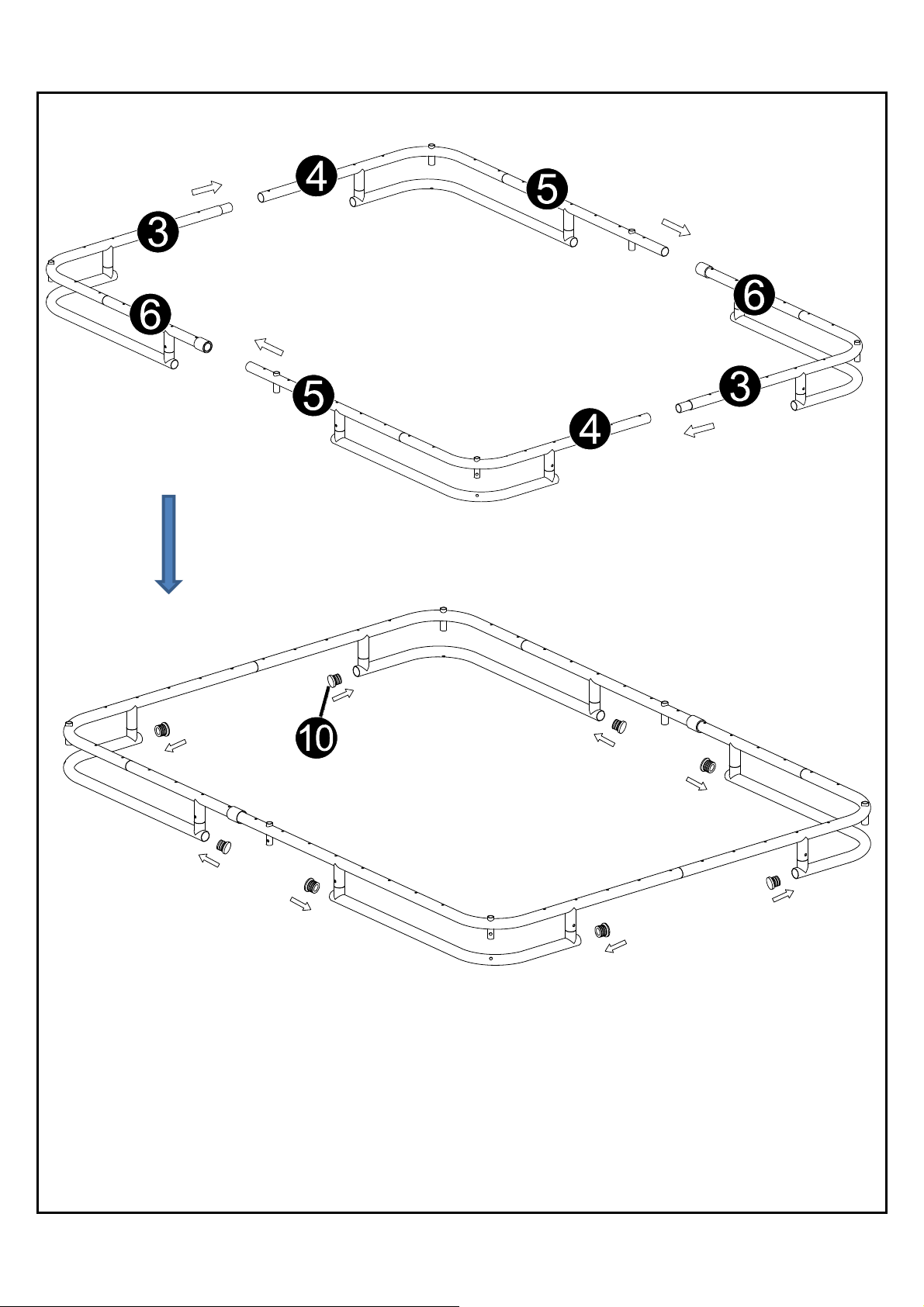
STEP 4
Insert Large Cap(# 10) to Leg Base.
16
Page 18
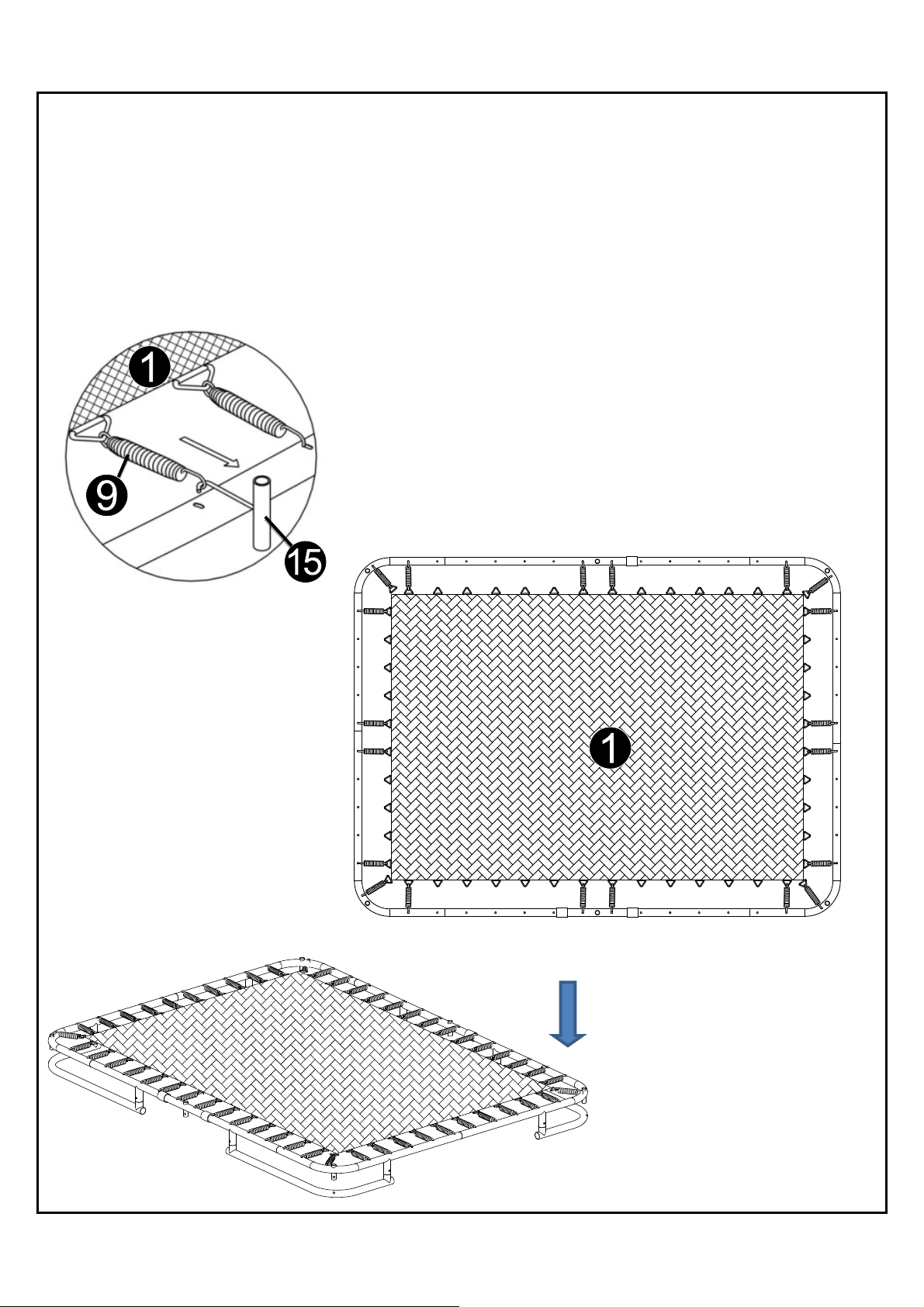
STEP 5
Place the Trampoline Mat (# 1) flat on the ground inside the assembled frame with the warning labels facing up
as shown in STEP 5.
Select a starting point on the frame and let it be called point “ONE” , hook one end of the Spring (# 9) into the
Triangle-Ring on the Mat (# 1). Holding the Spring Loading Tool (# 15) underhand, pull the other end of the
Spring and lock it into the hole on the frame as shown in STEP 5.
Hint: Tap on the Spring (# 9) with the handle of the Spring Loading Tool to make sure it is securely latched into
the hole.
1st
th
5
th
th
9
7
11
th
3rd
13th
14
15th 16
17
th
18
19th
th
4
20
th
6
8
th
th
10
12
th
nd
2
th
th
th
th
17
Page 19
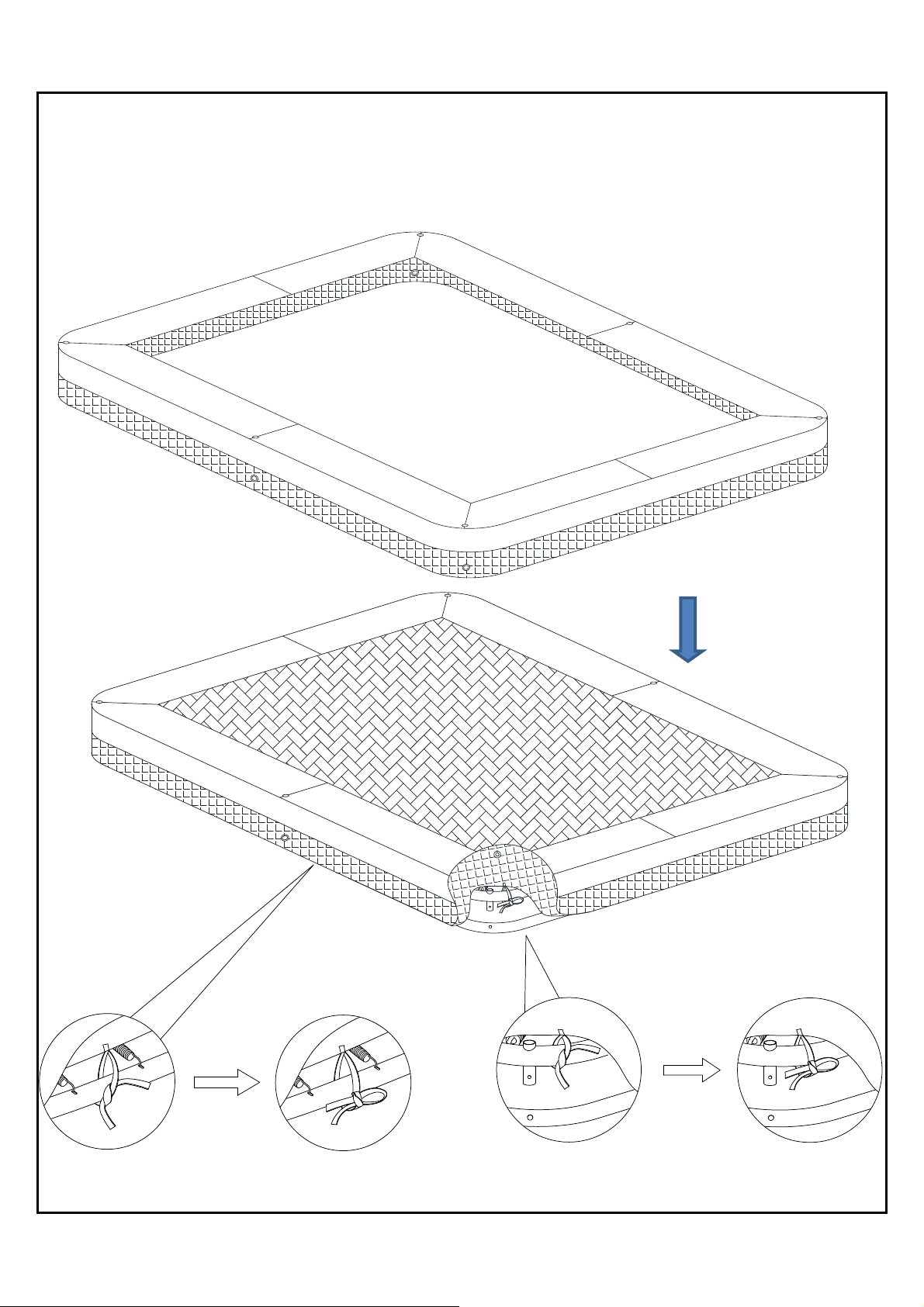
STEP 6
Lay the Frame Pad (# 2) over the trampoline so that the springs and steel frame are fully covered. Next, line up
the elastic straps to the Top Rail and wrap. First, tie a knot and then a one-sided bow as shown in STEP 6.
Finally, wrap the inner elastic straps around the triangle-ring and tie a half-knot , then tie it into a one-sided
bow.
Repeat this step for all of the straps.
18
Page 20
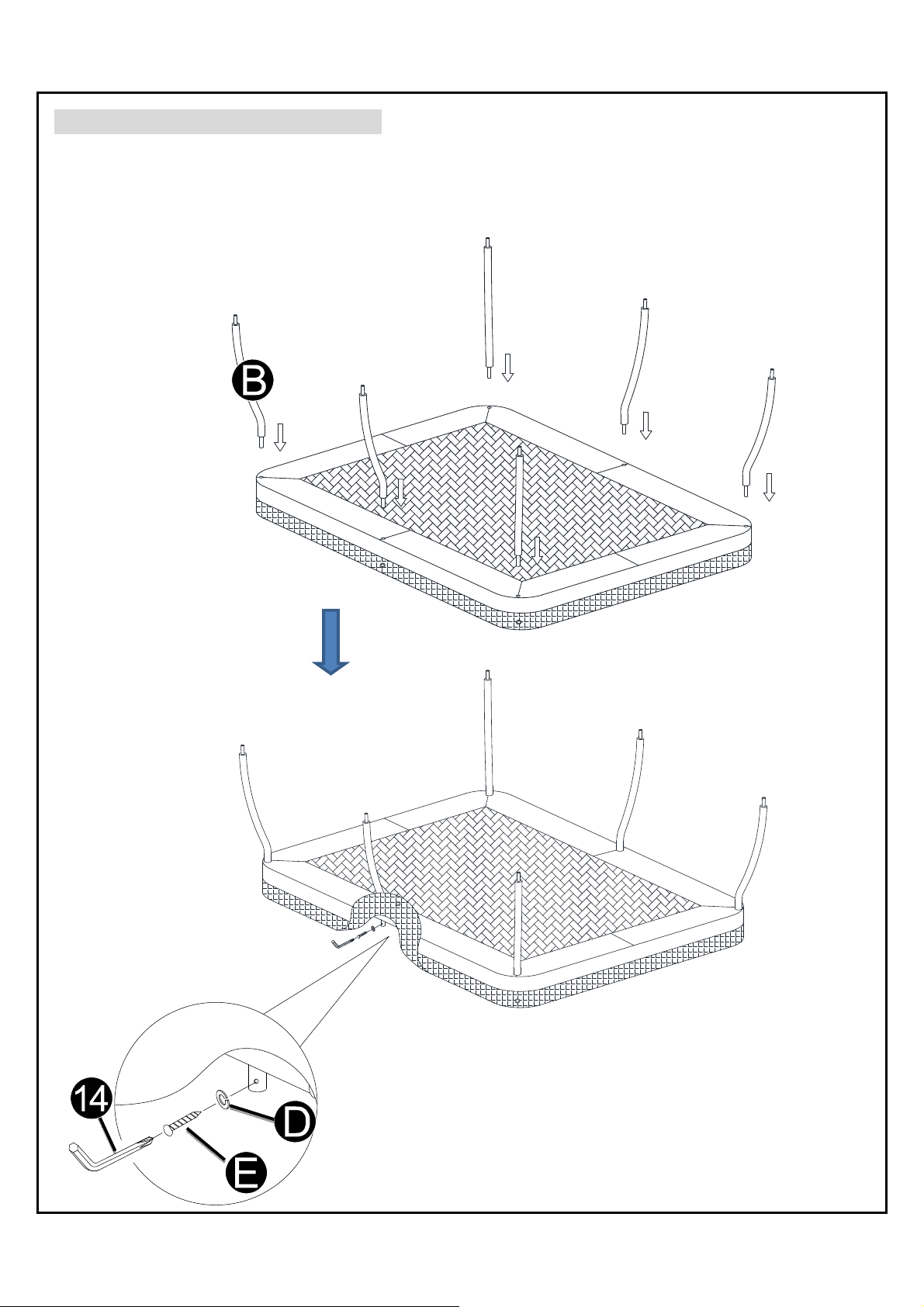
Trampoline Enclosure Assembly
STEP 7
Insert Lower Frame Tube with Foam (# B) to holes in Top Rail with Leg Sockets and secure them by using
Self-Locking Screw (# E) , Small spring Lock washer (# D) as shown in STEP 7.
19
Page 21
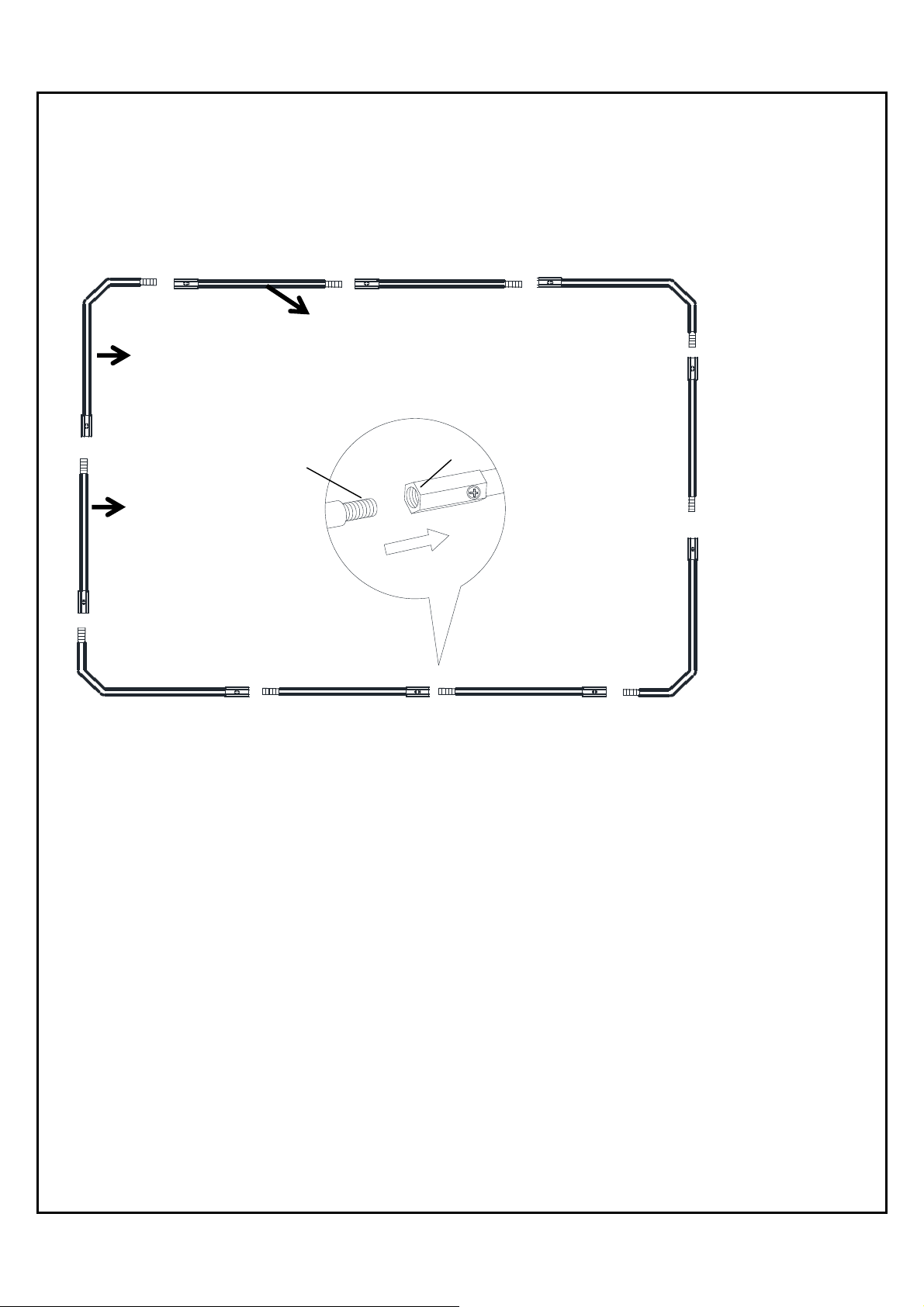
STEP 8
list the cable wires as below :
There are 10 Cable Wires (# J) needed to form the enclosure top frame.
4-STYLE A
6-STYLE B
STYLE A
STYLE B
STYLE B
Thread
10FT SIDE
Nut
7.5FT SIDE
20
Page 22
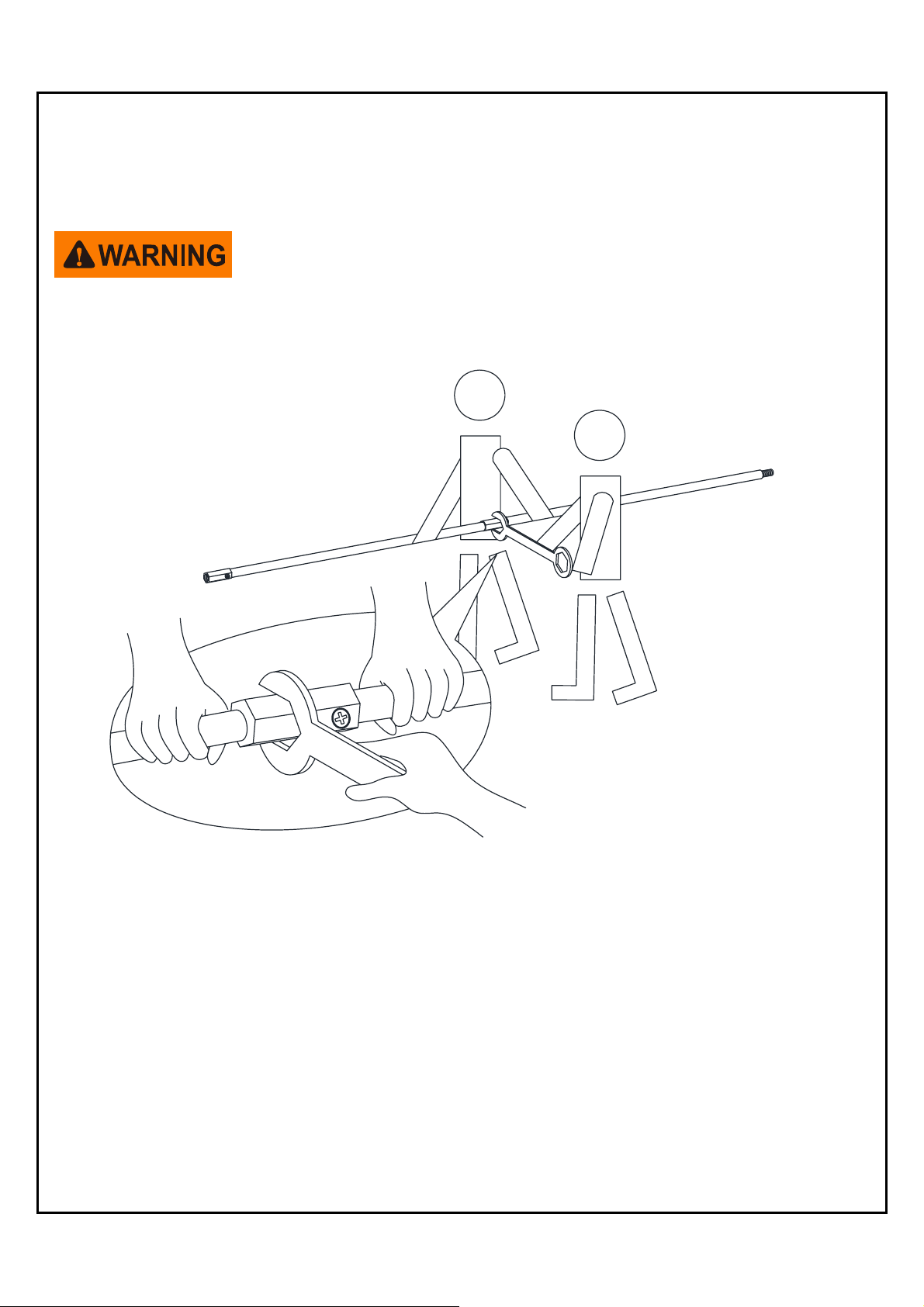
STEP 9
Assembly the Cable wire sets
Connect the two ends of the Cable Wires and securely tighten using the Wrench (# I).
Please ensure that the cable wires are securely fastened together using the Wrench. Failing to do so
may increase the chance of injury due to the enclosure frame snapping apart during assembly or
trampoline use.
21
Page 23
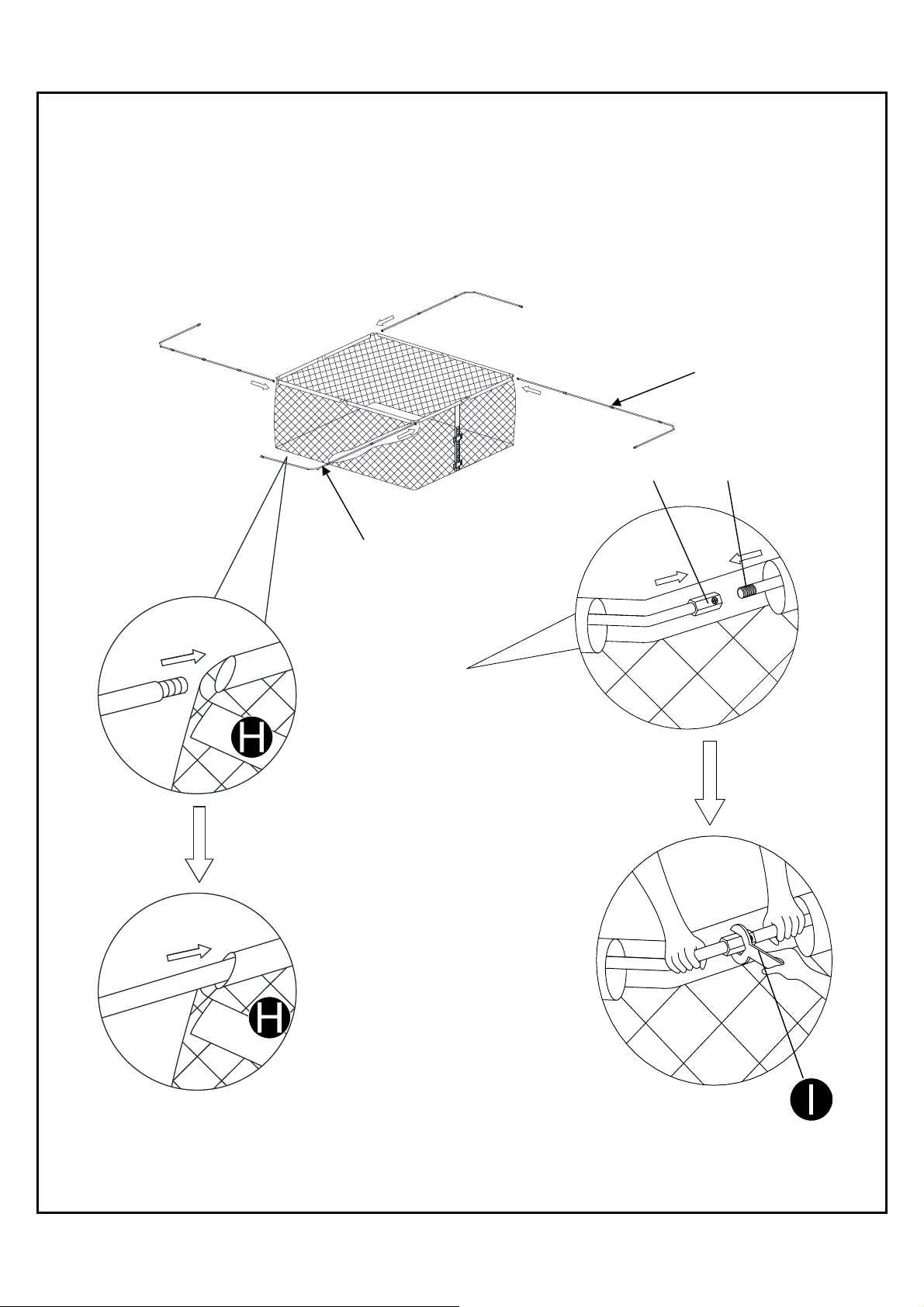
STEP 10
Lay out the Enclosure Netting (# H) on top of the trampoline frame and then insert the four sets of
assembled cable wires into the sleeves of the netting as shown below. Make sure the zipper door of
the enclosure netting is positioned on the side where you intend to enter the trampoline.
IMPORTANT: Slowly guide the cables wires through the sleeve to avoid any tears or damage to the
netting.
10FT SIDE
7.5FT SIDE
Nut
Thread
22
Page 24
STEP 11
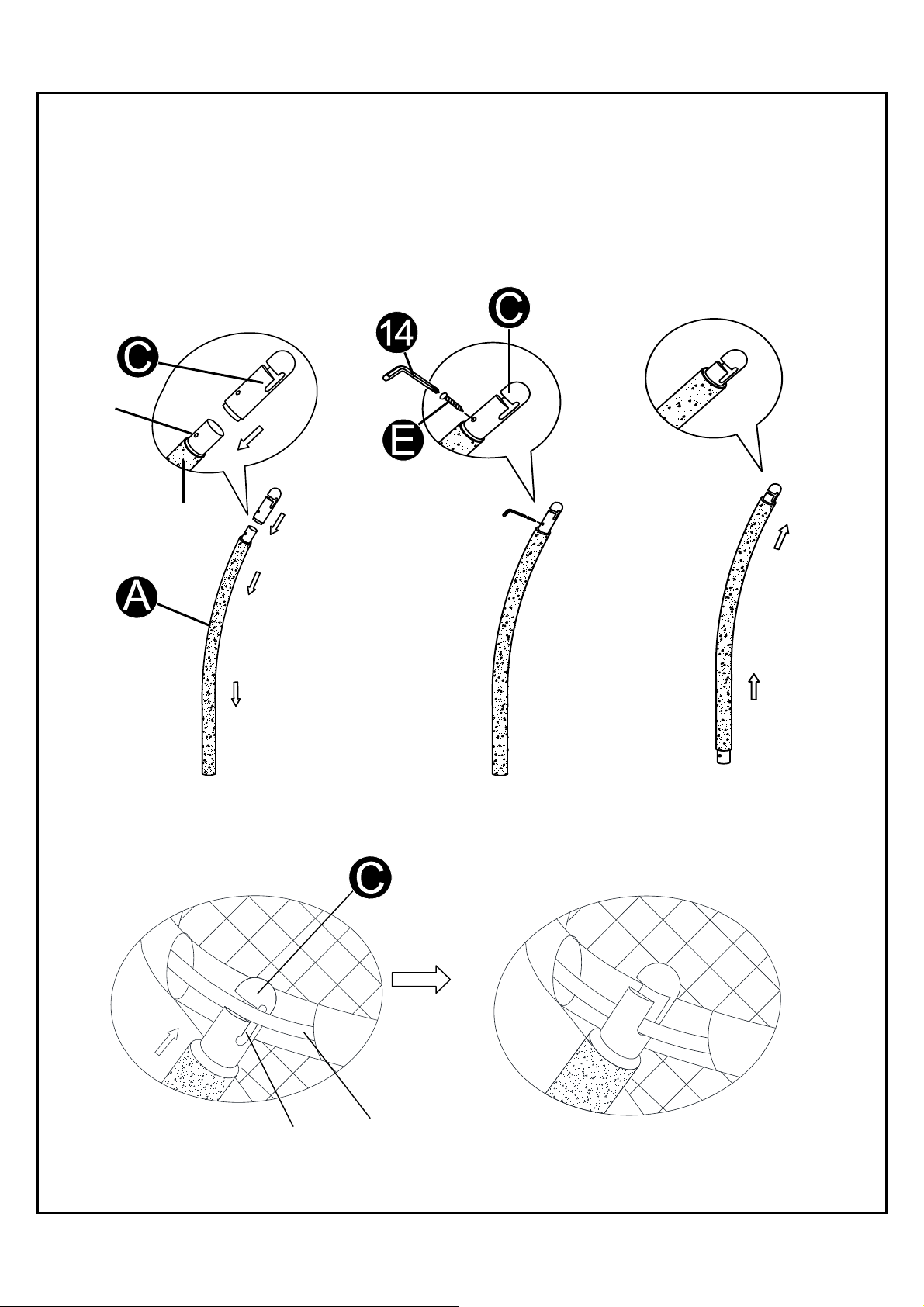
First, attach Plastic Cap (# C) to Upper Frame Tube with Foam (# A), and secure using Self-Locking Screw (#
E) by Allen Wrench (# 14), and then attach the assembled Plastic Cap (# C) and Upper Frame Tube with Foam
(# A) to the Cable Wire as shown in STEP 11. Repeat in the same manner for all of the plastic caps and frame
tubes.
Note: Make sure that the Cable Wire hooks into the slot securely.
Hole
Foam
ENLARGED
DIAGRAM
Slot
Cable Wire
23
Page 25
STEP 12
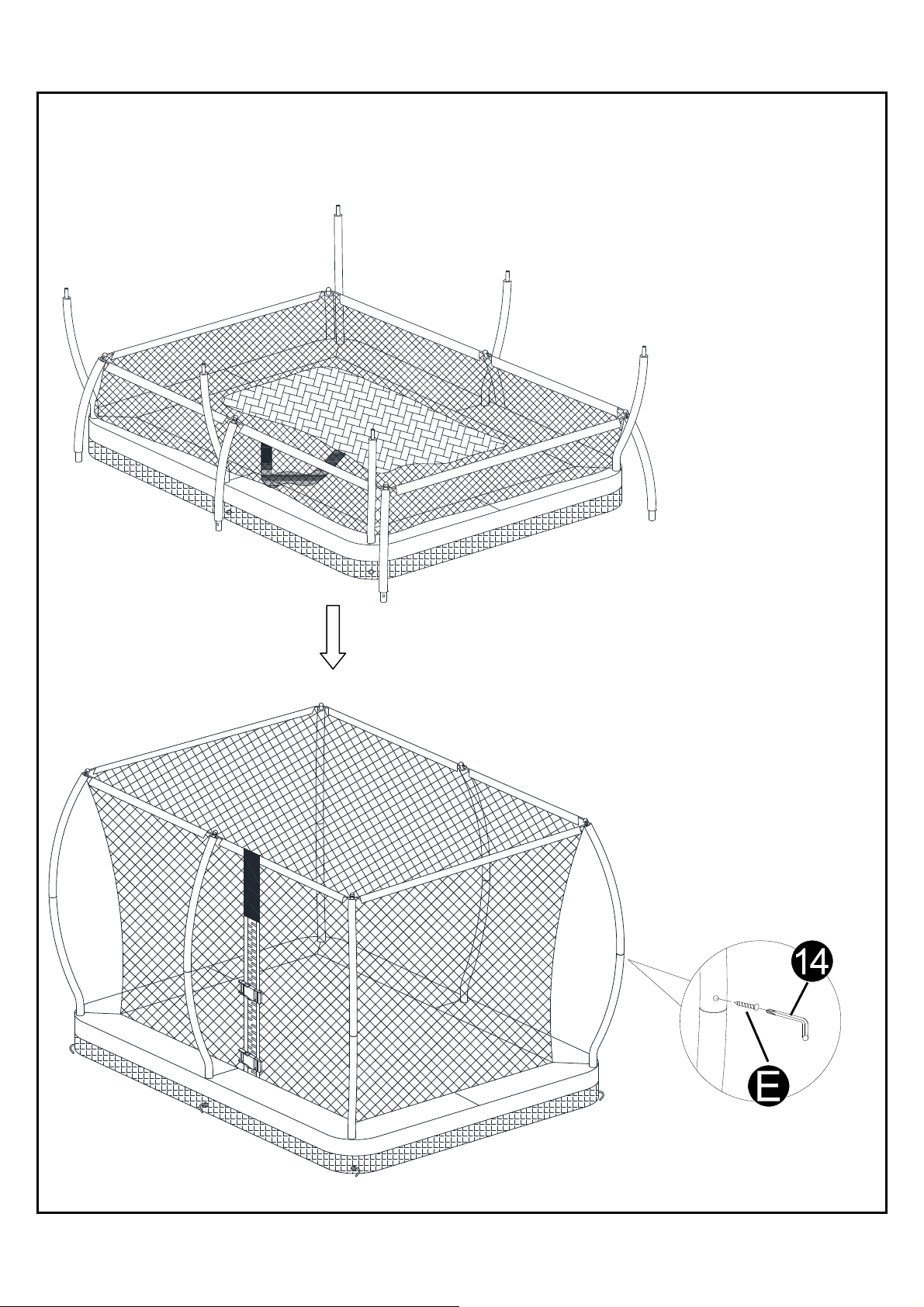
Connect the Upper Frame Tube with Foam (# A) to the Lower Frame Tube with Foam (# B) by using SelfLocking Screw (# E) as shown in STEP 12.
24
Page 26
STEP 13
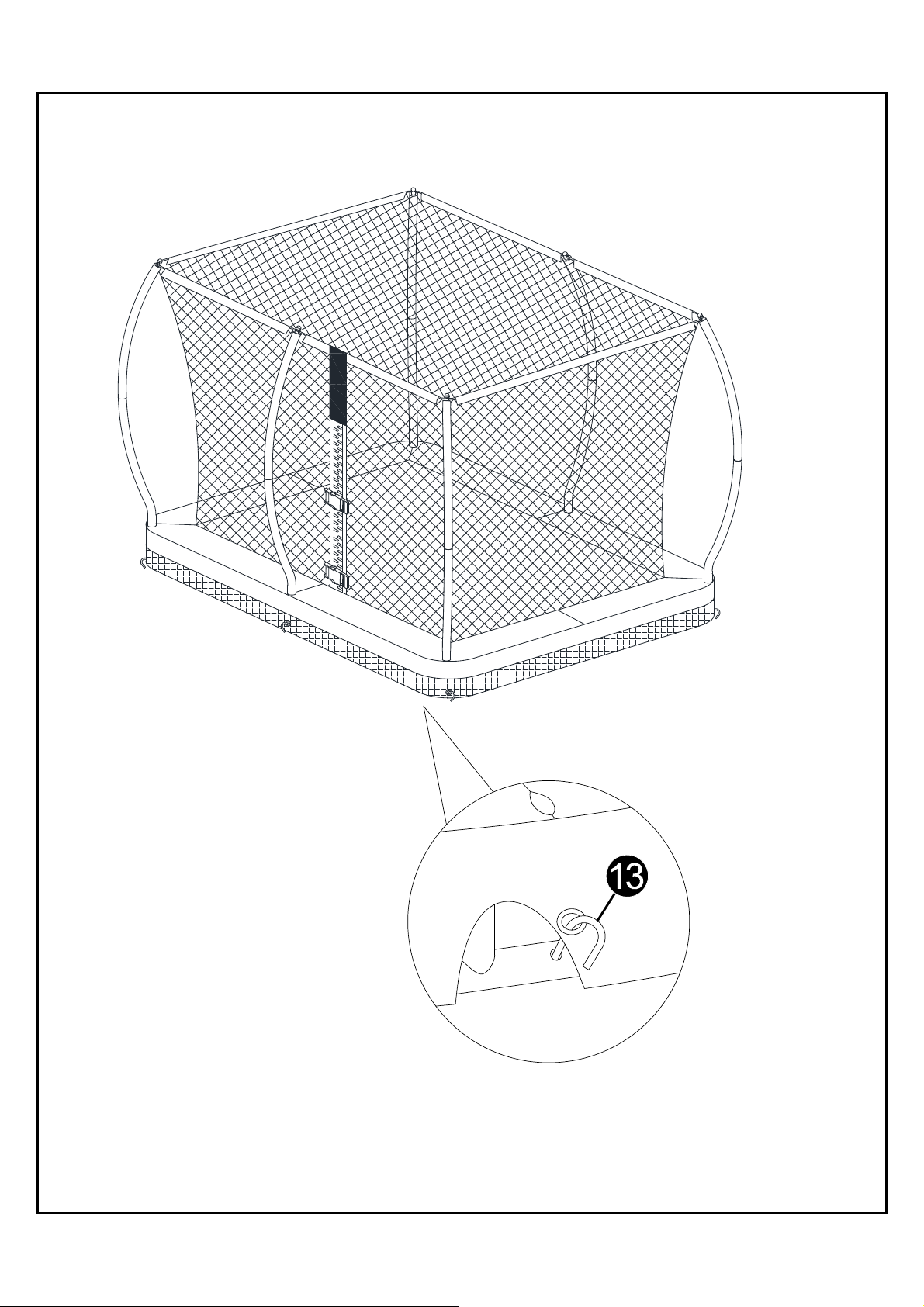
Insert Anchor Set (# 13) to holes in Frame Pad and Leg Base to fix the trampoline.
25
Page 27
STEP 14
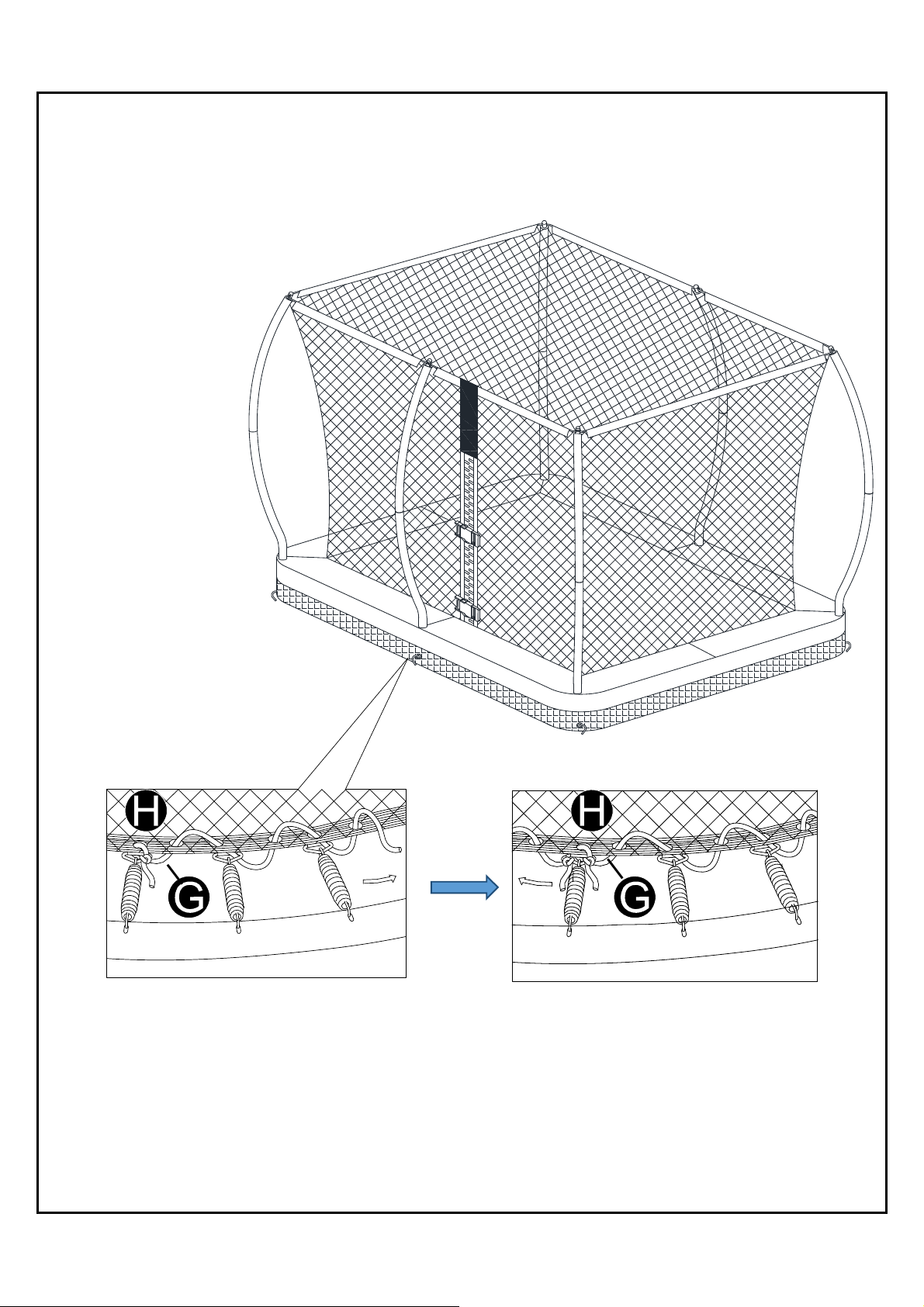
Secure the trampoline netting to the trampoline frame using the Cord (# G). Lift up the frame pad and tie one
end of the cord to any one of the triangle-rings on the trampoline mat as shown in STEP 14.
26
Page 28
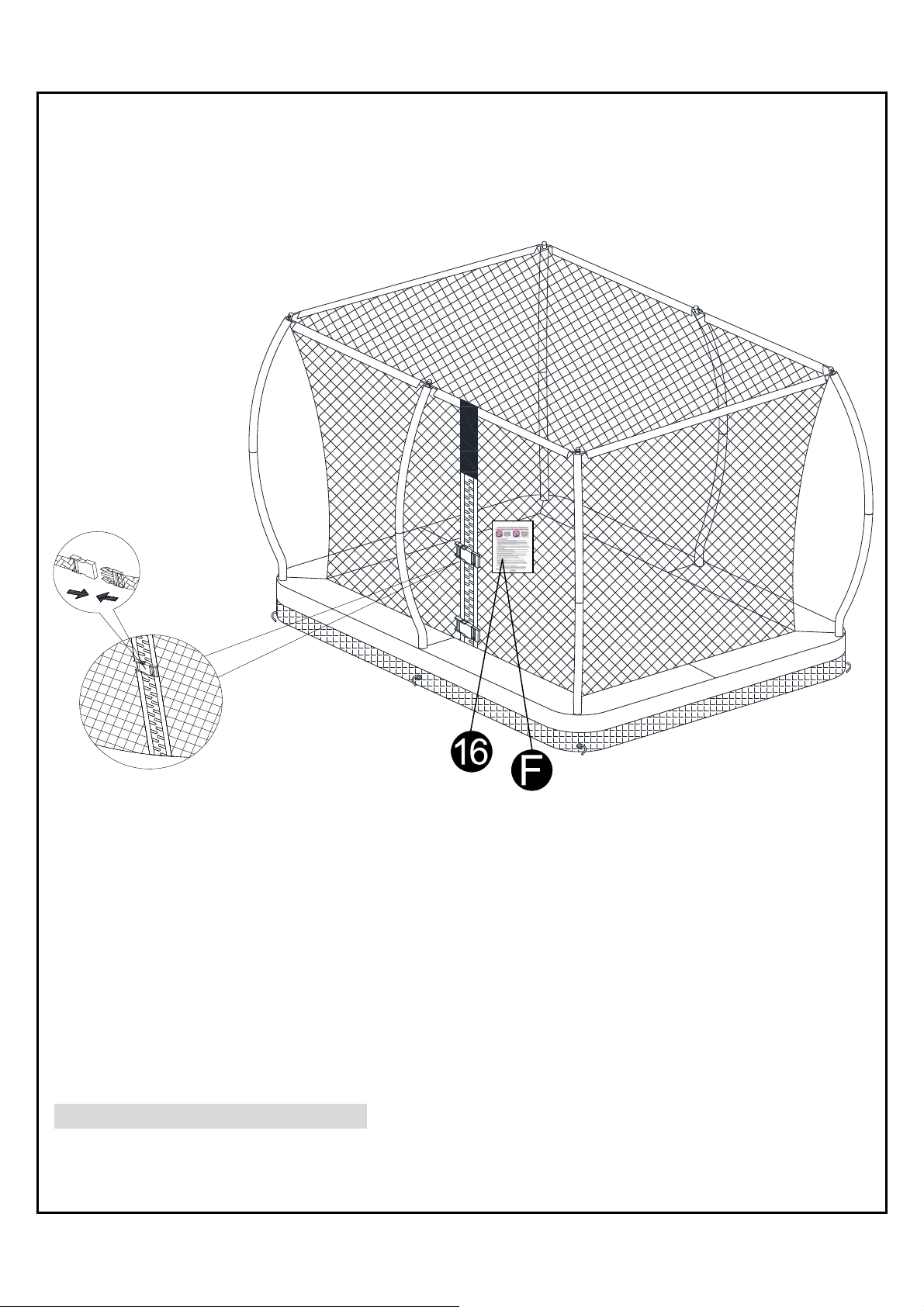
STEP 15
Close the zipper which is located at the entrance of the Enclosure Netting (# H) and secure the entrance by
connecting the Buckles as shown in STEP 15.
Hanging Trampoline Safety Instruction Placard (#16) and Enclosure Safety Instruction Placard (# F).
Disassembly of the Trampoline
To disassemble the trampoline, follow assembly steps in reverse order.
27
Page 29

WARNING
CARE AND MAINTENANCE
This trampoline was designed and manufactured with quality materials and craftsmanship. If
proper care and maintenance is provided, it will provide all jumpers with years of exercise, fun,
and enjoyment as well as reduce the risk of injury. Please follow the guidelines listed below:
This trampoline is designed to withhold a certain amount of weight and use. Please make sure
that only one person at any one time uses the trampoline. Jumpers should either wear socks,
gymnastics shoes, or be barefoot when using the trampoline. Please be aware that street
shoes or tennis shoes should NOT be worn while using the trampoline. In order to prevent the
trampoline mat from getting cut or damaged please do not allow any pets onto the mat. Also,
jumpers should remove all sharp objects from their person prior to using the trampoline. Any
type of sharp or pointed objects should be kept off the trampoline mat at all times.
Always inspect the trampoline before each use for worn, abused or missing parts. A number of
conditions could arise that may increase your chances of getting injured. Please be aware of:
Punctures, frays, tears or holes worn in the bed or frame padding
Missing, improperly positioned or insecurely attached frame padding
Sagging trampoline mat
Loose stitching or any kind of deterioration of the mat
Bent or broken frame parts (legs and/or rails)
Broken, missing or damaged springs
Damaged, missing or insecurely attached frame pad
Protrusions of any types (especially sharp typed) on the frame, springs or mat or
suspension
IF YOU FIND ANY OF THE PREVIOUS CONDITIONS OR ANYTHING ELSE THAT YOU
FEEL COULD CAUSE HARM TO ANY USER, THE TRAMPOLINE SHOULD BE
DISASSEMBLED OR SECURED FROM USE UNTIL THE CONDITION(S) HAS BEEN
RESOLVED.
WINDY CONDITIONS
In severe wind situations, the trampoline can be blown about. If you expect windy weather
conditions, the trampoline should be moved to a sheltered area or disassembled. Another
option is to tie the round, outside portion (top frame) of the trampoline to the ground using
ropes and stakes. To ensure security, at least four (4) tie downs should be used. Do not just
secure the legs of the trampoline to the ground because they can pull out the frame sockets.
28
Page 30

USE INSTRUCTIONS
Before you begin use of this trampoline and trampoline enclosure, be sure to carefully read all
the information provided to you in this manual. Just like any other type of physical recreational
activity, participants can be injured.
To reduce the risk of injury, be sure to follow appropriate safety rules and tips.
* Trampolines over 20 in. (51cm) tall are not recommended for use by children under 6 years
of age.
* DO NOT attempt or allow somersaults. Landing on the head or neck can cause serious injury,
paralysis, or death, even when landing in the middle of the bed.
* Inspect the trampoline before each use. Make sure the frame padding is correctly and
securely positioned. Replace any worn, defective or missing parts.
* To climb on and off the trampoline, it is a dangerous practice to jump from the trampoline to
the floor or ground when dismounting, or to jump onto the trampoline when mounting. Do not
use the trampoline as a springboard to jump onto other objects.
* Stop bounce by flexing knees as feet come in contact with the trampoline bed. Learn this skill
before attempting others.
* Learn fundamental bounces and body positions thoroughly before trying more advanced
skills. A variety of trampoline activities can be carried out by performing the basic
fundamentals in various series and combinations, performing one fundamental after another,
with or without feet bounces between them.
* Avoid bouncing too high. Stay low until bounce control and repeated landing in the center of
the trampoline can be accomplished. Control is more important than height.
* While keeping the head erect, focus eyes on the trampoline toward the perimeter. This will
help control bounce. Avoid bouncing when tired. Keep turns short.
* Properly secure the trampoline when not in use. Protect it against unauthorized use. If a
trampoline ladder is used, the supervisor should remove it from the trampoline when leaving
the area to prevent unsupervised access by children under 6 years of age.
* Keep objects away which could interfere with the performer. Maintain a clear area around the
trampoline.
* Do not use the trampoline while under the influence of alcohol or drugs.
* For further information or additional instruction materials on skill training, contact a competent
trampoline instructor.
* Bounce only when the surface of the bed is dry. Wind or air movement should be calm and
gentle. The trampoline must not to be used in gusty or severe winds.
* Read all instructions before using the trampoline. Warnings and instructions for the care,
maintenance and use of this trampoline are included to promote safe, enjoyable use of this
equipment.
*You should always mount and dismount properly in order to avoid injury. It is a dangerous
practice to jump from the trampoline to the floor or ground when dismounting, or to jump onto
the trampoline when mounting.
*Stop bounce by flexing knees as feet come in contact with the trampoline bed. Learn this skill
before attempting others. This technique should also be practiced while you are learning each
of the basic bounces. The skill of breaking should be used whenever you lose balance or
control of your jump. Initially, you should get accustomed to the feel and bounce of the
trampoline. The focus must be on the fundamentals of your body position and you should
practice each bounce (the basic bounces) until you c an do each skill with ease and control.
*Always learn the simplest bounce first and be consistent with the control of your bounce
before moving on to more difficult and advanced bounces. A controlled bounce is one when
your take off point and landing point is the same spot on the mat. If you move up to the next
bounce without first mastering the previous, you increase your chances of getting injured.
29
Page 31
*Do not bounce recklessly on the trampoline since this will increase your chances of getting
injured. The key to safety and having fun on the trampoline is control and mastering the
various bounces. Never try to out-bounce another bouncer in terms of height! Never use the
trampoline without supervision.
*Do not bounce on the trampoline for extended periods of time because fatigue can increase
your chances of becoming injured. Bounce for a brief period of time and then allow others to
join in on the fun! Never have more than one person bouncing on the trampoline.
*Focus your eyes on the end of the trampoline. This will help you control your bounce. Do
check your position while jumping by checking your position in relation to the center of the
trampoline bed. Do not jump more than 1ft or 30.5cm from the center of the trampoline bed.
*Keep objects away that could interfere with the performer. Maintain a clear area around the
trampoline and trampoline enclosure.
*Bounce only when the surface of the mat is dry. Wind or air movement should be calm to
gentle. The trampoline must not be used in gusty or severe winds.
*In severe wind situations, the trampoline can be blown about. If you expect windy weather
conditions, the trampoline and moved to a sheltered area or disassembled. Another option for
the trampoline is to tie the round, outside portion (top frame) of the trampoline, to the ground
using ropes and stakes. To ensure security, at least four (4) tie downs should be used. Do not
just secure the legs of the trampoline to the ground because they can pull out of the frame
sockets.
*For further information or additional instructional materials on skill training, contact a
competent trampoline instructor.
*Do not jump from other objects, buildings or surfaces onto the trampoline.
TIPS TO REDUCE THE RISK OF ACCIDENTS
All jumpers need to be supervised, regardless of skill level or age.
Jumper’s role in accident prevention
The key here is to stay in control of your jumps. DO NOT move onto more complicated, more difficult
maneuvers until you have mastered the basic, fundamental bounce. Education is also key to safety and
very important. Read, understand, and practice all safety precautions and warnings prior to using the
trampoline. A controlled jump is when you land and take off from the same location.
For additional safety tips and instructions, contact a certified trampoline instructor.
Supervisor’s or owner’s role in accident prevention
Supervisors need to understand and enforce all safety rules and guidelines. It is the responsibility of the
supervisor to provide knowledgeable advice and guidance to all jumpers of the trampoline. If
supervision is unavailable or inadequate, the trampoline should be stored in a secure place,
disassembled to prevent unauthorized use or covered with a heavy tarp that can be locked or secured
with lock or chains. The supervisor is also responsible to ensure that the safety placard is placed on the
trampoline that jumpers are informed of these warnings and instructions.
Customer Service Number: (1) 877-512-9188
Please contact us, before Returning the item to the store, where purchased.
30
 Loading...