

Page 1
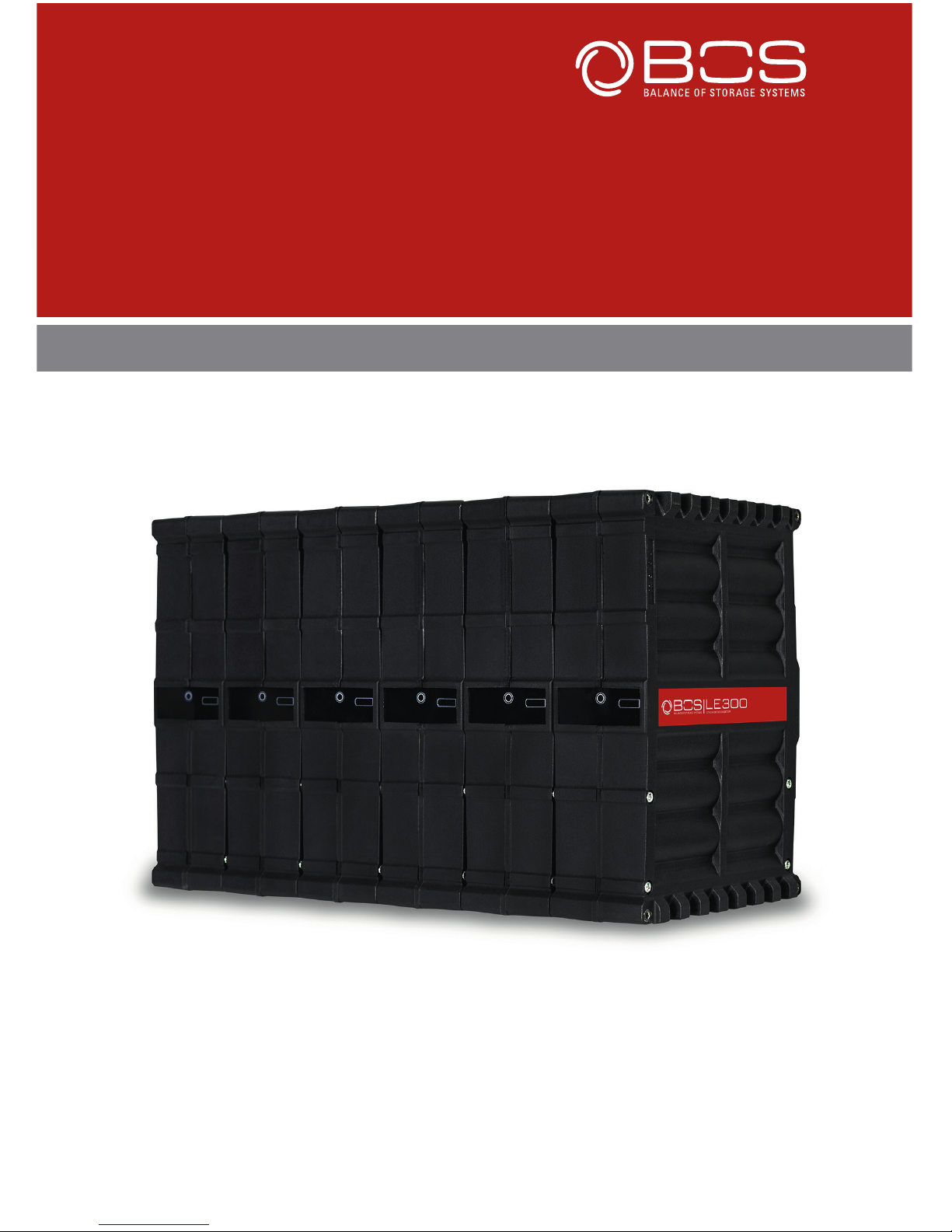
LE300
Installation & User Manual
BOS BALANCE OF STORAGE SYSTEMS AG / BEIM MÜHLBACH 3 / 89171 ILLERKIRCHBERG / GERMANY
PHONE: +49 (0) 731 72 54 41 07 / MAIL: [email protected] / WEB: WWW.BOS-AG.COM
LITHIUM EXTENSION BATTERY
EN
User Manual Version No. 98803201
Release date: August 2018; Revision 12
Page 2

2
TABLE OF CONTENTS
1 GENERAL INFORMATION
2 TECHNICAL SPECIFICATIONS
3 OVERVIEW
4 SYSTEM FUNCTIONS
5 INSTALLATION
6 COMMISSIONING
7 DISPLAY & OPERATION
8 TROUBLESHOOTING AND FAQ
9 MAINTENANCE
10 STORAGE
11 TRANSPORTATION
12 WARRANTY & LEGAL NOTES
13 RECYCLING INFORMATION
2
6
8
9
11
14
15
16
17
18
18
19
20
Package Contents
• User manual
• Device LE300 Lithium Extension Battery Art. No. 12000001
• Power cable connector RAST 5 with 20 cm cable and 2x WAGO clamp
Art. No. 97904600
• Spare part fuse KFZ-Mini 20 A (1x) Art. No. 96915600
Optional accessories
• RS485 parallel connection cable Art. No. 97905000
• Parallel mechanic mounting kit (threaded bolt and nuts, for max. 6 LEs
in parallel) Art. No. 1200080
Page 3

3
1. GENERAL INFORMATION
Thank you for purchasing a high quality, German made product
from BOS Balance of Storage Systems AG. We worked according
to strict engineering standards in order to deliver valuable energy services for our customers. In case of technical problems or
comments of any kind, please contact the local distributor for
support.
LE300 Lithium Extension Battery is a fully scalable solution to
enhance performance and add capacity to lead acid batteries in
solar and any other kind of energy storage systems. They can be
used with new or existing 12 V lead acid batteries. Just stack
them in parallel to meet your specific system specs.
As all BOS AG hybrid battery systems, the LE300 Lithium Extension Battery takes most of the charging cycles while the lead
acid battery provides inexpensive backup capacity. The lead
acid battery is charged with higher priority and the LE300 takes
all surplus energy. This helps to increase the lead acid battery
life.
The system recognizes the lead acid battery voltage and automatically starts to support the lead acid battery with a maximum current of 12.5 A per unit. Bigger loads get supplied by the
lead acid and the LE300 in parallel, resulting smaller currents
for the whole system.
Page 4

4
Safety instructions
• Please read and understand the whole user manual before installation and usage of
the LE300 Lithium Extension Battery.
• Only connect to 12 VDC batteries of the following types:
– Lead storage batteries with liquid electrolytes
– Sealed lead acid batteries – GEL or AGM
• Use the device only in combination with a lead acid battery and a lead acid charge
controller, do NOT connect loads or power sources directly to the lead acid battery nor to the
LE300 device.
• Lead acid batteries can generate explosive gases during operation. Never smoke, allow
flames or sparks near the battery. Make sure to keep sufficient ventilation around the
battery and read the lead acid battery user manual.
• Do NOT use with nickel cadmium batteries, nickel metal hydride batteries or other
battery types.
• Do NOT mix up the + (plus) and - (minus) poles of the battery.
• Do NOT connect anything to a damaged battery. It could heat up, catch fire or explode.
• Do NOT open the battery pack. Danger of short-circuiting. Opening the LE300 device voids
any and all warranty claims.
• Best operating temperature is between 15 and 20 °C. Higher temperatures shorten the
lifespan of the batteries. Do NOT place device in direct sunlight!
• Protect the LE300 against heat (e.g. prolonged sun exposure) and fire and from water.
Do NOT store or operate the LE300 near hot or flammable objects.
• Install this device step by step as written in this manual for best results.
• After installation, the device needs to be fully charged.
• Do NOT charge the device over an extended period, if the device is unused.
• After prolonged storage period, it may be necessary to charge and discharge the device
numerous times to achieve the full performance capability.
• Follow all safety precautions during installation of device & handling batteries.
• Improper handling of batteries may introduce a risk of battery explosion.
• Keep batteries away from children & animals.
• During handling of batteries no smoking or exposure to naked light & fire.
• Wear eye protection during installation process.
• When working with a battery and LE300, remove all personal metal items like watches, rings,
necklaces and bracelets. Metal items in contact with the battery terminals might cause a
short circuit with a very high electric current, which may heat up and melt nearby objects and
cause severe burns.
• Keep the LE300 not being used away from paper clips, coins, keys, nails, screws or other
small metal objects, that can make a connection from one terminal to another. Shorting the
battery-pack terminals together may cause burns or a fire. For short-circuiting damage
caused in this manner, any and all warranty claims shall be invalid.
Page 5

5
• Use electrically insulated tools for connecting cables.
• The mounting and the electrical connection may only be carried out by trained specialists.
• Use only properly functioning test equipment with this device.
• Internal voltage of device may be higher than the rated level, take care to avoid being zapped
during installation.
• Keep this document in a safe place for the entire service life of the device. Pass the
document on to subsequent owners and operators of the device.
• Incorrect operation can damage system components.
• The device must not be connected to a lead acid battery if it has a damaged casing.
• Factory labels and markings must never be altered, removed or rendered unreadable.
• This device contains sensitive electronics, so take care during installation and use.
• Consider all relevant official safety instructions during transportation of the device.
Safety instructions might vary depending on the mode of transport and on local country
regulations.
• Check the recycling information at the end of the user manual for disposal of device.
Application Scope
• The primary application of the LE300 is the stationary storage of renewable energy in the
area of solar energy.
• This device is for residential, recreational & small commercial operations.
• This device is for operation with 12 V lead acid batteries only. A lead acid charge controller
is needed for correct operation.
• The device is not permitted to be mounted in outdoors, underside, engine compartment or
exposed areas of interior spaces (e.g. side pockets in the trunk, outer wet chamber, spare
wheel recess).
• Failure to follow this precaution can cause damage to this device and the energy source
to which it is connected.
•Consultauthorizedsupplierifdeviceistobeconnectedinnonstandardconguration.
•Sizingofleadacidbatteryneedstottotheoverallsystemdesign.Forlonglifetimeleadacid
battery must frequently be charged to 100%.
•Ifsizingofthesystemisnotdonewithinthespecicationwarrantybecomesvoid.
• The battery connection in the KFZ range need to be chosen <3 m.
• Failure to comply with correct product usage or neglecting the user manual, the warranty
and guarantee becomes void.
Page 6
6
2. TECHNICAL SPECIFICATIONS
12 VDC
12.8 VDC
11 – 15 VDC
IFpR/26/65 [8p/4s] E/-20NA/95 LiFePO
4
rechargeable battery
25.6 Ah/328 Wh
90 % (23 Ah/295 Wh)
>2000 complete cycles
70 – 125 Ah @ 12 VDC
1/3 in solar home applications. Values vary
depending on needed autonomy and on
application.
Max. 12.5 A between 5 and 40 °C, at higher
and lower temperatures current is limited.
Max. 12.5 A between 5 and 40 °C, at higher
and lower temperatures current is limited.
> 90 %
175x229x67 mm
3.4 kg
RAST 5/mini module 4 pin/communication
interface/external display
1.5 – 4 mm²
-20 – 50 °C ambient temperature with
maximum battery life at 15 - 25 °C.
Warehousing temperature 10 – 30 °C.
System voltage
Nominal voltage
Voltage range
Battery packs used in LE300
Nominal lithium capacity
Usable lithium capacity
Numbers of cycles at room temprature
Recommended lead acid capacity for
each LE300 (not included)
Recommended lithium/lead acid
capacity ratio (net)
Continuous charging current
Continuous discharging current
Batteryefciency
Housing dimensions
Weight
Connection terminals
Recommended wire size
Ambient temp.
(operation & warehousing)
Page 7
7
Low and high temperature protection,
heating, charging & discharging
Lithium cell balancing
Protection features
Operation mode/compatible
external batteries
Connection possibilities
Max. parallel LE300s
Temp. sensor prevents lithium battery charge
under -5 °C or above 55 °C cell temp. Charging starts once cell temp. is higher than -5
°C. Device has an integrated heating that is
active between -20 °C and 10 °C cell temp.
Discharge possible between -20 °C and 60
°C cell temp. At cell temp. below -20 °C and
over 60 °C system is running in pure lead
acid mode for higher battery lifetime.
Battery management inclusive balancer
Overcurrent, overvoltage, short circuit, deep
discharge, wrong polarity protection.
Works in combination with any 12 V lead
acid battery & lead acid charge controller.
Packs can be connected in parallel with each
other (see exemplary parallel combination in
the table below).
In standard version, a maximum of 24
LE300 can be connected only in parallel,
higher quantities possible after consulting
BOS partner.
Exemplary
parallel combination
Qt. in parallel
Total nominal voltage
Total lithium capacity
Continuous charging current to LEs
Continuous discharging current from LEs
Recommended lead acid capacity
(not included)
Parallel
4
12.8 VDC
102.4 Ah/1.3 kWh
Max. 50 A
Max. 50 A
4 – 12 kWh
vt
Page 8
8
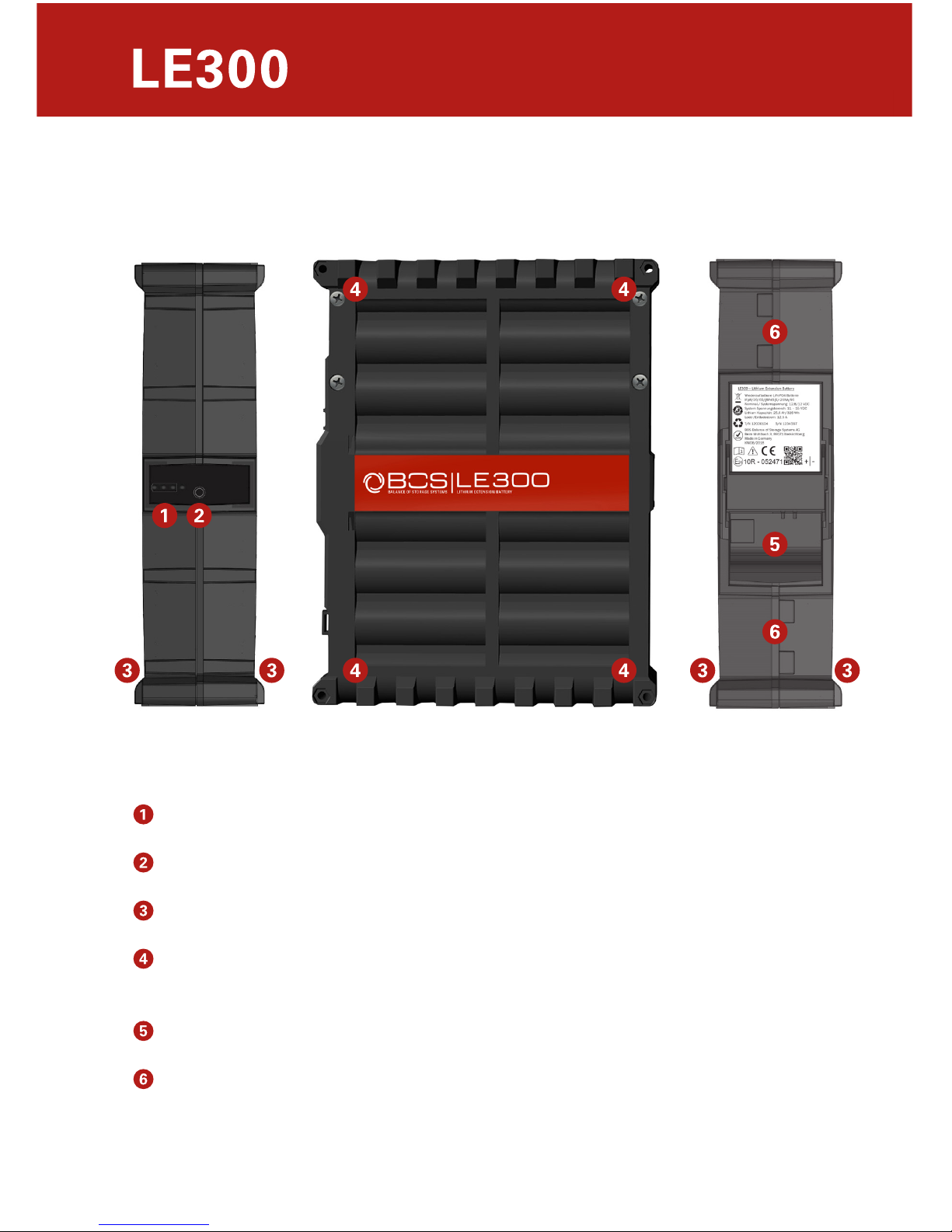
State-of-charge-trend-display and torchlight
Push button
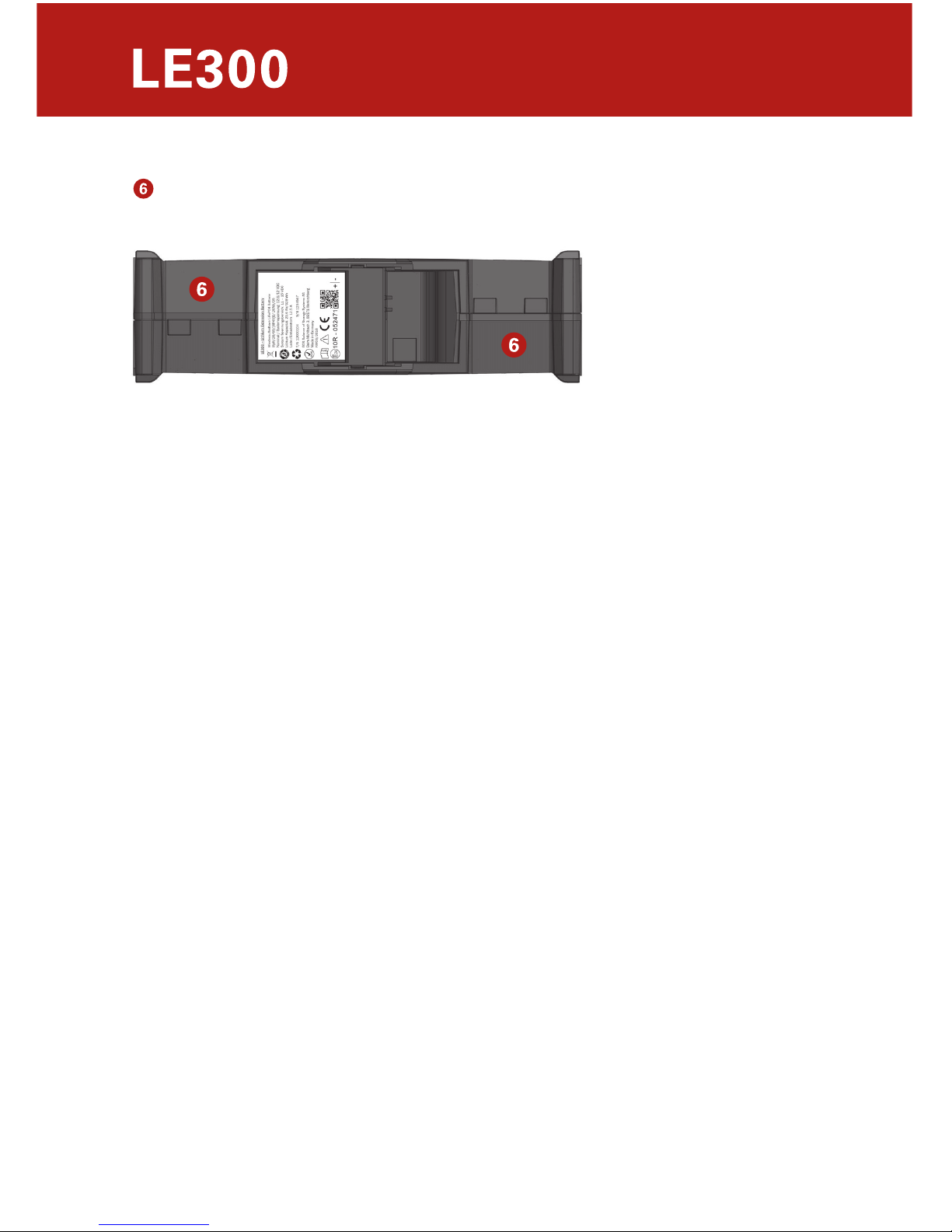
Mounting shape for standard lead acid mounting clamp
Holes for mechanical parallel mounting/mounting on mounting plate
(optional)
Cable connector plugs
Cable strain relief connectors
3. OVERVIEW
Page 9

9
4. SYSTEM FUNCTIONS
Charging
The lead acid battery is charged with higher priority. After the lead acid battery is
charged 80% the LE300 starts being charged in parallel. However, it still leaves
sufficient energy for the lead acid battery to be properly fully charged.
The charging current is limited to about 12.5 A per device, for instance 4x LE300
can be charged with up to 50 A.
Discharging
At the beginning of each discharge phase, the LE300 will be discharged first
(given that the LE300 has not been empty). Depending on the load, the LE300
is doing all the work until the LE300 is almost completely discharged. Once the
LE is discharged the lead acid battery will be discharged (if load continuous).
Therefore, in charging & discharging phases the LE300 is supporting the lead
acid battery.
The current is limited to about 12.5 A per device, for instance 4x LE300 can thus
together support the lead acid battery with up to 50 A. Currents higher than the
nominal rated currents of the LEs are supported by both, the LEs and the lead
acid batteries, resulting in smaller C-rates for both batteries
Protection
Due to the intelligent battery management, the LE300 is fully protected against
overload and deep discharge as well as overcurrent, short circuits, wrong polarity
and too high or too low temperatures.
Under cold conditions (<10 °C cell temperature) the integrated heater heats
up the LE300 to operating temperature to avoid damage to the cells during the
charging phase. At cell temperatures below -20 °C no discharge of the device is
possible. At cell temperatures below -5 °C no charge is possible. Once the integrated heater has warmed up the LE300 and the thresholds of -5 °C for charging
and -20 °C for discharging are passed, the LE300 starts charging/discharging.
Full charging and discharging power is available between 5 °C and 40 °C. At cell
temperatures lower than 5 °C and higher than 40 °C the charging and discharging currents are limited.
Page 10

10
The device is short circuit protected, in case of short circuit the device will show
an error code (see details under chapter 7 Display & operation).
The device is wrong polarity protected, in case of connection with wrong polarity
the device will show an error code (see details under chapter 7 Display & operation).
Sleep mode
An internal sleep mode protects against a complete discharge of the Li-cells.
When idle, under normal conditions the LE300 goes into a standby/sleep mode.
Every 128 seconds the device will be automatically waked up to check, if LE300
is needed for charging/discharging.
If one of the Li-cells falls under deep discharge, caused by self-discharge, the
LE300 goes into a deep sleep mode. In this mode, the LE300 can only be woken
up by pressing the push button or by recharging the device (this is checked every
four mins automatically). After wake-up, a charging phase is possible.
If one of the Li-cells is critically deep discharged, the LE300 system shuts down
completely into a safety mode to protect from potential dangers that could occur
when recharging depleted lithium cells. The LE300 cannot be woken up anymore. Neither charging nor discharging is possible anymore. In this case, please
contact your local BOS dealer for support.
Page 11
11
5. INSTALLATION
Please read and understand our general information before starting the installation.
Technical installation
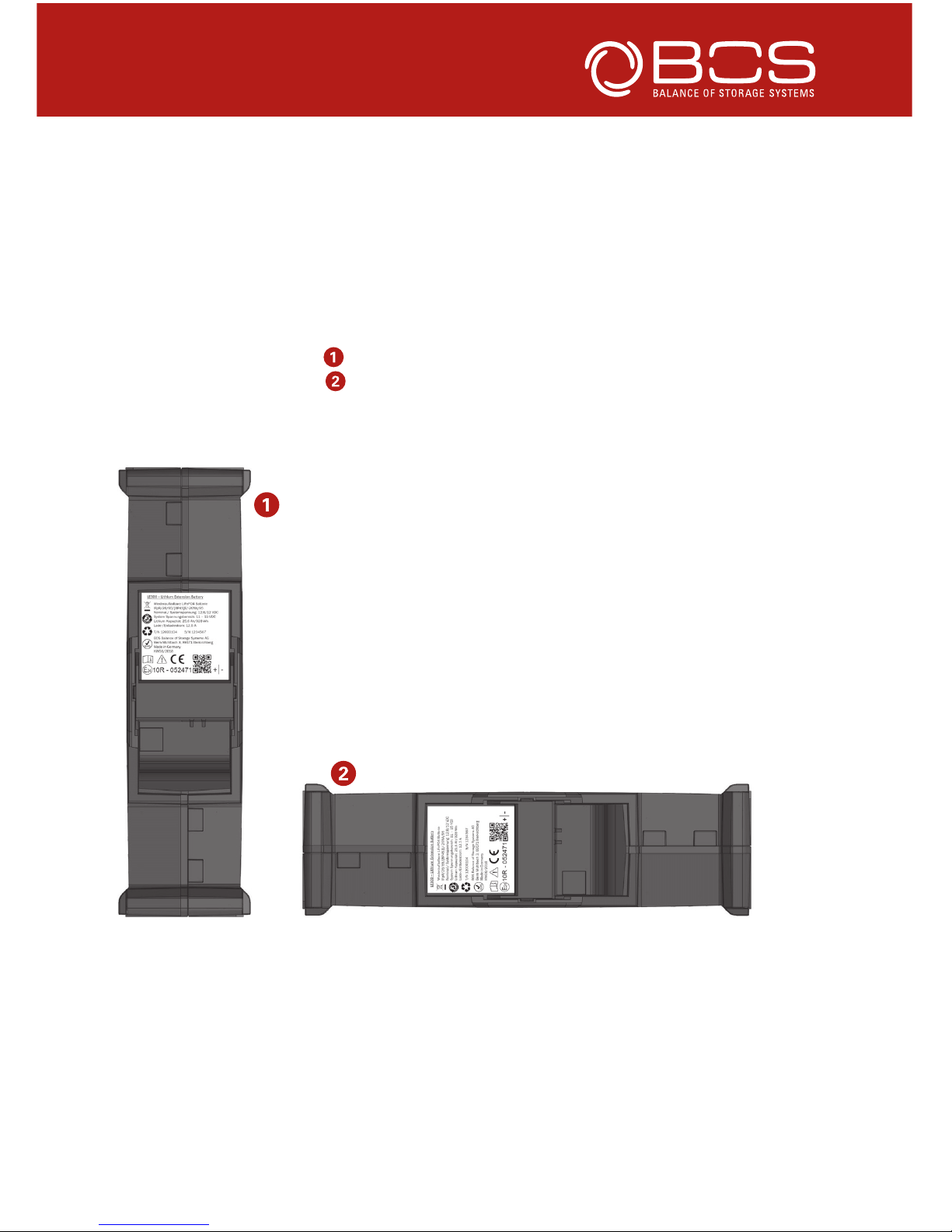
In general, the LE300 can be installed in any mounting direction. Recommended
mounting directions are mounting in upright position using the standard lead
acid battery clamps and mounting flat on biggest area using direct mounting
to a mounting plate with screws/bolts. See graphics below for details.
Electronical installation
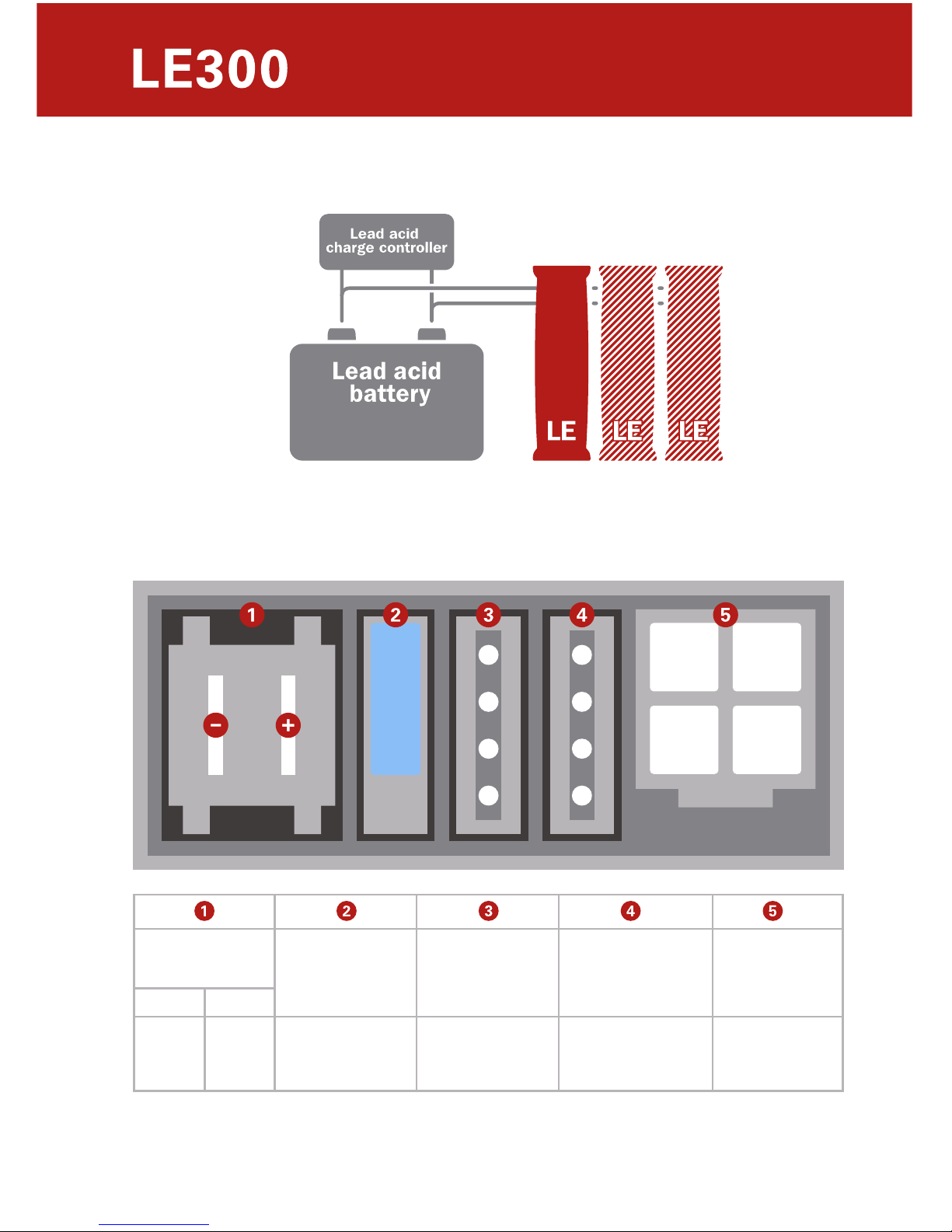
The LE300 Lithium Extension Battery is connected in parallel to the lead acid
battery. Please note that a standard lead acid battery charge controller is needed. No special additional charge controller is needed for the LE300. It is important to choose the right size of connection cable, depending on the maximum
currents. Several sets of connecting cables might be required. Make sure that
wiring is done according to DIN VDE 0298-4.
Page 12
12
The picture above is a basic visualization of the system connection, details on the
electrical connection are explained in the following:t
RAST 5 LEAD ACID
IN/OUT
-
to lead
acid
-
+
to lead
acid
+
Fuse
20 A
mini-KFZ
fuse
Communication
interface
Optional to
next LE
Communication
interface
Optional to
next LE
DISPLAY
OUT
Optional to
display
20
Page 13
13
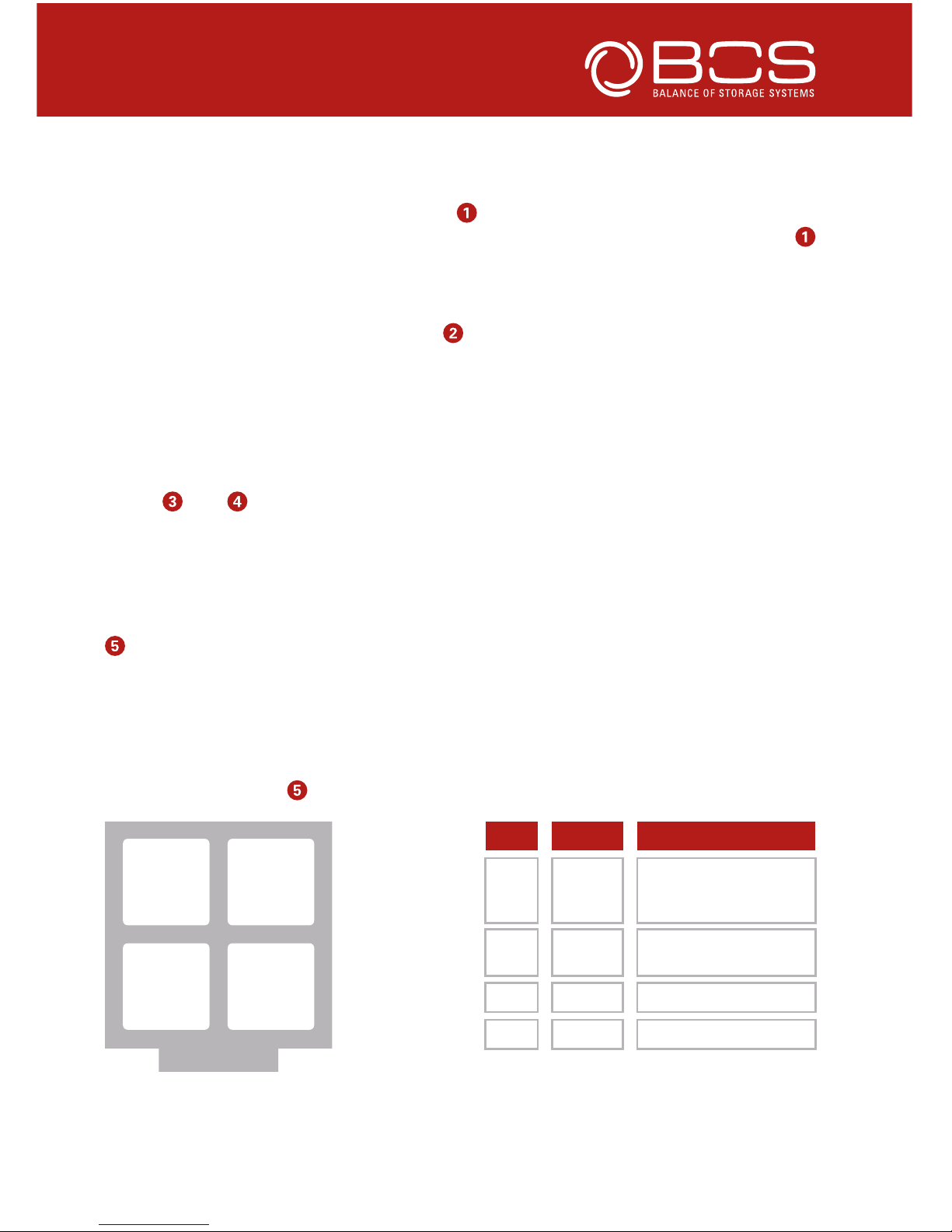
Simply connect the LE300 system directly in parallel to the lead acid battery at
the RAST 5 (code 00E) power connector . Therefore, use the supplied plug con-
nector, fix cables to it, plug it to the back of the LE300 at the power connector.....
and mount the other side of the cables to your lead acid battery. Pay attention to
right polarity and proper cable connection!
Check if the 20 A fuse is inserted at . If fuse is missing, insert the supplied
spare part 20 A fuse.
In case of parallel connection of several LEs, make sure that LE enclosures are
mounted firmly together. It is recommended to use a threaded bolt and nuts
to tighten LEs with each other (optional mechanical parallel mounting kit). It is
recommended to connect all LE300 with each other through RS485 communication and . LE300s would also work in parallel mode without the RS485
communication, however one common state-of-charge-trend-signal couldn’t be
generated anymore for the whole system. Maximum number of LEs in parallel
configuration is 24 LEs as standard version, please get in touch with your BOS
dealer if more LEs in parallel are needed.
Optional signal outlet for display connection. 0 - 10 V state-of-charge-trendsignal to be connected to displays with 0 - 10 V signal input. It is recommended
to use the following plug with cables at the signal outlet: Mini-Fit Jr.™ TPA Cable
Assembly 45135 (plug not included). Optionally a LCD state-of-charge-trend-display is available.
ANOUT
Analog
Out
1
3
2
4
GND
Ground
DIN1
Digital
Input 1
DIN2
Digital
Input 2
Pin
1
2
3
4
Name
Anout
DIN1
DIN2
GND
Description
Analog OUT 0 - 10 V
SOC (0 V = 0%
10 V = 100%)
Digital IN 1
(Wake up)
Digital IN 2
Ground
Display out graphic
Page 14
14
Once mechanical and electrical connection is done according to chapter 5, the
LE300 will automatically start working and supporting the lead acid battery system. Please push the pushbutton of LEs to check the status of the products (see
details in chapter 7).
It is recommended to fully charge the system once LEs were connected. A full
system charge is needed in order to give accurate information on the state of
charge of the system.
For devices which are stored over a longer period of time, several charging cycles
might be necessary. This is done to balance each lithium-cells and to show an
accurate state-of-charge-trend-display.
6. COMMISSIONING
Tighten the installed cables with a cable tie to the strain relief connectors to
avoid damages to the electronics from moving cables.
Page 15
15
7. DISPLAY & OPERATION
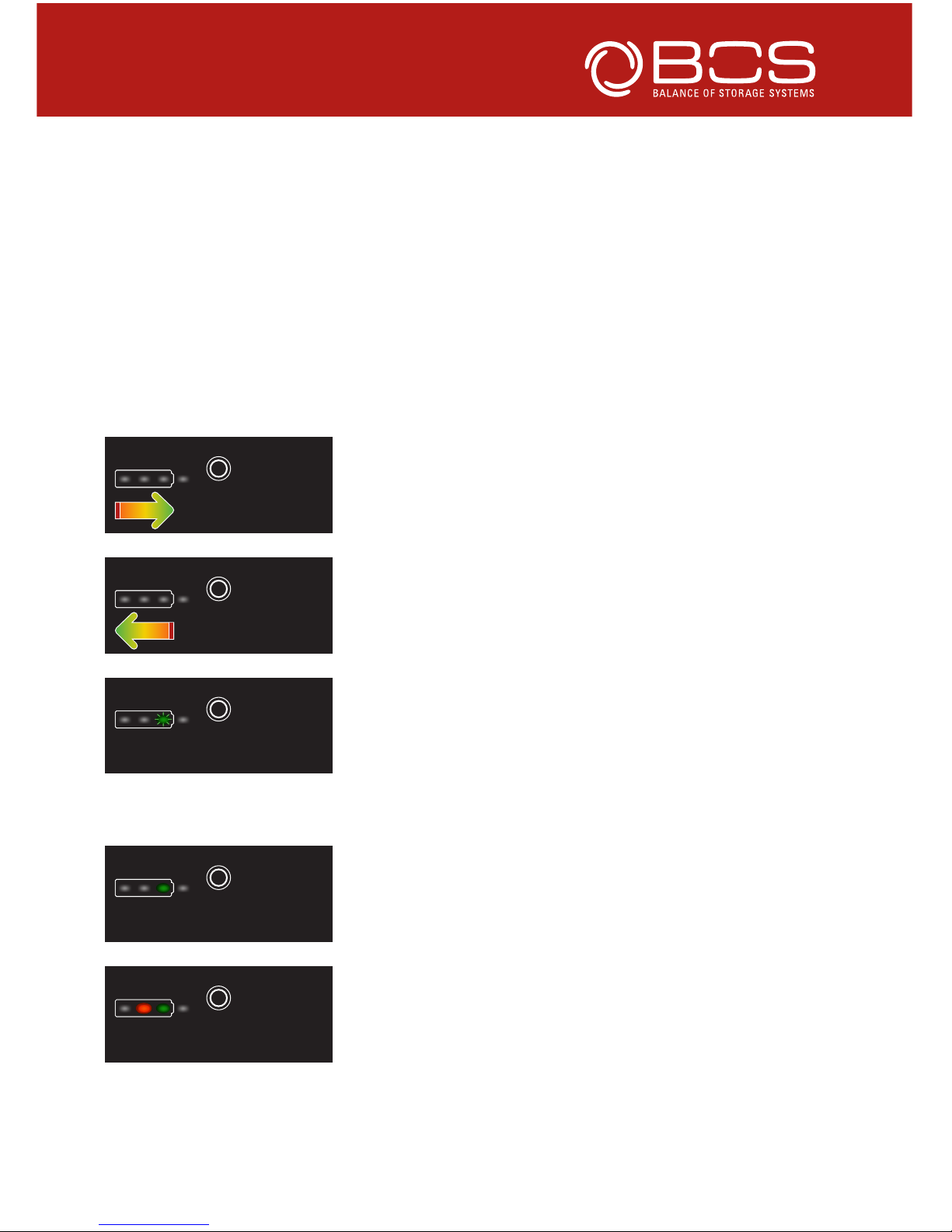
The display is off by default, to save power. To activate the device, just press the
push button. It consists of four status LEDs and one push button. Once the push
button is no longer pressed, the display turns off after ten seconds.
Once the push button is pressed and hold, the device shows whether it is charging or discharging (in case of errors in the LE or the set-up, error codes are
shown as described in chapter 8):
Chaser light from red to green indicate that the
LE300 is being charged.
Chaser light from green to red indicate that the
LE300 is being discharged.
If green LED flashes whilst the push button is
pressed, the LE300 is neither charged nor discharged but in idle mode.
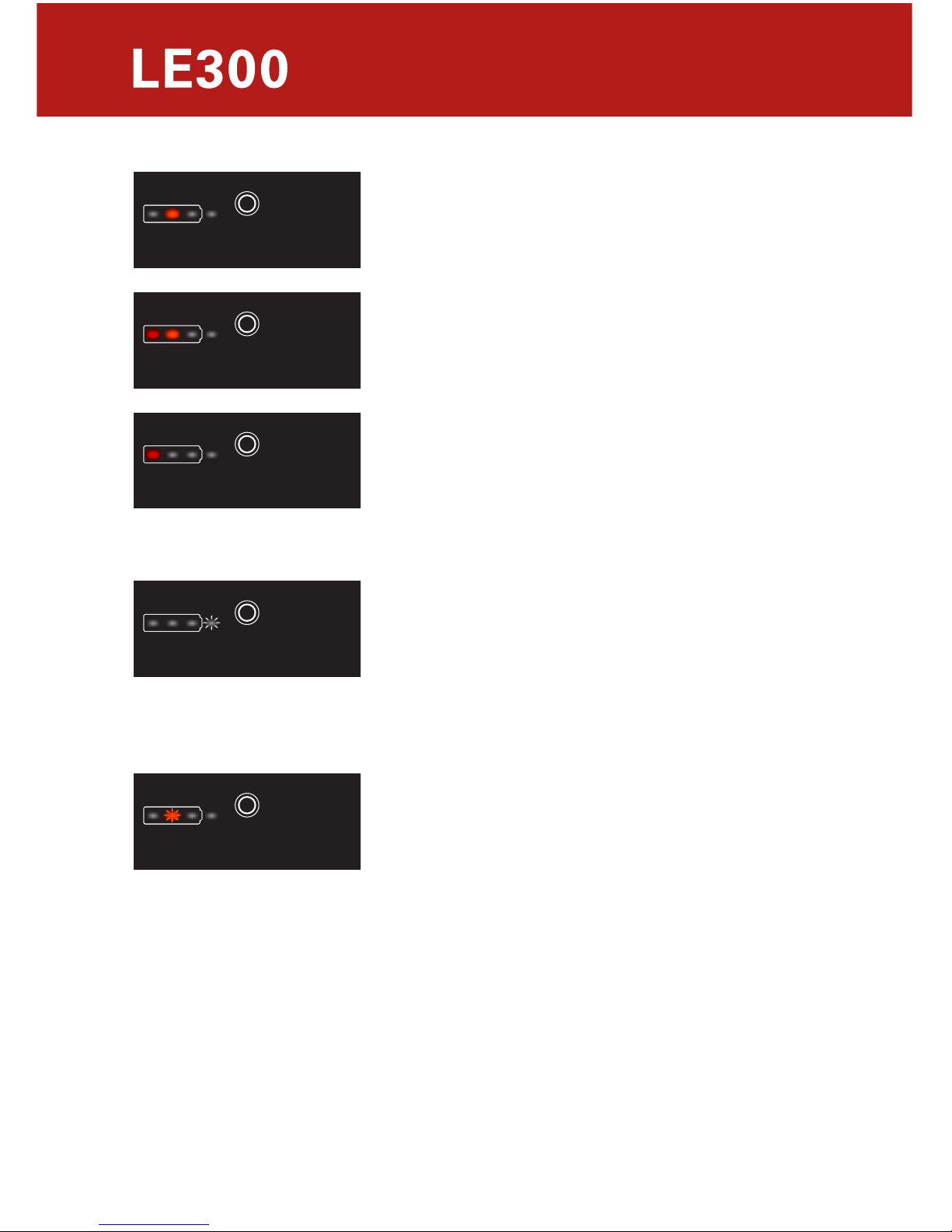
Once the push button is released, the device shows the state of charge:
Green LED indicates, that the LE300 is fully charged, SOC > 80 % (SOC = State of charge).
Green and yellow LED indicates, that the LE300 is
between 61 – 80 % SOC.
Page 16
16
Yellow and red LED indicates, that the LE300 is at
low SOC between 21 – 40 %.
Red LED indicates, that SOC is between 0 – 20 %.
Yellow LED indicates, that the LE300 is half-full,
SOC between 41 – 60 %.
If the push button is pressed for five seconds, an emergency light turns on:
The emergency light can be activated by pressing
the push button for five seconds. It turns off automatically after ten seconds and automatically
starts a reboot.
8. TROUBLESHOOTING AND FAQ
IfyellowLEDashesoncethepushbuttonispressed
andhold,theLEitselfisne.However,thereissome
problem in the operation of the LE, which is linked to
either of the following events: the connection to the
lead acid battery is not working (tripped fuse or bad/
no connection to lead acid battery or wrong polarity); short circuit.
Please check if the LE is properly connected to the lead acid battery with the
right polarity and if the lead acid battery voltage is higher than 10.5 V. Also, please check if the 20 A fuse at the LE and any other fuse in the line between the LE
and the lead acid battery is tripped. Exchange tripped fuses and recheck status
once it is assured that connection to lead acid battery is done properly (no short
circuit, right polarity, properly connection at lead acid and LE). Once the issue is
resolved, restart the LE by pushing the push button.
Page 17
17
9. MAINTENANCE
In case of too low temperature, the LE heats up, once the system gets charged.
In case of too high temperature, the LE will reactivate, once temperature is lower.
The LE300 itself is fine, but either the short circuit or the wrong polarity protection was triggered. Please check the wiring for short circuits or wrong polarity
connection.
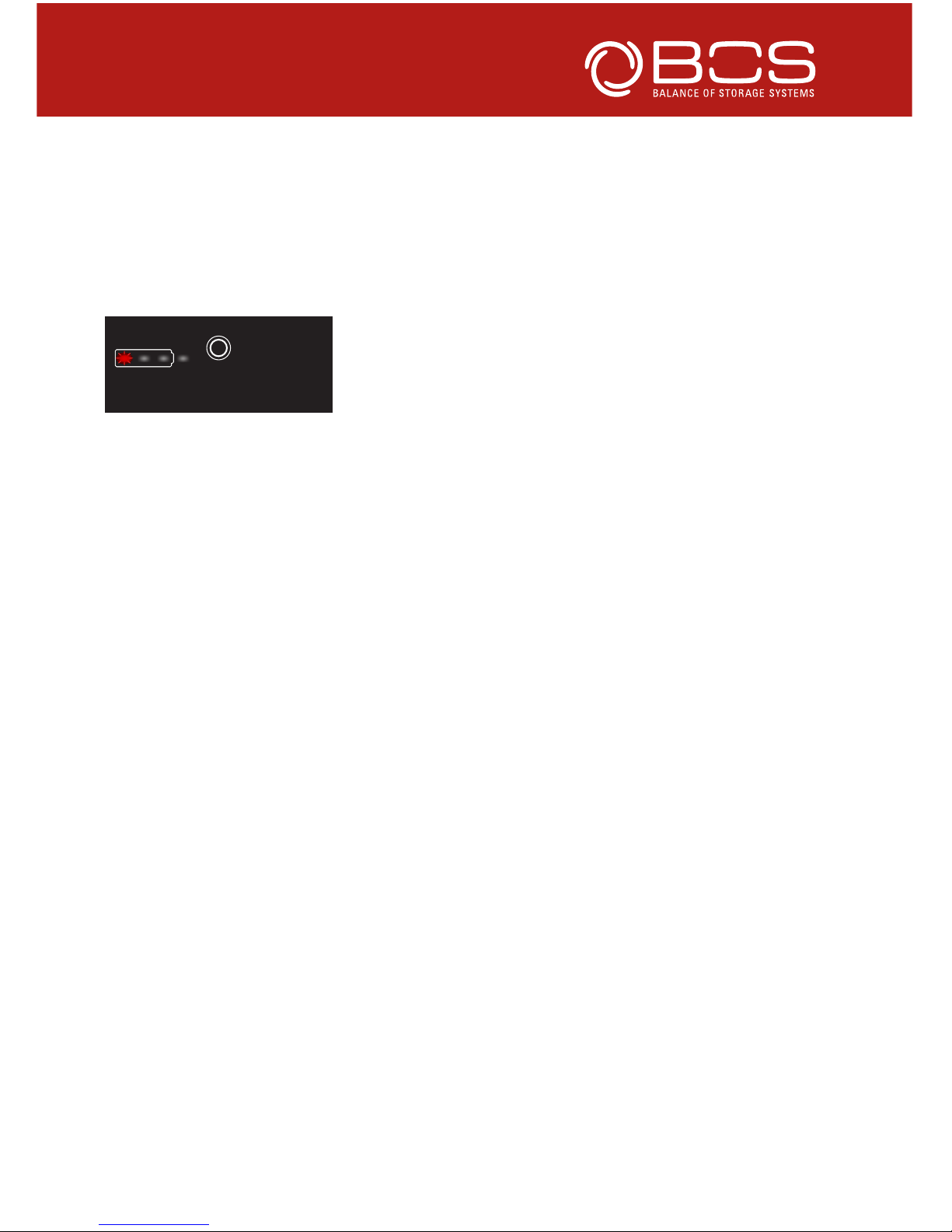
Red LED flashes, if temperature is too high or too
low (<-40 °C or >60 °C). If no LED turns on once
the push button was pushed, please contact your
BOS dealer.
Why is there no voltage at the power connector of the LE?
The device is basically maintenance-free. Cable connections should be checked
frequently. Clean the device from dust when necessary with a dry cloth. Avoid any
contact with water or other liquids.
The lifespan of the LE300 can be prolonged when being properly maintained and
especially when being operated and stored at the right temperatures.
With increasing age however, the LE300 capacity will diminish even when properly maintained.
If the operating period significantly reduces after charging, the LE300 is probably worn out and must be replaced.
As long as the LE300 is not connected to a lead acid battery, the power connector of the LE300 is deactivated. In order to use the LE300, connect it to a 12 V
lead acid battery.
Page 18

18
10. STORAGE
11. TRANSPORTATION
The LE300 has been designed to last at least ten years of normal use. If the
product is stored for a long period of time, please recharge the device every six
month. Therefore, connect the system to either a photovoltaic (PV) module or to
a direct current (DC) power source (in each case the usage of a lead acid charge
controller is mandatory). Please be aware that batteries will get damaged by
deep discharge, if not recharged regularly.
Note: When the LE300 is stored empty for longer periods, it can become damaged despite the low self-discharge and the LE300 capacity may be strongly
reduced.
Store the LE300 in a dry and well-ventilated location. Protect the product against
moisture and water. The LE300 can be stored at temperatures between 10 °C
and 30 °C. Take care that the maximal storage temperature is not exceeded.
Avoid relative humidity over 85 % as well as condensation.
The LE300 is UN38.3 certified, nonetheless it is subject to the Dangerous Goods
Legislation requirements. Private users can transport undamaged LE300 by
road without further requirements.
When being transported by commercial users or third parties (e.g. air transport
or forwarding agency), special requirements on packaging and labelling must be
observed (e.g. ADR regulations). If necessary, an expert for hazardous materials
can be consulted when preparing the item for shipping.
Dispatch LE300 only when the housing is undamaged. Tape or mask off open
contacts and pack up the LE300 in such a manner that it cannot move around
in the packaging.
Inform your parcel service that the package contains dangerous goods. Please
also observe the possibility of more detailed national regulations.
In case of questions concerning transport of the LE300, please refer to an authorized BOS dealer. The BOS dealers can also provide suitable transport packaging.
Page 19

19
12. WARRANTY & LEGAL NOTES
Warranty
The LE300 Lithium Extension Battery come with a two-year warranty on the product including the integrated lithium battery starting from the date of purchase.
There is no warranty granted on other system components from other manufacturers that are used together with the LE300 Lithium Extension Battery. In case
of problems, comments or a warranty claim or the need for spare parts please
contact the local dealer or BOS AG for support.
Exclusion of liability
The manufacturer can neither monitor the compliance with this manual nor the
conditions and methods during the installation, operation, usage and maintenance of the device. Improper installation of the device may result in damage to
property and, as a result, to bodily injury.
Therefore, the manufacturer assumes no responsibility and liability for loss,
damage or costs which result from or are in any way related to incorrect installation, improper operation, incorrect execution of installation work and incorrect
usage and maintenance.
Similarly, we assume no responsibility for patent right or other right infringements of third parties caused by usage of this device.
The manufacturer reserves the right to make changes to the product, technical
data or installation and operating instructions without prior notice.
Declaration of conformity
The LE300 Lithium Extension Battery comply with all applicable provisions of
relevant directives and regulations and are in conformity with the relevant standards. The full declaration of conformity is found for download at
www.bos-ag.com.
Page 20

13. RECYCLING INFORMATION
Recycling of the integrated lithium battery is handled in Germany by GRS Service
GmbH.
Do not dispose in waste bin, but recycle electronics, batteries and packaging
materials according to local regulations. Tape or mask off the contact surfaces
of the LE300 terminals with adhesive tape before disposing of the device.
For more information, please contact your BOS dealer or BOS Balance of Storage
Systems AG.
Only for EC countries:
According to the European Guideline 2012/19/EU, electrical devices/tools that
are no longer usable, and according to the European Guideline 2006/66/EC,
defective or used battery packs/batteries, must be collected separately and disposed of in an environmentally correct manner.
BOS Balance of Storage Systems AG
Beim Mühlbach 3
89171 Illerkirchberg
Tel.: +49 (0) 731 72544107
[email protected]
www.bos-ag.com
Contact BOS AG Contact local BOS-dealer
 Loading...