

Page 1

Operating Manual
Revision D
Page 2

THERMOstar Operating Manual BMG LABTECH
2006
-05-190300B0001D
japan
@bmglabtech.com
This manual was designed to guide THERMOstar users through the basic hardware
features of the instrument.
Headquarters
Germany
BMG LABTECH GmbH
Hanns-Martin-Schleyer Str. 10
77656 Offenburg
Phone: +49 781 96968-0
Fax: +49 781 96968-67
Subsidiaries
Australia
BMG LABTECH Pty. Ltd. BMG LABTECH SARL BMG LABTECH JAPAN Ltd.
2/24 Carbine Way 7, Rue Roland Martin 2 FT.S.-1 Building
Mornington 3931 94500 Champigny s/ Marne 1-6-2, Shimo-cho, Omiya-ku
Victoria Phone: +33 1 48 86 20 20 Saitama-city 330-0844
Phone: +61 3 5973 4744 Fax: +33 1 48 86 47 07 Phone: +81 48 6477217
France
Japan
United Kingdom
BMG LABTECH Ltd. BMG LABTECH Inc.
P.O. Box 73 2415 Presidential Dr.
Aylesbury Bucks, HP 20 2 QJ Bldg. 204, Suite 118
United Kingdom Durham, NC 27703
Phone: +44 1296 33 66 50 Phone: +1 919 806 1735
Fax: +44 1296 33 66 51 Fax: +1 919 806 8526
Copyright 2001-2006 BMG LABTECH. All rights res erved. All B MG LABTECH br and an d product names are tradem arks of BMG LABTECH.
USA
2/10
Page 3
THERMOstar Operating Manual BMG LABTECH
2006
-05-190300B0001D
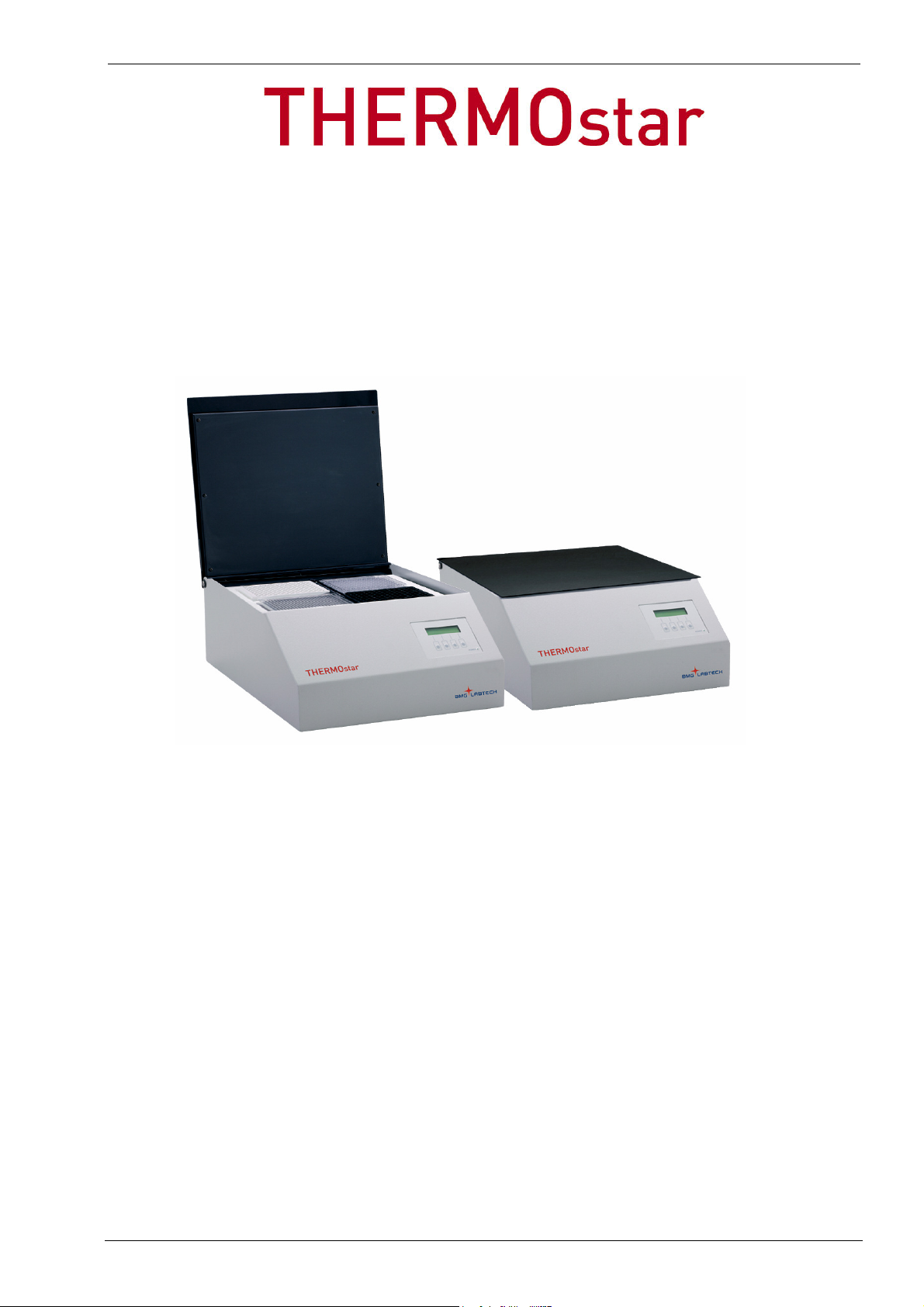
The THERMOstar is a high performance temperature controlled shaker which
accommodates up to four microplates. Temperature, shaking speed and incubation
time are fully programmable via keypad, while the status parameters are displayed on
the LCD in real time. Microprocessor-controlled heating plates above and below the
microplates provide uniform incubation with less than 1.0°C variation between any
two wells.
Figure 1: THERMOstar
3/10
Page 4

THERMOstar Operating Manual BMG LABTECH
2006
-05-190300B0001D
TABLE OF CONTENTS
1 TECHNICAL SPECIFICATIONS 5
2 UNPACKING AND INSTALLING THE THERMOSTAR 6
2.1 TRANSPORT LOCK 6
2.2
POWER CONNECTION 7
3 OPERATING THE KEYPAD 8
4 CLEANING AND DISINFECTION 9
4.1 INSTRUMENT DISINFECTION 9
4/10
Page 5

THERMOstar Operating Manual BMG LABTECH
2006
-05-190300B0001D
1 Technical Specifications
Incubation Incubation range from ambient +8°C to 45°C (option: 56°C)
in 1°C steps
Temperature stability ± 0.2°C
Temperature gradient 1.0°C (@ 37°C)
Shaking 0.75 mm orbit radius
Shaking range from 120 to 700 rpm
Timed shaking (range 0 to 18 h in 1s steps) or continuous
Power Requirements 115/230 V, 60/50 Hz
Consumption: max. 90 VA
Fuses: T0.5A/250V for main power 230 V
T1A/250V for main power 115 V
(use original type Wickmann only)
Dimensions Height: 17 cm, width: 33.5 cm, and depth 40.5 cm
Weight 8.5 kg
Ambient Conditions - Operating temperature: 15 °C to 35 °C
- Storage temperature: -10 °C to 50 °C
- Humidity of atmosphere: 20 % to 85 %
Instrument conformity: Over voltage category II
Contamination class II
Protection class I
Specifications are subject to change without notice.
5/10
Page 6
THERMOstar Operating Manual BMG LABTECH
2006
-05-190300B0001D
2 Unpacking and Installing the THERMOstar
When unpacking the instrument please check to ensure that all parts are available.
The shipping box should contain:
• THERMOstar
• Manual
• Power cord
• Service box containing: - 2 extra fuses-Wickmann original:
T0.5A/250V for main power 230 V
T1A/250V for main power 115 V
Call BMG LABTECH immediately if any of these items are missing.
The area designated for the instrument should be free of dust, liquids and acidic
vapours. The table's surface should be flat and even. Avoid areas subject to vibrations
and direct sunlight.
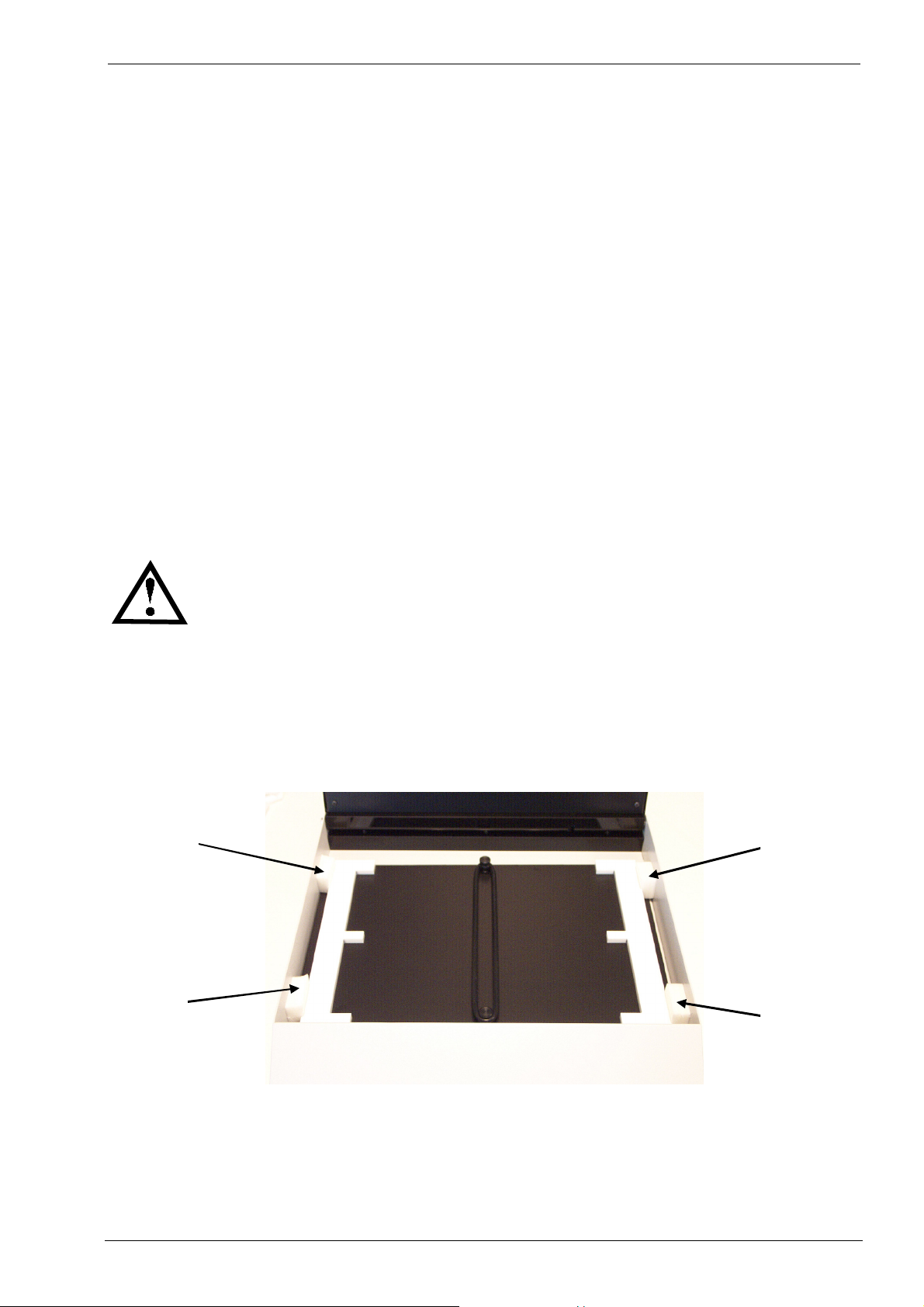
Upon unpacking and positioning the THERMOstar make sure to
remove the transport lock (section 2.1, transport lock) before any
power connection (section 2.2).
2.1 Transport Lock
Remove the four transport lock pieces.
Figure 2: transport lock
If the THERMOstar is to be transported the transport lock should be re-positioned to
prevent any damage of the shaking system.
6/10
Page 7

THERMOstar Operating Manual BMG LABTECH
2006
-05-190300B0001D
2.2 Power Connection
Before connecting the power cable or turning the power switch on
please make sure the transport lock is removed (section 2.1)
• Power Connection
First check that the power switch on the back side of the instrument is in the "off"
position. Inspect the voltage information on the label next to the power switch to
ensure that it corresponds to the local main power specifications. Also make sure the
power cable is with a protective earthed conductor. Hereafter the power cable can be
connected to the instrument.
7/10
Page 8
THERMOstar Operating Manual BMG LABTECH
2006
-05-190300B0001D
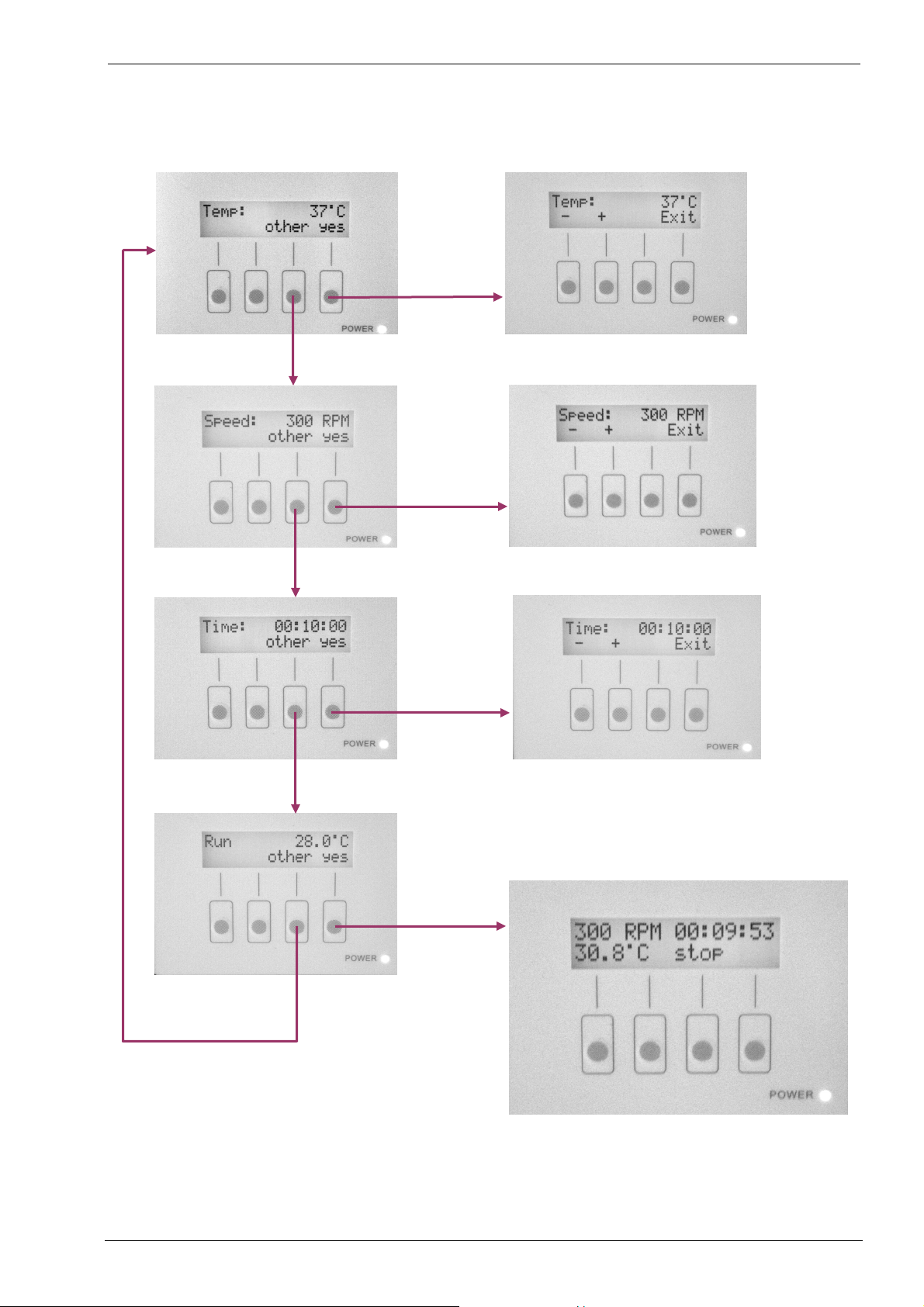
3 Operating the keypad
NoTemp, 25°C – 45°C (Option: 56°C)
NoSpeed, 120RPM – 700RPM
continuous, 00:00:01 – 17:59:59
RUN active until display “READY”
(incubation still on test temperature!)
8/10
Page 9

THERMOstar Operating Manual BMG LABTECH
2006
-05-190300B0001D
4 Cleaning and Disinfection
4.1 Instrument disinfection
Please follow all instructions carefully for a successful disinfection of the THERMOstar.
All parts of the instrument, which possibly can be in contact with patient sera or
positive samples, have to be handled as if they are hazardous. For this reason it is
recommended that gloves are worn while maintaining or working with the instrument.
It is very important that the instrument is thoroughly disinfected before maintenance
or before removing the instrument from the laboratory. Be sure that the instrument is
disinfected before you send it to your distributor or to the manufacturer. For safety
reasons, you have to fill out the Disinfection Certificate, or the instrument may not be
accepted by the service center or by customs authorities.
If the laboratory has no experience in disinfecting instruments, the following solutions
can be used:
Formaldehyde solution 10%
Alcohol 70%
(Please ensure that the national regulations for the handling of formaldehyde are
observed).
The procedure for disinfection has to be performed only by authorized personnel
wearing the necessary protection such as disposable gloves and protective clothing.
The location should be well ventilated.
Please note that formaldehyde may have influence on measurement results.
Disinfection steps
1. Disconnect the instrument from the main power supply.
2. Clean all outside surfaces of the instrument carefully with cotton wool, which has
been soaked in formaldehyde solution.
3. Place the instrument in a large plastic bag along with the cotton wool that has
been soaked in formaldehyde. Ensure that the wool does not touch the instrument.
4. Close and seal the bag.
5. Keep the instrument in the plastic bag for at least 24 hours.
6. After the disinfection time has lapsed, remove the instrument from the plastic bag
and clean all outside surfaces of the instrument with cotton wool that has been
soaked in alcohol solution.
7. Repeat the procedure for disinfection on any accessories, which will be returned
with the instrument.
8. Complete the Disinfection Certificate.
9/10
Page 10

THERMOstar Operating Manual BMG LABTECH
2006
-05-190300B0001D
Disinfection Certification
This instrument and its inventory has never been in contact with any
dangerous biological material, or if so, the instrument and its inventory
has been disinfected according to the instructions in the operating
manual of the instrument.
Name:
__________________________________________________________
Company:
________________________________________________
________________________________________________
________________________________________________
________________________________________________
Date, signature: ____________________________________________
10/10
 Loading...