

Page 1
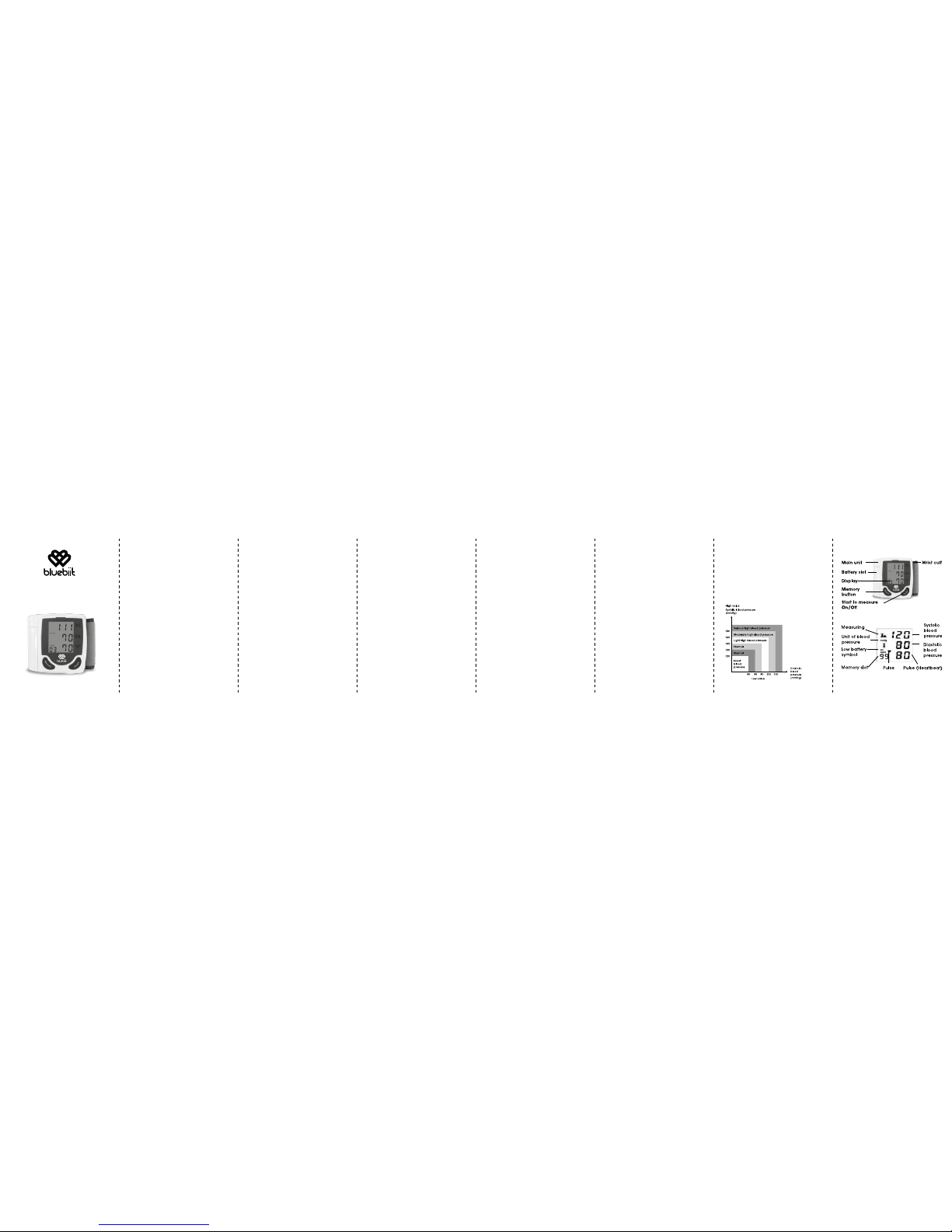
Introduction
Read this user guide carefully prior to use. This
ensures that you are using the device correctly and interpreting the values measured by
the device correctly. The device is designed
for normal home use only. Keep this user
guide for future reference. Contact your doctor if you need more information about your
blood pressure.
Features
• Smart, automatic compression and decompression of the wrist cuff
• High value (systolic), low value (diastolic)
and pulse are shown simultaneously
• Easy to use – Measure with one touch of a
button
• 99 memory slots
• The device saves the measurement results
automatically
• The device turns off automatically after one
minute of inactivity
• Automatic device error correction, automatic battery charge level monitoring
• Suitable for wrist circumferences of 135–195
mm
• Large LCD display
• Accurate measurement results
• Uses two AAA batteries
Safe use
The measurement results provided by the
device are indicative. Using the measurement
results for self-diagnosis or self-medication is
dangerous. Follow your doctor’s instructions
when using this product. If you have any
questions regarding the measurement results
provided by the device, talk to your doctor as
soon possible.
Various conditions, such as diabetes, high
cholesterol or high blood pressure, and other
illnesses, such as arteriosclerosis, can cause
blood pressure measurement from the wrist
or hand to yield very varied results. If you
have been diagnosed with severe blood flow
problems or complications, ask your doctor
first about using the device.
Even healthy people may exhibit 20 mmHg
differences in blood pressure measurement
results due to incorrect measurement conditions or methods. The measurement results
should not be used to derive diagnoses or
start treatment by yourself. It is dangerous. Talk
to your doctor about the issue and follow the
advice given.
It is good to remember that various situations,
such as tension, affect the measurement
results, which is why the measurement results
may vary. For example, measuring blood pressure in a soothing environment, such as at
home, may yield results that are 20–30 mmHg
lower than a measurement performed by a
doctor in a hospital environment.
Due to the variation in measurement
conditions, it is important to perform the
measurement at home at regular intervals.
Different emotional states and environments
may cause changes of up to 30–50 mmHg in
blood pressure.
Safety instructions
• Keep the device out of the reach of children.
• Only use the device to measure blood
pressure.
• If you have been diagnosed with severe
blood flow problems or complications, ask
your doctor first about using the device.
• Do not use the device for small infants or
persons who are unable to express their will.
• Do not use a mobile phone or other devices
that generate an electromagnetic field in the
proximity of the blood measure monitor when
performing measurements. They may cause
errors in the operation of the device.
• Do not disassemble the device or wrist cuff.
It can lead to damage to the device or unreliability of the measurement results.
• Do not turn on the device (using the On/Off
button) when it is not around a wrist.
• Do not drop, bang, subject to vibration or
heat the device.
• Do not twist or stretch the device. Place
the wrist cuff around your wrist without using
unnecessary force.
• Do not subject the device to hot temperatures, high humidity, dust or direct sunlight.
• Do not use benzene, petrol or alco-
hol-based cleaning agents or solvents to
clean the device.
Batteries
• Use two batteries labelled “AAA” in the device (LR03 1.5V). No other types of batteries.
• Do not place the battery terminals the
wrong way round. The correct way to install
the batteries is indicated with symbols inside
the battery slot.
• Remove the batteries from the device if
you do not use the device for more than 3
months.
• Replace empty batteries with new ones
immediately. Replace both batteries at the
same time.
• Do not use new and old batteries simultaneously.
Information about blood pressure
Blood flow in the arteries causes pressure in
them.
Systolic blood pressure (highest pressure)
Diastolic blood pressure (lowest pressure)
In general, blood pressure is at its lowest in
the morning and slightly higher in the afternoon and in the evening.
The pressure is lower in summer than in winter.
Physical fitness and exercise affect blood
pressure and pulse.
Blood pressure classification chart defined
by the World Health Organization (WHO)
and the International Society of Hypertension
Parts
Display
Wrist blood pressure monitor
User guide
Page 2

Preparations
Battery installation
1. Remove the cover of the battery slot by
pressing the cover in the direction indicated
by the embossment on the cover.
2. Place 2 AAA batteries in the battery slot as
indicated by the embossment on the bottom
of the battery slot. The negative battery
terminals (-) go against the springs in the
battery slot.
3. Close the cover of the battery slot.
Battery replacement
The device detects the charge level of batteries automatically and indicates a charge
that is too low with a symbol. (battery symbol)
The device retains the measurement memory
for 30 seconds without batteries, so remove
the new batteries from their packaging and
place them next to the device before removing the old ones.
1. Remove the cover of the battery slot by
pressing the cover in the direction indicated
by the embossment on the cover.
2. Remove the old batteries and replace
them with new ones. Replace both batteries
at the same time.
3. Close the cover of the battery slot.
Note!
• The charge level of batteries decreases in
cool air.
• Old batteries may damage the device, so
when the device indicates a low charge level,
remove the old batteries from the device and
replace them with new ones.
• Do not leave batteries in the device for
more than three months if you do not intend
to use the device.
• Do not mix old and new batteries.
• If you accidentally place the batteries in
the device the wrong way round, remove the
batteries, wait for 1 minute and then place
the batteries in the battery slot again the right
way round.
• Recycle old batteries. They must not be
burned as they may explode.
Recommendations for use
• Always measure blood pressure from the
same wrist and in the same position.
• Measure blood pressure in room temperature.
• Measure at the same time in the morning,
afternoon and evening. Three times a day.
• During measurement, hold the blood
pressure monitor at heart level so that you are
sitting up straight and supporting your elbow
on a table, for example.
• You should be relaxed during measurement.
30 minutes before measurement, you should
refrain from going to sauna, bathing, exercising, smoking, eating, alcohol and products
containing caffeine, such as coffee.
• The feeling of needing to urinate raises
blood pressure. Go to the toilet before measurement if you feel the need.
• Calm down and relax for a few minutes
while sitting in place prior to measurement.
• If you take several measurements at a time,
have 5 minute breaks between the measurements.
• The first measurement result is not reliable
because several measurements over a longer
period of time are required to detect the
general level.
• Keep a record of measurement results in the
long term to gain more accurate information
and, if necessary, to present them to your
doctor.
Wrist cuff placement
1. Open the wrist cuff and place it around
the left, bare wrist so that the display of the
device is on the palm side. The palm and the
device are pointed at you.
2. Ensure that the edge of the device is approx. 1 cm from the bottom of the palm.
3. Wrap the wrist cuff around the wrist with
your right hand and fasten it at the Velcro
tape.
Measuring position
1. Sit in a chair with your back straight and
your feet firmly on the floor.
2. Support your elbow against a table so that
the blood pressure monitor is at heart level.
You can place a pillow under the elbow but
the pillow must not put pressure on the wrist
cuff.
3. Ensure that the palm and the blood pres-
sure monitor are facing you.
4. Let the hand and wrist rest in a relaxed
position.
Taking a measurement
Measurement is started using the On/Off
button and it can be interrupted at any time
using the same button.
1. Press the On/Off button. The display of the
device wakes up and all symbols light up
momentarily on the display.
2. The device flashes the reading “00” a few
times, after which the wrist cuff inflates and
tightens. The reading on the display increases
and reaches its peak.
3. The reading starts to gradually decrease
while the wrist cuff deflates. The device beeps
in time with the pulse while the reading on
the display decreases.
4. When the measurement result is ready, the
device will no longer flash the reading, but
display the systolic pressure, diastolic pressure
and pulse.
5. You can open the wrist cuff and remove the
device from the wrist.
The measurement result is automatically
saved in the device’s memory and the display/device turns itself off after a short while.
You can also turn off the device using the
On/Off button. It is a good idea to take a 5
minute break before the next measurement.
The second measurement result is often more
accurate.
Warning!
• If the device malfunctions and the wrist cuff
continues to tighten, remove the wrist cuff
and turn off the device immediately.
• Do not use the device if you have injured
your hand. Talk to your doctor first about
using the device.
Viewing saved measurement results
1. Press the Memory button.
The device displays the most recent measurement data. The number in the bottom left
corner of the display indicates the memory
slot (01–99).
2. You can browse the data of previous measurements by pressing the Memory button
again. The device saves 99 measurements,
and when new measurements are taken, the
device deletes the data of the oldest measurements to make way for the new.
The display stays on for 9 seconds and then
turns itself off if the Memory button is not
pressed again, browsing saved measurements. When the display is on, the device can
also be turned off by pressing the Power (On/
Off) button.
Device cleaning and storage
You can wipe the device with a damp cloth
if it is dirty. Place the wrist blood pressure monitor and guide back into their packaging so
that the wrist cuff is rolled up and the display
of the monitor is facing upwards.
Remove the batteries from the battery slot if
you do not intend to use the device for more
than 3 months.
Device calibration
We do not offer recalibration of devices.
Technical specifications
Bluebiit Wrist blood pressure monitor
BBBP99WT1
Wrist cuff inflation: Automatic pump inflation
Wrist cuff deflation: Automatic
Display: LCD digital display (width 28 mm, height 35 mm)
Measurement method: Oscillographic method
Pressure measurement range: 20–280 mmHg (0.4–37.3
kPa)
Pressure measurement accuracy: ±3 mmHg (±0.4 kPa)
Pulse measurement range: 40–199 beats/min.
Pulse measurement accuracy: ±5%
Operating temperature: 10–40°C, Maximum relative
humidity 40–85%
Storage temperature: -20–50°C, Maximum relative
humidity 15–90%
Power source: 2 AAA batteries (1.5V LR03)
Voltage: 3 V, Power: 1 W
Measurable wrist circumference: 135–195 mm
Measurements without wrist cuff: 73 mm × 70 mm × 32
mm, Weight: 100 g (without batteries)
Package contents
Wrist blood pressure monitor, wrist cuff, protective cover and user guide
www.bluebiit.com
 Loading...