

Page 1
Storm Hood Dishwasher
User Manual
Read these instructions carefully before using your
Glasswasher, and care for it properly.
If you follow the instructions, your dishwasher will
provide you with many years of good service.
Page 2
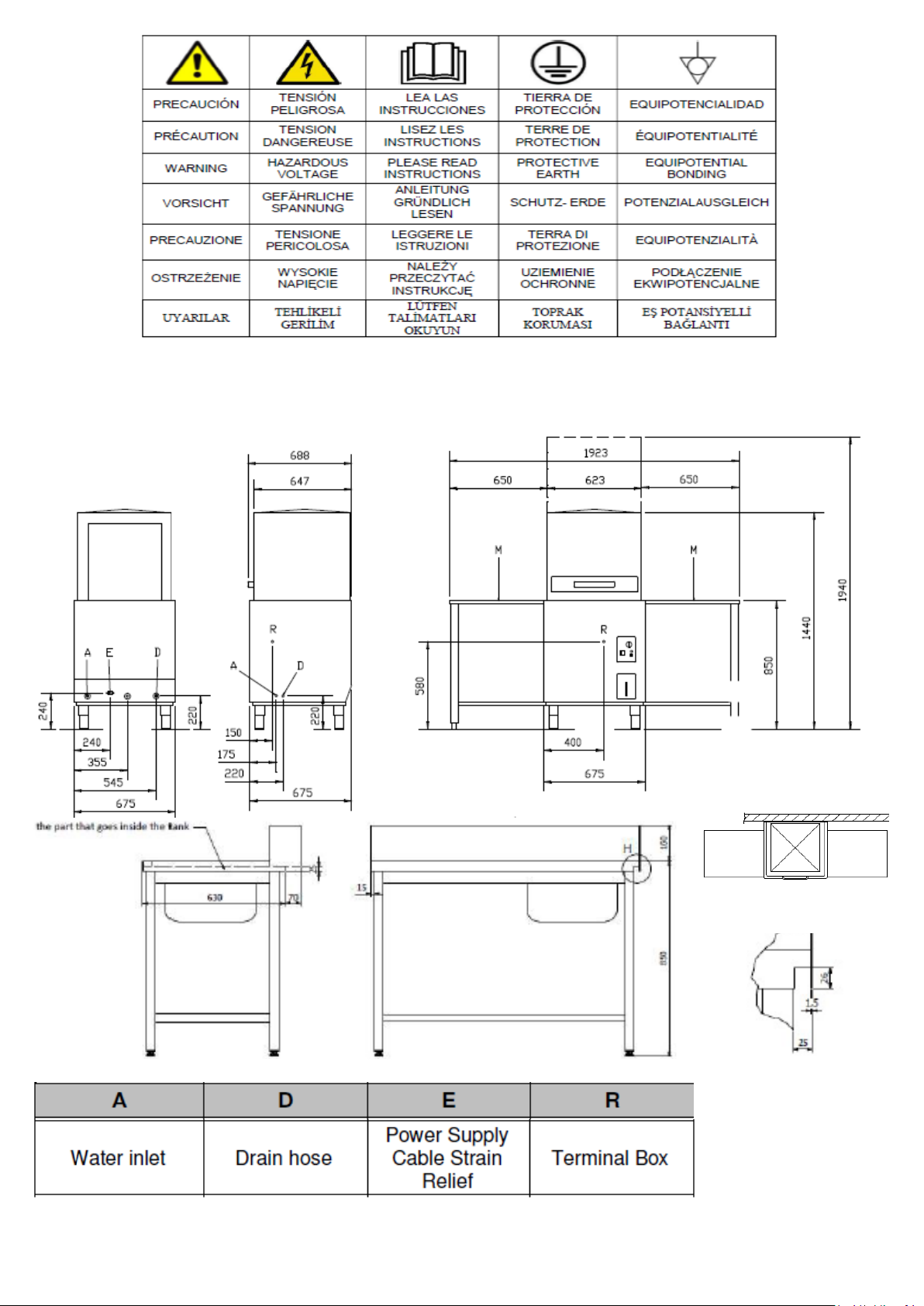
Fig1: Dimensions (mm)
Storm 100BTDP
Page 3
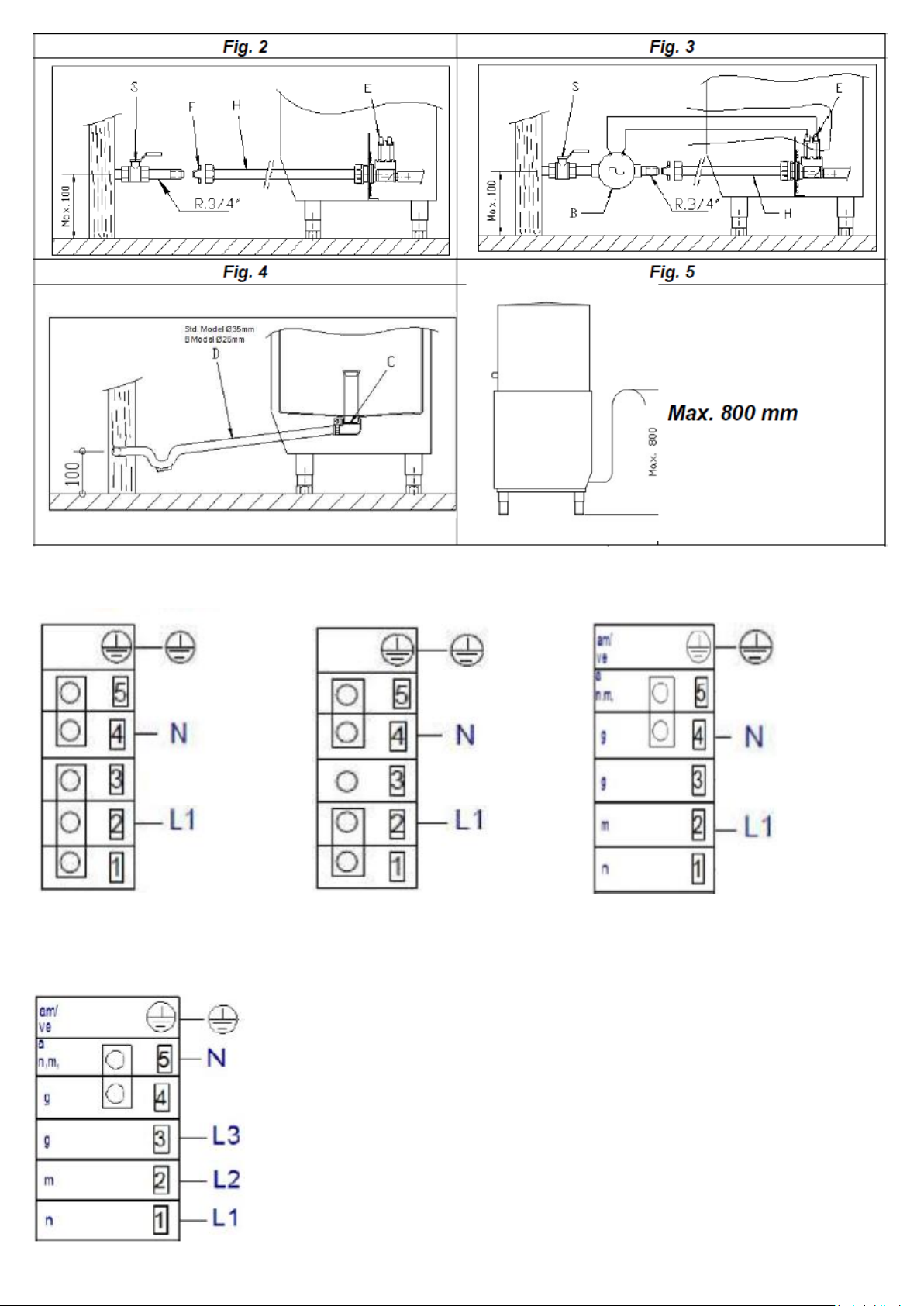
Fig8 400V 3N
Fig6 230V 1N
60A
40A
30A
Page 4
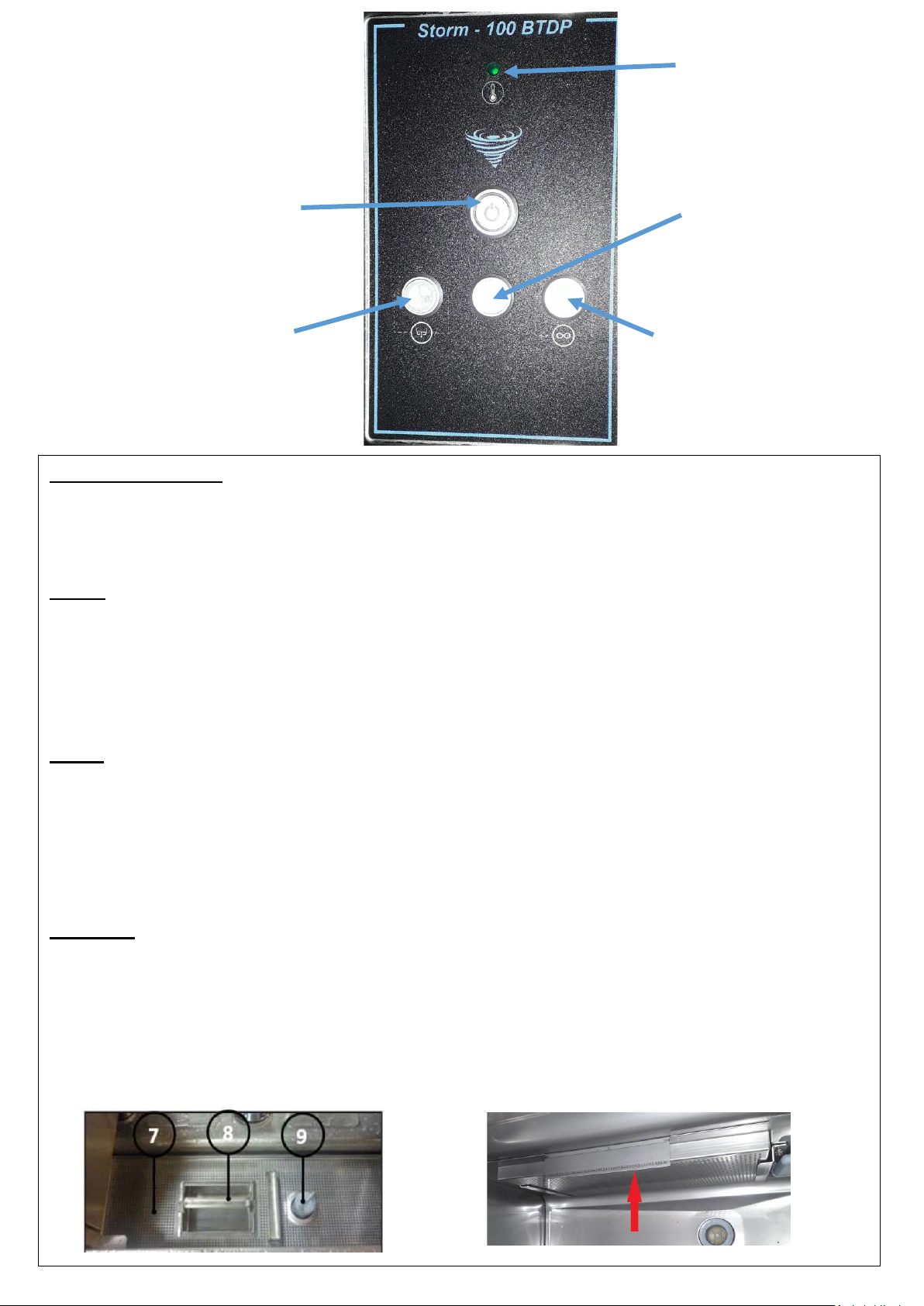
Fig. 7
Control Panel:
QUICK GUIDE
On/Off switch, press and
hold for 3 seconds
switches the power On /
Off.
Temperature
satisfied indicator.
Illuminates when
at full temperature
Press and release to start a
Short cycle, button
illuminates during a cycle.
Press and hold initiates
drain down cycle (door
open, drain plug removed)
Press and release to start
a long cycle.
Press and Hold initiates a
Permanent wash 5 mins
Press and
release to start
a medium cycle
Cycle buttons illuminate to indicate which
cycle is running. Flashing indicates
secondary switch function is operational.
Filling and Heating:
Ensure drain plug and filters are in position, close door and press the on/off button for 3 seconds.
The machine fills up and stops when full and heats up, switch on ½ hr before first use, when
temperature is fully satisfied the temperature satisfied light illuminates, unit is ready for use.
Wash:
Remove scraps from items before loading into the basket, open the door and insert basket, close
door. Press and release the cycle button relating to the length of wash required, the cycle button
will illuminate when a cycle is in action. The cycle light goes out when the cycle is complete. Open
the door when finished and leave tray to dry (2 mins) before handling. Cycle auto-starts the same
cycle when closing door
Drain:
Gravity drain version: Switch off the unit, Open door, remove overflow drain plug(9), LEAVE
FILTER IN POSITION. Fig 3
Pump drain version: Open door, remove overflow drain plug, LEAVE FILTER IN POSITION Fig 3,
press and hold the short cycle button for 3 seconds, the drain pump will start and the button will
flash, when empty switch off the unit by pressing the on/off button.
Cleaning:
Daily: drain machine, only when fully drained, remove filters (7) (8) and clean thoroughly, slide up
lower filter and clean (10). Check upper and lower wash arms spin freely by hand. Replace cleaned
filters immediately and insert overflow drain plug. Clean and dry the machine with a soft cloth.
Check detergent and Rinse-aid chemicals are topped up.
Weekly: Check all upper and lower wash jets and rinse jets for blockages, remove and clean as
necessary. If wash arms are stiff, remove wash arms and clean arms and spigot thoroughly.
10
Page 5

2. GENERAL INFORMATION AND WARNINGS
This manual has been created to help you understand the operation, installation and maintenance of the
machine. It contains all the necessary information and warnings to ensure that the appliance is installed
and
used correctly, together with information about the characteristics and possibilities offered, so that you
may
enjoy your machine to the full.
BEFORE STARTING THE APPLIANCE, PLEASE READ THE INSTRUCTIONS
CONTAINED IN THIS MANUAL CAREFULLY.
The manual should be kept safely to hand for future reference.
If the machine is sold or transferred, please pass the manual to the new user.
THIS APPLIANCE IS EXCLUSIVELY FOR PROFESSIONAL USE, AND SHOULD ONLY
BE USED BY QUALIFIED PERSONNEL.
The positioning and installation, and all repairs or modifications, should always be carried out by an
AUTHORISED TECHNICIAN, in accordance with the applicable legislation of the country. The
manufacturer does not accept liability if the machine is incorrectly installed.
The installation, incorrect adjustment, inappropriate maintenance or use of the appliance may cause
material damages and injuries.
The dishwasher should be correctly levelled and care taken to ensure that none of the electric cables,
water or drainage hoses are trapped or kinked.
DO NOT climb on top of the dishwasher or place heavy objects on top of the machine as it has only
been designed to bear the weight of the basket of plates to be washed.
The dishwasher is designed for washing plates, glasses and other kitchenware with traces of
human food. Any other objects must not be washed in the machine.
If your machine breaks down, please call the Technical Service Centre.
Unqualified or unauthorised personnel must NOT try to repair the machine.
Use of spare parts other than original parts will cancel the guarantee.
During all maintenance operations, the dishwasher must be disconnected from the main
power
supply at the mains power switch, and the water intake tap must be closed.
Abrasive or corrosive products, acids, solvents and chlorine-based detergents must NOT be
used to clean the appliance, as this may damage the components.
This appliance has been designed for use in ambient temperatures between 5 ⁰C and 40 ⁰C.
Only the baskets, soaps and rinse aids recommended by the manufacturer should be used.
FAILURE TO COMPLY WITH THESE INSTRUCTIONS OR THE INCORRECT USE OF THE
APPLIANCE SHALL RELIEVE THE MANUFACTURER OF ANY OBLIGATIONS
REGARDING THE GUARANTEE OR POSSIBLE CLAIMS.
Page 6
3. PRODUCT DETAILS
The machine which you have just purchased is specially designed for cleaning tableware, glassware
and
other items of kitchenware used in the hotel and catering sector. As it is an industrial product, it is
characterised for having a high dishwashing capacity.
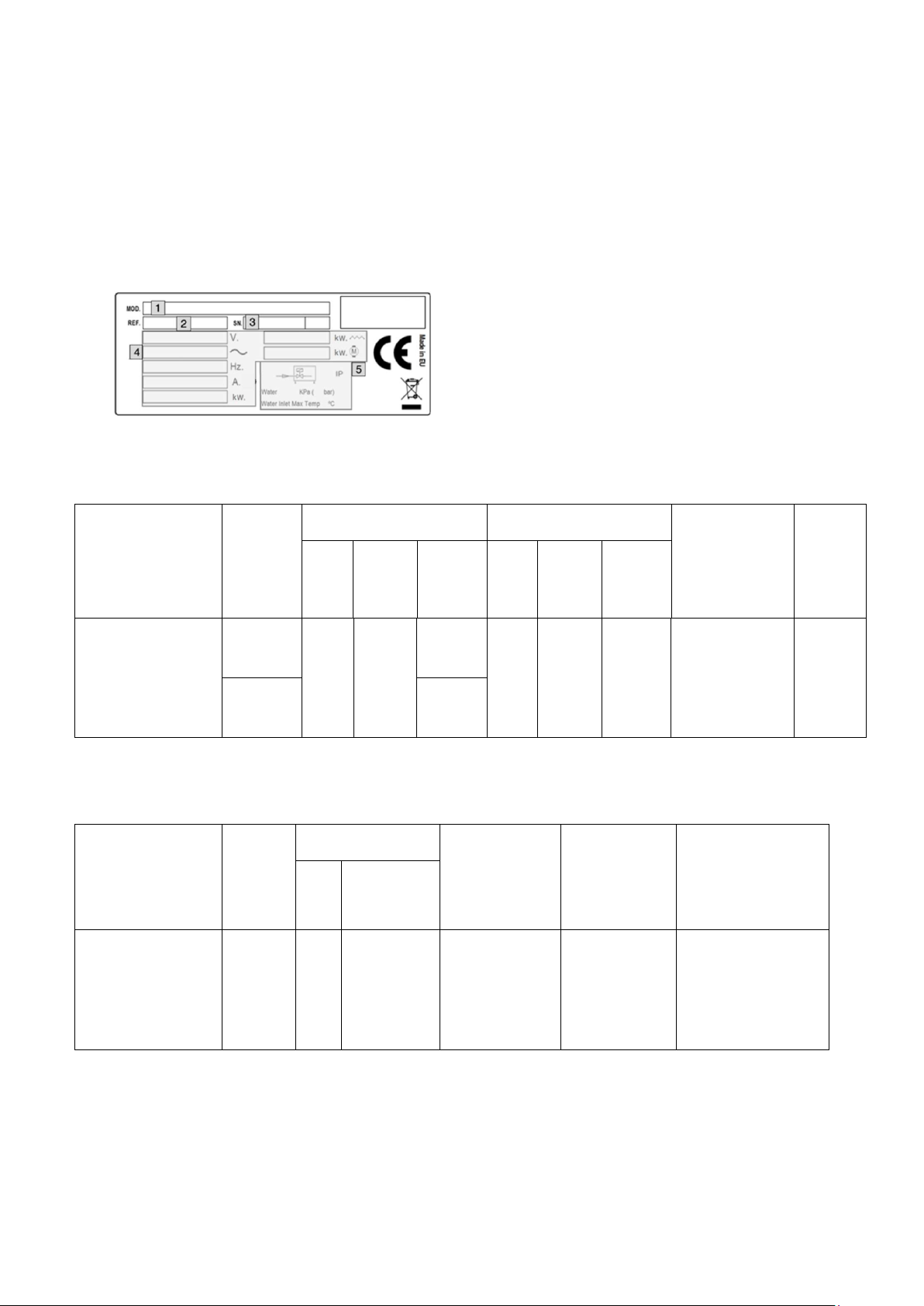
All the appliances have a specifications plate which identifies the appliance and indicates its technical
characteristics, it is located on one side of the machine. Don`t remove the specifications plate from the
unit.
SPECIFICATIONS PLATE
1: APPLIANCE MODEL NAME
2: APPLIANCE REFERENCE
3: SERIAL NUMBER + MANUFACTURE
DATE
4: ELECTRICAL SPECIFICATIONS
5: WATER INLET SPECIFICATIONS
These details should be quoted when the technical service is called.
3.1 General specifications
Model
Voltage
supply
Boiler
Reservoir
Water
consumption
per cycle
(Ltr/Cyc)
Sound
Level
Cap
(Ltr)
Temp
(°C)
Power
(W)
Cap
(Ltr)
Temp
(°C)
Power
(W)
Storm100BTDP
230V
50Hz
7
85
12000
45 60
4500
3
65dBA
400V
50Hz
12000
3.1 Specific Characteristics
Model
Cold
Rinse
option
Wash Cycles
Detergent
and
Rinseaid
valves fitted
Thermostop
Wash Capacity
(Baskets/hr)
No.
Length
(S)
Storm100BTDP
NO
3
55 / 75 /
120
YES
YES
40
Page 7
4. INSTALLATION INSTRUCTIONS
The positioning and installation, and all repairs or modifications,
should always be carried out by an AUTHORISED TECHNICIAN,
in accordance with the applicable legislation of the country.
The installation, incorrect adjustment, inappropriate maintenance or use of
the appliance may cause material damages and injuries.
4.1 Removal of packaging
Remove packaging from the machine and check for damage during transportation. If any damage is
observed, immediately notify the supplier and the transport company. In the event of doubt, do not
use the machine until the problem has been assessed.
Packaging (plastic, expanded polyurethane, staples, etc…) must not be left in the
reach of children, they are a potential hazard.
The machine should be moved using a fork-lift truck or similar to avoid damage to the structure.
Transport the machine to the installation location and then remove packaging.
All the packaging can be recycled. Dispose of packaging correctly.
4.2 Positioning and levelling
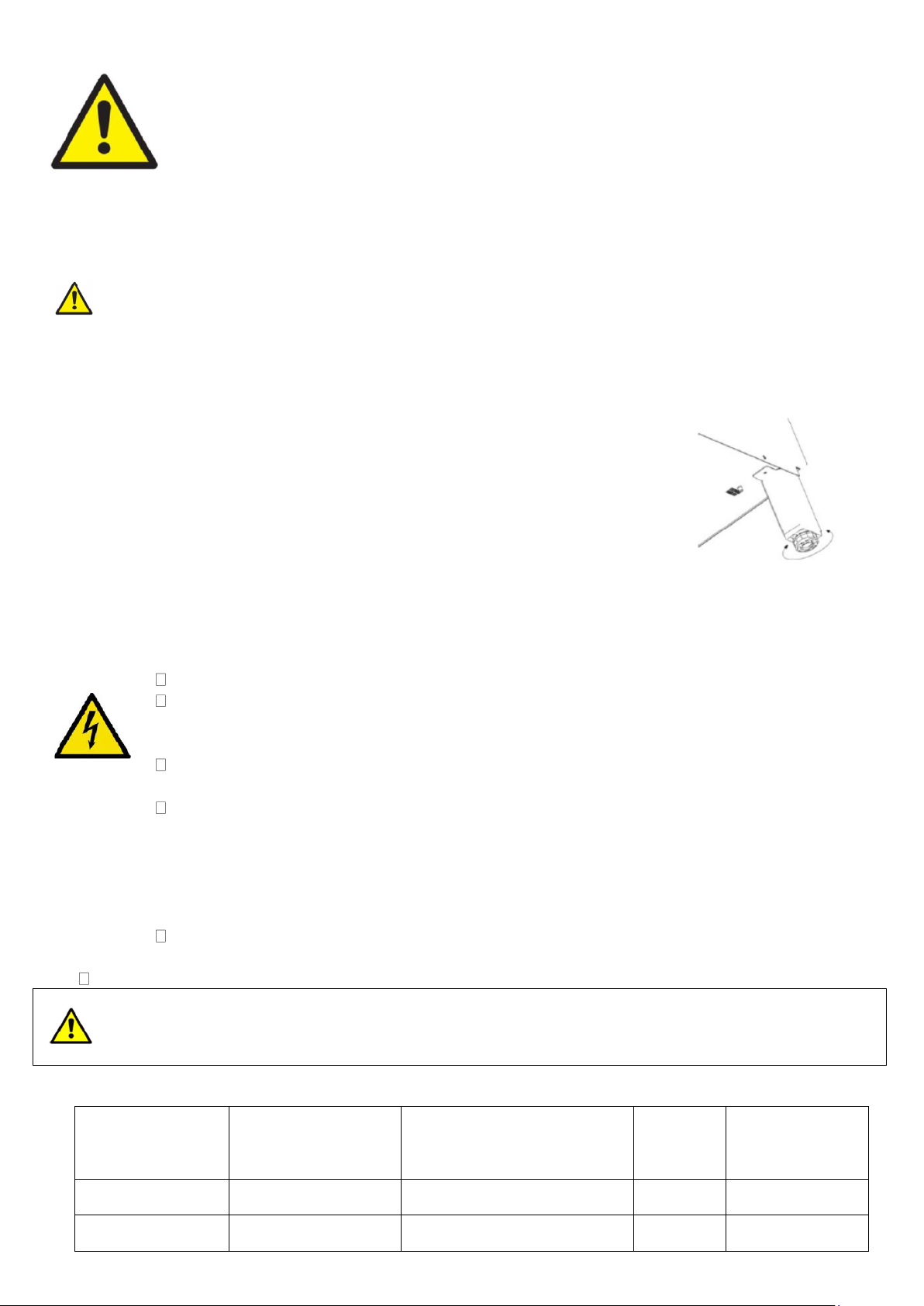
This appliance has adjustable feet to allow it to be adjusted to the correct
height, this is done by turning the foot to the desired height. For optimum
operation, it is essential that the machine is correctly levelled. The flooring on
which the machine is to be installed must be able to bear the full weight of the
machine.
Inspect final location of the machine prior to installation to prevent
damage during use.
4.3 Electrical connection
An AUTHORISED TECHNICIAN should always carry out the appliance’s electrical connection.
The legal standards in force in each country regarding connection to the mains should be taken into
account.
Check that the mains voltage corresponds to that indicated on the nameplate.
The electric cable should be flexible, with an oil-proof covering, and it should not
weigh less than the cable in an ordinary sleeve made of standard polychloroprene
or an equivalent synthetic elastomer (H07RN-F).
The cross-section of the power cable must be suitable for the rated current of the
machine.
An easily accessible switch device should be installed next to the appliance for all
the phases, with a minimum gap of 3 mm between contacts. This switch should be
used to disconnect the appliance during installation, repair, cleaning and
maintenance work. The switch should have fuses suitable for use with the rated
current (A) of the machine. Alternatively, a suitable magneto-thermal switch may be
used.
The appliance must be earthed using a differential protector. The manufacturer will
not be held liable for damage originated by failure to observe this requirement.
If any faults are observed during the installation, the supplier should be notified immediately.
4.3.1 Electrical specifications of the installation
Model
Supply Voltage
Max Electrical power(KW)
Amp (A)
Net Weight
(Kg)
Storm100BTDP
230V 1N 50/60Hz
12.2
53
126
Storm100BTDP
400V 3N 50/60Hz
12.2
29.1
126
The manufacturer will not be held liable for any personal or material damage to the
machine resulting from incorrect installation or failure to comply with the manufacturer’s
specifications
Page 8
4.3.2 Voltage Configuration of the machine
The voltage configuration of the machine is stipulated on the nameplate (400V 3N~50Hz/60Hz). This
configuration can be changed to 230V 1N, see fig6 and fig8. Authorised personnel only to change this
configuration.
4.4 Hydraulic connection
The new hoses supplied with the appliance should be used (do not reuse old hoses).
Before connecting the machine to the water supply, the water quality should be tested.
Recommended water quality:
Water Temp (T):
Max. 60°C
Total water hardness:
5-10°fH (French
degrees)
pH:
6.5 - 7.5
7 – 14 ⁰eH (English
degrees)
Impurities:
Ø < 0.08 mm
9 – 18 ⁰dH (German
degrees)
Chlorides:
max. 150 mg/l
Conductivity:
400 - 1,000 μS/cm
Cl:
0.2 - 0.5 mg/l
If the water hardness is more than 10 ⁰fH (French degrees), a water softener must be installed. In
addition to water quality, the pressure of the mains water supply must be considered. This is important
to ensure the machine operates correctly.
Required water pressure:
Dynamic
Pressure
MIN.
MAX.
bar
kPa
Kg/cm2
psi
bar
kPa
Kg/cm2
psi
2
200
2.03
29
3.5
350
3.56
50.76
If the water pressure is higher than the recommended pressure, a pressure regulator must be
mounted at the output Fig. 2. If the mains water pressure is lower than the recommended pressure,
a pressure pump should be mounted at the mains water supply Fig. 3. It is not necessary to install a
pressure pump in the BT models.
Fig. 2. Direct connection of water input hose.
Fig. 3. Pressure pump connection.
S → SHUT-OFF COCK F → FILTER H → WATER HOSE5
E → ELECTROVALVE B → ELECTRIC PRESSURE PUMP
The following requirements are necessary for the correct hydraulic installation of the machine.
The hydraulic circuit must be fitted with a valve to shut-off the water supply.
Check that the mains pressure is within the range indicated above.
To optimise the working of the machine, the manufacturer recommends that the water temperature at
the machine intake is within +5°C and 60°C.
If using hot water, the water temperature must not exceed 60 ⁰C / 140 ⁰F.
All the machines should have a ¾” screw-on connection.
4.5 Drainage connection
5 For Australia, watermark certified inlet hose and backflow prevention device. Must be installed in
accordance with AS/NZS3500.1 (water service supply) including installation of the supplied backflow
prevention device.
The water draining from the machine must flow freely and therefore the drainage pipe should be
lower than the drainage outlet Fig. 4. If the drainage pipe is not lower, a drainage pump will be
required. This must not be mounted at a height of more than 800 mm Fig. 5. In this case, the pump
may be requested at the time of purchase or subsequently. Drain pipes of 31mm in diameter must be
installed in accordance with AS/ NZ3500.2 (drainage) by means of coupled connection to a DN50 or
larger pipe
Page 9

Fig. 4. Drainage installation. 6
Fig. 5. Installation of drainage at a height using drainage pump.
The drainage pump must only be installed by personnel authorised by the
manufacturer, and the manufacturer does not accept liability in the event of
incorrect installation.
4.6 Mechanical / Electric (BTmodels) rinse aid dispenser
Operation: The mechanical dispenser absorbs the rinse aid when it detects a loss in pressure during
rinsing. That is, when the filling solenoid valve closes, a vacuum is created that makes the rinse aid
dispenser absorb the fluid to which it is connected. The electric pump on BT models rinse-aid into the
break-tank.
Adjustment: The dispenser should be adjusted when the machine is installed to ensure that the
wash is optimised from the start. The setting should be adjusted according to the type of rinse aid
and the water hardness.
4.7 Detergent dispenser
This ensures that the correct measure of detergent is supplied to the machine.
Installation: the detergent dispenser input must be in the tub of the machine, below the maximum
water level. Please see the electrical circuit diagram for details of the electrical connection The tub
has an opening for the installation of the dispenser.
Operation: the detergent dispenser is activated when the machine is taking water, whether it is in
rinse cycle or whether it is filling.
Settings: the measure of detergent used should be adjusted when the component is installed to
ensure that the wash is optimised from the start.
The manufacturer recommends that the detergent and the dispenser setting are defined
by a technician specialised in the use of chemical products in order to ensure a more
efficient wash.
4.8 Pressure pump
If the mains water pressure is less than 2 bar (200 kPa), you have the option of installing a pressure
pump. If the pressure is less than 2 bar (200kPa), the machine may operate incorrectly. The
electrical connections for the pressure pump are shown in the electric circuit diagram. The water
connection to the pressure pump is shown in Fig. 3.
If the mains water pressure is less than 2 bar (200 kPa), please contact your supplier or the
manufacturer to request the PRESSURE PUMP KIT.
The pressure pump must only be installed by personnel authorised by the manufacturer,
and the manufacturer does not accept liability in the event of incorrect installation
5. USE AND MAINTENANCE INSTRUCTIONS
BEFORE STARTING THE APPLIANCE, PLEASE READ THE INSTRUCTIONS
CONTAINED IN THIS MANUAL CAREFULLY.
THE APPLIANCE IS EXCLUSIVELY FOR PROFESSIONAL USE, AND SHOULD
ONLY BE USED BY QUALIFIED PERSONNEL.
5.1 Operation
The steps required to optimise the operation of your dishwasher are shown below, with all the available
options.
5.1.1 Control panel symbols Fig. 7
A. Machine on/off button. (ON/OFF) / Machine on pilot light
B. Machine ready pilot temperature satisfied
C. Short cycle button (55 s)/ Drainage button / Machine working pilot
D. Medium cycle button (750 s) / Machine working pilot
E. Long cycle button (120 s) / Constant wash button / Machine working pilot
Page 10

5.1.2 Switching on the machine
Before switching on the machine, check the following:
The mains switch must be on.
The water stop cock must be open.
There must be water in the mains network.
The corresponding filters must be in place.
The overflow should be mounted in place.
The chemical tubes are inserted fully into liquid in the correct chemical bottles
To switch on the machine just press the ON-OFF button (A) once for 1.5 seconds.
5.1.3 Filling and heating
When the machine is switched on, it will start to fill. First the rinse boiler is filled and then the wash
tub. The filling process may last a few minutes. Once the wash tub is full, the boiler starts to heat up
and when it is hot, the tub is heated. Although it is possible to start the wash process, this is not
recommended as the water inside the machine is not yet at the ideal temperature. When the
machine has reached the ideal temperature for washing the dishes properly, the machine ready light
comes on.
The temperature in the boiler should be between 82-90 ºC and in the tank between 57-62 ºC
The manufacturer recommends that the water in the glass washer is changed every 40/50 washes or
twice a day.
The door must be closed for the machine to start filling. For safety reasons, if the
door is open, the machine will not fill. DO NOT leave the door open for prolonged periods.
The machine you have purchased has a safety thermostat in the boiler and another for the tub, so
that in the event of the breakdown of any of the main thermostats, the safety thermostats switch off
the corresponding heating.
During the first heating of the day, the boiler may reach a higher temperature than
that mentioned above due to heating inertia. This is normal. If pressurised steam is
observed coming out of the rinse branch nozzles, while the boiler is heating, the
technical service should be notified.
5.1.4 Preparation of the dishes
Before washing the dishes, the preparatory steps below should be followed:
Remove the largest pieces of waste from the dishes before placing them in the baskets.
Wash glassware first.
Put the plates in the rack basket.
Place the glasses upside down.
Place the cutlery in the cutlery baskets with the handles downwards. The different pieces of
cutlery can be mixed.
Place the cutlery baskets in the lower baskets.
5.1.5 Selecting the wash cycle
Before starting the wash cycle, place the corresponding basket containing the dishes in the machine.
To start the wash process first close the door and then select the wash cycle you wish to run for 1.5
s. The wash cycle will start automatically. Each wash cycle runs for a set time that is selected
according to how dirty the plates are (55 s/75 s/120 s).
The door must be closed for the machine to start the wash cycle. For safety reasons,
if the door is open, the wash cycle will not start.
5.1.6 Thermo-stop
The thermo-stop guarantees a constant rinse at a temperature of 85 ⁰C. This means that the
machine continues washing until the boiler reaches the ideal temperature. Then the rinse cycle
starts.
5.1.7 Stopping the wash cycle and end of wash cycle
The wash cycle can be stopped in the following ways:
By switching off the machine → the cycle stops completely.
By opening the door → when the door is closed, the cycle continues.
At the end of the wash cycle, remove the basket and leave the dishes to dry naturally. Remove the
dishes from the basket with clean hands, taking care not to burn yourself as the dishes are very hot.
Page 11

5.1.8 Continuous wash cycle
The machine you have purchased has a continuous wash cycle so that heavily soiled items can be
washed for a longer period. To activate the constant wash cycle, press and hold the long cycle button
for 5 seconds, switch off or open the hood slightly to stop the cycle
5.1.9 Drainage of the machine
The dishwashers have two types of drainage: gravity drainage or using a drainage pump.
5.1.9.1 Drainage by gravity
To drain the machine in this way, just remove the overflow from the machine and it will drain
naturally. For reasons of safety, this method of drainage should only be used with the machine
switched off.
5.1.9.2 Drainage using the drainage pump (optional)
The drainage using the drainage pump option is only available on request. The drainage pipe must
always be fitted on a siphon to prevent the return of odours. To drain the machine using this method,
proceed as follows:
Remove the overflow valve.
Leave the door open.
Press the drain button (B) for 3 seconds and the drainage cycle will start automatically.
At the end of the cycle (approx. 160 s), replace the overflow valve. The machine may be
switched off.
To drain the machine with the drainage pump, the hose must be at a
height (max. 800 mm).
5.1.10 Switching off the machine
The dishwasher is switched off by pressing the ON-OFF button for 1.5 s.
The machine should not be switched off during the wash process as this will stop the tableware
inside the machine from being cleaned properly.
5.1.11 Cleaning the machine at the end of the day
At the end of the day, the filters, wash distributors, rinse branches and other accessories must be
cleaned. This is necessary to prolong the service life of the machine. To ensure the efficient washing
of the dishes, the dishwasher must be perfectly clean and disinfected.
5.2 Useful tips
Read the useful tips listed below carefully to allow you to get the most out of your dishwasher.
5.2.1 Maintenance
Always clean the machine correctly to prolong the service life of the machine.
Remove any waste from the machine at the end of each day.
Do not use abrasive, corrosive or acid products, chlorine-based detergents, solvents or
petrol derivatives to clean the machine.
Do not use pressurised water to clean the machine.
Only wash tableware, glassware or kitchenware that has been used for human food.
Check that the wash distributors rotate correctly every day.
Check the salt, rinse aid and detergent levels at the start of each day.
Call the technical service twice a year to have the machine serviced:
o Cleaning of water filter.
o Cleaning of limescale on the resistors.
o Inspection of the condition of the seals.
o Inspection of the condition of the parts.
o Adjustment of the dispensers.
o Tightening of the electrical connections on the terminals.
If the power cable is damaged, it must be replaced by the manufacturer, after-sales service or
authorised technical personnel in order to prevent risks.
Page 12

5.2.2 Rinse aid and detergent
If you change the rinse aid or detergent, the settings should be adjusted accordingly. This
adjustment must be carried out by qualified personnel. Only use detergents suitable for industrial
dishwashers. Do not use foam-producing detergents. Detergents designed for domestic use should
not be used under any circumstances.
When handling chemical substances, the safety instructions must be observed. Use
suitable protective clothing, gloves and safety goggles when handling chemical
substances. Do not mix different detergents.
5.2.3 Hygiene regulations
Do not touch clean dishes with dirty or greasy hands.
Use clean sterilised cloths to thoroughly dry the dishes.
We recommend you wait until the machine reaches the correct wash temperature as this will
ensure a more thorough disinfection and wash.
Drain the wash tub at least twice a day or every 40/50 wash cycles.
5.2.4 Optimum results
To obtain optimum dishwashing results, the manufacturer recommends you proceed as follows:
Wash the dishes when the machine is ready.
Always ensure the different dispensers are correctly adjusted.
Keep the dishwasher thoroughly clean.
5.2.5 Prolonged non use
If the machine is kept out of service for a long period of time (holidays, temporary closure…), please
observe the following:
Drain the machine completely, including the boiler.
Clean the machine thoroughly.
Leave the door of the machine open.
Close the water intake valve.
Switch off the mains power supply.
If there is a risk of frosts, ask your technical service to protect the machine against frosts.
6. FAULTS, ALARMS AND BREAKDOWNS
The steps to be followed in the event of a fault or operating error are described below. The possible
causes and possible solutions are listed in the following table. In the event of doubt, or if you are unable
to resolve the problem, please contact the technical service.
Do not handle electrical components, as there is a risk of death as the
components are live.
NOTE: If a fault occurs and is not listed in the below table, please call the
technical service. The manufacturer reserves the right to modify the
technical characteristics with prior warning.
Page 13
FAULT
POSSIBLE CAUSE
SOLUTION
The machine does
not come on.
There is no power supply.
Check MCB/switches and isolators are switched on
The fuses have blown
Call technician to analyse reason for failure
On/off switch problem
Press and hold for 3 seconds the on/off switch
The machine does
not fill
with water.
Water entrance valve closed.
Open the water valve.
Rinse nozzles blocked.
Clean nozzles and check branches for build-up of lime.
Solenoid valve filter blocked.
Call the technical service to clean the filter.
Rinse pump faulty
Call the technical service to replace the Rinse pump.
Pressostat is broken.
Call the technical service to replace the pressure
switch.
Door is not closed properly
Close the door properly
Unsatisfactory wash.
Wash distributors obstructed.
Clean distributors thoroughly.
Shortage of detergent.
Call the technical service to reset the dispenser.
Dirty filters.
Clean the filters thoroughly
Presence of foam
Unsuitable detergent. Too much detergent, reduce
Too much rinse aid. Reduce rinse-aid intake.
Wash temperature < 50⁰C
Thermostat incorrectly set / faulty call technician
Dishes heavily soiled
Select a longer cycle.
Water too dirty
Drain the wash tub and fill with clean water.
Dishes and
kitchenware
are not dry.
There is no rinse aid
Fill the rinse aid container
Rinse aid low
Adjust rinse aid intake
Dishes left inside dishwasher
for too long.
When the dishwasher finishes, remove the basket
from the machine and allow to dry naturally
Rinse temperature < 80 ⁰C
Thermostat incorrectly set / faulty call technician
Scratches or stains
on dishes
Too much rinse aid
Call technical service to adjust rinse aid dispenser
Water too chalky
Install / regenerate water softener
Not rinsing properly
Check rinse pressure and all jets are clear
Detergent setting incorrect
Check detergent quality and adjust to suit
Machine stops
during
operation
Electrical sockets overloaded
Contact electrician to check power supply
Machine protection tripped
Reset safety device and if it trips again, call technician
Machine stops and
fills
with water when it is
washing.
Overflow incorrectly mounted
Mount overflow correctly
Pressure switch pipe blocked
Empty the tub and clean thoroughly.
Pressure switch is faulty
Call the technical service to replace it
Machine does not
start a wash cycle
Door is not closed properly
Close door properly, if reopens adjust tensioners
Door micro switch faulty
Call technical service to replace switch
Machine does not
drain completely
Machine not levelled correctly
Level the machine correctly
Drain blocked or restricted
Check drain pipe is not blocked and is correct
Page 14
6.1 Errors shown in display
Error
code
Indication
Reason
E1
ON/OFF LED lights up for 0.5 s and turns off
for 2 seconds, repeatedly.
Door or hood is open
E2
ON/OFF LED lights up twice for 0.5 s each
time and turns off for 2 seconds, repeatedly
Incorrect water level. Stipulated fill time
exceeded.
E3
ON/OFF LED lights up three times for 0.5 s
each time and turns off for 2 seconds,
repeatedly.
Incorrect drainage of the machine Stipulated
drainage time exceeded.
E4
ON/OFF LED lights up four times for 0.5 s
each time and turns off for 2 seconds,
repeatedly.
Incorrect boiler temperature. Stipulated boiler
heating time exceeded.
E5
ON/OFF LED lights up five times for 0.5 s each
time and turns off for 2 seconds, repeatedly.
Incorrect tank temperature. Stipulated tank
heating time exceeded
Disposal:
EU regulations require products to be disposed of by specialist companies who remove or
recycle products, including electronic, metal and plastic components Consult your local
waste collection authority regarding disposal of your appliance. Local authorities are not
obliged to dispose of commercial equipment but may be able to offer advice on how to
dispose of the equipment locally. All packaging materials should be disposed of in an
environmentally friendly way. The cardboard may be used as
scrap paper. The protective foil and the foam cushions are CFC-free. Do not allow children to play with
the packaging and destroy plastic bags safely.
Environmental protection:
Discarded electric appliances are recyclable and should not be discarded in the domestic
waste! Please actively support us in conserving resources and protecting the environment
by returning this appliance to the collection centres (if available).
Compliance
Parts have undergone strict product testing in order to comply with regulatory standards and
specification set by international, independent, and federal authorities. Products have been approved to
carry the following symbol:
Pentland Wholesale Ltd. Unit17 Walker Park Industrial Estate Walker Rd., Blackburn, BB1 2QE.
TEL: 01254614444 www.pentlandwholesale.co.uk
 Loading...