

Page 1
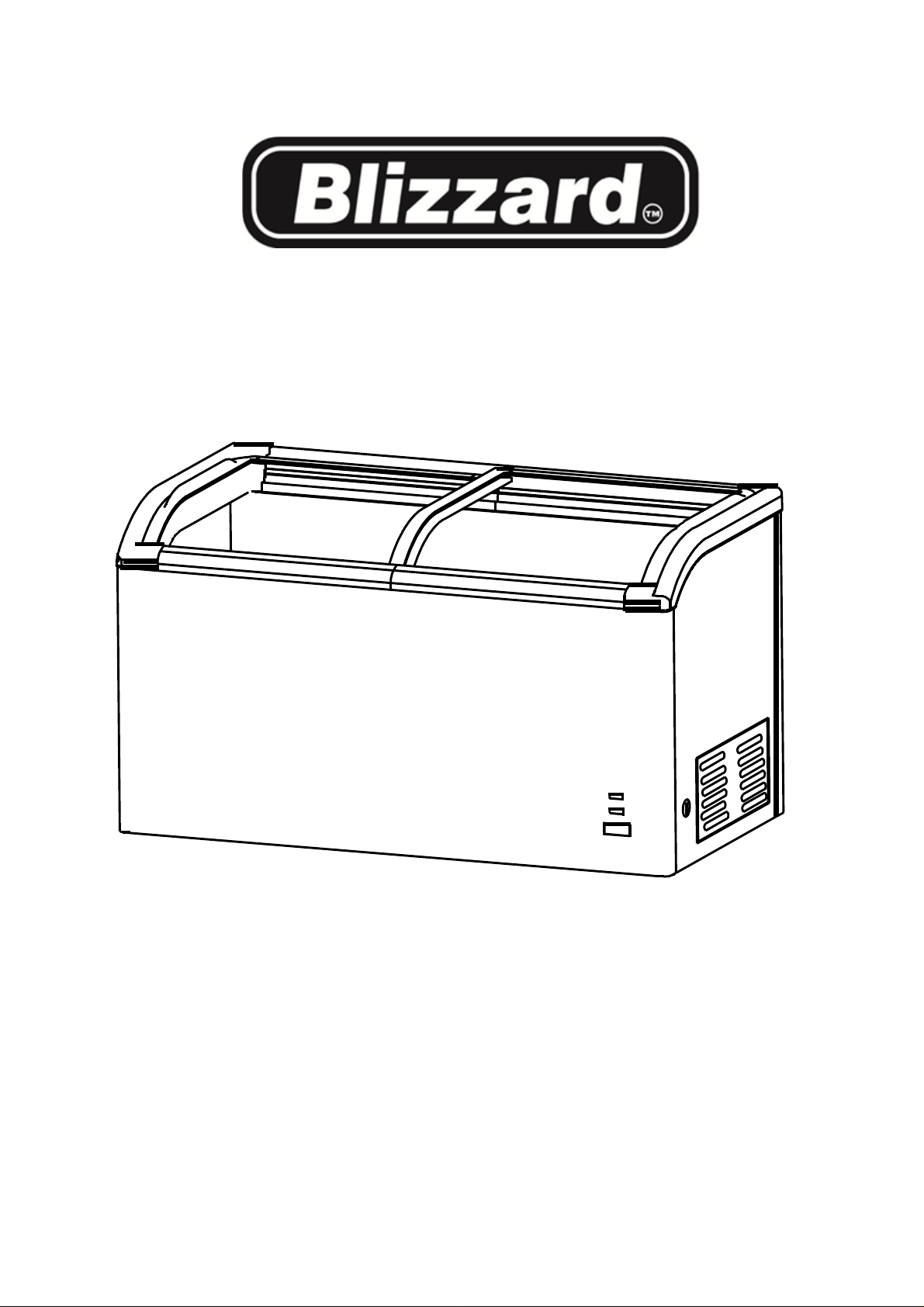
GLASS LID CHEST FREEZER
Installation, Operation & Maintenance Manual
(HC Gas R290 used)
Page 2

Thank you for buying this high quality appliance
This handbook is designed to help you through each step of owning your new appliance,
from installation to use.
Please read through this handbook carefully before you start using your appliance, as we
have endeavoured to answer as many questions as possible, and provide you with as
much support as possible.
If, however, you find something missing or not covered, please contact our Customer Care
Centre, using the number at the back of this handbook, who will be only too happy to help
you.
Our policy is one of constant development and improvement, therefore we cannot
guarantee the strict accuracy of all our illustrations and specifications, changes may have
been made subsequent to publishing.
WARNING: When positioning the appliance ensure the supply cord is not trapped or
damaged.
WARNING: Do not locate extension sockets or charging transformers/power supplies
adjacent to the compressor as they could overheat.
Page 3

Index
BEFORE USING YOUR APPLIANCE ............................................. 2
Safety Instructions ................................................................................ 2
Warnings .............................................................................................. 2
Installation ............................................................................................ 3
OPERATING YOUR APPLIANCE ................................................... 4
Parts of the Appliance ........................................................................... 4
Temperature Adjustment/Operation ...................................................... 5
Food Storage in the Appliance .............................................................. 5
DEFROSTING AND CLEANING ...................................................... 6
Defrosting and Cleaning........................................................................ 6
TROUBLE SHOOTING AND TECHNICAL DATA ........................... 6
Trouble Shooting .................................................................................. 6
Trouble Shooting guide ......................................................................... 7
1
Page 4
Before Using Your Appliance
Safety Instructions
After installation make sure that the power cable is not trapped underneath appliance.
Please read this booklet thoroughly before installing and switching on the appliance.
The manufacturer accepts no responsibility for incorrect installation and use.
• If this appliance is to replace an old one equipped with a lock, break or remove the lock as a
safety measure to avoid children becoming trapped inside.
• Do not damage the refrigerant circuit. In the event that the refrigerant circuit is damaged,
avoid open flames or ignition sources and ventilate the room in which the unit is placed – do
not use the appliance until you have been advised to do so by a service engineer.
• Do not allow children to play with the appliance. Children must never sit in the drawers or
hang from the door.
• Do not plug this appliance into an extension lead.
• Do not use old or damaged power supply cables.
• Do not twist, bend or trap the cable. Cables should also be kept clear of heat sources.
• When plugging in the appliance, always make sure that your hands are dry.
• Your old appliances contain insulation gases and refrigerant that must be disposed
of properly. Please contact your local authority for information about recycling centre’s
Do not dispose of this appliance with household waste.
Warnings
• WARNING: This appliance is not intended for use by persons (including children) with
reduced physical, sensory or mental capabilities, or lack of experience and knowledge,
unless they have been given supervision or instruction concerning use of the appliance by a
person responsible for their safety. Children should be supervised to ensure that they do not
play with the appliance.
• Do not defrost the appliance with other electrical devices (i.e. hair dryer) or any artificial
means and do not use sharp metal objects to remove the ice on the freezer, as this could
cause damage to the refrigerant system.
• Do not operate any electrical appliances inside the refrigerator or freezer.
• WARNING: Do not place bottles (glass or plastic) containing liquids (especially
effervescent liquids) into the freezer as they could cause the bottle to burst
during freezing.
• WARNING: Do not store explosive substances such as aerosol cans with a
flammable propellant in this appliance.
• WARNING: Do not damage the refrigerant circuit.
• WARNING: Keep ventilation openings, in the appliance enclosure or in the
built-in structure, clear of obstruction.
• Do not touch the cooling surfaces while the appliance operates, especially with wet
hands, because the skin may stick to cold surfaces.
• Do not eat ice which has just been removed from the freezer as this can cause
freezer burns to the hands and tongue.
2
Page 5

Installation
• Install and level the appliance on a floor able to take its weight and in a place suitable for
its size and use
• Before switching on place the appliance in an upright position and wait at least three
hours without moving the appliance. This will give the refrigerant circuit time to settle and
operate efficiently.
• Insert the plug into a socket which is appropriate. This appliance has a plug already fitted
– if the plug is not suitable for your socket we suggest that you call an authorized
electrician for assistance. If the plug is damaged in any way – do not attempt to use it. It
must be replaced with a new plug
• Do not install the appliance in direct sunlight and close to heat sources. Do not allow the
appliance to be exposed to rain
• Choose a well-ventilated area. There should be at least 10 cm of open space along the
sides, top, and back of the freezer
• Install the appliance in a dry and well-ventilated place. The appliance is for use in places
within the temperature and humidity ranges defined according to the climatic class given
on the Data Label located on the back of the product. The appliance may not operate
consistently if it is situated for extended periods of time below the cold end of the climate
class temperature range for which the appliance is designed.
• If the appliance is installed next to another refrigerator or freezer, observe the minimum
distance of 10cm to avoid condensation
• The manufacturer is not responsible for failure to complete installation as
described in this guide.
Operating voltage for your fridge is
220V-240V at 50HZ
Conformity Information
• The appliance is designed in compliance with the Directive 2011/65/EU, IEC60335-2-24,
IEC60335-1. Directive 2004/108/EC, EN55014-1:2006/+A1:2009,
EN55014-2:1997/+A1:2001/+A2:2008, EN61000-3-2:2006/+A1:2009/+A2:2009 and
EN61000-3-3:2008.
3
Page 6
OPERATING YOUR APPLIANCE
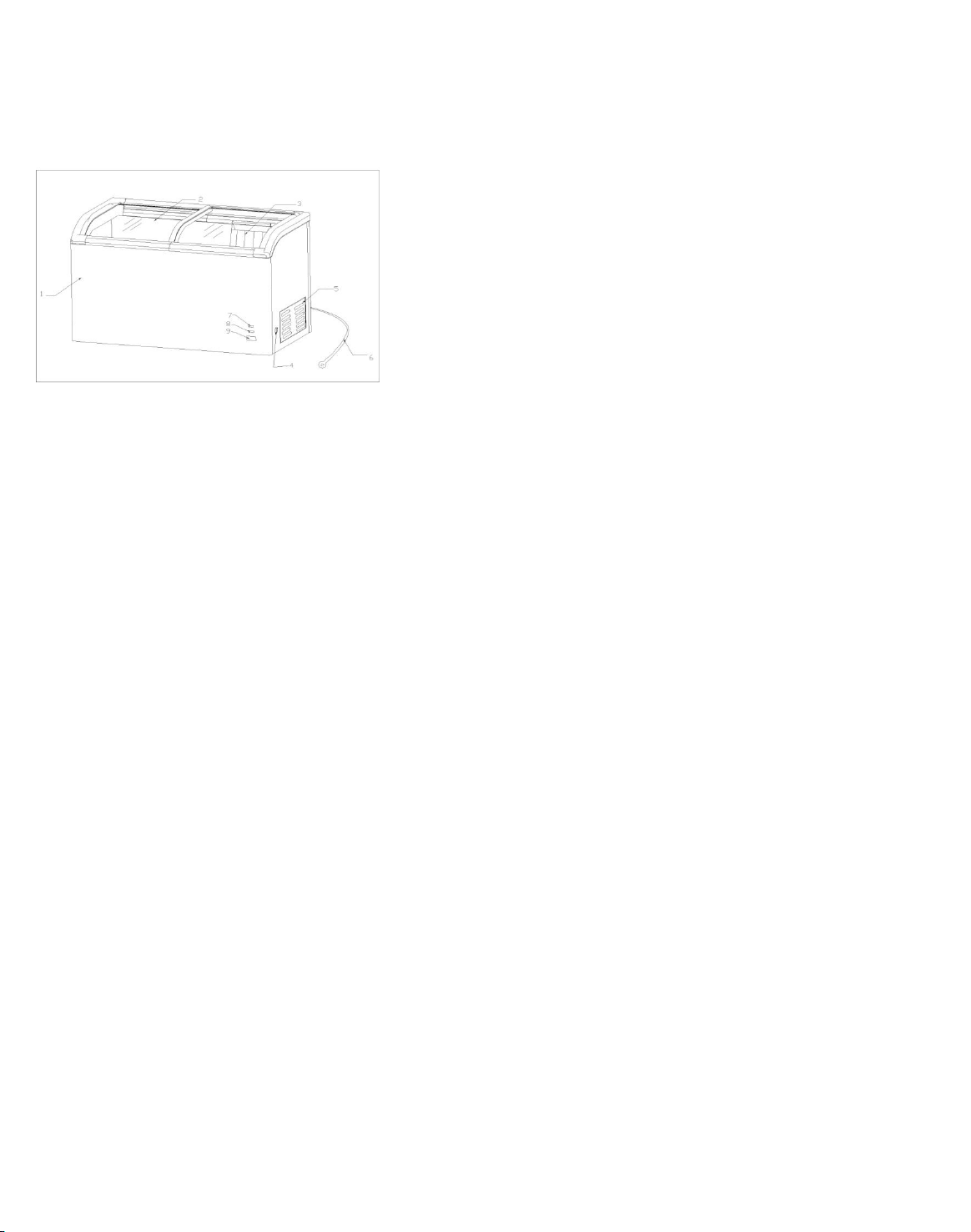
Parts of the Appliance
1. Cabinet 2. Glass door
3. Basket 4.Thermostat knob
5. Compressor room cover
6. Power wire 7.Yellow switch
8. Green light
9. Mechanical temperature display
NOTE:
■Turning the temperature control to "0" position stops the cooling cycle but does
not shut off the power to the refrigerator.
■If the unit is unplugged, lost power, or turned off; you must wait 3 to 5 minutes
before restarting the unit. If you attempt to restart before this time delay, the
refrigerator will not start.
■Large amounts of food will lower the cooling efficiency of the appliance.
■If you choose to change the thermostat setting, adjust thermostat control by
one numerical increment at a time. Allow several hours for temperature to
stabilize between adjustments.
4
Page 7
Temperature Adjustment/Operation
• The appliance temperature can be adjusted by turning the thermostat on the Control Panel.
• The thermostat should be adjusted according to different environment temperature and the and
the quantity of food being stored by adjusting the knob of the thermostat. The knob rotates
clockwise from”1” to “7” .The setting should be reduced down in summer (anti-clockwise
rotation) and up in winter (clockwise rotation). The thermostat is set to a certain point before
leaving the factory, this is the optimum setting for the product.
• Products should be pre-frozen before storing in this cabinet.
• The red lamp is a power indicating lamp. When the power is on, the lamp will be on.
• Once power is cut off, wait for at least 5 minutes before plugging in again to avoid damaging the
compressor or the system.
Food Storage in the Appliance
This freezer is a 3 star rated ( ) appliance.
• The use of a freezer is for storing frozen food for long periods of time and making ice cubes.
• Do not put fresh or warm food with frozen food side by side as it can thaw the frozen food.
• For storing frozen food; the instructions shown on frozen food packages should always be
followed carefully, if no information is provided food should not be stored for more than 3
months from the purchased date.
• When buying frozen food; ensure that these have been frozen at suitable temperatures and
that the packing is intact.
• Frozen food should be transported in appropriate containers to maintain the quality of the food
and should be placed into the freezer as soon as possible.
• If a package of frozen food shows signs of humidity and abnormal swelling it is probable that it
has been previously stored at an unsuitable temperature and that the contents have
deteriorated. Do not use this food, dispose of it as soon as possible.
• The storage life of frozen food depends on the room temperature, thermostat setting, how often
the door is opened, the type of food and the length of time required to transport the product from
the shop to your home. Always follow the instructions printed on the package and never exceed
the maximum storage life indicated.
5
Page 8
Defrosting and Cleaning
• Defrost twice a year or when a frost layer of around 7 mm (1/4") has formed. To start
defrosting procedure switch off the freezer at the socket outlet and pull out the mains plug.
• All food should be moved to alternative storage facilities while defrosting is taking place.
• Containers full of warm water may be placed carefully in the freezer to speed up the
defrosting.
• Do not use pointed or sharp edged objects such as knives, forks to remove the frost.
• Never use hairdryers, electrical heaters and other similar electrical appliances for defrosting.
• When defrosting has finished, sponge out any defrost water which collects at the bottom of
the freezer and dry the interior thoroughly.
• You can wipe the inner and outer sides with a soft cloth or a sponge using warm and soapy
water.
• Do not wash your freezer by pouring water into it.
• Never use flammable, explosive or corrosive material like thinner, gas, acid for cleaning.
• Make sure that your freezer remains unplugged while cleaning.
• Once defrosting/cleaning has been completed, plug in the appliance and return to its
temperature setting.
Trouble Shooting
The following problems are not causes of breakdown:
Problems
Causes and resolutions
There is a sound of liquid flowing in the freezer
It is the sound of refrigerant flowing in the
circulating pipeline of the refrigerating system,
this is normal
Too noisy
The freezer is not installed in a level ground,
change the position
The refrigeration system does not work for a
long time but the inside temperature is very
low
It is an indicator of good insulation and low
cooling retention, this is normal.
Condensation forming on the glass and
surrounding areas
High humidity around the unit. Reposition
the unit into the correct operating
environment. Improve ventilation in the
room / install a dehumidifier.
6
Page 9
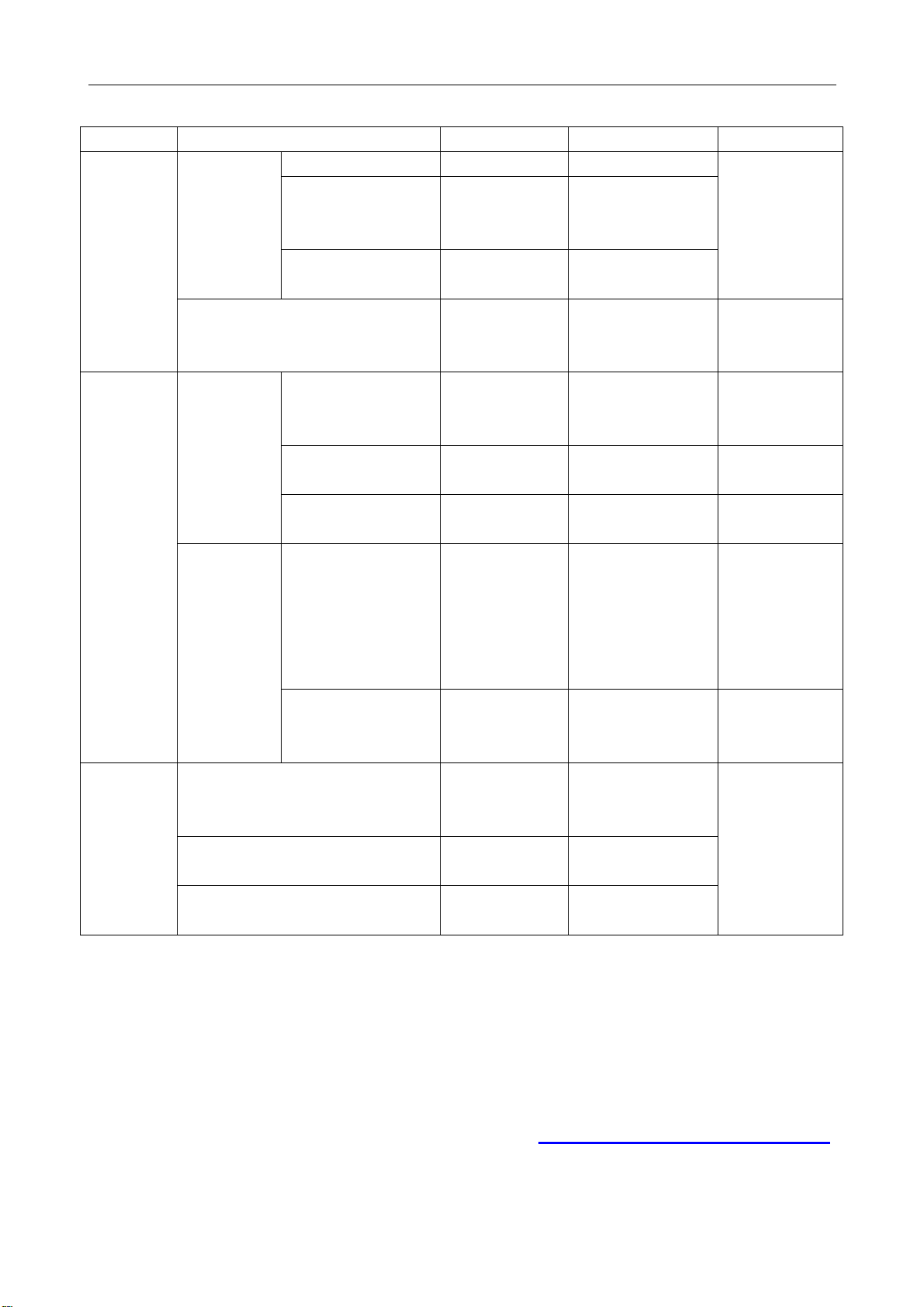
Trouble Shooting Guide
Trouble
Possibilities
Cheek up
Solutions
Remarks
Compressor
does not
work
Power is off
The fuse is broken
Check the fuse
Replace the fuse
If it is necessary
please contact
after-sales
service
for repair
The connection
between plug and
socket is not good
Check the socket
Repair or replace
the socket
The circuit of input and
output is out of use
Make sure that
the power is on
Check the circuit with
electric instrument
The thermostat knob is not in the
proper position
Check the
thermostat
Rotate the
thermostat to the
proper position
Ask for
professional help
Compressor
keeps on
working
The
temperature
inside is too
high
Frost on the
evaporator
is too thick
Check whether
the frost is thicker
than 6-8mm
Defrost regularly
The door is being
opened too frequently
Reduce the times
of opening
Too much food has
been stored at once
Take out some of
the food
The
temperature
inside is OK
The ambient
temperature is too
high .while
the thermostat
indicates
a small number
Make sure
whether
the knob is
indicating at the
“5-6”(or deeper)
Adjust the
thermostat knob
The thermostat
knob on”2-4”is
better(or proper)
The thermostat does
not work
Replace the
thermostat
Ask for
after-sales
service
Too noisy
The floor is not level
Make sure that
the freezer is
level
Put pad under the
castors
The screw in fan or condenser is loose
The screw is
loose
Rotate the fixed
screw
The refrigerating circuits touch each
other
Separate them
Pentland Wholesale Ltd, Blizzard House, Unit 17 Walker Ind Est. Walker Rd.
Blackburn, Lancs. BB1 2QE. TEL: 01254 614444. www.pentlandwholesale.co.uk
7
Page 10
R290 refrigerant is used for this equipment.
Caution!
Consult repair manual/owner’s guide before attempting to install or service this product. All safety
precautions must be followed. Dispose of properly in accordance with federal or local regulations. Risk
of fire or explosion due to puncture of refrigerant tubing. Follow handling instructions carefully.
Danger!
Risk of fire or explosion. Flammable refrigerant used. To be repaired only by trained service personnel.
Do not use mechanical devices to defrost refrigerator. Do not puncture refrigerant tubing.
Disposal
EU regulations require refrigeration product to be disposed of by specialist companies
who remove or recycle all gasses, metal and plastic components.
Consult your local waste collection authority regarding disposal of your appliance. Local
authorities are not obliged to dispose of commercial refrigeration equipment but may be
able to offer advice on how to dispose of the equipment locally.
All packaging materials should be disposed of in an environmentally friendly way. The
cardboard may be used as scrap paper. The protective foil and the foam cushions are
CFC-free.
Do not allow children to play with the packaging and destroy plastic bags safely.
Environmental protection
Discarded electric appliances are recyclable and should not be discarded in the domestic
waste! Please actively support us in conserving resources and protecting the
environment by returning this appliance to the collection centers (if available).
Compliance
Parts have undergone strict product testing in order to comply with regulatory standards and
specification set by
international, independent, and federal authorities.
Products have been approved to carry the following symbol:
 Loading...