

Page 1
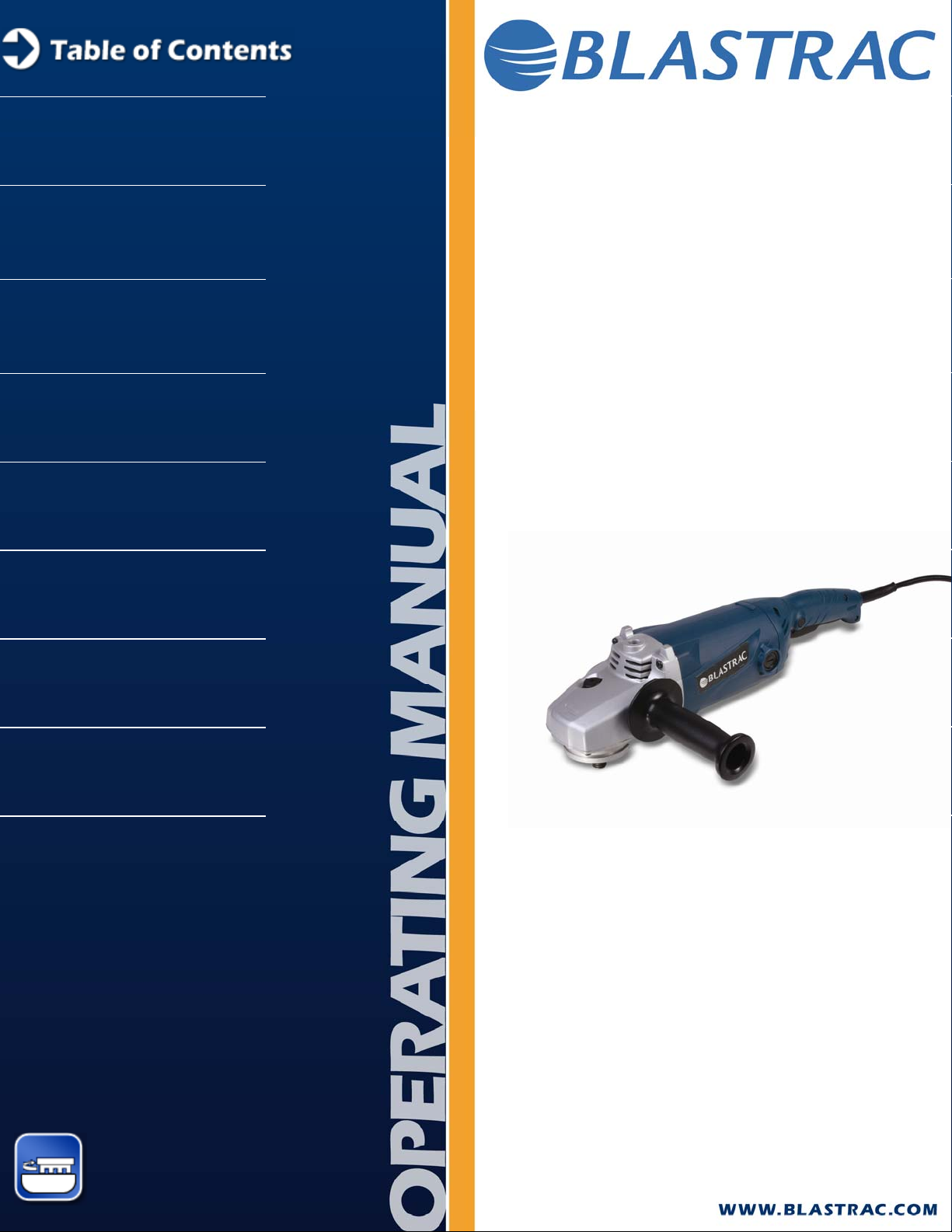
Polishing/Sanding
General Safety Rules 1
Specific Safety Rules 2
Symbols 3
Additional Safety Rules 4
General Information 5
Functional Description 6
MODEL
BL-183 / BL-233
Sander/ Polisher
Operation 7
Maintenance 8
Page 2

BL-183 / BL-233 SANDER/POLISHER
INSTRUCTION MANUAL
SECTION 1 GENERAL SAFETY RULES
OCTOBER 2008
CONTENTS – SECTION 1 GENERAL SAFETY RULES
WARNING – To reduce the risk of injury, user must read instruction manual.
General Safety Rules
WARNING! Read all instructions Failure to follow all instructions listed below may result
in electric shock, fire and/or serious injury. The term ″power tool″ in all of the warnings
listed below refers to your mains-operated (corded) power tool or battery-operated
(cordless) power tool.
SAVE THESE INSTRUCTIONS
1) Work area safety
a) Keep work area clean and well lit. Cluttered or dark areas invite accidents.
b) Do not operate power tools in explosive atmospheres, such as in the
presence of flammable liquids, gases or dust. Power tools create sparks which
may ignite the dust or fumes.
c) Keep children and bystanders away while operating a power tool. Distractions
can cause you to lose control
2) Electrical safety
a) Power tool plugs must match the outlet. Never modify the plug in any way.
Do not use any adapter plugs with earthed (grounded) power tools.
Unmodified plugs and matching outlets will reduce risk of electric shock
b) Avoid body contact with earthed or grounded surfaces such as pipes,
radiators, ranges and refrigerators. There is an increased risk of electric shock
if your body is earthed or grounded.
c) Do not expose power tools to rain or wet conditions. Water entering a power
tool will increase the risk of electric shock
d) Do not abuse the cord. Never use the cord for carrying, pulling or unplugging
the power tool. Keep cord away from heat, oil, sharp edges or moving parts.
Damaged or entangled cords increase the risk of electric shock.
e) When operating a power tool outdoors, use an extension cord suitable for
outdoor use. Use of a cord suitable for outdoor use reduces the risk of electric
shock.
3) Personal safety
a) Stay alert, watch what you are doing and use common sense when operating
a power tool. Do not use a power tool while you are tired or under the
influence of drugs, alcohol or medication. A moment of inattention while
operating power tools may result in serious personal injury.
b) Use safety equipment. Always wear eye protection. Safety equipment such as
dust mask, non-skid safety shoes, hard hat, or hearing protection used for
appropriate conditions will reduce personal injuries.
c) Avoid accidental starting. Ensure the switch is in the off-position before
plugging in. Carrying power tools with your finger on the switch or plugging in
power tools that have the switch on invites accidents.
Page 3

BL-183 / BL-233 SANDER/POLISHER
INSTRUCTION MANUAL
SECTION 1 GENERAL SAFETY RULES
d) Remove any adjusting key or wrench before turning the power tool on. A
wrench or a key left attached to a rotating part of the power tool may result in
personal injury.
e) Do not overreach. Keep proper footing and balance at all times. This enables
better control of the power tool in unexpected situations.
f) Dress properly. Do not wear loose clothing or jewellery. Keep your hair,
clothing and gloves away from moving parts. Loose clothes, jewellery or long
hair can be caught in moving parts.
g) If devices are provided for the connection of dust extraction and collection
facilities, ensure these are connected and properly used. Use of these devices
can reduce dust-related hazards.
4) Power tool use and care
a) Do not force the power tool. Use the correct power tool for your application.
The correct power tool will do the job better and safer at the rate for which it was
designed.
b) Do not use the power tool if the switch does not turn it on and off. Any power
tool that cannot be controlled with the switch is dangerous and must be repaired.
c) Disconnect the plug from the power source and/or the battery pack from the
power tool before making any adjustments, changing accessories, or storing
power tools. Such preventive safety measures reduce the risk of starting the
power tool accidentally.
d) Store idle power tools out of the reach of children and do not allow persons
unfamiliar with the power tool or these instructions to operate the power
tool. Power tools are dangerous in the hands of untrained users.
e) Maintain power tools. Check for misalignment or binding of moving parts,
breakage of parts and any other condition that may affect the power tools
operation. If damaged, have the power tool repaired before use. Many
accidents are caused by poorly maintained power tools.
f) Keep cutting tools sharp and clean. Properly maintained cutting tools with sharp
cutting edges are less likely to bind and are easier to control.
g) Use the power tool, accessories and tool bits etc., in accordance with these
instructions and in the manner intended for the particular type of power tool,
taking into account the working conditions and the work to be performed.
Use of the power tool for operations different from those intended could result in a
hazardous situation.
5) Service
a) Have your power tool serviced by a qualified repair person using only
identical replacement parts. This will ensure that the safety of the power tool is
maintained.
OCTOBER 2008
Page 4

BL-183 / BL-233 SANDER/POLISHER
INSTRUCTION MANUAL
SECTION 2 SPECIFICSAFETY RULES
OCTOBER 2008
CONTENTS – SECTION 2 SPECIFIC SAFETY RULES
Safety Warnings Common for Sanding or Polishing Operations:
a) This power tool is intended to function as a sander or polisher tool. Read all
safety warnings, instructions, illustrations and specifications provided with
this power tool. Failure to follow all instructions listed below may result in electric
shock, fire and/or serious injury.
b) Operations such as grinding, wire brushing or cutting-off are not
recommended to be performed with this power tool. Operations for which the
power tool was not designed may create a hazard and cause personal injury.
c) Do not use accessories which are not specifically designed and
recommended by the tool manufacturer. Just because the accessory can be
attached to your power tool, it does not assure safe operation.
d) The rated speed of the accessory must be at least equal to the maximum
speed marked on the power tool. Accessories running faster than their RATED
SPEED can break and fly apart.
e) The outside diameter and the thickness of your accessory must be within the
capacity rating of your power tool. Incorrectly sized accessories cannot be
adequately guarded or controlled.
f) The arbour size of wheels, flanges, backing pads or any other accessory must
properly fit the spindle of the power tool. Accessories with arbour holes that do
not match the mounting hardware of the power tool will run out of balance, vibrate
excessively and may cause loss of control.
g) Do not use a damaged accessory. Before each use inspect the accessory
such as abrasive wheels for chips and cracks, backing pad for cracks, tear or
excess wear, wire brush for loose or cracked wires. If power tool or
accessory is dropped, inspect for damage or install an undamaged
accessory. After inspecting and installing an accessory, position yourself
and bystanders away from the plane of the rotating accessory and run the
power tool at maximum no-load speed for one minute. Damaged accessories
will normally break apart during this test time.
h) Wear personal protective equipment. Depending on application, use face
shield, safety goggles or safety glasses. As appropriate, wear dust mask,
hearing protectors, gloves and workshop apron capable of stopping small
abrasive or workpiece fragments. The eye protection must be capable of
stopping flying debris generated by various operations. The eye protection
must be capable of stopping flying debris generated by various operations. The
dust mask or respirator must be capable of filtrating particles generated by your
operation. Prolonged exposure to high intensity noise may cause hearing loss.
i) Keep bystanders a safe distance away from work area. Anyone entering the
work area must wear personal protective equipment. Fragments of workpiece
or of a broken accessory may fly away and cause injury beyond immediate area of
operation.
j) Hold power tool by insulated gripping surfaces only, when performing an
operation where the cutting accessory may contact hidden wiring or its own
cord. Cutting accessory contacting a ″live″ wire may make exposed metal parts of
the power tool ″live″ and shock the operator.
Page 5

BL-183 / BL-233 SANDER/POLISHER
INSTRUCTION MANUAL
SECTION 2 SPECIFICSAFETY RULES
k) Position the cord clear of the spinning accessory. If you lose control, the cord
may be cut or snagged and your hand or arm may be pulled into the spinning
accessory.
l) Never lay the power tool down until the accessory has come to a complete stop. The
spinning accessory may grab the surface and pull the power tool out of your control.
m) Do not run the power tool while carrying it at your side. Accidental contact with the
spinning accessory could snag your clothing, pulling the accessory into your body.
n) Regularly clean the power tool’s air vents. The motor’s fan will draw the dust inside the
housing and excessive accumulation of powdered metal may cause electrical hazards.
o) Do not operate the power tool near flammable materials. Sparks could ignite these
materials.
Kickback and Related Warnings
Kickback is a sudden reaction to a pinched or snagged rotating wheel, backing pad,
brush or any other accessory. Pinching or snagging causes rapid stalling of the rotating
accessory which in turn causes the uncontrolled power tool to be forced in the direction
opposite of the accessory’s rotation at the point of the binding.
For example, if an abrasive wheel is snagged or pinched by the workpiece, the edge of
the wheel that is entering into the pinch point can dig into the surface of the material
causing the wheel to climb out or kick out. The wheel may either jump toward or away
from the operator, depending on direction of the wheel’s movement at the point of
pinching. Abrasive wheels may also break under these conditions.
Kickback is the result of power tool misuse and/or incorrect operating procedures or
conditions and can be avoided by taking proper precautions as given below.
a) Maintain a firm grip on the power tool and position your body and arm to
allow you to resist kickback forces. Always use auxiliary handle, if provided,
for maximum control over kickback or torque reaction during start-up. The
operator can control torque reactions or kickback forces, if proper precautions are
taken.
b) Never place your hand near the rotating accessory. Accessory may kickback
over your hand.
c) Do not position your body in the area where power tool will move if kickback
occurs. Kickback will propel the tool in direction opposite to the wheel’s movement
at the point of snagging.
d) Use special care when working corners, sharp edges etc. Avoid bouncing
and snagging the accessory. Corners, sharp edges or bouncing have a tendency
to snag the rotating accessory and cause loss of control or kickback.
e) Do not attach a saw chain woodcarving blade or toothed saw blade. Such
blades create frequent kickback and loss of control.
Safety Warnings Specific for Sanding Operations:
a) Do not use excessively oversized sanding disc paper. Follow manufacturers
recommendations, when selecting sanding paper. Larger sanding paper
extending beyond the sanding pad presents a laceration hazard and may cause
snagging, tearing of the disc or kickback.
OCTOBER 2008
Page 6

BL-183 / BL-233 SANDER/POLISHER
INSTRUCTION MANUAL
SECTION 2 SPECIFICSAFETY RULES
Safety Warnings Specific for Polishing Operations:
a) Do not allow any loose portion of the polishing bonnet or its attachment strings
to spin freely. Tuck away or trim any loose attachment strings. Loose and
spinning attachment strings can entangle your fingers or snag on the workpiece.
OCTOBER 2008
Page 7
BL-183 / BL-233 SANDER/POLISHER
INSTRUCTION MANUAL
SECTION 3 SYMBOLS
OCTOBER 2008
CONTENTS – SECTION 3 SYMBOLS
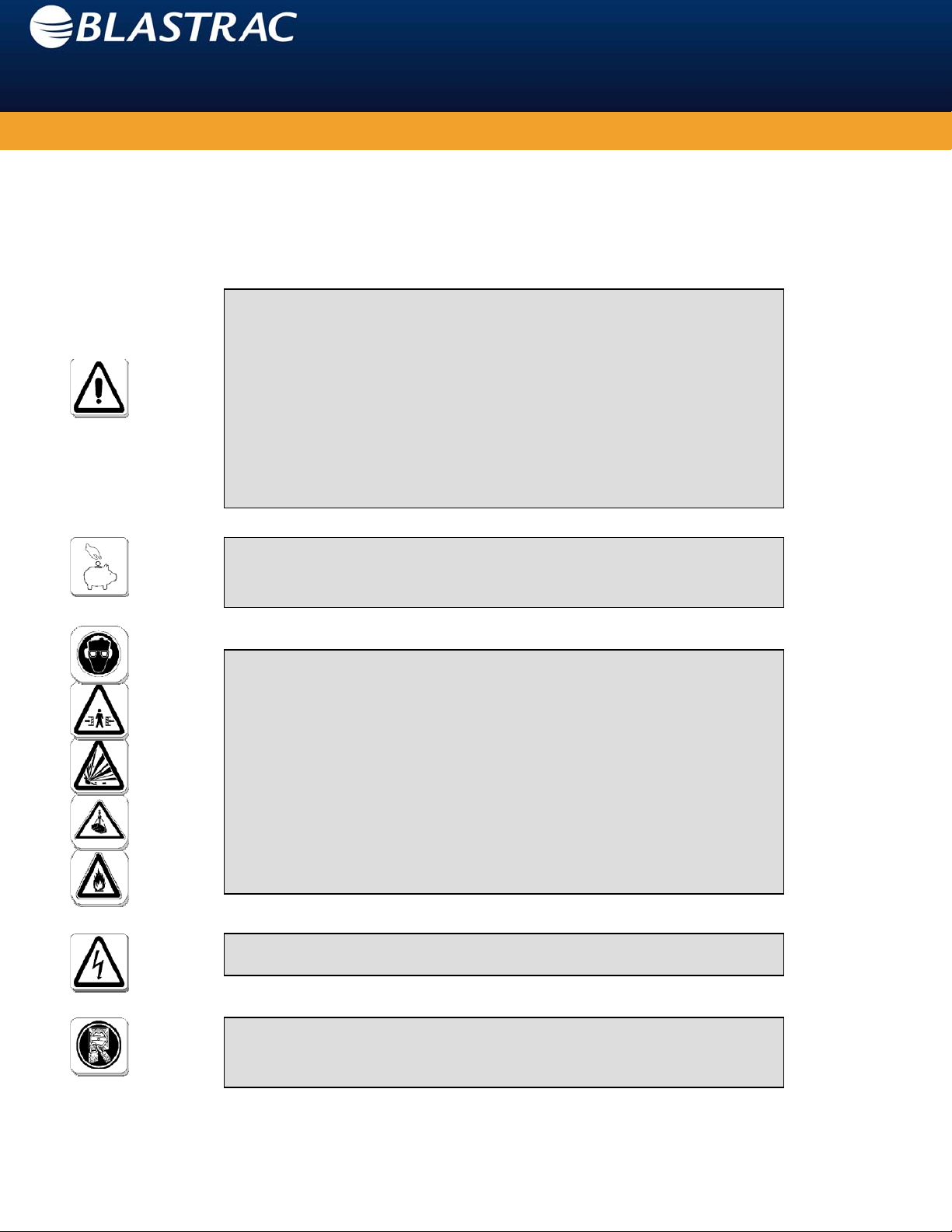
The following denominations and symbols are used in the Operating Instructions
to highlight areas of particular importance:
Symbol of operational safety.
In these Operating Instructions this symbol will be
shown next to all safety precautions that are to be
taken in order to ensure prevention of life and injury.
Follow these instructions and take special care in these
circumstances. In addition to these instructions, the
general safety precautions and accident prevention
guidelines are also to be followed.
Particular details regarding the economical use of the
equipment.
Information, instructions and restrictions with regard to
possible risks to persons or to extensive material
damages.
Warning against dangerous voltages.
Indications relating to protective devices in electrical
appliances.
Page 8
BL-183 / BL-233 SANDER/POLISHER
INSTRUCTION MANUAL
SECTION 3 SYMBOLS
OCTOBER 2008
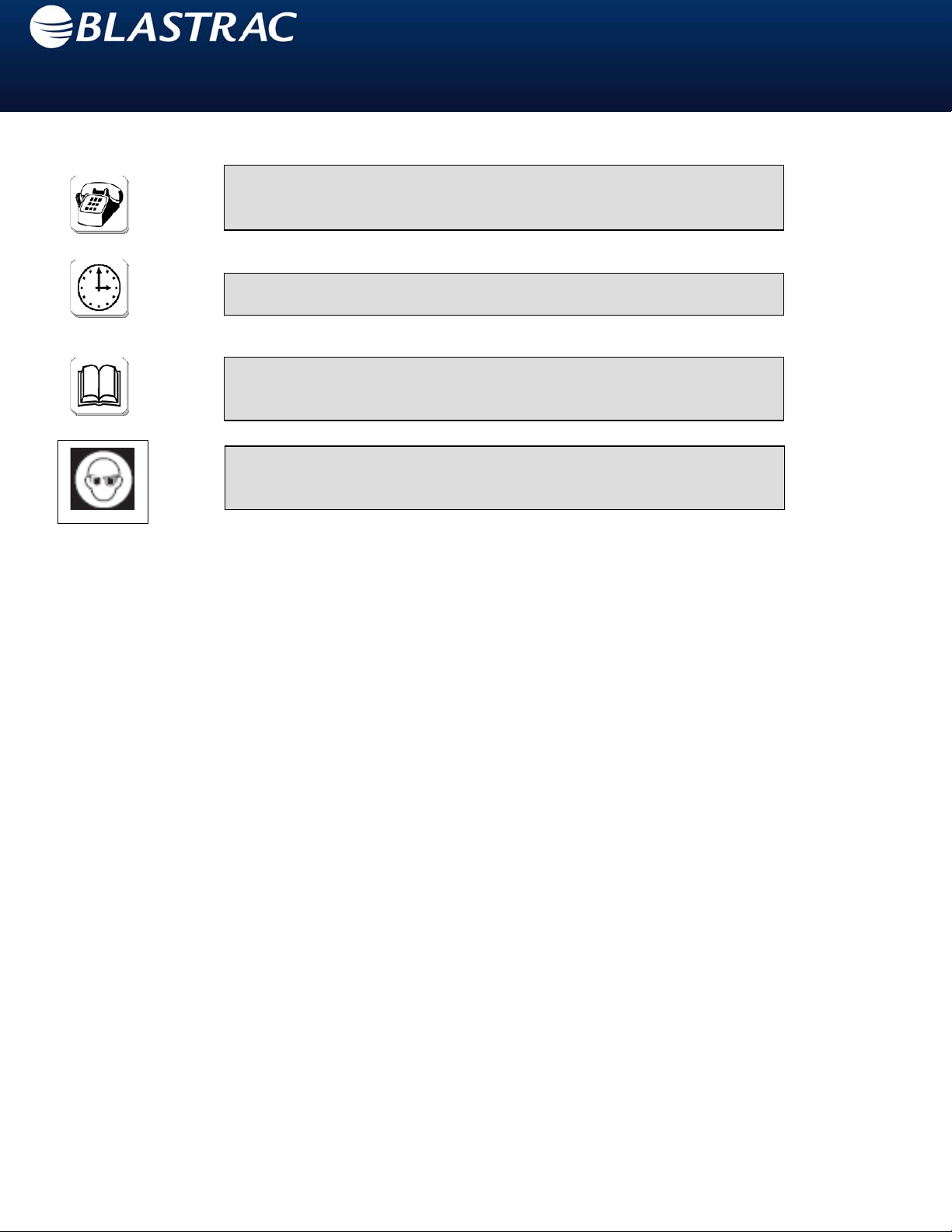
Indications where consultation with the manufacturer is
required.
Instructions relating to periodic checks.
Reference to important instructions contained in the
Operating Instructions.
WARNING – To reduce the risk of injury always
wear eye protection
Page 9
BL-183 / BL-233 SANDER/POLISHER
INSTRUCTION MANUAL
SECTION 4 ADDITIONAL SAFETY RULES
OCTOBER 2008
CONTENTS – SECTION 4 ADDITIONAL SAFETY RULES
The Operating Instructions are to be kept near the location where the
machine is being operated, and must be within reach at all times!
Grounded tools must be plugged into an outlet properly installed and
grounded in accordance with all codes and ordinances.
Check with a qualified electrician if you are in doubt as to whether the
outlet is properly grounded.
If the tools should electrically malfunction or break down, grounding provides a
low resistance path to carry electricity away from the user. (Applicable only to
Class I [grounded] tools.)
Double insulated tools are equipped with a polarized plug (one blade is
wider than the other.) This plug will fit in a polarized outlet only one way. If
the plug does not fit fully in the outlet, reverse the plug. If it still does not
fit, contact a qualified electrician to install a polarized outlet. Do not change
the plug in any way.
Double insulation eliminates the need for the three wire grounded power cord
and grounded power supply system. (Applicable only to Class II tools.)
Replace damaged cords immediately. Damaged cords increase the risk of
electric shock.
In addition to these Operating Instructions, general and legal regulations
regarding accident prevention and environmental protection must be complied
with and indicated!
Such duties may, for example, relate to the handling of hazardous substances, or
to the provision and wearing of personal protection equipment, as well as
compliance with traffic regulations.
The Operating Instructions are to be kept near the location
where the machine is being operated, and must be within reach
at all times!
Page 10
BL-183 / BL-233 SANDER/POLISHER
INSTRUCTION MANUAL
SECTION 4 ADDITIONAL SAFETY RULES
OCTOBER 2008
The Operating Instructions must be supplemented by other instructions; this
includes the duty to supervise and report incidents relating to particular
working practices, for example, work organization, work procedures and
personnel allocation.
Personnel entrusted with working with the machine must read the Operating
Instructions before starting work, in particular all safety instructions. To read
these instructions after work has commenced is too late. This particularly applies
to incidental activities such as setting up the equipment, carrying out
maintenance work or training staff to work with the machine.
From time to time the working practices of the operators are to be checked by a
supervisor, especially as to the items regarding awareness of safety and
hazards.
Personnel must tie back long hair, and not wear loose clothing or jewelry
including rings. There is a risk of injury through items getting caught or being
drawn into moving machinery.
:
Use personnel protection equipment if necessary or required by
local regulations! Take notice of all safety and hazard notices on
the machine!
All safet y and hazard notices at or on the machine must be kept complete and
legible!
If safety-critical changes occur to the machine or its working method, the
machine must be shut down immediately! The cause of the fault must be
established and remedied immediately!
Changes, add-ons or conversions to the machine which might
impair safety, must not be made, without the manufacturer’s
permission!
This applies in particular to the fitting and adjustment of safety devices as well as
to welding on load-bearing parts.
Spare parts must comply with the technical requirements specified by the
manufacturer. This is always guaranteed if original spare parts are used.
Page 11
BL-183 / BL-233 SANDER/POLISHER
INSTRUCTION MANUAL
SECTION 4 ADDITIONAL SAFETY RULES
OCTOBER 2008
Intervals for recurring checks and inspections specified in these Operating
Instructions must be complied with!
To perform maintenance work correctly, it is imperative to be equipped with the
proper tools for the task in question.
The location and the operation of fire extinguishers must be made known on
each work site!
Take note of the facilities for reporting of, and fighting fires!
Fundamental duties:
a) Work on the machine may only be undertaken by trained personnel.
b) Only trained personnel may be employed. Note the statutory minimum
age! Specify clearly the responsibilities of personnel for operation, setting
up, servicing and maintenance work!
c) Make sure that only authorized personnel operate or work on the
machine!
d) Define responsibilities of the machine operator, with regard to traffic
safety regulations, and inform him not to take instructions from third
parties who may not be complying with the local safety requirements!
e) Personnel, who are being trained to operate equipment, may only use the
machine under constant supervision of an experienced person!
.
Work on electrical equipment may only be undertaken by a
skilled electrician or by trained persons under the supervision
of a skilled electrician, as well as in accordance with the local
electrical engineering regulations.
Do not allow any method of working that impairs safety!
Recognized official procedures have to be used, to ensure the machine is
operated in the safest and best conditions.
Only operate the machine when all safety devices, and related
safety equipment, are present and operational!
Page 12
BL-183 / BL-233 SANDER/POLISHER
INSTRUCTION MANUAL
SECTION 4 ADDITIONAL SAFETY RULES
OCTOBER 2008
Check the machine visually for any damage and defects at least once a day!
In the event of operational malfunctions, the machine must be shut down
immediately and secured, and the fault must be rectified!
Carry out the switch on and switch off operations in accordance with the
operations manual!
Do not switch off, or remove the exhaust, and/or the ventilation devices while the
machine is running!
All persons in the proximity of the machine must wear ear
protectors and safety shoes. In addition, the machine operator
must wear close fitting protective clothing.
a) Use clamps or other practical ways to secure and support the workpiece
to a stable platform. Holding the work by hand or against your body is
unstable and may lead to loss of control.
b) Maintain tools with care. Keep cutting tools sharp and clean. Properly
maintained tools, with sharp cutting edges are less likely to bind and are
easier to control.
c) Check for misalignment or binding of moving parts, breakage or parts,
and any other condition that may affect the tools operation. If damaged,
have the tool serviced before using. Many accidents are caused by poorly
maintained tools.
d) Use only accessories that are recommended by the manufacturer for
your model. Accessories that may be suitable for one tool, may become
hazardous when used on another tool.
a) Tool service must be performed only by qualified repair personnel.
b) Service or maintenance performed by unqualified personnel could result in
a risk of injury.
Page 13

BL-183 / BL-233 SANDER/POLISHER
INSTRUCTION MANUAL
SECTION 4 ADDITIONAL SAFETY RULES
OCTOBER 2008
c) When servicing a tool, use only identical replacement parts. Follow
instructions in the Maintenance section of this manual. Use of
unauthorized parts or failure to follow Maintenance instructions may create
a risk of electric shock or injury.
Mechanical servicing work:
a) Put the machine in the Safety off position as described below before
carrying out any servicing work on the machine in order to prevent the
machine from being switched on accidentally.
b) Follow any special safety instructions in sections on servicing the
machine. See Section 7.
c) Adjustment, servicing and inspection work on the period of time
limits, specified in these Operating Instructions as well as any information
on the replacement of parts and equipment must be undertaken and/or
complied with!
d) These activities may only be undertaken by qualified personnel.
e) Do not use any aggressive cleaning materials! Use lint-free cleaning
cloths! The operator must be given information about maintenance
and work procedures, before starting the cleaning process!
f) Always tighten any screen connections that are undone during servicing
and maintenance work!
g) If safety devices need to be dismantled during setting up, servicing and
repairs, these safety devices must be reinstalled and inspected
immediately after completion of the servicing and repair work.
h) Make sure that process materials and replaced parts are disposed of
safely and in an environmentally-friendly manner!
Page 14
BL-183 / BL-233 SANDER/POLISHER
INSTRUCTION MANUAL
SECTION 4 ADDITIONAL SAFETY RULES
OCTOBER 2008
Electrical servicing work:
Make sure that electrical components used for replacement purposes comply
with the original parts and are correctly adjusted if necessary.
Definition of the Safety Off Position: The machine is in a safe condition where
it cannot generate any hazard.
Putting the equipment in the Safety off position involves:
9 Switching off the grinding machine.
9 Switching off the dust collector (if being used).
9 Waiting for all drives to stop.
9 Pulling out mains plug.
9 Securing against unintended restart.
Any machine, if it is not used according to the regulations, may
be hazardous for operating, set-up and service personnel. The
operating authority is responsible for compliance with the
safety regulations during operation and maintenance, and for the
use of safety devices supplied with the machine, as well as the
provision of appropriate additional safety devices!
Page 15

BL-183 / BL-233 SANDER/POLISHER
INSTRUCTION MANUAL
SECTION 5 GENERAL INFORMATION
OCTOBER 2008
CONTENTS – SECTION 5 GENERAL INFORMATION
5.1 Range of application
5.2 Description of the machine
Page 16
BL-183 / BL-233 SANDER/POLISHER
INSTRUCTION MANUAL
SECTION 5 GENERAL INFORMATION
OCTOBER 2008
5.1 RATING
Unit / Designation: Sander / Polisher
Machine Type: BL-183 / BL-233
Manufacturer:
Blastrac US
13201 North Santa Fe
Oklahoma City, OK 73114
United States of America
Local: 405-478-3440
Toll-free: 800-256-3440
5.2 UNIT SPECIFICATIONS
Technical Data:
Grinding machine BL-183 BL-233
Frequency 60 Hz 60 Hz
Rated Voltage* 120 V 120 V
Rated current 15 A 15 A
Sanding disc capacity 180 mm (7”) 230 mm (9”)
Rated speed 8500 (min-1) 6600 (min-1)
Spindle thread 5/8’’ – 11UNC 5/8’’ – 11UNC
Overall length 481 mm (19”) 481 mm (19”)
Net Weight 4.8 kg (10.6 lbs) 4.8 kg (10.6 lbs)
*Be sure to check the nameplate on the product, because the voltage is subject
to change depending on the area in which the product is to be used.
Page 17

BL-183 / BL-233 SANDER/POLISHER
INSTRUCTION MANUAL
SECTION 6 FUNCTIONAL DESCRIPTION
OCTOBER 2008
CONTENTS – SECTION 6 FUNCTIONAL DESCRIPTION
6.1 Range of application
6.2 Description of the machine
Page 18

BL-183 / BL-233 SANDER/POLISHER
INSTRUCTION MANUAL
SECTION 6 FUNCTIONAL DESCRIPTION
OCTOBER 2008
6.1 RANGE OF APPLICATION
Use the BL-183 / BL-233 for the following applications only:
• Sanding and grinding concrete surfaces
• For removing rust from steel surfaces as well as finishing
• Surface finishing wood
• Polishing painted metal, lacquered wood, synthetic resin, etc.
• Sanding metal plate surfaces
Page 19
BL-183 / BL-233 SANDER/POLISHER
INSTRUCTION MANUAL
SECTION 6 FUNCTIONAL DESCRIPTION
OCTOBER 2008
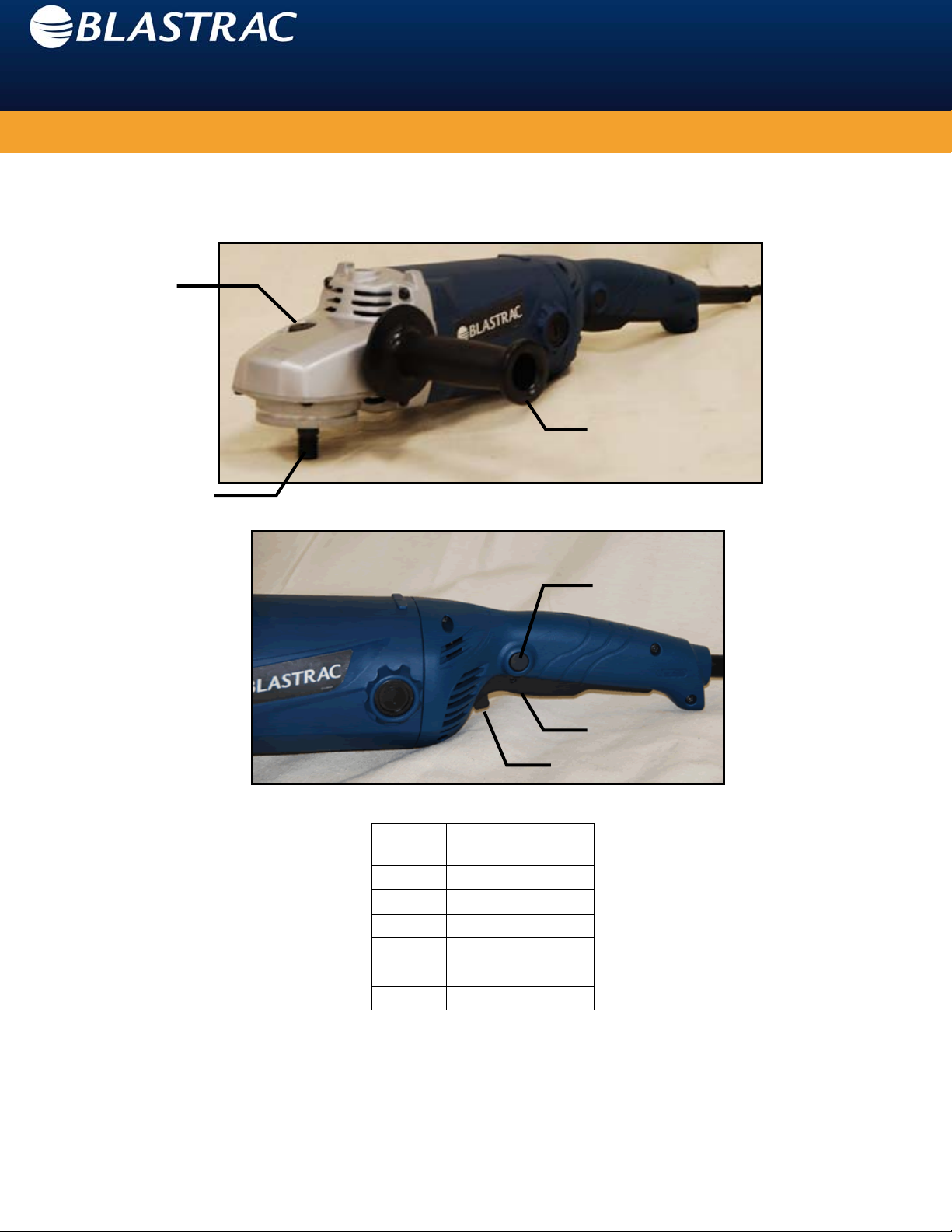
6.2 DESCRIPTION OF THE MACHINE
5
1
3
4
2
6
Item
No.
1 Aux.Handle
2 Switch
3 SpindleShaft
4 LockButton
5 SpindleLock
6 SafetyLever
PartDescription
Page 20

BL-183 / BL-233 SANDER/POLISHER
INSTRUCTION MANUAL
SECTION 7 OPERATION
OCTOBER 2008
CONTENTS – SECTION 7 OPERATION
7.1 Operating Instructions
Page 21
BL-183 / BL-233 SANDER/POLISHER
INSTRUCTION MANUAL
SECTION 7 OPERATION
OCTOBER 2008
7.1 OPERATING INSTRUCTIONS
Before start-up, the operating personnel must be familiar with the
safety regulations given in this manual.
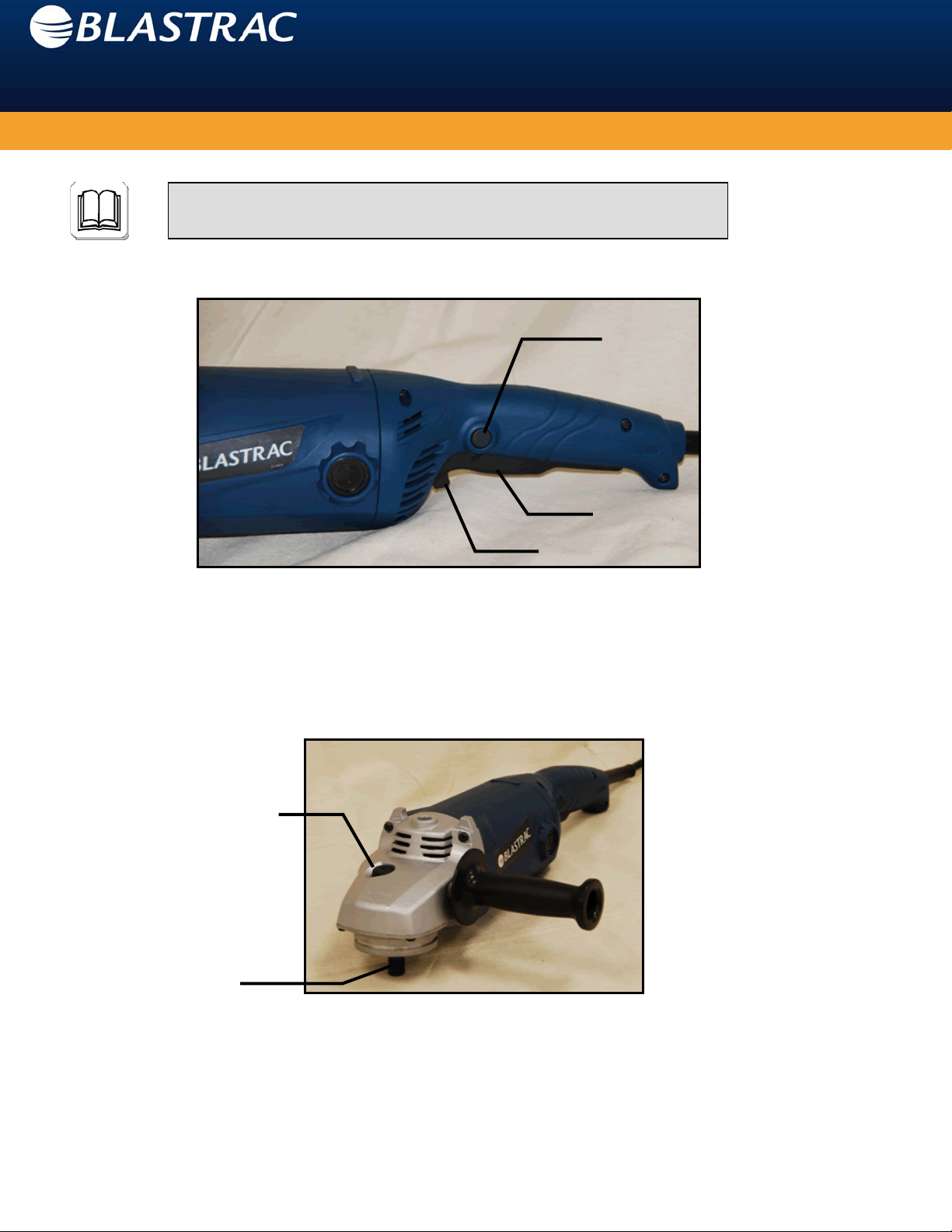
This tool is started by depressing the safety (6) and engaging the switch (2). The
tool is stopped by releasing the switch (2).
For continuous operation, depress the lock button (4) while the switch is
engaged. To release continuous operation, depress the switch (2) and release.
To lock the spindle from rotation, press and hold the spindle locking button (5).
Turn the spindle shaft (3) until the shaft locks in position. To release, simply let
off the locking button (5). The shaft should turn freely.
5
3
6
4
2
Page 22
BL-183 / BL-233 SANDER/POLISHER
INSTRUCTION MANUAL
SECTION 7 OPERATION
OCTOBER 2008
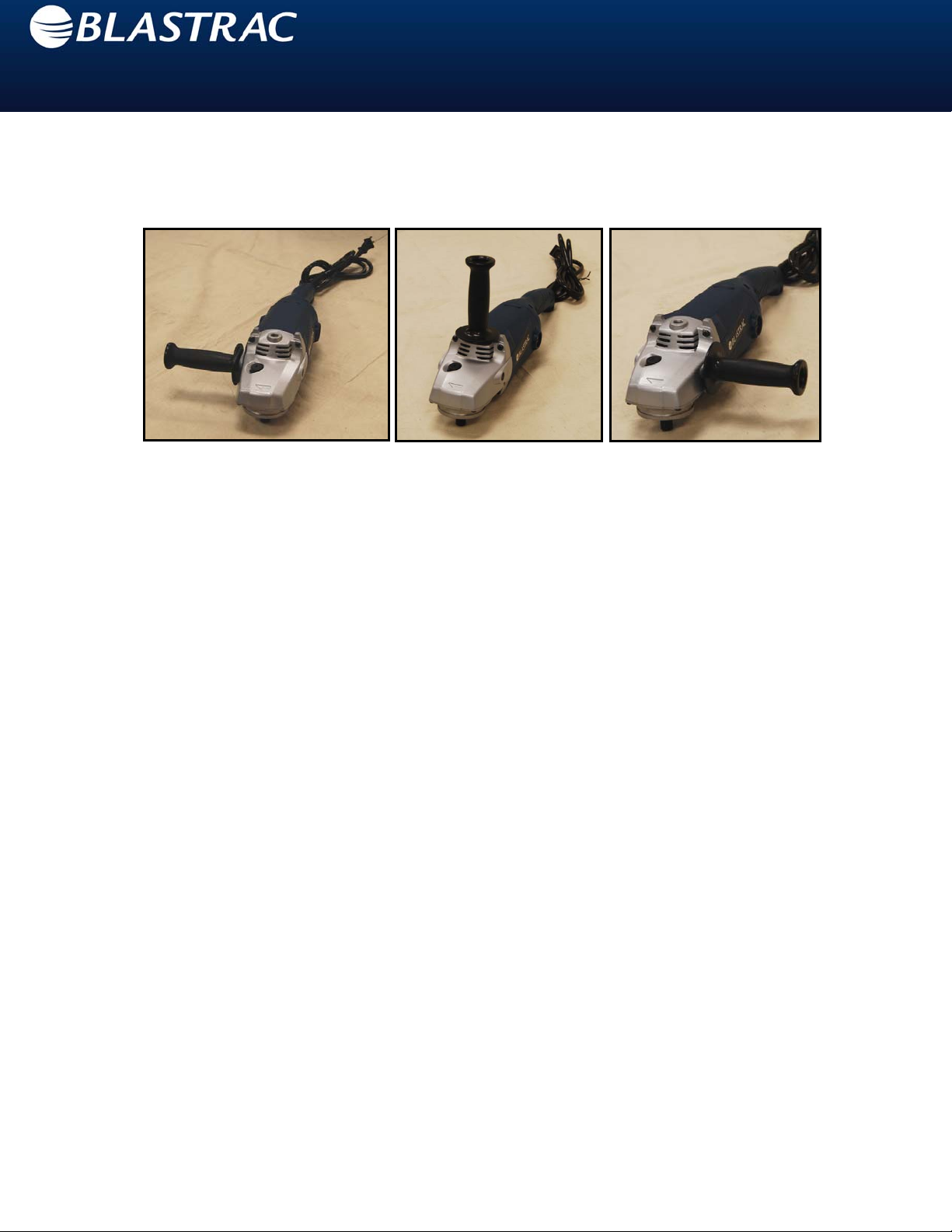
The handle can be attached to either side or on top. Make sure it is tight before
use.
Never cover the air vents since they must always be open for proper motor
cooling.
The key to efficient operating is controlling the pressure and surface contact
between the disc/polishing wool and work piece.
Page 23

BL-183 / BL-233 SANDER/POLISHER
INSTRUCTION MANUAL
SECTION 8 MAINTENANCE
OCTOBER 2008
CONTENTS – SECTION 8 MAINTENANCE
8.1 Care and Maintenance
8.2 Replacement Parts
Page 24

SECTION 8
MAINTENANCE
8.1 CARE AND MAINTENANCE
Operational safety and service life of the machine depend, among other things,
on proper maintenance.
After use, check the tool to make sure that it is in top condition.
It is recommended that you take this to a Blastrac Authorized Service Center for
a thorough cleaning and lubrication at least once a year.
Do not make any adjustments while the motor is in motion.
Always disconnect the power cord from the receptacle before changing
removable or expendable parts (blade, bit, sanding paper, etc.), lubricating
or working on the unit.
BL-183 / BL-233 SANDER/POLISHER
INSTRUCTION MANUAL
OCTOBER 2008
WARNING! To ensure safety and reliability, all repairs should be performed
by an AUTHORIZED SERVICE CENTER or other QUALIFIED SERVICE
ORGANIZATION.
Special attendance and regular maintenance of the machine are imperative for
functioning and safety.
Pay attention to unusual noises or strong vibrations. Check for the cause of every
big change. Call a technician if you have doubts about the cause or when a
repair without a technician does not seem possible without damages.
Before using the machine you should always check all screws and connection
points for correct seating.
Due to different working conditions it cannot be foreseen how frequently
inspections for wear checks, maintenance and repair work should be carried out.
Prepare a suitable inspection schedule considering known working conditions
and experience.
Our specialists will be happy to assist with more advice.
Please call 1-800-256-3440.
Page 25
SECTION 8
MAINTENANCE
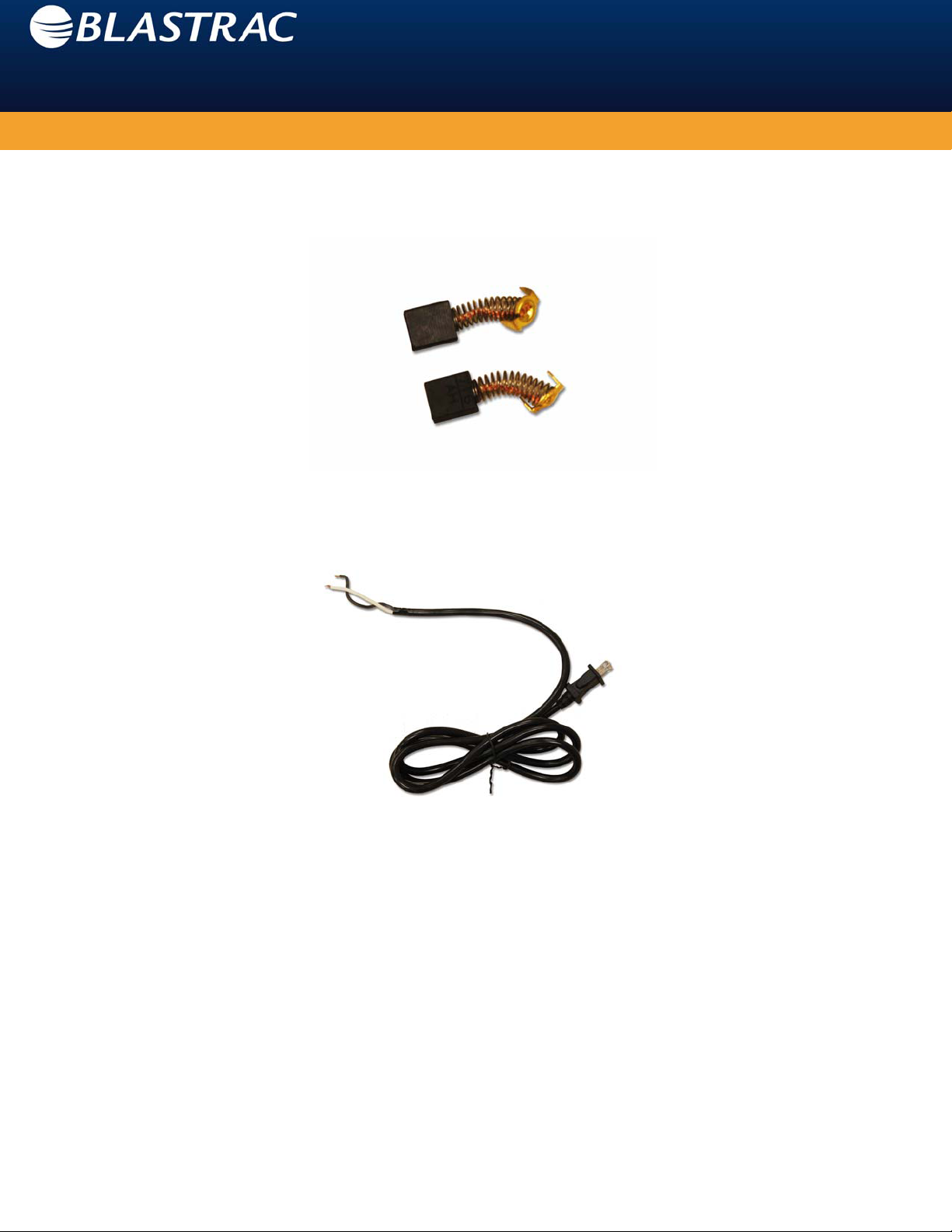
8.2 REPLACEMENT PARTS
Part Description: Brush Set, BL-183/BL-233
BL-183 / BL-233 SANDER/POLISHER
INSTRUCTION MANUAL
OCTOBER 2008
Part Number: 05-32113
Part Number: 05-32111
Part Description: Cord Set, BL-183/BL-233
Page 26

13201 North Santa Fe Avenue Oklahoma City, OK 73114 Ph: 800-256-3440 F: 405-478-8608 blastrac.com
Product Warranty
Standard Equipment Products:
Blastrac warrants its Blastrac Standard Equipment Products against defects in quality of
material and workmanship, under normal and proper use for a period of 1 Year from the date of
delivery, as noted on the returned warranty registration card, or, in the case of Rental Fleet
Machines, 180 Days from the date of assignment to Rental Fleet. This warranty is nontransferable and is extended to machines purchased and entered into the normal service of
surface preparation by a recognized professional or qualified contractor. Blastrac makes this
warranty only to the buyer who purchases the products directly from Blastrac or its Authorized
Distributor. This warranty does not include expendable parts such as, but not limited to, blades,
blast wheels, wear plates, liners, seals, and electrical components. All purchased parts utilized
in the manufacture will be honored to the original manufacturer’s specified warranty.
If the buyer does not return the warranty card or register the product online at
www.blastrac.com within 30 days after taking delivery of Blastrac Standard Equipment Products,
the warranty period is limited to 6 months from the date of delivery noted on shipping receipt.
Hand Tool Products:
Blastrac warrants its BLASTRAC Hand Tool Products, including hand grinders and
accessories, against defects in material and workmanship under normal and proper use for a
period of 90 days from the date of delivery or, in the case of Rental Fleet Machines, from the
date of assignment to a Rental Fleet. Blastrac makes this warranty only to the buyer who
purchases the products directly from Blastrac or its authorized distributor. This warranty does
not include expendable parts such as blades.
If the buyer does not return the warranty card, or register online at www.blastrac.com
within 15 days after taking delivery of Blastrac Hand Tool Products, the warranty period is
limited to 30 days from the date of delivery noted on shipping receipt.
WARRANTY TERMS AND CONDITIONS:
1. Blastrac’s obligation under this warranty is limited to the replacement or repair, at
Blastrac’s option, of products and does not include, labor, the cost of transportation, loss
of operating time, or normal maintenance services.
2. This warranty does not apply to failure occurring as a result of abuse, misuse,
negligence, corrosion, erosion, normal wear and tear, alterations or modifications made to
products without the express written consent of Blastrac.
3. The buyer must submit all warranty claims no later than thirty (30) days after buyer
becomes aware of the basis for any such claim, or should have become aware of the basis
for any such claim in the exercise of reasonable diligence.
Page 27

To return parts for warranty consideration, please call Blastrac Customer Service at
800-256-3440. Your customer service representative will obtain the necessary
information to complete the Blastrac Returned Merchandise Authorization (RMA) Form.
Blastrac will then send the RMA form to the customer authorizing the return of the parts
for warranty evaluation. The parts must be received within sixty (60) days following the
RMA origination date or the warranty claim will be denied. Once the parts are received they
will be evaluated for warranty.
If the customer cannot wait for the evaluation/replacement of the parts during this
process, the customer must issue a new purchase order to Blastrac for the replacement
parts before they can be shipped. Once the evaluation process is complete and parts are
deemed a valid warranty claim, a credit will be issued against this invoice.
4. The buyer may not return Blastrac products without written authorization to do so
through a Blastrac RMA.
5. Blastrac reserves the right to inspect and determine the scope of its warranty
responsibilities for any returned Blastrac products.
6. Blastrac makes no warranty with respect to accessories it does not manufacture,
including but not limited to, engines, motors, batteries, tires and all other parts. See
component manufacture warranty.
7. Blastrac reserves the right to make product changes or improvements without
prior notice and without undertaking any obligation for such changes or improvements on
previously sold products.
8. The above warranty conditions can only be altered by Blastrac. Blastrac must
confirm alterations in writing for each specific transaction.
9. Blastrac reserves the right to modify this warranty for used or demo products on an
individual transaction basis. Blastrac will include warranty modifications on its invoices for
used or demo products.
10. BLASTRAC DOES NOT AUTHORIZE ANY PERSON, REPRESENTATIVE, SERVICE OR
SALES OUTLET TO MAKE ANY WARRANTY DIFFERENT FROM THIS PRODUCT WARRANTY.
11. EXCEPT FOR ITS PRODUCT REPAIR OR REPLACEMENT OBLGATIONS DESCRIBED
IN THIS PRODUCT WARRANTY, UNDER NO CIRCUMSTANCES SHALL BLASTRAC BE LIABLE
TO THE BUYER, OR ANY OTHER PERSON, FOR ANY DIRECT, INCIDENTAL, OR
CONSEQUENTIAL DAMAGES RESULTING FROM THE USE OF THE BLASTRAC PRODUCT, OR
FOR ANY SPECIAL OR CONSEQUENTIAL DAMAGES OF ANY CHARACTER, INCLUDING
WITHOUT LIMITATIONS, DAMAGES FOR ANY LOSS OF GOODWILL, WORK STOPPAGE, OR
ANY AND ALL OTHER COMMERCIAL DAMAGES OR LOSSES.
12. BLASTRAC MAKES NO OTHER PRODUCT WARRANTIES, EXPRESS OR IMPLIED,
INCLUDING, BUT NOT LIMITED TO, THE IMPLIED WARRANTIES OF MERCHANTABILITY AND
FITNESS FOR A PARTICULAR PURPOSE.
This Product Warranty Effective January 1, 2010.
Page 28

Warranty Registration Notification
IMPORTANT!
TO THE DELIVERING DISTRIBUTOR OR END USER
To ensure the proper warranty coverage is extended to the owner of this machine, fill
in the necessary information below COMPLETELY and ACCURATELY and retain for
your records. Go to www.blastrac.com and register online. Click on the Register icon
in the left column of the homepage, and fill out the product registration form with the
same information that will be recorded here.
The warranty period will start upon the delivery date of the machine.
The distributor or the end user must provide the machine warranty information when
the machine is delivered. Registration of the machine will extend the warranty period
from the recorded delivery date entered with product registration. Failure to comply
will make any and all warranties on the equipment void after 6 months.
OWNER/END USER’S REFERENCE INFORMATION
Delivery Date _________________________
Delivering Distributor’s Name and Address
_____________________________________
_____________________________________
_____________________________________
Machine Model No._____________________
Machine Serial No. _____________________
Modifications__________________________
_____________________________________
_____________________________________
_____________________________________
_____________________________________
Signature of Delivering Distributor’s Representative
Blastrac is a registered trademark of Blastrac,NA
Fold and Detach Here if Mailing
Warranty Registration
IMPORTANT! To ensure that your Blastrac
the information recorded here by registering online at blastrac.com, or complete this page and fax
to 866-485-1046, or if you prefer, detach and mail to:
Blastrac, 13201 North Santa Fe Avenue, Oklahoma City, OK 73114-9901
(Please print legibly)
_____________________________________
_____________________________________
®
machine is covered under warranty, please provide
Company _____________________________________________________________________
Address ______________________________________________________________________
City, State, & Zip _______________________________________________________________
Telephone No._____________________ Contact Person ______________________________
Date of Purchase___________________ Date Received ______________________________
Machine Model No. __________________________ Serial No. _________________________
Distributor Name _______________________________________________________________
End User Name _______________________________________________________________
End User E-mail _______________________________________________________________
Page 29

Contact
Blastrac NA
www.blastrac.com
13201 North Santa Fe Avenue
Oklahoma City, OK 73114
Tel: 800-256-3440
Fax: 405-478-8608
 Loading...