

Page 1
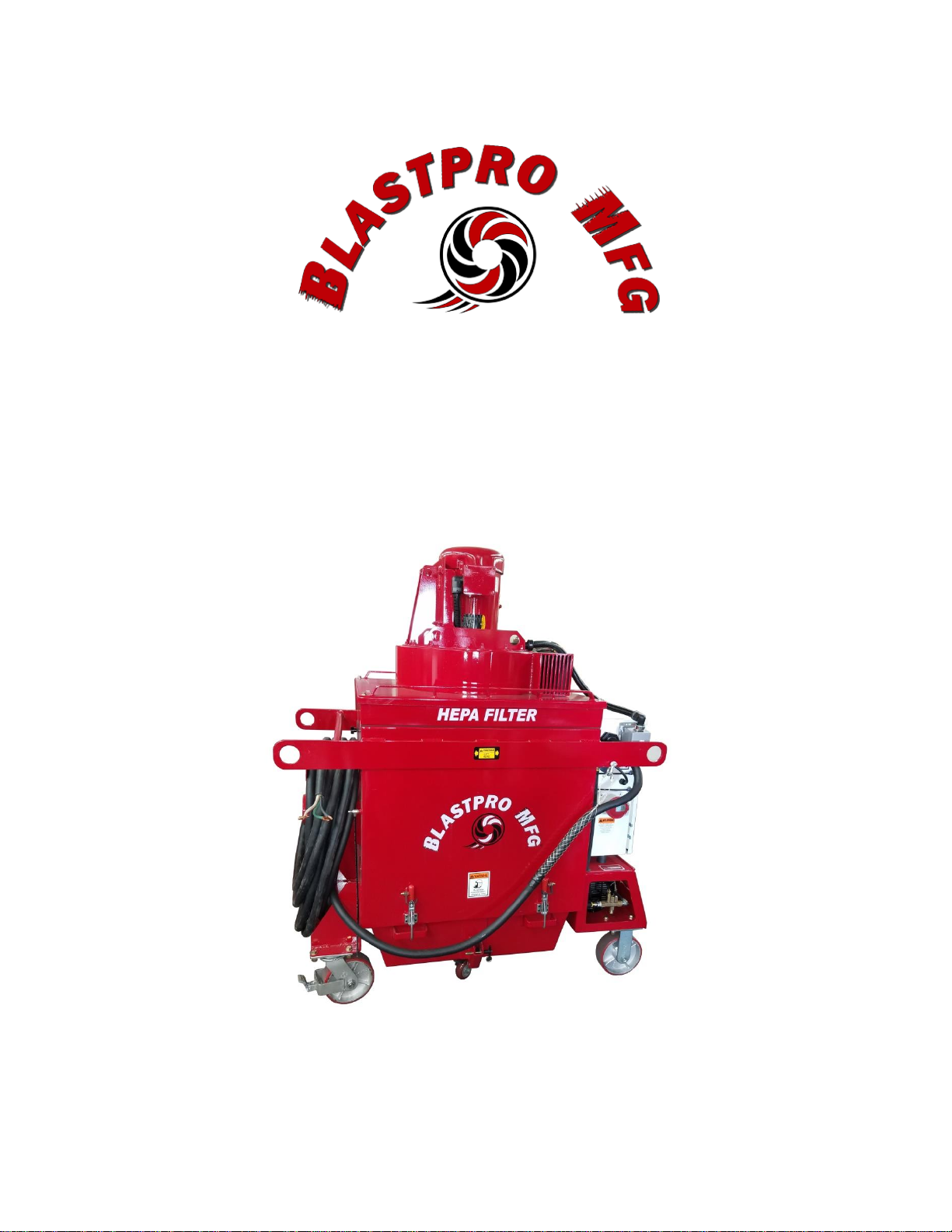
Owner’s Manual
BP 9-54 Dust Collector
Page 2

Page 3

BP 9-54 Table of Contents
FORWARD ................................................................................................................................................... 2
INTRODUCTION ........................................................................................................................................ 3
S
PECIFICATIONS
SAFETY INSTRUCTION ........................................................................................................................... 4
S
AFETY — GENERAL
S
AFETY — SITE ASSESSMENT
S
AFETY — START UP
S
AFETY — OPERATION PROCEDURES
S
AFETY — SHUT DOWN PROCEDURES
S
AFETY — MAINTENANCE PROCEDURES
OPERATING INSTRUCTIONS ................................................................................................................. 9
V
ACUUM ADJUSTMENT
V
ENTILATION SYSTEM
PROBLEMS AND POSSIBLE SOLUTIONS ..........................................................................................10
PARTS LIST ................................................................................................................................................12
MAINTENANCE INTERVALS ................................................................................................................13
......................................................................................................................................... 3
.................................................................................................................................. 4
.................................................................................................................... 4
................................................................................................................................. 6
......................................................................................................... 7
....................................................................................................... 8
................................................................................................... 8
.............................................................................................................................. 9
............................................................................................................................... 9
1
Page 4

Forward
Thank you for choosing to purchase the BP 9-54 Dust Collector from BlastPro
Manufacturing, Inc. We feel that you have purchased the highest quality portable
shotblasting equipment on the market today.
This manual has been prepared to give the operator a general understanding of the
machine. It is not intended to be an all encompassing document which addresses every
situation which may be encountered when operating this machine. BEFORE
OPERATING, MAINTAINING, OR SERVICING THE EQUIPMENT, THIS
MANUAL SHOULD BE READ BY ALL INDIVIDUALS RESPONSIBLE FOR
OPERATION, MAINTENANCE, OR SERVICE OF THE EQUIPMENT.
The individuals responsible for operating, maintaining, and servicing the equipment
should thoroughly understand and follow all safety precautions listed on the equipment
and listed in this manual. As with any piece of construction equipment, serious damage
to the equipment and serious injury to the operator can occur if the safety instructions and
safety warnings are not followed.
If you have any questions or problems regarding the operation of the equipment, then
please call:
BlastPro Manufacturing, Inc.
6021 Melrose Lane
Oklahoma City, OK 73127
Toll free: 877-495-6464
Phone: 405-491-6464
Fax: 405-495-4994
Website: www.BlastProMfg.com
2
Page 5

Introduction
The BP 9-54 is BlastPro’s state of the art dust collection system and is recommended for use
with the BP-10 SUPER and the BP-15 SUPER. The 1200 cfm dust collector has nine filters,
which are automatically cleaned every 13 seconds, and a large dust bin that enables the
contractor to blast for an extended period of time. The BP 9-54 also features two additional 2”
vacuum inlets so that additional pieces of equipment, such as grinders and edgers, can be
operated simultaneously. All consumable parts are compatible with BLASTRAC® parts.
The BP 9-54 is mounted on a mobile chassis and is able to move through door openings of thirtyfour inches. Attached to the portable shot blast unit by 50 feet of 5” flexible duct hose, the BP 954 cleans in a radial area around the dust collector. When one area has been completed, the
entire system is then moved to an adjacent area. When blasting steel surfaces where less dust
and contaminants need to be removed, the dust collector may be placed in an adjacent area and
connected using a longer hose.
Specifications
Model Number:
Voltage:
Amperage:
Maximum Air Flow:
Maximum Static Pressure:
BP 9-54
208 – 230 – 460
24.2 – 22 – 11.9
1200 cfm
23 Inches H2O
Dust Bin Capacity:
Power Cord Length:
Vacuum Hose
Diameter/Length:
Dimensions (L x W x H):
Weight:
259 lbs
75 ft.
6” x 50’
57” x 35 ½” x 68”
1335 lbs
3
Page 6

Safety Instruction
ALL OPERATORS AND MAINTENANCE PERSONNEL SHOULD READ THIS SECTION
CAREFULLY BEFORE OPERATING OR MAINTAINING THIS EQUIPMENT. THESE
SAFETY INSTRUCTIONS ARE NOT MEANT TO REPRESENT AN ALL-INCLUSIVE LIST
OF INSTANCES WHICH COULD TAKE PLACE WHEN OPERATING THIS EQUIPMENT.
FOR, AS WITH ANY PIECE OF CONSTRUCTION EQUIPMENT, SERIOUS INJURY CAN
OCCUR IF PROPER SAFETY PROCEDURES ARE NOT DILIGENTLY FOLLOWED. ALL
SAFETY AND WARNING LABELS POSTED ON THE MACHINE MUST BE FOLLOWED
AS WELL AS THE SAFETY PROGRAM INSTITUTED BY YOUR COMPANY. THERE IS
NO SUBSTITUTE FOR SOUND JUDGEMENT IN THE OPERATION AND
MAINTENANCE OF THIS EQUIPMENT. IN CASES WHERE OPERATING PERSONNEL
HAVE INSUFFICIENT KNOWLEDGE OR UNDERSTANDING OF THE ENGLISH
LANGUAGE, PROPER TRANSLATED TRAINING MUST BE COMPLETED BEFORE USE
OF THIS EQUIPMENT CAN TAKE PLACE.
Note: This manual must be kept with the machine at all times so as to allow the operator
easy access to its vital information.
Safety — General
The United States Department of Labor’s Occupational Safety & Health Administration (OSHA)
provides statutory requirements, standards, and regulations relating to the use of portable tools
on construction sites. These statutory requirements, standards, and regulations are posted on the
OSHA website at www.osha.gov. The operator and maintenance personnel should understand
and follow these statutory requirements, standards, and regulations.
Safety — Site Assessment
Before starting blasting operations, a site assessment must be performed. During the site
assessment verify the following:
• Work area is flat, clean, and dry, free of debris, frost-free, and has no flammable liquids
nearby. Also, make sure that the machine will be able to clear all obstructions. NEVER
BLAST A WET SURFACE! NEVER ALLOW PERSONNEL, ELECTRICAL
CORDS, OR CONNECTIONS TO COME INTO CONTACT WITH ANY TYPE
OF MOISTURE!
• NEVER BLAST OVER BOLTS, NUTS, SCREWS, NAILS, ANY OTHER TYPE
OF DEBRIS, OR OVER OPENINGS IN THE BLASTING SURFACE AS THIS
MAY RESULT IN SIGNIFICANT DAMAGE TO THE MACHINE AND
SERIOUS INJURY TO THE OPERATOR!
• If using a generator, then proper safety precautions have been undertaken in order to help
reduce the risk of carbon monoxide poisoning. Making certain that the work area is well
ventilated is extremely important. For further information, refer to the owner’s manual of
your generator.
4
Page 7

• Each worker has a carbon monoxide monitor on their persons. These carbon monoxide
monitors should be calibrated, in working order, and should be equipped with audible
alarms that will warn workers if carbon monoxide levels become too high. IF CARBON
MONOXIDE LEVELS EXCEED 35 PARTS PER MILLION, ALL WORK MUST
CEASE IMMEDIATELY! THIS REPRESENTS A POTENTIALLY DEADLY
SITUATION WHICH NECESSITATES AN IMMEDIATE SHUTDOWN!
• All workers have received training on the dangers of overexposure to carbon monoxide.
Staff members must also be able to identify all of the signs and all of the symptoms
associated with carbon monoxide poisoning. This training should ensure that work
would stop immediately and emergency medical personnel would be notified promptly if
one or more workers exhibited or complained of any of the common signs and symptoms
associated with carbon monoxide overexposure, including: headache, nausea, weakness,
dizziness, lethargy, visual disturbances, changes in personality, and/or loss of
consciousness.
• SURFACES HAVE BEEN THOROUGLY INSPECTED. SOME FLOOR OR
DECK SURFACES MAY BE COATED WITH OR CONTAMINATED BY
DANGEROUS MATERIALS SUCH AS PCBs, LEAD, ASBESTOS, PESTICIDES,
SOLVENTS, CLEANING FLUIDS, AND/OR OTHER HARMFUL CHEMICALS.
THE DUST PRODUCED FROM SHOTBLASTING SUCH SURFACES CAN
CREATE A SERIOUS HEALTH THREAT TO THOSE WHO INHAIL OR
COME INTO CONTACT WITH THE DUST. AS A RESULT, THE WORK
AREA MUST BE CHECKED FOR THESE MATERIALS BEFORE WORK CAN
BEGIN. BLASTPRO MANUFACTURING, INC. DOES NOT WARRANT ITS
EQUIPMENT TO BE SUITABLE FOR, OR APPROVED FOR, REMOVING
DANGEROUS MATERIALS. IT IS THEREFORE THE RESPONSIBILITY OF
THE CONTRACTOR TO AFFIRM THE SAFETY OF THE WORK AREA AND
OF THE EQUIPMENT TO BE USED WITH THE PROPER AUTHORITIES. IT
IS ALSO THE RESPONSIBILITY OF THE CONTRACTOR TO WARN ALL
STAFF MEMBERS OF ALL POTENTIAL SHORT-TERM AND LONG-TERM
HEALTH RISKS ASSOCIATED WITH INHALING AND COMING INTO
CONTACT WITH DANGEROUS MATERIALS. THE CONTRACTOR IS
RESPONSIBLE, FURTHERMORE, FOR PROTECTING ALL WORKERS
FROM BEING EXPOSED TO DANGEROUS MATERIALS. SO, BECAUSE THE
BP 9-54 SHOTBLASTING MACHINE HAS NOT BEEN DESIGNED TO
REMOVE, CLEAN, PROFILE, OR ALTER ANY SURFACE COATED WITH OR
OTHERWISE CONTAMINATED BY DANGEROUS MATERIALS, BLASTPRO
MANUFACTURING, INC. EXPRESSLY DISCLAIMS ANY LIABILITY FOR
INJURY, ILLNESS, DEATH, OR DAMAGE THAT MIGHT OCCUR OR
RESULT FROM SUCH IMPROPER USE.
• Operator and any other personnel in the work area are wearing safety glasses with side
shields, dust masks, ear plugs, hard hats, steel-toed work boots, long sleeved shirts, tight
fitting clothing, and gloves. It is also imperative for staff to tie back long hair and to
remove all jewelry.
• Work area has been blocked off to pedestrians, unprotected personnel, and untrained
personnel. In the event pedestrians, unprotected personnel, or untrained personnel enter
the work area, blasting operations are to be stopped immediately.
5
Page 8

• Fire extinguishers are nearby. Also, take note of the location and of the contact
information of fire departments close to the work site.
• Belt guards are in working order and are present on the machine where needed at all
times.
• All glass and equipment, including vehicles, are protected from steel shot. This can be
done by loosely hanging a sheet of visqueen or other protective material in front of the
glass or equipment in a curtain-like fashion. The importance of protecting glass and
equipment from steel shot cannot be overemphasized.
• All floors drains have been plugged or covered so as to prevent steel shot from falling
into the drains.
• This equipment is only being used for commercial purposes. This equipment is only to
be operated by professional, trained, and competent operators.
• The operator is aware of his surroundings and will use common sense. THE
OPERATOR IS NOT TO OPERATE THE EQUIPMENT IF HE IS TIRED,
DISTRACTED, OR UNDER THE INFLUENCE OF DRUGS, ALCOHOL, OR
MEDICATIONS THAT DECREASE AWARENESS!
Safety — Start Up
After performing the site assessment safety procedures listed above, bring the BP 9-54 dust
collector to the work area and perform the following procedures:
• Verify that personnel are competent and that they have read and understood the safety
information in this manual. Staff must also be familiar with how to operate the machine
and with all of its components. Make certain that all personnel follow all safety
instructions and programs required by their company and by the worksite.
• Verify that all machine parts are assembled safely and correctly.
Note: It is recommended to have original spare parts and wear parts on hand. It is
imperative that the machine receive special attention and regular maintenance in
order to function properly and to operate safely.
• Inspect all electrical cords on the BP 9-54 for damage, tears, or other signs of wear. If
electrical cords are damaged, then do not attempt to perform blasting operations until
cords have been repaired or replaced.
• Inspect the dust collector. Verify that the dust bin is empty, filters are clean and clear of
debris, and motors and fans are in working order.
Note: The dust bin must be emptied whenever it becomes full.
• Inspect the duct hose leading to the BP 9-54 dust collector. Make sure that the hose is
free of debris, that the hose is not cracked, and that holes do not exist. If necessary, then
replace hose.
• Make certain that all screws and other fasteners are tight.
• Check the shot storage hopper, the feed spout, and the blast wheel parts for foreign
bodies and remove them if present.
• Check the tightness of the hose connections and the condition of the hose to the filter.
• Check the electrical connections for dirt and foreign body deposits.
6
Page 9

• Verify that the electrical motors are free of dirt and other contaminants.
• Verify that the main power cable and the dust hose are free of damage. Replace or repair
all damaged parts before putting the machine into operation.
• Connect the blast cleaning machine and the filter unit with the dust hose. Use hose
clamps at the connections.
• Connect the supply cable of the blast cleaning machine with filter unit. Connect the
electrical cable of the filter unit with the site supply.
• Check that the filter dust container has been emptied.
• Make certain to keep hands away from all moving parts once the machine is in operation.
• In the unlikely event of a failure, turn the main power switch to the OFF position.
Safety – Procedures
When operating the 9-54 Dust Collector it is important to follow these safety procedures:
• Dust hoppers must be kept empty. It is imperative that dust level be monitored during
normal operation. Taking this step aides the blast system in keeping the abrasive as
clean as possible reducing the greatest cause of wear to internal components of the
machine.
• Dust hoppers must be emptied at the end of each day. Many types of dust have the
potential to easily ignite when stored. The risk of fire and explosion is reduced when
dust is removed as recommended.
Safety — Operation Procedures
When operating the BP 9-54, perform the following safety procedures:
• SUPPORT PERSONNEL MUST KEEP A SAFE DISTANCE FROM THE
MACHINE WHILE IT IS IN OPERATION! DO NOT STAND IN FRONT OF
THE MACHINE WHILE IT IS IN OPERATION!
• Whenever the dust collector becomes full, it must be emptied. Failure to empty the dust
collector could result in the machine loosing its suction to the floor. If this happens, then
all of the shot will fall out of the shot hopper.
• Never switch off or remove the exhaust and ventilation devices when the machine is in
operation.
• MAKE CERTAIN CIRCUIT BREAKERS CAN HANDLE THE ELECTRICAL
LOAD REQUIRED BY THE BP 9-54!
• A SECOND PERSON MUST BE PRESENT SO AS TO PULL OUT THE
MACHINE’S PLUG IN AN EMERGENCY! THE WORK AREA MUST THEN
BE SEALED OFF USING A RED AND WHITE SAFETY CHAIN AND A
DANGER SIGN! USE A TOOL THAT IS INSULATED AGAINST VOLTAGES!
• IF AN ERROR OCCURS WHILE THE MACHINE IS IN OPERATION, THEN IT
MUST BE SHUT DOWN IMMEDIATELY! THE CAUSE OF THE ERROR
MUST BE ESTABLISHED IMMEDIATELY!
7
Page 10

• IF CABLES BECOME LOOSE OR SCORCHED, THE MACHINE MUST BE
SHUT DOWN IMMEDIATELY!
Safety — Shut Down Procedures
When shutting down the BP 9-54, always perform the following safety procedures:
• Turn off the breakers to the BP 9-54 dust collector.
• Turn switch on the BP 9-54 dust collector to the OFF position.
• Empty dust from the dust collector. WHEN REMOVING DUST FROM DUST
COLLECTOR, ALWAYS WEAR A PARTICLE MASK. CONCRETE DUST
MAY CONTAIN PARTICLES WHICH ARE EXTREMELY HAZARDOUS!
THESE PARTICLES SHOULD NEVER BE INHALED!
• AFTER COMPLETING WORK, CLEAN ALL STRAY SHOT FROM WORK
AREA. SHOT CAN BE CLEANED WITH A MAGNETIC BROOM OR WITH A
SHOP VACUUM. NEVER LEAVE STRAY SHOT IN WORK AREA AS SHOT
REPRESENTS A SLIP AND FALL HAZARD! STEPPING AND FALLING ON
STEEL SHOT CAN RESULT IN SERIOUS INJURY OR EVEN DEATH!
Safety — Maintenance Procedures
When performing maintenance on the BP 9-54, make certain that the following safety
procedures are followed:
• Verify that the BP 9-54 dust collector is not in operation. Attempting to perform
maintenance operations on the BP 9-54 dust collector while in operation could lead to
serious injury or death.
• Verify that the BP 9-54 dust collector is on a level and stable surface.
• Make certain that the shotblasting machine to which the BP 9-54 is connected to is in
the Safety off position (valve is closed, blast machine is switched off, dust collector is
switched off, all drives are at a standstill, and main plug has been pulled).
• Make certain maintenance personnel are wearing lint-free cleaning cloths.
• All repairs to electrical components, including wiring, should be performed by a
licensed electrician.
• When performing electrical servicing work, maker certain that all replacement
electrical components comply with the original parts and are correctly adjusted.
• All other repairs must be completed by competent, qualified personnel.
• Make certain that process materials and replaced parts are disposed of safely and in
an environmentally-appropriate manner.
• FAILURE TO REPLACE LOOSE OR DAMAGED PARTS COULD CAUSE
DAMAGE TO THE EQUIPMENT AND/OR SERIOUS INJURY OR DEATH
TO THE OPERATOR!
• Verify that aggressive cleaning products are not used.
• MAKE CERTAIN TO NEVER WELD, FLAME CUT/TORCH, OR PERFORM
ANY GRINDINGWORK ON THE BP 9-54 WITHOUT WRITTEN
AUTHORIZATION FROM BLASTPRO MANUFACTURING, INC!
8
Page 11

• Make certain that electrical equipment is inspected regularly.
• Verify that all screw connections that were undone during maintenance work are
retightened prior to putting the machine back into operation.
• After performing maintenance operations on the BP 9-54 dust collector, verify that all
safety labels, guards, control panels, housings, lids, seals, casters, magnets and other
parts that have been replaced are secure.
Operating Instructions
Before operating the BP 9-54, make certain that it is in an area adjacent to the area being cleaned
and that it is connected by fifty feet of five inch flexible duct hose to the shotblasting machine
being implemented. Also verify that that the dust bin is empty.
Vacuum Adjustment
To reduce or increase suction on the BP 9-54 between the blast machine and the dust collector,
the vacuum adjustment gate must be manipulated. To reduce the suction, close the gate.
Conversely, to increase the suction, open the gate.
BlastPro Manufacturing, Inc. does not recommend using more than the supplied 50’ of duct
hose. Adding hose footage may reduce the amount of suction, causing premature wear to blast
machine parts.
It is recommended to position the vacuum adjustment gate so that it is partially open during
normal shotblasting operations. Too much suction may allow abrasives to be pulled into the
dustpan from the blast unit, especially when using small shot.
Maximum suction must be used when using the BP 9-54 Dust Collector with the 1-15D Portable
Shotblaster. More dust is generated as a result of the larger blast pattern. This is achieved by
positioning the vacuum adjustment gate so that is completely closed.
You may have to manipulate the vacuum adjustment gate several times so as to get the correct
suction for each job. This can involve a process of trial and error.
Ventilation System
A controlled flow of air must pass through the BP 9-54 Dust Collector during normal operation.
This is necessary for the following reasons:
• Cools machine components
• Helps remove abrasive residue and dust from work area.
• Transports dust and contaminates to dust collector
• Separates and collects dust and contaminants from recycled abrasives.
9
Page 12

Problems and Possible Solutions
Problem: Visible dust discharge.
Possible Solution: Check filters. Replace or reinstall filters. (New machines may allow small
amounts of dust through filters for about 30 minutes until filters are broke in).
Problem: High Differential Power.
Possible Solution: Check the pulsing rate and pressure of filters. Do not allow dust bin to
overfill. Replace filters if they are old or saturated.
Problem: Contaminated Abrasive
Possible Solution: Increase machine speed to reduce the amount of concrete removal or reduce
abrasive flow to wheel. Make sure exhaust hose and connections are clear and secure. Air
control gates should be checked as well.
Problem: Loss of pressure.
Possible Solution: Check all high pressure air connections. Ensure solenoid valves are
operating correctly. Replace as necessary. Also, it may be necessary to check diaphragms.
Clean or replace as necessary.
Problem: Blower isn’t operating correctly.
Possible Solution: Using lockout/tagout procedures, lock out power supply at the source
(generator, disconnect switch, distribution panel, etc), open door panel and check 2MLV and
2MHV overloads in the control panel. Use caution, if tripped. One indication that a FAULT
CURRENT has been interrupted is the opening of a branch-circuit device. Current carrying parts
and components of the combination controller should be examined and replaced if damaged to
ensure continued protection against fire or electric shock. The complete overload relay must be
replaced if burnout of the current-element of an overload relay occurs. Reset by turning “off”
and “on” ONLY after this has been done. Check overload for proper settings according to
schematics. If problem persists, check for excessive current in motor.
Problem: Compressor isn’t operating correctly.
10
Page 13

Possible Solution: Using lockout/tagout procedures, lock out power supply at the source
(generator, disconnect switch, distribution panel, etc), open door panel and check 1MLV and
1MHV overloads in the control panel. Use caution, if tripped. One indication that a FAULT
CURRENT has been interrupted is the opening of a branch-circuit device. Current carrying parts
and components of the combination controller should be examined and replaced if damaged to
ensure continued protection against fire or electric shock. The complete overload relay must be
replaced if burnout of the current-element of an overload relay occurs. Reset by turning “off”
and “on” ONLY after this has been done. Check overload for proper settings according to
schematics. If problem persists, check for excessive current in motor.
Problem: Pulse Board won’t operate.
Possible Solutions: The fan must be running before power is presented to the Pulse Board.
Check for blown glass fuses on Pulse Board. If fuses are blown, check solenoid coils. If coils
are bad, clean valve and replace solenoid coil. Using EXACT replacement, replace blown fuse
on Pulse Board.
11
Page 14

Parts List
Part Number Part Description
BT6765570 RIDGID CASTER 9-54
BT4906970 SWIVEL CASTER 9-54
BT4920190 5" DUCT HOSE 1-10 -15
BT6765540 6-54 9-54 Air Compressor
BP40000519 BLOWER 9-54 D.C.
BTP000185 DUST COLLECTOR PANEL
BT6765530 GOYEN VALVE 9-54 dust coll-17
BT4934100 SOLENOID 110 V 9-54dust col-25
BT4932060 FILTER/ELEMENT 6-54 9-54
BT4992180 TIMER BOARD 110 V 9-54
BT4984990 HANGER RODS 9-54
BT4906960-1 SWIVEL CASTER 9-54 DUST BIN
BT4906960 RIDGID DUST BIN CASTER
BT6823550 FILTER/ASM/SOLBFRG 9-54
12
Page 15

1,2
Maintenance Intervals
INTERVAL MAINTENANCE POINT
DAILY INSPECT DUST HOSE FOR DAMAGE
DAILY INPECT POWER CHORD FOR DAMAGE
DAILY DRAIN WATER FROM AIR SYSTEM
DAILY RELEASE ALL AIR FROM THE AIR
SYSTEM AT THE END OF EACH SHIFT
DAILY INPECT ALL AIR CONNECTIONS
WHEN DIFFERENTIAL PRESSURE
GAUGE IS CONSISTENTLY ABOVE 4
ANNUALLY INPECT, REPAIR, REPLACE DIAPHRAGM
250 HOURS GREASE CASTER BEARINGS1
EVERY 1800 HOURS GREASE BLOWER MOTOR BEARING
1. Care should be taken not to over-grease the bearings. 1 pump is sufficient for
casters. The blower bearing will take 0.30 oz (.6 in³) of grease.
2. The recommended grease for the blower bearing is Mobil Polyrex EM. DO NOT
MIX GREASES UNLESS COMPATIBILITY HAS BEEN VERIFIED.
Alternate acceptable greases are Texaco Polystar, Rykon Premium #2, Pennzoil
Pen 2 Lube and Chevron SRI.
CLEAN FILTERS AND/OR REPLACE
FILTERS
VALVES
13
 Loading...