

Page 1
9036
English 3
www.blackanddecker.com
Page 2
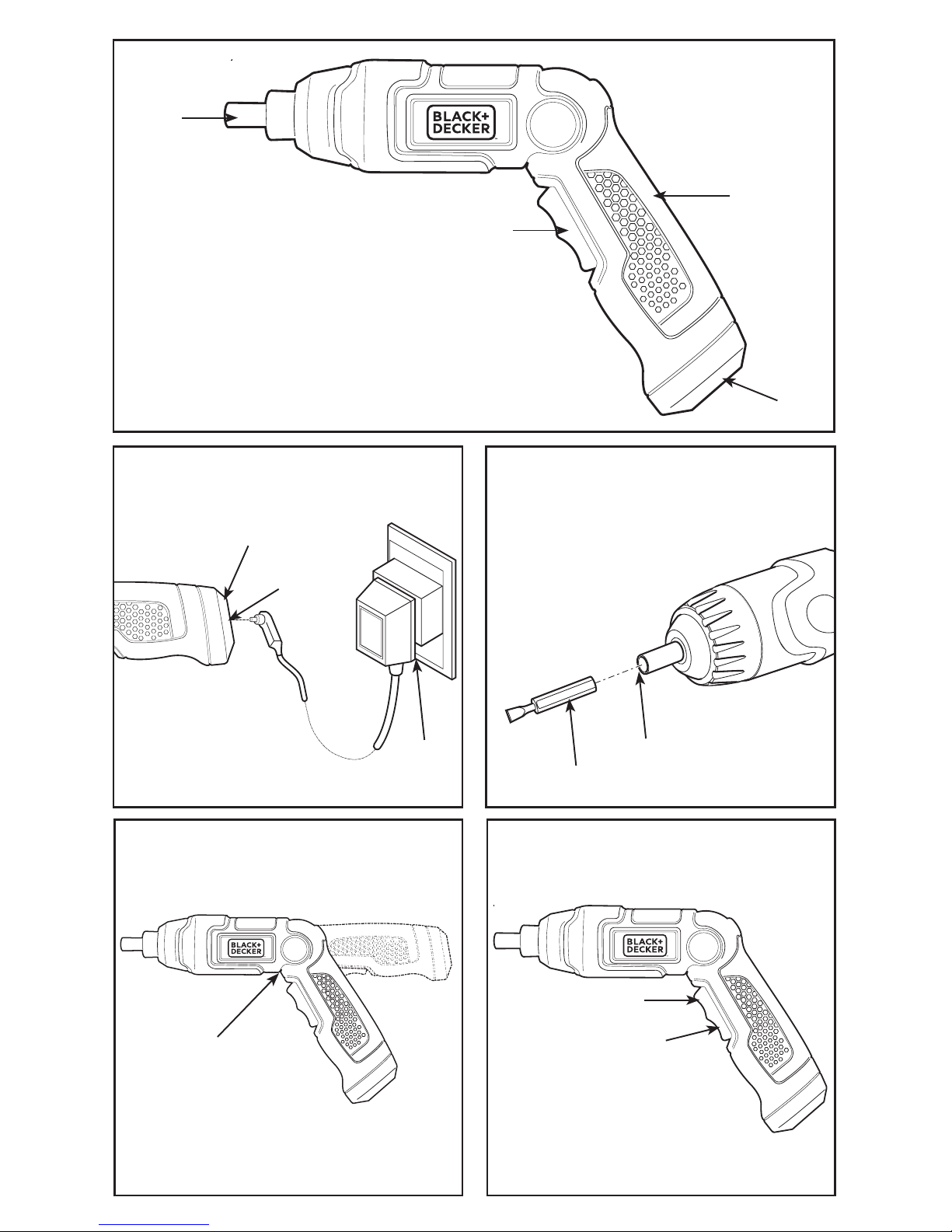
FIG. A
FIG. B FIG. C
FIG. D FIG. E
3
1
8
9
2
4
4
6
Pinch Point
7
3
5
Page 3
ENGLISH • 3
9036
CORDLESS SCREWDRIVER
TECHNICAL DATA
9036
Voltage V
dc
3.6
Speed /min (rpm) 200
Torque Nm 4
Charger
Input V 220
Charge time Hours 8
DO NOT RETURN THIS PRODUCT TO THE STORE,
first contact your local BLACK+DECKER office
or nearest authorized service center.
GENERAL SAFETY RULES
Warning! Read and understand all instructions. Failure
to follow all instructions listed below, may result in electric
shock, fire and/or serious personal injury.
SAVE THESE INSTRUCTIONS
SAFETY INSTRUCTIONS
General power tool safety warnings.
Warning! Read all safety warnings and
all instructions. Failure to follow the warnings and
instructions listed below may result in electric shock,
fire and/or serious injury.
Save all warnings and instructions for future reference.
The term “power tool” in all of the warnings listed below
refers to your mains operated (corded) power tool or
battery operated (cordless) power tool.
1. Work Area Safety
a. Keep work area clean and well lit. Cluttered and
dark areas invite accidents.
b. Do not operate power tools in explosive atmospheres,
such as in the presence of flammable liquids,
gases or dust. Power tools create sparks which may
ignite the dust or fumes.
c. Keep children and bystanders away while
operating a power tool. Distractions can cause you
to lose control.
2. Electrical Safety
a. Power tool plugs must match the outlet. Never
modify the plug in any way. Do not use any
adapter plugs with earthed (grounded) power
tools. Unmodified plugs and matching outlets will
reduce risk of electric shock.
b. Avoid body contact with earthed or grounded
surfaces such as pipes, radiators, ranges and
refrigerators. There is an increased risk of electric
shock if your body is earthed or grounded.
c. Do not expose power tools to rain or wet conditions.
Water entering a power tool will increase the risk of
electric shock.
d. Do not abuse the cord. Never use the cord for
carrying, pulling or unplugging the power tool.
Keep cord away from heat, oil, sharp edges or
moving parts. Damaged or entangled cords increase
the risk of electric shock.
e. When operating a power tool outdoors, use an
extension cord suitable for outdoor use. Use of
a cord suitable for outdoor use reduces the risk of
electric shock.
f. If operating a power tool in a damp location is
unavoidable, use a residual current device (RCD)
protected supply. Use of an RCD reduces the risk of
electric shock. Note: The term “Residual Curent Device
(RCD)” can be replaced by “Ground Fault Circuit
Interrupter (GFCI)” or by “Earth Leakage Circuit
Breaker (ELCB)”.
3. Personal Safety
a. Stay alert, watch what you are doing and use
common sense when operating a power tool. Do
not use a power tool while you are tired or under
the influence of drugs, alcohol or medication. A
moment of inattention while operating power tools
may result in serious personal injury.
b. Use personal protective equipment. Always wear
eye protection. Protective equipment such as dust
mask, non-skid safety shoes, hard hat, or hearing
protection used for appropriate conditions will reduce
personal injuries.
c. Prevent unintentional starting. Ensure the switch
is in the off-position before connecting to power
source and/or battery pack, picking up or carrying
the tool. Carrying power tools with your finger on the
switch or energising power tools that have the switch
on invites accidents.
d. Remove any adjusting key or wrench before
turning the power tool on. A wrench or a key left
attached to a rotating part of the power tool may result
in personal injury.
e. Do not overreach. Keep proper footing and
balance at all times. This enables better control of
the power tool in unexpected situations.
f. Dress properly. Do not wear loose clothing or
jewellery. Keep your hair, clothing and gloves away
from moving parts. Loose clothes, jewellery or long
Page 4
4 • ENGLISH
hair can be caught in moving parts.
g. If devices are provided for the connection of dust
extraction and collection facilities, ensure these are
connected and properly used. Use of these devices
can reduce dust related hazards.
4. Power Tool Use and Care
a. Do not force the power tool. Use the correct power
tool for your application. The correct power tool will
do the job better and safer at the rate for which it was
designed.
b. Do not use the power tool if the switch does not
turn it on and off. Any power tool that cannot be
controlled with the switch is dangerous and must be
repaired.
c. Disconnect the plug from the power source and/or
the battery pack from the power tool before
making any adjustments, changing accessories,
or storing power tools. Such preventive safety measures
reduce the risk of starting the power tool accidentally.
d. Store idle power tools out of the reach of children
and do not allow persons unfamiliar with the power
tool or these instructions to operate the power
tool. Power tools are dangerous in the hands
of untrained users.
e. Maintain power tools. Check for misalignment
or binding of moving parts, breakage of parts and
any other condition that may affect the power
tools operation. If damaged, have the power tool
repaired before use. Many accidents are caused by
poorly maintained power tools.
f. Keep cutting tools sharp and clean. Properly
maintained cutting tools with sharp cutting edges are
less likely to bind and are easier to control.
5. Battery Tool Use and Care
a. Recharge only with the charger specified by the
manufacturer. A charger that is suitable for one type
of battery pack may create a risk of fire when used
with another battery pack.
b. Use power tools only with specifically designated
battery packs. Use of any other battery packs may
create a risk of injury and fire.
c. When battery pack is not in use, keep it away
from other metal objects, like paper clips, coins,
keys, nails, screws, or other small metal objects,
that can make a connection from one terminal
to another. Shorting the battery terminals together
may cause burns or a fire.
d. Under abusive conditions, liquid may be ejected from
the battery; avoid contact. If contact accidentally
ccurs, flush with water. If liquid contacts eyes,
additionally seek medical help. Liquid ejected from
the battery may cause irritation or burns.
6. Service
a. Have your power tool serviced by a qualified
repair person using only identical replacement
parts. This will ensure that the safety of the power
tool is maintained.
7. Electrical safety
Your tool is double insulated; therefore no earth
wire is required. Always check that the main voltage
corresponds to the voltage on the rating plate.
Warning! If the power cord is damaged, it must
be replaced by the manufacturer, authorized
BLACK+DECKER Service Center or an equally
qualified person in order to avoid damage or
injury. If the power cord is replaced by an equally
qualified person, but not authorized by
BLACK+DECKER, the warranty will not be valid.
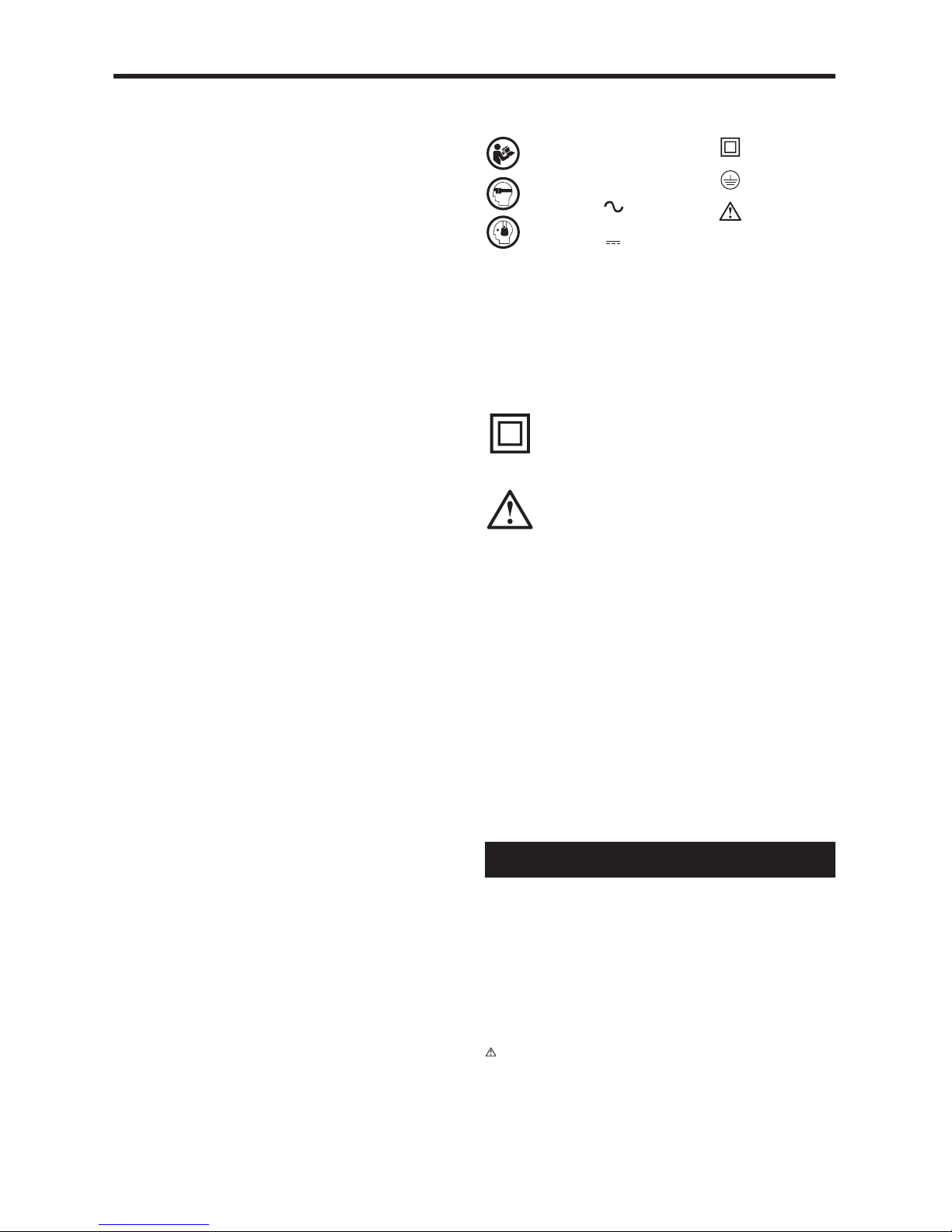
8. Labels on tool
The label on your tool may include the following symbols:
FEATURES (Fig. A and B)
1. ON/OFF switch with Forward/Reverse function
2. Handle
3. Bit Holder
4. Charger Connector
5. Charge Indicator
6. Wall Charger
7. Screwdriver Bit
ADDITIONAL SAFETY RULES
f Avoid prolonged contact with dust from power
sanding, sawing, grinding, drilling, and other
construction activities. Wear protective clothing
and wash exposed areas with soap and water.
Allowing dust to get into your mouth, eyes, or lay
on the skin may promote absorption of harmful
chemicals.
Warning! Use of this tool can generate and/or disburse
dust, which may cause serious and permanent respiratory
or other injury. Direct particles away from face and body.
Some dust created by power sanding, sawing, grinding,
drilling, and other construction activities contains
chemicals known to cause cancer, birth defects or other
Read
Instructions
Manual
Use Eye
Protection
Use Ear
Protection
V ........ Volts
A ........ Amperes
Hz ....... Hertz
W ........ Watts
min ..... minutes
..... Alternating
Current
..... Direct
Current
n
0
....... No-Load
Speed
...... Class II
Construction
.... Earthing
Terminal
.... Safety Alert
Symbol
.../min.. Revolutions
or Recipro cation per
minute
Page 5

ENGLISH • 5
reproductive harm.
Some examples of these chemicals are:
f lead from lead-based paints,
f crystalline silica from bricks and cement and other
masonry products, and
f arsenic and chromium from chemically-treated
lumber.(CCA)
Your risk from these exposures varies, depending on how
often you do this type of work. To reduce your exposure
to these chemicals: Work in a well ventilated area, and
work with approved safety equipment, such as those dust
masks that are specially designed to filter out microscopic
particles.
f Avoid prolonged contact with dust from power
sanding, sawing, grinding, drilling, and other
construction activities. Wear protective clothing
and wash exposed areas with soap and water.
Allowing dust to get into your mouth, eyes, or lay on
the skin may promote absorption of harmful chemicals.
CHARGING THE SCREWDRIVER (Fig. B)
Before attempting to charge your screwdriver, thoroughly
read all of the safety instructions.
To charge your screwdriver, follow the steps below.
1. Plug the output cord of the charger (6) into the socket
in the back half of the screwdriver handle (4) as shown
in Fig. B.
2. Plug the charger into any standard electrical outlet.
3. The red charge indicator light next to the socket in the
back half of the handle (5) will come ON indicating that
the battery is charging. This light will remain on as
long as the the screwdriver is connected to the
charger.
Charging Notes
The tool was sent from the factory in an uncharged
condition. Before attempting to use it, it must be charged
for 12 hours.
1. Charger will work best at normal room temperature.
2. The charger plug and the tool handle may become
warm while charging. This is normal and does not
indicate a problem.
3. The tool can be left on charge as long as you desire.
A minimum charge time of 8 hours is required to
recharge a completely discharged tool.
4. For most fix up jobs a charge of 3 to 4 hours adequate.
5. For long periods that the screwdriver will not be used,
it is recommended that it be fully charged, disconnected
from the charger and stored in a cool, dry location.
Warning! When disconnecting the screwdriver from the
charger, be sure to unplug the charger from the outlet first
then disconnect the charger cord from the screwdriver.
USE
Removing and Installing Bits (Fig. C)
To install a screwdriver bit (6) Fig. C simply insert it into
the cavity in the bit holder (3) until it snaps into place. To
remove the bit pull it straight out. If bit does not fit, rotate
the bit and reinsert it.
Adjusting the Handle
For optimum versatility, the handle can be be set to
different positions as shown in Fig. D. To adjust the handle
into the desired position.
Note: To avoid being pinched, grasp the handle below the
pinch point shown in Fig. D.
OPERATION (Fig. E)
Forward
f Press the button on the top (Clockwise Arrow) (8)
and the tool will run forwards.
f Release the button and the tool will stop.
Reverse
f Press the button on the bottom (Counter Clockwise
Arrow) (9) and the tool will run in reverse.
f Release the button and the tool will stop.
Operating in Manual Mode
f The tool can be used as a conventional non-powered
screwdriver whenever the forward/reverse button is
not depressed. With the button (ON/OFF)(1) in the
middle position, the tool will not activate.
HINTS FOR OPTIMUM USE
f Always use the correct type of screwdriver bit.
f If screws are difficult to tighten, try applying a small
amount of washing liquid or soap as a lubricant.
f Use the screwdriver manually as a non powered
screwdriver to loosen very tight screws or to firmly
tighten screws.
f Always hold the tool and screwdriver bit in a straight
line with the screw.
LUBRICATION
BLACK+DECKER tools are properly lubricated at the
factory and are ready for use.
BATTERY PACK REMOVAL
Important! This tool is designed for disassembly for
the purpose of battery pack removal and recycling. It
is not designed to be re-assembled by the consumer.
Before attempting to disassemble this tool, turn it on
and run it in either direction until it stops to ensure a
Page 6
6 • ENGLISH
complete discharge of the battery pack. To disassemble
the tool, remove the screws in the side of the tool body.
Take the two body halves apart and you will find the
battery pack. Lift the battery pack out and cut the wires
connected to it.
MAINTENANCE
Keep guards, air vents and the motor housing as clear as
possible of dust and dirt. Wipe with a clean cloth and blow
through with a low-pressure air supply. Excessive build-up
of metal dust can cause tracking of electrical current from
the internal parts to exposed metal parts.
Important! To assure product SAFETY and RELIABILITY,
repairs, maintenance and adjustment (other than those
listed in this manual) should be performed by authorized
service centers or other qualified service personnel,
always using identical replacement parts.
ACCESSORIES
Recommended accessories for use with your tool are
available at extra cost from your local dealer or authorized
serv- ice center.
Warning! The use of any accessory not recommended
for use with this tool could be hazardous.
PROTECTING THE ENVIRONMENT
Separate collection. This product must not be
disposed of with normal household waste.
Should you find one day that your
BLACK+DECKER product needs replacement, or
if it is of no further use to you, do not dispose of it
with household waste. Make this product available
for separate collection.
Separate collection of used products and packaging
allows materials to be recycled and used again.
Re-use of recycled materials helps prevent
environmental pollution and reduces the demand
for raw materials. Local regulations may provide for
separate collection of electrical products from the
household, at municipal waste sites or by the
retailer when you purchase a new product.
BAT TERIES
BLACK+DECKER batteries can be recharged
many times. At the end of their useful life,
discard batteries with due care for our
environment:
f Run the battery down completely, then remove it from
the tool.
f NiCd, NiMH and Li-Ion batteries are recyclable.
Take them to any authorized repair agent or a local
recycling station.
SERVICE INFORMATION
BLACK+DECKER offers a full network of company-owned
and authorized service locations throughtout Asia. All
BLACK+DECKER Service Centers are staffed with trained
personnel to provide customers with efficient and reliable
product service.
Whether you need technical advice, repair, or genuine
factory replacement parts, contact the BLACK+DECKER
location nearest to you.
NOTE
f BLACK+DECKER’s policy is one of continuous
improvement to our products and, as such, we
reserve the right to change product specifications
without prior notice.
f Standard equipment and accessories may vary by
countr y.
f Product specifications may differ by country.
f Complete product range may not be available in all
countries. Contact your local BLACK+DECKER
dealers for range availability.
Page 7

Page 8

04/2016
 Loading...