

Page 1
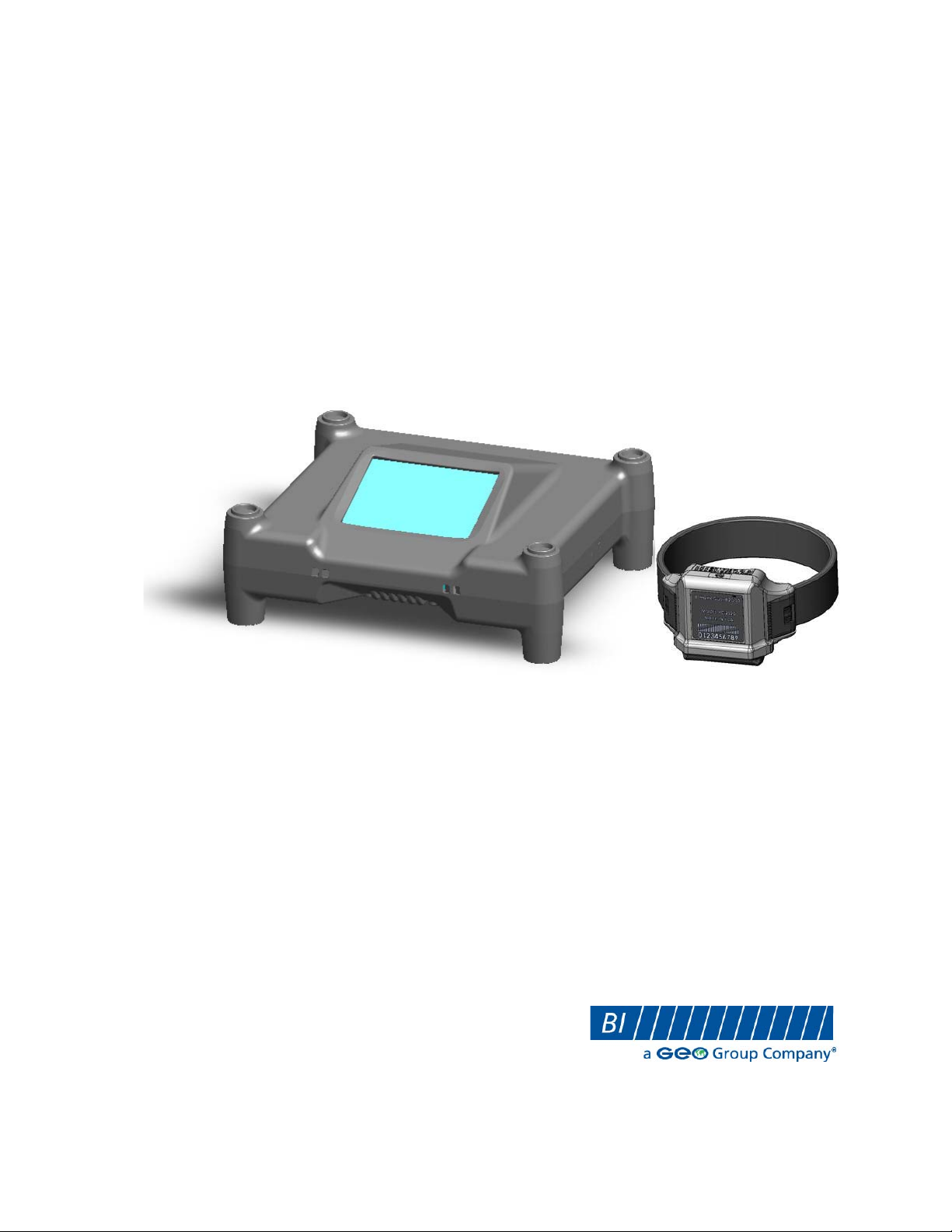
BI HomeGuard 20|20
8-90-00175-0
Revision 2
© 2018 BI Incorporated
BI Proprietary & Confidential
User Guide
Page 2

ii BI Proprietary & Confidential © 2018 BI Incorporated 8-90-00175-0, Revision 2
®
Page 3

BI HomeGuard 20|20 User Guide
Contents
Preface . . . . . . . . . . . . . . . . . . . . . . . . . . . . . . . . . . . . . . . . . . . . . . . . . . . . . . . . . . iii
Chapter 1 Introduction . . . . . . . . . . . . . . . . . . . . . . . . . . . . . . . . . . . . . . . . . . . . . 1
Product Overview . . . . . . . . . . . . . . . . . . . . . . . . . . . . . . . . . . . . . . . . . . . . . . . . . . . . . . . . 1
Product Components . . . . . . . . . . . . . . . . . . . . . . . . . . . . . . . . . . . . . . . . . . . . . . . . . . . . . . 2
HomeGuard 20|20 Transmitter . . . . . . . . . . . . . . . . . . . . . . . . . . . . . . . . . . . . . . . . . . . 2
HomeGuard 20|20 Receiver . . . . . . . . . . . . . . . . . . . . . . . . . . . . . . . . . . . . . . . . . . . . . . 2
Central Monitoring Computer . . . . . . . . . . . . . . . . . . . . . . . . . . . . . . . . . . . . . . . . . . . 2
Common Terms . . . . . . . . . . . . . . . . . . . . . . . . . . . . . . . . . . . . . . . . . . . . . . . . . . . . . . . . . . 3
Chapter 2 The HomeGuard 20|20 Transmitter . . . . . . . . . . . . . . . . . . . . . . . . . . . 5
Transmitter Battery . . . . . . . . . . . . . . . . . . . . . . . . . . . . . . . . . . . . . . . . . . . . . . . . . . . . . . . 6
Tamper Reporting . . . . . . . . . . . . . . . . . . . . . . . . . . . . . . . . . . . . . . . . . . . . . . . . . . . . . . . . 6
Automatic Tamper Reset . . . . . . . . . . . . . . . . . . . . . . . . . . . . . . . . . . . . . . . . . . . . . . . . 6
False Alerts . . . . . . . . . . . . . . . . . . . . . . . . . . . . . . . . . . . . . . . . . . . . . . . . . . . . . . . . . . . 6
Transmitter Parts . . . . . . . . . . . . . . . . . . . . . . . . . . . . . . . . . . . . . . . . . . . . . . . . . . . . . . . . . 7
Installation and Removal . . . . . . . . . . . . . . . . . . . . . . . . . . . . . . . . . . . . . . . . . . . . . . . . . . 9
Assembling . . . . . . . . . . . . . . . . . . . . . . . . . . . . . . . . . . . . . . . . . . . . . . . . . . . . . . . . . . . 9
Sizing . . . . . . . . . . . . . . . . . . . . . . . . . . . . . . . . . . . . . . . . . . . . . . . . . . . . . . . . . . . . . . 11
Attaching . . . . . . . . . . . . . . . . . . . . . . . . . . . . . . . . . . . . . . . . . . . . . . . . . . . . . . . . . . . 13
Installation Tips . . . . . . . . . . . . . . . . . . . . . . . . . . . . . . . . . . . . . . . . . . . . . . . . . . . . . . 13
Battery Maintenance . . . . . . . . . . . . . . . . . . . . . . . . . . . . . . . . . . . . . . . . . . . . . . . . . . 14
Removal . . . . . . . . . . . . . . . . . . . . . . . . . . . . . . . . . . . . . . . . . . . . . . . . . . . . . . . . . . . . 14
Cleaning . . . . . . . . . . . . . . . . . . . . . . . . . . . . . . . . . . . . . . . . . . . . . . . . . . . . . . . . . . . . 15
Chapter 3 The HomeGuard 20|20 Receiver . . . . . . . . . . . . . . . . . . . . . . . . . . . . 17
Components . . . . . . . . . . . . . . . . . . . . . . . . . . . . . . . . . . . . . . . . . . . . . . . . . . . . . . . . . . . . 18
Status Indicators . . . . . . . . . . . . . . . . . . . . . . . . . . . . . . . . . . . . . . . . . . . . . . . . . . . . . . . . 18
Range Indicator . . . . . . . . . . . . . . . . . . . . . . . . . . . . . . . . . . . . . . . . . . . . . . . . . . . . . . 18
Power Indicator . . . . . . . . . . . . . . . . . . . . . . . . . . . . . . . . . . . . . . . . . . . . . . . . . . . . . . 19
Receiver Messages . . . . . . . . . . . . . . . . . . . . . . . . . . . . . . . . . . . . . . . . . . . . . . . . . . . . . . . 19
Variable Leave Window . . . . . . . . . . . . . . . . . . . . . . . . . . . . . . . . . . . . . . . . . . . . . . . 19
8-90-00175-0, Revision 2 © 2018 BI Incorporated BI Proprietary & Confidential iii
®
Page 4

Power and Cell Signal Loss . . . . . . . . . . . . . . . . . . . . . . . . . . . . . . . . . . . . . . . . . . . . . 19
Callback And Missed Callback Messages . . . . . . . . . . . . . . . . . . . . . . . . . . . . . . . . . . 20
48-Hour Backup Battery . . . . . . . . . . . . . . . . . . . . . . . . . . . . . . . . . . . . . . . . . . . . . . . 20
Tamper Detection . . . . . . . . . . . . . . . . . . . . . . . . . . . . . . . . . . . . . . . . . . . . . . . . . . . . 21
Telephone Restrictions . . . . . . . . . . . . . . . . . . . . . . . . . . . . . . . . . . . . . . . . . . . . . . . . . . . 21
Motion Detection . . . . . . . . . . . . . . . . . . . . . . . . . . . . . . . . . . . . . . . . . . . . . . . . . . . . 22
Range Considerations . . . . . . . . . . . . . . . . . . . . . . . . . . . . . . . . . . . . . . . . . . . . . . . . . . . . 22
Leave Alarm . . . . . . . . . . . . . . . . . . . . . . . . . . . . . . . . . . . . . . . . . . . . . . . . . . . . . . . . . . . . 23
Key-Operated Power Switch . . . . . . . . . . . . . . . . . . . . . . . . . . . . . . . . . . . . . . . . . . . . . . . 23
Receiver Connectors . . . . . . . . . . . . . . . . . . . . . . . . . . . . . . . . . . . . . . . . . . . . . . . . . . . . . 23
Installation and Removal . . . . . . . . . . . . . . . . . . . . . . . . . . . . . . . . . . . . . . . . . . . . . . . . . 24
Placement Guidelines . . . . . . . . . . . . . . . . . . . . . . . . . . . . . . . . . . . . . . . . . . . . . . . . . 24
Installing . . . . . . . . . . . . . . . . . . . . . . . . . . . . . . . . . . . . . . . . . . . . . . . . . . . . . . . . . . . . 25
Confirmation . . . . . . . . . . . . . . . . . . . . . . . . . . . . . . . . . . . . . . . . . . . . . . . . . . . . . . . . 26
Removing . . . . . . . . . . . . . . . . . . . . . . . . . . . . . . . . . . . . . . . . . . . . . . . . . . . . . . . . . . . 29
Cleaning and Storage . . . . . . . . . . . . . . . . . . . . . . . . . . . . . . . . . . . . . . . . . . . . . . . . . 30
Appendix 1 Frequently Asked Questions . . . . . . . . . . . . . . . . . . . . . . . . . . . . . .31
Appendix 2 Troubleshooting . . . . . . . . . . . . . . . . . . . . . . . . . . . . . . . . . . . . . . . .35
Appendix 3 Event Messages . . . . . . . . . . . . . . . . . . . . . . . . . . . . . . . . . . . . . . . .37
Appendix 4 Unit Configurations . . . . . . . . . . . . . . . . . . . . . . . . . . . . . . . . . . . . .41
Appendix 5 Product Specifications . . . . . . . . . . . . . . . . . . . . . . . . . . . . . . . . . . . 43
iv BI Proprietary & Confidential © 2018 BI Incorporated 8-90-00175-0, Revision 2
®
Page 5

BI HomeGuard 20|20 User Guide Preface
®
Preface
BI HomeGuard 20|20 User Guide
Copyright © 2018 BI Incorporated
All Rights Reserved
Printed in USA
BI Incorporated (BI) prepared this user guide for use by BI customers only. All
comments concerning the contents of this user guide should be directed to BI’s
Marketing Department, 6265 Gunbarrel Avenue, Suite B, Boulder, CO 80301,
USA. No part of this work covered by copyright may be reproduced in any
form whether graphically, electronically, or mechanically; including
photocopying, recording, taping, or storage in an information retrieval system
without prior written permission from BI.
Trademarks and Patents
The following are registered trademarks of BI Incorporated:
BI
BI logo
BI TotalAccess
BI GuardServer
Technical Support
For technical support when using BI’s monitoring center, contact BI
Monitoring Operations:
BI Monitoring Operations
2801 Enterprise Drive
Anderson, Indiana 46013
1-800-666-3145
1-765-778-5760 Fax
For technical support when using an agency monitoring center, contact BI
Tec hn ic al Sup por t:
BI Technical Support
6265 Gunbarrel Avenue, Suite B
Boulder, CO 80301
1-800-241-9924
Waste Electrical and Electronic Equipment (WEEE)
All electrical products that reach the duration of their functioning
capabilities must be returned to BI Incorporated for recycling.
8-90-00175-0, Revision 2 © 2018 BI Incorporated BI Proprietary & Confidential iii
Page 6

Preface BI HomeGuard 20|20 User Guide
Registrations
CSQ-RF2021 8595A-2AGQN4NNN
1449A-RF2021 XPY2AGQN4NNN
United States FCC, Part 15
These devices comply with Part 15 of the FCC Rules. If requested, this
information must be provided to the telephone company. Operation is subject
to the following two conditions: (1) This device may not cause harmful
interference, and (2) this device must accept any interference received,
including interference that may cause undesired operation.
Any changes or modifications by the user to the equipment that are made
without written approval by BI Incorporated could void the user’s authority to
operate the equipment. This equipment has been tested and found to comply
with the limits for a Class B digital device, pursuant to Part 15 of the FCC
Rules. These limits are designed to provide reasonable protection against
harmful interference in a residential installation.
This equipment generates, uses, and can radiate radio frequency (RF) energy.
If not installed and used in accordance with the instructions, may cause
harmful interference to radio communications. However, there is no
guarantee that interference will not occur in a particular installation.
Innovation, Science, and Economic Development Canada
This device complies with Industry Canada’s licence-exempt RSSs. Operation
is subject to the following two conditions: (1) This device may not cause
interference; and (2) This device must accept any interference, including
interference that may cause undesired operation of the device.
1
Le présent appareil est conforme aux CNR d’Industrie Canada applicables aux
appareils radio exempts de licence. L’exploitation est autorisée aux deux
conditions suivantes: 1) l’appareil ne doit pas produire de brouillage; 2)
l’appareil doit accepter tout brouillage radioélectrique subi, même si le
brouillage est susceptible d’en compromettre le fonctionnement.
2
UL Recognized Component Mark
This equipment is recognized by UL. Representative samples of this
component have been evaluated by UL and meet applicable UL requirements.
Do not disassemble, short circuit, or dispose of in fire. Improper use may
result in fire. Use the BI charging system only.
La batterie de la balise est reconnu par UL. Des échantillons représentatifs de
cette composante ont été évalués par UL et répondre aux exigences UL
1.http://www.ic.gc.ca/eic/site/smt-gst.nsf/eng/sf08449.html
2.https://www.ic.gc.ca/eic/site/smt-gst.nsf/fra/sf08449.html
iv BI Proprietary & Confidential © 2018 BI Incorporated 8-90-00175-0, Revision 2
®
Page 7

BI HomeGuard 20|20 User Guide Preface
®
applicables. Ne pas désassembler, court-circuit, ou jeter dans le feu. Une
mauvaise utilisation peut provoquer un incendie. Utiliser uniquement le
système de charge de BI.
Operation and EME Exposure
The equipment represented herein is designed to comply with the following
national and international standards and guidelines regarding exposure of
human beings to radio frequency electromagnetic energy (EME):
United States Federal Communications Commission, Code of Federal
Regulations; 47 CFR part 2 sub-part J.
American National Standards Institute (ANSI)/Institute of Electrical and
Electronics Engineers (IEEE). C95. 1-2005.
Institute of Electrical and Electronics Engineers (IEEE). C95. 1-2005 Edition.
International Commission on Non-Ionizing Radiation Protection (ICNIRP)
1998.
Ministry of Health (Canada). Safety Code 6- Limits of Human Exposure to
Radio Frequency Electromagnetic Fields in the Frequency Range from 3 kHz
or 300 GHz (2015).
Australian Communications Authority Radiocommunications
(Electromagnetic Radiation - Human Exposure) Standard 2014.
ANATEL (Agência Nacional de Telecomunicações), Brazil Regulatory
Authority, Resolution 303 (July 2, 2002) “Regulation of the limitation of
exposure to electrical, magnetic, and electromagnetic fields in the radio
frequency range between 9 kHz and 300 GHz.” Attachment to Resolution 303
from July 2, 2002. Updated on November 22, 2012.
Requirements for Exposure to Radio Waves
The HomeGuard 20|20 equipment includes a radio transmitter and receiver. It
is designed and manufactured not to exceed the emission limits for exposure
to radio frequency (RF) energy set by the Federal Communications
Commission of the U.S. Government. These limits are part of comprehensive
guidelines that establish permitted levels of RF energy for standards that were
developed by independent scientific organizations through periodic and
thorough evaluation of scientific studies. These standards include a substantial
safety margin designed to assure the safety of all persons, regardless of age and
health.
Electromagnetic Interference/Compatibility
Nearly every electronic device is susceptible to electromagnetic interference
(EMI) if inadequately shielded, designed, or otherwise configured for
electromagnetic compatibility.
Medical Devices
If a person using the HomeGuard 20|20 equipment also uses any personal
medical device (i.e., pacemaker, hearing aid, etc.), consult the manufacturer of
the personal medical device to determine if it is adequately shielded from RF
energy. A physician may be able to assist in obtaining this information.
8-90-00175-0, Revision 2 © 2018 BI Incorporated BI Proprietary & Confidential v
Page 8

Preface BI HomeGuard 20|20 User Guide
Operational Warnings
There are certain areas where you want to avoid operation of any radio
product.
Potentially Explosive Atmospheres
Turn off any radio product prior to entering any area with a potentially
explosive atmosphere unless it is a radio product type especially qualified for
use as “Intrinsically Safe” (for example, Factory Mutual, CSA, or ULapproved). Do not remove, install, or charge batteries in such areas. Sparks in a
potentially explosive atmosphere can cause an explosion or fire resulting in
bodily injury or even death.
NOTE: The areas with potentially explosive atmospheres referred to
above include fueling areas, such as below boat decks; fuel or
chemical transfer or storage facilities; areas where the air contains
chemicals or particles, such as grain, dust, or metal powders; and
any other area where you would normally be advised to turn off
your vehicle engine. Areas with potentially explosive
atmospheres are often but not always posted.
vi BI Proprietary & Confidential © 2018 BI Incorporated 8-90-00175-0, Revision 2
®
 Loading...