

Page 1

Page 2
General Information
Storage
GEL-MA INX X210 should be stored in a fridge at 4˚C until ready to use. Protect it
from light. Expiry date of the product is indicated on the sealed pouch. The product
can be stored for a maximum of 3 months after opening and should be consumed
before the expiry date.
Intended Use
Research use only. This product is not intended for use in diagnostic or therapeutic
procedures.
Safety Information
For more information, please refer to the material safety data sheet.
User Guidelines
Preparation
GEL-MA INX X210 is a lyophilized gelatin methacryloyl, containing a water
soluble photo-initiator.
GEL-MA INX X210 was produced under sterile conditions. To ensure optimal
performance and prevent contamination, it is recommended to handle this
product in a sterile environment.
1. Pipette the required amount of solvent (water, buffer or cell culture
media) to the GEL-MA INX X210 vial. For recommended concentrations,
see processing guidelines.
2. Place the vial in a water bath (37-40 °C) until it fully dissolves.
Occasional shaking and vortexing is recommended to remove
undissolved material from the side of the bottle. Depending on the
selected concentration, it can take up to 90 minutes for the material to
fully dissolve.
3. After complete dissolution, incorporate the cell suspension (if
applicable) and homogenize the mixture by gently pipetting up and
down several times.
4. The bioink is ready. Insert the bioink in a cartridge for printing. For
printing and UV-crosslinking parameters, see processing guidelines.
01
240306
2
Page 3
Processing
Recommended Concentration
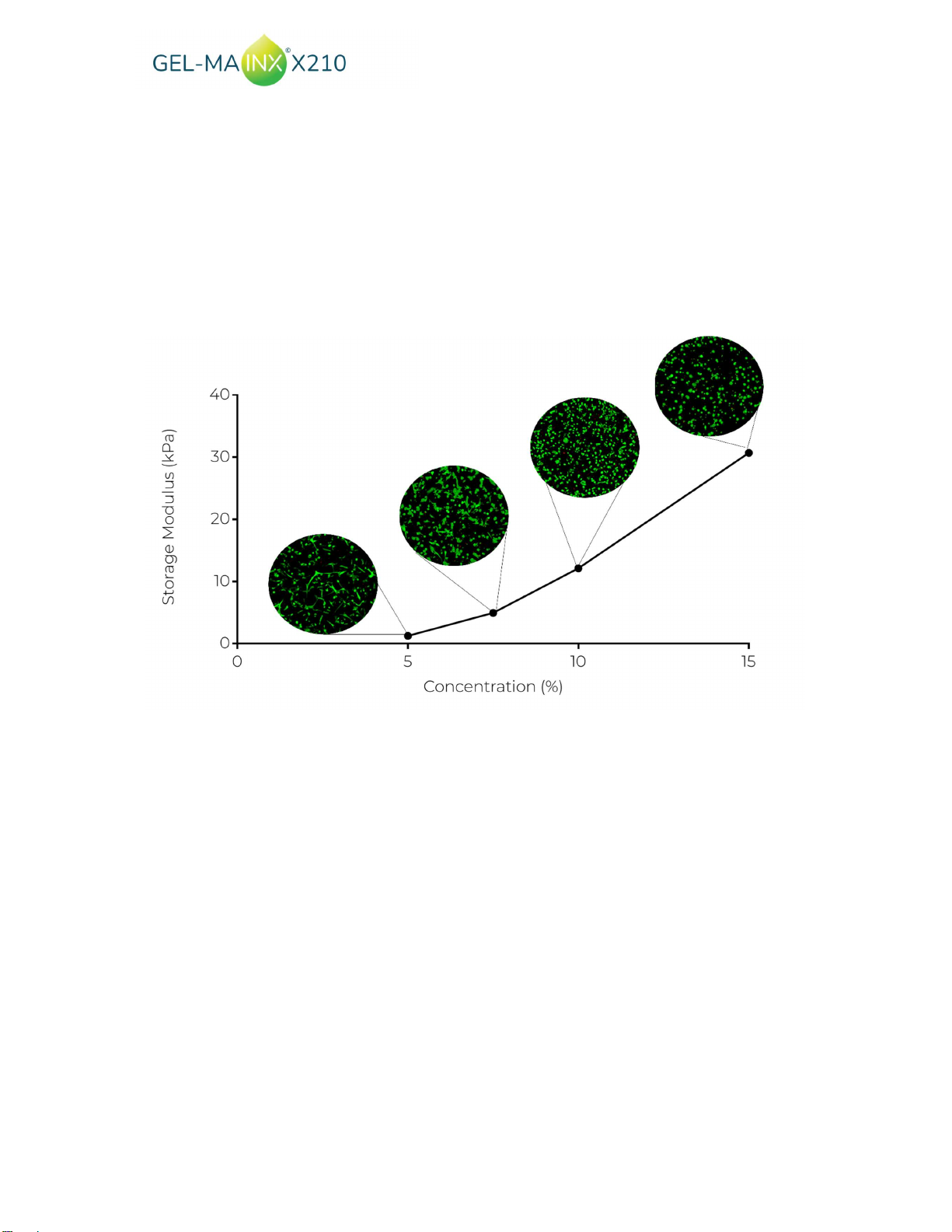
The concentration of GEL-MA INX X210 can be varied by adding different
amount of buffer to the dry material. The final storage modulus of the
material will depend on the selected concentration which in turn will
influence cell behaviour (Figure 1). For extrusion-based 3D printing, the
recommended concentration is 7.5 - 15% (w/v).
Figure 1. Storage moduli of GEL-MA INX X210 as a function of concentration and
its effect on the morphology of encapsulated Human Foreskin Fibroblasts.
01
240306
3
Page 4
Processing Parameters for 10% GEL-MA INX X210
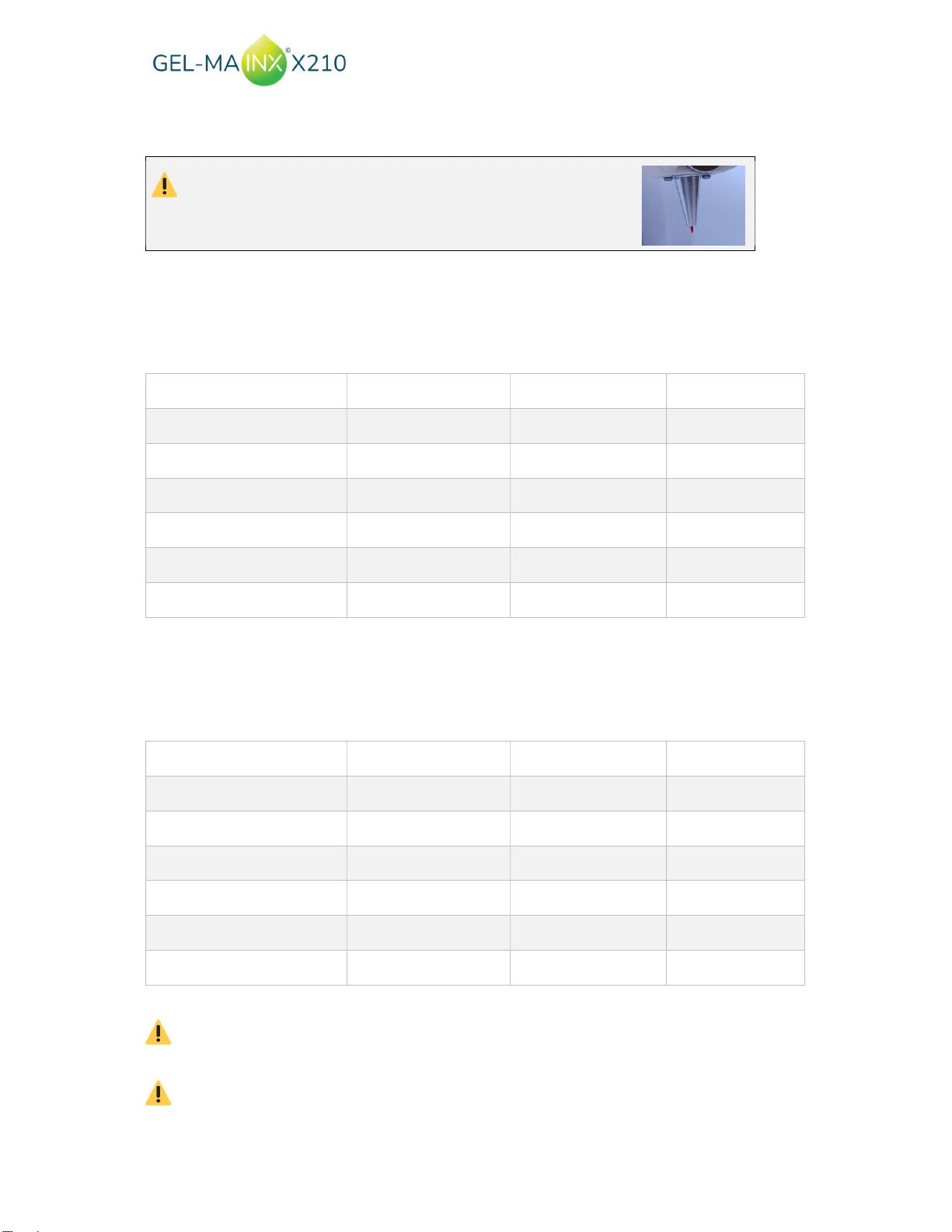
For an optimal printing performance, the use of a metal
conical nozzle insulator is required. Insert the nozzle tip in the
insulator as shown in the image.
a) Recommended parameters for pneumatic-based printers
Recommended processing parameters for a pneumatic-based 3D printer
are listed below.
22G Nozzle 25G Nozzle 27G Nozzle
Nozzle geometry Conical Conical Conical
Printhead Temperature 27 ± 1 °C 27 ± 1 °C 27 ± 1 °C
Printbed Temperature 16 ± 1 °C 16 ± 1 °C 16 ± 1 °C
Pressure 30 ± 20 kPa 35 ± 20 kPa 40 ± 20 kPa
Infill Speed 8 ± 2 mm/s 8 ± 2 mm/s 8 ± 2 mm/s
Layer Height 0.25 ± 0.02 mm 0.18 ± 0.02 mm 0.13 ± 0.02 mm
b) Recommended parameters for piston-based printers
Recommended processing parameters for a piston-based 3D printer are
listed below.
22G Nozzle 25G Nozzle 27G Nozzle
Nozzle geometry Conical Conical Conical
Printhead Temperature 27 ± 1 °C 27 ± 1 °C 27 ± 1 °C
Printbed Temperature 16 ± 1 °C 16 ± 1 °C 16 ± 1 °C
Flow speed 3 ± 1 mm/s 3 ± 1 mm/s 3 ± 1 mm/s
Infill Speed 5 ± 1 mm/s 5 ± 1 mm/s 5 ± 1 mm/s
Layer Height 0.21 ± 0.02 mm 0.14 ± 0.02 mm 0.11 ± 0.02 mm
The printing parameters have been validated for printing a cube with
dimensions 15 x 15 mm (W x L) using 3 ml cartridges.
Use of rectilinear infill pattern is recommended.
01
240306
4
Page 5
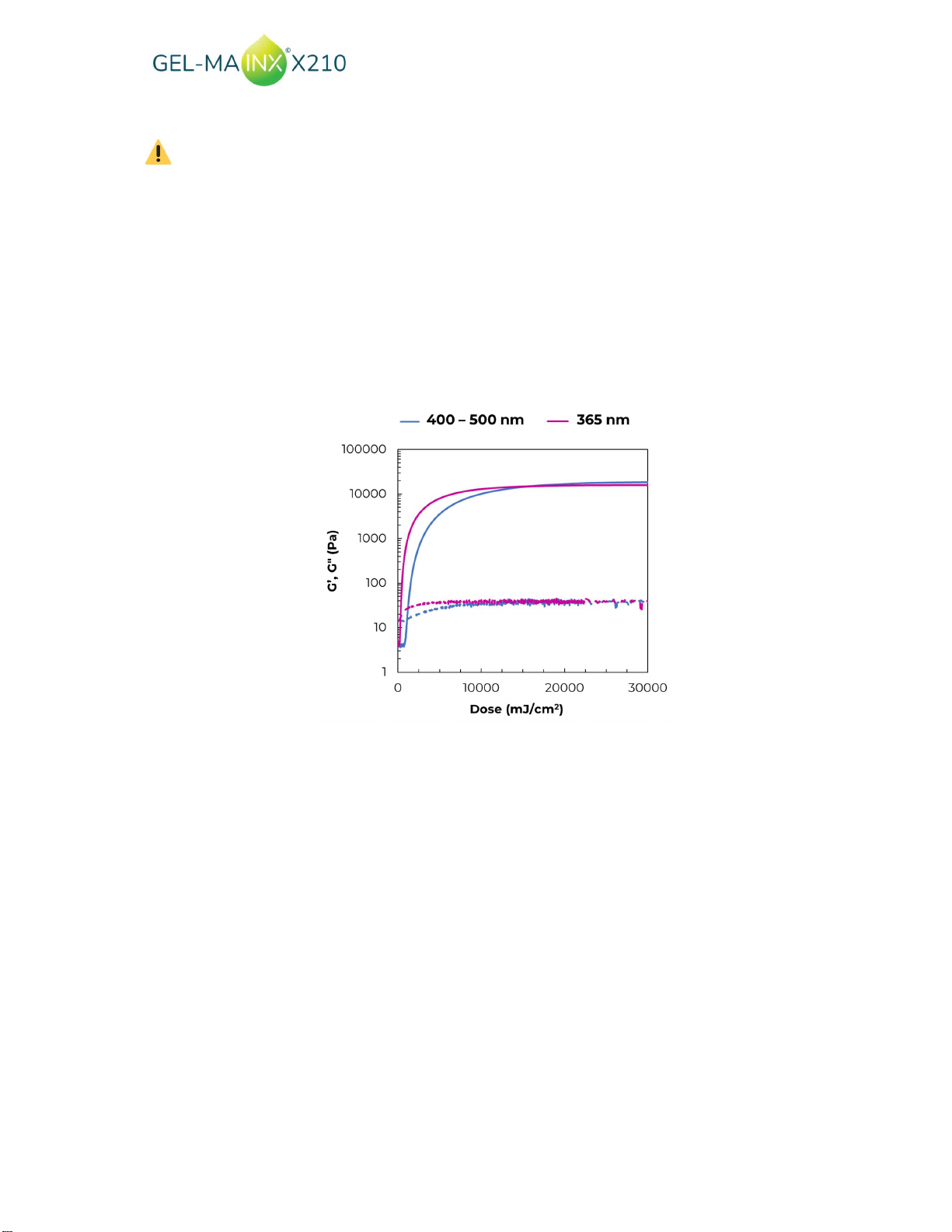
Photo-crosslinking: During printing, structure should be irradiated
with light (λ: 365 nm or 405 nm, Dose: 70 mJ/cm2) after every five layers.
This step is required for partial crosslinking of the structure for a better
shape retention. After completion of printing, the final structure should
be promptly placed under UV light for complete crosslinking.
(Recommended parameters for post-printing photo-crosslinking:
λ: 365 or 405 nm, Dose: 10000 mJ/cm2)
For photo-crosslinking kinetics of 10% GEL-MA INX at two different
wavelengths, see Figure 2.
Figure 2. Storage (G’, solid lines) and loss (G”, dashed lines) moduli of GEL-MA INX
as a function of irradiation dose at 365 nm and 400-500 nm wavelengths
01
240306
5
 Loading...