

Page 1

Biclique Cryptanalysis of the Full AES
Andrey Bogdanov⋆, Dmitry Khovratovich , and Christian Rechberger
K.U. Leuven, Belgium; Microsoft Research Redmond, USA; ENS Paris and Chaire France Telecom, France
Abstract. Since Rijndael was chosen as the Advanced Encryption Standard, improving upon
7-round attacks on the 128-bit key variant or upon 8-round attacks on the 192/256-bit key
variants h as been one of the most difficult challenges in the cryptanalysis of block ciphers for
more than a decade. In this paper we present a novel technique of block cipher cryptanalysis
with bicliques, which leads to the following results:
– The first key recovery attack on the full AES-128 with computational complexity 2
– The first key recovery attack on the full AES-192 with computational complexity 2
– The first key recovery attack on the full AES-256 with computational complexity 2
– Attacks with lower complexity on the reduced-round versions of AES not considered before,
including an attack on 8-round AES-128 with complexity 2
– Preimage attacks on compression functions based on the full AES versions.
In contrast to most shortcut attacks on AES variants, we do not need to assume related-keys.
Most of our attacks only need a very small part of the codebook and have small memory requirements, and are practically verified to a large extent. As our attacks are of high computational
complexity, they do not threaten the practical use of AES in any way.
Keywords: block ciphers, bicliques, AES, key recovery, preimage
124.9
.
⋆
126.1
189.7
254.4
.
.
.
1 Introduction
The block cipher AES (Advanced Encryption Standard) is a worldwide standard and one of
the most popular cryptographic primitives. Designed in 1997, AES has survived numerous
cryptanalytic efforts. Though m any papers have been published on the cryptanalysis of AES,
the fastest single-key attacks on round-reduced AES variants [20,33] so far are only slightly
more powerful than those proposed 10 years ago [23,24]. For all versions of AES, the number
of cryptanalyzed rounds did not increase since then (7 for AES-128, 8 for AES-192 and AES-
256), only a decrease in the computational complexity of the key recovery was achieved. In
general, the last ten years saw some p rogress in the cryptanalysis of block ciphers. However,
the block cipher standard AES is almost as secure as it was 10 years ago in the strongest and
most practical model with a single unknown key. The former standard DES has not seen a
major improvement since Matsui’s seminal paper in 1993 [34].
In contrast, the area of hash function cryptanalysis is growing quickly, encouraged by
the cryptanalysis MD5 [43], of SHA-0 [6, 13] and SHA-1 [42], followed by a practical attack
on protocols using MD5 [39, 40], preimage attacks on Tiger [26] and MD5 [38], etc. As
differential cryptanalysis [7], a technique originally developed for ciphers, was carried over
to hash function analysis, cryptanalysts are now looking for the opposite: a hash analysis
method that would give new results on block ciphers. So far the most well-known attempt
is the an alysis of AES with local collisions [8–11], but it is only applicable to the relatedkey model. In the latter model an attacker works with plaintexts and ciphertexts that are
produced under not only the unknown key, but also under other keys related to the first one
in a way chosen by the adversary. Such a strong requirement is rarely practical and, thus,
has not been considered to be a threat for the use of AES. Also, there has been no evidence
⋆
The authors were visiting Microsoft Research Redmond while working on these results.
Page 2

that the local collision approach can facilitate an attack in the more practical and relevant
single-key model.
State of the art for attacks on AES. AES with its wide-trail strategy was designed to
withstand differential and linear cryptanalyses [15], so pure versions of these techniques have
limited applications in attacks. With r espect to AES, probably the most powerful singlekey recovery methods designed so far are impossible differential cryptanalysis [5, 33] and
Square attacks [14, 20]. The imp ossible differential cryptanalysis yielded the first attack on
7-round AES-128 with non-marginal data complexity. The Square attack and its variations
such as integral attack and multiset attack resulted in the cryptanalysis of round-reduced
AES variants with lowest computational complexity to date, while the first attack on 8-round
AES-192 with non-marginal data complexity has appeared only recently [20].
The s itu ation is different in weaker attack models, where the related-key cryptanalysis
was applied to the full versions of AES-192 and AES-256 [9], and the rebound attack demonstrated a non-random property in 8-round AES-128 [25,30]. However, there is little evidence
so far that carrying over these techniques to the most practical single-secret-key m odel is
feasible.
Meet-in-the-middle atta cks with bicliques. Meet-in-the-middle attacks on block ciphers did get less attention (exceptions are [12, 19, 22, 27, 44]) than the differential, linear,
impossible differential, and integral approaches. However, they are probably the most practical in terms of data complexity. A simple meet-in-the-middle attack requires only a single
plaintext/ciphertext pair. The limited use of these attacks must be attributed to the requirement for large parts of the cipher to be independent of particular key bits. For the
ciphers with nonlinear key schedule, like AES and most AES candidates, this requirement
is apparently strong. As a result, the number of rounds broken with this technique is rather
small [19], which seems to prevent it from producing r esults on yet unbroken 8-, 9-, and
10-round (full) AES. We also mention that the collision attacks [17, 18] use some elements
of the meet-in-the-middle framework.
In this paper we demonstrate that the meet-in-the-middle attacks on blo ck ciphers have
great potential if enhanced by a new concept called bicliques. Biclique cryptanalysis was first
introduced for hash cryptanalysis [29]. The new approach originates from the so-called spliceand-cut framework [1, 2,26] in th e h ash function cryptanalysis, more specifically its element
called initial structure. Formally introduced in [29], bicliques led to the best p reimage attacks
on the SHA family of hash functions, including the attack on 50 rounds of SHA-512, and the
first attack on a round-reduced Skein hash function. We show how to carry over the concept
of b icliques to block cipher cryptanalysis and get even more significant results, including the
first key recovery method for the full AES faster than brute-force.
A b iclique is characterized by its length (number of rounds covered) and dimension. The
dimension is related to the cardinality of the biclique elements and is one of the factors that
determines the advantage over brute-force. Moreover, the construction of long bicliques of
high dimension appears to be a very difficult task for primitives with fast diffusion [37].
Two paradigms for key recove ry with bicliques. Taking the biclique properties into
account, we propose two different approaches, or paradigms, for the key-recovery attack.
Suppose that the ciph er admits the basic meet-in-the-middle attack on m (out of r) rounds.
The first paradigm, the long biclique, aims to constr uct a biclique for the remaining r − m
rounds. Though the dimension of the biclique decreases as r grows, small-dimension bicliques
Page 3
can be constructed with numerous tools and methods from differential cryptanalysis of block
ciphers and hash functions: rebound attacks, trail backtracking, local collisions, etc. Also from
an information-theoretic point of view, bicliques of dimension 1 are likely to exist in a cipher,
regardless of the number of rounds.
The s econd paradigm, the independent biclique, aims to construct bicliques of high dimension for smaller b < r − m number of rounds efficiently and cover the remaining rounds
with a new method of matching with precomputations. Smaller number of rounds also makes
use of simp ler tools for the biclique construction. This paradigm is best suited for ciphers
with diffusion that is slow with respect to r − m rounds, surprisingly, including AES.
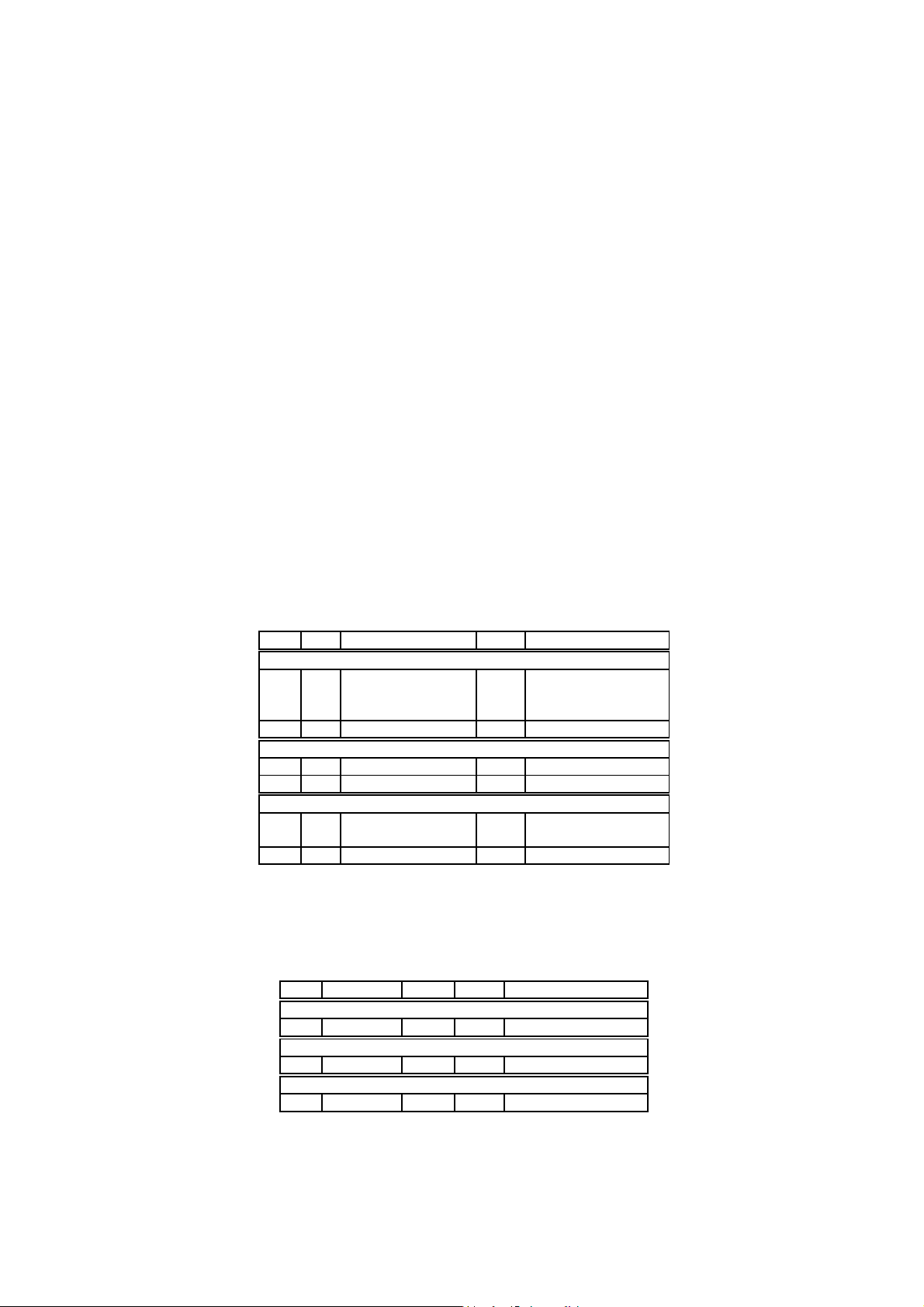
Results on AES. The biclique cryptanalysis successfully applies to all full versions of AES
and compared to brute-force pr ovides an advantage of about a factor 3 to 5, depending on
the version, Also, it yields advantages of up to factor 15 for the key recovery of round-reduced
AES variants with numbers of rounds higher than those cryptanalyed before. The attacks
with lowest computational complexities follow the paradigm of independent bicliques and
have success rate 1. We also provide complexities for finding compression function preimages
for all full versions of AES when considered in hash mode. Our results on AES are summarized
in Table 2, and an attempt to give an exhaustive overview with earlier results is given in
Table 6 in the Appendix.
Table 1. Biclique key recovery for AES
rounds data computations/succ.rate memory biclique length in rounds
AES-128 secret key recovery
124.97
2
125.64
2
125.34
2
126.18
2
AES-192 secret key recovery
188.8
2
189.74
2
AES-256 secret key recovery
253.1
2
251.92
2
254.42
2
102
2
32
2
8
2
8
2
8
2
8
2
8
2
8
2
8
2
5
5
3
3
4
4
6
4
4
8 2
8 2
8 2
10 2
9 2
12 2
9 2
9 2
14 2
126.33
127
88
88
80
80
120
120
40
Table 2. Biclique cryptanalysis of AES in hash modes
rounds computations succ.rate memory biclique length in rounds
AES-128 compression function preimage, Miyaguchi-Preneel
10 2
12 2
14 2
125.83
AES-192 compression function preimage, Davies-Meyer
125.71
AES-256 compression function preimage, Davies-Meyer
126.35
0.632 2
0.632 2
0.632 2
8
8
8
3
4
4
Page 4

2 Biclique Cryptanalysis
2.1 Basic Meet-in-the-Middle Attacks
An adversary chooses a p artition of the key space into groups of keys of cardinality 22deach
for some d. A key in a group is indexed as an element of a 2d× 2dmatrix: K[i, j]. The
adversary selects an internal variable v in the data trans form of the cipher such that
– as a function of a plaintext and a key, it is identical for all keys in a row:
K[i,·]
P
−−−→
– as a function of a ciphertext and a key, it is identical for all keys in a column:
v
←−−−
where f1and f2are the corresponding parts of the cipher.
Given a pair (P, C), an adversary computes 2dpossible values−→v and 2dpossible values
←−
v from the plaintext and from the ciphertext, respectively. A matching pair−→vi=←−vjyields
a key candidate K [i,j]. The number of key candidates depends on the bit size |v| of v and is
given by the formula 2
2d−|v|
. For |v| close to d and larger an attack has advantage of about
2dover brute force search as it tests 22dkeys w ith less than 2dcalls of the full cipher.
The basic meet-in-the-middle attack has clear limitations in the block cipher cryptanalysis
since an internal variable with the properties listed above can be found for a very small
number of rounds only. We show how to bypass this obstacle with the concept of a biclique.
f
1
K[·,j]
f
2
v;
C,
2.2 Bicliques
Now we introduce the notion of a biclique. Let f be a subcipher th at maps an internal state
S to the ciphertext C : fK(S) = C . According to (2), f connects 2dinternal states {Sj} to
2dciphertexts {Ci} with 22dkeys {K [i,j]}:
K[0, 0] K[0, 1] . . . K[0, 2d− 1]
{K[i, j]} =
. . .
.
K[2d− 1, 0] K[2d− 1, 1] . . . K [2d− 1, 2d− 1]
The 3-tuple [{Ci}, {Sj}, {K[i, j]}] is called a d-dimensional biclique, if
Ci= f
(Sj) for all i, j ∈ {0, . . . , 2d− 1}. (1)
K[i,j]
In other words, in a biclique, the key K[i, j] maps the internal state Sito the ciphertext C
and vice versa. This is illustrated in Figure 1.
2.3 The Flow of Biclique Cryptanalysis
Preparation. An adversary chooses a partition of the key space into groups of keys of
cardinality 22deach for some d and considers the block cipher as a composition of two
subciphers: e = f ◦ g, where f follows g. A key in a group is indexed as an element of a
2d× 2dmatrix: K[i, j].
j
Page 5

S0S
K[0, 0] K[2d− 1, 2d− 1]
C0C
Fig. 1. d-dimensional biclique
1
1
. . .
. . .
S
C
2d−1
2d−1
Step 1. For each group of keys the adversary builds a str ucture of 2dciphertexts Ciand
2dintermediate states Sjwith r espect to the group of keys {K [i,j]} so that the partial
decryption of Ciwith K[i, j] yields Sj. In other words, the structure satisfies the following
condition:
∀i, j : S
K[i,j]
−−−→fCi. (2)
j
Step 2. The adversary asks the oracle to decrypt ciphertexts Ciwith the secret key K
secret
and obtains the 2dplaintexts Pi:
decryption oracle
C
−−−−−−−−−−→
i
−1
e
Step 3. If one of tested keys K [i, j] is the secret key K
Pi. (3)
, then it maps intermediate state
secret
Sjto the plaintext Pi. Therefore, the adversary checks if
∃i, j : P
K[i,j]
−−−→gSj, (4)
i
which proposes a key candidate.
3 New Tools and Techniques for Bicliques
In here we describe two approaches to construct bicliques, and propose a precomputation
technique that can speed-up the application of bicliques for key-recovery. The exposition is
mainly independent of any concrete cipher.
3.1 Bicliques from Independent Related-Key Differentials
A straightforward approach to find a d-dimensional biclique would be to fix 2dstates and 2
ciphertexts, and derive a key for each pair to satisfy (2). This would require at least 22dkey
recovery attempts for f . A much more efficient way for th e adversary is to choose the keys
in advance and require them to conform to specific differentials as follows.
Let the key K[0, 0] map intermediate state S0to ciphertext C0, and consider two sets of
2drelated key differentials each over f with respect to the base computation S
K[0,0]
−−−−→ C0:
0
d
– ∆i-differentials. A differential in the first set maps input difference 0 to an output
difference ∆iunder key difference ∆
K
∆
i
0
7−−→f∆iwith ∆
K
:
i
K
= 0 and ∆0= 0. (5)
0
Page 6

– ∇j-differentials. A differential in the second set maps an input difference ∇jto ou tput
difference 0 under key difference ∇
∇
j
K
:
j
K
∇
j
7−−→f0 with ∇
K
= 0 and ∇0= 0. (6)
0
The tuple (S0, C0, K[0, 0]) conforms to both sets of differentials by defin ition. If the trails of
∆i-differentials do not share active nonlinear components (such as active S-boxes in AES)
with the trails of ∇j-differentials, then the tuple also conforms to 22dcombined (∆i, ∇j)differentials:
K
K
∆
⊕∇
i
7−−−−−−→f∆ifor i, j ∈ {0, . . . , 2d− 1}. (7)
∇
j
j
The proof follows from the theory of boomerang attacks [41] and particularly from the
concept of the S-box switch [9] and a sandwich attack [21]. Since ∆i- and ∇j-trails share
no active non-linear elements, a boomerang based on them returns from the ciphertext with
probability 1 as the quartet of states forms the boomerang rectangle at every step.
Substituting S0, C0, and K[0, 0] to the combined differentials (7), one obtains:
K
K
⊕∇
i
j
S0⊕ ∇
K[0,0]⊕∆
−−−−−−−−−−→fC0⊕ ∆i. (8)
j
Finally, we put
Sj= S0⊕ ∇j,
Ci= C0⊕ ∆i, and
K[i, j] = K[0, 0] ⊕ ∆
K
i
⊕ ∇
K
j
and get exactly the definition of a d-dimensional biclique (1). If all ∆i6= ∇j, then all keys
K[i, j] are different. The construction of a biclique is thus reduced to the computation of ∆
and ∇j, which requires no more than 2 · 2dcomputations of f .
The independency of the related-key differentials allows one to efficiently construct higherdimensional bicliques and simplifies the coverage of the key space with such bicliques. Though
this approach turns out to be effective in case of AES, it is exactly the independency of differentials that limits the length of the biclique constructed.
3.2 Bicliques from Interleaving Related-Key Differential Trails
To construct longer bicliques, we drop the differential independency requirement imposed
above and reduce the dimension of the resulting biclique. The differential trails share some
active nonlinear components now. This yields conditions on values that need to be satisfied
in a biclique search.
We outline here how bicliques of dimen sion 1 can be constructed in terms of differentials and differential trails with a procedure resembling the rebound attack [35]. We are
also able to amortize the construction cost of a biclique by producing many more out
of a single one. The construction algorithm is outlined as follows for a fixed key group
{K[0, 0], K[0, 1], K[1, 0], K[1, 1]}, see also Figure 2:
– Intermediate state T . Choose an intermediate state T in subcipher f (over which the
biclique is constructed). The position of T splits f into two parts : f = f2◦ f1. f1maps
from Sjto T . f2maps from T to Ci.
i
Page 7

– ∆- and ∇-trails. Choose some truncated related-key differential trails: ∆-trails over f
??
? ?
K
0,0
K
1,1
K
1,0
K
0,1
Guess
difference
in computations
Resolve
in the middle
S
0
S
1
C
1
C
0
Construct
solutions
1 2 (a-c) 2 (d-e)
and ∇-trails over f2.
– Inbound phase. Guess the differences in the differential trails up to T . Get the values
of T th at satisfy the input and output differences over f .
– Outbound phase. Use the remaining degrees in freedom in the state to sustain difference
propagation in trails.
– Output the states for the biclique.
For longer keys some bicliques are filtered out. Having found a biclique, we produce new
ones out of it for other key groups.
Numerous optimizations of the outlined biclique construction algorithm are possible. For
instance, it is not necessary to guess all differences in the trail, but only part of them, and
subsequently filter out the solutions. Instead of fixing the key group, it is also possible to fix
only the difference between keys and derive actual values dur ing the attack (the disadvantage
of this approach is that key groups are generated online, and we have to take care of possible
repetitions).
We stress here that when ever we speak of differences between keys, these describe differences inside the group of keys that are guessed. We never need access to decryptions under
keys that are related by those differences, i.e. the attacks we describe are always in the
single-key model.
1
Fig. 2. Construction of a 1-dimensional biclique from dependent related-key differential trails: Guess difference
between computations and derive states Sjand ciphertext Cias conforming elements.
3.3 Matching with Precomputations
Here we describe the idea of matching with precomputations that can provide significant
computational advantage due to amortized complexity. This can be seen as an efficient way
of checking equation (4) in the basic flow of biclique cryptanalysis.
First, the adversary computes and stores in memory 2 · 2dfull computations
for all i P
K[i,0]
−−−→−→v and for all j←−v
i
up to some matching variable v, which can be a small part of the internal cipher s tate. Then
for particular i, j he recomputes only those parts of the cipher that differ from the s tored
ones:
K[0,j]
←−−−− S
j
Page 8

P
i
S
j
v
The amount of recalculation depends on the diffu sion properties of both internal rounds
and the key schedule of the cipher. The relatively slow diffusion in the AES key schedule
allows the adversary to skip most recomputations of the key schedule operations.
4 Two Paradigms of Key Recovery
We have introduced different approaches to construct bicliques and to perform matching with
precomputations. One may ask which approach is optimal and relevant. We have studied
several block ciphers and hash functions, including different variants of AES, and it turns
out that the optimal choice depends on a primitive, its diffusion properties, and features of
the key schedule. This prepares the case to introduce two paradigms for key recovery, which
differ both methodologically and in their use of tools.
To put our statement in context, let us consider the basic meet-in-the-middle attack
(Section2.1) and assume that it can be applied to m rounds of a primitive, while we are
going to attack r > m rounds.
4.1 Long Bicliques
Our first paradigm aims to construct a biclique at the remaining (r − m) rounds so that
the basic meet-in-the-middle attack can be applied with negligible modification. The first
advantage of this approach is that theoretically we can get the same advantage as the basic
attack if we manage to construct a biclique of appropriate dimension. If the dimension
is inevitably s mall due to the diffusion, then we use the second advantage: the biclique
construction methods based on differential cryptanalysis of block ciphers and hash fu nctions.
The disadvantage of this paradigm is that the construction of bicliques for many rounds
is very difficult. Therefore, we are limited in the total number of rounds th at we can attack.
Furthermore, the data complexity can be very large since we use all the d egrees of freedom
to constr uct a biclique and may have nothing left to impose restrictions on the plaintexts or
ciphertexts.
Nevertheless, we expect this paradigm to benefit from the further development of differential cryptanalysis and the inside-out strategy and predict its applicability to many other
ciphers.
Hence, to check (4) the adversary selects an internal variable v ∈ V that can be computed
as follows for each key group {K[i, j]}:
P
K[i,·]
−−−→
E
K[·,j]
v
←−−−
1
S. (9)
E
2
Therefore, the computational complexity of matching is upper bounded by 2dcomputations
of the cipher.
Page 9
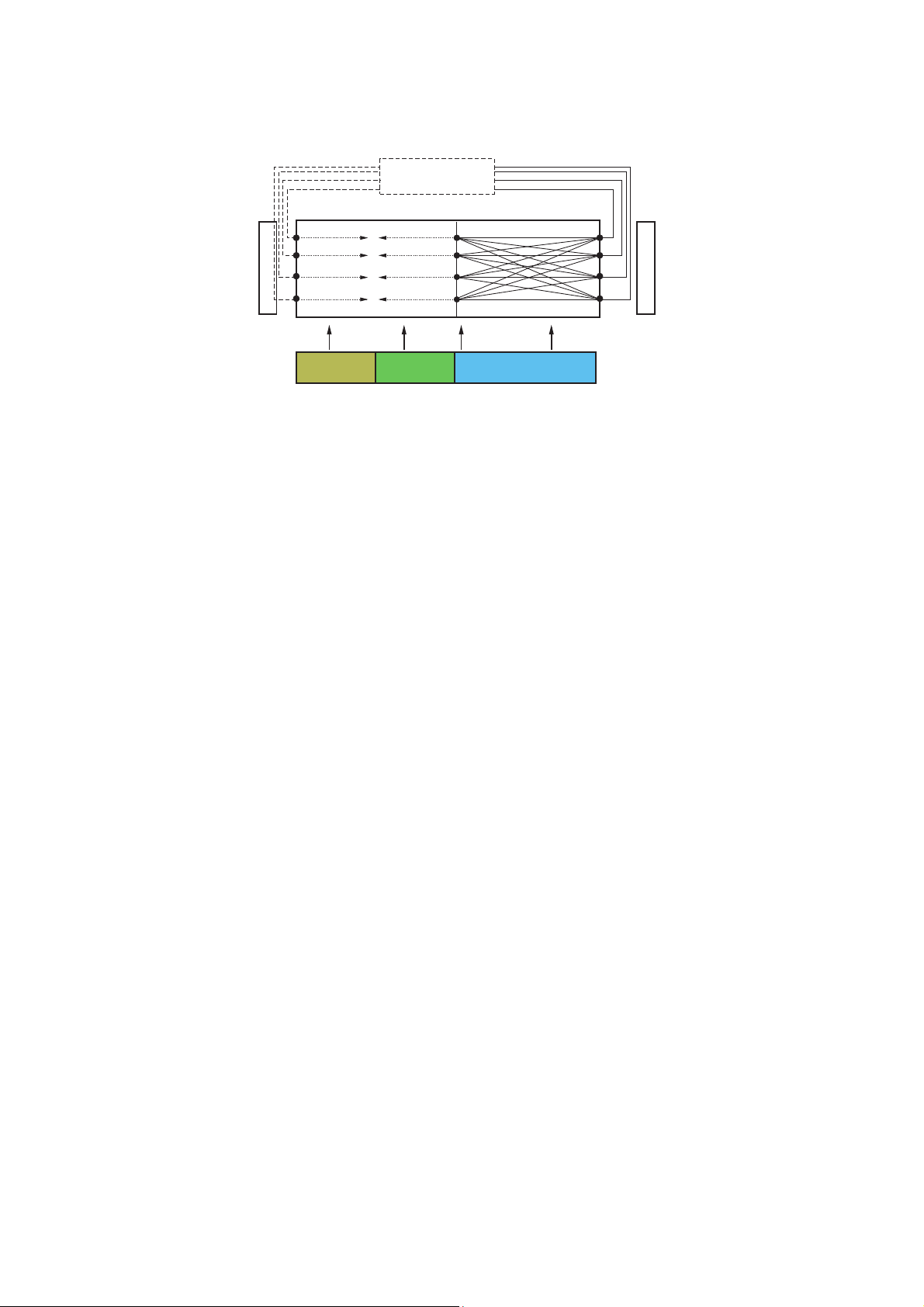
S
1
S
3
C
1
C
2
key
plaintext ciphertext
C
3
S
2
K[4, 4]
K[1, 1]
K[i, ∗] K[∗, j]
S
4
C
4
K[i, j]
K[∗, 4]
K[∗, 1]
Decryption
oracle
K[4, ∗]
K[1, ∗]
Fig. 3. Long biclique attack with four states an d four ciphertexts.
Complexity of Key Recovery Let us evaluate the full complexity of the long biclique
approach. Since the full key recovery is merely the application of Steps 1-3 2
n−2d
times, we
get the following equation:
= 2
n−2d
[C
biclique
+ C
match
+ C
falsepos
] ,
C
full
where
– C
biclique
is the complexity of constructing a single biclique. Since the differential-based
method is time-consuming, one has to amortize the construction cost by selecting a proper
set of neutral bytes that do not affect the biclique equations.
– C
is the complexity of the computation of the internal variable v 2dtimes in each
match
direction. It is upper bounded by 2dcalls of E.
– C
falsepos
is the complexity generated by false positives, which have to be matched on
other variables. If we match on a single byte, the number of false positives is ab ou t
2d−8
2
. Each requ ires only a few operations to re-check.
Generally, the complexity is dominated by C
and hence has an advantage of at least 2
match
over brute-force. The memory complexity depends on the biclique construction procedure.
4.2 Independent Bicliques
Our second paradigm lets the attacker exploit the diffusion properties rather than differential, and does not aim to construct the longest biclique. In contrast, it proposes to construct
shorter bicliques with high dimension by tools like independent related-key differentials (Section 3.1).
This approach has clear advantages. First, the data complexity can be made quite low.
Since the biclique area is small, the attack designer h as more freedom to impose constraints
on the ciphertext and hence restrict it to a particular set. Secondly, the attack gets a compact
and small description, since the independent trails are generally short and self-explaining.
For the further explanation, we r ecall the decomposition of the cipher:
d
E : P −→
E
1
V −→
E
2
S −→
E
3
C,
Page 10

In (4), th e adversary detect the right key by computing an intermediate variable v in both
directions:
P
K[i,j]
−−−→
i
−→
v?=←−v
E
1
K[i,j]
←−−−
E
2
Sj. (10)
Since the meet-in-the-middle attack is no longer applicable to the E2◦ E1, we apply the
matching with precomputations (Section 3.3).
As in the long b iclique paradigm, 22dkeys are tested using only 2dintermediate cipher
states. Th e precomputation of about 2
d+1
matches allows for a significant complexity gain
and is the major source of the computational advantage of our attacks on AES. The advantage
comes from th e fact that in case of high dimension th e basic computation has negligible cost,
and the full complexity is determined by the amount of precomputation. By a careful choice
of key groups, one is able to redu ce the precomputation proportion to a very small factor,
e.g. factor 1/15 in attacks on reduced-round versions of AES-256.
Complexity of Key Recovery The full complexity of the independent biclique approach
is evaluated as follows:
= 2
n−2d
[C
biclique
+ C
precomp
+ C
recomp
+ C
falsepos
] ,
C
full
where
– C
precomp
is the complexity of the precomputation in Step 3. It is equivalent to less than
2druns of the subcipher g.
– C
recomp
is the complexity of the recomputation of the internal variable v 22dtimes. It
strongly depends on the diffusion properties of the cipher. For AES this value varies from
2d−1.5
2
to 2
2d−4
.
The biclique construction is quite cheap in this p arad igm. The method in Section 3.1 enables
construction of a biclique in only 2
complexity is dominated by 2
n−2d
d+1
calls of subcipher f. Therefore, the full key recovery
· C
. We give more details for the case of AES in
recomp
further sections. The memory complexity of the key recovery is upper-bounded by storing
2dfull computations of the cipher.
5 Description of AES
AES is a block cipher with 128-bit internal state and 128/192/256-bit key K (AES-128,
AES-192, AES-256, respectively). The internal state is represented by a 4 × 4 byte matrix,
and the key is represented by a 4 × 4/4 × 6/4 × 8 matrix.
The encryption works as follows. The plaintext is xored with the key, and then undergoes a
sequence of 10/12/14 round s. Each round consists of f ou r transformations: nonlinear bytewise
SubBytes, the byte permutation S hiftRows, linear transformation MixColumns, and the
addition with a subkey AddRoundKey. MixColumns is omitted in the last round.
SB is a nonlinear transformation operating on 8-bit S-boxes with maximum differential
probability as low as 2−6(for most cases 0 or 2−7). The ShiftRows rotates bytes in row r
by r positions to the left. The MixColumns is a linear transformation with branch number
5, i.e. in the column equation (y0, y1, y2, y3) = MC(x0, x1, x2, x3) only 5 and more variables
can be non-zero.
We address two internal states in each round as follows in AES-128: #1 is the state before
SubBytes in round 1, #2 is the state after MixColumns in round 1, #3 is the state before
Page 11
SubBytes in round 2, . . ., #19 is the state before SubBytes in round 10, #20 is the state
0
1
2
3
4
5
6
7
8
9
10
11
12
13
14
15
after ShiftRows in round 10 (MixColumns is omitted in the last round). The states in the
last round of AES-192 are addressed as #23 and #24, and of AES-256 as #27 an d #28.
The su bkeys come out of the key schedule procedure, which slightly differs for each version
of AES. The key K is expanded to a sequence of keys K0, K1, K2, . . . , K10, which form a
4×60 byte array. Then the 128-bit subkeys $0, $1, $2, .. . , $14 come out of the sliding window
with a 4-column step. The keys in the expanded key are formed as follows. First, K0= K .
Then, column 0 of Kris the column 0 of K
the last column of K
and of column i of K
r−1
. Subsequently, column i of Kris the xor of column i − 1 of K
r−1
. In AES-256 column 3 undergoes SubBytes transformation while
r−1
xored with the nonlinear fun ction (SK) of
r−1
forming column 4.
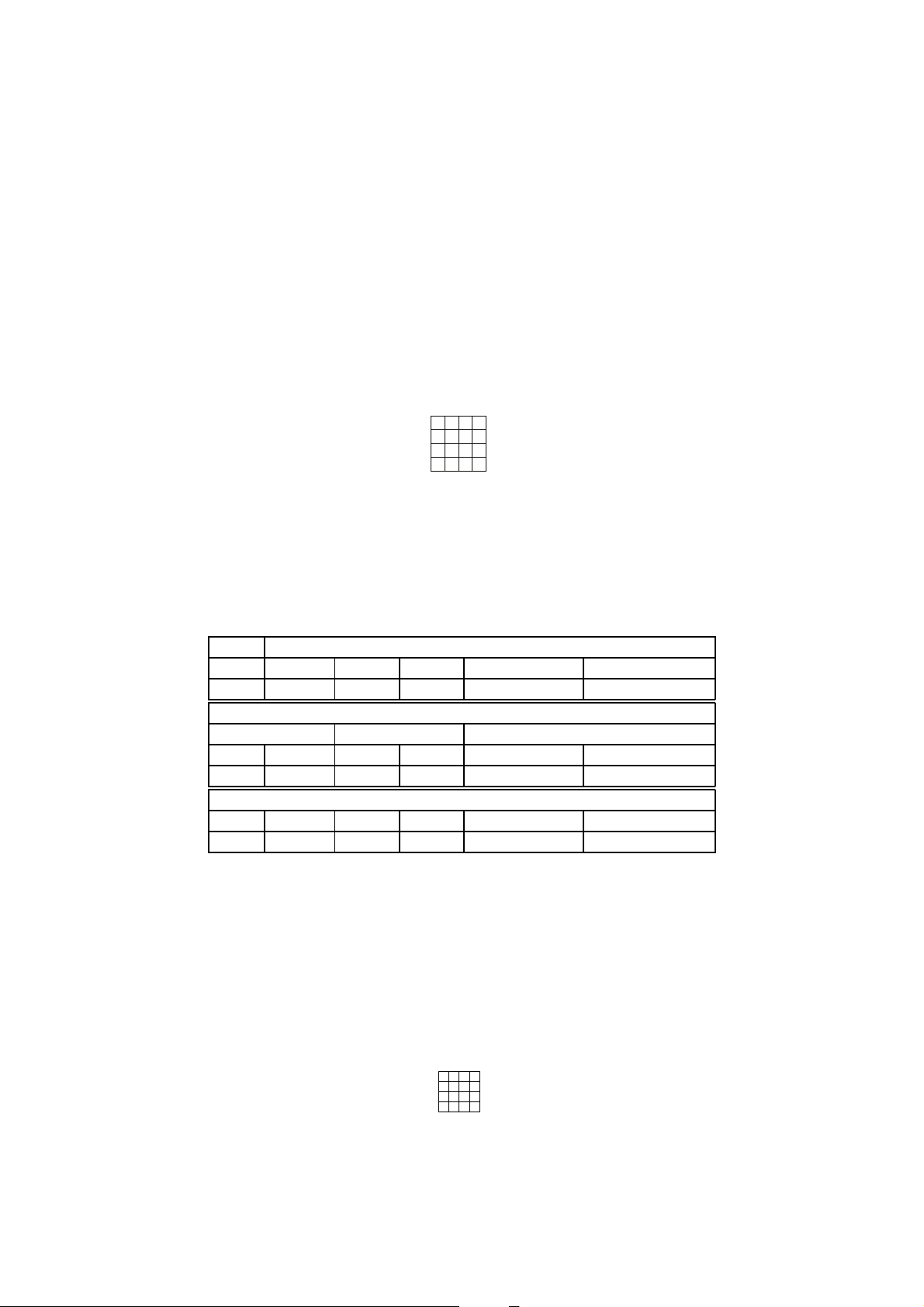
Bytes within a state and a subkey are enumerated as follows
Byte i in state Q is addressed as Qi.
6 Independent Bicliques: Key Recovery for the Full AES-128
Table 3. Parameters of the key recovery for the full AES-128
f Biclique
Rounds Dimension ∆Kbytes ∇Kbytes Time Memory
8-10 8 $88, $812$81, $8
7
9
2
9
2
Matching
g Precomputation Recomputation
Rounds v Workload Memory SubBytes: forward SubBytes: backward
1-7 #5
8−ε
12
2
9
2
0.875 2.625
Total complexity
Memory C
13
2
biclique
C
7
2
precompCrecomp
7
2
2
14.14
C
f alsepos
2
C
8
126.18
2
f ull
6.1 Key Partitioning
For more clarity we define the key groups with respect to the subkey $8 of round 8 and
enumerate the groups of keys by 2
112
base keys. Since the AES-128 key schedule bijectively
maps each key to $8, the enumeration is well-defined. The base keys K [0,0] are all possible
112
2
16-byte values with two bytes fixed to 0 whereas the remaining 14 bytes run over all
values:
0
0
The keys {K[i, j]} in a grou p are enumerated by all possible byte differences i and j with
respect to the base key K[0, 0]:
Page 12
i
i
jj
This yields the partition of the round-8 subkey space, and hence the AES key space, into
112
the 2
groups of 216keys each.
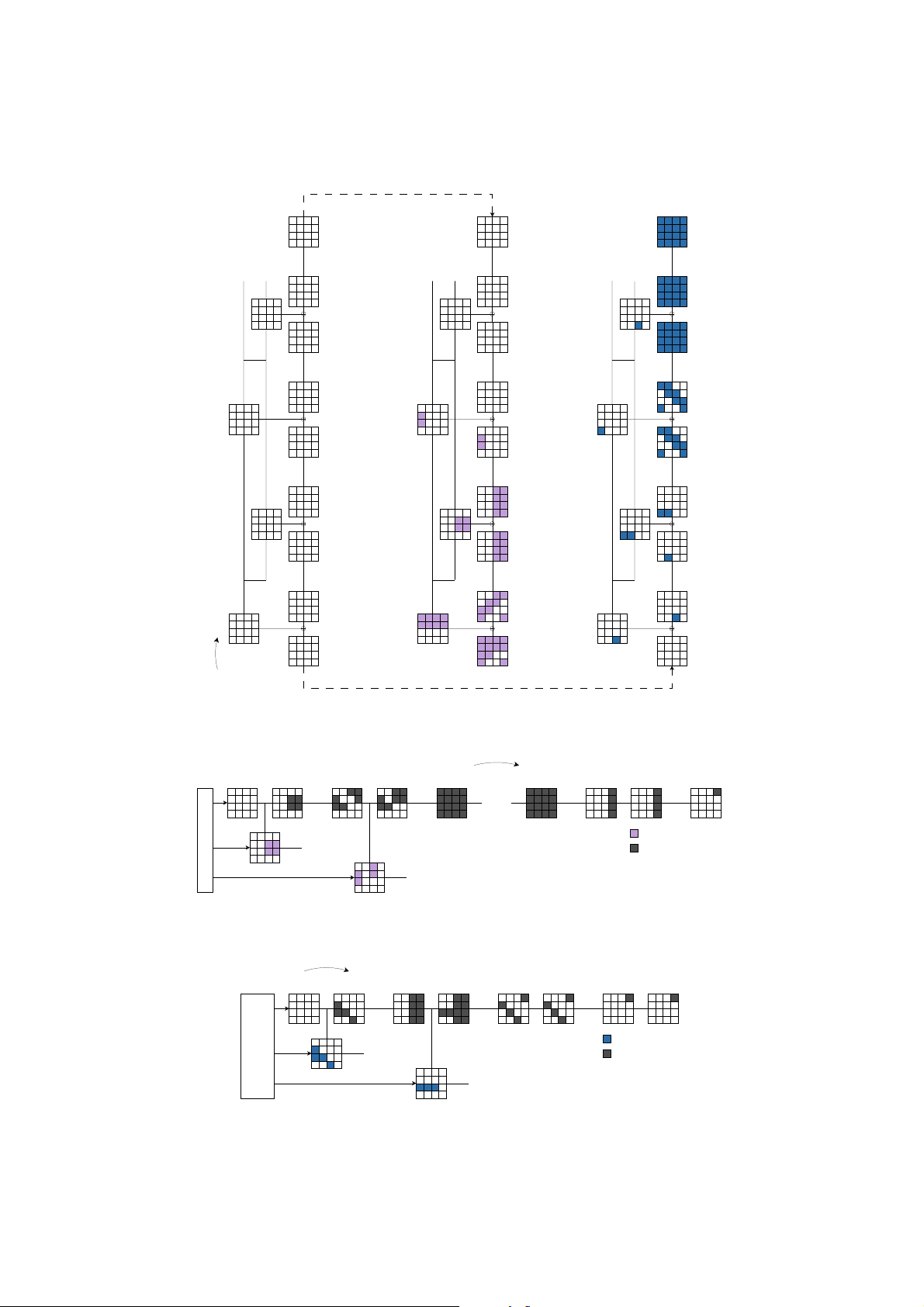
6.2 3-Round Biclique of Dimension 8
We constr uct a 3-round biclique from combined related-key differentials as described in
Section 3.1. The parameters of th e key recovery are sum marized in Table 3. The adversary
−1
fixes C0= 0 and derives S0= f
the difference ∆
K
in $8, and ∇j-differentials are based on the difference ∇
i
K
∆
($8) =
i
(C0) (Figure 13, left). The ∆i-differentials are based on
K[0,0]
i
i
and ∇
K
($8) =
j
jj
.
K
j
in $8:
Both sets of differentials are depicted in Figure 13 in the truncated form. As they share no
active S-boxes, the resulting combined differentials yield a biclique of dimension 8.
Since the ∆i-differential affects only 12 bytes of the ciphertext, all the ciphertexts share
the same values in bytes C
. Furthermore, since ∆
0,1,4,13
K
($1010) = ∆
i
K
($1014), the ciph er text
i
bytes C10and C14are also always equal. As a result, the data complexity does not exceed
288.
base
computation
Step 2. Add ∆ito the key
S
0
SB
SR
MC
$8
SB
SR
key schedulekey schedule
$9
$10
C
0
Step 1. Start with C0= 0
∆i-differentials ∇j-differentials
S
0
K
∆
i
SB
SR
MCMC
key schedulekey schedule
SBSB
SRSR
C
i
Step 3. Add ∇jto the key
K
∇
j
key schedulekey schedule
SBSB
SRSR
MCMC
SB
SR
MC
SB
SR
Sj, #15
#16
#17
#18
#19
#20
C
0
Fig. 4. AES-128 biclique from combined differentials: base computation as well as ∆i- and ∇j-differentials.
Page 13
S
j
AK
MC
SR
biclique
AK
MC
SB
$6$7
SR
AK
MC
SB
SR
AK
MC
SB
SR
AK
SB
∆
recomputed
#5#6#7#8#9#10#11#12#13#14#15
←−
MC
K
j
v
SR
SB
Forward computation. Now we figure out how the computation P
stored one P
K[i,0]
−−−→−→vi. Similarly, it is determined by the influ ence of the difference between
i
Fig. 5. Recomputation in the backward direction: AES-128
K[i,j]
−−−→−→v differs from the
i
keys K[i, j ] and K [i,0], now applied to the plaintext. Thanks to the low diffusion of the AES
key schedule and sparsity of the key difference in round 8, the whitening subkeys of K[i, j]
and K[i, 0] differ in 9 bytes only. The difference is no longer a linear function of j as it is in
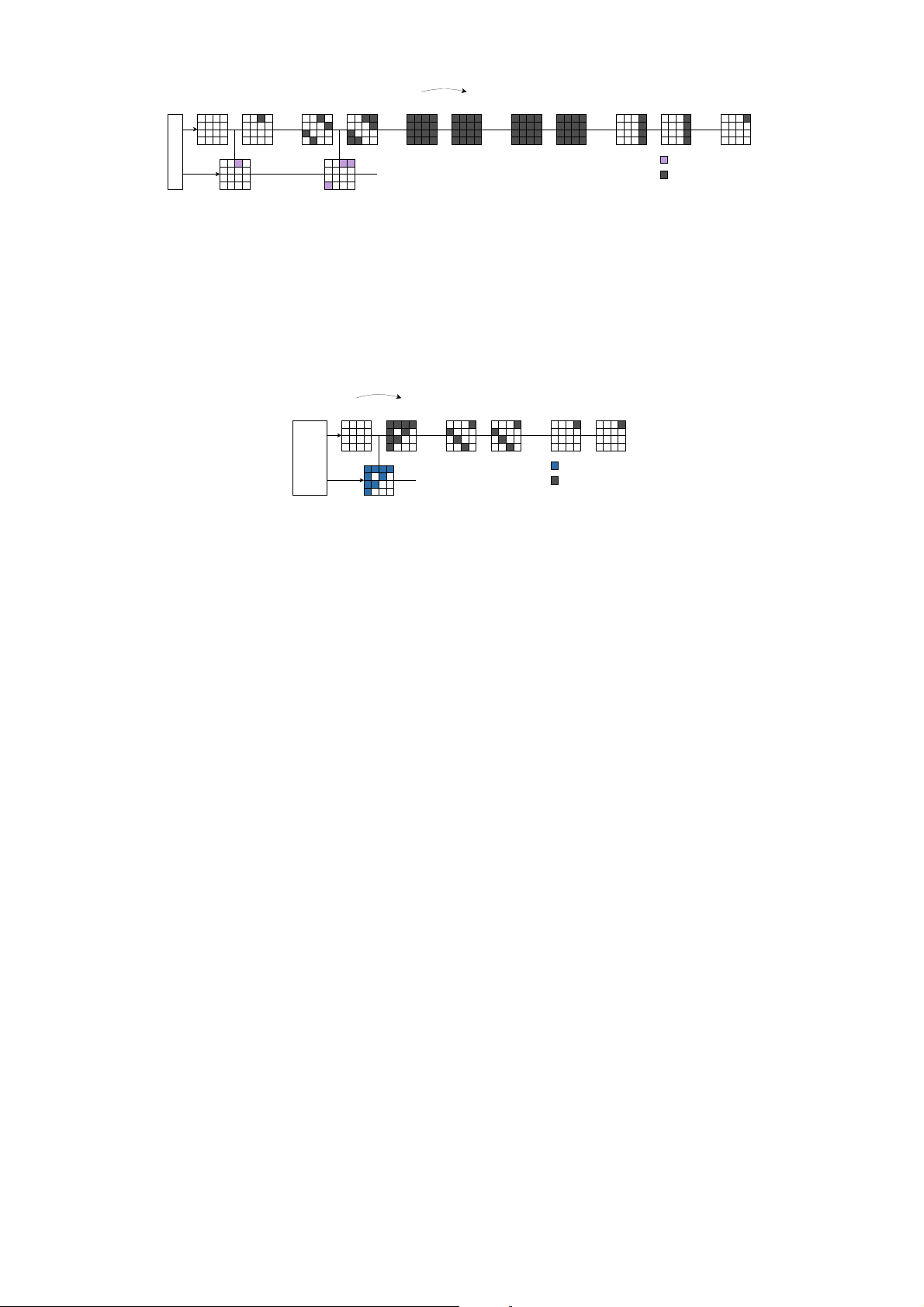
the computation of←−v , but still requires only three s-boxes in the key schedule to recompute.
The areas of internal states to be recomputed (with 13 S-boxes) are depicted in Figure 6.
P
i
AK
SB
biclique
oracle &
decryption
$0
AK
MCMCSRSRSB
Fig. 6. Recomputation the forward direction: AES-128
#5#4#3#2#1
AK
K
∇
i
recomputed
−→
v
6.3 Matching over 7 Rounds
Now we check whether the secret key K
to Section 3.3. We make 2
d+1
precomputations of v and store values as well as the interme-
belongs to the key group {K[i, j]} according
secret
diate states and subkeys in memory. Then we check (10) for every i, j by recomputing only
those variables that differ from the ones stored in memory. Now we evaluate the amount of
recomputation in both directions.
Backward direction. Let us figure out how the computation←−v
stored one←−v
K[0,j]
←−−−− Sj. It is determined by the influence of the difference between keys
j
K[i,j]
←−−− Sjdiffers from the
K[i, j] and K[0, j] (see the definition of the key group in Section 6.1). The difference in the
subkey $5 is non-zero in only one byte, so we have to recompute as few as four S-boxes in
round 5 (state #13). The full area to be recomputed, which includes 41 S-boxes, is depicted
in Figure 5. Note that the difference in the relevant subkeys is a linear fu nction of i, and
hence can be precomputed and stored.
Forward computation. Now we look at how the computation P
stored one P
K[i,0]
−−−→−→vi. Similarly, it is determined by the influ ence of the difference between
i
K[i,j]
−−−→−→v differs from the
i
keys K[i, j ] and K [i,0], now applied to the plaintext. Thanks to the low diffusion of the AES
key schedule and sparsity of the key difference in round 8, the whitening subkeys of K[i, j]
and K [i,0] differ in 9 bytes only. The difference is no longer a linear function of j as it is
involved into the computation of←−v , but still requires only three S-boxes in the key schedule
to recompute. This effect and the areas of internal states to be recomputed (with 13 S-boxes)
are depicted in Figure 6.
Page 14

6.4 Complexities
Since only a portion of the round function is recomputed, one has to be highly accurate in
evaluating the complexity C
. A r ou gh division of AES-128 into 10 rounds is not precise
recomp
enough. For a more exact evaluation, we count the number of S-boxes in each SubBytes
operation that we have to recompute, the number of active variables in MixColumns, the
number of output variables that we need from MixColumns, and, finally, the number of
S-boxes to recompute in the key schedule.
Altogether, we need an equivalent of 3.4375 SubBytes operations (i.e., 55 S-boxes), 2.3125
MixColumns operations, and a negligible amount of XORs in the key schedule. The number of
SubBytes computations clearly is a larger summand. S-boxes are also the major contributor
to the practical complexity of AES both in hardware and software. Therefore, if we aim for a
single number that refers to the complexity, it makes sense to count the number of Su bBytes
operations that we need an d compare it to that in the full cipher. The latter number is
10 + 2.5 = 12.5 as we have to take the key schedule nonlinearity into account. As a result,
C
recomp
and C
is equivalent to 216·3.4375/12.5 = 2
precomp
together do not exceed 28calls of the full AES-128.
14.14
runs of the full AES-128. The values C
biclique
The full computational complexity amounts to about
112
2
28+ 2
14.14
+ 2
8
126.18
= 2
.
The memory requirement is upper-bounded by the storage of 28full computations of g. Since
the coverage of the key space by groups around base keys is complete, the success probability
is 1.
This approach for 8-round AES-128 yields a key recovery with computational complexity
about 2
125.34
, data complexity 288, memory complexity 28, and success probability 1. Similarly, preimage search for the compression function of the full AES-128 in Miyaguchi-Preneel
mode requires about 2
125.83
computations, 28memory, and has a success prob ab ility of about
0.6321.
7 Indepent Bicliques for the Full AES-192
7.1 Key Partitioning
We define the key groups with respect to the expanded key block K6, which consists of the
subkey $9 and left two columns of the subkey $10 (further denoted by $10L) and enumerate
the groups of keys by 2
key to $9||$10L, the enumeration is well-defined. The base keys K[0, 0] are all possible 2
24-byte values with two bytes fixed to 0 whereas the remaining 22 bytes run over all values:
176
base keys. Since the AES-192 key schedule bijectively maps each
176
0
0
The keys {K[i, j]} in a group are enumerated by all p ossible byte differences i and j with
respect to the base key K[0, 0]:
i
1
i
K
∆
($9||$10L) =
i
2
and ∇
K
($9||$10L) =
j
j j
,
Page 15

where (i1, i2) are all possible columns that have one byte zero after applying MixColumns−1:
0
i
1
= MixColumns
i
2
0
∗
i
. (11)
∗
0
This yields the partition of the AES-192 key space by the 2
176
groups of 216keys each.
7.2 4-Round Biclique
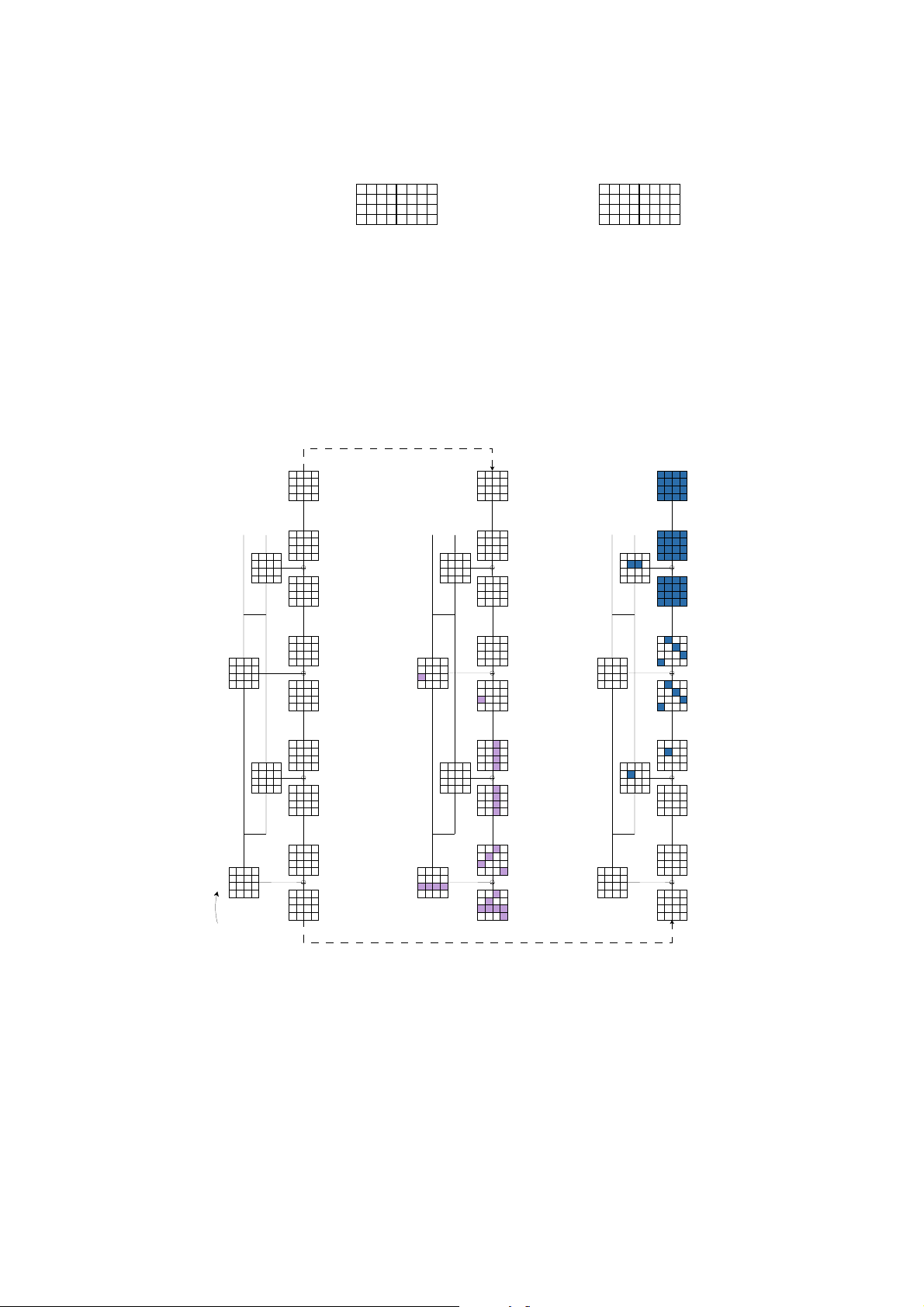
The parameters of the key recovery are outlined in Table 4. The biclique is defined analogously to the biclique for AES-128. Thanks to the longer key, we are able to construct a
biclique over 4-round f , so that S0= #17. Again, the ∆i- and ∇j-differential trails share no
active S-boxes (Figure 7).
Table 4. Parameters of the key recovery in the full AES-192
f Biclique
Rounds Dimension ∆Kbytes ∇Kbytes Time Memory
9-12 8 $617, $618$611, $6
17
Matching
g Precomputation Recomputation
Rounds v Workload Memory SubBytes: forward SubBytes: backward
1-8 #7
8−ε
12
2
9
2
Total complexity
Memory C
13
2
biclique
C
7
2
precompCrecomp
7
2
2
13.68
7
2
1.1875 1.625
C
f alsepos
2
8
C
189.68
2
9
2
f ull
Since the ∆i-differential affects only 12 bytes of the ciphertext, all the ciphertexts share
the same values in bytes C
K
($1213), we have the following property for the ciphertext bytes:
∆
i
. Furthermore, since ∆
3,6,7,10
K
($120) = ∆
i
K
($1212) and ∆
i
K
($129) =
i
C0= C12and C9= C13.
As a result, the data complexity does not exceed 280.
7.3 Matching over 8 Rounds
The partial matching procedure is very similar to that in AES-128. The areas to be recomputed in the backward direction are depicted in Figure 8, and in the forward direction in
Figure 9. In the backward direction we save two S-boxes, since the ∆K($9||$10L) is the expansion of 3-byte difference by MixColumns (Equation (11)). As a result, only six (instead of
eight) S-boxes needs recomputing in state #15 (round 8). Regarding the forward direction,
the whitening subkeys $0 differ in 4 bytes only, which makes only four S-boxes to recompute.
Note that the difference in the relevant subkeys is a linear function of i and j, respectively,
and hence can be precomputed and stored.
Page 16
base
computation
$9
key schedule
$10
$11
key schedule
$12
Step 1. Start with C0= 0
Fig. 7. Two key modifications for AES-192 biclique
Step 2. Add ∆ito the key
S
0
SB
SR
MC
SB
SR
C
0
∆i-differential
S
0
K
∆
i
key schedulekey schedule
SB
SR
MCMC
SBSB
SRSR
C
i
Step 3. Add ∇jto the key
∇j-differential
K
∇
j
key schedule
key schedule
SBSB SB
SRSR SR
MCMC MC
SBSB
SRSR
MCMC
SB
SR
MC
SB
SR
Sj, #17
#18
#19
#20
#21
#22
#23
#24
C
0
S
j
AK
MC
SR
biclique
$8
Fig. 8. Recomputation in the backward direction: AES-192
P
i
biclique
oracle &
decryption
$0
AK
MC
SR
SB
$7
AK
SR
SB
SB
#2#1
#3
AK
MC
$1
AK
AK
...
MC
SR
SB
MC
SR
AK
SB
SR
SB
AK
MC
K
∇
i
recomputed
∆
recomputed
AK
#7#8#9#10#13#14#15#16#17
←−
SR
−→
v
SB
v
MC
K
j
#7#6#5#4
Fig. 9. Recomputation the forward direction: AES-192
Page 17

7.4 Complexities
Again, we aim to count the nonlinear operations as both a larger summand and the bottleneck
of most implementations. Altogether, we need an equivalent of 2.8125 SubBytes operations
compared to the equivalent of 14 in the full cipher (there are 8 key schedule rounds). As a
result, C
recomp
is equivalent to 216· 2.8125/14 = 2
13.68
runs of the full AES-192. The full
computational complexity amounts to about
172
2
·29+ 2
13.68
= 2
189.74
.
The memory requirement is upper-bounded by the storage of 28full computations of g. Since
the coverage of the key space by groups around base keys is complete, the success probability
is 1.
This approach for 9-round AES-192 yields a key recovery with computational complexity
about 2
188.8
, data complexity 280, memory complexity 28, and success probability 1. Similarly,
preimage search for the compression function of the full AES-192 in Davies-Meyer mode
requires about 2
125.71
computations, 28memory, and has success rate 0.6321.
8 Independent Bicliques for the Full AES-256
Table 5. Parameters of the key recovery in the full AES-256
f Biclique
Rounds Dimension ∆Kbytes ∇Kbytes Time Memory
11-14 8 $12
$13
2
5
7
2
9
2
Matching
g Precomputation Recomputation
Rounds v Workload Memory SubBytes: forward SubBytes: backward
1-10 #7
7
12
2
9
2
0.625 4.8125
Total complexity
Memory C
13
2
biclique
C
7
2
precompCrecomp
7
2
2
14.64
C
f alsepos
2
C
8
254.64
2
f ull
8.1 Key Partitioning
We define the key groups with respect to the expanded key block K6= $12||$13 and enumerate the groups of keys by 2
240
base keys. Since the AES-256 key schedule bijectively maps
each key to $12||$13, the enumeration is well-defined. The base keys K[0, 0] are all possible
240
2
32-byte values with two bytes fixed to 0 whereas the remaining 30 bytes run over all
values:
0
0
The keys {K[i, j]} in a group are enumerated by all p ossible byte differences i and j with
respect to the base key K[0, 0]:
Page 18
K
∆
($12||$13) =
i
i
and ∇
K
($12||$13) =
j
This yields the partition of the AES-256 key space into the 2
240
groups of 216keys each.
j
.
8.2 4-Round Biclique
The parameters of the key recovery are outlined in Table 5. The biclique is defined analogously to the biclique for AES-128. Thanks to the longer key, we are able to construct a
biclique over 4-round f , so that S0= #21. Again, the ∆i- and ∇j-differential trails share no
active S-boxes (Figure 15).
base
computation
$11
key schedule
$12
$13
key schedule
$14
Step 1. Start with C0= 0
Fig. 10. Two key modifications for AES-256 biclique
Step 2. Add ∆ito the key
S
0
SB
SR
MC
SB
SR
C
0
∆i-differential
S
0
K
∆
i
key schedulekey schedule
SB
SR
MCMC
SBSB
SRSR
C
i
Step 3. Add ∇jto the key
∇j-differential
K
∇
j
key schedule
key schedule
SBSB SB
SRSR SR
MCMC MC
SBSB
SRSR
MCMC
SB
SR
MC
SB
SR
Sj, #21
#22
#23
#24
#25
#26
#27
#28
C
0
The ∆i-differential affects only 7 bytes of the ciphertext, and the key difference is equal
in all non-zero bytes of $14. Therefore, the data complexity does not exceed 240.
8.3 Matching over 10 Rounds
The partial matching procedure is again similar to that in AES-128. The areas to be recomputed in the backward direction are depicted in Figure 11, and in the forward direction
Page 19
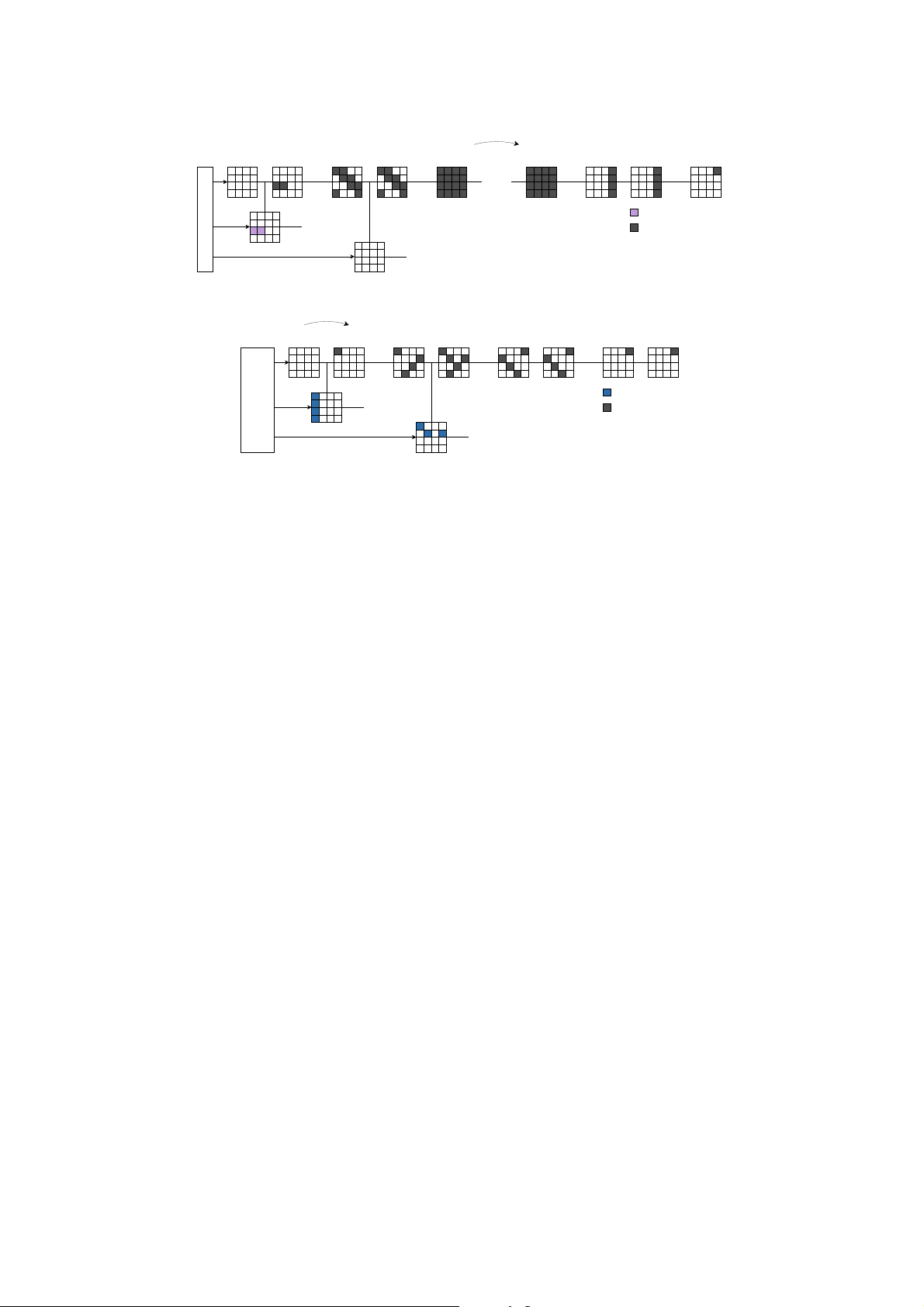
S
j
AK
MC
SR
biclique
$10
AK
MC
SR
SB
$9
SB
AK
AK
...
MC
SR
AK
SB
∆
recomputed
#7#8#9#10#17#18#19#20#21
←−
MC
K
j
v
SR
SB
Fig. 11. Recomputation in the backward direction: AES-256
P
i
AK
oracle &
biclique
decryption
$1
#2#1
MC
SR
SB
#3
AK
$2
SR
SB
AK
MC
MC
SR
SB
#7#6#5#4
AK
K
∇
i
recomputed
−→
v
Fig. 12. Recomputation the forward direction: AES-256
in Figure 12. The whitening subkeys differ in 1 byte only. Note that the difference in the
relevant subkeys is a linear function of i and j, respectively, and hence can be precomputed
and stored.
8.4 Complexities
Again, we aim to count the non-linear operations as both a larger summand and the bottleneck of most implementations. Altogether, we need an equivalent of 5.4375 SubBytes
operations compared to the equivalent of 17.25 in the full cipher (there are 6.5 key schedule rounds). As a result, C
recomp
is equivalent to 216· 5.625/17.25 = 2
14.383
runs of th e full
AES-256. The full computational complexity amounts to about
240
2
·29+ 2
14.383
= 2
254.42
.
The memory requirement is upper bounded by the storage of 28full computations of g. S ince
the coverage of the key space by groups arou nd base keys is full, the success probability is 1.
This approach for 9-round AES-256 yields a key recovery with computational complex-
ity about 2
251.92
, data complexity 2
120
, memory complexity 28, and success probability 1.
Similarly, preimage search for the compression function of the full AES-256 in Davies-Meyer
mode requires about 2
126.35
computations, 28memory, and works with success probability
0.6321.
9 Long Bicliques: Key Recovery for 8-Round AES-128
We view the sequence SB ◦ AK ◦ M C ◦ SR ◦ SB as a layer of four p arallel 32-bit super
boxes [16], each parameterized with the corresponding column of the subkey. We decided to
include SR to the Super Box for more clarity.
9.1 Attack
Following the long biclique paradigm, we construct a biclique for the maximum number
of rounds – 5. We have to set dimension to 1 and use heavily dependent differential trails
(Section 3.2).
Page 20

Step 1. A biclique of dimension 1 involves two states, two ciphertexts, and a group of four
keys, which is defined as follows:
The keys in the group are defined via the differences in subkeys $4 and $6:, i.e. like in a
related-subkey boomerang attack:
K[0, 1] : $4(K [0, 1]) ⊕ $4(K[0, 0]) = ∆K;
K[1, 0] : $6(K [1, 0]) ⊕ $6(K[0, 0]) = ∇K;
K[1, 1] : $4(K [1, 1]) ⊕ $4(K[0, 1]) = ∆K.
The differences ∆K and ∇K are defined columnwise:
∆K = (A, 0, 0, 0); ∇K = (B, 0, B, 0),
where
Let us note that ∇K in round 8 (∇$8) is equal to (B,
A =
0
∗
= MixColumns
∗
∗
0
0
∗
∗
; B =
0, 0, 0).
1
0
.
0
0
Instead of fixing the full keys in the group, we fix only three key bytes in the last column
of $5 so that we know the key difference in the ∆-trail in roun d 6.
We split the 8-round AES-128 as follows:
– E1is round 1.
– E2is rounds 2-3.
– E3is rounds 4-8.
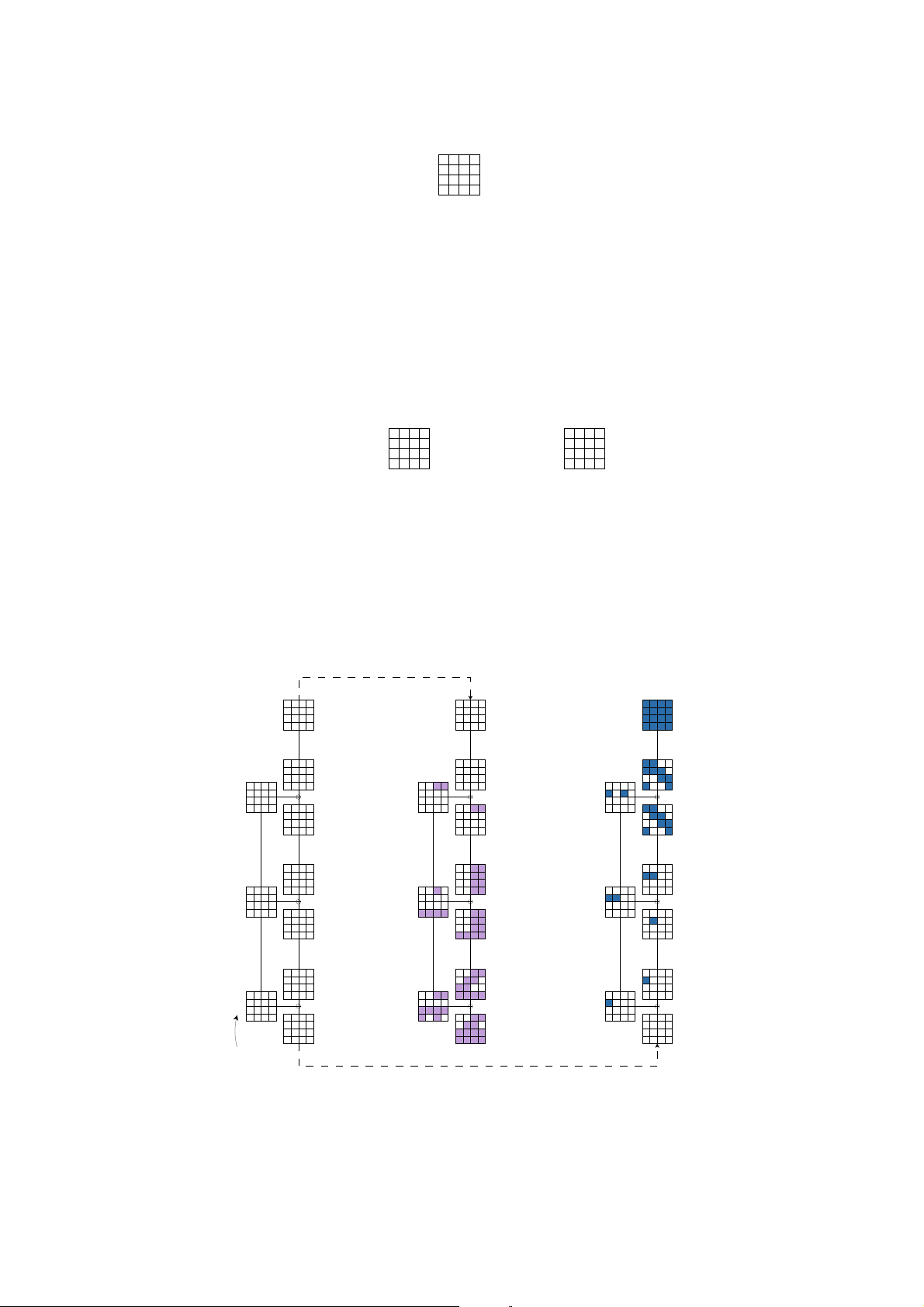
Step 2. An illustration of the biclique construction in steps 2(a) - 2(e) is given in Fig. 13.
Step 2 (a). The intermediate state in E3is the Super-Box layer in rounds 6-7. We construct
truncated differential trails in rounds 5 based on the injection of ∆K after round 4 (Fig. 13,
left), and in rounds 7-8 based on the injection of ∇($8) after round 8 (Fig. 13, right). Given
the keys in the group, we know the key differences in trails.
Step 2 (b). We guess the actual differences in the truncated trails. We have three active
S-boxes in round 5 and one active S-boxes in round 8. In total we make 2
7·4·2
= 256guesses.
Step 2 (c). First, for Super-boxes in columns 0 and 1 we construct all possible solutions that
conform to the input and ou tput differences. We note that the $6 bytes not ad jacent to active
S-boxes in the ∇-trail in round 7 do not affect the ∇-trail, and thus can be left undefined.
Therefore, we construct 2
64−32
= 232solutions. Similarly, we construct all possible solutions
for Super-boxes in columns 2 and 3. We get only 224solutions since we have restricted three
bytes of $5.
Page 21
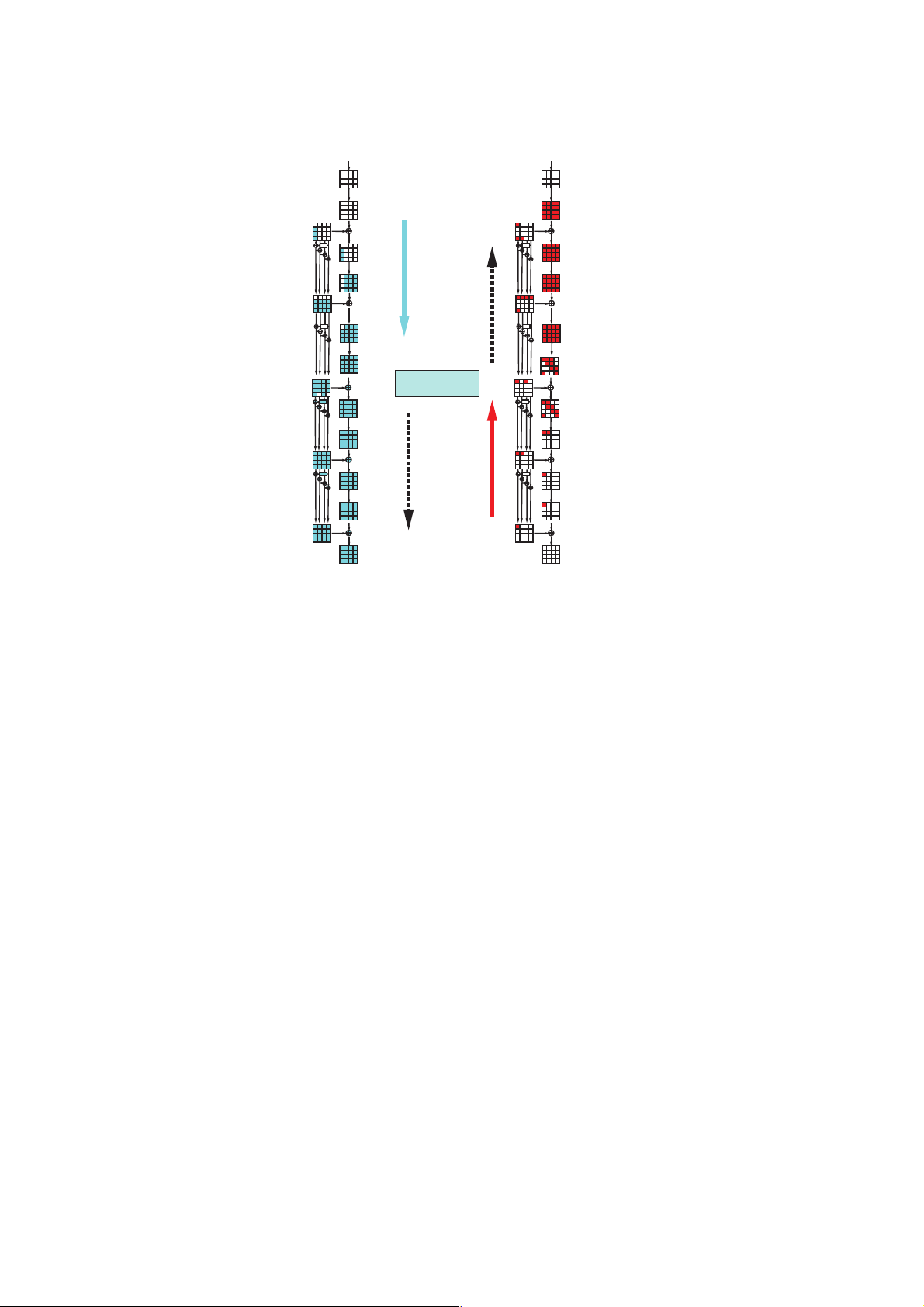
KS
ShiftRows
MixColumns
KS
ShiftRows
MixColumns
ShiftRows
MixColumns
KS
ShiftRows
MixColumns
KS
ShiftRows
SubBytes
SubBytes
SubBytes
SubBytes
KS
ShiftRows
MixColumns
KS
ShiftRows
MixColumns
ShiftRows
MixColumns
KS
ShiftRows
MixColumns
KS
ShiftRows
SubBytes
SubBytes
SubBytes
SubBytes
∇K
8
Guess
Guess
ResolveT :
4
8
7
5
6
Round
∆K
Fig. 13. Biclique construction in AES-128.
Step 2 (d). Outbound phase: we combine the solutions for pairs of Super-boxes and filter
out those that are incompatible with the S-box behavior guessed in rounds 6 and 8. In round 8
we have a full 14-bit filter, and in round 6 we have only a portion of filter via the differences in
the extended ∇-trails. For the latter, the filter is 6 bit per active S-box, with the remaining 8bit filter to be fulfilled by adjusting the key. Therefore, we have 2
32+24−14−6·3
= 224solutions.
In those solutions we have fixed 64 bits of $6 and 24 bits of $5, which gives 80 bits in total due
to dependencies. Finally, we additionally fix 24 key bits to sustain the difference propagation
in round 6. Taking the guess of differences into account, we have constructed 280bicliques
with 104 key bits fixed. The r emaining 126 −104 = 22 key bits that define the key group can
be chosen arbitrarily, so we amortize the construction of a biclique. As a result, we construct
102
2
bicliques for each value of the three bytes of $5 we have fixed in advance.
2
. We compute v in both directions and check for the match
2,3
Step 2 (e). We do not restrict the ciphertexts.
Step 3-5. We ask for the decryption of two ciphertexts and get two plaintexts. The matching
position (v) is the state S
(Figure 14).
Step 6. We construct 222bicliques out of one by choosing 22 bits of the key (defined in Step
2 (d)) so that difference propagation in the guessed parts remains untouched. The simplest
change that does not affect the trails is the flip in two bytes of K6not adjacent to the active
S-boxes and simultaneously in four bytes of K5so that three active S-boxes in round 5 are
stable.
Page 22
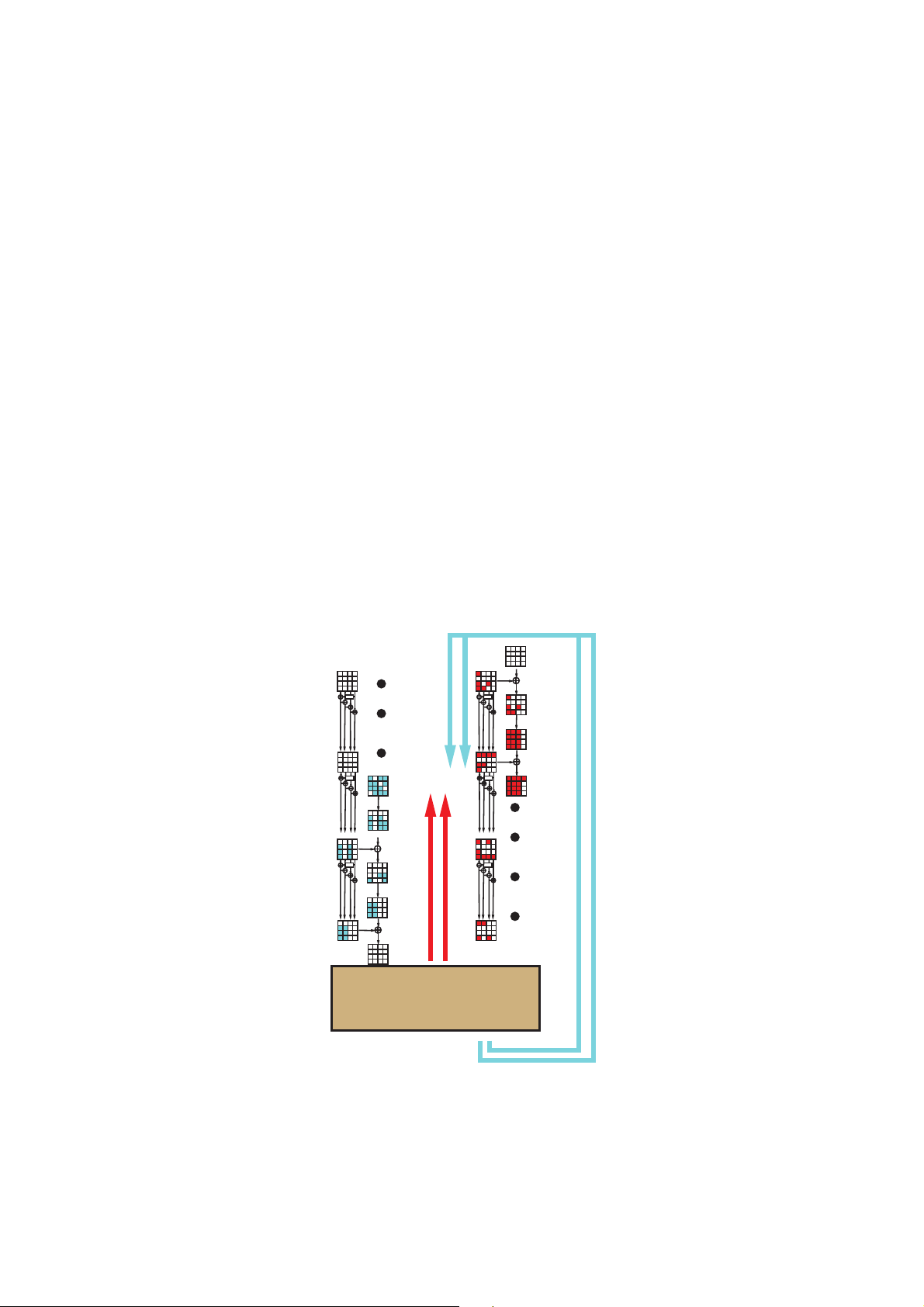
9.2 Complexity
KS
KS
ShiftRows
MixColumns
KS
SubBytes
SubBytes
KS
ShiftRows
MixColumns
KS
KS
ShiftRows
MixColumns
SubBytes
SubBytes
Match
S
SB−2
Biclique
1
2
3
4
Solutions for the Super-boxes are constructed online by substituting 232input pairs to the
super-box transformation and filtering out incorrect quartets. This gives the time complexity
232and the memory complexity 216. Therefore, Step 2 (c) has complexity 232. It also dominates the complexity of other steps, so we construct 280bicliques with 104 fixed key bits
in 2
56+32
= 288, and 2
102
bicliques in 288plus the time required to construct a new biclique
(Step 6). Again, in th e complexity evaluation we count the number of recomputed S-boxes.
Step 6 requires 3/8 SubBytes operations in round 5, 1 in round 4, 1/8 in round 7, 1/2 in
round 8 per biclique ciphertext, hence 4 SubBytes operations per biclique. In the matching
phase we compute 9 S-boxes in rounds 1-3, i.e. 1.125 S ubBytes operations per biclique. Additionally, Step 6 requires four S-boxes in the key schedule to recalculate, of which only two
are relevant for the matching. Recall that AES-128 has 40 S-boxes in the key schedule, or
equivalent of 2.5 SubBytes operations.
The chance of getting a false positive is 4 · 2−8= 2−6per biclique. Most of false positives
require on ly round 2 to recompute, which gives 2−9AES calls overhead on aver age, which
is negligible compared to the matching phase. Therefore, the total complexity of the attack
with 2
126
bicliques is about
126
2
4/10.5 + 2−9+ 1.125/10.5= 2
124.97
.
with 232memory and 2
127
data.
Fig. 14. Matching in the 8-round attack on AES-128.
Page 23

9.3 Success rate
Our attack always outputs the right key as soon as it belongs to one of the quartets produced
in the attack. As the key bits are adaptively chosen in the attack, the algorithm does not
guarantee that the quartets are pairwise different. On the other hand, each quartet has
equal chance to be produced. Therefore, we estimate that the algorithm generates a natural
proportion of (1−1/e) = 63% quartets. If we keep track of quartets in the loop after the guess
of three bytes of K5, then the memory complexity grows to 2
of 63% the second variant of the attack produces 2
126.33
2
chosen ciphertexts. The workload/success rate ratio is thus 2
125.33
102
. For a success pr ob ab ility
bicliques in 2
124.97
124.3
time, and needs
.
10 Long Bicliques: 9-Round AES-256
Our attack is differential-based biclique attack (Section 3.2).
Step 1. A biclique of dimension 1 involves two states, two ciphertexts, and a group of four
keys. The keys in the group are defined via the difference in subkeys:
K[0, 1] : $5(K [0, 1]) ⊕ $5(K[0, 0]) = ∆K;
K[1, 0] : $6(K [1, 0]) ⊕ $6(K[0, 0]) = ∇K;
K[1, 1] : $6(K [1, 1]) ⊕ $6(K[0, 1]) = ∇K.
The differences ∆K and ∇K are defined columnwise:
∆K = (A, 0, 0, 0); ∇K = (B, B, 0, 0),
where
A = MixColumns
0
0
2
0
; B =
0
2
= MixColumns
b9
2
Let us note that the key relation in the next expanded key is still linear:
$4(K [1, 0]) ⊕ $4(K[0, 0]) = $4(K[1, 1]) ⊕ $4(K[0, 1]) = (B,
Evidently, the groups do not intersect and cover the full key space.
We split the 9-round AES-256 as follows:
– E1is round 1.
– E2is rounds 2-4.
– E3is rounds 5-9.
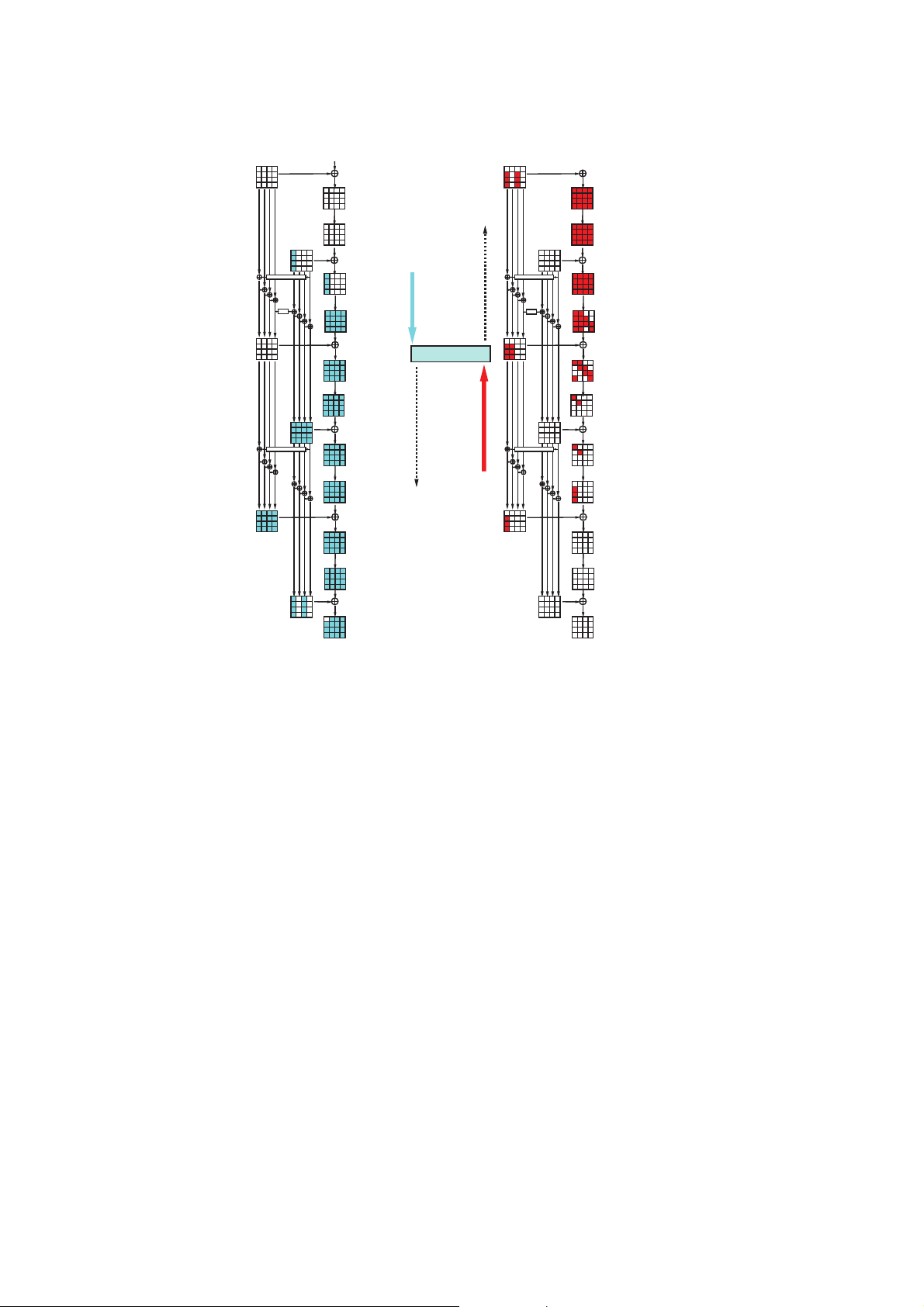
Step 2. An illustration of steps 2(a) - 2(e) is given in Fig. 15.
∗
∗
.
0
0
0, 0, 0).
Step 2 (a). The intermediate state T in E3is the S-box layer in round 7. We construct tru n-
cated differential trails in rounds 5-6 based on the injection of ∆K after round 5 (Figure 15,
left), and in rounds 7-9 based on the injection of ∇K before round 9 (Figure 15, right).
Page 24
SubBytes
ShiftRows
MixColumns
SubBytes
ShiftRows
MixColumns
ShiftRows
MixColumns
ShiftRows
MixColumns
7
8
9
SubBytes
ShiftRows
5
6
SubBytes
SubBytes
KS
KS
SubBytes
ShiftRows
MixColumns
SubBytes
ShiftRows
MixColumns
ShiftRows
MixColumns
ShiftRows
MixColumns
SubBytes
ShiftRows
SubBytes
SubBytes
KS
KS
SB
SB
Resolve
Guess
difference
Guess
difference
K
4
K
5
K
6
K
7
K
8
K
9
T :
Round
Fig. 15. Biclique construction in AES-256. ∆-trail (left) and ∇-trail (right).
Step 2 (b). We guess the differences in the truncated trails up to T . We have four active
S-boxes in round 6 and two active S-boxes in round 8. We also require ∆-trails be equal. In
total we make 2
7·(4+2·2)
= 256guesses.
Step 2 (c). For each S-box in round 7 that is active in both trails (eight in total) we take
a quartet of values that conform to the input and output differences, being essentially the
boomerang quartet for the S-box (one solution per S-box on average). For the remaining 8
S-boxes we take all possible values. Therefore, we have 264solutions for each guess in the
inbound phase, or 2
Step 2 (d). Outbound phase: we filter out the solutions that do not conform to the differential trails in rounds 6 and 8. We have four active S-boxes in each ∆-trail, and two active
120
solutions in total.
S-boxes in each ∇-trail, hence 12 in total. Therefore, we get a 84-bit filter, and leave with
236bicliques.
Step 2 (e). Now we keep only the bicliques with byte C
equal to zero in both ciphertexts.
0,0
This is a 16-bit filter, which reduces the number of bicliques to 220. We need only one.
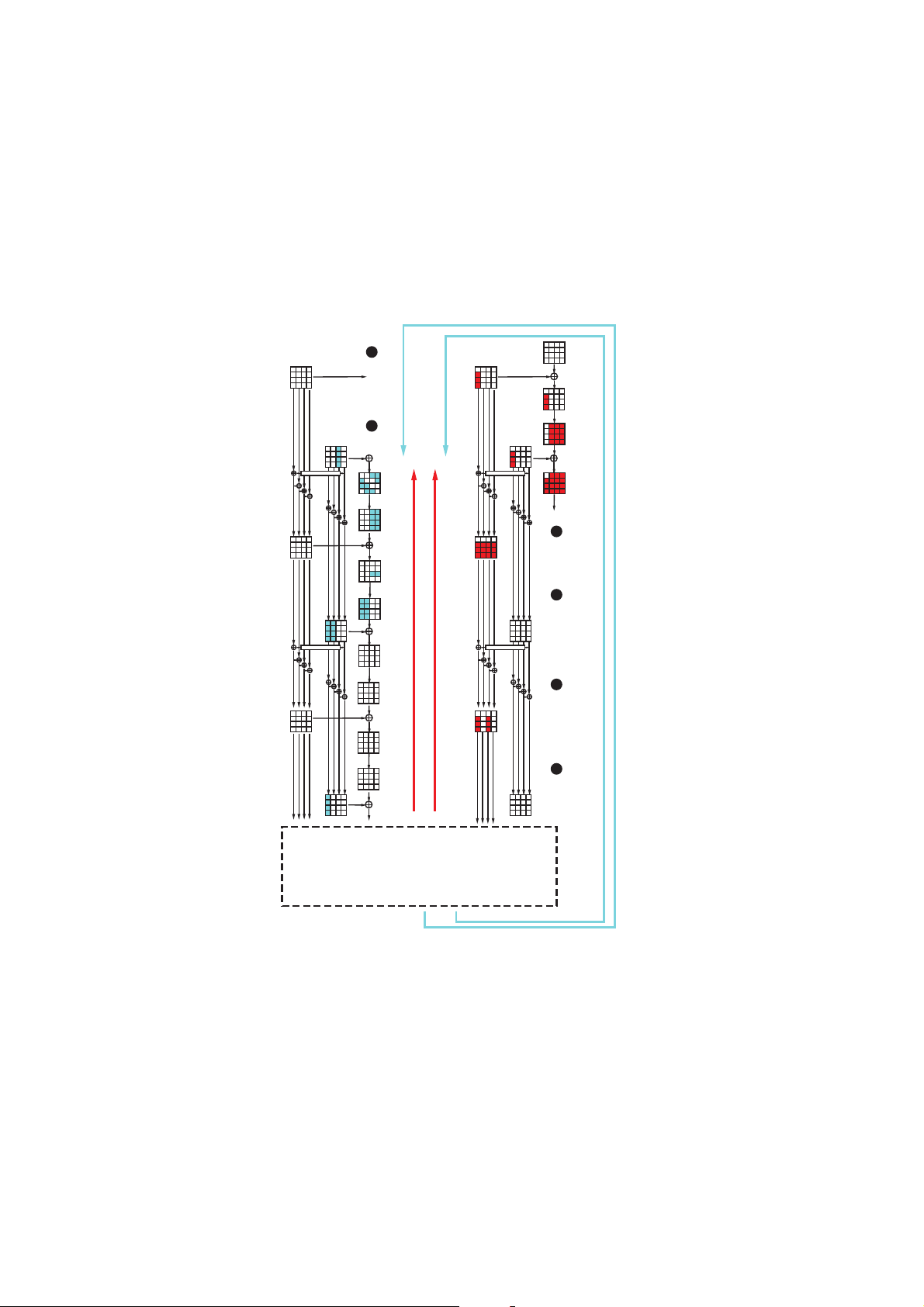
Step 3-5. We ask for the decryption of two ciphertexts and get two plaintexts. The matching
position (v) is the byte #3
. As demonstrated in Fig. 16, it is equal as a function of the
0,0
Page 25

plaintext for keys with difference ∆K (not affected by lightblue cells), and is also equal as a
function of S for keys with difference ∇K (not affected by red cells). We compute v in both
directions and check for the match.
Step 6. We can produce sufficiently many bicliques out of one to amortize the construction
cost. Let us lo ok at the subkey $6 in the outbound phase. We can change its value to any of
the 296specific values so that the active S-boxes in round 6 during the outbound phase are
not affected. On the other hand, any change in bytes in rows 1,2,3 affects only those rows in
the subkeys $8 and $9 and hence does not affect C
. Therefore, we have 128 − 32 − 32 = 64
0,0
neutral bits in $6.
Similarly, we identify 9 bytes in $7 that can be changed so that $6, the active S-boxes in
round 8, and the byte C
are unaffected. Those are bytes in the first three columns not on
0,0
the main diagonal. Therefore, we have 72 neutral bits in $7, and 136 neutral bits in total.
Complexity. A single biclique with the C
100
2
and 28memory for table lookups at Step 2 (c). However, 136 neutral bits in the key
= 0 is constructed with complexity 2
0,0
120−20
=
reduce the amortized construction cost significantly. Let us compute the cost of constructing
a new biclique according to Step 6. A change in a single byte in K7needs 5 S-boxes, 1 MixColumn and several XORs recomputing for each ciphertext, which gives us the complexity
of 10/16 AES rounds. This change also affects two bytes of K5, so we have to recompute
one half of round 5, with the resulting complexity of 1 AES round per biclique. The total
amortized complexity is 1.625 AES rounds.
In the matching part we compute a single byte in two directions, thus spending 9/16 of
a round in rounds 1-3, and full round 4, i.e. 3.125 full rounds per biclique. In total we need
4.75 AES rounds per biclique, i.e. 2
by false positives is at most 2−6rounds per biclique. We need 2
complexity is 2
The data complexity is 2
253.1
.
120
−0.92
9-round AES-256 calls. The complexity generated
254
bicliques, so the total
since one ciphertext byte is always fixed. The success rate of
the attack is 1, since we can generate many bicliques for each key group.
11 On practical verification
Especially for the type of cryptanalysis described in this paper were carring out an attack in
full is computationally infeasible, practical verification of attack details and steps is important
in order to confidence in it. To address this, we explicitly state the following:
– We verified all truncated differentials through 8-round and 10-round AES-128 key-schedules,
and through 9-round AES-256 key-schedule.
– We implemented the technically most complex part of one of our attacks: the long-biclique
construction (for the AES-256 attack). We verified the complexity estimate, and also give
an example of a biclique in Table 7 in the Appendix.
– We checked the distribution of super-box output differen ces. We checked that it is random
enough where we require ran domness, though some non-random behavior was detected
and might be important for constructing bicliques of high dimension over super-boxes.
Note that we avoid doing this in the independent-biclique approach.
– We verified that some difference guesses must be equ al like in the AES-256 attack due
to the branch number of MixColumns that results in the correlation of differences in the
outbound phase.
Page 26
SubBytes
ShiftRows
MixColumns
ShiftRows
0
1
SubBytes
KS
KS
SubBytes
ShiftRows
MixColumns
SubBytes
ShiftRows
MixColumns
5
4
3
1
ShiftRows
MixColumns
ShiftRows
MixColumns
0
1
2
SubBytes
SubBytes
SubBytes
KS
KS
Biclique
Fig. 16. Matching in AES-256. Byte S
after round 1 can be computed in each direction.
0,0
Page 27

12 Discussion and Conclusions
We propose the concept of bicliques for block cipher cryptanalysis and give various application to AES, including a key recovery method for the full versions of AES-128, AES-192, and
AES-256. For the latter, we allow a small portion of the cipher to be recomputed in every
key test. The use of bicliques in combination with the technique of matching with precomputation, results in a surprisingly low recomputation in the innermost loop, varying from
about 1/3 to approximately 1/5 of the cipher depending on the key size, while having data
complexities of 288, 280and 240plaintext-ciphertext pairs, respectively. Arguably no known
generic ap proach to key recovery allows for that gain. We notice that the data complexity of
key recovery can be significantly reduced by sacrificing only a small factor of computational
advantage.
To conclude, we discuss the properties of AES that allowed us to cover more rounds than
in previous cryptanalysis, discuss the attained computational advantage, and list a number
of problems to consider for future work.
12.1 What properties of the AES allowed to obtain these new results
Our approach heavily relies on the existence of high-probability related-key d ifferentials over
a part of the cipher. More specifically:
– The round transformation of AES is not designed to have strong resistance against several
classes of attacks for a smaller number of rounds. The fact that our approach allows to
split up the cipher into three parts exposes these properties even when consider ing the full
cipher. Also, as already observed in [19,37], the fact that the MixColumn tr an sformation
is omitted in the last round of AES helps to design attacks for more rounds.
– In the key schedule, we especially take advantage of the relatively slow backwards diffu-
sion. Whereas using key-schedule properties in related-key attacks is natural, there seem
only a few examples in the literature w here this is used in the arguably more relevant
single-key setting. This includes the attack on the self-synchronized stream cipher Mous-
tique [28], the lightweight block cipher KTANTAN [12], and recent improvements upon
attacks on 8-round s of AES-192 and AES-256 [20].
12.2 On the computational advantage of the biclique techniques
Most computational complexities in this paper are relatively close to those of generic attacks.
In here we discuss why we think the complexity advantage is meaningful.
– The attacks with independent bicliques – which lead to the key recovery for the full AES
– allow us to be very precise about the required computations. In all cases we arrive at
a computational complexity that is considerably lower than generic attacks.
– For the attacks with long bicliques, whenever it is difficult to be precise about certain
parts of our estimates, we choose to be conservative, potentially resulting in an under-
estimate of the claimed improvement. Again, in all cases we arrive at a computational
complexity that is considerably lower than generic attacks.
– Improved AES implementations (that may e.g. be used to speed-up brute force key
search) will very likely also improve the biclique techniques we propose.
– To the best of our knowledge, there are no generic methods known that would speed-up
key-recovery attacks given a part of the codebook.
Page 28

12.3 Open Problems
There are a number of other settings this approach may be applied to. It will be interesting
to study other block ciphers like the AES finalists or more recent proposals with respect
to this class of attacks. Also, we may decide to drop the requirement of the biclique to be
complete, i.e. instead of a complete bipartite graph consider a more general graph. There
may be cases where different tradeoffs between success probability, complexity requirements,
and even number of rounds are obtainable. Alternatively, this paper may inspire work on
more generic attacks on block ciphers th at tr y to take advantage of the fact that a small
part of the codebook, or some memory, is available.
Acknolwedgements
We thank Joan Daemen and Vincent Rijmen for their h elpful feedback. Part of this work was
done while Andrey Bogdanov was visiting MSR Redmond and while Christian Rechberger
was with K.U.Leuven and visiting MSR Redmond. This work was supported in part by the
European Commission under contract ICT-2007-216646 (ECRYPT II).
References
1. Kazumaro Aoki and Yu Sasaki. Preimage attacks on one-block MD4, 63-step MD5 and more. In Selected
Areas in Cryptography’08, volume 5381 of Lecture Notes in Computer Science, pages 103–119. Springer,
2008.
2. Kazumaro Aoki and Yu Sasaki. Meet-in-the-middle preimage attacks against reduced SHA-0 and SHA-1.
In CRYPTO’09, volume 5677 of Lecture Notes in Computer Science, pages 70–89. Springer, 2009.
3. Behran Bahrak and Mohammad Reza Aref. A novel impossible differential cryptanalysis of AES. In
Proceedings of the Western European Workshop on Research in Cryptology 2007 (WEWoRC’07), pages
152–156, 2007.
4. Behran Bahrak and Mohammad Reza Aref. Impossible differential attack on seven-round aes-128. IET
Inf. Secur., 2(2):28–32, June 2008.
5. Eli Biham, Alex Biryukov, and Adi Shamir. Miss in the middle attacks on IDEA and Khufu. In FSE’99,
volume 1636 of Lecture Notes in Computer Science, pages 124–138. Springer, 1999.
6. Eli Biham, Rafi Chen, Antoine Joux, Patrick Carribault, Christophe Lemuet, and William Jalby. Collisions of SHA-0 and reduced SHA-1. In EUROCRYPT’05, volume 3494 of Lecture Notes in Computer
Science, pages 36–57. Springer, 2005.
7. Eli Biham and Adi Shamir. Differential Cryptanalysis of DES-like Cryptosystems. J. Cryptology, 4(1):3–
72, 1991.
8. Alex Biryukov, Orr Dunkelman, Nathan Keller, Dmitry Khovratovich, and Adi Shamir. Key recovery
attacks of practical complexity on AES-256 variants with up to 10 rounds. In EUROCRYPT’10, volume
6110 of Lecture Notes in Computer Science, pages 299–319. Springer, 2010.
9. Alex Biryukov and Dmitry Khovratovich. Related-Key Cryptanalysis of the Full AES-192 and AES-256.
In ASIACRYPT’09, volume 5912 of Lecture Notes in Computer Science, pages 1–18. Springer, 2009.
10. Alex Biryukov, Dmitry Khovratovich, and Ivica Nikoli´c. Distinguisher and related-key attack on the full
AES-256. In CRYPTO’09, volume 5677 of Lecture Notes in Computer Science, pages 231–249. Springer,
2009.
11. Alex Biryukov and Ivica Nikoli´c. Automatic Search for Related-Key Differential Characteristics in Byt eOriented Block Ciphers: Application to AES, Camellia, Khazad and Ot hers. In EUROCRYPT’10, volume
6110 of Lecture Notes in Computer Science, pages 322–344. Springer, 2010.
12. Andrey Bogdanov and Christian Rechberger. A 3-Subset Meet-in-the- Middle Attack: Cryptanalysis of the
Lightweight Block Cipher KTANTAN. In SAC’10, volume 6544 of Lecture Notes in Computer Science,
pages 229–240. Springer, 2010.
13. Florent Chabaud and Antoine Joux. Differential collisions in SHA-0. In CRYPTO’98, volume 1462 of
Lecture Notes in Computer Science, pages 56–71. Springer, 1998.
14. Joan Daemen, Lars R. Knudsen, and V incent Rijmen. The Block Cipher Square. In Eli Biham, editor,
FSE’97, volume 1267 of Lecture Notes in Computer Science, pages 149–165. Springer, 1997.
Page 29

15. Joan Daemen and Vincent Rijmen. The Design of Rijndael: AES - The Advanced Encryption Standard.
Springer, 2002.
16. Joan Daemen and Vincent Rijmen. Understanding two-round differentials in AES. In Roberto De
Prisco and Moti Yung, editors, SCN’06, volume 4116 of Lecture Notes in Computer Science, pages 78–94.
Springer, 2006.
17. H¨useyin Demirci and Ali Aydin Sel¸cuk. A meet-in-the-middle attack on 8-round AES. In FSE’08, volume
5086 of Lecture Notes in Computer Science, pages 116–126. Springer, 2008.
18. H¨useyin Demirci, Ihsan Taskin, Mustafa C¸ oban, and Adnan Baysal. Improved Meet-in-the-Middle Attacks on AES. In INDOCRYPT’09, volume 5922 of Lecture Notes in Computer Science, pages 144–156.
Springer, 2009.
19. Orr Dunkelman and Nathan Keller. The effects of the omission of last round’s MixColumns on AES. Inf.
Process. Lett., 110(8-9):304–308, 2010.
20. Orr Dunkelman, Nathan Keller, and Adi Shamir. Improved Single-Key Attacks on 8-Round AES-192
and AES-256. In ASIACRYPT’10, volume 6477 of Lecture Notes in Computer Science, pages 158–176.
Springer, 2010.
21. Orr Dunkelman, Nathan Keller, and Adi Shamir. A practical-time related-key attack on the KASUMI
cryptosystem used in GSM and 3G telephony. In CRYPTO’10, volume 6223 of Lecture Notes in Computer
Science, pages 393–410. Springer, 2010.
22. Orr Dunkelman, Gautham Sekar, and Bart Preneel. Improved meet-in-the-middle attacks on reducedround DES. In INDOCRYPT’07, volume 4859 of Lecture Notes in Computer Science, pages 86–100.
Springer, 2007.
23. Niels Ferguson, John Kelsey, Stefan Lucks, Bruce Schneier, Michael Stay, David Wagner, and Doug
Whiting. Improved cryptanalysis of Rijndael. In FSE’00, volume 1978 of Lecture Notes in Computer
Science, pages 213–230. Springer, 2000.
24. Henri Gilbert and Marine Minier. A Collision Attack on 7 Rounds of Rijndael. In AES Candidate
Conference, pages 230–241, 2000.
25. Henri Gilbert and Thomas Peyrin. Super-Sbox cryptanalysis: Improved attacks for AES-like permutations. In FSE’10, volume 6147 of Lecture Notes in Computer Science, pages 365–383. Springer, 2010.
26. Jian Guo, San Ling, Christian Rechberger, and Huaxiong Wang. Advanced Meet-in-the-Middle Preimage
Attacks: First R esults on Full Tiger, and Improved Results on MD4 and SHA-2. In ASIACRYPT’10,
volume 6477 of Lecture Notes in Computer Science, pages 56–75. Springer, 2010.
27. Takanori Isobe. A single-key attack on the full GOST block cipher. In FSE’11 Preproceedings, 2011.
28. Emilia K¨asper, Vincent Rijmen, Tor E. Bjørstad, Christian Rechberger, Matthew J. B. Robshaw, and
Gautham Sekar. Correlated Keystreams in Moustique. In AFRICACRYPT’08, volume 5023 of Lecture
Notes in Computer Science, pages 246–257. Springer, 2008.
29. Dmitry Khovratovich, Christian Rechberger, and Alexandra Savelieva. Bicliques for preimages: attacks
on Skein-512 and the SHA-2 family. available at http://eprint.iacr.org/2011/286.pdf, 2011.
30. Mario Lamberger, Florian Mendel, Christian Rechberger, Vincent Rijmen, and Martin Schl¨affer. Rebound
Distinguishers: Results on the Full Whirlpool Compression Function. In ASIACRYPT’09, volume 5912
of Lecture Notes in Computer Science, pages 126–143. Springer, 2009.
31. Jiqiang Lu, Orr Dunkelman, Nathan Keller, and Jongsung Kim. New impossible differential attacks on
AES. In INDOCRYPT’08, volume 5365 of Lecture Notes in Computer Science, pages 279–293. Springer,
2008.
32. Stefan Lucks. Attacking seven rounds of Rijndael under 192-bit and 256-bit keys. In AES Candidate
Conference, pages 215–229, 2000.
33. Hamid Mala, Mohammad Dakhilalian, Vincent Rijmen, and Mahmoud Modarres-Hashemi. Improved
Impossible Differential Cryptanalysis of 7-Round AES-128. In INDOCRYPT’10, volume 6498 of Lecture
Notes in Computer Science, pages 282–291. Springer, 2010.
34. Mitsuru Matsui. Linear cryptanalysis method for DES cipher. In EUROCRYPT’93, volume 765 of Lecture
Notes in Computer Science, pages 386–397. Springer, 1993.
35. Florian Mendel, Christian Rechberger, Martin Schl¨affer, and S øren S. Thomsen. The rebound attack:
Cryptanalysis of reduced Whirlpool and Grøstl. In FSE’09, volume 5665 of Lecture Notes in Computer
Science, pages 260–276. Springer, 2009.
36. Raphael Chung-Wei Phan. Impossible differential cryptanalysis of 7-round advanced encryption standard
(AES). Inf. Process. Lett., 91(1):33–38, 2004.
37. Yu Sasaki. Meet-in-the-Middle Preimage Attacks on AES Hashing Modes and an Application to
Whirlpool. In FSE’11 Preproceedings, 2011.
38. Yu Sasaki and Kazumaro Aoki. Finding Preimages in Full MD5 Faster Than Ex haustive Search. In
EUROCRYPT’09, volume 5479 of Lecture Notes in Computer Science, pages 134–152. Springer, 2009.
Page 30

39. Marc Stevens, Arjen K. Lenstra, and Benne de Weger. Chosen-prefi x collisions for MD5 and colliding
X.509 certifi cates for different identities. In EUROCRYPT’07, volume 4515 of Lecture Notes in Computer
Science, pages 1–22. Springer, 2007.
40. Marc Stevens, Alexander Sotirov, Jacob Appelbaum, Arjen K. Lenstra, David Molnar, Dag Arne Osvik,
and Benne de Weger. Short chosen-prefix collisions for MD5 and the creation of a rogue ca certificate.
In CRYPTO’09, volume 5677 of Lecture Notes in Computer Science, pages 55–69. Springer, 2009.
41. David Wagner. The boomerang attack. In FSE’99, volume 1636 of Lecture Notes in Computer Science,
pages 156–170. Springer, 1999.
42. Xiaoyun Wang, Yiqun Lisa Yin, and Hongbo Yu. Finding collisions in the full SHA-1. In CRYPTO’05,
volume 3621 of Lecture Notes in Computer Science, pages 17–36. Springer, 2005.
43. Xiaoyun Wang and Hongbo Yu. How to break MD5 and other hash functions. In EUROCRYPT’05,
volume 3494 of Lecture Notes in Computer Science, pages 19–35. Springer, 2005.
44. Lei Wei, Christian Rechberger, Jian Guo, Hongjun Wu, Huaxiong Wang, and San Ling. Improved
meet-in-the-middle cryptanalysis of KTANTAN. Cryptology ePrint Archive, Report 2011/201, 2011.
http://eprint.iacr.org/.
45. Wentao Zhang, Wenling Wu, and Dengguo Feng. New results on impossible differential cryptanalysis of
reduced AES. In ICISC’07, volume 4817 of Lecture Notes in Computer Science, pages 239–250. Springer,
2007.
Page 31
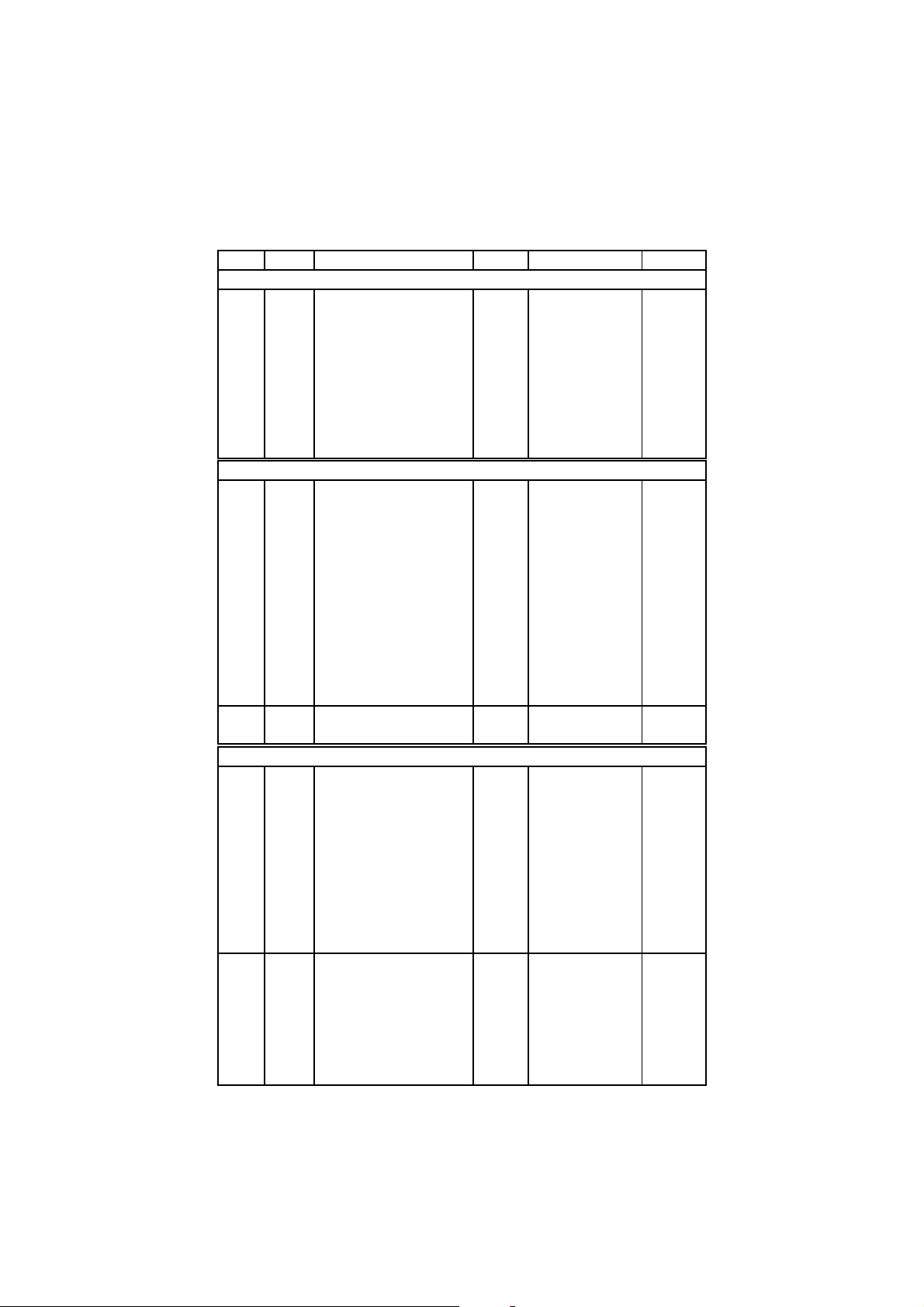
Table 6. Summary of previous results on AES in the single-key model
rounds data workload memory method reference
AES-128
7 2
7 2
7 2
7 2
7 2
7 2
7 2
7 2
7 2
127.997
32
117.5
115.5
115.5
112.2
80
106.2
103
113+2123
2
2
112
2
107.1
120
2
128−ǫ
2
123
2
119
2
119
2
117.2
+ 2
MA 2
precomp. 2
117.2
+ 2
116
2
MA 2
64
2
100
2
109
2
45
2
109
2
109
? impossible [31] 2008
122
94.2
116
2
Square [23], 2000
Square-functional [24], 2000
impossible [3], 2007
impossible [45], 2007
impossible [4], 2008
MitM [18], 2009
impossible [33], 2010
Square-multiset [20], 2010
AES-192
127.997
7 2
7 2
7 2
7 2
7 2
7 2
7 2
7 2
7 2
7 2
7 2
7 2
8 2
8 2
36
32
32
92
115.5
92
91.2
113.8
34+n274+n+2208−n
80
103
127.997
113
113+2123
2
120
2
155
2
182
2
140
2
186
2
119
2
162
2
139.2
2
118.8
2
MA 2
precomp. 2
precomp. 2
116
2
188
2
172
2
64
2
32
2
32
2
84
2
153
2
45
2
153
2
61
2
89.2
206−n
122
116
2
64
2
129
2
Square [23], 2000
Square [23], 2000
Square [32], 2000
Square-functional [24], 2000
Impossible [36], 2004
impossible [45], 2007
impossible [45], 2007
impossible [31] 2008
impossible [31] 2008
MitM [17], 2008
MitM [18], 2009
Square-multiset [20], 2010
Square [23], 2000
Square-multiset [20], 2010
AES-256
7 2
7 2
7 2
7 2
7 2
7 2
7 2
7 2
7 2
7 2
8 2
8 2
8 2
8 2
8 2
8 2
8 2
36
127.997
32
32
92.5
115.5
113.8
92
34+n274+n+2208−n
80
127.997
116.5
89.1
111.1
34+n2202+n+2208−n
80
113
113+2123
2
172
2
120
2
200
2
184
2
250.5
2
119
2
118.8
2
MA 2
163
2
MA 2
precomp. 2
precomp. 2
204
2
247.5
2
229.7
2
MA 2
227.8
2
MA 2
precomp. 2
241
2
196
2
32
2
64
2
32
2
140
2
153
2
45
2
89.2
61
206−n
122
1044
2
45
2
97
112.1
206−n
123
2
129
2
Square [23], 2000
Square [23], 2000
Square [32], 2000
Square-functional [24], 2000
Impossible [36], 2004
impossible [45], 2007
impossible [31] 2008
impossible [31] 2008
MitM [17], 2008
MitM [18], 2009
Square [23], 2000
impossible [45], 2007
impossible [31] 2008
impossible [31] 2008
MitM [17], 2008
MitM [18], 2009
Square-multiset [20], 2010
Page 32
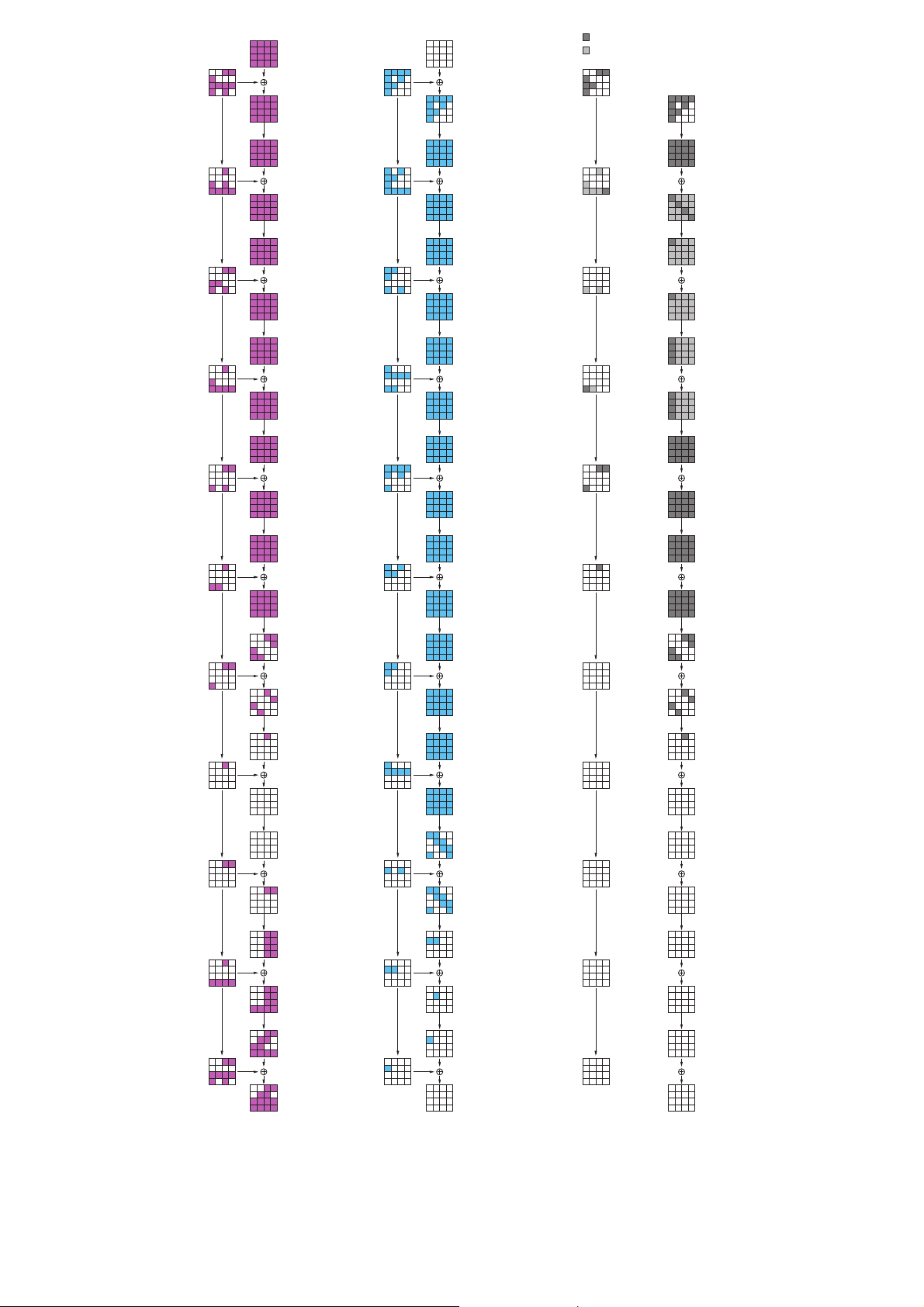
SB
SR
MC
KS
SB
SR
MC
KS
SB
SR
MC
KS
SB
SR
MC
KS
SB
SR
MC
KS
SB
SR
KS
SB
SR
MC
KS
SB
SR
MC
KS
SB
SR
MC
KS
SB
SR
MC
KS
#1
#2
#3
#4
#5
#6
#7
#8
#9
#10
#11
#12
#13
#14
#15
#16
#17
#18
#19
#20
SB
SR
MC
KS
SB
SR
MC
KS
SB
SR
MC
KS
SB
SR
MC
KS
SB
SR
MC
KS
SB
SR
KS
SB
SR
MC
KS
SB
SR
MC
KS
SB
SR
MC
KS
SB
SR
MC
KS
#1
#2
#3
#4
#5
#6
#7
#8
#9
#10
#11
#12
#13
#14
#15
#16
#17
#18
#19
#20
SB
SR
MC
KS
SB
SR
MC
KS
SB
SR
MC
KS
SB
SR
MC
KS
SB
SR
MC
KS
SB
SR
KS
SB
SR
MC
KS
SB
SR
MC
KS
SB
SR
MC
KS
SB
SR
MC
KS
#1
#2
#3
#4
#5
#6
#7
#8
#9
#10
#11
#12
#13
#14
#15
#16
#17
#18
#19
#20
$10
$9
$1
$0
$2
$8
$3
$4
Recomputation
in subkeys
Recomputation
in states
Influence
on backward matching
Influence
on forward matching
Biclique
∆-differential
Biclique
∇-differential
- full recomputation
- not needed for matching
$6
$5
$7
Fig. 17. Biclique differentials and matching in A ES-128. Recomputation parts are derived as follows: formally
overlap pink and blue schemes, then interleaving parts must be recomputed (darkgray cells). The lightgray
cells are those excluded from recomputation since we do not match on the full state.
Page 33
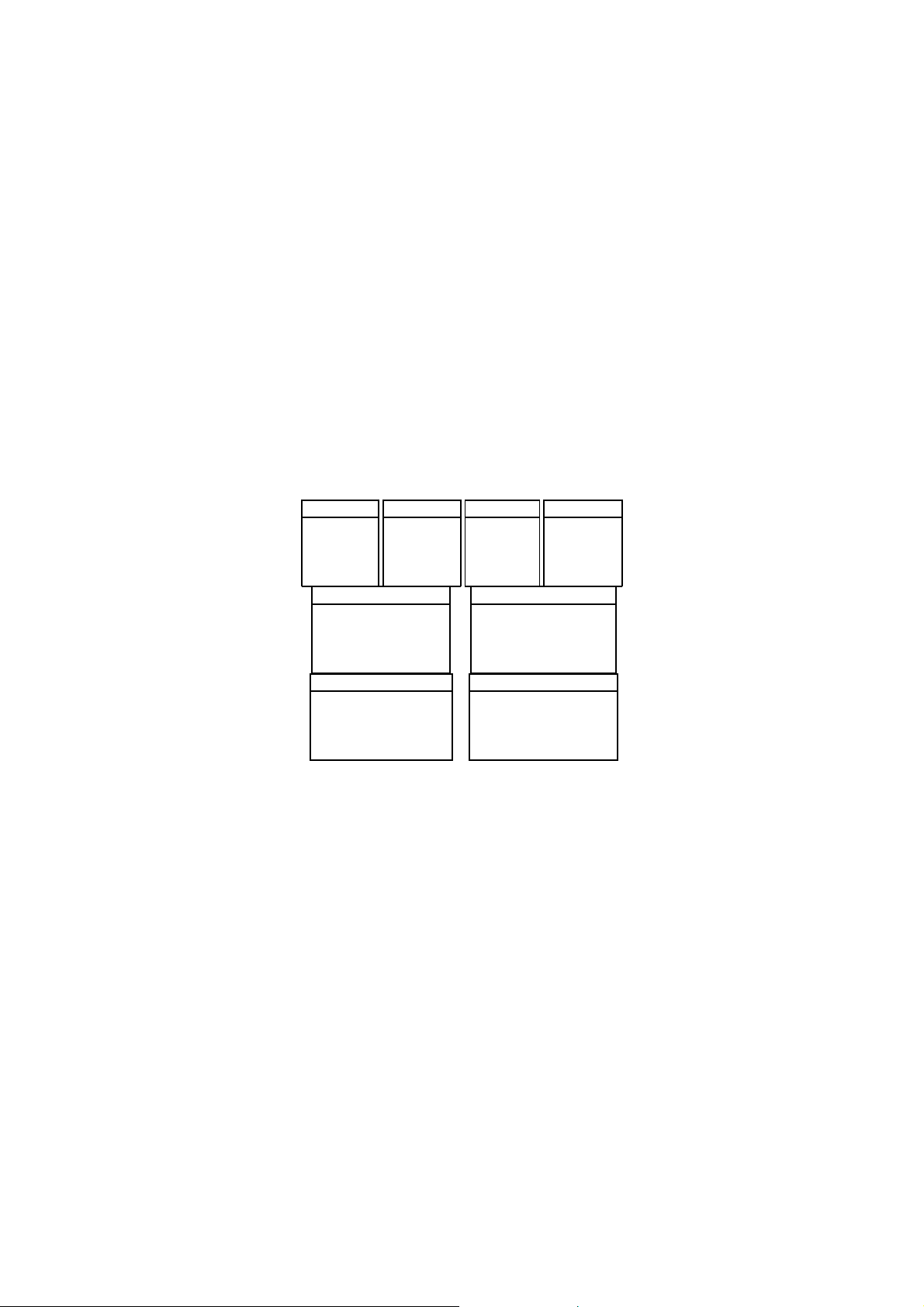
S
0
40 8a ba 52
30 4a 10 52
34 b6 84 52
b8 fe aa 52
K
7d 8a d8 a4 30 e8 0 0
12 a8 f9 31 5a 42 0 0
12 55 cd 0b 32 d6 0 0
58 66 d8 cf 54 f8 0 0
K
7d 8a d8 a4 30 e8 0 0
10 aa f9 31 5a 42 0 0
ab ec cd 0b 32 d6 0 0
5a 64 d8 cf 54 f8 0 0
S
44 d2 66 7b
32 34 6e f7
36 f4 b0 7a
b8 ba 71 3a
[3]
0,0
[3]
1,0
1
C
0
79 18 c0 8e
67 ac 89 9e
2e 39 52 84
3c fd 40 26
K
C
5d 08 b5 ac
e5 bd d3 54
a0 ac d9 8a
09 6a 55 1e
[3]
0,1
1
7d 8a d8 a4 34 ec 4 4
12 a8 f9 31 58 40 2 2
12 55 cd 0b 30 d4 2 2
58 66 d8 cf 52 fe 6 6
K
[3]
1,1
7d 8a d8 a4 34 ec 4 4
10 aa f9 31 58 40 2 2
ab ec cd 0b 30 d4 2 2
5a 64 d8 cf 52 fe 6 6
Table 7. Example of a biclique for A ES-256. Siare states after MixColumns in round 5, Ciare ciphertexts.
 Loading...