

Page 1
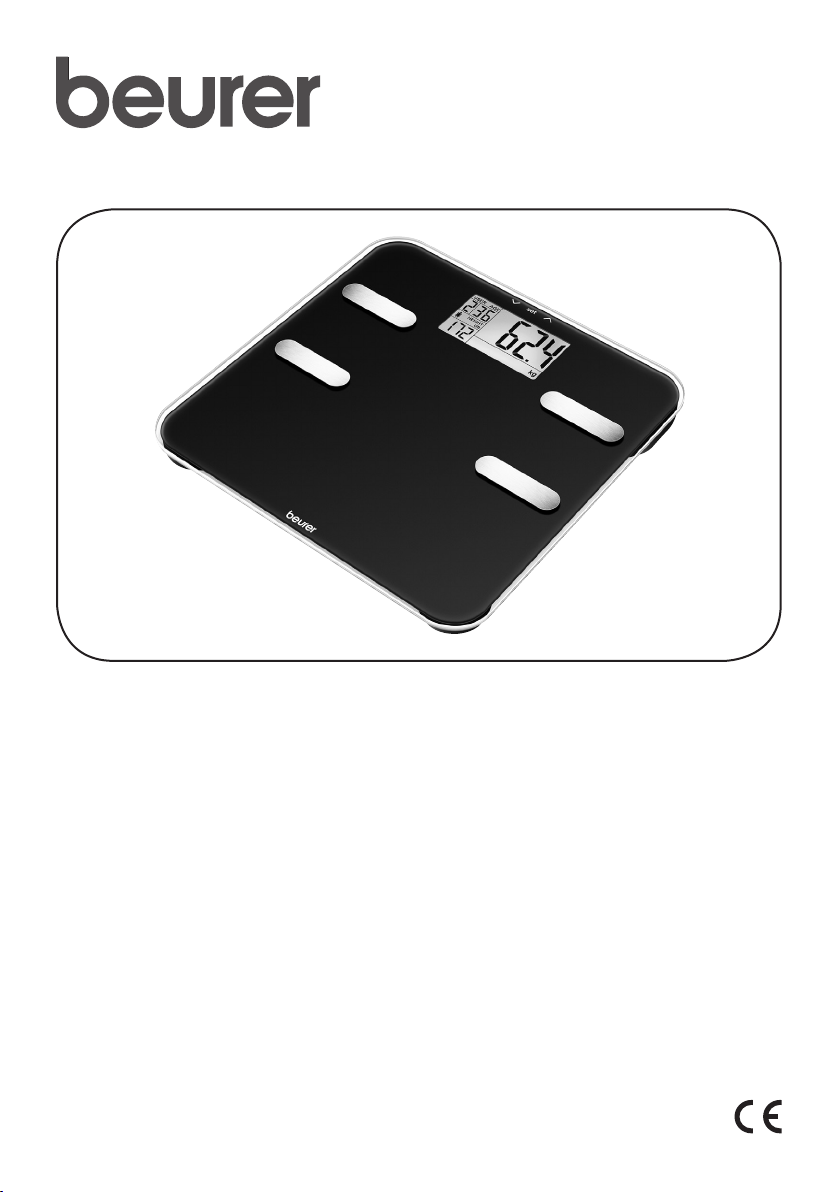
BF 185
D
Diagnosewaage
Gebrauchsanweisung.......................2
G
Diagnostic bathroom scale
Instruction for Use ..........................10
F
Pèse-personne impédancemètre
Mode d´emploi ................................17
E
Báscula de diagnóstico
Instrucciones para el uso ..............24
I
Bilancia diagnostica
Instruzioni per l´uso ........................31
T
Diyagnoz terazisi
Kullanma Talimatı ...........................45
r
Диагностические весы
Инструкция по применению .......38
Q
Waga diagnostyczna
Instrukcja obsługi ...........................53
Page 2
DEUTSCH
Inhalt
1. Gerätebeschreibung ........................................ 2
2. Hinweise ......................................................... 2
3. Informationen zur Diagnosewaage .................. 3
4. Batterien .......................................................... 4
5. Benutzung ........................................................ 4
5.1 Gewicht messen ........................................ 4
5.2 Benutzerdaten einstellen .......................... 4
5.3 Messung durchführen ................................ 5
6. Fehlmessung ................................................... 8
7. Entsorgung ...................................................... 8
8. Garantie ........................................................... 9
Sehr geehrte Kundin, sehr geehrter Kunde,
wir freuen uns, dass Sie sich für ein Produkt unseres Sortimentes entschieden haben. Unser Name steht
für hochwertige und eingehend geprüfte Qualitätsprodukte aus den Bereichen Wärme, Gewicht, Blut
druck, Körper temperatur, Puls, Sanfte Therapie, Massage und Luft.
Bitte lesen Sie diese Gebrauchsanleitung aufmerksam durch, bewahren Sie sie für späteren Gebrauch auf,
machen Sie sie anderen Benutzern zugänglich und beachten Sie die Hinweise.
Mit freundlicher Empfehlung
Ihr Beurer-Team
-
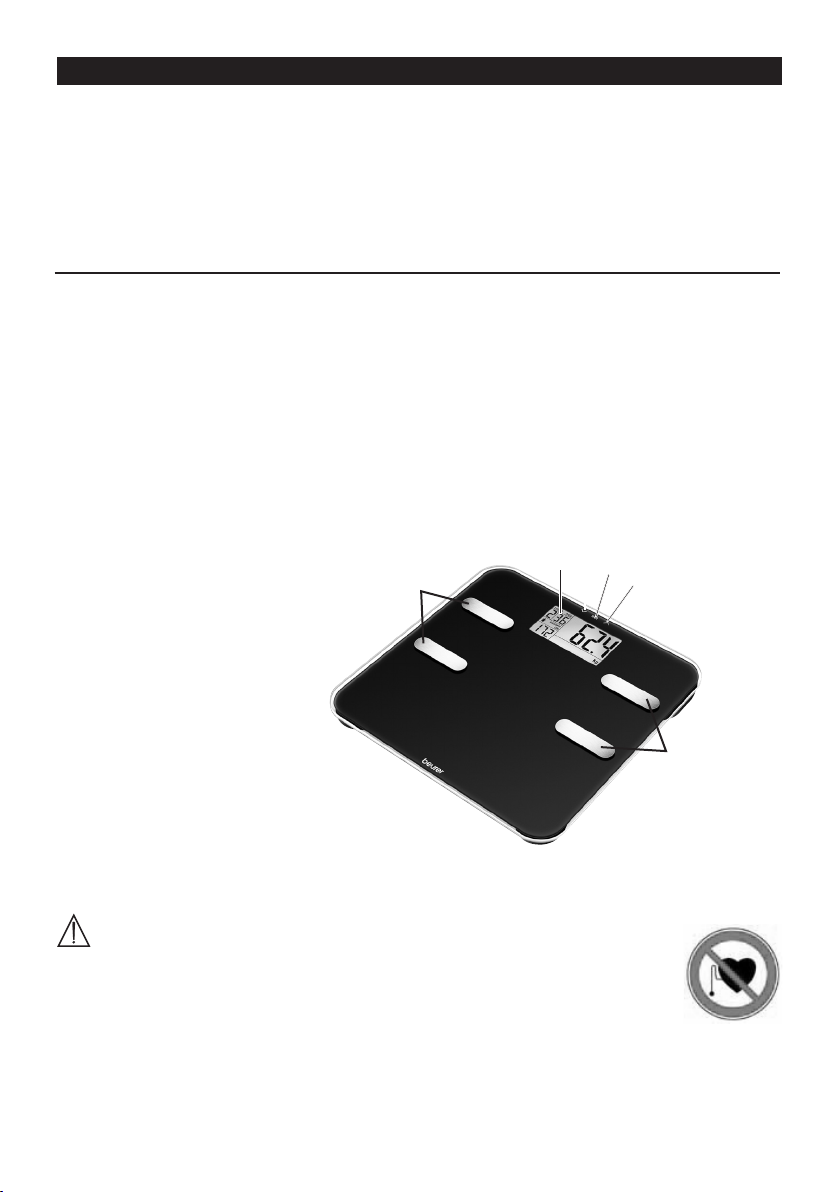
1. Gerätebeschreibung
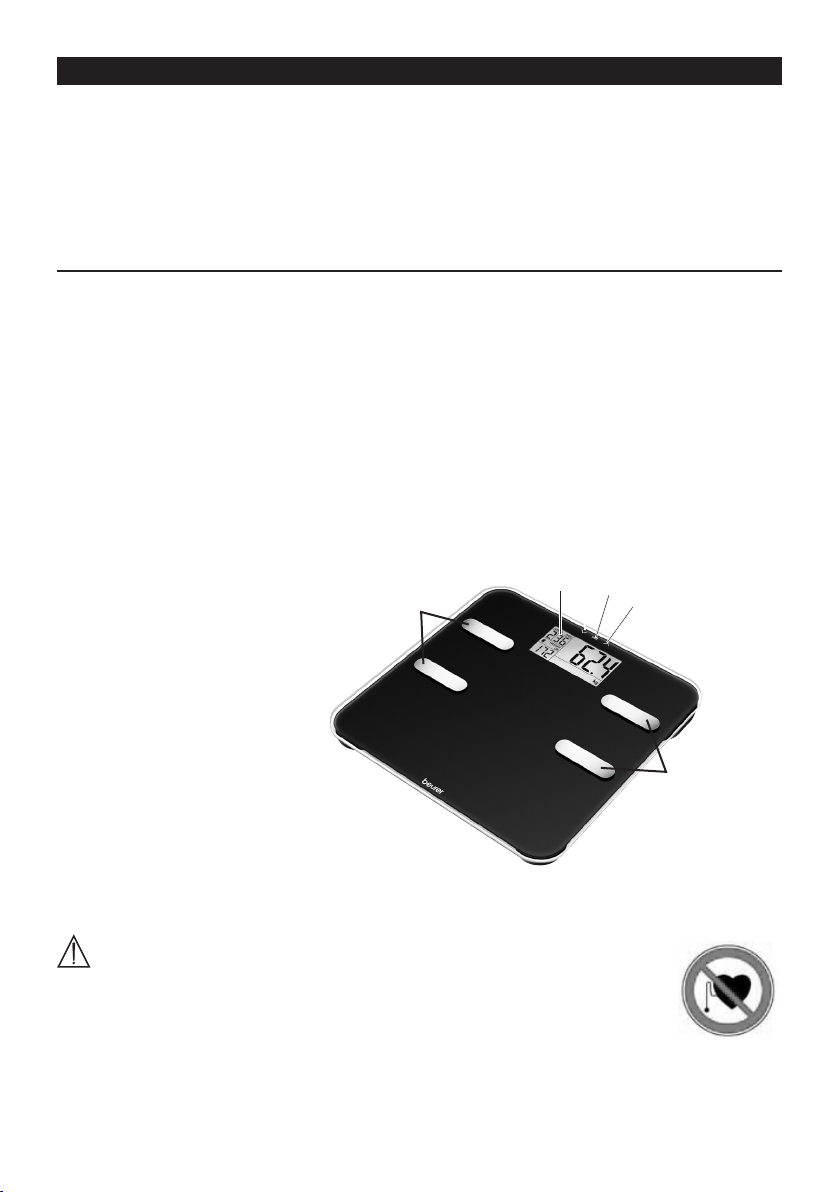
1. Display
2. Ab-Taste
3. SET-Taste
4. Auf-Taste
5. Elektroden
5
2
1
3
4
5
2. Hinweise
Sicherheitshinweise:
• Die Waage darf nicht von Personen mit medizinischen Implantaten (z.B. Herzschritt
macher) verwendet werden. Andernfalls kann deren Funktion beeinträchtigt sein.
• Nicht während der Schwangerschaft benutzen.
• Achtung, steigen Sie nicht mit nassen Füßen auf die Waage und betreten Sie die Waage
nicht, wenn die Oberfläche feucht ist – Rutschgefahr!
• Batterien können bei Verschlucken lebensgefährlich sein. Bewahren Sie Batterien und Waage für Klein
kinder unerreichbar auf. Wurde eine Batterie verschluckt, nehmen Sie sofort medizinische Hilfe in Anspruch.
-
-
2
Page 3
• Halten Sie Kinder vom Verpackungsmaterial fern (Erstickungsgefahr).
• Batterien dürfen nicht geladen oder mit anderen Mitteln reaktiviert, nicht auseinander genommen, in
Feuer geworfen oder kurzgeschlossen werden.
Hinweise zum Umgang mit Batterien
• Wenn Flüssigkeit aus einer Batteriezelle mit Haut oder Augen in Kontakt kommt, die betroffene Stelle mit
Wasser auswaschen und ärztliche Hilfe aufsuchen.
Verschluckungsgefahr! Kleinkinder könnten Batterien verschlucken und daran ersticken. Daher
•
Batterien für Kleinkinder unerreichbar aufbewahren!
• Auf Polaritätskennzeichen Plus (+) und Minus (-) achten.
• Wenn eine Batterie ausgelaufen ist, Schutzhandschuhe anziehen und das Batteriefach mit einem trocke
nen Tuch reinigen.
• Schützen Sie Batterien vor übermäßiger Wärme.
Explosionsgefahr! Keine Batterien ins Feuer werfen.
•
• Batterien dürfen nicht geladen oder kurzgeschlossen werden.
• Bei längerer Nichtbenutzung des Geräts die Batterien aus dem Batteriefach nehmen.
• Verwenden Sie nur denselben oder einen gleichwertigen Batterietyp.
• Immer alle Batterien gleichzeitig auswechseln.
• Keine Akkus verwenden!
• Keine Batterien zerlegen, öffnen oder zerkleinern.
Allgemeine Hinweise:
• Das Gerät ist nur zur Eigenanwendung, nicht für den medizinischen oder kommerziellen Gebrauch vor
gesehen.
• Beachten Sie, dass technisch bedingt Messtoleranzen möglich sind, da es sich um keine geeichte Waa
ge für den professionellen, medizinischen Gebrauch handelt.
• Die Belastbarkeit der Waage beträgt max 180 kg (396 lb, 28 St). Bei der Gewichtsmessung und bei der
Knochenmassebestimmung werden die Ergebnisse in 100 g-Schritten (0,2 lb, 1/4 St) angezeigt. Die
Messergebnisse des Körperfett-, Körperwasser- und Muskelanteils werden in 0,1%-Schritten angezeigt.
• Der Kalorienbedarf wird in Schritten von 1 kcal angegeben. Der BMI-Wert (Body-Mass-Index) wird in
0,1-Schritten angezeigt.
Im Auslieferungszustand ist die Waage auf die Einheiten „cm” und „kg” eingestellt. Auf der Rückseite
•
Waage befindet sich ein Schalter mit dem Sie auf „inch”, „Pfund” und „Stones” (lb, St) umstellen kön
nen.
• Stellen Sie die Waage auf einen ebenen festen Boden; ein fester Bodenbelag ist Voraussetzung für eine
korrekte Messung.
• Von Zeit zu Zeit sollte das Gerät mit einem feuchten Tuch gereinigt werden. Benutzen Sie keine scharfen
Reinigungsmittel, und halten Sie das Gerät niemals unter Wasser.
• Schützen Sie das Gerät vor Stößen, Feuchtigkeit, Staub, Chemikalien, starken Temperaturschwankun
gen und zu nahen Wärmequellen (Öfen, Heizungskörper).
Reparaturen dürfen nur vom Beurer Kundenservice oder autorisierten Händlern durchgeführt werden.
•
Prüfen Sie jedoch vor jeder Reklamation zuerst die Batterien und tauschen Sie diese gegebenenfalls aus.
-
-
-
der
-
-
3. Informationen zur Diagnosewaage
Das Messprinzip der Diagnosewaage
Diese Waage arbeitet mit dem Prinzip der B.I.A., der Bioelektrischen-Impedanz-Analyse. Dabei wird inner
halb von Sekunden durch einen nicht spürbaren, völlig unbedenklichen und ungefährlichen Strom eine Bestimmung von Körperanteilen ermöglicht. Mit dieser Messung des elektrischen Widerstandes (Impedanz)
und der Einberechnung von Konstanten bzw. individuellen Werten (Alter, Größe, Geschlecht, Aktivitäts
grad) kann der Körperfettanteil und weitere Größen im Körper bestimmt werden.
3
-
-
Page 4

Muskelgewebe und Wasser haben eine gute elektrische Leitfähigkeit und daher einen geringeren Widerstand.
Knochen und Fettgewebe hingegen haben eine geringe Leitfähigkeit, da die Fettzellen und Knochen durch
sehr hohen Widerstand den Strom kaum leiten.
Beachten Sie, dass die von der Diagnosewaage ermittelten Werte nur eine Annäherung an die medizi
nischen, realen Analysewerte des Körpers darstellen. Nur der Facharzt kann mit medizinischen Methoden
(z.B. Computertomografie) eine exakte Ermittlung von Körperfett, Körperwasser, Muskelanteil und Kno
chenbau durchführen.
Allgemeine Tipps
• Wiegen Sie sich möglichst zur selben Tageszeit (am besten morgens), nach dem Toilettengang, nüchtern
und ohne Bekleidung, um vergleichbare Ergebnisse zu erzielen.
• Wichtig bei der Messung: Die Ermittlung des Körperfettes darf nur barfuß und kann zweckmäßig mit
schwach befeuchteten Fußsohlen vorgenommen werden. Völlig trockene Fußsohlen können zu unbefrie
digenden Ergebnissen führen, da diese eine zu geringe Leitfähigkeit aufweisen.
• Stehen Sie während des Messvorgangs still.
• Warten Sie einige Stunden nach ungewohnter körperlicher Anstrengung.
• Warten Sie ca. 15 Minuten nach dem Aufstehen, damit sich das im Körper befindliche Wasser verteilen
kann.
Einschränkungen
Bei der Ermittlung des Körperfettes und der weiteren Werte können abweichende und nicht plausible Er
gebnisse auftreten bei:
• Kindern unter ca. 10 Jahren,
• Leistungssportlern und Bodybuildern,
• Schwangeren,
• Personen mit Fieber, in Dialysebehandlung, Ödem-Symptomen oder Osteoporose,
• Personen, die kardiovaskuläre Medizin einnehmen,
• Personen, die gefäßerweiternde oder gefäßverengende Medikamente einnehmen.
• Personen mit erheblichen anatomischen Abweichungen an den Beinen bezüglich der Gesamtkörpergrö
ße (Beinlänge erheblich verkürzt oder verlängert).
-
-
-
-
-
4. Batterien
Falls vorhanden, ziehen Sie den Batterie-Isolierstreifen am Batteriefachdeckel beziehungsweise entfernen
Sie die Schutzfolie der Batterie und setzen Sie die Batterie gemäß Polung ein. Zeigt die Waage keine Funk
tion, so entfernen Sie die Batterie komplett und setzen Sie sie erneut ein.
Ihre Waage ist mit einer „Batteriewechselanzeige” ausgestattet. Beim Betreiben der Waage mit zu schwa
cher Batterie erscheint auf dem Anzeigenfeld „Lo”, und die Waage schaltet sich automatisch aus. Die Batterie muss in diesem Fall ersetzt werden (4 x1,5 V, AAA).
-
-
5. Benutzung
5.1 Gewicht messen
Betreten Sie die Waage. Stehen Sie ruhig auf der Waage mit gleichmäßiger Gewichtsverteilung auf bei
den Beinen. Die Waage beginnt sofort mit der Messung. Nach zweimaligem Blinken ist Ihr Gewicht fixiert.
Wenn Sie die Trittfläche verlassen, schaltet sich die Waage nach einigen Sekunden ab.
5.2 Benutzerdaten einstellen
Um Ihren Körperfettanteil und weitere Körperwerte ermitteln zu können, müssen Sie die persönlichen Be
nutzerdaten einspeichern.
Die Waage verfügt über 10 Benutzerspeicherplätze, auf denen Sie und die Mitglieder Ihrer Familie die per
sönlichen Einstellungen abspeichern und wieder abrufen können.
4
-
-
-
Page 5
Schalten Sie die Waage ein indem Sie kurz auf die Trittfläche treten. Warten Sie, bis in der Anzeige „0.0”
erscheint.
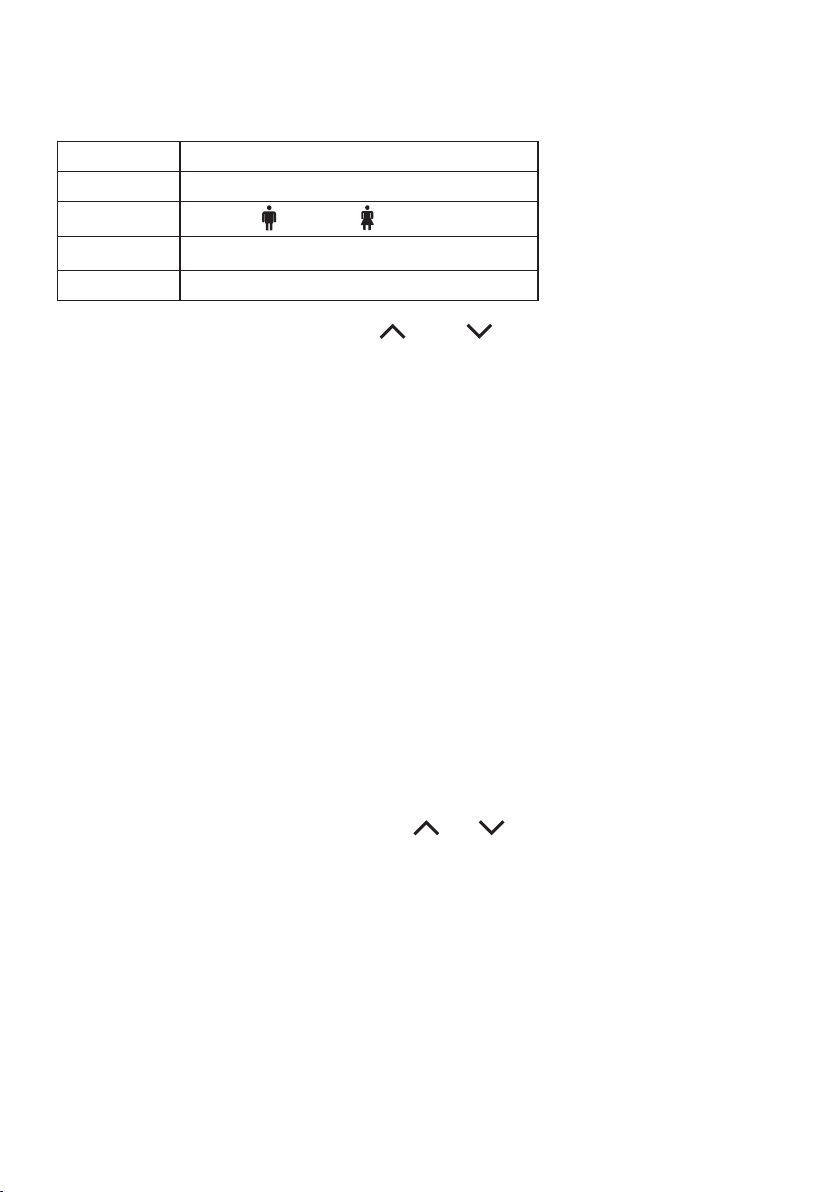
Drücken Sie dann „SET”. Im Display erscheint nun blinkend der erste Speicherplatz. Nun können Sie fol
gende Einstellungen vornehmen:
Speicherplatz 0 bis 9
Alter 10 bis 100 Jahre
Geschlecht
Körpergrösse 100 bis 220 cm (3‘-03“ bis 7‘-03“)
Aktivitätsgrad 1 bis 5
männlich (
), weiblich ( )
-
Mit kurzem oder langem Drücken der Taste auf
len. Bestätigen Sie die Werte jeweils mit „SET“.
Danach ist die Waage zur Messung bereit. Wenn Sie keine Messung vornehmen, schaltet sich die Waage
nach einigen Sekunden automatisch ab.
Aktivitätsgrade:
Bei der Auswahl des Aktivitätsgrades ist die mittel- und langfristige Betrachtung entscheidend.
• Aktivitätsgrad 1: Keine körperliche Aktivität.
• Aktivitätsgrad 2: Geringe körperliche Aktivität.
Wenige und leichte körperliche Anstrengungen (z.B. Spazierengehen, leichte Gartenarbeit, gymnastische
Übungen).
• Aktivitätsgrad 3: Mittlere körperliche Aktivität.
Körperliche Anstrengungen, mindestens 2 bis 4 mal pro Woche, jeweils 30 Minuten.
• Aktivitätsgrad 4: Hohe körperliche Aktivität.
Körperliche Anstrengungen, mindestens 4 bis 6 mal pro Woche, jeweils 30 Minuten.
• Aktivitätsgrad 5: Sehr hohe körperliche Aktivität.
Intensive körperliche Anstrengungen, intensives Training oder harte körperliche Arbeit, täglich, jeweils
mindestens 1 Stunde.
5.3 Messung durchführen
Nachdem alle Parameter eingegeben wurden, können nun Gewicht, Körperfett und die weiteren Werte er
mittelt werden.
• Drücken Sie „SET“.
• Wählen Sie durch mehrfaches Drücken der Tasten
persönlichen Grunddaten gespeichert sind. Diese werden kurz angezeigt bis die Anzeige „0.0“ erscheint.
• Steigen Sie barfuß auf die Waage und achten Sie darauf, dass Sie ruhig auf den Elektroden stehen.
• Nach der Gewichtsmessung erscheinen sämtliche ermittelten Werte.
Wichtig: Es darf kein Kontakt zwischen beiden Füßen, Beinen, Waden und Oberschenkeln bestehen. An
dernfalls kann die Messung nicht korrekt ausgeführt werden.
oder ab können Sie die jeweiligen Werte einstel-
-
oder den Speicherplatz aus, auf dem Ihre
-
5
Page 6
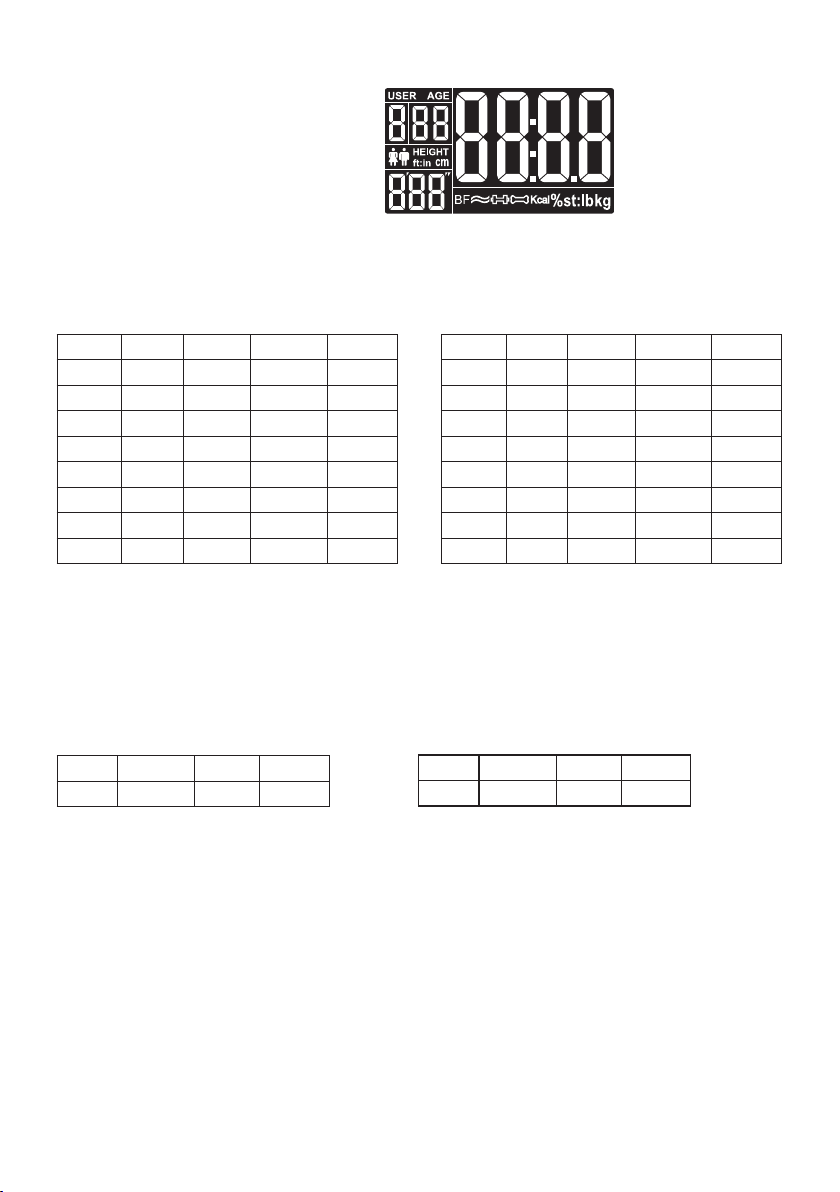
Zunächst erscheint folgende Anzeige:
1. Gewicht in kg
2. Körperfett in %
3. Körperwasser in %
4. Muskelanteil in %
5. Knochenmasse in kg
6. Aktivitätsumsatz in Kcal
Körperfettanteil
Nachfolgende Körperfettwerte geben Ihnen eine Richtlinie (für weitere Informationen wenden Sie sich bitte
an Ihren Arzt!).
Mann Frau
Alter sehr gut gut mittel schlecht
10–14 <11% 11–16% 16,1–21% >21,1%
15–19 <12% 12–17% 17,1–22% >22,1%
20–29 <13% 13–18% 18,1–23% >23,1%
30–39 <14% 14–19% 19,1–24% >24,1%
40–49 <15% 15–20% 20,1–25% >25,1%
50–59 <16% 16–21% 21,1–26% >26,1%
60–69 <17% 17–22% 22,1–27% >27,1%
70–100 <18% 18–23% 23,1–28% >28,1%
Alter sehr gut gut mittel schlecht
10–14 <16% 16–21% 21,1–26% >26,1%
15–19 <17% 17–22% 22,1–27% >27,1%
20–29 <18% 18–23% 23,1–28% >28,1%
30–39 <19% 19–24% 24,1–29% >29,1%
40–49 <20% 20–25% 25,1–30% >30,1%
50–59 <21% 21–26% 26,1–31% >31,1%
60–69 <22% 22–27% 27,1–32% >32,1%
70–100 <23% 23–28% 28,1–33% >33,1%
Bei Sportlern ist oft ein niedrigerer Wert festzustellen. Je nach betriebener Sportart, Trainingsintensität und
körperlicher Konstitution können Werte erreicht werden, die noch unterhalb der angegebenen Richtwerte
liegen.
Bitte beachten Sie jedoch, dass bei extrem niedrigen Werten Gesundheitsgefahren bestehen können.
Körperwasser:
Der Anteil des Körperwassers liegt normalerweise in folgenden Bereichen:
Mann Frau
Alter schlecht gut sehr gut
10–100 <50% 50–65% >65%
Alter schlecht gut sehr gut
10–100 <45% 45–60% >60%
Körperfett beinhaltet relativ wenig Wasser. Deshalb können bei Personen mit einem hohen Körperfettanteil
der Körperwasseranteil unter den Richtwerten liegen. Bei Ausdauer-Sportlern hingegen können die Richt
-
werte aufgrund geringer Fettanteile und hohem Muskelanteil überschritten werden.
Die Körperwasserermittlung mit dieser Waage sind nicht dazu geeignet, medizinische Rückschlüsse auf
z.B. altersbedingte Wassereinlagerungen zu ziehen. Fragen sie gegebenfalls ihren Arzt.
Grundsätzlich gilt es, einen hohen Körperwasseranteil anzustreben.
6
Page 7
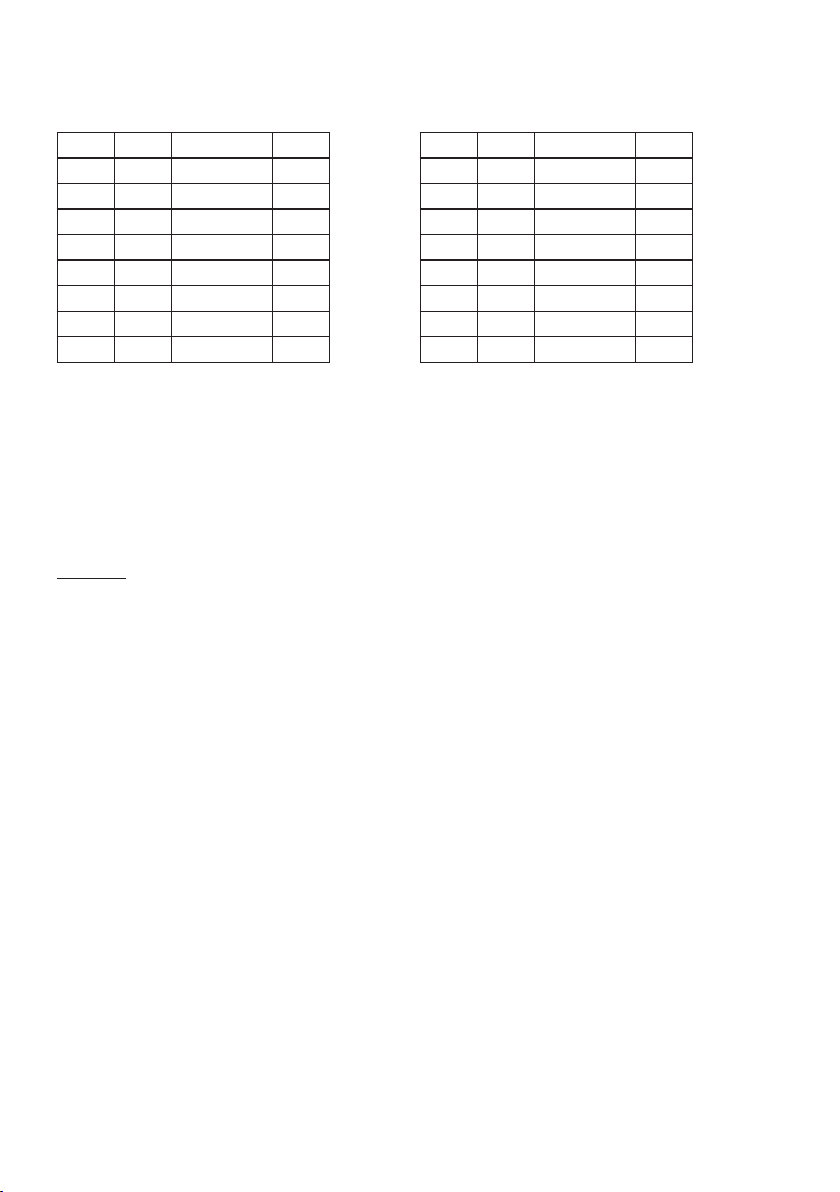
Muskelanteil:
Der Muskelanteil liegt normalerweise in folgenden Bereichen:
Mann Frau
Alter wenig normal viel
10–14 <44% 44–57% >57%
15–19 <43% 43–56% >56%
20–29 <42% 42–54% >54%
30–39 <41% 41–52% >52%
40–49 <40% 40–50% >50%
50–59 <39% 39-48% >48%
60–69 <38% 38–47% >47%
70–100 <37% 37–46% >46%
Alter wenig normal viel
10–14 <36% 36–43% >43%
15–19 <35% 35–41% >41%
20–29 <34% 34–39% >39%
30–39 <33% 33–38% >38%
40–49 <31% 31–36% >36%
50–59 <29% 29–34% >34%
60–69 <28% 28–33% >33%
70–100 <27% 27–32% >32%
Knochenmasse:
Unsere Knochen sind wie der Rest unseres Körpers natürlichen Aufbau-, Abbau- und Alterungspro zessen
unterworfen. Die Knochenmasse nimmt im Kindesalter rasch zu und erreicht mit 30 bis 40 Jahren das Ma
ximum. Mit zunehmendem Alter nimmt die Knochenmasse dann wieder etwas ab. Mit gesunder Ernährung
(insbesondere Kalzium und Vitamin D) und regelmäßiger körperlicher Bewegung können Sie diesem Ab
bau ein Stück weit entgegen wirken. Mit gezieltem Muskelaufbau können Sie die Stabilität Ihres Knochengerüstes zusätzlich verstärken.
Beachten Sie, dass diese Waage nicht den Kalziumgehalt der Knochen ausweist, sondern sie ermittelt das
Gewicht aller Bestandteile der Knochen (organische Stoffe, anorganische Stoffe und Wasser).
Achtung: Bitte verwechseln Sie die Knochenmasse jedoch nicht mit der Knochendichte. Die Knochendichte kann nur bei medizinischer Untersuchung (z.B. Computertomographie, Ultraschall) ermittelt werden.
Deshalb sind Rückschlüsse auf Veränderungen der Knochen und der Knochenhärte (z.B. Osteoporose) mit
dieser Waage nicht möglich.
Die Knochenmasse lässt sich kaum beeinflussen, schwankt aber geringfügig innerhalb der beeinflussen
-
den Faktoren (Gewicht, Größe, Alter, Geschlecht).
AMR:
Der Aktivitätsumsatz (AMR=Active Metabolic Rate) ist die Energiemenge, die der Körper im aktiven Zu
stand pro Tag verbraucht. Der Energieverbrauch eines Menschen steigt mit zunehmender körperlicher Aktivität an und wird bei der Diagnosewaage über den eingegebenen Aktivitätsgrad (1–5) ermittelt.
Um das aktuelle Gewicht zu halten, muss die verbrauchte Energie in Form von Essen und Trinken dem
Körper entsprechend wieder zugeführt werden. Wird über einen längeren Zeitraum hinweg weniger En
ergie zugeführt als verbraucht, holt sich der Körper die Differenz im wesentlichen aus den angelegten
Fett-Speichern, das Gewicht nimmt ab. Wird hingegen über einen längeren Zeitraum hinweg mehr Ener
gie zugeführt als der berechnete Gesamt-Energie-Umsatz (AMR) kann der Körper den Energieüberschuss
nicht verbrennen, der Überschuss wird als Fett im Körper eingelagert, das Gewicht nimmt zu.
Zeitlicher Zusammenhang der Ergebnisse
Beachten Sie dass, nur der langfristige Trend zählt. Kurzfristige Gewichtsabweichungen innerhalb von we
-
nigen Tagen sind zumeist lediglich durch Flüssigkeitsverlust bedingt.
Die Deutung der Ergebnisse richtet sich nach den Veränderungen des Gesamtgewichts und der prozen
tualen Körperfett-, Körperwasser- und Muskelanteile, sowie nach der Zeitdauer mit welcher diese Änderungen erfolgen. Rasche Veränderungen im Bereich von Tagen sind von mittelfristigen Änderungen (im
Bereich von Wochen) und langfristigen Änderungen (Monaten) zu unterscheiden.
Als Grundregel kann gelten, dass kurzfristige Veränderungen des Gewichts fast ausschließlich Ände
rungen des Wassergehalts darstellen, während mittel- und langfristige Veränderungen auch den Fett- und
Muskelanteil betreffen können.
7
Page 8
• Wenn kurzfristig das Gewicht sinkt, jedoch der Körperfettanteil steigt oder gleich bleibt, haben Sie ledig-
lich Wasser verloren – z.B. nach einem Training, Saunagang oder einer nur auf schnellen Gewichtsverlust beschränkten Diät.
• Wenn das Gewicht mittelfristig steigt, der Körperfettanteil sinkt oder gleich bleibt, könnten Sie hingegen
wertvolle Muskelmasse aufgebaut haben.
Wenn Gewicht und Körperfettanteil gleichzeitig sinken, funktioniert Ihre Diät – Sie verlieren Fettmasse.
Idealerweise unterstützen Sie Ihre Diät mit körperlicher Aktivität, Fitness- oder Krafttraining. Damit können
Sie mittelfristig Ihren Muskelanteil erhöhen.
Körperfett, Körperwasser oder Muskelanteile dürfen nicht addiert werden (Muskelgewebe enthält auch Be
standteile aus Körperwasser).
-
6. Fehlmessung
Stellt die Waage bei der Messung einen Fehler fest, wird „ ” angezeigt.
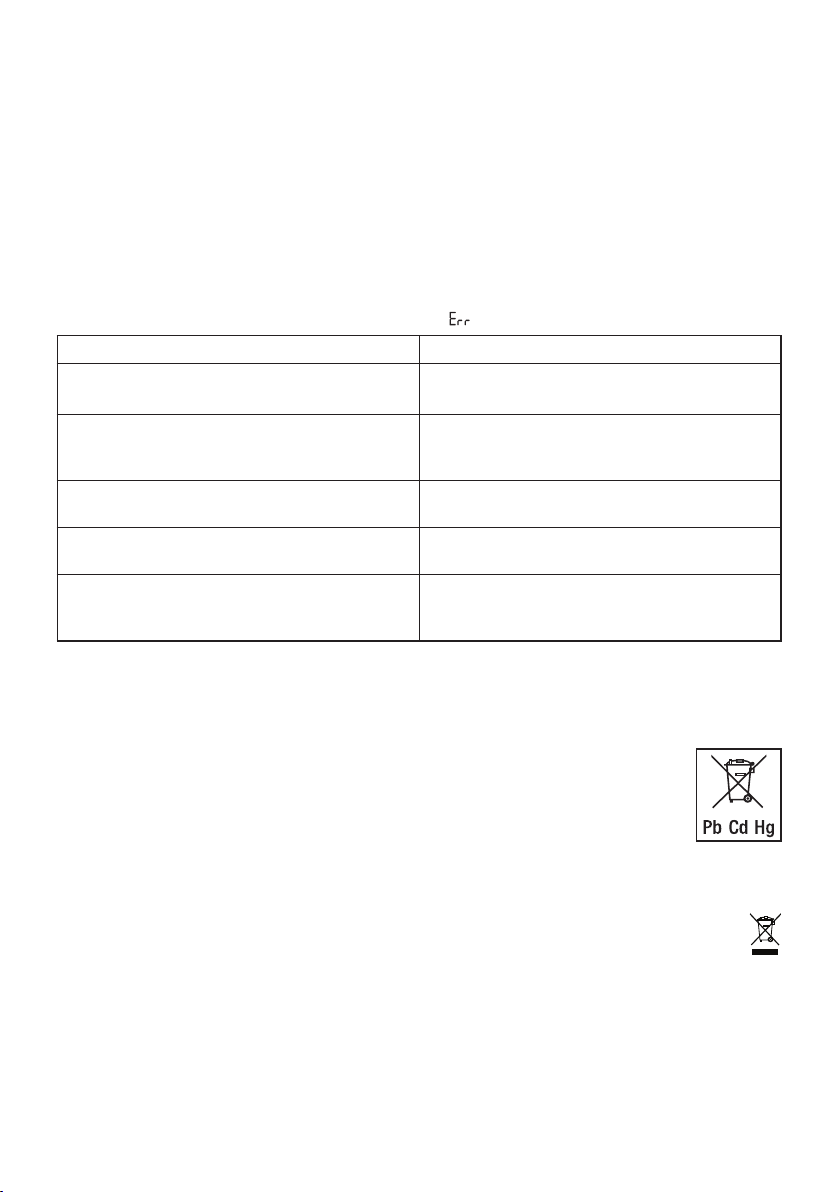
Mögliche Fehlerursachen: Behebung:
Die maximale Tragkraft von 180 kg wurde über
schritten.
Der elektrische Widerstand zwischen Elektroden
und Fußsohle ist zu hoch (z.B. bei starker Horn
haut).
Der Fettanteil liegt außerhalb des messbaren Be
reichs (kleiner 3% oder größer 55%).
Der Wasseranteil liegt außerhalb des messbaren Be
reichs (kleiner 36% oder größer 70%).
Der Muskel- und Knochenanteil liegt außer
halb des messbaren Bereichs (alters- und
geschlechtsab hängig).
-
Nur maximal zulässiges Gewicht wiegen.
-
Die Messung bitte barfuß wiederholen. Feuchten
-
Sie ggf. Ihre Fußsohlen leicht an. Entfernen Sie
ggf. die Hornhaut an den Fußsohlen.
Die Messung bitte barfuß wiederholen oder feuch
ten Sie ggf. Ihre Fußsohlen leicht an.
Die Messung bitte barfuß wiederholen oder feuch
ten Sie ggf. Ihre Fußsohlen leicht an.
Die Messung bitte barfuß wiederholen oder feuch
ten Sie ggf. Ihre Fußsohlen leicht an.
-
-
-
7. Entsorgung
Die verbrauchten, vollkommen entladenen Batterien müssen Sie über speziell gekennzeichnete Sammelbehälter, Sondermüllannahmestellen oder über den Elektrohändler entsorgen. Sie sind gesetzlich dazu
verpflichtet, die Batterien zu entsorgen.
Diese Zeichen finden Sie auf schadstoffhaltigen Batterien:
Pb = Batterie enthält Blei,
Cd = Batterie enthält Cadmium,
Hg = Batterie enthält Quecksilber.
Im Interesse des Umweltschutzes darf das Gerät am Ende seiner Lebensdauer nicht mit dem Hausmüll
entsorgt werden. Die Entsorgung kann über entsprechende Sammelstellen in Ihrem Land erfolgen.
Entsorgen Sie das Gerät gemäß der Elektro- und Elektronik Altgeräte EG-Richtlinie – WEEE (Waste
Electrical and Electronic Equipment). Bei Rückfragen wenden Sie sich an die für die Entsorgung zu
ständige kommunale Behörde.
8
-
Page 9

8. Garantie
Wir leisten 5 Jahre Garantie ab Kaufdatum für Material- und Fabrikationsfehler des Produktes. Die Garantie
gilt nicht:
• Im Falle von Schäden, die auf unsachgemäßer Bedienung beruhen.
• Für Verschleißteile.
• Bei Eigenverschulden des Kunden.
• Sobald das Gerät durch eine nicht autorisierte Werkstatt geöffnet wurde.
Die gesetzlichen Gewährleistungen des Kunden bleiben durch die Garantie unberührt. Für Geltendma
chung eines Garantiefalles innerhalb der Garantiezeit ist durch den Kunden der Nachweis des Kaufes zu
führen. Die Garantie ist innerhalb eines Zeitraumes von 5 Jahren ab Kaufdatum gegenüber der Beurer
GmbH, Ulm (Germany) geltend zu machen.
Bitte wenden Sie sich im Falle von Reklamationen an unseren Service unter folgendem Kontakt:
Service Hotline:
Tel.: +49 (0) 731 / 39 89-144
E-Mail: [email protected]
www.beurer.com
Fordern wir Sie zur Übersendung des defekten Produktes auf, ist das Produkt an folgende Adresse
zu senden:
Beurer GmbH
Servicecenter
Lessingstraße 10 b
89231 Neu-Ulm
Germany
-
Irrtum und Änderungen vorbehalten
9
Page 10
ENGLISH
Contents
1. Device description ......................................... 10
2. Notes ............................................................ 10
3. Information on the diagnostic scale .............. 11
4. Batteries ......................................................... 12
5. Operation ....................................................... 12
5.1 Weight measurement ............................... 12
5.2 Setting user data .................................... 12
5.3 Taking measurements .............................. 13
6. Incorrect measurement.................................. 16
7. Disposal ........................................................ 16
Dear Customer,
Thank you for choosing one of our products. Our name stands for high-quality, thoroughly tested products
for the applications in the areas of heat, weight, blood pressure, body temperature, pulse, gentle therapy,
massage and air.
Please read these instructions for use carefully and keep them for later use, be sure to make them
accessible to other users and observe the information they contain.
Best regards,
Your Beurer Team
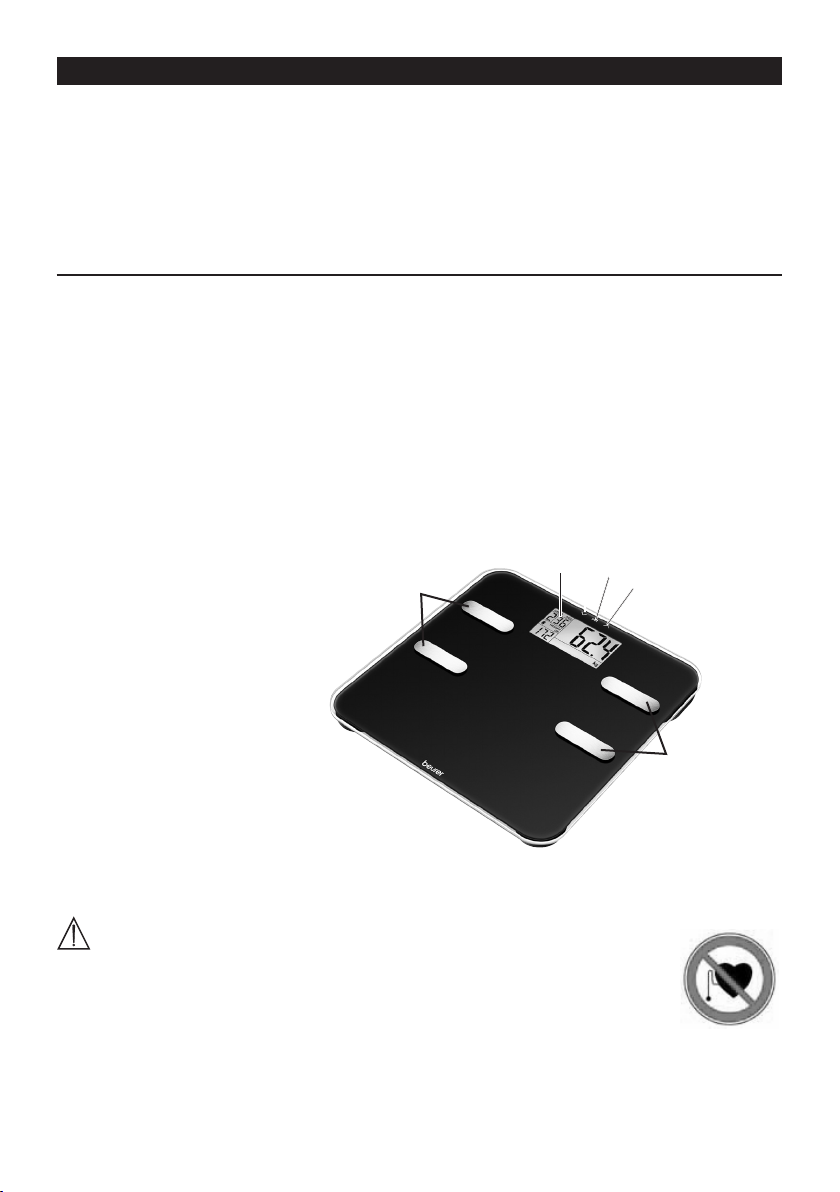
1. Device description
1. Display
2. Down key
3. SET key
4. Up key
5. Electrodes
5
2
1
3
4
5
2. Notes
Safety notes:
• The scales must not be used by persons with medical implants (e.g. heart pace
makers). Otherwise their function could be impaired.
• Do not use during pregnancy.
• Caution! Do not stand on the scale with wet feet and do not step on the scale when its
surface is wet – danger of slipping!
• Batteries are highly dangerous if swallowed. Keep batteries and scale out of reach of small children. If
batteries are swallowed, get medical help immediately.
• Keep children away from packing materials (danger of suffocation).
-
10
Page 11
• Batteries must not be charged or reactivated by other means, taken apart, thrown into a fire or short-circuited.
Notes on handling batteries
• If your skin or eyes come into contact with battery fluid, flush out the affected areas with water and seek
medical assistance.
Choking hazard! Small children may swallow and choke on batteries. Store the batteries out of the
•
reach of small children.
• Observe the plus (+) and minus (-) polarity signs.
• If a battery has leaked, put on protective gloves and clean the battery compartment with a dry cloth.
• Protect the batteries from excessive heat.
Risk of explosion! Never throw batteries into a fire.
•
• Do not charge or short-circuit batteries.
• If the device is not to be used for a long period, take the batteries out of the battery compartment.
• Use identical or equivalent battery types only.
• Always replace all batteries at the same time.
• Do not use rechargeable batteries.
• Do not disassemble, split or crush the batteries.
General notes:
• The unit is for personal use only and is not intended for medical or commercial applications.
• Please note that technically related measuring tolerances are possible, as the scale is not calibrated for
professional medical applications.
• The capacity of the scale is 180 kg (396 lb, 28 st.). For weight measurement and bone mass measure
ment, the results are shown in 100 g increments (0.2 lb, 1/4 st.). The measuring results of the body fat,
body water and muscle percentage are shown in 0.1% increments.
• Calorie requirement is indicated in steps of 1 kcal. The BMI value (body mass index) is shown in increments of 0.1.
• On delivery, the scale is set to “cm” and “kg”. At the back of the scales is a switch with which you can
switch between “inches”, “pounds” and “stones” (lb, st.).
• Place the scale on a firm level floor; a firm floor covering is required for correct measurement.
• The scale should be cleaned occasionally with a damp cloth. Do not use abrasive detergents and never
immerse the scale in water.
• Protect the scale against hard knocks, moisture, dust, chemicals, major temperature fluctuations and
heat sources which are too close (stove, heating radiators).
• Repairs may only be carried out by Beurer customer service or authorized dealers. Before submitting
any complaint, first check the batteries and replace them if necessary.
-
3. Information on the diagnostic scale
The measuring principle of the diagnostic scale
This scale operates according to the B.I.A. principle (bioelectric impedance analysis). This enables
physical relationships to be measured within seconds by means of an undetectable, completely harmless
electric current. The body fat percentage and other physical relationships in the body can
be determined by measuring the electrical resistance (impedance), and the inclusion in a calculation of
constants and individual parameters (age, height, gender, degree of activity).
Muscle tissue and water have good electrical conductivity, and therefore lower resistance.
Bones and fatty tissue, on the other hand, have low conductivity, as fat cells and bones conduct hardly
any current as a result of their very high resistance.
11
Page 12

Please be aware that values obtained from the diagnostic scale represent only an approximation of actual
analytical medical data. Only a specialist physician can accurately determine body fat, body water, muscle
percentage and bone structure using medical procedures (e.g. computed tomography).
General tips
• If possible, always weigh yourself at the same time of day (preferably in the morning), after using the toi
let, on an empty stomach and unclothed, in order to achieve comparable results.
• Important for the measurement: body fat can only be measured when barefoot and with the soles of the
feet slightly moist. Completely dry soles can result in unsatisfactory measurements due to inadequate
conductivity.
• Stand still during the measurement.
• Wait a few hours after unaccustomed strenuous activity.
• Wait approx. 15 minutes after getting up in the morning to allow the water in the body to distribute.
Limitations
When measuring body fat and other values, deviating and implausible results may occur in:
• children under approx. 10 years,
• competitive athletes and body builders,
• pregnant women,
• persons with fever, undergoing dialysis treatment or with symptoms of edema or osteoporosis, – persons
taking cardiovascular medication,
• persons taking vascular dilating or vascular constricting medication,
• persons with considerable anatomic deviations of the legs in relation to total body size (length of the
legs considerably shortened or lengthened).
-
4. Batteries
If provided, pull out the battery insulating strip at the battery compartment or remove the protective film
from the battery and insert the battery with the correct polarity. If the scale fails to operate, remove the
battery completely and reinsert it.
Your scale is provided with a “Change battery” indicator. If the scale is operating with a battery which is
too weak, “Lo” appears on the display and the scale will switch off automatically. In this case, the battery
must be exchanged (4 x1.5 V, AAA).
5. Operation
5.1 Weight measurement
Step onto the scale. Stand still with your weight distributed equally on both feet. The scale begins to take
measurements straight away. After flashing twice, the weight is established.
If you step off the weighing area, the scale switches off after a few seconds.
5.2 Setting user data
To measure your body fat percentage and other physical data, you must enter your personal user parameters.
The scale has 10 memory positions in which you and other members of your family can save and recall
personal settings.
Switch on the scale by briefly stepping on the platform. Wait until the display shows “0.0”.
12
Page 13
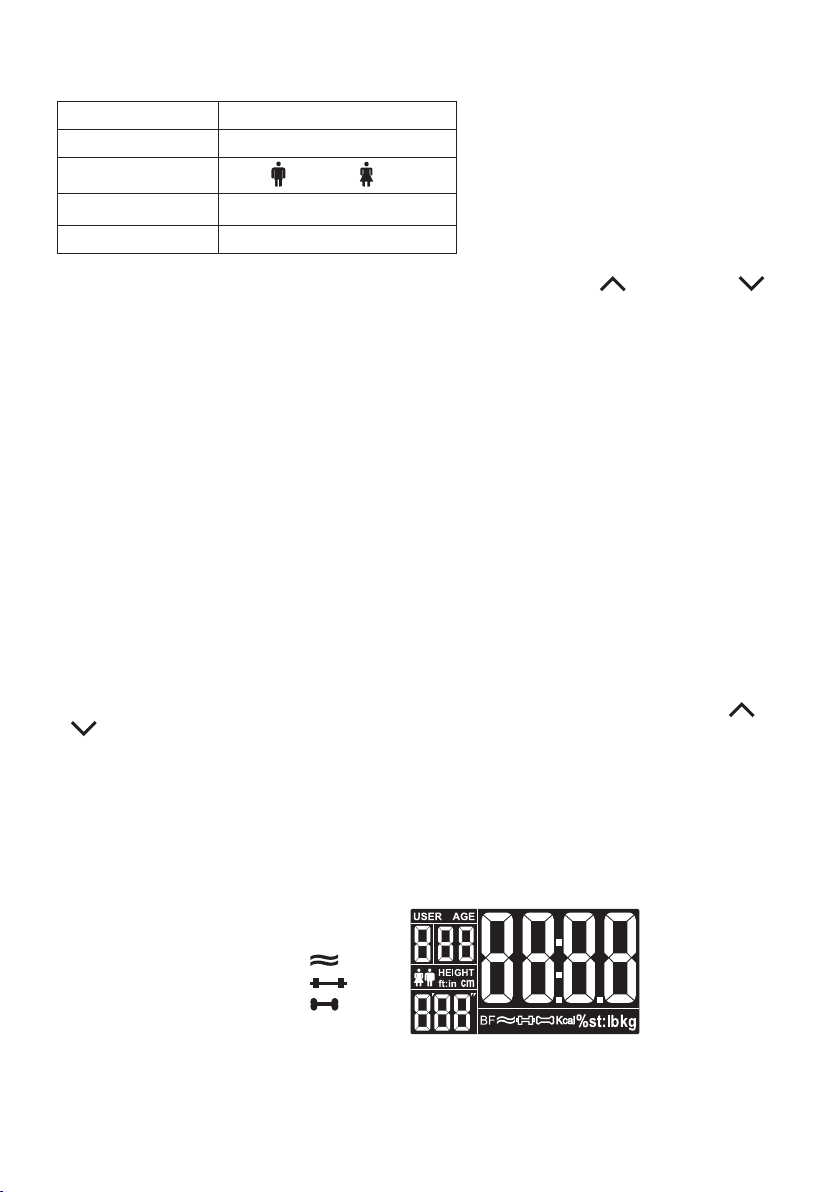
Then press “SET”. The first memory position will appear flashing on the display. Now you can enter the following settings:
Memory position 0 to 9
Age 10 to100 years
Sex
Body size 100 to 220 cm (3‘-03“ to 7‘-03“)
Degree of activity 1 to 5
male (
), female ( )
You can enter the relevant settings with short or long pressure on the up button
Confirm the settings in each case by pressing “SET”.
Then the scale is ready for measuring. If you do not carry out a measurement, the scale switches off auto
matically after several seconds.
Degree of activity:
Selection of the degree of activity must refer to the medium and long term.
• Degree of activity 1: No physical activity.
• Degree of activity 2: Low physical activity.
A small amount of light physical effort (e.g. short walks, light garden work, gymnastic exercises).
• Degree of activity 3: Medium physical activity.
Physical effort for 30 minutes at least 2 to 4 times a week.
• Degree of activity 4: High physical activity.
Physical effort for 30 minutes at least 4 to 6 times a week.
• Degree of activity 5: Very high physical activity.
Intensive physical effort, intensive training or hard physical work for at least one hour daily.
5.3 Taking measurements
After all parameters have been entered, you can now measure your weight, body fat and the other data.
• Press “SET”.
• Select the memory space where you would like to save your basic personal data by pressing the
button several times. These are then displayed briefly until “0.0” appears.
• Step onto the scale with bare feet and make sure that you are standing still on the electrodes.
• All values determined appear after weighing.
Important: There may be no contact between feet, legs, calves and thighs. Otherwise the measurement
will not be performed correctly.
or down button .
-
or
The following display then appears:
1. Weight in kg
2. Body fat in %
3. Body water in %
4. Muscle percentage in %
5. Bone mass in kg
6. Active metabolic rate in Kcal
KG
BF
13
Page 14
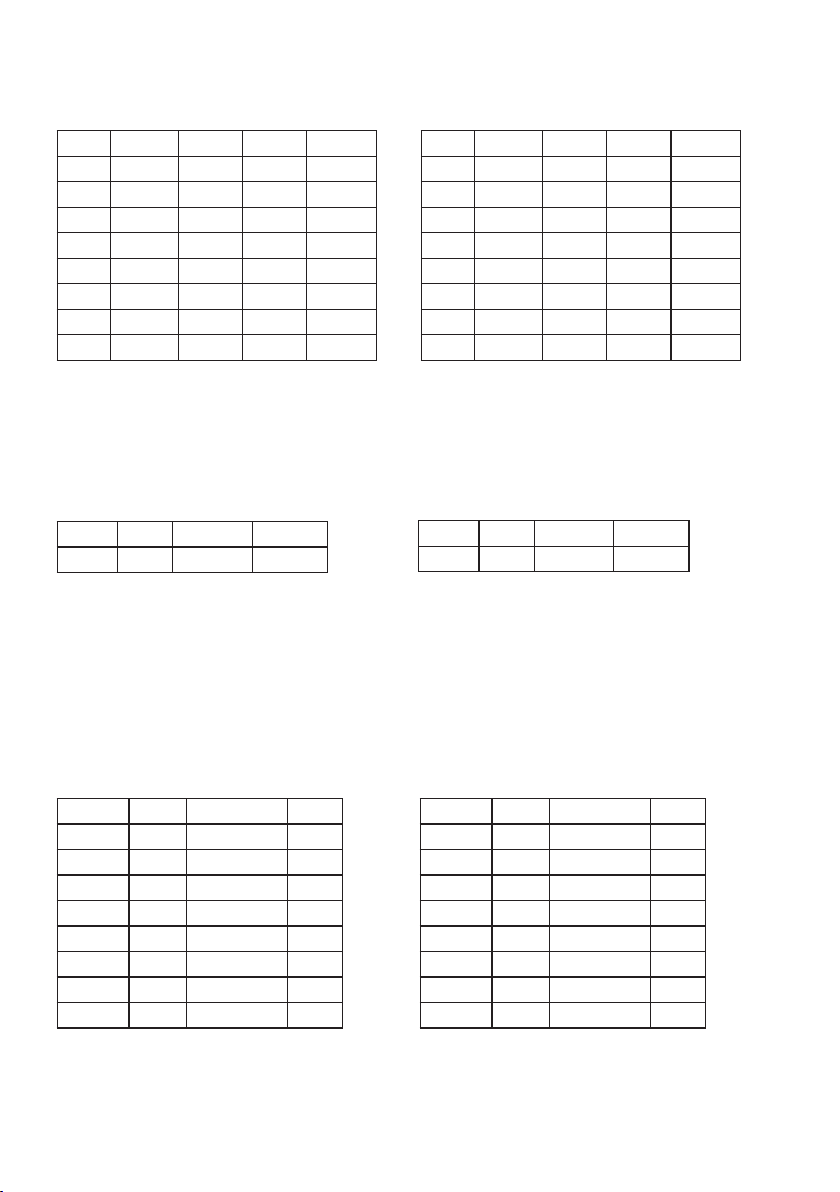
Body fat percentage
The following body fat percentages are for guidance (contact your physician for further information).
Man Woman
Age very good good average poor
10-14 <11% 11-16% 16,1-21% >21,1%
15-19 <12% 12-17% 17,1-22% >22,1%
20-29 <13% 13-18% 18,1-23% >23,1%
30-39 <14% 14-19% 19,1-24% >24,1%
40-49 <15% 15-20% 20,1-25% >25,1%
50-59 <16% 16-21% 21,1-26% >26,1%
60-69 <17% 17-22% 22,1-27% >27,1%
70-100 <18% 18-23% 23,1-28% >28,1%
Age very good good average poor
10-14 <16% 16-21% 21,1-26% >26,1%
15-19 <17% 17-22% 22,1-27% >27,1%
20-29 <18% 18-23% 23,1-28% >28,1%
30-39 <19% 19-24% 24,1-29% >29,1%
40-49 <20% 20-25% 25,1-30% >30,1%
50-59 <21% 21-26% 26,1-31% >31,1%
60-69 <22% 22-27% 27,1-32% >32,1%
70-100 <23% 23-28% 28,1-33% >33,1%
A lower value is often found in athletes. Depending on the type of sports, training intensity and physical
constitution, values may result which are below the recommended values stated.
It should, however, be noted that there could be a danger to health in the case of extremely low values.
Body water:
The body water percentage is normally within the following ranges:
Man Woman
Age poor good very good
10-100 <50% 50-65% >65
Age poor good very good
10-100 <45% 45-60% >60
Body fat contains relatively little water. Therefore persons with a high body fat percentage have body water percentages below the recommended values. With endurance athletes, however, the recommended
values could be exceeded due to low fat percentages and high muscle percentage.
Body water measurement with this scale is not suitable for drawing medical conclusions, for example con
cerning age-related water retention. If necessary ask your physician.
Basically, a high body water percentage should be the aim.
-
Muscle percentage:
The muscle percentage is normally within the following ranges:
Man Woman
Age low normal high
10-14 <44% 44-57% >57%
15-19 <43% 43-56% >56%
20-29 <42% 42-54% >54%
30-39 <41% 41-52% >52%
40-49 <40% 40-50% >50%
50-59 <39% 39-48% >48%
60-69 <38% 38-47% >47%
70-100 <37% 37-46% >46%
Age low normal high
10-14 <36% 36-43% >43%
15-19 <35% 35-41% >41%
20-29 <34% 34-39% >39%
30-39 <33% 33-38% >38%
40-49 <31% 31-36% >36%
50-59 <29% 29-34% >34%
60-69 <28% 28-33% >33%
70-100 <27% 27-32% >32%
14
Page 15

Bone mass:
Like the rest of our body, our bones are subject to the natural development, degeneration and ageing pro
cesses. Bone mass increases rapidly in childhood and reaches its maximum between 30 and 40 years of
age. Bone mass reduces slightly with increasing age. You can reduce this degeneration somewhat with
healthy nutrition (particularly calcium and vitamin D) and regular exercise. With appropriate muscle buil
ding, you can also strengthen your bone structure.
Note that this scale will not show you the calcium content of your bones, but will measure the weight of all
bone constituents (organic substances, inorganic substances and water).
Attention: Please do not confuse bone mass with bone density. Bone density can be determined only by
means of a medical examination (e.g. computer tomography, ultrasound). It is therefore not possible to
draw conclusions concerning changes to the bones and bone hardness (e.g. osteoporosis) using this scale.
Little influence can be exerted on bone mass, but it will vary slightly within the influencing factors (weight,
height, age, gender).
AMR:
The active metabolic rate (AMR) is the amount of energy required daily by the body in its active state. The
energy consumption of a human being rises with increasing physical activity and is measured on the dia
gnostic scale in relation to the degree of activity entered (1-5).
To maintain your existing weight, the amount of energy used must be reintroduced into the body in the
form of food and drink. If less energy is introduced than is used over a longer period of time, your body
will obtain the difference largely from the amount of fat stored and your weight will reduce. If, on the other
hand, over a longer period of time more energy is introduced than the total active metabolic rate (AMR)
calculated, your body will be unable to burn off the excess energy, and the excess will be stored in the
body as fat and your weight will increase.
Results in relation to time
Note that it is only the long-term trend which counts. Short period fluctuations in weight over a few days
are mostly the result of a loss of fluid.
The interpretation of the results will depend on changes in your:
overall weight and body fat, body water and muscle percentages, as well as on the period during which
these changes take place. Rapid changes within days must be distinguished from medium term changes
(over weeks) and long term changes (months).
A basic rule is that short term changes in weight almost exclusively represent changes in water content,
whereas medium and long term changes may also involve the fat and muscle percentages.
• If your weight reduces over the short term, but your body fat percentage increases or remains the same,
you have merely lost water – e.g. after a training session, sauna session or a diet restricted only to rapid
weight loss.
• If your weight increases over the medium term and the body fat percentage falls or stays the same, then
you could have built up valuable muscle mass.
If your weight and body fat percentage fall simultaneously then your diet is working – you are losing fat
mass. Ideally you should support your diet with physical activity, fitness or power training. By this means,
you can increase your muscle percentage over the medium term.
-
-
-
15
Page 16
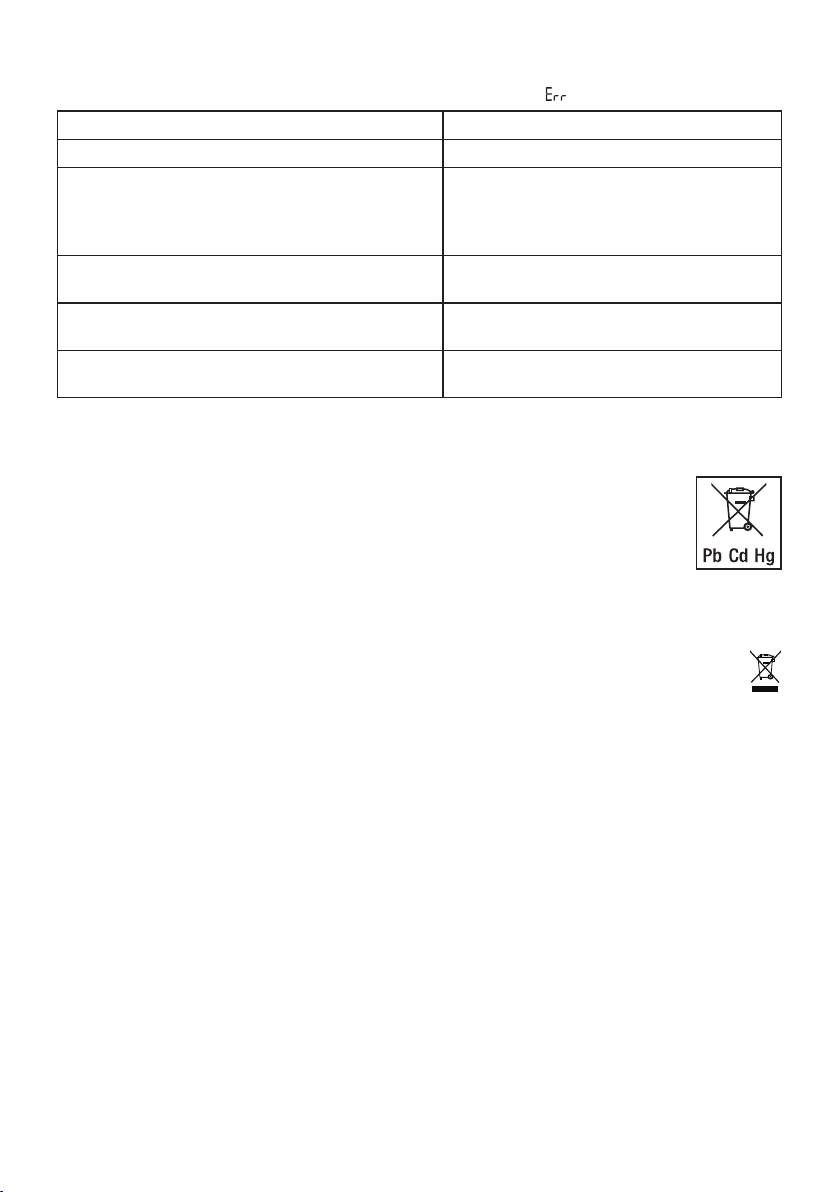
6. Incorrect measurement
If the scale detects an error during measurement, this is indicated with “ ”.
Possible causes of error: Remedy:
The maximum capacity of 180 kg has been exceeded. Weigh only the maximum permissible weight.
The electrical resistance between the electrodes and
the soles of the feet is too high (e.g. in the case of
thick calluses).
The fat percentage is outside the measurable range
(less than 3% or greater than 55%).
The water percentage is outside the measurable ran
ge (less than 36% or greater than 70%).
The muscle and bone percentages are outside the
measurable range (age and gender related).
Repeat the measurement barefoot.
If necessary, moisten the soles of your feet
slightly. If necessary, remove the calluses from
the soles of your feet.
Repeat the measurement barefoot or, if neces
sary, moisten the soles of your feet slightly.
Repeat the measurement barefoot or, if neces
sary, moisten the soles of your feet slightly.
Repeat the measurement barefoot or, if neces
sary, moisten the soles of your feet slightly.
7. Disposal
Empty, completely flat batteries must be disposed of through specially designated collection boxes, recycling points or electronics retailers. You are legally required to dispose of the batteries.
The codes below are printed on batteries containing harmful substances:
Pb = Battery contains lead
Cd = Battery contains cadmium
Hg = Battery contains mercury
For environmental reasons, do not dispose of the device in the household waste at the end of its service
life. Dispose of the device at a suitable local collection or recycling point.
Dispose of the device in accordance with EC Directive – WEEE (Waste Electrical and Electronic
Equipment). If you have any questions, please contact the local authorities responsible for waste
disposal.
-
-
-
16
Subject to error and change
Page 17
FRANÇAIS
Sommaire
1. Description du tensiomètre ........................... 17
2. Remarques .................................................... 17
3. Informations sur la balance
impédancemètre ............................................ 18
4. Piles ............................................................... 19
5. Utilisation ....................................................... 19
5.1 Pesée ...................................................... 19
5.2 Réglages des données de l’utilisateur .... 19
5.3 Effectuer une mesure ............................... 20
6. Mesures erronées .......................................... 23
7. Elimination ..................................................... 23
Chère cliente, cher client,
Nous sommes heureux que vous ayez choisi un produit de notre assortiment. Notre nom est synonyme de
produits de qualité haut de gamme ayant subi des vérifications approfondies, ils trouvent leur application
dans le domaine de la chaleur, du contrôle du poids, de la pression artérielle, de la mesure de température
du corps et du pouls, des thérapies douces, des massages et de l’air.
Lisez attentivement ce mode d’emploi, conservez-le pour un usage ultérieur, mettez-le à la disposition des
autres utilisateurs et suivez les consignes.
Avec nos sentiments dévoués
Beurer et son équipe
1. Description du tensiomètre
1. Ecran
2. Touche Bas
3. Touche SET
4. Touche Haut
5. Electrodes
5
2
1
3
4
5
2. Remarques
Remarques de sécurité
• Cette balance ne doit pas être utilisée par des personnes munies d‘implants mé
dicaux (stimulateurs cardiaques, par exemple). Sinon leur fonctionnement risque
d‘être entravé.
• Ne pas utiliser pendant la grossesse.
• Attention, ne montez pas sur la balance les pieds mouillés et ne posez pas les pieds sur le plateau de
pesée s‘il est humide – vous pourriez glisser!
-
17
Page 18
• Les piles avalées risquent de mettre la vie en danger. Laissez les piles et la balance hors de portée des
jeunes enfants. Au cas où une pile a été avalée, faites immédiatement appel à un médecin.
• Ne laissez pas l‘emballage à la portée des enfants (risque d‘asphyxie).
• Les piles ne doivent être ni rechargées ni réactivées par d’autres méthodes ni démontées ni jetées dans
le feu ni court-circuitées.
Remarques relatives aux piles
• Si du liquide de la cellule de pile entre en contact avec la peau ou les yeux, rincez la zone touchée avec
de l’eau et consultez un médecin.
Risque d’ingestion! Les enfants en bas âge pourraient avaler des piles et s’étouffer. Veuillez donc
•
conserver les piles hors de portée des enfants en bas âge!
• Respectez les signes de polarité plus (+) et moins (-).
Si la pile a coulé, enfilez des gants de protection et nettoyez le compartiment à piles avec un chiffon sec.
•
• Protégez les piles d’une chaleur excessive.
Risque d’explosion! Ne jetez pas les piles dans le feu.
•
• Les piles ne doivent être ni rechargées, ni court-circuitées.
• En cas de non utilisation prolongée de l’appareil, sortez les piles du compartiment à piles.
• Utilisez uniquement des piles identiques ou équivalentes.
• Remplacez toujours l’ensemble des piles simultanément.
• N’utilisez pas d’accumulateur!
• Ne démontez, n’ouvrez ou ne cassez pas les piles.
Remarques générales
• L‘appareil est prévu strictement pour un usage personnel et non pas à des fins médicales ou commer
ciales.
• Notez que des variations de mesure d’ordre technique sont possibles, car cette balance n‘est pas éta
lonnée en vue d‘un usage médical professionnel.
• La portée maximale de la balance est de 180 kg (396 lb, 28 st.). Lors de la pesée et de la détermination
de la masse osseuse, les résultats s‘affichent par incréments de 100 g (0,2 lb, 1/4 st.). Les résultats de
mesure du taux de graisse corporelle, de masse hydrique et de masse musculaire s‘affichent par incré
ments de 0,1 %.
• Le besoin calorique est donné par graduations de 1 kcal. La valeur de l’IMC (indice de masse corporelle)
est affichée par graduations de 0,1.
• A la livraison de la balance, le réglage des unités est en « cm » et « kg ». Au dos de la balance, un inter
rupteur vous permet de commuter sur « inch », « livres » et « stones » (lb, st).
• Posez la balance sur un sol plan et stable; une surface ferme est la condition préalable à une mesure ex
acte.
• De temps en temps, nettoyez l‘appareil avec un chiffon humide. N‘utilisez pas de nettoyant agressif et
ne mettez jamais l‘appareil sous l‘eau.
Mettez la balance à l’abri des chocs, de l‘humidité, de la poussière, des produits chimiques, des fortes va-
•
riations de température et évitez la proximité de sources de chaleur (fourneaux, radiateurs de chauffage).
• Les réparations doivent être effectuées uniquement par le service après-vente de Beurer ou des revendeurs agréés. Cependant, avant de faire une réclamation, contrôlez d‘abord les piles et changez-les, le
cas échéant.
-
-
-
-
-
3. Informations sur la balance impédancemètre
Principe de mesure de la balance impédancemètre
Cette balance fonctionne selon le principe d‘analyse d‘impédance bioélectrique (B.I.A). A cet effet, un
courant imperceptible, absolument sans risque et sans danger permet de connaître en quelques secondes
18
Page 19

le taux des tissus corporels. La mesure de la résistance électrique (impédance) ainsi que la prise en compte de constantes et, le cas échéant, de données individuelles (âge, taille, sexe, activité physique) permet
de définir le taux de graisse corporelle et d’autres paramètres physiques.
Le tissu musculaire et l‘eau ont une bonne conductibilité électrique et donc une faible résistance.
Par contre, les os et le tissu adipeux a une faible conductibilité, car les os et les cellules adipeuses sont
très peu conducteurs en raison de leur résistance très élevée.
Notez que les valeurs déterminées par la balance impédancemètre ne représentent que des approxima
tions par rapport aux analyses physiques effectives d’ordre médical. Seul un médecin spécialisé peut déterminer avec précision la graisse corporelle, la masse hydrique, le taux de masse musculaire et la masse
osseuse par des méthodes médicales (tomographie, par ex.).
Conseils généraux
• Pesez-vous, si possible, à la même heure (de préférence le matin), après la selle, à jeun et nu(e) afin
d‘obtenir des résultats comparables.
Important: La détermination de la graisse corporelle doit toujours être faite pieds nus; si nécessaire, elle peut
•
s‘effectuer la plante des pieds légèrement humide. Il se peut que des mesures effectuées avec les pieds
complètement secs ne conduisent pas à des résultats satisfaisants, car leur conductibilité est trop faible.
• Ne bougez pas pendant la mesure.
• Attendez quelques heures après un effort physique inhabituel.
• Après votre lever, attendez 15 minutes environ avant de faire la mesure pour que l‘eau puisse se répartir
dans le corps.
Restrictions
Il se peut que la détermination de la graisse corporelle et d’autres données présente des écarts et des ré
sultats non plausibles dans les cas suivants:
• les enfants de moins de 10 ans environ,
• les sportifs de haut niveau et les personnes pratiquant le bodybuilding,
• les femmes enceintes,
• les personnes fiévreuses, en dialyse, présentant des symptômes d‘œdèmes ou d‘ostéoporose,
• les personnes sous traitement médical cardiovasculaire,
• les personnes prenant des médicaments vasodilatateurs ou vasoconstricteurs,
• les personnes présentant des écarts anatomiques sérieux des jambes par rapport à leur taille (jambes
nettement courtes ou longues).
-
-
4. Piles
Tirez éventuellement sur la languette isolante de la pile sur le couvercle du compartiment à piles ou retirez le film de protection de la pile et introduisez-la en respectant la polarité. Si la balance n‘affiche aucune
fonction, retirez complètement la pile et remettez-la en place.
Votre balance est pourvue d‘un « affichage de changement de piles ». En cas d‘utilisation de la balance
avec des piles trop faibles, le message « Lo » s‘affiche et la balance s‘arrête automatiquement. Il est alors
temps de remplacer la pile (4 x1,5 V, AAA).
5. Utilisation
5.1 Pesée
Montez sur le pèse-personne. Restez immobile sur le pèse-personne en répartissant votre poids de ma
nière égale entre les deux jambes. Le pèse-personne commence tout de suite la mesure. Votre poids clignote deux fois puis reste fixe.
Lorsque vous quittez le plateau de pesée, le pèse-personne s’éteint au bout de quelques secondes.
5.2 Réglages des données de l’utilisateur
Pour déterminer le taux de graisse corporelle et les autres paramètres, il faut enregistrer les données indi
viduelles de l‘utilisateur.
19
-
-
Page 20
La balance est équipée de 10 positions de mémoire d’utilisateurs permettant d’enregistrer et d’afficher les
réglages individuels pour vous et les membres de votre famille.
Pour mettre la balance en marche, posez brièvement le pied sur le plateau et attendez que «0.0» s‘affiche.
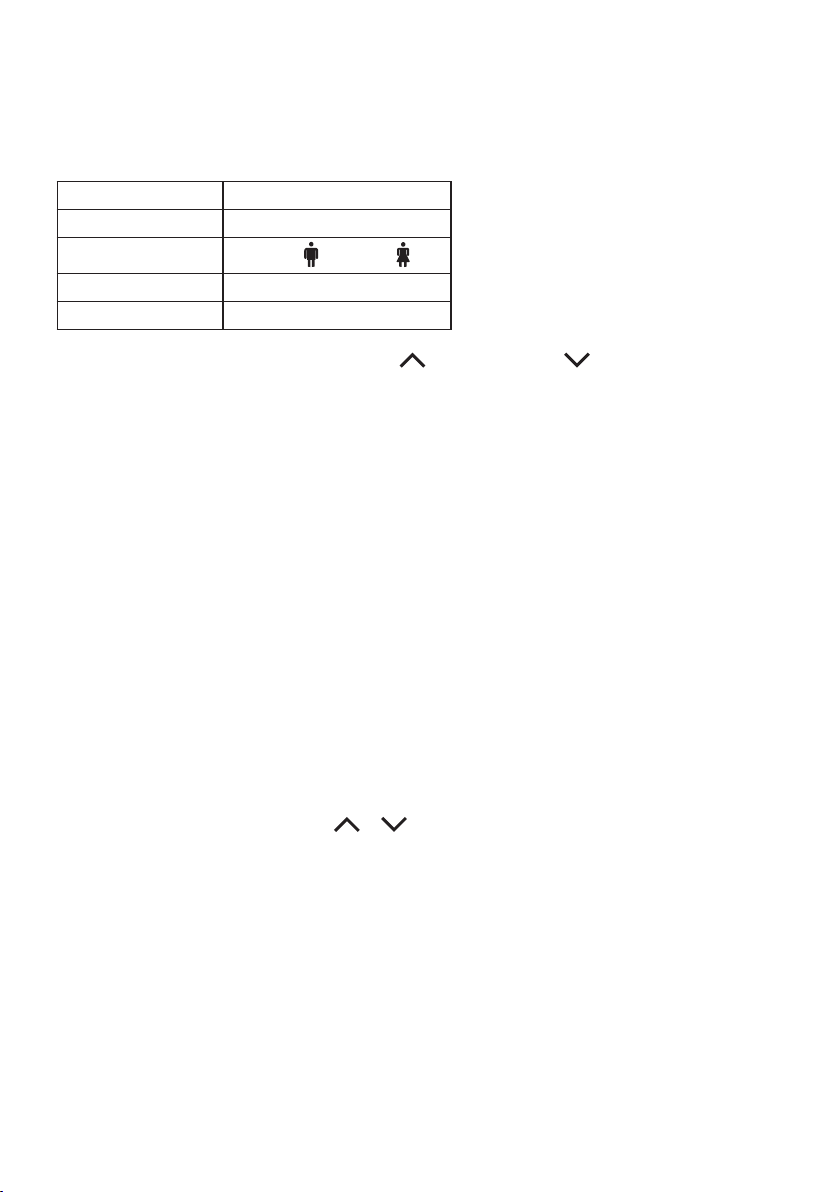
Ensuite appuyez sur « SET ». La première position de mémoire clignote au panneau d‘affichage. Vous
pouvez alors effectuer les réglages suivants:
Position de mémoire 0 à 9
Age 10 à 100 ans
Sexe
Taille 100 à 220 cm (3‘-03“ à 7‘-03“)
Degré d‘activité 1 à 5
masculin (
), féminin ( )
Appuyez brièvement ou longuement sur la touche
de réglage. Validez chacune de vos données en appuyant sur « SET ».
La balance est ensuite prête pour la mesure. Si vous ne procédez à aucune mesure, la balance s’éteint au
tomatiquement au bout de quelques secondes.
Niveaux d’activité
Le niveau d’activité sera sélectionné en fonction des perspectives à moyen et à long terme.
• Niveau d’activité 1: aucune activité physique.
• Niveau d’activité 2: activité physique réduite.
peu d’efforts physiques et efforts limités (promenade, jardinage facile, exercices de gymnastique, par ex.).
• Niveau d’activité 3: activité physique moyenne.
pour augmenter ou pour diminuer les valeurs
efforts physiques au moins 2 à 4 fois par semaine pendant 30 minutes.
• Niveau d’activité 4: activité physique intense.
efforts physiques au moins 4 à 6 fois par semaine pendant 30 minutes.
• Niveau d’activité 5: activité physique très intense.
efforts physiques très prononcés, entraînement intense ou travail physique dur quotidiennement, 1
heure au moins.
5.3 Effectuer une mesure
Quand tous les paramètres ont été entrés, il est possible de déterminer le poids, la graisse corporelle et
les autres valeurs.
• Appuyez sur la touche « SET ».
• Appuyez plusieurs fois sur les touches
données personnelles. Elles s’affichent rapidement jusqu’à ce que « 0.0 » s’affiche.
• Montez pieds nus sur la balance et assurez-vous de vous tenir sans bouger sur les électrodes.
• Les valeurs mesurées s’affichent après la mesure du poids.
Important: Il ne faut en aucun cas qu‘il y ait un contact entre les deux pieds, jambes, mollets et cuisses.
Sinon, la mesure ne peut pas être faite de manière correcte.
et pour trouver l’emplacement où sont sauvegardées vos
-
20
Page 21
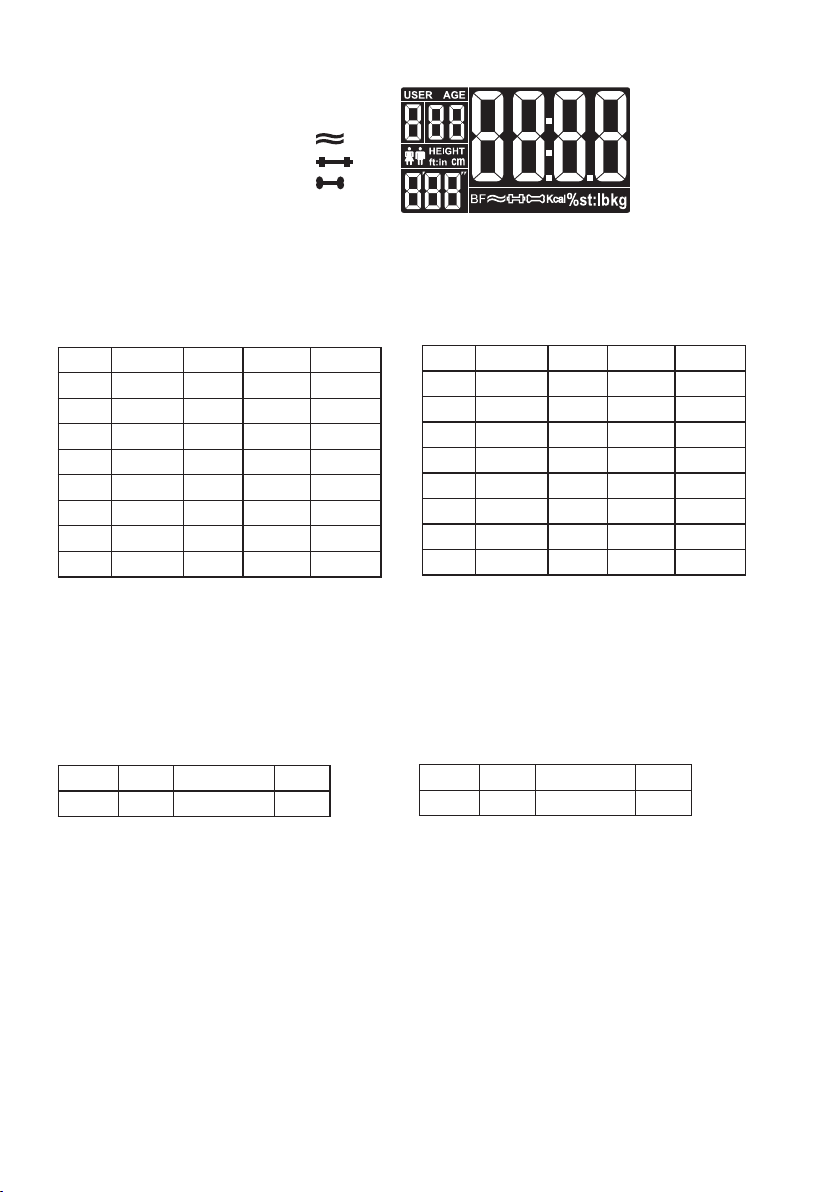
D’abord, l’affichage est le suivant:
1. Poids en kg
2. Graisse corporelle en %
KG
BF
3. Masse hydrique en %
4. Masse musculaire en %
5. Masse osseuse en kg
6. Taux métabolique actif en kcal
Taux de graisse corporelle
Les taux de graisse corporelle suivants sont donnés à titre indicatif (pour avoir plus d‘informations,
adressez-vous à votre médecin!)
Hommes
Age très bien bien moyen mauvais
10-14 <11% 11-16% 16,1-21% >21,1%
15-19 <12% 12-17% 17,1-22% >22,1%
20-29 <13% 13-18% 18,1-23% >23,1%
30-39 <14% 14-19% 19,1-24% >24,1%
40-49 <15% 15-20% 20,1-25% >25,1%
50-59 <16% 16-21% 21,1-26% >26,1%
60-69 <17% 17-22% 22,1-27% >27,1%
70-100 <18% 18-23% 23,1-28% >28,1%
Femmes
Age très bien bien moyen mauvais
10-14 <16% 16-21% 21,1-26% >26,1%
15-19 <17% 17-22% 22,1-27% >27,1%
20-29 <18% 18-23% 23,1-28% >28,1%
30-39 <19% 19-24% 24,1-29% >29,1%
40-49 <20% 20-25% 25,1-30% >30,1%
50-59 <21% 21-26% 26,1-31% >31,1%
60-69 <22% 22-27% 27,1-32% >32,1%
70-100 <23% 23-28% 28,1-33% >33,1%
Chez les sportifs, les valeurs sont souvent plus basses. En fonction du type de sport pratiqué, de
l‘intensité de l‘entraînement et de la constitution physique de la personne, il se peut que les taux obtenus
soient encore inférieurs aux taux de référence.
Notez cependant que des valeurs extrêmement basses peuvent représenter des risques pour la santé.
Taux de masse hydrique:
Le taux de masse hydrique se situe normalement dans les zones suivantes:
Hommes Femmes
Age mauvais bien très bien
10-100 <50 50-65% >65
Age mauvais bien très bien
10-100 <45 45-60% >60
La graisse corporelle contient relativement peu d’eau. Il est donc possible que chez les personnes dont
le taux de graisse corporelle est élevé, le taux de masse hydrique soit inférieur aux données de référence.
Par contre, chez les personnes pratiquant des sports d’endurance, le taux de masse hydrique peut être
supérieur aux données de référence en raison d’un taux de graisse corporelle inférieur et un taux de mas
-
se musculaire supérieur.
Le taux de masse hydrique déterminé sur cette balance ne permet pas de tirer des conclusions d’ordre
médical sur la rétention d’eau dans les tissus dûe à l’âge. Le cas échéant, demandez à votre médecin.
De manière générale, un taux de masse hydrique élevé est souhaitable.
21
Page 22
Taux de masse musculaire
Le taux de masse musculaire se situe normalement dans les plages suivantes:
Hommes Femmes
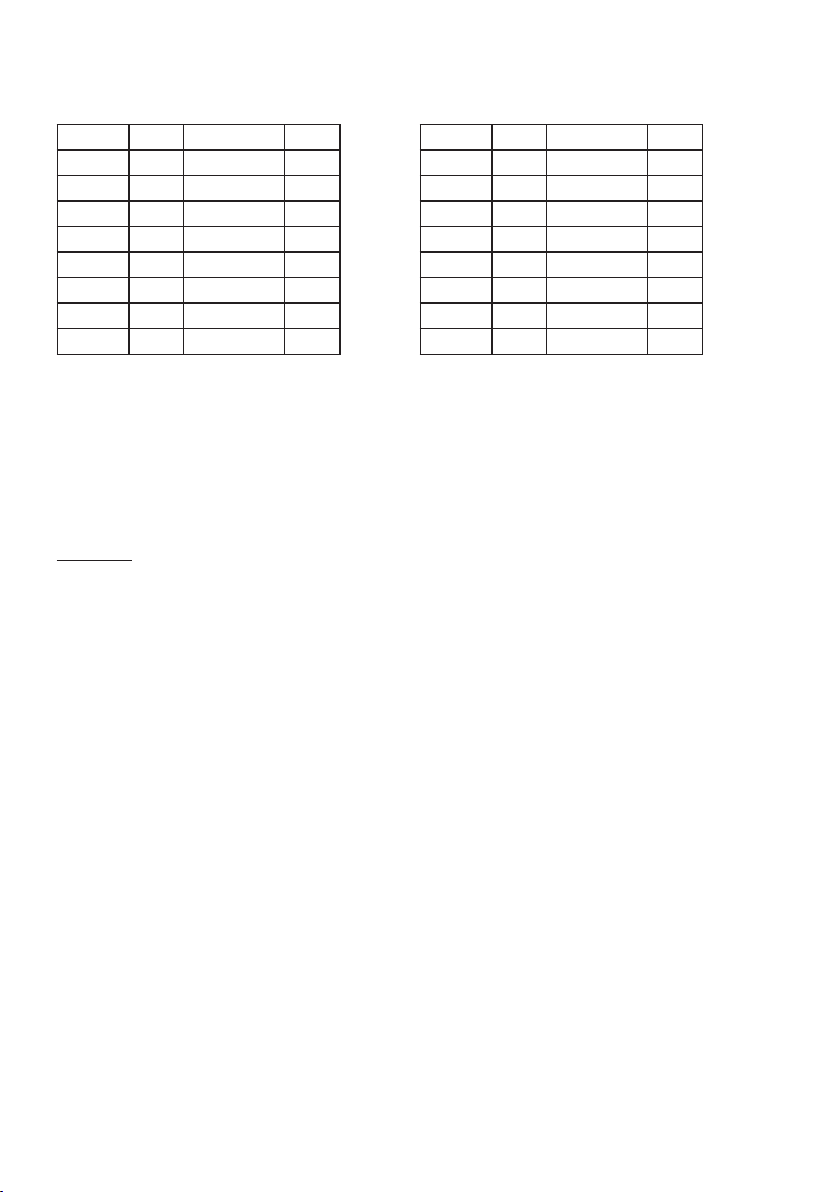
Age faible normal élevé
10-14 <44% 44-57% >57%
15-19 <43& 43-56% >56%
20-29 <42% 42-54% >54%
30-39 <41% 41-52% >52%
40-49 <40% 40-50% >50%
50-59 <39% 39-48% >48%
60-69 <38% 38-47% >47%
70-100 <37% 37-46% >46%
Age faible normal élevé
10-14 <36% 36-43% >43%
15-19 <35% 35-41% >41%
20-29 <34% 34-39% >39%
30-39 <33% 33-38% >38%
40-49 <31% 31-36% >36%
50-59 <29% 29-34% >34%
60-69 <28% 28-33% >33%
70-100 <27% 27-32% >32%
Masse osseuse
Notre squelette, tout comme le reste du corps, est soumis à des phases naturelles de croissance, de dégradation et de vieillissement. La masse osseuse augmente rapidement au cours de l’enfance pour atteindre
son maximum à l’âge de 30 à 40 ans. Avec l’âge, la masse osseuse diminue ensuite. Il est possible de lutter
en partie contre cette dégénérescence par une alimentation saine (calcium et vitamine D surtout) et par un
exercice physique régulier. Une musculation adaptée vous permettra en plus de stabiliser le support osseux.
Notez que cette balance n’indique par la teneur en calcium du squelette mais qu’elle détermine le poids
de tous les constituants des os (matières organiques, matières inorganiques et eau).
Attention: Ne confondez pas cependant la masse osseuse et la densité osseuse. Pour déterminer la
densité osseuse, il faut procéder à un examen médical (tomographie, échographie, par ex.). C’est pour
quoi cette balance ne permet pas de tirer de conclusions sur les modifications et la dureté des os
(ostéoporose, par ex.).
La masse osseuse n’est guère soumise à des influences, mais elle varie légèrement sous l’effet de cer
-
tains facteurs (poids, taille, âge, sexe).
AMR
L’AMR, le taux métabolique actif, représente la quantité d‘énergie dont le corps en activité a besoin quoti
diennement. Les besoins énergétiques d’une personne augmentent en fonction de son activité physique ;
sur la balance impédancemètre elle est déterminée à l’aide du niveau d‘activité entré (1 à 5).
Pour maintenir le poids actuel, il faut que l’énergie dépensée soit restituée au corps sous forme d’aliments
et de boissons. Si, pendant une assez longue période, le corps dépense plus d‘énergie qu‘il lui est resti
tué, il contre-balance cette différence en puisant dans les réserves de graisse accumulées et le poids diminue. Au contraire, si l‘énergie fournie au corps est supérieure au taux métabolique actif (AMR) déterminé
pendant une assez longue période, il ne peut consommer ce surplus d‘énergie qu‘il emmagasine sous
forme de graisse et le poids augmente.
Corrélation des résultats dans le temps
Notez que seule compte la tendance à long terme. Des écarts de poids de courte durée enregistrés en
l‘espace de quelques jours ne sont dus qu‘à une simple perte de liquides dans la plupart des cas.
L‘interprétation des résultats dépend des modifications du poids d’ensemble et des pourcentages de
graisse corporelle, de masse hydrique et musculaire ainsi que de la durée de ces changements. Il faut
distinguer les modifications rapides (de l‘ordre de quelques jours) des modifications à moyen terme (de
l‘ordre de quelques semaines) et à long terme (plusieurs mois).
La règle générale peut être la suivante : les modifications de poids à court terme représentent presque ex
clusivement des changements de la teneur en eau, alors que les modifications à moyen et à long
terme peuvent aussi concerner le taux de graisse et de masse musculaire.
22
Page 23
• Si votre poids diminue à court terme, alors que le taux de graisse corporelle augmente ou reste stable,
vous n‘avez perdu que de l‘eau, par exemple suite à un entraînement, une séance de sauna
ou un régime visant uniquement à une perte de poids rapide.
• Si votre poids augmente à moyen terme, alors que le taux de graisse corporelle diminue ou reste stable,
il se pourrait au contraire que vous ayez augmenté la masse musculaire, ce qui est précieux.
Si votre poids et votre taux de graisse corporelle diminuent simultanément, cela signifie que votre régime
fonctionne: vous perdez de la graisse. L‘activité physique, les séances de mise en forme ou de musculati
on seront les compléments parfaits de votre régime. Ils vous permettent d‘augmenter votre taux de masse
musculaire à moyen terme.
Il ne faut pas additionner la graisse corporelle, la masse hydrique ou musculaire (le tissu musculaire conti
ent aussi des constituants de la masse hydrique).
-
-
6. Mesures erronées
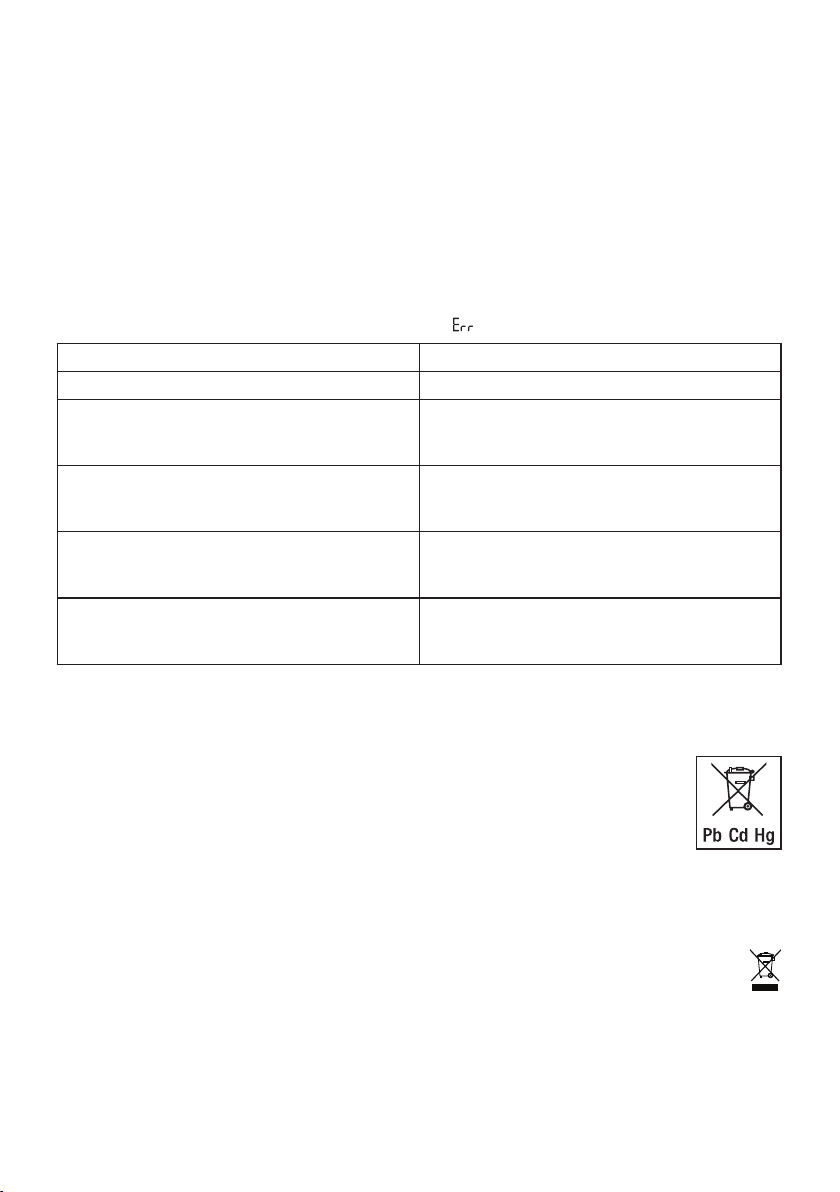
Si la balance détecte une erreur au cours d‘une mesure, « » s‘affiche.
Causes possibles d‘erreur: Correction:
La portée maximale de 180 kg a été dépassée. Peser uniquement le poids maximal autorisé.
La résistance électrique entre les électrodes et la
plante du pied est trop forte (en cas de callosités
épaisses, par ex.).
Le taux de graisse corporelle se trouve au-delà de
la plage de mesure (inférieur à 3% ou supérieur à
55%).
Le taux de masse hydrique se trouve au-delà de
la plage de mesure (inférieur à 36% ou supérieur
à 70%).
Le taux de masse musculaire et osseuse n‘est pas
compris dans la plage de mesure (en fonction de
l‘âge et du sexe).
Refaire la mesure pieds nus. Si besoin, humidifier
légèrement la plante des pieds. Le cas échéant,
enlever les callosités de la plante des pieds.
Répéter la mesure pieds nus ou le cas échéant,
humidifier légèrement la plante des pieds.
Répéter la mesure pieds nus ou le cas échéant,
humidifier légèrement la plante des pieds.
Répéter la mesure pieds nus ou le cas échéant,
humidifier légèrement la plante des pieds.
7. Elimination
Les piles usagées et complètement déchargées doivent être mises au rebut dans des conteneurs spéciaux ou aux points de collecte réservés à cet usage ou bien déposées chez un revendeur d’appareils électriques. L’élimination des piles est une obligation légale qui vous incombe.
Ces pictogrammes se trouvent sur les piles à substances nocives:
Pb = pile contenant du plomb,
Cd = pile contenant du cadmium,
Hg = pile contenant du mercure.
Dans l’intérêt de la protection de l’environnement, l’appareil ne doit pas être jeté avec les ordures
ménagères à la fin de sa durée de service. L’élimination doit se faire par le biais des points de collecte
compétents dans votre pays.
Veuillez éliminer l’appareil conformément à la directive européenne – WEEE (Waste Electrical and
Electronic Equipment) relative aux appareils électriques et électroniques usagés. Pour toute questi
on, adressez-vous aux collectivités locales responsables de l’élimination et du recyclage de ces produits.
23
-
Sous réserve d’erreur et de modifications
Page 24
ESPAÑOL
Contenido
1. Descripción del aparato ................................ 24
2. Indicaciones ................................................... 24
3. Informaciones sobre la báscula de
diagnóstico .................................................... 25
4. Pilas ............................................................... 26
5. Utilización ...................................................... 26
5.1 Medir el peso ........................................... 26
5.2 Ajustar los datos del usuario .................. 27
5.3 Llevar a cabo la medición ....................... 27
6. Medición errónea ........................................... 30
7. Eliminación de desechos ............................... 30
Estimados clientes:
Es un placer para nosotros que usted haya decidido adquirir un producto de nuestra colección. Nuestro
nombre es sinónimo de productos de alta y calidad estrictamente controlada en los campos de energía
térmica, peso, presión sanguínea, temperatura del cuerpo, pulso, terapias suaves, masaje y aire.
Sírvase leer las presentes instrucciones para el uso detenidamente; guarde el manual para usarlo
ulteriormente; póngalo a disposición de otros usuarios y observe las instrucciones.
Les saluda cordialmente
Su equipo Beurer
1. Descripción del aparato
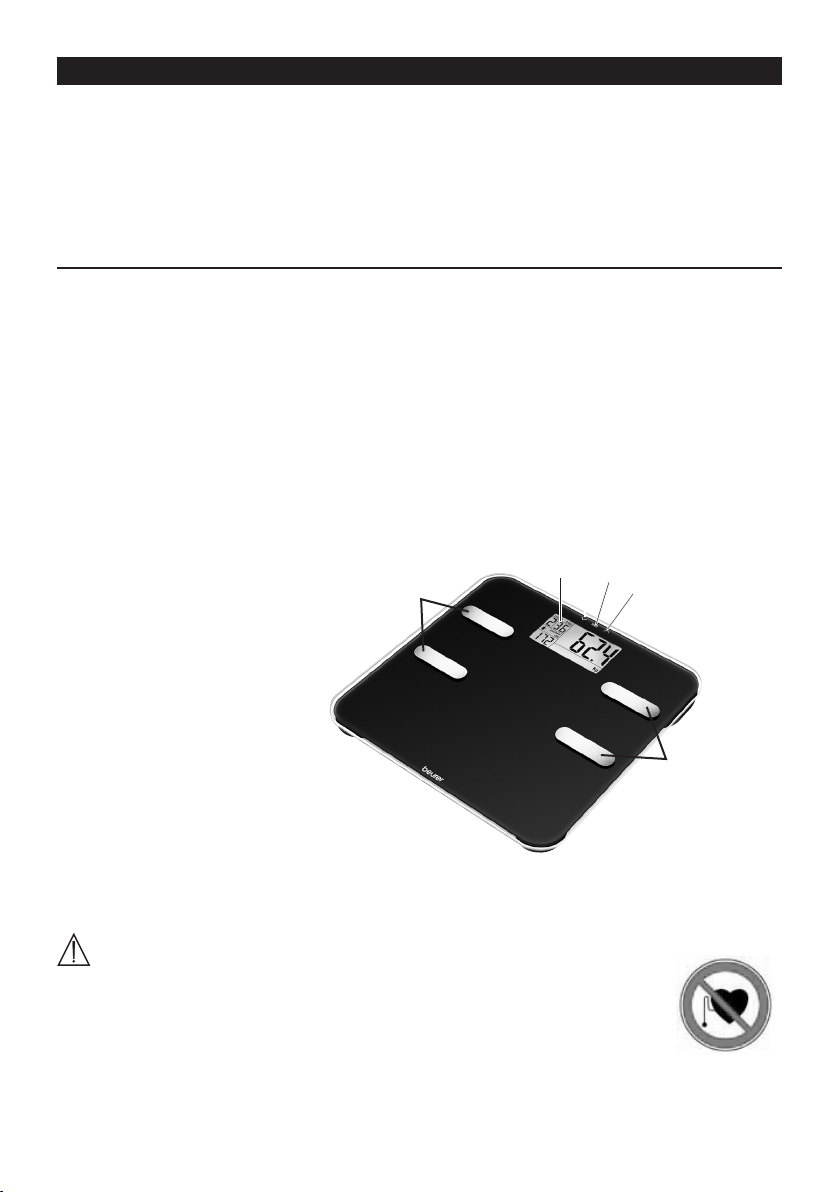
1. Pantalla
2. Botón „disminuir“
3. Botón SET
4. Botón „incrementar“
5. Electrodos
5
2
1
3
4
5
2. Indicaciones
Instrucciones de seguridad:
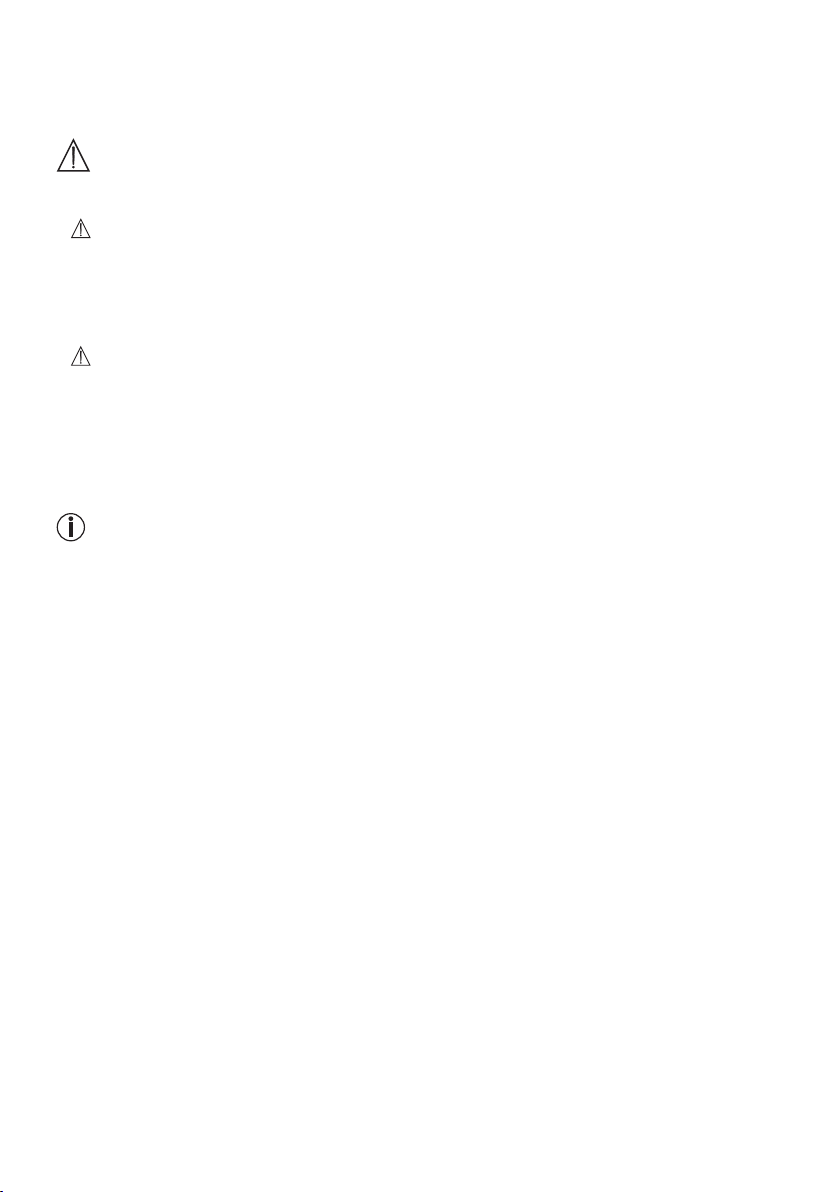
• Esta báscula no debe ser utilizada por personas que lleven implantes médicos
(por ejemplo, marcapasos cardíacos). De lo contrario podría afectar a la función
de dichos implantes.
• No utilizar durante el embarazo.
• Atención, nunca suba a la báscula con los pies mojados ni cuando la superficie de la
báscula esté húmeda. ¡Peligro de resbalamiento!
• Las pilas pueden llegar a ser un peligro mortal, si son ingeridas. Guarde las pilas y la báscula en lugares
fuera del alcance de los niños. Si se ha ingerido una pila, haga uso inmediato de ayuda médica.
24
Page 25
• Mantenga el material de embalaje fuera del alcance de los niños (peligro de asfixia).
• Las pilas no deben ser recargadas ni reactivadas con otros medios; tampoco deben ser desarmadas,
echadas al fuego o cortocircuitadas.
Indicaciones para la manipulación de pilas
• En caso de que el líquido de las pilas entre en contacto con la piel o los ojos, lave la zona afectada con
agua y busque asistencia médica.
¡Peligro de asfixia! Los niños pequeños podrían tragarse las pilas y asfixiarse. Guarde las pilas
•
fuera del alcance de los niños.
• Fíjese en los símbolos más (+) y menos (-) que indican la polaridad.
• Si se derrama el líquido de una pila, póngase guantes protectores y limpie el compartimento de las pilas
con un paño seco.
• Proteja las pilas de un calor excesivo.
¡Peligro de explosión! No arroje las pilas al fuego.
•
• Las pilas no se pueden cargar ni cortocircuitar.
Si no va a utilizar el aparato durante un periodo de tiempo prolongado, retire las pilas del compartimento.
•
• Utilice únicamente el mismo tipo de pila o un tipo equivalente.
• Cambie siempre todas las pilas a la vez.
• ¡No utilice baterías!
• No despiece, abra ni triture las pilas.
Instrucciones generales:
• El presente aparato está destinado únicamente para la aplicación propia, no habiéndose previsto un uso
médico ni comercial.
• Tenga en cuenta que puede haber tolerancias de medición por razones técnicas, ya que no se trata de
una báscula calibrada para el uso profesional médico.
• La capacidad de carga máxima de la báscula es de 180 kg (396 lb, 28 St). Los resultados de la medi
ción de peso y de la determinación de la masa ósea están indicados en intervalos de 100 g (0,2 lb, 1/4
St). Los resultados de la medición de la masa adiposa, líquida y muscular del cuerpo están indicados en
intervalos de 0,1%.
• La necesidad de calorías se indica en intervalos de 1 kcal. El valor de su IMC (índice de masa corporal)
se muestra en intervalos de 0,1.
• La báscula viene ajustada de fábrica con las unidades “cm” y “kg”. En el lado trasero de la báscula se
encuentra instalado un interruptor que permite usar las unidades “pulgadas”, “libras” y “piedras” (lb, St).
• Coloque usted la báscula sobre una superficie plana y firme; esta es una condición imprescindible para
que la medición sea correcta.
• Es aconsejable limpiar de vez en cuando el aparato con un paño húmedo. No utilice a tal efecto deter
gentes agresivos y nunca lave el aparato bajo agua.
• Proteja la báscula contra golpes, humedad, polvo, productos químicos, grandes fluctuaciones de tem
peratura y no la coloque cerca de fuentes de calor intenso (estufas, calefacciones, radiadores).
• Las reparaciones deben ser llevadas a cabo exclusivamente por el servicio postventa de Beurer o bien
por agentes autorizados. No obstante, antes de hacer una reclamación compruebe usted las pilas y, si
fuera necesario, cámbielas.
-
-
-
3. Informaciones sobre la báscula de diagnóstico
El principio de medición de la báscula de diagnóstico
Esta báscula funciona según el principio A.I.B., el Análisis de la Impedancia Bioeléctrica. A tal efecto se hace
pasar por el cuerpo durante pocos segundos una corriente eléctrica completamente inofensiva e imper
ceptible que permite una determinación de las masas corporales. Mediante esta medición de la resistencia
eléctrica (impedancia) y con el cálculo de las constantes, o bien, de los valores individuales (edad, estatura,
sexo, grado de actividad) es posible determinar la masa adiposa corporal y otras magnitudes del cuerpo.
25
-
Page 26

El tejido muscular y el líquido presentan una buena conductividad eléctrica ejerciendo así poca resistencia
al paso de la corriente eléctrica.
En cambio la conductividad de los huesos y del tejido graso es muy baja ya que las células grasas y
óseas oponen una gran resistencia al paso de la corriente eléctrica.
Observe que los valores determinados por la báscula de diagnóstico son sólo valores aproximados a los
valores médicos reales resultantes del análisis del cuerpo. Solamente un facultativo especializado puede
determinar exactamente la masa corporal adiposa, líquida, muscular y ósea, aplicando a tal fin los méto
dos médicos (por ejemplo, la tomografía computadorizada).
Consejos generales
• A ser posible uno debe pesarse a la misma hora del día (lo ideal es por la mañana), después de la pri
mera defecación, en ayunas y sin ropa, a fin de obtener resultados comparables.
• Importante durante la medición: La determinación de la masa adiposa corporal siempre debe realizarse
descalzo, pudiendo resultar útil humedecer ligeramente las plantas de los pies. Si las plantas de los pies
están totalmente secas, los resultados pueden ser incorrectos debido a que presentan una conductivi
dad eléctrica insuficiente.
• No se mueva durante el proceso de medición.
• Si ha realizado un ejercicio físico especialmente intenso, espere algunas horas.
• Después de levantarse, espere unos 15 minutos antes de pesarse para que el agua contenida en el or
ganismo pueda distribuirse.
Restricciones
En los casos siguientes es posible que durante la determinación de la masa adiposa corporal y de los
otros valores mencionados se obtengan resultados divergentes o no aceptables:
• Niños menores de 10 años,
• Deportistas de competición y culturistas,
• Mujeres embarazadas,
• Personas con fiebre, sometidas a tratamiento de diálisis, edemas u osteoporosis,
• Personas que toman medicamentos cardiovasculares,
• Personas que toman medicamentos vasodilatadores o vasoconstrictores,
• Personas con discrepancias anatómicas significativas en sus extremidades inferiores en relación con la
estatura total (piernas especialmente acortadas o alargadas).
-
-
-
-
4. Pilas
Retire la cinta aislante, si la hubiera, puesta en la tapa del compartimiento de pilas o bien retire la
ámina protectora de la pila y coloque la pila observando la polaridad correcta. Si la báscula no funcionara
ahora, retire la pila completa y vuelva a colocarla.
Su báscula está provista de una “indicación de cambio de pila”. Si la báscula se usa con una pila
demasiado débil, en la pantalla se visualizará “Lo“, y la báscula se desconectará automáticamente.
En este caso debe reemplazarse la pila (4 x1,5 V, AAA).
5. Utilización
5.1 Medir el peso
Súbase a la báscula. Apóyese cuidadosamente sobre la báscula repartiendo bien el peso entre las dos
piernas.
La báscula empieza inmediatamente la medición. Después de dos parpadeos se habrá fijado su peso.
Si abandona la superficie de la báscula, la báscula se desactiva tras algunos segundos.
26
Page 27
5.2 Ajustar los datos del usuario
Para poder determinar su masa corporal adiposa y otros valores del cuerpo es necesario que usted alma
cene los valores personales del usuario.
La báscula dispone de lugares de almacenamiento para 10 usuarios diferentes; usted y los miembros de
su familia pueden usarlos para almacenar sus ajustes personales y volver a visualizarlos.
Conecte la báscula pisándola brevemente. Espere hasta que se visualice la indicación “0.0”.
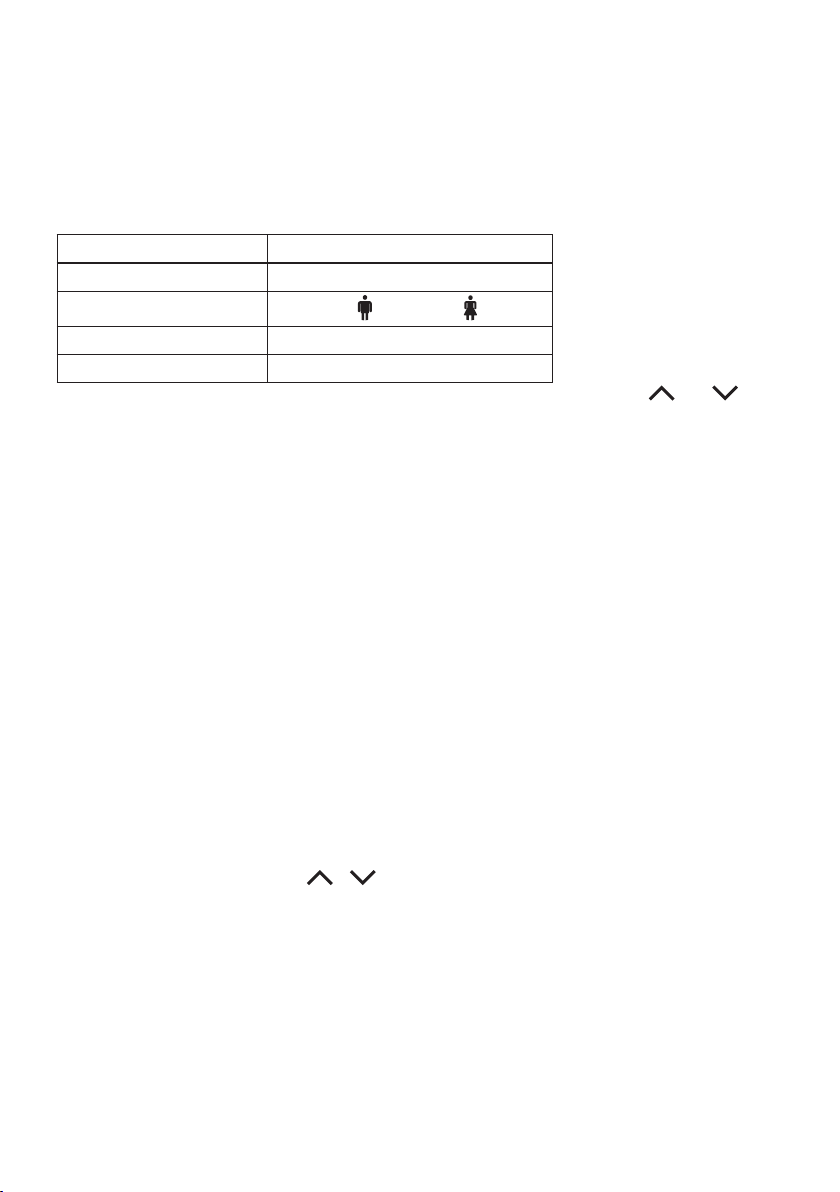
Pulse ahora “SET“. En la pantalla parpadea ahora el primer lugar de memorización. Ahora puede usted lle
var a cabo los siguientes ajustes:
Lugar de almacenamiento 0 hasta 9
Edad 10 hasta 100 años
Sexo
Estatura 100 hasta 220 cm (3‘-03“ hasta 7‘-03“)
Grado de actividad 1 hasta 5
Lleve a cabo el ajuste pulsando durante corto o largo tiempo el botón s para aumentar
disminuir los valores correspondientes. Cada valor ajustado debe ser confirmado con “SET“.
A continuación la balaza está lista para la medción. Si no se efectúa ninguna medición, la balanza se
desconecta automáticamente después de unos segundos.
Grados de actividad:
Para la selección del grado de actividad será determinante considerar la actividad a medio y largo plazo.
• Grado de actividad 1: No hay actividad física alguna.
• Grado de actividad 2: Actividad física reducida.
Esfuerzos físicos reducidos y livianos (por ejemplo, pasear, trabajos de jardín livianos, ejercicios fáciles
de gimnasia).
• Grado de actividad 3: Actividad física media.
Esfuerzos físicos por lo menos 2 a 4 veces por semana, durante 30 minutos respectivamente.
• Grado de actividad 4: Actividad física alta.
Esfuerzos físicos por lo menos 4 a 6 veces por semana, durante 30 minutos respectivamente.
• Grado de actividad 5: Actividad física muy alta.
Esfuerzos físicos intensos, entrenamiento intenso o bien trabajo pesado, diariamente por lo menos durante 1 hora respectivamente.
masculino (
), femenino ( )
bien para
-
-
5.3 Llevar a cabo la medición
Una vez insertados todos los parámetros puede determinarse ahora el peso, la masa adiposa y los otros
valores.
• Pulse “SET”.
• Pulsando repetidamente las teclas
guardados sus datos personales. Estos se mostrarán brevemente hasta que aparece la indicación “0.0”.
• Súbase descalzo a la báscula y asegúrese de estar pisando los electrodos sin moverse.
• Tras medir el peso aparecen todos los valores calculados.
Importante: No debe haber contacto entre ambos pies, piernas, pantorrillas ni muslos. En caso
contrario será imposible realizar la medición correctamente.
o , seleccione el puesto de almacenamiento en el que están
27
Page 28
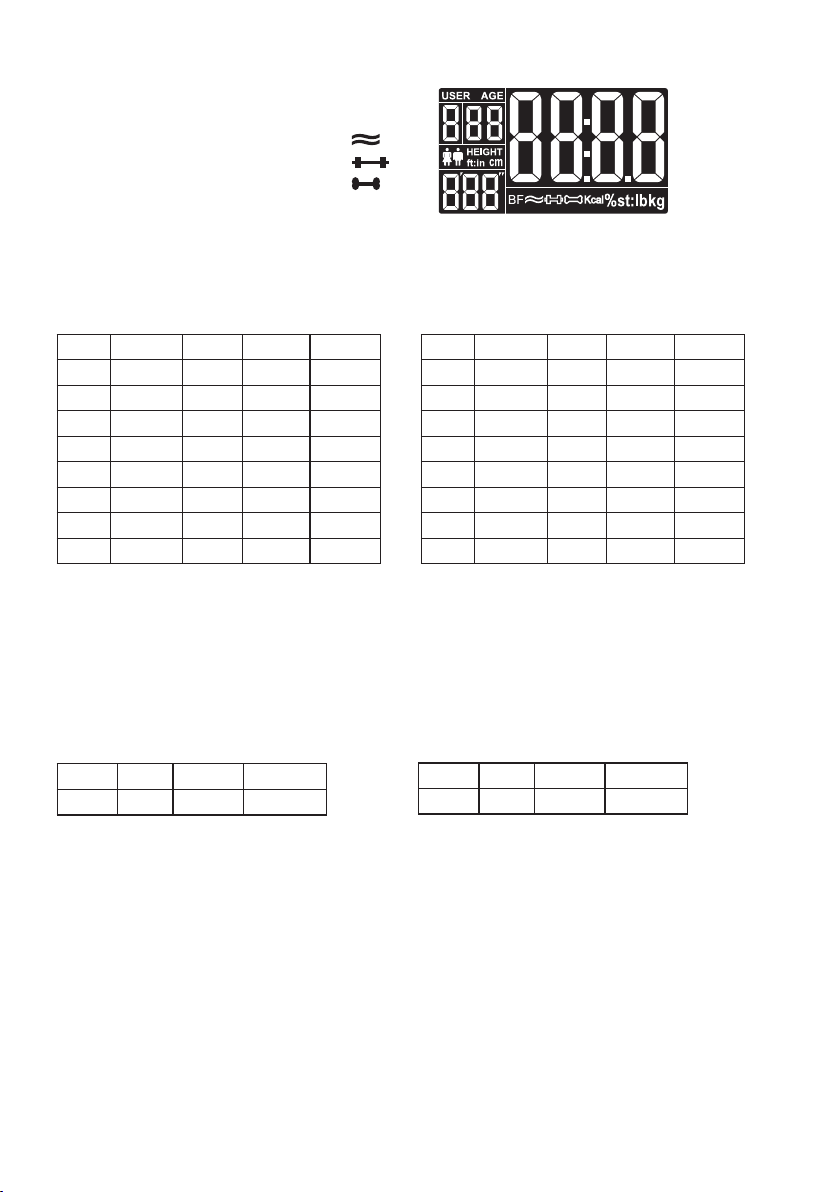
En primer lugar aparece la siguiente indicación:
1. Peso en kg
2. Masa adiposa en %
KG
BF
3. Masa líquida en %
4. Masa muscular en %
5. Masa ósea en kg
6. Metabolismo de actividad en Kcal
Masa adiposa corporal
Los siguientes valores de la masa adiposa corporal servirán para orientarse (consulte a su médico para in
formación más detallada).
Varón Mujer
Edad Excelente Bueno Regular Malo
10-14 <11% 11-16% 16,1-21% >21,1%
15-19 <12% 12-17% 17,1-22% >22,1%
20-29 <13% 13-18% 18,1-23% >23,1%
30-39 <14% 14-19% 19,1-24% >24,1%
40-49 <15% 15-20% 20,1-25% >25,1%
50-59 <16% 16-21% 21,1-26% >26,1%
60-69 <17% 17-22% 22,1-27% >27,1%
70-100 <18% 18-23% 23,1-28% >28,1%
Edad Excelente Bueno Regular Malo
10-14 <16% 16-21% 21,1-26% >26,1%
15-19 <17% 17-22% 22,1-27% >27,1%
20-29 <18% 18-23% 23,1-28% >28,1%
30-39 <19% 19-24% 24,1-29% >29,1%
40-49 <20% 20-25% 25,1-30% >30,1%
50-59 <21% 21-26% 26,1-31% >31,1%
60-69 <22% 22-27% 27,1-32% >32,1%
70-100 <23% 23-28% 28,1-33% >33,1%
-
En deportistas se observa a menudo un valor más reducido. Dependiendo del tipo de deporte, de la
intensidad del entrenamiento y de la constitución física, los valores alcanzables pueden ser inferiores
a los valores de orientación especificados.
No obstante, observe que si los valores son extremadamente bajos, puede existir peligro para la salud.
Masa líquida:
El porcentaje de masa líquida en el cuerpo se encuentra normalmente entre los siguientes valores:
Varón Mujer
Edad Malo Bueno Excelente
10-100 <50% 50-65% >65%
Edad Malo Bueno Excelente
10-100 <45% 45-60% >60%
El contenido de agua en la masa adiposa es relativamente bajo. Por esta razón es posible que el porcentaje
de masa líquida en personas con un alto porcentaje de masa adiposa, se encuentre por debajo de los va
lores de referencia. En cambio si se trata de deportistas perseverantes, es posible que sean sobrepasados
los valores de referencia debido al bajo porcentaje de masa adiposa y alto porcentaje de masa muscular.
La determinación de la masa líquida con esta báscula no es apropiada para sacar conclusiones médicas,
por ejemplo, sobre depósitos de agua debidos a la edad. En caso dado consulte a su médico.
En principio es conveniente esforzarse en obtener un alto porcentaje de masa líquida.
28
Page 29
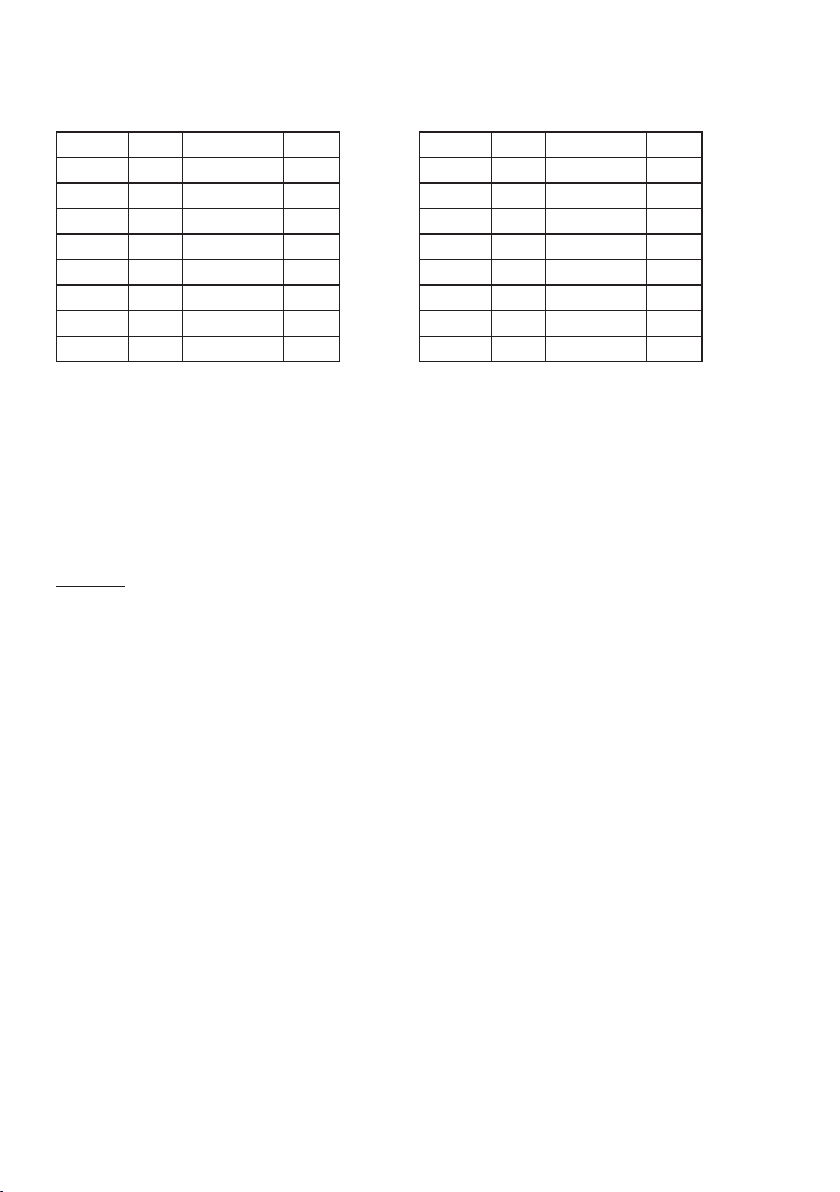
Porcentaje de masa muscular:
El porcentaje de masa muscular en el cuerpo se encuentra normalmente entre los siguientes valores:
Varón
Edad poco normal mucho
10-14 <44% 44-57% >57%
15-19 <43% 43-56% >56%
20-29 <42% 42-54% >54%
30-39 <41% 41-52% >52%
40-49 <40% 40-50% >50%
50-59 <39% 39-48% >48%
60-69 <38% 38-47% >47%
70-100 <37% 37-46% >46%
Mujer
Edad poco normal mucho
10-14 <36% 36-43% >43%
15-19 <35% 35-41% >41%
20-29 <34% 34-39% >39%
30-39 <33% 33-38% >38%
40-49 <31% 31-36% >36%
50-59 <29% 29-34% >34%
60-69 <28% 28-33% >33%
70-100 <27% 27-32% >32%
Masa ósea:
Nuestros huesos, tal como las otras partes del cuerpo, están sometidos a procesos naturales de descom
posición, regeneración y envejecimiento. La masa ósea aumenta rápidamente en la infancia y alcanza un
máximo entre los 30 y 40 años de edad. Al aumentar la edad vuelve a reducirse levemente la mása ósea.
Usted puede contrarrestar esta reducción hasta cierto punto con una alimentación sana (de alto contenido
en calcio y vitamina D) y ejercicios físicos periódicos. Usted puede además reforzar adicionalmente la es
-
tabilidad de su esqueleto con una encauzada regeneración muscular.
Observe que la presente báscula no especifica el contenido de calcio de los huesos sino que determina el
peso de todos los compuestos óseos (substancias orgánicas, substancias anorgánicas y agua).
Atención: Sin embargo, no debe confundirse la masa ósea con la densidad ósea. La densidad ósea pu
ede ser determinada solamente en un examen médico (por ejemplo, tomografía axial computadorizada, ultrasonido). Por esta razón, mediante la presente báscula no es posible sacar conclusiones médicas
sobre alteraciones de los huesos o sobre su dureza (por ejemplo, osteoporosis)
Es prácticamente imposible influir en la masa ósea, pero puede fluctuar levemente dentro de los factores
influyentes (peso, estatura, edad, sexo).
AMR:
El metabolismo activo (AMR=Active Metabolic Rate) es la cantidad de energía que requiere el cuerpo di
ariamente en estado activo. El consumo de energía de una persona aumenta al acrecentarse la actividad
física; el consumo está determinado en la báscula de diagnóstico mediante el grado de actividad (1-5) es
-
pecificado.
Para mantener el peso actual es necesario suministrar al cuerpo nuevamente la cantidad correspondiente
de energía consumida en forma de comida y bebida. Si durante un espacio mayor de tiempo se suministrara
menos energía que la consumida, el cuerpo compensará la diferencia recurriendo principalmente a los depó
sitos de masa adiposa existentes; el peso se reduce. En cambio, si durante un espacio mayor de tiempo se
suministrara al cuerpo más energía que la correspondiente al metabolismo activo (AMR) calculado, el cuerpo
no podrá quemar el excedente de energía depositándolo en forma de masa adiposa; el peso aumenta.
Relación cronológica de los resultados
Observe que solamente la tendencia a largo plazo es la que vale. Las fluctuaciones de peso a corto plazo
dentro de pocos días se deben en la mayoría de los casos a la pérdida de líquidos.
La interpretación de los resultados depende de las variaciones de los siguientes factores:
El peso total y los porcentajes de masa adiposa, líquida y muscular así como el espacio de tiempo en que
tienen lugar estas variaciones. Es necesario diferenciar aquí entre las variaciones rápidas a corto plazo (en
pocos días), las variaciones a medio plazo (en semanas) y las variaciones a largo plazo (en meses).
Una regla fundamental es que las variaciones de peso a corto plazo se deben casi siempre a los cambios
29
Page 30
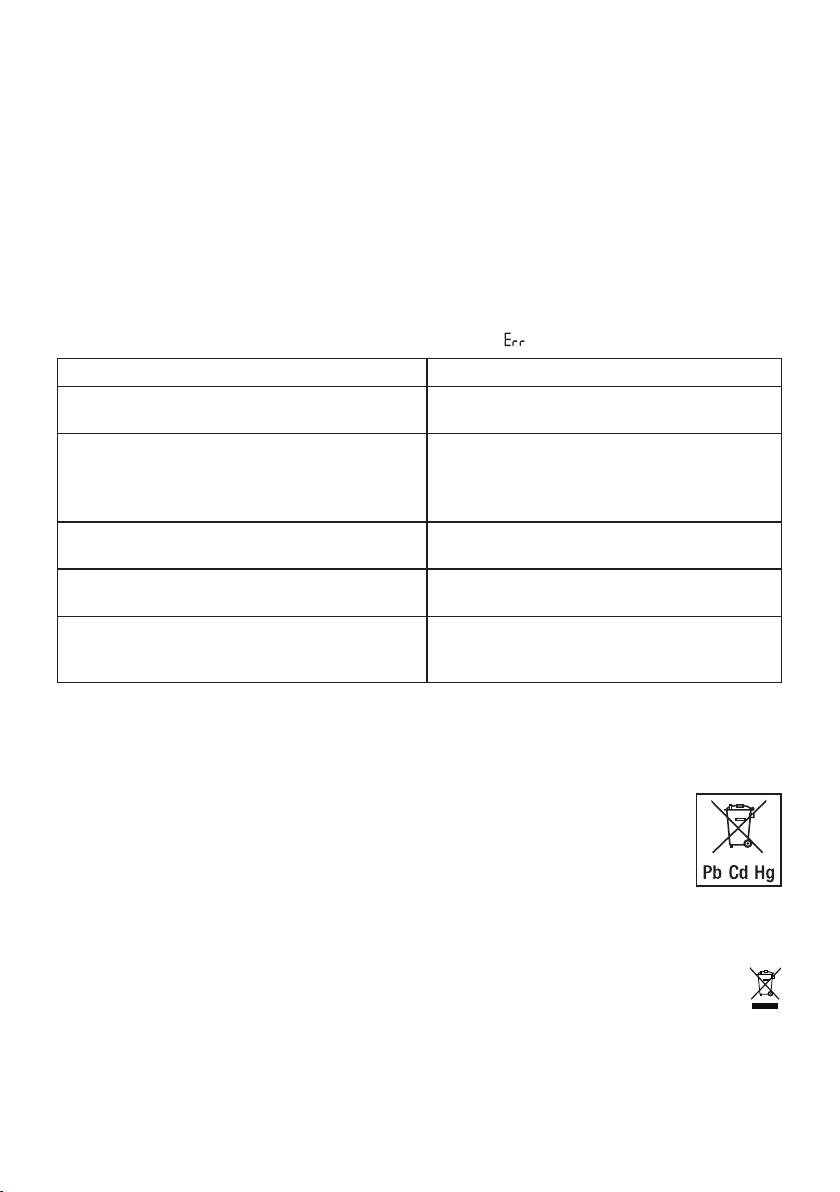
en el contenido de líquido corporal, mientras que las variaciones a medio plazo y a largo plazo pueden deberse también a cambios en las masas adiposa y muscular.
• En caso de que el peso se redujera a corto plazo pero la masa adiposa corporal aumentara o se mantu
viera constante, significa que usted ha perdido líquido, por ejemplo, después de un
entrenamiento físico, visita a la sauna o bien debido a una dieta que se ha limitado solamente a la rápi
da reducción del peso.
• En cambio si el peso aumentara a medio plazo reduciéndose o manteniéndose constante el porcentaje
de masa adiposa, probablemente ha regenerado usted valiosa masa muscular.
Si el peso y la masa adiposa del cuerpo disminuyen simultáneamente, significa que su dieta funciona y
usted está perdiendo masa adiposa. Lo ideal es complementar el régimen dietético con actividades físicas
o entrenamientos para mejorar el estado físico. De esta manera usted puede aumentar a medio
-
-
6. Medición errónea
Si la báscula detecta un error durante la medición, se visualizará “ ”.
Posibles causas del error: Solución:
Se ha excedido la capacidad máxima de carga de
180 kg.
La resistencia eléctrica entre los electrodos y la
planta de los pies es excesiva (por ejemplo por exi
stir una fuerte callosidad).
La masa adiposa está fuera de la gama de valores
medibles (inferior a un 3 % ó superior a un 55 %).
La masa líquida está fuera de la gama de valores
medibles (inferior a un 36% o superior a un 70%).
El porcentaje de masa muscular y ósea se encu
entra fuera de la gama de valores medibles (en dependencia de la edad y sexo).
Mida pesos inferiores al límite máximo admisible.
Repita la medición descalzo.
-
En caso necesario, humedezca ligeramente las
plantas de los pies. Si fuera necesario, saque las
callosidades de las plantas de los pies.
Repita la medición con los pies descalzos o bien,
humedezca levemente la planta de los pies.
Repita la medición con los pies descalzos o bien,
humedezca levemente la planta de los pies.
-
Repita la medición con los pies descalzos o bien,
humedezca levemente la planta de los pies.
7. Eliminación de desechos
Las pilas usadas, completamente descargadas, deben eliminarse a través de contenedores de recogida
señalados de forma especial, los puntos de recogida de residuos especiales o a través de los distribuido
res de equipos electrónicos. Los usuarios están obligados por ley a eliminar las pilas
correctamente.
Estos símbolos se encuentran en pilas que contienen sustancias tóxicas:
Pb: la pila contiene plomo.
Cd: la pila contiene cadmio.
Hg: la pila contiene mercurio.
A fin de preservar el medio ambiente, cuando el aparato llegue al fin de su vida útil no lo deseche con la
basura doméstica. Se puede desechar en los puntos de recogida adecuados disponibles en su zona.
Deseche el aparato según la Directiva europea sobre residuos de aparatos eléctricos y electrónicos
(RAEE). Para más información, póngase en contacto con la autoridad municipal competente en ma
teria de eliminación de residuos.
30
-
-
Salvo errores y modificaciones
Page 31
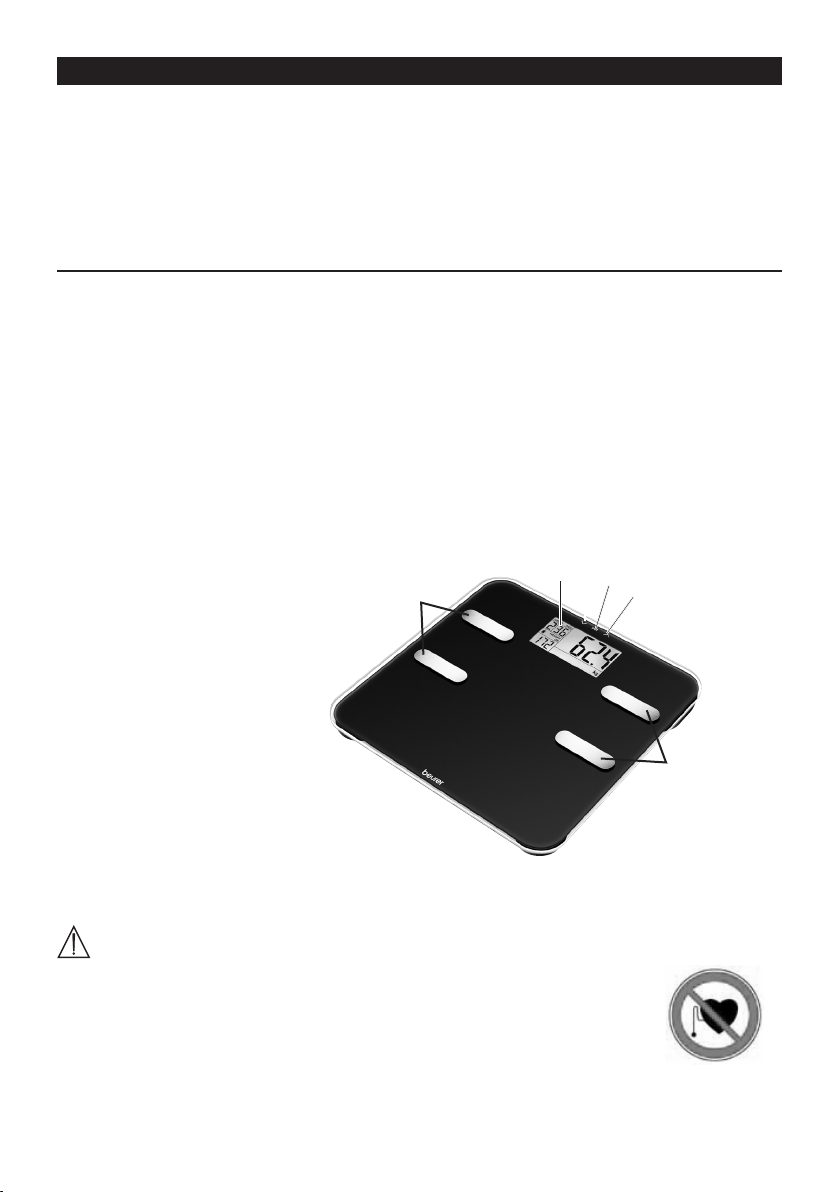
ITALIANO
Indice
1. Descrizione dell‘apparecchio ........................ 31
2. Avvertenze .................................................... 31
3. Informazioni sulla bilancia diagnostica .......... 32
4. Batterie .......................................................... 33
5. Modalità d‘uso ............................................... 33
5.1 Misurare il peso ....................................... 33
5.2 Impostare i dati personali ........................ 33
5.3 Eseguire la misurazione ........................... 34
6. Misurazione errata ......................................... 37
7. Smaltimento ................................................... 37
Gentile cliente,
siamo lieti che abbia scelto un prodotto della nostra gamma. Il nostro nome è sinonimo di prodotti
di alta qualità continuamente sottoposti a controlli nei settori del calore, del peso, della pressione
sanguigna, della temperatura corporea, delle pulsazioni, della terapia dolce, del massaggio e dell’aria.
La preghiamo di leggere attentamente le presenti istruzioni, di conservarle per un’eventuale consultazione
successiva, di metterle a disposizione di altri utenti e di osservare le avvertenze ivi riportate.
Cordiali saluti
Il Suo team Beurer
1. Descrizione dell‘apparecchio
1. Display
2. Tasto Giù
3. Tasto SET
4. Tasto Su
5. Elettrodi
5
2
1
3
4
5
2. Avvertenze
Avvertenze di sicurezza:
• La bilancia non deve essere utilizzata da persone portatrici di impianti medica
li (ad es. pacemaker). In caso contrario, si corre il rischio di danneggiare il loro
funzionamento.
• Non usare per le donne in gravidanza.
• Attenzione, non salire sulla bilancia con i piedi bagnati o con la superficie della pedana
bagnata – Pericolo di scivolare!
• L‘ingestione delle batterie può essere mortale. Conservare le batterie e la bilancia fuori della portata dei
bambini piccoli. In caso d’ingestione di una batteria, contattare immediatamente il medico.
-
31
Page 32
• Tenere i bambini lontani dal materiale d’imballaggio (pericolo di soffocamento).
• Non ricaricare o riattivare le batterie con altri mezzi, non scomporle, non gettarle nel fuoco, non cortocir
cuitarle.
-
Avvertenze sull’uso delle batterie
• Se il liquido della batteria viene a contatto con la pelle e con gli occhi, sciacquare le parti interessate con
acqua e consultare il medico.
Pericolo d’ingestione! I bambini possono ingerire le batterie e soffocare. Tenere quindi le batterie
•
lontano dalla portata dei bambini!
• Prestare attenzione alla polarità positiva (+) e negativa (-).
• In caso di fuoriuscita di liquido dalla batteria, indossare guanti protettivi e pulire il vano batterie con un
panno asciutto.
• Proteggere le batterie dal caldo eccessivo.
Rischio di esplosione! Non gettare le batterie nel fuoco.
•
• Le batterie non devono essere ricaricate o mandate in cortocircuito.
• Qualora l’apparecchio non dovesse essere utilizzato per un periodo prolungato, rimuovere le batteria dal
vano batterie.
• Utilizzare solo tipologie di batterie uguali o equivalenti.
• Sostituire sempre tutte le batterie contemporaneamente.
• Non utilizzare batterie ricaricabili!
• Non smontare, aprire o frantumare le batterie.
Avvertenze generali:
• L‘apparecchio è previsto esclusivamente per l’uso personale e non per scopi medici o commerciali.
• Si noti che, per ragioni tecniche, sono possibili tolleranze di misurazione poiché non si tratta di una bi
lancia tarata per l’uso professionale o medico.
• La portata della bilancia è di max. 180 kg (396 lb, 28 St). I risultati della misurazione del peso e della de
terminazione della massa ossea sono indicati in intervalli di 100 g (0,2 lb, 1/4 st). I risultati della misurazione del grasso e dell‘acqua corporei e dei muscoli sono indicati in intervalli di 0,1%.
• I risultati della misurazione del peso e della Il fabbisogno calorico viene indicato in intervalli di 1 kcal. Il
valore IMC (indice di massa corporea) viene visualizzato in intervalli pari a 0,1.
• Alla consegna la bilancia è impostata sulle unità “cm” e “kg”. Sul retro della bilancia è installato un selet
tore che consente di impostare le unità di misura su “pollici”, “libbre” e “stone” (lb, st).
• Collocare la bilancia su un pavimento piano e solido; un rivestimento solido del pavimento è il
presupposto per una misurazione corretta.
• Pulire di tanto in tanto l’apparecchio con un panno umido. Non utilizzare detergenti aggressivi e non
0immergere mai l’apparecchio nell’acqua.
• Proteggere l’apparecchio da urti, umidità, polvere, prodotti chimici, forti variazioni di temperatura e
tenerlo lontano da fonti di calore (stufe, radiatori).
Le riparazioni devono essere eseguite esclusivamente dal servizio assistenza di Beurer o da rivenditori au-
•
torizzati. Prima di ogni reclamo verificare in primo luogo lo stato delle batterie e sostituirle, se necessario.
-
-
-
3. Informazioni sulla bilancia diagnostica
Il principio di misurazione della bilancia diagnostica
Questa bilancia funziona secondo il metodo dell’analisi dell’impedenza bioelettrica (BIA), che consente
di determinare entro pochi secondi le percentuali di parti corporee tramite una corrente elettrica non per
cettibile e del tutto innocua. La misura della resistenza elettrica (l’impedenza) e l‘inclusione nel calcolo di
costanti e di dati personali (età, altezza, sesso, livello di attività) consente di determinare la percentuale di
grasso e di altre componenti del corpo.
32
-
Page 33

I tessuti muscolari e l’acqua possiedono una buona conduttività elettrica e quindi una bassa resistenza.
Le ossa ed i tessuti adiposi, viceversa, presentano una debole conduttività poiché l’elevato grado di resistenza
delle cellule del tessuto adiposo e delle ossa impediscono quasi completamente il passaggio della corrente.
Si noti che i valori determinati dalla bilancia diagnostica sono solo valori approssimativi dei reali valori
ottenuti da un esame medico del corpo. Solo il medico specialista è in grado di eseguire una determi
nazione esatta della percentuale di grasso, acqua, muscoli ed ossa corporei con l’ausilio di adeguate apparecchiature medicali (ad es. la tomografia computerizzata).
Suggerimenti generali
• Effettuare la misurazione possibilmente sempre alla stessa ora (preferibilmente al mattino), dopo le nor
mali abitudini di minzione o evacuazione, a digiuno e senza abiti per ottenere risultati comparabili.
• Importante per la misurazione: la determinazione del grasso corporeo deve essere eseguita solo a pie
di nudi e, per facilitare la misurazione, con le piante dei piedi leggermente inumidite. Le piante dei piedi
completamente asciutte possono causare risultati insoddisfacenti, poiché presentano una conduttività
troppo debole.
• Rimanere fermi durante l’operazione di pesatura.
• Attendere alcune ore dopo sforzi fisici inconsueti.
Attendere circa 15 minuti dopo essersi alzati per consentire all’acqua corporea di ripartirsi uniformemente.
•
Restrizioni
Nella determinazione del grasso corporeo e degli altri valori possono comparire nelle seguenti persone ri
sultati anomali e non plausibili:
• bambini sotto i 10 anni circa,
• atleti e bodybuilder,
• donne gravide,
• persone con febbre, in trattamento di dialisi, con sintomi di edema o malate di osteoporosi,
• persone che assumono farmaci cardiovascolari,
• persone che assumono farmaci vasodilatatori o vasocostrittori,
• persone con gravi anomalie anatomiche delle gambe rispetto all’altezza complessiva del corpo (gambe
eccessivamente lunghe o corte).
-
-
-
-
4. Batterie
Se presente, togliere il nastro isolante dalla batteria sul coperchio del comparto batterie, o rimuovere il foglio protettivo della batteria, e inserire la batteria rispettando la polarità. Se la bilancia non mostra nessuna
funzione, estrarre completamente la batteria e reinserirla.
La bilancia è dotata di un „indicatore di cambio batteria“. Quando si sale sulla bilancia con batterie
quasi scariche, il display visualizza il messaggio „Lo“ e la bilancia si spegne automaticamente. In questo
caso è necessario sostituire la batteria (3 x1,5 V, AAA).
5. Modalità d‘uso
5.1 Misurare il peso
Salire sulla bilancia. Restare fermi sulla bilancia cercando di distribuire il peso in modo uniforme sulle
gambe.
La bilancia avvia subito la misurazione. La rilevazione termina dopo un doppio lampeggio.
Se si scende dalla superficie di appoggio, la bilancia si spegne dopo alcuni secondi.
5.2 Impostare i dati personali
Per poter determinare la percentuale di grasso e gli altri valori corporei è necessario immettere i propri dati
33
Page 34
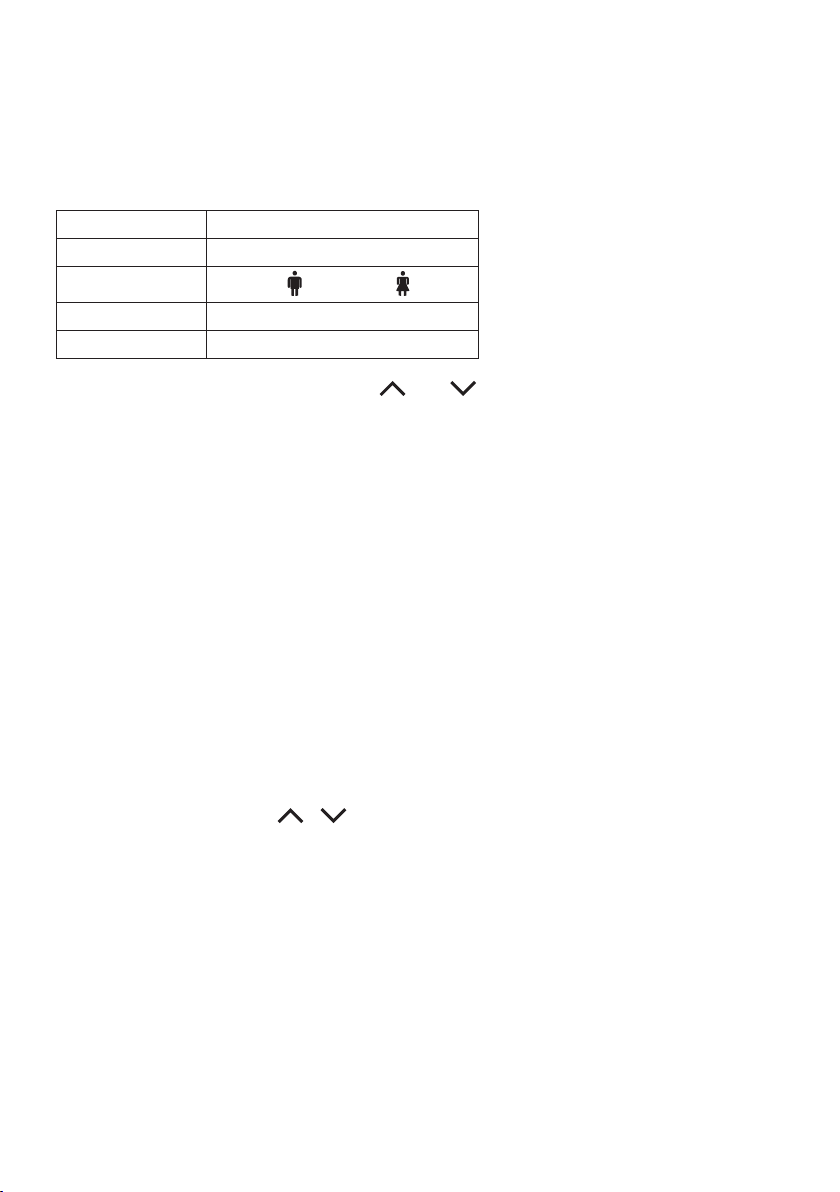
personali.
La bilancia dispone di 10 spazi di memoria utente nei quali è possibile memorizzare, e richiamare
successivamente, i propri dati personali e quelli dei propri familiari.
Accendere la bilancia premendo brevemente la pedana con il piede e attendere fino a quando non appare
l‘indicazione „0.0“.
Premere quindi „SET“. Sul display appare lampeggiante il primo spazio di memoria. Si possono eseguire le
seguenti impostazioni:
Spazio di memoria da 0 a 9
Etá da 10 a 100 anni
Sesso
Statura da 100 a 220 cm (da 3‘-03“ a 7‘-03“)
Livello di attività da 1 a 5
maschile (
), femminile ( )
Premendo brevemente o più a lungo il tasto Su
Confermare ogni valore con „SET“.
Ora la bilancia è pronta per la misurazione. Se non si eseguono misurazioni, la bilancia si spegne automa
ticamente dopo qualche secondo.
Livelli di attività:
Per la selezione del livello di attività sono decisive le considerazioni a medio e a lungo termine.
• Livello di attività 1: nessuna attività fisica.
• Livello di attività 2: attività fisica ridotta.
Pochi e leggeri sforzi fisici (ad es. passeggiate, lavori leggeri di giardinaggio, esercizi di ginnastica).
• Livello di attività 3: attività fisica media.
Sforzi fisici, almeno 2-4 volte la settimana, per 30 minuti ogni volta.
• Livello di attività 4: attività fisica elevata.
Sforzi fisici, almeno 4-6 volte la settimana, per 30 minuti ogni volta.
• Livello di attività 5: attività fisica molto elevata.
Sforzi fisici intensi, training intenso o duro lavoro fisico, giornalmente per almeno 1 ora.
5.3 Eseguire la misurazione
Dopo aver immesso tutti i parametri è possibile determinare il peso, il grasso corporeo e gli altri valori.
• Premere “SET”.
• Premendo più volte il pulsante
zati i propri dati personali. Tali dati vengono visualizzati brevemente fino a quando viene indicato il valore
“0.0”.
• Salire a piedi nudi sulla bilancia e assicurarsi di poggiare sugli elettrodi.
• In seguito al calcolo del peso, vengono visualizzati tutti i valori misurati.
Importante: fra i piedi, le gambe, i polpacci e le cosce non deve esserci alcun contatto. In caso contrario
la misurazione non potrà essere eseguita correttamente.
o selezionare la posizione di memoria nella quale sono memoriz-
o Giù è possibile impostare i valori corrispondenti.
-
34
Page 35
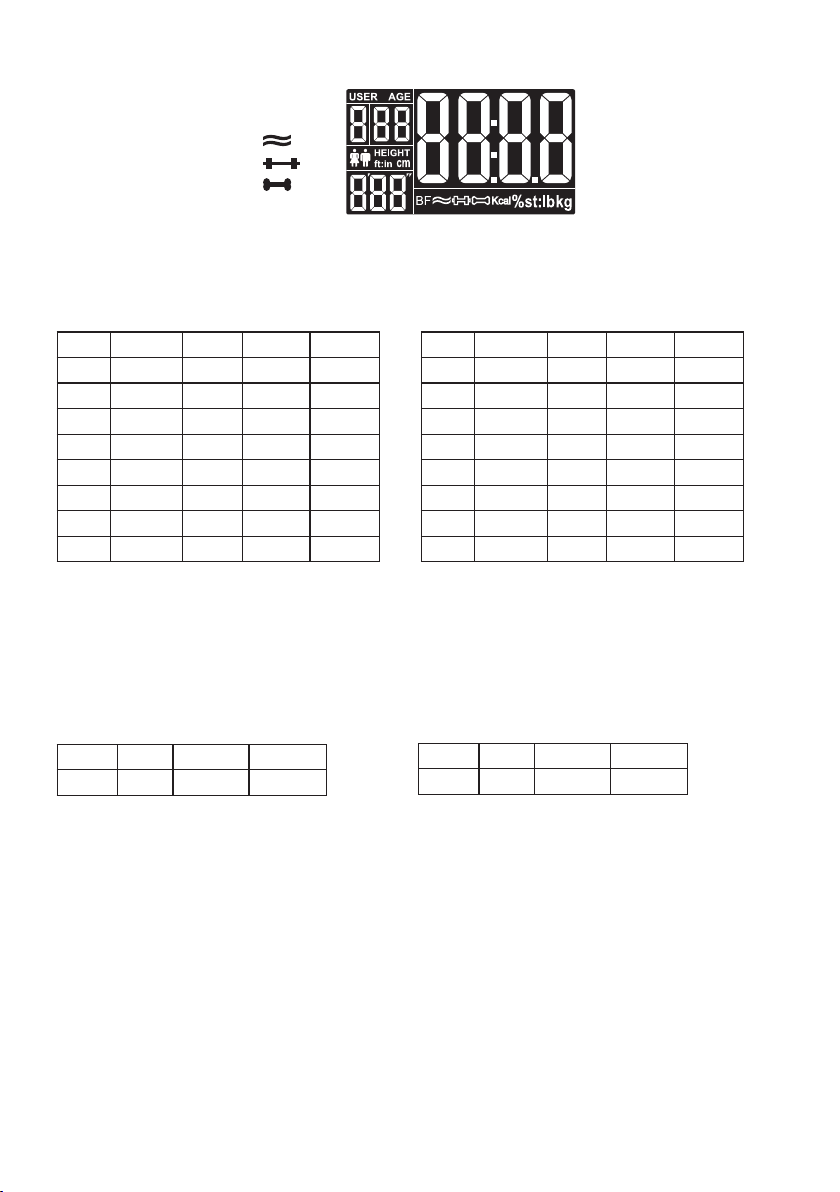
In primo luogo appare la seguente indicazione:
1. Peso in kg
2. % di grasso corporeo
KG
BF
3. % di acqua corporea
4. % di muscoli
5. Massa ossea in kg
6. Attività basale in Kcal
Percentuale di grasso corporeo
I seguenti valori di grasso corporeo sono un criterio di massima (per altre informazioni su questo argomen
to consultare il proprio medico!).
Uomo Donna
Età molto bene bene mediocre male
10-14 <11% 11-16% 16,1-21% >21,1%
15-19 <12% 12-17% 17,1-22% >22,1%
20-29 <13% 13-18% 18,1-23% >23,1%
30-39 <14% 14-19% 19,1-24% >24,1%
40-49 <15% 15-20% 20,1-25% >25,1%
50-59 <16% 16-21% 21,1-26% >26,1%
60-69 <17% 17-22% 22,1-27% >27,1%
70-100 <18% 18-23% 23,1-28% >28,1%
Età molto bene bene mediocre male
10-14 <16% 16-21% 21,1-26% >26,1%
15-19 <17% 17-22% 22,1-27% >27,1%
20-29 <18% 18-23% 23,1-28% >28,1%
30-39 <19% 19-24% 24,1-29% >29,1%
40-49 <20% 20-25% 25,1-30% >30,1%
50-59 <21% 21-26% 26,1-31% >31,1%
60-69 <22% 22-27% 27,1-32% >32,1%
70-100 <23% 23-28% 28,1-33% >33,1%
Nel caso di atleti si nota spesso un valore inferiore. A seconda del tipo di sport praticato, intensità di training
e costituzione fisica, possono essere raggiunti valori dei inferiori ai valori indicativi riportati nella tabella.
Si noti comunque che con valori estremamente bassi possono insorgere pericoli per la salute.
-
Acqua corporea:
La percentuale di acqua corporea si colloca normalmente nei seguenti campi:
Uomo Donna
Età male bene molto bene
10-100 <50% 50-65% >65%
Età male bene
10-100 <45% 45-60% >60%
molto bene
Il grasso corporeo contiene relativamente poca acqua. Per questa ragione le persone con un‘elevata percentuale di grasso corporeo possono avere una percentuale di acqua corporea al di sotto dei valori indicativi. Negli atleti agonistici, viceversa, i valori possono essere superiori a quelli indicativi a causa della bassa
percentuale di grasso e dell‘alta percentuale di muscoli.
La determinazione dell‘acqua corporea con questa bilancia non è adatta a trarre conclusioni mediche, ad
es. sull’accumulo di acqua nel corpo dovuto all‘età. Consultare il proprio medico su questo argomento.
Fondamentalmente si deve aspirare ad un‘alta percentuale di acqua corporea.
35
Page 36
Percentuale di muscoli:
La percentuale di muscoli si colloca normalmente nei seguenti campi:
Uomo Donna
Età bassa normale alta
10-14 <44% 44-57% >57%
15-19 <43% 43-56% >56%
20-29 <42% 42-54% >54%
30-39 <41% 41-52% >52%
40-49 <40% 40-50% >50%
50-59 <39% 39-48% >48%
60-69 <38% 38-47% >47%
70-100 <37% 37-46% >46%
Età bassa normale alta
10-14 <36% 36-43% >43%
15-19 <35% 35-41% >41%
20-29 <34% 34-39% >39%
30-39 <33% 33-38% >38%
40-49 <31% 31-36% >36%
50-59 <29% 29-34% >34%
60-69 <28% 28-33% >33%
70-100 <27% 27-32% >32%
Massa ossea:
Le nostre ossa, come il resto del nostro corpo, sono soggette a processi di crescita, calo e invecchiamen
to. La massa ossea aumenta rapidamente durante l‘infanzia e raggiunge il massimo in un‘età compresa fra
i 30 e 40 anni. Invecchiando, la massa ossea diminuisce leggermente. Un‘alimentazione sana (ricca spe
cialmente di calcio e vitamina D) ed un esercizio fisico regolare possono contrastare efficacemente questo
deperimento. La crescita mirata dei muscoli contribuisce a rafforzare la stabilità dell‘ossatura.
Si noti che questa bilancia non indica il contenuto in calcio delle ossa, ma determina il peso di tutte le
componenti delle ossa (sostanze organiche e inorganiche, acqua).
Attenzione: non confondere la massa ossea con la densità delle ossa. La densità delle ossa può essere
determinata unicamente da esami medici (ad es. tomografia computerizzata, ultrasuoni). Pertanto, questa
bilancia non consente di trarre conclusioni su variazioni delle ossa e della durezza della ossa (ad es. oste
-
oporosi).
La massa ossea è pressoché ininfluenzabile, ma varia leggermente nell‘ambito di determinati fattori (peso,
statura, età sesso).
:
AMR
Il metabolismo di attività (AMR=Active Metabolic Rate) è la quantità di energia che il corpo consuma giornalmente in stato attivo. Il consumo energetico di un essere umano aumenta con l‘incremento della sua
attività fisica e viene determinato nella bilancia diagnostica tramite il livello di attività (1-5).
Per mantenere il peso attuale è necessario rifornire al corpo l‘energia consumata assumendo alimenti sot
to forma solida e liquida. Se, durante un lungo periodo, si apporta al corpo un’energia inferiore a quella
consumata, il corpo compensa la differenza essenzialmente a spese della riserva di grasso accumulata,
ed il peso diminuisce. Se, viceversa, si apporta al corpo durante un lungo periodo una quantità di energia
superiore a quella totale calcolata (AMR), il corpo non può bruciare l‘eccesso di energia, ma lo deposita
nel corpo sotto forma di grasso, ed il peso aumenta.
Interazione temporale dei risultati
Si noti che conta solo la tendenza a lungo termine. Variazioni di peso nell‘ambito di qualche giorno sono
per lo più da imputare ad una perdita di liquidi.
L‘interpretazione dei risultati si orienta sulle variazioni del:
peso totale e della percentuale di grasso, acqua e muscoli corporei, nonché sull’intervallo di tempo in cui
queste variazioni sono avvenute. Occorre distinguere variazioni rapide, nell‘ambito di qualche giorno, da
quelle a medio termine (nell‘ambito di qualche settimana) e da quelle a lungo termine (mesi).
Come regola fondamentale è valida l’affermazione secondo cui le variazioni di peso a breve termine sono
da imputare quasi esclusivamente alla variazione del tenore d’acqua, mentre le variazioni a medio e a lun
go termine possono concernere anche le percentuali di grasso e di muscoli.
36
Page 37
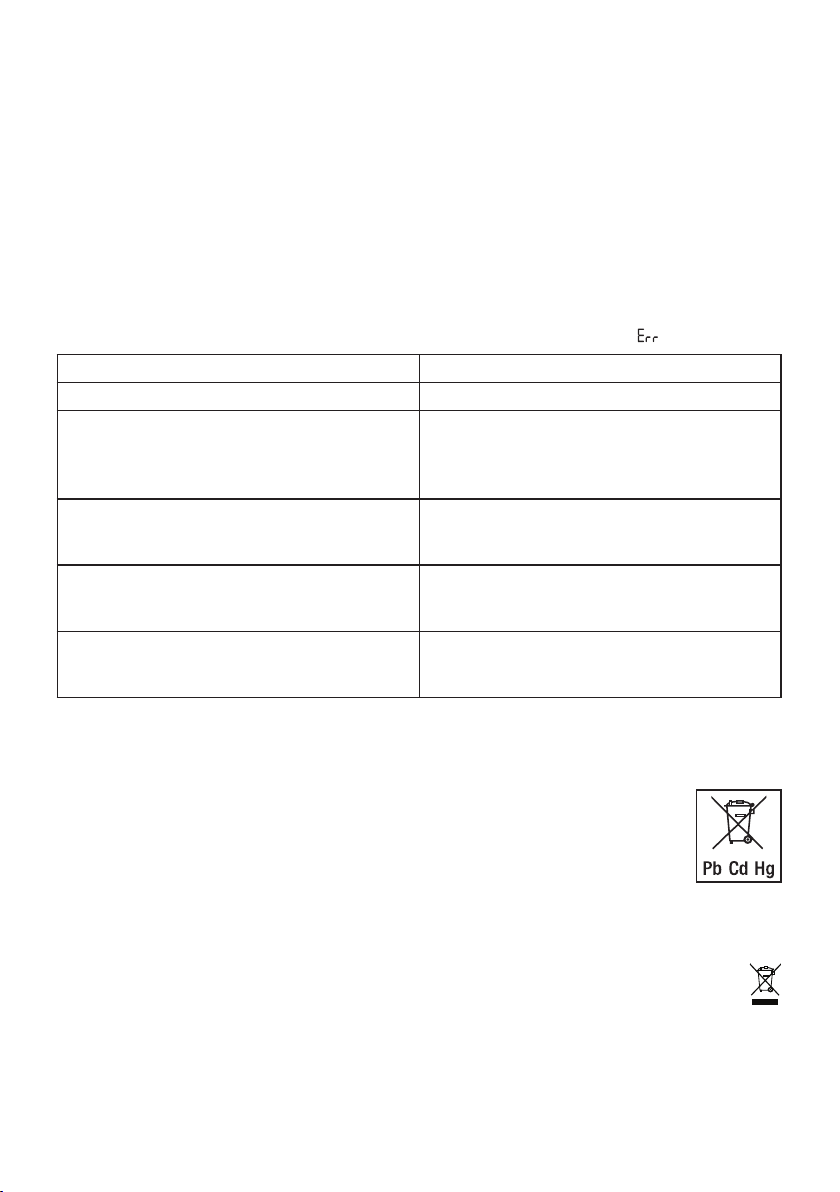
• Se il peso diminuisce entro breve termine, mentre la percentuale di grasso corporeo aumenta o rimane
invariata, significa che è stata persa solo acqua – ad es. dopo un training, una sauna oppure una dieta
mirante solo ad una rapida perdita di peso.
• Quando il peso aumenta a medio termine, mentre la percentuale di grasso corporeo diminuisce o rimane
invariato, significa che probabilmente è stata creata una preziosa massa muscolare.
Quando il peso e la percentuale di grasso corporeo diminuiscono contemporaneamente significa che la
dieta ha successo e che si perde massa grassa. Una soluzione ideale è “aiutare” la dieta con attività fisica,
allenamento fitness o di forza. In questo modo è possibile incrementare a medio termine la propria percen
tuale di muscoli.
Il grasso, l‘acqua corporei e la percentuale di muscoli non possono essere addizionati (il tessuto musco
lare contiene anche componenti presenti nell’acqua corporea).
-
-
6. Misurazione errata
Se la bilancia rileva un errore durante la misurazione, viene visualizzato il messaggio „ “.
Cause possibili degli errori: Rimedio:
La portata massima di 180 kg è stata superata. Pesare solo fino al peso massimo consentito.
La resistenza elettrica fra gli elettrodi e la pianta
del piede è troppo alta (ad es. in presenza di gros
si duroni).
La percentuale di grasso è al di fuori del cam
po misurabile (inferiore a 3% oppure superiore a
55%).
La percentuale di acqua è al di fuori del campo
misurabile (inferiore a 36% oppure superiore a
70%).
La percentuale di muscoli e di ossa è al di fuo
ri del campo misurabile (dipendente dall‘età e dal
sesso).
Ripetere la misurazione a piedi nudi.
-
Se necessario, inumidire leggermente le piante dei
piedi. Eliminare i duroni sulla pianta dei piedi, se
necessario.
-
Ripetere la misurazione a piedi nudi oppure inumi
dire leggermente le piante dei piedi.
Ripetere la misurazione a piedi nudi oppure inumi
dire leggermente le piante dei piedi.
-
Ripetere la misurazione a piedi nudi oppure inumi
dire leggermente le piante dei piedi.
-
-
-
7. Smaltimento
Smaltire le batterie esauste e completamente scariche negli appositi punti di raccolta, nei punti di raccolta
per rifiuti tossici o presso i negozi di elettronica. Lo smaltimento delle batterie è un obbligo
di legge.
I simboli riportati di seguito indicano che le batterie contengono sostanze tossiche.
Pb = batteria contenente piombo
Cd = batteria contenente cadmio
Hg = batteria contenente mercurio
Per motivi ecologici, l’apparecchio non deve essere smaltito tra i normali rifiuti quando viene buttato via.
Lo smaltimento va effettuato negli appositi centri di raccolta.
Smaltire l’apparecchio secondo la direttiva europea sui rifiuti di apparecchiature elettriche ed elett
roniche (RAEE). Per eventuali chiarimenti, rivolgersi alle autorità comunali competenti per lo smaltimento.
37
-
Con riserva di errori e modifiche
Page 38
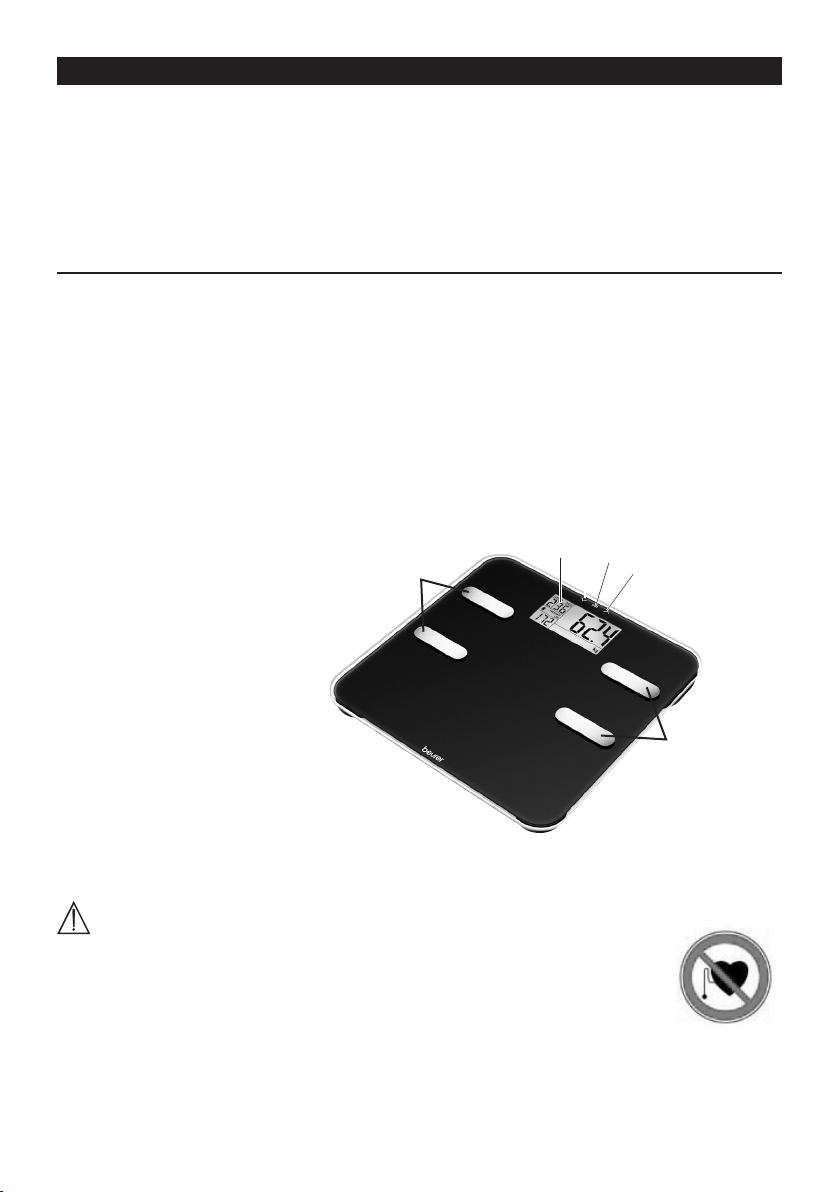
TÜRKÇE
İçindekiler
1. Alet Tanımı ..................................................... 38
3. Tanı Tartıları Hakkında Bilgiler ....................... 39
4. Piller ............................................................... 40
5. Kullanım ......................................................... 40
5.1 Ağırlık ölçmek .......................................... 40
5.2 Kullanıcı verileri ayarlamak ....................... 40
5.3 Ölçüm yapmak ......................................... 41
6. Hatalı ölçüm ................................................... 44
7. Atığın yok edilmesi ......................................... 44
Sayın Müşterimiz,
İmalatımız olan bir ürünü tercih etmenizden dolayı memnuniyetimizi belirtmek isteriz. Adımız, Isı, Ağırlık,
Kan Basıncı, Vücut Isısı, Nabız, Yumuşak Terapi, Masaj ve Hava alanlarında ayrıntılı olarak kontrolden geçi
rilmiş yüksek kaliteli ürünlerin simgesidir. Lütfen bu kullanma talimatını dikkatle okuyup sonrakı kullanımlar
için saklayınız, diğer kullanıcıların da okumasına olanak tanıyınız ve belirtilen açıklamalara uyunuz.
Dostane tavsiyelerimizle
Beurer Müessesesi
-
1. Alet Tanımı
1. Display
2. Aşağı düğmesi
3. SET düğmesi
4. Yukarı düğmesi
5. Elektrodlar
5
2
1
3
4
5
2. Talimatlar
Güvenlik Talimatları:
• Bu tartı, tıbbi emplantatı (örn. kalp pili) olan kişilerce kullanılmamalıdır. Aksi takdir-
de, bunların işlevi etkilenebilir.
• Hamilelik süresinde kullanmayınız.
• Dikkat, tartı üzerine ıslak ayakla çıkmayınız ve tartının yüzeyi nemli ise üzerine basmayı
nız – Kayma tehlikesi!
• Piller, yutulması halinde yaşamsal tehlike arz edebilir. Pilleri ve tartıyı, çocukların ulaşamayacakları şekil
de saklayınız. Bir pil yutulmuşsa, derhal tıbbi yardıma başvurunuz.
• Çocukları, ambalaj malzemesinden uzak tutunuz (Boğulma tehlikesi).
-
-
38
Page 39
• Piller, doldurulmamalı veya başka araçlarla yeniden aktive edilmemeli, parçalara ayrılmamalı, ateşe atıl-
mamalı veya kısa kontak yapılmamalıdır.
Pillerle temas etme durumu için uyarılar
• Pil hücresindeki sıvı, cilt veya gözlerle temas ettiğinde, ilgili yeri suyla yıkayın ve bir doktora başvurun.
Yutma tehlikesi! Küçük çocuklar pilleri yutabilir ve bunun sonucunda boğulabilir. Bu nedenle pilleri,
•
küçük çocukların erişmeyeceği yerlerde saklayın!
• Artı (+) ve eksi (-) kutup işaretlerine dikkat edin.
• Bir pil aktığında koruyucu eldiven giyin ve pil bölmesini kuru bir bezle temizleyin.
• Pilleri aşırı ısıya karşı koruyun.
Patlama tehlikesi! Pilleri ateşle atmayın.
•
• Piller şarj edilmemeli veya kısa devre yaptırılmamalıdır.
• Cihazı uzun süre kullanmayacağınız durumlarda pilleri pil bölmesinden çıkarın.
• Yalnız aynı tip veya eşdeğer tip piller kullanın.
• Her zaman tüm pilleri aynı anda değiştirin.
• Şarj edilebilir pil kullanmayın!
• Pilleri parçalarına ayırmayın, açmayın veya parçalamayın.
Genel Talimatlar:
• Alet, sadece kişisel kullanıma yöneliktir, tıbbi ve ticari amaçla kullanıma uygun değildir.
• Burada sözkonusu olan profesyonel ve tıbbi kullanım için ayarlanmış bir tartı olmadığından, teknik zorun
luluktan dolayı ölçüm toleransının mümkün olabileceğini dikkate alınız.
• Tartının taşıyabileceği ağırlık azami 180 kg‘dır (396 lb, 28 Adım). Kilo ölçümünde ve kemik hacmi belir
lemesinde sonuçlar, 100 g’lık adımlar (0,2 lb, 1/4 Adım) halinde gösterilir. Vücut yağı, vücut suyu ve kas
oranlarının ölçüm sonuçları, %0,1’lik adımlarla gösterilir.
• Kalori ihtiyacı 1 kcal’lik artışlarla gösterilir. BMI değeri (Body-Mass-Index) 0,1’lik artışlarla gösterilir.
• Tartı, teslim edilmeye hazır durumda iken, “cm” ve “kg” birimlerine göre ayarlıdır. Tartının arkasında bulu
nan bir şalter yardımıyla ayarı, “inç” (“1/2 kg”) ve “libre” (lb) ve “stone (14 libre)” birimlerine değiştirebilirsiniz.
• Tartıyı sağlam düzgün bir zemine koyunuz; sağlam bir zemin döşemesi, doğru bir ölçüm için ön şarttır.
• Tartı, zaman zaman nemli bir bezle temizlenmelidir. Keskin temizlik maddeleri kullanmayınız ve tartıyı, ke
sinlikle su altına tutmayınız.
• Tartıyı, darbelere, neme, toza, kimyasal maddelere, aşırı ısı değişimlerine ve yakın ısı kaynaklarına (soba,
kalorifer) karşı koruyunuz.
• Onarımlar, yalnız Beurer Müşteri Servisince veya yetkili satıcılar tarafından yapılmalıdır. Her bir reklamas
yondan önce, yine de ilk olarak pilleri kontrol ediniz ve gerekirse bunları değiştiriniz.
-
-
-
-
-
3. Tanı Tartıları Hakkında Bilgiler
Tanı Tartısının Ölçüm Prensibi
Bu tartı, B.I.A, Biyoelektrik-Empedans-Analizi’ne göre çalışır. Burada sözkonusu olan, hissedilmeden, ta
mamen sakıncasız ve tehlikesi olmayan bir elektrik akımı ile birkaç saniye içerisinde vücut oranlarının tespit
edilmesinin sağlanmasıdır. Elektrik direncinin (Empedans) ölçümü ve sabit ve bireysel değerlerin (Yaş, Boy,
Cinsiyet, Hareketlilik derecesi) dahil edilerek hesaplanması ile, vücuttaki yağı oranı ve vücuttaki diğer bü
yüklükler belirlenebilir.
Kas dokusu ve su, iyi birer elektriksel iletken özelliği taşırlar ve bu nedenle düşük bir dirence sahiptirler.
Bunun tersine, yağ hücreleri ve kemik çok yüksek diren nedeniyle elektriği çok az ilettiğinden, kemik ve
yağ dokusu, düşük bir iletkenliğe sahiptir.
39
-
-
Page 40

Tanı tartısından aktarılan değerin vücudun tıbbi ve gerçek analiz değerine yalnız bir yaklaşık değer olduğuna dikkat ediniz. Yalnız uyman doktor tıbbi metodlarla (örn. Bilgisayar Tomografisi) vücut yağı, vücut suyu,
kas oranı ve kemik yapısının tam bir tahkikatını yapabilir.
Genel Öneriler
• Birbiriyle karşılaştırılabilir sonuçlar elde edebilmek için, mümkün olduğunca günün aynı saatlerinde (en
iyisi sabahları), tuvalete gittikten sonra, aç karnına ve giysisiz olarak tartılın.
• Ölçümde Önemli olanlar: Ölçüm, sadece yalınayak ve amaca uygun olarak hafifçe nemlendirilmiş ayak
tabanlarıyla yapılmalıdır. Kuru ayak tabanlarının iletkenlik özelliği az olduğundan, tamamen kuru ayak ta
banları tatmin edici olmayan sonuçlara yol açabilir.
• Ölçme sırasında kıpırdamayınız.
• Alışılmadık yorucu bedensel çalışmadan sonra birkaç saat bekleyiniz.
• Ayağa kalktıktan sonra yaklaşık 15 dakika bekleyiniz ki, vücudunuzdaki su dağılabilsin.
Sınırlılıklar
Aşağıdaki gruplarda vücut yağının ve diğer değerlerin tahkikatında farklı ve makul olmayan sonuçlar ortaya
çıkabilir:
• 10 yaşın altındaki çocuklarda,
• Başarı sporcularında ve vücut geliştirenlerde,
• Hamilelerde,
• Ateşi olan, diyaliz tedavisi gören, ödem belirtileri olan veya kemik erimesi olan şahıslarda,
• Kardiyovasküler ilaç alan şahıslarda,
• Damar genişleten veya damar daraltan ilaçlar kullanan şahıslarda,
• Tüm vücut büyüklüğüne bağlantılı olarak bacaklarında mühim derecede anatomik farklılıkları
olan kişilerde (Bacak uzunluğu önemli derecede kısa veya uzun ise).
-
4. Piller
Mevcut ise, pil haznesi kapağının izole bandını çekerek pil yatağı kapağını ve de pil koruma folyesini
çıkartınız ve pili kutuplarına göre yerleştiriniz. Tartının, herhangi bir fonksiyon göstermemesi halinde, pillerin
tamamını çıkarıp yeniden yerleştiriniz.
Tartınız, bir “pil değiştirme göstergesi” ile donatılmıştır. Tartıyı zayıf piller ile çalıştırınca, göstergede “Lo” bil
dirisi belirir ve tartı otomatik olarak kapanır. Bu durumda, piller yenilenmelidir (4 x1,5 V, AAA).
-
5. Kullanım
5.1 Ağırlık ölçmek
Terazinin üzerine çıkın. Terazinin üzerinde ağırlığınızı iki bacağınıza eşit olarak dağıtarak hareket etmeden
durun. Terazi hemen tartmaya başlar. İki kez yanıp söndükten sonra ağırlığınız sabitlenir.
Basma yüzeyinden indiğinizde, terazi birkaç saniye sonra kapanır.
5.2 Kullanıcı verileri ayarlamak
Vücut yağı oranını ve vücut değerlerini belirleyebilmek için, kişisel kullanıcı verilerini hafızaya kaydetmeniz
gerekir.
Tartı, kendinizin ve aile bireylerinizin kişisel ayarlarını kaydedebilmesi ve bunları tekrar çağırabilmesi için 10
kullanıcı hafıza kaydetme yerine sahiptir.
Tartıyı, kısaca ayak basma yerine basarak aşınız. Göstergede “0.0” belirene kadar bekleyiniz.
40
Page 41
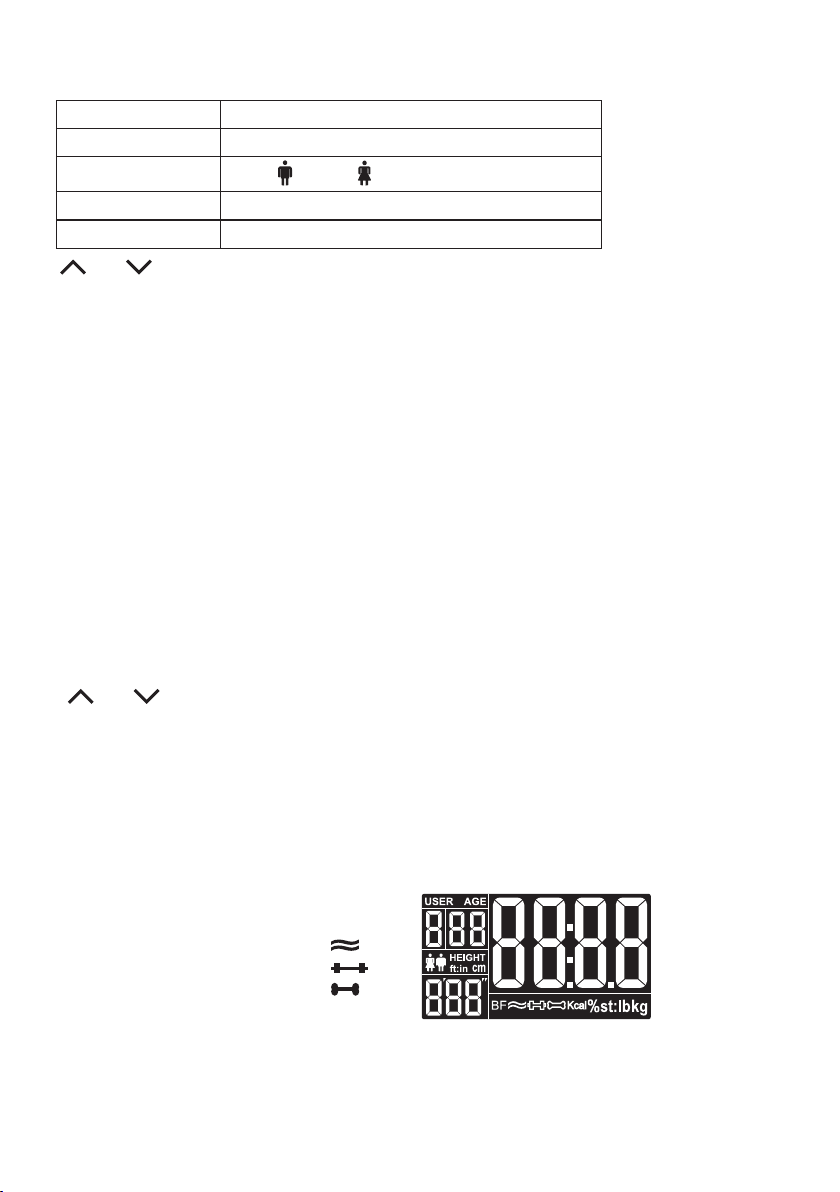
Sonra “SET” tuşuna basınız. Göstergede şimdi yanıp sönerek ilk hafıza yeri belirir. Artık aşağıdaki ayarları
yapabilirsiniz:
Hafıza yeri 0’den 9’a kadar
Yaş 10’dan 100 yaşına kadar
Cinsiyet
Vücut büyüklüğü 100’den 220 cm’ye kadar (3‘-03“’den 7‘-03“e kadar )
Hareketlilik derecesi 1’den 5’e kadar
veya tuşlarına kısaca veya uzunca basarak ilgili değeri ayarlayabilirsiniz. Değerleri, her seferinde
“SET” tuşuyla onaylayınız.
Tartı artık ölçme, yani tartma işlemine hazırdır. Eğer herhangi bir ölçüm yapmazsanız, tartı birkaç saniye
sonra otomatik olarak kapanır.
Hareketlilik dereceleri:
Harekelilik derecesinin seçiminde, orta ve uzun vadeli gözleme belirleyicidir.
• Hareketlilik derecesi 1: Bedensel hareketlilik yok.
• Hareketlilik derecesi 2: çok az bedensel hareketlilik.
az ve hafif bedensel çalışmalar (örn. Yürüyüşler, hafif bahçe işleri, jimnastik hareketleri).
• Hareketlilik derecesi 3: Orta dereceli bedensel hareket.
Bedensel çalışmalar, her biri 30 dakika haftada en az 2 ile 4 kez.
• Hareketlilik derecesi 4: Yüksek dereceli bedensel hareket.
Bedensel çalışmalar, her biri 30 dakika haftada en az 4 ile 6 kez.
• Hareketlilik derecesi 5: Çok yüksek dereceli bedensel hareke t.
Yoğun bedensel çalışma, yoğun antreman veya ağır bedensel iş, her biri en az 1 saat hergün.
5.3 Ölçüm yapmak
Tüm parametreler girildikten sonra, artık ağırlık, vücut yağı ve diğer değerler belirlenebilir.
• “SET” üzerine basın.
veya düğmelerine art arda basarak, kişisel başlangıç verilerinizin kaydedildiği hafıza konumunu
•
seçin. Bunlar “0.0” ifadesi belirene dek kısa süre görüntülenir.
• Terazinin üzerine çıplak ayakla çıkın ve elektrotların üzerinde sakince durduğunuzdan emin olun.
• Ağırlık ölçümünden sonra tespit edilen tüm değerler belirir.
erkek (
), kadın ( )
Önemli: Her iki ayağınız, bacağınız, baldırınız ve üst baldırınız arasında bir temas olmamalıdır. Aksi halde,
tartılma işlemi doğru olarak gerçekleşmeyebilir.
Önce aşağıdaki gösterge belirir:
1. Ağırlık kg,
2. Vücut yağı %
3. Vücut suyu %
4. Kas payı %
5. Kemik kütlesi kg olarak
6. Aktif metabolik oran Kcal olarak
KG
BF
41
Page 42
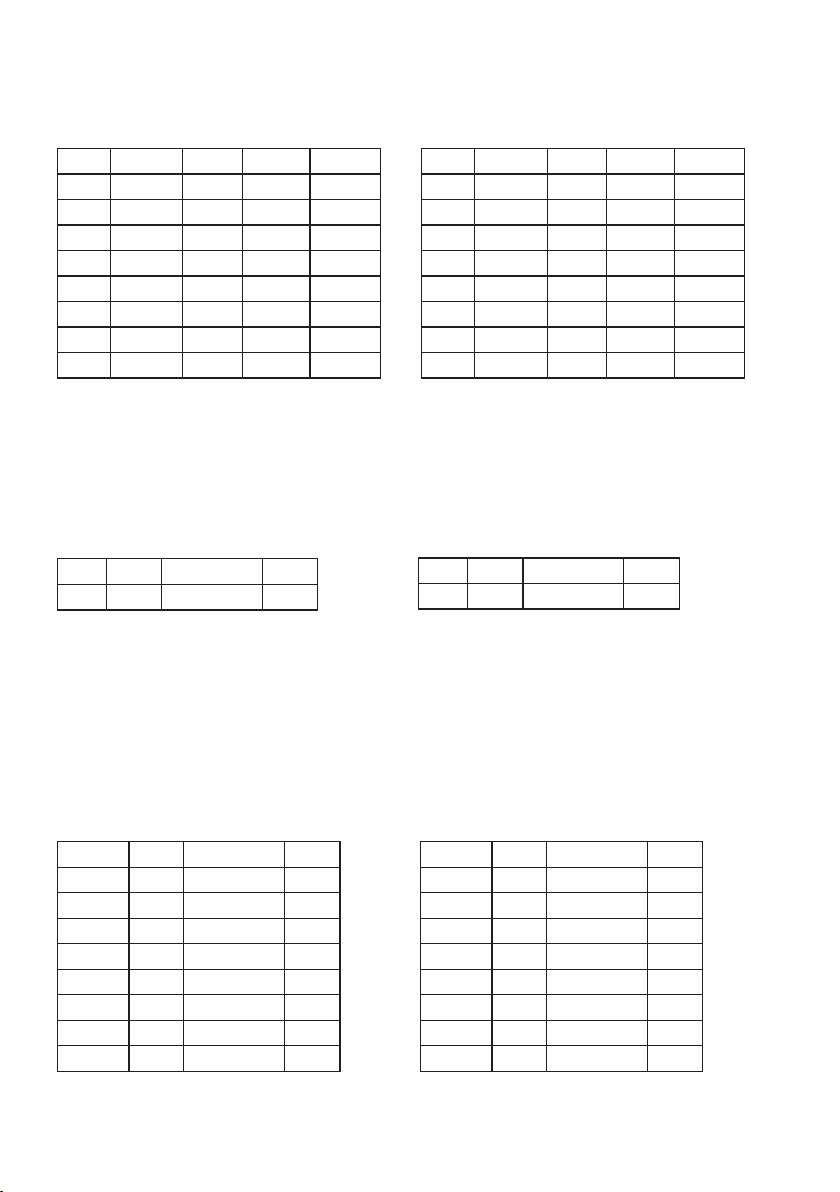
Vücut yağı payı
Aşağıdaki belirtilen vücut yağı değerleri size bir ipucu verirler (daha fazla bilgi için lütfen doktorunuza baş
-
vurunuz!).
Erkek Kadın
Yaş çok iyi iy orta kötü
10-14 <11% 11-16% 16,1-21% >21,1%
15-19 <12% 12-17% 17,1-22% >22,1%
20-29 <13% 13-18% 18,1-23% >23,1%
30-39 <14% 14-19% 19,1-24% >24,1%
40-49 <15% 15-20% 20,1-25% >25,1%
50-59 <16% 16-21% 21,1-26% >26,1%
60-69 <17% 17-22% 22,1-27% >27,1%
70-100 <18% 18-23% 23,1-28% >28,1%
Yaş çok iyi iy orta kötü
10-14 <16% 16-21% 21,1-26% >26,1%
15-19 <17% 17-22% 22,1-27% >27,1%
20-29 <18% 18-23% 23,1-28% >28,1%
30-39 <19% 19-24% 24,1-29% >29,1%
40-49 <20% 20-25% 25,1-30% >30,1%
50-59 <21% 21-26% 26,1-31% >31,1%
60-69 <22% 22-27% 27,1-32% >32,1%
70-100 <23% 23-28% 28,1-33% >33,1%
Sporcularda çoğunlukla daha düşük bir değer tespit edilir. Uygulanan spor türüne, antrenman yoğunluğuna ve bedensel yapıya göre, öngörülen değerlerin daha altında kalan değerlere ulaşılabilir.
Lütfen, yine de aşırı düşük değerlerde sağlık tehlikesinin olabileceğine dikkat ediniz.
Vücut suyu:
Vücut suyu payı, normalde aşağıda sıralanan alanlarda yer alır:
Erkek Kadın
Yaş kötü iyi çok iyi
10-100 <50% 50-65% >65%
Yaş kötü iyi çok iyi
10-100 <45% 45-60% >60%
Vücut yağı o dukça az su içerir. Bu nedenle, yüksek bir vücut yağ payı olan kişilerde, vücut su payı, yukarıda belirtilen değerlerin altında bulunabilir. Dayanıklı sporcularda ise bunun zıttına, ,düşük yağ payı ve yüksek kas payı nedeniyle standart değerler, aşılabilir.
Bu tartı ile vücut suyu belirlemesi, örn. yaşa bağlı olarak su toplanmaları gibi tıbbi sonuçları hesaba katma
-
ya uygun değildir. Gerekli olması halinde doktorunuza başvurunuz.
Prensip olarak, yüksek bir vücut suyu payının sağlanması geçerlidir.
Kas Payı:
Kas payı, normalde aşağıda sıralanan alanlarda yer alır:
Erkek Kadın
Yaş az normal çok
10-14 <44% 44-57% >57%
15-19 <43% 43-56% >56%
20-29 <42% 42-54% >54%
30-39 <41% 41-52% >52%
40-49 <40% 40-50% >50%
50-59 <39% 39-48% >48%
60-69 <38% 38-47% >47%
70-100 <37% 37-46% >46%
Yaş az normal çok
10-14 <36% 36-43% >43%
15-19 <35% 35-41% >41%
20-29 <34% 34-39% >39%
30-39 <33% 33-38% >38%
40-49 <31% 31-36% >36%
50-59 <29% 29-34% >34%
60-69 <28% 28-33% >33%
70-100 <27% 27-32% >32%
42
Page 43

Kemik Kütlesi:
Kemiklerimiz, vücudumuzun diğer organları gibi, doğal yenileme, yıpranma ve yaşlanma süreçlerine maruz
dur. Kemik kütlesi, çocuk yaşta çok hızla gelişir ve 30 ile 40 yaşa kadar gelişiminin en üst noktasına ulaşır.
İleri yaşlarda, kemik kütlesi sonra tekrar biraz azalır. Sağlıklı bir beslenme (özellikle Kalsiyum ve D Vitamini)
ve düzenli bedensel hareket ile bu gerilemeye karşı bir parça etki edebilirsiniz. Hedefli bir şekilde kas yap
mayla, kemik iskelenizin sağlamlılığını ek olarak güçlendirebilirsiniz.
Bu tartının kemiğin kalsiyum miktarını çıkarmadığına, bilakis kemiğin tüm bileşenlerininin (organik madde
ler, anoragik maddeler ve su) ağırlığını belirlediğine dikkat ediniz.
Dikkat: Lütfen kemik kütlesini lakin kemik yoğunluğuyla karıştırmayınız. Kemik yoğunluğu, yalnız tıbbi tah
kikatlarla (örn. Bilgisayar tomografisi, ültrason) belirlenebilir. Bu nedenle, kemik sertliğindeki ve kemikteki
değişimlerin (örn. Osteoporoz) sonuçları, bu tartı ile mümkün değildir.
Kemik kütlesi, çok nadir etkilenir, ama etkileyen faktörler (Ağırlık, Boy, Yaş, Cinsiyet) dahilinde önemsiz
oranda salınır.
AMR
Aktif metabolik oran (AMR = Aktive Metabolic Rate), vücudun aktif durumda iken günlük tükettiği ener
ji miktarıdır. Bir insanın enerji tüketimi, gittikçe çoğalan bedensel etkinlikle artar ve tanı tartısında girilmiş
hareketlilik derecesi (1-5) üzerinden belirlenir.
Güncel ağırlığı korumak için, tüketilen enerji yiyecek ve içecek olarak vücuda uygun olarak geri sağlanmalı
dır. Uzunca bir süre tüketilenden daha az enerji alınmışsa, vücut başlıca depolanmış yağ reservlerinden bu
farkı kapatır, kilo kaybı oluşur. Bunun aksine, uzunca bir süre hesaplanan toplam enerji oranından (AMR)
daha fazla enerji alınmışsa, vücut enerji fazlalığını yakamaz, fazlalık yağ olarak depolanır ve kilo alınır.
Sonuçların zamanla ilişkisi
Yalnız uzun vadeli eğilimin önemli olduğuna dikkat ediniz. Birkaç gün içersinde kısa sürede gelişen ağırlık
(kilo) sapmaları, çoğunlukla yalnız sıvı kaybı nedeniyledir.
Sonuçların yorumu, aşağıda belirtilenlerin değişimlere göre belirlenir:
Toplam ağırlık ve vücut yağı, vücut suyu ve kas paylarının yüzdesi ve de bu değişimlerin hangi zaman di
limine göre gerçekleştiğidir. Birkaç gün içerisinde olan hızlı değişimleri, orta vadeli değişimlerden (haftalar
dahilinde) ve uzun vadeli değişimlerden (aylar dahilinde) ayırt etmek gerekir.
Orta ve uzun vadeli değişimler, yağ ve kas oranlarını da içerisine alabilir iken, kısa vadeli ağırlık (kilo) değişimlerinin neredeyse istisnasız olarak, su miktarındaki değişikliği gösterdiği temel kural olarak geçerli olabilir.
• Ağırlıkta, kısa vadeli olarak azalma olur, bununla beraber vücuttaki yağ oranı artar veya aynı kalırsa, o za-
man yalnız su kaybetmişsinizdir; örn. bir antrenmandan, saunadan veya sadece hızlı kilo vermekle sınırlı
olan bir rejimden sonra.
• Ağırlık orta vadeli olarak artar ve vücuttaki yağ oranı azalır veya aynı kalırsa, bunların aksine o zaman de
ğerli kas kütlesi oluşturmuş olabilirsiniz.
Ağırlık ve vücut yağ payı aynı anda azalırsa, rejiminiz işlevini yerine getiriyor demektir; yağ kütlesi kaybedi
yorsunuzdur. Diyetinizi, ideal olarak bedensel hareketler, Fitnes ve Ağırlık çalışmaları ile desteklemiş olursunuz. Böylece, orta vade de kas oranınızı artırabilirsiniz.
Vücut yağı, vücut suyu veza kas payları, toplanmamalıdır (Kas dokusu, vücut suyundan bileşenleri de içerir).
-
-
-
-
-
-
-
-
-
43
Page 44
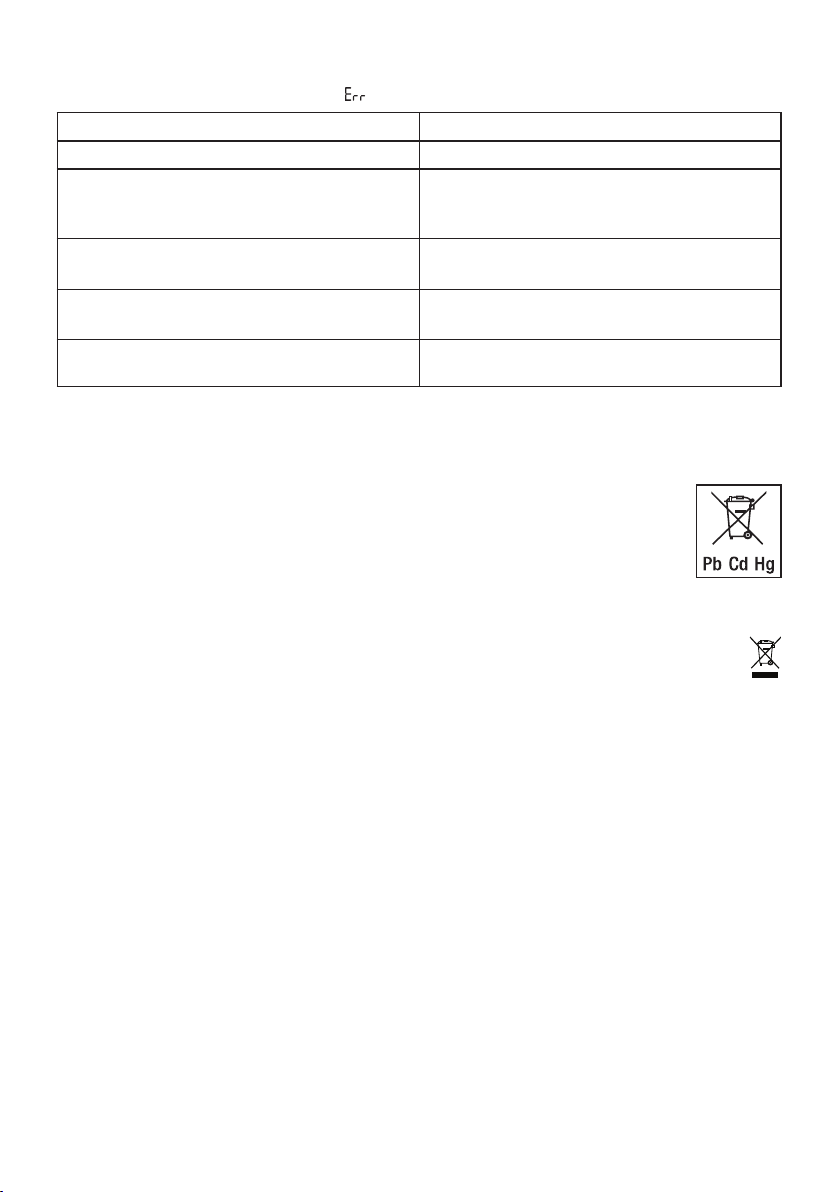
6. Hatalı ölçüm
Tartı, ölçüm sırasında bir hata belirler ise, “ ” belirir.
Olası Hata Nedenleri: Giderme:
Maksimum 180 kg taşıma kapasitesi aşıldı sadece izin verilen maksimum ağırlığı tartın.
Elektrotlar ile ayak tabanı arasındaki elektrik di
renci
çok yüksek (örn. aşırı nasırlardan dolayı).
Yağ oranı tartılabilir kesim dışında
kalıyor (%3’ten küçük veya %55’den büyük).
Su oranı ölçülebilen alanın dışında
kalıyor (%36’ten küçük veya %70’den büyük).
Kas ve kemik payı tartılabilir kesim dışında kalıyor
(yaşa ve cinsiyete bağlı).
-
Tartma işlemini lütfen yalınayak tekrarlayın.
Gerektiğinde ayak tabanınızı biraz nemlendirin.
Gerekirse ayak tabanlarındaki nasırları giderin.
Tartma işlemini lütfen yalınayak tekrarlayın veya
gerektiğinde ayak tabanlarınızı biraz nemlendirin.
Tartma işlemini lütfen yalınayak tekrarlayın veya
gerektiğinde ayak tabanlarınızı biraz nemlendirin.
Tartma işlemini lütfen yalınayak tekrarlayın veya
gerektiğinde ayak tabanlarınızı biraz nemlendirin.
7. Atığın yok edilmesi
Kullanılmış, tamamen boşalmış piller özel işaretli toplama kutularına atılarak, özel atık toplama yerlerine
veya elektrikli cihaz satıcılarına teslim edilerek bertaraf edilmelidir. Pillerin bertaraf edilmesi, yasal olarak si
zin sorumluluğunuzdadır.
Bu işaretler, zararlı madde içeren pillerin üzerinde bulunur:
Pb = Pil kurşun içeriyor,
Cd = Pil kadmiyum içeriyor,
Hg = Pil cıva içeriyor.
Çevreyi korumak için, kullanım ömrü dolan cihazı evsel atıklarla beraber bertaraf etmeyin. Cihaz,
ülkenizdeki uygun atık toplama merkezleri aracılığıyla bertaraf edilmelidir.
Cihazı, elektrikli ve elektronik hurda cihazlarla ilgili AB direktifine (WEEE - Waste Electrical and Elec
tronic Equipment) uygun şekilde bertaraf edin. Bertaraf etme ile ilgili sorularınızı, ilgili yerel makamlara iletebilirsiniz.
-
-
44
Hata, yanılma ve değişiklik yapma hakkımız saklıdır
Page 45
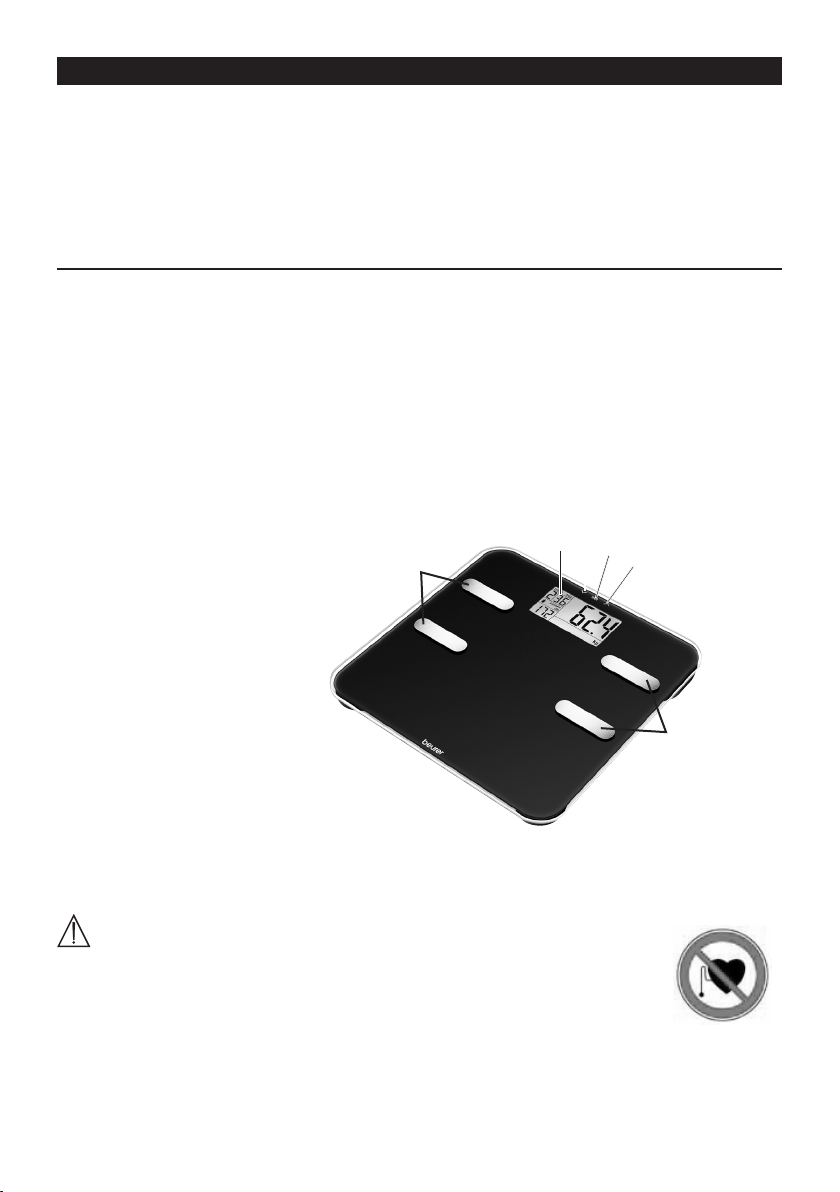
РУССКИЙ
Содержание
1. Описание аппарата ........................................... 45
2. Указания ............................................................ 45
3. Информация о диагностических весах .......... 46
4. Батарейки .......................................................... 47
5. Как пользоваться весами ................................ 47
5.1 Измерение веса .......................................... 47
5.2 Настройка пользовательских данных ....... 48
5.3 Проведение измерения .............................. 48
6. Неверное измерение ........................................ 51
7. Утилизация ....................................................... 51
8. Гарантия ............................................................. 52
Многоуважаемый покупатель!
Мы рады тому, что Вы выбрали товар из нашего ассортимента. Изделия нашей компании являются продуктами высочайшего качества, используемых для измерения веса, артериального давления, температуры тела, частоты пульса, в области мягкой терапии и массажа.
Внимательно прочтите данную инструкцию по эксплуатации, сохраняйте ее для дальнейшего использова
ния, дайте ее прочитать и другим пользователям и строго следуйте приведенным в ней указаниям.
С дружескими пожеланиями сотрудники компании Beurer
1. Описание аппарата
1. Дисплей
2. Кнопка „Уменьшить“
3. Кнопка „Set“
4. Кнопка „Увеличить“
5. Электроды
5
2
1
3
4
-
5
2. Указания
Указания по технике безопасности:
• Запрещается пользоваться весами лицам с медицинскими имплантатами (напри-
мер, с кардиостимулятором ). В противном случае могут произойти сбои в работе
имплантатов.
• Не использовать во время беременности.
• Внимание! Не становитесь на весы, если Ваши ноги или поверхность весов мокрые -
Вы можете поскользнуться!
• При попадании в пищеварительный тракт батарейки могут представлять опасность для жизни. Храните
батарейки и весы в недоступном для детей месте. Лицу, проглотившему батарейку, следует незамедли
тельно обратиться к врачу.
45
-
Page 46
• Не допускайте попадания упаковочного материала в руки детей (опасность удушья).
• Запрещается заряжать или иными способами восстанавливать батарейки, разбирать их, бросать в
огонь или накоротко замыкать полюса.
Обращение с элементами питания
• При попадании жидкости из аккумулятора на кожу или в глаза необходимо промыть
соответствующий участок большим количеством воды и обратиться к врачу.
Опасность проглатывания мелких частей! Маленькие дети могут проглотить батарейки и
•
подавиться ими. Поэтому батарейки необходимо хранить в недоступном для детей месте!
• Обращайте внимание на обозначение полярности: плюс (+) и минус (-).
• Если батарейка потекла, очистите отделение для батареек сухой салфеткой, надев защитные
перчатки.
• Защищайте батарейки от чрезмерного воздействия тепла.
Опасность взрыва! Не бросайте батарейки в огонь.
•
• Не заряжайте и не замыкайте батарейки накоротко.
• Если прибор длительное время не используется, извлеките из него батарейки.
• Используйте батарейки только одного типа или равноценных типов.
• Заменяйте все батарейки сразу.
• Не используйте перезаряжаемые аккумуляторы!
• Не разбирайте, не открывайте и не разбивайте батарейки.
Общие указания:
• Прибор предназначен только для индивидуального применения и не должен использоваться в меди-
цинских или коммерческих целях.
• Учтите, что возможны обусловленные конструкцией погрешности измерения, поскольку данные весы
не являются точным прибором для профессионального медицинского использования.
• Предельно допустимая нагрузка на весы составляет 180 кг (396 фунтов, 28 стоуна). Результаты измере
ния веса и костной массы отображаются с шагом 100 г (0,2 фунта, 1/4 стоуна). Результаты измерений
процентного содержания жировой ткани, воды и мышечной массы отображаются с шагом 0,1%.
• Расчетный расход энергии отображается с шагом 1 ккал. Значение ИМТ (индекс массы тела) отобража
ется с шагом 0,1.
• При продаже весы настроены на единицы измерения «см» и «кг». На задней стенке весов находится пе
реключатель, при помощи которого Вы можете выбрать в качестве единиц измерения „дюймы“, „фунты” и „стоуны” (lb, St).
• Весы следует устанавливать на твердом ровном полу; твердое, не прогибающееся напольное покрытие
является необходимым условием точного измерения.
• Рекомендуется периодически протирать прибор влажной тряпкой. Не используйте абразивные чистя
щие средства и ни в коем случае не погружайте прибор в воду.
• Оберегайте прибор от толчков, воздействия влаги, пыли, химических веществ, значительных колебаний
температуры и слишком близко расположенных источников тепла (печей, радиаторов отопления).
• Ремонт разрешается выполнять только персоналу службы технического обеспечения фирмы Beurer
или авторизированных торговых представителей. Прежде чем предъявлять претензию, проверьте бата
рейки и при необходимости замените их.
-
-
-
-
-
3. Информация о диагностических весах
Принцип измерения, используемый диагностическими весами
Данные весы работают по принципу анализа биоэлектрического сопротивления (B.I.A.). При этом определение процентного содержания различных тканей происходит всего за несколько секунд с помощью не
ощутимого человеком, безопасного и не причиняющего вреда электрического тока. Используя результат
измерения электрического сопротивления, ряда констант человеческого организма и индивидуальных
46
Page 47

характеристик человека (возраст, рост, пол, степень активности), можно определить процентное содержание жировой ткани и другие параметры человеческого тела.
Для мышечной ткани и воды характерна хорошая электропроводность и, следовательно, незначительное
электрическое сопротивление.
Кости и жировая ткань, напротив, имеют низкую электропроводность, так как клетки жировой ткани и ко
сти из-за очень высокого сопротивления практически не проводят электрический ток.
Следует иметь в виду, что значения, полученные при использовании диагностических весов, представля
ют собой лишь приблизительные, неточные данные по сравнению с результатами реальных медицинских
анализов. Только врач-специалист при помощи медицинских методов (например, посредством компью
терной томографии) способен точно определить процентное содержание жировой ткани, воды, мышечной массы и скелета.
-
-
-
Общие рекомендации
• Чтобы получать сопоставимые результаты, по возможности, измеряйте свой вес в одно и то же время
суток (лучше всего по утрам), после посещения туалета, натощак и без одежды.
• При измерении важно учитывать следующее: измерение процентного содержания жировой ткани
должно проводиться только босиком; подошвы стоп целесообразно слегка увлажнить. Абсолютно су
хие подошвы могут стать причиной неудовлетворительного результата, так как имеют слишком низкую
электрическую проводимость.
• В процессе измерения стойте неподвижно.
• После необычных физических нагрузок подождите несколько часов.
• После того, как вы встали утром с постели, подождите около 15 минут, чтобы имеющаяся в теле вода
могла равномерно распределиться.
-
Ограничения
При определении процентного содержания жировой ткани и других параметров в следующих случаях могут быть получены отклоняющиеся и недостоверные результаты:
• у детей младше 10 лет
• у спортсменов-профессионалов и культуристов
• у беременных
• у лиц с высокой температурой, лечащихся диализом, склонных к отекам или больных остеопорозом
• у лиц, принимающих сердечно-сосудистые средства
• у лиц, принимающих сосудорасширяющие или сосудосуживающие средства
• у лиц со значительными анатомическими отклонениями размеров ног относительного общего роста
(длина ног значительно уменьшена или увеличена).
4. Батарейки
Вытяните изолирующую полоску на крышке отсека для батареек (если таковая имеется) либо снимите защитную пленку с самой батарейки и установите ее в отсек, соблюдая полярность. Если весы не работают,
извлеките батарейку из отсека и снова установите ее.
Весы оснащены «индикатором замены батарейки». При включении весов с разряженной батарейкой на
дисплее появляется сообщение „Lo“, и весы автоматически выключаются. В этом случае необходимо за
менить батарейку (3 x1,5 V, AAA).
-
5. Как пользоваться весами
5.1 Измерение веса
Встаньте на весы. На весах следует стоять спокойно, равномерно распределяя вес на обе ноги.
Весы немедленно начинают измерение. После того как дисплей дважды мигнет, вес будет
зафиксирован.
Когда с весов сходят, они отключаются через несколько секунд.
47
Page 48
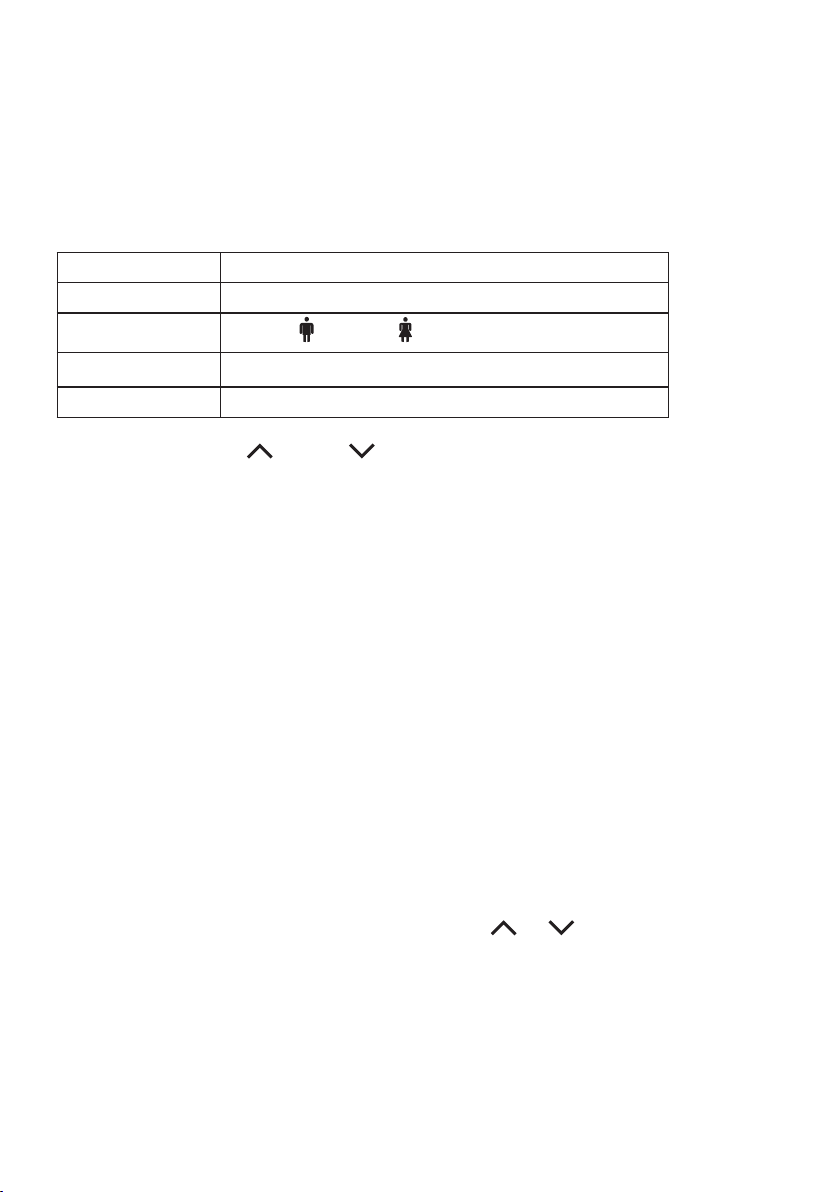
5.2 Настройка пользовательских данных
Для того, чтобы можно было определить процентное содержание жировой ткани и другие параметры,
следует ввести в память весов личные пользовательские данные.
Весы имеют 10 пользовательских ячеек памяти, которые можно использовать для сохранения и вызова
личных настроек всех членов семьи.
Включите весы непродолжительным нажатием ноги на платформу. Дождитесь появления на дисплее по
казания „
Затем нажмите кнопку „SET“. На дисплее отображается (мигает) первая ячейка памяти. Теперь Вы
можете сделать следующие настройки:
0.0
”.
Ячейка памяти от 0 до 9
Возраст от 10 до 100 лет
Пол
Рост от 100 до 220 см (от 3футов-03 дюймов до 7 футов-03 дюймов)
Уровень активности от 1 до 5
мужской (
), женский ( )
-
Нажимая на кнопки «вверх»
соответствующие значения. Ввод каждого значения следует подтвердить, нажав кнопку „SET“.
После этого весы готовы к измерению. Если Вы не выполняете измерение, весы автоматически отключа
ются через несколько секунд.
или «вниз» дискретно или длительно, Вы можете установить
-
Уровни активности:
При выборе уровня активности решающим является средне- и долгосрочный аспект.
• Уровень активности 1: отсутствие физической активности.
• Уровень активности 2: незначительная физическая активность.
Малые и нетяжелые физические нагрузки (например, прогулки, легкие работы в саду, гимнастические
упражнения).
• Уровень активности 3: средняя физическая активность.
Физические нагрузки, не менее 2–4 раз в неделю по 30 минут.
• Уровень активности 4: высокая физическая активность.
Физические нагрузки не менее 4–6 раз в неделю по 30 минут.
• Уровень активности 5: очень высокая физическая активность.
Интенсивные физические нагрузки, интенсивные тренировки или тяжелая физическая работа,
ежедневно, не менее чем по 1 часу.
5.3 Проведение измерения
После того, как были введены все параметры, можно определить вес, процентное содержание жировой
ткани и другие значения.
• Нажмите «SET».
• Выберите с помощью нескольких повторных нажатий кнопок
ны Ваши личные данные. Они будут высвечиваться друг за другом до появления индикации «0.0».
• Встаньте на весы без обуви, обратите внимание на то, что стоять не электродах нельзя.
• После измерения веса появляются все измеренные значения.
или ячейку памяти, где сохране-
Важно: при измерении не должно быть контакта между обеими ступнями, икрами, голенями и бедрами. В
противном случае измерение не может быть выполнено должным образом.
48
Page 49
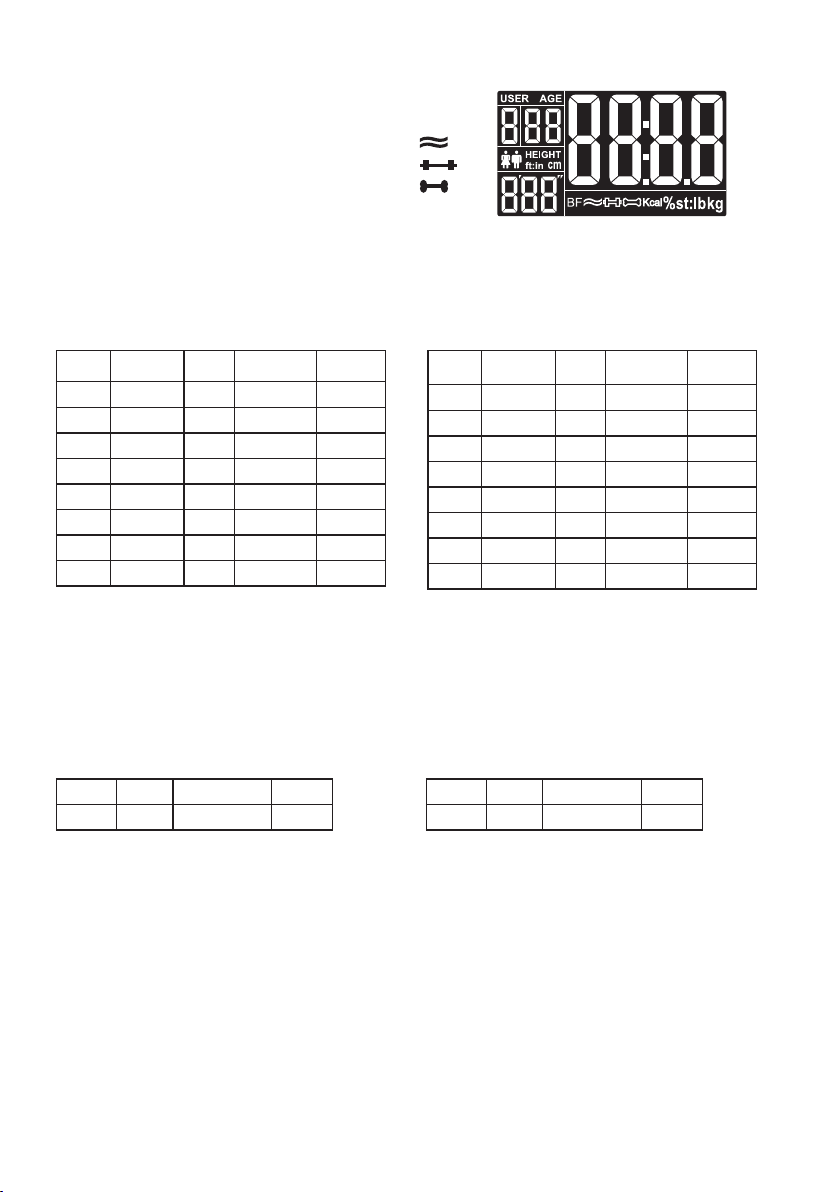
Сначала появляются следующие показания:
1. Вес в кг
2. Процентное содержание жировой .
KG
BF
ткани в %
3. Процентное содержание воды в %
4. Процентное содержание мышечной ткани в %
5. Костная масса в кг
6. Активный расход энергии в ккал
Процентное содержание жировой ткани
Приведенные ниже значения процентного содержания жировой ткани представляют собой лишь ориентировочные величины (за более подробной информацией обратитесь к врачу!).
Мужчины Женщины
Воз-
очень
раст
хорошо
10-14 <11% 11-16% 16,1-21% >21,1%
15-19 <12% 12-17% 17,1-22% >22,1%
20-29 <13% 13-18% 18,1-23% >23,1%
30-39 <14% 14-19% 19,1-24% >24,1%
40-49 <15% 15-20% 20,1-25% >25,1%
50-59 <16% 16-21% 21,1-26% >26,1%
60-69 <17% 17-22% 22,1-27% >27,1%
70-100 <18% 18-23% 23,1-28% >28,1%
хоро-шоудовлетвори-
тельно
плохо
Воз-
очень хо-
раст
рошо
10-14 <16% 16-21% 21,1-26% >26,1%
15-19 <17% 17-22% 22,1-27% >27,1%
20-29 <18% 18-23% 23,1-28% >28,1%
30-39 <19% 19-24% 24,1-29% >29,1%
40-49 <20% 20-25% 25,1-30% >30,1%
50-59 <21% 21-26% 26,1-31% >31,1%
60-69 <22% 22-27% 27,1-32% >32,1%
70-100 <23% 23-28% 28,1-33% >33,1%
хоро-шоудовлетвори-
тельно
плохо
У спортсменов часто бывает более низкое значение. В зависимости от вида спорта, интенсивности тре
нировок и физической конституции могут быть достигнуты значения, которые значительно меньше указанных ориентировочных значений.
Но учтите, что при слишком низких значениях может возникнуть опасность для здоровья.
Процентное содержание воды:
П
роцентное содержание воды обычно находится в следующих пределах:
Мужчины Женщины
Возраст плохо хорошо очень хорошо
10-100 <50% 50-65% >65%
Возраст плохо хорошо очень хорошо
10-100 <45% 45-60% >60%
Жировая ткань содержит относительно мало воды. Поэтому у людей с высоким процентным содержанием жировой ткани процентное содержание воды может быть меньше ориентировочных значений. У людей, занимающихся видами спорта, требующими выносливости, напротив, ориентировочные значения
могут быть превышены из-за малого процентного содержания жировой ткани и большого процентного
содержания мышечной ткани.
Процентное содержание воды, определенное с помощью этих весов, непригодно для того, чтобы делать
медицинские заключения, например, о возрастном накоплении воды в организме. При необходимости
обратитесь к врачу.
В принципе, нужно стремиться к высоким значениям процентного содержания воды.
49
Page 50
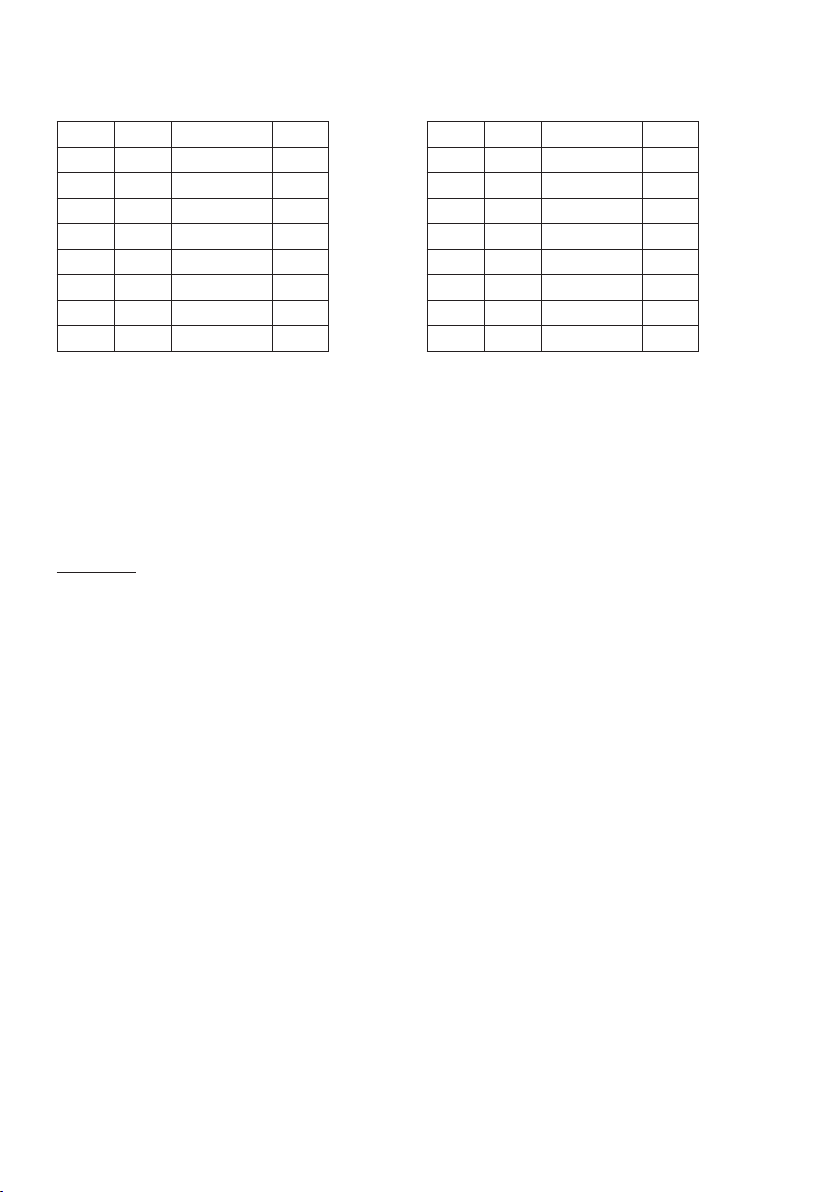
Процентное содержание мышечной ткани:
Процентное содержание мышечной ткани обычно находится в следующих пределах:
Мужчины Женщины
Возраст мало норма много
10-14 <44% 44-57% >57%
15-19 <43% 43-56% >56%
20-29 <42% 42-54% >54%
30-39 <41% 41-52% >52%
40-49 <40% 40-50% >50%
50-59 <39% 39-48% >48%
60-69 <38% 38-47% >47%
70-100 <37% 37-46% >46%
Возраст мало норма много
10-14 <36% 36-43% >43%
15-19 <35% 35-41% >41%
20-29 <34% 34-39% >39%
30-39 <33% 33-38% >38%
40-49 <31% 31-36% >36%
50-59 <29% 29-34% >34%
60-69 <28% 28-33% >33%
70-100 <27% 27-32% >32%
Костная масса:
Наши кости, как и остальные части тела, подвержены естественным процессам роста, распада и старения. Костная масса резко возрастает в детском возрасте и достигает своего максимума к 30–40 годам. С
возрастом костная масса снова несколько уменьшается. Вы можете противодействовать этому процессу
при помощи здорового питания (прежде всего, богатого кальцием и витамином D) и регулярных физиче
ских нагрузок. Целенаправленным наращиванием мускулатуры вы можете дополнительно повысить стабильность скелета.
Учтите, что эти весы не измеряют содержание кальция в крови, а определяют вес всех составных частей
костей (органических и неорганических веществ и воды).
Внимание: не путайте костную массу с плотностью костей. Плотность костей может быть определена
только при медицинском исследовании (например, компьютерной томографии, ультразвуковом исследо
вании). Поэтому с помощью этих весов нельзя сделать заключение об изменениях костей и их плотности
(например, о наличии остеопороза).
На костную массу практически нельзя воздействовать, однако она незначительно изменяется в связи с
колебаниями влияющих на нее факторов (вес, рост, возраст, пол).
AMR:
Уровень активного обмена (AMR=Active Metabolic Rate) – это количество энергии, которое потребляет организм в активном состоянии за сутки. Расход человеком энергии возрастает с увеличением физической
нагрузки и определяется диагностическими весами по предварительно записанному в память уровню ак
-
тивности (1-5).
Для поддержания веса потребленная энергия должна быть возмещена организму в виде еды и жидко
сти. Если в течение длительного времени организм получает меньше энергии, чем потребляет, то он компенсирует разницу, используя накопленные запасы жировой ткани, вес уменьшается. И наоборот: если в
течение длительного времени организм получает больше энергии, чем рассчитанное суммарное потре
бление энергии (AMR), то он не может сжечь избыток энергии, и тот откладывается в организме в виде
жировой ткани; как результат – увеличение веса.
Временная взаимосвязь результатов
Учтите - в счет идет только долговременная тенденция. Кратковременные изменения веса в течение нескольких дней чаще всего вызываются лишь потерей жидкости.
Интерпретация результатов зависит от изменений:
общего веса и процентного соотношения жировой ткани, воды и мышечной ткани, а также от отрезка
времени, на протяжении которого эти изменения происходят. Быстрые изменения в течение нескольких
дней следует отличать от изменений в среднем темпе (в пределах нескольких недель) и медленных изме
-
нений (несколько месяцев).
50
Page 51
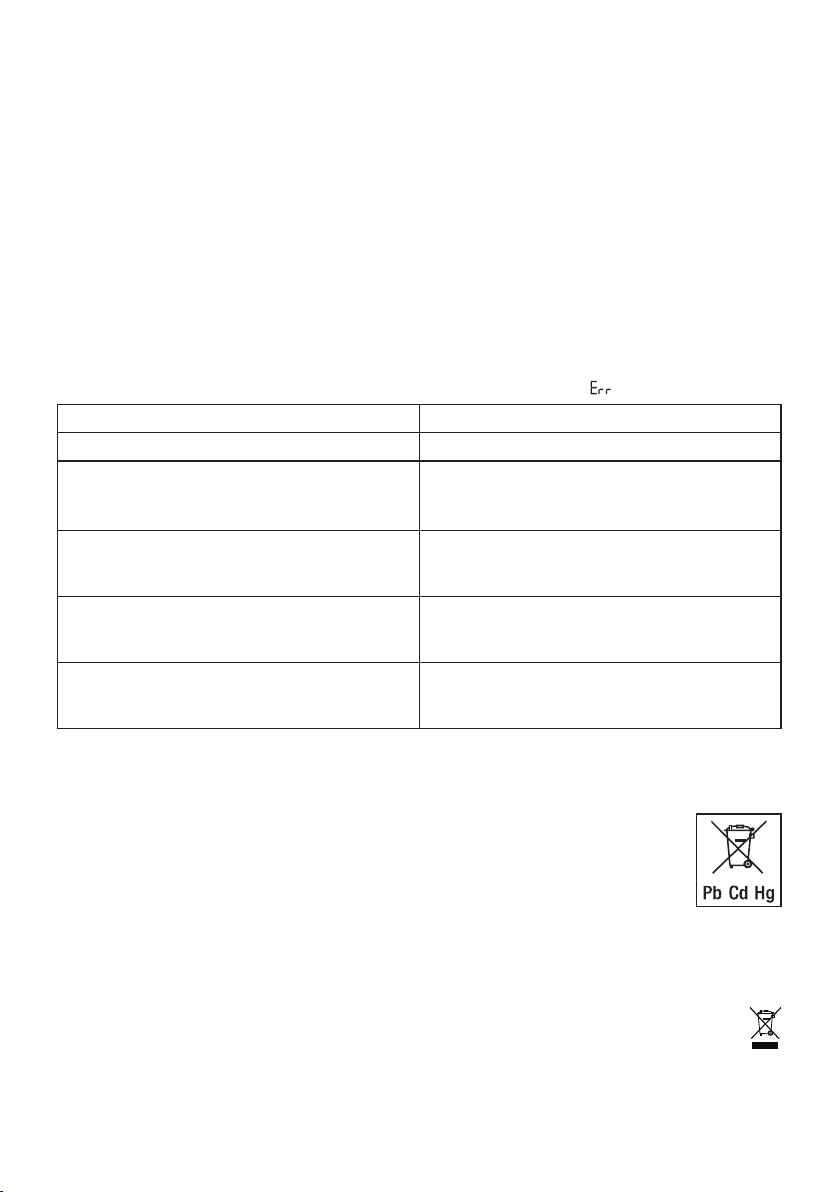
Основным правилом может считаться, что кратковременные изменения веса почти всегда представляют
собой изменения содержания воды, в то время как медленные и среднего темпа изменения могут также
затрагивать процентное содержание жировой и мышечной ткани.
• Если вес снижается в течение короткого времени, но процентное содержание жировой ткани растет
или остается неизменным, это означает, что Вы потеряли лишь воду – например, после тренировки, по
сещения сауны либо диеты, направленной лишь на быструю потерю веса.
• Если вес возрастает в среднем темпе, а процентное содержание жировой ткани уменьшается или оста
ется на прежнем уровне, это может означать, что Вы нарастили ценную мышечную массу.
Если вес и процентное содержание жировой ткани уменьшаются одновременно – ваша диета эффектив
на, и Вы теряете жировую ткань. В идеальном случае вы поддерживаете диету физической активностью,
занимаясь фитнесом или спортом. Тем самым, Вы можете добиться среднего темпа роста процентного
содержания мышечной ткани.
Проценты жировой ткани, воды или мышечной ткани нельзя складывать (мышечная ткань также содер
жит воду).
-
-
-
-
6. Неверное измерение
Если при измерении обнаружена ошибка, на дисплее появляется сообщение „ “.
Возможные причины неполадок: Устранение:
Был превышен предельно допустимый вес 180 кг. Не превышайте предельно допустимый вес.
Слишком большое электрическое сопротивление
между электродами и подошвами (например, изза сильных мозолей).
Процентное содержание жировой ткани находит
ся за пределами измеряемого диапазона (меньше
3% или больше 55%).
Процентное содержание воды находится за пре
делами измеряемого диапазона (меньше 36% или
больше 70%).
Процентное содержание мышц и костей находит
ся за пределами измеряемого диапазона (зависит
от возраста и пола).
Повторите измерение босиком.
При необходимости слегка смочите ступни ног;
возможно, потребуется удалить мозоли.
-
Повторите измерение босиком или, если потребу
ется, слегка смочите ступни.
-
Повторите измерение босиком или, если потребу
ется, слегка смочите ступни.
-
Повторите измерение босиком или, если потребу
ется, слегка смочите ступни.
-
-
-
7. Утилизация
Выбрасывайте использованные, полностью разряженные батарейки вспециальные контейнеры,
сдавайте впункты приема спецотходов или вмагазины электрооборудования. Закон обязывает
пользователей обеспечить утилизацию батареек.
Эти знаки предупреждают оналичии вбатарейках токсичных веществ:
Pb = свинец,
Cd = кадмий,
Hg = ртуть.
Винтересах охраны окружающей среды категорически запрещается выбрасывать прибор по
завершении срока его службы вместе сбытовыми отходами. Утилизация должна производиться
через соответствующие пункты сбора вВашей стране.
Прибор следует утилизировать согласно директиве ЕС поотходам электрического
иэлектронного оборудования— WEEE (Waste Electrical and Electronic Equipment).
Припоявлении вопросов обращайтесь вместную коммунальную службу, ответственную
заутилизацию отходов.
51
Page 52

8. Гарантия
Мы предоставляем гарантию на дефекты материалов и изготовления на срок 36 месяцев с момента
продажи через розничную сеть.
Гарантия не распространяется:
- на случаи ущерба, вызванного неправильным использованием
- на быстроизнашивающиеся части ( батарейки )
- на дефекты, о которых покупатель знал в момент покупки
- на случаи собственной вины покупателя
- при отсутствии кассового чека.
Товар не подлежит обязательной сертификации
Срок эксплуатации изделия: мин. 5 лет
Фирма-изготовитель: Бойрер Гмбх,
Софлингер штрассе 218,
89077-УЛМ, Германия
Фирма-импортер : OOO Бойрер
109451 г. Москва, ул.
Перерва , 62,корп.2 , офис 3
Сервисный центр: 109451 г. Москва, ул.
Перерва, 62, корп.2
Тел(факс) 495—658 54 90
[email protected]
Дата продажи
Подпись продавца
Штамп магазина
Подпись покупателя
52
Возможны ошибки и изменения
Page 53
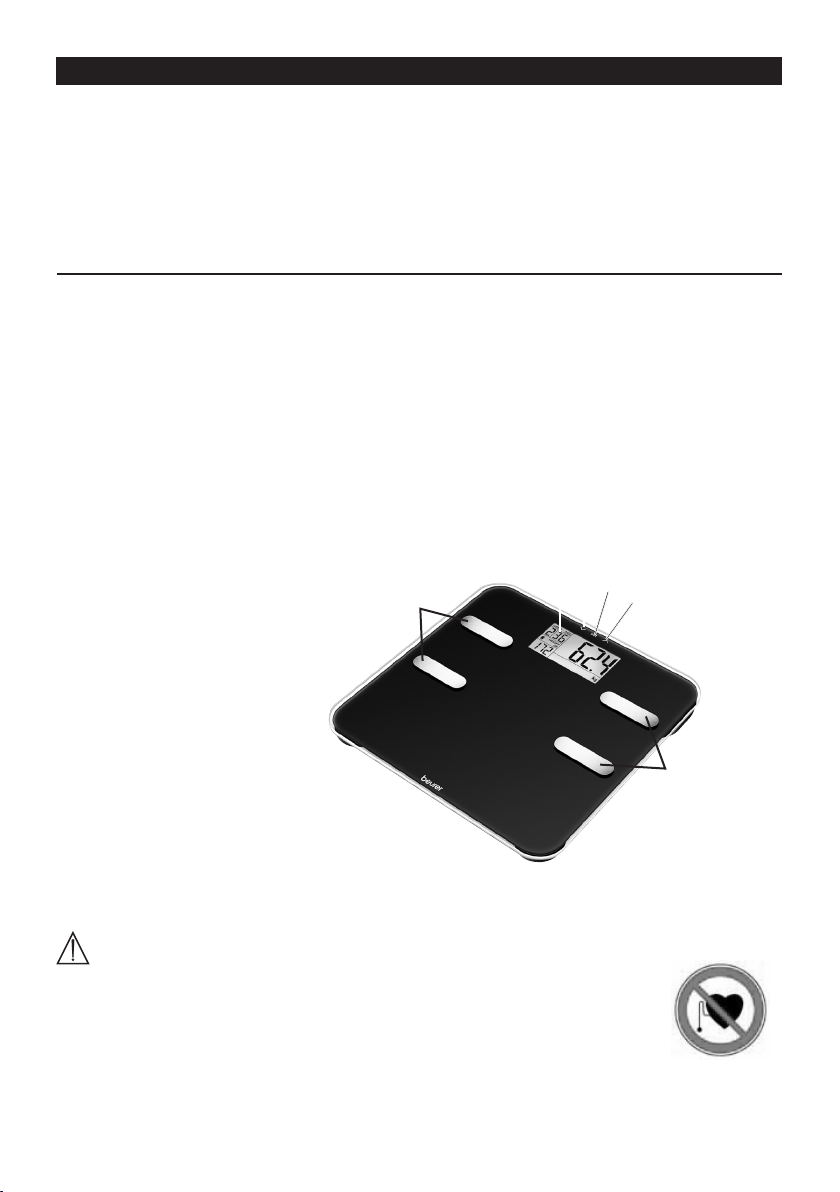
POLSKI
Spis treści
1. Opis urządzenia ............................................. 53
2. Wskazówki ..................................................... 53
3. Waga diagnostyczna – informacje ................ 54
4. Baterie ............................................................ 55
5. Użytkowanie .................................................. 55
5.1. Pomiar masy ciała .................................. 55
5.2. Ustawianie danych użytkownika ............. 55
5.3. Przeprowadzanie pomiarów ................... 56
6. Błędne pomiary .............................................. 59
7. Utylizacja........................................................ 59
Szanowni Klienci,
bardzo dziękujemy za wybór jednego z naszych wyrobów. Nazwa naszej firmy oznacza wysokiej jakości
wyroby, dokładnie sprawdzone w zakresie zastosowań w obszarach nagrzewania, pomiarów masy ciała,
ciśnienia krwi, temperatury ciała, tętna, łagodnej terapii, masażu i powietrza.
Prosimy o dokładne przeczytanie niniejszej instrukcji obsługi oraz o zatrzymanie jej do późniejszego
użytku, udostępniając ją innym użytkownikom oraz przestrzegając zawartych w niej informacji.
Z poważaniem,
Zespół firmy Beurer
1. Opis urządzenia
1. Wyświetlacz
2. Przycisk „Zmniejszanie”
3. Przycisk „Ustawianie”
4. Przycisk „Zwiększanie”
5. Elektrody
5
2
1
3
4
5
2. Wskazówki
Wskazówki dotyczące bezpieczeństwa:
• Waga nie może być używana przez osoby z medycznymi implantami (np. rozrusz
nikiem serca). W przeciwnym razie ich funkcjonowanie może ulec zakłóceniu.
• Nie używać w czasie ciąży.
• Uwaga! Na wagę nie wolno stawać mokrymi stopami, ani kiedy powierzchnia wagi jest
mokra – niebezpieczeństwo poślizgnięcia!
• Połknięcie baterii może zagrażać życiu. Wagę i baterie należy przechowywać w miejscu niedostępnym
dla dzieci. W razie połknięcia baterii należy natychmiast skontaktować się z lekarzem.
-
53
Page 54
• Opakowanie wagi należy przechowywać w miejscu niedostępnym dla dzieci (niebezpieczeństwo udus-
zenia).
• Baterii nie wolno ładować ani reaktywować w inny sposób, rozkładać na części, wrzucać w ogień lub
poddawać działaniu elektryczności.
Wskazówki dotyczące postępowania z bateriami
• Jeśli dojdzie do kontaktu elektrolitu ze skórą lub oczami, należy przemyć dane miejsce wodą i
skontaktować się z lekarzem.
Istnieje niebezpieczeństwo połknięcia! Małe dzieci mogłyby połknąć baterie i się nimi udusić.
•
Dlatego baterie należy przechowywać w miejscach niedostępnych dla dzieci.
• Należy zwrócić uwagę na znak polaryzacji plus (+) i minus (-).
• Jeśli z baterii wyciekł elektrolit, należy założyć rękawice ochronne i wyczyścić przegrodę na baterie
suchą szmatką.
• Baterie należy chronić przed nadmiernym działaniem wysokiej temperatury.
Zagrożenie wybuchem! Nie wrzucać baterii do ognia.
•
• Nie wolno ładować ani zwierać baterii.
• W przypadku niekorzystania z urządzenia przez dłuższy czas wyjąć baterie z przegrody.
• Należy używać tylko tego samego lub równoważnego typu baterii.
• Zawsze należy wymieniać jednocześnie wszystkie baterie.
• Nie należy używać akumulatorów!
• Nie wolno rozmontowywać, otwierać ani rozdrabniać baterii.
Wskazówki ogólne:
• Urządzenie służy do użytku domowego, a nie medycznego ani komercyjnego.
• Należy pamiętać, iż nie jest to waga precyzyjna do użytku profesjonalnego, medycznego, dlatego
możliwe są technicznie uzasadnione odchylenia od wartości rzeczywistych.
• Obciążenie wagi nie może przekraczać 180 kg (396 funtów, 28 kamieni). Przy określaniu masy ciała i
masy kości wyniki podawane są z dokładnością do 100 g (0,2 funta, 1/4 kamienia). Wyniki pomiarów
udziału tkanki tłuszczowej, wody i mięśni podawane są z dokładnością do 0,1%.
• Zapotrzebowanie kaloryczne jest podawane z dokładnością do 1 kcal. Współczynnik BMI (Body Mass
Index) jest wyświetlany z dokładnością do 0,1.
• Waga jest fabrycznie ustawiona na jednostki „cm” oraz „kg”. Z tyłu wagi znajduje się przełącznik, którym
można zmienić jednostki na „cale”, „funty” (lb) i „kamienie” (St).
• Wagę należy ustawić na stabilnym podłożu, co jest warunkiem uzyskania prawidłowych pomiarów.
• Od czasu do czasu wagę należy wyczyścić wilgotną ściereczką. Nie należy stosować agresywnych
środków czyszczących i nie wolno czyścić wagi pod strumieniem bieżącej wody.
• Urządzenie należy chronić przed uderzeniem, wilgocią, kurzem, chemikaliami, znacznymi wahaniami
temperatury i zbyt bliskimi źródłami ciepła (piece, grzejniki).
• Naprawy można dokonywać jedynie w punkcie obsługi klienta Beurer lub w autoryzowanych punktach
sprzedaży. Przed wniesieniem reklamacji prosimy o sprawdzenie stanu baterii i ich ewentualną wymianę.
3. Waga diagnostyczna – informacje
Zasada działania wagi diagnostycznej
Waga pracuje zgodnie z zasadą analizy bioelektrycznej impedancji (B.I.A.). Umożliwia dokonywanie
pomiarów w ciągu kilku sekund przy pomocy niewyczuwalnego, całkowicie bezpiecznego prądu. Przy
pomocy pomiaru oporu elektrycznego (impedancji) i uwzględnienia stałych lub indywidualnych wartości
(wiek, wzrost, płeć, stopień aktywności) można określić udział tkanki tłuszczowej w organizmie oraz inne
wielkości.
Tkanka mięśniowa i woda posiadają dobre właściwości przewodzące i tym samym ograniczony opór elek
tryczny.
54
-
Page 55

Kości oraz tkanka tłuszczowa posiadają natomiast ograniczone właściwości przewodzące, ze względu na
wysoki opór elektryczny komórek tłuszczowych i kości.
Należy jednak pamiętać, iż wartości pokazywane przez wagę diagnostyczną stanowią jedynie wartości
zbliżone do faktycznych, medycznych wartości analitycznych. Jedynie lekarz specjalista przy pomo
cy metod medycznych (np. tomografii komputerowej) może przeprowadzić dokładne pomiary tkanki
tłuszczowej, wody w organizmie, udziału mięśni i budowy kości.
Rady ogólne
• Jeżeli to możliwe, należy ważyć się o tej samej porze dnia (najlepiej rano), po skorzystaniu z toalety, na
czczo i bez ubrania, aby uzyskać porównywalne wyniki.
• Podczas pomiaru: udział tkanki tłuszczowej należy określać, stając na wadze boso i ewentualnie z lek
ko wilgotnymi stopami. Zupełnie suche stopy mogą prowadzić do niezadowalających wyników, gdyż
wykazują ograniczone właściwości przewodzące.
• Podczas pomiaru należy stać nieruchomo.
• Po nietypowym dla siebie wysiłku przed ważeniem należy odczekać kilka godzin.
• Należy odczekać ok. 15 minut po wstaniu, aby znajdująca się w organizmie woda mogła się wyrównać.
Ograniczenia
Przy określaniu udziału tkanki tłuszczowej i pozostałych wartości można uzyskać sprzeczne i niewiarygod
ne wyniki, szczególnie:
• u dzieci poniżej ok. 10 roku życia,
• u sportowców wyczynowych i kulturystów,
• u kobiet w ciąży,
• u chorych z gorączką, leczonych dializami, z objawami odmy lub osteoporozą,
• u osób przyjmujących leki sercowo-naczyniowe,
• u osób przyjmujących leki rozszerzające lub zwężających naczynia krwionośne,
• u osób ze znacznymi zmianami anatomicznymi nóg w stosunku do wzrostu (nogi znacznie dłuższe lub
krótsze).
-
-
-
4. Baterie
W razie potrzeby należy ściągnąć pasek izolacyjny z pokrywy komory baterii lub usunąć folię ochronną z
baterii i umieścić ją w komorze zgodnie z oznaczeniami biegunów. Jeżeli waga nie wykazuje żadnej reak
cji, należy wyjąć baterię i włożyć ją ponownie.
Waga wyświetla komunikat o zmianie baterii. Jeżeli waga pracuje na zbyt słabej baterii, na wyświetlaczu
pojawia się komunikat „Lo”, a waga automatycznie się wyłącza. W takim wypadku należy wymienić baterię
(4 x1,5 V, AAA).
-
5. Użytkowanie
5.1. Pomiar masy ciała
Wejdź na wagę. Stań spokojnie na wadze, rozkładając ciężar ciała równomiernie na obu nogach. Waga na
tychmiast rozpocznie pomiar. Wynik zostanie ustalony po dwukrotnym mignięciu wyświetlacza.
Po zejściu z powierzchni ważącej waga wyłączy się samoczynnie po upływie kilku sekund.
5.2. Ustawianie danych użytkownika
Aby możliwy był pomiar udziału tkanki tłuszczowej i innych wartości, należy w pamięci wagi zapisać oso
biste dane użytkownika.
Waga dysponuje 10 miejscami pamięci, na których można zapisać osobiste ustawienia użytkowników i
ponownie je wywoływać.
Należy włączyć wagę dotykając krótko stopą jej powierzchni i odczekać do pojawienia się komunikatu
„0.0”.
55
-
-
Page 56
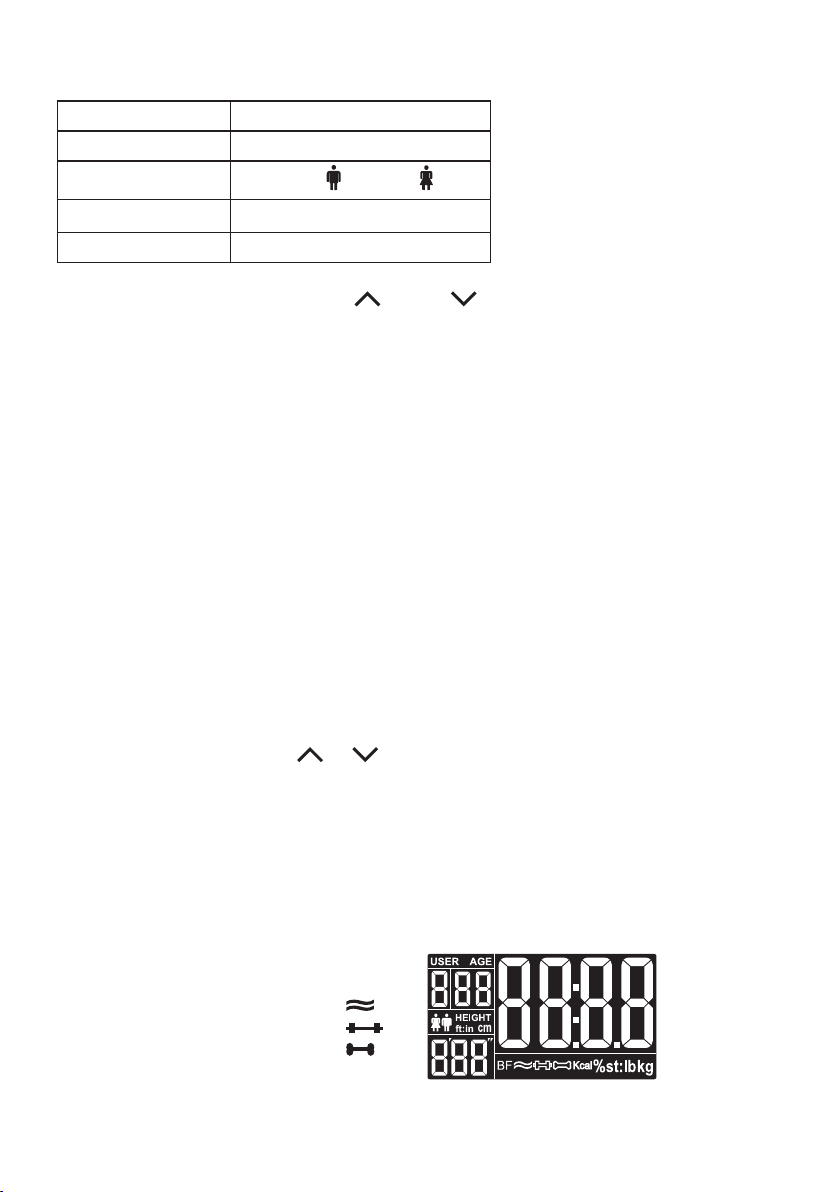
Wcisnąć „SET”. Na wyświetlaczu zacznie migać pierwsze miejsce pamięci. Teraz można wprowadzić
następujące ustawienia:
Miejsce pamięci 0 do 9
Wiek 10 do 100 lat
Płeć
Wzrost 100 do 220 cm (3‘-03“ do 7‘-03“)
Stopień aktywności 1 do 5
mężczyzna (
), kobieta ( )
Naciskając krótko lub długo klawisz w górę
należy potwierdzać, naciskając klawisz „SET”.
Waga jest po tym gotowa do pomiaru. Jeśli nie zostanie dokonany żaden pomiar, waga po kilku sekun
dach wyłączy się automatycznie.
Stopnie aktywności:
Przy wyborze stopnia aktywności decydująca jest aktywność średnio- i długookresowa.
• Stopień aktywności 1: brak aktywności fizycznej.
• Stopień aktywności 2: ograniczona aktywność fizyczna.
Niewielki i rzadki wysiłek fizyczny (np. spacery, lekkie prace w ogrodzie, ćwiczenia gimnastyczne).
• Stopień aktywności 3: średnia aktywność fizyczna.
Wysiłek fizyczny co najmniej 2 do 4 razy w tygodniu po 30 minut.
• Stopień aktywności 4: Wysoka aktywność fizyczna.
Wysiłek fizyczny co najmniej 4 do 6 razy w tygodniu po 30 minut.
• Stopień aktywności 5: Bardzo wysoka aktywność fizyczna.
Intensywny wysiłek fizyczny, intensywny trening lub ciężka. praca fizyczna, codziennie przynajmniej
przez 1 godzinę.
5.3. Przeprowadzanie pomiarów
Po ustawieniu wszystkich parametrów można dokonywać pomiarów masy ciała, tkanki tłuszczowej i
pozostałych wartości.
• Naciśnij przycisk „SET”.
• Wielokrotnie naciskając przyciski
biste dane podstawowe. Będą one wyświetlane krótko, aż do pojawienia się „0.0”.
• Stań spokojnie, boso na wadze.
• Po zakończeniu pomiaru na wyświetlaczu pojawią się wyniki.
Uwaga: stopy, łydki i uda obu nóg nie powinny się dotykać. W przeciwnym razie pomiar może być
nieprawidłowy.
lub w dół można ustawić żądane wartości. Wartości
lub , wybierz miejsce pamięci, w którym będą zapisane oso-
-
Najpierw wyświetlany jest następujący komunikat:
1. Masa ciała w kg
2. Tkanka tłuszczowa w %
3. Woda w organizmie w %
4. Udział mięśni w %
5. Masa kości w kg
6. Aktywna przemiana materii w kcal
KG
BF
56
Page 57
Udział tkanki tłuszczowej
Poniższe wartości tkanki tłuszczowej są jedynie orientacyjne (aby uzyskać więcej informacji należy zwrócić
się do lekarza!).
Mężczyźni Kobiety
wiek bardzo dobrze dobrze średnio źle
10-14 <11% 11-16% 16,1-21% >21,1%
15-19 <12% 12-17% 17,1-22% >22,1%
20-29 <13% 13-18% 18,1-23% >23,1%
30-39 <14% 14-19% 19,1-24% >24,1%
40-49 <15% 15-20% 20,1-25% >25,1%
50-59 <16% 16-21% 21,1-26% >26,1%
60-69 <17% 17-22% 22,1-27% >27,1%
70-100 <18% 18-23% 23,1-28% >28,1%
wiek bardzo dobrze dobrze średnio źle
10-14 <16% 16-21% 21,1-26% >26,1%
15-19 <17% 17-22% 22,1-27% >27,1%
20-29 <18% 18-23% 23,1-28% >28,1%
30-39 <19% 19-24% 24,1-29% >29,1%
40-49 <20% 20-25% 25,1-30% >30,1%
50-59 <21% 21-26% 26,1-31% >31,1%
60-69 <22% 22-27% 27,1-32% >32,1%
70-100 <23% 23-28% 28,1-33% >33,1%
U sportowców często wykazywany jest niski udział tkanki tłuszczowej. Zależnie od uprawianej dyscypliny sportu, intensywności treningów i budowy ciała można uzyskać wartości leżące poniżej podanych
wartości orientacyjnych.
Należy jednak pamiętać, iż bardzo niskie wartości udziału tkanki tłuszczowej stanowią poważne
zagrożenia dla zdrowia.
Woda w organizmie:
Udział wody w organizmie mieści się zazwyczaj w następującym przedziale:
Mężczyźni Kobiety
wiek źle dobrze bardzo dobrze
10-100 <50% 50-65% >65%
wiek źle dobrze
10-100 <45% 45-60% >60%
bardzo dobrze
Tkanka tłuszczowa zawiera względnie mało wody. Dlatego udział wody w organizmie u osób o dużym
udziale tkanki tłuszczowej może leżeć poniżej podanych wartości orientacyjnych. Natomiast u osób
uprawiających sporty wytrzymałościowe wartości te ze względu na niski udział tkanki tłuszczowej i wysoką
masę mięśniową mogą być przekroczone.
Określenie wody w organizmie przy pomocy wagi nie powinno być stosowane do wyciągania wniosków
medycznych, np. o zatrzymywaniu wody w organizmie u osób starszych. W razie wątpliwości należy
zwrócić się do lekarza.
Zasadniczo należy dążyć do wyższych wartości wody w organizmie.
Udział mięśni:
Udział mięśni mieści się zazwyczaj w następującym przedziale:
Mężczyźni Kobiety
wiek mało w normie dużo
10-14 <44% 44-57% >57%
15-19 <43& 43-56% >56%
20-29 <42% 42-54% >54%
30-39 <41% 41-52% >52%
40-49 <40% 40-50% >50%
50-59 <39% 39-48% >48%
60-69 <38% 38-47% >47%
70-100 <37% 37-46% >46%
wiek mało w normie dużo
10-14 <36% 36-43% >43%
15-19 <35% 35-41% >41%
20-29 <34% 34-39% >39%
30-39 <33% 33-38% >38%
40-49 <31% 31-36% >36%
50-59 <29% 29-34% >34%
60-69 <28% 28-33% >33%
70-100 <27% 27-32% >32%
57
Page 58

Masa kości:
kości tak jak reszta ciała człowieka podlegają naturalnym procesom wzrostu, starzenia i rozkładu. Masa
kości szybko wzrasta w okresie dzieciństwa i osiąga maksimum w wieku 30-40 lat. Wraz z wiekiem masa
kości następnie ponownie spada. Przy zdrowym odżywianiu (dieta bogata w wapń i witaminę D) oraz
regularnym wysiłku fizycznym można w pewnym stopniu przeciwdziałać temu procesowi. Dodatkowo
stabilność kości można wzmocnić przez ukierunkowany rozwój mięśni.
Należy pamiętać, iż waga nie pokazuje zawartości wapnia w kościach, ale określa masę wszystkich
składników kości (substancje organiczne, nieorganiczne i woda).
Uwaga: nie należy mylić masy kości z gęstością kości. Gęstość kości można ustalić jedynie w bada
niu medycznym (np. przy pomocy tomografii komputerowej, USG). Dlatego wnioski dotyczące zmian
kostnych i twardości kości (np. osteoporoza) przy pomocy tej wagi nie są możliwe.
Na masę kości raczej nie da się wpłynąć, choć waha się ona w pewnym stopniu zależnie od takich
czynników, jak masa ciała, wzrost, wiek i płeć.
AMR:
Aktywna przemiana materii (AMR = Active Metabolic Rate) to ilość energii potrzebnej organizmowi w
stanie aktywności na dzień. Zużycie energii wzrasta wraz ze zwiększaniem wysiłku fizycznego i określane
jest na wadze przy pomocy stopnia aktywności (1-5).
Aby utrzymać aktualną masę ciała, należy zużywaną energię uzupełniać w jedzeniu i piciu. Jeżeli przez
dłuższy czas organizmowi dostarczana jest zmniejszona ilość energii niż energia zużywana, organizm
czerpie niedobory energii z odłożonych komórek tłuszczowych, a masa ciała spada. Jeżeli natomiast przez
dłuższy czas organizmowi dostarczana jest większa ilość energii niż obliczony wskaźnik AMR, nadmiar
energii nie może zostać wykorzystany i odkładany jest w postaci komórek tłuszczowych, a masa ciała wz
rasta.
Powiązanie wyników w czasie
Należy zwracać uwagę tylko na tendencje długookresowe. Krótkookresowe zmiany masy ciała w ciągu kil
ku dni spowodowane są najczęściej utratą płynów.
Znaczenie wyników zależy od zmian masy ciała i procentowego udziału tkanki tłuszczowej, wody
oraz mięśni, a także okresu czasu, w jakim zmiany te zachodzą. Gwałtowne zmiany w ciągu kilku dni
należy odróżnić od zmian średniookresowych (w ciągu kilku tygodni) i długoookresowych (w ciągu kilku
miesięcy).
Za podstawową zasadę należy uznać, iż krótkookresowe zmiany masy ciała wynikają prawie wyłącznie
ze zmian udziału wody w organizmie, natomiast średnio- i długookresowe zmiany mogą dotyczyć także
udziału tkanki tłuszczowej i mięśni.
• Jeżeli masa ciała spada w krótkim okresie, ale udział tkanki tłuszczowej wzrasta lub pozostaje na tym
samym poziomie, wskazuje to jedynie na utratę wody - np. po treningu, wizycie w saunie - albo na szyb
ka utratę masy ciała wynikającą z ograniczonej diety.
• Jeżeli masa ciała wzrasta w dłuższym okresie, ale udział tkaki tłuszczowej spada lub pozostaje na takim
samym poziomie, może to oznaczać wartościowe zwiększenie masy mięśni.
Jeżeli jednocześnie spada masa ciała i udział tkanki tłuszczowej, jest to wynikiem prawidłowej diety - spa
da masa tłuszczu. W idealnym przypadku dietę należy wspomagać wysiłkiem fizycznym, ćwiczeniami fitness lub treningiem siłowym. W ten sposób można w dłuższym okresie zwiększyć udział masy mięśniowej.
Nie można dodawać do siebie udziałów tkanki tłuszczowej, wody w organizmie czy mięśni (tkanka
mięśniowe zawiera także wodę).
-
-
-
-
-
58
Page 59
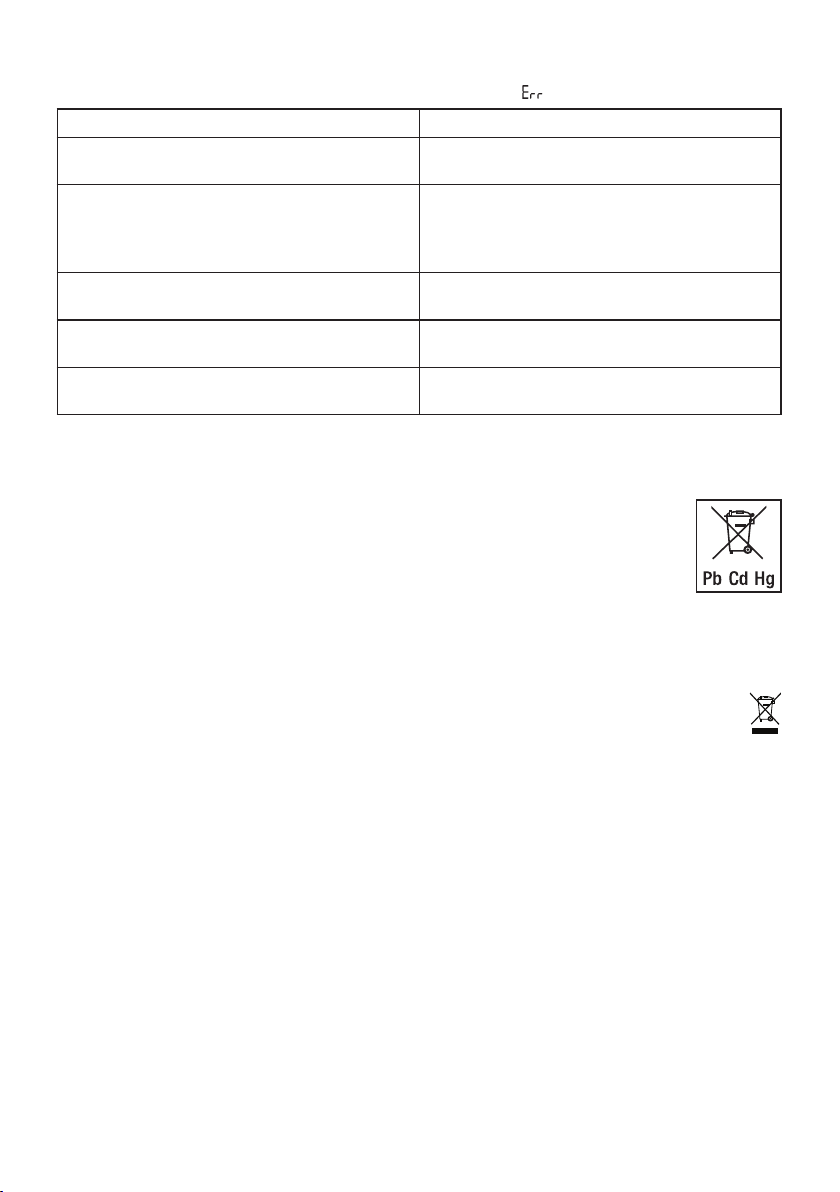
6. Błędne pomiary
Jeżeli podczas pomiarów nastąpi błąd, wyświetlany jest komunikat „ ”.
Możliwe przyczyny błędów: Usuwanie błędów:
Maksymalna siła nacisku 180 kg została przekro
czona.
Opór elektryczny między elektrodami i stopami
jest za wysoki (np. przy silnie zrogowaciałym nas
kórku).
Udział tkanki tłuszczowej leży poza mierzalnym
zakresem (mniej niż 3% lub więcej niż 55%).
Udział wody leży poza mierzalnym zakresem
(mniej niż 36% lub więcej niż 70%).
Udział mięśni i kości leży poza mierzalnym zakre
sem (zależnie od wieku i płci).
Dokonywać pomiaru tylko w zakresie dopuszczal
nej masy.
Powtórzyć pomiar, stając na wadze bosymi sto
-
pami.
Można także zwilżyć stopy wodą. Ewentualnie
należy usunąć zrogowaciały naskórek stóp.
Powtórzyć pomiar stając na wadze bosymi stopa
mi, ewentualnie lekko zwilżyć stopy wodą.
Powtórzyć pomiar stając na wadze bosymi stopa
mi, ewentualnie lekko zwilżyć stopy wodą.
Powtórzyć pomiar stając na wadze bosymi stopa
mi, ewentualnie lekko zwilżyć stopy wodą.
-
-
-
-
-
7. Utylizacja
Zużyte, całkowicie rozładowane baterie należy wyrzucać do specjalnie oznakowanych pojemników zbiorczych, przekazywać do punktów zbiórki odpadów specjalnych lub do sklepu ze sprzętem elektrycznym.
Użytkownik jest zobowiązany do utylizacji baterii zgodnie zprzepisami.
Na bateriach zawierających szkodliwe związki znajdują się następujące oznaczenia:
Pb = bateria zawiera ołów,
Cd = bateria zawiera kadm,
Hg = bateria zawiera rtęć.
Ze względu na ochronę środowiska naturalnego po zakończeniu okresu eksploatacji urządzenia nie należy
wyrzucać wraz ze zwykłymi odpadami domowymi. Utylizację należy zlecić wodpowiednim punkcie zbiórki
wdanym kraju.
Urządzenie należy zutylizować zgodnie zdyrektywą WE ozużytych urządzeniach elektrycznych
ielektronicznych – WEEE (Waste Electrical and Electronic Equipment). Wrazie pytań należy zwrócić
się do odpowiedniej instytucji odpowiedzialnej za utylizację.
59
Zastrzega się możliwość zmian lub pomyłki
Page 60
Beurer GmbH • Söflinger Str. 218 • 89077 Ulm (Germany) • www.beurer.com
•
www.beurer-gesundheitsratgeber.com
www.beurer-healthguide.com
60
758.816-0417
 Loading...