

Page 1
Cleaning Guidelines
You can wash these bottles with any mild, non-abrasive detergent, such as Aquet® Liquid
Laboratory Detergent (Cat. # F17094-0030 and F17094-0020). Rinse thoroughly with distilled
water. To avoid scratching the plastic or the printing, do not use abrasive cleaners or scouring
pads. Do not autoclave these bottles.
NOTICE:
Periodically inspect the wash bottles for signs of stress such as cracking, crazing,
or whitening of the plastic. When signs of stress are detected, discontinue use
and dispose in a manner consistent with federal, state, and local regulations.
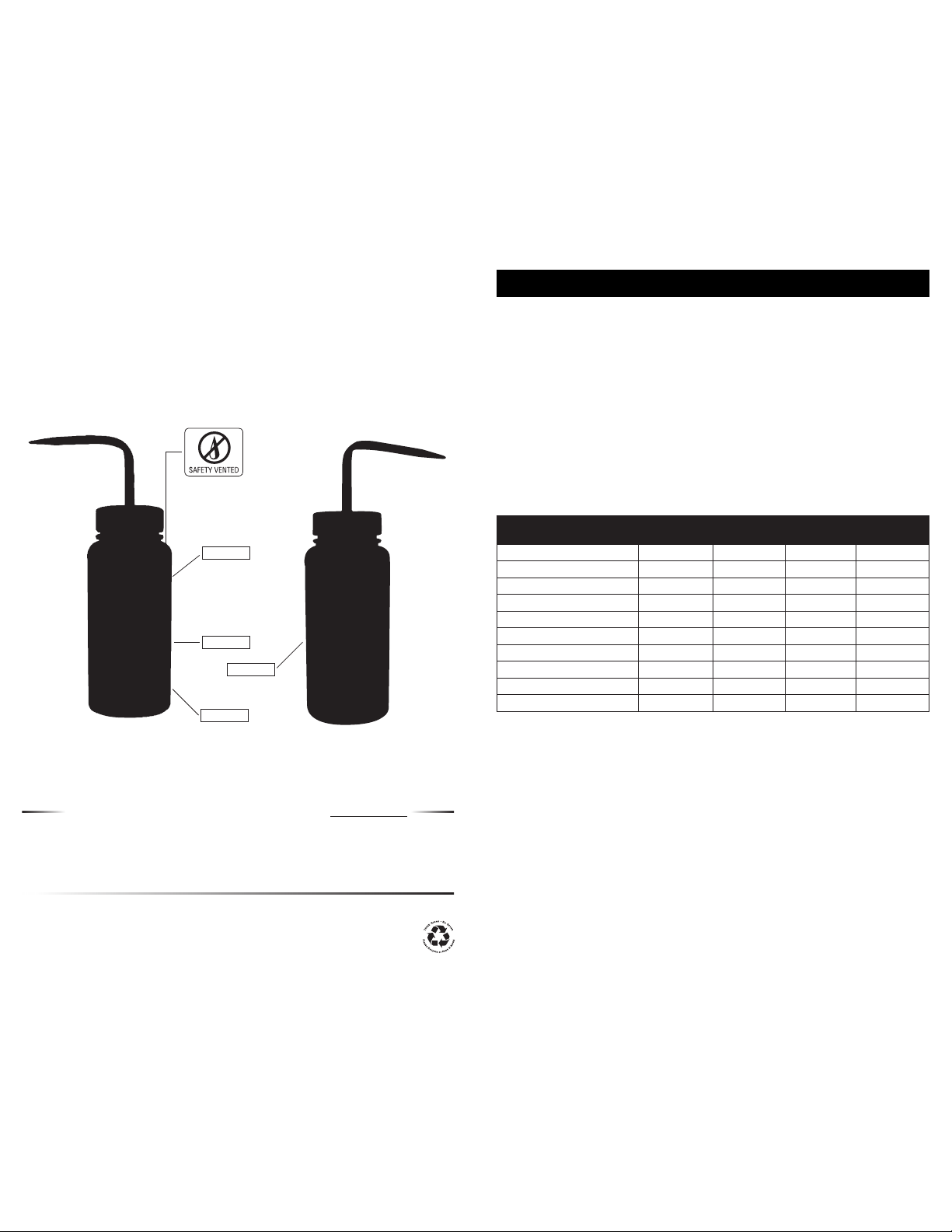
Section A
Section C
Section D
Section B
INSTRUCTIONS
Safety-Vented™ Right-To-Know Wash Bottles
These wash bottles feature codes and symbols for handling hazardous chemicals in an easily
recognized format. They are ready for use when you transfer common laboratory chemicals from
the manufacturer’s containers.
Bottles are made of translucent low-density polyethylene (LDPE) with vented polypropylene
closure, with the following exceptions:
• Sodium hypochlorite (Bleach) bottles have a white LDPE bottle
• Toluene bottles have a red LDPE bottle
Scienceware® Safety-Vented™ Right-To-Know Wash Bottles Catalog Numbers and Sizes
CHEMICAL 250ml
Assorment Pack* F1
Acetone F11808-0001 F11816-0001 F11832-0001 Red
Distilled Water F11808-0004 F11816-0004 F11832-0004 Blue
Ethanol F11808-0019 F11816-0019 F11832-0019 Natural
Ethyl Acetate N/A F11816-0007 N/A Green
Isopropanol F11808-0008 F11816-0008 F11832-0008 Yellow
Label Your Own Bottle (LYOB) F11808-0009 F11816-0009 F11832-0009 Natural
Methanol F11808-0011 F11816-0011 F11832-0011 Green
Methyl Ethyl Ketone N/A F11816-0012 F11832-0012 Green
Sodium Hypochlorite (Bleach) F11808-0015 F11816-0015 F11832-0015 Yellow
* Assortment Pack contains one each of the following: Acetone, Ethanol, Isopropanol, Distilled Water, Bleach, and LYOB.
The venting fitting is an anti-siphoning device that prevents volatile liquids from percolating up
through the stem and dripping out of the tip when there is a change in atmospheric pressure or
temperature. Additionally, this venting fitting allows the wash bottle to dispense liquids with the
bottle in an inverted position.
Catalog No. F11816/832/808-series
(8oz)
1808-0050 F11816-0050 N/A -
500ml
(16oz)
1000ml
(32oz)
Color-Coded
Caps
Let others know what you think. Write a product review at www.belart.com
91181620 0 – 11/18
Find Quality Products Online at: [email protected]
www.GlobalTestSupply.com
Page 2
Assembly Directions:
The venting fitting is in three pieces:
(A) the stem, (B) the slide valve and (C) the
tube. These three pieces will be assembled
and attached to underside of the cap (D).
1.
Assemble the slide valve (B) onto
the narrow end of the stem (A).
2.
Press the square cut end of the tube (C)
onto the narrow end of the stem (A)
to retain the slide valve (B) on the stem.
The square cut end of the tube must be
pressed past the two ribs on the narrow
end of the stem (A) until it stops at the
slightly wider mid section of the stem.
3.
Press the large, wide end of the stem (A)
onto the center boss on the underside
of the wash bottle cap (D). The shortest of
the four ribs on the wide end of the stem
should be facing away from the direction
of the spout tip.
4.
Screw the cap and assembled venting
fitting and tube securely onto the bottle
neck.
The Safety-Vented™ Wash Bottles are for dispensing only, NOT for storage.
Contents of wash bottles should be emptied daily (not retained overnight).
NOTE:
High vapor pressure liquids may exhibit some dripping when the bottle is first filled
and capped. To prevent this from happening screw the cap on loosely and wait
a short time before tightening.
See bottle diagram on back page for section A-D reference
Section A: Chemical Identification
The name of the chemical, ICS (International Chemical Society) formula, U.S. DOT, OSHA ,
and CAS (Chemical Abstract Service) reference number are clearly identified.
Section B: Hazard Codes
The primary hazards are represented by the appropriate symbol.
Tox i c: Any chemical or material that has proven to be an acute or chronic health hazard.
Oxidizer (or Oxidizing Material): A substance that yields oxygen readily to enhance or
accelerate the combustion of organic material.
Corrosive: A chemical that causes visible destruction of, or irreversible alterations in,
living tissue by chemical action at the site of contact; also a material that causes severe
corrosion of steel.
NOTICE:
Consult appropriate Material Safety Data Sheet (MSDS) for additional information and
instructions.
Section C: Fire Hazards
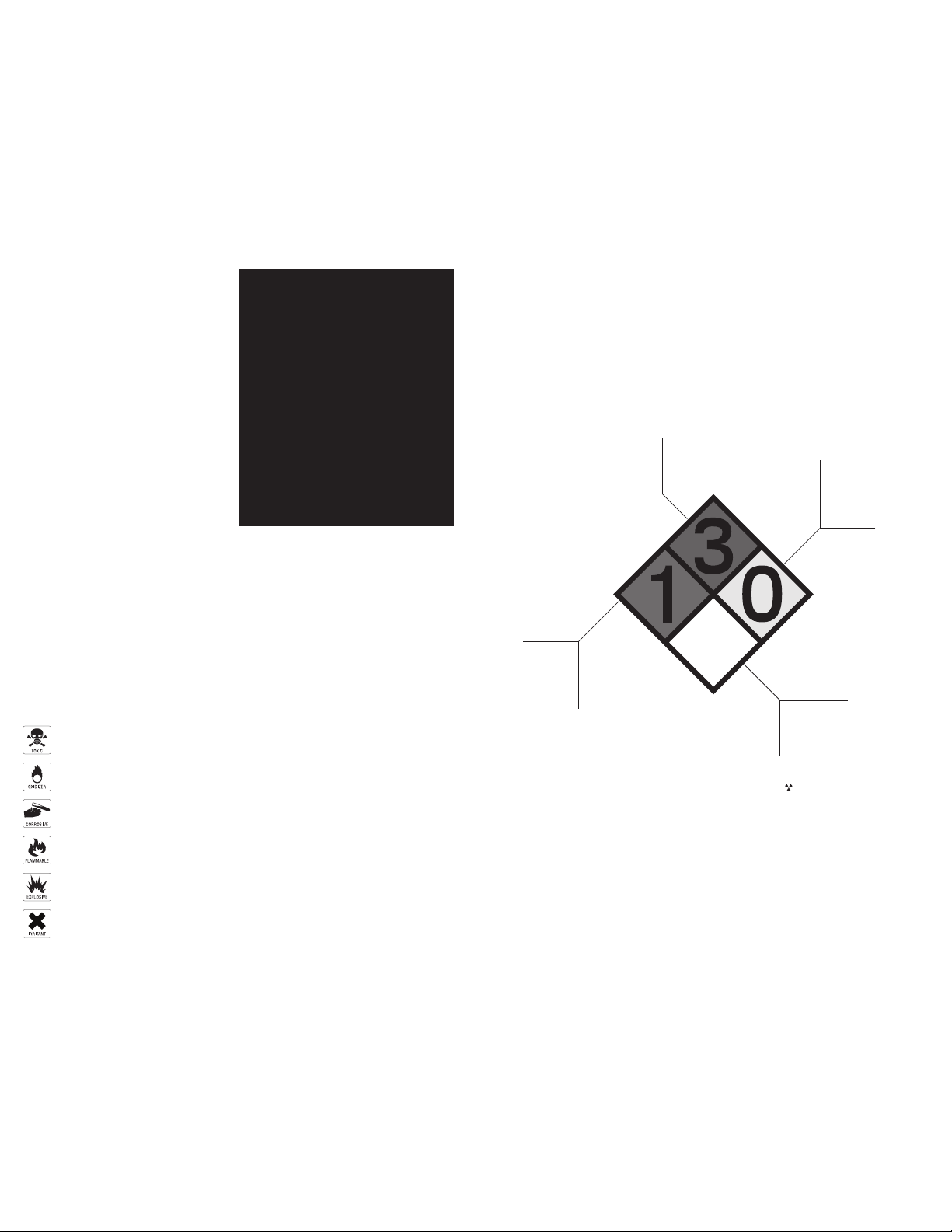
The diamond indicates U.S. standard NFPA (National Fire Protection Association) codes that
rank hazards according to the chemical’s reactivity to the presence of fire. The red, yellow,
and blue diamonds use a rating scale of 0 to 4, with 4 representing the greatest hazard
and 0 the least. The bottom diamond contains special pictograms as needed.
Top Diamond (Red):
Fire Hazard and Flash Point
4 – Very flammable; Below 21°C/70°F
3 – Ignites under normal temperature
conditions; Below 38°C/100°F
2 – Ignites with moderate heating; Below 93°C/200°F
1 – Ignites when preheated; Above 93°C/200°F
0 – Will not ignite (Non-flammable)
Left-hand Diamond
(Blue): Health Hazard
4 – Deadly
3 – Extremely Hazardous
2 – Hazardous
1 – Slightly Hazardous
0 – Normal Material
Right-hand Diamond
(Yellow): Reactivity
4 – Explosive
3 – Shock and heat may detonate
2 – Violent change may occur
1 – Unstable if heated
0 – Normally stable
Bottom Diamond (Uncolored/White):
Specific Hazard
OXY – Oxidizer
ACID – Acid
ALK – Alkali
COR – Corrosive
W – Water Reactive, use NO WATER
– Radiation Hazard
Flammable: Any solid, liquid, vapor or gas that ignites easily and burns rapidly.
Explosive: Any material that produces a sudden, almost instantaneous release of
pressure, gas or heat when subjected to suicient abrupt shock, pressure or temperature.
Irritant: Any non-corrosive material that causes a reversible inflammatory eect on living
tissue by chemical action at the site of contact as a function of concentration or exposure
duration.
Find Quality Products Online at: [email protected]
www.GlobalTestSupply.com
Section D: Target Organs, Effects and Route of Entry
Additional information required by OSHA Hazard Communication Standard.
Appropriate Target Organs and Effects labels:
Lungs; heart; kidney; eyes; skin; prostate; blood; liver; central nervous system;
cardiovascular system; mucous membranes; autonomic nervous system; respiratory system.
Recommended Protective Equipment:
Goggles; shield; lab coat; vent hood; proper gloves; extinguisher.
 Loading...