

Page 1

1
LUBRICANT CLASSIFICATION
MOTOR OIL
There are two main classification criteria for motor oils:
• Based on Viscosity (SAE)
• Based on Performance (API, ACEA, manufacturer's specifications)
SAE CLASSIFICATION
Kinematic viscosity measured at 100°C defines SAE degrees from 20 to 60 for rising levels
of viscosity. Dynamic vis cosity at low temperat u res def ines the S AE "W" degrees, fro m the
initial "winter", from 0W to 25W on the basis of viscosity leve ls measured at tempe ratures
from -35° to -5°C. The temperature represents the lowest possible temperature at which
the engine can be start e d w hen lu bri cated wi th an oi l of th e cor resp on din g SA E degr ee (e.g.
a 15W oil makes it possible to start the engine at up to -20°C). The minimum pumping
temperature is the minimum temperature at which oil, in addition to allowing start up, can
flow freely and lubricate the critical parts of the engine.
SAE J300 JANUARY 2009 (ENGINE OILS)
The most widely used system for engine oil viscosity classification is that established by the
Society of Automotive Engineers (SAE) in the USA. In this system two series of viscosity
grades are defined – those containing the letter W and those without the letter W.
Grades with th e letter W are intended f or use at lower temperatu res and are based on a
maximum low temperature viscosity and a maximum borderline pumping temperature, as
well as a minimum viscosity at 100°C. The low temperature viscosity is measured by means
of a multi-temperature version of ASTM D2602 ‘Meth od of Test for app arent Viscosity of
Motor Oils at Low temperature using the Cold Cranking Simulator’.
Viscosities measured by this method have been found to correlate with engine speeds
developed during low temperature cranking. Borderli n e pu mpi ng temp eratu re i s meas u red
according to ASTM D3829 ‘Standard Method for Predicting the Borderline Pumping
Page 2

2
Temperature of Engine Oil’. This provides a measure of an oils’ ability to flow to the
engine oil pump inlet and provide adequate engine oil pressure during the initial stages of
operation.
Oils without the letter W, intended for use at higher temperatures, are based on the
viscosity at 100°C only. These are measured by ASTM D445 ‘Method of Test for Kinematic
Viscosity of temperature and Opaque Liquids’.
‘multi-grade’ oil is on e w h os e low temperat u re vi s cos ity an d b ord erli ne te mpe ratu re s ati sf y
the requirements of one of the W grades and whose viscosity at 100°C is within the
stipulated range of one-W-grades
Page 3

3
0W
6200 at-35
60 000 at-40
3.8 - -
5W
6600 at-30
60 000 at-35
3.8 - -
10W
7000 at-25
60 000 at-30
4.1 - -
15W
7000 at-20
60 000 at-25
5.6 - -
20W
9500 at-15
60 000 at-20
5.6 - -
25W
13000 at-10
60 000 at-15
9.3 - -
8
- - 4.0
<6.1
1.7
12 - -
5.0
<7.1
2.0
16 - -
6.1
<8.2
2.3
20 - -
6.9
<9.3
2.6
30 - -
9.3
<12.5
2.9
3.5 (0W-40,
3.7 (15W40,
50 - -
16.3
<21.9
3.7
60 - -
21.9
<26.1
3.7
SAE J300 VISCOSITY GRADES FOR ENGINE OILS12 (JANUARY 2015)
SAE
Viscosity
Grades
Low Temperature
(°C)
Cranking
Viscosity
3
,
mPa.s Max
Low Temperature
(°C)
Pumping Viscosity,
mPa.s Max
With No Yield Stress4
Low-Shear-Rate
Kinematic
Viscosity
(mm
2/s
) at
5
100°CMin.
Low-Shear-Rate
100°CMin.
40 - - 12.5 <16.3
Kinematic
Viscosity
2/s
(mm
) at
High-Shear-Rate
5
Viscosity
(mPa.s)
(6)6
at 150°CMin.
5W-40 and
40 - - 12.5 <16.3
10W-40 grades)
20W-40 ,
25W-40, 40 grades)
1
1 mPa.s=1cP , mm
2
All Values, With the exception of the low-temperature cranking viscosity, are critical specifications as defined
by ASTM D3244 (See Text, section 3).
3
ASTM D5293:(Cold - Cranking Simulator) – The non-critical specification protocol in ASTM D3244: shall be
applied with a P value of 0.95.
4
ASTM D4684:(apparent viscosity) Note that the presence of any yield stress detectable by this method
constitutes a failure regardless of viscosity.
5
ASTM D445: (Kinematic viscosity)
6
ASTM D4683: CEC L-36-A-90 (ASTM D4741),or ASTM D5481 (Tapered bearing or tapered plug methods )
2
/5 =1 cSt
Page 4

4
API CLASSIFICATION
API stands for American Petroleum Institute. In 1970 along with the SAE and ASTM
(American Society for Testing and Materials), they established the API Service
Classificati on System to defi ne the performance level of a given oil, unrelated in the main,
to oil viscosity.
The API requirements “S” for Spark Ignition (petrol) and “C” for Compression Ignition
(diesel) can be briefly described as follows. For automotive gasoline engines, the latest
engine oil servi ce category in cludes the perf ormance properti es of each earl ier category. If
an automotive owner’s manual calls for API SJ or SL oil, API SM oil will provide full
protection. For diesel engines, the latest category usually – but n ot always – includes the
performance properties of an earlier category.
Page 5

5
Introduced in October 2010, designed to provide improved high
protection for pistons, more stringent sludge control,
turbocharger protection, emission control system compatibility, and
For all automotive engines currently in use. Introduced in 2004, SM oils are
improved oxidation resistance, improved deposit
CAUTION: Not suitable for use in gasoline-powered automotive engines
Use in more modern engines may cause unsatisfactory
Use in more modern engines may cause unsatisfactory
GASOLINE ENGINES
Category Status Service
temperature despite
SN
SM
Current
Current
and seal compatibility. API SN with resource Conserving matches ILSAC
GF-5 by combining API SN performance with improved fuel economy,
protection of engine operating on ethanol-containing fuels up to E85.
designed to provide
protection, better wear protection, and better low-temperature performance
over the life of the oil. Some SM oils may also meet the latest ILSAC
specification and/or qualify as Energy Conserving
For 2010 and older automotive engines.
SL
SJ
SH
SG
SF
SE
SD
SC
SB
Current For 2004 and older automotive engines.
Current For 2001 and older automotive engines.
Obsolete For 1996 and older engines.
Obsolete For 1993 and older engines.
Obsolete For 1988 and older engines.
Obsolete
Obsolete
Obsolete
Obsolete
CAUTION: Not suitable for use in gasoline-powered automotive engines
built after 1979.
built after 1971.
performance or equipment harm.
CAUTION: Not suitable for use in gasoline-powered automotive engines
built after 1967. Use in more modern engines may cause unsatisfactory
performance or equipment harm.
CAUTION: Not suitable for use in gasoline-powered automotive engines
built after 1951.
performance or equipment harm.
CAUTION: Contains no additives. Not suitable for use in gasoline-powered
SA
Obsolete
automotive engines built after 1930. Use in more modern engines may cause
unsatisfactory performance or equipment harm.
Note: API intentionally omitted “SI” and “SK” from the sequence of categories.
Page 6

6
DIESEL ENGINES
Introduced in 2006. For high-speed, four-stroke engines designed to meet 2007
systems are used. Optimum protection is provided for control of
effectively lubricate engines calling for those API Service Categories. When
ult the engine
manufacturer for service interv al.
Introduced in 2002. For high-speed, four-stroke engines designed to meet 2004
may also qualify for the CI-4 PLUS designation.
Introduced in 1998. For high-speed, four-stroke engines designed to meet 1998
Introduced in 1995. For severe duty, high-speed, four-stroke engines using fuel
Introduced in 1990. For high-speed, four-stroke, naturally aspirated and
Introduced in 1994. For severe duty, two-stroke-cycle engines. Can be used in
Introduced in 1994. For off-road, indirect-injected and other diesel engines
Introduced in 1985. For high-speed, four-stroke, naturally aspirated and
CD-II
Obsolete
Introduced in 1985. For two-stroke cycle engines.
CD
Introduced in 1955. For certain naturally aspirated and turbocharged engines.
CC
Obsolete
CAUTION: Not suitable for use in diesel-powered engines built after 1990.
CB
Obsolete
CAUTION: Not suitable for use in diesel-powered engines built after 1961.
CA
CAUTION: Not suitable for use in diesel-powered engines built after 1959.
Category Status Service
model year on-highway exhaust emission standards. CJ-4 oils are compounded
for use in all applicat ions with dies el fuels rangi ng in sulfur c ontent up to 500
ppm (0.05% by weight). However, use of these oils with greater than 15 ppm
(0.0015% by weight) sulfur fuel may impact exhaust after treatment system
durabi lity a nd/or oi l drai n inter val. CJ-4 oils are effective at sustaining emission
control system durability where particulate filters and other advanced after
CJ-4
CI-4
Current
Current
treatment
catalyst poisoning, particulate filter blocking, engine wear, piston deposits, lowand high-temperature stability, soot handling properties, oxidative thickening,
foaming, and viscosity loss due to shear. API CJ-4 oils exceed the performance
criteria of API CI-4 with CI-4 PLUS, CI-4, CH-4, CG-4 and CF-4 and can
using CJ-4 oil with higher than 15 ppm sulfur fuel, cons
exhaust emission standards implemented in 2002. CI-4 oils are formulated to
sustain engine durability where exhaust gas recirculation (EGR) is used and are
intended for use with diesel fuels ranging in sulfur content up to 0.5% weight.
Can be used in place of CD, CE, CF-4, CG-4, and CH-4 oils. Some CI-4 oils
CH-4
CG-4
CF-4
CF-2
CF
CE
Current
Obsolete
Obsolete
Obsolete
Obsolete
Obsolete
Obsolete
Obsolete
exhaust emission standards. CH-4 oils are specifically compounded for use with
diesel fuels ranging in sulfur content up to 0.5% weight. Can be used in place of
CD, CE, CF-4, and CG-4 oils.
with less than 0.5% weight sulfur. CG-4 oils are required for engines meeting
1994 emission standards. Can be used in place of CD, CE, and CF-4 oils.
turbocharged engines. Can be used in place of CD and CE oils.
place of CD-II oils.
including those using fuel with over 0.5% weight sulfur. Can be used in place of
CD oils.
turbocharged engines. Can be used in place of CC and CD oils.
Page 7

7
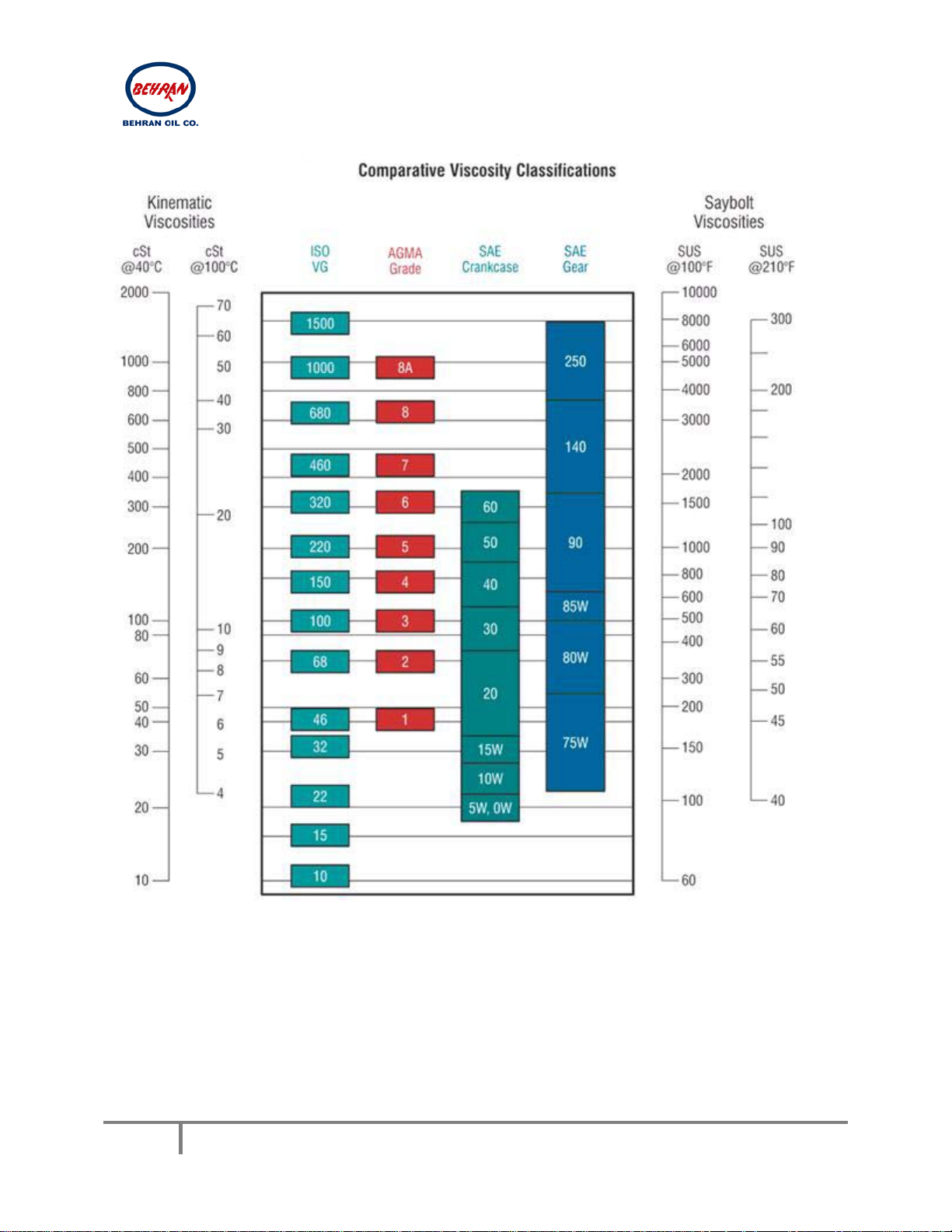
Through the years, lubricant users have been treated to a number of ways to designate
viscosity grades of the lubricants used in manufacturing. There are SAE (Society of
Automotive Engineers) grades for gear oils and crankcases (engines), AGMA (American
Gear Manufacturers Association) grades for gear oi ls, SUS (Say bolt Universal Seconds),
cSt (kinematic viscosity in centistokes), and absolute viscosity. To add to the confusion, two
measures of temperature (Fahrenheit and Celsius) can be applied to most of these, not to
mention that viscosity might be presented at either 40°C (104°F) or 100°C (212°F).
While all of thes e have served useful purpos es to one degree or anoth er, most lubrication
practitioners settle on and use one method as a basis for selecting products. To the new
entrant into the lubrication field, the number of options can be confusing, particularly if
the primary lubrican t supplier d oes not ass ociate one of th e prominent vis cosity systems to
the product label. To complicate matters, ma chinery designers must define the lubricant
viscosity in such a way that the equipment user understands clearly what is needed without
having to consult outside advice.
These points to the need for a universally accepted viscosity designation - one that can be
used by lubrication practitioners, lubricant suppliers and machinery design engineers
simultaneously with minimal confusion.
ACEA CLASSIFICATION
ACEA stands for Association des Constructers Europeans de l’Automobile. This
classification system is the European equivalent of the API classification system, but is
stricter and has more severe requirements. Hence oil that meets both API and ACEA
specifications uses a better additive package than one that is designed to meet only API
specifications. Unlike the API, ACEA has three main groups – “A/B” for gasoline and light
duty (passenge r car, 4WD et c) diesel engines, “C” for light duty three way catalyst (TWC)
and diesel particu late filter (DPF) compatible oils and “E” for heavy duty diesel engines.
These can be defined as follows.
Page 8

8
The ACEA 2008 Eu ropean Oil Sequences for Service-fill Oils comprise 3 sets (classes) of
sequences: one for Gasoline and Light-Duty Diesel engines; one specifically for Gasoline
and Light-Duty Diesel engines with af ter treatment devices an d one for Heavy-Duty Di esel
engines. Withi n each of these sets the re are categories w hich reflect dif ferent performance
requirements - four (A1/B1, A3/B3, A3/B4 & A5/B5) for gasoline and light-duty diesel
engines; four (C1, C2, C3, C4) specifically for engines with after treatment devices, and
four (E4, E6, E7, E9) for heavy-duty diesel engines. Typical applications f or each sequ ence
are described below for guidance only. Specific applications of each sequence are the
responsibility of individual engine manufacturers for their own vehicles / engines.
The sequences define the minimum quality level of a product for self-certification to
EELQMS and pres entation to ACE A members. Performance p arameters othe r than those
covered by the tests shown or more stringen t limits may be indi cated by individual ACE A
member companies.
Where claims are made that Oil performance meets the requirements of the ACEA
sequences (e.g. product literature, packaging, labels) they must specify the ACEA Class
and Category (see Nomenclature & ACEA Process for definitions).
Page 9

9
ACEA 2008 European Oil Sequences for Service-Fill Oils
A/B : gasoline and diesel engine oils
A1/В1
Stable, stay-in-grade oil intended for use at extended drain intervals in gasoline engines
unsuitable for use in some engines. Consult owner manual or handbook if in doubt.
Stable, stay-in-grade oil intended for use in high performance gasoline engines and car
operating conditions as defined by the engine manufacturer.
Stable, stay-in-grade oil intended for use in high performance gasoline and directinjection diesel engines, but also suitable for applications described under A3/B3.
Stable, stay-in-grade oil intended for use at extended drain intervals in high
tion low viscosity oils with a High temperature / High shear rate
Consult owner manual or handbook if in doubt.
C : Catalyst compatibility oils
Stable, stay-in-grade oil intended for use as catalyst compatible oil in vehicles with DPF
low friction, low viscosity, low SAPS oils with a minimum HTHS viscosity of 2.9
engines. Consult owner manual or handbook if in doubt.
Stable, stay-in-grade oil intended for use as catalyst compatible oil in vehicles with DPF
handbook if in doubt.
Stable, stay-in-grade oil intended for use as catalyst compatible oil in vehicles with DPF
handbook if in doubt.
Stable, stay-in-grade oil intended for use as catalyst compatible oil in vehicles with DPF
and car & light van diesel engines specifically designed to be capable of using low
friction low viscosity oils with a high temperature / high shear rate viscosity of 2.6
mPa*s for xW/20 and 2.9 to 3.5 mPa.s for all other viscosity grades. These oils are
А3/В3
А3/В4
А5/В5
С1
C2
& light van diesel engines and/or for extended drain intervals where specified by the
engine manufacturer, and/or for year-round use of low viscosity oils, and/or for severe
performance gasol ine engine s and car & li ght v an di esel en gin es desi gned t o be c apable
of using low fric
(HTHS) viscosity of 2.9 to 3.5 mPa.s. These oils are unsuitable for use in some engines.
and TWC in high performance car and light van diesel and gasoline engines requiring
mPa.s. These oils will inc rease the DPF and TWC life and m aintain the vehicles fuel
economy.
Warning: these oils have the lowest SAPS limits and are unsuitable for use in some
and TWC in high performance car and light van diesel and gasoline engines designed to
be capable of using low friction, low viscosity oils it a minimum HTHS viscosity of
2.9mPa.s. These oi ls wi ll i ncreas e the DP F and T W C li fe and mai ntain the vehi cles fu el
economy.
Warning: these oils are unsuitable for use in some engines. Consult owner manual or
and TWC in high performance car and light van diesel and gasoline engines, with a
C3
C4
minimum HTHS viscosity of 3.5mPa.s. These oils will increase the DPF and TWC life.
Warning: these oils are unsuitable for use in some engines. Consult owner manual or
and TWC in high performance car and light van diesel and gasoline engines requiring
low SAPS oil with a minimum HTHS viscosity of 3.5mPa.s. These oils will increase the
DPF and TWC life.
Warning: these oils are unsuitable for use in some engines. Consult owner manual or
handbook if in doubt.
Page 10

10
E : Heavy Duty-Diesel engine oils
E4
Stable, stay-in-grade oil providing excellent control of piston cleanliness, wear, soot
ction systems. However, recommendations may differ between engine
Stable, stay-in-grade oil providing excellent control of piston cleanliness, wear, soot
cant stability. It is recommended for highly rated diesel engines
or without particulate filters, and for engines fitted with SCR NOx reduction systems.
E6 quality is strongly recommended for engines fitted with particulate filters and is
ombination with low sulphur diesel fuel. However,
Dealers shall be consulted if in doubt.
Stable, stay-in-grade oil providing effective control with respect to piston cleanliness
and bore polishing. It further provides excellent wear control, soot handling and
oil drain intervals according to the manufacturer’s
engines and most engines fitted with SCR NOx reduction systems. However,
Dealers shall be consulted if in doubt.
Stable, stay-in-grade oil providing effective control with respect to piston cleanliness
excellent wear control, soot handling and
als according to the manufacturer’s
consulted if in doubt.
E6
handling and lubricant stability. It is recommended for highly rated diesel engines
meeting Euro I, Euro II, Euro III, Euro IV and Euro V emission requirements and
running under very severe conditions, e.g. significantly extended oil drain intervals
according to the manufacturer’s recommendations. It is suitable for engines without
particulate filters, and for some EGR engines and some engines fitted with SCR NOx
redu
manufacturers so Driver Manuals and/or Dealers shall be consulted if in doubt.
handling and lubri
meeting Euro I, Euro II, Euro III, Euro IV and Euro V emission requirements and
running under very severe conditions, e.g. significantly extended oil drain intervals
according to the manufacturer’s recommendations. It is suitable for EGR engines, with
designed for use in c
recommendations m ay differ between engine manuf acturers so Driver Manuals and/or
lubricant stability. It is recommended for highly rated diesel engines meeting Euro I,
Euro II, Euro III, Euro IV and Euro V emission requirements and running under severe
E7
E9
conditions, e.g. Extended
recommendations. It is suitable for engines without particulate filters, and for most EGR
recommendations m ay differ between engine manuf acturers so Driver Manuals and/or
and bore polishing. It further provides
lubricant stability. It is recommended for highly rated diesel engines meeting Euro I,
Euro II, Euro III, Euro IV and Euro V emission requirements and running under severe
conditions, e.g. extended oil drain interv
recommendations. It is suitable for engines with or without particulate filters, and for
most EGR engines and for most engines fitted with SCR NOx reduction systems. E9 is
strongly recommended for engines fitted with particulate filters and is designed for use
in combination with low sulphur diesel fuel. However, recommendations may differ
between engine manufacturers so Drivers Manuals and/or Dealers should be
Page 11

11
ILSAC ENGINE SERVICE CLASSIFICATIONS
ILSAC (International Lubricants Standardization and Approval Committee) includes the
major automobile manufacturers that manufacture vehicles in the USA. This includes the
Japanese manufac turers. Eff ectively, I LSAC specif ications are the fuel econ omy version of
the API specifications.
GF-1 is obsolete
GF-2 is equivalent to API SJ
GF-3 is equivalent to API SL
GF-4 is equivalent to API SM
GF-5 is equivalent to API SN
ILSAC grades only apply to viscosities XW-20 and XW-30. GF-4 has introduced a
phosphorus limit of 0.08% maximum and a sulphur limit of 0.2% maximum, GF-5 is
similar, but it introduced new requirements relating to phosphorus volatility and
compatibility with ethanol fuels.
ILSAC, API and ACEA specifications require a large range of engine tests and laboratory
tests on the oil. Parameters such as high and low temperature wear, oxidation, soot control,
oil thickening, deposit control, volatility, stay in grade performance, fuel economy,
chemical composition and many others are tested against limits and rated.
In the case of the API, the oil specifications become more sever e as the letters climb the
alphabet, eg SL is more severe than SJ. This is not necessarily the case wi th ACE A as th eir
specifications are more application specific.
TWO STROKE OILS
AIR COOLED
These are low ash or ash less oils depending on the end use. Products can be used in oil
injection syste ms or pre mixed w ith th e fuel . As they are con su med w ith the f uel , two s troke
Page 12

12
oils must not caus e exc ess ive co mbus tion ch amb er or pis ton d epos its, or engin e fai lu re may
result. The most common two stroke specifications are air cooled.
API TC
ISO EG-B/JASO FB provides good protection against scuffing and varnish.
ISO EG-C/ JASO FC as per EG-B/FB but it has severe restrictions on exhaust smoke,
system blocking and detergency.
ISO EG-D/JASO FD enhanced detergency and varnish protection compared to EG-C/FD.
WATER COOLED
NMMA TC-W3® is ash less oil for two stroke outboard engines. Oils can be licensed to this
category.
AUTOMATIC TRANSMISSION FLUID
CLASSIFICATIONS
There are no API standards for automatic transmission fluids. Indeed, it is only in recent
times that the Japanese have released a general industry standard that stands alongside
their individual requirements. (JASO-1A)
GENERAL MOTORS
TYPE A AND TYPE A SUFFIX A
The original fluids. They came out on 1949 and 1957 respectively and are long obsolete.
Page 13

13
DEXRON®-IID
Now obsolete as far as General Motors is concerned, it was the closest we had to an
industry specification. Indeed, it formed the basis of many other OEM (Original
Equipment Manufacturer) ATFs specifications. It is still used by GM Europe up until
recently and by other European and some Japanese OEMs.
DEXRON®-IIE
A development that had better low temperature properties than IID. Now superseded.
DEXRON®-III
For many years it was in “F” and “G” specifications, which h ad the same low temperature
characteristics as the IIE version, but with modifications to antioxidancy and friction
material. The 2003 IIIH specification was for 160,000km drain intervals and extended
durability and superseded “G”. This specification became obsolete at the end of 2006 and
was replaced by DEXRON®-VI .
DEXRON®-VI
Initially released in 2005, this is a special low viscosity fluid which will replace
DEXRON®-III in all GM manufactured automatic transmissions. It has a
very long oil drain capability of up to 400,000km
DEX-CVT®
Special specification for CVTs.
.
FORD MOTOR COMPANY
M2C33-F and M2C33-G
F came out for the USA and G for Europe. These are non-friction modified fl uids and as such
cannot be used in most transmissions.
Page 14

14
M2C138-CJ and M2C166-H
Introduced to deal with problems with the C-6 and C-5 transmissions, these are satisfied by
DEXRON
MERCON®
The original MERCON® fluids were again satisfied by DEXRON®-IID and the revised
MERCON®-IV fluids by DEXRON®-IID/E and DEXRON®-III. (Now obsolete)
MERCON®-C
Special specification for CVTs.
MERCON®-V
This is the first MERCON® fluid not satisfied by a standard DEXRON® type fluid.
Usually semi or fu lly synthetic, i t has more severe requirements on f riction, fluid ity, shear
loss and oil drain. While fluids meeting MERCON®-V must pass DEXRON® -III initially,
they are then subjected to many other tests. Updated in mid 2008.
MERCON®-SP and MERCON®-LV
Both fluids are low viscosity fluids. MERCON®-SP was based around a ZF specification
and was used in six speed automatic transmissions, f or b ot h front and rear wheel d rive . L V
was introduced in 2007 and Ford plan to make it backwards compatible.
®-IID.
ALLISON
C-4 Designed for heavy-duty transmissions in off-highway vehicles. ATFs and special fluids
are qualified against it. Supersedes C-3.
TES295 Special formulation-specific, PAO based fluid for heavy duty applications.
TES389 Introduced in 2006 to cover DEXRON®-III application s. Now required for all onhighway transmissions instead of C-4.
Page 15

15
SAE J306 Automotive Gear Viscosity Classifications Axle and
70W
75W
80W
85W
80
85
90
110
140
190
250
Viscosity
Min,mm2/s
4.1
4.1
7.0
11.0
7.0
11.0
13.5
18.5
24.0
32.5
41.0
Max,mm2/s
--
--
--
--
11.0
13.5
18.5
24.0
32.5
41.0
--
Viscosity of 150,000
20hr. KRL Shear
KV100, after Shear
CATERPILLAR
TO-4 specialized fluid for Caterpillar units. Oils meeting TO-4 and C-4 find wide
application in heavy-duty construction equipment manufactured by many OEMs such as
Komatsu. Also used in manual transmissions.
GEAR OIL CLASSIFICATIONS
Like motor oils, there are two main classification criteria for gear oils:
• Based on Viscosity (SAE)
• Based on Performance (API, manufacturer's specifications)
SAE CLASSIFICATION
Manual Transmission Lubricant Viscosity Classifications
at 100°C
mPa.s max. temp°C
(CRCL-45-t-93) ,
mm2/s, min.
-55 -40 -26 -12
--
-- -- -- -- -- --
4.1 4.1 7.0 11.0 7.0 11.0 13.5 18.5 24.0 32.0 41.0
Page 16

16
SAE J2360 Automotive Gear Viscosity Classifications
Viscosity
at 100°C
Min,mm2/s
4.1
13.5
24.0
Max,mm2/s
--
18.5
32.5
Viscosity of 150,000 mPa.s max. temp. °C
-40
-26
-12
Channel Point, Min. °C
-45
-35
-20
Flash Point, Min. °C
150
165
180
75W 80W-90 85W-140
API CLASSIFICATION
For gear oils (loosely including MTFs), there is the below set of standards:
GL-1 Oil without additive
GL-2 usually contains fatty materials
GL-3 contains a mild EP additive
GL-4 Equivalent to MIL-L-2105B and is usually satisfied by a 50% GL-5 additive level.
GL-5 Equivalent to MIL-PRF-2105E. Primary f ield servi ce recommen dation for Passen ger
cars and trucks worldwide.
GL-6 for severe service involving high offset hypoid gears. Often used to describ e oils us ed
in limited slip differentials.
MT-1 For non-synchronized manual transmissions in buses and trucks at a higher level
than GL-4. GL-2, GL-3, and GL 6 are not normally used for automotive applications.
MIL-PRF-2105E – designed by the US military it takes conventional GL-5 and adds more
demands to the specification. Most hypoid oils conform to this standard.
AGMA SPECIFICATIONS FOR GEAR LUBRICANTS
The American Gear Manufacturers Association (AGMA) has issued specifications and
recommendations for gear lubricants used in various types of gear application. AGMA
Standard 250.04 details specifications for rust and oxidation inhibited (R and O) and
extreme –pressure (EP) Lubricants used in enclosed gear drives.
Page 17

17
Viscosity Ranges for AGMA Lubricant Numbers
Rust and Oxidation
Equivalent ISO
Extreme Pressure
1
41.4 to 50.6
46 2
61.2 to 74.8
68
2 EP
3
90 to 110
100
3 EP
4
135 to 165
150
4 EP
5
198 to 242
220
5 EP
6
288 to 352
320
6 EP
7Compounded
414 to 506
460
7 EP
8 Compounded
612 to 748
680
8 EP
8A Compounded
900 to 1100
1000
8A EP
The viscosity brackets correspond to those given in ASTM D 2422 ‘Standard
Recommended Practice for Viscosity System for Industrial Fluid Lubricants’.
Viscosity Ranges
Inhibited Gear Oils
AGMA Lubricant No. cSt (mm2/s) at 40 °C AGMA Lubricant No.
Grade
Gear Lubricants
NOTE: Viscosity ranges for AGMA Lubricant Numbers will henceforth be identical with those of the ASTM System oils
compounded with 39% to 10% fatty or synthetic fatty oils.
Page 18

18
INDUSTRIAL LUBRICANT CL ASSIFICATIONS
ISO (INTERNATIONAL STANDARDS ORGANIZATION)
VISCOSITY CLASSIFICATION
The ISO viscosity classification uses mm2/s (cSt) units an d relates to viscosity at 40 ْ◌ C. It
consists of series of 18 viscosity bracts between 1.98 mm2/s and 1650mm2/s, each of which is
defined by a number .The numbers indicate to the nearest whole number, the mind point of
their corresponding brackets. For example, ISO viscosity grade 32relates to the viscosity
bracket 28.8 to 35.2 mm2/s, the midpoint of which is 32.0mm2/s. This is illustrated in the
table below, which shows the ISO viscosity grade number, the mid-points of each break,
and the viscosity limits. This system is now used to classify all industrial lubricating oils
where viscosity is an important criterion in the selection of the oil. Cutting oil and some
other specialized products are more important in relation to grade selection.
Page 19
19
ISO VISCOSITY GRADE CONVERSIONS
Kinematic Viscosity Limits
Say bolt Viscosity SUS
MIN
MAX
MIN
MAX
2
2.2
1.98
2.42
32
34
35.5
3
3.2
2.88
3.52
36
36.5
38.2
5
4.6
4.14
5.06
40
39.9
42.7
7
6.8
6.12
7.48
50
45.7
50.3
10
10 9 11
60
55.5
62.8
15
15
13.5
16.5
75
72
83
22
22
19.8
24.2
105
96
115
32
32
28.8
35.2
150
135
164
46
46
41.4
50.6
215
191
234
68
68
61.2
74.8
315
280
345
100
100
90
110
465
410
500
150
150
135
165
700
615
750
220
220
198
242
1000
900
1110
320
320
288
352
1500
1310
1600
460
460
414
506
2150
1880
2300
680
680
612
748
3150
2800
3400
1000
1000
900
1100
4650
4100
5000
1500
1500
1350
1650
7000
6100
7500
ISO
Viscosity
Grade
Mid-point
Kinematic
Viscosity
cSt at 40 °C(104 °F)
ASTM, Say bolt
Viscosity
Number
100 °F(37.8 °C)
Page 20
20
Viscosity Equivalents at Same Temperat ure
Page 21
21
Neutrals
40°C
100°C
cSt
SUS
cSt
SUS
70N
13.3
70.8
3.0
37.0
80N
15.6
80.3
3.35
37.3
90N
18.0
89.0
3.4
37.5
100N
21.5
104.0
4.0
39.0
140N
30.7
144.0
4.5
41.0
150N
31.6
148.0
4.9
42.4
160N
33.7
158.0
5.2
43.3
170N
34.0
159.0
5.4
44.0
180N
38.5
181.0
5.7
44.9
200N
44.5
204.0
6.2
46.0
250N
56.1
257.0
6.5
47.0
300N
61.3
285.0
7.0
49.0
315N
70.0
315.0
7.9
52.0
330N
70.9
328.0
8.4
53.7
350N
76.0
358.0
8.8
55.0
400N
86.0
398.6
9.8
58.0
450N
98.0
454.0
10.5
61.0
500N
107.0
496.0
11.0
64.0
600N
130.4
604.0
12.1
66.0
650N
141.0
665.0
14.8
71.0
700N
151.0
668.0
14.0
73.0
135Brt
413.2
1875.0
28.6
135.0
145 Brt
523.3
2425.0
30.9
145.0
150 Brt
568.0
2632.0
33.0
155.0
160 Brt
600.0
2800.0
35.2
166.0
175 Brt
616.0
2855.0
36.0
169.7
185 Brt
654.7
3034.0
37.6
177.0
225 Brt
1030.0
4800.0
49.3
229.0
GRADE
BASE STOCK VISCOSITY
 Loading...