

Page 1

Prenatal Gift Set
Juego de Regalo Prenatal
Model #BE005
Instruction Manual
Manual de Instrucciones
www.bebesounds.com
Page 2

TABLE OF CONTENTS
Please Read the Following to Enjoy Our Product..................................................4
SECTION I:
LISTENING TO YOUR UNBORN BABY
Introduction..............................................................................................................................5
Contents.....................................................................................................................................6
Identifying the Fetal Sounds You Will Hear...............................................................7
When You Will Hear These Sounds...............................................................................7
Prenatal Heart Listener® vs. Doppler............................................................................8
Record Your Baby's Sounds and Your Own Heartbeat........................................8
Instructions for Listening to Your Unborn Baby......................................................9
Instructions to Record Your Baby's Sounds............................................................11
Instructions to Record and Email
Your Baby's Sounds with Your Computer.................................................................11
SECTION II:
TALKING & PLAYING MUSIC TO YOUR UNBORN BABY
Introduction.............................................................................................................................12
How Your Unborn Baby Develops................................................................................13
How Your Unborn Baby's Brain Develops................................................................14
2
Page 3

Research Findings..............................................................................................................15
Instructions for Playing Music to Your Unborn Baby..........................................17
Playing Music to Your Newborn Baby....................................................................19
Instructions for Talking, Singing, and Reading to Your Unborn Baby.........19
Frequently Asked Questions..........................................................................................20
Endnotes.................................................................................................................................21
Schedule of Music Played..............................................................................................22
SECTION III:
ADDITIONAL PRODUCT INFORMATION
Tips for Using the Prenatal Heart Listener®...........................................................23
Care and Cleaning..............................................................................................................23
Troubleshooting...................................................................................................................24
Technical Specifi cations..................................................................................................26
Disclaimer...............................................................................................................................27
Limited Product Warranty...............................................................................................27
Also Available from BébéSounds®.............................................................................30
En Español............................................................................................................................32
3
Page 4

PLEASE READ THE FOLLOWING TO ENJOY OUR PRODUCT
• Please have patience. This product requires a little time but the
results are wonderful. You should start using it at the begining of your
third trimester.
• What you will hear through our Prenatal Heart Listener® will be the
natural sounds of your baby. Your doctor uses Doppler ultrasound
equipment which produces artifi cial noise by turning movement into
sound. Our Prenatal Listener® amplifi es the actual sounds of your baby.
• The best time to listen is 3 to 4 hours after eating and when you
are relaxed.
• The Prenatal Heart Listener® must be used in a very quiet room.
• Placing the volume control at a low to moderate level will produce the
best results and avoid static.
• You might not hear your baby's sounds immediately so don't be
disappointed. The more you use the Prenatal Heart Listener®, the
better you will become at fi nding the sounds. Your baby's position will
also greatly affect your success. The best position is with your baby's
back to your belly button. Your success will also depend on how relaxed
you are. You may have to try several times before you will hear your
baby's sounds, particularly the heartbeat.
• Your baby's heartbeat does not sound like your own. A fetal heart beats
from 120-180 times per minute. It will sound like a soft, rapidly beating
drum or a galloping horse.
• You will also hear kick, hiccups, and nutrients passing through the
placenta. Kicks sound like uneven thumps, hiccups like two rapid
drumbeats, and the nutrients like a whooshing sound.
4
Page 5

• The provided headset is specially designed to be used with your
Prenatal Heart Listener®. Do not use any other headset.
• Our Prenatal Heart Listener® is completely safe for you and your baby.
It does not use any AC current, ultrasound, or radio waves.
SECTION I:
LISTENING TO YOUR UNBORN BABY
INTRODUCTION
Thank you for purchasing our BébéSounds® Prenatal Heart Listener®.
Please read the following material carefully to maximize your enjoyment
of this product.
It is important to understand that many factors affect what you will hear
with your Prenatal Heart Listener®. The position of your baby, your baby's
weight, your weight, your stage of pregnancy, and where you place the
Prenatal Listener® will all affect what you will hear.
For example, when listening for the fetal heartbeat, the sound will be
loudest in the third trimester and if your baby is positioned with her
back to your belly button. Your baby may naturally shift position, thereby
creating the situation where you will hear your baby one moment but
not the next. However, once you've passed the second trimester, your
baby will be growing very rapidly and you will hear the heartbeat and all
the other sounds on a much more regular basis.
Don't worry! It's quite normal that there will be times you will not be
able to hear your baby's sounds due to your baby's position or stage
of development. This is especially true of the heartbeat which is highly
dependent on your baby's position.
5
Page 6
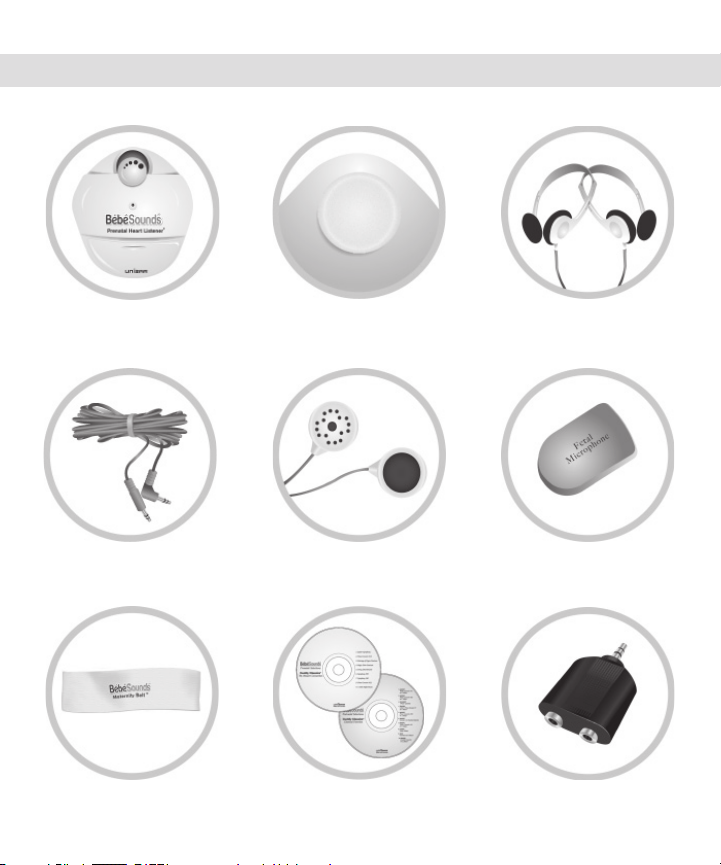
CONTENTS
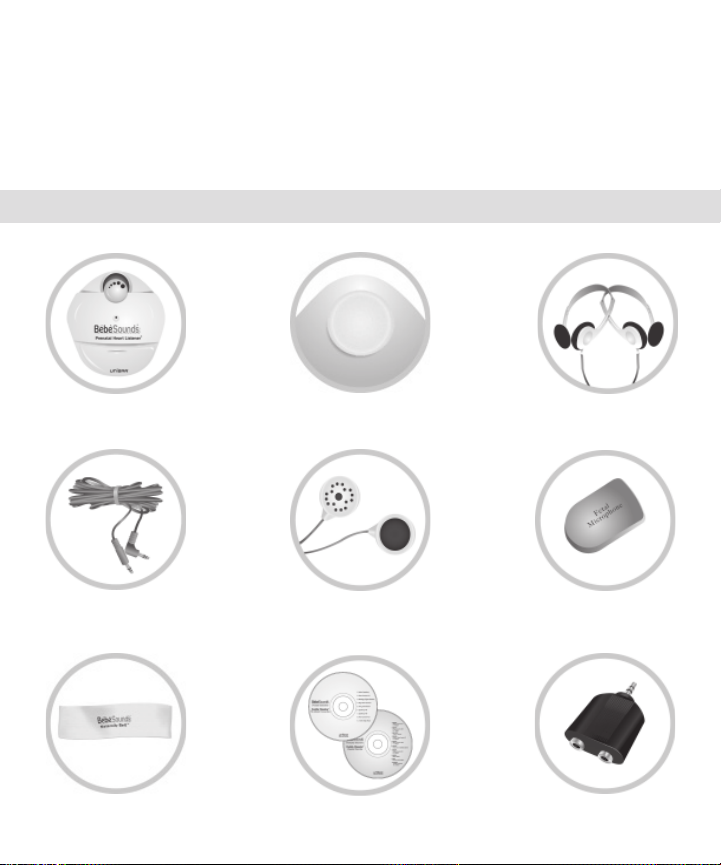
fig.1
prenatal heart listener
®
fi g.4
recording cable fetal speakers fetal microphone
fi g.7
fi g.2
foam cover
fi g.5
fi g.8
fi g.3
fi g.6
fi g.9
two headsets
0 prenatal & postnatal CD
6
adapter
Page 7

IDENTIFYING THE FETAL SOUNDS YOU WILL HEAR
You will hear kicks, hiccups, nutrients passing through the placenta,
and, of course, the heartbeat. Each one is distinctive and being able
to identify them will signifi cantly enhance your experience.
The best way to describe each sound is as follows:
Heartbeat: A very soft rapidly beating drum or a galloping horse
Kicks: A series of uneven thumps
Hiccups: Two rapid, soft drumbeats
Nutrients: A whooshing sound
A fetal heart beats from 120 to 180 times a minute while the heart of
a pregnant woman beats approximately 100 times a minute. Knowing
this should help prevent you from confusing your own heartbeat with
that of your baby's.
WHEN YOU WILL HEAR THESE SOUNDS
The fetal heartbeat, kicks and hiccups may be heard from the
beginning of your third trimester. You will need to listen very carefully
for your baby's heartbeat as it may be extremely diffi cult to hear it over
the beating of your own heart. The sound of your own bowels may
also interfere with your ability to hear the heartbeat. While the Prenatal
Heart Listener® is specially designed to tune out these sounds, they
can still get in the way. This is why the best time to listen is 3 to 4 hours
after a meal and when you are relaxed and have a slower heartbeat.
Remember, as your baby grows and gets stronger, so do the sounds
she creates. You will also become more familiar with the sounds so they
will be easier to identify.
7
Page 8

PRENATAL HEART LISTENER
®
VS. DOPPLER
You will notice that the sounds you hear through the Prenatal Heart
Listener® are different from those you hear at your doctor's offi ce. This
is because your doctor probably uses Doppler ultrasound equipment
which creates electronic noise based on movement. The Prenatal
Listener®, however, is designed to amplify the sounds naturally by using
the absolutely safe Bell stethoscope method of amplifi cation. Again,
the heartbeat heard through the Prenatal Listener® sounds more like the
soft, rapid beating of a drum, while the Doppler sound is more of a
gushing noise. Please keep in mind that it will take a little practice to
pick up this faint sound so listen very carefully.
RECORD YOUR BABY'S SOUNDS & YOUR OWN HEARTBEAT
With our recording cable and your own recorder you can record your
baby's sounds. We also encourage you to record your own heartbeat
prior to your baby being born. You will then be able to play it back to
your newborn after birth which may have a calming and soothing effect.
8
Page 9

INSTRUCTIONS FOR LISTENING TO YOUR UNBORN BABY
(See Figs. 10 and 11)
1. Remove the battery cover and install a new 9-volt battery (not included).
We recommend using a new battery as an old one will severely
®
interfere with the performance of your Prenatal Heart Listener
. Be
sure to match positive (+) to positive (+) and negative (-) to negative
(-). Replace the battery cover.
2. Insert the headset plug into either jack on the unit and put the
headset on. For two people to listen at the same time, insert the
second headset plug into the other jack.
3. Be sure the foam cover is in place on the listening cone. Hold
the listening cone to your stomach or lower back. Use the Prenatal
Listener® on bare skin in a quiet room.
4. Turn the Prenatal Heart Listener® on by turning the Power/Volume
control wheel to the right until you hear a click. The red power indicator
on the front will light up to indicate the unit is in the ON position.
5. Adjust the volume to optimize the listening level and amplifi cation.
Begin with a low to moderate level to avoid static.
6. Start by placing the listening cone two inches below and several
inches to the right of your belly button. Gently move the unit one inch
at a time to different places until you fi nd the best position for listening
to your baby's sounds. Before moving the Prenatal Listener®, turn
the volume level down to the lowest position to avoid the sound of
the cone moving against your skin.
7. When you are fi nished, turn the Power/Volume control wheel all the
way to the left until you hear a click to turn the Prenatal Listener® off.
The red power indicator light will turn off.
9
Page 10
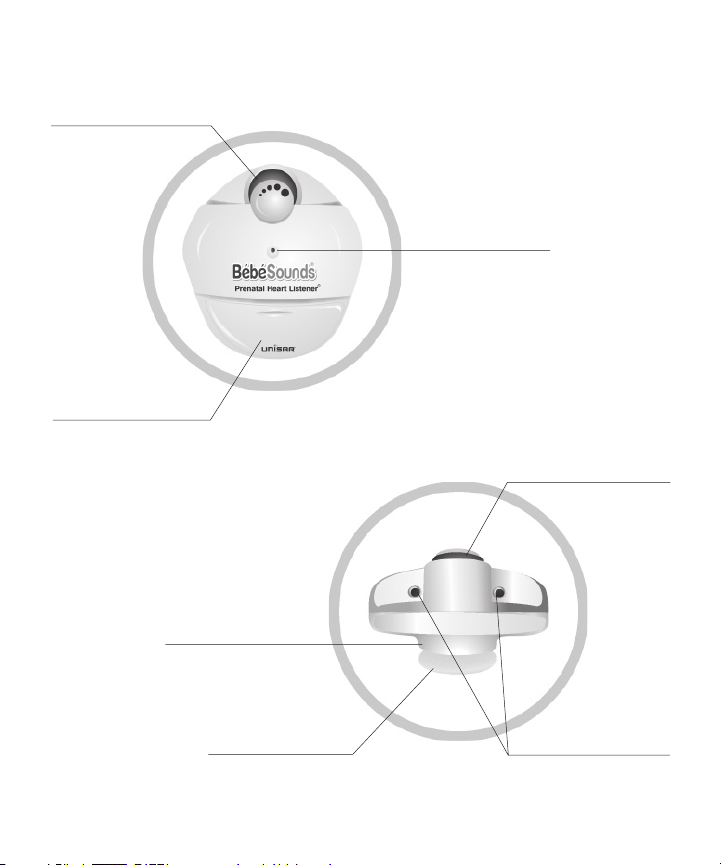
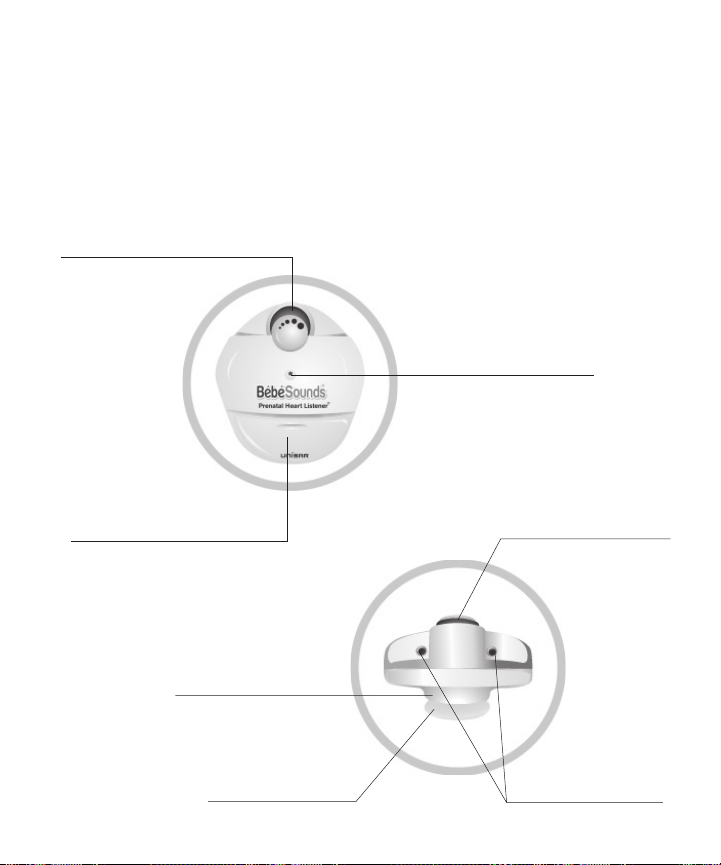
fi g.10
power/volume control
battery compartment
power indicator
listening cone
foam cover
fi g.11
10
power/volume control
headset jack
Page 11

INSTRUCTIONS TO RECORD YOUR BABY'S SOUNDS
(See Figs. 10 and 11)
1. Plug the L-shaped end of the recording cable into either jack of
the Prenatal Listener®. Plug the straight end into the line input of
your recorder (some portable recorders do not provide this input).
2. Set up your Prenatal Heart Listener® for listening to your baby.
3. Adjust the recording level on your recorder if necessary.
4. Hold the Prenatal Listener® very still and begin recording.
Remember, the sound of your heartbeat can have a very calming
and soothing effect on your baby. Your may want to record your
own heartbeat before your baby is born. You will then be able to
play back your recorded heartbeat to your baby after birth. We
recommend a 30-minute recording. NOTE: You will need to reduce
the volume when you record your own heartbeat since it is much
louder than that of your unborn baby's.
INSTRUCTIONS TO RECORD & EMAIL YOUR
BABY'S SOUNDS WITH YOUR COMPUTER
(See Figs. 10 and 11)
1. Plug the L-shaped end of the recording cable into either jack on the
Prenatal Listener®. Plug the straight end into the microphone jack on
your computer. This is indicated by a picture of a microphone near
the jack or the jack is color coded pink on the back of your computer.
2. On your computer, go to START, PROGRAMS, ACCESSORIES,
ENTERTAINMENT (or MULTIMEDIA), SOUND RECORDER.
11
Page 12

3. Set up your Prenatal Heart Listener® for listening to your baby.
4. Press the red recording button in the SOUND RECORDER program
to begin recording a one-minute sound fi le. You are now recording
your baby's sounds.
5. After one minute, the recording will fi nish. Name and save your
sound fi le in an appropriate folder. You can now email your sound
fi le to family and friends.
SECTION II:
TALKING & PLAYING MUSIC TO YOUR UNBORN BABY
INTRODUCTION
Research into the benefi ts of stimulating your unborn baby has been
done worldwide and it is now believed that your baby can learn while still
in your womb. While most of the attention in the past has focused on the
positive results of infant stimulation, it is very important not to overlook
the potential benefi ts of prenatal stimulation.
Studies have shown that a prenatally stimulated baby tends to display
faster visual, linguistic, and motor development than a baby who was
not stimulated. Research has also shown that the brain of the prenatally
stimulated baby tends to be more developed, thereby providing a better
foundation for the child to have a higher IQ and intelligence level.
Prenatal stimulation can come from playing classical music, talking,
or singing to your baby, and even rubbing your stomach. “The most
effective way to stimulate your baby and enhance her brain development
while still in the womb is through sound.”
1
12
Page 13

Dr. Norman A. Ravski, Assistant Clinical Professor, Department of
Obstetrics and Gynecology at Yale University School of Medicine, and
Attending Physician at Yale New Haven Hospital, has endorsed playing
classical music to your baby. In his endorsement, Dr. Ravski states,
“In-utero fetal acoustic stimulation has been shown to improve pregnancy outcomes as well as benefi t the growing fetus.” The BébéSounds®
Prenatal Gift Set enables you to direct our specially selected classical
music through your womb to your baby with our Fetal Speakers.
It is also believed that your newborn baby will recognize the voices
of her parents immediately after birth if they are heard while in the
womb. In addition to stimulating your baby, talking to her will help your
baby's father bond with her. Talk and sing to your unborn baby using
®
the BébéSounds
Fetal Speakers and Microphone, which will amplify
your voices so they will be heard over the other noises inside the womb.
When speaking to your baby, keep in mind that the fi rst step in your
baby's development of language skills is the recognition of intonations
so it is important for both parents to speak to their child. Although
the mother's voice tends to be more melodic and is constantly heard,
the father's voice is louder and deeper and penetrates the womb
more easily.
It is always a good idea to keep your doctor informed of what you
are doing during your pregnancy. Therefore, we encourage you to inform
your doctor that you will be stimulating your unborn baby with the
BébéSounds® Prenatal Gift Set.
HOW YOUR UNBORN BABY DEVELOPS
First Trimester: The embryo begins to develop; the head and limbs
start to form; head, body, and limbs begin to move (you won’t fell this
movement yet); nervous system that deals with equilibrium and spatial
13
Page 14

relations begins to develop; and heart begins to beat more strongly.
Second Trimester: The head develops more actively than the rest of
the body; eyes respond to light; key organs mature; fetus reacts to
music and loud noise; arms and legs are moving strongly enough so
you can feel them; fetus can hear and the ability to learn signifi cantly
increases; signs of memory and the ability to respond to various stimuli
are apparent; and music has a calming effect while harsh sounds have
an agitating effect.
Third Trimester: The nervous system has matured and becomes fully
formed; brain enters a rapid growth phase; movements are more
coordinated and muscles are stronger; fetus moves to the rhythm of
music; sight has developed and response to light is evident; movement
is less frequent but stronger toward the end of the ninth month; and
growth and development continue until birth.
HOW YOUR UNBORN BABY'S BRAIN DEVELOPS
Your baby's brain begins developing almost immediately and by the
fi fth month the number of brain cells your baby will have for the rest of
her life is determined. From this point forward, her brain develops by
increasing the size and complexity of the cells already created. Around
the eighth month, your unborn baby's brain changes signifi cantly. At this
time, it doubles in weight and the connections between the brain cells,
known as synapses, become even more complex.
The following is the structure of a brain cell:
Dendrites: receive messages from the body
Cell body: decides whether to send the message received from the
dendrites or to store it
Axons: transmit messages received from the cell body
14
Page 15

As the cells get larger, the axons grow longer and the dendrites become
an increasingly complex system of multiple connections like branches of
a tree. The more stimulation the cells receive, the more complex these
dendrites become, resulting in a more developed brain.
The number of brain cells your baby is born with helps determine her
potential, but it is also the number of connections between these cells
that determines her fi nal intelligence. Helping to increase the number of
connections and complexity of the brain cells with stimulation increases
the probability of your baby having a higher intelligence level and IQ.
RESEARCH FINDINGS
It is now known that stimulation of the senses affects the growth of
the brain cells and if a fetus has little stimulation in the womb, fewer
connections are made. Specialists in fetal and infant brain development
have agreed that stimulating your unborn baby's senses can affect the
development of the connections between the brain cells. In fact, the lack
of these connections can actually cause cells to die, especially in the
eighth month of pregnancy.
2
By the end of the fi fth month, your baby can hear and begins to learn,
and you can tell when she is reacting to external stimulation. In one
case, pregnant mothers actually had to leave a concert of classical
music before it was over because their babies were kicking so hard in
time to the music that they couldn’t tolerate it.
3
In another case, mothers were asked to play their favorite classical
music to their unborn baby for ten minutes a day at a volume that was
just a little louder than normal speaking voice. It was discovered that
the babies recognized the change in their environments immediately as
was evidenced by their heart rates increasing noticeably. What is also
15
Page 16

interesting is that the unborn baby does not respond in this way to many
single notes even if they are played very loud and very close to her.
4
Yet another study showed that unborn babies who had classical music
played to them from the middle of the fi fth month until they were born,
for ten minutes twice a day, developed more quickly, began to talk up
to six months earlier, and had greater intellectual development than
those babies who had not had classical music played to them inside
the womb.
5
Some women worry that if they improve the brain's development, the
baby's head will be larger thereby causing an increase in the risk of
delivery problems. In fact, there is reason to believe the opposite is
true. Prenatal sound stimulation has led to shorter and less painful labor
periods, a lower number of cesarean section deliveries, and a greater
number of non-traumatic births.6 In addition, a baby who experiences
prenatal stimulation tends to:
• Be calmer and more alert
• Be happier and cry less
• Have a longer attention span
• Be stronger and have better coordination
• Lift his or her head up earlier and stand earlier
• Walk earlier
• Talk earlier
• Have more self-confi dence
7
Remember, by the end of the fi fth month your unborn baby begins to
hear and by the sixth month, her ability to learn increases signifi cantly.
It is now time to start stimulating your baby. Keep in mind that your baby
is most alert during the evening hours so you may want to play music or
talk to her a few more times.
16
Page 17

INSTRUCTIONS FOR PLAYING MUSIC TO YOUR
UNBORN BABY (YOU WILL NEED YOUR OWN CD PLAYER)
The best time to play music is once in the morning and once in the
evening, for a period of 5 to 10 minutes, around the same time each
day. Be careful not to play the music too long or too frequently as your
unborn baby also needs to rest. However, you will probably fi nd that
your baby will be very active and obviously awake during the evening.
Do not play the same music over and over again. It is believed that if
your baby hears the same thing repeatedly, she will eventually ignore it.
However, periodic repetition of the same music is advisable. In some
cases, when the music was played after the baby was born, the newborn
seemed to recognize the melody.
We suggest playing different music during each session in a single day
and replaying it two or three days later. We also suggest that you keep a
schedule of the music you have played showing the date, music played,
and times it was played. We've provided you with a starter schedule on
page 22 in this booklet.
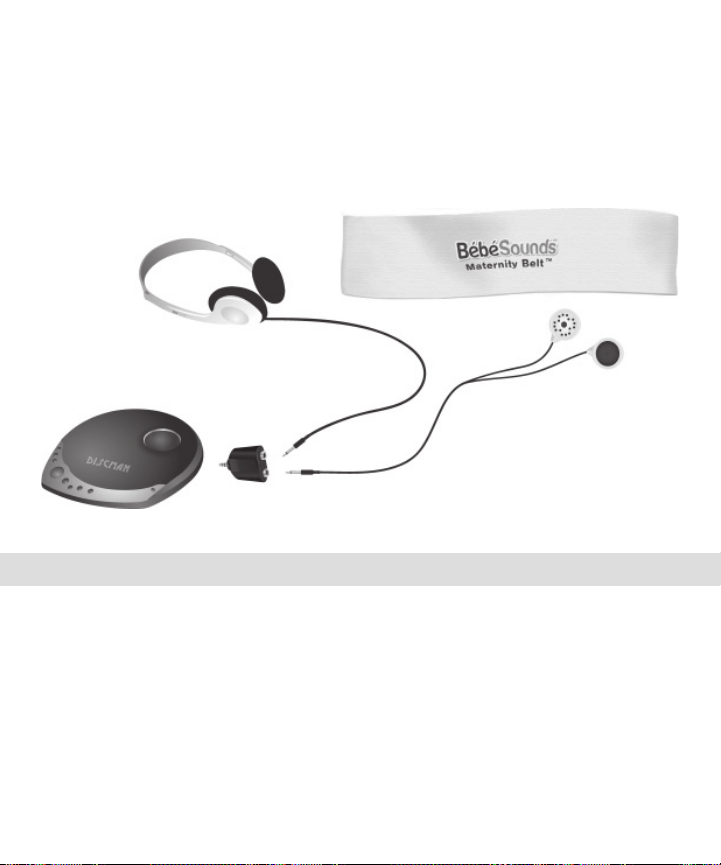
To play music to your unborn baby, follow these easy steps (See Fig. 12):
1. Connect the cable from the Fetal Speakers to the input jack on your
own CD player. If you want to listen to the music at the same time,
use the enclosed adapter. Plug the adapter into your CD player. Then
plug the cable from the Fetal Speakers into one of the jacks on the
adapter and the headset into the other jack.
2. Insert the enclosed prenatal CD of classical music in your CD player.
3. Position the Fetal Speakers against your belly. You will want to adjust
the position of the speakers depending on what month of pregnancy
you are in. You should be able to tell where your baby's head is by
17
Page 18
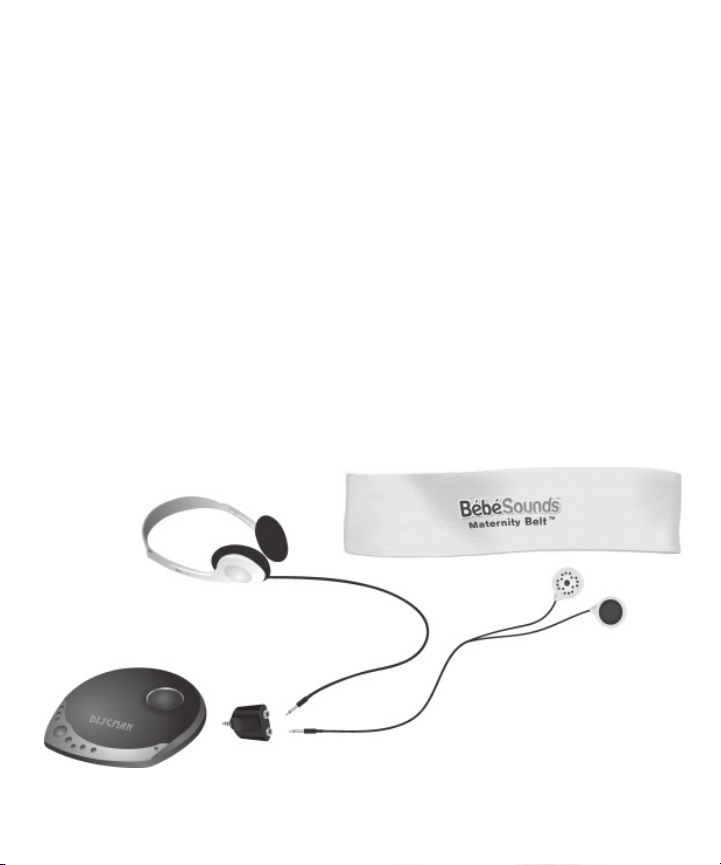
where you feel her kicking most frequently. You may tuck the speakers
into your clothing or use the Maternity Belt to hold them in place.
4. Play the music for approximately 10 minutes at a time and alternate
the selections you play. Use the schedule included in this booklet as
a record of what selections you have played and how frequently you
played them.
5. Play the music just a little louder than you would normally play it for
yourself. If it is much too loud for you, it will be too loud for your baby.
The Maternity Belt will provide you with support and additional comfort
while you are doing something special for your baby. You may wear it
when you are not playing music to your baby as well. Please care for it by
hand washing it in cold water using a mild soap.
fi g.12
maternity belt
headset
fetal speakers
CD player
adapter
18
Page 19

PLAYING MUSIC TO YOUR NEWBORN
The stimulation of your baby can continue after birth to help enhance
development. Our postnatal CD contains special selections of music
from a variety of classical composers. They are longer in duration than
the prenatal CD because as your baby gets older she will be able to
focus for longer periods of time.
INSTRUCTIONS FOR TALKING, SINGING,
& READING TO YOUR UNBORN BABY
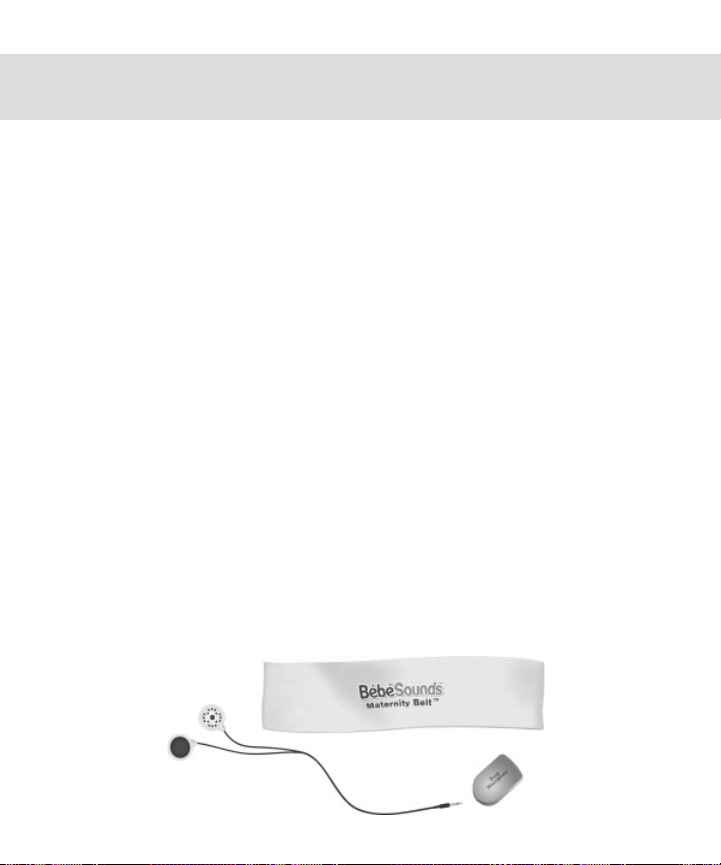
(See Fig. 13)
1. Connect the cable from the Fetal Speakers to the Fetal Microphone.
The Fetal Microphone requires one AAA battery (not included).
2. Position the Fetal Speakers against your belly. You will want to adjust
the position of the speakers depending on what month of pregnancy
you are in. You should be able to tell where your baby's head is by
where you feel her kicking most frequently. You may tuck the speakers
into your clothing or use the Maternity Belt to hold them in place.
3. Be careful to speak in a normal voice. The microphone will amplify
your voice so you don't have to speak too loudly as this may disturb
your baby. You may also want to gently stroke your stomach while
you are speaking.
BABY
4. Alternate your voice with the baby's father's voice – fi ve minutes of
yours and the fi ve minutes of his. Speak in loving tones and repeat
what you say 3 to 4 times. Repeat this a few times each day. Also read
your baby a story. Choose one that you will read after she is born.
19
Page 20
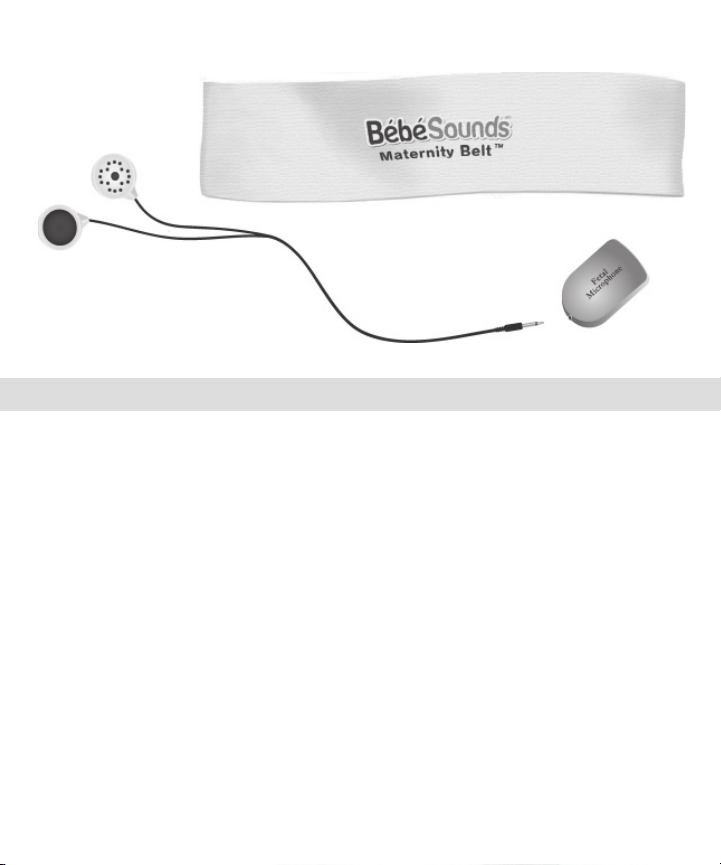
fi g.13
maternity belt
fetal speakers
fetal microphone
FREQUENTLY ASKED QUESTIONS
Q: What type of music should I play?
A: The universal opinion seems to be that classical music is the best,
particularly music by Mozart. That is why we have enclosed a 60-minute
CD of specially selected music by Mozart.
Q: Do I have to use the Maternity Belt when playing the music?
A: Yes. For maximum benefi t, the Fetal Speakers must be kept in a
stationary position toward the bottom of your stomach as your baby
has his/her head down in the third trimester. Our Maternity Belt is
specially designed to accomplish this.
Q: How loud should I play the music or speak?
A: Because the sound must pass through the womb and be heard over
the natural sounds of your body, play the music a little louder than you
would for yourself. Speak in a normal voice as the microphone will
amplify it.
20
Page 21

Q: Are you sure I won’t be disturbing my baby when I play music or
speak to her?
A: Yes. What you will be doing is stimulating your baby and helping her
brain develop. However, if you play the music or speak too long or too
frequently, you will disturb your baby. Please remember your baby must
have time to rest as well as develop.
Q: How soon can I start talking and playing music to my baby?
A: By the end of your fi fth month of pregnancy, your baby's senses are
developed enough so she can hear. Continue stimulating your baby from
the end of the fi rth month until she is born.
ENDNOTES
1. Jay Gordon, M.D. and Brenda Adderly, M.H.A., Brighter Baby
(Washington, DC: Lifeline Press, 1999), 79.
2. Dr. Susan Ludington-Hoe with Susan K. Golant, How to Have a
Smarter Baby (New York: Bantam Books, 1987), 39.
3. Dr. Susan Ludington-Hoe with Susan K. Golant, How to Have a
Smarter Baby (New York: Bantam Books, 1987), 18.
4. Dr. Susan Ludington-Hoe with Susan K. Golant, How to Have a
Smarter Baby (New York: Bantam Books, 1987), 18.
5. Dr. Sarah Brewer, Super Baby (London: Thorsons, 1998), 70.
6. Dr. Sarah Brewer, Super Baby (London: Thorsons, 1998), 97-98.
7. Dr. Sarah Brewer, Super Baby (London: Thorsons, 1998), 229.
21
Page 22

SCHEDULE OF MUSIC PLAYED
date time played music played
22
Page 23

SECTION III:
ADDITIONAL PRODUCT INFORMATION
TIPS FOR USING THE PRENATAL HEART LISTENER
• The Prenatal Heart Listener® has powerful amplifi cation capabilities
required to pick up the quiet sounds produced by your baby. To protect
your ears and prevent feedback (squealing sounds), do not turn on the
unit unless the listening cone is pressed against your body.
• There are many different sounds being produced by your baby and your
body. Increasing the volume also increases these sounds. Keeping the
volume at a moderate level usually produces the best results; therefore,
adjust the volume carefully.
• Your baby's heartbeat is a very low volume sound and is very diffi cult
to detect until the third trimester. Patience and very careful listening
are required to locate the best position to hear the heartbeat. It is
perfectly normal to hear it on some days and not others due to your
baby's position and movements. It is also normal that you will hear it
one moment and not the next. Don't worry! It is very natural for your
baby to shift her position.
CARE & CLEANING
• To clean your Prenatal Heart Listener®, simply wipe with a soft dry
or slightly damp cloth. Do not submerge in water or any other liquid.
• Store in a cool dry place.
®
• Keep out of the reach of children when not in use.
• Do not disassemble the Prenatal Heart Listener®.
• Only use a 9-volt alkaline battery.
23
Page 24

• During long periods of non-use, remove battery from the compartment.
• Please dispose of batteries properly and safely.
• Do not use or place open fl ames such as lighted candles on or near the unit.
• The Prenatal Heart Listener® should be used in normal room
temperature. Do not use in extreme heat or cold.
TROUBLESHOOTING
1. You cannot hear your unborn baby with your Prenatal Heart Listener®.
a. It may be too early in your pregnancy to hear your baby. Wait until
you are in your third trimester when the fetal heartbeat starts
becoming louder.
b. It is quite normal not to hear your baby due to her position. Try
again later. The best time to listen is 3 to 4 hours after a meal and
when you are relaxed. You may also want to try placing the Prenatal
Heart Listener® against your lower back as this may help minimize
interference from your own body's sounds.
c. Unit is not on. Turn unit on by turning the Power/Volume control
wheel to the right until you hear a click and the red power indicator
lights up.
d. Volume control is turned down. Increase the volume by turning the
Power/Volume control wheel to the right.
e. The headset is not connected to the monitor. Make sure the
headset is securely plugged into either jack on the monitor.
f. Battery is low. Red power indicator light will dim. Insert a new 9-volt
alkaline battery.
g. Battery is not inserted properly. Open the battery compartment
and check to see that positive (+) is matched with positive (+) and
negative (-) is matched with negative (-).
24
Page 25

h. Foam cover is not in place on the listening cone. Make sure the
foam cover is on the listening cone.
i. There is foreign matter in the listening cone. Remove the foam
cover and make sure there is nothing in the listening cone.
2. There is feedback (squealing noises) when you use your Prenatal
®
Heart Listener
.
a. The volume is too high. Turn the volume down by turning the wheel
to the left.
b. Lower the volume before moving the Prenatal Listener® against
your skin.
3. You cannot record from your Prenatal Heart Listener®.
a. The recording cable is not plugged in correctly. Make sure the L-
shaped end of the recording cable is securely plugged into either
jack on the Prenatal Listener® and the straight end into the line
input of your recorder.
b. The recorder is not working. Make sure the recorder works. Replace
batteries if necessary.
c. The volume control is turned down on your recorder. Increase
the volume.
4. There is too much background noise and it makes a scratching sound
when you move it.
a. Turn the volume down BEFORE you move the Prenatal Heart
Listener® from one spot to the next and don't turn it up again until
you are no longer moving it against your stomach.
25
Page 26

TECHNICAL SPECIFICATIONS
• For home use only.
®
• The Prenatal Heart Listener
requires one 9-volt battery (not included).
• The Fetal Microphone requires one AAA battery (not included).
• Manufacturer and battery information is also located on the inside wall
of the battery compartment.
Applied Standards and Approvals
This product conforms to the provisions of the Electromagnetic
Compatibility Directive (89/336/EEC).
The following standards apply to the design and/or manufacturing of
this product:
• EN60065:2002: Audio, video and similar electronic apparatus.
Safety requirements.
• EN55013:2001: Sound and television broadcast receivers and
associated equipment. Radio disturbance characteristics. Limits and
methods of measurement.
• EN55020:2002: Sound and television broadcast receivers and
associated equipment. Immunity characteristics. Limits and methods
of measurement.
26
Page 27

DISCLAIMER
THE BÉBÉSOUNDS® PRENATAL HEART LISTENER®
IS NOT A MEDICAL DEVICE.
The BébéSounds® Prenatal Heart Listener® is not a medical device
and should not be used or relied upon in any way for diagnostic or other
medical purposes. Any concerns about your pregnancy should be
addressed with a medical practitioner. The BébéSounds® Prenatal Heart
Listener® is not intended to be and should not be used as a substitute
for regular prenatal care by an appropriate medical practitioner. You are
encouraged to seek such prenatal care in connection with your pregnancy.
The BébéSounds® Prenatal Heart Listener® should be used only in
accordance with the instructions provided herein, and the manufacturers
and distributors of the BébéSounds® Prenatal Heart Listener® are not
responsible for inappropriate use. The manufacturer expressly disclaims
liability for incidental, consequential, or special damages of any nature.
LIMITED PRODUCT WARRANTY
Register your product warranty online at www.bebesounds.com.
Unisar Inc., the distributor of the BébéSounds® Prenatal Heart Listener®,
warrants to the original owner of this product that this product is free
from defects in materials and workmanship for a period of three (3)
months from the date of the original purchase. If this product fails to
function properly when used as directed under normal conditions within
the three-month period, Unisar Inc. will either repair or replace the
product, at its option, free of charge, when it is returned in its original
packaging, postage prepaid, with proof of purchase. Unisar Inc. will bear
the cost of repairing or replacing the product and shipping it back to you
within the United States. Repair or replacement of the defective item is
subject to verifi cation of the malfunction or defect when delivered to:
27
Page 28

Unisar® Service Center
15 West 36th Street
New York, NY 10018
NOTE: The warrantor expressly disclaims liability for incidental,
consequential, or special damages of any nature. This warranty does
not cover 1) A defect that has been caused by repair or modifi cation
by any person other than a Unisar
®
technician; 2) A defect caused by
negligence, accident, or misuse of the product; 3) A defect caused by
incorrect installation of and/or defective batteries; 4) Battery life; or 5)
Damage resulting from improper operation.
LEGAL RIGHTS VARY FROM STATE TO STATE.
NOTE: This warranty is only valid for products sold in the United States.
If you have purchased your product outside of the United States, please
see your local retailer or distributor for service.
If you believe your Prenatal Heart Listener® is defective or otherwise not
operating properly, please check the battery fi rst. Defective or exhausted
batteries are the leading cause of problems with this item and are not
covered by this limited warranty. If it is still not operating properly or if
you have other technical problems, please contact the BébéSounds®
Help Desk at 1-888-232-6476 Mon-Fri from 9:00AM-5:00PM EST.
The BébéSounds® Prenatal Heart Listener® is subject to United States
patent and related foreign counterparts.
The Prenatal Heart Listener® is a personal care product and cannot
be returned to the retailer. All exchange and refund requests should
be directed to the BébéSounds® Help Desk at 1-888-232-6476 Mon-Fri
from 9:00AM-5:00PM EST.
28
Page 29

29
Page 30

ÍNDICE DE CONTENIDOS
Por Favor Lea lo Siguiente para Disfrutar de Nuestro Producto..................34
SECCIÓN I:
ESCUCHANDO A SU BEBÉ POR NACER
Introducción...........................................................................................................................35
Contenidos.............................................................................................................................36
Identifi cando los Sonidos Fetales Que Usted Escuchará..............................37
Cuándo Escuchará Usted Estos Sonidos...............................................................37
Monitor Cardíaco Prenatal vs. Doppler.....................................................................38
Grabe los Sonidos de Su Bebé y Sus Propios Latidos Cardíacos.............38
Instrucciones para Escuchar a Su Bebé Por Nacer...........................................39
Instrucciones para Grabar los Sonidos de Su Bebé.........................................41
Instrucciones para Grabar y Enviar por Correo Electrónico
los Sonidos de Su Bebé con Su Computadora..................................................41
SECCIÓN II:
HABLANDO Y HACIÉNDOLE ESCUCHAR MÚSICA A SU BEBÉ POR NACER
Introducción...........................................................................................................................42
Cómo Se Desarolla Su Bebé Por Nacer..................................................................44
Cómo Se Desarrolla El Cerebro de Su Bebé Por Nacer.................................44
32
Page 31

Hallazgos de Investigación.............................................................................................45
Instrucciones para Hacerle Escuchar Música a Su Bebé Por Nacer.........47
Haciéndole Escuchar Música a Su Bebé Recién Nacido...............................49
Instrucciones para Hablar, Cantar y Leerle a Su Bebé Por Nacer..............50
Preguntas Frequentes......................................................................................................51
Libros de Referencia.........................................................................................................52
Cronograma de Música Reproducida.......................................................................53
SECCIÓN III:
INFORMACIÓN DE PRODUCTO ADICIONAL
Consejos para Usar el Monitor Cardíaco Prenatal..............................................54
Cuidados y Limpieza.........................................................................................................54
Solución de Problemas....................................................................................................55
Especifícaciones Técnicas..............................................................................................57
Exención de Responsabilidades.................................................................................58
Garantía Limitada del Producto...................................................................................58
También Disponibles de BébéSounds®...................................................................62
33
Page 32

LIMITED PRODUCT WARRANTY
POR FAVOR LEA LO SIGUIENTE PARA
DISFRUTAR DE NUESTRO PRODUCTO
• Por favor tenga paciencia. Este producto requiere de algo de tiempo
pero los resultados son maravillosos. Usted debería comenzar a usarlo
al inicio de su tercer trimestre.
• Lo que usted escuchará a través de nuestro Monitor Cardíaco
Prenatal serán los sonidos naturales de su bebé. Su doctor usa equipos
de ultrasonido Doppler que producen ruido artifi cial convirtiendo el
movimiento en sonido. Nuestro Monitor Prenatal amplifi ca los sonidos
reales de su bebé.
• El mejor momento para escuchar es entre las 3 a 4 horas después de
comer y cuando usted esté relajada.
• El Monitor Cardíaco Prenatal debe ser usado en una habitación muy
silenciosa.
• Colocar el control de volumen en un nivel bajo a moderado producirá
los mejores resultados y evitará la estática.
• Usted quizá no escuche los sonidos de su bebé de inmediato pero
no se decepcione. Cuanto más use usted el Monitor Cardíaco Prenatal,
más habilidad desarrollará para encontrar los sonidos. La postura de
su bebé también determinará su éxito en gran medida. La mejor postura es con la espalda de su bebé contra su ombligo. Su éxito también
dependerá de qué tan relajada se encuentre usted. Usted quizá deba
intentarlo varias veces antes de escuchar los sonidos de su bebé,
particularmente los latidos cardíacos.
• Los latidos cardíacos de su bebé no suenan como los de usted. Un
corazón fetal late entre 120 y 180 veces por minuto. Sonará como un
tambor suave, golpeando rápidamente o como un caballo galopando.
34
Page 33

• Usted también escuchará patadas, hipos y nutrientes pasando a través de
la placenta. Las patadas suenan como golpes desiguales, los hipos como
dos golpes de tambor rápidos, y los nutrientes como un sonido de chorro.
• El auricular provisto está especialmente diseñado para ser usado con su
Monitor Cardíaco Prenatal. No use cualquier otro auricular.
• Nuestro Monitor Cardíaco Prenatal es completamente seguro para usted
y su bebé. No utiliza corriente AC, ultrasonido ni ondas de radio.
SECCIÓN I:
ESCUCHANDO A SU BEBÉ POR NACER
introducción
INTRODUCCIÓN
®
Gracias por comprar nuestro Monitor Cardíaco Prenatal BébéSounds
Por favor lea el siguiente material cuidadosamente para maximizar su
aprovechamiento de este producto.
Es importante entender que muchos factores afectan lo que usted
escuchará con nuestro Monitor Cardíaco Prenatal. La postura de su
bebé, el peso de su bebé, su peso, la fase de su embarazo, y dónde
usted coloque el Monitor Prenatal afectarán lo que usted escuche.
Por ejemplo, al escuchar los latidos cardíacos fetales, el sonido será
más alto en el tercer trimestre y si su bebé está en una postura con su
espalda contra su ombligo. Naturalmente su bebé puede cambiar de
posición, creando por lo tanto la situación en que usted escuchará a
su bebé en un momento pero no al siguiente. Sin embargo, una vez
que usted haya pasado el segundo trimestre, su bebé estará creciendo
con mucha rapidez y usted escuchará los latidos cardíacos y todos
los demás sonidos en forma mucho más regular.
.
35
Page 34
¡No se preocupe! Es bastante normal que haya ocasiones en que usted
no podrá escuchar los sonidos de su bebé debido a la postura de su
bebé o a la etapa de su desarrollo. Esto es especialmente cierto en el
caso del latido cardíaco el cual depende principalmente de la postura
de su bebé.
CONTENIDOS
fi g.1
monitor cardíaco prenatal
fi g.4
cable de grabación
fi g.7
cinturón de maternidad
fi g.2
cubierta de espuma
fi g.5
altoparlantes fetales
fi g.8
CD prenatal y postnatal
36
fi g.3
dos auriculares
fi g.6
micrófono fetal
fi g.9
adaptador
Page 35

INDENTIFICANDO LOS SONIDOS FETALES QUE USTED ESCUCHARÁ
Usted escuchará patadas, hipos, nutrientes pasando a través de la placenta,
y, por supuesto, los latidos cardíacos. Cada uno es distintivo y tener la
capacidad de identifi carlos mejorará signifi cativamente su experiencia.
La mejor manera de describir cada sonido es la siguiente:
Latidos Cardíacos: Un tambor muy suave golpeando rápidamente
o un caballo galopando
Patadas: Una serie de golpes desiguales
Hipos: Dos golpes de tambor rápidos y suaves
Nutrientes: Un sonido de chorro
Un corazón fetal late de 120 a 180 veces por minuto mientras que el
corazón de una mujer embarazada late aproximadamente 100 veces
por minuto. Saber esto debería ayudarle a evitar confundir sus propios
latidos cardíacos con los de su bebé.
CUÁNDO ESCUCHARÁ USTED ESTOS SONIDOS
El latido cardíaco fetal, las patadas y los hipos pueden ser escuchados
desde el inicio de su tercer trimestre. Usted necesitará escuchar muy
atentamente el sonido de los latidos cardíacos de su bebé ya que
podría ser extremadamente difícil escucharlos por encima de los latidos
de su propio corazón. El sonido de sus propias entrañas también puede
interferir con su capacidad de escuchar los latidos cardíacos. Si bien el
Monitor Cardíaco Prenatal está especialmente diseñado para dispersar
estos sonidos, los mismos podrían interferir de todas maneras. Es por
eso que el mejor momento para escuchar es de 3 a 4 horas después
de una comida y cuando usted esté relajada y tenga un ritmo cardíaco
más lento.
37
Page 36

Recuerde, a medida que su bebé crece y se pone fuerte, lo mismo
sucede con los sonidos que crea. Usted también se irá familiarizando
con los sonidos de modo tal que serán más sencillos de identifi car.
MONITOR CARDÍACO PRENATAL VS. DOPPLER
Usted notará que los sonidos que escuchará a través del Monitor
Cardíaco Prenatal son diferentes de aquellos que escucha en el
consultorio de su doctor. Esto se debe a que su doctor usa equipos
de ultrasonido Doppler que crean ruido electrónico basado en el
movimiento. El Monitor Prenatal, sin embargo, está diseñado para
amplifi car los sonidos usando el método de amplifi cación totalmente
seguro del estetoscopio Bell. Repetimos, los latidos cardíacos escuchados
a través del Monitor Prenatal suenan similares al golpeteo suave y rápido
de un tambor, mientras que el sonido Doppler es mucho más efusivo.
Por favor tenga en cuenta que hará falta un poco de práctica para captar
este leve sonido así que escuche con mucha atención.
GRABE LOS SONIDOS DE SU BEBÉ Y
SUS PROPIOS LATIDOS CARDÍACOS
Con nuestro cable de grabación y su propia grabadora, usted puede
grabar los sonidos de su bebé. También le sugerimos que grabe
sus propios latidos cardíacos antes que nazca su bebé. De ese modo,
usted podrá reproducírselos a su bebé recién nacido después del
nacimiento lo cual tendrá un efecto tranquilizador.
38
Page 37

INSTRUCCIONES PARA ESCUCHAR A SU BEBÉ POR NACER
(Ver Figs. 10 y 11)
1. Retire la cubierta de la batería e instale la batería de 9 voltios (no incluida).
Recomendamos usar una batería nueva ya que una vieja puede
interferir gravemente con el funcionamiento de su Monitor Cardíaco
Prenatal. Asegúrese de hacer coincidir el positivo (+) con el positivo
(+) y el negativo (-) con el negativo (-). Vuelva a colocar la cubierta de
la batería.
2. Inserte el conector de los auriculares en cualquiera de los enchufes
de la unidad y colóquese los auriculares. Para que dos personas
puedan escuchar al mismo tiempo, inserte el segundo conector de
auriculares en el otro enchufe.
3. Asegúrese que la cubierta de espuma esté colocada en el cono
de e cucha. Sostenga el cono de escucha contra su estómago o baja
espalda. Use el Monitor Prenatal sobre la piel desnuda en una
habitación silenciosa.
4. Encienda el Monitor Cardíaco Prenatal girando la perilla de control
de Encendido/Volumen hacia la derecha hasta que oiga un clic. El
indicador de encendido rojo al frente se encenderá para indicar que
la unidad está en posición de ENCENDIDA.
5. Ajuste el volumen para optimizar el nivel de escucha y amplifi cación.
Comience con un nivel de bajo a moderado para evitar la estática.
6. Comience colocando el cono de escucha a dos pulgadas por debajo
y varias pulgadas hacia la derecha de su ombligo. Suavemente mueva
la unidad una pulgada a la vez hacia diferentes lugares hasta que
encuentre la mejor posición para escuchar los sonidos de su bebé.
Antes de mover el Monitor Prenatal, baje el nivel de volumen hasta la
39
Page 38
posición más baja para evitar el sonido del cono moviéndose contra
su piel.
7. Cuando haya terminado, gire la perilla de control de Encendido/
Volumen al máximo hacia la izquierda hasta que oiga un clic para que
el Monitor Cardíaco Prenatal quede apagado. La luz roja del indicador
de encendido se apagará.
control de encendido/volumen
compartimiento de la batería
cono de escucha
cubierta de espuma
fi g.10
indicador de encendido
control de encendido/
volumen
fi g.11
enchufe del auricular
40
Page 39

INSTRUCCIONES PARA GRABAR LOS SONIDOS DE SU BEBÉ
(Ver Figs. 10 y 11)
1. Conecte el extremo en forma de L del cable de grabación en
cualquiera de los enchufes del Monitor Prenatal. Conecte el extremo
recto en la entrada de línea de su grabadora (algunas grabadoras
portátiles no vienen con esta entrada).
2. Prepare su Monitor Cardíaco Prenatal para escuchar a su bebé.
3. Ajuste el nivel de grabación de su grabadora de ser necesario.
4. Sostenga el Monitor Prenatal muy quieto y comience a grabar.
Recuerde, el sonido de sus latidos cardíacos puede tener un efecto
muy tranquilizador y calmante sobre su bebé. Usted puede grabar sus
propios latidos cardíacos antes que nazca su bebé. Entonces podrá
hacerle escuchar sus latidos cardíacos grabados a su bebé después
del nacimiento. Recomendamos una grabación de 30 minutos. NOTA:
Usted necesitará reducir el volumen cuando grabe sus propios latidos
cardíacos ya que son mucho más altos que los de su bebé por nacer.
INSTRUCCIONES PARA GRABAR Y ENVIAR POR CORREO
ELECTRÓNICO LOS SONIDOS DE SU BEBÉ CON SU COMPUTADORA
(Ver Figs. 10 y 11)
1. Conecte el extremo en forma de L del cable de grabación en
cualquiera de los enchufes del Monitor Prenatal. Conecte el extremo
recto en el enchufe de micrófono de su computadora. Esto está
indicado por la imagen de un micrófono cerca del enchufe o el enchufe
tiene un código de color rosa en la parte posterior de su computadora.
41
Page 40

2. En su computadora, vaya a INICIO, PROGRAMAS, ACCESSORIOS,
ENTRETENIMIENTOS (o MULTIMEDIA), GRABADORA DE SONIDOS.
3. Prepare su Monitor Cardíaco Prenatal para escuchar a su bebé.
4. Oprima el botón rojo de grabación en el programa de la GRABADORA
DE SONIDOS para comenzar a grabar un archivo de sonido de un
minuto. Ahora usted está grabando los sonidos de su bebé.
5. Después de un minuto, la grabación terminará. Nombre y guarde su
archivo de sonido en una carpeta apropiada. Ahora usted puede enviar
su archivo de sonido por correo electrónico a sus familiares y amigos.
SECCIÓN II:
HABLANDO Y HACIÉNDOLE ESCUCHAR MÚSICA
A SU BEBÉ POR NACER
INTRODUCCIÓN
Investigaciones realizadas acerca de los benefi cios de estimular a
los bebés antes de nacer a sido realizada mundialmente, y ahora hay
pruebas de que los bebés pueden aprender mientras se encuentran
adentro el útero. Por lo tanto, mientras que en el pasado la atención
estaba concentrada en la estimulación infantil, es muy importante
prestar atención a los benefi cios de la estimulación prenatal.
Estudios han mostrado que el bebé estimulado prenatalmente muestra
un más rápido desarrollo visual, lingüístico, y motriz que los bebés no
estimulados. Adicionalmente, estudios han mostrado que el cerebro de
un bebé estimulado prenatalmente tiene una tendencia a estar más
desarrollado, mostrando como resultado un mayor porcentaje de posibilidades
de que el bebé tenga un mayor nivel intelectual e inteligencia.
42
Page 41

La estimulación puede provenir de: tocar cierta clase de música clásica
(considerada una de las mejores fuentes de estimulación), hablar a su
bebé, y también de frotar el estomago de la madre. “La mejor forma de
estimular a su bebé y mejorar el desarrollo de su cerebro mientras esta
dentro de útero de la madre con sonidos”.1
El BébéSounds
®
Monitor Cardíaco Prenatal le permite tocar música
clásica directamente a su bebé a través de Altoparlantes Fetales. “Estos
han sido aprobados por el Dr. Norman A. Ravski, Profesor de Asistencia
Clinica, Departamento de Obstetricia y Ginecología de la Escuela de
Medicina de la Universidad de Yale, y Doctor del Hospital Yale New Haven.
En su aprobación el Dr. Ravski declara que “Dentro del útero la
estimulación acústica ha demostrado mejorar los resultados del
embarazo como también los benefi cios del crecimiento del feto… Creo
que este producto va a mejorar tanto la comodidad de la mujer
embarazada como la del feto creciendo dentro del útero.”
Es un hecho que el bebé recién nacido reconocerá las voces de sus padres
inmediatamente solo si el los ha escuchado antes dentro del útero de la
madre. El BébéSounds® Monitor Cardíaco Prenatal le permite dirigir las
vices directamente a su bebé, todavía dentro del útero de la madre, a
través de nuestro Micrófono y Altoparlantes Fetales. El primer paso en el
desarrollo lingüístico de su bebé es el reconocimiento de entonaciones
por lo cual, es importante para ambos padres hablar a su bebé. Aunque
la voz de la madre es por lo general más melódica y es constantemente
escuchada, la voz del padre es más potente y profunda lo cual genera
una mayor penetración en el útero.
Es siempre una buena idea mantener informado a su medico de lo Ud.
esta haciendo durante su embarazo. Por lo tanto, nuestra sugerencia es
informar a su medico que Ud. va a estar usando el Monitor Cardíaco Prenatal.
43
Page 42

CÓMO SE DESARROLLA SU BEBÉ POR NACER
Primer Trimestre: El embrión comienza a desarrollar su cabeza y
miembros (Ud. no sentirá los movimientos), el sistema nervioso que se
encarga del equilibrio y espacio comienza a desarrollarse, y el corazón
comienza a latir mas fuertemente.
Segundo Trimestre: La cabeza se desarrolla mas activamente que el
resto del cuerpo; los ojos responden a la luz ; los órganos importantes
se desarrollan; el feto reacciona a sonidos fuertes y a música; los
brazos y piernas se mueven tan fuertemente que la madre puede
sentirlos; el feto puede oír y la habilidad de aprendizaje se incrementa
signifi cativamente; la capacidad de memoria y la habilidad de responder
a estímulos se hacen presentes; la música calma al feto, mientras que
sonidos agresivos.
Tercer Trimestre: El sistema nervioso se ha desarrollado y se ha
desarrollado completamente; los movimientos son mas coordinados y
los músculos son más fuertes; el feto se mueve al ritmo de la música;
visión se ha desarrollado y su respuesta es evidente; el movimiento es
menos frecuente pero mas fuerte cerca del fi n del noveno mes; y el
crecimiento y el desarrollo del bebe continúan hasta el nacimiento.
CÓMO SE DESARROLLA EL CEREBRO DE SU BEBÉ POR NACER
El cerebro de su bebé comienza a desarrollarse casi inmediatamente y
para el quinto mes, la cantidad de neuronas que tendrá su bebé por el
resto de su vida ya está determinada. Desde este momento en adelante,
su cerebro se desarrolla incrementando el tamaño y la complejidad
de las neuronas ya creadas. Alrededor del octavo mes, el cerebro de
su bebé por nacer cambia signifi cativamente. En este punto, el mismo
duplica su peso y las conexiones entre las neuronas, conocidas como
sinapsis, se vuelven aún más complejas.
44
Page 43

La siguiente es la estructura de una neurona:
Dendritas: reciben mensajes del cuerpo
Cuerpo de la neurona: decide si enviar el mensaje recibido de las
dendritas o almacenarlo
Axones: transmiten mensajes recibidos del cuerpode la neurona
A medida que las neuronas crecen, los axones se hacen más grandes
y las dendritas se transforman en un sistema cada vez más complejo
de múltiples conexiones como las ramas de un árbol. Cuanta más
estimulación reciban las neuronas, más complejas se vuelven estas
dendritas, resultando en un cerebro más desarrollado.
La cantidad de neuronas con que nace su bebé ayuda a determinar
su potencial, pero es también la cantidad de conexiones entre dichas
neuronas lo que determina su inteligencia fi nal. Ayudar a incrementar la
cantidad de conexiones y la complejidad de las neuronas a través de
la estimulación, aumenta la probabilidad de que su bebé tenga un nivel
de inteligencia y Coefi ciente Intelectual más elevados.
HALLAZGOS DE INVESTIGACIÓNES
Es un hecho que la estimulación de los sentidos afecta el crecimiento
de las células cerebrales, y si el feto tiene poca estimulación dentro
del útero de la madre, pocas conexiones (synapses) serán hechas.
Especialistas en desarrollo del cerebro de fetos e infantes afi rman que
la estimulación de loas sentidos de su bebé antes de nacer puede
afectar el desarrollo de las conexiones entre las células cerebrales. Es
más, la ausencia de esas conexiones puede causar la muerte de células,
especialmente durante el octavo mes de embarazo.
2
Para el fi n del quinto mes su bebé puede oír y empieza a aprender, y
Ud. puede darse cuenta cuando el/ella reacciona a estímulos externos.
45
Page 44

En un caso, mujeres embarazadas tuvieron que abandoner un concierto
de música clásica antes de su culminación, porque sus bebés estaban
pateando tan fuertemente que no podían tolerar el dolor.
3
En otras situaciones, varias madres experimentaron tocando su música
clásica favorita por 10 minutos cada día un poco más fuerte del volumen
normal de la voz humana. Fue descubierto que los bebés reconocieron
el cambio en su medio ambiente, debido a la aceleración de sus ritmos
cardiacos. Lo más interesante es que los bebés todavía no nacidos no
responden de esta manera a cualquier sinfonía, aun si esta es tocada
muy fuerte y muy cerca del bebé.
4
Sin embargo, otro estudio mostró que los bebés todavía no nacidos que
han sido expuestos a música clásica dos veces al día por 10 minutos,
desde el quinto mes de embarazo hasta el nacimiento, se han desarrollado más rápidamente, han empezado a caminar hasta seis meses
antes, y han tenido un mayor desarrollo intelectual en comparación a
los bebés que no han sido expuestos a másica clásica cuando estaban
dentro del atero de la madre.
5
Algunas mujeres temen que si estimulan el desarrollo del cerebro
del bebé, la cabeza del bebé aumentara de tamaño, y como resultado
un mayor riesgo durante el parto. En realidad existen pruebas que
demuestran que lo anterior es falso. La estimulación prenatal por medio
de sonidos ha causado menos dolor durante el parto, menor número
de cesáreas, y un mayor numero de nacimientos sin dolor.6 Es más, un
bebé que ha sido expuesto a la estimulación prenatal tiende a mostrar:
• Ser más sereno y alerta
• Ser más feliz y llorar menos
• Prestar atención por un periodo de tiempo mas largo
• Mayor fortaleza y una mayor coordinación
46
Page 45

• Levantar su cabeza más temprano y pararse antes
• Caminar antes
• Hablar antes
• Tener mayor confi anza en sí mismo.
7
Recuerde que para el fi nal del quinto mes su bebé no nacido aun
comienza a oír, y para el sexto mes su habilidad para aprender se
incrementa signifi cativamente. Es ahora el momento indicado para tocar
la música clásica que hemos seleccionado especialmente para nuestro bebé.
INSTRUCCIONES PARA HACERLE ESCUCHAR MÚSICA A SU BEBÉ
POR NACER (USTED NECESITARÁ SU PROPIO REPRODUCTOR DE CD)
La mejor hora para tocarle la música a su bebé es una vez en la mañana
y otra en la noche, por un periodo de 5-10 minutos y manteniendo la
misma hora todos los días. Sea cuidadoso de no tocarle la música por
más tiempo o más frecuentemente de lo indicado anteriormente porque
su bebé necesita descansar. Sin embargo, Ud. encontrara que su bebé
es más activo a la noche.
No toque la misma música una y otra vez. Esta comprobado que si
su bebé escucha la misma canción una y otra vez, el/ella ignorara la
canción. Sin embargo, la repetición periódica de la misma canción
es recomendable. En algunos casos cuando la misma música que el
bebé escuchaba dentro el útero de la madre era tocada después de su
nacimiento, el bebé parece reconocer la melodía.
Es por eso que sugerimos tocar distinta música en cada sesión por día,
y repetirla dos o tres días después. También creemos conveniente
mantener una lista de las canciones que se han tocado incluyendo la
fecha, la canción, y la cantidad de veces que fue tocada la canción.
47
Page 46

Nosotros incluimos una tabla para llevar registro de las canciones en la
página 53 de este manual.
Para hacerle escuchar música a su bebé por nacer, siga estos sencillos
pasos (Ver Fig. 12):
1. Conecte el cable de los Altoparlantes Fetales al enchufe de entrada
de su propio reproductor de CD. Si usted desea escuchar la música
al mismo tiempo, use el adaptador incluido. Conecte el adaptador a
su
reproductor de CD. Luego conecte el cable de los Altoparlantes
Fetales en uno de los enchufes del adaptador y los auriculares en el
otro enchufe.
2. Inserte el CD prenatal incluido de música clásica en su reproductor
de CD.
3. Posición de los Altoparlantes Fetales contra su estómago. Usted
deberá ajustar la posición de los altoparlantes dependiendo del mes
de embarazo en que se encuentre. Usted podrá determinar dónde
está la cabeza de su bebé de acuerdo con el lugar donde lo sienta
patear más frecuentemente. Usted puede colocar los altoparlantes
dentro de su ropa o usar el Cinturón de Maternidad para sostenerlos
en su lugar.
4. Reproduzca la música durante aproximadamente 10 minutos y
alterne las selecciones que reproduzca. Use el cronograma incluido
en este manual como registro de qué selecciones ha reproducido y
con qué frecuencia las ha reproducido.
5. Reproduzca la música apenas un poco más alta de lo que
normalmente la reproduciría para usted. Si es demasiado alta para
usted, será demasiado alta para su bebé.
48
Page 47
El cinturón maternal le brinda la comodidad y soporte adicional para
que Ud. pueda realizar distintas tareas al mismo tiempo que se ocupa
de su bebe. Ud. también puede usarlo aun cuando no este tocando
música. Por favor lave el cinturón a mano con agua fría y jabón.
fi g.12
cinturón de maternidad
auriculares
altoparlantes fetales
adaptador
reproductor de CD
HACIÉNDOLE ESCUCHAR MÚSICA A SU BEBÉ RECIÉN NACIDO
La estimulación de su bebé puede continuar después del nacimiento
para ayudar al desarrollo. Nuestro CD postnatal contiene selecciones
especiales de música de una variedad de compositores clásicos.
Tienen una duración más larga que el CD prenatal porque, a medida
que su bebé vaya creciendo, adquirirá la capacidad de concentrarse
por períodos de tiempo más largos.
49
Page 48
INSTRUCCIONES PARA HABLAR, CANTAR
Y LEERLE A SU BEBÉ POR NACER
(Ver Fig. 13)
1. Conecte el cable de los Altoparlantes Fetales al Micrófono Fetal. El
Micrófono Fetal requiere una batería AAA (no incluida).
2. Coloque los Altoparlantes Fetales contra su estómago. Usted
deberá ajustar la posición de los altoparlantes dependiendo del mes
de embarazo en que se encuentre. Usted podrá determinar dónde
está la cabeza de su bebé de acuerdo con el lugar donde lo sienta
patear más frecuentemente. Usted puede colocar los altoparlantes
dentro de su ropa o usar el Cinturón de Maternidad para sostenerlos
en su lugar.
3. Tenga la precaución de hablar en un tono de voz normal. El micrófono
amplifi cará su voz así que usted no tiene que hablar demasiado alto
ya que esto podría molestar a su bebé. Usted también puede optar
por acariciarse suavemente su estómago mientras habla.
4. Alterne su voz con la voz del padre del bebé – cinco minutos de la
suya y cinco minutos de la de él. Hable en tonos cariñosos y repita
lo que dice de 3 a 4 veces. Repita esto varias veces por día. También
puede leerle un cuento a su bebé. Elija uno que podrá leerle después
que haya nacido.
fi g.13
cinturón de
maternidad
altoparlantes fetales
micrófono fetal
50
Page 49

PREGUNTAS FREQUENTES
¿Que tipo de música debo tocarle a mi bebé?
La opinión universal parece ser que la música clásica es la mejor. Es
por eso que nosotros incluimos un CD de 60 minutos de música clásica
especialmente seleccionada.
¿Tengo que usar el cinturón de maternidad cuando toco la música?
Sí. Para benefi cios máximos los Altoparlantes Fetales deben ser colocados
contra la parte baja de su estomago, así como su bebé tiene la cabeza
apuntando hacia abajo en su tercer trimestre.
¿Que tan fuerte debo tocar la música o hablar?
Tóquela música un poco mas fuerte que el volumen normal de su voz,
de esta forma el sonido de la música / voz podrá atravesar el útero y
llegar a ser oído por su bebé.
¿Esta seguro que no molestare a mí bebé cuando le toque música o
cuando le hable?
Lo que Ud. estará haciendo cuando le toque música o cuando le
hable es estimularlo/la. Sin embargo, si Ud. toca la música por demasiado
tiempo o demasiado frecuente, Ud. corre el riesgo de disturbar a
su bebé. Recuerde su bebé debe tener tiempo para descansar, como
para desarrollarse.
¿Que tan pronto puedo empezar a utilizar el Monitor Cardíaco Prenatal?
Estudios demuestran que su bebe esta lo sufi cientemente desarrollado
al fi nal del quinto mes como para poder empezar a tocarle música y
hablarle. Sin embargo, no hay evidencia de que Ud. no pueda empezar a
hacerlo a mitad del quinto mes.
51
Page 50

LIBROS DE REFERENCIA
1. Jay Gordon, M.D. and Brenda Adderly, M.H.A., Brighter Baby
(Washington, DC: Lifeline Press, 1999), 79.
2. Dr. Susan Ludington-Hoe with Susan K. Golant, How to Have a
Smarter Baby (New York: Bantam Books, 1987), 39.
3. Dr. Susan Ludington-Hoe with Susan K. Golant, How to Have a
Smarter Baby (New York: Bantam Books, 1987), 18.
4. Dr. Susan Ludington-Hoe with Susan K. Golant, How to Have a
Smarter Baby (New York: Bantam Books, 1987), 18.
5. Dr. Sarah Brewer, Super Baby (London: Thorsons, 1998), 70.
6. Dr. Sarah Brewer, Super Baby (London: Thorsons, 1998), 97-98.
7. Dr. Sarah Brewer, Super Baby (London: Thorsons, 1998), 229.
52
Page 51

CRONOGRAMA DE MÚSICA REPRODUCIDA
fecha tiempo de reproducción música reproducida
53
Page 52

SECCIÓN III:
INFORMACIÓN DE PRODUCTO ADICIONAL
CONSEJOS PARA USAR EL MONITOR CARDÍACO PRENATAL
• El Monitor Cardíaco Prenatal tiene poderosas capacidades de
amplifi cación requeridas para captar los suaves sonidos producidos
por su bebé. Para proteger sus oídos y evitar los acoples (sonidos
chirriantes), no encienda la unidad a menos que el cono de escucha
esté presionado contra su cuerpo.
• Hay muchos sonidos diferentes que son producidos por su bebé y por
su cuerpo. Increamentar el volumen también incrementa estos sonidos.
Mantener el volumen a un nivel moderado usualmente produce los
mejores resultados; por lo tanto, ajuste el volumen cuidadosamente.
• El latido cardíaco de su bebé es un sonido de muy bajo volumen y es
muy difícil de detectar hasta el tercer trimestre. Se requieren paciencia
y una escucha muy atenta para localizar la mejor posición para escuchar
los latidos cardíacos. Es perfectamente normal escucharlo en algunos
días y no en otros debido a la postura y movimientos de su bebé. También es normal que usted los escuche en un momento y no al siguiente.
¡No se preocupe! Es muy natural que su bebé cambie de posición.
CUIDADOS Y LIMPIEZA
• Para limpiar su Monitor Cardíaco Prenatal, simplemente repáselo con
un trozo de tela suave y seco o ligeramente húmedo. No lo sumerja en
agua ni en ningún otro líquido.
• Almacénelo en un lugar fresco y seco.
• Mantenga lejos del alcance de los niños cuando no esté en uso.
54
Page 53

• No desarme el Monitor Cardíaco Prenatal.
• Use únicamente una batería alcalina de 9 voltios.
• Durante períodos largos sin uso, retire la batería del compartimiento.
• Elimine las baterías apropiadamente y con seguridad.
• No utilice ni coloque la unidad sobre o cerca de las llamas, por
ejemplo, velas encendidas.
• El Monitor Cardíaco Prenatal debe utilixarse a temperatura ambiente
normal. No utilice en calor o frio extremos.
SOLUCIÓN DE PROBLEMAS
1. Usted no puede escuchar a su bebé por nacer con su Monitor
Cardíaco Prenatal.
a. Puede ser demasiado temprano en su embarazo para escuchar
a su bebé. Espere hasta que usted se encuentre en su tercer
trimestre cuando los latidos cardíacos fetales comienzan a volverse
más altos.
b. Es bastante normal no escuchar a su bebé debido a su postura
Inténtelo nuevamente más tarde. El mejor momento para escuchar
es de 3 a 4 horas después de una comida y cuando usted esté
relajada. Usted también puede intentar colocar el monitor contra su
baja espalda ya que esto puede ayudar a minimizar la interferencia
de los sonidos de su propio cuerpo.
c. La unidad no está encendida. Encienda la unidad haciendo girar
la perilla de control de Encendido/Volumen a la derecha hasta que
oiga un clic y la luz roja del indicador de encendido se encienda.
d. El control de volumen está bajo. Aumente el volumen haciendo
girar la perilla de control de Encendido/Volumen hacia la derecha.
55
Page 54

e. Los auriculares no están conectados al monitor. Asegúrese
que los auriculares estén fi rmemente conectados en cualquier
enchufe del monitor.
f. La batería está baja. El indicador de encendido rojo se atenuará.
Inserte una nueva batería alcalina de 9 voltios.
g. La batería no está correctamente insertada. Abra el compa
timiento de la batería y controle para ver que el positivo (+) coincida
con el positivo (+) y el negativo (-) coincida con el negativo (-).
h. La cubierta de espuma no está colocada en el cono de escucha.
Asegúrese que la cubierta de espuma esté colocada en el cono
de escucha.
i. Hay sustancias extrañas en el cono de escucha. Retire la
cubierta de espuma y asegúrese que no haya nada dentro del
cono de escucha.
2. Hay acople (sonidos chirriantes) cuando usted usa su Monitor Cardíaco
Prenatal.
a. El volumen está demasiado alto. Baje el volumen girando la perilla
hacia la izquierda.
b. Baje el volumen antes de mover el Monitor Prenatal contra su piel.
3. Usted no puede grabar desde su Monitor Cardíaco Prenatal.
a. El cable de grabación no está correctamente enchufado. Asegúrese
que el extremo en L del cable de grabación esté fi rmemente
conectado en cualquier enchufe el Monitor Prenatal y que el extremo
recto esté conectado en la entrada de línea de su grabadora.
b. La grabadora no está funcionando. Asegúrese que la grabadora
funcione. Reemplace las baterías de ser necesario.
c. El control de volumen de su grabadora está demasiado bajo.
Aumente el volumen.
4. Hay demasiado sonido de fondo y produce un sonido de raspado
cuando usted lo mueve.
56
Page 55

a. Baje el volumen ANTES de mover el monitor de un lugar al
siguiente y no vuelva a subirlo hasta que haya dejado de moverlo
contra su estómago.
ESPECIFICACIONES TÉCNICAS
• Solamente para uso hogareño.
• El Monitor Cardíaco Prenatal requiere una batería de 9 voltios (no incluida).
• El Micrófono Fetal requiere una batería AAA (no incluida).
• Se encuentra información sobre el fabricante y la batería en la parte
lateral del compartimiento de la batería.
Normas y Aprobaciones Aplicadas
Este producto cumple con los requerimientos de la Directiva Electromagnética
de la Compatibilidad (89/336/EEC).
Las siguientes normas se aplican al diseño y/o fabricación del producto:
• EN60065:2002: Aparato electrónico de audio, video y similar.
Requisitos de seguridad.
• EN55013:2001: Receptores de transmisión de sonido y televisión y
equipos asociados. Características de radio perturbación. Límites y
métodos de medición.
• EN55020:2002: EN55020:2002: Receptores de transmisión de sonido
y televisión y equipos asociados. Características de inmunidad. Límites
y métodos de medición.
57
Page 56

EXENCIÓN DE RESPONSABILIDADES
EL MONITOR CARDÍACO PRENATAL BÉBÉSOUNDS®
NO ES UN DISPOSITIVO MÉDICO.
El Monitor Cardíaco Prenatal BébéSounds® no es un dispositivo médico
y no debe ser usado ni dependerse del mismo en modo alguno para
diagnóstico u otros propósitos médicos. Cualquier preocupación acerca
de su embarazo debe ser tratada por un profesional de la medicina. El
Monitor Cardíaco Prenatal BébéSounds® no está destinado y no debe
ser usado como sustituto de la atención regular a cargo del profesional
de la medicina indicado. Le sugerimos que busque esa atención prenatal
en conexión con su embarazo. El Monitor Cardíaco Prenatal BébéSounds
debe ser usado únicamente de acuerdo con las instrucciones aquí
provistas, y los fabricantes y distribuidores del Monitor Cardíaco Prenatal
BébéSounds® no son responsables por el uso inadecuado. El fabricante
expresamente se desliga de la responsabilidad por daños incidentales,
por consecuencia o especiales de cualquier naturaleza. se desliga de la
responsabilidad por daños incidentales, por consecuencia o especiales
de cualquier naturaleza.
GARANTÍA LIMITADA DEL PRODUCTO
Registre la garantía de su producto en línea en www.bebesounds.com.
Unisar Inc., el distribuidor del Monitor Cardíaco Prenatal de BébéSounds®,
le garantiza al propietario original de este producto que este producto
está libre de defectos en materiales y mano de obra por un período de
tres (3) meses a partir de la fecha de compra original. Si este producto no
funciona correctamente cuando se lo use de acuerdo con las instrucciones bajo condiciones normales dentro del período de tres meses,
Unisar Inc. o bien reparará o reemplazará el producto, a su opción, sin
®
58
Page 57

cargo alguno, cuando sea devuelto en su envase original, franqueo
postal prepago, con prueba de compra. Unisar Inc. afrontará el costo de
reparar o reemplazar el producto y enviarlo de vuelta a usted dentro de
los Estados Unidos. La reparación o reemplazo del artículo defectuoso
está sujeta a verifi cación del mal funcionamiento o defecto cuando sea
entregado a:
Unisar® Service Center
15 West 36th Street
New York, NY 10018
NOTA: El garante expresamente renuncia a toda responsabilidad por los
daños incidentales, indirectos o especiales de cualquier naturaleza. Esta
garantía no cubre: 1) Un defecto que haya sido causado por reparación
o modifi cación de cualquier persona que no fuese un técnico de
Unisar®; 2) Un defecto causado por negligencia, accidente o mal uso
del producto; 3) Un defecto causado por instalación incorrecta de y/o
baterías defectuosas; 4) Vida de las baterías; o 5) Daño resultante de
operación incorrecta.
LOS DERECHOS LEGALES VARÍAN DE UN ESTADO A OTRO.
NOTA: Esta garantía es válida sólo para productos vendidos en los Estados
Unidos. Si usted compró su producto fuera de los Estados Unidos, sírvase
visitar al concesionario o distribuidor más cercano para obtener servicio.
Si usted cree que su Monitor Cardíaco Prenatal es defectuoso o no
está funcionando adecuadamente en cualquier otro sentido, por favor
verifi que primero la batería. Las baterías defectuosas o agotadas
son la causa principal de problemas con este artículo y no están
cubiertas por esta garantía limitada. Si el dispositivo sigue sin funcionar
correctamente o si usted continúa experimentando otros problemas
técnicos, por favor contacte al Departamento de Atención al Cliente
59
Page 58

de BébéSounds® llamando al 1-888-242-6476 de lunes a viernes de
9:00-17:00 (hora del este).
El Monitor Cardíaco Prenatal de BébéSounds® está sujeto a patentes de
diseño y utilitario en los Estados Unidos, y a documentos equivalentes
en el extranjero.
El Monitor Cardíaco Prenatal es un producto de aseo personal y no
puede devolverse a la tienda. Todas las peticiones de cambio o de
devolución del dinero deben dirigirse al Departamento de Atención
al Cliente de BébéSounds
®
al 1-888-232-6476 de lunes a viernes de
9:00 a 17:00 (hora del este).
60
Page 59

61
Page 60
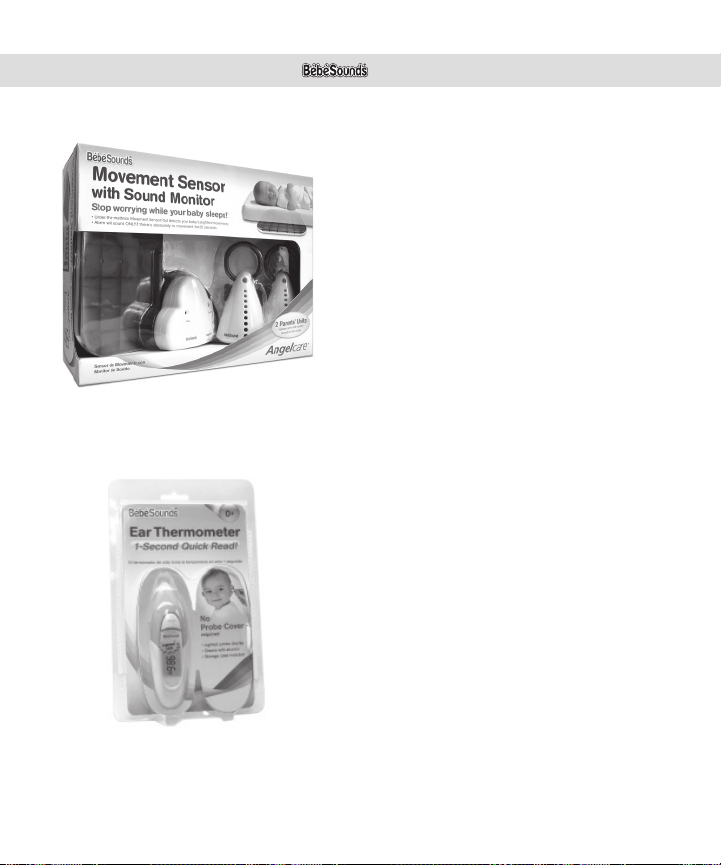
TAMBIÉN DISPONIBLES DE …
Sensor de Movimiento Angelcare
con Monitor de Sonido
¡Deje de preocuparse mientras
su bebé duerme! Detecta los
movimientos más leves de su bebé
mientras éste duerme. Una alarma
suena SOLAMENTE si no se detecta
absolutamente ningún movimiento
por 20 segundos. También funciona
como un monitor de sonido común.
Termómetro para Oídos
de 1 Segundo
Hace que tomarle la temperatura a
su hijo sea rápido y conveniente.
No se requiere cobertura para la
sonda o “tirón de orejas”. Se limpia
con alcohol. Pantalla luminosa
de gran tamaño. Mide en grados
Fahrenheit y Celsius.
®
Llame al 1-800-430-0222
para la tienda más cercana.
62
Page 61
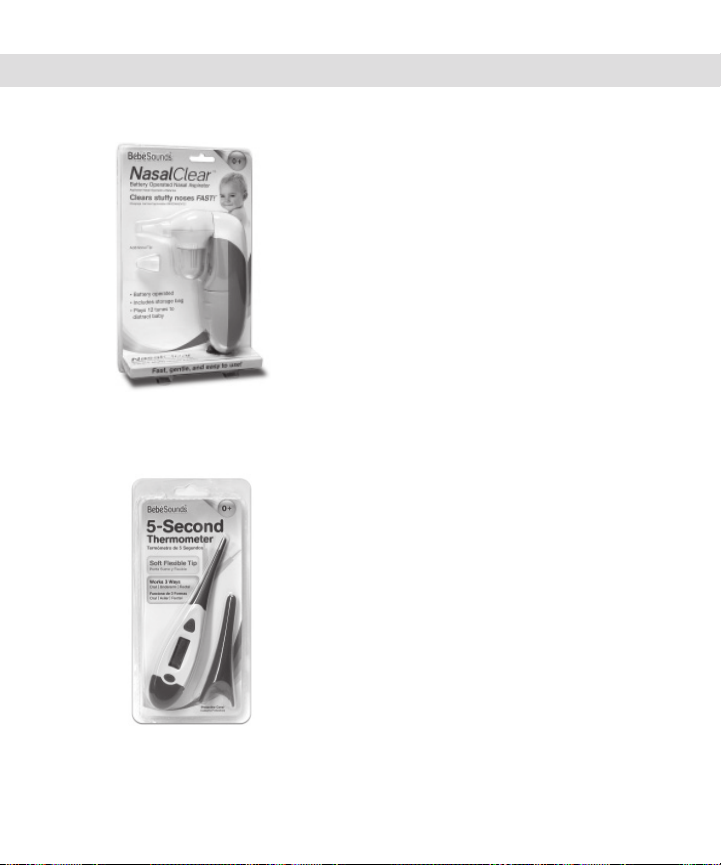
Aspirador NasalClear™
¡Despeja narices taponadas
RÁPIDAMENTE! Despeje con seguridad y rapidez la congestión nasal
de su bebé con este aspirador
operado a batería. Sufi cientemente
suave como para usarlo en un bebé
recién nacido. Se desarma para una
limpieza fácil y a fondo.
Termómetro Flexible
de 5 Segundos y 3 Vías
¡Rápido, fácil y preciso! Obtiene
una lectura de temperatura precisa
en apenas 5 segundos. Y la punta
fl exible le ofrece a su hijo la máxima
comodidad. Recuerda la última
medición de temperatura. Mide en
grados Fahrenheit y Celsius.
Llame al 1-800-430-0222
para la tienda más cercana.
63
 Loading...