

Page 1

1
User Manual
For Bea-fon S50
Page 2

2
Directory
Directory ............................................................................. 2
General Information........................................................... 4
Sales package: ................................................................ 4
Access codes: ................................................................. 4
Security code: .................................................................. 4
PIN code: ......................................................................... 4
SOS Button: ..................................................................... 4
Getting started ................................................................... 5
Insert a SIM card: ............................................................ 5
Insert the battery: ............................................................. 6
Keypad lock: .................................................................... 7
Charging the battery: ....................................................... 8
Switching on or off: .......................................................... 8
Display modes: ................................................................ 9
Screen Icons: .................................................................10
Key function: .................................................................. 11
Call function .....................................................................14
Making a call: .................................................................14
Making a call using the phone book ..............................14
Making a conference call: ..............................................14
Answering a call: ...........................................................15
Listening to voice messages: ........................................15
Redialling: ......................................................................16
Speed dialling: ...............................................................16
Hands Free: ...................................................................16
Contacts............................................................................17
Name and Number: .......................................................17
Searching for a name and phone number ....................17
Quick search: .................................................................17
Settings: .........................................................................18
Menu function ..................................................................19
Menu: .............................................................................19
List of menu functions: ..................................................19
SMS ...................................................................................21
Write SMS: .....................................................................21
Reading a SMS: ............................................................23
Delete a SMS: ...............................................................24
Voicemail: ......................................................................24
SMS Settings: ................................................................24
Page 3

3
Directory
Memory status: ..............................................................25
Broadcast message: ......................................................25
Calls ..................................................................................26
Calls: ..............................................................................26
Settings .............................................................................27
Sound & Alert: ................................................................27
Phone: ...........................................................................27
Date &Time: ...................................................................27
Input settings: ................................................................28
Emergency Call: ............................................................28
Functionality: .................................................................29
Emergency Button: ........................................................31
Emergency Number:......................................................31
Edit emergency SMS: ....................................................31
Language: ......................................................................32
Display: ..........................................................................32
Network: .........................................................................32
Locks: ............................................................................34
Master reset: ..................................................................35
Alarm & Tools ..................................................................36
Alarm clock: ...................................................................36
Birthday reminder: .........................................................36
Calculator:......................................................................36
Timer: .............................................................................37
Battery ...............................................................................38
Charging and Discharging: ............................................38
Phone ................................................................................39
Care and Maintenance: .................................................39
For Your safety ................................................................41
Traffic Safety: .................................................................42
Operating environment: .................................................42
Electronic devices: .........................................................42
Pacemakers: ..................................................................43
Hearing aids: .................................................................43
Other medical devices: ..................................................43
Potentially explosive atmospheres: ...............................44
Vehicles: ........................................................................45
Certification information (SAR): .....................................45
Liability Disclaimer: ........................................................46
Page 4

4
General Information
Sales package:
Mobile phone
Charger cable
Headset
Battery
User Guide
Access codes:
Security code:
This code, supplied with the phone, protects your
phone against unauthorised use.
The factory code is “0000”.
PIN code:
This code, supplied with the SIM card, protects the
card against unauthorised use.
SOS Button:
The SOS Button is an easy function for an
emergency call. (Please see page 31).
Page 5

5
Getting started
Insert a SIM card:
Keep all miniature SIM cards out of small children‟s
reach.
The SIM card and its contacts can easily be
damaged by scratches or bending, so be careful
when handling, inserting or removing the card.
Before installing the SIM card, make sure that the
phone is switched off, disconnected from the
charger and then remove the battery.
Turn around the closed mobile phone, slide the
battery cover down with your thumb approx. 5mm
and then take it off.
Take out the battery (providing it is already in the
device). Raise and lift or pull out the lower corners.
Page 6

6
Getting started
Insert a SIM card:
Slide the SIM card carefully into the SIM card slot
Make sure that the gold-coloured connectors on the
Card are facing downwards and that the bevelled
corner is on the right.
Insert the battery:
Battery contacts must be lying on the golden
contacts of the mobile phone.
Page 7

7
Getting started
Insert the battery:
Attach the battery cover on to the mobile phone
again. Slide the cover into the device again.
Keypad lock:
The keypad lock prevents keys from being pressed
accidentally.
To lock or unlock the keypad:
Switch the unlock key, which is on the
left side of the phone, up and then the
key lock is activated. If you switch the
unlock key down the key lock is
deactivated.
Note:
The key lock is only activated when the phone is
closed.
Page 8

8
Getting started
Charging the battery:
Please note: Charge the battery for at
least 10 hours before first use the phone.
Put the mains plug into a mains socket.
Put the recharger cable connector into the jack at
the right side of the mobile phone.
During the charging process, a large battery symbol
and charging will be indicated on the mobile phone.
As soon as the battery is fully charged, Battery Full
appears in the display.
Disconnect the recharger cable from the mobile
phone as well as from the socket.
Switching on or off:
Warning: Do not switch on the phone when
wireless phone use is prohibited or
when it may cause interference or danger.
Press and hold the key.
Page 9

9
Getting started
Display modes:
The indicators described below are shown when the
phone is ready for use and no characters have
been keyed in by the user. The screen is called
„standby mode‟.
1. Shows the signal intensity of the cellular
network at your current location.
2. Shows the battery charge level.
3. Shows the Time.
4. Shows Date and Weekday.
5. Indicates which cellular network the phone is
using. It can be an operator name or logo.
6. Call.
7. Menu.
8. Contacts.
Display:
Page 10

10
Getting started
Screen Icons:
Icons may appear on the screen:
Alarm on
Unread SMS
Call diversion
Key lock on
Roaming net
Missed call
Headset connected
Hands free:
Activation
Hands free:
Deactivation
Mute:
To mute the call
without answering,
press
Page 11

11
Getting started
Key function:
Note:
Press in standby mode to go to the main
menu.
Press in standby mode to go to the SMS menu
(quick access).
Call key and
soft key
End key and
soft key
Navi key
Page 12

12
Key lock
Flash light
Volume
Getting started
Key function:
Left side
Right side
Top
Headset connector
On/off button
Page 13

13
Getting started
Key function:
For setting and activating the emergency button please see page 31.
Emergency button
Page 14

14
Call function
Making a call:
1. Key in the phone number including the area
code. To make international phone calls: Add a
"+" by pressing twice, and add the country
(or region) code in front of the area code (delete
the leading 0 if necessary). Press Delete to
delete the digit to the left of the cursor; move
the cursor to the desired position by pressing
or if necessary.
2. Press to call the number.
3. Press to end the call (or to cancel the call
attempt).
Making a call using the phone book:
In standby mode, press to reach the name
you want.
Press Call to call the number.
Making a conference call:
Conference call is a Network Service that allows up
to four people participate in the same call.
1. Make a call to the first participant. Key in the
phone number or select it from the phone book
and press Call.
2. To make a call to a new participant, press
Options, and select Contacts.
Page 15
15
Call function
3. When the new call has been answered, add it
to the conference call by pressing Options and
selecting Build Conference.
4. To add another new participant to the call,
repeat steps 1 to 3.
5. To end the conference call, press
Release all.
Answering a call:
In standby mode, press
To end the call or to reject the call without
answering, press
.
To mute the call without answering, press .
Listening to voice messages:
Voice mailbox is a Network Service. For more
information and for the voice mailbox number,
contact your service provider. To call your voice
mailbox, press and hold in standby mode. To
change the voice mailbox number, see voice
mailbox number on page 24.
To divert calls to your voice mailbox, refer to "Call
divert" on page 33.
Page 16
16
Call function
Redialling:
To redial one of the last 20 phone numbers you
have called or attempted to call:
Press
in standby mode, scroll with or
to the phone number or name you want, and press
Option and select call.
Speed dialling:
Press Contacts in the Main Menu and select Speed
dials. Select the key you want (2-9), and press
Select. Select the name you want and press Select.
After the phone number has been assigned to a
number key, you can speed dial the number in the
following way:
Press and hold the corresponding number key
until the call is started.
In-call operations:
During a call, press Option for some of the
following functions. Many of these are Network
Services. Mute or Unmute, Hold or Unhold,
Disconnect, Contacts, SMS.
Hands Free:
During the call you can turn the hands free
equipment on or off with the button.
Page 17
17
Contacts
Name and Number:
You can save names and phone numbers in the
phone´s memory (internal phone book) and in the
SIM card´s memory (SIM phone book). The internal
phone book can store up to 300 names.
To access the contacts, press
in standby
mode, or in main menu Contacts. To access the
contacts during a call, press Options and select
Contacts.
Searching for a name and phone number:
In main menu, press Contacts and select Browse
and choose the wanted store. Key in the first
character of the name you are looking for and press
or to find the name you want.
If the name or phone number is saved in the SIM
card memory, is shown at the left side of the
name; if it is saved in the phone‟s internal memory,
is shown instead.
Quick search:
Press in standby mode, key in the first
letter of the name. Scroll with or to find the
name you want.
Page 18

18
Contacts
Option:
You can also use the following options:
New: To save names and phone numbers in
the contacts.
Edit: To edit names and phone numbers in the
contacts.
Copy: To copy names and phone numbers all
at once from the phone´s memory to the SIM
card´s memory, or vice versa.
Delete: To delete names and phone numbers
from the contacts one by one or all at once.
Speed dials: See Speed dialling page 16.
Settings:
Save contact on: to select whether the names and
phone numbers are saved in Phone or SIM card.
Note that when you change the SIM card, the SIM
card memory is automatically selected.
Memory status: to check how many names and
phone numbers are already saved and how many
can still be saved in each phone book.
Page 19

19
Menu function
Menu:
You can use the key features in the menus in the
following ways:
By scrolling:
Press in standby mode.
Press or to scroll to the main menu you
want, and press Select to enter it. Press Back to
exit a main menu.
If the menu contains submenus, scroll to the one
you want and press Select to enter it. Press Back
to exit a submenu.
If you do not want to save the changes you made to
menu settings, press or press and hold Back.
List of menu functions:
1. SMS
1. Inbox
2. Write SMS
3. Outbox
4. Templates
5. Voicemail
6. Settings
7. Memory status
8. Broadcast SMS
9. Delete
Page 20

20
Menu function
2. Contacts
1. Browse
2. New
3. Edit
4. Copy
5. Delete
6. Speed dials
7. Settings
3. Calls
1. All
2. Dialed
3. Missed
4. Received
5. Delete
6. Call duration
4. Settings
1. Sound & Alert
2. Phone
3. Emergency
4. Language
5. Display
6. Own number
7. Network
8. Locks
9. Master reset
5. Alarm & Tool
1. Alarm Clock
2. Birthday reminder
3. Calculator
4. Timer
Page 21

21
SMS
SMS:
You can write and send multi-part text messages
(network service). Invoicing is based upon how
many ordinary messages are needed for any multipart message.
If you use special (Unicode) characters, more parts
may be needed for the message than otherwise.
Note that predictive text input may use Unicode
characters.
To send a message, the phone number of your
message centre has to be saved in the phone. See
SMS settings on page 25.
Write SMS:
Press the key marked with the letter that you want
repeatedly until the letter appears.
Use the following functions to edit the text:
To add a space, press .
To add a punctuation mark or special
character, press , select the desired
character, and press Select.
To move the cursor left or right, press or
, respectively.
To delete the character to the left of the
cursor, press Delete. To clear the screen,
press and hold this key.
Page 22
22
SMS
Write a SMS:
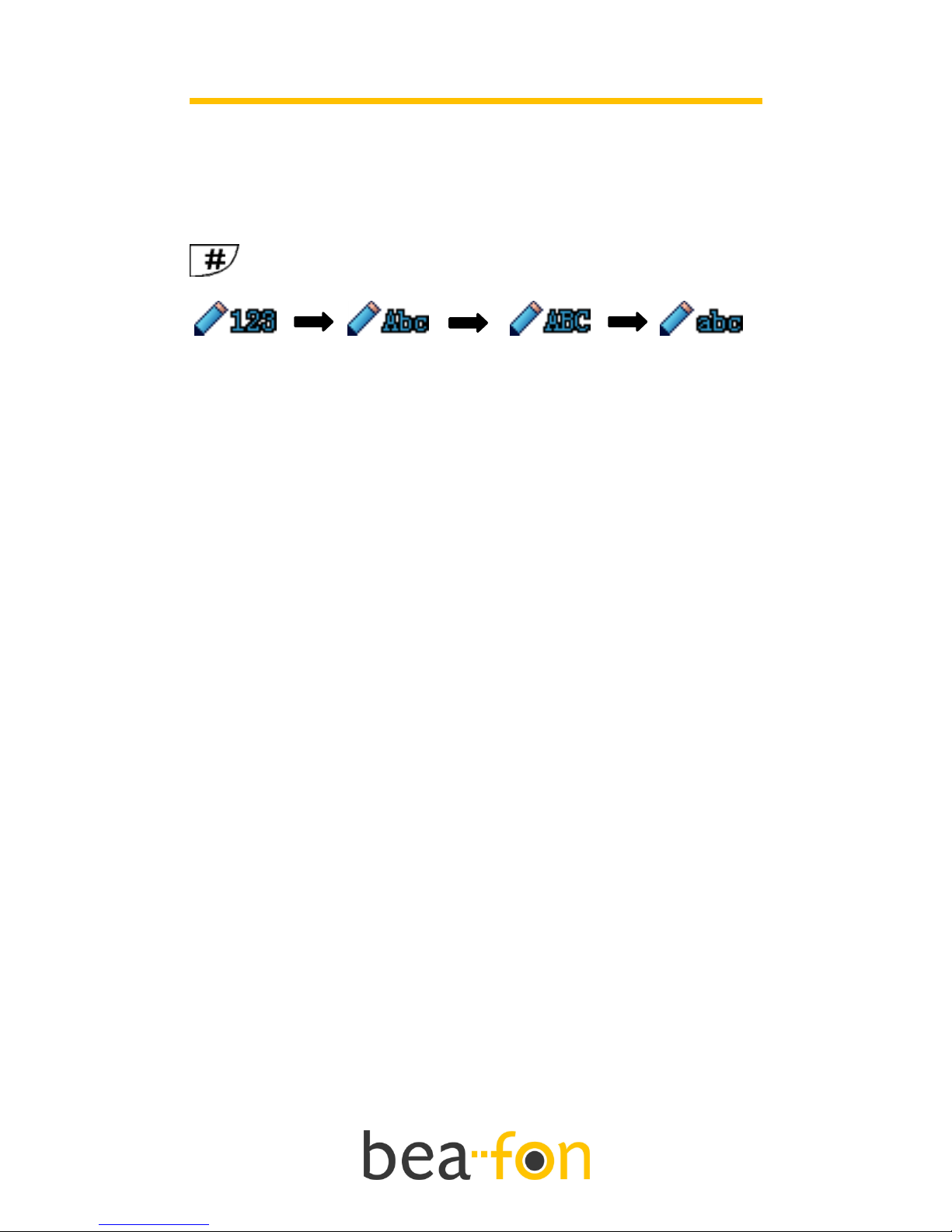
To switch between upper and lower case, press
indicated with:
Key in the message. The number of characters and
the current part numbers are shown on the top right
of the display.
When the message is complete, press Option,
select Send, key in the recipient‟s phone number,
and press Select.
If you want to send the message to several people,
press Option and select Send to many, scroll to the
first recipient, and press Select. Repeat this for
each recipient and press Complete and send to
finish.
Other options are:
Insert template, Insert number, Insert name.
Input settings:
Go to the Settings – Phone settings – Input settings
and select the preferred input method as you like.
Page 23

23
SMS
Reading a SMS:
When you have received text messages in standby
mode, the number of new messages as well as an
are shown on the display.
Press Select to view the messages right away.
To view the messages later, press Back. Go to the
Inbox menu when you want to read the messages.
Use scroll keys to browse through the message.
While reading the message, you can press Option
for the following:
Delete, Text reply, Forward, Call back, Save number.
Viewing a message you have send:
In the Outbox menu you can view the messages
that you have send. Press Option for the following:
Delete, Forward, Call back, Save number.
Page 24

24
SMS
Delete a SMS:
In standby mode, press , select SMS and
Delete.
To delete all the read messages in a folder, scroll to
the folder and select Delete all and press Select.
Then press Select when Delete? is displayed.
Templates:
You can view or edit the preset messages
(‟templates‟) that you can use for writing a
message.
Voicemail:
Call voicemail:
Press OK to call the Voicemail.
Voicemailbox number:
You can save and change the phone number of
your voice mailbox (network service) here.
SMS Settings:
Message service center:
The central number of the network operator through
which all short messages are developed. This
number is usually already saved by the network
operator on the SIM card and does not have to be
entered or altered by you any further.
Page 25

25
SMS
SMS Settings:
Status report:
To request the network to send delivery reports on
your messages (network service).
Storage position:
Select the preferred storage as you like.
Memory status:
To check how many SMS are already saved and
how many can still be saved in each phone.
Broadcast message:
Is an information service which depends of the
operator.
Page 26

26
Calls
Calls:
The phone registers the phone numbers of missed,
received and dialled calls, and the approximate
length of your calls.
When you press Option in the Dialled, Missed,
Received calls or menu, you can view the time of
the call, view or call the registered phone number,
add it to the contacts (Save), or delete it from the
list. You can also send a text message (Send
SMS).
Call Duration:
Shows the total time of the dialled calls and the
received calls. Press Reset to reset the total time
on zero.
Page 27

27
Settings
Sound & Alert:
You can also use the following settings:
Ringing tone, Ringing volume, Alert style, Alarm
tone, Alarm volume, SMS alert tone, SMS
volume, Key volume, Vibrating alert, Power on
volume, Power off volume.
SMS alert tone:
Sets the tone you hear when you receive a text
message.
Phone:
Date & Time:
Date & Time settings:
To give the current Date and Time.
The clock also serves the functions Messages, Call
register, Alarm clock, and Birthday reminder.
If the battery is removed from the phone for a long
time, you may need to set the time again.
Date format:
Choose from 3 formats:
(DD MM YYYY, YYYY MM DD, MM DD YYYY).
Time format:
Set the 12-hour or 24-hour time format.
Page 28

28
Settings
Date & Time display:
The time is shown on the top of the display when
the phone is in standby mode.
Input settings:
See “Input settings” on page 22.
Emergency Call:
The emergency function is a simple function which
can save lives at the deciding moment. In all, you
can save 4 emergency numbers (relatives,
neighbours, friends and rescue). These numbers,
previously saved in order of sequence, will be
automatically dialled in an emergency by pressing
the emergency button on the back of the mobile
phone. During the emergency call, a warning tone
sounds so the person that you rang knows that it is
an emergency! If you cannot get through on the first
number, the second number will be called
automatically. If you cannot get through on the
second number, the third number will be called etc.
If no emergency number is saved or your phone
card has run out or you are not allowed under a
foreign network (e.g. Roaming not activated), 112
can be selected by pressing the button.
Page 29

29
Settings
Emergency:
Press the emergency button on the back of the
mobile phone for 3 seconds. If you want to stop or
cancel the emergency call, press
for 3
seconds.
Functionality:
By pressing the emergency button, the emergency
numbers you have previously saved will be
automatically dialled in the given sequence. (The
emergency button also functions when the key lock
is on.) The mobile phone switches on the hands
free function at full volume and at the same time,
the person called will be informed by the sending of
an emergency SMS that an emergency call is
coming through (in case mobile number or
telephone with SMS function is available for
emergency contact).
If you are called within an hour of the start of the
emergency call function, the telephone
automatically takes each incoming call. If you would
like to stop the “automatic reception up to 1 hour
after emergency call” function you must switch your
mobile phone off and then switch it on again (For
safety reasons, only pressing is not sufficient).
Page 30

30
Settings
Note:
To stop the emergency call, keep pressed
for 3 seconds.
The emergency call should not end up unheard
on a mobile- or voice mail box. To make this
sure the calling time is limited for two minutes.
After that the next number will be called
automatically.
When changing a phone card: Always make
sure that there is sufficient credit on your phone
card because private emergency numbers
cannot be dialled without sufficient credit.
As a rule, the international emergency call 112
can still be called outside of the regional
network of your network operator.
Attention: If you want to save emergency numbers
such as the ambulance service, the police, fire
brigade etc. as an emergency number, you must
gain permission from each of these institutions
beforehand. There will be no liability for possible
costs arising from calling them by accident.
Page 31

31
Settings
Emergency Button:
You can switch on/off the emergency call button in
the menu Settings, Emergency, Emergency button
settings. If the emergency button is pressed when
switched off, no emergency call will be made.
However, you can dial 112 on the numerical
keypad.
Emergency Number:
Set up a maximum four emergency numbers and
their sequence.
The fifth number is automatically the emergency
number 112.
Edit emergency SMS:
If you press the emergency button, this text will be
send to the emergency numbers, the text can be
changed (maximum 150 characters).
Page 32

32
Settings
Language:
To select the language for the display texts.
Display:
Backlight:
Select 10, 20 or 30 seconds to set the lights on
after a key press.
Wallpaper:
The Wallpaper is shown on the display background
when the phone is in standby mode.
Own number:
Save your own phone number.
Network:
Call waiting:
When this network service is activated, the network
notifies you of a new incoming call while you have a
call in progress. Press Ok to answer the waiting
call. The first call is put on hold or press
to
reject the call.
Page 33

33
Settings
Network:
Call divert:
To divert your incoming calls to your voice mailbox
or some other phone number (network service).
Select the divert option you want, for example,
select Divert if busy to divert the calls when you are
on a call or when you reject a call.
Several divert options may be active at the same
time. When Divert all voice calls is activated, is
shown on the display in standby mode.
Set the selected option on (Activate) or off (Cancel),
check whether the option is activated by selecting
Check status.
Call barring service:
With this network service you can restrict the
making and receiving of calls with your phone.
Select one of the barring options and set the option
on (Activate) or off (Cancel) or check whether a
service is activated (Check status).
Network selection:
To set the phone to automatically select a cellular
network available in your area, or you can select
the network manually. The network you select must
have a roaming agreement with your home
network.
Page 34

34
Settings
Locks:
PIN1 code request:
You can set your phone to ask for the PIN code of
the SIM card when the phone is switched on. Some
SIM cards do not allow turning off this function.
Change PIN1 code:
You can change the PIN1 code.
These codes can include the numbers 0 to 9 only.
Change PIN2 code:
You can change the PIN2 code.
These codes can include the numbers 0 to 9 only.
Phone Lock:
Set the phone in a way that you will be ask for the
security code when you switch the phone power on,
Verify when power-on or when a new SIM card is
inserted in the phone, Verify with new SIM.
Change phone password:
You can change phone password code.
(The preset code is “0000”)
Privacy lock:
Set the phone in a way that it asks for the security
code when you access on the locks (Call log, SMS,
Phonebook).
Page 35

35
Settings
Master reset:
To reset some of the menu settings to their original
values. Select Settings and Master reset. Key in the
security code (The preset code is “0000”) and
press Select.
The names and phone numbers saved in the phone
book are not deleted.
Page 36

36
Alarm & Tools
Alarm clock:
You can set the alarm to sound at the time you
want just once, or repeatedly, for example every
working day.
When alarm sounds, you can stop the alarm by
pressing Back. If you press Snooze, the alarm
stops and rings again in five minutes. If the alarm
sounds for one minute, the alarm will stop and
sound again after about five minutes.
Birthday reminder:
With this memory aid you can save five short text
notes with an alarm. The alarm is activated when
the set date and time is reached.
Note: Your phone must be switched on to use this
function.
Calculator:
The phone is provided with a calculator which can
also be used for rough currency conversions.
This calculator has limited accuracy and rounding
errors may occur, especially in long divisions.
Page 37

37
Alarm & Tools
Function:
The keys 1 to 0 insert a digit. “#” inserts a decimal
point.
Press or for "+", "-", "x" and "/".
To get the result, press Result. Press and hold
Clear to clear the display for a new calculation.
Timer:
You can measure time.
Press Start to start the time observation and press
Pause to stop the observation.
Page 38

38
Battery
Charging and Discharging:
Your phone is powered by a rechargeable battery.
Note that a new battery's full performance is achieved only
after two or three complete charge and discharge cycles!
The battery can be charged and discharged hundreds of
times but it will eventually wear out.
When the operating time (talk-time and standby time) is
noticeably shorter than normal, it is time to buy a new
battery. Use only batteries approved by the phone
manufacturer and recharge your battery only with the
chargers approved by the manufacturer. Unplug the
charger when not in use. Do not leave the battery
connected to a charger for longer than a week, since
overcharging may shorten its lifetime. If left unused a fully
charged battery will discharge itself over time.
Temperature extremes can affect the ability of your battery
to charge.
Use the battery only for its intended purpose.
Never use any charger or battery which is damaged.
Do not short-circuit the battery. Accidental short-circuiting
can occur when a metallic object (coin, clip or pen) causes
direct connection of the + and - terminals of the battery
(metal strips on the battery) for example when you carry a
spare battery in your pocket or purse. Short-circuiting the
terminals may damage the battery or the connecting object.
Leaving the battery in hot or cold places, such as in a
closed car in summer or winter conditions, will reduce the
capacity and lifetime of the battery. Always try to keep the
battery between 15°C and 25°C. A phone with a hot or cold
battery may temporarily not work, even when the battery is
fully charged. Batteries performance is particularly limited
in temperatures well below freezing.
Do not dispose of batteries in a fire! Dispose of batteries
according to local regulations (e.g. recycling). Do not
dispose as household waste.
Page 39

39
Phone
Care and Maintenance:
Your phone is a product of superior design and
craftsmanship and should be treated with care.
The suggestions below will help you to fulfil any
warranty obligations and to enjoy this product for
many years.
Keep the phone and all its parts and
accessories out of the reach of small children.
Keep the phone dry. Precipitation, humidity and
all types of liquids or moisture can contain
minerals that will corrode electronic circuits.
Do not use or store the phone in dusty, dirty
areas. Its moving parts can be damaged.
Do not store the phone in hot areas. High
temperatures can shorten the life of electronic
devices, damage batteries, and warp or melt
certain plastics.
Do not store the phone in cold areas. When it
warms up (to its normal temperature), moisture
can form inside, which may damage electronic
circuit boards.
Do not attempt to open the phone. Non-expert
handling may damage it.
Do not drop, knock or shake the phone. Rough
handling can break internal circuit boards.
Do not use harsh chemicals, cleaning solvents,
or strong detergents to clean the phone.
Do not paint the phone. Paint can clog the
moving parts and prevent proper operation.
Page 40

40
Phone
Use only the supplied or an approved
replacement antenna. Unauthorised antennas,
modifications or attachments could damage the
phone and may violate regulations governing
radio devices.
All of the above suggestions apply equally to your
phone, battery, charger or any accessory. If any of
them is not working properly, take it to your nearest
qualified service facility.
Page 41
41
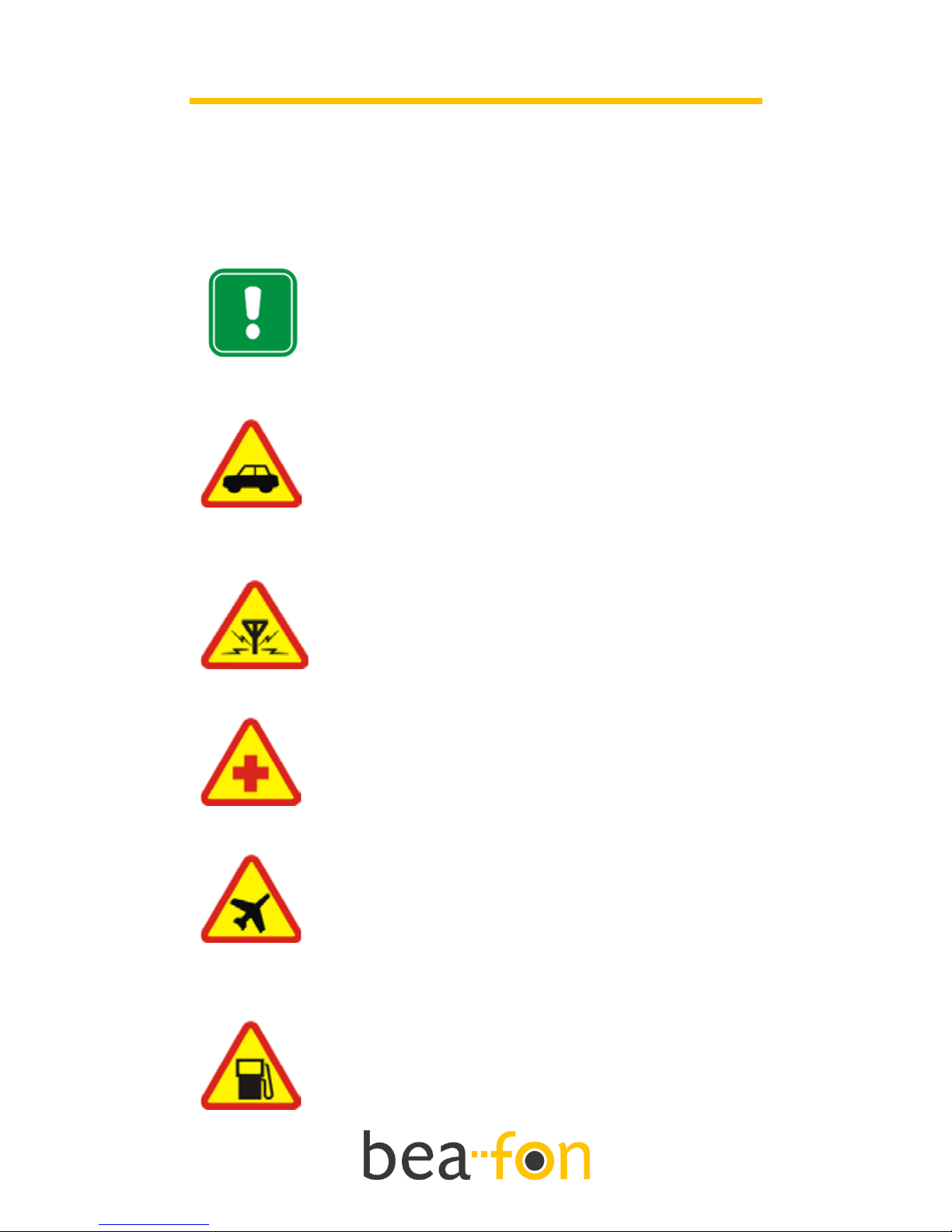
For Your safety
Read these simple guidelines. Breaking the rules
may be dangerous or illegal. Further detailed
information is given in this manual.
Do not switch on the phone when
wireless phone use is prohibited or
when it may cause interference or
danger.
ROAD SAFETY COMES FIRST
Do not use a hand-held phone while
driving.
INTERFERENCE
All wireless phones may get
interference, which could affect
performance.
SWITCH OFF IN HOSPITALS
Follow any regulations or rules. Switch
the phone off near medical equipment.
SWITCH OFF IN AIRCRAFT
Wireless devices can cause
interference in aircraft.
SWITCH OFF WHEN REFUELLING
Do not use the phone at a refuelling
point. Do not use near fuel or
chemicals.
Page 42

42
For Your safety
Traffic Safety:
Do not use a hand-held telephone while driving a
vehicle. Always secure the phone in its holder; do
not place the phone on the passenger seat or
where it can break loose in a collision or sudden
stop. Remember road safety always comes first!
Operating environment:
Remember to follow any special regulations in force
in any area and always switch off your phone
whenever it is forbidden to use it, or when it may
cause interference or danger.
Use the phone only in its normal operating
positions.
Parts of the phone are magnetic. Metallic materials
may be attracted to the phone, and persons with a
hearing aid should not hold the phone to the ear
with the hearing aid. Always secure the phone in its
holder, because metallic materials may be attracted
by the earpiece.
Do not place credit cards or other magnetic storage
media near the phone, because information stored
on them may be erased.
Electronic devices:
Most modern electronic equipment is shielded from
radio frequency (RF) signals. However,
certain electronic equipment may not be shielded
against the RF signals from your wireless phone.
Page 43

43
For Your safety
Pacemakers:
Pacemaker manufacturers recommend that a
minimum separation of 20 cm (6 inches) be
maintained between a handheld wireless phone
and a pacemaker to avoid potential interference
with the pacemaker. These recommendations are
consistent with the independent research by and
recommendations of Wireless Technology
Research. Persons with pacemakers:
Should always keep the phone more than 20
cm (6 inches) from their pacemaker when the
phone is switched on.
Should not carry the phone in a breast pocket.
Should use the ear opposite the pacemaker to
minimise the potential for interference.
If you have any reason to suspect that
interference is taking place, switch off your
phone immediately.
Hearing aids:
Some digital wireless phones may interfere with
some hearing aids. In the event of such
interference, you may want to consult your service
provider.
Other medical devices:
Operation of any radio transmitting equipment,
including cellular phones, may interfere with the
Page 44

44
For Your safety
functionality of inadequately protected medical
devices. Consult a physician or the manufacturer of
the medical device to determine if they are
adequately shielded from external RF energy or if
you have any questions. Switch off your phone in
health care facilities when any regulations posted in
these areas instruct you to do so. Hospitals or
health care facilities may be using equipment that
could be sensitive to external RF energy.
Posted facilities:
Switch your phone off in any facility where posted
notices so require.
Potentially explosive atmospheres:
Switch off your phone when in any area with a
potentially explosive atmosphere and obey all signs
and instructions. Sparks in such areas could cause
an explosion or fire resulting in bodily injury or even
death.
Users are advised to switch off the phone when at a
refuelling point (service station). Users are
reminded of the need to observe restrictions on the
use of radio equipment in fuel depots (fuel storage
and distribution areas), chemical plants or where
blasting operations are in progress.
Areas with a potentially explosive atmosphere are
often but not always clearly marked. They include
below deck on boats; chemical transfer or storage
facilities; vehicles using liquefied petroleum gas
(such as propane or butane); areas where the air
Page 45

45
For Your safety
contains chemicals or particles, such as grain, dust
or metal powders; and any other area where you
would normally be advised to turn off your vehicle
engine.
Vehicles:
RF signals may affect improperly installed or
inadequately shielded electronic systems in motor
vehicles (e.g. electronic fuel injection systems,
electronic anti-skid (anti-lock) braking systems,
electronic speed control systems, air bag systems).
Check with the manufacturer or its representative
regarding your vehicle. You should also consult the
manufacturer of any equipment that has been
added to your vehicle.
Certification information (SAR):
This model phone meets the EU requirements for
exposure to radio waves.
The exposure standard for mobile phones employs
a unit of measurement known as the Specific
Absorption Rate, or SAR. The SAR limit
recommended by The Council of the European
Union is 2.0 W/kg. Tests for SAR have been
conducted using standard operating positions with
the phone transmitting at its highest certified power
level in all tested frequency bands.
Page 46

46
For Your safety
The highest SAR value for this model phone when
tested for compliance against the standard was
0.521 W/kg.
While there may be differences between the SAR
levels of various phones and at various positions,
they all meet the EU requirements for RF exposure.
Liability Disclaimer:
Beafon Mobile GmbH shall not bear any liability
for any relevant, indirect, special, incidental, or
inevitable injuries caused by using of this
product, including injuries which have been
considered, or unconsidered, likely to happen.
For any losses caused by natural disasters
(such as earthquake, flood, etc.) or any acts or
accidents (including deliberate or accidental
misuses by the user under these accidents or
other unusual circumstances) which are beyond
our liability scope, non-responsibility should be
accounted on us.
S50UK2
 Loading...