

Page 1
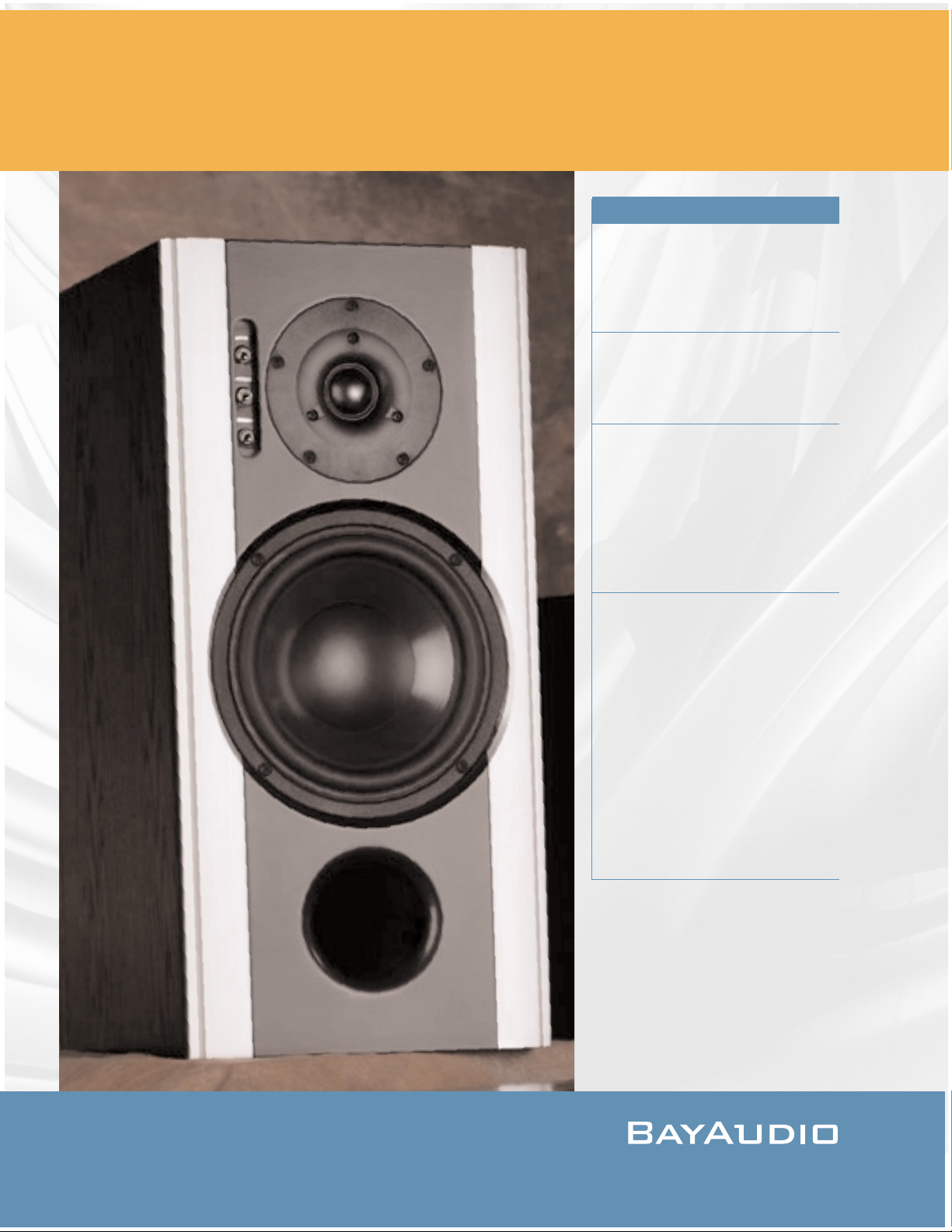
JAM Theater
JAM Monitor and matching theater components
Monitor Description
The JAM Monitor is a versatile full-range
bookshelf system that combines the detail
and clarity of an audiophile speaker, with
the impact of a theater speaker. It’s sized to
fit in any entertainment cabinet.
2-Channel Systems
The JAM Monitors are perfect for use in
2-channel systems. They fill a 5,000 ft3room
with concert level sound.
Theater Systems
The JAM Monitor is the basis for a high-
performance theater system. Use the JAM
Center and JAM Subwoofers. For the
surround channel, choose the BeBop or
Floating Grille In-Walls for surround. All units
are sonically matched within ±2dB for seam-
less multi-channel playback.
Product Features
• Reverberance control reduces echoes
in lively rooms.
• Presence control reduces throw for
near-field listening.
• Boundary control reduces midbass
“bloat” caused by bookshelf or
wall placement.
• Constrained layer baffle greatly reduces
distortion in the midrange and bass.
• Wood veneer on both sides of the cabinet
walls ensures structural integrity even in
high-humidity environments.
• Video shielded for placement next to TVs.
Page 2

©2000 Bay Audio. Specifications are subject to change.
7905 Silverton Avenue, San Diego, CA 92126 ph 858.271.1422 fx 858.271.1752 www.BayAudio.com
Specifications
Monitor Center Subwoofer BeBop
Maximum Output @ 1 meter 110dB with 400w 107dB with 150w 114dB 102dB with 100w
of amplification of amplification of amplification
Recommended Room Size 5,000 ft
3
5,000 ft
3
9,000 ft
3
3,000 ft
3
Close-Miked Near-Field Response
(±3dB) 49-32,000 Hz 67-20,000 Hz 25-200 Hz 67-20,000 Hz
6dB Downpoint 38 Hz 49 Hz 20 Hz 49 Hz
Nominal Coverage Angle
(-6dB from reference) 60° H, 42° V 60° H, 50° V 60° H, 50° V
Sensitivity [1 watt (2.83v) @ 1m] 84dB 86dB 84dB
Nominal Impedance 8Ω 8Ω 8Ω
Drivers 1" soft-dome tweeter. 1" soft-dome tweeter. 10" long-throw 1" soft-dome tweeter.
All models are video shielded 6
1
⁄2" long throw 3" midrange. bass unit with 51⁄4" bass unit with
bass unit with polymer 51⁄4" bass unit with aluminum cone, butyl polymer cone, butyl
cone, butyl surround, polymer cone, butyl surround. surround, shorting
shorting cylinder. surround, shorting cylinder.
cylinder.
51⁄4" passive radiator.
On-Board Tuning Reverberance Reverberance Gain Reverberance
Presence Boundary Low Pass Pi Space
Boundary Variable Phase
Amplifier 550w class A/B
digital amplifier.
Cabinetry 1" MDF, veneered inside 1" MDF, veneered inside 1" MDF, veneered inside3⁄4" MDF, veneered inside
and out. Braced on four and out. Braced on four and out. Braced on four and out. Braced on four
sides. sides. sides. Includes 3-inch sides.
spikes.
Finishes Black paint on Ash veneer, Cherry veneer, solid White. Custom finishes available.
Weight 40 lbs 20 lbs 60 lbs 14 lbs
Dimensions (HxWxD) 18 x 81⁄2x 13" 7 x 21 x 81⁄4" 16 x 16 x 17" 101⁄2x 7 x 105⁄8"
Add 3" with spikes
Page 3
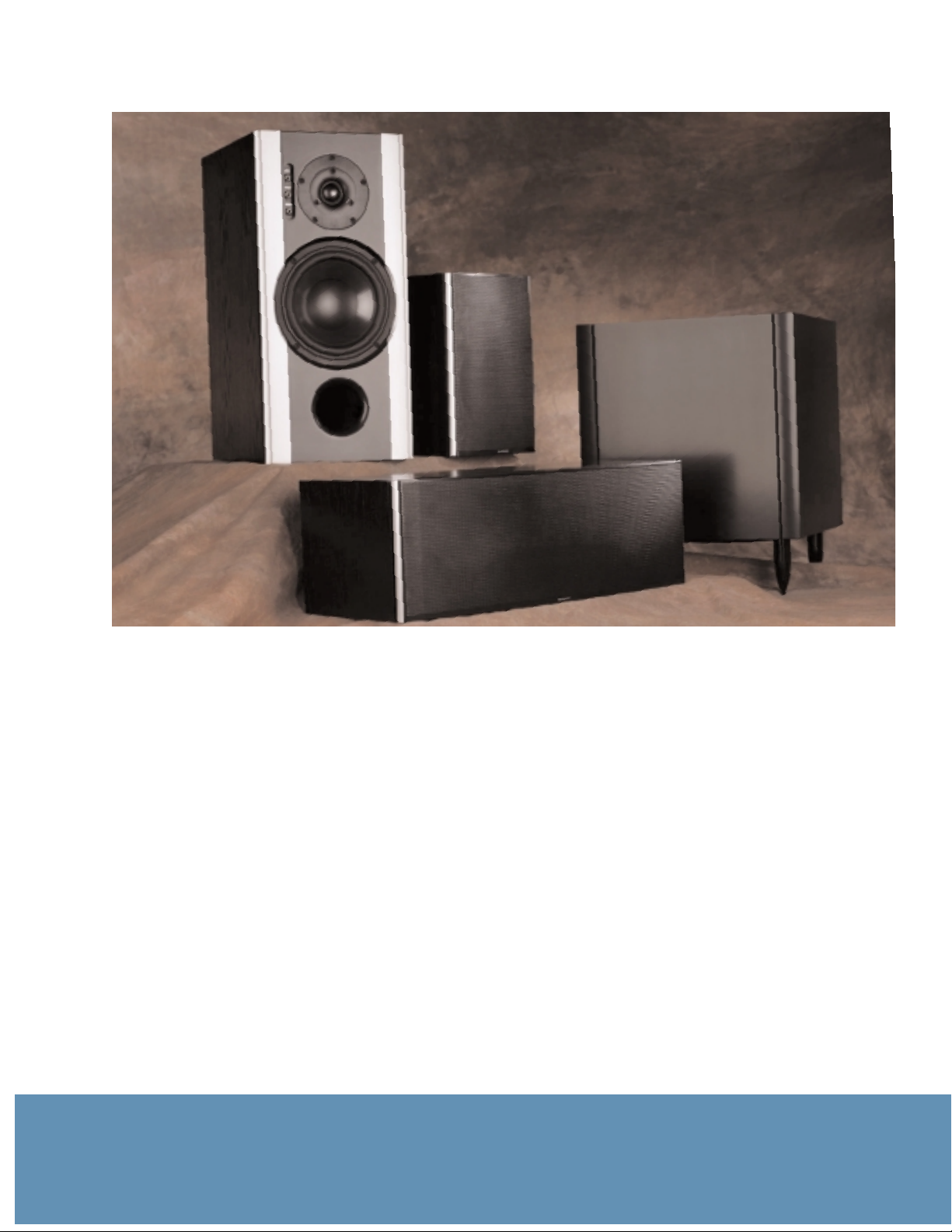
Theater Components
Voice-Matched Components
If you’re building a theater with JAM Monitors
in the front, we offer several options for the
remaining channels. Our JAM Center, BeBop,
and Floating Grille In-walls match the JAM
Monitor ±2dB throughout their operating
range for seamless playback.
JAM Center
Tuned for vocal articulation, this speaker uses
a vertically aligned tweeter/midrange assembly
for smooth horizontal coverage. We eliminate
comb filtering in the midrange, so you hear
dialog and on-screen effects more clearly
throughout the listening area. Voices are life-
like, and effects are clean and distinct. Dual
bass units — one active, one passive — pro-
vide bass to 80Hz.
JAM Active Subwoofer
We take special pride in this subwoofer. Unlike
most subs, ours is free of limiting and soft-
clipping circuits which rob a subwoofer of its
attack. (Engineers include these devices to
overcome deficiencies in their systems.) We
took a different approach, and designed a
high-current amplifier and long-throw bass
unit to work together perfectly. This results in
a subwoofer that produces articulate bass,
and plenty of it.
JAM Subwoofers are small enough to fit into
cabinets and behind furniture. The optional
down-firing tray permits placement behind
kick-panels for a completely concealed look.
BeBop
Choose the BeBop when using a box speaker
for the surround channel. It’s matched to the
Monitor and Center for smooth front to back
pans. The BeBop has a 3⁄8" mounting bracket
insert for wall or ceiling placement.
We spec our theaters with two pair of sur-
rounds. We aim one pair for direct sound, the
other is aimed to produce a diffuse field. This
combination replicates a dubbing studio for
accurate soundtrack reproduction. We espe-
cially like the feeling of “fullness” from two
pair of surrounds.
Page 4

Product Construction
Crossover Networks
We build our crossovers with the finest electrical components. We use a glass PCB board and hand-wound
chokes. For increased transient response and clarity,
we use Solen capacitors, 500v bypass capacitors,
and solid-core cable for internal wiring.
Terminal Plate
Our aluminum terminal plate has gold-plated binding
posts which accept bare wire, spades, and pins. A
unique wire clamp holds your cables in place after
installation. The BeBop has a
5
⁄8" X 20 insert on back
for wall or ceiling mounting.
Speaker Baffle
We fabricate a 3-ply constrained layer baffle with two
sheets of MDF sandwiching a visco-elastic polymer
core. This type of construction converts vibrations into
heat, reducing distortion. You’ll hear more bass, and
cleaner midrange.
Cabinetry
Our cabinets are a thing of beauty. We start with
architectural grade veneers mounted to a premium
substrate. Then, we run the boards through computer
controlled woodworking equipment for spot-on precision. We hand sand each cabinet multiple times, and
spray each with two coats of paint or lacquer.
On-Board Tuning
We include controls such as Reverberance, Presence,
and Boundary with these products to overcome common problems with room acoustics.
Grilles
Our custom–perforated grilles float in front of the cabinet to eliminate defraction. Our speakers have a finished look under the grille, so you can remove them
for audiophile performance.
By methodically measuring the effects of room
size, building materials, furnishings, and
speaker placement on music reproduction, we
create products that sound great in any room
of your home. We’re pioneers in this field—the
first, and we believe, only speaker company to
focus entirely on designing speakers mindful
of the interaction of placement on room
acoustics.
Only Bay Audio has on–board filters to opti-
mize the speaker for its intended placement.
These are the most common room acoustic
issues, and a description of the controls we
developed to solve them:
Reverberance
You may have a listening room with hardwood
floors, exposed windows, and a minimum of
furniture. This creates a distinct echo effect in
the room we call reverberance. It makes
certain frequencies — especially the higher
notes — overbearing. We put a Reverberance
control on the JAM Monitor, JAM Center, and
BeBop to mitigate this effect.
On-Board Tuning
Presence
Pro sound engineers touring with bands talk
about “throw” when they describe the dis-
tance a speaker reaches into the audience
before the sound begins to fall off. In the
home, we refer to this as Presence, and
equate it with how natural the Monitor sounds
when a listener is sitting a fixed distance away.
Our Presence control lets you figuratively
move the speaker closer or further from the
listening position to balance its sound.
Boundary
Take a typical speaker and place it on stands.
Sounds good. Now put it in a bookshelf and
its sound changes. Most likely, vocal clarity
degrades, and bass becomes muddy. The
JAM Monitor, JAM Center and BeBop have a
Boundary control to “normalize” placement,
whether you place them on a shelf, in an AV
cabinet, atop a television, or on stands.
Room Modes
Reproducing balanced bass is the trickiest
task an installer faces. Low frequencies are
affected by the size and shape of your listen-
ing area, where you place the speaker, and
where you sit to listen. Every room creates
pockets of strong bass (usually along the walls
and in corners), and pockets where the bass
seems non-existent (unfortunately, usually at
the listening position). These pockets are
known as “standing waves.”
Solving this problem requires multiple sources
of bass. We designed the JAM Monitor to play
full range information in the theater — repro-
ducing much of the same bass information
sent to the subwoofer. Pairing two JAM
Monitors with the JAM Subwoofer puts three
sources of bass into the room, greatly reduc-
ing standing waves.
 Loading...