

Page 1
Encounter
16x, 20x, 25x70mm
Binocular Telescope
Operating Instructions
AB11190
WARNING!
NEVER LOOK DIRECTLY AT THE SUN
THROUGH YOUR BINOCULARS WITHOUT
PROFESSIONALLY MADE SOLAR
FILTERS, EVEN FOR AN INSTANT
OR PERMANENT EYE DAMAGE
COULD RESULT. YOUNG CHILDREN
SHOULD USE THESE BINOCULARS
ON SUNNY D
AYS ONLY WITH
ADULT SUPERVISION.
1.
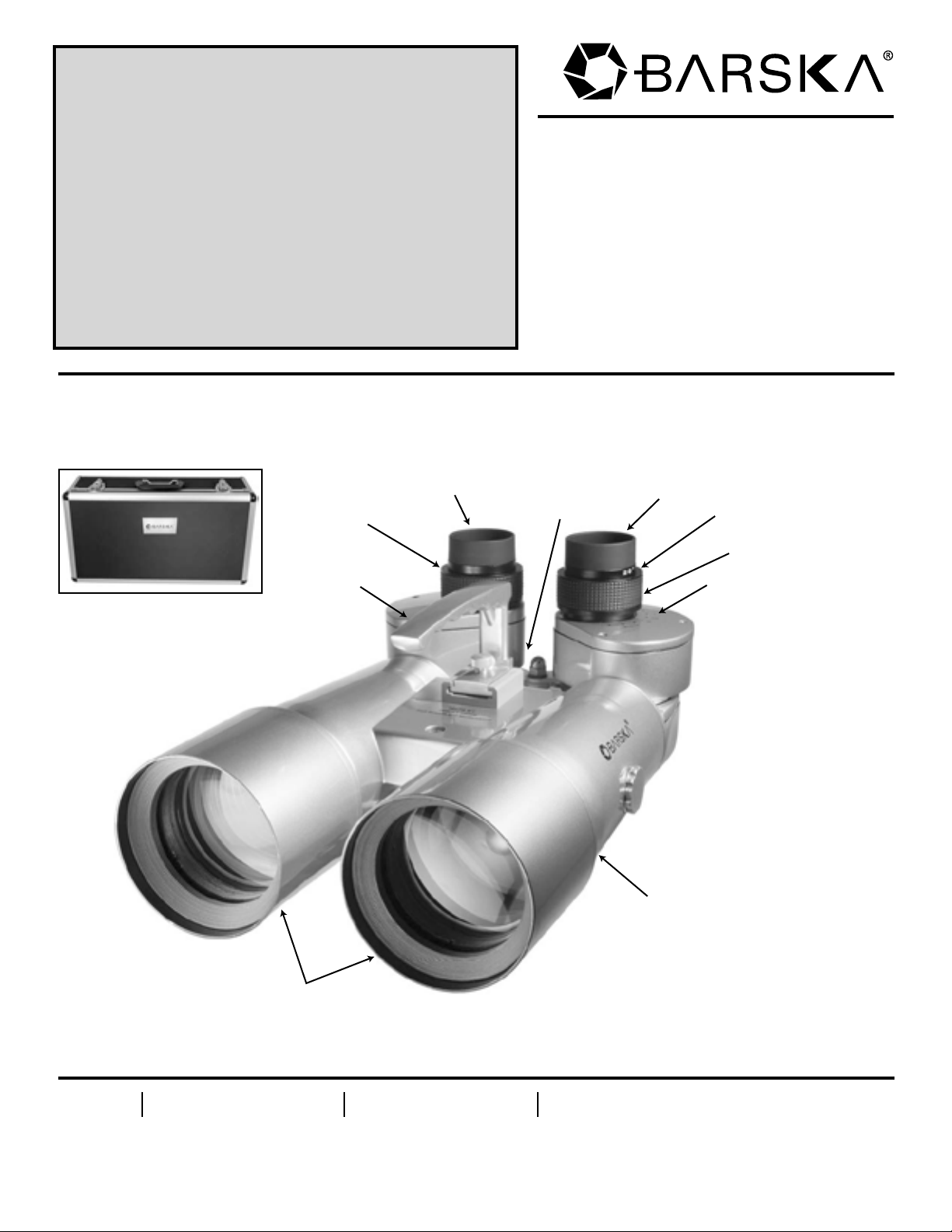
Diopter Scale
Removeable
Carry Handle
Eyepiece Holder
Focus Ring Grip
Eyepiece Holder
Lens Shades (Retracted)
IP
Knob (Not visible)
Mounting Plate
(Not visible)
Hard Storage Case
EyepieceEyepiece
BARSKA 1721 Wright Avenue La Verne, CA 91750 Tel: 909.445.8168 Fax: 909.445.8169
www.barska.com
BINOCULAR PARTS
Figure 1.
Congr
atulations on your purchase of a BARSKA Encounter 16x,20x,25x70mm Binocular
Telescope. Please carefully read the following instructions. With proper care and use of
this instrument, you will be assured of many years of enjoyable viewing.
Page 2
Encounter 16x, 20x, 25x70mm Binocular
Telescope Operating Instructions
2.
BARSKA Model AF10738
Professional Photo Tripod
BARSKA 1721 Wright Avenue La Verne, CA 91750 Tel: 909.445.8168 Fax: 909.445.8169
www.barska.com
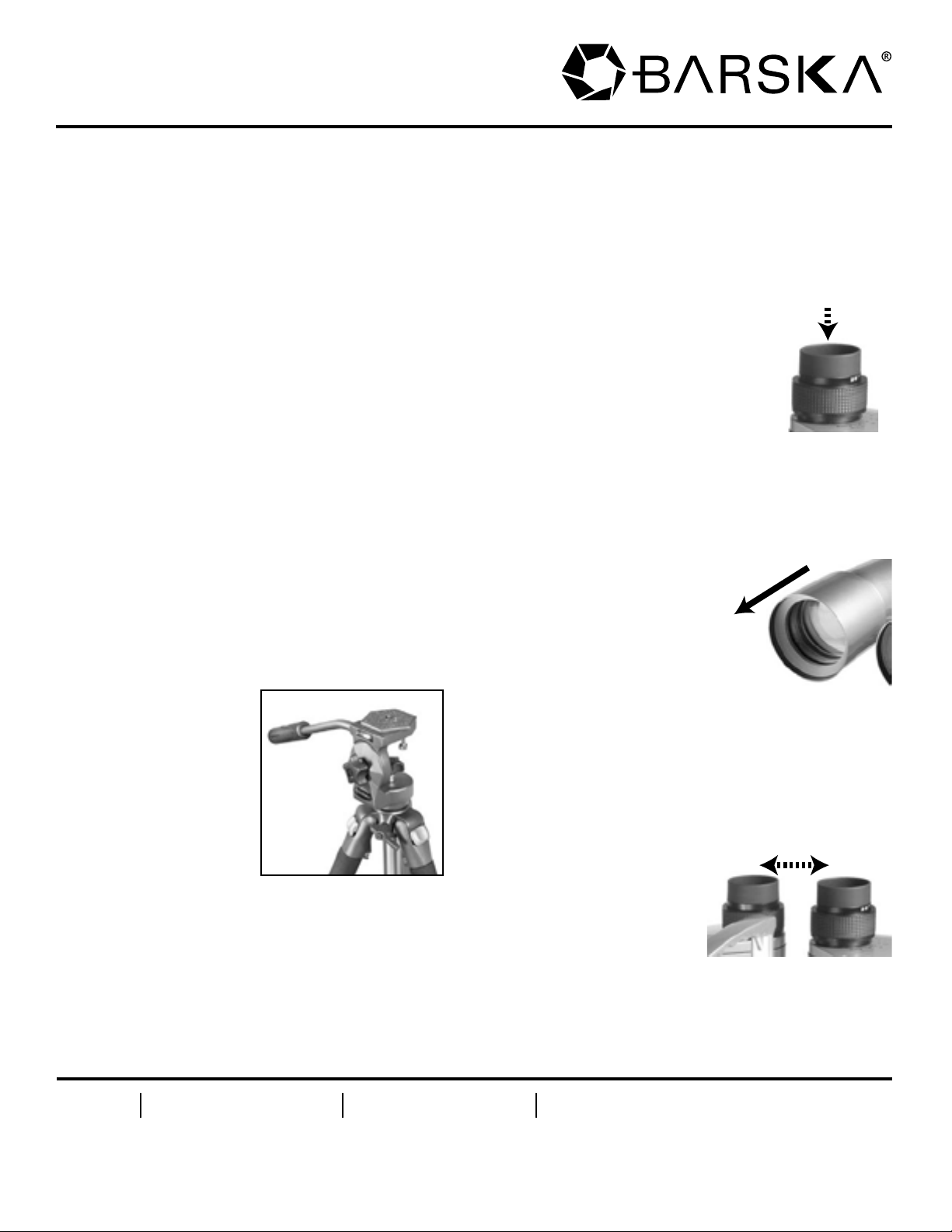
Figure 4.
ENCOUNTER - BREATHTAKING VIEWS
OF THE NIGHT SKY AND THE WORLD
AROUND YOU.
T
he large optical system of the BARSKA
Encounter Binocular Telescope provides the
amount of light gathering that is necesssary
for astronomical observation and , unlike a
conventional telescope, allows you to use
both eyes simultaneously for viewing. As a
result, you have better image resolution,
contrast and brightness than a similar size
telescope. The included eyepieces provide
20x magnification. Optional interchangeable
eyepieces (available from a camera or
telescope dealer) let you vary the
magnification for different types of
observing. The 90-degree eyepiece viewing
angle makes observing at night more
comfortable and convenient. With proper
care, the rugged body construction and
waterproof design of this instrument will
ensure years of enjoyable viewing.
Important:
P
lease read the following
instructions carefully.
2. INSERTING THE EYEPIECES
One
of the most important features of the
Encounter Binocular Telescope is its ability to
change eyepieces.
To install the included eyepieces:
1. Remove the cover caps from the
binoculars and eyepieces.
2. Insert the eyepieces into the binocular's
eyepiece holders.
3. Gently push the eyepieces
down into the holders until
they are fully seated (Fig.2).
4. T
o remove the eyepieces,
carefully pull the eyepieces
from the holders.
3. EXTENDING THE LENS SHADES
The extendable lens shades help to increase
contr
ast by preventing unwanted glare from
entering the objective lenses. They also slow
the formation of dew or moisture on the
objectiv
e lens exterior surface.
To extend the lens shades:
1. Grasp lens shade with
your fingers.
2. Carefully pull lens shade
outw
ards (Fig.3).
4. ADJUSTING THE EYEPIECE
DISTANCE BETWEEN YOUR
EYES (INTERPUPILLARY DISTANCE)
T
o adjust the interpupillary (IP) distance:
1. Turn the chrome IP knob located between
the eyepieces.
2. Rotate the knob until the distance between
the eyepieces matches the distance
between your eyes.
3. When properly
adjusted, y
ou should
see a single round
field of view when
looking through
the ey
epieces.
4. Important: Make this adjustment
BEFORE you attempt to focus the
binoculars.
1. USING A TRIPOD
W
hen observing with a large aperture
binocular like the Encounter, a sturdy photo
tripod such as the
BARSKA AF10738 or
an altazimuth mount
is required. T
o attach
the Encounter to a
photo tripod, simply
thread the tripod's
1/4"-20 mounting
stud into the threaded
hole in the Encounter's
mounting plate.
T
o attach the binocular
to an altazimuth mount,
that
utilizes a dovetail holder, an optional
dovetail L-Bracket (available from a camera
or telescope dealer) is required. The
L-Bracket connects to the Encounter's
mounting plate and has a dovetail bar that
goes directly into the mount's dovetail
holder.
Figure 2.
Figure 3.
Page 3
Encounter 16x, 20x, 25x70mm Binocular
Telescope Operating Instructions
3.
BARSKA 1721 Wright Avenue La Verne, CA 91750 Tel: 909.445.8168 Fax: 909.445.8169
www.barska.com
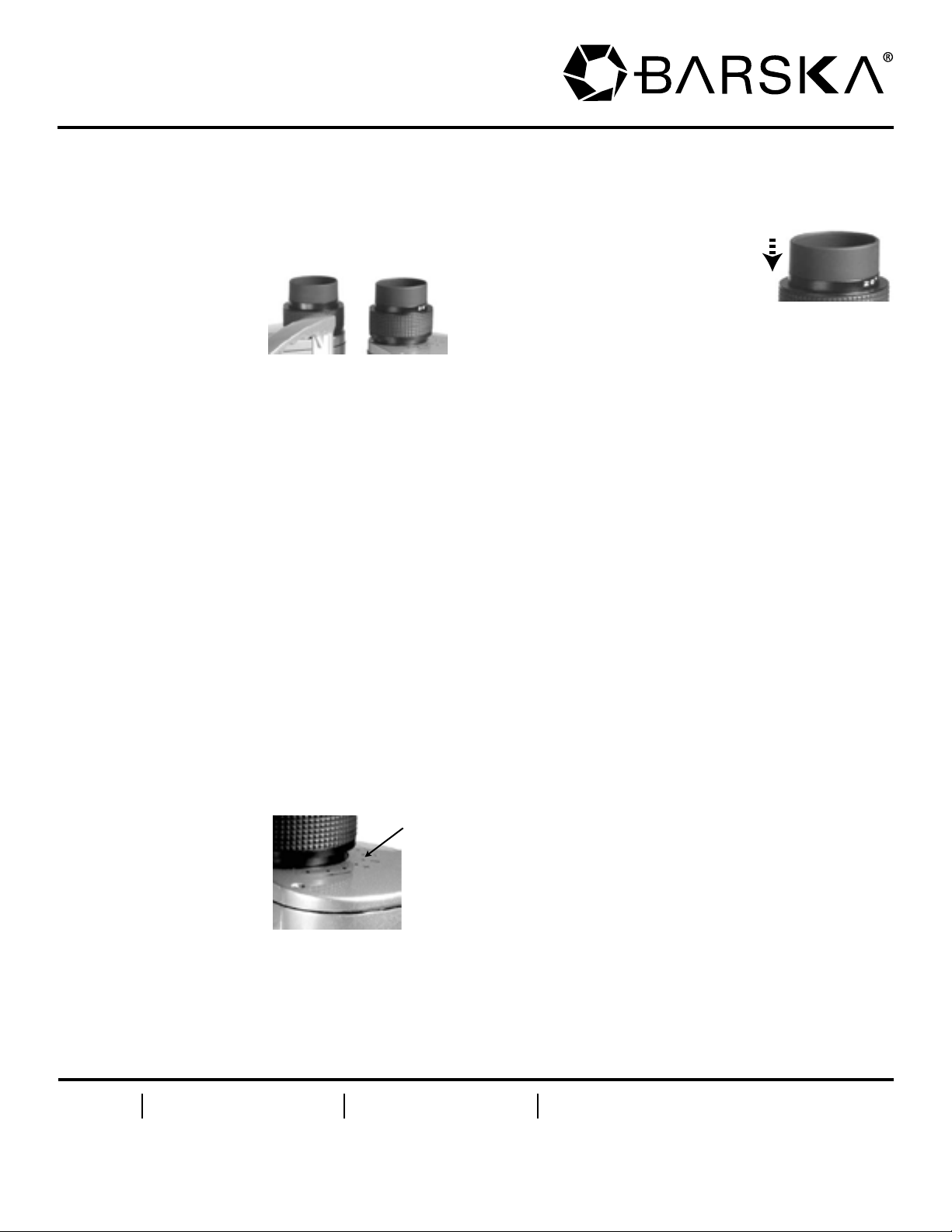
Figure 5.
Diopter Scale
Figure 6.
5. FOCUSING THE ENCOUNTER
BINOCULAR TELESCOPE
The BARSKA Encounter Binocular Telescope
eyepieces can be individually focused and
help maintain optical alignment (Fig.5).
T
o focus the binocular:
1. During daylight, pick
a stationary distant
object to view such
as a street sign. A
t
night, the best focus
will be achiev
ed by
focusing on the Moon or a bright star.
2. Cover your right eye (or cover the right
objective lens of the binocular) and focus
the left eyepiece by slowly rotating the
rubber grip ring on the eyepiece holder
until the image appears clearest. To focus
the right eyepiece, repeat this procedure
but cover your left eye or the left
objective lens of the binocular. The
binocular should now be in focus.
3. If y
ou want to view an object at a
different distance, re-focusing of both
ey
epieces is required.
4. Changing the eyepieces may also require
some slight focus adjustments.
Astronomical Observation:
All
objects will always appear focused at the
infinity focus point. This means that you only
need to focus the binoculars once per
viewing session. This also means that you
can take note of the diopter scale setting for
each eyepiece when
focused on an
astronomical object and
return to those settings
when observing another
night (Fig.6). Since
ev
eryone's eyes focus
on images slightly
differently
, other observers who are using
the binoculars will need to re-focus the
binoculars and adjust them to their own
vision and interpupillary distance.
6. FOLD-DOWN EYEGUARDS
The Encounter Binocular T
elescope features
fold-down eyeguards on the eyepieces.
The eyeguards are usually left
in the up position for use
without ey
eglasses as this
helps prevent glare from
entering between the eye
and eyepiece.
To use the binoculars with eyeglasses:
1. Fold the eyeguards down in order to get
your eyes close enough to the eyepieces
to see the entire field of view.
7. CLEANING AND CARE OF BINOCULAR
T
o protect your binocular, please follow these
important instructions:
Outside Surface
1. The Encounter Binocular T
elescope is
nitrogen-purged and sealed to be
waterproof and internally fogproof.
However, DO NOT immerse the binocular
in water under any circumstances.
2. If the binocular becomes wet with fresh
water, blot it dry with a clean dry cloth.
3. If the binocular becomes wet with salt
w
ater, the surface should be rinsed off
completely and the binocular blotted dry
with a clean cloth.
4. If the binocular body becomes dirt
y, it
can be cleaned with warm water and a dry
cloth.
5. If extremely dirt
y or oily, clean the body
with a dilute solution of warm water and
mild soap on a cloth, then rinse with clean
w
ater and blot dry.
Lens Surface
The lens surfaces of the Encounter Binocular
T
elescope are coated with anti-reflection
multi-coatings than can be easily damaged
with careless handling. T
o protect the
binocular's lenses, please follow these
recommendations:
1. DO NO
T CLEAN LENS SURFACE WITH
SOAP AND WATER!
Figure 7.
Page 4
Encounter 16x, 20x, 25x70mm Binocular
Telescope Operating Instructions
4.
BARSKA 1721 Wright Avenue La Verne, CA 91750 Tel: 909.445.8168 Fax: 909.445.8169
www.barska.com
2. Avoid touching the lens surface with
fingers or any coarse material.
3. All optics, even if stored, should be
cleaned at least once per year or
whenever they become dirty.
4. Avoid over-cleaning as this can also
damage the lens coatings.
5. Alw
ays use lens cleaning tissue and lens
cleaning fluid that are specifically
designed for multicoated lenses.
6. DO NO
T use fluids or tissues that are for
eyeglasses or household use.
7. DO NOT attempt to disassemble the
binocular or eyepieces in order to clean
them. This could result in damage to the
binocular and v
oid the Warranty.
Cleaning The Lenses
1. Blow off the lens with a blower bulb or
gently wipe the lens with a lens cleaning
brush to remo
ve the larger dust particles.
2. Put a few drops of lens cleaning fluid on a
fresh piece of lens cleaning tissue (NEVER
apply directly on the lens surface) and
gently wipe the lens.
3. Quickly wipe the ex
cess fluid with a new
dry piece of lens cleaning tissue.
4. On large lenses, clean only a small area
at a time using a new tissue each time.
5. On ex
cessively dirty lenses, wipe across
the lens using one stroke per tissue,
alternating wet and dry.
6.
To avoid scratching the lens surface,
alw
ays avoid excessive pressure or
rubbing when wiping.
Storing and Transporting the Binocular
1. Alw
ays keep the binoculars in their
storage case with the cover caps on when
not in use.
2. T
o prevent the optics from becoming
misaligned, avoid unnecessary shocks to
the binocular whether it is in the storage
case or not. This is not covered by the
Warranty.
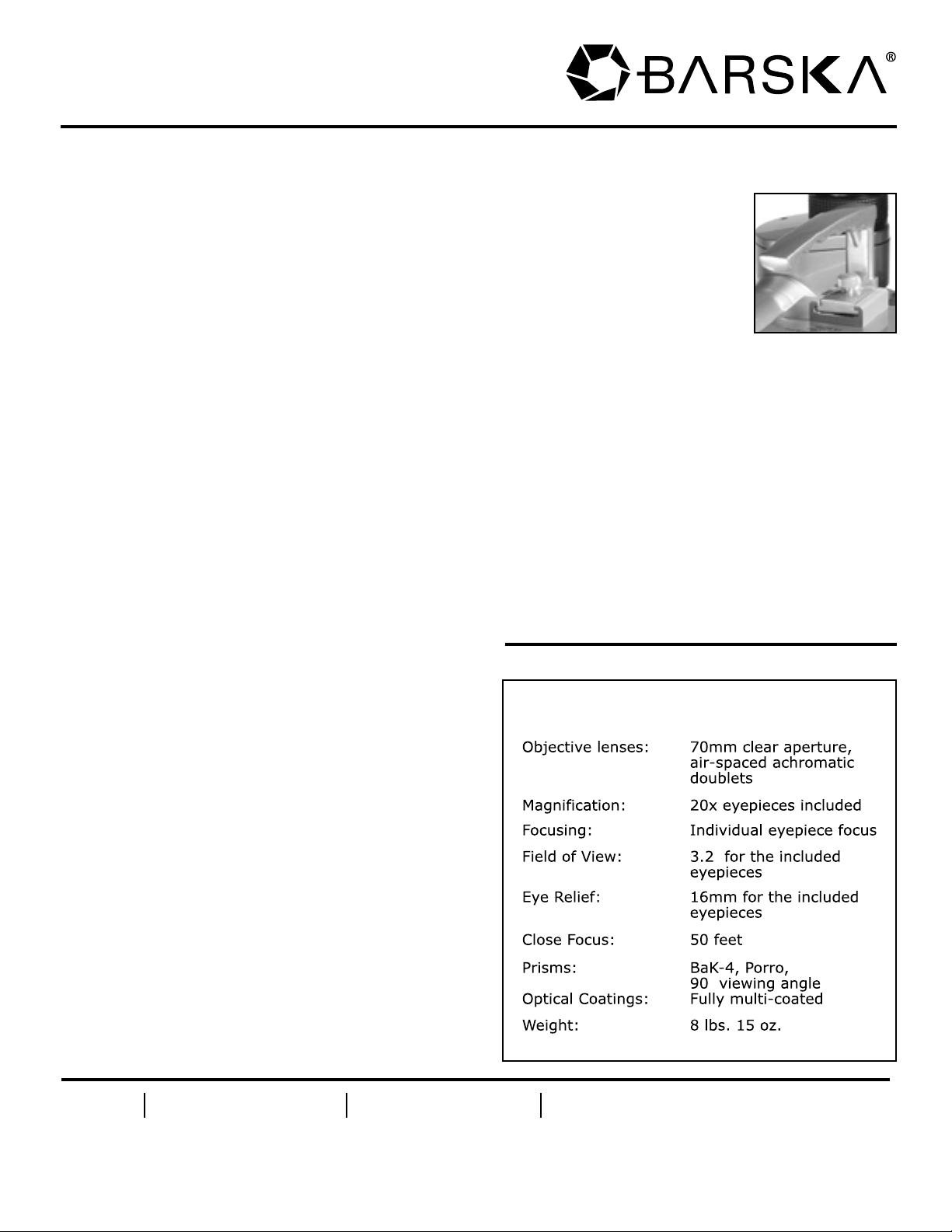
3. A metal carry handle is supplied with the
binocular
. This handle connects to the
dovetail holder on the binoculars which is
located in front of the eyepieces (Fig.8).
4. Slide the handle's base into the do
vetail
holder and secure it in place by tightening
the thumbscrew.
5. Use the handle to lift the
binocular when mounting
to a tripod.
6. R
emove the handle
before placing the
binocular into its
stor
age case.
Important Note:
Allow the optics to slowly adjust to cold
weather b
y storing the binocular in its case
in a cold area such as an unheated gar
age,
unheated basement, or the trunk of a car for
a few hours before use. When bringing the
binoculars back inside a w
arm house, open
up the case, remove the binoculars, remove
the cover caps and allow everything to dry
out. The binoculars should be stored in a
cool, dry place to prev
ent mold growth which
can damage the optics. This is not covered
by the Warranty.
Figure 8.
SPECIFICATIONS
o
o
 Loading...