

Page 1
ELECTRIC
®
PAINT
Application Notes
PRODUCT DESCRIPTION
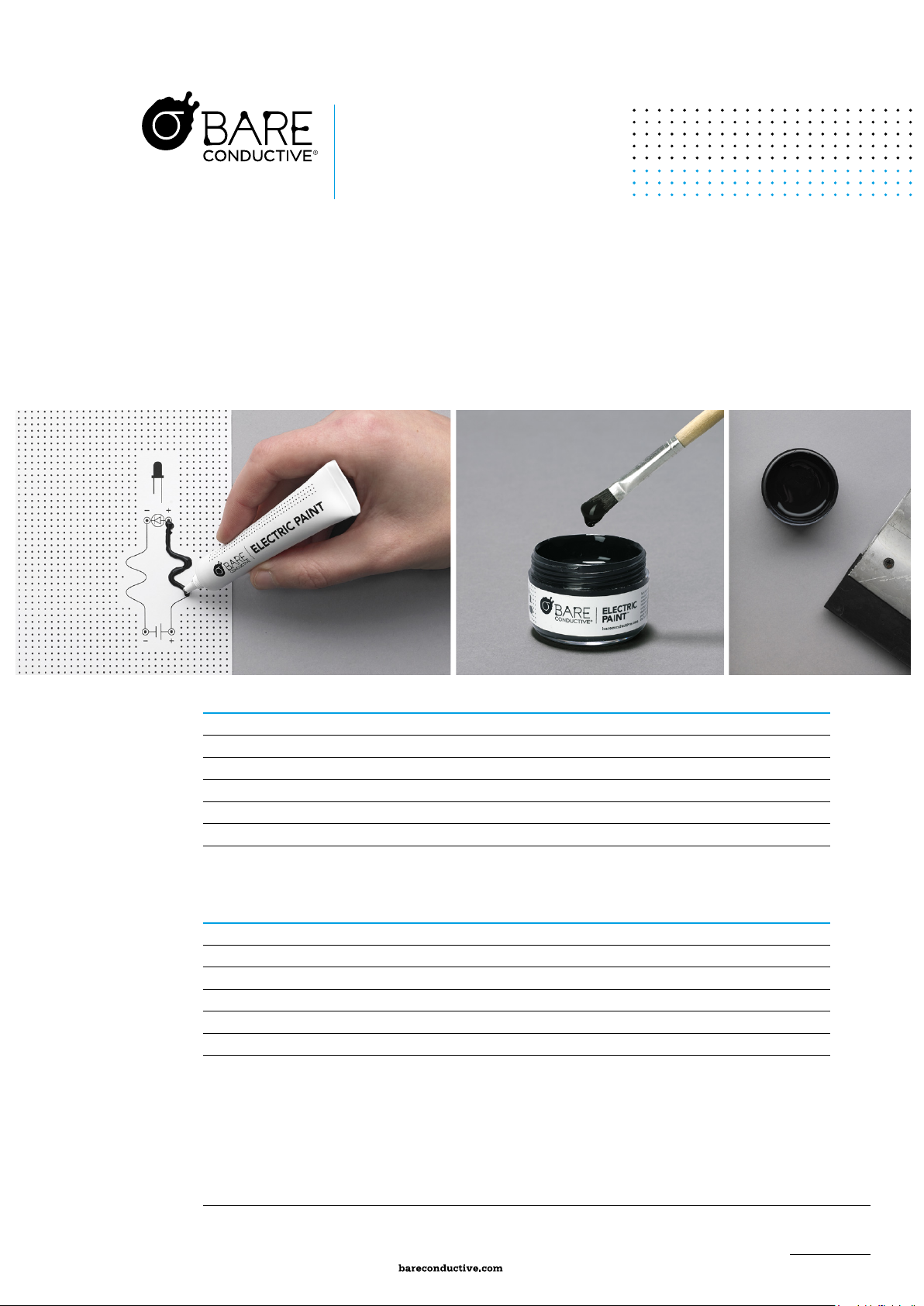
Electric Paint is available in 10ml pens and 50ml jars. It is a nontoxic, water based, water
soluble, electrically conductive paint. Electric Paint adheres to a wide variety of substrates
and is easily removed with water. It is black in color and can be over- painted with any
material compatible with a water-based paint. Please see the Electric Paint MSDS for
precautionary information.
ADVANTAGES / PRODUCT BENEFITS
• Electrically conductive
• Nontoxic
• Water-soluble
• Works with low voltage DC power sources at low currents (see “Power Sources” p.2) Powers small devices
• Can be used as a potentiometer
• Compatible with many standard printing processes
TYPICAL PROPERTIES
Color / Black
Viscosity / Highly viscous and shear sensitive (thixotropic)
Density / 1.16 g/ml
Surface Resistivity / 55 Ω/Sq @ 50 microns or 32 Ω/Sq when using a brush (see p.3)
Vehicle / Water-based
Use by / 6 months after opening
Drying Temperature / Electric Paint should be allowed to dry at room temperature for 5 – 15 minutes.
Drying time can be reduced by placing Electric Paint under a warm lamp or other
low intensity heat source.
Bare Conductive Ltd
First Floor, 98 Commercial St
London E1 6LZ
United Kingdom
tel +44 0 207 650 7977
fax +44 0 203 002 4697
info @bareconductive.com
© 2015 / Bare Conductive Ltd.
1
Page 2
APPLICATION TIPS
Electric Paint is a unique material that can be applied in many different ways, from a paintbrush to
common printing processes like screen-printing. To achieve consistent electrical performance it is best to
apply Electric Paint in an even layer. If you’re interested in screen printing Electric Pain, it is best to use
a textile-type screen in order to achieve a generous layer thickness. We tend to use a 43T screen. Electric
Pain is not inkjet printer compatible. For more application tips visit www.bareconductive.com/tutorials
POWER SOURCES
Electric Paint is intended for use with low voltage DC power sources at low currents and has not been
tested with sources exceeding 12VDC. Higher voltages are not recommended.
SUBSTRATES
Electric Paint is a water-based paint and acts much like other poster paints. Electric Paint adheres well
to wood, paper products, some plastics, corks, textiles and metal. Hydrophobic materials such as some
glass and plastics will exhibit poor adhesion, though this can be improved by roughing the surface with
sandpaper or similar.
DRYING TIPS
Electric Paint is fast drying at room temperature. This material dries rather than cures and gives off no
fumes during the drying process. Drying time can be moderately reduced by placing the material near a
low intensity heat source such as an incandescent lamp. Subjecting Electric Paint to a high temperature
environment will negatively affect both physical and electrical performance.
FLEXIBILITY
Electric Paint is somewhat exible, but this exibility depends on two factors, the layer thickness and
choice of substrate. Regardless of substrate, a consistently thin layer of paint creates the most exible
circuitry. Areas of paint with wide variation in thickness tend to produce fracturing. Substrates which are
exible, but not stretchy (such as paper) work better than materials like Lycra which stretch in multiple
dimensions.
COLD SOLDERING
Electric Paint works well as a cold solder joint. Whether used to solder a surface mount or through-hole
component onto a circuit board, or to adhere a component to a piece of paper, this material
is non-permanent and almost innitely repairable.These unique properties mean that components
can be harvested from projects, cleaned and reused.
RESISTANCE SAMPLES
The aim of these application notes is to give you as much information as you need to get your work
moving forward. As there are so many ways to apply Electric Paint, raw technical data is not always
the most useful way to present the product. Presenting sheet resistances at thicknesses not achievable
with screen printing are not helpful for someone wanting to experiment in a loose manner, yet still be able
to make meaningful calculations.
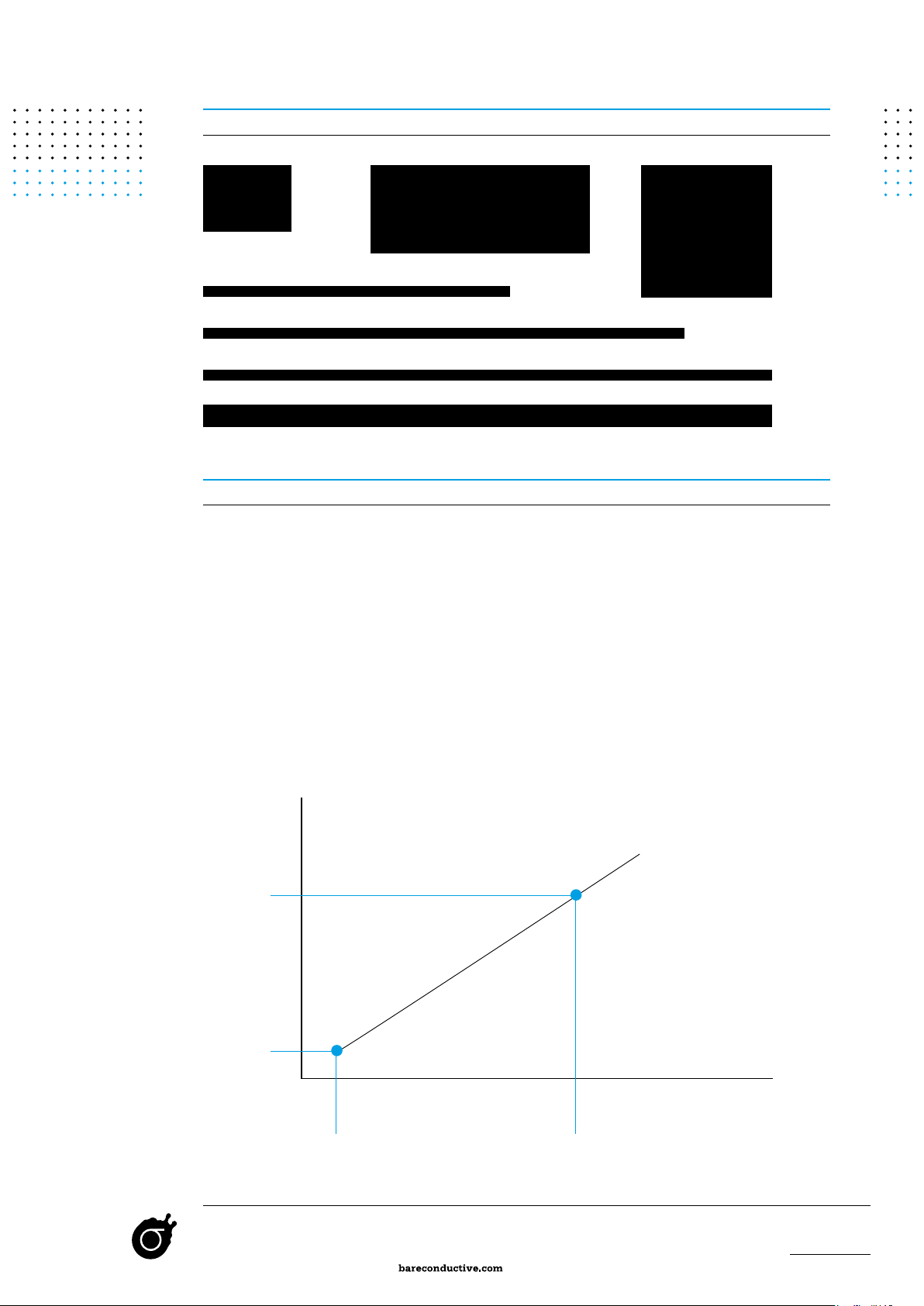
Page 3 showcases a series of samples which indicate the amount of electrical resistance (measured
end to end) that you might expect from a given area of Electric Paint. This assumes a reasonably
thin layer of material (i.e. carefully painted with a brush or home screen printed). The areas of paint below
are shown full size.
See next page for visual.
Bare Conductive Ltd
First Floor, 98 Commercial St
London E1 6LZ
United Kingdom
tel +44 0 207 650 7977
fax +44 0 203 002 4697
info @bareconductive.com
© 2015 / Bare Conductive Ltd.
2
Page 3
RESISTANCE SAMPLES VISUAL
39Ω 20mm x 15mm 61Ω 50mm x 20mm 32Ω 30mm x 30mm
473Ω 70mm x 3mm
737Ω 110mm x 3mm
869Ω 130mm x 3mm
526Ω 130mm x 5mm
RESISTANCE GRAPH
Electric Paint presents a wholly unique way of exploring electrical resistance. In general, the resistance
of a sample of conductive material is dened by the dimensions of the sample being tested,
and resistance is inversely proportional to cross sectional area (i.e. given a set length and depth,
a wider sample will have less resistance than a thin one). Thus, the resistance can be dened by the ratio
of length/width.
The diagram below plots the proportional ratio of a sample of Electric Paint against its approximate
resistance. This diagram assumes that Electric Paint has been applied with a brush. You can calculate
an estimated resistance for any proportion over 1, based on the equation: Resistance=19.77(Ratio)+12
Example one is illustrated by a blue point on the diagram. This point is associated with a shape with a
ratio of 1 (dimensions of 10mm x 10mm i.e. 10 x 10 =1). The resistance associated with this ratio is 32 Ohm.
The nature of the ratio number means that this shape could have the dimensions of 100mm x 100mm and
the resistance would still be 32 Ohm.
Example two shows a shape of ratio 125. In this example the shape has the dimensions of
1250mm x 10mm (1250/10=125). The resistance associated with this shape is 2500 Ohm.
RESISTANCE Ω
3000
2500Ω
2000
1000
50
32Ω
1 50 100 150
Bare Conductive Ltd
First Floor, 98 Commercial St
London E1 6LZ
United Kingdom
10mm x 10mm Shape 1250mm x 10mm Shape
tel +44 0 207 650 7977
fax +44 0 203 002 4697
info @bareconductive.com
© 2015 / Bare Conductive Ltd.
RATIO (L/W)
3
 Loading...