

Page 1
OPERATING INSTRUCTIONS
1
3
4
It is the latest handheld gas leak detector. It features
the following functions :
1. Flexible probe
2. Sensor cap
3. Indicator LED
4. ON/OFF key
5. Earphone jack (Dia.:3.5 mm)
6. Adaptor jack
(Dia.: outer:4mm/inner:1.3mm)
7. Mute slide switch
Sensor: Semiconductor
Response time: < 10 seconds
Warm up time: < 60 seconds
o o
Operation temp. Range: -5 C ~45 C
Power off : 10 minutes from power on
Power supply : 4pcs AA batteries (alkaline one
suggested) or 9V adaptor.
Battery life: 14 hours (Continuous working)
Minimum BAT. voltage: 4.8V
Probe length:
Size: 175 x 70 x 38 mm (HxWxT)
Indicator: Intermittent beep(Acoustic) / LED (Visual)
447 mm
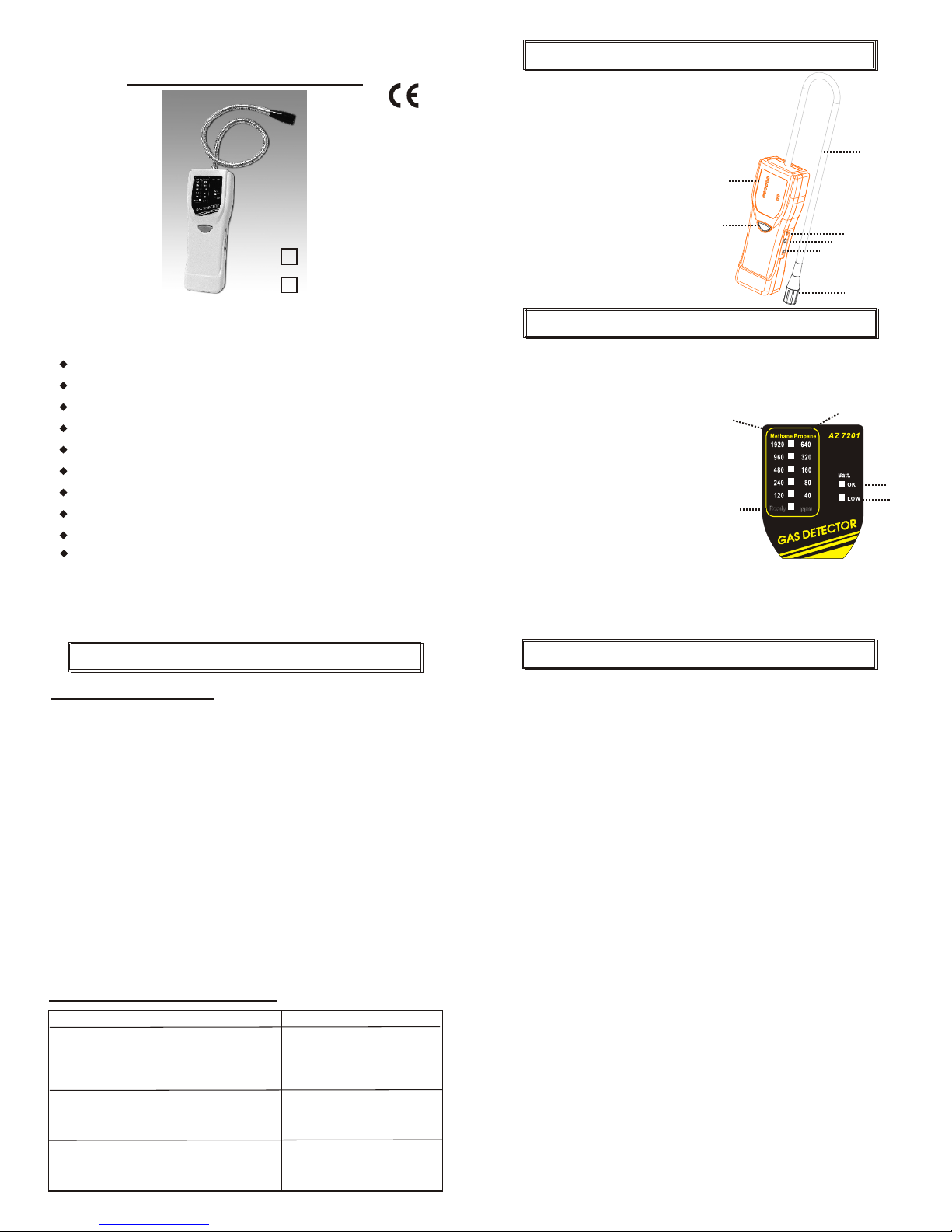
1. Methane 5 level LED
2. Propane 5 level LED
3. Sensor ready LED
4. Power on & Bat. OK LED
5. Bat. Low LED
MEASUREMENT OPERATION
1. Power ON/OFF
Press ON/OFF key more than 0.2 second to turn on
the meter. While the meter is on and electrical power
is enough, the BAT. OK LED will stay on.
To ensure the accuracy, users must perform the
warm-up in the clean air.
The meter will be automatically switched off in 10
minutes. Or you could press ON/OFF key again to
turn off.
!
Please note that the left m eth ane value on 7201
doesn't equal to the r igh t side propane value.
So, make sure the gas you mea sure then read
the value from the correc t side.
2. Warm-up status
While the meter is power on but Ready LED doesn’t
light on, the sensor warm-up is in process. It takes
around 60 seconds and Ready LED is on when it
is ready to measure.
GAS LEAK DETECTOR
2
INTRODUCTION
INDICATOR
1
2
3
4
5
6
7
Detects methane and propane gas.
Quick to pinpoint gas leaks.
Automatically calibrate when power is on.
Auto power off to save battery life.
60 seconds warm up time.
Response time less than 10 seconds.
5-level LED leak alarm.
Over 440mm long flexible probe.
Built in earphone jack.
Mute function.
During this phase, a special compensating circuit
automatically allows to limit the effect of environ mental change.
Even you turn off the meter for a short time and
turn on again, it is always needed to wait for
60 seconds warm-up time.
MODEL: 7201
MODEL: 7291
General Specification
Specification Difference Table
Methane
Propane
Fast response & High
Methane sensitivity
120 to 1920 ppm
40 to 640 ppm
40ppm (Propane)
120ppm (Methane)
7201
7291
Range
40 to 640 ppm
Sensitivity
40ppm
(Propane & Methane)
Advantage
Filter included for
high discrimination
1
2
3
4
5
(Exa mp le :7201)
SPECIFICATIONS
Page 2

6
8
3. Mute function
The meter beeps every second to assure the meter
is in normal working status. The beeps frequency will
speed up while the detected gas concentration
becomes higher.
5
Meter does not turn on
a) Make sure you press "ON/OFF " key for more
than 200 mS.
b) Check the batteries are in place, good contact
& correct polarity.
c) Replace with new batteries and try again.
TROUBLESHOOTING
MAINTENANCE
7
The meter is warranted to be free from defects
in material and workmanship for one year. The
warranty covers normal operation and does not
cover battery, misuse, abuse, alteration, neglect,
improper maintenance, or damage resulting from
leaking batteries. Proof of purchase is required for
warranty repairs. Warranty is void if the meter has
been opened.
WARRANTY
Authorization must be obtained from the supplier
before returning items for any reason . When
requiring a RA (Return Authorization), please
include data regarding the defective reason, the
meters are to be returned along with good packing
to prevent any damage in shipment and insured
against possible damage or loss.
RETURN AUTHORIZATION
4. Leakage check
BATTERY REPLACEMENT
While the LOW battery LED is on, it is suggested to
always change fresh batteries to ensure the accuracy.
Open the battery compartment from the meter rear
side and replace with 4 new AA alkaline batteries.
Check if the sensor is in goo d contact. If LED is
still off, please return the meter to the dealer
for repair.
Ready LED isn't on after 60 s eco nds warm up
4) Sensor drift may occur w hen it is soaked or
splashed with wate r.
5) If water freezes on the se nsi ng surface, the
sensor would crack and al ter characteristics.
6) This meter requires to operate under around
21% ambient oxygen e nvi ronment in order to
function properly. This meter cannot work well
in zero or low oxygen atmos phere.
Situations must be avoi ded
1) If silicone vapor i s abs orbed onto sensor
surface, the sensor wil l be coated. So, avoid
exposure to where silic one adhesives, hair
grooming materia ls, s ilicone rubber/putty
may exist.
1) Light condensat ion u nder indoor usage should
not be a problem for sensor. H owever, if water
condenses on the sensor s urface for a while,
the sensor characteri sti cs may still drift.
2) Sensor performa nce m ay be also affected if
exposed to a high dens ity g as for a long time,
regardless of the power c ondition.
3) When meter is turned off for a long time, the
sensor may show a drift in re sis tance according
to the storage environm ent. So, the meter should
be stored in a sealed ba g wit h clean air.
Note!! The longer the meter off time, the longer
warm-up time required t o sta bilize the sensor
before usage. Turn on the me ter o ften to ensure
the warm up time is long eno ugh .accumulative
Situations to be avoided whe nev er possible
4) Regardless of pow er co ndition, when the
sensor is exposed in e xtr eme conditions such
as very high humidity, extreme temp. or high
contamination le vel s for a long period of time,
sensor performance wi ll be adversely affected.
To check the pipe leakage, follow the steps below.
Hold the sensor toward the pipe, slide slowly the
sensor along the pipe; repeat the procedure from
the other side of the pipe. When the sensor is close
to a leakage, the LED will light on corresponding
levels and beep frequency increases.
It takes at least 2 min. to wait for sensor recovery
after removing the sensor out of a leak point.
While earphone is plugged on, users will hear the
beeps only through the earphone.
To mute the beeper, just slide the mute switch ON.
2) High-density ex pos ure to corrosive materials
such as H2S, Sox, Cl2, Hcl, e tc. m ay cause
corrosion or break age o f the lead wires or
heater material.
3) Sensor drift may occur w hen the sensor is
contaminated by alkal ine metals, especially
salt water spray.
2009 .0 9. modified
 Loading...