

Page 1
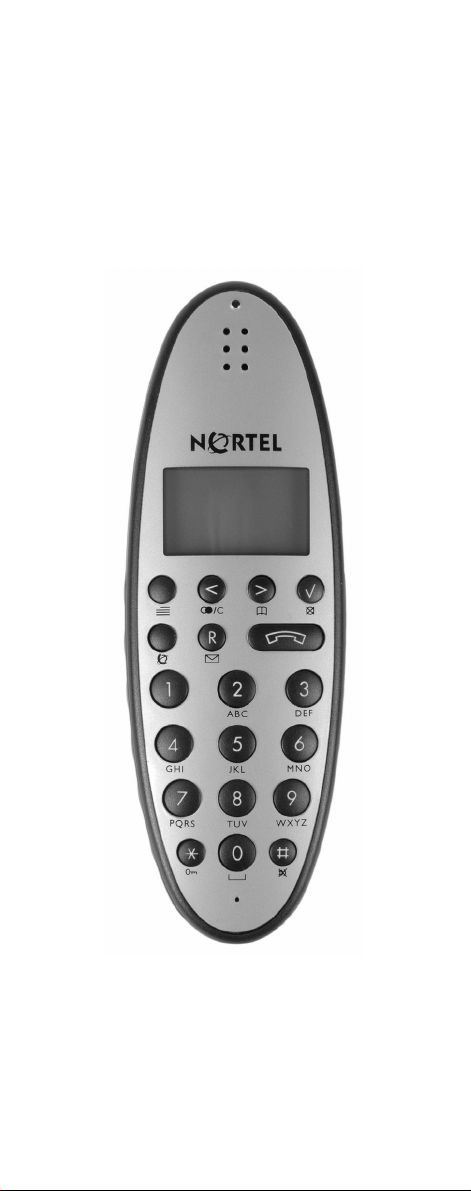
Nortel
Digital Mobility Handset 743X
and 744X User Guide
www.nortel.com
© 2008 Nortel Networks
N0000636 02
Printed in Denmark
Page 2

Congratulations
on your new Nortel 743X/744X handset
X represents the frequency variant of
the models:
0 = (2.4 GHz frequency band)
4 = (1900 - 1930 MHz frequency band)
9 = (1920 -1930 MHz frequency band)
The handset 743X/744X will provide you with
the greatest possible degree of flexibility and
mobility due to high battery capacity, practical weight, size and design.
6723
&KDUJH\RXU
KDQGVHW
KRXUVSULRUWR
ILUVWXVHIRUEHVW
SHUIRUPDQFH
Page 3

Please note that the handset 743X/744X is
for use with the following Nortel host systems:
• Norstar MICS 7.0 or greater (Modular
Integrated Communications System)
• Norstar CICS 7.0 or greater (Compact
Integrated Communications System)
• BCM1000/200/400 3.7 or greater
(Business Communication Manager)
• BCM50 Rel. 2.0 or greater
(Business Communication Manager)
• BCM450 Rel. 1.0 or greater
(Business Communication Manager)
Page 4

Page 5

Contents
Getting Started. . . . . . . . . . . . . . . . . . 7
Handset information . . . . . . . . . . . . . 7
Battery information . . . . . . . . . . . . . . 8
Installing battery . . . . . . . . . . . . . . . . 9
Charging battery . . . . . . . . . . . . . . .10
Checking battery capacity . . . . . . .11
Battery disposal . . . . . . . . . . . . . . . 12
About your 743X/744X handset . . . 13
Handset display . . . . . . . . . . . . . . . 15
Display softkeys . . . . . . . . . . . . . . . 17
Display backlight . . . . . . . . . . . . . .17
Basic handset options. . . . . . . . . . . 18
Turning the handset ON/OFF . . . . . 18
Adjusting speaker volume . . . . . . . 18
Changing Menu Language . . . . . . . 18
Customizing handset . . . . . . . . . . . 19
Making and answering calls . . . . . . 22
Dial directly . . . . . . . . . . . . . . . . . . .22
On hook dialling (pre-dial) . . . . . . . 22
Dial from your phone book . . . . . . .23
Redial . . . . . . . . . . . . . . . . . . . . . . . 23
Answering calls . . . . . . . . . . . . . . . 24
Hold a call . . . . . . . . . . . . . . . . . . . . 24
Making or answering a second call 25
Mute a call . . . . . . . . . . . . . . . . . . . 25
Turn on loudspeaker . . . . . . . . . . . 25
Replying to messages . . . . . . . . . . 26
More handset options . . . . . . . . . . . 27
Moving around in the Menu . . . . . . 27
Using phone book . . . . . . . . . . . . . 30
Using text messages (MSF) . . . . . . 34
Shortcuts . . . . . . . . . . . . . . . . . . . . 38
General information. . . . . . . . . . . . . 39
Troubleshooting . . . . . . . . . . . . . . . 39
Information . . . . . . . . . . . . . . . . . . . 39
5
Page 6

6
Page 7

Getting Started
Read all the information in this section
before you use your handset.
Handset information
Ensure that the adapter voltage is the
same as the electrical outlet voltage.
The 743X/744X handset uses radio
signals and does not guarantee a
connection in all circumstances. Do
not rely on a cordless handset to
make emergency calls.
Never use your handset:
• in the vicinity of electrical
detonators
• in shielded rooms
• in areas where radio transmission is
forbidden
• in aircraft
Do not place a handset near:
• water, moisture or damp areas
• heat sources, direct sunlight or
unventilated areas
• devices which generate strong
magnetic fields such as electrical
appliances, fluorescent lamps,
computers, radios, televisions or
fax machines
• areas where the handset can be
covered, its ventilation impaired,
liquid spilled on the unit or objects
inserted into the handset through
any openings.
7
Page 8

• areas with dust, vibration, shock or
temperature extremes
Check for small metal objects in the
handset earpiece/mouthpiece before
using the handset.
Do not store or locate flammable liquids, gases, or explosive materials in
the same compartment or vicinity as
the cordless handset, its parts or
accessories.
Battery information
Read the following information before
you handle the batteries:
• Do not replace the batteries in
potentially explosive environments,
such as rooms where flammable
liquids or gases are present.
• The battery will explode if disposed
of in a fire.
• Do not charge the batteries unless
you use the Nortel Networks
approved charger and the proper
batteries.
• Only use battery type NT7B65LDE6 in
the 743X/744X handset. Do not
use these batteries with other
products. These batteries were
designed specifically for use with
the 743X/744X handset and the
743X/744X charger ONLY.
Improper use of the batteries may
result in fire hazard.
• Do not do anything that would
cause the battery to short circuit.
• Do not let the battery or the charger
come into contact with conductive
metal objects.
8
Page 9
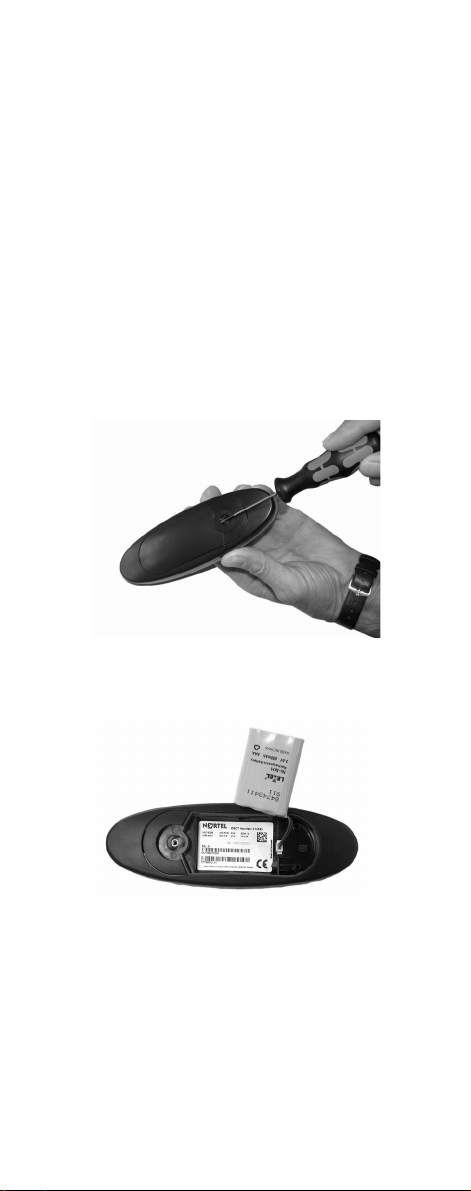
Installing battery
The battery is connected to the handset when it is shipped from the factory.
1 To change the battery unscrew
the plate on the rear of the
handset to access the battery
compartment. Use a normal
screw driver.
2 Insert the screwdriver into the
small crack behind the blind cover
and break to open the handset.
3 Place the battery plug in the slot
in the battery box.
4 Insert battery with the label
readable.
5 Replace the back cover.
9
Page 10
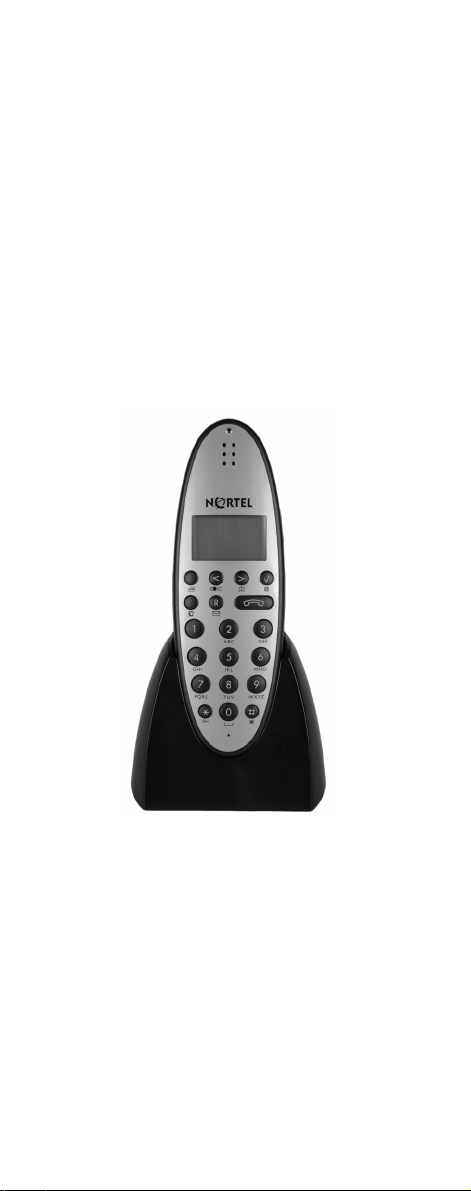
Charging battery
When charging the battery for the first
time, it is necessary to leave the
handset in the charger for 14-16
hours for the battery to be fully
charged.
During normal operation, it takes
approximately 3.5 hours to charge the
handset from fully discharged to its
full capacity.
• Place the handset in the charger.
For correct charging, be sure the
room temperature is between 0°C
and 25°C. Do not place the
handset in direct sunlight. The
battery has a built-in heat sensor
which will stop charging if the
battery temperature is too high.
10
Page 11

If the handset is turned off when
placed in charger, only the LED
indicates the charging. When
handset is turned off, the LED
flashes at a low frequency while
charging and lights constantly
when the charging is finished.
There will be no reaction for
incoming calls.
If the handset is turned on when
charging, the display shows the
charging status. The display goes
back to normal mode when fully
charged. It will not vibrate.
Auto-answer is inactive. The
handset reacts normally for
incoming calls.
It is necessary to recharge the battery
when the display shows BATTERY
LOW, or if the handset cannot be
turned on. When the battery is fully
discharged, up to 10 minutes may
pass before charging begins (display
lights up). When the charger begins
the charging, status is shown in the
display if the handset is turned on.
Checking battery capacity
In the BATTERY MENU it is possible
to see the remaining battery capacity.
For reading the correct capacity, the
handset has to be removed from the
charger for at least one hour.
1 Press MENU ( ) and use the <
or > keys to reach the BATTERY
MENU.
2 Press 3 to enter the BATTERY
MENU, and see the current status
of the battery capacity.
11
Page 12

3 Press 3 to return to the menu
system, or press MENU ( ) to
quit.
The indication on the display is not
necessarily an exact reflection on the
remaining speech time, but only an
indication of the voltage on the battery.
Battery disposal
Defective batteries must be returned
to a collection point for chemical
waste disposal.
Warning: Nickel metal hydride
batteries must be disposed of
properly. Do not dispose of the
batteries in office or household waste.
Nickel metal hydride batteries are
recyclable. You can help preserve the
environment by returning your
unwanted batteries to your nearest
recycling center for recycling or
proper disposal.
Contact your system administrator for
more information about battery disposal and recycling centers in your
local area.
12
Page 13
About your 743X/744X
handset
A
C
C
D
D
J
J
J
F
H
G
H
K
E
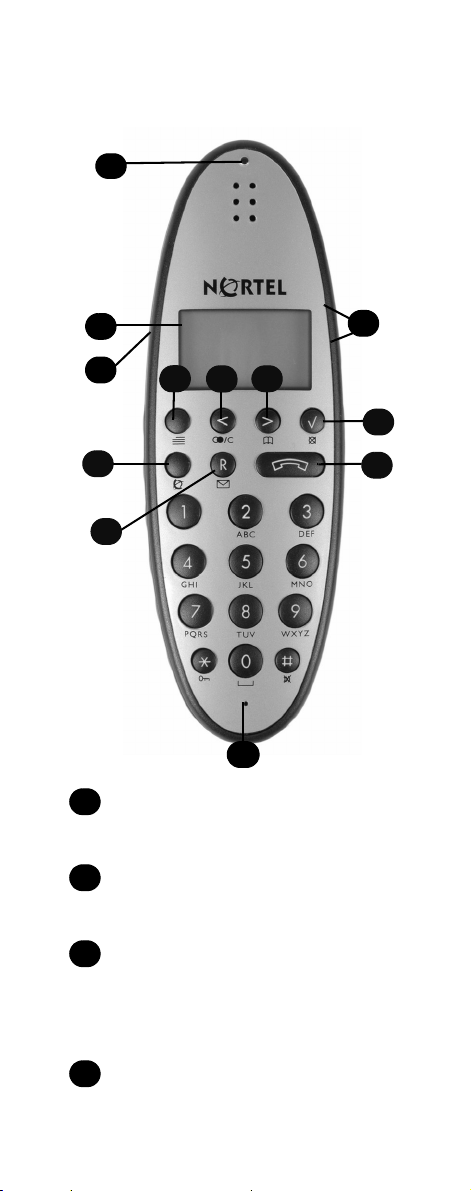
Message indicator light
A
Flashes when you have a
message waiting.
Volume control
B
Adjusts the handset and ringer
volume.
Display
C
Shows call information, handset
status icons, and guides you
through features and option
menus.
Headset connector
D
Only available on handset 744X.
B
I
L
13
Page 14

Microphone
E
Keys F to L activate different
functions when your handset is
on hook or off hook.
On hook: Handset is idle (not in
use).
Off hook: Handset is active, call
or feature in progress.
Menu key
F
On hook
(idle)
Off hook
(active)
G
On hook
(idle)
Off hook
(active)
H
On hook
(idle)
Off hook
(active)
I
On hook
(idle)
Off hook
(active)
J
On hook
(idle)
Enters the Handset
Options menu.
Activates a feature option.
< ( ) key
Enters the Redial List
menu.
Activates a feature option.
> ( ) key
Enters the Telephone
Book menu.
Activates a feature option.
3 ( ) key
Turns the handset off with
a long (four second) key
press.
Turns the microphone off
or on when you are on a
call.
Feature key
Turns the display on for
three seconds with two
rapid key presses.
OR
Starts a feature session.
14
Page 15

Off hook
(active)
Starts or ends a feature
session.
OR
Turns the loud speaker on
with a long key press
(only available on handset
744X).
R ( ) key
K
On hook
(idle)
Opens your message list
with a short key press.
OR
Enters the text message
(MSF-MAIL) menu with a
long (three second) key
press.
Off hook
Places calls on hold.
(active)
L
On hook
On/Off hook key
Turns the handset on.
(idle)
Off hook
Ends an active call.
(active)
Handset display
There are four lines on your handset
display.
Display information example
61-: !
<1@1>OMXXQP
:1D@ /-88 1>-?1
(((.)))
Line 1
Line 2
Line 3
Line 4
15
Page 16

The types of information shown on
the display are:
• Standby text: When the handset
is on hook (idle), your extension
name and number appears on the
first line of the display.
• Information text: Call or feature
information appears on the second
line of the display.
• Feature options: Feature options
appear on the third line of the
display.
Feature options vary, depending on
the type of call or feature in use.
• Handset icons: The following
icons appear on the fourth line of
the display:
The radio signal icon indicates
((.)))
connection to system.
Note: The icon flashes when
the system is busy and you
will not be able to make or
answer calls.
The envelope icon indicates a
new text message
(MSF-MAIL).
Left and right arrow icons
appear on the display when
you access Handset option
menus.
The telephone icon indicates a
call is active.
Note: The icon flashes when a
call connection is in progress.
16
Page 17

Display softkeys
s
Three display softkeys are used to
activate feature options that appear
on the third line of the display.
The following graphic shows the
softkey mapping for feature options
on the third line of the display.
Display softkey mapping example
:1D@ /-88 1>-?1
2
1 3
Display softkeys
Display softkeys
Display softkeys
Display
Line 3
Display backlight
The display backlight automatically
turns on when there is an incoming
call, or if a key is pressed.
The backlight turns off after 10
seconds when the handset is idle.
You can disable the backlight to save
power, refer to the “Customizing
handset” section in this guide for
more information.
Note: The backlight is disabled when
the key lock function is activated.
17
Page 18

Basic handset options
Turning the handset ON/OFF
ON
Press .
When the handset is turned on the
radio signal display icon is shown in
the lower left corner of the display, if
the handset is subscribed to a system.
OFF
Press 3 ()for 1 seconds.
Adjusting speaker volume
1 Press .
2 Use the two keys placed at the
upper right side of the handset for
volume control.
3 Press again.
Changing Menu Language
There are three predefined languages
in the handset: English, French, and
Spanish.
1 Press MENU ( ), and then press
3.
2 Switch to SET PROFILE
LANGUAGE using the <> keys,
then press 3.
3 Use the <> keys to choose
between the predefined
languages, then press 3 to select
the required language.
4 Press MENU ( ) to exit the menu
structure.
See Figure 1 on page 45.
18
Page 19

Customizing handset
The handset has one user-defined
profile (set up), and a mode where all
sounds are disabled (SILENT).
• Press MENU ( ) followed by 3 to
show the profile.
All settings have to be defined
under the profile. The display
shows if the SILENT mode is
enabled.
Profile set-up
In the following you will find a description of how to set up the profile.
1 Press MENU ( ) to enter the
PROFILE SET UP MENU.
2 Press 3.
You are now able to switch
between the different settings
using < or >.
3 Press 3 when you find the setting
you wish to change (or see).
4 Change the setting according to
your needs, confirm with 3 and
you automatically go to the next
setting.
5 Press MENU ( ) to finalize profile
setup.
See Figure 2 on page 46.
19
Page 20

Description of profile functions
RINGERTONE:
Scroll through the 9 different ringertones using < and >. Confirm with 3.
RINGER VOL:
Turn the volume up and down using <
or >. Confirm with 3.
KEY CLICK:
Turn the volume up and down using <
and >. Confirm with 3.
VIBRATOR:
Can be turned on/off using < and >.
Confirm with 3. (Works only on hand-
set 744X).
Auto-ANSWER:
Can be turned on/off using < and >.
Confirm with 3.
When turned on, the telephone automatically goes off hook when ringing.
START VOL:
Start volume can be adjusted using <
and >. Confirm with 3.
OUT OF RANGE:
The out of range indication can be
turned on/off using < and >. Confirm
with 3.
With the out of range indicator turned
on, a beep will sound when the telephone is moving out of range of the
base station, and “;A@;2>-:31” will
appear in the display. If on a call
(when out of range) the call will be
transferred to the prime set.
20
Page 21

AUTO KEYLOCK:
The auto keylock function can be
turned on/off using < and >. Confirm
with 3.
With auto keylock turned on the handset will automatically lock the keys
after 60 seconds. Press MENU ( ),
then press º to activate the keys
again.
Language:
Choose between predefined languages using < and >. Confirm with 3.
BACKLIGHT:
Can be turned on/off using < and >.
Confirm with 3.
Refer to “More handset options” on
page 27 for more information on the
menu.
21
Page 22

Making and answering calls
The handset must be subscribed and
registered to make or answer a call.
(Contact your system administrator to
have your handset subscribed).
For internal calls, dial the extension
number. (Contact your system administrator for a list of extension numbers).
For external calls, dial the external
code (or line pool code) to access an
external line, then dial the external
telephone number. (Contact your system administrator to confirm what
external code or line pool code to
use).
Dial directly
1 Press , the display icon
flashes until the call is connected.
2 Dial the number.
3 Press again to end the call.
On hook dialling (pre-dial)
1 Dial the number.
A long press on º will make a
pause, if necessary.
2 Press .
3 Press again to end the call.
22
Page 23

Dial from your phone book
1 Press > ( ) to enter the
telephone book.
2 Search for the number either by
using the <> -keys, or by pressing
the first letter in the name by
using the digits 2 – 9.
3 Press , the display icon
flashes until the call is connected.
4 Press again to end the call.
Note: For more information on using
your phone book, refer to “Using
phone book” on page 30.
Redial
The handset has maximum 10 redial
numbers. Each number is only represented once.
1 Press <( ) to enter the redial
list.
You can also reach the REDIAL
MENU in the main menu.
2 Search for the number by using
the <> -keys.
Redial numbers are marked with
“REDIAL” or name of the person
who called, if present in the phone
book.
3 Press , the display icon
flashes until the call is connected.
4 Press again to end the call.
Note: Use the Redial list or the Last
Number Redial Feature (
automatically redial the last external
telephone number that you called.
23
5) to
Page 24

Answering calls
Depending on the system hardware/
software configuration, Call Display
information (CLID) for incoming external calls will appear on the display.
Your system administrator must
enable the CLID feature for your
handset in system programming.
To answer a call:
• Press to answer a call when
your handset rings.
• If you are using headset, press any
key on the handset to answer the
call.
To stop the handset ringing without
answering the call:
• Press and the ring signal is
muted. The display shows:
»RINGER MUTED«
• Alternatively, press one of the
volume control buttons to mute the
ringing signal.
Hold a call
1 While on a call, press R ( ).
2 To retrieve the held call, press R
() again.
24
Page 25

Making or answering a second
call
You can have two calls active at the
same time. Use R ( ) to switch
between calls.
To answer a second call while on
another call
• Press R ( ) to answer the second
call. The first call is automatically
put on hold.
To hold a call and make a second
call
1 Press R ( ) to put the first call on
hold.
2 Dial the telephone number of the
second call.
To return to the first call
• Press R ( ) again to return to the
first call.
The second call is automatically
put on hold.
Mute a call
1 While on a call, press .
2 To cancel mute, press again.
Turn on loudspeaker
Only available on Handset 744X.
1 While on a call, press
press) to turn the loudspeaker on.
2 To turn the loudspeaker off, press
(long key press) again.
25
(long key
Page 26

Replying to messages
This allows you to read messages
from another DN (Directory Number)
in the system or to listen to voice-mail
messages.
The red LED on your handset flashes
when you receive a message from an
internal voice message center or
another telephone on your system.
This is the message waiting indication.
To view, reply and listen to your
messages
1 While on hook, press R ( ) (short
key press) to access your
message list.
2 Press :1D@
in the list.
Note: The :1D@
on the display when you have more
than one message.
3 Press /-88
in the list.
4 Press 1>-?1
from the list.
Note: Refer to the document provided
with the internal voice message
center for more information about
mailbox options.
to view all messages
softkey only appears
to reply to a message
to delete a message
26
Page 27

More handset options
Moving around in the Menu
Press MENU ( ) to enter or exit the
menu structure. It has to be used if a
“NO” or “CLEAR” is wanted in the
menu structure.
Press 3 to jump to a lower level in the
menu. When the lowest menu level is
reached, it will store the setting and
jump to a higher level. It has to be
used if a “YES” is wanted.
Note: If the handset is in the menu,
and an incoming call arrives, then the
menu will be dropped and the call
handled in the normal way.
See Figure 3 on page 47.
Menu structure
The main menu consists of the following 8 menus:
MENU PROFILE SET UP
For more information, see “Customiz-
ing handset” on page 19.
MENU EXT. SERVICE
External services are only applicable
to the Master handset. For more information, contact your system administrator .
MENU BATTERY
For more information, see “Checking
battery capacity” on page 11.
MENU PHONE BOOK
For more information, see “Using
phone book” on page 30.
27
Page 28

MENU REDIAL
The handset has maximum 10 redial
numbers. Each number is only represented once.
• Press MENU ( ), press > four
times from standby text to enter the
REDIAL MENU, and then press 3.
Repeated presses at < turn
backward through the dialled
numbers (from newest to the
oldest).
Right arrow moves in the opposite
direction.
Note: It is also possible to reach the
REDIAL MENU, using the <( )
key.
• Numbers are named “REDIAL” or
with the name.
• If you want to delete a ”REDIAL”
use < or > to scroll to the name/
number, and then press 3 twice.
The name/number is now deleted.
If the number is stored, it is moved
to the telephone book.
It is possible to add prefixes to the
redial numbers.
• Find the number you wish to edit
and press the digits you want to
add to the number, e.g. prefix = O.
See also “Redial” on page 23.
MENU MSF-MAIL
For more information,see “Replying to
messages” on page 26.
28
Page 29

MENU LOGIN
For more information on this menu
option, contact your system administrator.
MENU MSF FUNCTION
MSF Functions are special functions,
which are based on MSF (Message
Service Function). The functions
require special software in the main
system.
Note: The PHONE BOOK MENU,
REDIAL MENU and MSF-MAIL
MENU can be accessed directly. The
PHONE BOOK MENU by pressing >
(), the REDIAL MENU by pressing
< ( ), and the MSF-MAIL MENU
by pressing R ( ) with a long key
press.
29
Page 30

Using phone book
You can store telephone numbers and
names in your telephone book.
The telephone book can store up to
80 numbers with name. A maximum
of 23 digits, including spaces, is
allowed for each number. A maximum
of 24 digits, including spaces, is
allowed for each name. Names are
sorted alphabetically starting with
their first character.
Using the alphanumeric keyboard
The normal dialling keys (0-9) are
used for writing the name to be
placed in the telephone book. By
pressing the keys a certain number of
times the related letters or digits will
appear in the display.
Spaces are made by using the 0 -key.
Keyº changes between uppercase
and lowercase letters.
The arrows will move the cursor.
Left arrow is also used for deleting
(hold for 1 sec.) = delete. New letters
can be inserted.
Change of key press and pauses lasting more than 1 second automatically
moves the cursor to next position.
30
Page 31

Key Capital letter Small letter
1
? ! 1 - + * / =
& ( ) % ¿ ¡
2
A B C 2 Ä Å À
Á Ã Æ Ç
3
D E F 3 È É Ê Ëd e f 3 è é ê ë
4
G H I 4 Ì Í Î Ï g h i 4 ì í î ï
5
J K L 5 j k l 5
6
M N O 6 Ñ Ö
Ò Ó Ô Õ Ø
7
P Q R S 7 ß p q r s 7 ß
8
T U V 8 Ü Ù Ú Ût u v 8 ü ù ú û
9
W X Y Z 9 w x y z 9
0
[Space] , . 0 : ;
_ ” ‘ ^ ~
*
AÆaaÆA
#
# @ € $ £ ¥ § <
> { | } [ \ ]
? ! 1 - + * / =
& ( ) % ¿ ¡
a b c 2 ä å à á ã
æ ç
m n o 6 ñ ö ò ó
ô õ ø
[Space] , . 0 : ;
_ ” ‘ ^ ~
# @ € $ £ ¥ § <
> { | } [ \ ]
Storing a number
1 While on hook, press the number
to be stored (max. 23 digits),
press >, and then press 3.
2 Enter a name (max. 24 digits),
and then press 3 to store the
number.
After storing, the telephone will go
back to standby mode.
31
Page 32

3 If the display shows “MEMORY
FULL”, it is necessary to delete
one or more numbers from the
telephone book.
See Figure 5 on page 49.
Storing from Redial list
1 While on hook, use the < -key to
find the number in the redial list to
be stored in the telephone book.
2 Press 3, then >, and then press 3
again.
3 Enter a name, and then press 3
to store the redial list number in
the telephone book.
Storing number from last caller
• While on hook, press < to store a
number from last caller, then 3,
then press >, then 3 to confirm.
Reading BOOK numbers
1 While on hook, press > ( ) to
enter the telephone book.
2 For quick-search: press the first
letter of the name (using
2-9)(Refer to “Using the
alphanumeric keyboard” on page
30).
3 Press to call the displayed
person.
It is also possible to reach the
PHONE BOOK MENU from the
main menu.
32
Page 33

4 Press MENU ( ) to exit the
telephone book.
Note: Viewing and editing the
telephone book can also be done
while in conversation (off hook) by
pressing > ( ) with a long key press.
See Figure 6 on page 50.
Changing numbers
1 While on hook, press > ( ) to
enter the telephone book.
2 Use the < > -keys to find the
number to be edited, press 3,
press >, then press 3.
3 Edit the number, and then press 3
to store the number.
Note: Viewing and editing the
telephone book can also be done
while in conversation (off hook) by
pressing > ( ) with a long key press.
See Figure 6 on page 50.
Changing Redial number
1 While on hook, press < ( ),
use the < > -keys to find the redial
number to be edited, and press
the digits you want to add to the
number, e.g. prefix = O.
2 Press 3, followed by >, enter a
name, and then press 3 again to
store the number.
33
Page 34

Deleting numbers
1 While on hook, press > ( ) to
enter the telephone book.
2 Use the < > -keys to find the
number to be deleted, press 3
twice.
See Figure 6 on page 50.
Deleting from Redial list
• While on hook, press < ( ), then
use the < > -keys to find the name/
number to be deleted, and press 3
twice.
The name/number is now deleted.
If number is stored, it is moved to
the telephone book.
Using text messages (MSF)
It is possible to send text messages
from handset to handset on the same
system.
Note: Sending text messages is not
supported. This feature will be
supported in upcoming releases.
See Figure 4 on page 48.
At the reception of a text message the
envelope display icon appears. The
envelope display icon is indicating
one or more unread messages or
unanswered calls.
• The text message is shown in the
display, and when the message is
read the envelope display icon will
disappear.
34
Page 35

• If the message contains a callback
number, this will be displayed on
the bottom line of the display. As
long as the callback number is in
the display, it is possible to activate
the number by pressing .
• 1st letter in the display, in front of
the timestamp, shows the message
status: read (R), unread (N) or
locked (L).
• Mails include a maximum of 72
letters or digits. Call back no. is
max 23 digits (or letters for E-mail).
• 14 messages can be ”stored” in the
handset. When receiving a new
message, the oldest unlocked will
be deleted.
• Locked messages will not
automatically be overwritten, but
can manually be deleted.
Maximum 7 messages can be
locked.
Reading a MSF mail
1 While on hook, press R ( ) with a
long key press, then press 3.
If the message includes more
than 48 letters or digits, the
message will run over 2 display
screens.
2 Use the > -key to scroll.
3 To see the sender of the mail,
press 3.
4 To leave the mail, press MENU
().
35
Page 36

Replying a MSF mail
1 While on hook, press R ( ) to
open the mail, then 3, press 3
again and use the < > -keys to
find the reply feature, press 3 and
you are now able to reply the
mail.
2 After writing your reply, press 3 to
confirm.
Forwarding a MSF mail
1 While on hook, press R ( ) to
open the mail, then 3, press 3
again and use the < > -keys to
find the forward feature, press 3
twice and you are now able to dial
the number on the receiver.
2 Press 3 to confirm.
Deleting all MSF mails
1 While on hook, press R ( ) to
open the mail stack, then 3, press
3 again and use the < > -keys to
find the delete feature.
2 Press 3 and all mails are deleted.
Deleting a MSF mail
1 While on hook, press R ( ) to
open the mail, then 3, press 3
again and use the < >-keys to find
the delete feature.
2 Press 3 and the mail is deleted.
36
Page 37

Locking/unlocking a MSF mail
When locking a message, the message will not automatically be overwritten when receiving a new
message. If unlocked, the oldest message will be deleted when receiving a
new message.
1 While on hook, press R ( ) to
open the mail
again and use the < > -keys to
find the lock/unlock feature
2 Press 3 and the mail is locked/
unlocked.
, then 3, press 3
Writing a MSF mail
1 While on hook, press R ( ) with a
long key press to write a new
mail, confirm with 3, and then
write your message.
2 To send the mail press 3, dial the
number of the receiver, and then
confirm with 3.
3 If one or more mails are stored do
as followed:
• Press R ( ), then >, confirm
with 3, and then write your
message.
• Press 3, dial the number of the
receiver, and confirm with 3.
The message is sent.
Note: In case a sent message is not
received, the sender will get a
message in the display.
37
Page 38

Shortcuts
”SILENT”: Press: MENU ( ) followed
by #. (No sounds) (Display shows
SILENT)
”KEY LOCKED”: Press: MENU ( )
followed by º. (Display shows KEY
LOCKED)
“PHONE BOOK”: Press > ( ) (in on
hook).
Name search in telephone book:
Press the first letter in name.
Store a number: Press > ( ) after the
number (in on hook).
“REDIAL”: Press < ( ) in on hook.
Check messages: Short Press R ( )
in on hook.
“MSF-MAIL”: Long Press R ( ) in on
hook.
MUTE temporarily the ringer: Press 3
() when the telephone is ringing.
Alternatively, you can also press one
of the volume control buttons to mute
the ringing signal.
MUTE the microphone: Press 3 ()
when the telephone is off hook.
RECALL: Press R ( ).
Pause(-): Hold º for one second (only
for on hook dialling/pre-dial).
38
Page 39

General information
Troubleshooting
The telephone freezes.
Remove and replace the battery pack.
Press to turn on the telephone.
The telephone does not ring.
Check whether the ringer is SILENT
or RINGER VOL. is OFF.
Not possible to turn on the
telephone.
Check if battery is connected. If yes,
charge the battery.
The telephone turn off when
receiving a call and going off-hook.
Charge the battery. If still a problem
change the battery as it might be
defective.
Information
Error information
Improper function of the handset
might be related to the installation of
the DMC system or failures related to
the main system.
Before declaring a handset for repair
be sure that the main system is operating properly.
Technical specification
Size and weight
Size: 148 x 50 x 28 mm
Weight: 130 g incl. battery ± 10 g
Capacity
Active talking time 16 hours
Stand-by time 150 hours
39
Page 40

Important Safety instructions and
Product Information
Before using your telephone equipment,
you should always follow basic safety instruction to reduce the risk of fire, electrical shock and injury to persons, and
damage to property.
1. Read and understand all instructions.
2. Follow all warnings and instructions
including those marked on the product.
3. Unplug this product before cleaning.
Do not use liquid cleaners or aerosol
cleaners. Use damp cloth for cleaning.
4. Do not install the telephone equipment
in the bathroom or near a wash bowl,
kitchen sink, or laundry tub, in a wet
basement, or near a swimming pool.
5. Slots or openings in the equipment are
provided for ventilation to protect it
from overheating. These openings
must not be blocked or covered.
6. The product should be operated only
from the type of power source indicated on the instructions. If you are not
sure of the type of power supply, consult your dealer or local power company.
7. Do not overload wall outlets and extension cords as this can result in fire or
electrical shock.
8. Never push objects of any kind into
this product through cabinet slots as
they may touch dangerous voltage
points or short out parts that could result in fire, electrical shock, or injury.
Never spill liquid of any kind into this
product.
9. To reduce the risk of electrical shock or
burns, do not disassemble this pro-
40
Page 41

duct. Opening or removing covers may
expose you to dangerous voltages,
dangerous electrical current, or other
risks. Incorrect reassemble can cause
electrical shock when the appliance is
subsequently used. If the product need
repair, consult your dealer.
10. Refer servicing to qualified service
personnel.
11. Avoid using telephone during an electrical storm. There may be a risk of
electrical shock from lightning.
12. Do not use the telephone to report a
gas leak in the vicinity of the leak.
13. Do not place the base or charger near
microwave ovens, radio equipment, or
non-ground connected televisions.
These appliances may cause electrical
interference to the base or handset.
14. The charger must be placed on a hard,
flat surface and connected to a functional power source.
15. This telephone will not operate in the
event of a blackout. Please keep a
backup phone for emergencies.
16. Installation must be performed in accordance with all relevant national wiring rules.
17. Plug acts as Disconnect Device - The
socket outlet to which this apparatus is
connected must be installed near the
equipment and must always be readily
accessible.
Intrinsic safety
Do not use the handset in conditions
where there is a danger of electrically ignited explosions.
Exposure to sunlight, heat and moisture.
Do not expose the wireless phone to direct
sunlight for long periods. Keep the wireless phone away from excessive heat and
moisture.
Spare parts and accessories
Use only approved spare parts and accessories. The operation of non- approved
41
Page 42

parts cannot be guaranteed and may even
cause damage.
Power failure
In the event of a power failure or flat battery, you cannot use the handset to make
or receive calls.
Battery Precautions
1. Periodically clean the charge contacts
on both the charger and handset.
2. Exercise care in handling batteries in
order not to short the batteries with
conducting materials such as rings,
bracelets, and keys. The batteries or
conducting material may overheat and
cause burns or fire.
3. Do not open or mutilate the batteries.
Released electrolyte is corrosive and
may cause damage to the eyes or skin.
The electrolyte may be toxic if swallowed.
4. During charging batteries heat up. This
is normal and not dangerous.
5. Do not use non-Nortel charging device.
This could damage the batteries.
Note: This equipment has been tested and
found to comply with the limits for a class
B digital device, pursuant to local regulations. These limits are designed to provide
reasonable protection against harmful interference in a residential installation. This
equipment generates, uses and can radiate radio frequency energy and, if not installed and used in accordance with the
instructions, may cause harmful interference to radio communications. However,
there is no guarantee that interference will
not occur in a particular installation. If this
equipment does cause harmful interference to radio or television reception,
which can be determined by turning the
equipment off and on, the user is encouraged to try to correct the interference by
one or more of the following measures:
42
Page 43

— Reorient or relocate the receiving an-
tenna.
— Increase the separation between the
equipment and receiver.
— Connect the equipment into an outlet
on a circuit different from that to which
the receiver is connected.
— Consult the dealer or an experienced
radio/TV technician for help.
FCC Note: This device complies with part
15 of the FCC rules. Operation is subject
to the following two conditions: (1) This device may not cause harmful interference,
and (2) this device must accept any interference received, including interference
that may cause undesired operation. In accordance with part 15 of the FCC rules,
the user is cautioned that any changes or
modifications not expressly approved by
Polycom Inc. could void the user’s authority to operate the equipment.
SAR: Device has been tested for SAR
compliance for head and body worn configurations. The highest reported SAR values are: 743X: 0.037 W/kg head, 0.01
W/kg body and 744X: 0.037 W/kg head,
0.01 W/kg body.
IC Note: Operation is subject to the following two conditions: (1) This device may
not cause interference, and (2) this device
must accept any interference, including interference that may cause undesired operation of the device. The Term "IC": before
the certification/ registration number only
signifies that the Industry Canada technical specifications were met.
Privacy of communications may not be ensured when using this telephone.
This Class [B] digital apparatus complies
with Canadian ICES-003.
Cet appareil numérique de la classe [B]
est conforme à la norme NMB-003 du Canada.
43
Page 44

Power Outage: In the event of a power
outage, your wireless telephone will not
operate. The wireless telephone requires
electricity for operation. You should have a
telephone which does not require electricity available for use during power outages.
Information to user: The users manual or
instruction manual for an intentional or
unintentional radiator shall caution the
user that changes or modifications not expressly approved by the party responsible
for compliance could void the user's authority to operate the equipment.
44
Page 45

Menu language
Figure 1
45
Page 46

Menu profile set-up
Figure 2
46
Page 47

Menu structure
Figure 3
47
Page 48

Menu mail
Figure 4
48
Page 49

Menu phone book - storing a number
Figure 5
49
Page 50

Menu phone book - reading, deleting, editing a number
Figure 6
50
Page 51

Page 52

1412 4900-HD ED3 . A. Rasmussens Bogtrykkeri, Ringkøbing
 Loading...